Hubbry Logo
Burmese pythonBurmese pythonMain
Open search
Burmese python
Community hub
Burmese python
logo
8 pages, 0 posts
0 subscribers
Be the first to start a discussion here.
Burmese python
Burmese python
from Wikipedia

Burmese python
Scientific classification Edit this classification
Kingdom: Animalia
Phylum: Chordata
Class: Reptilia
Order: Squamata
Suborder: Serpentes
Family: Pythonidae
Genus: Python
Species:
P. bivittatus
Binomial name
Python bivittatus
(Kuhl, 1820)
Native distribution in green
Synonyms[2]

Python molurus bivittatus Kuhl, 1820

The Burmese python (Python bivittatus) is one of the largest species of snakes. It is native to a large area of Southeast Asia and is listed as Vulnerable on the IUCN Red List.[1] Until 2009, it was considered a subspecies of the Indian python, but is now recognized as a distinct species.[3] It is an invasive species in Florida as a result of the pet trade.[4]

Description

[edit]

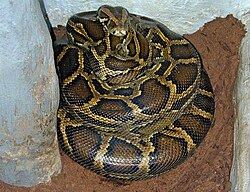
The Burmese python is a dark-colored non-venomous snake with many brown blotches bordered by black down the back. In the wild, Burmese pythons typically grow to 5 m (16 ft),[5][6] while specimens of more than 7 m (23 ft) are unconfirmed.[7] This species is sexually dimorphic in size; females average only slightly longer, but are considerably heavier and bulkier than the males. For example, length-weight comparisons in captive Burmese pythons for individual females have shown: at 3.47 m (11 ft 5 in) length, a specimen weighed 29 kg (64 lb), a specimen of just over 4 m (13 ft) weighed 36 kg (79 lb), a specimen of 4.5 m (15 ft) weighed 40 kg (88 lb), and a specimen of 5 m (16 ft) weighed 75 kg (165 lb). In comparison, length-weight comparisons for males found: a specimen of 2.8 m (9 ft 2 in) weighed 12 kg (26 lb), 2.97 m (9 ft 9 in) weighed 14.5 kg (32 lb), a specimen of 3 m (9.8 ft) weighed 7 kg (15 lb), and a specimen of 3.05 m (10.0 ft) weighed 18.5 kg (41 lb).[8][9][10][11][12] In general, individuals over 5 m (16 ft) are rare.[13] The record for maximum length of a Burmese python is 5.79 m (19 ft 0 in) and was caught 10 July 2023 in South Florida's Big Cypress National Preserve.[14] Widely published data of specimens reported to have been several feet longer are not verified.[7] At her death, a Burmese named "Baby" was the heaviest snake recorded in the world at the time at 182.8 kg (403 lb),[7] much heavier than any wild snake ever measured.[15] Her length was measured at 5.74 m (18 ft 10 in) circa 1999.[7] The minimum size for adults is 2.35 m (7 ft 9 in).[16] Dwarf forms occur in Java, Bali, and Sulawesi, with an average length of 2 m (6 ft 7 in) in Bali,[17] and a maximum of 2.5 m (8 ft 2 in) on Sulawesi.[18] Wild individuals average 3.7 m (12 ft) long,[5][6] but have been known to reach 5.79 m (19 ft 0 in).[14]

Diseases

[edit]

In both their native and invasive range they suffer from Raillietiella orientalis (a pentastome parasitic disease).[19]

Distribution and habitat

[edit]

The Burmese python occurs throughout Southern and Southeast Asia, including eastern India, southeastern Nepal, western Bhutan, southeastern Bangladesh, Myanmar, Thailand, Laos, Cambodia, Vietnam, northern continental Malaysia, and southern China in Fujian, Jiangxi, Guangdong, Hainan, Guangxi, and Yunnan.[20] It also occurs in Hong Kong, and in Indonesia on Java, southern Sulawesi, Bali, and Sumbawa.[21] It has also been reported in Kinmen.[22]

It is an excellent swimmer and needs a permanent source of water. It lives in grasslands, marshes, swamps, rocky foothills, woodlands, river valleys, and jungles with open clearings. It is a good climber and has a prehensile tail. It can stay in water for 30 minutes but mostly stays on land.[citation needed]

As an invasive species

[edit]
United States range in 2007
A captured Burmese python in the Florida Everglades

Python invasion has been particularly extensive, notably across South Florida, where a large number of pythons can now be found in the Florida Everglades.[23][24] Between 1996 and 2006, the Burmese python gained popularity in the pet trade, with more than 90,000 snakes imported into the U.S.[25] The current number of Burmese pythons in the Florida Everglades may have reached a minimum viable population and become an invasive species. Hurricane Andrew in 1992 was deemed responsible for the destruction of a python-breeding facility and zoo, and these escaped snakes spread and populated areas into the Everglades.[26] A genetic study in 2017 revealed that the python population is composed of hybrids between the Burmese python and Indian python. The species also displays cytonuclear discordance which has made phylogenetic studies of its origin more complicated.[27] As of 2024, the population in the Florida Everglades was estimated anywhere between 30,000 and 300,000 Burmese pythons.[28]

By 2007, the Burmese python was found in northern Florida and in the coastal areas of the Florida Panhandle. The importation of Burmese pythons was banned in the United States in January 2012 by the U.S. Department of the Interior.[29] A 2012 report stated, "in areas where the snakes are well established, foxes and rabbits have disappeared. Sightings of raccoons are down by 99.3%, opossums by 98.9%, and white-tailed deer by 94.1%."[30] Road surveys between 2003 and 2011 indicated an 87.3% decrease in bobcat populations, and in some areas rabbits have not been detected at all.[31] Experimental efforts to reintroduce rabbit populations to areas where rabbits have been eliminated have mostly failed "due to high (77% of mortalities) rates of predation by pythons."[32] Bird and coyote populations may be threatened, as well as the already-rare Florida panther.[30] In addition to this correlational relationship, the pythons have also been experimentally shown to decrease marsh rabbit populations, further suggesting they are responsible for many of the recorded mammal declines. They may also outcompete native predators for food.[33]

By 2011, researchers identified up to 25 species of birds from nine avian orders in the digestive tract remains of 85 Burmese pythons in Everglades National Park.[34] Native bird populations are suffering a negative impact from the introduction of the Burmese python in Florida; among these bird species, the wood stork is of specific concern, now listed as federally endangered.[34]

Numerous efforts have been made to eliminate the Burmese python population in the last decade.[when?] Understanding the preferred habitat of the species is needed to narrow down the python hunt. Burmese pythons have been found to select broad-leafed and low-flooded habitats. Broad-leafed habitats comprise cypress, overstory, and coniferous forest. Though aquatic marsh environments would be a great source for prey, the pythons seem to prioritize environments allowing for morphological and behavioral camouflage to be protected from predators.[clarification needed] Also, the Burmese pythons in Florida have been found to prefer elevated habitats, since this provides the optimal conditions for nesting. In addition to elevated habitats, edge habitats are common places where Burmese pythons are found for thermoregulation, nesting, and hunting purposes.[25]

One of the Burmese python eradication movements with the biggest influence was the 2013 Florida Python Challenge. This was a month-long contest wherein a total of 68 pythons were removed. The contest offered incentives such as prizes for longest and greatest number of captured pythons. The purpose of the challenge was to raise awareness about the invasive species, increase participation from the public and agency cooperation, and to remove as many pythons as possible from the Florida Everglades.[35] The challenge has run a few times again since then and is now an annual event over the duration of ten days.[36] Recently, in 2023, it resulted in 209 pythons removed by 1,050 participants.[37]

A study from 2017 introduced a new method for identifying the presence of Burmese pythons in southern Florida; this method involves the screening of mosquito blood. Since the introduction of the Burmese python in Florida, mosquito communities use the pythons as hosts even though they are recently introduced.[38]

Invasive Burmese pythons also face certain physiological changes. Unlike their native South Asian counterparts who spend long periods fasting due to seasonal variation in prey availability, pythons in Florida feed year-round due to the constant availability of food. They are also vulnerable to cold stress, with winter freezes resulting in mortality rates of up to 90%. Genomic data suggests natural selection on these populations favors increased thermal tolerance as a result of these high-mortality freezes.[39]

They have carried Raillietiella orientalis, a pentastome parasitic disease, with them from Southeast Asia. Other reptiles in Florida have become infested, and the parasite appears to have become endemic.[19]

In April 2019, researchers captured and killed a large Burmese python in Florida's Big Cypress National Preserve. It was more than 5.2 m (17 ft) long, weighed 64 kg (140 lb), and contained 73 developing eggs.[40] In December 2021, a Burmese python was captured in Florida that weighed 98 kg (215 lb) and had a length of 5.5 m (18 ft); it contained a record 122 developing eggs.[41] In July 2023, local hunters captured and killed a 5.8 m (19 ft) long Burmese python that weighed 57 kg (125 lb) in Florida's Big Cypress National Preserve.[14]

Behavior

[edit]

Burmese pythons are mainly nocturnal rainforest dwellers.[42] When young, they are equally at home on the ground and in trees, but as they gain girth, they tend to restrict most of their movements to the ground. They are also excellent swimmers, being able to stay submerged for up to half an hour. Burmese pythons spend the majority of their time hidden in the underbrush. In the northern parts of its range, the Burmese python may brumate for some months during the cold season in a hollow tree, a hole in the riverbank, or under rocks. Brumation[43] is biologically distinct from hibernation. While the behavior has similar benefits, allowing organisms to endure the winter without moving, it also involves the preparation of both male and female reproductive organs for the upcoming breeding season. The Florida population also goes through brumation.[44]

They tend to be solitary and are usually found in pairs only when mating. Burmese pythons breed in the early spring, with females laying clutches of 12–36 eggs in March or April. They remain with the eggs until they hatch, wrapping around them and twitching their muscles in such a way as to raise the ambient temperature around the eggs by several degrees. Once the hatchlings use their egg tooth to cut their way out of their eggs, no further maternal care is given. The newly hatched babies often remain inside their eggs until they are ready to complete their first shedding of skin, after which they hunt for their first meal.[45]

Parthenogenesis

[edit]

The Burmese python is able to reproduce asexually when in captivity.[12] Offspring are clones of their mother and reproduction appears to be by a parthenogenetic mechanism that involves a modification of the meiotic process.[12]

Diet

[edit]
Burmese python photographed in Bardiya National Park, Nepal

Like all snakes, the Burmese python is carnivorous. Its diet consists primarily of birds and mammals, but also includes amphibians and reptiles. It is a sit-and-wait predator, meaning it spends most of its time staying relatively still, waiting for prey to approach, then striking rapidly.[46] The snake grabs a prey animal with its sharp teeth, then wraps its body around the animal to kill it through constriction.[47] The python then swallows its prey whole. It is often found near human habitation due to the presence of rats, mice, and other vermin as a food source. However, its equal affinity for domesticated birds and mammals means it is often treated as a pest. In captivity, its diet consists primarily of commercially available appropriately sized rats, graduating to larger prey such as rabbits and poultry as it grows. As an invasive species in Florida, Burmese pythons primarily eat a variety of small mammals including foxes, rabbits, and raccoons. Due to their high predation levels, they have been implicated in the decline and even disappearance of many mammal species.[4][33] In their invasive range, pythons also eat birds and occasionally other reptiles. Exceptionally large pythons may even require larger food items such as pigs or goats, and are known to have attacked and eaten alligators and adult deer in Florida.[48]

Digestion

[edit]

The digestive response of Burmese pythons to such large prey has made them a model species for digestive physiology. Its sit-and-wait hunting style is characterized by long fasting periods in between meals, with Burmese pythons typically feeding every month or two, but sometimes fasting for as long as 18 months.[46] As digestive tissues are energetically costly to maintain, they are downregulated during fasting periods to conserve energy when they are not in use.[49] A fasting python has a reduced stomach volume and acidity, reduced intestinal mass, and a 'normal' heart volume. After ingesting prey, the entire digestive system undergoes a massive re-modelling, with rapid hypertrophy of the intestines, production of stomach acid, and a 40% increase in mass of the ventricle of the heart to fuel the digestive process.[50] During digestion, the snake's oxygen consumption rises drastically as well, increasing with meal size by 17 to 40 times its resting rate.[46] This dramatic increase is a result of the energetic cost of restarting many aspects of the digestive system, from rebuilding the stomach and small intestine to producing hydrochloric acid to be secreted in the stomach. Hydrochloric acid production is a significant component of the energetic cost of digestion, as digesting whole prey items requires the animal to be broken down without the use of teeth, either for chewing or tearing into smaller pieces. To compensate, once food has been ingested, Burmese pythons begin producing large amounts of acid to make the stomach acidic enough to turn the food into a semi-liquid that can be passed through to the small intestine and undergo the rest of the digestive process.[citation needed]

The energy cost is highest in the first few days after eating when these regenerative processes are most active, meaning Burmese pythons rely on existing food energy storage to digest a new meal.[46][51] Overall, the entire digestive process from food intake to defecation lasts 8–14 days.[49]

Conservation

[edit]
Leather goods and skins of Burmese pythons and reticulated pythons (Malayopython reticulatus) at a local shop at Mandalay, Myanmar

The Burmese python is listed on CITES Appendix II.[1] It has been listed as vulnerable on the IUCN Red List since 2012, as the wild population is estimated to have declined by at least 30% in the first decade of the 21st century due to habitat loss and over-harvesting.[1]

To maintain Burmese python populations, the IUCN recommends increased conservation legislation and enforcement at the national and international levels to reduce harvesting across the snake's native range. The IUCN also recommends increased research into its population ecology and threats. In Hong Kong, it is a protected species under Wild Animals Protection Ordinance Cap 170. It is also protected in Thailand, Vietnam, China, and Indonesia. However, it is still common only in Hong Kong and Thailand, with rare to very rare statuses in the rest of its range.[citation needed]

In captivity

[edit]
Audience volunteers holding an adult Burmese python
An amelanistic Burmese python at a zoo in Japan

Burmese pythons are often sold as pets, and are made popular by their attractive coloration and apparently easy-going nature. However, they have a rapid growth rate, and can exceed 2.1 m (6 ft 11 in) in length in a year if power fed. However this may cause health issues in the future. By age four, they will have reached their adult size, though they continue growing very slowly throughout their lives, which may exceed 20 years.

Although the species has a reputation for docility, they are very powerful animals – capable of inflicting severe bites and even killing by constriction.[52][53][54][55][56][57] They also consume large amounts of food, and due to their size, require large, often custom-built, secure enclosures. As a result, some are released into the wild, and become invasive species that devastate the environment. For this reason, some jurisdictions (including Florida, due to the python invasion in the Everglades[58]) have placed restrictions on the keeping of Burmese pythons as pets. Violators could be imprisoned for more than seven years or fined $500,000 if convicted.

Burmese pythons are opportunistic feeders;[59] they eat almost any time food is offered, and often act hungry even when they have recently eaten. As a result, they are often overfed, causing obesity-related problems to be common in captive Burmese pythons.[citation needed]

Like the much smaller ball python, Burmese pythons are known to be easygoing or timid creatures, which means that if cared for properly, they can easily adjust to living near humans.[60]

Handling

[edit]

Although pythons are typically afraid of people due to their great stature, and generally avoid them, special care is still required when handling them. Given their adult strength, multiple handlers (up to one person per meter of snake) are usually recommended.[61] Some jurisdictions require owners to hold special licenses, and as with any wild animal being kept in captivity, treating them with the respect an animal of this size commands is important.[62]

Variations

[edit]
Caramel Burmese python

The Burmese python is frequently captive-bred for color, pattern, and more recently, size. Its amelanistic form is especially popular and is the most widely available morph. This morph is white with patterns in butterscotch yellow and burnt orange. Also, "labyrinth" specimens with maze-like patterns, khaki-colored "green", and "granite" with many small angular spots are available. Breeders have recently begun working with an island lineage of Burmese pythons. Early reports indicate that these dwarf Burmese pythons have slightly different coloring and pattern from their mainland relatives and do not grow much over 2.1 m (6 ft 11 in) in length. One of the most sought-after of these variations is the leucistic Burmese. This particular variety is very rare, being entirely bright white with no pattern and blue eyes, and has only in 2008/2009 been reproduced in captivity as the homozygous form (referred to as "super" by reptile keepers) of the co-dominant hypomelanistic trait. The caramel Burmese python has a caramel-colored pattern with "milk-chocolate" eyes.

See also

[edit]

References

[edit]

Further reading

[edit]
[edit]
Revisions and contributorsEdit on WikipediaRead on Wikipedia
from Grokipedia
The Burmese python (Python bivittatus) is a large nonvenomous constrictor snake native to tropical and subtropical regions of southeastern , including northeastern , southern , , , , , , , and parts of . In its indigenous range, it inhabits diverse environments such as grasslands, swamps, marshes, forests, and rocky foothills, often favoring areas near . Among the heaviest and longest snake species, adults commonly measure 3 to 5 meters (10 to 16 feet) in length and exceed 90 kilograms (200 pounds) in weight, with females growing larger than males and rare individuals surpassing 6 meters. Burmese pythons are solitary ambush predators that subdue prey—including mammals, birds, and reptiles—through constriction after initial strikes with recurved teeth, capable of consuming animals as large as deer in their native habitats. Introduced to the through the pet trade, the species has established invasive populations in southern , particularly the , where it preys extensively on native wildlife, contributing to documented declines of up to 99% in some mammal species. Although proliferating as an ecological disruptor outside its range, the Burmese python faces population reductions in from , hunting for skins and food, and incidental killing, leading to its Vulnerable status on the .

Taxonomy and Etymology

Scientific Classification

The Burmese python (Python bivittatus) is classified in the kingdom Animalia, phylum Chordata, class Reptilia, order , suborder Serpentes, family , genus Python, and species P. bivittatus. This placement reflects its position as a non-venomous constrictor among boid-like snakes, with Pythonidae encompassing Old World pythons from , , and Indo-Australia. Formerly treated as a subspecies (Python molurus bivittatus) of the Indian python, P. bivittatus was recognized as a full species in taxonomic revisions around 2009, supported by morphological and genetic distinctions including differences in scalation and DNA sequences. One subspecies, the dwarf Burmese python (P. b. progschai), is endemic to certain Indonesian islands and characterized by smaller adult size relative to mainland populations. Phylogenetic studies using mitochondrial genes (e.g., cytochrome b and oxidase I) and nuclear markers position P. bivittatus within a Southeast Asian clade of the genus Python, diverging from African python lineages and showing closer affinity to species like P. molurus than to Australian pythons in the family. Whole-genome sequencing further delineates species boundaries, revealing unique adaptations in metabolic genes absent in more distant snake lineages. Cytogenetic data confirm a diploid chromosome number of 2n=36, with XY sex chromosomes identified via male-specific markers, aligning with karyotypes in related pythonids but distinguishing it from advanced snakes (Caenophidia).

Naming and Historical Synonyms

The specific epithet bivittatus derives from the Latin roots bi- (two) and vittatus (banded or striped), referring to the two prominent pale stripes typically observed along the anterior portion of the snake's dorsum or its banded color pattern. The was first formally described as Python bivittatus by German naturalist Heinrich Kuhl in 1820, based on specimens and iconotypes available at the time, with later designated as the type locality in 1930. For much of the 19th and 20th centuries, P. bivittatus was synonymized as a subspecies of the Indian python (Python molurus), denoted Python molurus bivittatus, due to perceived morphological overlap in size, scalation, and patterning between the two taxa. This classification, first proposed by Mertens in 1921, reflected limited genetic data and reliance on geographic variation for subspeciation. Taxonomic revisions in the late 20th century began questioning this arrangement, culminating in 2009 when phylogenetic analyses of mitochondrial DNA and nuclear genes, combined with morphometric differences such as head scale counts and body proportions, justified restoring full species rank to P. bivittatus. The vernacular name "Burmese python" stems from the species' native range encompassing (modern ), where it was among the first regions from which live specimens reached European naturalists via colonial trade routes in the early , facilitating Kuhl's description.

Physical Description

Morphology and Size Records

The Burmese python (Python bivittatus) is a large, heavy-bodied with a robust, cylindrical form adapted for ambushing and subduing prey through and . Its is broad and triangular, featuring highly mobile quadrate bones that enable extreme gape for large prey whole. The body is covered in smooth, iridescent scales, with a muscular girth that supports powerful squeezing force, estimated to exceed 90 psi in large specimens during . Adult Burmese pythons typically measure 3 to 5 meters in total length, with females attaining greater dimensions than males, reflecting pronounced sexual size dimorphism observed in wild populations. Field data from invasive populations in indicate females can exceed males by 1.5 to 1.8 meters in length and substantially in mass, with mature females averaging around 4 meters and males closer to 2.5 to 3 meters. Weights for adults range up to 90 kg for females, though most fall below 50 kg; exaggerated claims of specimens exceeding 7 meters or 100 kg lack verification and often stem from uncalibrated measurements or captive overestimations, as critiqued in analyses of historical records. The verified maximum length stands at 5.79 meters for a wild specimen, establishing a benchmark grounded in precise measurement protocols rather than anecdotal reports. Key anatomical adaptations include labial pits on the upper and lower lips, which function as infrared heat sensors to detect prey in low-light conditions, with sensitivity to differentials as small as 0.005°C. The houses rows of recurved, backward-pointing teeth, numbering around 100 to 150, designed to secure struggling prey without , facilitating . Males possess longer vestigial pelvic spurs—remnants of hind limbs—used in , while both sexes exhibit these keratinized structures adjacent to the .

Scalation, Coloration, and Sexual Dimorphism

The Burmese python exhibits a cryptic dorsal coloration consisting of a tan or light brown ground color overlaid with irregular, dark brown to black-bordered blotches along the back and sides, often outlined in yellowish or cream hues, facilitating blending into leaf litter and grasslands. The ventral surface is typically cream-white to yellowish, sometimes with subtle darker spotting near scale edges. This patterning aligns with predation strategies observed in field studies, where the blotches disrupt outlines against heterogeneous substrates like floors or swamps, reducing detection by prey. Scalation follows the boid pattern with smooth dorsal scales arranged in 50-60 rows at midbody, tapering anteriorly and posteriorly, and divided subcaudals. Ventral scales number approximately 254-264, with 55-66 paired subcaudals, providing diagnostic utility in herpetological identification; the anal plate is single. Labial scales bear thermoreceptive pits numbering up to 12-16 per side, enabling detection of prey, distinct from the loreal pits of viperids. Sexual dimorphism manifests subtly beyond overall size differences, with females exhibiting proportionally broader heads and lighter dorsal tones in some observations, potentially linked to reproductive demands for larger gape; males possess more prominent cloacal spurs derived from pelvic remnants. Scalation counts show no marked sexual variation, though hemipenial morphology in males features spines and bifurcation that intensify with maturity.

Captive-Bred Variations

Captive-bred Burmese pythons display diverse color and morphs derived from of genetic s, distinguishing them from wild-type phenotypes through artificial selection emphasizing aesthetic traits over natural adaptations. The albino morph, resulting from a recessive causing deficiency and producing yellow-white coloration with red eyes, was first achieved in captivity in 1986 by breeder using imported animals. Similarly, the morph, characterized by irregular white patches from localized pigment absence, emerged from a 2010 wild-caught lineage and yielded the first captive hatchlings in 2018. Other recessive traits, such as patternless, founded in 1987, further exemplify how breeders propagate homozygous expressions via targeted pairings. These morphs often rely on recessive genetics requiring both parents to carry the allele, leading to breeding strategies that prioritize trait fixation but introduce inbreeding risks. Inbreeding depression in captive reptile populations manifests in skeletal malformations like kinked spines, neurological issues, and reduced growth rates, as documented in veterinary assessments of selectively bred snakes. Certain morphs correlate with health complications including exophthalmos, fertility deficits, and wobble syndrome, attributed to deleterious homozygous effects rather than the mutations themselves. Economic incentives drive the proliferation of rare morphs, with prices for visually striking specimens like albino pied females exceeding $1,750 USD and complex combinations reaching $2,000 USD or more. Such high values sustain a robust pet trade, persisting despite prohibitions on Burmese pythons in invasive-prone areas like , where released or escaped exotic morphs have been recovered, linking to unintended ecological releases.

Native Range and Habitat

Geographic Distribution

The Burmese python (Python bivittatus) is native to a broad region spanning southern and southeastern , with core populations centered in , , and the Indochinese Peninsula, extending to peripheral distributions in northeastern , , southern , , , , and parts of including and . Historical records and recent surveys confirm this range has remained largely stable, without evidence of significant natural expansion, constrained by habitat fragmentation from , urbanization, and . Populations in peripheral areas, such as the Terai region of and , represent isolated subpopulations vulnerable to local extirpation. Elevational distribution spans from sea level to approximately 2,800 meters, though records indicate a strong preference for lowland areas below 1,500 meters, where suitable and mosaics predominate. Higher elevations host only sparse, peripheral occurrences, such as in Nepalese , with no surveys documenting dense populations above montane thresholds. Density estimates from native range surveys are limited but suggest higher abundances in lowland riverine and swamp systems of and compared to upland or fragmented peripheral habitats, with overall populations declining due to and habitat loss rather than expanding. Core lowland densities may historically have supported viable populations, but contemporary fragmentation has isolated subpopulations, preventing recolonization of altered landscapes.

Habitat Preferences and Adaptations

The Burmese python (Python bivittatus) inhabits a variety of and terrestrial environments in its native Southeast Asian range, including swamps, marshes, grasslands, woodlands, and river valleys. These snakes demonstrate a strong preference for areas proximate to bodies, as evidenced by radio-telemetry studies in showing positive associations with aquatic features such as ponds and irrigation canals within agricultural mosaics. This microhabitat selection facilitates predation and refuge during environmental fluctuations, with tracked individuals exhibiting site fidelity and limited movements averaging under 3 meters variance. Adaptations to these habitats include robust capabilities, enabling prolonged submersion and through flooded regions, which supports tolerance of seasonal inundations common in riparian and ecosystems. Additionally, proficient allows access to arboreal refuges in forested riverine areas, while burrowing into or utilizing existing burrows provides during drier periods or . For , these ectothermic reptiles rely on basking to elevate body temperatures above 30°C, aligning with optimal ranges of 30–35°C suited to tropical lowland conditions. Such physiological and behavioral traits underpin their persistence across heterogeneous landscapes marked by alternating wet and dry seasons.

Native Ecology and Behavior

Diet and Predation Strategies

The Burmese python (Python bivittatus) functions as an in its native Southeast Asian range, primarily targeting mammals such as deer, , langur monkeys, porcupines, , goats, and , alongside birds like and reptiles including , frogs, and snakes. These prey items reflect a broad opportunistic diet documented through historical observations and ecological surveys, with mammals forming the dominant category based on reported stomach contents and field records, though precise volumetric or frequency-based percentages remain unquantified in native-range gut analyses. Amphibians and occasional contribute marginally, underscoring dietary flexibility tied to local availability rather than strict specialization. Ontogenetic shifts characterize prey selection, with juveniles favoring smaller ectothermic prey such as and frogs due to gape limitations and foraging constraints, transitioning to larger endothermic mammals like and ungulates as body size increases. Adults, reaching lengths over 5 m, exploit this shift to consume prey up to approximately 67% of their own body mass, as demonstrated by a 52.3 kg specimen ingesting a 35 kg deer, which occupied 92.5-96.2% of its maximal gape area and diameter. This capacity enables consumption of prey exceeding half the python's mass, facilitated by isometric scaling of jaw gape with snout-vent length. Predation employs , where the python coils around prey and exerts escalating pressure to induce circulatory arrest via vascular occlusion, rather than primary suffocation. In constricting snakes, this manifests as a rapid six-fold rise in and halving of peripheral arterial pressure within seconds, culminating in cardiac electrical dysfunction and systemic hypoperfusion within minutes, corroborated by physiological monitoring of prey cardiovascular collapse. Pythons modulate constriction intensity in response to prey heartbeat cessation, prolonging coils and total pressure application until confirms immobility, optimizing energy expenditure for large meals.

Activity Patterns and Sensory Capabilities

Burmese pythons exhibit primarily nocturnal and crepuscular activity patterns, with movements peaking around (1800–2000 h) and retreating to resting sites near dawn (0600–0800 h), enabling them to exploit low-light conditions for reduced detection by prey and competitors. As predators, they maintain sedentary postures for extended periods, supported by a low that permits fasting for weeks or months between meals, minimizing energy expenditure while positioned to intercept passing prey. In their native tropical range, activity intensifies during the (typically May–October), when increased rainfall enhances mobility and prey availability through flooded habitats, though movements correlate with presence across seasons. Sensory capabilities emphasize chemoreception via a that samples airborne and substrate chemicals, delivering them to the for processing olfactory and pheromone cues essential for prey location over distances. Vision provides supplementary detection, though limited in acuity and low-light efficacy, prompting reliance on other modalities during nocturnal hunts. Mechanoreception detects substrate vibrations from approaching prey, integrating with tactile cues from scales. Unlike pit vipers' singular facial pits, Burmese pythons possess multiple labial pit organs—thermoreceptors on upper and lower lip scales—that sense radiation from targets, enabling thermal imaging to refine strike accuracy in darkness or cover, with sensitivity to wavelengths of 5–30 μm. This multimodal sensory array, combined with low metabolic demands, underpins efficient by allowing precise, energy-conserving responses to environmental stimuli without active pursuit.

Reproduction and Life Cycle

Burmese pythons (Python bivittatus) attain between 3 and 5 years of age, with males reaching breeding condition at lengths of 2.1–2.7 meters and females at 2.7 meters or greater. These snakes are oviparous, with females depositing clutches ranging from 20 to 100 eggs in concealed sites such as cavities or burrows during the in their native range. Clutch size correlates positively with female body size, enabling larger individuals to produce more offspring. Mating typically occurs in aggregations during the cooler months, where males follow female trails and engage in combat rituals, including , neck-biting, and body-topping maneuvers to establish dominance and gain access to receptive females. Following fertilization, gravid females seek suitable nest sites and exhibit brooding , around the eggs to maintain temperatures of 31–32°C through muscular thermogenesis. Incubation lasts 58–67 days under these conditions, after which the female abandons the nest upon hatching, leaving neonates to disperse independently. Juvenile survivorship is low, with high mortality rates from predation and environmental factors; radio-tracking studies indicate that many hatchlings do not reach adulthood, contributing to slow reliant on few successful breeders. Adults exhibit of 20–30 years in the wild, with females capable of multiple reproductive cycles over their lifespan, though human-induced mortality limits realized lifespan in native habitats. This life cycle underscores a strategy of high balanced against substantial early-life attrition.

Reproduction Specifics

Parthenogenesis Mechanisms

Facultative in the Burmese python (Python bivittatus) involves the development of unfertilized into viable offspring through automictic mechanisms, primarily terminal fusion automixis, where the second fuses with the oocyte nucleus to restore diploidy. This results in progeny that are partial clones of the mother, exhibiting heterozygosity only near centromeric regions while becoming homozygous at distal loci due to meiotic recombination and segregation. Genetic analyses exclude fully homozygous mechanisms like , as offspring retain some maternal heterozygosity, though overall genomic diversity is reduced compared to sexually produced litters. The phenomenon was first documented in 2002 in a captive female at Artis Zoo, Amsterdam, which produced seven viable female hatchlings without male contact; microsatellite genotyping confirmed maternal origin at all loci, with no paternal alleles detected. Subsequent cases in captivity, including unpublished reports, affirm this capability across multiple individuals, but all verified instances involve isolated females in controlled environments. In contrast, sexually fertilized clutches in the species commonly exhibit multiple paternity, indicating polyspermy and standard meiotic fidelity when males are present, which underscores the facultative nature of parthenogenesis as a backup reproductive strategy rather than a default mode. No confirmed occurrences have been reported in wild populations, though the mechanism's evolutionary utility is hypothesized in scenarios of extreme male scarcity, such as founder events or low-density invasive fronts, potentially facilitating initial population establishment. However, terminal fusion automixis incurs genetic costs, including elevated homozygosity that exposes deleterious recessive alleles, leading to and reduced long-term viability in successive parthenogenetic generations. Empirical studies in related squamates support this trade-off, where parthenogenetic lineages show diminished fitness under sustained absent sexual .

Clutch Size, Incubation, and Offspring Viability

Female Burmese pythons deposit averaging 49 eggs in wild populations in , with documented ranges of 22–84 eggs correlating with maternal body size. Larger , such as 61–71 eggs, have been recorded in specific nests, though hatching success varies from 82% to 100%. Following oviposition, females coil around the clutch in a burrow or nest site, employing shivering thermogenesis to maintain egg temperatures of 30–34°C during an incubation period of 60–80 days. This maternal brooding defends against predators and optimizes developmental conditions, with females losing up to 54% of body mass by hatching. Hatchlings emerge at total lengths of approximately 46–61 cm and are immediately independent, dispersing without post-hatching parental care. Incubation temperature influences offspring phenotype, including size, locomotor performance, and body condition, rather than sex determination, which is genetically controlled via XY chromosomes producing near 1:1 ratios. Post-hatching growth is rapid initially, with snout-vent length increments of 3.7–7.2 cm per month in juveniles, slowing with age; recaptured marked individuals from studied show clutch origin predicting early growth rates more than or feeding . Viability metrics, such as to maturity, remain understudied in wild contexts but indicate lower fitness in slower-growing cohorts.

Invasive Establishments

Introduction Pathways

The Burmese python (Python bivittatus) was introduced to through human-mediated pathways, primarily the trade, involving legal imports of live specimens followed by intentional releases or accidental escapes by owners unable to manage the snakes' rapid growth to lengths exceeding 5 meters and weights over 90 kg. Between 1990 and 2010, U.S. Fish and Wildlife Service records indicate over 112,000 Burmese pythons were imported, with an additional approximately 90,000 arriving from 1996 to 2006 alone, reflecting surging demand in the pet industry before federal importation bans took effect in January 2012 under the Lacey Act for listing as injurious wildlife. These imports originated mainly from , including and , with serving as a key entry point and establishment hub due to its subtropical climate closely matching the species' native wet-season flooding and warm temperatures. The first documented wild Burmese python in dates to October 24, 1979, in , predating widespread trade booms but aligning with early escapes from private collections or research facilities. Subsequent sightings in the confirmed reproducing populations, driven by owner releases—often of subadult or adult snakes too large or aggressive for —rather than natural dispersal across oceanic barriers, as the species lacks evidence of transatlantic rafting viability. Genetic analyses of captured pythons reveal a pronounced and bottleneck, with low mitochondrial diversity indicating establishment from a small number of progenitors (estimated in the dozens to low hundreds), consistent with discrete release events rather than mass natural colonization. Hurricane Andrew, a Category 5 storm striking on August 24, 1992, damaged reptile breeding and holding facilities, potentially releasing additional specimens and accelerating local proliferation, though this event did not initiate the invasion, as wild pythons were already documented over a decade prior and population epicenters developed independently of the storm's path. Expert assessments emphasize multiple, ongoing pet trade-related introductions over singular catastrophes, with no credible evidence supporting non-anthropogenic origins like or migratory accidents.

Spread Dynamics in Florida Everglades

Burmese pythons established a self-sustaining breeding population in the Florida Everglades around 2000, with gravid females producing clutches in wild nests documented shortly thereafter. Population estimates as of 2023 range from tens of thousands to potentially 300,000 individuals across southern Florida, though conservative assessments from the U.S. Geological Survey place the number in the tens of thousands within the Greater Everglades. Despite annual removals exceeding 1,000 snakes in recent years—totaling over 23,000 since 2000—the population demonstrates resilience, as evidenced by continued detections and range expansion beyond removal hotspots. Dispersal occurs primarily in linear patterns along roads, canals, and levees, facilitating northward and westward expansion from core areas in . Juveniles exhibit high net movement rates, with some traveling over 6 km in the first year via canal corridors, while adults can cover up to 77 km in a few months during active seasons. Gravid females preferentially seek elevated, drier sites such as tree islands for nesting, aligning with seasonal dry periods when water levels recede. Florida's subtropical climate, characterized by wet summers and dry winters, closely matches the monsoonal wet-dry cycles of the pythons' native Southeast Asian range, supporting year-round activity and without the cold-induced seen farther north. models based on detection and removal data indicate steady but density-dependent expansion, with verifiable rates derived from spatial surveys rather than unchecked exponential projections that often overlook ecological constraints like winter freezes and . Alarmist forecasts predicting rapid proliferation to millions have been critiqued for underestimating these limits, as empirical homing behaviors and landscape barriers temper long-distance spread.

Ecological Impacts as Invasive

Prey Depletion and Trophic Effects

Invasive Burmese pythons (Python bivittatus) have caused precipitous declines in small to medium-sized mammal populations within the core of Everglades National Park, as documented through road transect surveys and scat analyses spanning 1997 to 2011. Relative abundances dropped by 99.3% for raccoons (Procyon lotor), 98.9% for opossums (Didelphis virginiana), 94.0% for cotton rats (Sigmodon hispidus), 87.5% for bobcats (Lynx rufus), and 99.6% for marsh rabbits (Sylvilagus palustris) in python-colonized areas, with these spatiotemporal patterns aligning directly with python proliferation and absent in peripheral zones lacking pythons. Translocation experiments further confirmed pythons as the dominant predator of marsh rabbits, accounting for 77% of radio-collared individuals' mortalities within 11 months, exceeding combined rates from native predators like alligators and raptors. USGS monitoring reinforces these findings, attributing over 90% reductions in raccoon and opossum detections to python predation pressure via stomach content analyses of removed snakes. These mammal depletions have triggered trophic cascades, with pythons assuming the role vacated by suppressed native carnivores, thereby reshaping structure. Native mesopredators like bobcats, already reduced by 87.5%, face compounded scarcity of shared prey such as rabbits and , while American alligators (Alligator mississippiensis)—which consume up to 20% mammals in their diet—experience diminished foraging opportunities, potentially constraining population stability and secondary predation on python eggs or juveniles. Although reduced predation on lower trophic levels (e.g., small and ) has led to localized increases in prey fish densities, pythons' broad-spectrum consumption fails to replicate native predators' selective dynamics, yielding a net negative transfer to non-native biomass and persistent deficits in native abundance. Empirical evidence tempers speculation on compensatory mechanisms, such as release, noting instead that overall native trophic integrity remains compromised without observed rebounds in declining ; python biomass accumulation—estimated at tens of thousands of individuals—exacerbates this asymmetry, prioritizing invasion-driven equilibria over pre-invasion baselines.

Disease Transmission Risks

Invasive Burmese pythons (Python bivittatus) introduce novel pathogens from their Southeast Asian native range, facilitating potential spillover to susceptible native reptiles in , primarily through direct transmission via shared environments or predation-related exposure. The pentastomid parasite Raillietiella orientalis, endemic to Asian snakes and tolerated asymptomatically by pythons at high prevalences (up to 80% in some populations), has spilled over to native species including pygmy rattlesnakes () and rainbow snakes (), where infection intensities are markedly higher and associated with respiratory distress, organ damage, and elevated mortality rates—effects pythons largely evade due to co-evolutionary adaptations. Serpentoviruses (family Nidovirales), detected in approximately 25% of free-ranging pythons with minimal clinical signs such as mild oral inflammation, represent another Asian-origin risk, as pythons act as persistent carriers capable of shedding virus without severe disease. While divergent serpentovirus strains occur in native colubrids like watersnakes ( spp.), no confirmed spillover from pythons has been documented, though co-occurrence raises concerns for future transmission given the viruses' respiratory and potential for recombination. These pathogens likely entered via the international pet trade, with imported pythons harboring infections prior to release into the , where carriage amplifies dissemination risks; however, comprehensive 2023 assessments note no ecosystem-wide native die-offs directly linked to python-vectored agents, underscoring data gaps in long-term surveillance despite evident susceptibility differentials. Zoonotic spillover to humans remains negligible, with R. orientalis infections rare and non-pathogenic in documented human cases.

Competition with Native Predators

Burmese pythons in southern compete with native predators such as American alligators (Alligator mississippiensis) and bobcats (Lynx rufus) primarily through overlap in prey resources, including mammals and smaller reptiles, as well as bidirectional predation events influenced by body size. Pythons frequently prey on juvenile alligators, exploiting smaller size classes vulnerable in wetland habitats, while adult pythons exceeding 3 meters face predation from larger alligators capable of overpowering and consuming them. This size-dependent antagonism positions alligators as the principal native predator of mature pythons, with documented instances of alligators successfully subduing snakes up to several meters in length in . Bobcats exhibit competitive interactions through shared foraging on medium-sized mammals, and rare direct predation has been observed; in May 2025, a bobcat was recorded killing and partially consuming a 13-foot (approximately 4-meter) python in the , the first verified case of such , suggesting adaptive recognition of pythons as prey by native carnivores. Despite these encounters, pythons' lack of established predators in their invaded range—beyond opportunistic cases—contrasts with their native Asian habitats, where interspecific pressures limit populations. Pythons' nocturnal activity and specialization in swampy, vegetated micros enable potential niche partitioning from more diurnal or terrestrial natives like bobcats, yet dietary breadth and habitat overlap foster rivalry without evidence of hybridization or genetic . Empirical data link python proliferation since the 2000s to localized declines in native predator abundances, questioning long-term coexistence under pure competitive exclusion dynamics, though partitioning may mitigate outright displacement in heterogeneous environments.

Management and Control Efforts

Removal Techniques and Programs

The primary removal technique for invasive employs contracted professional hunters conducting systematic visual searches, predominantly at night when pythons are more active, using methods such as patrols, road cruising, and foot traverses in high-density hotspots like the and surrounding waterways. These contractors, incentivized through per-python bounties, have accounted for the majority of documented removals, with over 9,000 pythons via targeted euthanasia protocols following capture by hand or poles. Scent detection dogs trained specifically for Burmese python odor have been deployed to enhance search efficiency, particularly in vegetated areas where visual cues are obscured, though their performance is constrained by environmental factors like water saturation and python cryptic behavior post-feeding. Trapping efforts, including baited enclosures with mammalian lures monitored by time-lapse cameras, have been tested but yield low capture rates due to pythons' selective foraging and aversion to confined spaces. Complementary technologies such as environmental DNA (eDNA) sampling from water bodies aid in delineating python-occupied zones for prioritized removal, demonstrating higher detection sensitivity at invasion frontiers compared to traditional surveys. The South Florida Water Management District (SFWMD) Python Elimination Program (PEP) and Florida Fish and Wildlife Conservation Commission (FWC) Python Action Team Removing Invasive Constrictors (PATRIC), initiated around 2017, coordinate these techniques through year-round operations, collectively removing over 20,000 pythons by 2024 via contractor-led efforts. These programs focus on core infestation areas, achieving localized density reductions estimated at 10-20% annually in targeted grids through repeated surveys, though population-level eradication remains elusive due to pythons' low detectability—often below 1% per effort—and rapid . Annual expenditures exceed several million dollars, primarily for contractor compensation and logistics, with efficacy metrics showing improved capture per unit effort in optimized conditions like cooler months and scented baits.

Florida Python Challenge Outcomes

The Florida Python Challenge, an annual incentivized removal competition launched in 2013, has mobilized public participation in targeting invasive Burmese pythons in South 's public lands, with cumulative removals exceeding 1,200 pythons across events through 2025. In 2024, 857 participants from 33 states and removed 195 pythons during the August event, down slightly from 209 in 2023, amid prizes totaling $30,000 for top hunters. The 2025 iteration set records with 934 participants removing 294 pythons, highlighting growing engagement but variable annual yields influenced by , access restrictions, and hunter . These competitions provide hands-on training in detection and humane techniques, fostering skills that enable high-performing participants to qualify as paid contractors for year-round removal programs managed by the Fish and Wildlife Conservation Commission (FWC) and Water Management District. Professional contractors, supplemented by challenge alumni, have accounted for over 14,000 python removals since 2017, underscoring the event's role in building a broader removal workforce. of non-target remains minimal, with protocols emphasizing identification and restricted hunting zones to prioritize pythons. Despite these contributions, ecological models and field assessments indicate limited population-level effects from the challenge alone, as annual removals constitute a small fraction—estimated at less than 1%—of the invasive , which numbers in the tens of thousands across the . High , cryptic , and vast habitat render such episodic public hunts insufficient for suppression without sustained, targeted professional efforts, though they enhance awareness and recruitment into ongoing management.

Recent Advances (2023-2025)

In 2025, the Conservancy of surpassed a cumulative 20-ton milestone in Burmese python removals, highlighted by a record 6,300 pounds captured during the organization's research and removal season ending in June. Concurrently, state-led efforts through the Python Action Team Removing Invasive Constrictors (PATRIC) and partnerships like that with Inversa tripled monthly removals, yielding 748 pythons in July alone compared to 235 in July 2024, with over 2,700 removed statewide in the first eight months. These gains stemmed from expanded contractor networks under the Water Management District's Python Elimination Program, which continued recruiting removal agents, and enhanced inter-agency coordination via the Python Control Plan involving the Fish and Wildlife Conservation Commission, U.S. Geological Survey, and . A 2025 study in analyzed community science data to optimize survey timing, revealing that detections and removals peak during nighttime surveys from 20:00 to 02:00 under cooler, stable temperatures, with probability of removal increasing at mean daily air temperatures above 20.5°C and during dropping barometric pressure in the (May–October). Complementing this, researchers in February 2025 statistically evaluated contractor-collected data to pinpoint environmental and operational factors boosting efficiency, such as aquatic vehicle use over terrestrial methods. Technological innovations included trials of mammalian scent lures paired with time-lapse cameras, which in 2024 detected 21 independent python events at baited sites versus one at controls, and deployment of robotic decoys in 2025 to provoke strikes from hidden snakes in the . In December 2024, scientists introduced a DNA-based detection tool tailored for invasive Burmese pythons, enabling environmental sampling to assess occupancy and support targeted removals.

Conservation Status

Native Range Threats

In its native range across , from eastern through southern , , , , , , and into , the Burmese python faces primary anthropogenic pressures rather than widespread hyperbole might suggest. While agricultural expansion converts forests to rice paddies, rubber plantations, and estates, fragmenting and riparian habitats preferred by the species, pythons demonstrate adaptability by utilizing modified landscapes including canals, ditches, and farm edges for and shelter. This resilience mitigates some impacts of land-use change, though ongoing conversion reduces available wild prey bases like and birds in peripheral zones. The dominant threat stems from commercial harvesting for skins, meat, and , with humans identified as mortality factor. Approximately 100,000 Burmese python skins are exported annually from , primarily to markets in and for like handbags and boots, implying tens of thousands of individuals killed yearly through targeted and . Prior to stricter quotas and regulations in the 1990s–2000s, unregulated harvests exceeded sustainable levels in non-protected areas, driving localized depletions; for instance, wild-sourced skins dominated trade volumes until farmed alternatives partially offset demand. Meat from juveniles and organs like gallbladders fetch local prices of $10–100 USD in markets, exacerbating incentives. Direct persecution occurs when pythons are encountered near human settlements, often culled preemptively due to perceived risks to , , or crops, though empirical data on such killings as crop pests remain sparse compared to livestock predation incidents. Incidental road mortality contributes further, as Burmese pythons exhibit no aversion to paved s and frequently cross them during dispersal or , increasing collision risks in densely trafficked agricultural regions. trends reflect these pressures: stable or viable in core protected areas like national parks where enforcement limits access, but declining at range edges and in hotspots due to cumulative exploitation without offsetting rates.

IUCN Assessment and Protective Measures

The Burmese python (Python bivittatus) is classified as Vulnerable on the , a status assigned in the 2012 assessment and reaffirmed in subsequent evaluations, based primarily on criterion A2cd. This criterion infers a population reduction exceeding 30% over approximately three generations (estimated at 30–45 years) due to observed declines in habitat quality and levels of exploitation. The assessment draws on indirect evidence, including high volumes of skins and live specimens entering —estimated at over 300,000 annually in peak years—and accelerating habitat conversion for in , though direct quantitative data on native population trends, such as mark-recapture studies or density estimates, are limited across much of the range. To mitigate , the species has been listed under Appendix II since 1975, mandating export permits and non-detriment findings to verify that trade does not threaten wild populations. In native range countries like , protective measures include integration into national parks and biosphere reserves, where ongoing herpetological surveys by institutions such as the document occurrence and habitat use to inform management. Complementary actions promote ranching and captive propagation as substitutes for wild collection, reducing incentives for while supporting local economies through sustainable skin production. The Vulnerable designation has drawn scrutiny for potentially overweighting trade impacts amid sparse empirical validation of inferred declines; comprehensive range-wide monitoring is absent, and documented local extirpations are rare, with the demonstrating persistence in human-modified landscapes via site fidelity to aquatic habitats and opportunistic . This resilience, coupled with high (clutches of 20–80 eggs), suggests that while poses genuine risks, regulatory focus on commerce may undervalue adaptive traits and underemphasize verifiable demographic pressures.

Captivity and Human Interactions

Pet Trade History and Regulations

The Burmese python entered the U.S. pet trade in significant numbers starting in the 1970s, with imports accelerating during the 1990s and 2000s due to demand for large exotic reptiles. Between 1996 and 2006, U.S. Fish and Wildlife Service records show approximately 99,000 Burmese pythons were imported, reflecting a period of rapid commercialization that fueled breeding facilities and retail sales. Overall, from 1975 to 2018, more than 180,000 individuals entered via the live pet trade, contributing to an economic sector within the U.S. reptile industry valued at around $1.4 billion annually. This unchecked influx, under minimal federal oversight prior to the , enabled widespread private ownership, but invasive establishment in stemmed largely from deliberate releases by owners unable to manage the snakes' growth to over 20 feet and 200 pounds, rather than solely escapes or natural disasters. Early regulations were state-specific and reactive. Florida classified Burmese pythons as a "" in 2008 and a "Conditional" species in 2010, restricting sales and possession to permitted entities while allowing grandfathered ownership. Federally, the Lacey Act was amended in January 2012 to list the Burmese python as injurious , banning its importation and interstate transport to curb further proliferation, though intrastate possession remained legal in many areas absent state prohibitions. intensified measures, upgrading the species to "Prohibited" status effective April 29, 2021, which outlaws import, possession, breeding, and sale statewide, except for permitted removal efforts. Despite these restrictions, of color morphs—such as albino and caramel variants—persists legally in states without full bans, maintaining a limited domestic market for captive specimens. Surveys and reports consistently attribute over 90% of invasive founder populations to owner releases, underscoring accountability amid prior regulatory gaps that prioritized trade volume over ecological .

Husbandry Practices and Handling Risks

Burmese pythons demand expansive, secure enclosures scaled to their adult size exceeding 15 feet (4.6 m), with floor space recommendations of at least 10 times the snake's length to permit unrestricted movement and semi-arboreal behaviors. Enclosures must be escape-proof, featuring reinforced lids, tight seals, and minimal gaps under 0.25 inches (6 mm) to avert accidental releases that have fueled invasive populations. Optimal husbandry includes a thermal gradient with basking zones maintained at 88-92°F (31-33°C) via under-tank heaters or emitters, ambient temperatures of 78-80°F (26-27°C) on the cool side, and 50-60% humidity to replicate subtropical origins. Feeding regimens involve pre-killed like rats or rabbits, sized to 10-15% of the snake's body weight, offered weekly for growing individuals and biweekly or less for adults, who endure multi-month fasts without nutritional deficits due to metabolic adaptations. With meticulous care, captive Burmese pythons achieve lifespans of 20-30 years. Handling risks stem chiefly from the species' constricting power, capable of exerting pressures over 90 psi sufficient to cause or, rarely, ; documented U.S. fatalities number at least seven from Burmese pythons between 1978 and 2009, predominantly involving owners during feeding or cleaning mishaps. Bites, while non-venomous, transmit oral and pose Salmonella infection risks, with reptiles implicated in 6% of sporadic human cases; mitigation requires thorough handwashing post-contact and supervised interactions, especially with specimens over 8 feet (2.4 m). No verified deaths from wild Burmese pythons have occurred, underscoring low encounter probabilities outside .

Captive Diseases and Health Management

Captive Burmese pythons are susceptible to several infectious diseases, primarily viral and parasitic, that pose significant challenges in husbandry due to their contagious nature and often fatal outcomes. (IBD), caused by reptarenaviruses, is a progressive, incurable condition affecting pythons and boas worldwide, manifesting in Burmese pythons as disorders such as head tremors, without common signs like regurgitation seen in other species. The disease leads to intracytoplasmic inclusions in cells, confirmed via or PCR testing, and is invariably fatal, with no effective treatment available; is recommended upon diagnosis to prevent transmission. Serpentovirus (previously termed nidovirus) infections cause severe respiratory in pythons, including Burmese, characterized by of the upper , , sinuses, and lungs, often progressing to . Outbreaks, such as the fatal serpentovirus event in captive Burmese python colonies in fall , highlight rapid spread in confined settings, with subclinical carriers facilitating transmission. , a by Cryptosporidium serpentis, targets the gastric mucosa, leading to chronic regurgitation, , and ; experimental infections confirm susceptibility in Burmese pythons, and the parasite is environmentally resilient, persisting in enclosures. This condition is incurable, with supportive care limited to hydration and nutrition, and mortality rises in untreated cases due to secondary complications. Health management emphasizes prevention through strict protocols for newly acquired pythons, typically lasting 90 days or longer, involving isolation in separate facilities to avoid cross-contamination via fomites or aerosols. Routine veterinary screening, including fecal flotation for parasites, PCR assays for reptarenaviruses and serpentoviruses, and on biopsies, is essential for early detection, as many infections remain in carriers imported via the pet trade. Disinfection of enclosures with effective agents like accelerated , combined with avoiding shared equipment, mitigates outbreaks where mortality can approach 100% in juveniles or compromised adults. Such practices are critical, as undetected carriers from have seeded infections in U.S. collections, indirectly contributing to pathogen presence in released invasive populations in .

References

Add your contribution
Related Hubs
User Avatar
No comments yet.