Hubbry Logo
Raoul BottRaoul BottMain
Open search
Raoul Bott
Community hub
Raoul Bott
logo
8 pages, 0 posts
0 subscribers
Be the first to start a discussion here.
Raoul Bott
Raoul Bott
from Wikipedia

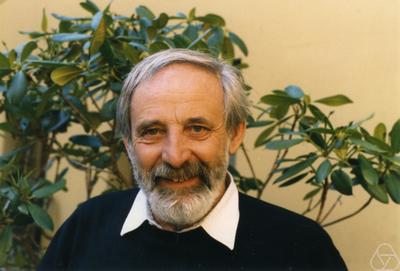
Raoul Bott (September 24, 1923 – December 20, 2005)[1] was a Hungarian-American mathematician known for numerous foundational contributions to geometry in its broad sense. He is best known for his Bott periodicity theorem, the Morse–Bott functions which he used in this context, and the Borel–Bott–Weil theorem.

Key Information

Early life

[edit]

Bott was born in Budapest, Hungary, the son of Margit Kovács and Rudolph Bott.[2] His father was of Austrian descent, and his mother was of Hungarian Jewish descent; Bott was raised a Catholic by his mother and stepfather in Bratislava, Czechoslovakia, now the capital of Slovakia.[3][4] Bott grew up in Czechoslovakia and spent his working life in the United States. His family emigrated to Canada in 1938, and subsequently he served in the Canadian Army in Europe during World War II.

Career

[edit]

Bott later went to college at McGill University in Montreal, where he studied electrical engineering. He then earned a PhD in mathematics from Carnegie Mellon University in Pittsburgh in 1949. His thesis, titled Electrical Network Theory, was written under the direction of Richard Duffin. Afterward, he began teaching at the University of Michigan in Ann Arbor. Bott continued his study at the Institute for Advanced Study in Princeton.[5] He was a professor at Harvard University from 1959 to 1999. In 2005 Bott died of cancer in San Diego.

With Richard Duffin at Carnegie Mellon, Bott studied existence of electronic filters corresponding to given positive-real functions. In 1949 they proved[6] a fundamental theorem of filter synthesis. Duffin and Bott extended earlier work by Otto Brune that requisite functions of complex frequency s could be realized by a passive network of inductors and capacitors. The proof relied on induction on the sum of the degrees of the polynomials in the numerator and denominator of the rational function.[7] In his 2000 interview[8] with Allyn Jackson of the American Mathematical Society, he explained that he sees "networks as discrete versions of harmonic theory", so his experience with network synthesis and electronic filter topology introduced him to algebraic topology.

Bott met Arnold S. Shapiro at the IAS and they worked together. He studied the homotopy theory of Lie groups, using methods from Morse theory, leading to the Bott periodicity theorem (1957). In the course of this work, he introduced Morse–Bott functions, an important generalization of Morse functions.

This led to his role as collaborator over many years with Michael Atiyah, initially via the part played by periodicity in K-theory. Bott made important contributions towards the index theorem, especially in formulating related fixed-point theorems, in particular the so-called 'Woods Hole fixed-point theorem', a combination of the Riemann–Roch theorem and Lefschetz fixed-point theorem (it is named after Woods Hole, Massachusetts, the site of a conference at which collective discussion formulated it).[9] The major Atiyah–Bott papers on what is now the Atiyah–Bott fixed-point theorem were written in the years up to 1968; they collaborated further in recovering in contemporary language Ivan Petrovsky on Petrovsky lacunas of hyperbolic partial differential equations, prompted by Lars Gårding. In the 1980s, Atiyah and Bott investigated gauge theory, using the Yang–Mills equations on a Riemann surface to obtain topological information about the moduli spaces of stable bundles on Riemann surfaces. In 1983 he spoke to the Canadian Mathematical Society in a talk he called "A topologist marvels at Physics".[10]

He is also well known in connection with the Borel–Bott–Weil theorem on representation theory of Lie groups via holomorphic sheaves and their cohomology groups; and for work on foliations. With Chern he worked on Nevanlinna theory, studied holomorphic vector bundles over complex analytic manifolds and introduced the Bott-Chern classes, useful in the theory of Arakelov geometry and also to algebraic number theory.

He introduced Bott–Samelson varieties and the Bott residue formula for complex manifolds and the Bott cannibalistic class.

Awards

[edit]

In 1964, he was awarded the Oswald Veblen Prize in Geometry by the American Mathematical Society. In 1983, he was awarded the Jeffery–Williams Prize[11] by the Canadian Mathematical Society. In 1987, he was awarded the National Medal of Science.[12]

In 2000, he received the Wolf Prize. In 2005, he was elected an Overseas Fellow of the Royal Society of London.

Students

[edit]

Bott had 35 PhD students, including Stephen Smale, Daniel Quillen, Peter Landweber, Robert MacPherson, Robert W. Brooks, Susan Tolman, and Eric Weinstein.[13] Smale and Quillen won Fields Medals in 1966 and 1978 respectively.

Publications

[edit]
  • 1995: Collected Papers. Vol. 4. Mathematics Related to Physics. Edited by Robert MacPherson. Contemporary Mathematicians. Birkhäuser Boston, xx+485 pp. ISBN 0-8176-3648-X MR 1321890
  • 1995: Collected Papers. Vol. 3. Foliations. Edited by Robert D. MacPherson. Contemporary Mathematicians. Birkhäuser, xxxii+610 pp. ISBN 0-8176-3647-1 MR 1321886
  • 1994: Collected Papers. Vol. 2. Differential Operators. Edited by Robert D. MacPherson. Contemporary Mathematicians. Birkhäuser, xxxiv+802 pp. ISBN 0-8176-3646-3 MR 1290361
  • 1994: Collected Papers. Vol. 1. Topology and Lie Groups. Edited by Robert D. MacPherson. Contemporary Mathematicians. Birkhäuser, xii+584 pp. ISBN 0-8176-3613-7 MR 1280032
  • 1982: (with Loring W. Tu) Differential Forms in Algebraic Topology. Graduate Texts in Mathematics #82. Springer-Verlag, New York-Berlin. xiv+331 pp. ISBN 0-387-90613-4 doi:10.1007/978-1-4757-3951-0 MR 0658304[14]
  • 1969: Lectures on K(X). Mathematics Lecture Note Series W. A. Benjamin, New York-Amsterdam x+203 pp.MR 0258020

See also

[edit]

References

[edit]
[edit]
Revisions and contributorsEdit on WikipediaRead on Wikipedia
from Grokipedia
Raoul Bott (September 24, 1923 – December 20, 2005) was a Hungarian-born American whose profound work in , , and related fields revolutionized modern , most notably through the development of the Bott periodicity theorem and key advancements in and index theory. Born in , , Bott spent his early childhood in until the age of 16, when geopolitical turmoil prompted his family to flee to in 1939 and then to in 1940. He earned a in electrical engineering from in 1945, followed by a there in 1946, before pursuing a in at the Carnegie Institute of Technology (now ), which he completed in 1949 under the supervision of . His doctoral thesis contributed to the Bott-Duffin theorem, a significant result in electrical network theory that provided solutions to problems in and optimization. Bott's academic career began with a membership at the Institute for Advanced Study in Princeton from 1949 to 1951, followed by a faculty position at the from 1951 to 1959, where he advanced to full professor. In 1959, he joined as a professor of mathematics, a role he held until his retirement in 1999, though he continued as emeritus professor until his death. During his tenure at Harvard, Bott became a central figure in the department, mentoring generations of mathematicians and fostering collaborations that shaped and . Among his most enduring contributions, the Bott periodicity theorem, established in the 1950s, describes the stable homotopy groups of the classical Lie groups using , providing a periodic structure that underpins much of modern . Collaborating with , he extended this work into , developing the Atiyah–Bott fixed-point theorem and contributing to the , which links analytic and topological invariants on manifolds and has applications across physics and geometry. Bott also advanced equivariant and the study of foliations, often applying Morse-theoretic techniques to Lie groups and symmetric spaces, influencing areas from to . Bott's impact was recognized with numerous prestigious awards, including the Oswald Veblen Prize in Geometry from the in 1964, the in 1987, the Steele Prize from the in 1990, and the in 2000. He was elected to the in 1964, the Royal Society as a foreign member in 2005, and the in 1995, cementing his legacy as one of the twentieth century's leading geometers and topologists.

Early Life and Education

Childhood and Family Background

Raoul Bott was born on September 24, 1923, in , , to a mother of Hungarian Jewish descent and a father of Austrian Catholic background. His parents separated shortly after his birth, and he was raised primarily by his mother, who remarried a German-speaking Czech stepfather, the chief executive of a local sugar factory; the family relocated to in 1932 for business reasons, settling in what was then part of . Raised as a Catholic despite his mother's Jewish heritage, Bott enjoyed an idyllic childhood in a luxurious family villa in , complete with English governesses, music lessons on the violin and piano, and exposure to multiple languages including Hungarian, Slovak, German, and English. Bott's early education was challenging, as he struggled academically in his first five years of school, performing well only in singing and German, though he displayed a precocious talent for hands-on experimentation, particularly with , often building gadgets like a coin-operated display and a communicator with a friend. His mother's emphasis on cultural and linguistic education profoundly shaped his formative years, fostering a love for and intellectual curiosity, but tragedy struck in 1935 when she died of cancer at age 42, leaving a deep emotional impact on the 12-year-old Bott; his subsequently remarried. The geopolitical turmoil of profoundly disrupted Bott's adolescence, as the family's Jewish ties made them vulnerable to Nazi persecution amid Germany's 1938 annexation of and subsequent invasion of . In 1938, at age 15, his stepparents sent him to a in for safety. His stepparents emigrated to in 1939–1940 using transit visas, and Bott followed in early 1940, initially settling in . Upon arriving in Canada, Bott spent a year in preparatory studies in before adapting to life in and enrolling at in 1941 to study . In 1945, shortly after graduating, he enlisted in the Canadian Army for non-combat service, but his four-month tenure ended abruptly with the atomic bombings of and , concluding his involvement in the war effort.

Academic Training and Influences

Raoul Bott enrolled at in in the fall of , initially pursuing a degree in due to his early interest in electrical experiments and practical applications. He completed his in at in 1945. In 1945, shortly after graduation, Bott enlisted in the Canadian Army but served only four months until the end of . During his one-year Master's program in engineering at from 1945 to 1946, Bott began to shift his focus toward mathematics, influenced by coursework and discussions that highlighted the theoretical underpinnings of engineering problems. He earned his in 1946 but decided against a career in applied fields, opting instead for after a conversation with McGill's medical school dean redirected his ambitions away from medicine. Key early influences at included professors such as John Synge, whose lectures on relativity and introduced Bott to advanced geometric concepts and sparked his interest in topological methods. Bott then moved to the Carnegie Institute of Technology (now ) for his doctoral studies, where he worked under advisor Richard J. Duffin. He received his PhD in 1949 for his thesis on Electrical Network Theory, which explored mathematical structures underlying electrical circuits and laid groundwork for his later topological insights through the Bott-Duffin on cycle spaces. Synge facilitated Bott's admission to Carnegie, further underscoring his role as a pivotal mentor. Following his doctorate, Bott accepted a postdoctoral position at the Institute for Advanced Study in Princeton from 1949 to 1951, where interactions with figures like , , and Norman Steenrod solidified his commitment to , particularly and .

Professional Career

Initial Appointments and Research Beginnings

Following the completion of his PhD at the Carnegie Institute of Technology in 1949, Bott accepted a position as a member of the School of Mathematics at the Institute for Advanced Study in Princeton, serving from 1949 to 1951. This appointment overlapped with the final stages of his doctoral research on electrical networks, during which he began shifting his interests toward under the influence of figures like , Norman Steenrod, and . In 1951, Bott joined the at Ann Arbor as an instructor; he was promoted to assistant professor in 1952, associate professor in 1955, and full professor in 1959. These initial roles provided the platform for his foundational contributions to . At , Bott's early research centered on the topology of groups and symmetric spaces, where he applied to study geodesic flows and homogeneous manifolds, often in collaboration with Hans Samelson. This work built on his growing engagement with , including explorations of fiber bundles and connections to Jean-Pierre Serre's results on loop spaces. He initiated investigations into the periodicity phenomena in homotopy groups of classical groups, addressing longstanding questions about their stable behavior as group dimensions increased. The pinnacle of this period was the development of the Bott periodicity theorem between 1955 and 1957, during a return to the Institute for Advanced Study. Announced in a seminal paper, the theorem reveals that the groups of the s U(n)U(n) stabilize for large nn and exhibit a 2-fold periodicity, specifically πk(U)πk+2(U)\pi_k(U) \cong \pi_{k+2}(U) for k1k \geq 1, where UU denotes the infinite . This result not only resolved apparent contradictions in prior computations of groups but also bridged with , influencing subsequent advances in and index theory.

Harvard Tenure and Institutional Roles

Raoul Bott joined as a full of mathematics in 1959, following positions at the Institute for Advanced Study and the . His appointment was championed by senior faculty members John Tate and Oscar Zariski, who sought to invigorate the department with his emerging expertise in . Bott held the position for four decades, becoming the William Caspar Graustein Professor of Mathematics in 1976. Bott retired from teaching in 1999 but was named professor emeritus and continued his engagement with Harvard until his death in 2005, frequently returning from his home in to participate in departmental activities and events. During his tenure, he played a key role in elevating the stature of Harvard's mathematics department through and efforts that attracted leading scholars. As department chair in the mid-1970s, he facilitated the hiring of promising faculty, contributing to a vibrant intellectual environment. Bott's teaching emphasized intuitive understanding over rigorous proofs, often delivering lectures without notes and using vivid examples to illuminate concepts in and . His graduate seminars fostered creativity and collaboration, as seen in his supervision of doctoral students like Daniel Quillen, who earned the in 1978. Colleagues and students recalled his infectious enthusiasm and ability to inspire, creating an atmosphere where felt alive and accessible. He also chaired committees on curriculum development, helping modernize the department's offerings and promote interdisciplinary connections.

Major Mathematical Contributions

Topology and K-Theory Developments

Raoul Bott's most influential contribution to was the periodicity theorem, which reveals a periodic structure in the stable groups of the classical groups. In his seminal paper, Bott established that the stable groups of the U=limnU(n)U = \lim_{n \to \infty} U(n) exhibit 2-periodicity, with π2k(U)0\pi_{2k}(U) \cong 0 and π2k+1(U)Z\pi_{2k+1}(U) \cong \mathbb{Z} for k0k \geq 0. For the O=limnO(n)O = \lim_{n \to \infty} O(n), he proved 8-periodicity, stating that πi(O)πi+8(O)\pi_i(O) \cong \pi_{i+8}(O) for i0i \geq 0, and specifically π4k(O)Z2\pi_{4k}(O) \cong \mathbb{Z}_2, π4k+1(O)Z2\pi_{4k+1}(O) \cong \mathbb{Z}_2, π4k+2(O)0\pi_{4k+2}(O) \cong 0, π4k+3(O)Z\pi_{4k+3}(O) \cong \mathbb{Z}. Bott's proof relied on applied to the loop spaces of these groups, analyzing the critical points of energy functionals on paths to compute the groups inductively. This periodicity theorem had profound applications in complex K-theory, providing a foundational K(X)[X,BU×Z]K(X) \cong [X, BU \times \mathbb{Z}] for compact spaces XX, where BUBU is the of the . The 2-periodicity directly implies the Bott K2(X)K0(X)K^{-2}(X) \cong K^0(X), enabling computations of K-groups via stable . In collaboration with , Bott extended these results to vector bundles, proving a Thom in K-theory and linking periodicity to elliptic operators. Their work underpinned Atiyah's subsequent proof of the index theorem using K-theory, where the analytical index of elliptic operators corresponds to a topological K-theory class. Bott further advanced Morse theory by introducing Morse-Bott functions in 1954, generalizing the classical framework to handle degenerate critical points that form . A smooth function f:MRf: M \to \mathbb{R} on a manifold MM is Morse-Bott if its critical set Crit(f)\operatorname{Crit}(f) decomposes into closed CiC_i, and the Hessian of ff is nondegenerate in the normal directions to each CiC_i. The Morse-Bott asserts that the topology of sublevel sets f1((,c])f^{-1}((-\infty, c]) changes predictably as cc passes through the critical values, with the generated by the negative to each critical CiC_i, yielding generalized Morse inequalities. This extension preserved the combinatorial structure of while accommodating symmetries in Lie groups and homogeneous spaces. Bott's developments significantly influenced computations of and groups by providing explicit generators and relations through the stable range. The periodicity facilitated the J-homomorphism, mapping groups of spheres into those of orthogonal groups, thereby determining the and revealing torsion patterns in π(Sn)\pi_*(S^n) for large nn. For compact groups, Bott's methods via Morse-Bott functions on flag manifolds yielded recursive formulas for , reducing calculations to finite cases and influencing computations in equivariant .

Differential Geometry and Index Theory

Bott's contributions to differential geometry and index theory bridged topological invariants with analytic problems on manifolds, particularly through collaborations that extended the Atiyah-Singer index theorem. His work emphasized geometric interpretations, using tools from K-theory and equivariant cohomology to analyze elliptic operators and their indices. These efforts provided foundational insights into the interplay between global topology and local differential structures, influencing both pure mathematics and theoretical physics. A pivotal achievement was Bott's collaboration with on the , developed in the mid-1960s as a localization formula in equivariant . This states that for a compact manifold equipped with a action and an equivariant elliptic complex, the index equals the sum over fixed points of local contributions determined by the weights of on the normal bundle. Originating from discussions at the 1964 Woods Hole conference, it generalized the to elliptic operators, enabling computations of indices via fixed-point data rather than global integrals. The result, published in , found applications in and equivariant index problems, such as verifying the for Lie groups. Bott further advanced the index theorem for elliptic operators on manifolds, extending the Atiyah-Singer framework through geometric and symplectic methods. In 1965, he provided a direct verification for homogeneous differential operators on homogeneous spaces, introducing a refined index as a character in the representation ring to capture topological constraints. This work highlighted how Bott periodicity served as a foundational tool for computing groups underlying the index. Later, in collaboration with Atiyah and V. K. Patodi, Bott developed a heat-equation proof of the index theorem in 1973, offering an analytic approach that clarified boundary conditions and family indices. These extensions incorporated , particularly in analyzing operators on Kähler manifolds and homogeneous spaces. In , Bott explored Yang-Mills equations and , applying to study critical points and moduli spaces. His 1982 joint paper with Atiyah examined the Yang-Mills functional over Riemann surfaces, proving it a "perfect" Morse-Bott function whose critical points correspond to stable bundles, with the index related to topological invariants like the . This equivariant approach linked instanton solutions to computations, providing tools for understanding non-abelian gauge fields in four dimensions. The work bridged with , influencing studies of monopoles and Donaldson invariants. Bott's contributions to foliation theory included the vanishing theorem, which imposes topological obstructions to integrability of distributions. The theorem asserts that for an integrable subbundle of the defining a , certain characteristic classes—such as Chern or —vanish in degrees above the codimension of the leaves. This result, emerging from his 1950s and 1960s studies on vector bundles, provided necessary conditions for the existence of foliations and clarified the of leaf spaces. In a 1977 collaboration with Graeme Segal, Bott extended these ideas to the of vector fields on manifolds, further connecting foliations to Gelfand-Fuchs classes and .90030-4)

Representation Theory and Other Advances

Bott's contributions to representation theory are exemplified by his co-development of the Borel–Bott–Weil theorem in the 1950s, which establishes a profound connection between the irreducible representations of a compact Lie group GG and the geometry of its flag variety G/TG/T. Specifically, the theorem asserts that every irreducible representation of GG arises as the space of holomorphic sections of an ample line bundle on G/TG/T, while non-dominant weights lead to vanishing cohomology in higher degrees, with the dimension of the representation given by the Weyl dimension formula. This result, building on the earlier Borel–Weil theorem, provided a geometric realization of highest weight representations and influenced subsequent developments in geometric representation theory. In , Bott introduced Bott–Chern cohomology in collaboration with , generalizing to settings where the ˉ\partial\bar{\partial}-lemma holds on compact complex manifolds. Defined via the cohomology of the complex (Ωp,q,+ˉ)(\Omega^{p,q}, \partial + \bar{\partial}) with respect to the operator ˉ\partial\bar{\partial}, this cohomology captures refined invariants of Hermitian manifolds, enabling the construction of characteristic classes that refine classical Chern classes under weaker assumptions than Kähler metrics. The framework has proven essential for studying non-Kähler complex structures and holomorphic bundles, bridging differential forms and sheaf cohomology. In his later career during the and , Bott explored symplectic structures through equivariant localization techniques, contributing to the understanding of symplectic quotients and moment maps in collaboration with Victor Guillemin. These methods hinted at connections to mirror symmetry by providing tools for computing invariants on symplectic manifolds that align with enumerative predictions from the complex side. Additionally, Bott's localization formulas facilitated advances in quantum cohomology and , influencing high-impact computations in Gromov–Witten theory. These efforts underscored the interplay between symplectic topology and algebraic enumerative problems.

Recognition and Awards

Major Prizes and Medals

Raoul Bott received the Prize in Geometry from the in 1964, recognizing his pioneering work in , particularly his papers on the space of loops on a and related developments in . This early-career award, presented when Bott was establishing his reputation at Harvard, highlighted his foundational contributions to understanding the structure of loop spaces and their applications in . In 1983, Bott was awarded the Jeffery-Williams Prize by the Canadian Mathematical Society for his outstanding overall contributions to mathematical research, including advancements in geometry and topology. The prize, delivered through his Jeffery-Williams Lecture on interactions between mathematics and physics, underscored his broad influence during his mid-career tenure at Harvard. Bott earned the National Medal of Science in 1987, presented by President Ronald Reagan, for his profound studies in the topology of Lie groups and differential geometry, with particular emphasis on his periodicity theorem. This prestigious U.S. honor, one of the highest civilian awards in science, affirmed his enduring impact on modern geometry as he approached the later stages of his career. The bestowed the Leroy P. Steele Prize for Lifetime Achievement upon Bott in 1990, honoring his incisive contributions to characteristic classes, , index theory, and other essential tools of modern . This award celebrated his transformative role in reshaping the fields of and over decades of research. Finally, in 2000, Bott shared the with , awarded by the Wolf Foundation for his many fundamental contributions in and , including their applications to Lie groups, differential operators, and . The prize, carrying a $100,000 honorarium, marked a capstone to his career, recognizing works such as , , and elliptic genera that bridged and physics.

Honorary Degrees and Memberships

Raoul Bott was elected to the American Academy of Arts and Sciences in 1959, recognizing his early contributions to . He was subsequently elected to the in 1964, affirming his status among leading American scientists. Bott's international stature was further acknowledged by his election as a foreign associate of the in 1995. In 2005, Bott was elected a Foreign Member of the Royal Society, one of the highest honors in the British scientific community, shortly before his death. He also received honorary fellowships, including from , in 1985. Additionally, he was made an honorary member of the London Mathematical Society in 1976 and of the Moscow Mathematical Society in 1997. Bott was awarded several honorary doctorates, reflecting his global influence. These include a from the in 1980, from —his alma mater—in 1987, from in 1989, and from the in 1995.

Legacy and Influence

Students and Intellectual Descendants

Raoul Bott supervised 35 PhD students during his career, the majority at Harvard University, where he served as a mentor shaping the next generation of mathematicians in topology and related fields. Among his most notable doctoral advisees were two Fields Medalists: Stephen Smale, who earned his PhD in 1957 from the University of Michigan under Bott's guidance for work on regular curves on Riemannian manifolds, later renowned for foundational contributions to dynamical systems and awarded the Fields Medal in 1966; and Daniel Quillen, who completed his PhD in 1964 at Harvard with a dissertation on formal properties of over-determined systems, celebrated for pioneering algebraic K-theory and receiving the Fields Medal in 1978. Other prominent students included Robert MacPherson, who obtained his PhD from Harvard in 1970 and advanced the understanding of singularities and characteristic classes in algebraic and through his development of stratified . Bott also influenced notable postdocs and collaborators, such as those working in , who extended his ideas on and index theory into new areas of . For instance, Loring Tu, while pursuing his PhD under another advisor at Harvard, closely collaborated with Bott on the seminal textbook Differential Forms in Algebraic (1982), which elucidates and its applications through intuitive geometric insights. Bott's advising philosophy centered on fostering deep problem-solving skills and intuitive grasp rather than rote memorization, employing a in lectures to engage students actively and using vivid analogies to reveal the "creation of mathematics" in action. This approach, as recounted by collaborators, encouraged independent exploration of complex structures like spectral sequences, making abstract accessible and inspiring. Bott's mentorship extended through an expansive intellectual lineage, as documented by the Mathematics Genealogy Project, which traces over 1,500 academic descendants stemming from his 35 direct students, underscoring his profound role in propagating advances in geometry and topology across generations.

Enduring Impact on Mathematics

Raoul Bott's periodicity theorem, a cornerstone of topological K-theory, has found profound applications in string theory, particularly in the classification of D-branes. In Type II superstring theories, K-theory provides a framework for understanding stable configurations of D-branes, where Bott periodicity manifests as the existence of only two distinct Type II theories, IIA and IIB, differing by their Ramond-Ramond charges. This periodicity underpins the topological invariants that ensure consistency in brane charges under duality transformations, influencing modern constructions of string vacua and non-perturbative effects. The Morse-Bott approach to , developed by Bott to handle non-degenerate critical manifolds rather than isolated points, has been instrumental in advancing symplectic topology through its integration into . In this context, Morse-Bott functions allow for the computation of symplectic invariants on manifolds with symmetries, enabling the definition of robust groups even when generic perturbations fail to isolate critical points. This extension has facilitated breakthroughs in understanding Lagrangian submanifolds and contact structures, with applications in equivariant Floer theories that capture symmetry-preserving dynamics in Hamiltonian systems. Bott's collaborations, notably with on the index theorem, have inspired key developments in , including anomaly cancellation mechanisms. The Atiyah-Singer index theorem, refined through Bott's geometric insights, computes the index of Dirac operators on curved spacetimes, directly relating to chiral anomalies in quantum field theories. In , this framework ensures gauge invariance by canceling anomalies in grand unified models, while in , it underpins consistency conditions for supersymmetric theories. Bott's work exemplifies a lasting bridge between , , and , fostering interdisciplinary tools that permeate modern mathematics. His localization techniques in equivariant have been extended post-2005 to mirror symmetry, where they aid in computing Gromov-Witten invariants and verifying conjectures on Calabi-Yau manifolds, as utilized in solutions to enumerative problems. This bridging influence is evident in tributes such as the CRM Proceedings volume dedicated to his legacy, featuring contributions on these interconnections, and the ongoing Raoul Bott Lectures at Harvard's Center for Mathematical Sciences and Applications, which highlight contemporary extensions of his ideas.

Selected Publications

Key Monographs and Books

One of Raoul Bott's most influential monographs is Differential Forms in Algebraic Topology, co-authored with Loring W. Tu and published in 1982 as part of Springer's series. This employs differential forms to elucidate core concepts in , with a focus on as a bridge between smooth manifolds and singular , alongside detailed treatments of characteristic classes such as Chern and , and applications to index theory via the Atiyah-Singer . The text stands out for its pedagogical approach, integrating computational examples and geometric intuition to make abstract topics accessible, and it has become a standard reference for graduate students and researchers in and . Another key work stemming from Bott's seminars in the 1970s is Lectures on Characteristic Classes and Foliations, based on notes by Lawrence Conlon and published in 1972 within Springer's Lecture Notes in Mathematics (Volume 279). These lectures provide an accessible introduction to , deriving characteristic classes for principal bundles and vector bundles through invariant polynomials on algebras, while extending the discussion to foliations on manifolds and their associated secondary characteristic classes. The material emphasizes the interplay between and , offering foundational insights that influenced subsequent developments in and global analysis. Bott also made significant contributions to the 1968 proceedings Global Analysis, edited by Shiing-Shen Chern and Stephen Smale as part of the Proceedings of Symposia in (Volume XVI) by the . His chapter compiles and synthesizes early results on smooth manifolds, highlighting topological obstructions to integrability in the context of partial differential equations and pseudogroups, which laid groundwork for understanding global properties of geometric structures. This work reflects Bott's role in bridging local with global topological phenomena during the .

Influential Papers and Articles

Raoul Bott's early work on closed geodesics culminated in his 1956 paper, where he applied to analyze the iteration of closed geodesics on Riemannian manifolds, introducing the Bott index to measure the degeneracy of these geodesics and establishing key results on their multiplicity and existence through Sturm . This contribution laid foundational groundwork for the study of dynamical systems on manifolds, influencing subsequent developments in symplectic and . In 1957, Bott published a seminal on the stable groups of the classical Lie groups, deriving the Bott periodicity theorem, which reveals an 8-periodic structure for orthogonal groups and 2-periodic for unitary groups in the stable range, fundamentally shaping and . The theorem provides explicit computations of these groups, enabling applications to index theory and vector bundles. Collaborating with , Bott developed in 1966 a Lefschetz-type fixed point formula for the index of elliptic differential operators on manifolds with group actions, expressing the index as an integral over fixed point sets using equivariant characteristic classes. The states: \index(D)=VVchG(EV)\td(TV)eG(NV),\index(D) = \sum_V \int_V \frac{\ch^G(E|_V) \cdot \td(TV)}{e^G(N_V)}, where the sum is over connected components VV of the fixed point set, chG(EV)\ch^G(E|_V) is the equivariant Chern character of the bundle EE restricted to VV, \td(TV)\td(TV) is the Todd class of the of VV, and eG(NV)e^G(N_V) is the equivariant of the normal bundle to VV; this generalized classical fixed point theorems and spurred advances in equivariant . In the 1980s, Bott extended his influence to through collaborations, notably with Atiyah on the moment map and equivariant cohomology, providing tools for studying Hamiltonian actions and symplectic quotients that remain central to and moduli spaces. Concurrently, his later works refined Bott-Chern forms, originally from his 1960s collaboration with Chern, offering differential form representatives for characteristic classes in and bridging Dolbeault and de Rham cohomologies.

References

Add your contribution
Related Hubs
User Avatar
No comments yet.