Hubbry Logo
Haplogroup R1aHaplogroup R1aMain
Open search
Haplogroup R1a
Community hub
Haplogroup R1a
logo
8 pages, 0 posts
0 subscribers
Be the first to start a discussion here.
Haplogroup R1a
Haplogroup R1a
from Wikipedia

Haplogroup R1a
Possible time of origin22,000[1] to 25,000[2] years ago
Possible place of originEurasia
AncestorHaplogroup R1
DescendantsR-M459, R-YP4141
Defining mutations
  • R1a: L62, L63, L120, M420, M449, M511, M513
  • R1a1a: M17, M198, M512, M514, M515, L168, L449, L457, L566
Highest frequenciesSee List of R1a frequency by population
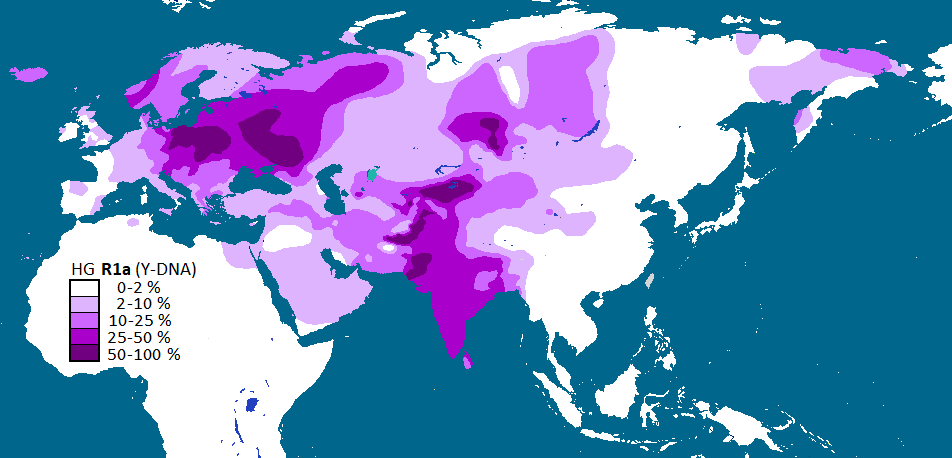
Map showing frequency of R1a haplogroup in Europe

Haplogroup R1a (R-M420), is a human Y-chromosome DNA haplogroup which is distributed in a large region in Eurasia, extending from Scandinavia and Central Europe to Central Asia, southern Siberia and South Asia.[3][2]

The R1a (R-M420) subclade diverged from R1 (R-M173) 15-25,000[2][4][5] years ago, its subclade M417 (R1a1a1) diversified c. 3,400-5,800 years ago.[6][5] The place of origin of the subclade plays a role in the debate about the origins of Proto-Indo-Europeans.

The SNP mutation R-M420 was discovered after R-M17 (R1a1a), which resulted in a reorganization of the lineage in particular establishing a new paragroup (designated R-M420*) for the relatively rare lineages which are not in the R-SRY10831.2 (R1a1) branch leading to R-M17.

Origins

[edit]

R1a origins

[edit]

The genetic divergence of R1a (M420) is estimated to have occurred 25,000[2] years ago, which is the time of the last glacial maximum. A 2014 study by Peter A. Underhill et al., using 16,244 individuals from over 126 populations from across Eurasia, concluded that there was "a compelling case for the Middle East, possibly near present-day Iran, as the geographic origin of hg R1a".[2] The ancient DNA record has shown the first R1a during the Mesolithic in Eastern Hunter-Gatherers (from Eastern Europe, c. 13,000 years ago),[7][8] and the earliest case of R* among Upper Paleolithic Ancient North Eurasians,[9] from which the Eastern Hunter-Gatherers predominantly derive their ancestry.[10] The genome of an individual belonging to the R1a5 subclade, dated to 10785–10626 BCE, from Peschanitsa, Arkhangelsk, Russia, and identified as a Western Russian Hunter-Gatherer, was published in January 2021.[11]

Diversification of R1a1a1 (M417) and ancient migrations

[edit]
R1a origins (Underhill 2009;[3] R1a1a origins (Pamjav et al. 2012); possible migration R1a to Baltic coast; and R1a1a oldest expansion and highest frequency (Underhill et al. 2014)

According to Underhill et al. (2014), the downstream M417 (R1a1a1) subclade diversified into Z282 (R1a1a1b1a) and Z93 (R1a1a1b2) circa 5,800 years ago "in the vicinity of Iran and Eastern Turkey".[6][note 1] Even though R1a occurs as a Y-chromosome haplogroup among speakers of various languages such as Slavic and Indo-Iranian, the question of the origins of R1a1a is relevant to the ongoing debate concerning the urheimat of the Proto-Indo-European people, and may also be relevant to the origins of the Indus Valley civilization. R1a shows a strong correlation with Indo-European languages of Southern and Western Asia, Central and Eastern Europe and to Scandinavia[13][3] being most prevalent in Eastern Europe, Central Asia, and South Asia. In Europe, Z282 is prevalent particularly while in Asia Z93 dominates. The connection between Y-DNA R-M17 and the spread of Indo-European languages was first noted by T. Zerjal and colleagues in 1999.[14]

Indo-European relation

[edit]
Proposed steppe dispersal of R1a1a
[edit]

Semino et al. (2000) proposed Ukrainian origins, and a postglacial spread of the R1a1 haplogroup during the Late Glacial Maximum, subsequently magnified by the expansion of the Kurgan culture into Europe and eastward.[15] Spencer Wells proposes Central Asian origins, suggesting that the distribution and age of R1a1 points to an ancient migration corresponding to the spread by the Kurgan people in their expansion from the Eurasian steppe.[16] According to Pamjav et al. (2012), R1a1a diversified in the Eurasian Steppes or the Middle East and Caucasus region:

Inner and Central Asia is an overlap zone for the R1a1-Z280 and R1a1-Z93 lineages [which] implies that an early differentiation zone of R1a1-M198 conceivably occurred somewhere within the Eurasian Steppes or the Middle East and Caucasus region as they lie between South Asia and Central- and Eastern Europe.[17]

Three genetic studies in 2015 gave support to the Kurgan theory of Gimbutas regarding the Indo-European Urheimat. According to those studies, haplogroups R1b and R1a, now the most common in Europe (R1a is also common in South Asia) would have expanded from the Pontic–Caspian steppes, along with the Indo-European languages; they also detected an autosomal component present in modern Europeans which was not present in Neolithic Europeans, which would have been introduced with paternal lineages R1b and R1a, as well as Indo-European languages.[18][19][20]

Silva et al. (2017) noted that R1a in South Asia most "likely spread from a single Central Asian source pool, there do seem to be at least three and probably more R1a founder clades within the Indian subcontinent, consistent with multiple waves of arrival."[21] According to Martin P. Richards, co-author of Silva et al. (2017), the prevalence of R1a in India was "very powerful evidence for a substantial Bronze Age migration from central Asia that most likely brought Indo-European speakers to India."[22][23]

Possible Yamnaya or Corded Ware origins
[edit]
European middle-Neolithic period. Comb Ware culture c. 4200 – c. 2000 BCE
Corded Ware culture (c. 2900 – c. 2350 BCE

David Anthony considers the Yamnaya culture to be the Indo-European Urheimat.[24][25] According to Haak et al. (2015), a massive migration from the Yamnaya culture northwards took place c. 2,500 BCE, accounting for 75% of the genetic ancestry of the Corded Ware culture, noting that R1a and R1b may have "spread into Europe from the East after 3,000 BCE".[26] Yet, all their seven Yamnaya samples belonged to the R1b-M269 subclade,[26] but no R1a1a has been found in their Yamnaya samples. This raises the question where the R1a1a in the Corded Ware culture came from, if it was not from the Yamnaya culture.[27]

According to Marc Haber, the absence of haplogroup R1a-M458 in Afghanistan does not support a Pontic-Caspian steppe origin for the R1a lineages in modern Central Asian populations.[28]

According to Leo Klejn, the absence of haplogroup R1a in Yamnaya remains (despite its presence in Eneolithic Samara and Eastern Hunter Gatherer populations) makes it unlikely that Europeans inherited haplogroup R1a from Yamnaya.[29]

Archaeologist Barry Cunliffe has said that the absence of haplogroup R1a in Yamnaya specimens is a major weakness in Haak's proposal that R1a has a Yamnaya origin.[30]

Semenov & Bulat (2016) do argue for a Yamnaya origin of R1a1a in the Corded Ware culture, noting that several publications point to the presence of R1a1 in the Comb Ware culture.[31][note 2]

Proposed South Asian origins

[edit]

Kivisild et al. (2003) have proposed either South or West Asia,[32][note 3] while Mirabal et al. (2009) see support for both South and Central Asia.[13] Sengupta et al. (2006) have proposed Indian origins.[33] Thanseem et al. (2006) have proposed either South or Central Asia.[34] Sahoo et al. (2006) have proposed either South or West Asia.[35] Thangaraj et al. (2010) have also proposed a South Asian origin.[36] Sharma et al.(2009) theorizes the existence of R1a in India beyond 18,000 years to possibly 44,000 years in origin.[1]

A number of studies from 2006 to 2010 concluded that South Asian populations have the highest STR diversity within R1a1a,[37][38][13][3][1][39] and subsequent older TMRCA datings.[note 4] R1a1a is present among both higher (Brahmin) castes and lower castes, and while the frequency is higher among Brahmin castes, the oldest TMRCA datings of the R1a haplogroup occur in the Saharia tribe, a scheduled caste of the Bundelkhand region of Central India.[1][39]

From these findings some researchers argued that R1a1a originated in South Asia,[38][1][note 5] excluding a more recent, yet minor, genetic influx from Indo-European migrants in northwestern regions such as Afghanistan, Balochistan, Punjab, and Kashmir.[38][37][3][note 6]

The conclusion that R1a originated in India has been questioned by more recent research,[21][41][note 7] offering an argument that R1a arrived in India with multiple waves of migration.[21][42]

Proposed Transcaucasia and West Asian origins and possible influence on Indus Valley Civilization

[edit]

Haak et al. (2015) found that part of the Yamnaya ancestry derived from the Middle East and that neolithic techniques probably arrived at the Yamnaya culture from the Balkans.[note 8] The Rössen culture (4,600–4,300 BC), which was situated on Germany and predates the Corded Ware culture, an old subclade of R1a, namely L664, can still be found.[note 9]

Part of the South Asian genetic ancestry derives from west Eurasian populations, and some researchers have implied that Z93 may have come to India via Iran[44] and expanded there during the Indus Valley civilization.[2][45]

Mascarenhas et al. (2015) proposed that the roots of Z93 lie in West Asia, and proposed that "Z93 and L342.2 expanded in a southeasterly direction from Transcaucasia into South Asia",[44] noting that such an expansion is compatible with "the archeological records of eastward expansion of West Asian populations in the 4th millennium BCE culminating in the so-called Kura-Araxes migrations in the post-Uruk IV period."[44] Yet, Lazaridis noted that sample I1635 of Lazaridis et al. (2016), their Armenian Kura-Araxes sample, carried Y-haplogroup R1b1-M415(xM269)[note 10] (also called R1b1a1b-CTS3187).[46][unreliable source?]

According to Underhill et al. (2014) the diversification of Z93 and the "early urbanization within the Indus Valley ... occurred at [5,600 years ago] and the geographic distribution of R1a-M780 (Figure 3d[note 11]) may reflect this."[2][note 12] Poznik et al. (2016) note that "striking expansions" occurred within R1a-Z93 at c. 4,500–4,000 years ago, which "predates by a few centuries the collapse of the Indus Valley Civilisation."[45][note 13]

However, according to Narasimhan et al. (2018), steppe pastoralists are a likely source for R1a in India.[48][note 14]

Phylogeny

[edit]

The R1a family tree now has three major levels of branching, with the largest number of defined subclades within the dominant and best known branch, R1a1a (which will be found with various names such as "R1a1" in relatively recent but not the latest literature).

Topology

[edit]

The topology of R1a is as follows (codes [in brackets] non-isogg codes):[12][49][verification needed][50][2][51] Tatiana et al. (2014) "rapid diversification process of K-M526 likely occurred in Southeast Asia, with subsequent westward expansions of the ancestors of haplogroups R and Q."[52]

  • P P295/PF5866/S8 (also known as K2b2).
  • R (R-M207)[50][12]
    • R*
    • R1 (R-M173)
      • R1*[50]
      • R1a (M420)[50] (Eastern Europe, Asia)[2]
        • R1a*[12]
        • R1a1[50] (M459/PF6235,[50] SRY1532.2/SRY10831.2[50])
          • R1a1 (M459)[50][12]
          • R1a1a (M17, M198)[50]
            • R1a1a1 (M417, page7)[50]
              • R1a1a1a (CTS7083/L664/S298)[50]
              • R1a1a1b (S224/Z645, S441/Z647)[50]
                • R1a1a1b1 (PF6217/S339/Z283)[50]
                  • R1a1a1b1a (Z282)[50] [R1a1a1a*] (Z282)[53] (Eastern Europe)
                    • R1a1a1b1a1[50] [The old topological code is R1a1a1b*,which is outdated and might lead to some confusion.][53] (M458)[50][53] [R1a1a1g] (M458)[51]
                    • R1a1a1b1a2[50] (S466/Z280, S204/Z91)[50]
                      • R1a1a1b1a2a[50]
                      • R1a1a1b1a2b (CTS1211)[50] [R1a1a1c*] (M558)[53] [R-CTS1211] (V2803/CTS3607/S3363/M558, CTS1211/S3357, Y34/FGC36457)[12]
                        • R1a1a1b1a2b3* (M417+, Z645+, Z283+, Z282+, Z280+, CTS1211+, CTS3402, Y33+, CTS3318+, Y2613+) (Gwozdz's Cluster K)[49][verification needed]
                        • R1a1a1b1a2b3a (L365/S468)[50]
                    • R1a1a1b1a3 (Z284)[50] [R1a1a1a1] (Z284)[53]
                • R1a1a1b2 (F992/S202/Z93)[50] [R1a1a2*] (Z93, M746)[53] (Central Asia, South Asia and West Asia)
                  • R1a1a1b2a (F3105/S340/Z94, L342.2/S278.2)[50] [R1a1b2a*] (Z95)[53] R-Z94 (Z94/F3105/S340, Z95/F3568)[12]
                    • R-Z2124 (Z2121/S3410, Z2124)[12]
                      • [R1a1b2a*] (Z2125)[53]
                        • [R1a1b2a*] (M434)[53] [R1a1a1f] (M434)[51]
                        • [R1a1b2a*] (M204)[53]
                    • [R1a1b2a1*] (M560)[53]
                    • [R1a1b2a2*] (M780, L657)[53] (India)[2]
                    • [R1a1b2a3*] (Z2122, M582)[53]
              • [R1a1a1c] (M64.2, M87, M204)[51]
              • [R1a1a1d] (P98)[51]
              • [R1a1a1e] (PK5)[51]
      • R1b (M343) (Western Europe)
    • R2 (India)

Haplogroup R

[edit]
Haplogroup R phylogeny

R  (M207)
R1   (M173)
 M420 

R1a

 M343 

R1b

 M173(xM420, M343) 

 R1*

R2 (M479)

R* M207(xM173, M479)

R-M173 (R1)

[edit]

R1a is distinguished by several unique markers, including the M420 mutation. It is a subclade of Haplogroup R-M173 (previously called R1). R1a has the sister-subclades Haplogroup R1b-M343, and the paragroup R-M173*.

R-M420 (R1a)

[edit]

R1a, defined by the mutation M420, has two primary branches: R-M459 (R1a1) and R-YP4141 (R1a2).

As of 2025, ten ancient basal R1a* genotypes have been recovered and published, from remains found in Estonia, Poland, Russia, and Ukraine; the oldest sample (Vasilevka 497) dated to c. 8700 BCE, and excavated in the Vasylivka, Bakhmut Raion, Donetsk Oblast.[55][5]

R-YP4141 (R1a2)

[edit]

R1a2 (R-YP4141) has two branches R1a2a (R-YP5018) and R1a2b (R-YP4132).[56]

This rare primary subclade was initially regarded as part of a paragroup of R1a*, defined by SRY1532.2 (and understood to always exclude M459 and its synonyms SRY10831.2, M448, L122, and M516).[3][57]

YP4141 later replaced SRY1532.2 – which was found to be unreliable – and the R1a(xR-M459) group was redefined as R1a2. It is relatively unusual, though it has been tested in more than one survey. Sahoo et al. (2006) reported R-SRY1532.2* for 1/15 Himachal Pradesh Rajput samples.[38] Underhill et al. (2009) reported 1/51 in Norway, 3/305 in Sweden, 1/57 Greek Macedonians, 1/150 (or 2/150) Iranians, 2/734 ethnic Armenians, 1/141 Kabardians, 1/121 Omanis, 1/164 in the United Arab Emirates, and 3/612 in Turkey. Testing of 7224 more males in 73 other Eurasian populations showed no sign of this category.[3]

The oldest known example genotyped is from a set of remains, dating to c. 3500 BCE, recovered from the Kumyshanskaya Cave, in Russia.[5]

R-M459 (R1a1)

[edit]

The major subclade R-M459 includes an overwhelming majority of individuals within R1a more broadly.

Ancient R-M459 genotypes, dating to c. 8650 BCE, have been recovered from two sets of remains excavated at Minino, Russia.[5]

R-YP1272 (R1a1b)

[edit]

R-YP1272, also known as R-M459(xM198), is an extremely rare primary subclade of R1a1. It has been found in three individuals, from Belarus, Tunisia and the Coptic community in Egypt respectively.[58]

R-M17/M198 (R1a1a)

[edit]

The following SNPs are associated with R1a1a:

SNP Mutation Y-position (NCBI36) Y-position (GRCh37) RefSNP ID
M17 INS G 20192556 21733168 rs3908
M198 C->T 13540146 15030752 rs2020857
M512 C->T 14824547 16315153 rs17222146
M514 C->T 17884688 19375294 rs17315926
M515 T->A 12564623 14054623 rs17221601
L168 A->G 14711571 16202177 -
L449 C->T 21376144 22966756 -
L457 G->A 14946266 16436872 rs113195541
L566 C->T - - -

R-M417 (R1a1a1)

[edit]

R1a1a1 (R-M417) is the most widely found subclade, in two variations which are found respectively in Europe (R1a1a1b1 (R-Z282) ([R1a1a1a*] (R-Z282) (Underhill 2014)[2]) and Central and South Asia (R1a1a1b2 (R-Z93) ([R1a1a2*] (R-Z93) Underhill 2014)[2]).

The oldest known basal R1a1a1 genotype so far published has been dated to c. 5650 BCE, and was recovered from a site at Trestiana, Romania.[5]

R-Z282 (R1a1a1b1a) (Eastern Europe)

[edit]

This large subclade appears to encompass most of the R1a1a found in Europe.[17]

  • R1a1a1b1a [R1a1a1a* (Underhill (2014))] (R-Z282*) occurs in northern Ukraine, Belarus, and Russia at a frequency of c. 20%.[2]
  • R1a1a1b1a3 [R1a1a1a1 (Underhill (2014))] (R-Z284) occurs in Northwest Europe and peaks at c. 20% in Norway.[2]
  • R1a1a1c (M64.2, M87, M204) is apparently rare: it was found in 1 of 117 males typed in southern Iran.[59]
R-M458 (R1a1a1b1a1)
[edit]
Frequency distribution of R-M458

R-M458 is a mainly Slavic SNP, characterized by its own mutation, and was first called cluster N. Underhill et al. (2009) found it to be present in modern European populations roughly between the Rhine catchment and the Ural Mountains and traced it to "a founder effect that ... falls into the early Holocene period, 7.9±2.6 KYA." (Zhivotovsky speeds, 3x overvalued)[3] M458 was found in one skeleton from a 14th-century grave field in Usedom, Mecklenburg-Vorpommern, Germany.[60] The paper by Underhill et al. (2009) also reports a surprisingly high frequency of M458 in some Northern Caucasian populations (18% among Ak Nogai,[61] 7.8% among Qara Nogai and 3.4% among Abazas).[62]

R-L260 (R1a1a1b1a1a)
[edit]

R1a1a1b1a1a (R-L260), commonly referred to as West Slavic or Polish, is a subclade of the larger parent group R-M458, and was first identified as an STR cluster by Pawlowski et al. 2002. In 2010 it was verified to be a haplogroup identified by its own mutation (SNP).[63] It apparently accounts for about 8% of Polish men, making it the most common subclade in Poland. Outside of Poland it is less common.[64] In addition to Poland, it is mainly found in the Czech Republic and Slovakia, and is considered "clearly West Slavic". The founding ancestor of R-L260 is estimated to have lived between 2000 and 3000 years ago, i.e. during the Iron Age, with significant population expansion less than 1,500 years ago.[65]

R-M334
[edit]

R-M334 ([R1a1a1g1],[51] a subclade of [R1a1a1g] (M458)[51] c.q. R1a1a1b1a1 (M458)[50]) was found by Underhill et al. (2009) only in one Estonian man and may define a very recently founded and small clade.[3]

R1a1a1b1a2 (S466/Z280, S204/Z91)
[edit]
R1a1a1b1a2b3* (Gwozdz's Cluster K)
[edit]

R1a1a1b1a2b3* (M417+, Z645+, Z283+, Z282+, Z280+, CTS1211+, CTS3402, Y33+, CTS3318+, Y2613+) (Gwozdz's Cluster K)[49][verification needed] is a STR based group that is R-M17(xM458). This cluster is common in Poland but not exclusive to Poland.[65]

R1a1a1b1a2b3a (R-L365)
[edit]

R1a1a1b1a2b3a (R-L365)[50] was early called Cluster G.[citation needed]

R1a1a1b2 (R-Z93) (Asia)

[edit]
Relative frequency of R-M434 to R-M17
Region People N R-M17 R-M434
Number Freq. (%) Number Freq. (%)
Pakistan Baloch 60 9 15% 5 8%
Pakistan Makrani 60 15 25% 4 7%
Middle East Oman 121 11 9% 3 2.5%
Pakistan Sindhi 134 65 49% 2 1.5%
Table only shows positive sets from N = 3667 derived from 60 Eurasian populations sample.[3]

This large subclade appears to encompass most of the R1a1a found in Asia, being related to Indo-European migrations (including Scythians, Indo-Aryan migrations and so on).[17]

  • R-Z93* or R1a1a1b2* (R1a1a2* in Underhill (2014)) is most common (>30%) in the South Siberian Altai region of Russia, cropping up in Kyrgyzstan (6%) and in all Iranian populations (1-8%).[2] The oldest published R-Z93 genotypes being sampled from graves, dated to c. 2650 - 2700 BCE, in Naumovskoye, and Khanevo, Vologda Oblast, and Khaldeevo, Rostov District, Russia.[5]
  • R-Z2125 occurs at highest frequencies in Kyrgyzstan and in Afghan Pashtuns (>40%). At a frequency of >10%, it is also observed in other Afghan ethnic groups and in some populations in the Caucasus and Iran.[2]
    • R-M434 (R1a1a6) is a subclade of Z2125. It was detected in 14 people (out of 3667 people tested), all in a restricted geographical range from Pakistan to Oman. This likely reflects a recent mutation event in Pakistan.[3]
  • R-M560 is very rare and was only observed in four samples: two Burushaski speakers (north Pakistan), one Hazara (Afghanistan), and one Iranian Azerbaijani.[2]
  • R-M780 (R1a1b2a2*) occurs at high frequency in South Asia: India, Pakistan, Afghanistan, and the Himalayas. Turkey share R1a (12.1%) sublineages.[66] Roma from Slovakia share 3% of R1a[67] The group also occurs at >3% in some Iranian populations and is present at >30% in Roma from Croatia and Hungary.[2]

Geographic distribution of R1a1a

[edit]
Distribution of R1a (purple) and R1b (red)

Pre-historical

[edit]

In Mesolithic Europe, R1a is characteristic of Eastern Hunter-Gatherers (EHGs).[68] A male EHG of the Veretye culture buried at Peschanitsa near Lake Lacha in Arkhangelsk Oblast, Russia c. 10,700 BCE was found to be a carrier of the paternal haplogroup R1a5-YP1301 and the maternal haplogroup U4a.[69][70][68] A male, named PES001, from Peschanitsa in northwestern Russia was found to carry R1a5, and dates to at least 10,600 years ago.[7] More examples include the males Minino II (V) and Minino II (I/1), with the former carrying R1a1 and the latter R1a respectively, with the former being at 10,600 years old and the latter at least 10,400 years old respectively, both from Minino in northwestern Russia.[71] A Mesolithic male from Karelia c. 8,800 BCE to 7950 BCE has been found to be carrying haplogroup R1a.[72] A Mesolithic male buried at Deriivka c. 7000 BCE to 6700 BCE carried the paternal haplogroup R1a and the maternal U5a2a.[20] Another male from Karelia from c. 5,500 to 5,000 BC, who was considered an EHG, carried haplogroup R1a.[18] A male from the Comb Ceramic culture in Kudruküla c. 5,900 BCE to 3,800 BCE has been determined to be a carrier of R1a and the maternal U2e1.[73] According to archaeologist David Anthony, the paternal R1a-Z93 was found at the Oskol river near a no longer existing kolkhoz "Alexandria", Ukraine c. 4000 BCE, "the earliest known sample to show the genetic adaptation to lactase persistence (13910-T)."[74] R1a has been found in the Corded Ware culture,[75][76] in which it is predominant.[77] Examined males of the Bronze Age Fatyanovo culture belong entirely to R1a, specifically subclade R1a-Z93.[68][69][78]

Haplogroup R1a has later been found in ancient fossils associated with the Urnfield culture;[79] as well as the burial of the remains of the Sintashta,[19] Andronovo,[80] the Pazyryk,[81] Tagar,[80] Tashtyk,[80] and Srubnaya cultures, the inhabitants of ancient Tanais,[82] in the Tarim mummies,[83] and the aristocracy of Xiongnu.[84] The skeletal remains of a father and his two sons, from an archaeological site discovered in 2005 near Eulau (in Saxony-Anhalt, Germany) and dated to about 2600 BCE, tested positive for the Y-SNP marker SRY10831.2. The Ysearch number for the Eulau remains is 2C46S. The ancestral clade was thus present in Europe at least 4600 years ago, in association with one site of the widespread Corded Ware culture.[75]

Europe

[edit]

In Europe, the R1a1a sub-clade is primarily characteristic of Balto-Slavic populations, with two exceptions: southern Slavs and northern Russians.[85] The highest frequency of R1a1a in Europe is observed in Sorbs (63%),[86] a West Slavic ethnic group, followed by Hungarians (60%).[15] Other groups with significant R1a1a, ranging from 27% to up to 58%, include Czechs, Poles, Slovenians, Slovaks, Moldovans, Belarusians, Rusyns, Ukrainians, and Russians.[85][86][15] R1a frequency decreases in northeastern Russian populations down to 20%–30%, in contrast to central-southern Russia, where its frequency is twice as high. In the Baltics, R1a1a frequencies decrease from Lithuania (45%) to Estonia (around 30%).[87][88][89][15][90]

There is also a significant presence in peoples of Germanic descent, with highest levels in Norway, Sweden and Iceland, where between 20 and 30% of men are in R1a1a.[91][92] Vikings and Normans may have also carried the R1a1a lineage further out, accounting for at least part of the small presence in the British Isles, the Canary Islands, and Sicily.[93][94] Haplogroup R1a1a averages between 10 and 30% in Germans, with a peak in Rostock at 31.3%.[95] R1a1a is found at a very low frequency among Dutch people (3.7%)[15] and is virtually absent in Danes.[96]

In Southern Europe R1a1a is not common, but significant levels have been found in pockets, such as in the Pas Valley in Northern Spain, areas of Venice, and Calabria in Italy.[97][better source needed] The Balkans shows wide variation between areas with significant levels of R1a1a, for example 36–39% in Slovenia,[98] 27–34% in Croatia,[88][99][100][101][102] and over 30% in Greek Macedonia, but less than 10% in Albania, Kosovo and parts of Greece south of Olympus gorge.[103][89][15]

R1a is virtually composed only of the Z284 subclade in Scandinavia. In Slovenia, the main subclade is Z282 (Z280 and M458), although the Z284 subclade was found in one sample of a Slovenian. There is a negligible representation of Z93 in Turkey, 12,1%[66][2] West Slavs and Hungarians are characterized by a high frequency of the subclade M458 and a low Z92, a subclade of Z280. Hundreds of Slovenian samples and Czechs lack the Z92 subclade of Z280, while Poles, Slovaks, Croats and Hungarians only show a very low frequency of Z92.[2] The Balts, East Slavs, Serbs, Macedonians, Bulgarians and Romanians demonstrate a ratio Z280>M458 and a high, up to a prevailing share of Z92.[2] Balts and East Slavs have the same subclades and similar frequencies in a more detailed phylogeny of the subclades.[104][105] The Russian geneticist Oleg Balanovsky speculated that there is a predominance of the assimilated pre-Slavic substrate in the genetics of East and West Slavic populations, according to him the common genetic structure which contrasts East Slavs and Balts from other populations may suggest the explanation that the pre-Slavic substrate of the East and West Slavs consisted most significantly of Baltic-speakers, which at one point predated the Slavs in the cultures of the Eurasian steppe according to archaeological and toponymic references.[note 15]

Asia

[edit]

Central Asia

[edit]

Zerjal et al. (2002) found R1a1a in 64% of a sample of the Tajiks of Tajikistan and 63% of a sample of the Kyrgyz of Kyrgyzstan.[106]

Haber et al. (2012) found R1a1a-M17 in 26.0% (53/204) of a set of samples from Afghanistan, including 60% (3/5) of a sample of Nuristanis, 51.0% (25/49) of a sample of Pashtuns, 30.4% (17/56) of a sample of Tajiks, 17.6% (3/17) of a sample of Uzbeks, 6.7% (4/60) of a sample of Hazaras, and in the only sampled Turkmen individual.[107]

Di Cristofaro et al. (2013) found R1a1a-M198/M17 in 56.3% (49/87) of a pair of samples of Pashtuns from Afghanistan (including 20/34 or 58.8% of a sample of Pashtuns from Baghlan and 29/53 or 54.7% of a sample of Pashtuns from Kunduz), 29.1% (37/127) of a pool of samples of Uzbeks from Afghanistan (including 28/94 or 29.8% of a sample of Uzbeks from Jawzjan, 8/28 or 28.6% of a sample of Uzbeks from Sar-e Pol, and 1/5 or 20% of a sample of Uzbeks from Balkh), 27.5% (39/142) of a pool of samples of Tajiks from Afghanistan (including 22/54 or 40.7% of a sample of Tajiks from Balkh, 9/35 or 25.7% of a sample of Tajiks from Takhar, 4/16 or 25.0% of a sample of Tajiks from Samangan, and 4/37 or 10.8% of a sample of Tajiks from Badakhshan), 16.2% (12/74) of a sample of Turkmens from Jawzjan, and 9.1% (7/77) of a pair of samples of Hazara from Afghanistan (including 7/69 or 10.1% of a sample of Hazara from Bamiyan and 0/8 or 0% of a sample of Hazara from Balkh).[108]

Malyarchuk et al. (2013) found R1a1-SRY10831.2 in 30.0% (12/40) of a sample of Tajiks from Tajikistan.[109]

Ashirbekov et al. (2017) found R1a-M198 in 6.03% (78/1294) of a set of samples of Kazakhs from Kazakhstan. R1a-M198 was observed with greater than average frequency in the study's samples of the following Kazakh tribes: 13/41 = 31.7% of a sample of Suan, 8/29 = 27.6% of a sample of Oshaqty, 6/30 = 20.0% of a sample of Qozha, 4/29 = 13.8% of a sample of Qypshaq, 1/8 = 12.5% of a sample of Tore, 9/86 = 10.5% of a sample of Jetyru, 4/50 = 8.0% of a sample of Argyn, 1/13 = 7.7% of a sample of Shanyshqyly, 8/122 = 6.6% of a sample of Alimuly, 3/46 = 6.5% of a sample of Alban. R1a-M198 also was observed in 5/42 = 11.9% of a sample of Kazakhs of unreported tribal affiliation.[110]

South Asia

[edit]

In South Asia, R1a1a has often been observed in a number of demographic groups.[38][37]

South Asian populations have the highest STR diversity within R1a1a,[37][38][13][3][1][39] and subsequent older TMRCA datings.[note 16] In India, high frequencies of this haplogroup is observed in West Bengal Brahmins (72%) in the east,[37] Bhanushali (67%) and Gujarat Lohanas (60%) in the west,[3] Uttar Pradesh Brahmins (68%), Punjab/Haryana Khatris (67%) and Ahirs (63%) in the north,[1][37][3] and Karnataka Medars (39%) in the south.[111] It has also been found in several South Indian Dravidian-speaking Adivasis including the Chenchu (26%) of Andhra Pradesh and Kota of Andhra Pradesh (22.58%)[112] and the Kallar of Tamil Nadu suggesting that R1a1a is widespread in Tribal Southern Indians.[32]

Besides these, studies show high percentages in regionally diverse groups such as Manipuris (50%)[3] to the extreme North East and among Punjabis (47%)[32] to the extreme North West.

In Pakistan it is found at 80% among Yusufzai tribe of Pashtuns (51%) from Swat District,[113] 71% among the Mohanna community in Sindh province to the south and 46% among the Baltis of Gilgit-Baltistan to the north.[3]

Among the Sinhalese of Sri Lanka, 23% were found to be R1a1a (R-SRY1532) positive.[114] Hindus of Chitwan District in the Terai region Nepal show it at 69%.[115]

East Asia

[edit]

The frequency of R1a1a is comparatively low among some Turkic-speaking groups like Yakuts, yet levels are higher (19 to 28%) in certain Turkic or Mongolic-speaking groups of Northwestern China, such as the Bonan, Dongxiang, Salar, and Uyghurs.[16][116][117]

A Chinese paper published in 2018 found R1a-Z94 in 38.5% (15/39) of a sample of Keriyalik Uyghurs from Darya Boyi / Darya Boye Village, Yutian County, Xinjiang (于田县达里雅布依乡), R1a-Z93 in 28.9% (22/76) of a sample of Dolan Uyghurs from Horiqol township, Awat County, Xinjiang (阿瓦提县乌鲁却勒镇), and R1a-Z93 in 6.3% (4/64) of a sample of Loplik Uyghurs from Karquga / Qarchugha Village, Yuli County, Xinjiang (尉犁县喀尔曲尕乡). R1a(xZ93) was observed only in one of 76 Dolan Uyghurs.[118] Note that Darya Boyi Village is located in a remote oasis formed by the Keriya River in the Taklamakan Desert. A 2011 Y-DNA study found Y-dna R1a1 in 10% of a sample of southern Hui people from Yunnan, 1.6% of a sample of Tibetan people from Tibet (Tibet Autonomous Region), 1.6% of a sample of Xibe people from Xinjiang, 3.2% of a sample of northern Hui from Ningxia, 9.4% of a sample of Hazak (Kazakhs) from Xinjiang, and rates of 24.0%, 22.2%, 35.2%, 29.2% in 4 different samples of Uyghurs from Xinjiang, 9.1% in a sample of Mongols from Inner Mongolia. A different subclade of R1 was also found in 1.5% of a sample of northern Hui from Ningxia.[119] in the same study there were no cases of R1a detected at all in 6 samples of Han Chinese in Yunnan, 1 sample of Han in Guangxi, 5 samples of Han in Guizhou, 2 samples of Han in Guangdong, 2 samples of Han in Fujian, 2 samples of Han in Zhejiang, 1 sample of Han in Shanghai, 1 samples of Han in Jiangxi, 2 samples of Han in Hunan, 1 sample of Han in Hubei, 2 samples of Han in Sichuan, 1 sample of Han in Chongqing, 3 samples of Han in Shandong, 5 samples of Han in Gansu, 3 samples of Han in Jilin and 2 samples of Han in Heilongjiang.[120] 40% of Salars, 45.2% of Tajiks of Xinjiang, 54.3% of Dongxiang, 60.6% of Tatars and 68.9% of Kyrgyz in Xinjiang in northwestern China tested in one sample had R1a1-M17. Bao'an (Bonan) had the most haplogroup diversity of 0.8946±0.0305 while the other ethnic minorities in northwestern China had a high haplogroup diversity like Central Asians, of 0.7602±0.0546.[121]

In Eastern Siberia, R1a1a is found among certain indigenous ethnic groups including Kamchatkans and Chukotkans, and peaking in Itel'man at 22%.[122]

Southeast Asia

[edit]

Y-haplogroups R1a-M420 and R2-M479 are found in Ede (8.3% and 4.2%) and Giarai (3.7% and 3.7%) peoples in Vietnam. The Cham additionally have haplogroups R-M17 (13.6%) and R-M124 (3.4%).

R1a1a1b2a2a (R-Z2123) and R1a1 are found in Khmer peoples from Thailand (3.4%) and Cambodia (7.2%) respectively. Haplogroup R1a1a1b2a1b (R-Y6) is also found among Kuy peoples (5%).

According to Changmai et al. (2022), these haplogroup frequencies originate from South Asians, who left a cultural and genetic legacy in Southeast Asia since the first millennium CE.[123]

West Asia

[edit]

R1a1a has been found in various forms, in most parts of Western Asia, in widely varying concentrations, from almost no presence in areas such as Jordan, to much higher levels in parts of Kuwait and Iran. The Shimar (Shammar) Bedouin tribe in Kuwait show the highest frequency in the Middle East at 43%.[124][125][126]

Wells 2001, noted that in the western part of the country, Iranians show low R1a1a levels, while males of eastern parts of Iran carried up to 35% R1a1a. Nasidze et al. 2004 found R1a1a in approximately 20% of Iranian males from the cities of Tehran and Isfahan. Regueiro 2006 in a study of Iran, noted much higher frequencies in the south than the north.

A newer study has found 20.3% R-M17* among Kurdish samples which were taken in the Kurdistan Province in western Iran, 19% among Azerbaijanis in West Azerbaijan, 9.7% among Mazandaranis in North Iran in the province of Mazandaran, 9.4% among Gilaks in province of Gilan, 12.8% among Persian and 17.6% among Zoroastrians in Yazd, 18.2% among Persians in Isfahan, 20.3% among Persians in Khorasan, 16.7% Afro-Iranians, 18.4% Qeshmi "Gheshmi", 21.4% among Persian Bandari people in Hormozgan and 25% among the Baloch people in Sistan and Baluchestan Province.[127]

Di Cristofaro et al. (2013) found haplogroup R1a in 9.68% (18/186) of a set of samples from Iran, though with a large variance ranging from 0% (0/18) in a sample of Iranians from Tehran to 25% (5/20) in a sample of Iranians from Khorasan and 27% (3/11) in a sample of Iranians of unknown provenance. All Iranian R1a individuals carried the M198 and M17 mutations except one individual in a sample of Iranians from Gilan (n=27), who was reported to belong to R1a-SRY1532.2(xM198, M17).[108]

Malyarchuk et al. (2013) found R1a1-SRY10831.2 in 20.8% (16/77) of a sample of Persians collected in the provinces of Khorasan and Kerman in eastern Iran, but they did not find any member of this haplogroup in a sample of 25 Kurds collected in the province of Kermanshah in western Iran.[109]

Further to the north of these Western Asian regions on the other hand, R1a1a levels start to increase in the Caucasus, once again in an uneven way. Several populations studied have shown no sign of R1a1a, while highest levels so far discovered in the region appears to belong to speakers of the Karachay-Balkar language among whom about one quarter of men tested so far are in haplogroup R1a1a.[3]

Historic naming of R1a

[edit]

The historic naming system commonly used for R1a was inconsistent in different published sources, because it changed often; this requires some explanation.

In 2002, the Y Chromosome Consortium (YCC) proposed a new naming system for haplogroups (YCC 2002), which has now become standard. In this system, names with the format "R1" and "R1a" are "phylogenetic" names, aimed at marking positions in a family tree. Names of SNP mutations can also be used to name clades or haplogroups. For example, as M173 is currently the defining mutation of R1, R1 is also R-M173, a "mutational" clade name. When a new branching in a tree is discovered, some phylogenetic names will change, but by definition all mutational names will remain the same.

The widely occurring haplogroup defined by mutation M17 was known by various names, such as "Eu19", as used in (Semino et al. 2000) in the older naming systems. The 2002 YCC proposal assigned the name R1a to the haplogroup defined by mutation SRY1532.2. This included Eu19 (i.e. R-M17) as a subclade, so Eu19 was named R1a1. Note, SRY1532.2 is also known as SRY10831.2[citation needed] The discovery of M420 in 2009 has caused a reassignment of these phylogenetic names.(Underhill et al. 2009 and ISOGG 2012) R1a is now defined by the M420 mutation: in this updated tree, the subclade defined by SRY1532.2 has moved from R1a to R1a1, and Eu19 (R-M17) from R1a1 to R1a1a.

More recent updates recorded at the ISOGG reference webpage involve branches of R-M17, including one major branch, R-M417.

Contrasting family trees for R1a, showing the evolution of understanding of this clade
2002 scheme proposed in (YCC 2002) 2009 scheme as per (Underhill et al. 2009) ISOGG tree as per January 2011 [citation needed]
As M420 went undetected, M420 lineages were classified as either R1* or R1a (SRY1532.2, also known as SRY10831.2)
R1
 M173  
R1*

All cases without M343 or SRY1532.2 (including a minority M420+ cases)

R1aSRY1532.2 (SRY10831.2)

R1a*


R1a1M17, M198

R1a1*

M56

R1a1a

M157

R1a1b

M87, M204
M64.2

R1a1c

R1b
M343

sibling clade to R1a

After 2009, a new layer was inserted covering all old R1a, plus its closest known relatives
R1
 M173  
R1*

All cases without M343 or M420 (smaller than old "R1a*")

R1a
M420 

R1a* All cases with M420 but without SRY1532.2

R1a1
SRY1532.2 

R1a1*(Old R1a*)

R1a1a
 M17, M198 

R1a1a*

M56

R1a1a1

M157

R1a1a2

M64.2,..

R1a1a3

P98

R1a1a4

PK5

R1a1a5

M434

R1a1a6

M458 

R1a1a7*


M334 

R1a1a7a

Page68

R1a1a8

R1b
M343

Sibling clade to R1a (same as before)

Latest information
R1
M173

R1* (As before)

R1a
M420

R1a* (As before)

R1a1
SRY1532.2

R1a1* (As before)

R1a1a
M17

R1a1a* (As before)

R1a1a1
M417, Page7

R1a1a1*

M56

R1a1a1a

M157

R1a1a1b

M64.2,..

R1a1a1c

P98

R1a1a1d

PK5

R1a1a1e

M434

R1a1a1f

Z283 

R1a1a1g*

M458 

R1a1a1g1*


M334 

R1a1a1g1a


L260 

R1a1a1g1b

Z280 

R1a1a1g2*


P278.2 

R1a1a1g2a


L365 

R1a1a1g2b


L366 

R1a1a1g2c


Z92 

R1a1a1g2d

Z284 

R1a1a1g3*


P278.2 

R1a1a1g3a

Z93

R1a1a1h*


L342.2 

R1a1a1h1*


L657 

R1a1a1h1a

R1b
M343

Sibling clade to R1a (same as before)

See also

[edit]

Y-DNA R-M207 subclades

[edit]

Y-DNA backbone tree

[edit]

Notes

[edit]

References

[edit]

Sources

[edit]

Further reading

[edit]
[edit]
Revisions and contributorsEdit on WikipediaRead on Wikipedia
from Grokipedia

Haplogroup R1a (M420) is a Y-chromosome DNA haplogroup defined by the M420 mutation, tracing patrilineal ancestry and exhibiting high frequencies across , particularly among Indo-European-speaking populations in , , and . Its major subclades diversified around 5,000–6,000 years ago, with confirming expansions from the Pontic-Caspian region during the .
The European branch, primarily under Z283, dominates in Slavic groups such as Poles and , where it reaches 50–60% frequency, reflecting migrations linked to the . In contrast, the Asian branch Z93 prevails in Indo-Iranian populations, correlating with the and Andronovo archaeological complexes. These patterns underscore R1a's role as a for steppe pastoralist dispersals that facilitated the dissemination of and technologies, though interpretations remain debated in contexts prioritizing cultural over genetic evidence.

Definition and Genetic Characteristics

Defining Markers and Mutation History

Haplogroup R1a is phylogenetically defined by the (SNP) M420, a G-to-A transition on the Y-chromosome that distinguishes it from its sister R1b-M343. This marker emerged as a branch from the ancestral haplogroup R1-M173, with the split from R1b estimated at approximately 25,000 years ago (95% : 21,300–29,000 years ago), coinciding with the . Basal R1a*-M420 lineages, lacking downstream mutations, are exceedingly rare in modern populations, occurring sporadically in regions such as , the , and parts of , suggesting limited survival of pre-diversification carriers. The mutation history of R1a involves a series of subsequent SNPs that structure its subclades, with M417 marking a major bottleneck and diversification event around 5,800 years ago (95% CI: 4,800–6,800 years ago), after which most contemporary R1a chromosomes descend. This is upstream of Z645, which further bifurcates into European-oriented branches like Z283 (including Z282, peaking in ) and Asian-oriented Z93, reflecting a dual westward and eastward expansion from a likely Near Eastern or Iranian core area of initial radiation. Additional markers, such as M458 within European subclades, arose around 7,900 years ago (SD ±2,600 years), with localized coalescence peaks in dating to the early . These age estimates derive from coalescent analyses of diversity and SNP phylogeny in large Y-chromosome datasets, emphasizing star-like expansions post-M417 rather than gradual accumulation, consistent with demographic bottlenecks followed by rapid population growth. While basal M420 TMRCA aligns with refugia, the subclade mutations postdate the , linking R1a diversification to steppe dynamics rather than earlier migrations.

Position in Broader Y-Chromosome Phylogeny

Haplogroup R1a, defined by the (SNP) M420, represents a primary of R1-M173 within the Y-chromosome phylogeny. R1-M173 diverged from its sister R1b-M343 approximately 22,000 to 25,000 years ago, based on calibrated rates from whole-genome sequencing of diverse Y-chromosomes. This bifurcation occurred downstream of R-M207, the defining marker for R, which emerged around 27,000 years ago from its parent P-M45. Haplogroup R constitutes one of the two major descendants of P-M45—the other being Q-M242, predominant in Siberian and Native American populations—positioning R1a as a key Eurasian lineage within non-African Y-chromosome diversity. Upstream, P-M45 (also known as P-F1085) derives from K2b2-P331, a of the broader K-M526 macrohaplogroup that diversified during the era around 40,000 years ago. K-M526 itself branches from the HIJK (IJKMNOPS) supergroup, which traces to F-M89, a foundational marking early modern human expansions into approximately 45,000 to 50,000 years ago. F-M89 descends from CF-P143, splitting from the CT-M168 lineage that signifies the primary Out-of-Africa migration event circa 60,000 years ago, with CT further rooting in the BT-M91 ancestor shared across non-basal African and Eurasian patrilines. This hierarchical structure, refined through high-coverage sequencing and SNP phylogenies, underscores R1a's intermediate position between ancient African basal clades (A and B) and the explosive diversification of post-glacial Eurasian subclades. The phylogenetic placement of R1a highlights its co-occurrence with R1b as "companion" haplogroups dominating modern European frequencies, though R1a predominates eastward while R1b does westward, reflecting differential migratory expansions rather than a shared basal origin . Ongoing refinements to the Y-tree, incorporating thousands of SNPs via projects like the 1000 Genomes and integrations, continue to calibrate branch lengths but affirm R1a's stable topology under R-P231, with no evidence of or re-rooting in recent updates.

Phylogeny and Subclade Structure

Overall Phylogenetic Topology

Haplogroup R1a (defined by the , or SNP, M420) occupies a basal position within the R1 (M173) branch of the human Y-chromosome phylogeny, with the split from its sister R1b (M343) estimated at approximately 25,100 years ago (95% : 21,300–29,000 years ago). The TMRCA for R1a-M420 itself is inferred to be older, around 15,000–22,000 years ago based on modeling of downstream markers, though direct estimates vary due to limited basal lineages. Rare paraphyletic basal R1a* lineages (M420* but negative for downstream markers like SRY10831.2) persist at low frequencies, primarily in and eastern , suggesting an ancient origin in the or adjacent regions before major post-glacial expansions. The core structure of R1a is dominated by the derived M417 , which encompasses over 99% of modern R1a chromosomes and exhibits a star-like phylogeny indicative of a bottleneck followed by rapid diversification. This clade's TMRCA is approximately 6,800 years ago, with its immediate descendants splitting into two geographically distinct major branches: Z282 (predominant in ) and Z93 (predominant in Central and ), both emerging around 5,800 years ago (95% CI: 4,800–6,800 years ago). These bifurcations align with archaeological correlates of expansions, such as the Corded Ware and Andronovo cultures, though phylogenetic resolution alone does not confirm causation. Minor parallel branches under M417, such as L664 (with a TMRCA around 4,700 years ago), occur sporadically in (e.g., ) and parts of , representing relictual or secondary dispersals but comprising less than 1% of total R1a diversity. Downstream from Z282, European subclades like Z284 (northwestern Europe), M458 (central-eastern Europe), and Z280/Z283 (eastern Europe and Baltics) show further regional structuring, often with STR haplotype clusters reflecting patrilocal expansions. Similarly, Z93 diversifies into Asian-specific lineages such as Z2124/Z2125 (), L657 (), and M780 (), with elevated diversity in the Altai region and Indus periphery indicating localized bottlenecks and serial founder effects. Overall, the topology underscores a dual Eurasian expansion model, with limited back-migration evidenced by asymmetric clade distributions and low basal lineage survival outside origin zones; refinements since via next-generation sequencing have added hundreds of SNPs but preserved this binary framework without altering basal splits.

Ancestral Haplogroup R and R1 Branches

Haplogroup (defined by the SNP M207) constitutes a foundational Y-chromosome lineage descending from haplogroup P, with its TMRCA estimated at approximately 30,000 years before present based on aggregated SNP and STR data from modern populations. Ancient DNA evidence, including R* from the ~24,000-year-old Mal'ta-Buret' culture individual in southern , supports an origin in during the , potentially linked to populations that contributed ancestry to both Europeans and Native Americans. This haplogroup's early diversification occurred amid post-Last Glacial Maximum repopulation dynamics, with subsequent migrations facilitating its spread across . The primary branches of R are R1 (M173) and R2 (M479). R2 remains concentrated in , particularly among Dravidian-speaking groups, suggesting limited expansion beyond the . In contrast, R1 underwent broader dispersal, with its TMRCA dated to around 20,000 years , likely originating in Central or following a southern refugium phase during the LGM. Y-STR diversity analyses indicate R1's initial post-glacial movements involved northern routes into around 18,000 years ago, predating major expansions. R1 further bifurcated into R1a (M420) and R1b (M343), lineages that dominate modern Y-chromosome variation in much of . R1b's core subclades, such as those under M269, exhibit West Asian phylogenetic roots and founder effects tied to pastoralist expansions, while R1a traces to steppe-associated dispersals. These splits, estimated between 15,000 and 22,000 years ago via calibrations, reflect adaptive responses to climatic amelioration and resource availability, enabling R1-derived groups to populate diverse ecological niches from to . Basal R1* paragroups, though rare today, underscore the lineage's deep antiquity and minimal survival outside major subclades.

Core R1a-M420 and Its Immediate Descendants

Haplogroup R1a is defined by the (SNP) M420 on the Y-chromosome, marking its divergence from the ancestral (defined by M173). Time to (TMRCA) estimates for R1a-M420 range from approximately 15,000 to 22,000 years before present, based on SNP accumulation rates and diversity analyses. Basal paragroup R1a*-M420, lacking derived mutations in downstream branches, occurs at low frequencies and has been identified primarily in samples from and eastern , suggesting persistence of early lineages in the . The immediate phylogenetic descendants of R1a-M420 include rare basal subclades such as R1a1-SRY10831.2*, which also show limited distribution in the and exhibit low diversity indicative of or bottlenecks. However, over 99% of extant R1a chromosomes belong to the major R1a-M417 (also denoted as Page7 or associated with Z645 in refined ), with a TMRCA estimated at around 5,800 years ago (95% : 4,800–6,800 years). This subclade's rapid expansion correlates with , as evidenced by elevated star-like structures in STR data. R1a-M417 represents the core of modern R1a diversity, serving as the progenitor for subsequent radiations, though its own basal lineages remain scarce outside the initial diversification zone near present-day . Phylogenetic resolution beyond M420 relies on high-coverage sequencing, revealing that earlier broad categorizations underestimated the antiquity and regional anchoring of these foundational branches. Ancient DNA from pre-Bronze Age contexts rarely carries R1a-M420, underscoring its relatively recent demographic prominence despite deep origins.

Major European Subclades (e.g., Z282)

Haplogroup R1a-Z282 constitutes the primary European branch of R1a-M417, accounting for more than 96% of European R1a-M417 lineages. Its time to (TMRCA) is estimated at approximately 5800 years (circa 3800 BCE), with a 95% of 4800–6800 years ago, based on SNP-based analysis of 16 Y-STR loci across diverse samples. This subclade exhibits strong geographic localization within , with paragroup R1a-Z282* frequencies reaching about 20% in northern , , and adjacent Russian regions, indicating early diversification centers in . evidence links Z282-derived lineages to the around 4600 years (circa 2600 BCE), supporting associations with expansions in Central and . The major subclades under Z282 include Z284, M458, and Z280, each showing distinct distributions tied to prehistoric population movements. R1a-Z284 is largely confined to Northwest Europe, peaking at approximately 20% in where it comprises the majority of R1a chromosomes (24 out of 26 sampled), and occurs at low frequencies elsewhere, such as single instances in . This pattern suggests a post-Bronze Age maritime or northern dispersal, potentially linked to Germanic expansions. R1a-M458 predominates in Central-Eastern Europe, with frequencies exceeding 20% in the , , , and western , and ranging from 11% to 33% across broader Slavic regions; it correlates with West Slavic populations and later medieval dispersals. R1a-Z280, encompassing subgroups like M558, displays high diversity and prevalence in , often exceeding 20% in Baltic and East Slavic areas, with elevated variance pointing to ancient roots. It is frequently associated with Balto-Slavic linguistic groups and cultures extending from the Corded Ware horizon eastward. These subclades collectively underscore Z282's role in Indo-European expansions, with spatial frequency gradients aligning with archaeological evidence of steppe-derived migrations into Europe rather than local origins.

Major Asian Subclades (e.g., Z93)

Haplogroup R1a-Z93 constitutes the principal Asian branch of R1a-M420, diverging from its European counterpart Z282 around 5,800 through the defining Z93 mutation. This subclade predominates in , , and parts of Southwest Asia, with the paragroup Z93* exhibiting frequencies exceeding 30% among South Siberian Altaians and notable presence (up to 6%) in and . Its expansion correlates with steppe migrations, as evidenced by from remains dated circa 2100 BCE, which include R1a-Z93 lineages linked to eastward dispersals from the Pontic-Caspian region. The core diversity of R1a-Z93 resides in its immediate descendant Z94, which encapsulates the bulk of Central and South Asian R1a variation and further ramifies into regionally specific subclades. Prominent among these is L657, a downstream branch under Z94 that achieves high frequencies in the , particularly among northern Indo-European-speaking populations, reflecting post-Bronze Age admixture and local expansions estimated around 4,400 years ago. Complementing L657, Z2124—another Z94 subclade—predominates in Iranian and Afghan Pashtun groups, with ancient attestations in contexts like Hun-period samples from the 5th century CE, underscoring recurrent nomadic incursions into Southwest and . Additional Z93 subclades, such as Z2125, contribute to patchy distributions in n Turkic and Iranian-speaking groups, often tied to Scythian-Saka horizon movements between 900 and 200 BCE. Overall, Z93's phylogenetic structure reveals a star-like expansion pattern post-2500 BCE, with minimal basal Z93* survival outside Siberian isolates, indicating rapid diversification during Andronovo-related spreads across the Eurasian interior. metrics, including haplotype variance, peak in southern , supporting a northerly origin followed by southward rather than autochthonous South Asian genesis.

Minor and Peripheral Branches

In addition to the dominant lineages descending from Z645, haplogroup R1a includes several minor and peripheral branches that represent early divergences or rare subclades with restricted distributions. These encompass basal paragroups such as R1a*-M420(xSRY10831.2), identified in 24 males across surveyed populations, with 18 samples from and 3 from eastern , indicating a concentration in Southwest Asia. Similarly, the upstream R1a1*-SRY10831.2(xM198) clade appears in 6 individuals, comprising 5 Iranians and 1 Kabardin from the , underscoring its peripheral occurrence outside major Eurasian expansions. Downstream of M198/M417 but basal to Z282 and Z93, the paragroup Page7*(xZ282,Z93) totals 12 samples in the , reflecting low diversity and suggestive of limited demographic success compared to core branches. Distinct rare markers within these peripheral structures include M204, detected in a single Iranian sample, and M560, observed in 4 individuals: 2 among speakers in , 1 Hazara from , and 1 Iranian Azeri. These lineages exhibit diversity patterns consistent with ancient persistence in localized refugia rather than large-scale migrations. The geographic clustering of these minor branches, predominantly in and adjacent regions, contrasts sharply with the broad Indo-European-associated spreads of Z282 and Z93, implying they survived as relict populations amid subsequent replacements or dilutions by expanding subclades. TMRCA estimates for basal R1a-M420 exceed 15,000 years, predating the radiations, though precise dating for these peripherals remains tentative due to sparse sampling.

Origins and Early Diversification

Primary Origin in the Pontic-Caspian Steppe

Haplogroup R1a-M420, defined by the M420 mutation, is estimated to have originated approximately 15,000–25,000 years ago, with its major subclade M417 exhibiting a time to most recent common ancestor (TMRCA) around 5,500 years before present, aligning with the early Bronze Age in the Pontic-Caspian steppe region. This temporal coincidence supports the steppe as the locus of early diversification, where pastoralist societies transitioned to mobile herding economies conducive to rapid haplogroup expansion. Phylogenetic analyses indicate that basal R1a lineages show patterns of post-glacial coalescent times, with initial radiation likely in Eastern European or adjacent steppe-forest zones rather than distant refugia. Ancient DNA evidence reinforces the Pontic-Caspian steppe as the primary homeland, with R1a-M417 appearing prominently in samples (circa 2900–2350 BCE), which derive substantial ancestry from Yamnaya-related steppe populations despite Yamnaya itself predominantly carrying R1b-Z2103. Although absent in core Yamnaya burials, R1a is attested in contemporaneous or slightly later steppe-forest groups like Fatyanovo-Balanovo, suggesting the haplogroup's presence in the broader ecological zone encompassing the western and eastern Pontic-Caspian grasslands. Further east, Srubnaya-Alakulskaya culture individuals (circa 2000–1500 BCE) from the eastern Pontic-Caspian steppe carried R1a, evidencing a major expansion originating there. While some phylogenetic reconstructions, such as those by Underhill et al., propose diversification of R1a subclades near present-day based on STR diversity and basal lineages, ancient DNA distributions prioritize the steppe for the explosive growth of both European (Z282) and Asian (Z93) branches, as Iranian samples lack early R1a-M417 equivalents. This causal linkage—steppe ecology enabling horse domestication, wheeled vehicles, and hierarchical warrior societies—facilitated R1a's demographic success, distinguishing it from more sedentary Near Eastern populations where equivalent haplogroups did not similarly proliferate.

Ancient DNA Evidence Supporting Steppe Homeland

Ancient DNA studies have revealed the presence of haplogroup R1a in populations directly linked to the Pontic-Caspian and adjacent forest- zones, providing empirical support for its origin in this region. In the (approximately 2900–2350 BCE), which spanned from the River to the middle , 10 out of 11 male individuals analyzed from sites in , , and carried R1a, predominantly the Z282 . These samples exhibit substantial autosomal ancestry from Yamnaya-related steppe pastoralists (up to 75%), indicating or cultural continuity from the steppe core, where early R1a diversification likely occurred. To the east, the (circa 2200–1800 BCE) in the southern Ural yielded R1a-Z93 in nearly all sampled males (9 out of 10), marking the earliest secure instances of this Asian subclade. Sintashta populations show a mixture of Corded Ware-like and local ancestry, with Y-chromosome dominance of R1a suggesting rapid male-mediated expansion within the steppe environment, contemporaneous with innovations in spoke-wheeled chariots and fortified settlements. This pattern aligns with phylogenetic estimates placing the split between European (Z282) and Asian (Z93) R1a branches around 3500–3000 BCE in the steppe vicinity. Later groups, such as the Srubnaya-Alakul horizon (circa 1900–1200 BCE) in the eastern Pontic-Caspian region, further document R1a prevalence, with multiple individuals carrying the amid evidence of demographic expansion. Genome-wide data from these samples indicate a stable genetic profile tracing back to earlier sources, predating dispersals into and . The temporal and geographic clustering of basal R1a-M420 derivatives in these contexts, absent in contemporaneous non- Neolithic farmers or hunter-gatherers, underscores the as the primary homeland, with coalescent times for major subclades (circa 5000–6000 years ago) matching archaeological timelines of pastoralist mobility.

Evaluation of Alternative Origin Hypotheses

One prominent posits the as the primary origin of haplogroup R1a, particularly its M417 , based on elevated (STR) diversity and frequency among certain Indian populations, such as Brahmins, suggesting an autochthonous development predating . Proponents argued that this diversity indicated a local expansion over millennia, challenging Steppe-derived introductions and aligning with cultural narratives of indigenous Aryan origins. However, this view has been undermined by SNP-based phylogenetic reconstructions, which estimate the time to (TMRCA) for R1a-M417 at approximately 5,800 years , with major branches Z282 (predominantly European) and Z93 (predominantly Asian) diverging around 4,700–5,200 years ago—timings incompatible with a deep South Asian root and instead aligning with cultures. STR variance, once central to Indian origin claims, proves unreliable for pinpointing origins due to its sensitivity to and serial founder effects rather than true antiquity, as later high-resolution SNP and whole-genome studies demonstrate younger coalescent times for Indian R1a-Z93 lineages compared to European counterparts. Ancient DNA evidence further refutes a pre-Bronze Age Indian origin, as no R1a lineages appear in Indus Valley Civilization samples (circa 2600–1900 BCE), which instead carry haplogroups like H and without Steppe ancestry components. In contrast, R1a-M417 derivatives, including Z93, emerge in -associated contexts like (circa 2100–1800 BCE), predating their detection in , where Z93 frequencies correlate with male-biased Steppe ancestry influx around 2000–1500 BCE, disproportionately elevated in upper-caste groups. This pattern indicates unidirectional from the Steppe, not vice versa. Other proposed alternatives, such as an or Anatolian origin, similarly lack substantiation; R1a frequencies remain low in ancient Near Eastern samples, and basal diversity does not cluster there, with phylogenetic gradients pointing eastward to the Pontic-Caspian rather than southward or westward. These hypotheses often stem from outdated diversity metrics or selective modern sampling, overlooking causal dynamics like bottleneck-driven expansions from small founder populations, which better explain the haplogroup's star-like phylogeny and rapid dispersal. Empirical genomic data, prioritizing ancient sequences over interpretive modern variances, thus overwhelmingly favor the as the locus of R1a-M420's defining diversification, rendering alternatives inconsistent with the chronological and geographic evidence.

Prehistoric Migrations and Expansions

Initial Bronze Age Dispersals (Yamnaya and Corded Ware)

The Yamnaya culture, dating from circa 3300 to 2600 BCE in the Pontic-Caspian steppe, primarily carried Y-haplogroup R1b-M269, with subclade Z2103 dominating male lineages in ancient DNA samples from over 100 individuals, while R1a remains rare or undetected in core Yamnaya burials. This R1b dominance reflects a patrilineal continuity from preceding Eastern Hunter-Gatherer populations, but the culture's expansive pastoralist lifestyle facilitated the initial dissemination of steppe autosomal ancestry westward into Europe and eastward into Central Asia, laying genetic foundations for subsequent Bronze Age groups without substantial R1a contribution from Yamnaya itself. Although direct R1a dispersal via Yamnaya is minimal, the culture's migrations correlate with the broader Bronze Age steppe expansions that enabled related populations carrying R1a to emerge and spread, as seen in peripheral or successor groups like those in the Don-Volga region where pre-Corded Ware R1a instances appear sporadically before 2900 BCE. Ancient DNA evidence indicates that R1a-M417 and its derivatives, such as Z283, were present in Eastern European contexts prior to major Yamnaya movements but gained prominence in the formation of derivative cultures rather than the Yamnaya core. The Corded Ware culture, emerging around 2900 BCE and extending to circa 2350 BCE across Central, Northern, and Eastern Europe, represents the primary vector for R1a dispersal during the early Bronze Age, with ancient DNA from dozens of male samples—particularly from sites in Poland, Germany, and the Baltic region—revealing R1a frequencies exceeding 70% in early phases, often subclade R1a-Z283. This culture incorporated substantial Yamnaya-derived steppe ancestry (up to 75% in some models) through male-mediated migration, effectively replacing Neolithic farmer Y-lineages like G2a and I2 in northern Europe, while R1a bearers expanded from probable origins near the middle Dnieper or upper Volga, driving linguistic and cultural shifts associated with Indo-European branches. Genetic continuity links Corded Ware R1a to later Baltic and Slavic populations, underscoring its role in the initial Bronze Age peopling of temperate Europe.

Sintashta and Andronovo Culture Associations

The , dated to approximately 2200–1800 BCE and centered in the southern Ural steppe region extending into northern , is distinguished by its fortified hilltop settlements, advanced , and the earliest archaeologically attested spoke-wheeled chariots, which facilitated enhanced mobility for pastoralist warriors. from 101 Eurasian samples, including those from sites, revealed that male individuals from this culture carried Y-haplogroup R1a, with subclade Z93 (specifically under R1a1a1b2-Z93) identified in analyzed burials such as RISE392. This genetic signature reflects a synthesis of incoming western steppe ancestry—linked to earlier Corded Ware populations—with minor local admixtures, marking as a pivotal eastern extension of R1a-bearing groups. Sintashta's successor, the (circa 2000–900 BCE), encompassed a broader expanse across the Eurasian steppes from the to the Altai region and into , characterized by semi-nomadic pastoralism, burials, and continuity in ceramic and metallurgical traditions. Genetic studies of Andronovo-associated remains consistently show male Y-chromosomes dominated by R1a-Z93, with frequencies approaching 100% in some Middle to Late steppe samples proxying Andronovo horizons, as evidenced in datasets from the Volga-Ural and regions. This uniformity in paternal lineages supports models of male-biased expansions, where R1a-Z93 carriers maintained genetic continuity amid geographic dispersal. The prevalence of R1a-Z93 in Sintashta and Andronovo underscores their role in the initial radiations of this subclade eastward from the Pontic-Caspian core, distinct from the Z282 branch predominant in contemporaneous western European expansions. These cultures' genetic profiles align with archaeological of technological and cultural innovations that enabled further migrations into South and , though debates persist on the extent of elite dominance versus broader population replacements in recipient regions.

Later Iron Age Movements into Asia and Europe

Ancient DNA evidence indicates that during the later (ca. 900 BCE–400 CE), populations carrying R1a subclades, particularly under Z93, expanded eastward with Scythian nomads from the Pontic-Caspian into and the Altai region, as seen in burials from and southern dated 900–200 BCE, where R1a-Z93 comprised a significant portion of male lineages alongside Q and R1b variants. These movements facilitated the spread of Iranian-speaking steppe pastoralists, with genetic continuity from earlier Andronovo-related groups but increased East Eurasian admixture in eastern samples, suggesting via marriage alliances rather than wholesale population replacement. Frequencies of R1a-Z93 in these eastern Scythian assemblages reached 40–60% in patrilineal clans, underscoring its role in male-biased dispersals across . In the western steppe, Scythians of the Middle Don region (7th century BCE–1st century CE) exhibited strong patrilineal clustering under R1a-Y2631 (a Z93 descendant), with at least 27 males from a single clan sharing this lineage, indicating clan-based expansions and limited diversity before Sarmatian displacements around the 3rd century BCE. Sarmatians, succeeding Scythians, maintained R1a-Z93/Z94 prominence while incorporating local elements, enabling further eastward pushes into the Volga-Ural zone and southward toward the Caucasus. Westward into , Sarmatian groups penetrated the Carpathian Basin and frontiers by the 1st–5th centuries CE, introducing R1a-Z94 alongside G and J2a haplogroups, as evidenced by genomic analyses of 156 individuals from Hungarian sites showing steppe-derived ancestry and Y-chromosome diversity reflective of nomadic incursions amid Roman provincial interactions. These movements contributed minor R1a influxes to Central European populations, contrasting with predominant local R1b and I2 lineages in pre-Sarmatian contexts, and lacked the scale of earlier dispersals. Overall, R1a dynamics emphasized Asian-directed expansions via mobile steppe elites, with European gene flow remaining peripheral until later periods.

Modern Geographic Distribution

Prevalence in Europe

Haplogroup R1a exhibits its highest frequencies in Europe within Eastern European populations, particularly those associated with Slavic ethnolinguistic groups, where it often constitutes 40-60% of male lineages. In , R1a reaches peaks exceeding 50% nationally, with subclades like M458 contributing significantly to this prevalence. Similarly, in , approximately every second Y-chromosome belongs to R1a, yielding frequencies of 45-50% or higher in central and northern regions. and show comparable levels, with R1a at around 44% and over 50%, respectively, driven by Z282 and M558 subclades. Frequencies decline westward and northward from this core. In , Czechia and register 30-40%, while averages 20-40%, reflecting partial Slavic admixture. exhibits 15-25%, concentrated in eastern areas, whereas and the maintain low incidences under 10% and around 5%, respectively, indicating limited Bronze Age Steppe influx in . In , stands out with up to 25% due to the Z284 subclade, linked to Viking-era movements, compared to 10-15% in . generally shows minimal R1a (<10%), except in Albania and Greece where isolated pockets reach 10-20%. These patterns align with ancient DNA evidence of Corded Ware and later Slavic expansions, with R1a-Z283 dominating European subclades (over 90% of continental R1a), contrasting with Asian Z93 branches. Variation within countries underscores regional heterogeneity, such as higher eastern concentrations in and .
Country/RegionR1a Frequency (%)Primary Subclades Noted
Poland50-60M458, Z282
Russia45-50+Z282, M558
Ukraine~44Z282, M558
Belarus>50M458, M558
~25Z284
15-25Z282
Frequencies derived from aggregated Y-chromosome surveys; subclade data from Underhill et al. (2014).

Prevalence in Central and South Asia

Haplogroup R1a exhibits elevated frequencies in several Central Asian populations, particularly among those with historical ties to pastoralists. In Kyrgyz samples, R1a reaches 55%, reflecting a predominant presence consistent with Andronovo and later Scythian-era expansions. Tajik populations show 35% R1a, with earlier studies reporting up to 64%, underscoring continuity in Iranian-speaking groups. In contrast, frequencies are lower among (10%) and (18%), while absent or minimal in Kazakh samples from certain datasets, indicating admixture with East Asian components diluting lineages in Turkic groups. The Z93 subclade dominates Asian R1a diversity, with Z2125 exceeding 40% in Kyrgyz and Pashtun , linking modern distributions to dispersals. Overall, Central Asian R1a prevalence correlates with Indo-Iranian linguistic substrates, though varying due to subsequent Turkic and Mongol influences that introduced alternative haplogroups like C2. In , R1a prevalence varies regionally and socially, averaging 15-25% genome-wide but peaking in northern Indo-Aryan speakers and upper s. Among North Indians, frequencies approach 22%, rising to 40-50% in and related groups. Upper caste Brahmins in exhibit 51.5% R1a, compared to 16-19% in middle and lower s, with similar gradients in (Brahmins 34-43% vs. others 18-21%). This stratification aligns with Y-chromosome affinity to Eastern European R1a lineages, decreasing with social rank (ρ=0.26, p<0.01), suggesting male-mediated steppe gene flow into elite strata during Vedic expansions. Southern Dravidian populations display lower overall R1a (around 13% in non-Brahmins), reflecting basal ancestries but elevated in priestly subgroups, consistent with Z93's role in Indo-Aryan admixture rather than indigenous origins, as diversity indicates recent times post-2000 BCE.

Presence in Other Regions (, East/Southeast Asia)

In , haplogroup R1a exhibits moderate frequencies, primarily linked to and Indo-Iranian expansions from Central Asian steppes, with subclades such as Z93 predominant. In , R1a represents the most common R subclade at 14.48% of male lineages, based on a large-scale 2024 assessment of over 1,000 samples, reflecting historical migrations rather than indigenous origins. Frequencies are higher in eastern and northeastern Iranian provinces, aligning with ancient and Parthian influences that introduced R1a-Z94 post-. In , R1a occurs at lower levels, approximately 6.6% in modern populations per a 2009 Y-chromosome survey, often tied to later Turkic or Central Asian admixtures rather than primary settlement. Across the and , R1a remains rare (<5%), overshadowed by haplogroups J1 and J2, with minimal evidence predating Hellenistic or medieval periods. In , R1a is sporadically present at trace levels, generally under 1% in core populations like , , and Japanese, likely resulting from limited gene flow via traders, Mongol expansions, or minor Central Asian contacts rather than foundational migrations. A 2006 global Y-chromosome analysis reported 0.4% unspecified R (including R1a) in Japanese samples (n=259) and 3.2% in broader Northeast Asian cohorts (n=441), with no dominant subclades indicating deep ancestry. from East Asian sites shows negligible R1a until recent millennia, contrasting with its origins. In , frequencies hover around 1% across diverse groups, per the same study (n=683), potentially from Austroasiatic or Tai-Kadai interactions with Indo-Iranian fringes, though lacking phylogenetic ties to high-frequency Eurasian branches. These low incidences underscore R1a's peripheral role outside its primary Eurasian corridors, with no evidence of autochthonous development.

Cultural, Linguistic, and Historical Associations

Haplogroup R1a subclades show a strong spatial correlation with Indo-European (IE) language distributions, particularly in Europe and Central/South Asia, supporting genetic evidence for Steppe-originated migrations as vectors for linguistic dispersal. Ancient DNA from Yamnaya-related cultures (ca. 3300–2600 BCE) and the subsequent Corded Ware horizon (ca. 2900–2350 BCE) reveals early R1a-M417 lineages expanding westward into Europe, coinciding with the replacement of up to 75% of Neolithic male lineages and the archaeolinguistic model for Proto-Indo-European (PIE) fragmentation into early IE branches like Germanic, Italic, and Balto-Slavic. This pattern is marked by the dominance of R1a-Z282 in Northern and Eastern Europe, where frequencies exceed 50% in Poland and Russia, aligning with Slavic and Baltic IE speakers. Eastward, the R1a-Z93 subclade, diverging around 2800–2500 BCE near the Pontic-Caspian region, predominates in Indo-Iranian speaking populations, with ancient genomes from (ca. 2200–1800 BCE) and Andronovo (ca. 2000–1500 BCE) cultures—key to Proto-Indo-Iranian—carrying this lineage at high proportions. These expansions correlate with technology and , facilitating rapid demographic spreads into and beyond. In , Steppe-derived male lineages, primarily R1a-Z93, appear in ancient samples from the Swat Valley (ca. 1200–800 BCE), temporally matching the inferred arrival of and Vedic culture, with modern elevated frequencies (up to 70%) among northern Indo-Aryan groups. Genetic modeling estimates this admixture event at 1500–1000 BCE, introducing 10–20% ancestry that structured linguistic shifts without replacing indigenous substrates. While mtDNA and autosomal data indicate bidirectional , the male-biased R1a signal underscores patrilineal dominance in spreads, as seen in higher Steppe ancestry among traditional Indo-Aryan like Brahmins. Phylogenetic analyses date R1a-Z93's expansion to align with Andronovo outflows, refuting autochthonous Indian origins given the subclade's low diversity and recent TMRCA (ca. 2500 years ago for Indian branches) compared to Central Asian hubs. This evidence integrates with linguistic reconstructions positing homeland in the , where R1a alongside R1b-M269 facilitated radiations, though debates persist on exact demographic scales versus .

Correlations with Social Structures (e.g., Caste in South Asia)

Genetic studies of Y-chromosome variation in South Asian populations indicate a pronounced stratification of haplogroup R1a frequencies along hierarchies, with elevated levels observed in upper varnas such as s and Kshatriyas compared to lower s and tribal groups. For instance, in samples from , R1a1 occurred at 26.7% in upper castes versus 11.1% in lower castes, with (p < 0.05). Northern groups display R1a frequencies of 40-72%, declining southward and with decreasing caste rank, while indigenous haplogroups like H, L, and F predominate in lower strata and tribes. This pattern aligns with male-biased gene flow from steppe pastoralists carrying R1a-Z93, a subclade whose TMRCA dates to approximately 2500 BCE in the Pontic-Caspian region, preceding its dispersal via Andronovo-related cultures into around 2000-1500 BCE. from Swat Valley sites (circa 1200 BCE) confirms steppe-derived R1a in early Indo-Aryan contexts, and modern autosomal analyses show steppe ancestry disproportionately in lineages, suggesting migrant males integrated into or established priestly and warrior elites. Endogamous practices since the preserved these patrilineal signals, resulting in rank-related clines absent in maternally inherited mtDNA, which reflects greater continuity with pre-steppe substrates. Early claims of an autochthonous Indian origin for R1a, based on elevated STR diversity in Brahmins (e.g., up to 72% frequency as a founder lineage), have been refuted by phylogenies and ancient genomes linking Z93 exclusively to expansions, not indigenous evolution. Such correlations underscore how Indo-Aryan linguistic and cultural impositions, tied to R1a-bearing groups, reinforced varna , though origins predate migrations in localized tribal divisions, with input amplifying north-south and rank-based genetic gradients. Recent analyses further stratify occupations—e.g., R1a associating with priestly roles—highlighting persistent paternal legacies in traditional structures.

Archaeological and Genetic Synthesis

The synthesis of archaeological and genetic evidence positions haplogroup R1a as a marker of Bronze Age expansions from the Pontic-Caspian steppe, where Yamnaya-related pastoralists (circa 3300–2600 BCE) exhibit early steppe ancestry components that later correlate with R1a prevalence in derivative cultures. Ancient DNA from Corded Ware burials (2900–2350 BCE) in Central and Northern Europe reveals R1a-M417 as the dominant Y-chromosome lineage in over 70% of sampled males, aligning with archaeological indicators of migration such as cord-decorated pottery, single-grave kurgans, and battle-axe technology originating from the steppe. Further east, (2100–1800 BCE) and Andronovo (2000–900 BCE) complexes in the Southern Urals and show high frequencies of R1a-Z93 subclades in ancient genomes, corresponding to fortified settlements, burials, and metallurgical innovations that archaeologically signify elite-driven mobility and exchange networks. This genetic continuity supports causal links between demographic movements—evidenced by horse domestication and wheeled transport—and the dissemination of economies, with R1a frequencies exceeding 50% in these assemblages. In later periods, and medieval expansions, such as Slavic migrations (6th–8th centuries CE), integrate R1a-M458 and related subclades with archaeological shifts toward village agglomerations and in , where genome-wide data indicate up to 80% replacement of prior populations by steppe-derived groups carrying R1a. Discrepancies arise in , where R1a-Z93 appears in modern upper castes without proportional steppe autosomal ancestry, suggesting sex-biased via elite dominance rather than , as corroborated by low admixture dates around 1500–1000 BCE aligning with Vedic textual references to warriors. Overall, this convergence of data refutes diffusion-only models, emphasizing male-mediated migrations as the primary vector for R1a dispersal, with archaeological serving as proxies for genetic turnover confirmed by . Phylogenetic TMRCA estimates for R1a-M417 around 5000–6000 years ago precede these expansions, rooting its diversification in Eastern European contexts prior to westward and eastward radiations.

Controversies and Debates

Indo-Aryan Migration and Steppe Ancestry Disputes

The Indo-Aryan migration hypothesis posits that speakers of Indo-Aryan languages, a branch of Indo-European, entered the Indian subcontinent from the Eurasian steppes via Central Asia around 2000–1500 BCE, following the decline of the Indus Valley Civilization (IVC). Genetic studies indicate that this influx introduced Steppe-related ancestry, characterized by a genetic profile similar to that of Bronze Age pastoralists from the Sintashta and Andronovo cultures, into populations ancestral to modern North Indians. Ancient DNA from South Asian sites post-dating 2000 BCE reveals the first appearance of this Steppe ancestry, absent in IVC samples such as the ~2600 BCE Rakhigarhi genome, which shows a mix of Iranian farmer-related and indigenous South Asian hunter-gatherer components without Steppe input.30967-5) Haplogroup R1a, particularly the Z93 subclade, serves as a key Y-chromosome marker associated with this migration, exhibiting high frequencies (often 40–70%) among Indo-Aryan-speaking groups in northern India, especially Brahmin and other upper-caste populations. Phylogenetic analysis dates the Z93 branch's expansion to approximately 2500–2000 BCE in the Pontic-Caspian steppe region, with subsequent dispersal eastward; ancient samples from Sintashta (~2100–1800 BCE) carry R1a-Z93, linking it to proto-Indo-Iranian speakers. In South Asia, R1a-Z93 shows reduced diversity and a star-like phylogeny indicative of a founder effect from a small male-biased migrant group, rather than deep indigenous roots, as earlier claims based on short tandem repeat (STR) data have been refuted by single nucleotide polymorphism (SNP) resolution. This pattern correlates with elevated Steppe ancestry in Ancestral North Indians (ANI), contributing 10–30% on average to modern Indian genomes, higher in northern and upper-caste groups. Disputes over this model often stem from proponents of indigenous origins for , who argue that R1a-Z93's presence in predates migrations, citing elevated STR variance or isolated modern tribal samples as evidence of local antiquity. However, time to most recent common ancestor (TMRCA) estimates from full Y-chromosome sequencing place the Z93 bottleneck outside , around the , with no ancient R1a-Z93 recovered from IVC or pre-2000 BCE Indian contexts to support pre-migration establishment. Critics, including some Indian scholars, further contend that the absence of widespread archaeological signs of —such as mass burials or weapon imports—undermines genetic inferences, proposing or elite dominance without large-scale population replacement. Yet, the genetic data's consistency with linguistic phylogenies and material culture parallels (e.g., horse-drawn chariots in the matching innovations) bolsters the migration framework over autochthonous development theories. Nationalist interpretations in have politicized the debate, rejecting ancestry as colonial-era fabrication despite empirical contradictions, often prioritizing continuity narratives over interdisciplinary synthesis. Peer-reviewed genetic consensus, drawn from over 500 ancient South Asian genomes, affirms admixture's timing and directionality, with male-biased explaining R1a's caste correlations without necessitating total replacement. Ongoing disputes highlight tensions between genetic causality—where admixture models predict ANI formation via -indigenous mixing—and interpretive biases in non-genetic fields, where evidentiary thresholds for "migration" vary.

Nationalist Interpretations and Political Weaponization

Haplogroup R1a frequencies have been cited by various nationalist groups to underscore claims of ethnic continuity and indigenous cultural origins, often emphasizing high in specific populations as evidence of ancient, unmixed lineages. In , proponents of indigenous theories, aligned with ideologies, have invoked the elevated R1a incidence among castes—reaching up to 72% in some samples—to argue against the Indo-Aryan migration model and assert that Vedic civilization developed locally without significant external gene flow. This interpretation draws on early arguments suggesting an Indian origin for R1a subclades like Z93 around 15,000–18,000 years ago, positioning it as a founder lineage for upper castes and refuting narratives of or elite dominance by steppe pastoralists. However, such claims have been challenged by subsequent phylogenetic analyses, which trace R1a-Z93's expansion to post-3000 BCE dispersals from the , correlating with Indo-Iranian linguistic shifts rather than development. In , particularly among Slavic populations, R1a subclades such as M458 and Z280—comprising over 50% of Y-chromosomes in Poles (55%) and (63%)—have been leveraged to link modern groups to Corded Ware cultures and Proto-Indo-European speakers, reinforcing narratives of deep-rooted territorial continuity and cultural primacy. Polish genetic studies highlight these frequencies to trace paternal ancestry to Eastern Hunter-Gatherers and Yamnaya-related expansions around 5000–3500 years before present, portraying as direct descendants of expansive Indo-European tribes rather than late medieval amalgamations. Russian scholars like Anatoly Klyosov have extended this to equate R1a dominance (up to 46% in ) with "Aryan" chariot warriors, using it to substantiate expansive historical claims amid debates over Slavic . These interpretations extend to broader ethnonationalist circles in , where R1a distribution maps are discussed on platforms like Stormfront to affirm "native" European heritage and minimize non-Indo-European admixture, often framing the as a marker of purity against or . Such weaponization risks oversimplifying complex admixture histories revealed by , which demonstrate R1a's origin and multiple waves of dispersal rather than isolated ethnic markers; for instance, full-genome studies show R1a carriers intermingled with local farmers, diluting claims of unadulterated descent. Politically, this has fueled identity-based disputes, including Hungarian royal attributions to R1a for and rejections of migration theories that challenge unified national myths. Empirical scrutiny underscores that while R1a tracks male-mediated expansions, it does not encode cultural or linguistic exclusivity, cautioning against its reduction to ideological tools.

Challenges to Genetic Evidence from Non-Steppe Proponents

Proponents of non-Steppe origins for haplogroup R1a, often aligned with indigenous Aryan models in South Asia, contend that patterns of modern Y-chromosome diversity undermine evidence for a Bronze Age influx from Eurasian steppes. A 2009 study by Sahoo et al. analyzed R1a1* lineages in Indian tribal populations, finding frequencies up to 26.76% in the Saharia tribe of Madhya Pradesh, coupled with high microsatellite variation, which they interpreted as indicative of an autochthonous South Asian origin predating any putative migrations and supporting local development of Indo-European speakers. Complementing this, Kivisild et al. (2003) reported elevated short tandem repeat () diversity for R1a-associated markers in Indian and Iranian samples relative to those in and , proposing a southerly dispersal for the from a Near Eastern or Indian cradle rather than a northerly Steppe expansion. Such arguments posit that apparent bottlenecks in Steppe-derived subclades like Z93 reflect secondary expansions, not the , and attribute lower diversity in intermediaries to during intermediate movements. These scholars further challenge ancient DNA interpretations by questioning the representativeness of sampled sites, asserting that the lack of R1a-Z93 in Indus Valley Civilization remains—such as the ~2600 BCE Rakhigarhi individuals showing only Iranian Neolithic and Ancient Ancestral South Indian ancestry—stems from incomplete coverage of diverse IVC settlements or taphonomic biases favoring certain burial types, rather than genuine absence of the haplogroup prior to ~2000 BCE.30967-5) They maintain that modern South Asian R1a distributions, particularly in and tribal groups, align better with long-term evolution than with elite male-mediated migrations, dismissing autosomal admixture signals as decoupled from linguistic or haplogroup shifts. Critics within this framework, including some Indian researchers, highlight that pre-aDNA diversity metrics prefigure a deeper Indian rooting, arguing that SNP-based phylogenies emphasizing recent Steppe expansions overlook older basal lineages potentially masked by incomplete modern sampling. However, these positions, largely from studies predating widespread ancient genome sequencing, face scrutiny for relying on STR variance—which is prone to recombination and population structure effects—over mutation-stable SNPs and direct prehistoric DNA, with mainstream genetic consensus favoring Steppe TMRCA estimates for key subclades around 3000–4000 years ago based on integrated aDNA and modern data.

Recent Research Developments

Key Studies from 2020 Onward

A 2022 ancient DNA study of the Southern Arc region, encompassing , the , and Southeastern Europe, identified multiple individuals carrying Y-haplogroup R1a, including subclades linking Southeastern European populations to Central and Eastern sources during the third millennium BCE. This analysis revealed R1a-Z93 variants in contexts suggesting bidirectional between Steppe pastoralists and local farming groups, refining models of Indo-European-related dispersals without relying on later historical migrations alone. In 2025, deep Y-chromosome of 598 modern Polish males showed that roughly 60% carry lineages from clades that underwent rapid expansions across Central, Eastern, and Southeastern Europe since the , with dominant R1a subclades such as Z282 (including Z280 and M458) comprising the majority. These findings indicate recent common ancestry for these paternal lines, tracing back to Yamnaya- and Corded Ware-associated populations around 2500–2000 BCE, and underscore limited medieval-era contributions to Poland's Y-chromosome pool compared to prehistoric expansions. A 2024 synthesis of evidence confirmed the Pontic-Caspian as the diversification center for basal R1a-M417 around 5000–4000 BCE, with subsequent radiations aligning temporally and geographically with archaeological signals of mobile . This work integrated over 100 ancient R1a genomes to argue against pre-Steppe origins for major branches like Z93 and Z283, emphasizing patrilineal continuity in Indo-European linguistic heartlands. Additional 2024 research on Y-chromosome variability in the Mediterranean basin recapitulated prehistoric events, detecting elevated R1a frequencies in post- contexts attributable to incursions rather than Neolithic dispersals. analysis highlighted R1a-Z645 derivatives in island and coastal populations, consistent with maritime and overland influences around 2000 BCE. These patterns challenge diffusionist models favoring gradual admixture, favoring punctuated male-biased migrations supported by STR and SNP data.

Advances in Subclade Resolution and Ancient Genomes

Improved resolution of R1a subclades has been driven by the accumulation of ancient DNA (aDNA) datasets and refined phylogenetic tools, enabling the mapping of SNP-defined branches with greater precision. High-coverage Y-chromosome sequencing from Bronze Age Steppe populations, such as those from the Sintashta and Andronovo cultures, has confirmed the early diversification of R1a-Z645 around 4,500–3,500 years ago, with Z93 lineages expanding eastward into Central Asia. Similarly, Z283 subclades, including M458 and CTS1211, appear in Corded Ware and subsequent European contexts, supporting a dual-branch model of R1a dispersal from Pontic-Caspian origins. These findings integrate over 200 ancient male genomes analyzed since 2020, revealing subclade-specific migration pulses rather than uniform spread. Ancient genome studies post-2020 have further clarified R1a origins by calibrating rates against radiocarbon-dated samples, reducing estimation errors in coalescence times. For instance, a 2025 analysis of Polish Y-chromosomes demonstrated that approximately 60% of modern lineages derive from medieval expansions, with R1a-M458 dominating Slavic-associated groups and traceable to ~1,500-year-old via improved rate calibration. In contexts, genomes from the showed R1a-Z93 variants admixed with local populations, linking to Andronovo-derived expansions around 2,500 years ago. A novel k-mer-based method, Y-mer, introduced in 2025, enhances resolution in low-coverage by bypassing traditional SNP calling limitations, applied successfully to over 1,000 Eurasian ancient samples to refine R1a assignments. These advances challenge earlier models reliant on modern distributions alone, emphasizing 's role in validating Steppe-mediated dispersals while highlighting regional bottlenecks, such as underrepresentation of R1a in pre-4,000 BCE Eastern samples. Ongoing full mitogenome and Y-SNP panels continue to resolve finer terminals, like R1a-YP414 in Viking-era , tying subclades to documented historical movements. Peer-reviewed syntheses underscore the necessity of integrating aDNA with archaeological data to avoid overgeneralization from biased modern sampling.

Implications for Population History Models

The presence of haplogroup R1a in ancient genomes from cultures, such as and Andronovo (circa 2200–1800 BCE), carrying the Z93 subclade, supports models of eastward migrations from the Pontic-Caspian region that facilitated the spread of , with genetic continuity evidenced by R1a-Z93 dominance in these pastoralist sites linked to technology and fortified settlements. In , R1a-Z282 subclades appear prominently in Corded Ware samples (circa 2900–2350 BCE), indicating a westward expansion of Yamnaya-related groups that introduced significant ancestry and correlated with the diversification of Centum Indo-European branches, refining earlier diffusion-only models by demonstrating male-biased gene flow and cultural shifts toward pastoral mobility. Recent analyses of over 100 ancient Eurasian genomes from 2020 onward, including those from the and , reveal R1a frequencies rising sharply during the (500–1000 CE), particularly subclades M458 and M558 tied to Slavic expansions originating near southern and northern , with replacements of 65–93% in recipient regions, thus validating large-scale demographic migrations over gradual acculturation in late Indo-European population histories. These findings challenge autochthonous continuity hypotheses, such as those positing minimal external input for Indo-Aryan or Balto-Slavic ethnogenesis, by providing direct empirical linkage between R1a-bearing lineages and linguistic-cultural archaeologies, while subclade phylogenies dated to approximately 5000–6000 years ago underscore a bifurcated dispersal from a common Eastern European reservoir rather than independent local evolutions. Such integrates genetic with archaeological syntheses, portraying as episodes of punctuated, founder-effect driven dispersals—exemplified by R1a expansions replacing up to 90% of prior male lineages in northern circa 2000–1500 BCE—over static admixture scenarios, thereby privileging causal mechanisms like dominance and ecological in mobile herder societies. Ongoing recoveries continue to test these models, with higher-resolution subclades mitigating earlier ambiguities in R1a attribution and reinforcing the Steppe hypothesis against Anatolian or Caucasian alternatives lacking comparable Y-lineage matches.

References

Add your contribution
Related Hubs
User Avatar
No comments yet.