


Community hub
Recent from talks
Contribute something
Nothing was collected or created yet.
Red flag (politics)
View on Wikipedia

In politics, a red flag is predominantly a symbol of left-wing ideologies, including socialism, communism, anarchism, and the labour movement. The originally empty or plain red flag has been associated with left-wing politics since the French Revolution (1789–1799). The red flag and red as a political colour are the oldest symbols of communism and socialism.
Socialists adopted the symbol during the Revolutions of 1848. It was first used as the flag of a new authority by the Lyon Commune and Paris Commune in the aftermath of the Franco-Prussian War (1870–1871). The flag of the Soviet Union, introduced during the Russian Revolution, as well as the flags of many subsequent communist states, were explicitly inspired by the plain red flag. Many socialist and socialist-adjacent political parties, including those of democratic socialists and social democrats, have adapted and adopted a red flag as their symbol. The plain red flag was an official symbol of the Labour Party in the United Kingdom until the late 1980s. It was the inspiration for the socialist songs "The Red Flag" and "Bandiera Rossa".
History
[edit]

Red color as a combat or revolt symbol in Europe goes back to the turn of the second millennium and before. In the Middle Ages, ships in combat flew long red streamers called baucans or bauccedillian to signify a fight with no quarter.[1]
Prior to the French Revolution and in some contexts since, red banners were seen as symbols of defiance and battle.[2]
In Eastern Arabia, tribal federations used red standards as their flags. These federations later developed into sheikhdoms and emirates. The red standard was adopted as one of the early Islamic flags. The prominent Arab military commander Amr ibn al-As used a red banner.[3]
The red cap was a symbol of popular revolt in France going back to the Jacquerie of 1358. The color red became associated with patriotism early in the French Revolution due to the popularity of the tricolour cockade, introduced in July 1789, and the Phrygian cap, introduced in May 1790. A red flag was raised over the Champ-de-Mars in Paris on July 17, 1791, by Gilbert du Motier, marquis de Lafayette, commander of the National Guard, as a symbol of martial law, warning rioters to disperse.[4] As many as fifty anti-royalist protesters were killed in the fighting that followed. Inverting the original symbolism, the Jacobins protested this action by flying a red flag to honour the "martyrs' blood" of those who had been killed.[5] They created their own red flags to declare "the martial law of the people against the revolt of the court."[6] The plain red flag has since been associated with left-wing politics.[7]
In 1797, British sailors mutinied near the mouth of the River Thames and hoisted red flags on several ships.[8]

Two red flags soaked in calf's blood were flown by marchers in South Wales during the Merthyr Rising of 1831. It is claimed to be the first time that the red flag was waved as a banner of workers' power. The red flags of Merthyr became a potent relic following the execution of early trade unionist Dic Penderyn (Richard Lewis) in August 1831, despite a public campaign to pardon him.[9][10]
During the Battle of the Alamo in March 1836, General Antonio López de Santa Anna of Mexico signified no quarter by displaying a plain blood-red flag (approx. 10 feet square) from the highest church tower in Béxar. William B. Travis, a commander of the Alamo defenders, responded with a blast from the Alamo's largest cannon.[11]
.svg)
During the Uruguayan Civil War (1839–1851), the victorious liberal faction of "Colorados" (lit. 'Reds') used red flags. This prolonged struggle received considerable attention and sympathy from liberals and revolutionaries in Europe; Giuseppe Garibaldi first made a name for himself in 1843, having been inspired to have his troops wear the famous Red Shirts.[12]
The Ottoman Empire used a variety of flags, especially as naval ensigns, during its history. The star and crescent came into use in the second half of the 18th century. A buyruldu (lit. 'decree') from 1793 required that the ships of the Ottoman Navy use a red flag with the star and crescent in white.[citation needed] In 1844, a version of this flag with a five-pointed star was officially adopted as the flag of the Ottoman Empire.[13][14]
During the 1848 revolution in France, socialists and radical republicans demanded that the red flag be adopted as France's national flag. Led by poet-politician Alphonse de Lamartine, the government rejected the demand: "[T]he red flag that you have brought back here has done nothing but being trailed around the Champ-de-Mars in the people's blood in [17]91 and [17]93, whereas the Tricolore flag went round the world along with the name, the glory and the liberty of the homeland!"[15]
Following the unexpected defeat of France by the Germans in the Franco-Prussian War, French workers and socialist revolutionaries seized major cities and created the Lyon Commune and Paris Commune.[16] The Lyon Commune was established in September 1870 and lasted for roughly eight months, while the Paris Commune was established in March 1871 and crushed by the French Army after two months, with much bloodshed. The original red banners of the Paris Commune became icons of the socialist revolution; in 1921, members of the French Communist Party came to Moscow and presented the new Soviet government with one of the original Commune banners; it remains in place in the tomb of Vladimir Lenin, next to his open coffin.[17]
In the Haymarket affair, during which a bomb blast killed a police officer at a May Day rally for an eight-hour workday in Chicago, anarchists flew red flags.[citation needed] This event, considered to be the beginning of the revival of the international labour movement, is still commemorated annually in many countries as International Workers' Day (though not in the United States).[18][19]
The red flag gained wide popularity in Russia during the Russian Revolutions of 1917,[20] having been used as a symbol of revolutionary struggle in both the February Revolution and October Revolution; red was the political color of socialists on several opposed sides in the revolutions, such as the Bolsheviks and Socialist Revolutionaries.[21] During the Russian Civil War (1917–1922), a red flag, with a red star symbolising the party and hammer and sickle to symbolise the workers and peasants respectively, became the official flag of Soviet Russia, and, in 1923, of the Soviet Union.[20] It remained so until the dissolution of the Soviet Union in 1991.[22]
During the Chinese Civil War (1927–1949), the flag of the Chinese Communist Party became a red flag with a hammer and sickle, while the flag of the People's Republic of China became a red flag with a large star symbolising the party and four smaller stars symbolising workers, peasants, the urban middle class, and rural middle class, respectively.[23] During the Cold War, many communist states, such as Vietnam, also adopted red flags,[24] while others, such as Cuba, chose to keep their previous flags.[25] Red national flags with symbolism unrelated to socialism have also been adopted; the red flag of Nepal, for instance, represents its national flower.[citation needed]
Usage
[edit]Anarchism
[edit]The red flag was one of the first anarchist symbols prior to the October Revolution, after which red flags started to be associated with Marxism-Leninism, Bolshevism, and state socialism.[26]
Arab world
[edit]Recent and current Arabian red flags include those of Muscat and Oman,[27] the individual emirates of the United Arab Emirates,[28] the Sheikhdom of Kuwait,[29] Bahrain,[30] and Qatar.[31]
China
[edit]

In China, both the Nationalist Party-led Republic of China and the Communist Party-led People's Republic of China use red fields for their flags, referencing their revolutionary origins.[citation needed] Streets, buildings, businesses and product brands named after the red flag are common in China as a result of recuperation.[citation needed] For example, a famous line of limousine cars manufactured by China FAW Group Corporation has the brand name of Red Flag. In 1967 during the Cultural Revolution, Pilal in Akto County, Kizilsu, Xinjiang, China was renamed as Hongqi Commune (红旗公社), meaning 'red flag commune'.[32] In 1968, Baykurut Commune in Ulugqat County, Kizilsu, Xinjiang, China was also renamed as Hongqi Commune.[33][34]
Labour Party (UK)
[edit]The red flag was the emblem of the British Labour Party from its inception until the Labour Party Conference of 1986 when it was replaced by a red rose, itself a variant of the fist and rose, then in wide use by left of center parties in Western Europe. The more floral red rose design has subsequently been adopted by a number of other socialist and social-democratic parties throughout Western Europe.[35] Members of the party also sing the traditional anthem "The Red Flag" at the conclusion of the annual party conference.[36][37] In February 2006, "The Red Flag" was sung in Parliament to mark the centenary of the Labour Party's founding. The flag was regularly flown above Sheffield Town Hall on May Day under David Blunkett's Labour administration of Sheffield City Council during the 1980s.[citation needed]
Newspapers
[edit]Various socialist newspapers have used the name The Red Flag.[38][39]
Soviet Union
[edit]


.svg)
In the Soviet Union, the Red Banner (Russian: Красное знамя, Romanized: Krasnoye znamya) was a widely used revolutionary symbol.[20] Military units, institutions, and organizations that were awarded with the Order of the Red Banner, such as the Soviet Army, Soviet Navy, and MVD Internal Troops, were referred to with the honorific title "of the Red Banner" (Russian: Краснознамённый, romanized: Krasnoznamyonny), as in "Red Banner Pacific Fleet", "Guards Red Banner Submarine S-56", or "Twice Red Banner Alexandrov Soviet Army Choir". Civilian establishments that were awarded with the Order of the Red Banner of Labour were also sometimes addressed with the "Red-Banner" honorific.[citation needed]
The Transferable Red Banner (Russian: переходящее Красное знамя) was an award for Soviet collectives in various workplaces that won socialist emulation contests. The term "transferable" means that for a given kind of competition at a given establishment (enterprise, school, institute, clinic, etc.) or category of establishments (e.g., type of industry), a single physical copy of the award was transferred from the winner of one competition to the winner of the next (held annually or quarterly). Any of several levels of the award could have been awarded, depending on the level of the socialist competition: all-Union, union-republican, oblast-wide, industry-wide, enterprise/institution-wide, etc. Similar awards existed in several communist states.[40]
A new article, 190, was added to the Soviet criminal code in the 1960s. It permitted imprisonment for anti-Soviet agitation (part 1), for participation in unauthorized meetings (part 2), and for defamation of the Soviet coat of arms or the Red Banner (part 3).[citation needed]
Trade unionism
[edit]The building to have had a red flag flying[41] for the longest period of time is the Victorian Trades Hall in Melbourne, Australia, the oldest trade union building in the world. The flag has been flying for over a century.[citation needed]
Historical laws banning red flags
[edit]After the suppression of the 1848 revolution, red flags and other insignia dominated by the colour red were banned in Prussia, as would later be the case in France after the demise of the Paris Commune.[42] During the persecution of communists and socialists amid the Red Scare of 1919–1920 in the United States, many states passed laws forbidding displays of red flags, including Minnesota, South Dakota, Oklahoma,[43] and California. In Stromberg v. California, the Supreme Court of the United States held that such laws are unconstitutional.[44]
In Australia, red flags were similarly banned in September 1918 under the War Precautions Act 1914. This ban was an arguable cause of the Red Flag riots.[citation needed] The ban ended in Australia with the repeal of the Act in 1920.[45]
Galleries
[edit]Artwork
[edit]-
 A French soldier takes down a red flag from barricades in Paris during the Revolutions of 1848
 -
 A poster from the Paris Commune (1871)
 -
 A demonstration in Moscow during the unsuccessful Russian Revolution of 1905, painted by Ilya Repin
 -
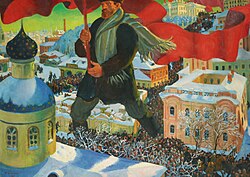 The Bolshevik, painting by Boris Kustodiev (1920)
 -
 A 2010 Azerbaijani stamp commemorating the 65th anniversary of the Allied victory in World War II, featuring Raising a Flag over the Reichstag


.jpg)


Current flags with socialist and/or communist symbolism
[edit]-
 Flag of the People's Republic of China; red symbolises revolution, the large star represents the Chinese Communist Party, and the four smaller stars represent the working class, the farmers, and the urban middle class, the rural middle class, respectively, as described by Mao Zedong.
 -
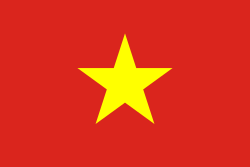 Flag of the Socialist Republic of Vietnam; red symbolises revolution, and the five-point star symbolises intellectuals, farmers, workers, traders and soldiers.
 -
 Flag of the Workers' Party of Korea; the hammer represents workers, the sickle represents farmers, and the paint brush represents artisans.


Former flags with socialist and/or communist symbolism
[edit]-
 Flag of the Democratic Republic of Afghanistan (1978–1980); the socialist-style emblem in the center represented the Khalq faction of the People's Democratic Party of Afghanistan.
 -
 Flag of the People's Republic of the Congo (1970–1991); red symbolised revolution, the star represented communism, while the hammer and hoe symbolised workers.
 -
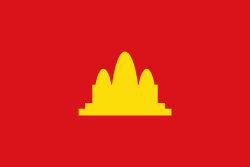 Flag of Democratic Kampuchea; red symbolised revolution, the silhouette of a temple represented Kampuchean tradition.
 -
 Flag of the People's Republic of Kampuchea; red symbolised revolution, the five-towered temple represented the unity of soldiers, traders, workers, peasants and intellectuals.
 -
 Flag of the Soviet Union (1955–1991); the hammer symbolised workers, the sickle represented farmers, and the red star symbolised the Communist Party.
.svg)


See also
[edit]


- Anarchist flag
- Bandiera Rossa
- Communist symbolism
- Flag of Angola
- Flag of Belarus
- Flag of China
- Flag of Kyrgyzstan
- Flag of Mongolia
- Flag of the Soviet Union
- Flag of Vietnam
- Flag of the Arab Revolt
- Green flag
- Hammer and sickle
- Racing flags § Red flag
- "The Red Flag"
- Red flag warning
- Red star
- Red triangle (badge)
- The Standard of Revolt
- White flag
References
[edit]- ^ Flags of the World, "Baucans (or Bauccedillian)".
- ^ Cited in "red flag", Oxford English Dictionary.
- ^ Nour, “L’Histoire du croissant,” p. 66/295. See also Ibn Khaldun, Muqaddimah, pp. 214–15.
- ^ Thomas Carlyle, French Revolution, p. 408.
- ^ Flags of the World, "French Revolution"
- ^ "Socialist History of the French Revolution"
- ^ ten Brink, Jan (1899). Robespierre and the Red Terror.
- ^ Frykman, Niklas (2020). The bloody flag: mutiny in the age of Atlantic revolution. Oakland (Calif.): University of California Press. pp. 147–148. ISBN 9780520355477.
- ^ Reddebrek (March 31, 2015). "1831: the Merthyr Rising and Dic Penderyn". LibCom. Retrieved March 25, 2022.
- ^ Attard, Joe (June 2, 2020). "The Merthyr Rising 1831: rage, rebellion and the red flag". International Marxist Tendency. Retrieved March 25, 2022.
- ^ Nofi (1992), p. 78.
- ^ "Unità d'Italia: Giuseppe Garibaldi, l'eroe dei due mondi". Sapere.it (in Italian). March 7, 2011.
- ^ Raw, Laurence (September 18, 2013). The Silk Road of Adaptation: Transformations across Disciplines and Cultures. Cambridge Scholars Publishing. p. 42. ISBN 9781443852890.
- ^ Marshall, Tim (July 4, 2017). A Flag Worth Dying For: The Power and Politics of National Symbols. Simon and Schuster. ISBN 978-1-5011-6833-8.
- ^ Flags of the World, "France"
- ^ Moissonnier, Maurice (1972). La premiere internationale et la commune a Lyon (1865–1871) [The international premiere and the commune in Lyon (1865–1871)] (in French). Paris: Editions sociales. p. 207. OCLC 902707001.
- ^ von Geldern, James (1993). Bolshevik Festivals 1917–21. Berkeley: University of California Press. p. 178. Archived from the original on November 26, 2018. Retrieved November 26, 2018.
- ^ Trachtenberg, Alexander (March 2002) [1932]. The History of May Day. Marxists.org. Retrieved January 19, 2008.
- ^ Foner, "The First May Day and the Haymarket Affair", May Day, pp. 27–39.
- ^ a b c Flags of the World, "Soviet"
- ^ [1]
- ^ Whitney Smith (2008). "Flag of Flag of Union of Soviet Socialist Republics". Encyclopædia Britannica. Retrieved November 5, 2008.
- ^ "National Flag of the People's Republic of China" (in Chinese). Gov.cn. May 24, 2005. Archived from the original on October 9, 2019. Retrieved November 8, 2009.
- ^ "Flag of Vietnam". Encyclopedia Britannica. Retrieved March 4, 2021.
- ^ Chacón, Hipólito Rafael (August 17, 2020). "The Global Legacy of Cuba's Estrella Solitaria (Lone Star Flag)" (PDF). North American Vexillological Association. Archived from the original (PDF) on August 17, 2020. Retrieved August 23, 2022.
- ^ "Barwy anarchistyczne: Skąd czarne i czarno-czerwone flagi?" [Anarchist colours: Where are black and black-red flags from]. cia.media.pl (in Polish). Centrum Informacji Anarchistycznej. June 19, 2012. Archived from the original on February 24, 2021. Retrieved September 4, 2016.
- ^ "Sultanate of Muscat and Oman until 1970 (Oman)". www.crwflags.com. Retrieved June 20, 2021.
- ^ Complete Flags of the World. Smithsonian Handbooks. 2007. p. 184. ISBN 978-0-7566-4115-3.
- ^ Nunn, Wilfred (1932). Tigris Gunboats: The Forgotten War in Iraq, 1914-1917. Naval Institute Press. p. 33. ISBN 978-1861763082.
{{cite book}}: ISBN / Date incompatibility (help) - ^ "National Flag of Bahrain". BBC News. BBC. Archived from the original on December 16, 2014. Retrieved June 16, 2012.
- ^ "Imperial era flag of Qatar". British Empire in the Middle East. Retrieved May 7, 2015.
- ^ 1997年阿克陶县行政区划 [1997 Akto County Administrative Divisions] (in Simplified Chinese). XZQH.org. December 31, 2010. Archived from the original on January 22, 2020. Retrieved September 30, 2020.
皮拉勒乡 1958年成立皮拉勒公社,1967年更名红旗公社,1984年改设皮拉勒乡。
- ^ 乌恰县行政区划和居民地名称 (in Simplified Chinese). xjwqx.gov.cn. June 4, 2018. Archived from the original on October 8, 2020. Retrieved October 21, 2019 – via Google Cache, Internet Archive.
- ^ 1997年乌恰县行政区划 [1997 Ulugqat County Administrative Divisions] (in Simplified Chinese). XZQH.org. December 31, 2010. Archived from the original on October 15, 2017. Retrieved October 5, 2020.
巴音库鲁提乡 {...}1950年成立巴音库鲁提三乡,1962年建巴音库鲁提公社,1968年更名红旗公社,1984年改设巴音库鲁提乡。
- ^ "The Red Rose of Labour". British Heritage. Retrieved July 24, 2023.
- ^ "The Red Flag ends Labour rally". BBC News. October 1, 1999. Retrieved December 21, 2011.
- ^ "Labour Party Anthems – Top 10 songs the Labour Party has used over the years". Daily Mirror. April 7, 2010. Retrieved December 21, 2011.
- ^ Weitz, Eric D. (1997). Creating German Communism, 1890-1990: From Popular Protests to Socialist State. Princeton University Press. pp. 91–92. ISBN 0691026823.
- ^ "The ISL in Australia". LIS-ISL.org. Retrieved March 22, 2020.
- ^ Красные знамена in the Great Soviet Encyclopedia (in Russian) – via Great Scientific Library
- ^ "Trades Hall". Melbourne Point. February 15, 2015. Retrieved December 1, 2018.
- ^ Balz, Hanno. "'Hostile take-over'. A political history of the red flag". Socialist History. 59: 8–30.
- ^ Zechariah Chafee, Jr., Freedom of Speech (NY: Harcourt, Brace and Howe, 1920), 180ff., Appendix V
- ^ Stromberg v. California, 283 U.S. 359 (1931).
- ^ War Precautions Repeal Act 1920 (Act 54). 1920.
External links
[edit] Media related to Red flags at Wikimedia Commons
Red flag (politics)
View on GrokipediaOrigins and Historical Development
Pre-19th Century Associations
In medieval and early modern European naval warfare, the red flag, often termed the "bloody flag," functioned as a signal of unrelenting combat and defiance, indicating no intention to grant quarter or truce to opponents. Deep red hues, derived from dyes like madder root or cochineal insects, evoked blood and suffering, serving practically for visibility amid smoke and distance rather than symbolic ideology. Historical records from the 17th century onward describe its hoisting from warship masts to declare battle without mercy, as codified in Royal Navy regulations by 1647.[8] By the 18th century, this martial connotation extended to piracy during the Golden Age, where captains like Edward England flew solid red flags—distinct from the black Jolly Roger—to warn merchant vessels that resistance would result in total annihilation, sparing no survivors. Such flags underscored a pragmatic threat of violence for deterrence and plunder, with red's bold visibility aiding rapid recognition at sea; surrender promised safety, but defiance invited extermination.[9] [10] Contemporary sources, including Chambers' Cyclopaedia (1728), explicitly defined the red flag as "a signal of defiance and battle," reflecting its role in pre-industrial conflicts as a marker of lethal intent unlinked to socioeconomic revolution.[8] These applications prioritized empirical utility—red's prevalence stemmed from abundant, fast-fixing dyes yielding durable, eye-catching fabric—over abstract notions like class struggle or martyrdom, which emerged later.[11]19th Century Revolutionary Adoption
During the Merthyr Rising of May and June 1831 in Wales, industrial workers protesting wage cuts and poor conditions raised a red flag as a symbol of defiance against ironmasters and authorities. The flag was reportedly fashioned by dipping a cloth in calf's blood to achieve its color, marking an early instance of its use in labor unrest tied to industrial strife.[12] An estimated 7,000 to 10,000 participants marched under it, briefly seizing control of Merthyr Tydfil before suppression by troops, resulting in deaths including that of soldier Donald Black and the execution of protester Dic Penderyn despite disputed evidence.[13] In France, red flags appeared on barricades during insurrections against the July Monarchy, including those of June 1832, April 1834, and May 1839, signifying radical opposition to monarchical rule.[14] These uses preceded broader adoption in the Revolutions of 1848, where workers in Paris and Lyon hoisted red banners during uprisings, associating the color with demands for social change beyond liberal reforms.[14] On February 25, 1848, provisional government leader Alphonse de Lamartine publicly rejected the red flag in favor of the tricolore, arguing it evoked memories of scaffold blood rather than republican liberty, though radicals persisted in its display.[15] Louis Auguste Blanqui, leader of insurrectionary clubs, defended the red flag in a February 1848 proclamation, linking it to the blood of martyrs from prior failed revolts and portraying it as the true emblem of popular sovereignty against elite compromise.[14] During the June Days uprising later that year, workers again flew red flags over barricades in Paris, defending them fiercely before brutal suppression by National Guard forces, which killed thousands and solidified the flag's tie to violent class confrontations.[16] These events highlighted the red flag's role in signaling anti-monarchist and proto-labor defiance, often met with state force that curtailed revolutionary gains.[14]Early 20th Century Institutionalization
The red flag's symbolic role in proletarian struggle, alluded to in Karl Marx and Friedrich Engels' Communist Manifesto (1848) as provoking bourgeois "convulsions of rage," received organizational endorsement through the International Workingmen's Association (First International, 1864–1876), where participants carried "blood red" flags during processions and congresses such as the 1866 Geneva meeting.[17][18] This usage reflected its established association with revolutionary defiance, though Marx and Engels emphasized class struggle over specific iconography, viewing the flag as a practical emblem of workers' unity amid contemporaneous perceptions of it signaling violent intent.[17] In the early 20th century, Russian Bolsheviks institutionalized the red flag during the 1905 Revolution, deploying it in mass demonstrations against tsarist rule, as depicted in Ilya Repin's painting of the October events where protesters brandished red banners to symbolize proletarian uprising.[19] Vladimir Lenin further elevated it as the "banner of the proletariat" in Bolshevik rhetoric, linking it causally to the seizure of state power through armed insurrection rather than reformist gradualism. By the 1917 October Revolution, red flags were hoisted over the Winter Palace and other seized sites, marking the Bolsheviks' formal adoption as a standardized symbol of communist victory and dictatorial rule by the working class.[20] The Bolshevik triumph facilitated the red flag's dissemination to international labor movements, evident in events like the 1919 Seattle General Strike, where over 60,000 workers halted city operations for five days, invoking red symbolism that alarmed authorities and media as a harbinger of "Bolshevik" disruption despite organizers' disavowals of violence.[21][22] This period saw socialist and communist parties worldwide, influenced by Lenin's Comintern (founded 1919), codify the flag in manifestos and rallies, though critics contemporaneously highlighted its ties to coercive tactics, as tsarist and provisional governments banned it for inciting rebellion.[23] Empirical records from strikes and congresses indicate its role shifted from ad hoc protest to ideological fixture, prioritizing revolutionary seizure over parliamentary means.Symbolism and Ideological Meanings
Associations with Labor and Revolution
In socialist and labor traditions, the red flag symbolizes the blood shed by workers in struggles against exploitation, a motif rooted in 19th-century accounts of revolutionary violence where blood-soaked items served as improvised banners during uprisings.[24] This interpretation frames the color as a marker of sacrifice for class unity, evoking the costs borne by laborers in early industrial conflicts.[25] The flag's adoption in organized labor dates to events like the 1831 Merthyr Rising, where Welsh ironworkers hoisted a red flag to protest wage reductions and assert collective defiance.[25] By 1890, it became central to International Workers' Day observances, first coordinated following the 1889 Paris congress of the Second International, with marchers carrying red banners to demand an eight-hour workday and symbolize proletarian solidarity across borders.[26] These May Day parades, observed annually since, feature the red flag to reinforce shared identity among participants in anti-capitalist demonstrations.[27] During strikes and labor marches, the red flag functions to build group cohesion, signaling readiness for collective action and commemorating past worker militancy. Historical examples include its display in early 20th-century European labor rallies, where it rallied strikers by invoking unified resistance to employers.[7] In ongoing International Workers' Day events, the flag continues to appear in processions, underscoring emotional bonds of solidarity among wage earners.[28] The 1889 song "The Red Flag," penned by Irish socialist James Connell, codifies this symbolism in verse, portraying the banner as the shroud of "martyred dead" from labor battles and a pledge of unwavering commitment to the workers' cause.[29] Sung at socialist gatherings and party conferences, it sustains the flag's role as an emblem of aspirational unity, prioritizing evocative imagery of struggle over detailed programmatic goals.[30]Links to Violence and Totalitarianism
The red flag served as the central emblem of the Soviet Union under Joseph Stalin, adorning state institutions during campaigns of mass repression that defined the regime's totalitarian character. From 1932 to 1933, the Holodomor—a man-made famine in Ukraine engineered through grain requisitions and border closures—resulted in approximately 3.9 million excess deaths, as calculated from demographic records and Soviet censuses.[31] The Great Purge of 1936-1938, targeting perceived enemies within the Communist Party, military, and society, led to roughly 682,000 documented executions, based on declassified NKVD archives. Complementing these were the Gulag forced-labor camps, where archival data indicate about 1.6 million prisoners perished from starvation, disease, and execution between the 1930s and 1950s.[32] Across communist regimes symbolized by the red flag, empirical tallies reveal a pattern of state-orchestrated violence on an unprecedented scale. The Black Book of Communism, drawing on historical records and survivor accounts, attributes nearly 100 million deaths worldwide to these systems in the 20th century, with the Soviet Union alone accounting for 20 million through executions, famines, and deportations.[33] In the People's Republic of China, the red-field national flag flew over the Cultural Revolution from 1966 to 1976, a Mao Zedong-led upheaval involving Red Guard purges that caused 1 to 2 million deaths via factional killings, suicides, and mob violence, per analyses of provincial reports and eyewitness testimonies.[34] These outcomes stemmed from ideological doctrines positing class struggle as perpetual, enabling one-party monopolies to frame suppression as revolutionary necessity, distinct from democratic governance where such symbols lack correlation with systematic lethality. Critiques grounded in causal analysis highlight how the red flag's revolutionary connotations facilitated propaganda that normalized coercion, contrasting with tricolors or stripes of pluralistic states that empirically avoided comparable death tolls. Post-archival revelations since 1991 have upheld high estimates despite debates over intent, underscoring the symbol's overlay on structures prioritizing power consolidation over individual rights. While some scholars affiliated with leftist institutions minimize figures by attributing deaths to policy errors rather than design, primary data from regime records affirm the totalitarian link.[35]Usage in Political Movements and Regimes
Anarchist and Trade Union Contexts
In anarcho-syndicalist traditions, the red-and-black diagonally bisected flag symbolized the fusion of socialist labor agitation—represented by red—with anarchist principles of direct action, autonomy, and opposition to state authority, as embodied by black.[36] This design gained prominence through organizations like the Confederación Nacional del Trabajo (CNT) and its affinity group, the Federación Anarquista Ibérica (FAI), which flew it during worker seizures of factories and land collectives in eastern Spain amid the 1936 revolution.[37] There, CNT-FAI militias numbering over 100,000 defended anarchist-held territories against both Nationalist forces and rival Marxist groups, implementing decentralized worker self-management that produced goods without capitalist or state hierarchies until Stalinist interventions eroded these experiments by 1937.[38] Trade unions outside strict anarchist circles also deployed the red flag as a emblem of class solidarity during industrial actions, signaling halted production and demands for better wages and hours. In the UK, during the May 1926 General Strike—coordinated by the Trades Union Congress to support 1.1 million coal miners facing 20-40% pay reductions—red flags appeared at picket lines and rallies involving up to 1.7 million workers across transport and manufacturing sectors, though the nine-day action ended in defeat after government mobilization of over 100,000 special constables and military reserves led to mass arrests and blacklisting.[39] Such uses often provoked legal repercussions under emergency powers, as seen in prosecutions for sedition tied to flag displays interpreted as incitements to unrest. Anarchists, however, harbored reservations about the red flag's dominance, associating its unadorned form with authoritarian socialism after the Bolsheviks co-opted it post-1917 while suppressing anarchist communes and federations—Moscow alone raided over 40 anarchist centers between April and June 1918, executing or imprisoning leaders.[40] This echoed Mikhail Bakunin's 19th-century warnings against centralized "red bureaucracy," where he argued that Marxist state control would inevitably betray libertarian worker aspirations, fostering vanguard rule over mutual aid; anarchists thus preferred black-red variants to underscore anti-statism amid clashes, such as those in Ukraine's Makhnovshchina where Nestor Makhno's 50,000-strong anarchist army allied temporarily with Bolsheviks before facing betrayal and dissolution in 1921.[41] These tensions highlighted irreconcilable divides: anarcho-syndicalists prioritized federated unions and expropriation without political parties, contrasting Bolshevik models that prioritized party dictatorship, leading to mutual accusations of deviation from revolutionary purity.[42]Soviet Union and Eastern Bloc
The red flag became the official state symbol of the Soviet Union following the Bolshevik Revolution, with the hammer-and-sickle emblem first proposed by artist Yevgeny Kamzolkin in 1918 for May Day decorations in Moscow, representing the alliance of industrial workers and peasants in pursuit of global communist revolution.[6] This design was formalized in the USSR's state flag in 1923, featuring a red field overlaid with the gold hammer, sickle, and a bordering star, and it remained in use until the Union's dissolution on December 26, 1991.[43] The red color denoted the blood of revolutionary martyrs and the socialist struggle, while the symbols underscored the regime's ideological commitment to proletarian unity and worldwide upheaval.[43] In the Eastern Bloc, Soviet-imposed communist governments after World War II adopted analogous red flags, incorporating hammer-and-sickle motifs or red stars to signify alignment with Moscow's doctrine, as seen in the flags of the German Democratic Republic (1949–1990) and the People's Republic of Poland (1944–1989), where red dominated as a marker of loyalty to Soviet-style socialism.[3] These flags were central to state propaganda, flown during mandatory parades and displayed on public buildings to reinforce the narrative of inevitable communist triumph, often juxtaposed with imagery of Lenin and Stalin to legitimize one-party rule.[44] During World War II, the red Victory Banner, a plain red field with no additional emblems, was raised over the Reichstag in Berlin on April 30, 1945, by Soviet soldiers of the 150th Rifle Division, symbolizing the Red Army's conquest and the USSR's pivotal role in defeating Nazi Germany.[45] This event, later immortalized in Yevgeny Khaldei's photograph, tied the red flag to Allied victory narratives but also facilitated the extension of Soviet influence, imposing red-banner regimes across Eastern Europe through occupations and puppet installations by 1948.[45] Under these red flag regimes, policies like forced agricultural collectivization from 1929 onward directly caused mass famines, including the Holodomor in Ukraine (1932–1933), where grain requisitions and suppression of private farming led to 3.9 million excess deaths, with ethnic Ukrainian mortality disproportionately high due to targeted Soviet enforcement.[46] Overall, the 1932–1934 Soviet famine claimed 6 to 8 million lives across Ukraine, Kazakhstan, and Russia, attributable to central planning failures that prioritized industrial quotas over food security, as evidenced by archival data on export-driven seizures amid domestic shortages.[47] Red flags accompanied propaganda glorifying these collectivizations as steps toward abundance, yet empirical records reveal causal links between state monopolies on production and distribution and the resulting starvation, with similar patterns replicated in Eastern Bloc land reforms post-1945.[48]China and Asian Communism
The red flag was central to the establishment of the People's Republic of China (PRC) in 1949, following the Chinese Communist Party's (CCP) victory in the Chinese Civil War against the Nationalists. The national flag, adopted on October 1, 1949, features a red background symbolizing the communist revolution, with five yellow stars arranged to depict the CCP's leadership over the unified Chinese people, including workers, peasants, and other social strata.[49] This design adapted Marxist-Leninist symbolism to Chinese nationalism, emphasizing party supremacy and revolutionary triumph, which enabled the CCP's consolidation of power and long-term rule despite internal upheavals. During the Cultural Revolution from 1966 to 1976, red flags proliferated as symbols of Maoist zeal, with Red Guards waving them in mass campaigns to purge perceived enemies and enforce ideological purity. The era saw widespread chaos, factional violence, and economic disruption, resulting in an estimated 1.1 to 1.6 million deaths from persecution and conflict, alongside tens of millions affected by displacement and trauma.[50] Scholarly analyses attribute this fervor, visually dominated by red banners and armbands, to Mao's cult of personality and power struggles, which undermined institutional stability but reinforced the red flag's association with unyielding party control.[51] In Vietnam, the red flag with a central yellow star, adopted after the 1945 August Revolution and retained post-1975 unification, symbolizes revolutionary bloodshed and the unity of laborers, peasants, soldiers, intellectuals, and youth under communist leadership.[52] Similarly, the Workers' Party of Korea's flag, featuring a red field with crossed hammer, sickle, and brush, represents workers, peasants, and intellectuals in North Korea's Juche ideology. These symbols persisted amid economic stagnation: North Korea's GDP per capita remains around $1,700, far below South Korea's $42,000, reflecting central planning's failures in fostering growth despite post-Korean War parity.[53] Vietnam experienced pre-1986 Doi Moi poverty under rigid communism but achieved rapid expansion—averaging over 6% annual GDP growth since reforms—by incorporating market mechanisms while retaining red flag iconography and one-party rule.[54] This adaptation highlights how Asian communist regimes blended red symbolism with nationalist pragmatism for regime continuity, prioritizing political monopoly over ideological purity.Western Political Parties and Protests
In Western democracies, the red flag has served as a historical emblem for socialist and labor movements, often symbolizing working-class struggle while prompting tensions over electoral viability. The United Kingdom's Labour Party adopted "The Red Flag" as its traditional conference anthem, a practice rooted in the early 1900s when delegates from the Independent Labour Party and Social Democratic Federation sang it to affirm socialist principles. Composed in 1889 by Irish activist Jim Connell during a train journey, the song's lyrics invoke defiance against capitalism but drew internal criticism by the 2010s for alienating centrist voters, particularly during Jeremy Corbyn's leadership when its revival at rallies underscored a perceived shift toward harder-left rhetoric. By the late 2010s and into the 2020s, party modernizers under Keir Starmer argued that such symbols evoked revolutionary connotations incompatible with broadening appeal, contributing to diluted usage amid electoral defeats in 2019 and strategic rebranding efforts.[55][56][57] The red flag also featured in mid-20th-century protests within Western Europe and the United States, where it denoted radical commitments amid broader youth-led upheavals. In France's May 1968 strikes, workers and students raised red flags over factories and universities during occupations involving over 10 million participants, framing demands for wage increases and university reforms through a lens of class conflict despite the movement's eclectic alliances. Across the Atlantic, U.S. anti-Vietnam War demonstrations by groups like Students for a Democratic Society incorporated red flags to signal Marxist influences, though their prominence often isolated activists from mainstream anti-war coalitions and foreshadowed the electoral marginalization of explicitly revolutionary factions. These instances underscored the flag's association with protest extremism rather than pragmatic politics, as radical symbolism correlated with limited influence on policy or voting outcomes in democratic systems.[58][59] Variants blending the red flag with Arab nationalist ideologies appeared in some Western solidarity protests, reflecting influences from Ba'athist socialism or Palestinian Marxist groups like the Popular Front for the Liberation of Palestine, which employed red banners alongside pan-Arab colors to merge anti-imperialism with class rhetoric. Ba'ath parties in Syria and Iraq incorporated red stripes in their flags to evoke revolutionary fervor tied to Arab unity, a motif echoed in Western leftist demonstrations supporting these causes during the mid-20th century. However, such hybrid symbolism remained niche, diluting the flag's purity while failing to translate into sustained electoral gains for aligned Western parties, which prioritized moderation over overt radicalism.[4][60]Other Regional Variations
In Latin American guerrilla insurgencies of the mid-20th century, red flags served as symbols of anti-imperialist revolt, often drawing from Cuban revolutionary precedents where red denoted blood shed for liberation and solidarity with proletarian internationalism. Groups such as Nicaragua's Sandinista National Liberation Front, which overthrew the Somoza regime in 1979, incorporated red banners in their iconography, reflecting influences from Augusto César Sandino's earlier red-black flags symbolizing labor struggles and anarcho-syndicalist roots adapted to Marxist guerrilla tactics.[61][62] In Africa, the Ethiopian Derg regime (1974–1991), a military council led by Mengistu Haile Mariam after his 1977 ascension to chairman, deployed red flags in official rallies and propaganda to embody its Soviet-aligned Marxist-Leninist doctrine, particularly during the Red Terror purges of 1977–1978 that targeted perceived counter-revolutionaries. The People's Democratic Republic of Ethiopia's flag (1987–1991) included a red horizontal stripe explicitly representing revolutionary bloodshed and socialist transformation, alongside green for fertile lands and yellow for mineral wealth, underscoring the regime's adaptation of communist symbology to local agrarian contexts.[63][64] Beyond state uses, Trotskyist organizations in the United Kingdom extended red flag symbolism into print media, with "The Red Flag" newspaper launched in 1933 by the British Section of the International Left Opposition as the first dedicated Trotskyist periodical, advocating permanent revolution and critiquing Stalinism through serialized agitation that persisted in variant forms amid 1970s factional splits within groups like the International Marxist Group.[65][66]Historical Bans and Restrictions
Early 20th Century Western Prohibitions
In the United States, the 1917 Bolshevik Revolution intensified fears of radical subversion, leading states to criminalize the red flag as a symbol of opposition to government during the First Red Scare (1917–1920). California's Penal Code § 403a, enacted in 1919, prohibited displaying a red flag "in any public place or in any meeting place... as a sign, symbol or emblem directed against organized government," reflecting concerns over anarchist and communist agitation.[67] This statute was tested in Stromberg v. California (1931), where the Supreme Court invalidated it 7–2, ruling the provision unconstitutionally vague and overbroad under the Fourteenth Amendment's free speech protections, as it encompassed legitimate political expression alongside incitement.[68] [69] Such measures stemmed from documented labor unrest, where red flags appeared in violent strikes; U.S. Bureau of Labor Statistics data recorded 3,600 strikes in 1919 involving over 4 million workers, with fatalities exceeding 300 in clashes often linked to radical elements waving red banners as defiance symbols.[70] The 1919 Steel Strike, for instance, saw union radicals deploy red flags amid riots that killed 18 and injured hundreds, amplifying perceptions of the symbol as a precursor to Bolshevik-style upheaval. In Europe, Germany's Weimar Republic faced analogous threats during the Spartacist uprising (January 5–12, 1919), when communists under Karl Liebknecht and Rosa Luxemburg raised red flags in Berlin to proclaim a soviet republic, sparking street fighting that claimed over 150 lives.[71] The provisional government, fearing contagion from Russia's revolution, authorized Freikorps militias to suppress the revolt and enacted emergency decrees restricting revolutionary insignia and assemblies, effectively curtailing public red flag displays as emblems of sedition.[72] These actions prioritized causal containment of violence over abstract symbolism, as Weimar officials cited the uprising's armed seizures and red flag-led occupations as empirical threats to nascent democracy.[73]Post-World War II and Cold War Measures
In Francoist Spain, the regime's suppression of communism extended into the post-World War II period, with the Spanish Communist Party remaining outlawed and public displays of associated symbols, including the red flag, treated as criminal acts under laws enforcing political uniformity and anti-subversive measures until Franco's death on November 20, 1975.[74] In the United States, the Second Red Scare from 1947 to 1957, epitomized by Senator Joseph McCarthy's investigations, targeted labor unions for alleged communist infiltration, resulting in the expulsion of eleven unions from the Congress of Industrial Organizations between 1949 and 1950 on charges of communist domination, which included scrutiny and removal of radical iconography such as red flags from union activities to avert subversion accusations.[75][76] The Hungarian Revolution of October 23 to November 4, 1956, saw widespread destruction of Soviet-imposed symbols, with revolutionaries removing red stars from public buildings, vandalizing Russian-associated sites, and tearing the communist coat of arms from the center of Hungarian national flags to signify rejection of Stalinist rule and Soviet occupation.[77][78] After regaining independence from the Soviet Union in 1991, the Baltic states implemented decommunization policies banning Soviet red flags and related emblems; Latvia and Lithuania, for instance, prohibited their public display as symbols of occupation and totalitarian repression, with Latvia's 1991 laws and subsequent 2014 amendments classifying such symbols alongside Nazi insignia as threats to national security and historical memory.[79]Empirical Outcomes and Criticisms of Associated Ideologies
Economic and Social Failures Under Red Flag Regimes
Regimes flying the red flag, emblematic of Marxist-Leninist ideologies, consistently exhibited economic underperformance attributable to centralized planning's inherent inefficiencies, including the absence of market price signals for resource allocation and diminished incentives for productivity. In the Soviet Union, gross national product growth averaged 5.7% annually in the 1950s but decelerated to 2.0% by the early 1980s, reflecting systemic stagnation from bureaucratic misallocation and technological lag.[80] Per capita economic growth from 1960 to 1989 reached only 2.4%, trailing capitalist economies like the United States, where comparable periods saw sustained higher rates driven by decentralized innovation.[81] The 1991 collapse saw GNP plummet by approximately 20% between 1989 and 1991, exacerbated by overreliance on oil exports and inability to adapt to falling global prices, underscoring the fragility of command economies lacking adaptive mechanisms.[82][83] China's Great Leap Forward (1958-1962), implemented under the red flag of the Chinese Communist Party, exemplifies catastrophic policy-induced failure, with collectivized agriculture and industrial targets causing widespread famine through exaggerated production reports and resource diversion to steel production. Demographic studies estimate 30 million excess deaths from starvation and related causes, with ranges from 23 to 45 million based on archival and census data analyses.[84][85] This disaster stemmed from central planners' disregard for local knowledge and incentives, leading to falsified outputs and grain requisitions that depleted rural food supplies. Similar patterns afflicted Eastern Bloc states, where GDP per capita growth lagged behind Western Europe by factors of two or more from the 1970s onward, with shortages in consumer goods persisting due to prioritized heavy industry over demand-responsive production.[86] Social outcomes under these regimes contradicted ideological promises of equality and progress, as measured by health and innovation metrics. Life expectancy in the USSR hovered around 69 years in the late 1980s, below the U.S. figure of 75, with stagnation after initial post-war gains reflecting chronic underinvestment in diverse healthcare amid resource distortions.[87] Innovation rates, proxied by patents per capita, were markedly lower in the USSR and Maoist China compared to the West; for instance, the Soviet Union filed fewer than one-tenth the patents per million people as the U.S. in the 1970s-1980s, hampering technological diffusion and consumer welfare.[88] Claims of egalitarian success overlook elite privileges in nomenklatura systems, which perpetuated de facto hierarchies while suppressing individual initiative essential for sustained social advancement.| Metric | USSR (1980s) | USA (1980s) |
|---|---|---|
| Annual GNP Growth | ~2% | ~3-4% |
| Life Expectancy (years) | 69 | 75 |
| Patents per Capita (relative) | <0.1x U.S. | Baseline |