Hubbry Logo
RotumaRotumaMain
Open search
Rotuma
Community hub
Rotuma
logo
8 pages, 0 posts
0 subscribers
Be the first to start a discussion here.
Rotuma
Rotuma
from Wikipedia

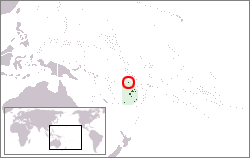
Rotuma (/rˈtmə/) is a self-governing heptarchy[citation needed], generally designated a dependency of Fiji. Rotuma commonly refers to the Rotuma Island, the only permanently inhabited and by far the largest of all the islands in the Rotuma Group. Officially, the Rotuma Act declares that Rotuma consists of Rotuma Island as well as its neighbouring islands, rocks, and reefs across the entire Rotuma Group. The dependency is situated around 500 km west of the French islands of Wallis and Futuna and a similar distance north of the Fijian mainland. Its capital is Ahau, a hamlet consisting of a number of colonial-era buildings. Rotuma exists as a dependency of Fiji but itself contains its own socioreligious pene-enclave[a] known traditionally as Faguta where the chiefs (of Juju and Pepjei) and their villages adhere to the practices of worship, festival dates, and French-based writing system of the Marists, based at Sumi.

Key Information

The island group is home to a large and unique Polynesian indigenous ethnic group which constitutes a recognisable minority within the population of Fiji, known as "Rotumans". Its population at the 2017 census was 1,594,[1] although many more Rotumans live on mainland Fijian islands, totaling 10,000.

History

[edit]

Origins according to oral history

[edit]

Rotuma was first inhabited according to record by people of Tahiti Nui, Marquesas, and Rapa Nui. At that time, it was known as Siria. Little was known about the exact years of migration from these far Eastern Kingdoms of those times. The only information known was that Rotuma was used by these three Kingdoms as the royal burial ground for the Kings and Queens of Tahiti Nui and Rapa Nui.

Rotuma was known as Siria by the indigenous peoples of Tahiti Nui and Rapa Nui as it was named after the star which lies exactly above the location of the island. Thus, the people of those days prayed to a mythical figure known as Tagaroa Siria. In remembrance of this old royal burial ground, a certain species of seaweed was given as a token of blood ties to remember the old and special bonds between Tahiti Nui and Rotuma. This particular species of seaweed is a delicacy amongst the islands, but it only grows on Tahiti and Rotuma. This seaweed species was said to be given by a Princess of Bora Bora. The princess' name was Teura ("redness") of Bora Bora, who married the legendary Prince Te-Fatu of Rotuma.

The first foreigner to arrive in Rotuma is sometimes named in oral tradition as Bulou ni Wasa, who arrived with her seven brothers. The name of the canoe that brought her and her family was known as Rogovoka. Her brothers left her on the island and made their way to Fiji. When she disembarked on Rotuma onto a rock which her priests called Vatu Vonu (Haf kafaghoi ta), the rulers of Rotuma are said to have immediately given her the name Tafatemasian, coincidently the same meaning as Adi Rarama ni Wasa (a spirit encircled with light). Without meeting her, some say Prince Sarefua and Princess Tefuimena decided that she be installed immediately as the ruler of the island as a gesture of welcome and therefore persuaded her to stay and rule the island.[citation needed]

Later settlers of the islands are believed to have come from Samoa, and were led by a man named Raho. In 1896, the scholar Friedrich Ratzel recorded a Samoan legend about Samoans' relationship to Rotuma:[2]

"Thus the Samoans relate that one of their chiefs fished in the vicinity of Rotuma and then planted coco-palms on the main island. In a later migration the chief Tokaniua came that way with a canoe full of men and quarrelled with the Samoan chief Raho about who had the right of possession."

Rotuman Revolution

[edit]

While Tongan forces invaded and occupied the island at one point in the 17th century, managing to consolidate their hold over the island and its people, eventually the Rotumans rebelled. According to the Acting-Resident Commissioner of Rotuma W.E. Russell, Rotumans ultimately overthrew their Tongan occupiers in a bloody uprising that took place over a single night.[3]

European contact

[edit]

Tupaia's Map is among the most important artifacts to have come from late 18th-century European–Indigenous encounters in the South Pacific region and features, in Epeli Hau‘ofa's terms, a "sea of islands" extending for more than 7,000 km from Rotuma in the west to Rapa Nui in the east and more than 5,000 km from Hawai‘i in the north to New Zealand in the south. The earliest known confirmed European sighting of Rotuma was in 1791, when Captain Edward Edwards and the crew of HMS Pandora landed in search of sailors who had disappeared following the Mutiny on the Bounty. Some scholars have suggested that the first European to sight the island was, instead, Pedro Fernandes de Queirós; his description of an island he sighted is consistent with the characteristics and location of Rotuma. However, this possibility has not been conclusively substantiated.

France, Catholicism, and Coquille

[edit]
Frenchman René Lesson whose sharing of his beliefs in 1824 was recorded as the first such occasion on the island. This act effectively rendered French Catholicism the first religion to reach Rotumans' ears.[4]

In 1824, French surgeon and naturalist René Lesson arrived in Rotuma onboard the vessel Coquille. Lesson observed that the Rotumans had no awareness of an afterlife; his revelation of such an idea therefore made French Catholicism, the official religion of the state of his employ, the Kingdom of France, the first faith shared with the Rotumans.[5] His catechising would subsequently be formalised and reinforced by French Marists two decades later, most especially in the formerly conjoined chiefdoms of Faguta, Pepjei and Juju, as well as extending into neighbouring districts, especially Ituʻtiʻu.

Whaling

[edit]

A favorite of whaling ships in need of reprovisioning, in the mid-nineteenth century Rotuma also became a haven for runaway sailors, some of whom were escaped convicts. Some of these deserters married local women and contributed their genes to an already heterogeneous pool; others met violent ends, reportedly at one another's hands. The first recorded whaleship to visit was the Loper in 1825, and the last known visit was by the Charles W. Morgan in 1894.[6] Rotuma was visited as part of the United States Exploring Expedition in 1840.

Tongan invasion and the Wesleyan agenda

[edit]

In the 1850s and 1860s, the Tongan prince Ma'afu claimed possession of Rotuma and sent his subordinates to administer the main island and its neighboring islets. Ma'afu had earlier made a serious effort to spread his Wesleyan beliefs to eastern Fiji and the Tongan invasion of Rotuma allowed him to consolidate its hold over a new group, the Rotumans in the north of the island.[7]

Cession to Britain

[edit]

Wesleyan missionaries from Tonga arrived on Rotuma in June 1841, followed by Catholic Marists in 1847. The Roman Catholic missionaries withdrew in 1853 but returned in 1868. Conflicts between the two groups, fuelled by previous political rivalries among the chiefs of Rotuma's seven districts, resulted in hostilities that led the local chiefs in 1879 to ask Britain to annex the island group. On 13 May 1881, Rotuma was officially ceded to the United Kingdom, when the British flag was hoisted by Hugh Romilly. The event is annually celebrated as Rotuma Day.

In 1881, a group of Rotuman chiefs travelled to Levuka, Ovalau, Fiji, to meet Queen Victoria's official representative to complete the process of cession. A memorial to the seven chiefs and their mission is located in the District of Ituʻtiʻu. In response to the cession, Queen Victoria bestowed the name of Albert on the paramount chief at the time - Gagaj Vaniak - in honour of her beloved husband, Prince Albert, who had died twenty years before. In June 2017, Pene Saggers (née Enasio) met with Her Majesty Queen Elizabeth II and together they spoke about the links between their ancestral lines and the cession of Rotuma.

After Rotuma was ceded to the United Kingdom, it was governed as part of the Colony of Fiji. Rotuma remained with Fiji after Fiji's independence in 1970 and the military coups of 1987.

Geography and geology

[edit]
Satellite image of Rotuma

The Rotuma group of volcanic islands are located 646 kilometres (401 miles) (Suva to Ahau) north of Fiji. Rotuma Island itself is 13 kilometres (8.1 miles) long and 4 kilometres (2.5 miles) wide, with a land area of approximately 47 square kilometres (12,000 acres),[8] making it the 12th-largest of the Fiji islands.

The island is bisected by an isthmus into a larger eastern part and a western peninsula. The isthmus is low and narrow, only 230 metres (750 ft) wide, and is the site of Motusa village (Ituʻtiʻu district). North of the isthmus is Maka Bay, and in the south is Hapmafau Bay. There is a large population of coral reefs in these bays, and there are boat passages through them.

Rotuma is a shield volcano made of alkali-olivine basalt and hawaiite, with many small cones. It reaches 256 metres (840 ft) above sea level at Mount Suelhof, near the center of the island. Satarua Peak, 166 metres (540 ft) high, lies near the eastern end of the island.[9] While they are very secluded from much of Fiji proper, the large reef and untouched beaches are renowned as some of the most beautiful in the Republic of Fiji.

There are several islands that lie between 50 metres (160 ft) and 2 kilometres (1.2 miles) distant from the main island, but are still within the fringing reef. They are:

There is also a separate chain of islands that lie between 3 kilometres (1.9 miles) and 6 kilometres (3.7 miles) to the northwest and west of Rotuma Island. In order, from northeast to southwest, these are:

The geological features of this island contribute to its national significance, as outlined in Fiji's Biodiversity Strategy and Action Plan.[11]

Pigs are so widespread in Rotuma their stone enclosures are a prominent feature of the island. Scientists conducting a botanical survey of the island in 2000 even remarked on this:[12]

"Pig rearing, often within elaborate stonewalled pens, is also an integral component of the agricultural system and has been recognized by Rotumans as having a considerable impact."

The Acting-Resident Commissioner of Rotuma, W.E. Russell, dubbed this network of stone pig sty fences the "Great Wall of Rotuma".[13]

Climate

[edit]
Climate data for Rotuma Island (1991–2020 normals)
Month Jan Feb Mar Apr May Jun Jul Aug Sep Oct Nov Dec Year
Record high °C (°F) 34
(93)
33
(91)
34
(93)
32
(90)
32
(90)
32
(90)
32
(90)
32
(90)
32
(90)
32
(90)
33
(91)
32
(90)
34
(93)
Mean daily maximum °C (°F) 31.2
(88.2)
31.1
(88.0)
31.1
(88.0)
31.1
(88.0)
30.7
(87.3)
30.0
(86.0)
29.7
(85.5)
29.7
(85.5)
29.9
(85.8)
30.3
(86.5)
30.8
(87.4)
31.1
(88.0)
30.6
(87.1)
Daily mean °C (°F) 28.1
(82.6)
28.1
(82.6)
28.1
(82.6)
28.1
(82.6)
27.9
(82.2)
27.5
(81.5)
27.2
(81.0)
27.2
(81.0)
27.3
(81.1)
27.5
(81.5)
27.9
(82.2)
28.1
(82.6)
27.8
(82.0)
Mean daily minimum °C (°F) 25.0
(77.0)
25.0
(77.0)
25.0
(77.0)
25.1
(77.2)
25.1
(77.2)
24.9
(76.8)
24.6
(76.3)
24.6
(76.3)
24.6
(76.3)
24.7
(76.5)
24.9
(76.8)
25
(77)
24.9
(76.8)
Record low °C (°F) 20
(68)
21
(70)
21
(70)
22
(72)
20
(68)
20
(68)
18
(64)
20
(68)
19
(66)
17
(63)
20
(68)
20
(68)
17
(63)
Average precipitation mm (inches) 359.9
(14.17)
312.8
(12.31)
359.5
(14.15)
264.5
(10.41)
275.8
(10.86)
274.2
(10.80)
249.0
(9.80)
248.2
(9.77)
289.1
(11.38)
355.4
(13.99)
323.5
(12.74)
322.7
(12.70)
3,634.6
(143.09)
Average precipitation days (≥ 1.0 mm) 19.9 19.0 19.5 18.4 15.9 17.1 17.1 17.2 17.9 18.4 17.9 19.1 217.4
Average relative humidity (%) 83 83 83 84 83 82 82 81 81 82 83 82 82
Mean monthly sunshine hours 166.2 162.6 177.8 194.2 194.5 178.9 194.1 201.4 179.5 193.2 188.7 182.4 2,213.5
Source 1: World Meteorological Organization[14]
Source 2: Deutscher Wetterdienst[15]

Flora and fauna

[edit]
Mofmanu beach in Motusa, Rotuma

A 4,200-hectare (10,000-acre) area covering the main island and its small satellite islets is the Rotuma Important Bird Area. The Important Bird Area covers the entire range of the vulnerable Rotuma myzomela, and the Rotuman subspecies of Polynesian starling and Fiji shrikebill. Rotuma also supports isolated outlying populations of Crimson-crowned fruit dove and Polynesian triller. The offshore islets of Haʻatana, Hofliua and Hatawa have nationally significant seabird colonies.[16]

Demographics

[edit]

Although the island has been politically part of Fiji since 1881, Rotumans are Polynesians and their culture more closely resembles that of the Polynesian islands to the east, most noticeably Tahiti, Tonga, Samoa, Futuna, and Uvea. Because of their Polynesian appearance and distinctive language, Rotumans now constitute a recognizable minority group within the Republic of Fiji. The great majority of Rotumans (9,984 according to the 2007 Fiji census) now live elsewhere in Fiji, with 1,953 Rotumans remaining on Rotuma.

Population in Rotuma[17]
Year Population
1986 2588
1996 2619
2007 1893
2017 1594

Rotumans are staunchly conservative culturally and maintain their customs in the face of changes brought about by increased contact with the outside world; social trends which have emerged elsewhere have remained entirely unwelcome in Rotuma. As recently as 1985, some 85 percent of Rotumans voted against opening the island up to tourism, concerned about the impact of an influx of secular tourist outsiders. P&O Cruises landed on the island only twice in the 1980s. Rotumans' inherent conservatism has led to a strict form of sociodemographic preservation. Indians and Chinese have no presence in Rotuma, unlike other Fijian islands, where these groups have managed to acquire property and establish themselves; this is because in Rotuma landholdings are held exclusively for the use and benefit of the island's own Rotuman people.

Notable Rotumans and people of Rotuman descent

[edit]

Politics and society

[edit]

Political offices

[edit]

Rotuma is divided into seven districts, each with its own chief (Gagaj ʻes Ituʻu). The district chiefs and elected district representatives make up the Rotuma Island Council. The districts are divided into subgroupings of households (hoʻaga) that function as work groups under the leadership of a subchief (gagaj ʻes hoʻaga). All district headmen and the majority of hoʻaga headmen are titled. In addition, some men hold titles without headship (as tög), although they are expected to exercise leadership roles in support of the district headman. Titles, which are held for life, belong to specified house sites (fuạg ri). All the descendants of previous occupants of a fuạg ri have a right to participate in the selection of successors to titles.

Participants of the formal tautoga dance sometimes wear the lengthy tailfeathers of the white-tailed tropicbird, called the "täväke" in Rotuman

On formal occasions, titled men and dignitaries such as priests, ministers, government representatives, and distinguished visitors occupy a place of honor. They are ceremonially served food from special baskets and kava. In the daily routine of village life, however, they are not especially privileged. As yet no significant class distinctions based on wealth or control of resources have emerged, but investments in elaborate housing and motor vehicles by a few families have led to visible differences in standard of living.

At the time of arrival by Europeans, there were three pan-Rotuman political positions created by the Samoan invaders: the fakpure, the sạu, and the mua. The fakpure acted as convener and presiding officer over the council of district headmen and was responsible for appointing the sạu and ensuring that he was cared for properly. The fakpure was headman of the district that headed the alliance that had won the last war. The sạu's role was to take part in the ritual cycle, oriented toward ensuring prosperity, as an object of veneration. Early European visitors referred to the sạu as "king", but he actually had no secular power. The position of sạu was supposed to rotate between districts, and a breach of this custom was considered to be incitement to war. The role of mua is more obscure, but like the sạu, he was an active participant in the ritual cycle. According to some accounts the mua acted as a kind of high priest.

Following Christianisation in the 1860s, the offices of sạu and mua were terminated. Colonial administration involved the appointment by the governor of Fiji of a Resident Commissioner (after 1935, a District Officer) to Rotuma. He was advised by a council composed of the district chiefs. In 1940 the council was expanded to include an elected representative from each district and the Assistant Medical Practitioner. Following Fiji's independence in 1970, the council assumed responsibility for the internal governance of Rotuma, with the District Officer assigned to an advisory role. Up until the first coup, Rotuma was represented in the Fiji legislature by a single senator.

Elections

[edit]

Administratively, Rotuma is fully incorporated into Fiji, but with local government so tailored as to give the island a measure of autonomy greater than that enjoyed by other political subdivisions of Fiji. At the national level, in the past Fijian citizens of Rotuman descent elected one representative to the Fijian House of Representatives, and the Council of Rotuma nominated one representative to the Fijian Senate. Rotuma was also represented in the influential Great Council of Chiefs by three representatives chosen by the Council of Rotuma. For electoral purposes, Rotumans were formerly classified as Fijians, but when the Constitution was revised in 1997–1998, they were granted separate representation at their own request. (The majority of seats in Fiji's House of Representatives are allocated on a communal basis to Fiji's various ethnic groups.) In addition, Rotuma forms part (along with Taveuni and the Lau Islands) of the Lau Taveuni Rotuma Open Constituency, one of 25 constituencies whose representatives are chosen by universal suffrage.

Social control

[edit]

The hoʻaga, a kinship community, was the basic residential unit in pre-contact Rotuma.[22] The basis for social control is a strong socialisation emphasis on social responsibility and a sensitivity to shaming. Gossip serves as a mechanism for sanctioning deviation, but the most powerful deterrent to antisocial behavior is an abiding belief in imminent justice, that supernatural forces (the ʻatua or spirits of ancestors) will punish wrongdoing. Rotumans are a rather gentle people; violence is extremely rare and serious crimes nearly nonexistent.

Conflict

[edit]

Prior to cession, warfare, though conducted on a modest scale, was endemic in Rotuma. During the colonial era political rivalries were muted, since power was concentrated in the offices of Resident Commissioner and District Officer. Following Fiji's independence, however, interdistrict rivalries were again given expression, now in the form of political contention. Following the second coup, when Fiji left the Commonwealth of Nations, a segment of the Rotuman population, known as the "Mölmahao Clan" of Noaʻtau rejected the council's decision to remain with the newly declared republic. Arguing that Rotuma had been ceded to the United Kingdom and not to Fiji, in 1987 these rebels attempted to form an independent aristocratic maritime republic which they called the Republic of Rotuma but they were promptly charged with sedition and the entity disintegrated almost immediately. It did not have any substantive support and while majority opinion appears to favor remaining with Fiji some rumblings of discontent remain.

Territorial divisions

[edit]
Schematic map of Rotuma indicating districts and main villages

Rotuma's seven districts can be grouped into three agglomerations: the medial and northern districts, the capital district, and the traditional territory of Faguta (whose special character was effectively agreed to by all Rotuma's chiefs in 1871 in the Treaty of Hamelin).

Medial and northern districts

[edit]

Noaʻtau

[edit]

Noaʻtau (extreme southeast) contains the villages Fekeioko, Maragteʻu, Fafʻiasina, Matuʻea, ʻUtʻutu, and Kalvaka.

Oinafa

[edit]

Oinafa (east) contains the villages Oinafa, Lopta, and Paptea.

Malhaha

[edit]

Malhaha (north) contains the villages Pepheua, ʻElseʻe, and ʻElsio.

Ituʻmuta

[edit]

Ituʻmuta (western peninsula) contains the villages Maftoa and Lopo.

Capital district

[edit]

Ituʻtiʻu

[edit]

Ituʻtiʻu (west, but east of western peninsula) contains the villages Savlei, Lạu, Feavại, Tuạʻkoi, Motusa, Hapmak, Losa, and Fapufa.

ʻAhạu, also located in the District of Ituʻtiʻu, is the capital and where the "tariạgsạu" (traditionally the name of the sạu's palace) meeting house for the Council of Rotuma is based which functions as Rotuma's seat of government.

Faguta

[edit]

The southern part of Rotuma is known traditionally as Faguta, a territory encompassing Juju and Pepjei, whose chiefs lead socioreligious communities which follow the ecclesiastical, cultural, and linguistic teachings of the Marists of France.[23]

Faguta
Ituʻu Location Villages
Juju south
  • Juju
  • Tuại
  • Haga
Pepjei southeast
  • ʻUjia
  • Uạnheta
  • Avave

Ituʻu is a Rotuman geographic term typically considered equivalent to a chiefdom or district.

Timeline of Faguta

[edit]

The main island in the Rotuma Group was formerly partitioned into five parts. One of these parts, Faguta, was located to the south of Rotuma Island, across the strait from Solnohu island. Faguta's chief, alongside the chief of Noatau, were generally considered the most influential of all those across the island and effectively governed the island's south and north, respectively. The significance of these two chiefs was reflected in the fact that the position of the head of the island's governing council alternated between the chief of Faguta and the chief of Noatau, depending on which of the two had been victorious in the last conflict between them. However, following victory and invasion by opposing forces (internecine conflict was endemic for centuries on Rotuma), Faguta was forcibly divided into two by the other districts' chiefs in an effort to weaken its influence, thereby forming Juju and Pepjei (although the territory is still commonly referred to by the two districts' inhabitants and descendants as "Faguta").[24]

Mythology centred around Faguta

[edit]
Local mythology tells of two turtles which live off the coast of Faguta, one red and one white. Green sea turtles, which are known to frequent the islands of Fiji, can actually exhibit reddish and whitish hues on their carapaces and plastrons, respectively.

Solnohu, a islet off the southern coast of Faguta roughly equidistant between its constituent districts, is the location of a significant local myth, "The turtle of Sol Onau". The myth tells of two local girls who fall from atop the island into the sea below. There, the two were transformed into sea turtles, one red and one white. Local beliefs hold that these two turtles, called 'Eao', continue to live around the coral of the rock and will resurface if a particular chant is performed.

Eao manuse, ka Lepiteala
Ai, ma vehia ka foro ole tufe,
Havei, ma foiak ta ka fau paufu,
He ta jauaki, ma moiea. Pete.

Traditional chant for sea turtles from "The Natives of Rotuma", (1898).[25]

J. Stanley Gardiner, who visited the island and wrote extensively on the locals' customs and myths wrote that he took Gagaj Mou, the chief of Pepjei, and five girls to recite the traditional chant. Gardiner recorded that from his vantage point out front he actually noticed the appearance of a green turtle. Green sea turtles are often located in the waters of Fiji and Rotuma.

He also recorded that Mou, the chief, as well as the others stated that they had regularly seen the turtle and that beach between Faguta and Solnohu was a frequently used feeding spot for the reptile.[26]

Fagutan culture

[edit]

Fagutan people, like all Rotumans, celebrate the traditional festival of Fara. This involves the residents of Faguta's villages (Juju, Tuại, Haga, Ujia, Uạnheta, and Avave) visiting other village communities, singing and dancing, where they are often invited inside by the local hosts. In exchange, the guests are served watermelon as a sort of reward for providing entertainment and are often doused in perfume, talcum powder, or turmeric. Across the island, these sorts of celebrations continue until mid-January. Fagutan Fara however begins much later in December (on December 24) than celebrations held elsewhere on the island.[27]

Notable Fagutans

[edit]

The term "Fagutan" commonly refers to those who live in the two Fagutan districts (Juju and Pepjei) or those with cultural or family ties to the area. Notable examples include:

Charles Chowe Howard, a Fagutan resident and forefather of much of Haga's population.
  • Charles Chowe Howard: beachcomber and longtime resident of Faguta. The village of Haga (written as "Hanga") in Juju was said to be primarily populated by Howard's own descendants, and it was theorised by the Acting-Resident Commissioner of Rotuma W.E. Russell that this bloodline contributed to these Fagutans' paler complexions when compared with other Pacific islanders and their referring to themselves as "white" and other islanders as "black men".[28]
  • Christine Rovoi: journalist, essayist, and writer in Fiji and New Zealand. Rovoi was born in Suva but with Fagutan ties was taught Rotuman using the French-based orthography used in Faguta.[29][30]

See also

[edit]

Notes

[edit]

References

[edit]
[edit]
Revisions and contributorsEdit on WikipediaRead on Wikipedia
from Grokipedia

Rotuma is a dependency of comprising Rotuma Island and several smaller islets, situated in the South at approximately 12.50° S and 177.13° E , about 465 kilometers north of 's main s. The main measures 13 kilometers in length and 4 kilometers in width, with a total land area of around 44 square kilometers and a highest of 256 meters. Its stood at 2,002 residents according to the 2007 , though the total number of including those living elsewhere in exceeds 10,000 due to significant migration. Ethnically Polynesian, maintain a distinct culture influenced by Tongan and Samoan traditions, including a unique language and social structures centered on groups known as kainaga, setting them apart from Fiji's predominantly Melanesian iTaukei .
Historically, Rotuma's chiefs petitioned for British protection in 1879 amid threats from French interests, leading to its formal cession to the on May 13, 1881, after which it was administered as part of the . Following Fiji's independence in 1970, Rotuma retained its status as a dependency with a measure of local governed by the Rotuma , which advises on district affairs and elects representatives to Fiji's , reflecting its seven traditional districts each led by a chief. This arrangement has preserved Rotuma's communal land tenure and cultural practices, such as elaborate music and dance rituals, while integrating it politically with despite occasional calls for greater independence.

History

Pre-Colonial Era and Oral Traditions

Rotuma's indigenous population originated from Polynesian voyagers, with archaeological evidence from the island indicating dating back approximately 1,700 years, consistent with broader patterns of eastward expansion in . Linguistic features of Rotuman, including lexical influences from Western Polynesian languages such as Samoan and Tongan, point to sustained interactions predating European contact and supporting a Polynesian cultural and genetic continuum. Genetic analyses of Rotuman samples reveal closer affinity to Polynesian groups than to neighboring Melanesian populations, with markers indicating admixture but predominant Polynesian ancestry shaped by voyaging networks rather than isolation. Societal organization in pre-colonial Rotuma centered on seven semi-autonomous , each led by a gagaj 'es itu'u (district chief) who mediated disputes, allocated resources, and represented the in inter-group affairs. were subdivided into ho'ag ( groups), fostering localized while chiefs' powers remained bounded by consensus-based councils and obligations, preventing centralized tyranny. Inter- rivalries, often rooted in for prestige, marriage , or fertile lands, periodically erupted into armed that realigned power through victorious coalitions, with the leading chief of the winning assuming temporary pan-island roles like fakpure (). These dynamics maintained a fragmented political landscape, where no single authority dominated, as evidenced by the absence of monumental chiefly structures in archaeological surveys compared to other Polynesian societies. Oral traditions preserved accounts of ancestral migrations from western Polynesia, emphasizing canoe voyages guided by navigators and spirits, which established foundational clans and district boundaries. Social hierarchies in these narratives positioned gagaj lineages as semi-divine, with deceased chiefs transforming into atitu (ancestral spirits) capable of bestowing prosperity or misfortune, reinforcing chiefly authority through ritual taboos and offerings. While such stories encode genealogical knowledge spanning generations, their verification relies on cross-referencing with linguistic phylogenies and site distributions, which confirm multi-phase settlements but reveal mythic elements exaggerating heroic feats beyond empirical traces like adze tools or pottery shards. This oral corpus, transmitted via chants and feasts, underscores causal links between migration success, hierarchical stability, and environmental adaptation in a resource-scarce atoll setting.

European Exploration and Early Contacts

The first recorded European sighting of Rotuma occurred on 23 August 1791, when Captain Edward Edwards of HMS Pandora identified the island during his search for the mutineers of . Edwards' crew made , marking the initial documented interaction, though substantive exchanges were limited due to the expedition's primary mission. Subsequent European contacts intensified from the onward, primarily through visits by American and British whaling vessels seeking fresh provisions such as yams, coconuts, and water. Rotuma's fertile lands and hospitable reception made it a favored stopover until the whaling industry's decline around 1870, facilitating early trade in European goods like iron tools and cloth for local produce. These interactions occasionally included survivors and escaped sailors settling on the island, introducing limited European influences two decades after initial discovery. In May 1824, the French corvette Coquille, under Louis-Isidore Duperrey, anchored at Rotuma as part of a scientific , with naturalist René-Primevère documenting Rotuman society, language, and customs. noted the absence of formalized beliefs in an among Rotumans, an observation that later informed French missionary approaches by highlighting potential receptivity to . Catholicism was introduced in 1846 when French Marist priest Pierre Verne arrived aboard a French warship, conducting the first on the and establishing an initial foothold for activity. These early contacts inadvertently transmitted European diseases, contributing to significant declines through epidemics that eroded pre-contact demographics, though precise early mortality figures remain undocumented.

Tongan Influence and Internal Conflicts

In the , according to Rotuman oral traditions and genealogical estimates, a Tongan chief named Ma'afu from Niuafo'ou invaded Rotuma with approximately 300 warriors in several large canoes, landing at Noa'tau . Initially allying with local chief Urakmata of Noa'tau to conquer other , Ma'afu subsequently subjugated Noa'tau itself, marrying Urakmata's daughter and establishing Tongan control over the island for about a generation. He appointed Tongan subordinates as chiefs, who imposed harsh labor demands and degrading punishments on the population, such as forcing locals to endure physical indignities during communal tasks. This oppression stemmed from efforts to extract resources and consolidate authority amid pre-existing rivalries, creating leadership vacuums exploited by external incursions. Resistance to Tongan rule arose from resource competition and resentment toward imposed hierarchies, culminating in a rebellion led by local figures like Pau of Itu'ti'u, who mobilized Rotuman forces to defeat Ma'afu at Itu'ti'u, resulting in his death and the elevation of Pau as (sau). Despite the overthrow, Tongan descendants retained ceremonial influence, particularly in Noa'tau, where Ma'afu's lineage (the Marafu) held elevated status, perpetuating hybrid chiefly lines that intertwined Rotuman and Tongan elements. These dynamics exacerbated internal power struggles among Rotuma's seven districts, where competition for , fishing grounds, and prestige fueled intermittent warfare, often resolved temporarily through alliances but leaving underlying tensions unresolved. Renewed Tongan influence arrived in the 19th century through Wesleyan missionaries dispatched from , who landed on Rotuma in 1841 under John Waterhouse, introducing and aligning with amenable local chiefs to advance conversions. This agenda intersected with district conflicts, as pro-Wesleyan chiefs like Maraf of Noa'tau—whose Tongan-descended lineage benefited from missionary support—gained leverage against rivals, transforming secular rivalries into religious divides by the 1860s under figures like Rev. William Fletcher. Catholic missionaries arrived in 1847 but withdrew amid hostilities, leaving Wesleyans dominant; the ensuing wars, including a 1871 battle at Motusa (under 100 casualties) and a 1878 conflict between Wesleyan-aligned northern districts and Catholic/unconverted southern ones, killed fewer than 100 but solidified Methodist control through strategic chiefly alliances. These external alignments mitigated immediate chaos by empowering Wesleyan-backed chiefs, who leveraged missionary resources and ideology to suppress opposition, such as the death of resistant chief Riamkau of in 1878, ending major hostilities. Methodist dominance ensued, with over 90% of Rotumans converting by the late 1870s, as the faith's hierarchical structure mirrored and reinforced chiefly authority derived from prior Tongan models. This resolution via foreign-influenced coalitions addressed leadership vacuums but highlighted causal reliance on external powers for stability, paving the way for unified petitions to colonial authorities.

Cession to Britain and Colonial Administration

In response to ongoing internal conflicts and threats of external invasion, particularly from , Rotuman chiefs petitioned for protection, leading to the voluntary of the island. On 13 May 1881, the chiefs signed a of Cession formally transferring sovereignty to , with the British flag raised to mark the event. This act followed 's own cession in 1874 and was motivated by the desire for stability amid religious wars and Tongan incursions that had destabilized the island since the early . Rotuma was subsequently administered as an integral part of the British Colony of Fiji rather than as a standalone protectorate, with a Resident Commissioner appointed to oversee governance from Suva. The commissioner functioned as both magistrate and interpreter of local customs, preserving certain Rotuman traditions while enforcing colonial law. A land commission was established shortly after cession to formalize tenure systems, registering communal lands under chiefs and districts to prevent disputes and facilitate orderly administration. This integration provided administrative continuity, with Rotuma's council of chiefs retained in an advisory capacity, though ultimate authority rested with the Fiji colonial government. The first colonial census, conducted in 1881, recorded a of 2,452, reflecting recovery from prior warfare but still vulnerable to epidemics. Under British rule, the island experienced relative peace, enabling gradual economic shifts toward a cash-based system, including production for export, which supplemented and . developments, such as basic roads and a station, supported administrative functions and trade links to , contributing to population stabilization before a outbreak in 1911 reversed short-term gains.

Post-Independence Integration with Fiji

Upon 's attainment of independence from Britain on October 10, 1970, Rotuma retained its distinct administrative autonomy as a self-governing dependency within the new . The Rotuma Island Council, comprising district chiefs and elected representatives, assumed direct responsibility for internal governance, including oversight of local bylaws, , and cultural affairs, while the appointed District Officer transitioned to an advisory role without executive authority. This structure, formalized through ordinances carried over from colonial administration, allowed Rotuma to maintain heptarchic traditions—governance by seven traditional districts—distinct from 's provincial system, with the Fijian holding ultimate oversight and funding channeled via the annual Rotuma Counterpart Fund. The 2013 Constitution of Fiji explicitly recognizes as an indigenous group with unique customs, traditions, and land ownership rights, embedding provisions for their cultural preservation and local self-rule. Early post-independence tensions arose from ambiguities in central-local authority. In 1970, a dispute erupted between the District Officer and the Rotuma Council over administrative precedence, highlighting Rotumans' resistance to diminished local control under the new national framework. These frictions persisted amid Fiji's political instability, particularly the coups of May and 1987, which ousted the elected and installed indigenous Fijian paramountcy under . In response to the republican declaration on September 25, 1987, the Rotuma Council convened and passed a resolution to disassociate from , citing fears of marginalization in the coup-driven ethno-nationalist shift. Expatriate leader , from , proclaimed the short-lived Republic of Rotuma, raising a provisional and appealing unsuccessfully to Queen Elizabeth II for support; the initiative lacked broad island consensus, international backing, and logistical viability, collapsing within months. Subsequent coups in 2000 and 2006 further strained integration but did not dismantle Rotuma's status, as Rotumans leveraged reserved parliamentary seats—historically including a dedicated Senator—and council representation to advocate for autonomy. Rotuman migration to urban Fiji, particularly Suva, has amplified their national influence, with migrants achieving overrepresentation in professional fields like medicine, law, and civil service by the 1990s. Remittances from this diaspora, alongside overseas earnings, have become a key economic pillar, funding household livelihoods and infrastructure on Rotuma, where surveys indicate 15% of households rely on combined wage and remittance inflows. In 2023, Rotuma secured three seats on Fiji's revived Great Council of Chiefs, enhancing Rotuman voices in chiefly deliberations and national policy. These dynamics reflect pragmatic integration, balancing autonomy with economic interdependence amid periodic separatist undercurrents.

Geography and Environment

Physical Features and Geology

Rotuma comprises a main volcanic island and eight surrounding islets, with a total land area of approximately 44 square kilometers. The main island measures about 13 kilometers in length and 4 kilometers in width, featuring rugged terrain formed by extinct volcanic craters that rise to elevations of up to 260 meters above sea level. Geologically, Rotuma originated as part of an island-arc system, with basaltic volcanic activity shaping its landforms during the Miocene epoch, followed by subsidence and coral reef development. The island's is characterized by a narrow of sand and debris bisecting it into a larger eastern section and a smaller western , enclosing a shallow on the northern side. Fringing reefs encircle the coastline, providing natural barriers but limiting deep-water access, with the reefs composed primarily of growth over volcanic substrates dating back to the . Seismic activity poses a potential due to Rotuma's position within the tectonically active Fiji-Tonga region, though geological assessments indicate no active , as evidenced by the absence of recent eruptive features or magmatic intrusions in surveys of the island's compositions.

Climate Patterns

Rotuma features a tropical maritime climate with consistently high temperatures and abundant rainfall, exhibiting minimal seasonal variation due to its equatorial proximity. Daily high temperatures average 30–31°C year-round, while lows range from 25–26°C, with an annual mean around 27°C based on historical observations from 1980 to 2016. remains near saturation, exceeding 80% on average, fostering muggy conditions throughout the year. Precipitation totals approximately 3,000 mm annually, with a pronounced from to characterized by monthly averages of 200–300 mm, driven by southeast and convergence zones. The drier period from May to sees reduced rainfall of 100–150 mm per month, though no true exists, as wet days occur year-round with over 10 days of measurable rain monthly. peaks during the wet season at around 80–90% , contrasting with clearer skies (40–50% clear) in the drier months. The island lies within the South Pacific cyclone belt, experiencing tropical s primarily from to , which contribute up to 20% of seasonal rainfall through intense downpours and gusts exceeding 100 km/h. Historical records indicate high variability, with Fiji-wide data showing an average of 1–2 cyclones passing within 400 km of northern islands like Rotuma per year over 1969–2010, though direct impacts occur less frequently. These events disrupt by causing flooding and wind damage, reducing viability for rain-fed crops like , as evidenced by correlations between cyclone-induced extremes and yield declines in Pacific island records.

Biodiversity and Natural Resources

Rotuma's comprises over 500 of indigenous and introduced , reflecting Polynesian introductions such as coconuts (Cocos nucifera), (Colocasia esculenta), and (Artocarpus altilis), alongside native coastal adapted to volcanic soils and saline conditions. The littoral vegetation includes 99 recorded , with only eight endemics primarily among dicotyledons, though 37% face threats from habitat alteration and , contributing to an overall impoverished coastal compared to mainland . Introduced dominate agricultural plots, supporting subsistence farming on the island's fertile, undulating coastal flats. Terrestrial fauna is depauperate due to Rotuma's small size and isolation, lacking amphibians and featuring 11 species, 15 landbirds—including the endemic and vulnerable Rotuma myzomela (Myzomela chermesina), a small whose remains stable—and two native mammals, likely bats. Seabirds, such as tropicbirds and terns, utilize offshore islets like Uea for breeding, while introduced rats and cats pose predation risks to ground-nesting . Marine supports subsistence fishing, with over 425 reef-associated fish targeted via traditional methods like spearing and netting, yielding assemblages dominated by parrotfishes, surgeons, and groupers. Natural resources center on renewable assets for local use, including timber from native hardwoods for construction and fuel, though from clearing for patches and production has reduced forest cover since colonial times. Conservation efforts, led by the community-based LäjeRotuma Initiative since the early 2000s, promote awareness of threats, habitat restoration, and sustainable practices to mitigate and amid agricultural expansion. These initiatives emphasize protecting endemic taxa and health without formal reserves, relying on customary to balance exploitation with resilience.

Demographics and Migration

The population of Rotuma stood at 1,594 according to Fiji's 2017 census, with the vast majority comprising ethnic of Polynesian ancestry. Minorities include small numbers of indigenous and other groups such as Europeans or part-Europeans, though these constitute less than 5% of residents based on historical patterns persisting into recent decades. The island's dependency status within results in occasional inflows of administrative personnel, but the core demographic remains overwhelmingly indigenous Rotuman. Population trends indicate a sustained decline, with an annual growth rate of -2.3% recorded around the 2017 period, driven primarily by net out-migration to mainland and beyond. Historical data show a peak of approximately 2,929 residents in 1946, followed by progressive reductions as economic opportunities elsewhere drew residents away. This outflow has skewed age distributions, particularly depleting the 20-29 male cohort, as evidenced by pyramids from the mid-20th century onward, reflecting selective migration of working-age individuals seeking employment. Household sizes have contracted over time, falling from an average of 7.1 persons in 1966 to 5.9 by 1976, a linked to smaller formations amid migration and modernization. Subsequent censuses, including 2007, confirm continued median household size reductions, aligning with broader Pacific island trends of fertility moderation and dispersal. ratios remain relatively balanced overall, though migration pressures have occasionally widened disparities in prime working ages, with females sometimes comprising a slight populations due to male-led outflows.

Ethnic Identity and Diaspora

Rotumans self-identify as a Polynesian people with a distinct cultural and linguistic heritage that sets them apart from the Melanesian iTaukei majority in , despite the islands' political integration since 1881. Their traditions, including chieftainship systems and social organization, align more closely with Polynesian societies, reinforced by genetic evidence showing closer affinities to other Polynesian populations than to mainland . This Polynesian orientation is central to Rotuman ethnic consciousness, often emphasized in opposition to classifications that subsume them under broader Melanesian indigenous frameworks. In constitutional debates, Rotumans have consistently advocated for recognition as a distinct indigenous group, rejecting full grouping with iTaukei due to profound cultural differences and historical autonomy; for instance, Rotuman chiefs declined to appoint a representative for Rotumans in as late as to preserve separateness. While successive Fijian constitutions, including the 2013 version, identify both iTaukei and Rotumans as indigenous peoples, Rotumans have pushed for separate parliamentary representation—such as dedicated seats—and tailored measures that account for their unique status, arguing against policies that treat them interchangeably with and potentially disadvantage them relative to other groups. This stance reflects a broader resistance to indigeneity classifications that overlook Polynesian specificity, prioritizing cultural preservation over undifferentiated indigenous entitlements. The Rotuman , comprising significant off-island populations, is concentrated in Fiji's urban centers like and Lami, where approximately 64% of non-island Rotumans reside, often forming tight-knit enclaves that sustain communal ties through reciprocal visits and fundraising. Internationally, communities in , , and the maintain ethnic networks via associations and digital platforms, with remittances serving as a vital economic lifeline; a household survey found 48% of Rotuman families receiving such transfers, a enduring amid ongoing migration. These diaspora hubs facilitate cultural events but face pressures from high intermarriage rates, particularly with non-Rotumans like Caucasians abroad, which blend identities and challenge ethnic boundaries. Intermarriage exacerbates language retention issues in the diaspora, as unions with outsiders frequently subordinate Rotuman to English or partners' tongues, hindering intergenerational transmission and eroding proficiency among youth. Despite these dynamics, migrant surveys reveal robust commitment to preservation, with respondents averaging high scores (4.64 on a 5-point scale) for the importance of retaining Rotuman cultural knowledge and identity amid assimilation forces.

Government and Politics

Local Governance Structure

The Council of Rotuma functions as the primary local advisory body, comprising the seven district chiefs (gagaj 'es itu'u) and seven elected representatives, one from each district, to provide guidance on island administration and policy implementation to Fijian authorities. The council addresses matters such as , community welfare, and coordination with district-level , operating under provisions recognizing it as a local authority in Fijian law. It is chaired by the gagaj es Rotuma, who presides over meetings and holds a to resolve ties, ensuring balanced decision-making in advisory deliberations. Rotuma's seven districts—Ahau, Itu'ti'u, Jare Rotuma, Losa, Malhaha, Noa'tau, and Pepjei—each maintain semi-autonomous structures led by a district chief responsible for internal administration, including oversight of land use and initial resolution of communal disputes through customary consultations. District-level mechanisms, often involving ho'aga (subgroupings of households), facilitate dispute mediation at the grassroots level before escalation to the council or formal bodies like the Rotuma Lands Commission, which comprises three members appointed to adjudicate ownership claims under statutory processes. District chiefs are selected via a fluid succession process rooted in Rotuman norms, where eligibility derives from ancestral ties to prior titleholders, but final confirmation typically arises from consensus or endorsement rather than rigid , allowing consideration of personal merit, community support, and avoidance of prolonged rivalries. Elected representatives, by contrast, are chosen through periodic elections to represent commoner interests, integrating democratic elements with chiefly while preserving traditional hierarchies in decision-making. This hybrid approach sustains local cohesion amid Rotuma's integration into Fiji's framework, though chiefly roles have occasionally faced challenges from deviations in selection protocols.

Autonomy within Fiji

Rotuma's special autonomy within derives from provisions in the 1970 Fiji Independence Constitution, which entrenched the Rotuma Ordinance of 1881 and the Rotuma Lands Ordinance, establishing the Rotuma Island as the primary local governing body with authority to enact regulations concerning the of the Rotuman community. These measures afford Rotuma control over customary matters, including where the majority of holdings—estimated at over 90%—remain under traditional, inalienable ownership administered by district land committees subordinate to the , preventing alienation without communal consent. The also advises on preservation, ensuring alignment with Rotuman traditions in local decision-making. Despite these constitutional safeguards, fiscal dependencies on constrain the practical scope of , as Rotuma lacks a diversified revenue base and relies heavily on annual allocations for administration, , , and services. For instance, the 2024-2025 national budget included targeted funding for Rotuma-specific projects such as government power stations and development initiatives, underscoring the island's integration into 's fiscal framework without independent budgetary control. This reliance, amounting to millions of Fijian dollars annually, ties local priorities to national approval processes, often prioritizing Fiji-wide policies over isolated Rotuman needs. The Rotuma Island Council's regulatory powers have enabled partial exercises of , such as influencing or blocking developments deemed incompatible with local interests, including opposition to proposed legislative changes like the 2015 Rotuma Bills that would have curtailed the Council's authority to make binding regulations. However, implementation gaps are evident in the central government's override potential on major economic or infrastructural projects, where national or funding conditions supersede local input, as seen in coordinated upgrades to Rotuma's utilities that require ministerial oversight. These dynamics reveal a hybrid status: formal local control over and coexists with substantive limitations from economic integration, fostering debates on the adequacy of amid persistent .

Independence Debates and Ethnic Tensions

Following the second Fijian military coup on September 25, 1987, part-Rotuman Henry Gibson publicly declared Rotuma's independence from Fiji, arguing that Rotuma had ceded directly to Britain in 1881 rather than to Fiji, and appealed unsuccessfully to Queen Elizabeth II for recognition. Rotuma's traditional chiefs rejected the declaration, voting to affirm loyalty to Fiji, which prompted Gibson's supporters to form a rival council of "ministers" and escalate the challenge into what was termed a rebellion. Fiji responded by deploying a gunboat and army personnel to Rotuma, resulting in arrests of dissidents on sedition charges, whose trials remained pending as of 1989; the episode underscored tensions between aspirations for self-determination and the perceived need for national stability amid Fiji's post-coup turmoil. Although the 1987 events briefly revived interest in separation, such sentiments have since declined, with Rotumans retaining significant through local governance, a dedicated senator in Fiji's , and representation on the . Proponents of have cited Rotuma's distinct Polynesian heritage, separate historical to Britain, and underrepresentation in Fiji's national bodies like and the as grounds for greater control over cultural practices, language, and resources such as seabed minerals. They argue that alone fails to address perceived inequities in resource entitlement, drawing parallels to self-governing entities like . However, opponents emphasize Rotuma's economic inviability as a standalone entity, given its small of around 2,000 residents, limited , and dependence on , government employment, and remittances, which could exacerbate fiscal burdens without Fiji's support. Separation risks internal disunity, diminished diaspora patriotism, and loss of access to Fijian citizenship benefits like healthcare and , while existing already safeguards cultural elements without necessitating statehood. Ethnic frictions arise from Rotumans' classification alongside iTaukei (indigenous Melanesian Fijians) as "indigenous" under 's constitutions, granting shared privileges such as reserved parliamentary seats and , despite Rotumans' Polynesian ethnicity and distinct language. Critics like Victor Lal have contested this grouping, asserting Rotumans lack historical indigeneity to Fiji's mainland and were administratively annexed via their 1881 cession, potentially diluting policy fairness by conflating Polynesian settlers with Melanesian iTaukei. Rotuman leaders, such as George Konrote, counter that a 1879 petition integrated Rotuma voluntarily into , emphasizing shared chiefly traditions and (83% Rotuman-owned) over ethnic divergence, though some advocate distinct recognition to ensure equitable policy application without special entitlements. These debates highlight causal trade-offs: inclusion bolsters national cohesion and development funding but risks subsuming Rotuman uniqueness, while separation could preserve identity at the cost of isolation. Allegations of Fijian dominance in persist, with criticisms that Rotuma receives inferior goods via state channels and modest budget increases insufficient for needs, prompting calls for stronger Rotuman advocacy in Fiji's administration. Yet empirical data on Rotuman outcomes challenge narratives of systemic marginalization: by the , Rotumans were overrepresented in Fiji's professional and managerial roles, and diaspora communities in Australia, , and attain middle-class status with low unemployment, attributing success to emphasis on and remittances supporting island infrastructure. This pattern suggests Rotumans' agency and adaptability mitigate any allocation disparities, prioritizing stability and integration over secession amid Fiji's multi-ethnic dynamics.

Culture and Society

Language and Oral Traditions

Rotuman (Fäeag Rotuạm) is an Austronesian language belonging to the Central Pacific subgroup of the Oceanic branch, spoken primarily by the indigenous population of Rotuma Island in . It exhibits distinctive phonological features, including a system of phase alternation that shifts between open and closed syllables, producing prosodic patterns uncommon in related languages. Lexical influences from Fijian and English have integrated into Rotuman, reflecting historical contact, yet core vocabulary retains Austronesian roots traceable to proto-Oceanic forms. The language faces significant endangerment, with approximately 15,000 speakers worldwide, many in the Rotuman rather than on the itself. Dominance of English in Fiji's system and administration, alongside Fijian as a , has accelerated shift away from Rotuman, particularly among younger generations exposed to urban migration and media. classifies it as vulnerable, citing intergenerational transmission disruptions driven by these external linguistic pressures rather than internal decay. Oral traditions in Rotuman serve as primary vehicles for preserving historical , encoding migrations, chiefly conflicts, and social hierarchies through memorized genealogies (laag) and epic narratives. These accounts detail ancestral voyages from broader Polynesian origins and intra-island disputes over resources, functioning as empirical records where written documentation is absent, with chiefly lineages invoked to legitimize land claims and authority. Recitation during communal gatherings reinforces causal links between past events and current obligations, countering erosion from introduced post-19th-century European contact. Revitalization initiatives, often diaspora-led, leverage to counter endangerment, including social platforms for language lessons and cultural content targeting overseas communities in and . Events like Rotuman Language Week in since 2019 promote fluency through storytelling sessions that revive oral epics, while community apps and online archives document genealogies to sustain transmission amid physical dispersal. These efforts prioritize immersion over assimilationist policies, yielding measurable gains in youth proficiency reported in participant surveys.

Social Organization and Customs

Rotuman society is organized around bilateral kinship systems, where descent and inheritance rights are traced through both maternal and paternal lines, forming extended kin groups known as kainaga. These groups emphasize collective obligations and reciprocity, with land tenure traditionally allocated based on usage and familial claims rather than strict primogeniture, allowing individuals to inherit from either parent while prioritizing communal access to resources. The social structure divides Rotuma into seven districts, each led by a gagaj'es itu'u (district chief), subdivided into ho'aga (localized kin clusters) that function as basic units of cooperation, fostering interdependence over individual autonomy. Reciprocity, encapsulated in the fa'a Rotuma ethos of mutual exchange and hospitality, permeates daily interactions and reinforces social bonds, as seen in obligations to share resources during shortages or ceremonies. Gender roles align with this communal framework, with men historically holding chiefly titles and public while women manage household production and kin networks, though both participate in within kainaga. Ethnographic accounts highlight conservative continuity in these roles, adapting minimally to external influences while preserving hierarchical respect for elders and chiefs. Fara festivals, held during the summer "av' manea" period, exemplify community-oriented rituals where groups traverse villages performing songs and dances to solicit , distributing food and reinforcing alliances across ho'aga. Life-cycle rites, such as naming ceremonies for infants, initiations marking youth transitions, and weddings, prioritize group participation to ensure and lineage perpetuation, with feasts and exchanges underscoring rather than personal achievement. Internal social controls rely on chiefly authority, ritual apologies, and communal gossip to deter deviance, channeling disputes through mediation by district leaders and kin elders, which ethnographic data links to empirically low incidences of violent crime and theft compared to urban Fiji settings. This system cultivates restraint and consensus, with chiefs wielding moral influence to uphold norms without formal policing.

Religion and Worldview

The population of Rotuma is predominantly Christian, with Methodism serving as the dominant denomination since its introduction by Wesleyan missionaries in the 1860s, who relied on Tongan and Fijian teachers to facilitate conversions among the islanders. French Catholic missionaries arrived concurrently, establishing a minority presence that persists today alongside smaller groups adhering to Seventh-day Adventism and Jehovah's Witnesses. These conversions supplanted the pre-Christian system, which centered on high gods, ancestral ghosts, and localized spirits believed to inhabit natural features and influence daily affairs, though remnants of such beliefs endure in folk interpretations. Syncretic elements appear in contemporary practices, where traditional notions of spirits are occasionally invoked in discourse on misfortune or , often reframed within Christian cosmology to avoid direct conflict with . For instance, Rotumans may attribute certain events to lingering supernatural agencies, but these are contextual and diminished compared to pre-missionary eras, reflecting the thorough institutionalization of through church-led and governance. Secularism remains negligible, with nearly the entire population identifying as practicing Christians, a that aligns with observed social cohesion metrics, such as sustained communal participation in religious events amid modernization pressures. This high fosters resilience in community bonds, contrasting with reports of eroding traditional in less faith-integrated contexts elsewhere in the Pacific.

Cultural Preservation Challenges

Significant out-migration from Rotuma to urban centers in , , and has eroded traditional cultural practices, with over 75% of residing off-island, including only 19% of the total estimated of 10,137 living on Rotuma according to the 2007 Fiji Census. This demographic shift diminishes opportunities for intergenerational transmission of subsistence skills like , , and , as youth prioritize wage labor and abroad, leading to a decline in communal labor systems that underpin Rotuman . Modernization exacerbates this erosion, with Western influences and global media exposure accelerating the shift away from use—only 14.6% of surveyed Rotumans speak it regularly—and traditional ceremonies, which become cost-prohibitive and less frequent in dispersed settings. Remittances from migrants, while enabling household consumption and improvements, foster dependency on imported goods and economies, indirectly weakening self-reliant traditions by substituting purchased foods for locally grown produce and reducing incentives for collective village efforts. A 2012–2013 survey of 236 identified dispersed populations (a top challenge for 30.6% of respondents) and modernization/ (17.0%) as primary barriers to cultural continuity, with language deficiencies noted by 25.2%, reflecting causal links between physical separation and diluted communal ties. Diaspora communities counter these losses through adaptive mechanisms, including and social networks; for instance, the Rotuma serves as a hub for cultural resources, used by 53.2% of survey respondents, while church-organized events and online reinvigorate identity via dances, fine mat exchanges, and virtual connections. These efforts demonstrate resilience, with 72.7% of respondents engaging in self-directed learning about Rotuman heritage, though second-generation migrants often exhibit reduced proficiency in traditions, balancing innovation against inevitable adaptations to host societies.

Economy and Development

Traditional and Subsistence Economy

The traditional economy of Rotuma centered on and marine resource exploitation, enabling nutritional self-sufficiency for most households prior to extensive modernization. Primary staples included Polynesian root crops such as (Colocasia esculenta), yams (Dioscorea spp.), (tapioca), (Artocarpus altilis), and bananas, cultivated in household gardens through rotational planting systems. Typically, yams were planted in the initial season, followed by , then and bananas, a practice that maintained and without reliance on external inputs. These crops, supplemented by fruits, pigs, and from lagoon and fishing, provided a balanced diet, with early accounts noting trade in small quantities of produce like yams or bananas for communal events. Land tenure in traditional Rotuma was organized around groups (kainaga), with parcels allocated for farming, , and resource access, fostering communal labor and reciprocal sharing that minimized individual accumulation but ensured broad access. Historical shifts, including declines from and in the , influences, and emerging cash opportunities, reduced subdivided holdings and emphasized collective over , which supported subsistence equity across clans but constrained large-scale individual investments or innovations in cultivation techniques. This system persisted into the early 20th century, underpinning self-reliant production where households met caloric and nutritional needs through localized, low-input methods. Fishing complemented as a key protein source, utilizing reefs, lagoons, and nearshore waters with traditional methods like handlines, spears, and traps, yielding sufficient catches for daily consumption and feasts without documented in pre-contact eras. production from coconuts emerged as an early semi-commercial extension of subsistence by the late , with Rotuma specializing in this dried kernel for , though output fluctuated due to cyclones and remained secondary to priorities. Overall, these practices demonstrated sustainable resource use, with empirical reliance on diverse, regenerative cropping and harvesting cycles supporting population stability until external economic pressures intensified post-1900.

Modern Economic Activities

Remittances from Rotuman migrants working in , , , and other countries form a cornerstone of the island's modern , supplementing local incomes and funding household improvements, education, and small-scale investments. A 2008 master's analyzing migration patterns found that these inflows significantly bolster development on Rotuma, with recipients using funds for consumption, construction, and community projects, often exceeding earnings from island-based activities. Government employment, particularly in , education, and health services, provides stable wage income for a portion of Rotuma's roughly 2,000 residents, representing a shift from colonial-era trade dependencies toward salaried positions integrated with Fiji's national framework. Small-scale commercial , including imports of consumer goods and exports of niche products like handicrafts, operates through informal networks and limited shipping links, though enterprises frequently encounter logistical hurdles such as irregular vessel schedules. In 2007, the Fijian government announced plans to designate the Oinafa jetty as an international to facilitate direct trade and visitor access, aiming to stimulate economic activity; by 2009, a new wharf supported initial trade links, including with . Despite this infrastructure, remains largely untapped and informal, with potential in hindered by inadequate marketing, limited accommodations, and Rotuma's remote location over 500 kilometers north of Fiji's main islands. Rotumans demonstrate adaptive through successes in Fiji's broader , where they hold prominent positions in , professions, and , leveraging migration networks to establish ventures like family-run crafts producing Fiji Day accessories. These achievements, including models that displaced colonial trading firms in copra handling, highlight Rotuman agency in post-1970 while sustaining ties to the island via reinvestments.

Development Issues and External Dependencies

Rotuma faces significant infrastructure limitations that constrain economic and social development, including inadequate roads, wharves, and broadband connectivity, which hinder digital services and reliable transport. As of 2025, ongoing upgrades include road maintenance and renewable energy projects, yet gaps persist in network infrastructure, exacerbating isolation for the island's approximately 1,600 residents. The island's exposure to tropical cyclones amplifies these challenges, with Fiji's broader vulnerability—evidenced by Tropical Cyclone Winston's F$2 billion in damages in 2016—translating to elevated recovery costs for remote areas like Rotuma due to logistical difficulties in aid delivery and repairs. External dependencies on are pronounced, particularly for defense, advanced healthcare, and fiscal support, as Rotuma lacks the capacity for self-sustaining military or specialized medical facilities. The newly constructed Rotuma Hospital, completed and handed over by the in February 2024, underscores this reliance, with residents often traveling to mainland for complex treatments. , channeled through Fiji's budget and international partners like , faces criticisms for inefficiencies, including delayed infrastructure investments amid high public debt, though it has enabled projects like smart classrooms launched in 2025 to bolster e-health and . Debates on Rotuma's political status highlight the trade-offs of Fijian integration versus , with the latter deemed unviable by many due to the island's diminutive scale and heavy subsidization—potentially forfeiting access to Fijian , healthcare, and employment opportunities. Proponents of separation argue for cultural , but empirical assessments emphasize economic fragility, as smaller entities exist yet Rotuma's limited resources and constrain self-reliance in defense and services. Amid these dependencies, achievements persist, such as historically high literacy rates—nearing universal by the late and sustained through Fijian-supported —contrasting with aid critiques by demonstrating effective resource allocation in development.

Notable Rotumans

Political and Cultural Figures

Gagaj Vaniak Alpat, the of Rotuma at the time of cession to on May 13, 1881, led the delegation of district chiefs who petitioned for annexation to avert internal conflicts and foreign encroachments, traveling by canoe to in for negotiations. In recognition, renamed him Albert, symbolizing the formal incorporation of Rotuma into the British , which preserved local chiefly structures under colonial oversight. His descendants continued to hold influence in district governance, maintaining Rotuman autonomy within Fiji's framework. In post-independence Fiji, Rotumans have contributed to national leadership, exemplified by Major-General Jioji Konousi Konrote (born December 26, 1947), a Rotuma native who rose through the Fiji Military to become Minister for State in 2006 and President from November 2015 to 2021, advancing Rotuman representation at the highest levels amid 's ethnic-political dynamics. Konrote's military career included service in multinational , reflecting Rotuman adaptability in 's apparatus. Marieta Rigamoto (born circa 1941–1942), elected as the independent for the Rotuma communal constituency in the 1999 general election with 50.38% of votes, served as Minister for Information and Media Relations, prioritizing subsidies for rural and outer-island communities including Rotuma to address economic dependencies. Her tenure emphasized Rotuman advocacy in parliamentary debates on land and development issues. Contemporary district chiefs, such as Gagaj Manav Kuata Pat Samuela and Gagaj Maraf Rupeti, nominated in 2023 to Fiji's , influence policy on indigenous affairs and cultural preservation, securing Rotuma's three seats to amplify Polynesian perspectives within predominantly iTaukei forums. These roles underscore Rotuman chiefs' ongoing empirical impact on negotiations and .

Contributions to Fiji and Beyond

Rotumans, comprising approximately 1.2 percent of 's population, demonstrate disproportionately high educational attainment compared to the national average, with 1986 data indicating that 58 percent had completed at least Form One and over 4 percent had postsecondary education, rates exceeding those of indigenous iTaukei on the main islands. This educational edge has translated into overrepresentation in Fiji's professional sectors, including , , and , where occupy roles far exceeding their demographic share due to early migration for schooling and employment post-cession in 1874. By 1936, nearly 10 percent of Rotumans resided in , contributing to urban economies in and through skilled labor. In economic terms, Rotuman professionals in bolster the national workforce, particularly in government and private sectors, while remittances from Rotumans abroad—estimated to enhance district-level welfare on Rotuma—indirectly support 's broader stability through familial networks and return migration. Overall remittances to average 4.7 percent of GDP annually, with Rotuman flows supplementing this via cash and goods, fostering construction and service sector growth. Despite these merits, Rotumans remain underrepresented in high political office relative to their professional success, a disparity attributable to 's ethnic-based communal voting systems prioritizing iTaukei and Indo-Fijian blocs over individual qualifications. This underscores arguments for meritocratic reforms to better integrate capable minorities into .

References

Add your contribution
Related Hubs
User Avatar
No comments yet.