Hubbry Logo
Saprotrophic nutritionSaprotrophic nutritionMain
Open search
Saprotrophic nutrition
Community hub
Saprotrophic nutrition
logo
8 pages, 0 posts
0 subscribers
Be the first to start a discussion here.
Saprotrophic nutrition
from Wikipedia

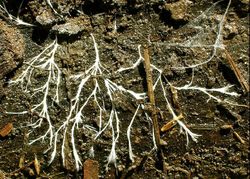
Mycelial cord of fungi made up of a collection of hyphae; an essential part in the process of saprotrophic nutrition, it is used for the intake of organic matter through its cell wall. The network of hyphae (the mycelium) is fundamental to fungal nutrition.

Saprotrophic nutrition /sæprəˈtrɒfɪk, -pr-/[1] or lysotrophic nutrition[2][3] is a process of chemoheterotrophic extracellular digestion involved in the processing of decayed (dead or waste) organic matter. It occurs in saprotrophs (organisms which feed on decaying organic matter), and is most often associated with fungi (e.g. Mucor) and with soil bacteria. Saprotrophic microscopic fungi are sometimes called saprobes.[4] Saprotrophic plants or bacterial flora are called saprophytes (sapro- 'rotten material' + -phyte 'plant'), although it is now believed[citation needed] that all plants previously thought to be saprotrophic are in fact parasites of microscopic fungi or of other plants. In fungi, the saprotrophic process is most often facilitated through the active transport of such materials through endocytosis within the internal mycelium and its constituent hyphae.[5]

Various word roots relating to decayed matter (detritus, sapro-, lyso-), to eating and nutrition (-vore, -phage, -troph), and to plants or life forms (-phyte, -obe) produce various terms, such as detritivore, detritophage, saprotroph, saprophyte, saprophage, and saprobe; their meanings overlap, although technical distinctions (based on physiologic mechanisms) narrow the senses. For example, biologists can make usage distinctions based on macroscopic swallowing of detritus (as in earthworms) versus microscopic lysis of detritus (as with mushrooms).

Process

[edit]

As matter decomposes within a medium in which a saprotroph is residing, the saprotroph breaks such matter down into its composites.

These products are re-absorbed into the hypha through the cell wall by endocytosis and passed on throughout the mycelium complex. This facilitates the passage of such materials throughout the organism and allows for growth and, if necessary, repair.[5]

Conditions

[edit]

In order for a saprotrophic organism to facilitate optimal growth and repair, favourable conditions and nutrients must be present.[7] Optimal conditions refers to several conditions which optimise the growth of saprotrophic organisms, such as;

  1. Presence of water: 80–90% of the mass of the fungi is water, and the fungi require excess water for absorption due to the evaporation of internally retained water.[7]
  2. Presence of oxygen: Very few saprotrophic organisms can endure anaerobic conditions as evidenced by their growth above media such as water or soil.[7]
  3. Neutral-acidic pH: The condition of neutral or mildly acidic conditions under pH 7 are required. [7]
  4. Low-medium temperature: The majority of saprotrophic organisms require temperatures between 1 and 35 °C (34 and 95 °F), with optimum growth occurring at 25 °C (77 °F).[7]

The majority of nutrients taken in by such organisms must be able to provide carbon, proteins, vitamins and, in some cases, ions. Due to the carbon composition of the majority of organisms, dead and organic matter provide rich sources of disaccharides and polysaccharides such as maltose and starch, and of the monosaccharide glucose.[5]

See also

[edit]

References

[edit]

Further reading

[edit]
Revisions and contributorsEdit on WikipediaRead on Wikipedia
from Grokipedia
Saprotrophic nutrition is a mode of heterotrophic feeding in which organisms, primarily fungi and certain , derive by externally digesting and absorbing organic compounds from dead or decaying matter. These organisms, known as saprotrophs, secrete extracellular enzymes such as hydrolases and oxidases to break down complex polymers like , , and proteins into simpler monomers that can be absorbed through their cell walls. This process is fundamental to the carbon and nutrient cycles, as saprotrophs play a primary role in decomposing and organic detritus, thereby releasing essential elements like , , and carbon back into the for reuse by living organisms. In terrestrial ecosystems, saprotrophic fungi dominate this nutritional strategy, forming extensive mycelial networks that penetrate and layers to access substrates. For instance, wood-decaying fungi such as those in the phylum produce ligninolytic enzymes like laccases and peroxidases, enabling the breakdown of recalcitrant materials that other decomposers cannot utilize. Bacteria contribute through similar enzymatic action, often in later stages of , targeting more labile compounds after initial fungal breakdown. The efficiency of saprotrophic nutrition varies with environmental factors, including temperature, moisture, and substrate quality, influencing rates and . Ecologically, saprotrophic nutrition underpins global biogeochemical processes by preventing the accumulation of organic waste and mitigating limitations in soils. Disruptions, such as those from or , can alter saprotroph communities, potentially slowing and affecting primary productivity. While most saprotrophs are free-living decomposers, some fungi exhibit facultative saprotrophy alongside parasitic or symbiotic lifestyles, highlighting the plasticity of fungal nutritional modes.

Definition and Classification

Core Definition

Saprotrophic nutrition, also known as saprophagy or saprotrophy, is a mode of in which organisms derive essential nutrients by decomposing non-living organic material, such as decaying or remains. Organisms engaging in this process, termed saprotrophs (formerly known as saprophytes), break down complex organic compounds externally into simpler, absorbable forms, distinguishing this from parasitic or symbiotic modes that rely on living hosts. The term "saprophyte" was coined in the late from the Greek words sapros, meaning "rotten" or "putrid," and phyton, meaning "," but it has been largely replaced by "saprotroph" (from trophē, meaning "nourishment"), first attested in the , to avoid implying a plant-like . This reflects the reliance on decayed matter for sustenance, with the underlying concept emerging in mycological studies during the late to describe fungal of organic . In the basic process, saprotrophs initiate the degradation of macromolecules like proteins, carbohydrates, and lignins into monomers such as , sugars, and fatty acids, typically without ingesting solid material. This involves the secretion of extracellular enzymes that facilitate outside the organism's body, enabling subsequent absorption of soluble nutrients.

Classification of Saprotrophs

Saprotrophs are primarily classified according to their biological kingdom, encompassing fungi, , and certain protists that derive nutrients from non-living through and absorption. This classification highlights the diversity of organisms adapted to deriving nutrients from non-living through and absorption. Fungi represent the most prominent group due to their filamentous hyphae, which enable efficient penetration and breakdown of complex substrates. operate via surface-attached biofilms that facilitate enzymatic action on . Protists contribute in niche environments, particularly aquatic ones. Detritivorous animals, such as earthworms (), millipedes (Polydesmus spp.), and dung beetles (), contribute to decomposition by ingesting decaying matter, where gut-associated microbes perform saprotrophic digestion, but animals themselves are classified as detritivores rather than saprotrophs. Within fungi, common examples include molds such as and species, which thrive on decaying plant material, and basidiomycete mushrooms like , the cultivated button mushroom that decomposes composted organic substrates. Bacteria include genera like (e.g., ) and (e.g., Clostridium thermocellum), which are widespread soil decomposers capable of breaking down and under anaerobic or aerobic conditions. Protists encompass fungus-like organisms such as oomycetes, including water molds like species, which absorb nutrients from dead fish or plant tissues in freshwater habitats. Saprotrophs are further categorized by habitat and substrate preferences, reflecting their ecological niches in decomposition sequences. Primary saprotrophs, such as certain wood-decaying fungi and fast-growing , colonize and initiate breakdown of freshly deceased organic material, releasing initial nutrients. Secondary saprotrophs, including many molds and slower-growing , exploit partially decomposed residues, further fragmenting and mineralizing the matter. This succession ensures efficient nutrient recycling in ecosystems. Habitat-specific subtypes emphasize substrate specialization: lignicolous saprotrophs, predominantly fungi like white-rot basidiomycetes (Phanerochaete chrysosporium), target lignified wood, degrading tough polymers such as through oxidative enzymes. Folicolous saprotrophs, often fungi or in leaf litter layers, focus on herbaceous foliage, accelerating decay in forest floors or grasslands. These distinctions underscore the of saprotrophs across terrestrial and aquatic detrital environments. Plants and are excluded from saprotrophic classification, as they are fundamentally autotrophic via ; although some and aquatic plants display mixotrophy—combining light-dependent carbon fixation with organic uptake—they do not rely on dead as primary decomposers.

Mechanisms of Nutrient Acquisition

Extracellular Digestion

Saprotrophs, primarily fungi and , initiate acquisition by secreting hydrolytic enzymes into the surrounding environment to depolymerize complex organic polymers such as , , proteins, and into simpler monomers. This allows them to access from dead without internalizing large molecules. Key enzyme types include cellulases, which break down into glucose; ligninases such as laccases, manganese peroxidases, and lignin peroxidases, which oxidize ; and proteases, which hydrolyze proteins into . Additional enzymes encompass amylases for depolymerization into sugars, lipases for hydrolysis into fatty acids and , and chitinases for degrading in fungal cell walls. In fungi, hyphal structures extend into substrates to maximize the surface area for enzyme secretion and release. The process unfolds in distinct stages: first, enzymes diffuse from the through the substrate matrix to reach target polymers; second, catalytic occurs, where enzymes cleave specific bonds—for instance, endo-1,4-β-glucanases and cellobiohydrolases in cellulase systems break β-1,4-glycosidic linkages in , yielding cellodextrins and glucose; third, the resulting products solubilize, becoming diffusible monomers available for absorption. Enzyme efficiency depends on factors such as stability in varying environmental conditions and resistance to inhibitors; for example, many fungal hydrolytic maintain activity across acidic to neutral ranges, but can bind and inhibit them by forming complexes with proteins. Heavy metals like and also reduce enzyme secretion and activity in saprotrophic fungi by disrupting cellular processes and directly binding to enzyme active sites. Synergistic interactions among enzyme classes, such as combined components, can enhance overall rates by up to 15-fold. The solubilized monomers are then briefly referenced for uptake in subsequent absorption processes.

Absorption and Utilization

Saprotrophs primarily absorb the simple organic monomers resulting from , such as monosaccharides (e.g., glucose), , and fatty acids, across their cell membranes. In fungi, glucose uptake occurs mainly via mediated by permeases (HXT proteins), which are proton symporters that couple glucose influx to the proton gradient established by plasma membrane H⁺-ATPases. These transporters exhibit varying affinities depending on environmental glucose concentrations, with high-affinity permeases active under nutrient scarcity. are similarly taken up through specific transporters, such as the dicarboxylic amino acid permease AgtA in , a high-affinity, pH-dependent system that facilitates proton-coupled symport. In , analogous mechanisms involve ATP-binding cassette (ABC) transporters or proton symporters for active uptake of these monomers, ensuring efficient acquisition against concentration gradients. Simple plays a minor role, limited to small, uncharged molecules under high external concentrations. Once internalized, these monomers enter central metabolic pathways for catabolism and biosynthesis. Carbohydrates like glucose are processed through glycolysis to generate pyruvate, which feeds into the tricarboxylic acid (TCA) cycle and oxidative phosphorylation under aerobic conditions. Amino acids undergo deamination or transamination to yield carbon skeletons that integrate into glycolysis or the TCA cycle, while nitrogen is assimilated via glutamine synthetase or glutamate dehydrogenase. Lipids are broken down via β-oxidation in peroxisomes, producing acetyl-CoA for the TCA cycle or gluconeogenesis. These pathways converge to produce ATP, precursors for biomass synthesis (e.g., nucleotides, amino acids), or secondary metabolites like antibiotics in some saprotrophic species. Regulation occurs through carbon catabolite repression, where preferred substrates like glucose inhibit utilization of alternatives. Aerobic respiration is the preferred mode for energy generation in most saprotrophic fungi and , maximizing efficiency by coupling the to . In fungi such as , complete oxidation of one glucose molecule yields approximately 16-18 ATP, though theoretical maxima for eukaryotic respiration reach ~36 ATP in some estimates, adjusted lower by shuttle mechanisms. Facultative anaerobes, including certain yeasts and like those in the genus , switch to pathways (e.g., alcoholic or ) under oxygen limitation, producing only 2 ATP per glucose but allowing survival in anaerobic niches. This metabolic flexibility supports growth in diverse, often fluctuating environments. Absorbed nutrients are allocated toward growth and storage, with glucose-derived UDP-N-acetylglucosamine serving as the precursor for synthesis in fungal cell walls via chitin synthases (CHS enzymes), reinforcing structural integrity during hyphal expansion. Excess carbon is stored as or for rapid mobilization, while accumulate in lipid bodies. In reproductive phases, nutrients fuel formation, such as conidia in , enabling dispersal and dormancy until favorable conditions arise. This efficient utilization underpins the saprotrophic lifestyle, converting degraded into viable .

Environmental and Biological Factors

Required Conditions

Saprotrophic nutrition relies on specific environmental conditions to facilitate the extracellular enzymatic breakdown of and the subsequent absorption of . These conditions encompass , , moisture, and oxygen availability, which directly influence microbial activity, growth rates, and overall efficiency. Deviations from optimal ranges can significantly impair saprotrophic processes, limiting release in ecosystems such as soils and decaying . Temperature plays a critical role in determining the activity of saprotrophic microorganisms, with mesophilic species—predominant in temperate soils and —exhibiting optimal growth and enzymatic function between 20°C and 30°C. This range supports the metabolic processes of most saprotrophic fungi and , enabling efficient degradation of complex substrates like and . In contrast, thermophilic saprotrophs, often found in high-heat environments such as heaps, thrive at elevated temperatures up to 60°C, where they accelerate during the active heating phase of organic waste breakdown. pH levels profoundly affect the dominance and enzymatic efficacy of saprotrophs, with fungi generally favoring acidic conditions in the range of 4 to 6, where they outcompete in nutrient acquisition from recalcitrant . Bacterial saprotrophs, however, predominate in neutral to alkaline soils ( 7 to 8), reflecting their broader tolerance and to less acidic environments. The optimal for key saprotrophic enzymes, such as fungal cellulases, is around 5, aligning with acidic microhabitats in forest floors and peatlands that enhance lignocellulosic . Moisture is essential for saprotrophic activity, as high (Aw > 0.9) is required to maintain enzyme solubility, facilitate substrate diffusion, and support hyphal extension in fungi and flagellar motility in bacteria. Below this threshold, desiccation restricts and organic matter breakdown, particularly in arid soils where activity halts. This moisture dependency underscores the vulnerability of saprotrophs to , which can suppress rates by limiting water-mediated transport of hydrolytic products. Oxygen availability shapes the distribution of saprotrophic communities, with aerobic conditions being preferred for the majority of fungi and obligate aerobic that rely on oxidative for energy-intensive . However, facultative anaerobic saprotrophs, including certain , enable activity in oxygen-depleted microenvironments such as sediments, where they switch to or to sustain nutrient cycling.

Influencing Factors

The quality of the substrate significantly influences the efficiency of saprotrophic nutrition, primarily through its . A low carbon-to- (C:N) in , ideally around 20-30:1, facilitates rapid by providing sufficient for microbial protein synthesis, enabling saprotrophs to break down carbon-rich substrates without immobilization delays. Conversely, high C:N s exceeding 40:1 limit availability, slowing microbial growth and rates. , a complex phenolic , further modulates this process due to its recalcitrance; its abundance in woody or fibrous litters resists enzymatic attack by saprotrophic fungi, extending timelines by protecting associated and from . Microbial interactions among saprotrophs also play a pivotal role in modulating nutrient acquisition rates. in decomposing substrates often begins with fast-growing bacterial pioneers that exploit labile compounds, paving the way for specialized fungi capable of degrading recalcitrant materials like . This temporal shift enhances overall breakdown efficiency but can be disrupted by antagonistic interactions, such as actinomycetes producing antibiotics that inhibit fungal competitors, thereby altering community composition and slowing collective . Abiotic stressors impose additional constraints on saprotrophic activity beyond core environmental requirements. Toxins like released from decaying material can inhibit extracellular production in saprotrophs in phenolic-rich . (UV) exposure degrades surface abiotically while directly harming microbial cells, diminishing saprotrophic populations and their enzymatic capabilities in exposed environments. Nutrient imbalances, such as excess carbon relative to other elements, further exacerbate limitations by inducing microbial stress and uneven community dynamics. Human activities profoundly affect saprotrophic processes in managed ecosystems. Pesticides applied in agricultural soils, such as fungicides and herbicides, often suppress saprotrophic fungal and bacterial populations, leading to reduced rates and altered nutrient cycling by inhibiting key enzymes like cellulases. In contrast, strategies leverage saprotrophic fungi to enhance degradation of contaminants; for instance, white-rot fungi like Phanerochaete chrysosporium are deployed to break down persistent pollutants such as , accelerating nutrient release in contaminated sites through targeted enzymatic activity.

Ecological and Evolutionary Role

Nutrient Cycling Contributions

Saprotrophs are essential contributors to nutrient cycling in ecosystems, particularly through their of dead , which prevents the accumulation of and facilitates the return of elements to available forms. In the , saprotrophic breaks down complex organic compounds in and , releasing (CO₂) as a primary byproduct of microbial respiration, thereby closing the loop between and atmospheric carbon. This process is dominated by saprotrophic fungi, which act as the principal agents of litter in terrestrial environments, a substantial fraction of inputs and mitigating long-term carbon buildup in soils. Globally, decomposers including saprotrophs process approximately 90% of the net that enters the dead pool each year, equivalent to about 90 gigatons of terrestrial . Beyond carbon, saprotrophs drive the mineralization of and from organic residues, converting them into inorganic forms such as (NH₄⁺) and (PO₄³⁻) that plants can directly absorb. This mineralization step is critical for maintaining availability in ecosystems, where from fallen leaves, wood, and animal remains would otherwise remain inaccessible. Saprotrophic fungi and accelerate these transformations through enzymatic activity, ensuring a steady flux of nitrogen and phosphorus to support primary productivity and prevent nutrient deficiencies in soil-plant systems. The residual products of saprotrophic contribute to formation, a stable organic fraction that bolsters by improving aggregate structure, enhancing water retention capacity, and increasing cation exchange for holding. This layer not only stabilizes against but also indirectly benefits living through provisioning to mycorrhizal networks, which link decomposed material to root systems for efficient uptake. On a broader scale, disruptions to saprotrophic communities—such as those caused by —can slow rates by altering quality, moisture levels, and microbial diversity, resulting in immobilization within undecomposed and reduced fertility.

Evolutionary Adaptations

Saprotrophic nutrition is considered the ancestral mode of feeding in , emerging alongside the divergence of the fungal lineage from other eukaryotes approximately 1.0–1.4 billion years ago during the Eon. Fossil evidence and analyses indicate that early , such as those in the basal lineages of and related groups, likely relied on osmotrophic absorption of dissolved organic compounds from decaying microbial mats in aquatic or semi-aquatic environments. Recent studies (as of 2025) using horizontal gene transfers and calibration suggest predated land , playing a key role in preparing terrestrial environments through early . In parallel, saprotrophic capabilities in , which trace back to the Eon over 3 billion years ago, underwent significant diversification following the around 541 million years ago, as the rise of multicellular eukaryotes provided novel substrates of complex for . Key morphological and physiological adaptations facilitated the expansion of saprotrophic nutrition, particularly in terrestrial contexts during the Paleozoic Era. In fungi, the evolution of hyphal growth, estimated by molecular clock analyses to have originated around 700 million years ago with fossil evidence dating to approximately 460 million years ago, enabled penetration into solid substrates and efficient exploration of heterogeneous dead organic matter. This filamentous structure, supported by polarized tip extension and septation for compartmentalization, allowed fungi to access nutrients deep within lignified plant tissues once land plants colonized continents around 470 million years ago. Spore dispersal mechanisms, evolving concurrently with hyphal systems, promoted colonization of ephemeral dead biomass by enabling aerial propagation and dormancy under unfavorable conditions. Enzyme diversification further enhanced degradative capacity; for instance, the emergence of lignin peroxidase in white-rot fungi around 300 million years ago during the Carboniferous Period coincided with the proliferation of vascular plants, allowing these organisms to break down recalcitrant lignin polymers that previously accumulated as coal deposits. At the genetic level, saprotrophic adaptations were bolstered by mechanisms promoting enzymatic innovation. In , (HGT) has been a primary driver, enabling the acquisition of novel degradative genes, such as those for plant cell wall , from distantly related microbes and even eukaryotes, facilitating rapid adaptation to diverse substrates like lignocellulose. clusters encoding secondary metabolites, including antibiotics and siderophores, are prevalent in both and fungi, coordinating the production of compounds that aid in nutrient solubilization and suppression of competing decomposers. These clusters, often regulated by environmental cues, reflect co-evolutionary pressures for efficient breakdown. Selective pressures from mass extinction events strongly favored saprotrophs by creating pulses of abundant dead . Following the end-Permian extinction approximately 252 million years ago, which eliminated over 90% of marine species and vast terrestrial vegetation, saprotrophic fungi and proliferated to decompose the resulting organic , recycling nutrients and preventing long-term . Similarly, after the Cretaceous-Paleogene event 66 million years ago, fungal spores dominated sedimentary records, indicating a surge in saprotrophic activity amid the decay of dinosaurs and angiosperms, which accelerated recovery. These episodes underscore how episodic surpluses drove the refinement of saprotrophic traits over geological time.

Comparisons to Other Nutrition Strategies

Differences from Autotrophy

Saprotrophic nutrition fundamentally differs from autotrophy in its energy source, as saprotrophs obtain nutrients by decomposing and absorbing pre-formed organic compounds from dead and decaying matter, whereas autotrophs synthesize organic molecules from inorganic precursors such as and water. In photoautotrophy, the primary form in plants and algae, light energy drives the fixation of carbon through , represented by the equation: 6CO2+6H2O[light](/page/Light)C6H12O6+6O26\text{CO}_2 + 6\text{H}_2\text{O} \xrightarrow{\text{[light](/page/Light)}} \text{C}_6\text{H}_{12}\text{O}_6 + 6\text{O}_2
Add your contribution
Related Hubs
User Avatar
No comments yet.