Hubbry Logo
SinkSinkMain
Open search
Sink
Community hub
Sink
logo
8 pages, 0 posts
0 subscribers
Be the first to start a discussion here.
Sink
Sink
from Wikipedia
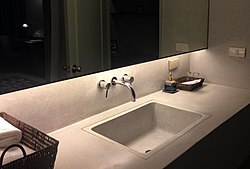
A sink/basin in a bathroom

A sink (also known as basin in the UK) is a bowl-shaped plumbing fixture for washing hands, dishwashing, and other purposes. Sinks have a tap (faucet) that supplies hot and cold water and may include a spray feature to be used for faster rinsing. They also include a drain to remove used water; this drain may itself include a strainer and/or shut-off device and an overflow-prevention device. Sinks may also have an integrated soap dispenser. Many sinks, especially in kitchens, are installed adjacent to or inside a counter.

History

[edit]

The washstand was a bathroom sink made in the United States in the late 18th century.[1] The washstands were small tables on which were placed a pitcher and a deep bowl, following the English tradition. Sometimes the table had a hole where the large bowl rested, which led to the making of dry sinks. From about 1820 to 1900, the dry sink evolved by the addition of a wooden cabinet with a trough built on the top, lined with zinc or lead.[1]

Materials

[edit]
Bathroom stainless steel vessel sink standing on a wood surface

Stainless steel is most commonly used in kitchens and commercial applications because it represents a good trade-off between cost, usability, durability, and ease of cleaning.[2] Most stainless steel sinks are made by drawing a sheet of stainless steel over a die. Some very deep sinks are fabricated by welding. Stainless steel sinks will not be damaged by hot or cold objects and resist damage from impacts. Stainless steel sinks are widely celebrated for their durability, sleek appearance, and resistance to rust and corrosion. However, many homeowners are baffled when they spot rust stains on their stainless steel sink.[3] One disadvantage of stainless steel is that, being made of thin metal, they tend to be noisier than most other sink materials, although better sinks apply a heavy coating of vibration-damping material to the underside of the sink.[4]

Other materials used for sinks include soapstone, fire clay, granite, cast iron, quartz, porcelain, and copper.[5]

Styles

[edit]

Butler's sink

[edit]

A butler's sink is a rectangular ceramic sink with a rounded rim which is set into a work surface.[6] There are generally two kinds of butler's sinks: the London sink and the Belfast sink.[6] In 2006, both types of sinks usually were 62 centimetres (24 in) across and 46 centimetres (18 in) front-to-back, with a depth of 22.5 centimetres (8.9 in).[7] London sinks were originally shallower than Belfast sinks.[6] One plumbing guide in 1921 suggested that the Belfast sink was 38 centimetres (15 in) deep.[8] The primary difference both in the past and today between a Belfast and London sink is that the Belfast sink is fitted with an overflow weir which prevented water from spilling over the sink's edge by draining it away and down into the wastewater plumbing.[9]

Vessel sink

[edit]

A vessel sink is a free-standing sink, generally finished and decorated on all sides, that sits directly on the surface of the furniture on which it is mounted. These sinks have become increasingly popular with bathroom designers because of the large range of materials, styles, and finishes that can be shown to good advantage.[10]

See also

[edit]

References

[edit]

Bibliography

[edit]
[edit]
Revisions and contributorsEdit on WikipediaRead on Wikipedia
from Grokipedia
A sink is a fixed consisting of a bowl-shaped basin designed to receive for purposes, such as hands, dishes, or , and to discharge through a connected drain into the building's drainage system. It typically includes a faucet or tap for supplying from hot and cold lines, and is constructed from durable, non-porous materials to ensure and ease of cleaning. Sinks are essential components of residential, commercial, and industrial systems, commonly installed in kitchens, bathrooms, laundry areas, and utility spaces to facilitate daily sanitation tasks. The evolution of the sink reflects advancements in plumbing technology and public health standards, tracing back to ancient civilizations like Egypt, Greece, and Rome where simple basins were used for washing. In the United States, prior to the widespread adoption of indoor plumbing in the 19th century, households relied on portable "dry sinks," which were wooden cabinets with a shallow, removable basin where water was manually poured from pitchers and then emptied by hand, preventing constant wetness and mold. With the development of municipal water systems and cast-iron or lead pipes in the mid-1800s, fixed sinks became feasible, transitioning from simple stone or wooden troughs to enameled cast-iron models that integrated with running water and drainage. By the late 19th and early 20th centuries, innovations like vitreous china coatings improved durability and sanitation, aligning with domestic reform movements that emphasized cleanliness in American homes. Modern sinks vary widely in design, materials, and function to suit diverse applications. Common types include kitchen sinks, often double- or triple-basin models for food preparation and ; bathroom lavatories, typically wall-mounted or basins for personal hygiene; and utility or service sinks, larger, durable fixtures made of or plastic for heavy-duty cleaning in garages or basements. Materials range from corrosion-resistant and fireclay for high-traffic areas to composite or acrylic for aesthetic versatility in contemporary installations. Key features may incorporate low-flow faucets compliant with standards, garbage disposals for , or accessible designs for universal use, all regulated by codes like the International Plumbing Code to ensure safety and performance.

Overview and Types

Definition and Uses

A sink is a stationary basin or fixture connected to a drain and usually a system, designed for washing and drainage purposes. In residential settings, sinks serve primary functions such as handwashing in bathrooms, and food preparation in kitchens, and utility tasks like soaking or cleaning tools in dedicated areas. Key components of a sink include the basin, which forms the main receptacle for ; the faucet (also known as a tap), a that controls the inflow of hot and cold ; and the drain, a pipe that carries away from the fixture. Many bathroom sinks also feature an overflow, a secondary conduit that prevents from spilling over the rim by directing excess to the drain. Sinks are often integrated with countertops to provide a seamless workspace, enhancing functionality in and bath environments. Basic terminology distinguishes sinks by basin configuration and mounting style; a single-basin sink features one undivided compartment suitable for compact spaces, while a double-basin sink has two separate compartments for simultaneous tasks like washing and rinsing. Mounting options include undermount, where the basin is affixed beneath the countertop for a flush appearance; drop-in, where the basin is inserted from above into a cutout in the countertop with a visible rim resting on the surface (requiring a countertop for support and sealing, and not suitable for direct mounting on a cabinet without one); and overlay (also known as top-mount), which can be mounted directly onto cabinet edges without a countertop in certain applications.

Classification by Location and Function

Sinks are classified primarily by their location within a building and the specific functions they serve, which influences their features such as basin depth, size, and additional accessories. This categorization helps in selecting appropriate models for residential, commercial, or specialized applications, ensuring efficiency and durability tailored to the task. sinks are typically designed as deep basins to accommodate food preparation, , and soaking large items, often featuring divided compartments for multitasking. Double-basin configurations, for instance, allow one side for washing and the other for rinsing, enhancing workflow in home or professional cooking environments. These sinks usually measure 20 to 36 inches in width and 8 to 10 inches in depth to handle pots and utensils effectively. Bathroom sinks, in contrast, are shallower to facilitate personal tasks like handwashing and face cleansing, with depths generally ranging from 4 to 6 inches for quick drainage and ease of use. Drop-in bathroom sinks, a common vanity-mounted type, have no universal standard size, but common dimensions are 16–24 inches wide, 12–20 inches front-to-back (depth), and 5–8 inches basin depth. Round or oval drop-in sinks typically range from 16–20 inches in diameter, while rectangular ones often measure 16–24 inches in length and 12–20 inches in width. Common variants include sinks, which stand alone on a supporting base for a space-saving, elegant appearance in small bathrooms, and vanity-mounted types that integrate into for added storage beneath. These designs prioritize and minimal splash, often incorporating overflow drains to prevent flooding. Utility or laundry sinks are built for heavy-duty, rugged tasks such as cleaning tools, pet bathing, or washing bulky laundry items, featuring robust and deeper basins up to 12 inches or more for containment of and . These are frequently freestanding or wall-mounted models made from impact-resistant materials, with wide, enclosed aprons to protect surrounding areas from splashes during intensive use. Their larger sizes, often 20 to 30 inches wide, make them ideal for basements, garages, or laundry rooms where durability against stains and chemicals is essential. Specialized sinks address niche functions beyond standard needs. Bar sinks are compact, typically 15 to 20 inches wide and 6 to 8 inches deep, designed for entertaining spaces to mix drinks or rinse glassware without dominating counter space. Prep sinks serve as secondary stations in kitchens for washing or quick rinsing, often undermounted and smaller than primary sinks to fit or butler's layouts. Industrial sinks, used in commercial settings like restaurants or workshops, emphasize and high-volume operations with features like multiple compartments for washing, rinsing, and sanitizing, constructed to withstand frequent, demanding use. Functionally, sinks differ between residential and commercial applications, as well as stationary and portable variants. Residential sinks focus on and moderate daily use, with features suited for homes like integrated dispensers, whereas commercial ones prioritize standards, larger capacities, and materials resistant to for high-traffic environments such as food service or healthcare facilities. Stationary sinks are fixed installations connected to permanent for consistent access in built spaces, while portable models incorporate self-contained water tanks and pumps for mobility in temporary setups like events, classrooms, or sites, offering flexibility without dependency.

Historical Development

Ancient and Pre-Industrial Sinks

The earliest known precursors to sinks emerged in ancient civilizations as simple basins and troughs designed for ritual and personal , often integrated into religious or communal practices. In around 2000 BCE, clay vessels and basins were used in purification rituals to cleanse cult statues, such as in the Mis Pî mouth-washing ceremony associated with offerings, reflecting the importance of in religious contexts. Similarly, in , was deeply tied to cultural and spiritual purity, with the River serving as the primary water source for bathing and washing; shallow stone or copper basins, such as those found in King Sahure's temple dating to circa 2500 BCE, facilitated ritual ablutions, while elites used scented waters and salts in these receptacles. By the Roman period, around 300 BCE, advanced public facilities evolved with the construction of aqueducts like the Aqua Appia in 312 BCE, which supplied fresh water to communal baths and latrines across the empire. These facilities featured lead-lined channels and basins for , enabling large-scale in urban settings, though lead posed risks over time. In , early vessels included bronze ritual basins in ancient China from the (circa 1600–1046 BCE), used for ceremonial cleansing, and brass lotas or basins in pre-industrial , which served practical and cultural roles in daily , often filled manually from rivers or wells. During the medieval period in Europe, sinks took rudimentary forms such as stone or wooden troughs in monasteries and households, typically gravity-fed from rainwater cisterns or nearby springs to support monastic routines of frequent washing for purity. These setups emphasized communal use, with water channeled through simple conduits into shared basins, highlighting the era's focus on ritual cleanliness amid limited infrastructure. Pre-industrial limitations persisted globally, including the absence of indoor plumbing, reliance on outdoor or communal arrangements where users carried water to pottery or carved stone basins, and vulnerability to contamination from shared sources, which constrained widespread personal hygiene until later technological advances.

Industrial Era and Modern Evolution

The Industrial Revolution spurred transformative changes in sink technology during the 19th century, particularly through the widespread adoption of enameled cast-iron sinks, which offered superior durability and resistance to corrosion compared to prior wooden or stone designs. These sinks, first introduced in the mid-19th century, featured a porcelain enamel coating fired onto cast iron, enabling easier cleaning and addressing escalating public health concerns over waterborne diseases in densely populated urban areas. By the late 19th century, such innovations became standard in both residential and commercial settings, reflecting broader advancements in mass production and metallurgy. In the 1880s, British plumber contributed key improvements to flushing and drainage systems that enhanced sink functionality, including the invention of the U-bend trap to prevent sewer gases from entering buildings and patents for refined siphon flushes and pipe joints between 1881 and 1896. These developments, such as the "Valveless Water Waste Preventer," optimized water efficiency and hygiene in plumbed fixtures, influencing modern sink drainage standards. Crapper's work aligned with the era's sanitary reforms, spurred by like the 1871 Metropolis Water Act, which mandated better waste management in urban plumbing. The 20th century saw further standardization and material innovations, with emerging as a dominant choice for sinks in the early due to its non-porous, stain-resistant surface that facilitated and met heightened demands in suburban booms. By the 1950s, sinks gained prominence in kitchens for their affordability, corrosion resistance, and seamless integration with emerging metal cabinetry, becoming a staple in American homes amid economic expansion. The 1970s introduced countertop-integrated designs, such as undermount sinks, which eliminated visible rims for a sleeker aesthetic and improved , coinciding with the rise of laminate and solid-surface countertops. Urbanization in the 19th and early 20th centuries accelerated indoor adoption, transitioning sinks from outdoor or freestanding units to essential indoor fixtures as cities expanded and municipal water systems proliferated, becoming widespread in U.S. homes by the mid-20th century. Post-1900 movements, including campaigns emphasizing , dramatically reduced infectious diseases like typhoid through improved sink access and , contributing to a 25-year rise in U.S. by century's end. In the , touchless faucets emerged as a residential trend, leveraging sensors for hands-free operation to minimize germ transmission and conserve —saving up to 70% compared to manual models—driven by familiarity from commercial spaces and smart home integration. Concurrently, smart sinks gained traction, incorporating features like app-controlled flow, built-in , and energy- sensors to enhance daily and in modern kitchens. By the , innovations continued with advanced smart sinks featuring voice activation, real-time monitoring, and integrated purification systems, alongside a focus on sustainable materials like recycled composites, reflecting ongoing emphasis on , , and environmental impact as of 2025.

Materials and Construction

Common Materials

Sinks are constructed from a variety of materials chosen for their , , and functionality in , , and settings. Stainless steel remains one of the most prevalent options due to its versatility and cost-effectiveness. , , and variants offer traditional appeal, while modern alternatives like composites provide customized looks. Each material balances factors such as maintenance, weight, and resistance to wear, influencing their suitability for specific applications. Recent trends as of 2025 emphasize sustainable options, such as with recycled content (up to 80% in some models) to reduce environmental impact. Stainless steel, an primarily composed of iron, , and , is widely used in sinks for its resistance and ability to withstand heavy use. It excels in , often lasting 15–30 years without significant degradation, and is relatively affordable, with prices typically ranging from $100 to $500 for standard residential models. For commercial triple compartment stainless steel sinks in Canada, current prices vary depending on size, gauge, brand, and features (e.g., with or without drainboards, faucet included or not), typically ranging from approximately $600 to $2,500 CAD, with standard models often falling between $800 and $1,500 CAD. Prices are subject to change and may include shipping or taxes. However, it can be prone to scratching and denting from impacts, and its metallic surface may produce noise when dishes are placed inside, though thicker gauges (e.g., 16-18 gauge) mitigate these issues. This material's properties stem from its non-porous nature, making it easy to clean and resistant to , which is ideal for food preparation areas. Porcelain or enamel-coated provides a glossy, heat-resistant finish that enhances traditional , commonly found in farmhouse-style kitchen sinks. The base offers substantial weight and rigidity, supporting heavy loads without flexing, while the enamel layer resists chipping and staining when properly applied. These sinks are valued for their ability to maintain color and shine over time, though they require careful handling to avoid cracks from extreme temperature changes. Typical costs range from $200 to $600, reflecting the labor-intensive enameling process. Ceramic or sinks, fired at high temperatures to create a dense, non-porous surface, are favored for applications due to their resistance and smooth, easy-to-clean finish. This material's glaze prevents water absorption, reducing mold growth and ensuring long-term hygiene, with many models meeting standards like those from the National Sanitation Foundation (NSF). They offer a classic, elegant appearance but can be brittle, susceptible to cracking under impact, and heavier than alternatives, often weighing 50-100 pounds. Prices generally fall between $150 and $400, making them accessible for residential use. Other materials expand options for specialized needs. Acrylic and fiberglass composites are lightweight and seamless, allowing for integrated designs in compact bathrooms or modern kitchens; they resist chipping but may discolor from harsh chemicals. sinks provide antimicrobial properties through natural oxidation, along with a warm, patina-forming aesthetic suitable for luxury installations, though they demand regular polishing to prevent buildup. Composite stone, often quartz-based, delivers a high-end, stone-like with minimal , ideal for upscale kitchens, but at a premium cost of $500 to $1,500. When selecting a sink , considerations include variability—such as stainless steel's budget-friendly range versus composites' higher investment—along with weight impacts on cabinet support and adherence to standards like NSF certification for food-contact surfaces. Lighter options like acrylic ease installation in retrofits, while heavier materials like enhance stability but require reinforced mounting.

and Processes

The of sinks varies by , with distinct processes tailored to achieve structural and functionality. For metal sinks, such as those made from , the primary method involves stamping, where sheets of metal are cut, heated, and pressed into shape using hydraulic presses and dies to form the basin and features like drain holes. This deep-drawing technique, often followed by annealing to relieve stresses and trimming for precision, ensures seamless, one-piece construction resistant to leaks. sinks, typically or fireclay, undergo a high-temperature firing process in reaching 1200–1400°C to vitrify the clay body and fuse glazes, creating a non-porous, durable surface. Composite sinks, such as those blending or with resins, are produced through molding, where raw materials are mixed, poured into molds under pressure, and cured to form heat- and stain-resistant basins. Durability in sinks is influenced by material-specific properties that determine resistance to everyday stresses. sinks, often enameled, exhibit high impact resistance, capable of withstanding forces from dropped heavy objects without significant deformation, making them suitable for high-use environments. is highly heat-resistant as a but sinks made from it are susceptible to from sudden temperature changes, such as pouring boiling water or placing very hot cookware directly on the surface, which can cause cracking; gradual heating is recommended to avoid damage. Additionally, ceramics like achieve a scratch hardness of 7 on the , providing robust protection against abrasions from utensils or cleaning tools. Quality control in sink production adheres to standards like NSF/ANSI 2, which certifies materials and design for hygiene by ensuring smooth, non-porous surfaces that resist and facilitate easy in food-handling settings. Common failure points include chipping in enamel coatings on or sinks, often resulting from high-impact blows that expose the underlying material to and if not repaired promptly. With proper installation and use, sinks exhibit varying lifespans based on material resilience. sinks typically last 15–30 years in residential applications, benefiting from resistance but potentially showing dents or scratches over time. sinks, when maintained to avoid chips, can endure 20-25 years, owing to their vitreous glaze and thermal stability.

Design and Styles

Traditional Styles

Traditional sink styles encompass classic designs that originated in the 19th and early 20th centuries, characterized by durable materials like fireclay ceramic and , and functional forms suited to the domestic needs of the era. These sinks often featured exposed aprons or freestanding supports, emphasizing practicality in sculleries, pantries, and bathrooms where space and water access were limited. The Butler's sink, also known as the farmhouse sink, emerged in 19th-century as a deep ceramic basin with an apron-front design, where the front panel extends beyond the for easy access during food preparation and . Originally intended for use in butler's pantries in affluent households, its wide, shallow bowl accommodated large pots and vegetables, reflecting the scarcity of running at the time that necessitated conserving every drop. The exposed front panel not only facilitated installation but also allowed for the sink to be set into wooden counters, a hallmark of Victorian-era utility. Closely related, the developed as a variation in 18th-century , sharing the deep apron-front profile of the Butler's sink but distinguished by an integral overflow—a sloped channel near the rim that prevented spillage in water-abundant regions. Popular in Victorian homes, particularly in rural and urban settings across the , it featured a slightly deeper bowl for heavy-duty tasks like and pot scrubbing, often paired with wooden draining boards. This design's robustness made it a staple in period kitchens, where its white fireclay construction resisted stains from daily use. Pedestal sinks, prominent in early 20th-century bathrooms, consist of a freestanding porcelain basin supported by a slender column, offering a space-saving alternative to bulky vanities in compact urban dwellings. This elegant form, with its tapered pedestal concealing plumbing, evoked classical influences while providing a hygienic, easy-to-clean surface for personal washing. Common in Edwardian and Arts and Crafts interiors, the design prioritized vertical lines and minimal footprint, enhancing the illusion of openness in small powder rooms. Trough sinks, utilized in late 19th- and early 20th-century kitchens including the Edwardian era for communal or industrial purposes, are elongated, shallow basins typically made of cast iron or porcelain, designed for multiple users or large-scale washing tasks. Their linear shape, often spanning several feet with integrated drainboards, facilitated efficient rinsing of produce, linens, or dishes in busy household sculleries, aligning with the era's emphasis on labor-saving fixtures amid growing domestic staff roles. Seen in period homes with expansive work areas, these sinks embodied the transitional shift toward more organized kitchen layouts. In contemporary settings, traditional sink styles have seen a revival, particularly in modern designs where Butler's and sinks are integrated with distressed finishes to evoke rustic heritage. This trend blends historical charm with updated functionality, such as reinforced materials for durability, appealing to homeowners seeking timeless in open-plan kitchens.

Modern and Specialized Styles

Vessel sinks, characterized by a freestanding bowl placed atop the countertop, emerged as a prominent feature in bathroom design during the late 1990s, drawing inspiration from ancient washbasins to create a luxurious, spa-like ambiance. Typically crafted from materials such as glass or natural stone, these sinks offer a sculptural, elevated aesthetic that transforms the vanity area into a focal point. However, their above-counter placement necessitates shorter vanities or countertops, usually 4 to 6 inches lower than standard (e.g., 30 inches high instead of 36 inches), to accommodate the basin's height (typically 5-8 inches) and ensure a comfortable rim height of 34-36 inches above the floor. Regional standards vary; for example, in regions like India, the recommended rim height for countertop wash basins is 80–85 cm (31.5–33.5 inches) for comfort. Undermount sinks, installed seamlessly beneath the edge, gained widespread adoption in modern kitchens starting in the , coinciding with the rise of solid surface materials that allowed for clean, integrated installations. This design eliminates the exposed rim typical of drop-in models, facilitating effortless by enabling users to sweep debris directly into the basin without obstruction. Their stems from the hygienic advantages and sleek appearance, particularly in contemporary settings where countertop continuity enhances visual flow. Integrated sinks, formed as a single piece with the —often using durable composites like Silgranit—provide a monolithic, minimalist profile that blurs the boundary between basin and surface. Silgranit, a granite-quartz blend comprising 80% natural stone, resists scratches, stains, and heat while offering a matte finish in various colors to complement streamlined interiors. This construction not only simplifies installation but also promotes a clutter-free aesthetic ideal for modern kitchens and bathrooms emphasizing simplicity and uniformity. Among specialized designs, wall-mounted sinks excel in compact environments by projecting directly from the wall without requiring a supporting cabinet, thereby maximizing and creating an of openness in small bathrooms or powder rooms. Their floating configuration also simplifies cleaning and allows for customizable concealment behind the wall. For , ADA-compliant low-profile sinks adhere to standards mandating a maximum of 34 inches from the and at least 27 inches of clearance beneath, ensuring users can approach and utilize the fixture comfortably. These designs often feature shallow basins to minimize reach depth, enhancing usability for individuals with mobility limitations. Touchless sinks, activated by infrared sensors, prioritize by eliminating handle contact, thereby reducing germ transmission in high-traffic areas like public restrooms and commercial kitchens. Ergonomic innovations further refine modern sink functionality, including zero-radius corners that form sharp 90-degree angles for maximized interior capacity, allowing efficient stacking of dishes and utensils without wedging into curved edges. Adjustable-height models, typically ranging from 28 to 42 inches, adapt to user stature via manual or electronic mechanisms, alleviating strain on the back and shoulders during prolonged tasks like or prepping. Such features promote , accommodating diverse physical needs in both residential and professional settings.

Installation and Plumbing

Basic Installation Requirements

Installing a sink requires careful preparation to ensure a proper fit and avoid structural issues. The first step involves measuring the cutout accurately, typically using the sink's template provided by the manufacturer or direct measurements of the basin's rim or base. For standard sinks, common dimensions are 33 inches long by 22 inches wide, aligning with typical base cabinet sizes of 36 inches wide. Bathroom sinks may vary, but preparation follows similar principles of verifying the opening against the sink's specifications to prevent misalignment. Essential tools for the installation include a for precise measurements, a jigsaw or for cutting openings if needed, adjustable wrenches or a for securing fittings, a or for applying sealants, safety glasses and gloves for protection, and a level to ensure even placement. Sealants such as silicone caulk and plumber's putty are also required to create watertight seals around the rim or base. Clips or brackets specific to the sink type—such as rim clips for drop-in models or undermount brackets—must be selected based on the material and sink weight. The fitting process varies by sink type but emphasizes secure mounting to the countertop. For drop-in sinks (also known as inset sinks), the rim rests on the countertop edge; a hole must be cut in the countertop for the basin to drop into, providing necessary support, sealing, and stability—drop-in sinks cannot be mounted directly on a cabinet without a countertop, as this lacks the required support surface. Position the sink into the cutout, apply a bead of silicone or plumber's putty along the underside of the rim for sealing, and secure with provided clips from below to hold it in place. For installations without a countertop, overlay sinks (also called top-mount in some contexts) are designed to mount directly onto the cabinet edges and serve as a suitable alternative. Undermount sinks attach beneath the countertop using epoxy or clips fastened to the underside; apply adhesive around the sink rim, press it against the cutout, and tighten brackets to draw it flush while ensuring the countertop overhang supports the basin. Vessel sinks sit atop the countertop; apply a continuous bead of clear silicone sealant to the bottom of the vessel, center it over the drain hole, and allow it to cure, often paired with a deck-mounted faucet installed directly on the surface. Safety considerations are critical, particularly for heavier materials like , which can weigh 100 pounds or more and require reinforced support to prevent sagging or cracking. Always use during fitting to align the sink horizontally and vertically, as uneven installation can lead to pooling water and accelerated wear. Wear protective gear when cutting or handling materials to avoid injury from sharp edges or debris. Common errors include improper sealing, such as using insufficient or incorrect , which allows water to seep between the sink and , causing damage to cabinets or mold growth over time. Failing to clean the contact surfaces thoroughly before applying sealant can also compromise , leading to leaks.

Integration with Plumbing Systems

Sinks integrate with primarily through dedicated lines and drainage assemblies that ensure safe, efficient operation while complying with established codes. The typically connects via separate hot and cold lines using 1/2-inch diameter pipes, such as , PEX, or CPVC, which meet minimum fixture supply requirements under the International Plumbing Code (IPC). These lines terminate at the faucet with compression fittings, allowing secure, tool-free connections that accommodate flexible supply hoses. Residential water pressure for these systems generally ranges from 40 to 60 pounds per square inch (PSI) to support adequate flow rates, such as a maximum of 1.2 gpm at 60 for private lavatory faucets, while preventing excessive force that could damage components. Drainage systems for sinks feature a P-trap, a U-shaped pipe that retains a water seal to block sewer gases from entering the building, typically constructed from PVC or ABS with a 1.5-inch diameter for most residential applications like kitchen and bathroom sinks. The trap must be installed close to the drain outlet, with the vertical distance from the fixture outlet to the trap weir not exceeding 24 inches and the horizontal distance not surpassing 30 inches, ensuring effective sealing without excessive tailpiece length. Proper venting, often via a 1.5- to 2-inch pipe connected to the main stack or an air admittance valve, maintains airflow to prevent vacuum-induced siphoning of the trap seal during drainage. Garbage disposals integrate upstream of the P-trap, connecting directly to the sink tailpiece or drain flange, and may require a 2-inch trap for higher waste volumes while ensuring the assembly complies with IPC provisions that prohibit discharge into grease interceptors. Similar requirements apply under the Uniform Plumbing Code (UPC). Common troubleshooting issues in sink plumbing include leaks from loose compression fittings or worn washers in supply lines, which can be resolved by tightening connections or replacing components to avoid water damage. Clogs often arise from improper venting, leading to slow drainage or backups as negative pressure restricts flow; inspecting and clearing vent paths typically restores function. Backflow prevention devices, such as check valves or air gaps (particularly for dishwasher connections), are essential to halt reverse flow of contaminated water into potable supplies, installed inline on supply lines per local codes. Upgrades like low-flow aerators enhance integration by restricting faucet output to 1.2 gpm for private lavatory faucets or 1.8 gpm for faucets where applicable, reducing consumption by up to 45% compared to previous standards of 2.2 gpm without compromising . These devices screw onto existing faucets, promoting efficiency while maintaining compatibility with supply s of 40–60 .

Maintenance and Sustainability

Cleaning and Upkeep

Maintaining a sink involves regular routines tailored to its material to prevent buildup, stains, and damage, ensuring longevity and hygiene. For sinks, a common method to remove stains is applying a paste made from baking soda and white , which gently lifts discoloration without scratching the surface. Let the paste sit for a few minutes before rinsing and wiping dry. sinks require non-abrasive cleaners, such as mild dish soap or soft cleansers like , to avoid scratches on the glazed finish. pads or powders can dull or damage the enamel, so always opt for liquid or foam formulas applied with a soft cloth. Daily upkeep helps prevent water spots and minor clogs. After each use, wipe the sink surface with a cloth or soft dampened with warm and mild dish to remove residue and avoid deposits from drying. For drains, clear visible weekly by removing and rinsing the strainer, then flush with hot to maintain flow and reduce buildup. Addressing common issues promptly preserves the sink's appearance and function. buildup, which appears as white scale around faucets and drains, can be removed using a solution—dissolve one tablespoon of citric acid powder in a of warm , apply with a , let sit for 10-15 minutes, then scrub lightly and rinse. For chips in enamel or sinks, use a dedicated repair kit containing filler and color-matched ; clean the area, apply the filler to level the chip, sand smooth once cured, and top with paint for a seamless finish. Recommended tools include soft sponges or non-abrasive scrubbers for surface cleaning to protect finishes, and drain strainers to capture particles and , preventing clogs in or sinks. Empty and clean strainers regularly to avoid bacterial growth. To promote longevity, especially for composite sinks like or varieties, avoid harsh chemicals such as , which can etch or discolor the resin-based surface; instead, use pH-neutral cleaners.

Environmental Considerations

The production of sinks involves significant , particularly in the extraction and of raw materials. For metal sinks, primarily made from , manufacturing requires substantial intake; integrated steel plants typically consume around 28.6 cubic meters (approximately 28 tons) of per of produced, much of which is used in cooling and stages. Ceramic sinks, common in bathrooms and kitchens, entail energy-intensive firing processes where clay is heated to high temperatures, contributing to the sector's overall high demands, typically around 10-20 GJ per of sanitaryware produced, though exact figures per sink vary by scale and efficiency. Sustainable manufacturing practices mitigate these impacts through material choices that reduce resource demands. Recycled , which can comprise 65-80% post-consumer content in sink production, lowers energy consumption by 60-70% compared to virgin materials, decreasing reliance on and fuels. Low-VOC () adhesives used in assembly minimize emissions during production, while FSC-certified wood accents in some hybrid designs ensure responsibly sourced timber, avoiding . Sinks also influence water use during operation, with design features promoting efficiency. Faucet aerators integrated with sinks can limit flow rates to 1.0-1.5 gallons per minute (gpm), compared to the standard 2.2 gpm, achieving savings of 0.7-1.2 gallons per minute and up to 45% overall reduction in use. Eco-designs incorporating systems capture and reuse sink for non-potable purposes like , reducing freshwater demand and volume sent to treatment facilities. At end-of-life, the recyclability of sink materials varies, affecting contributions. Metal sinks, especially , boast high rates approaching 90% in many regions, as they can be melted and repurposed with minimal loss, diverting waste from and conserving resources. In contrast, composite sinks, such as those made from or engineered stone, are challenging to and often end up in , where they occupy space; while resins may pose minor long-term risks, proper disposal mitigates broader environmental burdens. As of 2025, advancements in bio-based resins for composites are improving recyclability and reducing potential additive release. Regulatory frameworks encourage environmentally friendly sink production and use. In green building certifications like LEED v4.1 and v5, sinks with low-flow aerators and lead-free materials qualify for credits under water efficiency (e.g., Water Efficiency) and indoor environmental quality categories, promoting reduced consumption and safer plumbing. The EU Drinking Water Directive (2020/2184) restricts lead in materials contacting drinking water to minimize migration (e.g., <5 µg/L in water), applying to plumbing fixtures to prevent environmental and health contamination from hazardous substances.

References

Add your contribution
Related Hubs
User Avatar
No comments yet.