


Community hub
Recent from talks
Contribute something
Nothing was collected or created yet.
Skylake (microarchitecture)
View on Wikipedia
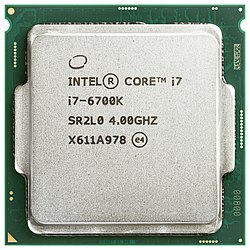
 Intel Core i7-6700K with four physical cores | |
| General information | |
|---|---|
| Launched | August 5, 2015 |
| Discontinued | March 4, 2019 (desktop processors) |
| Marketed by | Intel |
| Designed by | Intel |
| Common manufacturer |
|
| CPUID code | 0406e3h, 0506e3h |
| Product code |
|
| Performance | |
| Max. CPU clock rate | Up to 5.0 GHz |
| Cache | |
| L1 cache | 64 KB per core (32 KB instructions + 32 KB data) |
| L2 cache | 256 KB per core (1 MB per core for Skylake-X, SP, and W) |
| L3 cache | Up to 38.5 MB shared |
| L4 cache | 128 MB of eDRAM (on Iris Pro models) |
| Architecture and classification | |
| Technology node | 14 nm bulk silicon 3D transistors (Tri-Gate) |
| Microarchitecture | Skylake |
| Instruction set | x86-16, IA-32, x86-64 |
| Extensions | |
| Physical specifications | |
| Cores |
|
| Sockets | |
| Products, models, variants | |
| Product code name |
|
| Brand name |
|
| History | |
| Predecessor | Broadwell (tick/process) |
| Successors |
|
| Support status | |
| Client: Unsupported as of December 30, 2022 for iGPU Xeon E3 v5: Unsupported as of December 30, 2022 for iGPU Other Xeon: supported | |
Skylake[6][7] is Intel's codename for its sixth generation Core microprocessor family that was launched on August 5, 2015,[8] succeeding the Broadwell microarchitecture.[9] Skylake is a microarchitecture redesign using the same 14 nm manufacturing process technology[10] as its predecessor, serving as a tock in Intel's tick–tock manufacturing and design model. According to Intel, the redesign brings greater CPU and GPU performance and reduced power consumption. Skylake CPUs share their microarchitecture with Kaby Lake, Coffee Lake, Whiskey Lake, and Comet Lake CPUs.
Skylake is the last Intel platform on which Windows earlier than Windows 10 are officially supported by Microsoft,[11] although enthusiast-created modifications are available that disabled the Windows Update check and allowed Windows 8.1 and earlier to continue to receive Windows Updates on this and later platforms.[12][13][14]
Some of the processors based on the Skylake microarchitecture are marketed as sixth-generation Core.[15][16][17]
Intel officially declared end of life and discontinued Skylake LGA 1151 CPUs (except i3-6100, i5-6500, and Xeon E3 v5) on March 4, 2019.[18]
Development history
[edit]Skylake's development, as with previous processors such as Banias, Dothan, Conroe, Sandy Bridge, and Ivy Bridge, was primarily undertaken by Intel Israel at its engineering research center in Haifa, Israel.[19] The final design was largely an evolution of Haswell, with minor improvements to performance and several power-saving features being added.[20] A major priority of Skylake's design was to design a microarchitecture for envelopes as low as 4.5W to embed within tablet computers and notebooks in addition to higher-power desktop computers and servers.[21]
In September 2014, Intel announced the Skylake microarchitecture at the Intel Developer Forum in San Francisco, and that volume shipments of Skylake CPUs were scheduled for the second half of 2015. The Skylake development platform was announced to be available in Q1 2015. During the announcement, Intel also demonstrated two computers with desktop and mobile Skylake prototypes: the first was a desktop testbed system, running the latest version of 3DMark, while the second computer was a fully functional laptop, playing 4K video.[22]
An initial batch of Skylake CPU models (i5-6600K and i7-6700K) was announced for immediate availability during the Gamescom on August 5, 2015,[23] unusually soon after the release of its predecessor, Broadwell, which had suffered from launch delays.[24] Intel acknowledged in 2014 that moving from 22 nm (Haswell) to 14 nm (Broadwell) had been its most difficult process to develop yet, causing Broadwell's planned launch to slip by several months;[25] yet, the 14 nm production was back on track and in full production as of Q3 2014.[26] Industry observers had initially believed that the issues affecting Broadwell would also cause Skylake to slip to 2016, but Intel was able to bring forward Skylake's release and shorten Broadwell's release cycle instead.[27][28] As a result, the Broadwell architecture had an unusually short run.[27]
Overclocking of unsupported processors
[edit]Officially Intel supported overclocking of only the K and X versions of Skylake processors. However, it was later discovered that other non-K chips could be overclocked by modifying the base clock value – a process made feasible by the base clock applying only to the CPU, RAM, and integrated graphics on Skylake. Through beta UEFI firmware updates, some motherboard vendors, such as ASRock (which prominently promoted it under the name Sky OC) allowed the base clock to be modified in this manner.[29][30]
When overclocking unsupported processors using these UEFI firmware updates, several issues arise:
- C-states are disabled, therefore the CPU will constantly run at its highest frequency and voltage
- Turbo-boost is disabled
- Integrated graphics are disabled
- AVX2 instruction performance is poor, approximately 4-5 times slower due to the upper 128-bit half of the execution units and data buses not being taken out of their power saving states
- CPU core temperature readings are incorrect
These issues are partly caused by the power management of the processor needing to be disabled for base clock overclocking to work.[31]
In February 2016, however, an ASRock firmware update removed the feature. On February 9, 2016, Intel announced that it would no longer allow such overclocking of non-K processors, and that it had issued a CPU microcode update that removes the function.[32][33][34] In April 2016, ASRock started selling motherboards that allow overclocking of unsupported CPUs using an external clock generator.[35][36]
Operating system support
[edit]In January 2016, Microsoft announced that it would end support of Windows 7 and Windows 8.1 on Skylake processors effective July 17, 2017; after this date, only the most critical updates for the two operating systems would be released for Skylake users if they have been judged not to affect the reliability of the OS on older hardware (until July 31, 2019; August 2019 critical update requires at least Windows 10), and Windows 10 would be the only Microsoft Windows platform officially supported on Skylake and on later Intel CPU microarchitectures beginning with Skylake's successor Kaby Lake. Terry Myerson stated that Microsoft had to make a large investment in order to reliably support Skylake on older versions of Windows, and that future generations of processors would require further investments. Microsoft also stated that due to the age of the platform, it would be challenging for newer hardware, firmware, and device driver combinations to properly run under Windows 7.[37][38]
On March 18, 2016, in response to criticism over the move, primarily from enterprise customers, Microsoft announced revisions to the support policy, changing the cutoff for support and non-critical updates to July 17, 2018, and stating that Skylake users would receive all critical security updates for Windows 7 and 8.1 through the end of extended support.[39][40] In August 2016, citing "a strong partnership with our OEM partners and Intel", Microsoft stated that it would continue to fully support 7 and 8.1 on Skylake through the end of their respective lifecycles.[41][42] In addition, an enthusiast-created modification was released that disabled the Windows Update check and allowed Windows 8.1 and earlier to continue to be updated on this and later platforms.[43]
As of Linux kernel 4.10, Skylake mobile power management is supported with most Package C states supported seeing some use. Linux 4.11 enables Frame-Buffer Compression for the integrated graphics chipset by default, which lowers power consumption.[44]
Skylake is fully supported on OpenBSD 6.2 and later, including accelerated graphics.[45]
For Windows 11, only the high-end Skylake-X processors are officially listed as compatible.[46] All other Skylake processors are not officially supported due to security concerns.[47] However, it is still possible to manually upgrade using an ISO image (as Windows 10 users on those processors will not be offered to upgrade to Windows 11 via Windows Update), or perform a clean installation as long as the system has Trusted Platform Module (TPM) 2.0 enabled,[48] but the user must accept that they will not be entitled to receive updates, and that damage caused by using Windows 11 on an unsupported configuration are not covered by the manufacturer's warranty.[49][50]
Features
[edit]

Like its predecessor, Broadwell, Skylake is available in five variants, identified by the suffixes S (SKL-S), X (SKL-X), H (SKL-H), U (SKL-U), and Y (SKL-Y). SKL-S and SKL-X contain overclockable K and X variants with unlocked multipliers.[51] The H, U and Y variants are manufactured in ball grid array (BGA) packaging, while the S and X variants are manufactured in land grid array (LGA) packaging using a new socket, LGA 1151 (LGA 2066 for Skylake X).[52] Skylake is used in conjunction with Intel 100 Series chipsets, also known as Sunrise Point.[53]
The major changes between the Haswell and Skylake architectures include the removal of the fully integrated voltage regulator (FIVR) introduced with Haswell.[54] On the variants that will use a discrete Platform Controller Hub (PCH), Direct Media Interface (DMI) 2.0 is replaced by DMI 3.0, which allows speeds of up to 8 GT/s.
Skylake's U and Y variants support one DIMM slot per channel, while H and S variants support two DIMM slots per channel.[52] Skylake's launch and sales lifespan occur at the same time as the ongoing SDRAM market transition, with DDR3 SDRAM memory gradually being replaced by DDR4 SDRAM. Rather than working exclusively with DDR4, the Skylake microarchitecture remains backward compatible by interoperating with both types of memory. Accompanying the microarchitecture's support for both memory standards, a new SO-DIMM type capable of carrying either DDR3 or DDR4 memory chips, called UniDIMM, was also announced.[55]
Skylake's few P variants have a reduced on-die graphics unit (12 execution units enabled instead of 24 execution units) over their direct counterparts; see the table below. In contrast, with Ivy Bridge CPUs the P suffix was used for CPUs with completely disabled on-die video chipset.
Other enhancements include Thunderbolt 3.0, Serial ATA Express, Iris Pro graphics with Direct3D feature level 12_1 with up to 128 MB of L4 eDRAM cache on certain SKUs.[56] The Skylake line of processors retires VGA support,[57] while supporting up to three monitors connected via HDMI 1.4, DisplayPort 1.2 or Embedded DisplayPort (eDP) interfaces.[58] HDMI 2.0 (4K@60 Hz) is only supported on motherboards equipped with Intel's Alpine Ridge Thunderbolt controller.[59]
The Skylake instruction set changes include Intel MPX (Memory Protection Extensions) and Intel SGX (Software Guard Extensions). Future Xeon variants will also have Advanced Vector Extensions 3.2 (AVX-512F).[3][4]
Skylake-based laptops were predicted to use wireless technology called Rezence for charging, and other wireless technologies for communication with peripherals. Many major PC vendors agreed to use this technology in Skylake-based laptops; however, no laptops were released with the technology as of 2019.[60][61]
The integrated GPU of Skylake's S variant supports on Windows DirectX 12 Feature Level 12_1, OpenGL 4.6 with latest Windows 10 driver update[62] (OpenGL 4.5 on Linux[63]) and OpenCL 3.0 standards. The Quick Sync video engine now includes support for VP9 (GPU accelerated decode only), VP8 and HEVC (hardware accelerated 8-bit encode/decode and GPU accelerated 10-bit decode), and supports for resolutions up to 4096 × 2048.[64][65][66]
Intel also released unlocked (capable of overclocking) mobile Skylake CPUs.[67]
Unlike previous generations, Skylake-based Xeon E3 no longer works with a desktop chipset that supports the same socket, and requires either the C232 or the C236 chipset to operate.
Started from Skylake, Intel had removed IDE mode (of SATA controller) and EHCI controller from its client platform chipsets.
Known issues
[edit]Short loops with a specific combination of instruction use may cause unpredictable system behavior on CPUs with hyperthreading. A microcode update was issued to fix the issue.[68]
Skylake is vulnerable to Spectre attacks.[69] In fact, it is more vulnerable than other processors because it uses indirect branch speculation not just on indirect branches but also when the return prediction stack underflows.
The latency for the spinlock PAUSE instruction has been increased dramatically (from the usual 10 cycles to 141 cycles in Skylake), which can cause performance issues with older programs or libraries using pause instructions.[70] Intel documents the increased latency as a feature that improves power efficiency.[71]
CPU
[edit]- Improved front-end, deeper out-of-order buffers, improved execution units, more execution units (third vector integer ALU(VALU)) for five ALUs in total, more load/store bandwidth, improved hyper-threading (wider retirement), speedup of AES-GCM and AES-CBC by 17% and 33% accordingly.[72][73]
- Up to four cores as the default mainstream configuration[74] and up to 18 cores for X-series
- AVX-512: F, CD, VL, BW, and DQ for Xeon Scalable and W variants, but not Xeon E3[3]
- Intel Memory Protection Extensions (MPX)
- Intel Software Guard Extensions (SGX)
- Intel Transactional Synchronization Extensions (Disabled in 2021[75])
- Intel Speed Shift[76]
- Larger re-order buffer (224 entries, up from 192)
- L2 cache was changed from 8-way to 4-way set associative[77]
- Voltage regulator module (FIVR) is moved back to the motherboard
- Enhancements of Intel Processor Trace: fine-grained timing through CYC packets (cycle-accurate mode) and support for Instruction Pointer (IP) address filtering.[78]
- 64 to 128 MB L4 eDRAM cache on certain SKUs
- Add C10 C-states on certain SKUs (mobile)[79]
GPU
[edit]- Skylake's integrated Gen9 GPU supports Direct3D 12 at the feature level 12_1[6][80][81]
- Vulkan 1.3 support (1.4 on Linux by Mesa 25.0 and intel ANV driver[82])[83]
- Full fixed function HEVC Main/8bit encoding(only 4:2:0[84]) and decoding acceleration (Level 5.1).
- Hybrid/Partial HEVC Main10/10bit decoding acceleration.
- Partial VP9 decoding acceleration.[85]
- JPEG encoding acceleration for resolutions up to 16,000×16,000 pixels.
- Offloading some media decoding functionality to HEVC/H.265 micro controller (HuC)[86]
- Frame Buffer Compression (FBC)
- Up to 72 Execution Units (from 48)[87]
- Add Multiplane Overlay (MPO)[87]
- 16-bit float support[87]
I/O
[edit]- LGA 1151 socket for mainstream desktop processors and LGA 2066 socket for enthusiast gaming/workstation X-series processors
- 100-series chipset (Sunrise Point) [88] and 200-series chipset (Union Point)
- X-series uses X299-series chipset
- DMI 3.0 (From DMI 2.0)
- Support for both DDR3L SDRAM and DDR4 SDRAM in mainstream variants, using custom UniDIMM SO-DIMM form factor[74][89][90] with up to 64 GB of RAM on LGA 1151 variants. Usual DDR3 memory is also supported by certain motherboard vendors even though Intel does not officially support it.[91][92]
- Support for 16 PCI Express 3.0 lanes from CPU, 20 PCI Express 3.0 lanes from PCH (LGA 1151), 44 PCI Express 3.0 lanes for Skylake-X
- Support for Thunderbolt 3 (Alpine Ridge)[93]
- Add NVMe PCIe 3.0 x4 support through chipset
Other
[edit]- Thermal design power (TDP) up to 95 W (LGA 1151); up to 165 W (LGA 2066)[94]
- 14 nm manufacturing process[95]
Configurations
[edit]Skylake processors are produced in seven main families: Y, U, H, S, X, W, and SP. Multiple configurations are available within each family:[52]
| Feature | Family | |||||||||
|---|---|---|---|---|---|---|---|---|---|---|
| Y | U | H | T | S | R | X | W | SP | ||
| Max cores | 2 | 4 | 18 | 28 | ||||||
| Integrated L4 cache (eDRAM) | • | • | • | |||||||
| Low-power mobile/embedded systems | • | • | • | • | ||||||
| Socket | BGA | LGA 1151 | LGA 2066 | LGA 3647 | ||||||
| LPDDR3 SDRAM | • | • | • | |||||||
| DDR3L SDRAM | • | • | • | • | • | • | ||||
| DDR4 SDRAM | • | • | • | • | • | • | • | |||
| 128 GB to 1.5 TB of physical RAM | • | • | •+ | |||||||
| 28 to 44 PCIe 3.0 lanes | • | • | • | |||||||
List of Skylake processor models
[edit]Mainstream desktop processors
[edit].jpg)
Common features of the mainstream desktop Skylake CPUs:
- DMI 3.0 and PCIe 3.0 interfaces
- Dual-channel memory support in the following configurations: DDR3L-1600 1.35 V (32 GB maximum) or DDR4-2133 1.2 V (64 GB maximum). DDR3 is unofficially supported through some motherboard vendors[96][97][98]
- 16 PCIe 3.0 lanes
- The Core-branded processors support the AVX2 instruction set. The Celeron and Pentium-branded ones support only SSE4.1/4.2
- 350 MHz base graphics clock rate
| Processor branding and model |
Cores (threads) |
Clock rate (GHz) | GPU | Cache | TDP | Socket | Release date |
Release price (USD) | ||||||||
|---|---|---|---|---|---|---|---|---|---|---|---|---|---|---|---|---|
| Base | Turbo Boost 2.0 | Model | EUs | Max freq. (GHz) |
L2 | L3 | L4 (eDRAM) | |||||||||
| 1 | 2 [citation needed] | 4 [citation needed] | ||||||||||||||
| Core i7 | 6700K | 4 (8) | 4.0 | 4.2 | 4.0 | 4.0 | HD 530 | 24 | 1.15[99] | 1 MB | 8 MB | — | 91 W | LGA 1151 | August 5, 2015 | $339 |
| 6785R | 3.3 | 3.9 | 3.8 | 3.5 | Iris Pro 580 | 72 | 128 MB | 65 W | BGA 1440 | May 3, 2016 | $370 | |||||
| 6700 | 3.4 | 4.0 | 3.9 | 3.7 | HD 530 | 24 | — | LGA 1151 | September 1, 2015 | $303 | ||||||
| 6700T | 2.8 | 3.6 | 3.5 | 3.4 | 35 W | $303 | ||||||||||
| Core i5 | 6600K | 4 (4) | 3.5 | 3.9 | 3.8 | 3.6 | 6 MB | 91 W | August 5, 2015 | $242 | ||||||
| 6685R | 3.2 | 3.8 | 3.7 | 3.3 | Iris Pro 580 | 72 | 128 MB | 65 W | BGA 1440 | May 3, 2016 | $288 | |||||
| 6600 | 3.3 | 3.9 | 3.8 | 3.6 | HD 530 | 24 | — | LGA 1151 | September 1, 2015 | $213 | ||||||
| 6585R | 2.8 | 3.6 | 3.5 | 3.1 | Iris Pro 580 | 72 | 1.1 | 128 MB | BGA 1440 | May 3, 2016 | $255 | |||||
| 6500 | 3.2 | 3.3 | HD 530 | 24 | 1.05 | — | LGA 1151 | September 1, 2015 | $192 | |||||||
| 6600T | 2.7 | 3.5 | 3.4 | 3.3 | 1.1 | 35 W | Q3 2015 | $213 | ||||||||
| 6500T | 2.5 | 3.1 | 3.0 | 2.8 | $192 | |||||||||||
| 6402P | 2.8 | 3.4 | 3.4 | 3.2 | HD 510 | 12 | 0.95 | 65 W | December 27, 2015 | $182 | ||||||
| 6400T | 2.2 | 2.8 | 2.7 | 2.5 | HD 530 | 24 | 35 W | Q3 2015 | ||||||||
| 6400 | 2.7 | 3.3 | 3.3 | 3.1 | 65 W | August 5, 2015 | ||||||||||
| Core i3 | 6320 | 2 (4) | 3.9 | — | 1.15 | 512 KB | 4 MB | 51 W | Q3 2015 | $149 | ||||||
| 6300 | 3.8 | $138 | ||||||||||||||
| 6100 | 3.7 | 1.05 | 3 MB | October 2015 | $117 | |||||||||||
| 6300T | 3.3 | 0.95 | 4 MB | 35 W | $138 | |||||||||||
| 6100T | 3.2 | 3 MB | $117 | |||||||||||||
| 6098P | 3.6 | HD 510 | 12 | 1.050 | 54 W | December 27, 2015 | ||||||||||
| Pentium | G4520 | 2 (2) | 3.6 | HD 530 | 24 | 51 W | October 2015 | $86 | ||||||||
| G4500 | 3.5 | $75 | ||||||||||||||
| G4500T | 3.0 | 0.95 | 35 W | Q3 2015 | ||||||||||||
| G4400 | 3.3 | HD 510 | 12 | 1.0 | 54 W | October 2015 | $64 | |||||||||
| G4400T | 2.9 | 0.95 | 35 W | Q3 2015 | ||||||||||||
| G4400TE | 2.4 | Q4 2015 | $70 | |||||||||||||
| Celeron | G3920 | 2.9 | 2 MB | 51 W | $52 | |||||||||||
| G3900 | 2.8 | $42 | ||||||||||||||
| G3900TE | 2.3 | 35 W | ||||||||||||||
| G3900T | 2.6 | |||||||||||||||
High-end desktop processors (Skylake-X)
[edit]Common features of the high-performance Skylake-X CPUs:
- In addition to the AVX2 instruction set, they also support the AVX-512 instructions
- No built-in iGPU (integrated graphics processor)
- Turbo Boost Max Technology 3.0 for up to two/four threads workloads for CPUs that have eight cores and more (7820X, 7900X, 7920X, 7940X, 7960X, 7980XE, and all ninth generation chips)[100]
- A different cache hierarchy (when compared to client Skylake CPUs or previous architectures)
@i7-7820X@SR3L5_Stack-DSC09155-DSC09210_-_ZS-retouched_(28088639909).jpg)
| Processor branding and model |
Cores (threads) |
Clock rate (GHz) | Cache | PCIe lanes |
Memory support |
Socket | TDP | Release date |
Release price (USD) | ||||
|---|---|---|---|---|---|---|---|---|---|---|---|---|---|
| Base | Turbo | L2 | L3 | ||||||||||
| 2.0 | 3.0 | ||||||||||||
| Core i9[101] | 7980XE | 18 (36) | 2.6 | 4.2 | 4.4 | 18 MB | 24.75 MB | 44 PCIe 3.0 |
DDR4-2666 quad-channel |
LGA 2066 | 165 W | Sep 25, 2017[102] | $1999 |
| 7960X | 16 (32) | 2.8 | 16 MB | 22 MB | $1699 | ||||||||
| 7940X | 14 (28) | 3.1 | 4.3 | 14 MB | 19.25 MB | $1399 | |||||||
| 7920X | 12 (24) | 2.9 | 12 MB | 16.5 MB | 140 W | Aug 28, 2017 | $1189 | ||||||
| 7900X | 10 (20) | 3.3 | 4.5 | 10 MB | 13.75 MB | Jun 19, 2017 | $999 | ||||||
| Core i7 | 7820X | 8 (16) | 3.6 | 8 MB | 11 MB | 28 PCIe 3.0 |
$599 | ||||||
| 7800X | 6 (12) | 3.5 | 4.0 | — | 6 MB | 8.25 MB | DDR4-2400 quad-channel |
$389 | |||||
| Processor branding and model |
Cores (threads) |
Clock rate (GHz) | Cache | PCIe lanes |
Memory support |
Socket | TDP | Release date |
Release price (USD) | ||||
|---|---|---|---|---|---|---|---|---|---|---|---|---|---|
| Base | Turbo Boost | L2 | L3 | ||||||||||
| 2.0 | 3.0 | ||||||||||||
| Core i9[103] | 9990XE[104] | 14 (28) | 4.0 | 5.0 | 5.0 | 14 MB | 19.25 MB | 44 PCIe 3.0 |
DDR4-2666 quad-channel |
LGA 2066 | 255 W | Jan 3, 2019 | OEM |
| 9980XE | 18 (36) | 3.0 | 4.4 | 4.5 | 18 MB | 24.75 MB | 165 W | Oct 9, 2018[105] | $1979 | ||||
| 9960X | 16 (32) | 3.1 | 16 MB | 22 MB | $1684 | ||||||||
| 9940X | 14 (28) | 3.3 | 14 MB | 19.25 MB | $1387 | ||||||||
| 9920X | 12 (24) | 3.5 | 12 MB | $1189 | |||||||||
| 9900X | 10 (20) | 3.5 | 10 MB | $989 | |||||||||
| 9820X | 3.3 | 4.1 | 4.2 | 16.5 MB | $889 | ||||||||
| Core i7 | 9800X | 8 (16) | 3.8 | 4.4 | 4.5 | 8 MB | $589 | ||||||
Xeon high-end desktop processors (Skylake-X)
[edit]- Marketed as a Xeon
- Uses the C621 chipset
- Xeon W-3175X was the only Xeon with a multiplier officially unlocked for overclocking until the introduction of Sapphire Rapids-WS Xeon CPUs in 2023.[106]
| Model | sSpec number |
Cores (threads) |
Clock rate | Turbo Boost all-core/2.0 (/max. 3.0) |
L2 cache |
L3 cache |
TDP | Socket | I/O bus | Memory | Release date | Part number(s) |
Release price (USD) |
|---|---|---|---|---|---|---|---|---|---|---|---|---|---|
| Xeon W-3175X |
|
28 (56) | 3.1 GHz | 3.8/4.3 GHz | 28 × 1 MB | 38.50 MB | 255 W
|
LGA 3647 | DMI 3.0 | 6 × DDR4-2666 | January 30, 2019 |
|
$2999 |
Mobile processors
[edit]For mobile workstation processors, see Server processors
| Processor branding and model |
Cores (threads) |
CPU clock rate |
CPU Turbo clock rate | GPU | GPU clock rate | Cache | Max. PCIe lanes |
TDP | cTDP | Release date | Price (USD) | ||||||
|---|---|---|---|---|---|---|---|---|---|---|---|---|---|---|---|---|---|
| Single core |
Dual core [citation needed] |
Quad core [citation needed] |
Base | Turbo | L3 | L4 (eDRAM) |
Up | Down | |||||||||
| Core i7 | 6970HQ | 4 (8) | 2.8 GHz | 3.7 GHz | ? | Iris Pro 580 | 350 MHz | 1050 MHz | 8 MB | 128 MB | 16 | 45 W | — | 35 W | Q1 2016 | $623 | |
| 6920HQ | 2.9 GHz | 3.8 GHz | 3.6 GHz | 3.4 GHz | HD 530 | — | September 1, 2015 | $568 | |||||||||
| 6870HQ | 2.7 GHz | 3.6 GHz | ? | Iris Pro 580 | 1000 MHz | 128 MB | Q1 2016 | $434 | |||||||||
| 6820HQ | 3.4 GHz | 3.2 GHz | HD 530 | 1050 MHz | — | September 1, 2015 | $378 | ||||||||||
| 6820HK | |||||||||||||||||
| 6770HQ | 2.6 GHz | 3.5 GHz | ? | Iris Pro 580 | 950 MHz | 6 MB | 128 MB | Q1 2016 | $434 | ||||||||
| 6700HQ | 3.3 GHz | 3.1 GHz | HD 530 | 1050 MHz | — | September 1, 2015 | $378 | ||||||||||
| 6660U | 2 (4) | 2.4 GHz | 3.4 GHz | 3.2 GHz | — | Iris 540 | 300 MHz | 4 MB | 64 MB | 12 | 15 W | 9.5 W | Q1 2016 | $415 | |||
| 6650U | 2.2 GHz | Q3 2015 | |||||||||||||||
| 6600U | 2.6 GHz | — | HD 520 | — | 25 W | 7.5 W | September 1, 2015 | $393 | |||||||||
| 6567U | 3.3 GHz | 3.6 GHz | 3.4 GHz | Iris 550 | 1100 MHz | 64 MB | 28 W | — | 23 W | Q3 2015 | TBD | ||||||
| 6560U | 2.2 GHz | 3.2 GHz | 3.1 GHz | Iris 540 | 1050 MHz | 15 W | 9.5 W | ||||||||||
| 6500U | 2.5 GHz | 3.1 GHz | 3.0 GHz | HD 520 | — | 7.5 W | September 1, 2015 | $393 | |||||||||
| Core i5 | 6440HQ | 4 (4) | 2.6 GHz | 3.5 GHz | 3.3 GHz | 3.1 GHz | HD 530 | 350 MHz | 950 MHz | 6 MB | 16 | 45 W | 35 W | $250 | |||
| 6360U | 2 (4) | 2.0 GHz | 3.1 GHz | 2.9 GHz | — | Iris 540 | 300 MHz | 1000 MHz | 4 MB | 64 MB | 12 | 15 W | 9.5 W | Q3 2015 | $304 | ||
| 6350HQ | 4 (4) | 2.3 GHz | 3.2 GHz | ? | Iris Pro 580 | 350 MHz | 900 MHz | 6 MB | 128 MB | 16 | 45 W | 35 W | Q1 2016 | $306 | |||
| 6300HQ | 3.0 GHz | 2.8 GHz | HD 530 | 950 MHz | — | September 1, 2015 | $250 | ||||||||||
| 6300U | 2 (4) | 2.4 GHz | 3.0 GHz | 2.9 GHz | — | HD 520 | 300 MHz | 1000 MHz | 3 MB | 12 | 15 W | 7.5 W | $281 | ||||
| 6287U | 3.1 GHz | 3.5 GHz | 3.3 GHz | Iris 550 | 1100 MHz | 4 MB | 64 MB | 28 W | 23 W | Q3 2015 | $304 | ||||||
| 6267U | 2.9 GHz | 3.3 GHz | 3.1 GHz | 1050 MHz | 23 W | ||||||||||||
| 6260U | 1.8 GHz | 2.9 GHz | 2.7 GHz | Iris 540 | 950 MHz | 15 W | 9.5 W | $304 | |||||||||
| 6200U | 2.3 GHz | 2.8 GHz | HD 520 | 1000 MHz | 3 MB | — | 7.5 W | September 1, 2015 | $281 | ||||||||
| Core i3 | 6167U | 2.7 GHz | — | — | Iris 550 | 64 MB | 28 W | 23 W | Q3 2015 | $304 | |||||||
| 6157U | 2.4 GHz | Q3 2016 | |||||||||||||||
| 6100H | 2.7 GHz | HD 530 | 350 MHz | 900 MHz | — | 35 W | — | September 1, 2015 | $225 | ||||||||
| 6100U | 2.3 GHz | HD 520 | 300 MHz | 1000 MHz | 15 W | 7.5 W | $281 | ||||||||||
| 6006U | 2.0 GHz | 900 MHz | — | November, 2016 | $281 | ||||||||||||
| Core m7 | 6Y75 | 1.2 GHz | 3.1 GHz | 2.9 GHz | HD 515 | 300 MHz | 1000 MHz | 4 MB | 10 | 4.5 W | 7 W | 3.5 W | September 1, 2015 | $393 | |||
| Core m5 | 6Y57 | 1.1 GHz | 2.8 GHz | 2.4 GHz | 900 MHz | $281 | |||||||||||
| 6Y54 | 2.7 GHz | ||||||||||||||||
| Core m3 | 6Y30 | 0.9 GHz | 2.2 GHz | 2.0 GHz | 850 MHz | 3.8 W | |||||||||||
| Pentium | 4405U | 2.1 GHz | — | — | HD 510 | 950 MHz | 2 MB | 15 W | — | 10 W | Q3 2015 | $161 | |||||
| 4405Y | 1.5 GHz | HD 515 | 800 MHz | 6 W | 4.5 W | ||||||||||||
| Celeron | G3902E | 2 (2) | 1.6 GHz | — | HD 510 | 350 MHz | 950 MHz | 16 | 25 W | — | Q1 2016 | $107 | |||||
| G3900E | 2.4 GHz | 35 W | |||||||||||||||
| 3955U | 2.0 GHz | 300 MHz | 900 MHz | 10 | 15 W | 10 W | Q4 2015 | ||||||||||
| 3855U | 1.6 GHz | ||||||||||||||||
Workstation processors
[edit]- All models support: MMX, SSE, SSE2, SSE3, SSSE3, SSE4.1, SSE4.2, AVX, AVX2, AVX-512, FMA3, MPX, Enhanced Intel SpeedStep Technology (EIST), Intel 64, XD bit (an NX bit implementation), Intel VT-x, Intel VT-d, Turbo Boost (excluding W-2102 and W-2104), Hyper-threading (excluding W-2102 and W-2104), AES-NI, Intel TSX-NI, Smart Cache.
- PCI Express lanes: 48
- Supports up to eight DIMMs of DDR4 memory, maximum 512 GB.
| Model | sSpec number |
Cores (threads) |
Clock rate | Turbo Boost all-core/2.0 (/max. 3.0) |
L2 cache |
L3 cache |
TDP | Socket | I/O bus | Memory | Release date | Part number(s) |
Release price (USD) |
|---|---|---|---|---|---|---|---|---|---|---|---|---|---|
| Xeon W-2195 |
|
18 (36) | 2.3 GHz | 3.2/4.3 GHz | 18 × 1 MB | 24.75 MB | 140 W
|
LGA 2066 | DMI 3.0 | 4 × DDR4-2666 | August 29, 2017 |
|
$2553 |
| Xeon W-2191B |
|
18 (36) | 2.3 GHz | 3.2/4.3 GHz | 18 × 1 MB | 24.75 MB | 140 W
|
LGA 2066 | DMI 3.0 | 4 × DDR4-2666 | December 21, 2017 | OEM for Apple[107][108] | |
| Xeon W-2175 |
|
14 (28) | 2.5 GHz | 3.3/4.3 GHz | 14 × 1 MB | 19.25 MB | 140 W
|
LGA 2066 | DMI 3.0 | 4 × DDR4-2666 | October 15, 2017 |
|
$1947 |
| Xeon W-2170B |
|
14 (28) | 2.5 GHz | 3.3/4.3 GHz | 14 × 1 MB | 19.25 MB | 140 W
|
LGA 2066 | DMI 3.0 | 4 × DDR4-2666 | December 21, 2017 | OEM for Apple[107][108] | |
| Xeon W-2155 |
|
10 (20) | 3.3 GHz | 4.0/4.5 GHz | 10 × 1 MB | 13.75 MB | 140 W
|
LGA 2066 | DMI 3.0 | 4 × DDR4-2666 | August 29, 2017 |
|
$1440 |
| Xeon W-2150B |
|
10 (20) | 3 GHz | 4.0/4.5 GHz | 10 × 1 MB | 13.75 MB | 120 W
|
LGA 2066 | DMI 3.0 | 4 × DDR4-2666 | December 21, 2017 | OEM for Apple[107][108] | |
| Xeon W-2145 |
|
8 (16) | 3.7 GHz | 4.3/4.5 GHz | 8 × 1 MB | 11.00 MB | 140 W
|
LGA 2066 | DMI 3.0 | 4 × DDR4-2666 | August 29, 2017 |
|
$1113 |
| Xeon W-2140B |
|
8 (16) | 3.2 GHz | 3.9/4.2 GHz | 8 × 1 MB | 11.00 MB | 120 W
|
LGA 2066 | DMI 3.0 | 4 × DDR4-2666 | December 21, 2017 | OEM for Apple[107][108] | |
| Xeon W-2135 |
|
6 (12) | 3.7 GHz | 4.4/4.5 GHz | 6 × 1 MB | 8.25 MB | 140 W
|
LGA 2066 | DMI 3.0 | 4 × DDR4-2666 | August 29, 2017 |
|
$835 |
| Xeon W-2133 |
|
6 (12) | 3.6 GHz | 3.8/3.9 GHz | 6 × 1 MB | 8.25 MB | 140 W
|
LGA 2066 | DMI 3.0 | 4 × DDR4-2666 | August 29, 2017 |
|
$617 |
| Xeon W-2125 |
|
4 (8) | 4 GHz | 4.4/4.5 GHz | 4 × 1 MB | 8.25 MB | 120 W
|
LGA 2066 | DMI 3.0 | 4 × DDR4-2666 | August 29, 2017 |
|
$444 |
| Xeon W-2123 |
|
4 (8) | 3.6 GHz | 3.7/3.9 GHz | 4 × 1 MB | 8.25 MB | 120 W
|
LGA 2066 | DMI 3.0 | 4 × DDR4-2666 | August 29, 2017 |
|
$294 |
| Xeon W-2104 |
|
4 (4) | 3.2 GHz | N/A | 4 × 1 MB | 8.25 MB | 120 W
|
LGA 2066 | DMI 3.0 | 4 × DDR4-2400 | August 29, 2017 |
|
$255 |
| Xeon W-2102 |
|
4 (4) | 2.9 GHz | N/A | 4 × 1 MB | 8.25 MB | 120 W
|
LGA 2066 | DMI 3.0 | 4 × DDR4-2400 | August 29, 2017 |
|
$202 |
Server processors
[edit]E3 series server chips all consist of System Bus 9 GT/s, maximum memory bandwidth of 34.1 GB/s dual channel memory. Unlike its predecessor, the Skylake Xeon CPUs require C230 series (C232/C236) or C240 series (C242/C246) chipset to operate, with integrated graphics working only with C236 and C246 chipsets. Mobile counterparts uses CM230 and CM240 series chipsets.
| Target segment |
Cores (threads) |
Processor branding and model |
GPU | Clock rate | Cache | TDP | Release date |
Release price (USD) tray / box |
Motherboard | |||||||
|---|---|---|---|---|---|---|---|---|---|---|---|---|---|---|---|---|
| CPU | Graphics | L3 | L4 (eDRAM) | Socket | Interface | Memory | ||||||||||
| Normal | Turbo | Normal | Turbo | |||||||||||||
| Server | 4 (8) | Xeon E3 v5 | 1280v5 | — | 3.7 GHz | 4.0 GHz | — | 8 MB | — | 80 W | Q4 2015 | $612 / — | LGA 1151 |
DMI 3.0 PCIe 3.0 |
DDR4 2133/1866 or DDR3L 1333/1600 with ECC | |
| 1275v5 | HD P530 | 3.6 GHz | 350 MHz | 1.15 GHz | $339 / — | |||||||||||
| 1270v5 | — | 3.6 GHz | — | $328 / $339 | ||||||||||||
| 1260Lv5 | 2.9 GHz | 3.9 GHz | 45 W | $294 / — | ||||||||||||
| 1245v5 | HD P530 | 3.5 GHz | 350 MHz | 1.15 GHz | 80 W | $284 / — | ||||||||||
| 1240v5 | — | 3.5 GHz | — | $272 / $282 | ||||||||||||
| 1240Lv5 | 2.1 GHz | 3.2 GHz | 25 W | $278 / — | ||||||||||||
| 1230v5 | 3.4 GHz | 3.8 GHz | 80 W | $250 / $260 | ||||||||||||
| 4 (4) | 1235Lv5 | HD P530 | 2.0 GHz | 3.0 GHz | 350 MHz | 1.15 GHz | 25 W | $250 / — | ||||||||
| 1225v5 | 3.3 GHz | 3.7 GHz | 80 W | $213 / — | ||||||||||||
| 1220v5 | — | 3.0 GHz | 3.5 GHz | — | $193 / — | |||||||||||
| Mobile workstation |
4 (8) | 1575Mv5 | Iris Pro P580 | 3.0 GHz | 3.9 GHz | 350 MHz | 1.1 GHz | 128 MB | 45 W | Q1 2016 | $1207 / — | BGA 1440 |
DDR4-2133 LPDDR3-1866 DDR3L-1600 with ECC | |||
| 1545Mv5 | 2.9 GHz | 3.8 GHz | 1.05 GHz | $679 / — | ||||||||||||
| 1535Mv5 | HD P530 | — | Q3 2015 | $623 / — | ||||||||||||
| 1505Mv5 | 2.8 GHz | 3.7 GHz | $434 / — | |||||||||||||
| Embedded | 1505Lv5 | 2.0 GHz | 2.8 GHz | 1.0 GHz | 25 W | Q4 2015 | $433 / — | |||||||||
Skylake-SP (14 nm) Scalable Performance
[edit]- Xeon Platinum supports up to eight sockets. Xeon Gold supports up to four sockets. Xeon Silver and Bronze support up to two sockets.
- −M: 1536 GB RAM per socket instead of 768 GB RAM for non−M SKUs
- −F: integrated OmniPath fabric
- −T: High thermal-case and extended reliability
- Support for up to 12 DIMMs of DDR4 memory per CPU socket.
- Xeon Platinum, Gold 61XX, and Gold 5122 have two AVX-512 FMA units per core. Xeon Gold 51XX (except 5122), Silver, and Bronze have a single AVX-512 FMA unit per core.
Xeon Bronze and Silver (dual processor)
[edit]- Xeon Bronze 31XX has no HT or Turbo Boost support.
- Xeon Bronze 31XX supports DDR4-2133 MHz RAM. Xeon Silver 41XX supports DDR4-2400 MHz RAM.
- Xeon Bronze 31XX and Xeon Silver 41XX support two UPI links at 9.6 GT/s.
| Model | sSpec number |
Cores (threads) |
Clock rate | Turbo Boost all-core/2.0 (/max. 3.0) |
L2 cache |
L3 cache |
TDP | Socket | I/O bus | Memory | Release date | Part number(s) |
Release price (USD) |
|---|---|---|---|---|---|---|---|---|---|---|---|---|---|
| Xeon Silver 4116 |
|
12 (24) | 2.1 GHz | 2.4/3.0 GHz | 12 × 1 MB | 16.50 MB | 85 W
|
LGA 3647 | 2 × 9.6 GT/s UPI | 6 × DDR4-2400 | 11 July 2017 |
|
$1002 $1012 |
| Xeon Silver 4116T |
|
12 (24) | 2.1 GHz | 2.4/3.0 GHz | 12 × 1 MB | 16.50 MB | 85 W
|
LGA 3647 | 2 × 9.6 GT/s UPI | 6 × DDR4-2400 | Q3 2017 |
|
$1112 |
| Xeon Silver 4114 |
|
10 (20) | 2.2 GHz | 2.5/3.0 GHz | 10 × 1 MB | 13.75 MB | 85 W
|
LGA 3647 | 2 × 9.6 GT/s UPI | 6 × DDR4-2400 | 11 July 2017 |
|
$694 $704 |
| Xeon Silver 4114T |
|
10 (20) | 2.2 GHz | 2.5/3.0 GHz | 10 × 1 MB | 13.75 MB | 85 W
|
LGA 3647 | 2 × 9.6 GT/s UPI | 6 × DDR4-2400 | Q3 2017 |
|
$773 |
| Xeon Silver 4112 |
|
4 (8) | 2.6 GHz | 2.9/3.0 GHz | 4 × 1 MB | 8.25 MB | 85 W
|
LGA 3647 | 2 × 9.6 GT/s UPI | 6 × DDR4-2400 | 11 July 2017 |
|
$473 $483 |
| Xeon Silver 4110 |
|
8 (16) | 2.1 GHz | 2.4/3.0 GHz | 8 × 1 MB | 11.00 MB | 85 W
|
LGA 3647 | 2 × 9.6 GT/s UPI | 6 × DDR4-2400 | 11 July 2017 |
|
$501 $511 |
| Xeon Silver 4109T |
|
8 (16) | 2 GHz | 2.3/3.0 GHz | 8 × 1 MB | 11.00 MB | 70 W
|
LGA 3647 | 2 × 9.6 GT/s UPI | 6 × DDR4-2400 | 11 July 2017 |
|
$501 |
| Xeon Silver 4108 |
|
8 (16) | 1.8 GHz | 2.1/3.0 GHz | 8 × 1 MB | 11.00 MB | 85 W
|
LGA 3647 | 2 × 9.6 GT/s UPI | 6 × DDR4-2400 | 11 July 2017 |
|
$417 $427 |
| Xeon Bronze 3106 |
|
8 (8) | 1.7 GHz | N/A | 8 × 1 MB | 11.00 MB | 85 W
|
LGA 3647 | 2 × 9.6 GT/s UPI | 6 × DDR4-2133 | 11 July 2017 |
|
$306 $316 |
| Xeon Bronze 3104 |
|
6 (6) | 1.7 GHz | N/A | 6 × 1 MB | 8.25 MB | 85 W
|
LGA 3647 | 2 × 9.6 GT/s UPI | 6 × DDR4-2133 | 11 July 2017 |
|
$223 $213 |
Xeon Gold (quad processor)
[edit]- Xeon Gold 51XX and F SKUs has two UPIs at 10.4 GT/s. Xeon Gold 61XX has three UPIs at 10.4 GT/s.
- Xeon Gold 51XX support DDR4-2400 MHz RAM (except 5122). Xeon Gold 5122 and 61XX support DDR4-2666 MHz RAM.
| Model | sSpec number |
Cores (threads) |
Clock rate | Turbo Boost all-core/2.0 (/max. 3.0) |
L2 cache |
L3 cache |
TDP | Socket | I/O bus | Memory | Release date | Part number(s) |
Release price (USD) |
|---|---|---|---|---|---|---|---|---|---|---|---|---|---|
| Xeon Gold 6161 |
|
22 (44) | 2.2 GHz | 2.7/3.0GHz | 22 × 1 MB | 30.25 MB | 165 W
|
LGA 3647 | 3 × 10.4 GT/s UPI | 6 × DDR4-2666 | 2017 |
|
|
| Xeon Gold 6154 |
|
18 (36) | 3 GHz | 3.7/3.7GHz | 18 × 1 MB | 24.75 MB | 200 W
|
LGA 3647 | 3 × 10.4 GT/s UPI | 6 × DDR4-2666 | 11 July 2017 |
|
$3543 |
| Xeon Gold 6152 |
|
22 (44) | 2.1 GHz | 2.8/3.7GHz | 22 × 1 MB | 30.25 MB | 140 W
|
LGA 3647 | 3 × 10.4 GT/s UPI | 6 × DDR4-2666 | 11 July 2017 |
|
$3655 $3661 |
| Xeon Gold 6150 |
|
18 (36) | 2.7 GHz | 3.4/3.7GHz | 18 × 1 MB | 24.75 MB | 165 W
|
LGA 3647 | 3 × 10.4 GT/s UPI | 6 × DDR4-2666 | 11 July 2017 |
|
$3358 |
| Xeon Gold 6149 | 16 (32) | 3.1 GHz | 16 × 1 MB | MB | LGA 3647 | 3 × 10.4 GT/s UPI | 6 × DDR4-2666 | OEM | |||||
| Xeon Gold 6148 |
|
20 (40) | 2.4 GHz | 3.1/3.7GHz | 20 × 1 MB | 27.50 MB | 150 W
|
LGA 3647 | 3 × 10.4 GT/s UPI | 6 × DDR4-2666 | 11 July 2017 |
|
$3072 $3078 |
| Xeon Gold 6148F |
|
20 (40) | 2.4 GHz | 3.1/3.7GHz | 20 × 1 MB | 27.50 MB | 150 W
|
LGA 3647 | 2 × 10.4 GT/s UPI | 6 × DDR4-2666 | 11 July 2017 |
|
$3227 |
| Xeon Gold 6146 |
|
12 (24) | 3.2 GHz | 3.9/4.2GHz | 12 × 1 MB | 24.75 MB | 165 W
|
LGA 3647 | 3 × 10.4 GT/s UPI | 6 × DDR4-2666 | 11 July 2017 |
|
$3286 |
| Xeon Gold 6145 |
|
20 (40) | 2 GHz | 2.7/3.7GHz | 20 × 1 MB | 27.50 MB | 145 W
|
LGA 3647 | 3 × 10.4 GT/s UPI | 6 × DDR4-2666 | 2017 |
|
|
| Xeon Gold 6144 |
|
8 (16) | 3.5 GHz | 4.1/4.2GHz | 8 × 1 MB | 24.75 MB | 150 W
|
LGA 3647 | 3 × 10.4 GT/s UPI | 6 × DDR4-2666 | Q3 2017 |
|
$2925 |
| Xeon Gold 6142M |
|
16 (32) | 2.6 GHz | 3.3/3.7GHz | 16 × 1 MB | 22.00 MB | 150 W
|
LGA 3647 | 3 × 10.4 GT/s UPI | 6 × DDR4-2666 | 11 July 2017 |
|
$5949 |
| Xeon Gold 6142F |
|
16 (32) | 2.6 GHz | 3.3/3.7GHz | 16 × 1 MB | 22.00 MB | 160 W
|
LGA 3647 | 2 × 10.4 GT/s UPI | 6 × DDR4-2666 | 11 July 2017 |
|
$3101 |
| Xeon Gold 6142 |
|
16 (32) | 2.6 GHz | 3.3/3.7GHz | 16 × 1 MB | 22.00 MB | 150 W
|
LGA 3647 | 3 × 10.4 GT/s UPI | 6 × DDR4-2666 | 11 July 2017 |
|
$2946 $2952 |
| Xeon Gold 6140 |
|
18 (36) | 2.3 GHz | 3.0/3.7GHz | 18 × 1 MB | 24.75 MB | 140 W
|
LGA 3647 | 3 × 10.4 GT/s UPI | 6 × DDR4-2666 | 11 July 2017 |
|
$2445 $2451 |
| Xeon Gold 6140M |
|
18 (36) | 2.3 GHz | 3.0/3.7GHz | 18 × 1 MB | 24.75 MB | 140 W
|
LGA 3647 | 3 × 10.4 GT/s UPI | 6 × DDR4-2666 | 11 July 2017 |
|
$5448 |
| Xeon Gold 6138 |
|
20 (40) | 2 GHz | 2.7/3.7GHz | 20 × 1 MB | 27.50 MB | 125 W
|
LGA 3647 | 3 × 10.4 GT/s UPI | 6 × DDR4-2666 | 11 July 2017 |
|
$2612 $2618 |
| Xeon Gold 6138F |
|
20 (40) | 2 GHz | 2.7/3.7GHz | 20 × 1 MB | 27.50 MB | 135 W
|
LGA 3647 | 2 × 10.4 GT/s UPI | 6 × DDR4-2666 | 11 July 2017 |
|
$2767 |
| Xeon Gold 6138T |
|
20 (40) | 2 GHz | 2.7/3.7GHz | 20 × 1 MB | 27.50 MB | 125 W
|
LGA 3647 | 3 × 10.4 GT/s UPI | 6 × DDR4-2666 | 11 July 2017 |
|
$2742 |
| Xeon Gold 6136 |
|
12 (24) | 3 GHz | 3.6/3.7GHz | 12 × 1 MB | 24.75 MB | 150 W
|
LGA 3647 | 3 × 10.4 GT/s UPI | 6 × DDR4-2666 | 11 July 2017 |
|
$2460 |
| Xeon Gold 6134 |
|
8 (16) | 3.2 GHz | 3.7/3.7GHz | 8 × 1 MB | 24.75 MB | 130 W
|
LGA 3647 | 3 × 10.4 GT/s UPI | 6 × DDR4-2666 | 11 July 2017 |
|
$2214 $2220 |
| Xeon Gold 6134M |
|
8 (16) | 3.2 GHz | 3.7/3.7GHz | 8 × 1 MB | 24.75 MB | 130 W
|
LGA 3647 | 3 × 10.4 GT/s UPI | 6 × DDR4-2666 | 11 July 2017 |
|
$5217 |
| Xeon Gold 6132 |
|
14 (28) | 2.6 GHz | 3.3/3.7GHz | 14 × 1 MB | 19.25 MB | 140 W
|
LGA 3647 | 3 × 10.4 GT/s UPI | 6 × DDR4-2666 | 11 July 2017 |
|
$2111 |
| Xeon Gold 6130 |
|
16 (32) | 2.1 GHz | 2.8/3.7GHz | 16 × 1 MB | 22.00 MB | 125 W
|
LGA 3647 | 3 × 10.4 GT/s UPI | 6 × DDR4-2666 | 11 July 2017 |
|
$1900 |
| Xeon Gold 6130F |
|
16 (32) | 2.1 GHz | 2.8/3.7GHz | 16 × 1 MB | 22.00 MB | 125 W
|
LGA 3647 | 2 × 10.4 GT/s UPI | 6 × DDR4-2666 | 11 July 2017 |
|
$2049 |
| Xeon Gold 6130T |
|
16 (32) | 2.1 GHz | 2.8/3.7GHz | 16 × 1 MB | 22.00 MB | 125 W
|
LGA 3647 | 3 × 10.4 GT/s UPI | 6 × DDR4-2666 | 11 July 2017 |
|
$1988 |
| Xeon Gold 6128 |
|
6 (12) | 3.4 GHz | 3.7/3.7GHz | 6 × 1 MB | 19.25 MB | 115 W
|
LGA 3647 | 3 × 10.4 GT/s UPI | 6 × DDR4-2666 | 11 July 2017 |
|
$1691 $1697 |
| Xeon Gold 6126 |
|
12 (24) | 2.6 GHz | 3.3/3.7GHz | 12 × 1 MB | 19.25 MB | 125 W
|
LGA 3647 | 3 × 10.4 GT/s UPI | 6 × DDR4-2666 | 11 July 2017 |
|
$1776 |
| Xeon Gold 6126F |
|
12 (24) | 2.6 GHz | 3.3/3.7GHz | 12 × 1 MB | 19.25 MB | 135 W
|
LGA 3647 | 2 × 10.4 GT/s UPI | 6 × DDR4-2666 | 11 July 2017 |
|
$1931 |
| Xeon Gold 6126T |
|
12 (24) | 2.6 GHz | 3.3/3.7GHz | 12 × 1 MB | 19.25 MB | 125 W
|
LGA 3647 | 3 × 10.4 GT/s UPI | 6 × DDR4-2666 | 11 July 2017 |
|
$1865 |
| Xeon Gold 5122 |
|
4 (8) | 3.6 GHz | 3.7/3.7GHz | 4 × 1 MB | 16.50 MB | 105 W
|
LGA 3647 | 2 × 10.4 GT/s UPI | 6 × DDR4-2666 | 11 July 2017 |
|
$1221 $1227 |
| Xeon Gold 5120 |
|
14 (28) | 2.2 GHz | 2.6/3.2GHz | 14 × 1 MB | 19.25 MB | 105 W
|
LGA 3647 | 2 × 10.4 GT/s UPI | 6 × DDR4-2400 | 11 July 2017 |
|
$1555 $1561 |
| Xeon Gold 5120T |
|
14 (28) | 2.2 GHz | 2.6/3.2GHz | 14 × 1 MB | 19.25 MB | 105 W
|
LGA 3647 | 2 × 10.4 GT/s UPI | 6 × DDR4-2400 | 11 July 2017 |
|
$1727 |
| Xeon Gold 5119T |
|
14 (28) | 1.9 GHz | 2.3/3.2GHz | 14 × 1 MB | 19.25 MB | 85 W
|
LGA 3647 | 2 × 10.4 GT/s UPI | 6 × DDR4-2400 | 11 July 2017 |
|
$1555 |
| Xeon Gold 5118 |
|
12 (24) | 2.3 GHz | 2.7/3.2GHz | 12 × 1 MB | 16.50 MB | 105 W
|
LGA 3647 | 2 × 10.4 GT/s UPI | 6 × DDR4-2400 | 11 July 2017 |
|
$1273 |
| Xeon Gold 5117 |
|
14 (28) | 2 GHz | 2.3/2.8GHz | 14 × 1 MB | 19.25 MB | 105 W
|
LGA 3647 | 2 × 10.4 GT/s UPI | 6 × DDR4-2400 | 11 July 2017 |
|
$1286 |
| Xeon Gold 5117F |
|
14 (28) | 2 GHz | 2.3/2.8GHz | 14 × 1 MB | 19.25 MB | 113 W
|
LGA 3647 | 2 × 10.4 GT/s UPI | 6 × DDR4-2400 | 11 July 2017 |
|
|
| Xeon Gold 5115 |
|
10 (20) | 2.4 GHz | 2.8/3.2GHz | 10 × 1 MB | 13.75 MB | 85 W
|
LGA 3647 | 2 × 10.4 GT/s UPI | 6 × DDR4-2400 | 11 July 2017 |
|
$1221 |
-
 Intel Skylake Xeon gold processor
 -
 Intel Skylake Xeon gold processor, delidded
 -
 Die shot
@Xeon(ES)@QJW5_DSCx1.jpg)
@Xeon(ES)@QJW5_DSCx3.jpg)
@Xeon(ES)@QJW5_DSCx10@5x.jpg)
Xeon Platinum (octal processor)
[edit]- Xeon Platinum non-F SKUs have three UPIs at 10.4 GT/s. Xeon Platinum F-SKUs have two UPIs at 10.4 GT/s.
- Xeon Platinum supports DDR4-2666 MHz RAM.
| Model | sSpec number |
Cores (threads) |
Clock rate | Turbo Boost all-core/2.0 (/max. 3.0) |
L2 cache |
L3 cache |
TDP | Socket | I/O bus | Memory | Release date | Part number(s) |
Release price (USD) |
|---|---|---|---|---|---|---|---|---|---|---|---|---|---|
| Xeon Platinum 8180 |
|
28 (56) | 2.5 GHz | 3.2/3.8 GHz | 28 × 1 MB | 38.50 MB | 205 W
|
LGA 3647 | 3 × 10.4 GT/s UPI | 6 × DDR4-2666 | 11 July 2017 |
|
$10,009 |
| Xeon Platinum 8180M |
|
28 (56) | 2.5 GHz | 3.2/3.8 GHz | 28 × 1 MB | 38.50 MB | 205 W
|
LGA 3647 | 3 × 10.4 GT/s UPI | 6 × DDR4-2666 | 11 July 2017 |
|
$13,011 |
| Xeon Platinum 8176 |
|
28 (56) | 2.1 GHz | 2.8/3.8 GHz | 28 × 1 MB | 38.50 MB | 165 W
|
LGA 3647 | 3 × 10.4 GT/s UPI | 6 × DDR4-2666 | 11 July 2017 |
|
$8790 |
| Xeon Platinum 8176F |
|
28 (56) | 2.1 GHz | 2.8/3.8 GHz | 28 × 1 MB | 38.50 MB | 173 W
|
LGA 3647 | 2 × 10.4 GT/s UPI | 6 × DDR4-2666 | Q3, 2017 |
|
$8874 |
| Xeon Platinum 8176M |
|
28 (56) | 2.1 GHz | 2.8/3.8 GHz | 28 × 1 MB | 38.50 MB | 165 W
|
LGA 3647 | 3 × 10.4 GT/s UPI | 6 × DDR4-2666 | 11 July 2017 |
|
$11,722 |
| Xeon Platinum 8173M |
|
28 (56) | 2 GHz | 2.7/3.5 GHz | 28 × 1 MB | 38.50 MB | 165 W
|
LGA 3647 | 3 × 10.4 GT/s UPI | 6 × DDR4-2666 | 2017 |
|
|
| Xeon Platinum 8170 |
|
26 (52) | 2.1 GHz | 2.8/3.7 GHz | 26 × 1 MB | 35.75 MB | 165 W
|
LGA 3647 | 3 × 10.4 GT/s UPI | 6 × DDR4-2666 | 11 July 2017 |
|
$7405 $7411 |
| Xeon Platinum 8170M |
|
26 (52) | 2.1 GHz | 2.8/3.7 GHz | 26 × 1 MB | 35.75 MB | 165 W
|
LGA 3647 | 3 × 10.4 GT/s UPI | 6 × DDR4-2666 | 11 July 2017 |
|
$10,409 |
| Xeon Platinum 8168 |
|
24 (48) | 2.7 GHz | 3.4/3.7 GHz | 24 × 1 MB | 33.00 MB | 205 W
|
LGA 3647 | 3 × 10.4 GT/s UPI | 6 × DDR4-2666 | 11 July 2017 |
|
$5890 |
| Xeon Platinum 8167M |
|
26 (52) | 2 GHz | 2.4/2.4 GHz | 26 × 1 MB | 35.75 MB | 165 W
|
LGA 3647 | 3 × 10.4 GT/s UPI | 6 × DDR4-2666 | 2017 |
|
|
| Xeon Platinum 8164 |
|
26 (52) | 2 GHz | 2.7/3.7 GHz | 26 × 1 MB | 35.75 MB | 150 W
|
LGA 3647 | 3 × 10.4 GT/s UPI | 6 × DDR4-2666 | 11 July 2017 |
|
$6114 $6120 |
| Xeon Platinum 8163 |
|
24 (48) | 2.4 GHz | 2.7/3.1 GHz | 24 × 1 MB | 33.00 MB | 165 W
|
LGA 3647 | 3 × 10.4 GT/s UPI | 6 × DDR4-2666 | 2017 |
|
|
| Xeon Platinum 8160 |
|
24 (48) | 2.1 GHz | 2.8/3.7 GHz | 24 × 1 MB | 33.00 MB | 150 W
|
LGA 3647 | 3 × 10.4 GT/s UPI | 6 × DDR4-2666 | 11 July 2017 |
|
$4702 $4708 |
| Xeon Platinum 8160F |
|
24 (48) | 2.1 GHz | 2.8/3.7 GHz | 24 × 1 MB | 33.00 MB | 160 W
|
LGA 3647 | 2 × 10.4 GT/s UPI | 6 × DDR4-2666 | 11 July 2017 |
|
$4856 |
| Xeon Platinum 8160M |
|
24 (48) | 2.1 GHz | 2.8/3.7 GHz | 24 × 1 MB | 33.00 MB | 150 W
|
LGA 3647 | 3 × 10.4 GT/s UPI | 6 × DDR4-2666 | 11 July 2017 |
|
$7704 |
| Xeon Platinum 8160T |
|
24 (48) | 2.1 GHz | 2.8/3.7 GHz | 24 × 1 MB | 33.00 MB | 150 W
|
LGA 3647 | 3 × 10.4 GT/s UPI | 6 × DDR4-2666 | 11 July 2017 |
|
$4936 |
| Xeon Platinum 8158 |
|
12 (24) | 3 GHz | 2.7/3.7 GHz | 12 × 1 MB | 24.75 MB | 150 W
|
LGA 3647 | 3 × 10.4 GT/s UPI | 6 × DDR4-2666 | 11 July 2017 |
|
$7007 |
| Xeon Platinum 8156 |
|
4 (8) | 3.6 GHz | 3.3/3.7 GHz | 4 × 1 MB | 16.50 MB | 105 W
|
LGA 3647 | 3 × 10.4 GT/s UPI | 6 × DDR4-2666 | 11 July 2017 |
|
$7007 |
| Xeon Platinum 8153 |
|
16 (32) | 2 GHz | 2.3/2.8 GHz | 16 × 1 MB | 22.00 MB | 125 W
|
LGA 3647 | 3 × 10.4 GT/s QPI | 6 × DDR4-2666 | 11 July 2017 |
|
$3115 |
See also
[edit]References
[edit]- ^ "Intel Core i7-6700K Processor (8M Cache, up to 4.20 GHz)". Ark.intel.com. Retrieved January 24, 2018.
- ^ Alcorn, Paul (June 3, 2016). "Skylake Xeon Platforms Spotted, Purley Makes A Quiet Splash At Computex". Tom's Hardware. Retrieved April 7, 2023.
- ^ a b c "AVX-512 SIMD enabled only on Xeon models of SkyLake". Bits and Chips. February 27, 2015.
- ^ a b "Skylake processors for the PC will not support the AVX-512". Hardware-boom.com. March 3, 2015. Archived from the original on November 5, 2015. Retrieved January 24, 2018.
- ^ Cutress, Ian (August 5, 2015). "The Intel Skylake Mobile and Desktop Launch, with Architecture Analysis". AnandTech. Archived from the original on October 23, 2015. Retrieved September 18, 2015.
- ^ a b "The Compute Architecture of Intel® Processor Graphics Gen9" (PDF). Intel. Retrieved January 24, 2018.
- ^ "Intel® 64 and IA-32 Architectures Optimization Reference Manual" (PDF). Intel. Retrieved January 24, 2018.
- ^ "Intel Unleashes Next-Gen Enthusiast Desktop PC Platform at Gamescom". Intel Newsroom. August 5, 2015. Retrieved August 5, 2015.
- ^ Demerjian, Charlie (March 31, 2011). "After Intel's Haswell comes Broadwell". SemiAccurate. Retrieved January 4, 2012.
- ^ "Intel Presentation: 22nm Details" (PDF). Intel. Retrieved January 4, 2012.
- ^ Allan, Darren (August 31, 2016). "Intel's latest CPUs will only support Windows 10". TechRadar. Retrieved June 8, 2017.
- ^ "There's a patch to reinstate Windows 7 & 8.1 on Kaby Lake CPUs | TheINQUIRER". April 20, 2017. Archived from the original on April 20, 2017. Retrieved March 9, 2020.
- ^ pilao (March 3, 2020), zeffy/wufuc, retrieved March 9, 2020
- ^ Przemysław (February 9, 2020), p-lider/WuaCpuFix, retrieved March 9, 2020
- ^ "6th Generation Intel® Core i7-6700K and i5-6600K Processors". Intel. Retrieved May 25, 2018.
- ^ "6th Generation Intel® Processor Family". Intel. Retrieved May 25, 2018.
- ^ Mah Ung, Gordon (August 18, 2015). "Why Intel calls Skylake a 6th-generation CPU". PCWorld. Retrieved May 25, 2018.
- ^ "Product Change Notification" (PDF). Retrieved August 17, 2023.
- ^ "Intel in Israel: A Old Relationship Faces New Criticism". Knowledge.wharton.upenn.edu. Retrieved January 24, 2018.
- ^ "The many tricks Intel Skylake uses to go faster and use less power". Ars Technica. Condé Nast. August 19, 2015. Retrieved November 7, 2021.
- ^ Intel Introduced its 6th Generation Intel Core Published September 2, 2015, techtime.co.il
- ^ Shvets, Gennadiy (September 10, 2014). "Intel announces Skylake microarchitecture". CPU-World. Retrieved January 24, 2018.
- ^ "Intel to Debut its Core Skylake Processors at Gamescom 2015". TechPowerUp. June 19, 2015.
- ^ "Intel Corporation Launching Broadwell, Skylake Chips Back to Back". ValueWalk. September 16, 2014. Retrieved October 17, 2014.
- ^ Ryan Smith. "AnandTech – Intel's 14nm Technology in Detail". Anandtech.com. Archived from the original on August 11, 2014. Retrieved January 24, 2018.
- ^ "Intel Broadwell and Skylake client CPUs both launching in 2015". Hexus.net. September 9, 2014. Retrieved January 24, 2018.
- ^ a b Hruska, Joel (July 14, 2014). "Intel's 14nm puzzle: As Skylake details leak, everybody asks – is the chip coming in 2015 or not?". ExtremeTech. Retrieved October 17, 2014.
- ^ Arora, Piyush (October 15, 2014). "Intel: Skylake Development Appears To Be On Schedule". Seeking Alpha. Retrieved January 24, 2018.
- ^ Porter, Matt (February 9, 2016). "Intel puts a stop to overclocking on non-K Skylake CPUs". PC Gamer. Retrieved February 9, 2016.
- ^ "Intel Skylake Non-K OC KOed by ASRock". Hexus. February 5, 2016. Retrieved February 9, 2016.
- ^ "Non-K overclocking". hwbot.org. Archived from the original on May 5, 2021. Retrieved May 5, 2021.
- ^ Cutress, Ian (December 11, 2015). "BCLK Overclocking Intel's non-K Skylake Processors: Coming Soon". AnandTech. Archived from the original on December 13, 2015. Retrieved February 9, 2016.
- ^ "It's official: Intel shuts down the cheap overclocking party by closing Skylake loophole". PCWorld. February 8, 2016. Retrieved February 9, 2016.
- ^ "Yes, you can overclock cheap Intel Skylake chips". PC World. December 11, 2015. Retrieved February 9, 2016.
- ^ "New ASRock motherboards sport external clock generators for Intel CPU overclocking |". ExtremeTech. March 11, 2016. Retrieved April 10, 2016.
- ^ 株式会社インプレス (April 7, 2016). "独自OC機能を備えたH170マザーがASRockから登場、計2モデル - AKIBA PC Hotline!". AKIBA PC Hotline! (in Japanese). Retrieved April 10, 2016.
- ^ "Skylake users given 18 months to upgrade to Windows 10". Ars Technica. January 16, 2016. Retrieved January 16, 2016.
- ^ Bott, Ed. "Microsoft updates support policy: New CPUs will require Windows 10". ZDNet.com. CBS Interactive. Retrieved January 16, 2016.
- ^ "Skylake support on Windows 7 and 8.1 given a one-year extension". Ars Technica. March 18, 2016. Retrieved March 18, 2016.
- ^ "Microsoft backtracks on Windows 7 support deadline". Computerworld.com. March 18, 2016. Retrieved March 18, 2016.
- ^ Larsen, Shad (August 11, 2016). "Updates to Silicon Support Policy for Windows". Windows business blog. Microsoft. Archived from the original on April 25, 2017. Retrieved May 9, 2017.
- ^ Jo Foley, Mary (August 11, 2016). "Microsoft extends again support for Windows 7, 8.1 Skylake-based devices". ZDNet. CBS Interactive. Retrieved May 9, 2017.
- ^ "There's a patch to reinstate Windows 7 & 8.1 on Kaby Lake CPUs". Theinquirer.net. Archived from the original on December 22, 2019. Retrieved January 24, 2018.
- ^ "Linux 4.11 To Enable Frame-Buffer Compression By Default For Skylake+ - Phoronix". Phoronix.com.
- ^ "OpenBSD 6.2". Retrieved October 10, 2018.
- ^ "Windows processor requirements Windows 11 supported Intel processors". docs.microsoft.com. Retrieved October 5, 2021.
- ^ "Update on Windows 11 minimum system requirements". Windows Insider Blog. June 28, 2021. Retrieved October 5, 2021.
- ^ Warren, Tom (August 27, 2021). "Microsoft won't stop you installing Windows 11 on older PCs". The Verge. Retrieved October 5, 2021.
- ^ Hollister, Sean (September 21, 2021). "Windows 11 won't stop older PCs, but it might make you sign this waiver". The Verge. Retrieved October 5, 2021.
- ^ Hollister, Sean (August 28, 2021). "Microsoft is threatening to withhold Windows 11 updates if your CPU is old". The Verge. Retrieved October 5, 2021.
- ^ "Intel Skylake-S desktop CPUs expected at IDF 2015 in August". February 17, 2015.
- ^ a b c Pirzada, Syed Muhammad Usman (June 27, 2014). "Massive Intel 14nm Skylake Leak – Multiple eDRAM Configurations and Desktop Variant to have Configurable TDP". WCCFTech. WCCFTech Prvt. Ltd. Retrieved June 28, 2014.
- ^ "Intel Core Skylake CPUs Accompanied by 100-series Chipset". Techpowerup.com. May 5, 2014. Retrieved May 8, 2014.
- ^ Pirzada, Syed Muhammad Usman (June 5, 2014). "Intel to Abandon the Internal Voltage Regulator (IVR) with Skylake Microarchitecture". WCCFTech. WCCFTech Prvt. Ltd. Retrieved June 28, 2014.
- ^ "How Intel Plans to Transition Between DDR3 and DDR4 for the Mainstream". techpowerup.com. September 14, 2014. Retrieved November 19, 2014.
- ^ "Intel's 6th Generation Skylake Processors Scheduled For 2H 2015 – 5th Generation Broadwell in Spring '15, Updates 2015–2016 Mobility Roadmap". WCCFtech. November 24, 2014.
- ^ "ARK | Intel® Core i7-6700K Processor (8M Cache, up to 4.20 GHz)". Ark.intel.com. Retrieved August 6, 2015.
- ^ "[Phoronix] Intel Publishes Initial Skylake Linux Graphics Support". Phoronix.com. Retrieved January 24, 2018.
- ^ Cutress, Ian. "Intel Skylake Z170 Motherboards: A Quick Look at 55+ New Products". Anandtech.com. Archived from the original on August 24, 2015. Retrieved August 6, 2015.
- ^ "Wire-free PCs, tablets and phones coming in 2015 says Intel". ZDNet. September 10, 2014.
- ^ "Counterclockwise: the wireless charging format wars". GSMArena. November 11, 2018.
- ^ "DRIVER VERSION: 31.0.101.2115" (PDF). Downloadmirror.intel.com. Retrieved December 29, 2022.
- ^ "Mesa 13.0 Released With Intel OpenGL 4.5, RADV Radeon Vulkan Driver". Phoronix.com.
- ^ "Intel Skylake-S CPUs and 100-series Chipsets Detailed in Apparent Leak". NDTV Gadgets. April 17, 2015.
- ^ "Skylake's graphics architecture: Intel is still gunning for dedicated GPUs -- IDF15". Retrieved August 18, 2015.
- ^ T S, Ganesh (August 26, 2015). "Intel's Skylake GPU - Analyzing the Media Capabilities". AnandTech. Archived from the original on August 27, 2015. Retrieved July 6, 2022.
- ^ "Intel Unleashes Next-Gen Enthusiast Desktop PC Platform at Gamescom – Technology@Intel". Technology@Intel. August 5, 2015. Retrieved August 10, 2015.
- ^ "[Updated] Critical Flaw In Intel Skylake And Kaby Lake HyperThreading Discovered Requiring BIOS Microcode Fix - HotHardware". Hothardware.com. June 25, 2017. Retrieved January 24, 2018.
- ^ "Re: [RFC 09/10] x86/enter: Create macros to restrict/unrestrict Indirect Branch Speculation [LWN.net]". Lwn.net. Retrieved January 24, 2018.
- ^ Alois Kraus (June 16, 2018). "Why Skylake CPUs Are Sometimes 50% Slower – How Intel Has Broken Existing Code".
- ^ "Intel® 64 and IA-32 Architectures Optimization Reference Manual 248966-033" (PDF). June 2016.
- ^ [1] [dead link]
- ^ "Intel talks up new processor releases and celebrates an anniversary". Pcgamer. Retrieved April 16, 2016.
- ^ a b "Intel Skylake Processors To Launch in 2H 2015 – Compatible With LGA 1151 Socket and Z170 Chipset, Will Feature DDR3 / DDR4 Memory Support". Wccftech.com. June 4, 2014. Retrieved June 9, 2014.
- ^ "Intel sticks another nail in the coffin of TSX with feature-disabling microcode update". Archived from the original on April 17, 2025. Retrieved June 9, 2025.
- ^ Howse, Brett. "Examining Intel's New Speed Shift Tech on Skylake: More Responsive Processors". Anandtech.com. Archived from the original on November 7, 2015. Retrieved April 16, 2016.
- ^ "Skylake (client) - Microarchitectures - Intel - WikiChip". en.wikichip.org. Retrieved February 8, 2021.
- ^ "Cheat sheet for Intel Processor Trace with Linux perf and GDB at Andi Kleen's blog".
- ^ "mjg59 | Skylake's power management under Linux is dreadful and you shouldn't buy one until it's fixed". mjg59.dreamwidth.org. Retrieved September 7, 2025.
- ^ "Intel Skylake: Core i7-6700K und i5-6600K im Test". PC GAMES HARDWARE ONLINE. August 5, 2015. Retrieved August 5, 2015.
- ^ "Game Dev - Graphics API Developer's Guide For 6th Generation Intel® Core Processors | Intel® Developer Zone". Software.intel.com. Retrieved April 16, 2016.
- ^ "Report listing - Vulkan Hardware Database by Sascha Willems". vulkan.gpuinfo.org. Retrieved June 9, 2025.
- ^ "Intel HD Graphics 530 Specs". TechPowerUp. June 9, 2025. Retrieved June 9, 2025.
- ^ intel/media-driver, Intel® Corporation, June 9, 2025, retrieved June 9, 2025
- ^ Cutress, Ian. "The Intel 6th Gen Skylake Review: Core i7-6700K and i5-6600K Tested". Anandtech.com. Archived from the original on August 7, 2015. Retrieved January 24, 2018.
- ^ "Intel graphics - ArchWiki". wiki.archlinux.org. Retrieved June 9, 2025.
- ^ a b c Cutress, Ian. "The Intel Skylake Mobile and Desktop Launch, with Architecture Analysis". www.anandtech.com. Archived from the original on September 2, 2015. Retrieved June 9, 2025.
- ^ "Intel's Cannonlake 10nm Microarchitecture is Due For 2016 – Compatible On Union Bay With Union Point PCH". Wccftech.com. June 6, 2014. Retrieved June 15, 2014.
- ^ Shilov, Anton (April 4, 2012). "Intel to Start DDR4 Usage with Server Platforms in 2014". X-bit laboratories. Archived from the original on October 12, 2013. Retrieved October 5, 2013.
- ^ "Intel Skylake Could Feature Dual DDR3/DDR4 Memory Support with Double IMCs". Techpowerup.com. September 14, 2014. Retrieved November 20, 2014.
- ^ "GIGABYTE – Motherboard – Socket 1151 – GA-Z170-HD3 DDR3 (rev. 1.0)". Retrieved September 7, 2015.
- ^ "Skylake's IMC Supports Only DDR3L". September 28, 2015. Retrieved September 29, 2015.
- ^ Kirsch, Nathan (May 5, 2014). "Intel 2015 Platform Roadmap Shows Skylake CPUs, 100 Series Chipset and DDR4". Legit Reviews. Retrieved May 8, 2014.
- ^ "Intel 14nm Skylake Desktop 'Sky Bay Platform Detailed – TDPs For DT, H-Series, U-Series, Y-Series Unveiled, Quad Core With GT4e GPU Has 95W TDP". Wccftech.com. June 5, 2014. Retrieved June 9, 2014.
- ^ "6th Generation Intel® Core Processor Family Datasheet, Vol. 1". Intel. Retrieved August 22, 2015.
- ^ "GIGABYTE – Motherboard – Socket 1151 – GA-Z170-HD3 DDR3 (rev. 1.0)". Gigabyte.com. Retrieved November 2, 2015.
- ^ "Z170-P D3 – Overview". Asus. Retrieved November 2, 2015.
- ^ "Z170 Pro4/D3". ASRock. Retrieved November 2, 2015.
- ^ Cutress, Ian (August 5, 2015). "The Intel 6th Gen Skylake Review: Core i7-6700K and i5-6600K Tested". AnandTech. Archived from the original on August 5, 2015. Retrieved January 24, 2018.
- ^ "Intel Core X Series Processor Overview" (PDF). Intel Newsroom. Retrieved January 24, 2018.
- ^ Cutress, Ian (August 7, 2017). "Intel Finalizes Skylake-X Processor Specifications: 18-Cores, 4.4 GHz Turbo, 165W on September 25th". AnandTech. Archived from the original on August 7, 2017. Retrieved September 20, 2017.
- ^ "Intel Unveils Full Intel® Core X-series Processor Family Specs". Intel Newsroom. August 7, 2017. Archived from the original on August 7, 2017. Retrieved August 7, 2017.
- ^ Cutress, Ian. "Intel's Basin Falls Skylake-X Refresh: Core i9-9980XE with up to 15% Better Power Efficiency". Anandtech.com. Archived from the original on October 8, 2018. Retrieved October 27, 2018.
- ^ Cutress, Dr Ian. "The Intel Core i9-9990XE Review: All 14 Cores at 5.0 GHz". www.anandtech.com. Archived from the original on October 28, 2019. Retrieved January 4, 2020.
- ^ "Intel debuts 9th-generation Core chips, including Core i9 and X-series parts, with a few twists". October 8, 2018.
- ^ Paul Alcorn (February 15, 2023). "Intel Launches Overclockable Xeon W CPUs up to 56 Cores: a Return to HEDT-Class Chips". Tom's Hardware. Retrieved February 16, 2023.
- ^ a b c d "The Intel Xeon W Review: W-2195, W-2155, W-2123, W-2104 and W-2102 Tested". www.anandtech.com. Archived from the original on December 3, 2019. Retrieved May 4, 2019.
- ^ a b c d "Apple's iMac Pro Xeon W are ready". WikiChip Fuse. December 24, 2017. Retrieved May 4, 2019.
External links
[edit]- Ung, Gordon (August 18, 2015). "Intel Skylake CPU details revealed: These faster, more power-efficient chips can even drive three 4K monitors". PC world.
- Shields, Anne (September 19, 2015). "Intel's Skylake a New Lifeline for the PC Market?". Yahoo Finance.
- "Graphics Driver Support Update for 10th Generation and Older Intel Processor Graphics". Intel Support. December 30, 2022.
Skylake (microarchitecture)
View on GrokipediaDevelopment and Release
Design Goals and Planning
The development of Skylake was driven by Intel's objective to deliver a significant instructions per clock (IPC) uplift of approximately 10-15% compared to the preceding Broadwell microarchitecture, primarily through enhancements such as wider execution units and refined branch prediction mechanisms.[5][4] This targeted improvement aimed to boost overall computational efficiency without relying on aggressive clock speed increases, allowing for better performance in diverse workloads. The architecture was positioned as a "tock" in Intel's tick-tock model, emphasizing a full microarchitectural redesign on the established 14nm process node to optimize density and transistor performance over Broadwell's initial 14nm implementation.[6] A core focus of Skylake's planning was to balance high performance with power efficiency and cost-effectiveness across consumer desktops, mobile ultrabooks, and server environments, enabling scalability from low-power 4.5W tablets to high-end 91W processors.[7] This multi-segment approach addressed growing demands for integrated solutions that supported emerging standards like DDR4 memory and USB 3.1 while maintaining competitive pricing through process refinements that reduced power consumption by up to 22% in select scenarios.[8] The project was led by Intel's R&D center in Haifa, Israel, with key contributions from architects like Shlomit Weiss, who played a pivotal role in the CPU core design and overall microarchitectural integration.[9][10] For the integrated GPU aspects, Intel's Visual Computing Group handled the Gen9 architecture development, ensuring advancements in media processing and graphics capabilities to meet the era's multimedia and light gaming needs.[7] Strategically, Skylake was crafted to solidify Intel's dominance in the x86 market against competitors like AMD, whose Bulldozer and Excavator architectures lagged in IPC and efficiency during 2015, by leveraging 14nm optimizations for higher sustained clocks and better yield rates that lowered production costs.[11] This shift from the 22nm Haswell era enabled Intel to extend the 14nm node's viability, focusing on architectural tweaks rather than node transitions to deliver reliable volume production for broad market adoption.[6]Timeline and Manufacturing Process
The development of the Skylake microarchitecture was shaped by ongoing challenges in Intel's 14 nm process technology, which had previously delayed the rollout of the Broadwell microarchitecture due to low initial yields and defect density issues. These maturation hurdles limited Broadwell to niche mobile applications, positioning Skylake as the first widespread consumer implementation of the 14 nm FinFET process.[12][13] Skylake was first publicly showcased through partner announcements at Computex 2015 in June, with desktop variants officially launching on August 5, 2015, starting with unlocked models like the Core i5-6600K and i7-6700K. Mobile processors arrived shortly after in September 2015, expanding availability to laptops and ultrabooks with series such as Skylake-U and Skylake-H. The server-oriented Skylake-SP variant, part of the Xeon Scalable family, followed in July 2017, supporting up to 28 cores per socket.[14][15][16][17] Skylake processors were fabricated on Intel's 14 nm FinFET process at multiple facilities, including Fab 28 in Hillsboro, Oregon, and Fab 32 in Chandler, Arizona. The consumer die measured 122 mm², accommodating up to four cores, while initial yields started low but improved significantly by late 2015, enabling broader market penetration.[18][19]Architectural Changes from Broadwell
CPU Core Enhancements
Skylake introduced a wider front-end design compared to Broadwell, enabling higher instruction throughput in the initial pipeline stages. The micro-operation (μop) cache in Skylake supports fetching up to 6 μops per cycle, a significant increase from Broadwell's 4-wide μop cache, which helps sustain higher instruction supply rates for common code loops and reduces pressure on the decoders. Additionally, the legacy decoders can emit up to 5 μops per cycle in Skylake, compared to 4 in Broadwell, allowing for better handling of instruction decode bottlenecks when the μop cache misses. These enhancements contribute to an overall increase in instructions per cycle (IPC) by improving front-end efficiency.[4] Branch prediction in Skylake employs an advanced TAGE (TAgged GEometric) predictor, building on Broadwell's implementation with increased capacity and improved accuracy for complex patterns such as long repetitive sequences and indirect branches. This results in fewer mispredictions, with the penalty for a branch misprediction remaining around 15-20 cycles but occurring less frequently due to the predictor's enhancements. Skylake's branch target buffer (BTB) features a two-level structure with 128-entry L1 and 4K-entry L2, supporting up to 1 taken or 2 not-taken branches per cycle, which aids in maintaining front-end momentum.[20][21] The out-of-order execution engine in Skylake features a 4-wide dispatch/rename and 4-wide retirement unit, the same widths as Broadwell but with a larger reorder buffer for deeper speculation. It includes 4 integer arithmetic logic units (ALUs) across execution ports 0, 1, 5, and 6, providing balanced integer throughput similar to Broadwell's configuration. Skylake features three address generation units (AGUs), with two capable of loads on ports 2 and 3 and one dedicated to stores on port 4, the same as Broadwell, enabling better overlap of address calculations for memory operations. The reorder buffer size increases to 224 entries from Broadwell's 192, supporting deeper out-of-order execution windows.[20][22] Memory access resources in Skylake include two dedicated load ports (execution ports 2 and 3) and one store port (port 4), sustaining up to two 32-byte loads and one 32-byte store per cycle for a total of 64 bytes load bandwidth, matching Broadwell but integrated with the wider engine for improved utilization. This configuration supports 256-bit vector loads efficiently, enhancing bandwidth for data-intensive workloads without changes to the fundamental port count from Broadwell.[4] Skylake's floating-point execution incorporates fused multiply-add (FMA) units on ports 0 and 1, delivering 2x 256-bit AVX2 FMA operations per cycle with a 4-cycle latency, an optimization over Broadwell's 5-cycle FMA latency while maintaining the same peak throughput. This allows for up to 32 floating-point operations per cycle in AVX2 workloads, emphasizing vectorized compute efficiency in the core.[20]Integrated GPU Improvements
Skylake introduces the Gen9 graphics architecture, a significant evolution from Broadwell's Gen8, featuring low-power execution units (EUs) optimized for integrated GPUs in client processors. Each EU in Gen9 supports up to seven threads with enhanced SIMD capabilities, including native 32-bit floating-point atomics and improved 16-bit float operations, enabling better compute efficiency for graphics and media workloads. Configurations vary by model: GT1 variants like HD Graphics 510 include 12 EUs, GT2 models such as HD Graphics 530 and Iris Graphics 540 feature 24 EUs, while high-end Iris Pro Graphics 580 employs 72 EUs paired with 128 MB of eDRAM for superior performance in demanding scenarios. This architecture supports hardware-accelerated 4K video decoding via HEVC (H.265) Main 10 profile at 10-bit color depth, allowing efficient playback of high-dynamic-range content without excessive CPU overhead.[23][24][25] Gen9 enhances pixel throughput through architectural refinements, including an increased number of sub-slices per slice—up to three in GT2 and higher configurations compared to two in Gen8—and upgraded texture sampling units that double the sampling rate to four texels per clock in certain modes. These changes, combined with larger per-slice L3 caches (up to 768 KB) and optimized thread scheduling with fine-grained preemption, deliver up to 50% better overall graphics performance relative to Broadwell's equivalent configurations in benchmarks like 3DMark. For instance, the Iris Pro 580 achieves substantially higher frame rates in DirectX 11 titles at 1080p resolutions when compared to Broadwell's Iris Pro 6200, benefiting from both EU scaling and reduced latency in the graphics pipeline. Texture units now natively handle NV12 YUV formats and min/max filtering, improving efficiency for modern rendering techniques without relying on software fallbacks.[23][26][27] Quick Sync Video receives key enhancements in Skylake, introducing full hardware acceleration for H.265 (HEVC) encoding in the Main profile at 8-bit depth, enabling faster video transcoding for 4K content with lower power draw than software-only methods. This fixed-function media engine processes up to 4:2:0 chroma subsampling at 2160p resolutions, supporting lookahead variable bitrate control for better quality-to-efficiency balance in applications like streaming and content creation. Additionally, Gen9 GPUs conform to DirectX 12 Feature Level 12_1 on Windows, providing tiled resources, conservative rasterization, and typed UAV loads for advanced shader programming, which broadens compatibility with contemporary games and compute APIs.[28][29][30] A notable integration advancement is the shared last-level cache (LLC), often referred to as eLLC in high-end variants, which allocates up to 8 MB of coherent cache between the CPU cores and GPU, minimizing data transfer latency to system memory. In Iris Pro models, this shared LLC works alongside the dedicated eDRAM to form a multi-tiered caching system, where the GPU can access CPU data directly, boosting scenarios like heterogeneous computing and AI inference by reducing DRAM bandwidth pressure. This design contrasts with prior generations by implementing non-inclusive caching policies that enhance coherence for shared virtual memory (SVM) operations.[23]I/O and Memory Subsystem Changes
Skylake's integrated memory controller (IMC) supports dual-channel DDR4-2133 memory configurations, enabling a maximum capacity of 64 GB using non-ECC UDIMMs or SODIMMs. While consumer models like the Core i7-6700K do not support ECC, server-oriented variants such as the Xeon E3 v5 series include ECC compatibility for enhanced data integrity in enterprise environments. The IMC incorporates advanced scheduling features, including just-in-time command scheduling, command overlap, and out-of-order execution, which optimize memory access patterns to reduce latency and boost bandwidth over Broadwell's implementation. These enhancements allow for better handling of memory-intensive workloads by improving prefetch efficiency and minimizing idle times on the memory bus.[31][32] The uncore subsystem in Skylake features a ring bus interconnect that connects the CPU cores, last-level cache (LLC), memory controller, and integrated GPU, scaling bandwidth proportionally with core count for improved multi-core efficiency. This design distributes LLC slices—one per core—across the ring, enabling low-latency data sharing and better overall system throughput compared to prior generations. In quad-core configurations typical of client processors, the ring operates at effective frequencies aligned with the core clock, supporting up to 10-12 cores in later derivatives without significant degradation in inter-core communication.[4] Skylake pairs with the Intel 100 Series chipsets (Sunrise Point), such as the Z170 for enthusiast platforms, which integrate up to 20 additional PCIe 3.0 lanes beyond the CPU's 16 lanes for expanded peripheral connectivity, including high-speed storage and graphics cards. These chipsets also introduce USB 3.1 Gen 2 support, delivering up to 10 Gbps transfer rates for compatible devices, a step up from the USB 3.0 prevalent in Broadwell-era platforms. This combination enhances I/O scalability for desktops and laptops, facilitating faster data movement between the CPU and external components.[33] The integrated GPU's display engine receives upgrades in Skylake, supporting eDP 1.4 for embedded displays and HDMI 2.0 outputs, which enable simultaneous 4K resolution at 60 Hz across up to three monitors. This capability stems from the Gen9 graphics architecture's improved multi-display pipeline, allowing configurations like dual 4K over HDMI and DisplayPort without external hardware, surpassing Broadwell's limitations in high-resolution multi-monitor scenarios.[34][35]Other Architectural Modifications
Skylake increased the size of the shared L3 cache to 8 MB in quad-core client configurations, up from 6 MB in the preceding Broadwell architecture, while adopting a non-inclusive design that avoids duplicating data present in the private L2 caches. This shift to non-inclusivity, combined with an expanded per-core L2 cache in certain variants, enhances overall cache hit rates by reducing redundancy and minimizing evictions from lower-level caches.[6][36] In high-core-count implementations such as Skylake-X for high-end desktop and Skylake-SP for servers, an advanced mesh interconnect replaces the traditional ring bus topology to facilitate scalable communication among cores.[37] This mesh design supports configurations of up to 28 cores per socket in server variants, providing higher bandwidth and lower latency for inter-core data transfers while maintaining power efficiency.[3][38] Skylake continues support for Transactional Synchronization Extensions (TSX), incorporating Restricted Transactional Memory (RTM) as a mechanism to enable hardware-accelerated transactional execution with improved reliability through abort handling and fallback paths.[39][40] The microarchitecture benefits from die layout optimizations on the 14 nm FinFET process, including refined transistor structures and placement strategies that reduce static power leakage and enhance overall energy efficiency compared to Broadwell.[41][4]Key Features
Performance and Instruction Set Extensions
Skylake provides full-speed support for AVX2 instructions, enabling 256-bit vector operations across integer and floating-point domains without the throughput penalties seen in prior microarchitectures. This includes dedicated hardware for gather and scatter operations, such as VPGATHERDD and VPSCATTERDD, which facilitate efficient handling of irregular data access patterns in vectorized applications like scientific simulations and data analytics.[42] The microarchitecture introduces Intel Memory Protection Extensions (MPX), a set of instructions designed to enforce bounds checking on pointer arithmetic at runtime, thereby mitigating buffer overflow vulnerabilities common in software. MPX augments existing x86 instructions with new opcodes like BNDLDX and BNDMOV, allowing compilers to insert hardware-accelerated checks with low overhead in many workloads.[43][44] Skylake enhances SSE and AVX instruction throughput through refined execution pipelines, including improved macro-fusion and port utilization that serve as foundational elements for later vector neural network instructions (VNNI) in subsequent architectures. These optimizations yield up to 1.5x instructions per cycle (IPC) gains in highly vectorized workloads compared to scalar code, particularly in domains like image processing and machine learning primitives.[45] Skylake demonstrates performance uplifts over Broadwell, reflecting broader IPC improvements enabled by wider decode capabilities that accommodate these extensions.[46][47]Power Management and Efficiency
Skylake incorporates Enhanced Intel SpeedStep Technology (EIST), which enables dynamic voltage and frequency scaling (DVFS) to balance performance and energy consumption by adjusting the processor's operating frequency and voltage based on workload demands.[48] This is complemented by the Energy Performance Preference (EPP) feature, accessible via the IA32_HWP_REQUEST Model-Specific Register (MSR), allowing the operating system to specify a preference curve that influences hardware-controlled frequency decisions for optimized energy efficiency in varying scenarios.[48] Idle power management in Skylake relies on advanced C-states, ranging from C1 (processor halt) to deeper states like C6 for core power gating and up to C10 in mobile variants, where context retention occurs at sub-1 mW per core to minimize leakage during prolonged inactivity.[49] These states facilitate package-level power reduction by synchronizing with system activity, such as graphics frame boundaries, ensuring rapid resumption without significant latency penalties—typically under 50 µs for C6 wake-up.[50] For active workloads, Skylake employs Turbo Boost Technology 2.0, which dynamically increases core frequencies up to 4.2 GHz on single-core bursts for desktop models like the Core i7-6700K while adhering to the 91 W TDP envelope through thermal and power monitoring. This is enhanced by per-core P-states (PCPs), enabling fine-grained, independent voltage and frequency adjustments across cores, which can reduce average power consumption by 4-35% in mixed workloads compared to uniform chip-level scaling by tailoring operations to individual core utilization.[51] The Running Average Power Limit (RAPL) interface integrates these mechanisms by enforcing long-term (e.g., 28-second window) and short-term power caps, such as 91 W sustained and up to 141 W transient for desktops, to prolong turbo durations while preventing thermal throttling and supporting battery life in mobile configurations.[48] Overall, these features contribute to Skylake's improved efficiency, with mobile variants achieving connected-standby power as low as 10-20 mW for the platform in optimized idle scenarios.[49]Security and Virtualization Support
Skylake incorporates Intel Virtualization Technology (VT-x) with Extended Page Tables (EPT) and unrestricted guest mode, facilitating efficient hardware-assisted virtualization. EPT enables direct mapping of guest physical addresses to host physical addresses, reducing overhead from shadow paging and allowing virtual machines to achieve near-native performance by minimizing VM exits for memory management. The unrestricted guest mode further enhances this by permitting 64-bit guest execution without requiring the host to emulate certain privileged states, supporting seamless operation of unmodified guest operating systems in virtual environments. A key security innovation in Skylake is Software Guard Extensions (SGX), which provides hardware-enforced trusted execution environments known as enclaves. SGX allows applications to isolate sensitive code and data within these enclaves, protecting them from access or modification by the operating system, hypervisor, BIOS, or other higher-privilege software, even in compromised systems. Enclaves are created and managed through dedicated instructions like ECREATE and EENTER, with memory encrypted using a processor-derived key to ensure confidentiality and integrity during execution. This feature is particularly useful for securing cryptographic operations or proprietary algorithms in cloud or multi-tenant environments. Skylake enhances cryptographic performance through AES New Instructions (AES-NI), offering up to 4x throughput for AES encryption and decryption compared to pure software implementations on prior architectures, by accelerating key expansion, round computations, and inverse operations for 128-, 192-, and 256-bit keys.[52] To bolster kernel-level protection, Skylake supports Supervisor Mode Execution Prevention (SMEP) and Supervisor Mode Access Prevention (SMAP). SMEP prevents the execution of user-mode pages in supervisor mode, mitigating exploits that attempt to hijack kernel control flow by injecting malicious code into user-accessible memory. SMAP extends this by blocking supervisor-mode loads and stores to user-mode pages unless explicitly allowed via the Alignment Check flag, further separating kernel and user address spaces to prevent accidental or malicious data leaks and corruption. These features, enabled via CR4 control register bits, are integral to modern operating systems for defending against privilege escalation attacks.[53]Known Issues and Limitations
Hardware Bugs and Errata
Skylake processors are vulnerable to the Spectre and Meltdown security vulnerabilities, which exploit flaws in speculative execution mechanisms to potentially leak sensitive data across security boundaries. These issues, disclosed in early 2018, affect Skylake due to its branch prediction and out-of-order execution designs, enabling side-channel attacks that could read kernel memory from user space in the case of Meltdown or poison branch predictions for Spectre variants. Skylake is also affected by later speculative execution vulnerabilities, including Microarchitectural Data Sampling (MDS, disclosed 2019), which leaks data via store buffers and line fill buffers, and Gather Data Sampling (Downfall, disclosed 2023), exploiting AVX/AVX2 gather instructions for cross-core data leakage. Mitigations for these, including MDS and Downfall, involve microcode updates and OS patches, with potential performance impacts of up to 10-20% in affected workloads. Intel released microcode updates in January 2018 for Spectre/Meltdown, often in combination with operating system patches like kernel page table isolation, though full protection required coordinated software and hardware responses.[54][55] A notable hardware defect in Skylake, documented as erratum SKL150, involves hyper-threading enabled configurations where complex microarchitectural conditions—such as short loops under 64 instructions using both AH/BH/CH/DH registers and corresponding wide registers—can lead to incorrect instruction execution, resulting in data corruption or unpredictable system behavior. This bug, observed primarily in synthetic and specific computational scenarios, was fixed through a microcode update delivered via BIOS in mid-2017, restoring correct behavior without disabling hyper-threading. Early desktop Skylake processors exhibited unexpected current limit throttling due to conservative ICCTMAX and power limit settings (PL1/PL2), causing frequency reductions and performance degradation under heavy multi-threaded loads despite adequate cooling. This issue, affecting models like the Core i7-6700K, was resolved via BIOS updates from motherboard vendors in late 2015 and early 2016, adjusting limits to allow full Turbo Boost performance.[56] The integrated USB 3.0 controller in Skylake's 100 Series chipset (e.g., Z170) exhibited intermittent disconnects and detection failures, particularly after system resume from sleep states or during high-load transfers, stemming from errata like overwritten status bits or hangs in the xHCI controller. These issues, affecting device enumeration and stability, were addressed in subsequent chipset stepping revisions and BIOS workarounds, with Intel recommending updated drivers for resolution.[57] Intel's specification updates for Skylake detail numerous errata, including SKL091, which impacts performance monitoring counters for latency measurements, potentially reporting inaccurate divider operation timings in tools relying on these events. Other documented issues encompass AVX execution slowdowns post-power state transitions (SKL048) and speculative branch target injection vulnerabilities (SKX104 in server variants), all mitigated via microcode or BIOS updates where possible, ensuring overall platform reliability through ongoing firmware support.[58]Thermal and Power Delivery Problems
High TDP variants of the Skylake microarchitecture, such as those in the Skylake-X family, presented significant challenges for power delivery and thermal management. Processors like the Core i9-7900X featured a 140 W TDP rating, which demanded robust voltage regulator module (VRM) designs on motherboards to handle sustained loads without inducing thermal throttling.[59] Inadequate VRM cooling or capacity could lead to current limits—such as a thermal design current of 73 A—triggering frequency reductions under heavy multi-threaded workloads, as Intel defined these parameters to specify VRM load and cooling needs. This was exacerbated by the use of thermal paste instead of solder between the die and integrated heat spreader, resulting in inefficient heat transfer and higher operating temperatures even at stock settings.[60] Mobile implementations of Skylake, particularly in ultra-low power SKUs, faced thermal constraints that limited performance boosts. Variants configured for up to 28 W TDP, such as certain U-series processors, often reached junction temperatures (Tj) of 100 °C under prolonged loads, marking the maximum safe operating limit and activating thermal throttling to prevent damage.[61] These hotspots restricted the effectiveness of Turbo Boost, capping frequency increases and overall efficiency in thin-and-light laptops where cooling solutions were compact.[62] Early ball grid array (BGA) packages used in soldered mobile Skylake processors exhibited power delivery vulnerabilities, leading to instability at stock voltages. Insufficient regulation in laptop VRMs could cause voltage fluctuations during transient loads, resulting in crashes or reduced reliability without BIOS updates or enhanced power phases. Intel addressed these through integrated fully integrated voltage regulator (FIVR) refinements, but initial designs required careful system validation to maintain stability. To mitigate these issues, Skylake incorporated Intel's Thermal Monitoring Technologies, which enabled dynamic clock adjustments based on real-time temperature readings from digital thermal sensors. This allowed the processor to throttle frequencies proactively when approaching Tjmax, preserving performance while avoiding overheating, as detailed in Intel's architecture manuals for power management.[63] Such mechanisms integrated with Enhanced Intel SpeedStep Technology to balance power draw and thermal headroom across variants.[64]Software and OS Support
Initial Compatibility and Drivers
Upon its launch in August 2015, the Skylake microarchitecture received initial software support optimized primarily for Windows 10, as Microsoft optimized the operating system for its features like DirectX 12 and the Windows Display Driver Model 2.0 (WDDM 2.0), with limited compatibility on Windows 7 and 8.1. Intel provided dedicated graphics drivers for the integrated HD Graphics 530 series, starting with version 15.40, which enabled full GPU acceleration and hardware decoding for H.265/HEVC content.[65] For Linux distributions, full enablement of Skylake's features, including the Gen9 integrated graphics, required kernel version 4.2 or later, which incorporated preliminary support in the i915 DRM driver for display output, power management, and basic rendering capabilities. Earlier kernels like 4.1 offered limited functionality, often necessitating manual configuration or patches for stability.[66] Hackintosh enthusiasts faced significant compatibility challenges with macOS El Capitan (10.11) on Skylake systems due to the locked Intel Management Engine (ME) firmware, which prevented easy kernel extensions and required custom bootloaders like Clover with specific patches for CPU identification and graphics initialization. Initial builds often resulted in kernel panics or incomplete hardware recognition until supplemental updates in late 2015.[67] Early motherboard BIOS and UEFI implementations for Skylake's 100-series chipsets needed updates to support XMP profiles for DDR4 memory overclocking beyond the JEDEC standard of 2133 MT/s, ensuring stable operation at higher speeds like 2666 or 3200 MT/s. Additionally, enabling Secure Boot in UEFI mode was essential for Windows 10 certification and booting, with initial firmware versions from manufacturers like ASUS and MSI including these options to comply with the platform's requirements.Long-term Support and Updates
As of November 2025, support for the Skylake microarchitecture has transitioned into a maintenance phase focused on security and legacy compatibility, following the end of mainstream updates for associated operating systems. Microsoft concluded general support for Windows 10 on October 14, 2025, marking the cessation of free driver and feature updates for Skylake-based systems running this OS. However, extended security updates (ESU) remain available, with the first year free for consumers in regions like the European Economic Area (EEA) until October 2026, and paid extensions providing critical patches for vulnerabilities until at least October 2028 for eligible editions, thereby extending Skylake's viability on Windows 10.[68][69][70] Additionally, Intel continues to issue microcode updates for Skylake processors to address security issues, such as transient execution attacks, ensuring ongoing protection against newly disclosed exploits without requiring full OS upgrades.[54] In the Linux ecosystem, Skylake maintains robust long-term support through Long Term Support (LTS) kernels, with versions up to 6.12 and beyond providing full compatibility for x86-64 features introduced in this microarchitecture. These LTS releases, such as Linux 6.1 (extended through 2026) and 6.6, receive ongoing bug fixes and security enhancements, allowing Skylake systems to run modern distributions without hardware limitations. The integration of Rust-for-Linux further bolsters this support, as Rust-based kernel components—now stable in kernels 6.8 and later—enhance driver reliability and memory safety on Skylake hardware, with backports available to LTS branches for broader adoption.[71][72][73] Skylake's Transactional Synchronization Extensions (TSX), comprising Restricted Transactional Memory (RTM) and Hardware Lock Elision (HLE), faced deprecation following the discovery of Spectre-class vulnerabilities like ZombieLoad and Transactional Asynchronous Abort (TAA), which exploited speculative execution in these features. Intel responded with microcode updates starting in 2019 and expanding through 2021, disabling TSX by default on Skylake and subsequent generations to mitigate risks, while introducing an MSR (TSX_CTRL) that forces RTM transaction aborts and optionally preserves HLE as a lighter alternative for lock elision in software transactional memory scenarios. This disablement prioritizes security over performance gains from TSX, with developers encouraged to adopt software-based synchronization or HLE-enabled modes where feasible, though full TSX functionality remains accessible via BIOS reconfiguration at the user's risk.[39] Regarding newer operating systems, Skylake processors are not officially supported on Windows 11 due to Microsoft's stringent hardware requirements, including a minimum of 8th-generation Intel Core CPUs and mandatory TPM 2.0 support for enhanced security features like virtualization-based security. While Skylake systems can technically run Windows 11 through unofficial bypass methods—such as registry modifications to skip TPM and CPU checks during installation—Microsoft has actively patched some exploits and emphasizes that unsupported hardware may lack optimized drivers, security updates, and stability. This official exclusion reflects broader trends in deprecating older microarchitectures to align with evolving security standards, though legacy users retain options via extended Windows 10 support.[74][75][76]Processor Configurations and Models
Desktop and High-End Desktop (Skylake-X)
The desktop implementations of the Skylake microarchitecture targeted consumer and enthusiast users, emphasizing improved single-threaded performance and support for DDR4 memory on the LGA 1151 socket. The flagship model, the Core i7-6700K, featured 4 cores and 8 threads with a base frequency of 4.0 GHz and a maximum turbo frequency of 4.2 GHz; its unlocked multiplier enabled overclocking capabilities for enthusiasts seeking higher performance.[64] For high-end desktop (HEDT) applications, Intel introduced the Skylake-X series on the LGA 2066 socket with the X299 chipset, supporting up to quad-channel DDR4 memory and offering greater core counts for multi-threaded workloads. This lineup included the Core i7-7800X with 6 cores and 12 threads, a base frequency of 3.5 GHz, and a maximum turbo frequency of 4.0 GHz, as well as models up to the Core i9-7980XE with 18 cores and 36 threads, a base frequency of 2.6 GHz, and a maximum turbo frequency of 4.2 GHz.[77][78][79] Select desktop Skylake variants, such as the Skylake-R series (e.g., Core i7-6785R), integrated Intel Iris Pro Graphics 580 with 128 MB of eDRAM cache, which provided a significant performance uplift—approximately 20% in certain graphics benchmarks—over the standard HD Graphics 530 by reducing latency in texture-heavy applications.[80][81] Thermal design power (TDP) across desktop Skylake processors varied to suit different use cases, ranging from 35 W in low-power T-series models like the Core i7-6700T for compact systems to 91 W in unlocked K-series processors; Skylake-X models extended this to 140 W to accommodate their higher core counts and sustained multi-threaded performance.[64][82] The X-series employed a multi-chip module (MCM) design to scale core counts efficiently while maintaining compatibility with consumer motherboards.[79]Mobile and Embedded Variants
Skylake mobile processors were optimized for laptops and ultrabooks, with configurations emphasizing low thermal design power (TDP) for extended battery life and thermal constraints in thin designs. The U-series, exemplified by the Core i5-6200U, features 2 cores and 4 threads at a base frequency of 2.3 GHz, a 15W TDP, and integrated Intel HD Graphics 520, enabling efficient performance in mainstream ultrabooks. Higher-performance H-series variants, such as the Core i7-6700HQ, scale to 45W TDP in gaming laptops, offering 4 cores and 8 threads with base frequencies up to 2.6 GHz and Intel HD Graphics 530 for enhanced multimedia and gaming capabilities. For ultra-low-power fanless devices like tablets and 2-in-1 convertibles, the Y-series provides configurations at 4.5W TDP, as in the Core m3-6Y30 with 2 cores and 4 threads, a base frequency of 1.1 GHz, and Intel HD Graphics 515, prioritizing always-on connectivity and silent operation. Premium mobile implementations support dual-channel LPDDR3-1866 memory to balance bandwidth and power efficiency, while low-end models like certain Celeron variants disable Hyper-Threading to further minimize consumption.[83] Embedded variants of Skylake target IoT, industrial, and compact systems, often using soldered BGA packages for integration. Representative low-end options include the Celeron G3902E, a 2-core, 2-thread processor at 1.6 GHz with a 25W TDP and Intel HD Graphics 510, packaged in BGA 1440 for reliable deployment in space-constrained environments.[84] Mobile-derived embedded designs, such as those based on U-series in BGA 1356 packaging, extend Skylake's applicability to fanless embedded PCs, supporting similar power scaling from 15W while leveraging integrated platform controllers.[83] These configurations incorporate power efficiency features like dynamic frequency scaling to meet the demands of always-on embedded applications.Server and Workstation Processors (Skylake-SP)
The Intel Xeon Scalable processors based on the Skylake-SP microarchitecture, launched in July 2017, target data center and workstation environments, offering a range of core counts from 6 to 28 per socket to address diverse workloads such as virtualization, databases, and high-performance computing (HPC).[85] These processors utilize the LGA 3647 socket and support up to eight sockets interconnected via Intel Ultra Path Interconnect (UPI) links, with higher-end models featuring up to three UPI links per processor for scalable multi-socket configurations.[86] The family is divided into four tiers—Platinum, Gold, Silver, and Bronze—each optimized for different performance and cost profiles, with all models supporting six-channel DDR4 memory and ECC for enterprise reliability.[87] At the top end, Platinum processors like the Xeon Platinum 8180 deliver 28 cores operating at a 2.50 GHz base frequency (turbo up to 3.80 GHz), with a 205 W TDP and 38.5 MB of L3 cache, enabling robust multi-socket scalability for demanding enterprise applications.[86] Gold and Platinum tiers emphasize HPC capabilities through full AVX-512 support, featuring two fused multiply-add (FMA) units per core that allow 512-bit vector operations for accelerated scientific simulations and data analytics.[88] For entry-level dual-socket systems, Bronze and Silver processors provide cost-effective options; for instance, the Xeon Bronze 3106 offers 8 cores at 1.70 GHz base frequency with an 85 W TDP and 11 MB L3 cache, supporting DDR4-2133 memory speeds suitable for basic server tasks.[89] Silver models, such as those in the 4100 series, step up to DDR4-2400 and include hyper-threading for better multi-threaded performance in mid-range workloads.[90] A key innovation in Skylake-SP is the on-die mesh architecture, which replaces the previous ring bus to handle core counts exceeding 16 more efficiently by providing a 2D grid of interconnects for lower latency and higher bandwidth between cores, caches, and I/O.[3] This design facilitates massive memory capacities, with up to 1.5 TB per socket using load-reduced DIMMs (LRDIMMs), allowing multi-socket systems—such as eight-socket configurations—to exceed 12 TB of total DDR4 memory for memory-intensive applications like in-memory databases.[85] Overall, these features position Skylake-SP processors as foundational for scalable enterprise infrastructure, balancing power efficiency with performance in professional workstations and data centers.[87]Overclocking Capabilities
Official Overclocking Support
Intel officially supported overclocking on Skylake processors through specific unlocked models and compatible chipset features, enabling users to exceed stock turbo boost frequencies while maintaining warranty coverage when adhering to recommended guidelines. The K and KF series processors, such as the Core i7-6700K, include unlocked multipliers that allow manual adjustment of the core ratio in compatible BIOS/UEFI settings on Z170 motherboards.[91] This feature permits significant performance gains, with representative overclocks reaching stable all-core speeds of 5.0 GHz or higher using high-end air cooling solutions, depending on silicon quality and thermal management.[92][93] In addition to multiplier adjustments, the Z170 chipset supports base clock (BCLK) overclocking, which scales the reference clock frequency—typically 100 MHz—affecting the CPU, integrated graphics, memory controller, and PCIe lanes proportionally.[91] Users can achieve modest gains, such as 3-5% overall performance uplift, by increasing BCLK to 103-105 MHz while compensating for memory and other component stability through voltage tweaks and timing adjustments. This method provides flexibility for fine-tuning but requires careful validation to avoid system instability across all affected subsystems. Memory overclocking is facilitated by Intel's Extreme Memory Profile (XMP) 2.0 standard, integrated into Skylake's memory controller and Z170 BIOS implementations.[94] XMP profiles enable one-click activation of DDR4 speeds beyond the JEDEC standard of 2133 MT/s, commonly reaching 3000 MT/s or higher with dual-channel configurations, while adhering to safe DRAM voltage limits of 1.35 V to prevent degradation. This overclocking approach enhances bandwidth-sensitive workloads without manual configuration, though users must ensure compatibility with the processor's integrated memory controller for optimal results.Unofficial Overclocking Methods
Unofficial overclocking methods for Skylake microarchitecture primarily targeted non-K series processors, which lack unlocked multipliers, by leveraging base clock (BCLK) adjustments on compatible Z170 chipset motherboards. This approach, enabled through vendor-specific BIOS modifications, allowed enthusiasts to increase the base clock frequency beyond Intel's 100 MHz default, effectively scaling the CPU core speed while keeping the multiplier locked.[95] The method relied on BIOS features like ASRock's "SKY OS" function, which decoupled BCLK changes from PCIe and chipset limitations that Intel had imposed to prevent such overclocking. For instance, on an ASRock Z170 motherboard with a Core i3-6100 (3.7 GHz base), users could raise BCLK to 127 MHz, achieving a 4.7 GHz all-core overclock—a 27% boost—while disabling the integrated GPU to maintain stability. Similarly, a Core i5-6600 reached 4.45 GHz with a 135 MHz BCLK on compatible boards, yielding approximately 35% higher clock speeds. Performance improvements included 24% gains in multi-threaded Cinebench scores and 25% in single-threaded tasks for the i3-6100, with memory bandwidth increasing by 18% to 35.6 GB/s.[95][96] Implementation required Z170 motherboards from vendors like ASRock, MSI, or ASUS, often involving manual BIOS flashing to enable or retain BCLK controls. After initial BIOS updates in late 2015, Intel pressured manufacturers to remove these capabilities via microcode updates in subsequent firmware, effectively locking non-K overclocking by mid-2016. Workarounds included downgrading to older BIOS versions (e.g., using tools like UEFI BIOS Updater to revert microcode to version 74) or retaining unmodified firmware, though this risked compatibility with newer operating systems and security patches.[97][98] Limitations of BCLK overclocking included its coarse granularity, as adjustments affected not only CPU speed but also PCIe lanes, SATA controllers, and USB ports, often leading to instability beyond 130-135 MHz without fine-tuning voltages like VCCSA or VCCIO. Risks encompassed potential hardware damage from excessive voltages (e.g., core voltage exceeding 1.35V), system crashes, and voided warranties, as Intel explicitly did not support overclocking on non-K processors. Even a dual-core Pentium G4400 could achieve 4.2 GHz (27% overclock) via 127 MHz BCLK, but such gains were uneven across workloads due to the architecture's sensitivity to clock domain changes.[95][96]References
- https://en.wikichip.org/wiki/intel/microarchitectures/skylake_%28client%29
- https://en.wikichip.org/wiki/intel/microarchitectures/skylake_%28server%29
- https://en.wikichip.org/wiki/intel/microarchitectures/gen9