Hubbry Logo
Sonnet 73Sonnet 73Main
Open search
Sonnet 73
Community hub
Sonnet 73
logo
8 pages, 0 posts
0 subscribers
Be the first to start a discussion here.
Sonnet 73
Sonnet 73
from Wikipedia

Sonnet 73
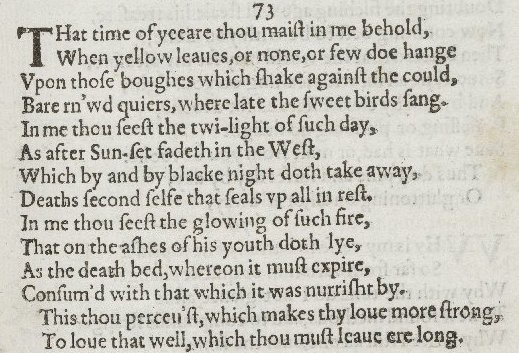
Detail of old-spelling text
Sonnet 73 in the 1609 Quarto

Q1


Q2


Q3


C

That time of year thou mayst in me behold,
When yellow leaves, or none, or few, do hang
Upon those boughs which shake against the cold,
Bare ruined choirs, where late the sweet birds sang;
In me thou seest the twilight of such day
As after sunset fadeth in the west,
Which by and by black night doth take away,
Death's second self that seals up all in rest;
In me thou seest the glowing of such fire
That on the ashes of his youth doth lie,
As the deathbed whereon it must expire,
Consum'd with that which it was nourish'd by;
This thou perceiv'st, which makes thy love more strong,
To love that well, which thou must leave ere long.


4


8


12

14

—William Shakespeare[1]

Sonnet 73, one of the most famous of William Shakespeare's 154 sonnets, focuses on the theme of old age. The sonnet addresses the Fair Youth. Each of the three quatrains contains a metaphor: Autumn, the passing of a day, and the dying out of a fire. Each metaphor proposes a way the young man may see the poet.[2]

Analysis and synopsis

[edit]

Barbara Estermann discusses William Shakespeare's Sonnet 73 in relation to the beginning of the Renaissance. She argues that the speaker of Sonnet 73 is comparing himself to the universe through his transition from "the physical act of aging to his final act of dying, and then to his death".[3] Esterman clarifies that throughout the three quatrains of Shakespeare's Sonnet 73; the speaker "demonstrates man's relationship to the cosmos and the parallel properties which ultimately reveal his humanity and his link to the universe. Shakespeare thus compares the fading of his youth through the three elements of the universe: the fading of life, the fading of the light, and the dying of the fire".[3]

The first quatrain is described by Seymour-Smith: "a highly compressed metaphor in which Shakespeare visualizes the ruined arches of churches, the memory of singing voices still echoing in them, and compares this with the naked boughs of early winter with which he identifies himself".[4]

In the second quatrain, Shakespeare focuses on the "twilight of such day" as death approaches throughout the nighttime. Barbara Estermann states that "he is concerned with the change of light, from twilight to sunset to black night, revealing the last hours of life".[3]

Of the third quatrain, Carl D. Atkins remarks, "As the fire goes out when the wood which has been feeding it is consumed, so is life extinguished when the strength of youth is past".[5] Barbara Estermann says it is concerned with "the fading out of life's energy".[3]

Structure

[edit]

Sonnet 73 is an English or Shakespearean sonnet. The English sonnet has three quatrains, followed by a final rhyming couplet. It follows the rhyme scheme of the English sonnet form, ABAB CDCD EFEF GG. It is composed in iambic pentameter, a poetic metre that has five feet per line, and each foot has two syllables accented weak then strong. Almost all of the lines follow this without variation, including the second line:

  ×   /  ×   /      ×   /    ×   /    ×  / 
When yellow leaves, or none, or few, do hang (73.2)
/ = ictus, a metrically strong syllabic position. × = nonictus.

Structure and metaphors

[edit]

The organization of the poem serves many roles in the overall effectiveness of the poem. Yet, one of the major roles implied by this scheme revolves around ending each quatrain with a complete phrase. Given the rhyme scheme of every other line within the quatrain, as an audience we are to infer a statement is being made by the end of every four lines. Further, when shifted toward the next four lines, a shift in the overall thought process is being made by the author.

If Shakespeare's use of a complete phrase within the rhyme scheme implies a statement then the use of a consistent metaphor at the end of each quatrain shows both the author's acknowledgement of his own mortality and a cynical view on aging. This view on aging is interconnected with the inverse introduction of each symbol within the poem. By dropping from a year, to a day, to the brief duration of a fire, Shakespeare is establishing empathy for our speaker through the lapse in time.[6] Additionally, the three metaphors utilized pointed to the universal natural phenomenon linked with existence. This phenomenon involved the realization of transience, decay, and death.[7]

Overall, the structure and use of metaphors are two connected entities toward the overall progression within the sonnet. Seen as a harsh critic on age, Shakespeare sets up the negative effects of aging in the three quatrains of this poem. These aspects not only take on a universal aspect from the symbols, but represent the inevitability of a gradual lapse in the element of time in general from their placement in the poem. Further, many of the metaphors utilized in this sonnet were personified and overwhelmed by this connection between the speaker's youth and death bed.[8]

Interpretation and criticism

[edit]

John Prince says that the speaker is telling his listener about his own life and the certainty of death in his near future. The reader perceives this imminent death and, because he does, he loves the author even more. However, an alternative understanding of the sonnet presented by Prince asserts that the author does not intend to address death, but rather the passage of youth. With this, the topic of the sonnet moves from the speaker's life to the listener's life.[9]

Regarding the last line, "this thou perceivest, which makes thy love more strong, to love that well which thou must leave ere long", Prince asks:

Why, if the speaker is referring to his own life, does he state that the listener must "leave" the speaker's life? If the "that" in the final line does refer to the speaker's life, then why doesn't the last line read "To love that well which thou must lose ere long?" Or why doesn't the action of leaving have as its subject the "I", the poet, who in death would leave behind his auditor?[9]

Bernhard Frank criticizes the metaphors Shakespeare uses to describe the passage of time, be it the coming of death or simply the loss of youth. Though lyrical, they are logically off and quite cliché, being the overused themes of seasonal change, sunset, and burn. In fact, the only notably original line is the one concerning leaves, stating that "when yellow leaves, or none, or few do hang, upon those boughs".[6] Logic would require that few should precede none; in fact, if the boughs were bare, no leaves would hang. Frank argues that Shakespeare did this on purpose, evoking sympathy from the reader as they "wish to nurse and cherish what little is left", taking him through the logic of pathos – ruefulness, to resignation, to sympathy.[10] This logic, Frank asserts, dictates the entire sonnet. Instead of moving from hour, to day, to year with fire, then sunset, then seasons, Shakespeare moves backwards. By making time shorter and shorter, the reader's fleeting mortality comes into focus, while sympathy for the speaker grows. This logic of pathos can be seen in the images in the sonnet's three quatrains. Frank explains:

Think now of the sonnet's three quatrains as a rectangular grid with one row for each of the governing images, and with four vertical columns:

spring summer  fall winter
morning  noon evening  night
tree log ember ashes

These divisions of the images seem perfectly congruous, but they are not. In the year the cold of winter takes up one quarter of the row; in the day, night takes up one half of the row; in the final row, however, death begins the moment the tree is chopped down into logs.[10]

This is a gradual progression to hopelessness. The sun goes away in the winter, but returns in the spring; it sets in the evening, but will rise in the morning; but the tree that has been chopped into logs and burned into ashes will never grow again. Frank concludes by arguing that the end couplet, compared to the beautifully crafted logic of pathos created prior, is anticlimactic and redundant. The poem's first three quatrains mean more to the reader than the seemingly important summation of the final couplet.[10]

Though he agrees with Frank in that the poem seems to create two themes, one which argues for devotion from a younger lover to one who will not be around much longer, and another which urges the young lover to enjoy his fleeting youth, James Schiffer asserts that the final couplet, instead of being unneeded and unimportant, brings the two interpretations together. In order to understand this, he explains that the reader must look at the preceding sonnets, 71 and 72, and the subsequent sonnet, 74. He explains:

The older poet may desire to "love more strong" from the younger man but feels, as 72 discloses, that he does not deserve it. This psychological conflict explains why the couplet hovers equivocally between the conclusions "to love me", which the persona cannot bring himself to ask for outright, and "to love your youth", the impersonal alternative exacted by his self-contempt.[11]

By reading the final couplet in this manner, the reader will realize that the two discordant meanings of the final statement do in fact merge to provide a more complex impression of the author's state of mind. Furthermore, this successfully puts the focus of the reader on the psyche of the "I", which is the subject of the following sonnet 74.

Possible sources for the third quatrain's metaphor

[edit]

A few possible sources have been suggested for both of two passages in Shakespeare's works: a scene in the play Pericles, and the third quatrain in Sonnet 73. In the scene in Pericles an emblem or impresa borne on a shield is described as bearing the image of a burning torch held upside down along with the Latin phrase Qui me alit, me extinguit ("what nourishes me, destroys me").[12] In the quatrain of Sonnet 73 the image is of a fire being choked by ashes, which is a bit different from an upside down torch, however the quatrain contains in English the same idea that is expressed in Latin on the impressa in Pericles: "Consum'd with that which it was nourished by." "Consumed" may not be the obvious word choice for being extinguished by ashes, but it allows for the irony of a consuming fire being consumed.[13][14]

One suggestion that has often been made is that Shakespeare's source may be Geoffrey Whitney's 1586 book, A Choice of Emblemes, in which there is an impresa or emblem, on which is the motto Qui me alit me extinguit, along with the image of a down-turned torch. This is followed by an explanation:

Even as the waxe doth feede and quenche the flame,
So, loue giues life; and love, dispaire doth giue:
The godlie loue, doth louers croune with fame:
The wicked loue, in shame dothe make them liue.
Then leaue to loue, or loue as reason will,
For, louers lewde doe vainlie langishe still.[15][16][17]

Joseph Kau suggests an alternate possible source – Samuel Daniel. In 1585 Daniel published the first English treatise and commentary on emblems, The Worthy Tract of Paulus Jovius,[18] which was a translation of Paolo Giovio's Dialogo Dell’ Imprese Militari et Amorose (Rome 1555). Appended to this work is "A discourse of Impreses", the first English collection of emblems, in which Daniel describes an impresa that contains the image of a down-turned torch:

"An amorous gentleman of Milan bare in his Standard a Torch figured burning, and turning downeward, whereby the melting wax falling in great aboundance, quencheth the flame. With this Posie thereunto. Quod me alit me extinguit. Alluding to a Lady whose beautie did foster his love, and whose disdayne did endamage his life."[19]

Kau's suggestion, however, has been confuted, because Kau made it crucial to his argument that Shakespeare and Daniel both used the Latin word quod rather than qui, however Shakespeare in fact nowhere uses the word quod.[20]

According to Alan R. Young, the likeliest source is Claude Paradin's post 1561 book Devises Heroïques, primarily because of the exactness and the detail with which it supports the scene in Pericles.[21]

Recordings

[edit]

References

[edit]

Bibliography

[edit]

Further reading

[edit]
Revisions and contributorsEdit on WikipediaRead on Wikipedia
from Grokipedia
Sonnet 73 is the seventy-third poem in William Shakespeare's sequence of 154 , first published in the 1609 quarto Shake-speares Sonnets, and belongs to the "Fair Youth" group (sonnets 1–126) addressed to an idealized young male figure of high social status. In this Shakespearean (or English) sonnet, structured in three quatrains and a final with an ABAB CDCD EFEF GG , the speaker reflects on his encroaching through extended metaphors of late autumn ("yellow leaves, or none, or few, do hang / Upon those boughs which shake against the cold"), twilight ("the twilight of such day / As after sunset fadeth in the west"), and a dying fire ("the glowing of such fire / That on the ashes of his youth doth lie"). These images culminate in the volta of the couplet, where the speaker asserts that perceiving his mortality—"This thou perceiv’st, which makes thy love more strong, / To love that well which thou must leave ere long"—intensifies the beloved's affection. The sonnet's themes center on the inevitability of aging and , juxtaposed against the enduring power of love, with the speaker adopting a of advanced age despite Shakespeare composing it around 1600 when he was approximately 36 years old. Scholars note how the progression of metaphors—from the cyclical decay of seasons and day to the final consumption of —builds a sense of inexorable endings, yet the poem balances this with renewal, as autumn implies spring and twilight precedes dawn, ultimately framing mortality as a catalyst for deeper appreciation of transient beauty. This interpretation underscores the sonnet's emotional core: awareness of loss heightens love's value, transforming pity into passionate commitment.
That time of year thou mayst in me behold
When yellow leaves, or none, or few, do hang
Upon those boughs which shake against the cold,
Bare ruined choirs, where late the sweet birds sang.
In me thou see’st the twilight of such day
As after sunset fadeth in the west,
Which by and by doth take away,
Death’s second self, that seals up all in rest.
In me thou see’st the glowing of such ,
That on the ashes of his youth doth lie,
As th’ death-bed whereon it must expire,
Consumed with that which it was nourish’d by.
This thou perceiv’st, which makes thy love more strong,
To love that well which thou must leave ere long.
Within the broader , Sonnet 73 contributes to recurring motifs of time's destructive force and the redemptive potential of and to defy it, particularly in the Fair Youth poems where the speaker urges preservation of beauty against decay. Its vivid natural and introspective tone have made it one of Shakespeare's most anthologized works, influencing interpretations of Elizabethan attitudes toward mortality in .

Publication and Context

Text of the Sonnet

Sonnet 73 appears in the 1609 edition of , the first published collection, printed by George Eld for Thomas Thorpe and sold by William Aspley. The full text, transcribed line by line with original spelling and punctuation preserved as closely as possible (noting that modern editions often normalize long 's' characters and minor typesetting), is as follows:
That time of yeeare thou maiſt in me behold,
When yellow leaues, or none, or fewe doe hange
Vpon thoſe boughes which ſhake againſt the could,
Bare rn'wd quiers, where late the sweet birds sang.
In me thou ſeeſt the twi-light of ſuch day
As after Sun-ſet fadeth in the Weſt,
Which by and by blacke night doth take away,
Deaths ſecond ſelfe that ſeals vp all in reſt.
In me thou ſeeſt the glowing of ſuch ,
That on the aſhes of his doth lye,
As the death bed, whereon it muſt expire,
Conſum'd with that which it was nurriſht by.
This thou perceu'ſt, which makes thy loue more ſtrong,
To loue that well, which thou muſt leaue ere long.
This transcription reflects the Elizabethan orthography of the Quarto, including variations such as "yeeare" for modern "year," "maiſt" for "mayst," "fewe" for "few," "could" for "cold," and "rn'wd" (a compositor's abbreviation or error emended to "ruin'd" in later editions) for "ruined." Other notable differences include "quiers" for "choirs," "Weſt" (with long 's') for "West," "blacke" (with final 'e') for "black," "vp" for "up," "nurriſht" for "nourish'd," "perceu'ſt" (with elision) for "perceiv'st," "loue" for "love," and "leaue" for "leave." These spellings and contractions are typical of early modern English printing conventions and do not alter the sonnet's iambic pentameter structure. The sonnet is addressed to the "Fair Youth," the enigmatic figure to whom sonnets 1 through 126 in the sequence are dedicated, as inferred from the thematic focus on youthful beauty and the poet's persuasive tone toward a beloved young man.

Place in the Sonnet Sequence

Shakespeare's Sonnets, a collection of 154 poems, was first published in 1609 as a quarto edition titled Shake-speares Sonnets, edited by Thomas Thorpe without the author's authorization. The sequence is broadly divided into sonnets 1–126, addressed to a figure known as the Fair Youth—a young man of beauty and promise—and sonnets 127–152 directed to the Dark Lady, with the final two sonnets serving as a coda. Sonnet 73 falls within the Fair Youth group, where the speaker contemplates themes of time, beauty, and human transience in relation to the beloved. Within this sequence, 73 occupies a pivotal position amid a cluster of poems (71–74) that intensify the meditation on mortality and legacy. It follows Sonnet 71, in which the speaker urges the Fair Youth to cease mourning upon his and to forget him entirely to avoid sorrow, emphasizing detachment from . Sonnet 72 extends this by engaging in , as the speaker questions his own worth and implores the not to recite any merits after his passing, lest it tarnish the youth's reputation. Sonnet 73 builds on these by vividly portraying the speaker's aging as a catalyst for deeper love, while Sonnet 74 resolves by asserting the endurance of the speaker's spirit through his verse, offering consolation that the essence survives beyond physical decay. This progression underscores a thematic arc toward acceptance of , highlighting how remembrance and poetic mitigate loss. The sonnets were likely composed in the late 1590s, during the height of , a period emphasizing individual experience, classical influences, and the tension between fleeting life and enduring art. This context informs the Fair Youth sequence's exploration of procreation, beauty's preservation, and mortality as counterpoints to humanistic ideals of vitality and legacy.

Form and Structure

Rhyme Scheme and Meter

Sonnet 73 follows the conventional rhyme scheme of the Shakespearean sonnet, ABAB CDCD EFEF GG, structured across three quatrains and a concluding couplet. This pattern pairs alternating rhymes in each quatrain—such as "behold" with "cold" and "hang" with "sang" in the first—before resolving in the final couplet's "strong" and "long," which provides a emphatic closure. The scheme's interlocking rhymes contribute to a sense of progression, building momentum through the quatrains toward the couplet's direct address. The is written in , featuring ten s per line arranged in five iambic feet, each consisting of an unstressed followed by a stressed one (da-DUM). For instance, the opening line scans as "That time | of year | thou mayst | in me | be hold," where stresses fall on "time," "year," "mayst," "me," and "hold," creating a rhythmic that evokes natural speech patterns. This meter dominates the poem, lending it a steady, heartbeat-like flow that underscores the contemplative tone. While largely regular, the includes subtle variations for emphasis, such as a trochaic substitution (stressed-unstressed) at the start of line 13: "This thou | per ceiv’st," marking the volta and drawing attention to the shift in perspective. A (two stressed syllables) appears in line 4's "Bare ru | in’d choirs," intensifying the image of desolation. These deviations, including feminine endings in lines 9 and 11 where "fire" counts as two syllables, disrupt the momentarily to heighten emotional impact without undermining the overall formal coherence.

Quatrain Organization and Metaphors

Sonnet 73 adheres to the Shakespearean form of three s followed by a , with each developing a distinct that illustrates the speaker's aging and proximity to . This organization allows the poem to build layers of progressively, inviting the addressee to "behold" the speaker's decline through and elemental analogies. The metaphors are unified by the repeated phrase "In me thou see'st," which frames each as a mirror for the speaker's inner state, emphasizing personal identification with decay. The first quatrain presents the of late autumn, depicting the speaker as a in seasonal decline: "That time of year thou mayst in me behold / When yellow leaves, or none, or few, do hang / Upon those boughs which shake against the cold, / Bare ruin'd quires, where late the sweet birds sang." Here, the sparse yellow leaves and bare branches evoke the shedding of vitality, with the "bare ruin'd quires" alluding to the skeletal remains of church choirs, symbolizing lost and impending barrenness. This external, natural image establishes the theme of gradual diminishment, rooted in the cyclical yet inexorable passage of seasons. In the second quatrain, the shifts to the twilight of a day: "In me thou see'st the twilight of such day / As after sunset fadeth in the west, / Which by and by black night doth take away, / Death's second self, that seals up all in rest." The fading light after sunset represents the speaker's waning life force, consumed by encroaching darkness, where night is equated with "Death's second self" and a final, sleep-like repose. This temporal extends the autumnal into a diurnal cycle, maintaining an external perspective but intensifying the sense of inevitable closure. The third quatrain introduces the metaphor of a dying fire: "In me thou see'st the glowing of such fire / That on the ashes of his youth doth lie, / As the death-bed whereon it must expire, / Consum'd with that which it was nourish'd by." The embers resting on the "ashes of his youth" portray the speaker's remaining vitality as self-consuming, like a fire that feeds on its own fuel until extinction, evoking a bed of death. This image moves toward internal decay, blending physical and psychological exhaustion in a more intimate, elemental process. The metaphors progress from broad external phenomena—seasonal change and daily twilight—to the intimate, internal erosion of the , creating a funneling effect that draws the addressee closer to the speaker's mortality. This sequence unifies the under the theme of , with each image layering upon the last to convey life's transience without renewal. The volta emerges after the third , in the couplet's direct address: "This thou perceiv'st, which makes thy love more strong, / To love that well which thou must leave ere long." This turn resolves the descriptive buildup by interpreting the metaphors as a for deepened , transforming of into an affirmation of love's urgency.

Content Analysis

Synopsis

In Sonnet 73, the speaker directly addresses a young man, often referred to as the Fair Youth, inviting him to observe the signs of the speaker's advancing age through a series of natural metaphors that evoke decay and transience. The first presents the image of late autumn, where the speaker compares himself to a in that : "That time of year mayst in me behold / When yellow leaves, or none, or few, do hang / Upon those boughs which shake against the cold, / Bare ruined where late the sweet birds sang." This paraphrases to the youth seeing in the speaker the barrenness of a stripped of most leaves, its branches trembling in the chill, resembling the empty remnants of a church where birds once sang sweetly. The second quatrain shifts to a diurnal , likening the speaker to the twilight following sunset: "In me thou see’st the twilight of such day / As after sunset fadeth in the west, / Which by and by black night doth take away, / ’s second self, that seals up all in rest." Here, the conveys the perceiving in the speaker the fading of day's end, gradually overtaken by encroaching , which the speaker equates to itself, bringing universal closure and . The third quatrain employs a thermal image of a dying fire: "In me thou see’st the glowing of such / That on the ashes of his doth lie, / As the death-bed whereon it must expire, / Consumed with that which it was nourished by." This summarizes as the viewing in the speaker the embers of a resting on the ashes of its former vitality, positioned on the very bed of death where it will extinguish, destroyed by the that once sustained it. The concluding couplet reveals the emotional outcome of this observation: "This thou perceiv’st, which makes thy love more strong, / To love that well which thou must leave ere long." In paraphrase, the youth's recognition of the speaker's impending decline intensifies his affection, compelling him to cherish deeply what he will soon lose. This progression from visual metaphors of decay to heightened emotional attachment forms the sonnet's narrative arc, centered on the speaker's self-presentation and the youth's responsive pity.

Imagery and Symbolism

In Sonnet 73, Shakespeare employs vivid visual to evoke the speaker's physical and temporal decline, beginning with the of autumn in the first . The "yellow leaves, or none, or few" hanging on boughs that "shake against the cold" symbolize the autumnal decline of late life, where fades into barrenness and sparsity, visually depicting a stripped of its former lushness. This image interconnects with the subsequent quatrain's "bare ruined choirs, where late the sweet birds sang," which extends the visual desolation to architectural remnants of a church, evoking loss through the empty, skeletal frames once filled with life and song, now reduced to hollow echoes of past vibrancy. The poem's auditory symbolism reinforces this sense of absence and transition, particularly in the implied by the "bare ruined choirs" devoid of the " birds" that previously sang there, contrasting former harmony with present quietude to underscore the erosion of youthful energy. Tactile elements further deepen the , as the shaking boughs against encroaching convey a physical chill of decay, while "death's second self" in the second —referring to that "seals up all in rest"—introduces a somnolent, enveloping sensation as a precursor to final oblivion, blending touch with the inevitability of closure. In the third quatrain, the tactile and visual symbolism of the provides a culminating image of self-consuming decline: "the glowing of such / That on the ashes of his doth lie," where the fading warmth represents ebbing passion and life's final , layered over the remnants of earlier vigor like embers atop cold ashes. These symbols interconnect across the to delineate progressive —from the external, seasonal barrenness of youth's end (autumn), through the diurnal fading toward (twilight and ), to the internal, consumptive extinction ()—creating a unified arc of aging that moves from natural observation to metaphysical .

Themes

Aging and Mortality

In Sonnet 73, the speaker employs a series of natural metaphors to convey the inexorable destructiveness of time, portraying himself as a figure in decay that parallels the cycles of . The first compares the speaker to late autumn, with "yellow leaves, or none, or few" clinging to bare boughs shaken by the cold, symbolizing the gradual stripping away of vitality and . This underscores time's relentless , transforming the human body into a ruined where once-abundant life has withered. The speaker's self-presentation as this "ruined" entity mirrors seasonal progression from abundance to desolation, emphasizing mortality as an inevitable extension of . The phrase "bare ruined choirs, where late the sweet birds sang" in the first quatrain evokes the dissolution of monasteries under , whose destruction left sacred spaces desolate and stripped of their choral life. Here, "choirs" refers not to singers but to the architectural stalls in church chancels, now empty like the speaker's aging form bereft of ful vigor, suggesting a divine abandonment akin to the loss of spiritual harmony in a post-Reformation world. Through these layers, the frames aging as a profane echo of sacred ruin, heightening the theme of mortality's universal reach. The progresses from physical decline to an implied , shifting in the second to twilight fading into night—"death's second self"—and in the third to the glowing remnants of a consumed by its own ashes, where life force is extinguished from within. This sequence illustrates not resistance but a resigned of time's , as the speaker internalizes decay as both bodily and existential. The reflects this acceptance by suggesting that recognizing one's impending end fosters a poignant intensity in love, binding the beloved more closely to the transient speaker.

Love and Separation

In Sonnet 73, the concluding couplet interprets the Fair Youth's perception of the speaker's impending mortality as a form of tender compassion that intensifies their emotional bond, rendering the anticipated separation all the more poignant while simultaneously strengthening affection. This "pity" is not mere sympathy for decline but a profound recognition that elevates love's value in the face of loss, as the youth is urged to "love that well which thou must leave ere long." Scholars note that this dynamic transforms the speaker's vulnerability into a catalyst for deeper devotion, emphasizing how awareness of transience fosters a more urgent and resilient connection. The relationship between the speaker and the Fair Youth in Sonnet 73 carries homoerotic undertones characteristic of the broader , where expressions of intense admiration for the youth's beauty and vitality suggest an intimate, non-platonic bond between men. This eroticism is implicit in the speaker's intimate address and the sequence's recurring motifs of desire and longing directed toward the male beloved, challenging conventional views of male friendship while highlighting the authenticity of such affections. The poem contrasts the speaker's physical and temporal decline—evoked through metaphors of decay—with the Fair Youth's enduring vitality, serving as a reminder to cherish the present moment before mortality intervenes. This juxtaposition underscores the youth's role in illuminating the speaker's fading life, prompting a mindful appreciation of their shared time that heightens the emotional stakes of their union. By drawing on imagery of autumnal barrenness and dying embers, the sonnet illustrates how the youth's vigor amplifies the speaker's awareness of loss, ultimately reinforcing the imperative to value amid inevitable parting.

Criticism and Interpretation

Historical Criticism

In the nineteenth century, critics such as Edward Dowden interpreted Sonnet 73 as an autobiographical plea from the aging Shakespeare to his young patron, emphasizing the poet's personal vulnerability and the urgency of love amid impending death. Dowden's reading, articulated in his edition of the sonnets, framed the poem as a direct expression of Shakespeare's emotional life, aligning with the era's tendency to view the sequence as a veiled of the author's experiences and relationships. This biographical approach dominated early scholarship, portraying the speaker's metaphors of decay as reflections of Shakespeare's own mortality during the early 1600s. By the early twentieth century, scholarly focus shifted from to formal and , as seen in Hyder Edward Rollins's 1944 New Variorum Edition of , which meticulously documented variants and early commentaries on Sonnet 73 without endorsing personal interpretations. Rollins compiled historical notes revealing minor textual differences, such as variations in phrasing from sources, underscoring the sonnet's evolution in print editions from onward while prioritizing structural integrity over . This formalist turn diminished emphasis on , treating the poem as a crafted artifact of Elizabethan rather than a document. Barbara Estermann's 1980 analysis further rooted Sonnet 73 in , linking its metaphors to the era's cosmological views of the microcosm-macrocosm correspondence, where aging mirrors universal cycles of decay and renewal. Estermann argued that the sonnet's imagery—autumn, twilight, and fire—evokes the Renaissance fascination with time's transience, connecting Shakespeare's work to broader philosophical traditions that universalized personal experience. Critics also debated the logical coherence of the third quatrain's fire metaphor, particularly the paradoxical line "Consum'd with that which it was nourish'd by," which describes extinguishing the flames they once fed, prompting questions about whether it represented a deliberate atic conceit or a rhetorical flaw. Early commentators, as collated by Rollins, noted influences from Geoffrey Whitney's 1586 A Choice of Emblemes, where an emblem depicts a dying amid ashes with the suggesting virtue's through consumption, providing a visual and source for Shakespeare's of self-devouring vitality. This tradition, drawn from continental sources like Alciato, reinforced the sonnet's exploration of mortality without resolving the metaphor's inherent tension.

Modern Interpretations

Modern interpretations of Shakespeare's Sonnet 73 have increasingly applied interdisciplinary theoretical frameworks, moving beyond traditional biographical or formalist readings to explore its emotional, cultural, and social dimensions. , in her analysis, emphasizes the sonnet's metaphorical progression across its three quatrains, which builds from seasonal decay in the first (autumnal leaves symbolizing physical decline) to temporal fading in the second (twilight evoking resignation), and culminates in elemental consumption in the third (a dying fire on its own ashes, representing metaphysical self-destruction). This hierarchical intensification, Vendler argues, deepens the speaker's confrontation with mortality, shifting from nostalgic linearity to spatial and philosophical introspection. Vendler further highlights the couplet's inherent , where the beloved's of the speaker's decay—"This thou perceiv’st, which makes thy love more strong / To love that well which thou must leave ere long"—can evoke as either a strengthening force of compassionate love or an emotional burden that strains the relationship. This duality, she contends, serves the speaker's psychological plea for redemption, creating a that mirrors the sonnet's thematic tensions between sight, tears, and loss. Complementing this, Frank Bernhard's close reading reinforces the metaphor's progressive logic, interpreting the quatrains as a unified that transforms personal aging into a universal on impermanence, with the in the final resolving earlier natural motifs into a poignant of self-consumption. Queer theory approaches, influenced by scholars like , have reframed Sonnet 73 within the homoerotic dynamics of the Fair Youth sequence, emphasizing the speaker's intimate address to a male beloved as an expression of non-normative desire amid vulnerability. Readings in explore how the sonnet's aging metaphors underscore erotic tension, where the speaker's decay invites the youth's gaze not just as pity but as a charged homoerotic bond that challenges norms. Ecocritical perspectives, gaining traction in the 21st century, interpret the poem's imagery of natural decay—bare boughs, fading twilight, and dying embers—as a critique of anthropocentric views, positioning human mortality as subordinate to nature's cyclical yet indifferent processes, as detailed in a 2025 ecological study of the sonnets. Post-2010 scholarship has extended these lenses to performance and gender, addressing how the sonnet's "unruliness" resists binary constructions of sexuality and identity in recitation or adaptation. For instance, a 2023 study on the articulation of feeling in the sonnets critiques earlier interpretations for imposing rigid gender frameworks, instead viewing Sonnet 73's speaker as performing vulnerability to disrupt heteronormative expectations and highlight fluid emotional exchanges. This focus fills interpretive gaps by emphasizing performative embodiment, such as in queer stagings where the poem's intimacy foregrounds gendered power dynamics in same-sex relations.

Influences and Sources

Literary Influences

Sonnet 73 draws on the tradition, particularly in its exploration of aging as a for emotional and physical decline, which Shakespeare adapts into the English sonnet form with its characteristic volta and . Petrarch's Canzoniere often employs seasonal imagery to symbolize the passage of time and the poet's waning vitality, a conceit that resonates in Shakespeare's depiction of autumnal barrenness and twilight in the sonnet's opening quatrains. This influence is evident in how Shakespeare transforms the Italian model's introspective melancholy into a more dramatic address to the Fair Youth, emphasizing mutual love amid decay rather than solitary lament. The imagery of seasonal decline in Sonnet 73 echoes 's Metamorphoses, especially in Arthur Golding's 1567 English translation, where themes of temporal transformation and inevitable decay underscore the mutability of life. In Book 15, describes the relentless advance of time through natural cycles, paralleling Shakespeare's lines on "yellow leaves, or none, or few" hanging on bare boughs, which evoke a world stripped by autumn's progression toward winter. While verbal parallels are limited, the philosophical underpinning of time's erosive power—central to 's epic—shapes the sonnet's contemplative tone on mortality. Contemporary English sonnet sequences, notably Sir Philip Sidney's Astrophil and Stella (1591), inform the dynamic between the aging speaker and the youthful addressee in , where the poet leverages his perceived frailty to intensify the bond of love. Sidney's work, which sparked the Elizabethan sonnet vogue, features a speaker who navigates desire and self-reflection in relation to a younger, idealized figure, much like Shakespeare's Fair Youth sequence; this relational tension heightens the emotional stakes, prompting the youth to value the speaker more profoundly in light of impending loss. The fire imagery in the sonnet's final quatrain appears also in Shakespeare's Pericles (c. 1607–1608), where similar motifs of consuming flame and death occur in descriptions of destructive passion and renewal. In Pericles Act I, Scene 1, the incestuous king's emblematic fire devours its own sustenance, mirroring the sonnet's "death-bed" consumed by its former nourishment, suggesting a shared symbolic lexicon across Shakespeare's works for themes of self-destruction and transience. This parallel likely stems from a common source in Samuel Daniel's Complaint of Rosamond (1592), but the recurrence highlights Shakespeare's recurring engagement with fiery extinction as an emblem of mortality.

Emblematic and Visual Sources

The emblem tradition, prevalent in the , frequently employed visual motifs such as dying fires and consuming flames to impart moral lessons on the transience of time, the inevitability of mortality, and the of human endeavors. These iconographic devices, combining images, Latin mottos, and explanatory verses, drew from classical and biblical sources to encapsulate philosophical reflections on decay and , influencing poets and artists across Europe. A prominent example appears in Geoffrey Whitney's A Choice of Emblemes (1586), an English compilation of continental emblems that includes the device of an inverted torch, where the wax melts downward to extinguish the flame it once fueled. Accompanied by the motto Qui me alit me extinguit ("That which nourishes me extinguishes me"), the emblem's epigram elaborates: "Even as the waxe dothe feede, and quenche the flame, / So, loue giues life ; and loue doth cause the same," symbolizing how life's sustaining elements ultimately lead to its demise, a concept resonant with the extinguishing fire in Sonnet 73's third quatrain. Whitney adapted this from earlier sources, emphasizing the paradox of nourishment turning to destruction as a cautionary image of extinguished vitality and love. Similarly, Claude Paradin's Devises Heroïques (first published 1551, with expanded editions post-1561), translated into English by 1591, contributed to the emblematic vocabulary available to English writers, reinforcing visual symbols of temporal ruin.

Cultural Legacy

Recordings and Performances

Sonnet 73 has inspired numerous audio recordings and theatrical recitations since 2000, often emphasizing its metaphors of seasonal decline, twilight, and dying embers through deliberate pacing and tonal shifts in vocal delivery. A prominent example is Sir Patrick Stewart's 2020 recording as part of his #ASonnetADay initiative during the lockdown, where he recites the twice—once in April dedicated to Sir Stirling Moss and again in July. Stewart employs subtle pauses after lines evoking decay, such as "Bare ruind quires, where late the sweet birds sang," to heighten the imagery of loss and mortality, drawing on his decades of familiarity with the text. This self-taped performance is freely available on . The Royal Shakespeare Company (RSC) contributed to post-2000 interpretations via its 2020 "Sonnets in Solitude" online series, prompted by theater closures. Actor Richard Clews delivers Sonnet 73 with a hushed, timbre, using elongated vowels on phrases like "the twilight of such day" to underscore the poem's fading metaphor and create a sense of quiet resignation. The video performance, filmed in lockdown, can be viewed on YouTube and RSC platforms. Professional audiobook productions include Bertie Carvel's narration of Sonnet 73 on AudioBooks' 2009 compilation From Shakespeare - With Love (The Best of Sonnets), part of a broader selection read by actors like and . Carvel's reading features crisp enunciation and rhythmic breathing that accentuates the sonnet's volta, transitioning from metaphors of autumnal barrenness to the fire's ashes, enhancing the emotional build toward love's intensity. It is accessible via streaming on ' catalog. Additional post-2000 efforts encompass community-driven audio, such as the 2006 project featuring ten volunteer readings that vary in accent and tempo, from brisk to meditative, allowing listeners to compare deliveries of the decay motifs. These public-domain recordings are hosted on LibriVox.org. More recent stage-linked recitations include Dame Judi Dench's 2024 video for , where her warm, faltering pauses on lines about "black night" and "death's second self" evoke personal vulnerability tied to the sonnet's themes of time and remembrance, in celebration of her 90th birthday and support for ancient tree protection; it is posted on . These interpretations, primarily available on digital platforms like and , fill gaps in earlier analog-era recordings by prioritizing accessible, actor-driven vocal explorations of the sonnet's introspective depth.

Adaptations and References

Sonnet 73 has been frequently anthologized in collections of , underscoring its enduring appeal as a on aging and transience. For instance, it appears in prominent volumes such as the 's curated selections of Shakespearean works, where it exemplifies the form's capacity to blend natural imagery with emotional depth. These inclusions highlight the poem's role in shaping modern understandings of mortality within literary education and appreciation. In music, Sonnet 73 has inspired several notable adaptations that reinterpret its themes through contemporary composition. Australian singer-songwriter Paul Kelly set the full text to a minimalist acoustic arrangement on his 2016 album Seven Sonnets & a Song, emphasizing the sonnet's rhythmic introspection with subtle guitar accompaniment to evoke the fading embers of life. Similarly, composer Shulamit Ran crafted a tender choral setting for S.A.T.B. voices, originally commissioned for the Cornell University Glee Club in 2011 (for men's chorus) and adapted in 2012 for the University of Chicago Rockefeller Chapel Choir, capturing the poem's elegiac tone through layered vocal harmonies that mirror its seasonal metaphors. Beyond direct settings, Sonnet 73 continues to resonate in contemporary cultural discourse, particularly in discussions of and impermanence. A scholarly analysis frames the sonnet's imagery of autumnal decay and dying fire as an , portraying mortality as intertwined with cycles of renewal and loss, thus extending Shakespeare's reflections to modern environmental concerns. This interpretive lens has influenced eco-poetry, where the sonnet serves as a touchstone for exploring humanity's fragile place within the .

References

Add your contribution
Related Hubs
User Avatar
No comments yet.