


Community hub
Recent from talks
Contribute something
Nothing was collected or created yet.
Station wagon
View on Wikipedia


.jpg)
A station wagon (US, also wagon) or estate car (UK, also estate) is an automotive body-style variant of a sedan with its roof extended rearward over a shared passenger/cargo volume with access at the back via a third or fifth door (the liftgate, or tailgate), instead of a trunk/boot lid.[1] The body style transforms a standard three-box design into a two-box design—to include an A, B, and C-pillar, as well as a D-pillar. Station wagons can flexibly reconfigure their interior volume via fold-down rear seats to prioritize either passenger or cargo volume.
The American Heritage Dictionary defines a station wagon as "an automobile with one or more rows of folding or removable seats behind the driver and no luggage compartment but an area behind the seats into which suitcases, parcels, etc., can be loaded through a tailgate."[2]
When a model range includes multiple body styles, such as sedan, hatchback, and station wagon, the models typically share their platform, drivetrain, and bodywork forward of the A-pillar, and usually the B-pillar. In 1969, Popular Mechanics said, "Station wagon-style ... follows that of the production sedan of which it is the counterpart. Most are on the same wheelbase, offer the same transmission and engine options, and the same comfort and convenience options."[3]
Station wagons have evolved from their early use as specialized vehicles to carry people and luggage to and from a train station. The demand for station wagon body style has faded since the 2010s in favor of the crossover or SUV designs.[4][5][6]
Name
[edit]Reflecting the original purpose of transporting people and luggage between country estates and railway stations,[7] the station wagon body style is called an "estate car" or "estate" in the United Kingdom or a "wagon" in Australia and New Zealand.
Either horse-drawn or automotive, the earliest use of the station wagon description would be considered to describe utility vehicles or light trucks.[8] The depot hackney or taxi, often on a Model T chassis with an exposed wood body, most often found around railroad stations, was the predecessor of the station wagon body style in the United States.[9] These early models with exposed wooden bodies became known as woodies.[10][11][12] By the 1920s the status of the station wagon description changed to consider them as vehicles for passengers.[8]
In Germany, the term "kombi" is used.[13] This is short for Kombinationskraftwagen ("combination motor vehicle").[14] "Kombi" is also the term used in Poland.[15]
In Russia and some post-Soviet countries, this type of car is called "universal".[16]
Manufacturers may designate station wagons across various model lines with a proprietary nameplate for marketing and advertising differentiation. Examples include "Avant", "Break", "Caravan", "Kombi", "Sports Tourer", "Sports Wagon", "Tourer", "Touring", and "Variant".
Design characteristics
[edit]Comparison with hatchbacks
[edit]
Station wagons and hatchbacks have in common a two-box design configuration, a shared interior volume for passengers and cargo[17][18] as well as a hatch or rear door (often called a tailgate in the case of a station wagon) that is hinged at roof level.[19][20] Folding rear seats designed to provide a larger space for cargo in place of passenger capacity, are also typical features for station wagons and hatchbacks.[2]
Distinguishing features between hatchbacks and station wagons include:
- D-pillar: Station wagons are more likely to have a D-pillar (hatchbacks and station wagons both have A-, B-, and C-pillars).
- Cargo volume: Station wagons prioritize passenger and cargo volume—with windows beside the cargo volume. Of the two body styles, a station wagon roof (viewed in profile) more likely extends to the very rearmost of the vehicle, enclosing a full-height cargo volume[18]—a hatchback design (especially a liftback version) is likely to have steeply sloping roofline behind the B- or C-Pillar, prioritizing style[1] over interior volume or cargo capacity, sometimes having a shorter rear overhang and smaller side windows (or no windows at all).
Other differences are more variable and can potentially include:
- Cargo floor contour: A station wagon often has a fold-flat floor (for increased cargo capacity), whereas a hatchback is more likely to have a cargo floor with a pronounced contour.[citation needed]
- Seating: Some station wagons have three rows of seats, whereas a hatchback will have two at most.[17] The rearmost row of seating in a station wagon is often located in the cargo area and can be front-facing, rear-facing, or side-facing.
- Rear suspension: A station wagon may include a reconfigured rear suspension for additional load capacity[1] and to minimize intrusion in the cargo volume.
- Rear Door: Hatchbacks usually feature a top-hinged liftgate for cargo access, with variations ranging from a two-part liftgate to a complex tailgate that can function as a full tailgate or a trunk lid. Station wagons have also been equipped with numerous tailgate configurations. Hatchbacks may be called Liftbacks when the opening area is very sloped, and the door is lifted to open.[17] A design director from General Motors has described the difference as "Where you break the roofline, at what angle, defines the spirit of the vehicle", he said. "You could have a 90-degree break in the back and have a station wagon."[21]
It has become common for station wagons to use a platform shared with other body styles, resulting in many shared components (such as chassis, engine, transmission, bodywork forward of the A-pillar, interior features, and optional features) being used for the wagon, sedan, and hatchback variants of the model range.[3]
Tailgate designs
[edit]Many modern station wagons have an upward-swinging, full-width, full-height rear door supported on gas springs—often where the rear window can swing up independently. A variety of other designs have been employed in the past.
Split gate
[edit]The split gate features an upward-swinging window and a downward-swinging tailgate, both manually operated. This configuration was typical in the 1920s through the 1940s, and remained common on many models into the 1960s.
Retractable window
[edit]In the early 1950s, tailgates with hand-cranked roll-down rear windows began to appear. Later in the decade, electric power was applied to the tailgate window so it could be operated from the driver's seat and by a key-activated switch in the tailgate. By the early 1970s, this arrangement was available on full-size, intermediate, and compact wagons. The lowered bottom hinged tailgate extended the cargo area floor and could serve as a picnic table for "tailgating."[22]
- Side hinge: A side-hinged tailgate that opened like a door was offered on some three-seat station wagons to facilitate the back-row passengers to enter and exit the rear-facing seats.[23][24]
.jpg)
.jpg)
Retractable roof
[edit]A station wagon design featuring a retractable rear roof section and a conventional rear tailgate with a window that rolled down and the gate opened down. The sliding roof section allowed the carrying of tall objects in the rear cargo area. This configuration appeared on the 1963–1966 Studebaker Wagonaire station wagon and the 1998-2009 GMC Envoy XUV SUV model.[25]
Dual and tri-operating gates
[edit]

In the United States, Ford's full-size station wagons for 1966 introduced a system marketed as "Magic Doorgate"—a conventional tailgate with retracting rear glass, where the tailgate could either fold down or pivot open on a side hinge—with the rear window retracted in either case. Competitors marketed their versions as a Drop and Swing or Dual Action Tailgate.[3] For 1969, Ford incorporated a design that allowed the rear glass to remain up or down when the door pivoted open on its side hinge, marketing the system, engineered by Donald N. Frey[26] as the "Three-Way Magic Doorgate".
Similar configurations became the standard feature on full-size and intermediate station wagons from General Motors, Ford, Chrysler, and American Motors Corporation (AMC).[27] Some full-size GM wagons added a notch in the rear bumper that acted as a step plate; a small portion of the bumper was attached to the tailgate to fill the gap. When opened as a swinging door, this part of the bumper moved away, allowing the depression in the bumper to provide a "step" to ease entry; when the gate was opened by being lowered or raised to a closed position, the chrome section remained in place making the bumper "whole".
Clamshell
[edit]

Full-size General Motors, from 1971 through 1976 station wagons (Chevrolet Kingswood, Townsman, Brookwood, Bel Air, Impala, and Caprice Estates; Pontiac Safari and Grand Safari; Oldsmobile Custom Cruiser, and the Buick Estate models) featured a 'clam shell' design marketed as the Glide-away tailgate, also called a "disappearing" tailgate because when open, the tailgate was entirely out of view.[28] On the clamshell design, the rear power-operated glass slid up into the roof and the lower tailgate (with either manual or optional power operation), lowered below the load floor. Manually operated types included a lower tailgate counterbalanced by a torque rod similar to the torque rods used in holding a trunk lid open. It required a 35-pound (16 kg) push to lower the gate. Raising it required a 35-pound (16 kg) pull on a handhold integral to the top edge of the retractable gate.[29] Power-assisted operation of both the upper glass and lower tailgate became standard equipment in later model years. Station wagons with this design were available with an optional third row of forward-facing seats accessed by the rear side doors and a folding second-row seat. They could accommodate 4-by-8-foot (1.2 m × 2.4 m) sheets of plywood or other panels with the rear seats folded. The clamshell design required no increased footprint or operational area to open the cargo area. This enabled access even if the station wagon's rear was parked against a wall.
The GM design, as used in a Pontiac Grand Safari, with a forward-facing third-row seat and the clamshell tailgate, was less popular with consumers and was described as the "least convenient of all wagon arrangements" with difficult passenger egress and problematic tailgate operation in comparison to the 1974 AMC Ambassador, Dodge Monaco, and Mercury Colony Park, full-size station wagons conducted by Popular Science magazine.[30] Subsequent GM full-size wagons reverted to the door/gate system for its full-size wagons.
Lift-gate
[edit]
A simplified, one-piece lift-gate on smaller wagons. The AMC Hornet Sportabout was introduced for the 1972 model year and featured a "liftgate-style hatchback instead of swing-out or fold-down tailgate ... would set a precedent for liftgates in modern SUVs."[31] The 1978-1996 GM's mid-size station wagons also returned to the upward-lifting rear window/gate as had been used in the 1940s.
- Swing-up window: An upward-lifting, full-height, full-width rear door, where the window on the rear door can be opened independently from the rear door itself. The window is also opened upwards and is held on pneumatic struts. The Renault Laguna II station wagon and Ford Taurus wagon featured this arrangement.
- Fold-up license plate: Wagons (including the Volvo Amazon wagon, early models of the Range Rover, and the Subaru Baja) had an upward folding hinged license plate attached to the lower tailgate of the split rear door. When the tailgate was folded down, the plate hung down and remained readable. The wagon versions of the Citroën DS, called the Break, Familiale, or Safari, had a different solution: two number plates were fitted to the tailgate at right angles to each other so one would be visible in either position.
Safety equipment
[edit]Cargo barriers may be used to prevent unsecured cargo from causing injuries in the event of sudden deceleration, collision, or a rollover.[32]
Performance models
[edit]Performance models of station wagons have included the 1970 Ford Falcon (XY) 'Grand Sport' pack,[33] the 1973 Chevrolet Chevelle Malibu SS-454 and the 1992 BMW M5 (E34).
The 1994 Audi RS2, developed with Porsche, has been described as the world's first performance station wagon.[34] This was followed by the Audi RS4 and Audi RS6.
The 2006 through 2008 Dodge Magnum SRT-8 model brought power and performance with station wagon features. The cars featured a 6.1 L Hemi V8 engine rated at 425 hp (317 kW; 431 PS). The Dodge Magnum SRT-8 shared its platform with the Chrysler 300C Touring SRT-8, which was only sold in Europe.[35][36][37][38][39]
Other German manufacturers have produced station wagon versions of their performance models, such as the Mercedes-AMG C63, Mercedes-AMG E63, BMW M5 (E60/E61), Volkswagen Golf R and Volkswagen Passat R36 wagons.[40][41][42]
The Cadillac CTS-V Wagon introduced for the 2011 model year was considered the most potent production station wagon offered with a manual transmission, and the Corvette-engined version continued until 2014.[43][44]
History by country
[edit]United States
[edit]1910 to 1940: Origins and woodie wagons
[edit]The first station wagons were built in around 1910 by independent manufacturers producing wooden custom bodies for the Ford Model T chassis.[45] They were initially called "depot hacks" because they worked around train depots as hacks (short for hackney carriage, as taxicabs were then known).[46] They also came to be known as "carryalls" and "suburbans".[45] Station wagons were initially considered commercial vehicles (rather than consumer automobiles) and the framing of the early[when?] station wagons was left unfinished, due to the commercial nature of the vehicles. Early[when?] station wagons were fixed-roof vehicles, but lacked the sides and glass that would generally enclose the passenger compartment, and included rudimentary benches for seating passengers.[47][page needed] Instead of framed glass, side curtains of canvas could be unrolled. More rigid curtains could be snapped to protect passengers from outside elements. The roofs of "woodie" wagons were usually made of stretched canvas treated with a waterproofing dressing. The framing of the wooden bodies was partially sheathed in steel[citation needed] and coated with tinted lacquer for protection. These wooden bodies required constant maintenance: varnishes required re-coating, and expansion/contraction of the wood meant that bolts and screws needed periodic re-tightening.
Manufacture of the wooden bodies was initially outsourced to custom coachbuilders because production of the all-wood bodies was very time-consuming.[48][49] One of the first builders of wagon bodies was the Stoughton Wagon Company in Stoughton, Wisconsin, which began putting custom wagon bodies on the Ford Model T chassis in 1919.[47][page needed] In 1922, the Essex Closed Coach, a sedan, became the first mass-produced car to use a steel body.[50] In 1923, Star (a division of Durant Motors) became the first car company to offer a station wagon assembled on its production line (using a wooden wagon body shipped in from an outside supplier).[51][52][53] Ford owned its own hardwood forest and mills (at the Ford Iron Mountain Plant in what is today Kingsford, Michigan, in Michigan's Upper Peninsula) and in 1929 became the first "Big Three" automaker in the United States to sell a factory-built station wagon.[54] The Model A wagon featured two rows of removable seating in the back and the body was made of maple, birch, and basswood.[54] Also in 1929, J.T. Cantrell began supplying woodie bodies for Chrysler vehicles, which continued until 1931.[47][page needed] These early models were utility vehicles also known as depot hacks, and were not targeted as "family-friendly" automobiles.[55]
By the 1930s, station wagons had become expensive and well-equipped vehicles.[52] When it was introduced in 1941, the Chrysler Town & Country was one of the most expensive cars in the company's model range. The first all-steel station wagon body style was the 1935 Chevrolet Suburban.[45] As part of the overall trend in the automotive industry, wooden bodies were superseded by all-steel bodies due to their strength, cost, and durability.[47] The commercial vehicle status was also reflected on those vehicles' registrations For example, there were special "Suburban" license plates in Pennsylvania used well into the 1960s, long after station wagons became car-based.
-

-
 1934 Buick Series 50 station wagon
 -
 1940 Pontiac Special Series 25

.jpg)

1945 to 1970: Steel-bodied station wagons
[edit]The first all-steel station wagon was the 1935 Chevrolet Suburban, which was built on the chassis of a panel truck.[45] However, most station wagons were produced with wooden bodies until after World War II.
When automobile production resumed after World War II, technological advances made all-steel station wagon bodies more practical, eliminating the cost, noise, and maintenance associated with wood bodies.[56] The first mass-produced steel-bodied station wagon was the 1946 Willys Station Wagon, based on the chassis of the Jeep CJ-2A.[45][57][58] In 1947, Crosley introduced a steel-bodied station wagon version of the Crosley CC Four.
The first postwar station wagon to be based on a passenger car chassis was the 1949 Plymouth Suburban, which used a two-door body style. Families were growing and suburbs expanding, making the Plymouth wagon attractive to parents.[55] Several manufacturers produced steel and wooden-bodied station wagons concurrently for several years. For example, Plymouth continued the production of wooden-bodied station wagons until 1950. The final wooden-bodied station built in the United States was the 1953 Buick Super Estate.
By 1951, most station wagons were being produced with all-steel bodies.[45] Station wagons experienced the highest production levels in the United States from the 1950s through the 1970s due to the American mid-20th century baby boom.
The late 1950s through the mid-1960s was also the period of significant variation in body styles, with models available without a B-pillar (called hardtop or pillarless models) or with a B-pillar, both in two-door and four-door variants.[59]
The 1956 Rambler was an all-new design, and the four-door "Cross Country" featured the industry's first station wagon hardtop.[60] However, the pillarless models could be expensive to produce, added wind noise, and created structural issues with body torque.[61] GM eliminated the pillarless wagon from its lineup in 1959, while AMC and Ford exited the field beginning with their 1960 and 1961 vehicles, leaving Chrysler and Dodge with the body style through the 1964 model year.
-
 1954 Studebaker Conestoga
 -
 1954 Plymouth Savoy Station Wagon
 -
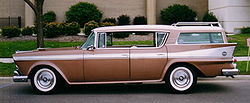 1958 AMC Ambassador 4-door pillarless hardtop station wagon


1970 to 1990: Competition from minivans
[edit].jpg)
The popularity of the station wagon—particularly full-size station wagons—in the United States was blunted by increased fuel prices caused by the 1973 oil crisis.[45][52] Then, in 1983, the market for station wagons was further eroded by the Chrysler minivans, based on the K platform.[46][62] While the K platform was also used for station wagon models (such as the Plymouth Reliant and Dodge Aries), the minivan would soon eclipse them in popularity.
The CAFE standards provided an advantage to minivans (and later SUVs) over station wagons because the minivans and SUVs were classified as trucks in the United States and, therefore subject to less stringent fuel economy and emissions regulations. Station wagons remained popular in Europe[63] and in locations where emissions and efficiency regulations did not distinguish between cars and light trucks.[64]
1990 to present: Competition from SUVs
[edit]
The emergence and popularity of SUVs, which closely approximate the traditional station wagon body style, was a blow. After low sales, the Chevrolet Caprice and the Buick Roadmaster, the last American full-size wagons, were discontinued in 1996. Smaller station wagons were marketed as lower-priced alternatives to SUVs and minivans. Domestic wagons also remained in the Ford, Mercury, and Saturn lines. However, after 2004, these compact station wagons also began to be phased out in the United States. The Ford Taurus wagon was discontinued in 2005, and the Ford Focus station wagon was discontinued in 2008. With other brands, the niche previously occupied by station wagons is now primarily filled with a similar style of Crossover SUV, which generally has a car underpinning and a wagon body.
An exception to this trend was the Subaru Legacy station wagon and its rugged derivative Subaru Outback, which continued to be produced at the Subaru of Indiana plant. The Outback was much more popular than the Legacy wagon and Legacy sedan, the latter two which were discontinued after the 2014 and 2025 model years, respectively. The Outback accounted for 80% of wagon sales in the U.S. However for the seventh generation, as there was no Legacy sedan counterpart being produced on the same platform, the Outback is no longer considered a wagon and instead is a mid-sized crossover SUV.[65]
The Cadillac CTS gave rise to a station wagon counterpart, the 2010 CTS Sportwagon, which defied the trend by offering almost as many trim levels as its sedan counterpart.[62] The CTS wagon, particularly in the performance CTS-V trim, received positive reviews until it was discontinued in 2014.[66][67]
In 2011, the Toyota Prius V introduced hybrid power to the compact wagon market, but was discontinued in 2017 to streamline the Toyota hybrid lineup and focus on the RAV4 Hybrid Crossover SUV.[68]
Imported station wagons, despite remaining popular in other countries,[69] struggled in the United States. European car manufacturers such as Audi, Volvo, BMW, and Mercedes-Benz continued to offer station wagons in their North American product ranges (marketed using the labels "Avant", "Touring", and "Estate" respectively). However, these wagons had fewer trim and powertrain levels than their sedan counterparts.[62] Audi has also offered rugged variants of the A4 and A6 wagons under the Audi allroad quattro sub-brand with mixed success in the U.S., while Mercedes-Benz has offered the E-Class All-Terrain based upon the E-Class Estate. The station wagons of the smaller Mercedes-Benz C-Class line-up were dropped in 2007, and the BMW 5 Series Touring models were discontinued in 2010 due to slow sales in the United States, with only 400 wagons sold in 2009.[70] In 2012, the Volvo V50 compact station wagon was withdrawn from the U.S. market due to poor sales. In 2016, Volvo reintroduced a large wagon to the U.S. market with the Volvo V90, but only by special order.[71] Some high-performance wagons have been offered in the U.S. market, including the Audi RS 6, BMW M5, and Mercedes-Benz E63 AMG; the more recent generations of the Audi RS 6 have only been offered as an Avant and not a sedan but nonetheless this is still appealing to American car enthusiasts and collectors.[72]
The 2015 VW Golf Sportwagen[73] was marketed as a sub-compact station wagon in the North American market. This model was withdrawn from the U.S. market after 2019.[74]
Simulated wood paneling
[edit]As the wooden bodies were replaced by steel from 1945 until 1953, manufacturers applied wooden decorative trim to the steel-bodied wagons as a visual link to the previous wooden style. By the late 1950s, the wooden trim was replaced by "simulated wood" in the form of stick-on vinyl coverings.[75] The woodgrain feature is not that the body is wood—or that it could ever be wood—rather, it is "totally honest in its artificiality."[9]
The design element was also used on cars that were not station wagons, including sedans, pickup trucks, and convertibles.[76][75]
Unique simulated wood designs included trim on the body pillars of the compact-size Nash Rambler station wagons that went up the roof's drip rail and around on the spit liftgate. The larger-sized Cross Country station wagon was available with bodyside wood trim that went unbroken up the C and D pillars to a thin strip on the roof above the side windows.[60][9]
Ford marketing began using “Country Squire” with the 1950 model year for the station wagon body design.[77] From 1950 through 1991, their simulated wood trim differentiated the Ford Country Squire station wagon models from the lower trim versions.[78][79] The "Squire" trim level was an available option in a few different Ford model ranges, including the Falcon Squire, Fairlane Squire, and the 1970s the Pinto Squire. The Squire was the highest trim level of any Ford Wagon and included additional exterior and better interior trims.
Other woodie-style wagon models produced in significant numbers include the 1984 through 1993 Jeep Grand Wagoneer that launched the luxury SUV market segment.[80][81][82][83] Simulated wood-grain trim differentiated the top level models of the 1957-1991 Mercury Colony Park, 1968–1988 Chrysler Town & Country, 1970–1990 Buick Estate, 1971–1992 Oldsmobile Custom Cruiser, and 1969–1972 Chevrolet Kingswood Estate.

.jpg)
Full-size wagons
[edit]

From the 1950s until the 1990s, many full-size American station wagons could be optioned with a third row of seating in the cargo area (over the rear axle) for a total of nine seats. Before 1956, the third-row seats were forward-facing.
Chrysler's 1957 models had a roof too low to permit a forward-facing seat in the cargo area,[citation needed] so a rear-facing seat was used for the third row.
General Motors adopted the rear-facing third row for most models during 1959-1971 and 1977–1996. However, the 1964–1972 Oldsmobile Vista Cruiser and 1964–1969 Buick Sport Wagon featured raised roof lines beginning above the second-row seat and continuing to the rear tailgate, resulting in the third row of seats being forward-facing. General Motors also used forward-facing seats for the third row from 1971 through 1976 clam shell wagons.
The Ford and Mercury full-size wagons built after 1964 were available with four rows of seats, with the rear two rows in the cargo area facing each other. The third and fourth rows were designed for two people each (although these seats were relatively narrow in later models), giving a total seating capacity of ten people.
The trend since the 1980s for smaller station wagon bodies has limited the seating to two rows, resulting in a total capacity of five people, or six people, if a bench front seat is used. Since the 1990s, full-size station wagons have been largely replaced by SUVs with three-row seating, such as the Chevrolet Suburban, Ford Expedition, Dodge Durango, Land Rover Defender 130 and the Range Rover, Mercedes-Benz GLS-Class, and BMW X7.[84]
Two-door wagons
[edit]The first two-door station wagon was the 1946 Willys Jeep Station Wagon.[85] Other early two-door station wagons were the 1951 Nash Rambler[86] and the 1954 Studebaker Conestoga.[87] In 1956, Studebaker introduced three new two-door wagons in Pelham, Parkview, and Pinehurst trims.[88]
General Motors began producing two-door station wagons in 1955 with the "Chevrolet Handyman" and the "Pontiac Chieftain".[89] General Motors also introduced the sportier Chevrolet Nomad and Pontiac Safari to their lineup in 1955. Ford began production of steel-bodied two-door station wagons in 1952 with the Ford Ranch Wagon. In 1956, Ford responded to the Nomad and Safari with the two-door wagon, the Ford Parklane. This was a one-year-only model, succeeded by the Ford Del Rio in 1957.
After the merger of Nash and Hudson, the new company, American Motors (AMC), reintroduced the two-door wagon in the "new" Rambler American line in 1958.[90] It was "recycling" with only a few modifications from the original version and targeted buyers looking for "no-frills" economy.[91] American Motors' strategy of reintroducing an old design made for two distinct model runs, one of few examples where such a strategy has been successful for an automobile manufacturer.[92]
The Chevrolet Vega Kammback, introduced in September 1970, was the first U.S.-made four-seat wagon[citation needed] and the first two-door wagon from GM in six years. It shared its wheelbase and length with Vega coupe versions and was produced in the 1971 through 1977 model years.
American Motors offered a two-door wagon version of the AMC Pacer from 1977 through 1980.[93][94] The wagon embodied all the features and handling of the coupe, including the wheelbase, while only 2.5 in (64 mm) longer and increasing cargo capacity to 48.3 cu ft (1,368 L) with the rear seat down.[95]
The last two-door wagon available marketed in the United States, the Geo Storm was the 1991 and 1992 "Wagonback", featuring a long roof and a rear hatch in place of the sloping liftback versions.[96]
-
 1958 Mercury Commuter hardtop
 -
 1971 Chevrolet Vega Kammback
 -
 1977 AMC Pacer DL


United Kingdom
[edit]1930s to 1950s
[edit]
Early[when?] estate cars were after-market conversions, with the new bodywork using a wooden frame and either steel or wooden panels. These wooden-bodied cars, produced until the 1960s, were among the most expensive vehicles. Since the 1930s, the term shooting-brake (originally a term for hunting vehicles) has been an alternative, if now rarely used, to the term for estates in the UK.
Later, estates were produced by vehicle manufacturers and included the 1937 Commer (based on the Hillman Minx Magnificent) designed for "operators requiring reliable light transport units" and the chassis for the Supervan "multipurpose utility vehicle, primarily designed for estate transport ... seating accommodation for five persons and the driver ... being quickly convertible to carry anything from hunting equipment to farm produce."[97] Others included the 1952 Morris Minor Traveller, 1952 Morris Oxford Traveller, 1954 Hillman Husky, 1954 Austin A30 Countryman and 1955 Ford Squire. Most of these models were two-door estates, and several models were built on the chassis of relatively small cars.
Manufacturers often chose a specific model name to apply to all their estate cars as a marketing exercise - for example, Austin used the Countryman name, and Morris called it Traveller. Some estates were closely derived from existing commercial van models, such as the Austin A30/35 Countryman and the Hillman Husky. Others included the Austin Cambridge Countryman and the Standard Ten Companion.
Rover and Austin produced 4×4 canvas-topped utility vehicles in the 1950s that were available in estate body styles sold as "Station Wagons". They incorporated better seating and trim than standard editions with options such as heaters. Early advertising for the Land Rover version took the name literally, showing the vehicle collecting people and goods from a railway station.
Despite the popularity of station wagons in America, estate offerings in the U.K. from Ford and Vauxhall were limited to factory-approved aftermarket conversions of the Ford Consul and Vauxhall Cresta until the factory-built Vauxhall Victor wagon was introduced in 1958.
1960s to 1970s
[edit].jpg)
One of the smallest estates ever produced was the Morris Mini Traveller / Austin Mini Countryman, introduced in 1960. Ford's first factory-built estate was the 1963 Ford Cortina.
The 1967 Hillman Husky station wagon version of the Hillman Imp was unusual in being a rear-engined estate.
Ford and Vauxhall produced factory-built estate variants of all three of their respective core models (small-, family- and large-size cars) by the 1970s. The FD- and FE-Series Vauxhall Victors, built between 1966 and 1978, were large cars and featured estate models in the style of an American station wagon with front and rear bench seats and large-capacity petrol engines.
Other estates sold in the United Kingdom included the Morris 1100 (introduced in 1966), Vauxhall Viva (introduced 1967), Ford Escort and Squire (introduced in 1968), and Vauxhall Chevette (introduced 1976).
-
 Austin Mini Traveller Mk.II 1000 1968-69
 -
 Morris Minor 1000 Traveller 1966
 -
 Ford 100E Squire with wood trim
.jpg)
.jpg)

1980s to present
[edit]In the decades following, Vauxhall has produced the Astra family car from 1980 continuing till now in estate form, as well as other estate versions of larger cars such as the Cavalier, replaced in 1995 by the Vectra which itself was replaced in 2008 by the Insignia, staying in production till 2022. The second generation Insignia was also made in Country Tourer form, a slightly raised crossover version of the standard Insignia Sports Tourer. Between 1978 and 2003, they also sold estate versions of two executive cars, the Carlton and the Omega. Vauxhall also produced the Signum in the mid-2000s as an executive take on a Vectra estate, and it was only available in such a body style; the Insignia VXR, a high-performance variant of the Insignia available in its first generation could also be had as an estate, with a V6 engine producing 321 bhp.
-
 Vauxhall Insignia Country Tourer
 -
 Opel Astra L Sports Tourer - estate version of the 11th generation Astra


Ford made a variety of estates, such as the Focus estate from 1998 that replaced the Escort, as well as the estate version of the family car Mondeo (1992-2022, which itself replaced the Sierra's estate variant made by Ford of Britain.
.jpg)
Jaguar produced the X-Type as an estate during the early 2000s, while the larger XF Sportbrake, produced from 2012, and the second generation, were available estate body style. The first generation had a 'floating roof' appearance as its D-pillars were blended with the rear and side windows to make it look like glass. The XFR-S was available with a 575 bhp (429 kW; 583 PS) 5.0 L supercharged V8, while the latter generation's most powerful engine was a 380 bhp (283 kW; 385 PS) 3.0 L supercharged V6.
-
 Jaguar XFR-S Sportbrake, showing the floating roof effect at the rear
 -
 Front
Front -
 2021 Jaguar XF Sportbrake
_(36330400245).jpg)
_(36286238246).jpg)
_Sportbrake_Facelift_Auto_Zuerich_2021_IMG_0586.jpg)
The Mini Clubman, made from 2007 until 2024 in Oxford, is an estate car made unique by having a split side-opening tailgate across both generations and a shooting brake body style in its first, with a small rearward-opening door on its right-hand side for rear seat access. The second generation was available in the high-performance John Cooper Works trim with up to 302 bhp (225 kW; 306 PS).[98]
-
 First generation Mini Clubman - shooting brake shape and right rearward-opening door visible
 -
 Mini Clubman JCW, demonstrating its split boot doors
_China.jpg)
_John_Cooper_Works_2.jpg)
MG marketed the MG5 EV - a rebadged Roewe Ei5, made in China - solely as an estate in the United Kingdom, the first estate since the brand's rebirth. Previously, MG sold the ZT, a badge-engineered Rover 75. This large family car also had the faster ZT-T version, a modified version of which, with over 800 bhp, gained the World's Fastest (non-production) Estate Car title in September 2003, with a top speed of 225.609 mph (363 km/h). Before its discontinuation, Rover produced various estate cars: the aforementioned 75, also sold in V8 form, and the Rover 400 in the 1990s.
-
 A 2022 MG5 EV
 -
 A 2005 Rover 75 estate
 -
 This MG ZT-T became the world's fastest (non-production) estate in 2003
.jpg)


Germany
[edit]_Avantgarde_station_wagon_(2015-07-09)_01.jpg)
Germany is the largest market for station wagons in the world, with around 600,000 to 700,000 vehicles sold each year—amounting to 20% of all car sales.[99] German-designed station wagons have been produced by Audi, BMW, Borgward, Mercedes-Benz, Opel, and Volkswagen. Some larger models are available with a third row of seats, such as the rear-facing jump seat for two passengers in the cargo area of the Mercedes-Benz E-Class wagon.[100]
In 1961, Volkswagen introduced the two-door "Variant" body style of the Volkswagen Type 3 (also known as the Volkswagen 1500—later the Volkswagen 1600). The Type 3's rear-engine layout was retained for the station wagon models, but the engine profile was flattened, resulting in a small car with interior room and trunk space in the front. The model was offered through the 1973 model year.
Station wagons produced in East Germany include the 1956–1965 Wartburg 311/312/313, the 1963–1990 Trabant 601 Universal, and the 1966–1988 Wartburg 353 Tourist.
France
[edit].jpg)

In France, almost all station wagon models are called a "Break".[citation needed]
The first station wagon produced by a French manufacturer was the Citroën Traction Avant Familiale model introduced in 1935.[101] The first Peugeot station wagon was the Peugeot 203, introduced in 1950.[102]
In 1958, the Citroën ID Break (known as the Safari in English-speaking countries) was introduced, larger than other French station wagon models and of similar size to contemporary full-size station wagons from the United States. It seated eight people, with two front-facing bench seats and two folding inward-facing seats in the cargo area. The 'Familiale' version had a front bench seat, a forward-facing three-space bench seat in the middle, and a folding forward-facing three-seat bench in the rear, providing a versatile nine-seat car. The Citroën ID also had a two-part tailgate and a hydropneumatic suspension that allowed a self-leveling ride height and automatic brake biasing regardless of the load carried. The car could also 'kneel' to the ground to facilitate loading heavy or large items. The successors to the ID, the Citroën CX and Citroën XM, continued to be among the largest station wagon cars produced in Europe. Nevertheless, the model was discontinued in 2000, and a station wagon version was unavailable for its Citroën C6 successor.
The Peugeot 404, introduced in 1960, offered a conventional large station wagon alternative to the innovative Citroëns. Its replacement, the 505 was available in both five-seat and seven-seat 'Familiale' versions. As with the Citroëns, changing demands in the French car market led to the end of the large Peugeot station wagon models in the mid-1990s, with the smaller Peugeot 406 becoming the largest station wagon model in the range from 1995. Similarly to the United States, the decline of traditional Break and Familiale models in France was partly due to the introduction of the minivan in the form of the Renault Espace in 1984.
Sweden
[edit]

The first station wagon produced in Sweden was the Volvo Duett, introduced in 1953.[103] The Duett two-door wagon was conceived as a dual-function delivery van and people-carrier and is based on the chassis of the PV444 and PV544 sedans.
In 1962, the Volvo Duett was supplemented by a larger but lower Amazon, which has a four-door body and a horizontal split tailgate. Volvo continued production of station wagons through the Volvo 145 (introduced in 1967), then the Volvo 200 Series (introduced in 1974), and the Volvo 700 Series (introduced in 1985). In many markets, the station wagon models of the 700 Series significantly outsold the sedan models.[citation needed] In 1990, the 700 Series was replaced by the Volvo 900 Series, which was sold alongside the smaller Volvo 850 wagon that was introduced one year later. The 900 Series ended production in 1998, and its successor (the Volvo S80) did not include any wagon models. Volvo station wagons produced since the mid-1990s are the Volvo V40, Volvo V50, Volvo V60, Volvo V70, and Volvo V90, with the V60 and V90 models currently in production.[104]
Saab began producing station wagons in 1959, with the Saab 95 two-door wagon, based on the Saab 93 sedan.[105] Following a hiatus in station wagon production since the Saab 95 ended production in 1978, in 1997 the company introduced the four-door Saab 9-5 station wagon, produced until 2010.[106] In 2005 a 'Sportwagon' version of the Saab 9-3 was introduced and produced until 2011.[107]
In 2017 station wagons accounted for 31% of all sold cars.[108]
Switzerland
[edit]In 1983, station wagons represented 15% of the passenger car market,[109] reflecting a trend throughout Europe of increasing popularity through the 1980s, with the vehicles becoming less cargo-oriented.
Japan
[edit]
_IMG_2662.jpg)
The first Japanese station wagon was the 1961 Isuzu Bellel four-door wagon, based on a compact sedan chassis. This was followed by the 1963 Mazda Familia, 1966 Toyota Corolla, 1967 Isuzu Florian, 1969 Mitsubishi Galant, 1973 Mitsubishi Lancer and 1974 Honda Civic wagons. However, Japanese manufacturers did not build station wagons in large volumes until the 1980s when the body style, along with SUVs and minivans, boomed in popularity as leisure vehicles.
Models marketed as passenger station wagons in export markets were often sold as utilitarian "van" models in the home market. Some were not updated in a model's life in Japan for consecutive generations. For example, a sedan might have a model life of four years, but the wagon was not updated for up to eight years (such as the Toyota Corolla wagon built from 1979 until 1987 and the 1987–1996 Mazda Capella wagon). Station wagons remain popular in Japan, although they are in slow decline as the SUVs and minivans have taken over a large portion of this market since the 2000s, with manufacturers replacing their station wagons with equivalent hatchbacks or crossover SUVs (i.e., Subaru replaced the wagon with the hatchback for their third-generation Impreza range). Several Japanese compact MPVs such as Subaru Exiga and Toyota Prius α take elements from older station wagons while being more in line with their corresponding category.
Korea
[edit]South Korean manufacturers do not have a strong tradition of producing station wagons. The first station wagon by the South Korean manufacturer was released in 1995 as the Hyundai Avante Touring (Lantra Sportswagon), followed in early 1996 as the Kia Pride station wagon. Daewoo Motors followed a year later with the first-generation Nubira.
South Korean manufacturer Kia produces both the Cee'd and Optima station wagons designated as Sportswagons with sister company Hyundai offering station wagon versions of the i30 and i40.
Australia
[edit]_SV6_Sportwagon_(2018-11-02).jpg)
The first Australian-designed car was built in 1948, but locally designed station wagons did not appear until nine years later when the 1957 Holden FE was introduced. Holden's main competitor, the Ford Falcon (XK) introduced wagon models in 1960.
Ford and Holden produced wagon models based on each generation of their large sedans until 2010. Other wagons produced in Australia include the smaller Toyota Camry and Mitsubishi Magna. The Ford and Holden wagons were usually built on a longer wheelbase than their sedan counterparts until the introduction of the Holden Commodore (VE), which switched to sharing the sedan's wheelbase.
Ford ceased production of wagons in Australia when the Ford Falcon (BF) ended production in 2010, primarily due to the declining station wagon and large car market, but also following the 2004 introduction and sales success of the Ford Territory SUV.[110] Production of wagons in Australia ceased in 2017 when the Holden Commodore (VF) ended production.
See also
[edit]References
[edit]- ^ a b c Hillier, Victor; Coombes, Peter (2004). Hillier's Fundamentals of Motor Vehicle Technology: Volume 1 (5th ed.). Nelson Thornes. p. 11. ISBN 9780748780822. Retrieved 31 July 2022 – via Google Books.
The estate body, also known as station wagons in some countries, has the roofline extended to the rear of the body to enlarge its internal capacity. Folding the rear seats down gives a large floor area for the carriage of luggage or goods. Stronger suspension springs are fitted at the rear to support the extra load. Hatchback: The hatchback is generally based on a sedan body but with the trunk area blended into the center section of the body. The hatchback is therefore halfway between a sedan and an estate car. This type of body is very popular due to its versatility and style. Although some hatchbacks are in fact sedan bodies with the trunk effectively removed (usually the smaller cars), many hatchbacks retain the full length of the sedan but the roofline extends down to the rear of the vehicle. As with the sedan bodies, a hatchback can have two or four passenger doors, however, there is a tendency to refer to hatchbacks as three or five doors because the rear compartment lid (or tailgate) is also referred to as a door on the hatchback bodies. As with the estate, the rear seats fold down to give a flat floor for the transportation of luggage or other objects. When the tailgate is closed, the luggage compartment is usually covered with a parcel shelf.
- ^ a b "Definition: Station Wagon". American Heritage Dictionary. Retrieved 31 July 2022.
- ^ a b c Hartford, Bill (February 1969). "Sizing up the 1969 Station Wagons". Popular Mechanics. p. 106. Retrieved 31 July 2022 – via Google Books.
- ^ Walton, Evan (30 August 2022). "Best Station Wagons for 2022 and 2023". autolist.com. Retrieved 19 January 2023.
- ^ "Here is Every Station Wagon You Can Buy in 2022". 2 February 2024.
- ^ Stafford, Eric (29 November 2022). "Best New Station Wagons of 2022". caranddriver.com. Retrieved 19 January 2023.
- ^ Peck, Colin (2008). British Woodies: From the 1920s to the 1950s. Veloce Publishing. p. 5. ISBN 9781845841690. Retrieved 31 July 2022 – via Google Books.
- ^ a b "Station wagon/estate car/shooting brake". wordorigins.org. 12 December 2022. Retrieved 18 May 2024.
- ^ a b c Kozak, Graham (9 April 2021). "The woodgrained Nash Rambler Cross Country wagon is an unintentional postmodern masterpiece". Autoweek. Retrieved 31 July 2022.
- ^ "History of the Ford Woody Wagon". autoheritagefoundation.org. 15 August 2022. Retrieved 16 August 2024.
- ^ Motavalli, Jim (14 July 2018). "The Knotty History of the Woody Wagon". cartalk.com. Retrieved 19 January 2023.
- ^ Smith, Kyle (22 July 2019). "The 6 coolest woody cars, according to you". Hagerty. Retrieved 19 January 2023.
- ^ "Translation of Kombi – German-English dictionary". dictionary.cambridge.org. Retrieved 14 September 2025.
- ^ IFO - Institut Fur Wirtschaftsforschung (1967). Die voraussichtliche Entwicklung der Nachfrage nach Personenverkehrslcistungen in der Bunderepublik Deutshland bis zum Jahre 1980. Duncker & Humblot. p. 35. Retrieved 14 September 2025.
Allerdings hat sich ihr Anteil am Gesamtbestand der Kombinationskraftwagen zwischen den Jahren 1954 und 1964 von 97% auf 82% verringert (However, their share of the total number of station wagons fell from 97% to 82% between 1954 and 1964)
- ^ "Translation of station wagon". Cambridge Dictionary English-Polish dictionary. Retrieved 18 May 2024.
- ^ "Translation of station wagon". Cambridge Dictionary English-Russian dictionary. Retrieved 4 August 2024.
- ^ a b c Jazar, G. Nakhaie (2008). Vehicle Dynamics: Theory and Application. Springer-Verlag. pp. 30, 1.8.3 Passenger Car Body Styles. ISBN 9780387742434.
Hatchback: Hatchback cars are identified by a rear door including the back window, that opens to access a storage area that is not separated from the rest of the passenger compartment. A hatchback may have two or four doors and two or four seats. They are also called three-door or five-door cars. A hatchback car is referred to a liftback when the opening area is very sloped and is lifted up to open. Station Wagon: A station wagon or wagon is a car with a full-height body all the way to the rear; the load-carrying space created is accessed via a rear door or doors.
- ^ a b Erjavec, Jack (2004). Automotive Technology: a Systems Approach Chapter 4. Cengage Learning. p. 55, Body Styles. ISBN 9781401848316.
Liftback or Hatchback: The distinguishing feature of this vehicle is its luggage compartment, which is an extension of the passenger compartment. Access to the luggage compartment is gained through an upward-opening hatch-type door. A car of this design can be a three- or five-door model; the third or fifth door is the rear hatch. Station Wagon: A station wagon is characterized by its roof which extends straight back, allowing a spacious interior luggage compartment in the rear. The rear door, which can be opened numerous ways depending on the model, provides access to the luggage compartment. Station wagons come in two and four-door models and have space for up to nine passengers.
- ^ "Car Design Glossary—Part 2: One-Box (Monospace or Monovolume)". cardesignnews.com. Archived from the original on 1 December 2010. Retrieved 31 July 2022.
A three or five-door hatchback (no separate trunk compartment) is a 'two-box' car.
- ^ Mueller, Mike (2003). American Cars of the '50s. Crestline. ISBN 9780760317129.
- ^ Neil, Dan (28 April 2002). "The Hatchback Is Back (but Nobody Uses the H-Word)". The New York Times. Retrieved 31 July 2022.
- ^ "1963 AMC Rambler Classic station wagon". Detroit Public Library. Retrieved 31 July 2022.
- ^ "1960 Rambler". Popular Mechanics. Vol. 113, no. 1. January 1960. p. 155. Retrieved 26 September 2025 – via Google Books.
- ^ "1966 Rambler Classic brochure". oldcarbrochures.org. p. 7. Retrieved 26 September 2025.
- ^ Estrada, Zac (29 July 2012). "The Studebaker Wagonaire And GMC Envoy Offer Sliding Roof Fun". Jalopnik. Retrieved 31 March 2022.
- ^ "The Thinker (Detroit Style)". Time. 21 April 1967. Retrieved 1 July 2024.
- ^ "American Motors Presents: four ways you can be the 1970 wagon master (brochure)". oldcarbrochures.org. p. 4. Retrieved 1 July 2024.
- ^ O'Clair, Jim (15 May 2008). "Collectible Clamshells". Hemmings. Retrieved 19 January 2023.
- ^ Norbye, Jan P.; Dunne, Jim (October 1970). "The '71 Wagons, Big Changes Coming Up". Popular Science. pp. 74–75. Retrieved 31 March 2022 – via Google Books.
- ^ Norbye, Jan P.; Dunne, Jim (May 1974). "The Big Wagons: They do a great job—at a high price". Popular Science. Vol. 204, no. 5. pp. 12, 21, 24, 26, 28. Retrieved 31 July 2022 – via Google Books.
- ^ Notte, Jason (9 April 2021). "29 Classic Station Wagons We Miss From Childhood". cheapism.com. Retrieved 31 July 2022.
- ^ Byard, RW; Bourne, AJ; James, R (August 1999). "Childhood deaths and cargo barriers in cars". Journal of Paediatrics and Child Health. 35 (4): 409–10. doi:10.1046/j.1440-1754.1999.00379.x. PMID 10457305. S2CID 5675364.
- ^ "Grand Sports". aus-ford-uk.co.uk. Retrieved 1 July 2024.
- ^ "How Porsche Helped Audi Create the World's First Performance Wagon". Road and Track. 12 July 2017. Retrieved 13 August 2022.
- ^ "Dodge Magnum srt8 specs". fastestlaps.com. Retrieved 16 August 2024.
- ^ Rivers, Stephen (6 January 2022). "The Chrysler 300C SRT8 Touring Is The Muscle Wagon You Always Wanted (But Still Can't Get In The USA)". carscoops.com. Retrieved 16 August 2024.
- ^ Veazey, Nick (25 July 2022). "The Dodge Magnum SRT-8: The Station Wagon Built for a Family On the Go". MotorBiscuit. Retrieved 13 August 2022.
- ^ Bedard, Patrick (20 October 2020). "Tested: 2006 Dodge Magnum SRT8". Car and Driver. Retrieved 13 August 2022.
- ^ Redgap, Curtis (2006). "2007 Dodge Magnum Full Throttle test drive". allpar.com. Retrieved 13 August 2022.
- ^ "The World's Best Station Wagons". Gear Patrol. 17 August 2015. Retrieved 27 November 2018.
- ^ "Is this Super Rare BMW M5 Wagon Worth $130,000?". roadandtrack.com. 3 August 2017. Retrieved 27 November 2018.
- ^ "E61 BMW M5 Touring: One of the best M cars of all time". bmwblog.com. 22 January 2016. Retrieved 27 November 2018.
- ^ Skwarczek, Matthew (10 June 2020). "We Still Can't Believe Cadillac Built a 556-hp CTS-V Station Wagon". MotorBiscuit. Retrieved 13 August 2022.
- ^ Courtney, Will Sabel (12 December 2020). "The Ultimate, Hyper-Rare Family Supercar Is Up for Sale". Gear Patrol. Retrieved 13 August 2022.
- ^ a b c d e f g "A Short History of Station Wagons in the USA". stationwagon.com. Retrieved 1 July 2024.
- ^ a b "The History Of The Station Wagon". coolridesonline.net. 23 September 2013. Archived from the original on 5 November 2018. Retrieved 4 November 2018.
- ^ a b c d G.N. Georgano, G. N. (2002). Cars: Early and Vintage, 1886–1930. Mason Crest. ISBN 978-1-59084-491-5.
- ^ Narus, Donald J. (1977). The Great American Woodies and Wagons. Crestline Publications. ISBN 978-0-912612-13-3.
- ^ Brown, Arch (April 1997). "Natural History: The 'Woody' Station Wagon Story—Part I". Collectible Automobile. Vol. 13, no. 6. pp. 26–41.
- ^ Lamm, Michael; Holls, Dave (1996). A century of automotive style: 100 years of American car design. Lamm-Morada. p. 29. ISBN 9780932128072. Retrieved 30 June 2012.
- ^ Mort, Norm (2010). American Woodies 1928-1953. Veloce Publishing. p. 10. ISBN 978-1-845842-69-7. Retrieved 12 May 2017.
- ^ a b c "The Last, Great, Gasp of the American Station Wagon". theatlantic.com. 2 July 2014. Retrieved 4 November 2018.
- ^ "1923 Star Station Wagon". The Henry Ford. Retrieved 2 August 2019.
- ^ a b "1929 Ford Model A Station Wagon". The Henry Ford. Retrieved 26 September 2025.
- ^ a b "1950 Plymouth Deluxe Suburban: The Classic Family Car". The Henry Ford. 7 August 2019. Retrieved 26 September 2025.
- ^ Vance, Bill (24 March 2001). "Motoring Memories: The history of the station wagon". Autos Canada. Retrieved 1 July 2024.
- ^ Cawthon, Bill (15 May 2002). "Jeep: From Station Wagon to Superstar". Retrieved 1 July 2024.
- ^ Editors of Publications International (13 December 2007). "1945–1952 Jeep: Willys Postwar Jeep". auto.howstuffworks.com. Retrieved 15 January 2013.
- ^ "Postwar Station Wagons: Mom's Car Makes a Comeback". .collectorcarmarket.com. 1999. Archived from the original on 15 November 2013. Retrieved 31 July 2022.
- ^ a b Zyla, Greg (19 October 2012). "Those famous '56 Rambler Cross Country wagons". The State Journal-Register. Retrieved 31 July 2022.
- ^ Schuon, Marshall (21 June 1992). "About Cars; Chewing Over the Art Of Automotive Design". The New York Times. Retrieved 15 January 2013.
- ^ a b c Lorio, Joe (27 November 2009). "The Wagon of Cadillacs". The New York Times. Retrieved 7 March 2012.
- ^ Heaps, Russ (6 November 2003). "Europe's station wagons flourish". The Washington Times. Retrieved 28 August 2022.
- ^ An, Feng; Sauer, Amanda (December 2004). "Comparison of passenger vehicle economy and greenhouse gas emission standards around the world" (PDF). Pew Center on Global Climate Change. Archived from the original (PDF) on 31 October 2016. Retrieved 15 January 2013.
- ^ "Station Wagon Owners Really Love Their Cars. Too Bad".
- ^ "2010 Cadillac CTS Sport Wagon 3.6". caranddriver.com. 17 August 2009. Retrieved 12 November 2018.
- ^ "2014 Cadillac CTS-V Wagon First Test". motortrend.com. 22 December 2014. Retrieved 12 November 2018.
- ^ "Toyota's own hybrid models are eating away at Prius sales". autoblog.com. 3 January 2020. Retrieved 9 July 2020.
- ^ Taylor III, Alex. "The death of the station wagon". autos.yahoo.com. Archived from the original on 29 September 2011. Retrieved 7 March 2012.
- ^ "BMW Might Kill 5 Series Wagon in Favor of GT Crossover". edmunds.com. 8 July 2009. Archived from the original on 30 August 2009. Retrieved 27 September 2009.
- ^ Capparella, Joey (6 January 2017). "2018 Volvo V90 Wagon Will Be Custom Order Only in America". caranddriver.com. Retrieved 1 July 2024.
- ^ "Station Wagon Owners Really Love Their Cars. Too Bad".
- ^ "VW Golf Sportwagen". vw.com. Archived from the original on 14 June 2015. Retrieved 19 January 2023.
- ^ Golson, Daniel (17 July 2019). "Volkswagen Is Ending Golf Sportwagen Alltrack Production". caranddriver.com. Retrieved 1 July 2024.
- ^ a b Litwin, Matthew (September 2009). "DI-NOC Siding: Restoring a station wagon's wood grain is now quick and easy". Hemmings Motor News. Retrieved 31 July 2022.
- ^ "Against the Grain: 21 Woodies That Weren't Station Wagons". Car and Driver. 2 September 2016. Retrieved 31 July 2022.
- ^ McGuire, Bob (30 July 2023). "Ford's Flagship Wagons: The 1950-91 Country Squires". macsmotorcitygarage.com. Retrieved 26 April 2024.
- ^ Auto Editors of Consumer Guide (9 October 2007). "1950–1959 Ford Country Squire". auto.howstuffworks.com. Archived from the original on 30 September 2020. Retrieved 31 July 2022.
- ^ "1955 Ford Country Squire Station Wagon". National Museum of American History. Retrieved 31 July 2022.
- ^ Garrett, Jerry (9 September 2015). "Jeep's Wagoneer Making Fake Wood Grain Fashionable Again?". Garrett on the Road. Retrieved 31 July 2022.
- ^ Sean (15 June 2015). "A look back at the 1963–1991 Jeep Wagoneer: A guide to year-to-year changes". Classic Cars Today Online. Retrieved 1 July 2024.
- ^ Fink, Matt (28 February 2023). "Limited-edition woody Grand Wagoneers support Hagerty Drivers Foundation". Hagerty. Retrieved 26 April 2024.
- ^ Seams, Clayton (24 April 2015). "Woody Wagoneer set the luxury SUV standard". Regina Leader-Post. Retrieved 26 April 2024 – via pressreader.com.
- ^ Ayapana, Erick (3 January 2013). "2013 Mercedes-Benz GL450 vs. 2012 Mercedes-Benz E350 4Matic Wagon". motortrend.com. Retrieved 1 July 2024.
- ^ Niedermeyer, Paul (24 April 2021). "Automotive History: The Short And Odd Life Of The Two Door Station Wagon". curbsideclassic.com. Retrieved 1 July 2024.
- ^ Severson, Aaron (19 September 2009). "Fashionably Small: The Compact Nash Rambler". ateupwithmotor.com. Retrieved 1 July 2024.
- ^ Gunnell, John (2004). Standard Guide to 1950s American Cars. Krause Publications. p. 235. ISBN 9780873498685. Retrieved 27 February 2018.
1954 Studebaker Conestoga two-door station wagon.
- ^ Flory Jr., J. "Kelly" (2008). American Cars, 1946–1959: Every Model, Year by Year. McFarland. p. 700. ISBN 9780786452309. Retrieved 27 February 2018.
- ^ The Auto Editors of Consumer Guide (25 October 2007). "1955-1957 Pontiac Star Chief Safari". auto.howstuffworks.com. Archived from the original on 25 September 2020. Retrieved 31 July 2022.
- ^ McNessor, Mike (July 2011). "1958-'60 Rambler American". Hemmings Motor News. Retrieved 31 July 2022.
- ^ Mattar, George (October 2007). "1958-1960 Rambler American". Hemmings Classic Car. Retrieved 31 July 2022.
- ^ Vance, Bill (28 July 2006). "Motoring Memories: AMC Rambler American 1958-1960". Autos Canada. Retrieved 31 July 2022.
- ^ "AMC Pacer Station Wagon is a Styling Coup!". Popular Mechanics. Vol. 146, no. 4. October 1976. pp. 96–178. Retrieved 31 July 2022 – via Google Books.
- ^ Lamm, Michael (May 1977). "PM Owners Report: AMC Pacer Station Wagon No one feels wishy-washy about AMC's eye-catchingest wagon". Popular Mechanics. Vol. 147, no. 5. pp. 92–93, 243. Retrieved 31 July 2022 – via Google Books.
- ^ Baron, Rich (7 April 2024). "Vintage R&T Review: 1977 AMC Pacer Wagon – "What The Pacer Should Have Been From The Beginning"". curbsideclassic.com. Retrieved 16 August 2024.
- ^ Streeter, Mercedes (19 April 2023). "The Geo Storm Was A Sporty Gem From America's Bargain Basement Brand: Holy Grails". theautopian.com. Retrieved 16 August 2024.
- ^ "Improved Commer 8-cwt. Van (archived 30 July 1937 article)". commercialmotor.com. Retrieved 1 July 2024.
- ^ Dorian, Drew. "2024 Mini Cooper Clubman JCW". Car and Driver. Retrieved 5 August 2024.
- ^ Niepraschk, Michael (9 December 2015). "Deutschland einig Kombiland". auto.de/magazin (in German). Retrieved 31 July 2022.
- ^ Ayapana, Erick (3 January 2013). "2013 Mercedes-Benz GL450 vs. 2012 Mercedes-Benz E350 4Matic Wagon". Motor Trend. Retrieved 31 July 2022.
- ^ "A Short History of the Citroen Traction Avant". traction.ch. Retrieved 31 July 2022.
- ^ Niedermeyer, Paul (15 July 2022). "The World's Greatest Wagons: Peugeot 203, 403, 404, 504, 505 – An Illustrated History". curbsideclassic.com. Retrieved 31 July 2022.
- ^ Sapienza, James Derek (14 February 2016). "Volvo Celebrates 60 Years of Station Wagon History". motorbiscuit.com. Retrieved 31 July 2022.
- ^ "Volvo Cars Gent 2019 production numbers". volvocargent.be (Press release) (in Dutch). 9 January 2020. Retrieved 31 July 2022.
- ^ "Curbside Classic: 1970 Saab 95 – Saab Shows Ford How To Make The Shortest Three-Row Wagon". curbsideclassic.com. 7 June 2018. Retrieved 30 November 2018.
- ^ "Saab 9-5 Model Details". nadaguides.com. Retrieved 30 November 2018.
- ^ "Saab 9-3 Sportwagon (2005–2011) review". parkers.co.uk. Retrieved 31 December 2020.
- ^ Berggren, Jan-Erik (17 October 2019). "Kombibilen tappar i världen men står sig stark i Sverige". Teknikens Värld. Retrieved 11 June 2021.
- ^ Meurer, Stany (24 January 1985). "Deux levres pour un hayon" [Two lips for one boot]. Le Moniteur de l'Automobile (in French). 36 (813). Brussels, Belgium: Editions Auto-Magazine: 25.
- ^ Hagon, Toby (2 October 2016). "Ford Falcon wagon dead". Drive. Australia. Retrieved 31 July 2022.
External links
[edit] Media related to Station wagons at Wikimedia Commons

| International | |
|---|---|
| Other | |

Station wagon
View on GrokipediaTerminology
Etymology and origins
The term "station wagon" originated in the late 19th century, deriving from horse-drawn carriages known as depot hacks or station wagons that transported passengers and their luggage to and from railway stations in rural areas.[6] These vehicles were essential for connecting remote estates and towns to rail depots, evolving directly into motorized forms as automobiles emerged in the early 20th century. The first documented use of the term "station wagon" for an automobile appeared in 1929 with Ford's introduction of the Model A woody wagon, a mass-produced vehicle featuring wooden bodywork made from maple, birch, and mahogany.[7] This model explicitly referenced the rural "station" stops associated with train travel, positioning the car as a practical successor to the horse-drawn wagons that serviced those locations. The design emphasized spacious cargo areas for luggage and goods, bridging the gap between commercial delivery vehicles and passenger transport. In parallel, the related British term "shooting brake" emerged in the 1890s from hunting estates, where horse-drawn brakes—open carriages originally used for breaking in horses—were modified to carry shooting parties, their equipment, and game.[8] This adaptation influenced early automotive body styles in Europe, with precursors like the 1917 Pullman Model 4-32 station wagon in the United States serving as one of the earliest motorized examples of the format, built by the York Motor Car Company with wood-paneled construction for versatile rural utility.[9]Regional naming conventions
In the United Kingdom, station wagons are commonly referred to as "estate cars," a term originating from their historical use in transporting people and goods on large country estates. This nomenclature dates back to at least 1937, when it appeared in advertisements for Renault vehicles sold in Britain.[10] In Australia and New Zealand, the terms "wagon" and "estate" are prevalent, often interchangeably with "station wagon," reflecting influences from both American and British automotive traditions. The slang term "shooter" occasionally appears in informal contexts, deriving from the "shooting brake" heritage of early estate vehicles used for hunting parties.[11] Germany employs the term "Kombi," short for Kombinationsfahrzeug (combination vehicle), which emphasizes the dual passenger and cargo functionality. This name was popularized by Borgward in 1955 with the introduction of the Isabella Combi, a station wagon variant of their sedan model.[12] In France, station wagons are known as "break," a term borrowed from the English "break" or "brake," originally denoting open horse-drawn carriages adapted for hunting, as in "break de chasse." Family-oriented models may also be designated as "familiale" to highlight their suitability for multiple passengers.[13] Japan adopted the term "wagon" for station wagons following World War II, influenced by American occupation and imports, which introduced the body style to the domestic market. Marketing sometimes blurs lines with "minivan" for spacious variants, reflecting evolving consumer preferences for versatile family vehicles.[14] Global import and export dynamics have shaped the evolution of these terms, with cross-cultural exchanges leading to adaptations like "touring" in some European markets. The rise of SUVs since the 1990s has further influenced nomenclature, prompting hybrid descriptors such as "crossover wagons" to differentiate traditional estates from taller utility vehicles.[15]Design and engineering
Body structure and cargo capacity
Station wagons are characterized by a two-box body configuration, distinguishing them from the three-box sedan design through the integration of the passenger and cargo volumes into a single rear compartment under an extended roofline. This elongated roofline typically spans the cargo area, allowing for seamless access and utilization of space behind the rear seats.[16][17] Modern mid-size station wagons typically measure 15 to 16 feet in length, providing substantial room for family use while maintaining maneuverability compared to larger vehicles; historical full-size models could exceed 18 feet. With rear seats in place, cargo capacity behind the second row generally ranges from 25 to 40 cubic feet, expanding to 50 to 70 cubic feet when the seats are folded, accommodating larger loads such as furniture or sports equipment. Tailgate mechanisms serve as the primary access points to this cargo area, facilitating easy loading.[18][19] Following the 1940s, station wagon construction shifted from traditional wood framing to steel unibody designs, enhancing structural integrity, reducing weight, and lowering production costs for mass-market appeal. This transition began with all-steel bodies in models like the 1946 Willys Jeep Station Wagon, with major automakers like Ford adopting it by 1952, and accelerated in the 1950s, as seen in Chrysler's adoption of unibody for its Town & Country wagons by 1960.[20] A key feature enabling versatile cargo use is the fold-flat rear seating, which allows the interior to convert from passenger-oriented to fully cargo-capable without removing components. The 1948 Pontiac Streamliner station wagon featured a split rear seatback that pivoted forward into fold-down jump seats, enhancing passenger capacity.[21] Many station wagons incorporate roof rails for securing additional cargo carriers and integrated hitch receivers, supporting towing capacities up to 3,500 pounds—significantly higher than typical sedans due to the reinforced rear structure and longer wheelbase. This capability, often achieved with Class III hitches, allows wagons to haul small trailers or boats effectively.[22] Aerodynamic efficiency in station wagons benefits from the sloping rear roofline, which promotes smoother airflow separation and reduces the drag coefficient to approximately 0.35-0.40, improving fuel economy over boxier designs. This sloped profile minimizes turbulence at the rear, a common issue in vehicles with abrupt endings.[23]Tailgate and access designs
Station wagons originated with split tailgate designs in the woodie era of the 1920s through 1950s, where the rear featured an upper section with a drop-down window framed in wood or steel and a lower folding gate that opened downward for loading, providing versatile access for passengers and cargo in early models like the Ford Woody Wagon.[24][25] The upward-hinging liftgate became increasingly common in station wagons from the 1960s onward, evolving from earlier side-hinged or drop-down configurations to offer a full rectangular aperture for easier loading of bulky items, though it requires sufficient overhead clearance to avoid contact with low ceilings or garage doors.[26][27] Split tailgate designs persisted into the 1960s, as seen in coachbuilt Mercedes-Benz models like the 1960 190b Binz Kombiwagen, which featured a clamshell tailgate.[28] Clamshell tailgate configurations, featuring two side-hinging doors that opened outward like butterfly wings, appeared in the 1970s for garage-friendly access in tight spaces, exemplified by the Citroën GS Break wagon's design that maximized the rectangular load area while minimizing protrusion.[29] Dual-action tailgates, which permitted separate operation of the rear window and main gate, were refined in the 1980s on models like the Volvo 745 wagon, where the glass panel lowered into the body for ventilation or partial access, and the upper-hinged gate lifted independently, enhancing usability for everyday loading.[27] These access innovations have evolved into modern power-assisted systems with proximity sensors, common in contemporary station wagons such as the BMW 3 Series Sports Wagon, where hands-free operation activates via a foot kick under the bumper, automatically raising or lowering the liftgate for convenience when hands are occupied.[30][31] Such tailgate designs contribute to station wagons' superior cargo capacity by enabling unobstructed entry to the extended load floor.[5]Interior and seating configurations
Station wagons are renowned for their versatile interior layouts, which prioritize accommodating families while maximizing cargo space through innovative seating designs. Standard configurations typically seat five to seven passengers, with the second-row bench often featuring a 60/40 split-folding mechanism that allows independent folding of the outboard (60 percent) and inboard (40 percent) sections for partial or full cargo expansion.[32] This design became prevalent in American full-size wagons starting in the 1960s, enabling users to carry tall items alongside rear passengers or create a flat load floor for bulky goods.[33] In larger full-size models, a third row of jump seats provided additional capacity, often seating up to nine passengers total. These seats, common in 1950s wagons like the Plymouth Suburban and Ford Country Squire, were rear-facing and folded flat into the cargo floor when not in use, enhancing accessibility and space efficiency for family outings.[34] For instance, the 1957 Chrysler Town & Country offered optional third-row seating that integrated seamlessly into the rear area, folding away to support extended cargo lengths.[33] This arrangement emphasized practicality, allowing quick reconfiguration without removing components. Post-1990s developments introduced more modular systems in compact wagons, such as the Subaru Outback, where the second-row bench could be removed entirely or the seats folded and slid forward for variable passenger and storage arrangements.[35] Such features catered to active lifestyles, providing up to 75.6 cubic feet of cargo volume when configured for maximum load. Tailgate access further complemented this interior versatility by facilitating easy loading of folded or removed seats.[36] Upholstery in station wagons evolved to balance durability and comfort, reflecting their family-hauling role. Early wood-bodied models from the 1940s often used vinyl or heavy-duty cloth for resistance to wear from frequent use and exposure to elements, while post-1950s steel wagons shifted toward more resilient vinyl coverings on benches to withstand children's activity and cargo shifts.[37] By the modern era, options expanded to include premium cloth or leather trims, as seen in vehicles like the Volvo V60, offering easier cleaning and longevity without sacrificing aesthetics.[37] Accessibility remains a hallmark, with low load floors typically measuring 20 to 25 inches from the ground in traditional station wagons, though raised models like the Subaru Outback have about 28 inches—and rear openings exceeding 40 inches in width for straightforward entry of passengers or gear.[38] Examples include the BMW 5 Series wagon's 43.5-inch hatch width, ensuring broad usability for families or those with mobility aids.[39]Comparisons to other vehicles
Versus hatchbacks and sedans
Station wagons differ from sedans primarily in their body design, which allows for significantly greater cargo versatility. Unlike sedans, which feature a separate trunk compartment isolated from the passenger area, station wagons integrate the cargo space by extending the roofline over the rear seats, enabling a foldable or removable second-row configuration that can expand the load area. This results in wagons offering 2-3 times the cargo volume of comparable sedans; for instance, a typical midsize sedan provides about 15 cubic feet of trunk space, while a station wagon like the Mercedes-Benz E-Class All-Terrain offers up to 64.6 cubic feet with seats folded.[40][41] The sedan's fixed trunk lid and separate deck limit flexibility for oversized or irregular items, whereas the wagon's liftgate provides a wide, level loading area that enhances practicality for hauling bulky goods.[42] In comparison to hatchbacks, station wagons typically feature a similar or slightly longer wheelbase to their hatchback counterparts, with added overall length from an extended rear overhang for greater cargo space, but this can lead to a higher load floor due to the extended body structure. Hatchbacks, with their shorter overall length and more compact proportions, maintain a lower cargo floor height, making them easier for loading heavy items, while offering sportier, more aerodynamic profiles suited to urban driving. For example, the Volkswagen Golf R wagon has a wheelbase 1.9 inches longer than its hatchback counterpart, contributing to better highway composure at the expense of maneuverability in tight spaces.[43] Additionally, wagons tend to weigh 200-500 pounds more than equivalent hatchbacks owing to their added length and structural reinforcements, which impacts handling and efficiency.[44] Fuel efficiency reflects these design trade-offs, with station wagons generally achieving 20-25 mpg combined compared to hatchbacks' 25-30 mpg, primarily due to the wagons' greater weight and frontal area. Models like the Subaru Outback average 26-29 mpg as of 2025, while a compact hatchback such as the Honda Civic reaches up to 49 mpg (hybrid).[45][46][47][48] In market positioning, sedans cater to urban commuters seeking efficient, maneuverable daily drivers, whereas station wagons target families needing robust hauling capabilities for errands, travel, and gear transport.[49][50]Versus SUVs and minivans
Station wagons offer distinct advantages over SUVs in on-road dynamics due to their lower center of gravity, typically measuring around 22-23 inches from the ground compared to 27-30 inches for most SUVs.[51] This positioning enhances stability, reduces body roll during cornering, and provides more precise handling, as demonstrated in comparative tests where wagons completed slalom courses up to 2 mph faster than equivalent SUVs.[51] However, wagons generally lack the elevated ground clearance and four-wheel-drive systems of SUVs, limiting their off-road capability on rough terrain. In terms of efficiency, station wagons achieve 10-15% better fuel economy than comparable SUVs, owing to their lighter weight, aerodynamic profiles, and lower drag coefficients.[52][53] Compared to minivans, station wagons utilize a car-based unibody chassis, which contributes to a sportier driving experience with sharper steering response and more engaging performance than the taller, van-derived unibody structures of minivans.[54] Seating capacity in wagons typically accommodates 5-7 passengers, fewer than the 7-8 seats standard in minivans, but their overall length—often under 200 inches—facilitates easier maneuvering and parking in urban settings versus minivans exceeding 200 inches.[55][18] The rise of SUVs and minivans contributed to the decline of station wagons, as these vehicles captured approximately 25-30% of the U.S. market share by the mid-2000s, driven by consumer preferences for the perceived ruggedness and elevated seating of SUVs alongside the family-oriented versatility of minivans.[56][57] Station wagons maintain niche appeal through their fully enclosed cargo areas, which provide secure protection for goods against weather elements and theft, similar to SUVs but with a lower load floor for easier access.[58] For instance, the Volvo V90 wagon achieves an EPA-estimated 25 mpg combined, outperforming non-hybrid minivans like the Toyota Sienna's previous generation at 22 mpg combined, underscoring wagons' efficiency in blending utility with car-like economy.[59][60]Safety and performance variants
Safety enhancements
Station wagons have benefited from structural reinforcements in their rear sections since the 1970s, particularly in models like the Volvo 240 series introduced in 1974, which featured extended crumple zones designed to absorb impact energy during rear-end collisions and protect the passenger compartment. These designs leverage the wagon's longer rear overhang compared to sedans, allowing for greater deformation in crash scenarios to dissipate kinetic energy before it reaches occupants.[61] By the 1990s, station wagons increasingly incorporated active safety systems as standard equipment, including anti-lock braking systems (ABS) to prevent wheel lockup during emergency stops, traction control to maintain grip on slippery surfaces, and side-impact airbags optimized for the vehicle's extended cabin length to provide broader thoracic protection.[62] For instance, the Volvo 850 wagon, launched in 1992, was among the first to offer these features, enhancing stability and occupant safety in diverse driving conditions.[63] To mitigate risks from shifting cargo in the rear area during accidents, station wagons commonly include barriers such as nets or screens, which secure loads and prevent them from intruding into the passenger space; European guidelines on cargo securing recommend these features for passenger vehicles.[64] The Insurance Institute for Highway Safety (IIHS) frequently awards station wagons "Top Safety Pick" status due to their superior roof strength, with models like the Subaru Outback achieving a strength-to-weight ratio exceeding 4 times the vehicle's weight in tests, providing robust protection against rollover crashes.[65] For child safety, station wagons typically feature ISOFIX (or LATCH in the US) anchors in all rear seating positions as mandated by standards like FMVSS 225, enabling secure installation of child restraint systems; full-size models with third-row seating often include LATCH anchors there as well to accommodate additional children.[66][67]High-performance models
High-performance station wagons, often dubbed "performance wagons" or "sleepers," combine the practicality of extended cargo space with potent powertrains, advanced chassis tuning, and sport-tuned suspensions to deliver sedan-like or superior acceleration and handling. These models emerged prominently in the late 20th century but gained renewed focus in the 21st as automakers like Audi and Mercedes-AMG targeted enthusiasts seeking versatile vehicles that outperform many sports cars while accommodating family needs.[68] The Audi RS6 Avant, produced since 2002 and continuing into the 2025 model year with its twin-turbo V8 powertrain, exemplifies this category with a 4.0-liter twin-turbocharged V8 engine producing 621 horsepower and 627 pound-feet of torque, enabling a 0-60 mph sprint in 3.3 seconds. This all-wheel-drive wagon features a stiffened chassis with reinforced subframes for enhanced rigidity, larger brakes including 15.7-inch front rotors for superior stopping power from high speeds, and an adaptive air suspension that lowers the ride height for better aerodynamics and cornering stability. Turbocharging in the RS6 Avant boosts low-end torque delivery, allowing seamless power through an eight-speed automatic transmission while maintaining the model's 30 cubic feet of cargo capacity behind the rear seats.[69][70] Similarly, the 2025 Mercedes-AMG E 53 Hybrid Estate employs a plug-in hybrid system with a 3.0-liter turbocharged inline-six engine and electric motor generating 577 horsepower and 553 pound-feet of torque combined, paired with all-wheel drive and an adaptive suspension system featuring adjustable damping for track-capable handling on public roads. Engineering enhancements include a reinforced chassis with additional bracing to counter the wagon's longer wheelbase, upsized brakes with 14.8-inch front rotors to manage the approximately 4,700-pound curb weight during aggressive braking, and the hybrid system optimized for torque delivery from low rpm. These features enable the E 53 Hybrid Estate to achieve 0-60 mph in 3.8 seconds, blending high performance with the ability to carry up to 64 cubic feet of cargo with seats folded.[71][72] Historically, the 1960s marked an early pinnacle for performance wagons with rare custom variants like the 1965 Ford Cortina Lotus Mk1 Estate, built to Lotus specifications with a 1.6-liter inline-four engine tuned to approximately 150 horsepower for enhanced rally potential, drawing from the sedan version's success in events like the British Saloon Car Championship. This estate adaptation retained the Lotus Cortina's lightweight aluminum components, disc brakes all around, and a stiffened suspension with leaf springs at the rear to handle rough terrain, offering a discreet 0-60 mph time around 9 seconds while providing estate utility for competitive use. Though not mass-produced, such conversions highlighted the era's experimentation in blending rally-derived engineering with wagon practicality.[73][74] Common engineering traits across these high-performance wagons include chassis stiffening via welded reinforcements and high-strength steel to minimize body flex during high-speed maneuvers, brake upgrades to 13- to 15-inch rotors with multi-piston calipers for fade-resistant performance, and powertrains delivering over 500 pound-feet of torque for instant acceleration without sacrificing the format's load-carrying versatility. These modifications ensure that power is effectively transferred to the road, often via all-wheel-drive systems that enhance traction under load.[75][76] The market appeal of performance wagons stems from their ability to deliver supercar-level power in a subdued, family-oriented package, allowing owners to haul groceries or gear without drawing attention, a trait particularly valued in Europe where wagons comprise a significant portion of the market.Historical development
Early innovations (pre-1940)
The earliest station wagons emerged in the 1910s as custom conversions of existing passenger car chassis, primarily to serve as practical vehicles for transporting passengers and luggage to and from railway stations. These prototypes often utilized the Ford Model T chassis, with wood-paneled bodies added by independent coachbuilders to create enclosed cargo areas behind forward-facing seats, enabling versatile use for both people and goods. The design drew inspiration from horse-drawn "depot hacks" of the late 19th century, which ferried travelers to rail depots—hence the name "station wagon."[33][77] The 1923 Star Four from the Star Motor Company of Elizabeth, New Jersey, marked a significant milestone as the first factory-produced station wagon, built directly on its own chassis rather than relying on aftermarket modifications. This model featured a wooden body with mahogany framing over a steel frame, accommodating up to seven passengers and emphasizing durability for suburban and rural transport. Priced affordably at around $800, it marked a shift toward standardized production, though volumes remained modest due to the niche market.[78][79] The "woodie" style defined the era, with bodies constructed from high-quality woods like mahogany or birch, often hand-assembled by specialized firms such as Bohman & Schwartz in Pasadena, California, which crafted luxury variants on premium chassis including Chrysler and Cadillac starting in the late 1920s. These wagons prioritized utility, incorporating removable rear seats to convert the space into a flat cargo bed for freight hauling, aligning with their origins in station-related logistics. Production was limited, typically under 1,000 units per year across manufacturers, as the labor-intensive wood construction deterred mass output.[80][81] Ford advanced accessibility with the 1928 Model A station wagon, the first assembly-line-built version from a major automaker, featuring a wood body on a steel ladder frame and seating for eight. Approximately 9,747 units were produced through 1931, making it a more attainable option at $650–$700 compared to bespoke customs, though still a small fraction of overall Model A output.[82] Despite their innovation, early station wagons faced practical drawbacks, including the need for regular maintenance of wooden components to prevent rot, warping, or cracking from exposure to weather—issues that required frequent varnishing and repairs. This upkeep, combined with high craftsmanship costs, confined them to affluent buyers or commercial fleets until broader adoption in later decades.[5][25]Postwar expansion (1940s-1960s)
Following World War II, the station wagon experienced a significant surge in popularity as American families expanded and suburban lifestyles proliferated, driven by economic prosperity and the need for versatile family transport. Building on the wood-bodied precursors of the prewar era, manufacturers shifted toward more durable, mass-produced designs that emphasized practicality and style. This period marked the maturation of the station wagon from a niche utility vehicle to a mainstream automotive segment, with production scaling rapidly to meet growing demand.[4] A key innovation was the introduction of all-steel construction, exemplified by the 1946 Willys Jeep Station Wagon, the first mass-produced all-steel model to eliminate traditional wood framing entirely, offering improved corrosion resistance and lower maintenance compared to earlier woodies.[83] This design choice addressed longstanding issues with wood's susceptibility to rot and warping, paving the way for broader adoption across the industry. By the late 1940s, other makers like Plymouth followed suit with fully steel-bodied models such as the 1949 Suburban, accelerating the transition away from labor-intensive wooden elements.[84] In the 1950s, engine advancements further enhanced the station wagon's appeal for family hauling and light towing duties, with V8 powerplants becoming standard in many models to provide greater torque and performance. For instance, the 1955 Chevrolet Nomad featured Chevrolet's new 265-cubic-inch small-block V8, delivering up to 162 horsepower and enabling towing capacities around 2,000 pounds, making it suitable for trailers and boats during the era's recreational boom. This power upgrade transformed wagons from sedate family haulers into more capable vehicles, aligning with the postwar emphasis on leisure and mobility.[85] The baby boom fueled explosive sales growth, with station wagons capturing approximately 20% of the U.S. passenger car market by 1960, reflecting their role as the ideal vehicle for larger households. Iconic models like the Ford Country Squire, with its nine-passenger seating and spacious cargo area, epitomized this trend, selling over 22,000 units that year alone and becoming a symbol of affluent suburban life. Manufacturers responded by offering upscale trims that blended utility with luxury, solidifying the wagon's position as a family essential.[4][86] Styling evolved to emphasize aesthetic appeal and modernity, incorporating chrome trim for a premium look, wraparound rear windows for improved visibility and a panoramic feel, and simulated wood paneling—often vinyl or plastic appliqués mimicking mahogany—that evoked the heritage of classic woodies without the upkeep. These features, seen on models like the Ford Country Squire, added visual distinction and market allure, helping wagons compete with emerging sedans and coupes. By the mid-1960s, such trends had refined the station wagon into a sophisticated yet practical choice.[78] Internationally, the segment expanded through exports, with European designs influencing global preferences for compact estates. The Combi variant of the 1954 Borgward Isabella, introduced as a steel-bodied wagon in 1955, exemplified this growth, boasting modern unitary construction and independent suspension that appealed to export markets, particularly the U.S., where two-fifths of production shipped abroad and boosted Borgward's status as Germany's second-largest auto exporter by the late 1950s. Its sleek, efficient design helped popularize versatile wagon variants beyond North America, shaping postwar European automotive trends.[87]Modern era and decline (1970s-present)
The 1973 oil crisis, triggered by an Arab oil embargo, led to fuel shortages and skyrocketing gasoline prices in the United States, prompting a shift toward more fuel-efficient vehicles and influencing automaker strategies globally.[88] In response, the U.S. Congress enacted the Energy Policy and Conservation Act of 1975, establishing Corporate Average Fuel Economy (CAFE) standards that required automakers to achieve an average of 27.5 miles per gallon for passenger cars by 1985, with station wagons classified under these stricter rules due to their low ride height and sedan-based design.[89] This regulatory pressure, combined with consumer demand for smaller, thriftier cars, caused station wagon market share in the U.S. to drop significantly to around 10% by 1980, as manufacturers phased out larger, less efficient models to meet compliance without sacrificing profits on high-margin trucks.[90] Automakers offset wagon inefficiencies by pairing them with subcompact cars, but the overall segment contracted as minivans and imports gained traction.[91] In the 1990s, station wagons experienced a revival through innovative designs that blended traditional utility with elevated styling, foreshadowing the rise of crossovers. The Subaru Legacy Outback, introduced as a 1995 model year trim on the second-generation Legacy wagon platform (with development roots in 1994), featured increased ground clearance, all-wheel drive, and rugged cladding, effectively creating a precursor to the modern crossover by merging wagon cargo space with SUV-like versatility.[92] This adaptation helped wagons appeal to outdoor enthusiasts and families seeking practicality without full SUV bulk, sustaining the segment amid ongoing competition from taller vehicles.[93] The 2020s have seen station wagons adapt to electrification trends, with hybrid and electric variants emerging to address efficiency demands and environmental concerns. Volkswagen's ID. Buzz, launched in Europe in 2022 and arriving in the U.S. in 2025, offers a wagon-like electric minivan variant with an EPA-estimated range of 234 miles for rear-wheel-drive models and 231 miles for all-wheel-drive models, while providing modular seating and ample cargo for family use.[94] These shifts reflect broader industry moves toward sustainable powertrains, allowing wagons to compete in a market increasingly focused on zero-emissions mobility.[95] Globally, station wagon sales persist in niche roles, with Europe maintaining a stronger presence at approximately 8-10% of new passenger vehicle registrations in 2023 (totaling about 1.1 million units), driven by demand for practical estates in markets like the Czech Republic and Sweden.[96] In contrast, the U.S. market share fell below 1% in 2023 (around 174,000 units sold), overshadowed by SUV dominance, which captured over 50% of sales due to perceived versatility and status.[96] Culturally, the "soccer mom" archetype—once tied to wood-paneled wagons hauling families to activities in the 1980s and 1990s—has evolved toward eco-conscious buyers favoring hybrid or electric wagons for their blend of space, efficiency, and lower emissions.[97]Regional histories
North America
The station wagon emerged in North America during the early 20th century, initially as custom-built vehicles with wooden bodies mounted on automobile chassis, often derived from touring cars or light trucks. These "woodies" gained popularity for their utility in transporting passengers and cargo, with Ford introducing the first mass-produced model in 1929 based on the Model A, featuring mahogany and birch construction for durability and aesthetics.[78] Chevrolet followed suit in the 1930s, offering wood-bodied wagons like the 1937 Master Deluxe, which emphasized family practicality amid growing suburbanization. By the late 1940s, manufacturers transitioned to all-steel bodies for cost efficiency and safety, exemplified by Ford's 1949 Country Squire and Chevrolet's 1949 Styleline DeLuxe station wagon, though faux-wood paneling preserved the woodie aesthetic.[5] This shift aligned with postwar economic booms and global design influences favoring streamlined, enclosed vehicles.[3] Ford and Chevrolet dominated the U.S. market through the 1950s, innovating with features like tailgates and three-row seating to appeal to expanding families. Annual station wagon sales in the U.S. reached approximately 500,000 by 1960, representing about 10% of total automobile sales and underscoring domestic manufacturing's lead over imports.[98] Models such as the 1955 Chevrolet Nomad and Ford Ranch Wagon became icons of American mobility, blending style with versatility for road trips and daily use.[4] The 1970s and 1980s brought challenges as fuel crises and shifting preferences eroded wagon popularity, with the introduction of Chrysler's minivan in 1984— the Dodge Caravan and Plymouth Voyager—accelerating the rivalry by offering superior space and sliding doors for families.[99] Wagon sales declined sharply, prompting downsizing; by the 1990s, full-size models like the Buick Roadmaster Estate Wagon persisted as holdouts, with total Roadmaster production for 1996 reaching 22,989 units before ending in December 1996, marking the close of an era for traditional rear-drive wagons.[100] In Canada, General Motors tailored offerings for local tastes, including the Chevrolet Optra Wagon introduced in the mid-2000s as a compact, front-wheel-drive option with available all-wheel drive, sold exclusively through Canadian dealerships to meet demand for affordable utility vehicles in diverse climates.[101] Revival efforts in the 2010s focused on performance niches, with Cadillac launching the CTS-V Wagon for the 2010 model year—a supercharged V8-powered variant emphasizing luxury and speed—though production ceased after the 2015 model year, with only 1,767 units built overall.[102] Station wagons held enduring cultural significance in North America as symbols of family adventure, prominently featured in media like the 1983 film National Lampoon's Vacation, where the fictional "Wagon Queen Family Truckster"—a modified 1979 Ford LTD Country Squire—satirized the archetype and contributed to its perceived decline by associating it with suburban excess.[103]Europe
In Europe, the station wagon, often termed "estate" in the UK, "Kombi" in Germany, "break" in France, or simply "caravelle" in other regions, evolved with a strong emphasis on engineering ingenuity, practicality, and luxury features tailored to family and executive needs. From the 1930s onward, British manufacturers pioneered affordable, versatile estates that blended traditional craftsmanship with modern utility, setting a tone for the continent's approach to the body style. The United Kingdom led early developments in estate cars during the 1930s to 1970s, with models like the Morris Minor Traveller exemplifying accessible design. Introduced in 1953, the Traveller featured a distinctive wooden frame for its rear bodywork, providing durable cargo space while maintaining the compact footprint of the base Minor saloon; production continued until 1971, with over 200,000 units built, contributing to the model's overall success as a postwar icon of British motoring.[104] In Germany, station wagons known as Kombis gained prominence from the 1950s, focusing on premium engineering and dynamic performance. BMW's introduction of the 3 Series Touring in 1987, as part of the E30 generation, marked a milestone in luxury wagons, offering rear-wheel-drive handling, a spacious liftgate, and high-quality interiors that appealed to affluent buyers seeking both practicality and sportiness; over 104,000 E30 Tourings were produced until 1993, establishing the line as a benchmark for refined estate dynamics.[105] France contributed innovative designs in the 1960s to 1990s, with the Renault 16 exemplifying forward-thinking versatility. Launched in 1965, the Renault 16 combined hatchback accessibility with wagon-like cargo flexibility through its innovative four-door layout and adjustable rear seats, earning acclaim as one of the first modern family cars to prioritize interior modularity; over 1.8 million units were sold until 1980, influencing subsequent European estates.[106] Sweden's contributions highlighted safety engineering, with Volvo pioneering protective features in wagons. The Volvo 240 series, introduced in 1974, integrated standard three-point seatbelts across all positions—a feature Volvo had championed since 1959—alongside a rigid safety cage and crumple zones, making it a global standard-bearer for secure family transport; the 240 wagon variants remained in production until 1993, underscoring Volvo's commitment to occupant protection.[107] By the 2000s, European station wagons consolidated their role amid tightening EU emissions regulations, which promoted aerodynamic, fuel-efficient designs over bulkier SUVs. Standards like Euro 4 (effective 2005) and subsequent CO2 fleet targets favored wagons' lower drag coefficients and lighter builds; the Skoda Octavia Combi, launched in 1998 and refined through the decade, exemplified this shift with its efficient diesel options and versatile boot space, becoming one of Europe's top-selling estates with millions produced.[108][109]Asia-Pacific
In the Asia-Pacific region, station wagons emerged as practical vehicles adapted to local needs, particularly in Japan during the 1960s and 1970s, where manufacturers focused on compact designs for urban and family use. The Toyota Corona Mark II wagon, introduced in September 1968 with a station wagon body type and updated in February 1969 with a 4-speed floor shifter option, exemplified early innovations in this market, offering expanded cargo space on a mid-size platform.[110] By the 1990s, Japan's kei-car segment further popularized wagon variants, with the Suzuki Wagon R debuting in 1993 as a mini-vehicle designed for the domestic market, emphasizing tall-boy styling for maximum interior space within strict kei-car regulations.[111] This model became a bestseller, reflecting the preference for versatile, fuel-efficient wagons in densely populated areas.[112] In South Korea, station wagon development accelerated from the 1980s onward, aligning with the country's growing automotive industry and export ambitions. Hyundai introduced the Avante Touring wagon in the mid-1990s—known internationally as the Lantra wagon from 1995 to 2001—featuring engine options up to 2.0 liters delivering 139 horsepower, catering to families seeking affordable practicality.[113] Despite a shift toward SUVs in the 2000s due to changing consumer preferences, Hyundai retained wagon offerings like the i30 Tourer, launched in 2017 as the Korean-market station wagon variant with shared design elements up to the B-pillars and a focus on versatility.[114] This model helped maintain a niche presence amid broader market trends favoring crossovers. Australia's station wagon history intertwined with local adaptations of global designs, particularly through General Motors' Holden division, which emphasized robust, rear-wheel-drive platforms for the country's vast distances. The Holden Commodore wagon debuted alongside the sedan's launch in 1978 as part of the VB series, drawing from Opel underpinnings but modified for Australian conditions with locally tuned suspensions and V8 engine options for towing capability.[115] Throughout the 1980s and 1990s, subsequent Commodore generations continued this tradition, incorporating GM's evolving architectures while prioritizing family-oriented features like spacious cargo areas; production of Commodore wagons ended in 2020 with the closure of the Holden brand. Market challenges in the Asia-Pacific, driven by high urban density and limited parking in cities like Tokyo, Seoul, and Sydney, have favored compact hatchbacks over larger wagons, resulting in station wagons holding approximately 5% market share by 2020. This decline prompted a pivot to hybrid and performance-oriented models, such as Subaru's Levorg, introduced in 2014 with a turbocharged 2.0-liter boxer engine producing 296 horsepower, paired with symmetrical all-wheel drive for enhanced traction and efficiency in varied terrains; a second-generation Levorg launched in 2020, continuing production as of 2025.[116]References
- https://en.wiktionary.org/wiki/station_wagon
- https://commons.wikimedia.org/wiki/File:Chevrolet_Optra_Station_Wagon.jpg