Hubbry Logo
TelescopeTelescopeMain
Open search
Telescope
Community hub
Telescope
logo
8 pages, 0 posts
0 subscribers
Be the first to start a discussion here.
Telescope
Telescope
from Wikipedia

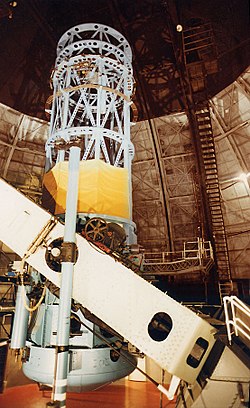
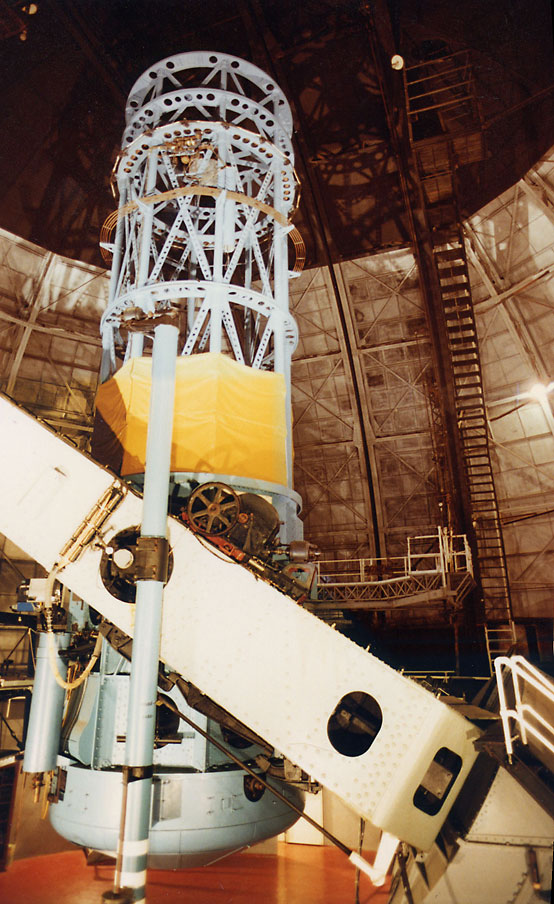
The 100-inch (2.54 m) Hooker reflecting telescope at Mount Wilson Observatory near Los Angeles, used by Edwin Hubble to measure galaxy redshifts and discover the general expansion of the universe.

A telescope is a device used to observe distant objects by their emission, absorption, or reflection of electromagnetic radiation.[1] Originally, it was an optical instrument using lenses, curved mirrors, or a combination of both to observe distant objects – an optical telescope. Nowadays, the word "telescope" is defined as a wide range of instruments capable of detecting different regions of the electromagnetic spectrum, and in some cases other types of detectors.

The first known practical telescopes were refracting telescopes with glass lenses and were invented in the Netherlands at the beginning of the 17th century. They were used for both terrestrial applications and astronomy.

The reflecting telescope, which uses mirrors to collect and focus light, was invented within a few decades of the first refracting telescope.

In the 20th century, many new types of telescopes were invented, including radio telescopes in the 1930s and infrared telescopes in the 1960s.

Etymology

[edit]

The word telescope was coined in 1611 by the Greek mathematician Giovanni Demisiani for one of Galileo Galilei's instruments presented at a banquet at the Accademia dei Lincei.[2][3] In the Starry Messenger, Galileo had used the Latin term perspicillum. The root of the word is from the Ancient Greek τῆλε, tele 'far' and σκοπεῖν, skopein 'to look or see'; τηλεσκόπος, teleskopos 'far-seeing'.[4]

History

[edit]
Replica of possibly the oldest surviving telescope (1609-1640), suspected to be an early "Cannocchiali" refracting telescope by Galileo Galilei.[5]
A replica of a second reflecting telescope Isaac Newton presented to the Royal Society in London in 1672

The earliest existing record of a telescope was a 1608 patent submitted to the government in the Netherlands by Middelburg spectacle maker Hans Lipperhey for a refracting telescope.[6] The actual inventor is unknown but word of it spread through Europe. Galileo heard about it and, in 1609, built his own version, and made his telescopic observations of celestial objects.[7][8]

The idea that the objective, or light-gathering element, could be a mirror instead of a lens was being investigated soon after the invention of the refracting telescope.[9] The potential advantages of using parabolic mirrors—reduction of spherical aberration and no chromatic aberration—led to many proposed designs and several attempts to build reflecting telescopes.[10] In 1668, Isaac Newton built the first practical reflecting telescope, of a design which now bears his name, the Newtonian reflector.[11]

The invention of the achromatic lens in 1733 partially corrected color aberrations present in the simple lens[12] and enabled the construction of shorter, more functional refracting telescopes.[13] Reflecting telescopes, though not limited by the color problems seen in refractors, were hampered by the use of fast tarnishing speculum metal mirrors employed during the 18th and early 19th century—a problem alleviated by the introduction of silver coated glass mirrors in 1857, and aluminized mirrors in 1932.[14] The maximum physical size limit for refracting telescopes is about 1 meter (39 inches), dictating that the vast majority of large optical researching telescopes built since the turn of the 20th century have been reflectors. The largest reflecting telescopes currently have objectives larger than 10 meters (33 feet), and work is underway on several 30–40m designs.[15]

The 20th century also saw the development of telescopes that worked in a wide range of wavelengths from radio to gamma-rays. The first purpose-built radio telescope went into operation in 1937. Since then, a large variety of complex astronomical instruments have been developed.

In the late 2010s, smart telescopes[16] democratize access to the night sky observation[17]. They simplify setup, automate object tracking, and deliver clear, processed images to users, including those in light-polluted environments. Smart telescopes don't have an eyepiece like a traditional telescope. They capture multiple images of an object, stacking the images in real time to display a clear view.

In space

[edit]

Since the atmosphere is opaque for most of the electromagnetic spectrum, only a few bands can be observed from the Earth's surface. These bands are visible – near-infrared and a portion of the radio-wave part of the spectrum.[18] For this reason there are no X-ray or far-infrared ground-based telescopes as these have to be observed from orbit. Even if a wavelength is observable from the ground, it might still be advantageous to place a telescope on a satellite due to issues such as clouds, astronomical seeing and light pollution.[19]

The disadvantages of launching a space telescope include cost, size, maintainability and upgradability.[20]

Some examples of space telescopes from NASA are the Hubble Space Telescope that detects visible light, ultraviolet, and near-infrared wavelengths, the Spitzer Space Telescope that detects infrared radiation, and the Kepler Space Telescope that discovered thousands of exoplanets.[21] The latest telescope that was launched was the James Webb Space Telescope on December 25, 2021, in Kourou, French Guiana. The Webb telescope detects infrared light.[22]

By electromagnetic spectrum

[edit]
Radio, infrared, visible, ultraviolet, x-ray and gamma ray
Six views of the Crab Nebula at different wavelengths of light

The name "telescope" covers a wide range of instruments. Most detect electromagnetic radiation, but there are major differences in how astronomers must go about collecting light (electromagnetic radiation) in different frequency bands.

As wavelengths become longer, it becomes easier to use antenna technology to interact with electromagnetic radiation (although it is possible to make very tiny antenna). The near-infrared can be collected much like visible light; however, in the far-infrared and submillimetre range, telescopes can operate more like a radio telescope. For example, the James Clerk Maxwell Telescope observes from wavelengths from 3 μm (0.003 mm) to 2000 μm (2 mm), but uses a parabolic aluminum antenna.[23] On the other hand, the Spitzer Space Telescope, observing from about 3 μm (0.003 mm) to 180 μm (0.18 mm) uses a mirror (reflecting optics). Also using reflecting optics, the Hubble Space Telescope with Wide Field Camera 3 can observe in the frequency range from about 0.2 μm (0.0002 mm) to 1.7 μm (0.0017 mm) (from ultra-violet to infrared light).[24]

With photons of the shorter wavelengths, with the higher frequencies, glancing-incident optics, rather than fully reflecting optics are used. Telescopes such as TRACE and SOHO use special mirrors to reflect extreme ultraviolet, producing higher resolution and brighter images than are otherwise possible. A larger aperture does not just mean that more light is collected, it also enables a finer angular resolution.

Telescopes may also be classified by location: ground telescope, space telescope, or flying telescope. They may also be classified by whether they are operated by professional astronomers or amateur astronomers. A vehicle or permanent campus containing one or more telescopes or other instruments is called an observatory.

Radio and submillimeter

[edit]
see caption
Three radio telescopes belonging to the Atacama Large Millimeter Array

Radio telescopes are directional radio antennas that typically employ a large dish to collect radio waves. The dishes are sometimes constructed of a conductive wire mesh whose openings are smaller than the wavelength being observed.

Unlike an optical telescope, which produces a magnified image of the patch of sky being observed, a traditional radio telescope dish contains a single receiver and records a single time-varying signal characteristic of the observed region; this signal may be sampled at various frequencies. In some newer radio telescope designs, a single dish contains an array of several receivers; this is known as a focal-plane array.

Map of the Square Kilometre Array, its membership and setup, which puts together radio telescopes in arrays for interferomrtric observation.

By collecting and correlating signals simultaneously received by several dishes, high-resolution images can be computed. Such multi-dish arrays are known as astronomical interferometers and the technique is called aperture synthesis. The 'virtual' apertures of these arrays are similar in size to the distance between the telescopes. As of 2005, the record array size is many times the diameter of the Earth – using space-based very-long-baseline interferometry (VLBI) telescopes such as the Japanese HALCA (Highly Advanced Laboratory for Communications and Astronomy) VSOP (VLBI Space Observatory Program) satellite.[25]

Aperture synthesis is now also being applied to optical telescopes using optical interferometers (arrays of optical telescopes) and aperture masking interferometry at single reflecting telescopes.

Radio telescopes are also used to collect microwave radiation, which has the advantage of being able to pass through the atmosphere and interstellar gas and dust clouds.

Some radio telescopes such as the Allen Telescope Array are used by programs such as SETI[26] and the Arecibo Observatory to search for extraterrestrial life.[27][28]

Infrared

[edit]

Visible light

[edit]
Dome-like telescope with extruding mirror mount
One of four auxiliary telescopes belong to the Very Large Telescope array

An optical telescope gathers and focuses light mainly from the visible part of the electromagnetic spectrum.[29] Optical telescopes increase the apparent angular size of distant objects as well as their apparent brightness. For the image to be observed, photographed, studied, and sent to a computer, telescopes work by employing one or more curved optical elements, usually made from glass lenses and/or mirrors, to gather light and other electromagnetic radiation to bring that light or radiation to a focal point. Optical telescopes are used for astronomy and in many non-astronomical instruments, including: theodolites (including transits), spotting scopes, monoculars, binoculars, camera lenses, and spyglasses. There are three main optical types:

A Fresnel imager is a proposed ultra-lightweight design for a space telescope that uses a Fresnel lens to focus light.[32][33]

Beyond these basic optical types there are many sub-types of varying optical design classified by the task they perform such as astrographs,[34] comet seekers[35] and solar telescopes.[36]

Ultraviolet

[edit]

Most ultraviolet light is absorbed by the Earth's atmosphere, so observations at these wavelengths must be performed from the upper atmosphere or from space.[37][38]

X-ray

[edit]
see caption
Hitomi telescope's X-ray focusing mirror, consisting of over two hundred concentric aluminium shells

X-rays are much harder to collect and focus than electromagnetic radiation of longer wavelengths. X-ray telescopes can use X-ray optics, such as Wolter telescopes composed of ring-shaped 'glancing' mirrors made of heavy metals that are able to reflect the rays just a few degrees. The mirrors are usually a section of a rotated parabola and a hyperbola, or ellipse. In 1952, Hans Wolter outlined 3 ways a telescope could be built using only this kind of mirror.[39][40] Examples of space observatories using this type of telescope are the Einstein Observatory,[41] ROSAT,[42] and the Chandra X-ray Observatory.[43][44] In 2012 the NuSTAR X-ray Telescope was launched which uses Wolter telescope design optics at the end of a long deployable mast to enable photon energies of 79 keV.[45][46]

Gamma ray

[edit]
The Compton Gamma Ray Observatory released into orbit by the Space Shuttle in 1991

Higher energy X-ray and gamma ray telescopes refrain from focusing completely and use coded aperture masks: the patterns of the shadow the mask creates can be reconstructed to form an image.

X-ray and Gamma-ray telescopes are usually installed on high-flying balloons[47][48] or Earth-orbiting satellites since the Earth's atmosphere is opaque to this part of the electromagnetic spectrum. An example of this type of telescope is the Fermi Gamma-ray Space Telescope which was launched in June 2008.[49][50]

The detection of very high energy gamma rays, with shorter wavelength and higher frequency than regular gamma rays, requires further specialization. Such detections can be made either with the Imaging Atmospheric Cherenkov Telescopes (IACTs) or with Water Cherenkov Detectors (WCDs). Examples of IACTs are H.E.S.S.[51] and VERITAS[52][53] with the next-generation gamma-ray telescope, the Cherenkov Telescope Array (CTA), currently under construction. HAWC and LHAASO are examples of gamma-ray detectors based on the Water Cherenkov Detectors.

A discovery in 2012 may allow focusing gamma-ray telescopes.[54] At photon energies greater than 700 keV, the index of refraction starts to increase again.[54]

Lists of telescopes

[edit]

See also

[edit]

References

[edit]

Further reading

[edit]
[edit]
Revisions and contributorsEdit on WikipediaRead on Wikipedia
from Grokipedia
A telescope is an that collects and focuses , primarily but also other wavelengths such as , , and X-rays, to enable the observation of remote objects in space or on . By using lenses or mirrors to gather from faint and distant sources, telescopes magnify images and reveal details invisible to the , serving as essential tools for astronomers to study celestial bodies like , , galaxies, and cosmic phenomena. The invention of the telescope is credited to Dutch spectacle maker Hans Lippershey in 1608, who applied for a patent for a device using two lenses to magnify distant objects, though similar designs were independently developed by others around the same time. Italian astronomer was the first to apply the instrument to astronomical observations in 1609, using it to discover Jupiter's moons, the , and the rugged surface of the , which revolutionized understanding of the solar system and challenged geocentric models of the universe. Early telescopes were refracting designs limited by lens imperfections, but advancements in the 17th century, including Isaac Newton's 1668 , addressed these issues by using mirrors instead of lenses. Telescopes are broadly classified into three main types based on their optical design: refracting, reflecting, and (or catadioptric). Refracting telescopes use a primary lens (objective) to bend and focus incoming light, producing clear images suitable for terrestrial and small astronomical viewing, though they suffer from where different colors focus at slightly different points. Reflecting telescopes employ a , often paraboloid-shaped, to reflect and converge light, allowing for larger apertures without the weight and cost of massive lenses, and they dominate modern observatories due to their ability to capture more light for fainter objects. Compound telescopes combine lenses and mirrors, such as in Schmidt-Cassegrain designs, to offer compact, versatile systems that minimize aberrations and are popular for both and use. Beyond visible light, specialized telescopes detect radiation across the , including radio telescopes with large dish antennas for long-wavelength signals and space-based observatories like the , which avoids atmospheric distortion to capture high-resolution images in and optical bands. The , launched in 2021, represents a pinnacle of modern technology with its 6.5-meter gold-coated mirror optimized for observations, enabling views of the universe's earliest galaxies and star-forming regions. These instruments have profoundly advanced fields like cosmology, exoplanet detection, and , continually expanding humanity's knowledge of the .

Fundamentals

Definition and Etymology

A telescope is an that employs lenses, mirrors, or electronic detectors to observe remote objects by collecting (EMR) from across the spectrum, including visible light, , , X-rays, and gamma rays, and focusing it to form magnified images or enhanced data. This process increases the apparent angular size of distant sources or improves their resolving power, allowing detailed study of otherwise faint or minuscule features. The word "telescope" originates from the Greek roots tēle- ("far," from the *kwel- meaning "to revolve or move round") and skopein ("to look or see," from *spek- "to observe"), literally meaning "far-seeing." It was coined in 1611 by the Greek mathematician Giovanni Demisiani during a banquet at the to name one of Galileo Galilei's instruments, distinguishing it from the "," which examines nearby objects. The term entered English via Italian telescopio (used by Galileo in 1611) and Latin telescopium (Kepler, 1613). Telescopes serve primarily in astronomy to investigate celestial bodies, gathering EMR from stars, galaxies, and cosmic phenomena that would be invisible to the , though they also enable terrestrial uses like and . Their effectiveness hinges on resolving power—the capacity to separate closely spaced objects—rather than magnifying power, which merely enlarges the image but cannot reveal details beyond the resolution limit. Resolving power is constrained by , while magnification is achieved by adjusting focal lengths and is secondary to light-gathering ability and detail clarity. The fundamental limit to resolving power is quantified by the Rayleigh criterion, which defines the minimum angular separation θ\theta (in radians) between two point sources as just resolvable when the central maximum of one diffraction pattern falls on the first minimum of the other: θ=1.22λD\theta = 1.22 \frac{\lambda}{D} Here, λ\lambda is the wavelength of the EMR, and DD is the aperture diameter. This formula derives from the Airy diffraction pattern for a circular aperture, where the first minimum occurs at an angle determined by the Bessel function of the first kind, yielding the 1.22 factor for equal-intensity sources. Shorter wavelengths or larger apertures reduce θ\theta, enhancing resolution; for visible light (λ550\lambda \approx 550 nm), a 1-meter telescope achieves θ0.14\theta \approx 0.14 arcseconds. Established by Lord Rayleigh in 1879, this criterion underscores why aperture size is paramount in telescope performance.

Basic Components and Principles

A telescope's primary function relies on its core optical and mechanical components, which work together to collect, focus, and magnify incoming electromagnetic radiation. The objective serves as the main light-gathering element, either a lens in refracting telescopes or a mirror in reflecting designs, capturing parallel rays from distant objects and converging them to form a real image at its focal plane. The eyepiece, used primarily in visual observing setups, acts as a magnifying lens that allows the observer to view this image by further magnifying it and presenting it at a comfortable distance. Supporting these optics, the mount provides stability and precise tracking; common types include the altazimuth mount, which allows motion in altitude (up-down) and azimuth (left-right) directions, and the equatorial mount, aligned with Earth's rotational axis for easier sidereal tracking. The tube or enclosure houses the optics, protecting them from stray light and environmental factors while maintaining alignment. The fundamental principles governing telescope performance stem from geometric optics and wave properties of . Light collection is determined by the objective's area, which scales with the square of its DD, given by the for circular apertures: A=π(D2)2A = \pi \left( \frac{D}{2} \right)^2 This area dictates the telescope's light-gathering power, enabling detection of fainter objects compared to the unaided eye. occurs at the objective's ff, the distance from the optic to the point where parallel rays converge; longer s produce larger but dimmer images. For refracting telescopes, angular MM is calculated as the ratio of the objective's to the eyepiece's: M=fobjectivefeyepieceM = \frac{f_\text{objective}}{f_\text{eyepiece}} This highlights how shorter eyepiece s increase , though practical limits arise from eye relief and . Telescopes employ two main optical principles: and reflection. In refracting systems, light bends through transparent lenses, but this introduces , where different wavelengths focus at slightly different points due to varying refractive indices, causing color fringing in images. Reflecting telescopes avoid this by using curved mirrors to bounce light, reflecting all wavelengths equally without dispersion, though they may introduce other issues like off-axis aberrations. Both types are ultimately limited by , the wave nature of light bending around the aperture edges, setting a theoretical of approximately θ1.22λ/D\theta \approx 1.22 \lambda / D, where λ\lambda is the ; smaller apertures yield blurrier images for fine details. Earth's atmosphere impacts ground-based observations through seeing and extinction. Seeing refers to image blurring from turbulent air cells, which distort wavefronts and limit resolution to about 0.5–2 arcseconds under typical conditions, far coarser than diffraction limits for large telescopes. diminishes light intensity via absorption (e.g., by or ) and (e.g., by aerosols), with effects worsening at shorter wavelengths and higher airmasses; for instance, blue light suffers more than red. To illustrate light-gathering power, the table below compares the collecting area of the (pupil diameter ≈7 mm under dark conditions) to common telescope apertures, showing relative gains:
Aperture Diameter (D)Collecting Area (relative to eye)Example Telescope Type
7 mm1x
10 cm204xSmall refractor
20 cm816xAmateur reflector
1 m20,224xProfessional observatory
These ratios underscore how even modest telescopes vastly outperform the eye for faint-object detection.

History

Invention and Early Development

The of the telescope is credited to the Dutch spectacle maker Hans Lippershey, who applied for a for a "spyglass" device in October 1608, describing an instrument that used two lenses to magnify distant objects by about three times. This refracting design consisted of a convex objective lens to gather and a concave lens to produce an upright image, marking the first practical for viewing remote objects. Independently, spectacle maker and his father also developed a similar device around the same time in the Netherlands, though Lippershey's application provides the earliest documented record. The Dutch government's denial of the patent exclusivity, due to similar inventions by others, allowed the design to spread quickly among artisans. In 1609, Italian astronomer and physicist learned of the Dutch spyglass through reports from and independently constructed his own version, rapidly iterating on the design to achieve magnifications up to 20 times within months. 's telescopes retained the basic Dutch refracting configuration—a convex objective lens paired with a concave —but featured improved lens grinding techniques for clearer, wider fields of view, enabling sustained astronomical observations. Turning the instrument skyward for the first time in late 1609, made groundbreaking discoveries, including the resolution of the into individual stars, the rugged, mountainous terrain of the 's surface, and the four largest (now known as the ), which he observed orbiting the planet between January 7 and 13, 1610. Later that year, he documented the , similar to those of the , providing visual evidence that challenged the prevailing geocentric model by supporting a heliocentric where planets orbit the Sun. These observations profoundly impacted astronomy by establishing the telescope as a tool for empirical investigation, undermining Aristotelian notions of perfect and the -centered universe. Galileo's findings, particularly Jupiter's moons demonstrating that not all celestial bodies revolve around , fueled debates over and spurred the creation of informal observatories, such as Galileo's own backyard setup in for systematic nightly viewings. In March 1610, Galileo published his results in (Starry Messenger), a concise that detailed these discoveries and included the first telescopic illustrations of celestial bodies, rapidly disseminating the knowledge across . The instrument's adoption spread through figures like English mathematician , who independently acquired a Dutch telescope in 1609 and sketched lunar features months before Galileo's publication, introducing telescopic astronomy to Britain and influencing early scientific circles.

Major Milestones and Advances

The invention of the marked a pivotal advancement in optical astronomy, addressing the inherent in early refractors. In 1663, Scottish mathematician James Gregory proposed the Gregorian reflector design, which utilized a parabolic primary mirror and an elliptical secondary mirror to focus light without dispersion, though practical construction was hindered by polishing limitations of the era. Five years later, in 1668, constructed the first functional reflector, employing a single curved primary mirror made of alloy and a flat secondary mirror angled at 45 degrees to direct light to the , achieving a of about 40 times and eliminating color fringing by avoiding lenses altogether. The 19th century witnessed substantial growth in telescope scale and capability, driven by industrialization's improvements in glassmaking and metalworking. Herschel discovered in 1781 using one of his smaller reflecting telescopes. He completed his 40-foot (12 m) Newtonian reflector in 1789, the largest of its time, with which he discovered several and Saturn, as well as detailed observations of Saturn's satellites. In 1845, William Parsons, 3rd Earl of Rosse, erected the , a 72-inch (1.8-meter) reflector with mirrors weighing over four tons each, allowing the first resolved views of spiral structures in nebulae like M51 and pushing the boundaries of deep-sky imaging. Concurrently, advances in production, pioneered by figures like Pierre Louis Guinand through stirred molten glass techniques, facilitated larger refractor objectives; for instance, Alvan Clark and Sons crafted the 36-inch (91-cm) lens for the Lick Observatory in 1887, the world's largest refractor at the time. Twentieth-century milestones emphasized even grander instruments and detection innovations, transforming astronomical research. The 100-inch (2.5-meter) Hooker Telescope at achieved first light in 1917, its light-gathering power—six times that of prior largest scopes—empowering Edwin Hubble's observations from 1919 onward, which confirmed the existence of extragalactic nebulae as independent galaxies and laid groundwork for cosmic expansion theories. In 1948, the 200-inch (5-meter) at commenced operations, supplanting the Hooker as the world's premier instrument for over four decades and enabling unprecedented resolution of faint celestial objects. The 1970s introduced charge-coupled devices (CCDs) to astronomy, with the first astronomical images captured in 1976 using a CCD on , , and ; this digital technology surpassed photographic plates in sensitivity and spectral range, revolutionizing and analysis. Institutional developments further propelled these advances through dedicated facilities and collaborative frameworks. The Lick Observatory, established in 1888 on Mount Hamilton, California, became the first permanently staffed mountaintop site, equipped with its 36-inch refractor to support systematic stellar spectroscopy and planetary studies. Similarly, Yerkes Observatory opened in 1897 in Williams Bay, Wisconsin, housing the 40-inch Great Refractor—the largest of its type—and fostering the first university astrophysics department under the University of Chicago. These efforts prefigured broader international collaborations, such as the late-19th-century Carte du Ciel project, which united observatories across Europe and beyond to map the skies uniformly, setting precedents for coordinated global astronomical endeavors.

Telescopes by Electromagnetic Spectrum

Radio Telescopes

Radio telescopes are specialized instruments designed to detect and study electromagnetic radiation in the radio portion of the spectrum, typically spanning wavelengths from about 1 millimeter to over 100 meters, corresponding to frequencies from 300 GHz down to 3 MHz. These telescopes capture faint radio signals from celestial sources such as stars, galaxies, and cosmic phenomena that are invisible to optical instruments. Unlike optical telescopes, radio telescopes operate effectively day and night and can penetrate dust and gas clouds that obscure visible light. The primary design principle of radio telescopes involves large parabolic dishes or arrays of antennas to collect and focus incoming radio waves onto sensitive receivers. A single parabolic dish acts as a reflector, directing plane waves to a focal point where the feed antenna captures the signal, with the dish's surface precision maintained to within a fraction of the observing to minimize losses. For enhanced sensitivity and resolution, arrays of multiple dishes are employed, such as the (VLA) in , which uses 27 antennas configurable in various baselines. Receivers in these systems typically employ techniques, mixing the incoming signal with a to down-convert it to an for amplification and detection, or direct detection methods like bolometers for submillimeter waves. To achieve high beyond that of a single dish—limited by its physical size— combines signals from separated antennas, effectively synthesizing a larger ; the resolution is approximated by θλB\theta \approx \frac{\lambda}{B}, where θ\theta is the in radians, λ\lambda is the , and BB is the maximum baseline between antennas. The development of radio telescopes began with Karl Jansky's 1931 detection of cosmic radio noise from the using a array at , marking the birth of . Inspired by Jansky's work, amateur astronomer constructed the first purpose-built parabolic —a 9.5-meter dish—in his backyard in 1937, which produced the first radio map of the sky at 160 MHz and confirmed extraterrestrial radio emissions. Modern examples include the Atacama Large Millimeter/submillimeter Array (ALMA), inaugurated in 2011 in , comprising 66 antennas that observe at submillimeter wavelengths to image protoplanetary disks around young stars, revealing dust and gas structures critical to planet formation. Another landmark is the Event Horizon Telescope (EHT), a global interferometric array that in 2019 produced the first image of the in the galaxy M87, demonstrating Earth-sized resolution at millimeter wavelengths through . Radio telescopes enable key applications in , including mapping the distribution of via the 21 cm emission line, which traces galactic structure and dynamics. They are essential for pulsar timing arrays, which monitor millisecond to detect low-frequency from binaries. Observations of the (CMB) radiation, the relic from the , use radio telescopes to study its temperature and polarization fluctuations, probing the early . A major challenge is radio frequency interference (RFI) from human sources like communications and satellites, addressed through advanced mitigation techniques such as real-time flagging of contaminated data and shielded site locations. Ground-based radio telescopes dominate the field due to the Earth's atmosphere being largely transparent in specific windows, notably 1–10 GHz (corresponding to decimeter wavelengths) and 30–100 GHz (millimeter wavelengths), where and oxygen absorption is minimal, allowing clear observations from high-altitude sites like those in or . These windows enable sensitive detections without the need for space-based platforms, though observations at lower frequencies below 1 GHz can suffer from ionospheric distortion.

Infrared Telescopes

Infrared telescopes are designed to detect in the portion of the , spanning wavelengths from approximately 0.7 to 1000 micrometers, which allows observation of cooler celestial objects such as dust-enshrouded star-forming regions and distant galaxies whose light has been redshifted. Unlike optical telescopes, instruments must mitigate from the telescope itself and the environment, as radiation is emitted by objects at temperatures between about 3 and 300 . This sensitivity to thermal emission necessitates specialized designs to achieve high signal-to-noise ratios. A key feature of infrared telescope design is the use of cooled detectors, such as (HgCdTe) arrays, which are cryogenically cooled to temperatures below 80 K to suppress dark current and reduce noise from the detector material itself. Mirrors in these telescopes are typically coated with or specialized layers to enhance reflectivity in the while minimizing , preventing the from contributing unwanted . Ground-based observations are further constrained by Earth's atmosphere, which is largely opaque to wavelengths except in specific transmission windows: the near- window from 1 to 5 μm and the mid- window from 8 to 13 μm, where absorption by molecules like and is minimal. One major challenge in infrared astronomy is atmospheric water vapor, which absorbs much of the incoming radiation, particularly in the mid- and far-infrared; this necessitates placement at high-altitude, dry sites like in , where precipitable water vapor can be as low as 1 mm, enabling clearer observations compared to lower elevations. Space-based infrared telescopes avoid these issues entirely by operating above the atmosphere, though they require active cooling systems to maintain low temperatures. Significant developments in infrared telescopes include the , launched in 2003, which featured a 0.85-meter telescope cryogenically cooled to below 5.5 K using 49 kg of superfluid to enable sensitive mid- and far- imaging and . On the ground, the W. M. Keck Observatory's 10-meter telescopes employ systems, such as the near-infrared wavefront sensor on Keck II, to correct for atmospheric distortion and achieve diffraction-limited imaging in the near- (1-5 μm). The (JWST), launched in December 2021, represents a pinnacle of far- capability with its 6.5-meter primary mirror coated in gold for , allowing observations up to 28.3 μm and enabling unprecedented views of cool, distant objects. Infrared telescopes have facilitated key discoveries, including detailed characterization of exoplanet atmospheres; for instance, Spitzer's infrared observations of the system in 2017 revealed density measurements for its seven Earth-sized planets, while JWST observations of TRAPPIST-1 e from 2023 to 2025 suggest a CO2-dominated atmosphere is unlikely but provide tentative evidence for a possible nitrogen-rich atmosphere, ruling out a bare-rock planet. They have also unveiled processes in dusty regions obscured at optical wavelengths, with Spitzer identifying thousands of young stars and protostellar disks in galaxies like the Milky Way's center. Additionally, infrared observations have mapped the —thermal emission from interplanetary dust in the Solar System—revealing its and composition through mid-infrared surveys. The utility of infrared telescopes for studying cool objects stems from Wien's displacement law, which describes the peak wavelength of blackbody radiation as λmax=bT\lambda_{\max} = \frac{b}{T}, where TT is the temperature in kelvin and b2898μmKb \approx 2898 \, \mu\mathrm{m \cdot K} is Wien's constant; for example, a 100 K dust cloud peaks at about 29 μm in the far-infrared, making it ideal for detection by instruments like JWST. This law underscores why infrared wavelengths are essential for probing the thermal emissions of star-forming nebulae and planetary atmospheres, providing insights into their temperatures and compositions.

Optical Telescopes

Optical telescopes are instruments designed to collect and focus visible in the wavelength range of approximately 400 to 700 nanometers, enabling detailed observations of celestial objects such as , galaxies, and from ground-based sites. These telescopes form images by refracting, reflecting, or combining both light paths, with designs optimized to minimize aberrations like chromatic dispersion and spherical for sharper resolution. Primarily used for terrestrial astronomy, they support a wide array of scientific investigations, from stellar to transient event monitoring, and are accessible to both professional researchers and amateur enthusiasts./16%3A_Light_and_the_Sun/16.03%3A_Telescopes) The three primary subtypes of optical telescopes are refracting, reflecting, and catadioptric systems. Refracting telescopes, or refractors, use a primary objective lens to bend incoming rays toward a focal point, producing an image viewed through an . To address —where different wavelengths focus at varying points due to the dispersive properties of glass—modern refractors employ achromatic doublets, consisting of a converging crown glass lens paired with a diverging lens of higher dispersion. This configuration balances the focal lengths for red and blue , achieving near-achromatic performance across the . Reflecting telescopes, or reflectors, utilize a primary concave mirror to gather , avoiding chromatic issues inherent in lenses but requiring designs to correct for and . Common variants include the Cassegrain, which features a parabolic primary mirror and a convex hyperbolic secondary mirror that reflects back through a central hole in the primary for a compact , and the Ritchey-Chrétien, an advanced Cassegrain with hyperbolic surfaces on both mirrors to eliminate and over a wider . Catadioptric telescopes integrate refractive and reflective elements for compactness and versatility; the Schmidt-Cassegrain design, for instance, employs a spherical primary mirror paired with a thin aspheric corrector plate at the front to compensate for , combined with a secondary mirror for a folded that provides a wide, flat field suitable for both visual and photographic use. Key design principles in optical telescopes emphasize aberration correction, particularly in refractors via the achromatic condition derived from the lensmaker's equation. For a thin achromatic doublet, the effective focal length ff is determined by combining the powers of the two lenses, where the power P=1/fP = 1/f of each is given by the simplified lensmaker's formula: 1f=(n1)(1R11R2)\frac{1}{f} = (n - 1) \left( \frac{1}{R_1} - \frac{1}{R_2} \right) Here, nn is the , and R1R_1, R2R_2 are the radii of curvature of the lens surfaces (positive for convex toward the incident ). Chromatic correction requires the dispersive powers ω\omega (related to the V=1/ωV = 1/\omega) to satisfy P1/ω1=P2/ω2P_1 / \omega_1 = -P_2 / \omega_2, ensuring the total power P=P1+P2P = P_1 + P_2 remains constant for different wavelengths, typically targeting yellow as the reference. In reflectors like the Ritchey-Chrétien, hyperbolic mirror profiles—defined by conic constants near -1.2 for the primary—are calculated to match the secondary's curvature, optimizing off-axis performance without additional elements. Among large ground-based examples, the , an 8.2-meter Ritchey-Chrétien reflector, exemplifies modern design with its thin meniscus primary mirror segmented for precision, achieving first in 1998 and full operations by 1999 at Observatory. Optical telescopes have enabled landmark discoveries, including the detection of through measurements, which track stellar wobbles via Doppler shifts in spectral lines observed in visible light. A seminal example is , the first around a Sun-like star, identified in 1995 using the ELODIE spectrograph on the 1.93-meter reflector at Observatoire de Haute-Provence, revealing a with an orbital period of 4.2 days. observations also highlight their role; ground-based optical telescopes captured the and spectra of in the , providing insights into core-collapse dynamics, while more recent events like in Messier 101 were monitored with the 8.1-meter Gemini North reflector for detailed evolution tracking. astronomers, equipped with portable refractors or catadioptrics up to 0.5 meters in aperture, contribute significantly by discovering novae and monitoring variable stars, complementing professional efforts with large-aperture reflectors (4-10 meters) that enable high-resolution and deep imaging. Ground-based optical telescopes are strategically located at high-altitude sites with minimal atmospheric interference and to maximize image clarity. The in , home to the European Southern Observatory's Paranal site with its 8.2-meter units, offers exceptionally dark skies due to its arid climate, low humidity, and remoteness from urban areas, achieving seeing conditions under 0.5 arcseconds. mitigation involves international agreements, such as Chile's Office for the Protection of the Sky Quality, which enforces shielded lighting standards and mining operation restrictions to preserve Bortle Class 1 skies essential for faint object detection.

Ultraviolet Telescopes

Ultraviolet telescopes operate in the range of approximately 10 to 400 nanometers, a portion of the that is largely absorbed by Earth's atmosphere, necessitating space-based platforms for effective observation. These instruments capture emissions from high-temperature phenomena, such as hot stars and active galactic nuclei, where light reveals atomic transitions and energetic processes invisible at longer wavelengths. The short wavelengths enable high due to the limit, allowing detailed imaging and , though the high energies pose challenges for detector efficiency. Design features of ultraviolet telescopes prioritize materials that transmit or reflect UV light efficiently. Primary mirrors typically employ aluminum coatings, often protected by thin layers of (MgF₂) or aluminum trifluoride (AlF₃) to prevent oxidation while maintaining reflectivity above 80% down to about 115 nm. optics, valued for their transparency in the near-UV (above 200 nm), are used for windows, lenses, or spectrograph components, as ordinary glass absorbs shorter wavelengths. Spectrographs are integral for analyzing emission and absorption lines, dispersing light to study spectral features like the line at 121.6 nm, which traces in astrophysical environments. These designs balance compactness with thermal stability, using low-coefficient-of-thermal-expansion materials to minimize wavefront errors in the vacuum of . Pioneering missions have advanced ultraviolet astronomy. The International Ultraviolet Explorer (IUE), launched in 1978 and operational until 1996, provided the first long-term observatory for UV spectroscopy from 115 to 325 nm, enabling real-time observations of stellar and galactic phenomena. The Hubble Space Telescope incorporates dedicated UV capabilities through instruments like the Cosmic Origins Spectrograph (COS), which offers high-sensitivity far-UV (90-200 nm) and near-UV (170-320 nm) spectroscopy, revolutionizing studies of cosmic evolution. The Galaxy Evolution Explorer (GALEX), active from 2003 to 2013, conducted an all-sky survey in far-UV (154 nm) and near-UV (232 nm) bands, mapping star formation history across 80% of the universe's age. Applications of ultraviolet telescopes center on probing stellar and interstellar processes. They elucidate by capturing spectra of hot, massive , revealing mass loss and through strong UV emission lines. In the , UV observations detect absorption features, such as , to map gas distribution, ionization states, and dust properties in . These insights contribute to understanding formation and the of elements in cosmic ecosystems. Key challenges include severe atmospheric absorption, particularly by below 300 nm, which blocks nearly all far-UV radiation from ground-based sites and mandates orbital deployment. Detector sensitivity remains a hurdle, as standard silicon CCDs have low quantum efficiency below 200 nm; specialized variants with UV-enhancing coatings or alternatives like tubes and microchannel plates are employed to achieve adequate signal-to-noise ratios for faint sources. Additionally, maintaining coating integrity against atomic oxygen in low-Earth orbit requires robust protective layers to sustain performance over multi-year missions.

X-ray Telescopes

X-ray telescopes observe celestial sources emitting in the portion of the , corresponding to wavelengths of approximately 0.01 to 10 nanometers (energies of 0.1 to 100 keV), which arise from extreme astrophysical environments such as accretion disks, remnants, and hot plasmas in clusters. Unlike optical telescopes, X-rays cannot be focused by conventional mirrors due to their high energy and short wavelength, which cause them to penetrate most materials at normal incidence; instead, X-ray telescopes rely on grazing-incidence where photons reflect at very shallow angles, typically less than 1 degree, to achieve focusing. The predominant design for telescopes is the Wolter Type I configuration, featuring a nested array of confocal parabolic primary mirrors followed by hyperbolic secondary mirrors, which corrects for and enables high-resolution imaging over a modest . These mirrors, often coated with or to enhance reflectivity at X-ray energies, are arranged in concentric shells to maximize collecting area while maintaining a compact form factor suitable for deployment. Detection at the focal plane typically employs gas-filled proportional counters for moderate-resolution in early missions or charge-coupled devices (CCDs) in modern instruments for higher spatial and spectral resolution, allowing the mapping of emission from diffuse structures or point sources. Pioneering missions include the Einstein Observatory, launched in 1978 as NASA's High Energy Astrophysics Observatory 2 (HEAO-2), which was the first space-based to produce high-resolution images with an of about 1 arcminute across 0.2–4 keV energies, enabling the detection of thousands of discrete sources and transforming our understanding of the X-ray sky. The , deployed in 1999, operates in the 0.1–10 keV range with sub-arcsecond resolution, allowing detailed studies of phenomena like the accretion flows around supermassive holes in active galactic nuclei, where X-rays reveal the dynamics of infalling heated to millions of degrees. Complementing Chandra, the European Space Agency's , also launched in 1999, features three large mirror modules with a total effective collecting area exceeding 4,500 cm² at 1 keV, facilitating deep spectroscopic surveys that detect faint, extended emissions from distant sources. Key discoveries from these telescopes include the measurement of cooling rates in supernova remnants, where spectra show surface temperatures declining over centuries post-explosion, providing tests of emission theories in dense matter. Observations of active galactic nuclei have uncovered powerful outflows from accreting black holes, driving galaxy evolution by heating surrounding gas and quenching . In supernova remnants like , imaging has mapped shock-heated ejecta and revealed chemical abundances from , elucidating explosion mechanisms. Quantitative analysis of these sources often involves computing the total energy flux FF as the integral of the S(E)S(E) over EE, F=S(E)dEF = \int S(E) \, dE, which integrates the observed to estimate bolometric output and source after correcting for interstellar absorption. X-ray telescopes face inherent challenges, as Earth's atmosphere completely absorbs s below 10 keV, necessitating space-based platforms for all observations. Achieving precise pointing accuracy, typically on the order of arcseconds, is critical for aligning the narrow (often 10–30 arcminutes) with faint, variable sources, where even minor drifts can lead to lost signal amid cosmic X-ray background noise.

Gamma-ray Telescopes

Gamma-ray telescopes detect photons with energies exceeding 10 keV, the highest-energy portion of the , which originate from extreme astrophysical processes such as accretion, supernovae, and particle acceleration in cosmic rays. Unlike lower-energy , gamma rays cannot be focused using traditional mirrors or lenses because their wavelengths are too short and they interact strongly with , necessitating indirect techniques to determine direction and . These instruments primarily operate from to avoid atmospheric absorption, though ground-based systems complement them at the highest energies. Key designs for gamma-ray detection rely on Compton scattering, where an incoming gamma ray interacts with an electron in a detector material, scattering at a measurable angle that encodes the photon's energy and direction via the Compton formula. Compton telescopes typically feature a two-layer setup: an upper layer of low atomic number (Z) material, such as scintillators or high-purity germanium arrays, for initial scattering, followed by a lower high-Z absorber to fully deposit the energy. For directional imaging, coded aperture masks—opaque patterns with precisely known geometries—are placed above the detectors; the shadow cast by the mask on the detector plane allows reconstruction of source positions through deconvolution algorithms. At higher energies above several MeV, pair production becomes dominant, where gamma rays convert into electron-positron pairs in high-Z converters, tracked to infer the incident direction. Prominent space missions include the (CGRO), launched in 1991 and deorbited in 2000, which featured four instruments covering 20 keV to 30 GeV and conducted the first all-sky gamma-ray survey. The , launched in 2008, employs the Large Area Telescope (LAT) for imaging in the 20 MeV to 300 GeV range using in a modular array of silicon trackers and cesium iodide calorimeters. The LAT achieves a point-source sensitivity of less than 6 × 10^{-9} photons cm^{-2} s^{-1} at E > 100 MeV for a 5σ detection over one year of survey data. Major discoveries from these missions include the isotropic yet inhomogeneous distribution of gamma-ray bursts (GRBs), transient explosions detected daily by CGRO's Burst and Transient Source Experiment (BATSE), revealing their extragalactic origin from massive star collapses or mergers. Fermi has identified over 300 gamma-ray pulsars, rapidly rotating emitting beamed radiation, expanding the known population by an order of magnitude through blind searches in survey data. Additionally, Fermi's LAT has provided stringent limits on annihilation signals by analyzing gamma-ray emission from dwarf galaxies, ruling out certain models below TeV masses. Observing gamma rays presents significant challenges due to their low flux—often below 10^{-6} photons cm^{-2} s^{-1} for typical sources—and high background from cosmic rays and atmospheric interactions, requiring sophisticated systems and event reconstruction to achieve signal-to-noise ratios sufficient for . For energies above 50 GeV, ground-based atmospheric Cherenkov telescopes like H.E.S.S. detect gamma rays indirectly via air showers of secondary particles, producing brief Cherenkov light flashes imaged by large mirrors, though this approach is limited to clear nights and specific sites.

Space Telescopes

Advantages and Challenges

Space telescopes offer several key advantages over ground-based observatories, primarily due to their position above Earth's atmosphere. Without atmospheric , they achieve diffraction-limited resolution, enabling sharper images and higher angular precision across various wavelengths. For instance, this allows space telescopes to resolve fine details in distant celestial objects that would be blurred by terrestrial seeing conditions. Additionally, space-based platforms provide full-sky access without horizon limitations or weather interruptions, and they operate in dark skies free from , enhancing sensitivity to faint sources. This is particularly beneficial for long-exposure observations of deep-space phenomena. Cryogenic cooling for and instruments is also facilitated in space, as there are no ground-based thermal constraints or atmospheric heat interference, allowing detectors to reach temperatures as low as 4 K for optimal performance. However, deploying and operating telescopes in space presents significant technical challenges. Launch constraints impose strict limits on size and mass; for example, most launch vehicles have fairing diameters under 5 meters, requiring large apertures like the James Webb Space Telescope's 6.5-meter mirror to be folded during ascent. Power generation relies on solar panels, which must provide reliable output—such as Hubble's 5,000 watts from gallium-arsenide arrays—while accounting for degradation over time and limited battery storage. Thermal control is another hurdle, with radiators essential for dissipating heat in the vacuum, but they must manage extreme temperature swings from -150°C in shadow to over 100°C in sunlight. Mission lifetimes are typically limited to 5-20 years, constrained by propellant for station-keeping, orbital decay, or component wear, though some like Hubble have exceeded expectations through servicing. Orbital choices further influence operations: suits ultraviolet and telescopes due to proximity for frequent data downlink, while Sun-Earth L2 offers exceptional stability for observatories like JWST, minimizing thermal and gravitational perturbations. Communication depends on NASA's Deep Space Network, a global array of antennas that relays commands and data, though L2 positions introduce slight delays of about 5 seconds one way in light travel time. The high costs and risks associated with space telescopes amplify these challenges. Development expenses often range from $1 billion to $10 billion; JWST, for example, totaled approximately $9.7 billion over 24 years, including $8.8 billion for spacecraft development. Risks include launch failures or in-orbit anomalies, such as the Hubble Space Telescope's primary mirror flaw discovered in 1990—a that degraded images until corrected during Servicing Mission 1 in 1993 via corrective optics and instrument upgrades. These factors demand rigorous testing and international collaboration to mitigate potential mission-ending issues.

Notable Space Observatories

The (HST), launched in 1990 and remaining operational as of 2025, features a 2.4-meter and observes primarily in the visible, , and near-infrared spectra. In June 2024, Hubble transitioned to operating in one-gyroscope mode to conserve resources and extend its lifespan. Its observations of distant Type Ia supernovae in 1998 provided key evidence for the , revealing the influence of and reshaping cosmological models. Iconic images, captured starting in 1995, revealed thousands of evolving galaxies, offering unprecedented views into the universe's early history and demonstrating its depth and diversity. The mission underwent five servicing missions by astronauts between 1993 and 2009, which repaired instruments, upgraded detectors, and extended its lifespan, enabling continued high-resolution observations. The (JWST), deployed in 2021 and operational at the Sun-Earth L2 point, boasts a 6.5-meter primary mirror composed of 18 gold-coated segments, optimized for observations to peer through and redshifted light. Early JWST data have illuminated the formation of galaxies mere hundreds of millions of years after the , challenging models of early cosmic structure by showing unexpectedly mature systems. In exoplanet science, JWST has delivered the first clear detection of in an exoplanet atmosphere (WASP-39 b) and confirmed rocky Earth-sized s like , which lacks a detectable thick atmosphere, to probe potential. Among other landmark space observatories, NASA's Kepler mission (2009–2018) revolutionized exoplanet detection using the transit method, monitoring stellar brightness dips to confirm over 2,600 planets, many Earth-sized, and estimating that our galaxy hosts billions of potentially habitable worlds. The Chandra X-ray Observatory, launched in 1999 and still active, has advanced understanding of high-energy phenomena, including X-ray binaries where compact objects like neutron stars accrete matter from companions, revealing dynamic processes in systems such as Circinus X-1, one of the youngest known at under 4,600 years old. Internationally, the European Space Agency's Herschel observatory (2009–2013), with NASA contributions, targeted far-infrared wavelengths to uncover cold, dust-obscured structures, including the first confirmed detection of molecular oxygen in space and detailed mappings of star-forming galaxies. These observatories have collectively driven paradigm shifts in cosmology and ; for instance, Hubble data alone underpin over 21,000 peer-reviewed papers, cited millions of times, fundamentally altering views on the universe's age, composition, and evolution.

Advanced Technologies and Instrumentation

Adaptive Optics

(AO) is a that enables ground-based telescopes to achieve near-diffraction-limited performance by compensating for the distortions caused by Earth's atmosphere in real time. The core components include a that measures incoming light aberrations using a guide star, a deformable mirror that adjusts its shape to counteract these distortions, and a computer that processes the data and applies corrections at frequencies up to 1000 Hz to match the rapid changes in atmospheric turbulence. guide stars, created by projecting a beam into the atmosphere to excite sodium atoms, serve as artificial reference sources when suitable natural stars are unavailable. The development of AO for astronomy began with early demonstrations in the early , with the first closed-loop system operational in 1991 on the European Southern Observatory's 3.6-m telescope using the Come-On instrument. By the late , AO became standard on large 8- to 10-m class telescopes, exemplified by the natural guide star AO system on the Keck II telescope, which achieved first light in 1999 and has since supported thousands of scientific observations. AO systems are categorized by their guide star approach: natural guide star (NGS) systems rely on bright stars within the telescope's for wavefront sensing, limiting sky coverage to regions with suitable references, while (LGS) systems use a sodium tuned to 589 nm to create a return signal from the sodium layer at approximately 90 km altitude, expanding accessible sky areas to nearly 100%. For broader fields of view, multi-conjugate AO (MCAO) employs multiple deformable mirrors conjugated to different atmospheric layers and several guide stars to correct three-dimensional , enabling uniform correction over larger angular extents than single-conjugate systems. The impacts of AO are profound, providing near-diffraction-limited imaging in the near-infrared, such as at 2 μm wavelengths where Strehl ratios exceeding 0.5 are routinely achieved under good seeing conditions, dramatically sharpening resolution beyond traditional atmospheric limits. This capability has enabled breakthroughs like the direct imaging of exoplanets, including the 2008 discovery of four planets orbiting using the Keck telescope's AO system in combination with angular differential imaging. A key parameter in AO performance is the isoplanatic angle θ, which defines the angular extent over which wavefront aberrations remain sufficiently correlated for effective correction from a single guide star. It is approximated by the formula θ0.3(r0h)5/6cos1/2z\theta \approx 0.3 \left( \frac{r_0}{h} \right)^{5/6} \cos^{1/2} z where r_0 is the representing atmospheric coherence length, h is the effective turbulence height, and z is the zenith angle; this derivation arises from integrating the turbulence strength profile along the , with the 5/6 exponent stemming from Kolmogorov statistics.

Detectors and Supporting Equipment

Detectors in telescopes have evolved significantly from early photographic methods to advanced electronic sensors that capture and digitize signals with high precision. Historically, photographic emulsions served as the primary detectors, recording images on plates exposed to focused by the telescope; these were labor-intensive to develop and offered limited sensitivity, but they dominated astronomical imaging until the late and are now obsolete. Photomultiplier tubes (PMTs), which amplify faint signals through electron multiplication, emerged as key tools for single-point photometry in the mid-20th century, enabling real-time measurements of stellar brightness before the widespread adoption of imaging arrays. Modern optical and near-infrared telescopes predominantly use charge-coupled devices (CCDs) as detectors, invented in 1969 and first applied to astronomy in the 1970s, revolutionizing imaging by providing linear response, high dynamic range, and quantum efficiencies exceeding 90% across visible wavelengths, far surpassing the roughly 1-2% efficiency of photographic plates. sensors have gained prominence in recent decades for their lower power consumption, faster readout speeds, and ability to support adaptive readout modes, such as region-of-interest scanning, which reduces data volume and enables real-time processing in large surveys. Spectrographs, essential for dispersing light into spectra, typically employ gratings where the dispersion follows the grating equation dsin[θ](/page/Theta)=mλd \sin [\theta](/page/Theta) = m \lambda, with dd as the groove spacing, θ\theta the diffraction angle, mm the order, and λ\lambda the , allowing precise wavelength separation for compositional analysis. Supporting equipment enhances detector performance by conditioning the incoming light. Filters select specific bandwidths, isolating wavelengths for targeted observations like photometry in UBVRI systems or imaging of emission lines, thereby reducing from unwanted regions. Polarimeters measure the polarization of light to infer in stars and galaxies, using components like wave plates and analyzers to quantify linear or states. Integral field units (IFUs) provide three-dimensional by mapping spatial elements to spectral channels via lenslets or fibers, capturing extended objects like nebulae in a single exposure without scanning. Recent advances include electron-multiplying CCDs (EMCCDs), which boost signal in low-light conditions through on-chip amplification, achieving effective quantum efficiencies near 100% for faint sources like transits. For infrared astronomy, (InSb) arrays detect wavelengths up to 5 μm with high sensitivity, hybridized to readout circuits for cryogenic operation in ground-based and space telescopes. Data reduction relies on software pipelines like IRAF (Image Reduction and Analysis Facility), which processes raw detector outputs through bias subtraction, flat-fielding, and to produce -ready images and spectra. These detectors and equipment enable key applications in photometry, where brightness is quantified in magnitude systems such as the Vega-based scale, allowing comparisons of celestial objects' fluxes across filters. In , they achieve positional accuracies better than 1 arcsecond, supporting precise mapping of star fields and orbit determinations. Detectors often integrate with systems to handle corrected wavefronts, while spectrum-specific variants like bolometers suit far-infrared and submillimeter telescopes.

Notable and Future Telescopes

Iconic Ground-based Telescopes

Ground-based telescopes have played a pivotal role in astronomical discovery, with several iconic instruments standing out for their pioneering designs, scale, and contributions across the electromagnetic spectrum. Among historical landmarks, the Yerkes Observatory's 40-inch refractor, completed in 1897, remains the largest refracting telescope ever built, featuring a 40-inch (1.02 m) objective lens and a 62-foot (19 m) focal length that enabled early twentieth-century advances in stellar spectroscopy and photography. Its construction marked the zenith of refractor technology, as larger reflectors soon surpassed it due to practical advantages in light-gathering power. Another historical icon is the Arecibo Observatory's 305-meter , operational from 1963 until its collapse in 2020, which served as the world's largest single-dish for decades and excelled in , including detailed mapping of asteroids and studies of Earth's . Notable achievements included the first detection of a in 1974, confirming aspects of , and radar observations of near-Earth objects that enhanced solar system defense strategies. Transitioning to modern giants, the twin 10-meter Keck telescopes on , , revolutionized optical and astronomy with their innovative segmented primary mirrors, each comprising 36 hexagonal segments actively aligned to nanometer precision. Keck I achieved first light in 1993, followed by Keck II in 1996, enabling breakthroughs such as the first direct image of an in 2008 and deep surveys of distant galaxies. Similarly, the European Southern Observatory's (VLT) in , consisting of four 8.2-meter Unit Telescopes, began operations with the first unit's first light in 1998, offering unparalleled resolution through and via the VLTI array. The VLT has facilitated discoveries like the acceleration of the universe's expansion through observations in 1998. In multi-wavelength capabilities, the (LBT) on , , features two 8.4-meter mirrors mounted side-by-side, providing an effective aperture of 11.9 meters for optical and infrared imaging, with first binocular light achieved in 2008. This binocular design doubles the light-collecting area compared to a single 11.9-meter mirror while enabling interferometric modes for high-resolution studies of star-forming regions. The Atacama Large Millimeter/submillimeter Array (ALMA) in , an interferometer of 66 antennas (54 of 12 meters and 12 of 7 meters), probes submillimeter wavelengths to reveal cold, distant phenomena like protoplanetary disks and early universe galaxies, achieving full operations by 2013. Looking ahead to near-term advancements, the (GMT), under construction in , will feature seven 8.4-meter segments forming a 24.5-meter effective primary mirror, with first light anticipated around 2029 to deliver ten times the resolution of Hubble for atmospheres and cosmology. These icons underscore ground-based telescopes' enduring impact, including optical follow-ups to LIGO's 2015 detection (GW150914) and the multimessenger event in 2017, where telescopes like the VLT confirmed mergers through emissions.

Upcoming Projects and Innovations

The (ELT), a 39-meter optical and infrared observatory under construction by the (ESO) in Chile's , is scheduled for first light in 2028, with the dome structure completed by late 2025 and mirror segment installation ongoing. This project will enable unprecedented imaging and spectroscopy of exoplanets, early universe galaxies, and , leveraging for near-diffraction-limited performance. The (TMT), planned as a 30-meter segmented mirror facility for optical and infrared observations, faces ongoing site challenges on in , with the U.S. withdrawing support in June 2025 in favor of alternative projects, prompting consideration of decommissioned sites on the same mountain and an extended environmental review through 2026. As of November 2025, state leaders have expressed support for exploring alternate sites on to address these challenges. Despite these hurdles, the TMT International Observatory completed its Preliminary Design Review in 2025, aiming for construction resumption in the late to advance studies in cosmology and galaxy evolution. In , the (SKA), spanning sites in and with over 1 million square meters of collecting area, is advancing through phased construction, including the first array assembly (AA0.5) in 2024-2025 that demonstrated early architecture with 1,024 antennas and produced initial images in March 2025, targeting full science operations by 2032. Among space-based initiatives, the , a wide-field set for launch in late 2026, will conduct surveys to map billions of galaxies and probe cosmic acceleration, enhancing understanding of through weak lensing and observations. The proposed X-ray , featuring advanced high-resolution mirrors for sensitive X-ray and , remains under consideration as a strategic mission concept to study black holes, galaxy clusters, and high-energy phenomena, though no launch timeline has been confirmed post-Astro2020 decadal survey. Innovative concepts like the starshade, an external occulter deployable up to 100 meters in diameter, are in technology development through NASA's Exoplanet Exploration Program, with 2025 data challenges validating its potential for direct of Earth-like exoplanets by blocking starlight when paired with telescopes such as Habitable Worlds precursors. Emerging technologies are poised to transform telescope capabilities, including (AI) frameworks for real-time data analysis, such as the StarWhisper system that automates end-to-end observations and detects transient events like supernovae. Quantum sensors promise enhanced sensitivity, enabling beyond classical limits through entangled detection and precision for follow-up. apertures, as explored in NASA's NIAC-funded projects like the Single Aperture Large Telescope for Universe Studies (SALTUS), allow for compact launch and deployment of 14-20 meter far-infrared mirrors in space, reducing costs for high-etendue observations. Sustainability efforts include low-water cooling systems at facilities like ESO , incorporating efficient chillers and low-flow fixtures to minimize environmental impact in arid sites. These advancements address key gaps, such as enhanced probes via Roman's high-precision surveys of cosmic structure growth and Vera C. Rubin Observatory's legacy data integration starting in 2025. Multi-messenger astronomy will benefit from coordinated networks, including NASA's Time Domain and Multi-Messenger Initiative delivering alert systems by October 2025 to link , neutrinos, and electromagnetic signals across upcoming facilities like the Einstein Telescope.

References

Add your contribution
Related Hubs
User Avatar
No comments yet.