



Community hub
Recent from talks
Contribute something
Nothing was collected or created yet.
Third derivative
View on Wikipedia | This article relies largely or entirely on a single source. (July 2013) |
| Part of a series of articles about |
| Calculus |
|---|
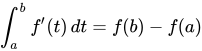
In calculus, a branch of mathematics, the third derivative or third-order derivative is the rate at which the second derivative, or the rate of change of the rate of change, is changing. The third derivative of a function can be denoted by

![{\displaystyle {\frac {d^{3}y}{dx^{3}}},\quad f'''(x),\quad {\text{or }}{\frac {d^{3}}{dx^{3}}}[f(x)].}](https://wikimedia.org/api/rest_v1/media/math/render/svg/79054d003d41a23caecb8975792a4075d9785ad6)
Other notations for differentiation can be used, but the above are the most common.
Mathematical definitions
[edit]Let . Then and . Therefore, the third derivative of f is, in this case,


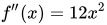
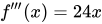
or, using Leibniz notation,
![{\displaystyle {\frac {d^{3}}{dx^{3}}}[x^{4}]=24x.}](https://wikimedia.org/api/rest_v1/media/math/render/svg/67b3ec5f0b84ba7065f4ee904062307c1e12c4c3)
Now for a more general definition. Let f be any function of x such that f ′′ is differentiable. Then the third derivative of f is given by
![{\displaystyle {\frac {d^{3}}{dx^{3}}}[f(x)]={\frac {d}{dx}}[f''(x)].}](https://wikimedia.org/api/rest_v1/media/math/render/svg/675b8334c333ff155d5d793deb786c4d3ce1e409)
The third derivative is the rate at which the second derivative (f′′(x)) is changing.
Applications in geometry
[edit]In differential geometry, the torsion of a curve — a fundamental property of curves in three dimensions — is computed using third derivatives of coordinate functions (or the position vector) describing the curve.[1]
Applications in physics
[edit]In physics, particularly kinematics, jerk is defined as the third derivative of the position function of an object. It is, essentially, the rate at which acceleration changes. In mathematical terms:

where j(t) is the jerk function with respect to time, and r(t) is the position function of the object with respect to time.
Economic examples
[edit]When campaigning for a second term in office, U.S. President Richard Nixon announced that the rate of increase of inflation was decreasing, which has been noted as "the first time a sitting president used the third derivative to advance his case for reelection."[2] Since inflation is itself a derivative—the rate at which the purchasing power of money decreases—then the rate of increase of inflation is the derivative of inflation, opposite in sign to the second time derivative of the purchasing power of money. Stating that a function is decreasing is equivalent to stating that its derivative is negative, so Nixon's statement is that the second derivative of inflation is negative, and so the third derivative of purchasing power is positive.
Since Nixon's statement allowed for the rate of inflation to increase, his statement did not necessarily indicate immediate price stability but proposed a trend of more stability in the future.
See also
[edit]References
[edit]- ^ do Carmo, Manfredo (1976). Differential Geometry of Curves and Surfaces. ISBN 0-13-212589-7.
- ^ Rossi, Hugo (October 1996). "Mathematics Is an Edifice, Not a Toolbox" (PDF). Notices of the American Mathematical Society. 43 (10): 1108. Retrieved 13 November 2012.
Third derivative
View on GrokipediaMathematical Foundations
Definition and Computation
In single-variable calculus, the third derivative of a function is defined as the derivative of its second derivative, denoted or , which quantifies the rate of change of the concavity of the function as determined by the second derivative .[1][4] To compute the third derivative analytically, differentiation is applied successively starting from the original function. First, obtain the first derivative using standard rules such as the power rule or product rule; then differentiate to yield the second derivative ; finally, differentiate to arrive at . For instance, consider the cubic polynomial : the first derivative is , the second derivative is , and the third derivative is .[1] This process assumes is sufficiently differentiable, and for polynomials of degree , the -th derivative and higher are zero.[1] In multivariable calculus, the third derivative extends to partial derivatives, including pure partials like (differentiating three times with respect to ) and mixed partials such as for a function . These are computed by applying the partial differentiation operator sequentially to the lower-order partials, following the same rules as single-variable cases but holding other variables constant. Clairaut's theorem, extended to higher orders, states that if the relevant partial derivatives are continuous in a neighborhood of the point, then mixed partials of the same total order are equal regardless of differentiation sequence—for example, .[5] When analytical computation is infeasible, numerical approximations of the third derivative can be obtained using finite difference methods, which rely on function evaluations at discrete points. A common forward finite difference formula for the third derivative at with step size is given by with a truncation error of order .[6] This formula derives from the third-order Taylor expansion and is exact for cubic polynomials.[6]Notation and Symbols
The third derivative of a function is commonly denoted using several established notations in mathematics. In Leibniz notation, introduced in the late 17th century, it is expressed as for a function , emphasizing the infinitesimal changes through repeated differentiation.[7] This form highlights the variable of differentiation in the denominator, making it particularly useful for partial derivatives or when specifying the independent variable.[8] In contrast, Lagrange notation, developed in the 18th century, uses primes to indicate successive derivatives, writing the third derivative as .[9] This compact functional notation, inspired by earlier ideas from Newton, is prevalent in pure mathematics for its simplicity in expressing higher-order derivatives without explicit variables.[10] Newton's notation, originally fluxional and adapted for time derivatives, employs dots over the variable to denote differentiation with respect to time . For position , the first derivative (velocity) is , the second (acceleration) is , and the third (jerk) is .[8] This overdot convention extends naturally to higher orders but is primarily used in physics and engineering contexts involving temporal rates of change.[11] The historical evolution of these notations traces back to the independent development of calculus by Isaac Newton and Gottfried Wilhelm Leibniz in the 1670s. Leibniz first proposed his fractional form, including and , in a 1675 manuscript, formalizing it in publications from 1684 onward to represent differentials and their ratios.[12] By the late 18th century, Joseph-Louis Lagrange refined the notation in his 1797 treatise Théorie des fonctions analytiques, introducing the prime symbol as a shorthand for the derivative, which was later extended to multiple primes for higher orders; this shift aimed to treat derivatives as operations on functions rather than ratios of infinitesimals.[9] Newton's dot notation, detailed in his Principia Mathematica (1687) and later works, evolved from fluxions and gained traction in applied sciences for its alignment with physical motions.[10] In physics, particularly kinematics, the third time derivative of position—known as jerk—is often denoted by or the symbol , with units of m/s³.[11] This extends Newton's dot notation and is used to describe changes in acceleration, such as in vehicle dynamics or roller coaster design.[13] In vector calculus, is not standard notation for the third derivative but may refer to a higher-order operator, such as components of the third partial derivatives tensor, depending on context; it is distinct from scalar third derivatives like .[14] Conventions for higher-order derivatives build on these notations, with the fourth derivative (snap or jounce) marked by quadruple dots in Newtonian form or in Lagrange notation, distinguishing it from the third.[13] The following table compares notations for the first three derivatives of or position :| Order | Description | Leibniz Notation | Lagrange Notation | Newton Notation (time ) |
|---|---|---|---|---|
| 1 | First derivative | or | ||
| 2 | Second derivative | or | ||
| 3 | Third derivative | or |
Interpretations in Calculus
Role in Taylor Series Expansion
In the Taylor series expansion of a function around a point , the third derivative plays a crucial role in providing a cubic approximation to the function's local behavior. Taylor's theorem states that if is three times differentiable in an interval containing and , then for some between and , where the third-order term captures the leading nonlinear deviation beyond quadratic behavior, enabling more precise approximations for functions with inflection or rapid changes near .[15] To quantify the accuracy of truncating the expansion after the quadratic term, the Lagrange form of the remainder after the second derivative (or equivalently, the error bound using the third derivative for the next term) is given by for some between and , but for approximations up to the third order, the remainder becomes for some between and , assuming is four times differentiable. This remainder term highlights how the third derivative indirectly bounds the error in lower-order approximations by influencing the cubic contribution, which is essential for estimating convergence in numerical methods or series summations.[16] A concrete example is the Maclaurin series expansion of around , where , , , and , yielding the third-order term since . This cubic term approximates the oscillatory nature of near the origin, improving accuracy for small compared to linear or quadratic approximations. The Maclaurin series, as the special case of Taylor's theorem at , relies on the third derivative to reveal cubic or higher-order asymmetries in function behavior close to the origin, particularly for oscillatory functions like trigonometric ones or those with inflection points.[15]Higher-Order Derivative Tests
In calculus, higher-order derivative tests extend the first and second derivative tests to classify critical points and inflection points when lower-order derivatives are inconclusive, particularly relying on the third derivative when the second derivative vanishes. These tests leverage the Taylor series expansion around a point where , approximating the function's behavior locally as . If the second derivative , the third derivative determines the nature of the point by examining the sign and order of the leading non-zero term.[1] The third derivative test for inflection points applies when . If , then is an inflection point, as the concavity of changes at . This follows from the Taylor expansion, where the cubic term dominates near , causing the second derivative to change sign: for , the function transitions from concave down to concave up, and vice versa if . For example, consider : here, , so , and at , confirming an inflection point where concavity changes from down (for ) to up (for ).[17][18] For refining the classification of extrema at critical points where , the higher-order derivative test examines successive derivatives until finding the first non-zero one beyond the first. Suppose the lowest order with ; a brief proof sketch uses Taylor's theorem, showing that near , has the sign of . If is even and , then is a local minimum; if , a local maximum. If is odd (such as ), is neither a local extremum nor an inflection point in the extremum sense but indicates a horizontal inflection, as the function changes monotonicity without extremal behavior. Thus, when and , the odd order implies no local extremum.[19][18] An illustrative example is : , so ; , so ; , so . The third derivative vanishes, requiring the fourth: , an even order, confirming a local minimum at . This distinguishes cases where even lower orders suffice from those needing higher scrutiny, unlike odd-order scenarios that preclude extrema.[1] These tests have limitations: if , the analysis is inconclusive, necessitating higher derivatives or alternative methods like the first derivative test. For instance, functions like at have and an odd fifth-order term, yielding neither extremum nor inflection in the concavity sense, highlighting the need for complete Taylor assessment.[19]Applications in Physics
Jerk in Kinematics
In kinematics, jerk is defined as the third time derivative of an object's position or the first time derivative of its acceleration, quantifying the rate at which acceleration changes. Mathematically, for one-dimensional motion, it is expressed as , where is position and is acceleration.[13][20] This derivative builds sequentially on lower-order kinematic quantities: position yields velocity , which in turn yields acceleration , and finally jerk . In three-dimensional space, jerk is a vector , where is the position vector, allowing analysis of directional changes in motion.[13][20] Physically, jerk measures the abruptness of changes in an object's motion, often perceived as a sudden "push" or "pull" due to varying forces, which can induce discomfort or stress in mechanical systems and human passengers. For instance, high jerk during vehicle acceleration contributes to sensations of unease by rapidly altering the forces felt by occupants. Its SI unit is meters per second cubed (m/s³), reflecting the dimensional progression from position (m) through velocity (m/s) and acceleration (m/s²).[13][20]Examples in Mechanical Systems
In elevator systems, jerk-limited trajectories are employed to minimize passenger discomfort during acceleration and deceleration phases. These profiles typically feature segments of constant jerk, where the jerk remains steady, allowing for smooth transitions in acceleration. For instance, during the ramp-up phase, assuming initial conditions of zero velocity and acceleration, the position can be derived by successive integration: acceleration , velocity , and position . Such profiles ensure jerk values below 1.0 m/s³, which are perceived as comfortable by passengers and align with standards like ISO 8100-34:2021 limiting jerk to 1.2 m/s³, reducing motion sickness and structural vibrations in the elevator mechanism.[21][22][23] In projectile motion under variable gravity, such as near Earth's surface where gravitational acceleration varies with altitude according to (with as Earth's gravitational parameter and as distance from the center), the third derivative—jerk—is non-zero due to the changing acceleration. For a falling object, jerk arises from the radial dependence of gravity, expressed as , incorporating both position and velocity terms, unlike constant- approximations where jerk vanishes. This effect becomes noticeable in high-altitude or precise orbital simulations but is typically small near the surface, on the order of fractions of m/s³ for typical velocities.[24] Vehicle dynamics during acceleration, such as a 0-60 mph sprint, often involve a constant jerk phase to smoothly ramp up acceleration and avoid abrupt shifts that could unsettle passengers or strain components. Here, jerk , where is acceleration. For example, to achieve 0-60 mph (approximately 26.8 m/s) in 4 seconds with an average acceleration of about 6.7 m/s², a constant jerk phase might ramp acceleration from 0 to a maximum of 10 m/s² over 0.5 seconds, yielding m/s³ during that interval; the velocity in this phase would then be , with subsequent constant acceleration to reach the target speed. This approach is common in electric vehicles for optimal torque delivery without excessive wear.[25][26] Dimensionally, jerk has SI units of m/s³, representing length per time cubed, which quantifies how rapidly acceleration changes and influences energy dissipation in mechanical systems through impulsive forces during transitions. In sharp stops, such as emergency braking, jerk values can reach 10–15 m/s³, leading to higher peak forces and potential passenger discomfort or component stress; for instance, city bus emergency braking systems report jerks up to 16 m/s³, emphasizing the need for limited-jerk designs to manage energy transfer efficiently without excessive vibrations.[27]Applications in Geometry
Relations to Curvature
In differential geometry, the third derivative of a plane curve parameterized by arc length plays a key role in describing the variation of curvature . The vector points in the direction of the principal normal , with magnitude , while captures how this curvature evolves along the curve.[28] Within the Frenet-Serret framework for plane curves, the unit tangent vector is , satisfying and . Differentiating with respect to yields the decomposition which separates the third derivative into its tangential component (proportional to ) and normal component (proportional to ). The rate of change of curvature is then given by the projection . For unsigned curvature, the absolute value may be used in certain contexts.[29][28] This relation highlights the third derivative's role in quantifying curvature variation. For instance, in a circle of radius parameterized as , the curvature is constant, so and , aligning the third derivative with the tangential direction.[29] The osculating circle at , with radius and center , approximates the curve up to second order by matching position, tangent, and curvature. The third derivative refines this approximation, as the Taylor expansion includes a third-order term , revealing deviations due to changing curvature.[28]Torsion in Space Curves
In the geometry of space curves, torsion quantifies the extent to which a curve twists out of its local osculating plane, providing a measure of deviation from planarity. For a curve parametrized by arc length , the torsion is defined as , where , , and are the first, second, and third derivatives with respect to .[30] This formula arises from the scalar triple product, capturing the third derivative's contribution to the curve's helical behavior, with the denominator normalizing by the square of the curvature term.[30] The Frenet-Serret equations relate the derivatives of the Frenet frame vectors—tangent , principal normal , and binormal —to curvature and torsion : These equations are derived by decomposing the third derivative in the Frenet frame: , where the term isolates torsion's influence on the binormal direction.[30] The torsion coefficient thus appears explicitly in the evolution of , reflecting the rate at which the osculating plane rotates around the tangent.[31] A classic example is the circular helix , a non-planar space curve with constant curvature and torsion. The first derivative is , the second is , and the third is . Computing the cross product yields , and the triple product . Thus, the torsion is the constant value , confirming the helix's uniform twisting.[32] Geometrically, torsion indicates a planar curve, where the binormal remains fixed and the curve lies entirely in one plane; positive corresponds to right-handed helical twisting, as in the standard helix, while negative denotes left-handed twisting.[31] This interpretation underscores torsion's role in distinguishing three-dimensional curve configurations beyond mere bending.[30]Applications in Other Fields
Economic Marginal Analysis
For a cubic total cost function of the form , the third derivative is constant. If , this indicates that the second derivative (slope of marginal cost) increases linearly, representing an accelerating change in marginal costs. In production functions with cubic terms, such as , the marginal product is , the second derivative captures changes in marginal returns, and the third derivative . A positive (i.e., ) implies an increasing rate of change in marginal returns, potentially reflecting accelerating efficiency in early production stages before diminishing effects.[33]Engineering and Control Systems
In engineering and control systems, the third derivative of position with respect to time, known as jerk, plays a crucial role in ensuring smooth actuation and minimizing vibrations in dynamic systems. In feedback control loops, such as those employing proportional-integral-derivative (PID) controllers, jerk minimization is integrated to prevent overshoot and mechanical stress during trajectory tracking. For instance, optimal tuning frameworks adapt performance indices like integral square error (ISE) and integral time absolute error (ITAE) to align controller gains with minimum-jerk profiles, enabling simultaneous optimization across multiple joints in robotic systems via particle swarm optimization (PSO). This approach enhances tracking accuracy while reducing peak control inputs and energy consumption compared to traditional tuning methods.[34] In vibration engineering, the third derivative of beam deflection is fundamental to analyzing structural dynamics under load, particularly in the Euler-Bernoulli beam theory. This theory models slender beams by relating the shear force to the third spatial derivative of transverse deflection , expressed as , where is the modulus of elasticity and is the moment of inertia. This relation derives from the equilibrium of forces and moments, with the third derivative capturing shear distribution essential for predicting deflections and stresses in applications like bridge design and machinery components. In dynamic contexts, it informs the governing partial differential equation , where boundary conditions often set for free ends to reflect zero shear. A practical example of jerk application arises in robotic arm trajectory planning, where limits on the third derivative ensure feasible motion profiles that avoid excessive wear on actuators. Engineers often employ trapezoidal acceleration profiles, characterized by phases of constant jerk (where is a bounded constant), transitioning smoothly between acceleration plateaus to compute position, velocity, and acceleration via successive integrations. This method optimizes time and smoothness for redundant manipulators, such as 7-DOF arms, by minimizing the integral of squared jerk in a multi-stage optimization process, reducing vibrations by up to 66% in experimental validations.[35] In modern applications, particularly 2020s autonomous vehicles, third derivative constraints are imposed to enhance passenger comfort by limiting jerk during maneuvers like lane changes and braking. Discomfort studies indicate jerk limits around 0.42 m/s³ for lateral motion at 50% discomfort probability and up to 0.9 m/s³ for seated occupants in short pulses.[36] These constraints, informed by ergonomic research, are integrated into motion planning algorithms, prioritizing triangular jerk profiles over sinusoidal for reduced perceived intensity. While standards like ISO 2631-1 evaluate whole-body vibration through acceleration metrics, jerk thresholds are derived from separate motion comfort studies.[36]References
- https://calculus.subwiki.org/wiki/Higher_derivative_test