Hubbry Logo
BustleBustleMain
Open search
Bustle
Community hub
Bustle
logo
8 pages, 0 posts
0 subscribers
Be the first to start a discussion here.
Bustle
Bustle
from Wikipedia
Bustle, lady's undergarment, England, c. 1885. Los Angeles County Museum of Art M.2007.211.399

A bustle is a padded undergarment or wire frame used to add fullness, or support the drapery, at the back of women's dresses in the mid-to-late 19th century.[1][2] Bustles are worn under the skirt in the back, just below the waist, to keep the skirt from dragging. Heavy fabric tended to pull the back of a skirt down and flatten it. As a result a woman's petticoated skirt would lose its shape during everyday wear (from merely sitting down or moving about).

Origin

[edit]

Women throughout history have used various methods to shape their skirts to accentuate the back of the hips. Padded cushions, historically called "bum rolls", "bearers", and "cork rumps", were among the many methods popular in Europe. They enjoyed sporadic popularity starting in the 16th century and were especially popular in France in the late 18th century.[3][4] The crinoline was a type of integrated padded petticoat that developed from this technology. The more elaborate and specialized bustle eventually replaced the crinoline. While the wireframe bustle was popular only very briefly, simpler padded cushions returned after the bustle went out of fashion, and have remained popular.[3][5]

While feminist scholars such as Anne Fausto-Sterling have attempted to link the popularity of the bustle to Sarah Baartman,[6][7] the use of padded cushions, panniers, farthingales, and petticoats to accentuate the general shape of the buttocks or hips were already well-established in Europe in the 16th century, long before Baartman.[3][4]

Baartman, a Khoikhoi woman from South Africa, was featured as a circus attraction in Europe in the early 1800s, due to the particular abundance of tissue on her buttocks.[8]

A US patent illustration of a concept crinoline/bustle. 1867

History

[edit]

In the early stages of the fashion for the bustle, the fullness to the back of the skirts was carried quite low and often fanned out to create a train. The transition from the voluminous crinoline-enhanced skirts of the 1850s and 1860s can be seen in the loops and gathers of fabric and trimmings worn during this period. The bustle later evolved into a much more pronounced humped shape on the back of the skirt immediately below the waist, with the fabric of the skirts falling quite sharply to the floor, changing the shape of the silhouette.[9]

Transition from crinoline (1863–1872)

[edit]

As the fashion for crinolines wore on, their shape changed. Instead of the large bell-like silhouette previously in vogue, they began to flatten out at the front and sides, creating more fullness at the back of the skirts.[10] This style was known as the "train". One type of crinoline, the crinolette, created a shape very similar to the one produced by a bustle. Crinolettes were more restrictive than traditional crinolines, as the flat front and bulk created around the posterior made sitting down more difficult for the wearer.[11] The excess skirt fabric created by this alteration in shape was looped around to the back, again creating increased fullness.

Early bustle (1869–1876)

[edit]

The bustle later developed into a feature of fashion on its own after the overskirt of the late 1860s was draped up toward the back and some kind of support was needed for the new draped shape.[12] Fullness of some sort was still considered necessary to make the waist look smaller and the bustle eventually replaced the crinoline completely. The bustle was worn in different shapes for most of the 1870s and 1880s, with a short period of non-bustled, flat-backed dresses from 1878 to 1882.

Late bustle (1881–1889)

[edit]
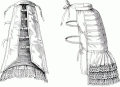
English bustle supports worn as undergarments, from 1875 to 1885.
Woman wearing a dress with a bustle, US, about mid-1880s

The bustle reappeared in late 1881,[13] and was exaggerated to become a major fashion feature in the mid and late 1880s, in 1885 reaching preposterous proportions to modern eyes, as used in the play Arms and the Man by George Bernard Shaw. The fashion for large bustles ended in 1889.[14]

1889–1913

[edit]

The bustle then survived into the 1890s and early 20th century, as a skirt support was still needed and the curve the bustle provided on the back of the body emphasized the hips.[3] The bustle had completely disappeared by 1905, as the long corset of the early 20th century was now successful in shaping the body to protrude behind.[15] The bustle was also abandoned by some women for more practical dress to be able to use the newly invented bicycle.[15]

Contemporary fashion

[edit]

Bustles and bustle gowns are rarely worn in contemporary society. Notable exceptions survive in the realms of haute couture and bridal fashion, in addition to dedicated Neo-Victorian aesthetic circles including the steampunk, Gothic, and Lolita subcultures. Bustles are also employed as part of period costuming in film and theatre: an example would be the 1992 film Bram Stoker's Dracula, for which costume designer Eiko Ishioka won an Academy Award. The film features several extravagant bustle gowns created for female leads Winona Ryder and Sadie Frost.[citation needed]

Other usage

[edit]
  • Bustle is also the term used for an additional external space at the rear of a tank's turret used for storing extra equipment, a notable usage being the added box at the rear of the turret on the Sherman Firefly variant. Its positioning on the vehicle resembling the similar placement of the bustle as used on the dress item.
  • In sailboat design, a bustle stern refers to any kind of stern that has a large "bustle" or blister at the waterline below the stern to prevent the stern from squatting when getting underway,[16] or to a similar shape produced by the IOR measuring system.
  • The term bustleback was used to describe cars styled with an additional rear protrusion that were produced in the early 1980s, such as the Cadillac Bustleback Seville.[17][18]
[edit]

See also

[edit]

References

[edit]
[edit]
Revisions and contributorsEdit on WikipediaRead on Wikipedia
from Grokipedia
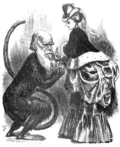
The bustle was a padded or framed undergarment worn under women's skirts in the mid-to-late 19th century to extend and support the fullness at the rear, producing an exaggerated posterior silhouette that contrasted sharply with the natural human form. Introduced in the early 1870s as crinolines declined, it employed materials such as fabric cushions, cane, whalebone, or metal hoops to gather and project skirt drapery backward from the waist. This device dominated fashion in two primary eras—the first from approximately 1869 to 1876, and a more pronounced second phase from 1883 to 1890—shaping the structured contours of Victorian and early Edwardian gowns while enabling intricate skirt pleating and trains. Though it defined elite women's attire across Europe and America, the bustle drew contemporary ridicule for its impracticality and discomfort, with periodicals like Punch satirizing it through caricatures likening wearers to burdened animals or evolutionary oddities, and medical observers noting risks of spinal strain and restricted movement despite fewer fire hazards than predecessors like crinolines. By the 1890s, evolving preferences for slimmer lines led to its obsolescence, supplanted by petticoats and the S-bend corset.

Definition and Purpose

Etymology and Core Function

The term "bustle" denotes a padded or framed undergarment worn by women to extend the rear of dresses, with the word entering fashion lexicon around to describe a device that projected the skirt backward from the waist. Prior to this, similar existed but lacked the specific , and Victorian usage often favored euphemisms like "tournure" or " improver" due to perceived in "bustle." The core function of the bustle was to provide and added fullness to the back of skirts, countering the forward thrust of corseted torsos and creating a balanced, exaggerated form that emphasized a narrow against widened hips and posterior volume. This enhancement aligned with mid-19th-century ideals of feminine , where the bustle lifted and shaped fabric to prevent dragging on floors—particularly useful during sitting—and maintained the garment's aesthetic integrity across various activities. Mechanically, bustles achieved this by distributing weight rearward, often through cushioned pads or rigid frameworks, enabling layered textiles to cascade gracefully without collapsing under their own mass. This innovation marked a shift from earlier crinolines, focusing volume low and back rather than circumferentially, thus refining the overall bodily presentation in formal and daily attire.

Role in Silhouette Enhancement

The bustle served primarily to project the rear portion of women's skirts outward and upward from below the waist, thereby concentrating skirt volume at the back and creating a distinctive characterized by a flat front and pronounced posterior fullness. This structural enhancement replaced the earlier crinoline's circumferential expansion, allowing skirts to drape more closely to the legs in front while supporting elaborate rear , such as the "waterfall" pleats of the . By shifting fullness rearward, the bustle elongated the frontal profile and emphasized verticality, contrasting sharply with the horizontally expansive bell shapes of the and . In conjunction with the tightly laced , which constricted the to as little as 18-20 inches, the bustle amplified the form by artificially exaggerating the hips and posterior, drawing visual emphasis to the narrowed through oppositional projection. During the first bustle era (circa 1868-1876), modest cushions or pads provided support for gathered fabrics, fostering draped overskirts and polonaises that accentuated rear contours without overwhelming the figure. The second period (1883-1889) saw heightened exaggeration, with steel-hooped frames forming shelf-like extensions that could project up to 18 inches horizontally, enabling the suspension of heavy trains, ruffles, and trimmings while maintaining structural integrity for formal attire. This rearward emphasis not only balanced the corseted torso's rigidity but also facilitated aesthetic ideals of by mimicking and intensifying natural curves, as evidenced in plates and surviving garments where the bustle's projection created dynamic folds and shadows in skirt textiles. Innovations like the 1884 "New Phantom" bustle, with its pivoting mechanism, further refined the by allowing seated postures without collapse, ensuring consistent enhancement across activities. Overall, the bustle's role was causal in evolving the Victorian toward greater rear projection, influencing garment design toward complexity in back detailing and tapering frontal lines until its decline in the .

Design and Construction

Materials and Structural Elements

Bustles were constructed using a variety of padding and framing materials to achieve the desired posterior projection. Common padding included , floss, , down, and feathers, often stuffed into fabric cushions or covered in , , or other textiles. These soft fillings provided volume in simpler designs, particularly during the earlier bustle periods, where the structure resembled a padded roll or tied at the . For rigidity and shape retention, especially in later iterations supporting heavier skirts, structural elements incorporated rigid components such as wires, cane, whalebone, or metal hoops. These were often arranged in cage-like frameworks, half-hoops, or cascading rigid bands mounted to a fabric base, allowing the bustle to extend horizontally or shelf-like from the lower back. Internal tapes, ties, and adjustable mechanisms enabled customization of the , with some designs featuring woven flounces for added support without full rigidity. The overall construction typically involved a or harness to secure the bustle over a , with fabric coverings in durable materials like or to encase the internal framework, ensuring durability under the weight of multiple layers. Variations ranged from padded versions for everyday wear to elaborate steel-supported cages for formal attire, reflecting adaptations to fashion's evolving demands for projection and drape.

Types and Mechanical Innovations

Bustles encompassed both padded and structured varieties, with the former relying on soft fillings like , down, , , or floss to create a rounded projection at the skirt's rear, often stiffened with ruffles or pleats for added volume. Structured types, emerging more prominently in the , incorporated rigid elements such as strips, metal hoops, whalebone, or cane frames to support expansive and achieve sharper, right-angled silhouettes that extended horizontally from the waist. Early 1870s designs favored tubular "waterfall" bustles, which used gathered or pleated fabrics to mimic cascading drapes over lowered volume, transitioning from supports. By the mid-1870s, softer puffs or modest pads suited narrowed skirts, while the revival introduced scaled variants: compact tournures for walking dresses, moderate puffs for afternoon attire, and oversized frames for gowns, often integrated with internal reinforcements sewn directly into underskirts. Mechanical advancements focused on functionality amid exaggerated forms, including adjustable tapes and ties for varying projection heights and widths to accommodate different activities. A notable innovation was the "New Phantom" bustle, patented in 1884, which employed a pivot-based system allowing the frame to fold downward when seated, thereby preventing damage to skirts and improving wearability during prolonged use; this design peaked in popularity around 1887–1888. Such features reflected adaptations to the era's demands, prioritizing structural integrity over mere padding.

Historical Development

Origins and Shift from Crinoline (1850s–1868)

The crinoline, a rigid cage of steel hoops encased in fabric, emerged in the mid-1850s to support the expansive dome-shaped skirts that characterized mid-Victorian women's fashion, reaching peak popularity by 1856 with widths exceeding 18 feet in circumference for elite gowns. This structure, patented by manufacturers like W. B. Jennings in 1856, provided lightweight volume compared to layered petticoats but proved cumbersome for mobility, prompting gradual modifications as early as the 1860s. Designers flattened the front and narrowed the sides, evolving the pyramid silhouette of the early 1860s toward an elliptical form that concentrated fullness at the rear, reducing overall skirt diameter from up to 120 inches in 1860 to about 100 inches by 1865. By the mid-1860s, the —a hybrid undergarment with hoops limited to the lower back and hips—bridged the full and the emerging bustle, featuring additional steel loops at the top to exaggerate posterior projection while allowing skirts to hang flat in front. This shift reflected practical demands for easier walking and aesthetic preferences for a slimmer profile, as evidenced in fashion plates from 1865 onward showing draped overskirts and gathered rear fabric. The concept of a dedicated rear-support device predated widespread use, with Douglas patenting an "improved bustle" on April 21, 1857 ( Patent 17,082), consisting of hinged steel bands and fabric padding to lift the skirt back, though crinoline dominance delayed commercial success until the cage's obsolescence. In 1868, the fully supplanted the frontal hoops of the crinoline, serving effectively as a proto-bustle by confining support to the posterior, which measured up to 18 inches in projection and enabled the straight-front, rear-emphasizing silhouette that defined late-1860s transitions. This evolution, driven by innovations in hoop placement rather than radical invention, marked the origins of the bustle as a distinct garment, prioritizing rear enhancement over circumferential volume and setting the stage for its prominence in the 1870s.

First Bustle Period (1869–1876)

The first bustle period marked a significant in women's , emerging around 1869 as the cage of the prior decade declined in favor of a more streamlined that concentrated volume at the rear. This shift originated from the elliptical crinoline designs of the , which had already begun flattening the front and projecting the back, gradually transforming into a distinct bustle supported by padded understructures rather than full hoops. The resulting form featured fullness in the front with excess fabric gathered into a pronounced at the hips and lower back, often enhanced by trained skirts that extended behind the wearer. Early bustles were constructed primarily as soft pads or cushions made from materials such as , batting, or feathers, tied or fastened at the to create the desired projection without rigid framing. More structured variants, like the lobster-tail or bustle, incorporated arched hoops of whalebone, cane, or metal within or covers, allowing adjustability via ties for varying degrees of drama. Overgarments included separate fitted bodices and skirts with essential overskirts or tunics that draped and gathered to accentuate the bustle, featuring heavy ruffles, controlled pleats, and trains; by 1873, the —a unified bodice-overskirt hybrid—gained prominence. Bodices initially terminated at the natural before extending into V-shapes over the hips, with narrowed sleeves and lightweight fabrics favored for evening ensembles. Throughout the period, the retained a conical profile with front narrowing by 1873, supported by multiple petticoats and dust ruffles to manage trains. Accessories such as wide belts, large rear bows, and chemisettes complemented the look, while brief trends like skirt pockets appeared in 1875. By 1876, the bustle's prominence waned, diminishing to a mere pad or disappearing entirely as transitioned toward the Natural Form era's slimmer princess line, which eliminated structured rear projection in favor of draped pleats behind the knees. This change reflected broader preferences for verticality and reduced artifice, though bustle elements persisted in modified forms until their revival in the .

Transitional Natural Form Era (1877–1882)

The Transitional Natural Form Era represented a brief interlude in bustle , characterized by the minimization or elimination of rear projection to achieve a slimmer, more body-conforming . By 1877, the once-prominent wire-framed bustles of the First Bustle Period had diminished to small cushions or been discarded entirely, with skirt fullness redirected to subtle poufs positioned behind the knees. This shift allowed tie-back skirts to cling closely to the legs while trailing into modest trains, reducing the exaggerated volume that defined earlier styles. Bodices evolved into elongated forms, such as the cuirass style—a tightly boned, long-waisted garment extending over the hips to mimic armor plating—which emphasized smooth, vertical lines over the figure. A key innovation of this period was the widespread adoption of the princess line dress, a one-piece without a defined seam, where fitted panels ran continuously from shoulders to hem. This design, initially developed in the early , aligned with the era's aesthetic by promoting a streamlined profile dependent on draped fabrics rather than structural undergarments. Sleeves remained close-fitting, shoulders achieved a natural slope, and necklines adopted conservative high collars or shallow V-shapes filled with chemisettes, often accented by vertical trims to enhance elongation. Skirts featured asymmetrical arrangements and sewn-in draperies, incorporating complex textures through layered pleats and contrasting colors, supported by petticoats but eschewing rigid hoops. By 1879, skirt styles progressed to fan-shaped configurations with fuller, spreading trains that necessitated lightweight petticoats or minimal hoop supports for volume. In 1880, overall skirt widths narrowed significantly, confining trains to formal occasions while introducing pannier-like drapes at the hips to simulate subtle side fullness without reinstating the bustle. This transitional phase, lasting until approximately 1882, bridged the voluminous First Bustle era and the impending Second Bustle resurgence, reflecting a temporary preference for perceived naturalism achieved through tailoring and fabric manipulation rather than mechanical augmentation. Despite the era's name, underlying corsetry preserved the constricted torso, underscoring that "natural form" denoted silhouette refinement over anatomical fidelity.

Second Bustle Period (1883–1889)

The second bustle period commenced in 1883, reviving the garment after the transitional Natural Form era of the late 1870s and early 1880s, which had emphasized slimmer, more fluid silhouettes without pronounced rear projection. This revival introduced a more exaggerated form compared to the first bustle era (1869–1876), shifting from softer, draped fullness to a rigid, shelf-like extension that projected sharply backward from the waist, creating a stark contrast with the flat front and sides of the skirt. Skirts were cut slim overall, with pleating and gathering concentrated at the back to accentuate the bustle's prominence, often supported by structured undergarments like tournures or padded cushions. Bustles during this phase typically employed stiffer materials and mechanisms for support, including watch-spring steel bands or lobster-tail designs—rows of articulated metal strips that allowed flexibility while maintaining projection—differing from the earlier period's reliance on fabric padding and lighter cage structures. The emphasized vertical lines in bodices, high sleeve heads, and floor-length trains that ballooned from the hips, peaking in extremity around 1885–1886 before gradual softening. Bodices were tailored more severely, hugging the to highlight the artificial posterior emphasis, reflecting a driven by Parisian influences that prioritized dramatic rear volume over the first period's more moderate train drapery. By 1889, the extreme projection waned as preferences shifted toward broader fullness and leg-of-mutton sleeves, signaling the period's close amid growing fatigue with the cumbersome structure, though echoes persisted into the early . This era's bustles, often constructed from , , or whalebone reinforced with metal, demanded precise engineering to balance with wearability, underscoring the period's commitment to an idealized, elongated posterior profile.

Decline and Post-Edwardian Echoes (1890–1914)

By the early 1890s, the exaggerated bustle of the 1880s had diminished significantly, evolving into a smaller, less protruding form that provided minimal rear support through pads or cushions attached directly to the skirt's interior rather than structured frames. This shift reflected a broader move toward practicality and mobility, as women increasingly favored tailored silhouettes with fitted hips and trumpet-shaped skirts that flared below the knee, allowing greater ease of movement compared to the restrictive angular projections of prior decades. The full bustle had effectively vanished by the mid-1890s, supplanted by bell-shaped skirts that skimmed the hips and emphasized a cinched with smooth lines over the derriere, marking the end of rear-focused volume as a dominant aesthetic. Entering the around 1901, fashion abandoned bustle elements entirely in favor of the S-bend silhouette created by straight-front corsets, which thrust the bust forward and hips backward to produce a pigeon-breasted profile with slender, columnar skirts devoid of artificial rear padding. This design prioritized an elongated, elegant line from shoulder to hem, often enhanced by leg-of-mutton sleeves and layered fabrics, but without the posterior emphasis that defined Victorian bustles. Skirt lengths remained long and ground-skimming until approximately 1910, when slight narrowing toward the ankles occurred, yet the absence of bustle supports persisted, underscoring a causal preference for verticality and fluidity over horizontal exaggeration. From 1910 to 1914, pre-World War I fashions echoed the Edwardian simplicity with even straighter, narrower silhouettes influenced by emerging athleticism and reformist ideals, featuring high-waisted tea gowns or hobble skirts that further minimized any residual back fullness. No verifiable revivals of true bustle structures occurred in this period; instead, the era's designs relied on draped fabrics or petticoats for subtle shaping, reflecting a sustained rejection of the cumbersome Victorian contraptions in favor of forms that accommodated increasing social activities like motoring and sports. This transition causally aligned with technological and societal changes, such as improved textiles and women's expanding roles, rendering the bustle obsolete by 1914.

Social and Cultural Dimensions

Status Signaling and Aesthetic Ideals

The bustle functioned as a key element of status signaling in , particularly among the upper classes, by exemplifying through its demand for expensive fabrics, intricate construction, and professional tailoring that were prohibitive for working women. Its impractical design, which restricted mobility and required assistance for donning, further underscored and detachment from manual labor, traits associated with wealth and refinement during the and . Elaborate bustles, often featuring wire frames or padded cushions supporting voluminous trains and , visibly demonstrated financial resources, as the excess material and structural support could consume yards of or per garment. Aesthetically, the bustle enforced rigid ideals of by artificially amplifying the posterior, shifting skirt volume rearward to create a pronounced, shelf-like extension below a tightly corseted , which measured ideally 18-22 inches in for adult women. This , peaking in exaggeration during the second bustle period from 1883 to 1889, prioritized a dramatic, vertical emphasis on and slenderness in the front with backward projection, diverging from natural to evoke elegance and poise in formal settings like balls, where larger tournures up to 18 inches in depth were employed. The form reflected cultural preferences for structured artifice over organic shapes, aligning with broader Victorian standards that valued pale complexions, delicate features, and an hourglass-derived profile enhanced by undergarments. Critics and satirists of the time, including cartoonists in Punch, lampooned the bustle's extremes as grotesque distortions, yet its persistence among elites indicates its role in conforming to prevailing norms of sophisticated allure, where deviation risked social . Empirical observations from fashion plates and surviving garments confirm that adherence to this ideal correlated with access to high-end couturiers like the House of Worth, whose clients in 1885 commissioned walking dresses with integrated bustles costing equivalent to several months' wages for middle-class households.

Influence on Gender Norms and Daily Life

The bustle garment, by projecting the rearward and creating an artificial exaggeration of the hips and posterior, reinforced Victorian-era ideals of that emphasized curvaceous forms as markers of reproductive potential and aesthetic ornamentation, distinct from male linearity. This , often paired with corsetry to cinch the waist, symbolically distanced women from utilitarian physicality, aligning with cultural narratives that positioned them as delicate guardians of domestic virtue rather than laborers or athletes. Such fashion imperatives perpetuated norms by constraining women's public agency; the encumbrance discouraged strenuous activity, thereby sustaining expectations of passivity and reliance on male protection, even as emerging middle-class women sought expanded roles in and light . Historical analyses note that while bustles were lighter than preceding crinolines—typically weighing 1-3 pounds via structures rather than heavy fabrics—this did not fully mitigate the prescriptive symbolism, as social pressured adherence to the form for marital and class signaling. In daily life, the bustle altered locomotion and routine tasks, necessitating modified gaits with shorter steps to maintain balance and prevent the projection from catching on furniture or doorways, which complicated urban navigation and household chores like bending or carrying. Women adapted by employing collapsible designs for seating—folding the structure upward—or opting for slimmer day versions versus fuller evening ones, yet contemporary accounts and satires depict frequent mishaps, such as trains snagging or top-heavy instability during wind, underscoring the garment's practical burdens amid a of industrializing mobility. Critiques in periodicals like Punch portrayed the bustle as a grotesque impediment to natural function, equating wearers to burdened creatures and implicitly challenging its role in enforcing gendered immobility, though these voices competed against fashion's economic drivers from industries. Empirical observations from dress reformers, who measured stride reductions and postural strains, argued the device exacerbated class divides, as working women often abandoned it for practicality while elites persisted, thus embedding it in status-linked .

Health Effects and Debates

Reported Physical Impacts

Contemporary accounts from the late 19th century highlighted the bustle's interference with natural sitting postures, often requiring women to perch forward on seats or manually adjust the garment to avoid crushing it, thereby preventing the back from resting against chair backs. This positioning contributed to prolonged strain during extended periods of seated activity, such as office work or travel. Medical observers in the reported that the bustle's rear weight distribution exacerbated lower , particularly among women required to sit for much of the day, as the garment's projection altered spinal alignment and increased lumbar pressure. An 1888 contributor to the Boston Medical and Surgical Journal described the device as promoting unnatural carriage, linking it to "severe backaches" and deeming it a health detriment alongside corsets and high heels. The bustle also restricted overall mobility by shifting the body's center of gravity rearward, complicating bending, walking on uneven surfaces, and rapid movements, which could lead to imbalance or minor injuries from falls. Critics noted its cumbersome nature forced compensatory postures, potentially straining hip and pelvic muscles over time, though direct causation of permanent deformities like spinal curvature was not conclusively attributed in period reports, often conflated with corset effects.

Empirical Evidence and Counterarguments

Contemporary physicians and reformers in the 1880s, such as those cited in engineering periodical The Manufacturer and Builder, argued that bustles disrupted natural posture by shifting the body's center of gravity rearward, potentially leading to spinal curvature and lower back strain, with one observer claiming women could not sit naturally without discomfort. Similar concerns appeared in medical discourse, linking extreme bustle designs—often comprising wire cages or padded horsehair weighing up to several pounds—to muscle imbalances and organ displacement, though these assertions relied on anecdotal observations rather than quantified patient data. No systematic medical studies or epidemiological records from the period, such as hospital admission logs or reports specifically attributing injuries to bustles, have been identified, suggesting claims of widespread harm may reflect reformist exaggeration amid broader critiques of rather than causal evidence. Historical analyses note the absence of mass casualty data akin to crinoline-related deaths, which exceeded thousands between 1850 and 1860, implying bustles posed comparatively lower acute risks despite chronic discomfort reports. Counterarguments emphasize practical adaptation: bustles enabled greater than preceding crinolines by confining volume to the hips and rear, facilitating walking and reducing tripping hazards, as d by their across social classes without documented surges in orthopedic complaints. historians contend that moderate designs, worn by most women rather than exaggerated elite versions, did not systematically weaken posture, drawing parallels to modern supportive garments like back braces, which contemporary shows do not muscles when used appropriately. Critics' warnings, often from moralistic or proto-feminist sources, overlooked wearer agency and the lack of alternative ergonomic , privileging ideological opposition over verifiable outcomes.

Modern Applications and Revivals

High Fashion and Subcultural Uses

In high fashion, the bustle silhouette has been revived sporadically on runways to create exaggerated, sculptural forms that nod to 19th-century aesthetics while subverting modern proportions. of incorporated bustle-like protrusions in her Spring/Summer 2012 ready-to-wear collection, using padded volumes at the rear to distort traditional garment shapes and emphasize asymmetry. Such references appear infrequently in , often as conceptual elements rather than functional undergarments, prioritizing visual impact over historical fidelity. Subcultural fashion communities, particularly and Gothic Lolita, adapt the bustle for everyday or event wear to evoke Victorian-era drama fused with alternative motifs. In attire, bustles support layered skirts with corsets and mechanical accessories, blending historical padding with industrial fantasy elements for conventions and performances. Gothic Lolita styles, originating from in the 1990s, employ bustle-inspired padding beneath bell-shaped skirts to achieve a doll-like posterior fullness, distinguishing substyles like steampunk Lolita from classical variants. These uses prioritize aesthetic immersion over practicality, with practitioners often customizing wire frames or fabric cushions from historical patterns.

Practical Adaptations in Bridal Wear

In modern bridal wear, the bustle technique secures a gown's train by gathering and attaching it to the or skirt, elevating the fabric off the ground to enable unhindered movement for dancing, receptions, and other post-ceremony activities while preserving the gown's aesthetic integrity. This adaptation draws conceptual inspiration from 19th-century bustle silhouettes, which emphasized , but prioritizes functionality over rigid understructures like wire cages or pads. Methods typically involve ribbons, hooks, buttons, or ties sewn into the gown, with attachments completed by attendants in under five minutes for most designs. Key variants include the American (over-bustle), where exterior points on the connect to hooks on the skirt's surface, forming visible pleats or loops that accentuate a decorative, shelf-like effect reminiscent of 1880s ; the French (under-bustle), which conceals attachments beneath the skirt for a seamless drape; and the bustle, converting long trains into a shorter, A-line via multiple interior ties. or Victorian bustle employs numerous connection points—often 6 to 12—to hoist the train upward, mimicking historical angular projections while distributing weight to avoid strain on delicate fabrics like or . These systems accommodate trains measuring 3 to 12 feet, reducing contact that could soil hems or impede mobility on floors. Practical benefits extend to gown longevity and versatility, as bustling prevents tears from dragging and allows two-in-one styling: a dramatic cathedral-length train for aisle walks, followed by a practical hemline for events accommodating 100-500 guests. Detachable overskirts or trains, evolved from late-19th-century designs like the 1880s butterfly train, further enhance adaptability by fully removing excess fabric via waist ties or snaps, enabling reuse for multiple wedding phases or post-event wear. Custom fittings ensure secure holds under motion, with seamstresses testing for up to 200 pounds of gown weight in elaborate beaded models. Despite occasional failures from loose stitching—reported in 5-10% of cases without professional alteration—reinforced methods using fabric loops over metal hardware minimize risks. Revival trends since the incorporate historical bustle pads sparingly in vintage-inspired gowns, such as padded hip extensions under detachable trains for subtle volume without impairing walkability, as seen in reproductions of bridal ensembles. This hybrid approach balances aesthetic nods to Victorian excess with empirical needs for comfort, evidenced by bridal surveys indicating 85% preference for bustled trains over unaltered long hems for multi-hour events.

References

Add your contribution
Related Hubs
User Avatar
No comments yet.