

Trigonometry
View on Wikipedia
| Trigonometry |
|---|
 |
| Reference |
| Laws and theorems |
| Calculus |
| Mathematicians |
Trigonometry (from Ancient Greek τρίγωνον (trígōnon) 'triangle' and μέτρον (métron) 'measure')[1] is a branch of mathematics concerned with relationships between angles and side lengths of triangles. In particular, the trigonometric functions relate the angles of a right triangle with ratios of its side lengths. The field emerged in the Hellenistic world during the 3rd century BC from applications of geometry to astronomical studies.[2] The Greeks focused on the calculation of chords, while mathematicians in India created the earliest-known tables of values for trigonometric ratios (also called trigonometric functions) such as sine.[3]
Throughout history, trigonometry has been applied in areas such as geodesy, surveying, celestial mechanics, and navigation.[4]
Trigonometry is known for its many identities. These trigonometric identities[5] are commonly used for rewriting trigonometrical expressions with the aim to simplify an expression, to find a more useful form of an expression, or to solve an equation.[6]
History
[edit].jpg)
Sumerian astronomers studied angle measure, using a division of circles into 360 degrees.[8] They, and later the Babylonians, studied the ratios of the sides of similar triangles and discovered some properties of these ratios but did not turn that into a systematic method for finding sides and angles of triangles. The ancient Nubians used a similar method.[9]
In the 3rd century BC, Hellenistic mathematicians such as Euclid and Archimedes studied the properties of chords and inscribed angles in circles, and they proved theorems that are equivalent to modern trigonometric formulae, although they presented them geometrically rather than algebraically. In 140 BC, Hipparchus (from Nicaea, Asia Minor) gave the first tables of chords, analogous to modern tables of sine values, and used them to solve problems in trigonometry and spherical trigonometry.[10] In the 2nd century AD, the Greco-Egyptian astronomer Ptolemy (from Alexandria, Egypt) constructed detailed trigonometric tables (Ptolemy's table of chords) in Book 1, chapter 11 of his Almagest.[11] Ptolemy used chord length to define his trigonometric functions, a minor difference from the sine convention we use today.[12] (The value we call sin(θ) can be found by looking up the chord length for twice the angle of interest (2θ) in Ptolemy's table, and then dividing that value by two.) Centuries passed before more detailed tables were produced, and Ptolemy's treatise remained in use for performing trigonometric calculations in astronomy throughout the next 1200 years in the medieval Byzantine, Islamic, and, later, Western European worlds.
The modern definition of the sine is first attested in the Surya Siddhanta, and its properties were further documented in the 5th century (AD) by Indian mathematician and astronomer Aryabhata.[13] These Greek and Indian works were translated and expanded by medieval Islamic mathematicians. In 830 AD, Persian mathematician Habash al-Hasib al-Marwazi produced the first table of cotangents.[14][15] By the 10th century AD, in the work of Persian mathematician Abū al-Wafā' al-Būzjānī, all six trigonometric functions were used.[16] Abu al-Wafa had sine tables in 0.25° increments, to 8 decimal places of accuracy, and accurate tables of tangent values.[16] He also made important innovations in spherical trigonometry[17][18][19] The Persian polymath Nasir al-Din al-Tusi has been described as the creator of trigonometry as a mathematical discipline in its own right.[20][21][22] He was the first to treat trigonometry as a mathematical discipline independent from astronomy, and he developed spherical trigonometry into its present form.[15] He listed the six distinct cases of a right-angled triangle in spherical trigonometry, and in his On the Sector Figure, he stated the law of sines for plane and spherical triangles, discovered the law of tangents for spherical triangles, and provided proofs for both these laws.[23] Knowledge of trigonometric functions and methods reached Western Europe via Latin translations of Ptolemy's Greek Almagest as well as the works of Persian and Arab astronomers such as Al Battani and Nasir al-Din al-Tusi.[24] One of the earliest works on trigonometry by a northern European mathematician is De Triangulis by the 15th century German mathematician Regiomontanus, who was encouraged to write, and provided with a copy of the Almagest, by the Byzantine Greek scholar cardinal Basilios Bessarion with whom he lived for several years.[25] At the same time, another translation of the Almagest from Greek into Latin was completed by the Cretan George of Trebizond.[26] Trigonometry was still so little known in 16th-century northern Europe that Nicolaus Copernicus devoted two chapters of De revolutionibus orbium coelestium to explain its basic concepts.
Driven by the demands of navigation and the growing need for accurate maps of large geographic areas, trigonometry grew into a major branch of mathematics.[27] Bartholomaeus Pitiscus was the first to use the word, publishing his Trigonometria in 1595.[28] Gemma Frisius described for the first time the method of triangulation still used today in surveying. It was Leonhard Euler who fully incorporated complex numbers into trigonometry. The works of the Scottish mathematicians James Gregory in the 17th century and Colin Maclaurin in the 18th century were influential in the development of trigonometric series.[29] Also in the 18th century, Brook Taylor defined the general Taylor series.[30]
Trigonometric ratios
[edit]
Trigonometric ratios are the ratios between edges of a right triangle. These ratios depend only on one acute angle of the right triangle, since any two right triangles with the same acute angle are similar.[31]
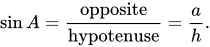
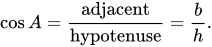
So, these ratios define functions of this angle that are called trigonometric functions. Explicitly, they are defined below as functions of the known angle A, where a, b and h refer to the lengths of the sides in the accompanying figure.
In the following definitions, the hypotenuse is the side opposite to the 90-degree angle in a right triangle; it is the longest side of the triangle and one of the two sides adjacent to angle A. The adjacent leg is the other side that is adjacent to angle A. The opposite side is the side that is opposite to angle A. The terms perpendicular and base are sometimes used for the opposite and adjacent sides respectively. See below under Mnemonics.
- Sine (denoted sin), defined as the ratio of the side opposite the angle to the hypotenuse.
- Cosine (denoted cos), defined as the ratio of the adjacent leg (the side of the triangle joining the angle to the right angle) to the hypotenuse.
- Tangent (denoted tan), defined as the ratio of the opposite leg to the adjacent leg.

The reciprocals of these ratios are named the cosecant (csc), secant (sec), and cotangent (cot), respectively:



The cosine, cotangent, and cosecant are so named because they are respectively the sine, tangent, and secant of the complementary angle abbreviated to "co-".[32]
With these functions, one can answer virtually all questions about arbitrary triangles by using the law of sines and the law of cosines.[33] These laws can be used to compute the remaining angles and sides of any triangle as soon as two sides and their included angle or two angles and a side or three sides are known.
Mnemonics
[edit]A common use of mnemonics is to remember facts and relationships in trigonometry. For example, the sine, cosine, and tangent ratios in a right triangle can be remembered by representing them and their corresponding sides as strings of letters. For instance, a mnemonic is SOH-CAH-TOA:[34]
- Sine = Opposite ÷ Hypotenuse
- Cosine = Adjacent ÷ Hypotenuse
- Tangent = Opposite ÷ Adjacent
One way to remember the letters is to sound them out phonetically (i.e. /ˌsoʊkəˈtoʊə/ SOH-kə-TOH-ə, similar to Krakatoa).[35] Another method is to expand the letters into a sentence, such as "Some Old Hippie Caught Another Hippie Trippin' On Acid".[36]
The unit circle and common trigonometric values
[edit]

Trigonometric ratios can also be represented using the unit circle, which is the circle of radius 1 centered at the origin in the plane.[37] In this setting, the terminal side of an angle A placed in standard position will intersect the unit circle in a point (x,y), where and .[37] This representation allows for the calculation of commonly found trigonometric values, such as those in the following table:[38]


| Function | 0 | ||||||||
|---|---|---|---|---|---|---|---|---|---|
| sine | |||||||||
| cosine | |||||||||
| tangent | undefined | ||||||||
| secant | undefined | ||||||||
| cosecant | undefined | undefined | |||||||
| cotangent | undefined | undefined |


Trigonometric functions of real or complex variables
[edit]Using the unit circle, one can extend the definitions of trigonometric ratios to all positive and negative arguments[39] (see trigonometric function).
Graphs of trigonometric functions
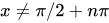
[edit]The following table summarizes the properties of the graphs of the six main trigonometric functions:[40][41]
| Function | Period | Domain | Range | Graph |
|---|---|---|---|---|
| sine | 
| |||
| cosine | 
| |||
| tangent | 
| |||
| secant | 
| |||
| cosecant | 
| |||
| cotangent | 
|


![{\displaystyle [-1,1]}](https://wikimedia.org/api/rest_v1/media/math/render/svg/51e3b7f14a6f70e614728c583409a0b9a8b9de01)
![{\displaystyle (-\infty ,-1]\cup [1,\infty )}](https://wikimedia.org/api/rest_v1/media/math/render/svg/7e3448e2de68557e598967fb8b1f8900260c4a64)

Inverse trigonometric functions
[edit]Because the six main trigonometric functions are periodic, they are not injective (or, 1 to 1), and thus are not invertible. By restricting the domain of a trigonometric function, however, they can be made invertible.[42]: 48ff
The names of the inverse trigonometric functions, together with their domains and range, can be found in the following table:[42]: 48ff [43]: 521ff
| Name | Usual notation | Definition | Domain of x for real result | Range of usual principal value (radians) |
Range of usual principal value (degrees) |
|---|---|---|---|---|---|
| arcsine | y = arcsin(x) | x = sin(y) | −1 ≤ x ≤ 1 | −π/2 ≤ y ≤ π/2 | −90° ≤ y ≤ 90° |
| arccosine | y = arccos(x) | x = cos(y) | −1 ≤ x ≤ 1 | 0 ≤ y ≤ π | 0° ≤ y ≤ 180° |
| arctangent | y = arctan(x) | x = tan(y) | all real numbers | −π/2 < y < π/2 | −90° < y < 90° |
| arccotangent | y = arccot(x) | x = cot(y) | all real numbers | 0 < y < π | 0° < y < 180° |
| arcsecant | y = arcsec(x) | x = sec(y) | x ≤ −1 or 1 ≤ x | 0 ≤ y < π/2 or π/2 < y ≤ π | 0° ≤ y < 90° or 90° < y ≤ 180° |
| arccosecant | y = arccsc(x) | x = csc(y) | x ≤ −1 or 1 ≤ x | −π/2 ≤ y < 0 or 0 < y ≤ π/2 | −90° ≤ y < 0° or 0° < y ≤ 90° |
Power series representations
[edit]When considered as functions of a real variable, the trigonometric ratios can be represented by an infinite series. For instance, sine and cosine have the following representations:[44]
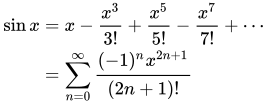
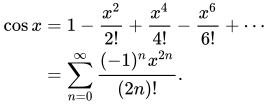
With these definitions the trigonometric functions can be defined for complex numbers.[45] When extended as functions of real or complex variables, the following formula holds for the complex exponential:

This complex exponential function, written in terms of trigonometric functions, is particularly useful.[46][47]
Calculating trigonometric functions
[edit]Trigonometric functions were among the earliest uses for mathematical tables.[48] Such tables were incorporated into mathematics textbooks and students were taught to look up values and how to interpolate between the values listed to get higher accuracy.[49] Slide rules had special scales for trigonometric functions.[50]
Scientific calculators have buttons for calculating the main trigonometric functions (sin, cos, tan, and sometimes cis and their inverses).[51] Most allow a choice of angle measurement methods: degrees, radians, and sometimes gradians. Most computer programming languages provide function libraries that include the trigonometric functions.[52] The floating point unit hardware incorporated into the microprocessor chips used in most personal computers has built-in instructions for calculating trigonometric functions.[53]
Other trigonometric functions
[edit]In addition to the six ratios listed earlier, there are additional trigonometric functions that were historically important, though seldom used today. These include the chord (crd(θ) = 2 sin(θ/2)), the versine (versin(θ) = 1 − cos(θ) = 2 sin2(θ/2)) (which appeared in the earliest tables[54]), the coversine (coversin(θ) = 1 − sin(θ) = versin(π/2 − θ)), the haversine (haversin(θ) = 1/2versin(θ) = sin2(θ/2)),[55] the exsecant (exsec(θ) = sec(θ) − 1), and the excosecant (excsc(θ) = exsec(π/2 − θ) = csc(θ) − 1). See List of trigonometric identities for more relations between these functions.
Applications
[edit]Astronomy
[edit]For centuries, spherical trigonometry has been used for locating solar, lunar, and stellar positions,[56] predicting eclipses, and describing the orbits of the planets.[57]
In modern times, the technique of triangulation is used in astronomy to measure the distance to nearby stars,[58] as well as in satellite navigation systems.[19]
Navigation
[edit]
Historically, trigonometry has been used for locating latitudes and longitudes of sailing vessels, plotting courses, and calculating distances during navigation.[59]
Trigonometry is still used in navigation through such means as the Global Positioning System and artificial intelligence for autonomous vehicles.[60]
Surveying
[edit]In land surveying, trigonometry is used in the calculation of lengths, areas, and relative angles between objects.[61]
On a larger scale, trigonometry is used in geography to measure distances between landmarks.[62]
Periodic functions
[edit]


The sine and cosine functions are fundamental to the theory of periodic functions,[63] such as those that describe sound and light waves. Fourier discovered that every continuous, periodic function could be described as an infinite sum of trigonometric functions.
Even non-periodic functions can be represented as an integral of sines and cosines through the Fourier transform. This has applications to quantum mechanics[64] and communications,[65] among other fields.
Optics and acoustics
[edit]Trigonometry is useful in many physical sciences,[66] including acoustics,[67] and optics.[67] In these areas, they are used to describe sound and light waves, and to solve boundary- and transmission-related problems.[68]
Other applications
[edit]Other fields that use trigonometry or trigonometric functions include music theory,[69] geodesy, audio synthesis,[70] architecture,[71] electronics,[69] biology,[72] medical imaging (CT scans and ultrasound),[73] chemistry,[74] number theory (and hence cryptology),[75] seismology,[67] meteorology,[76] oceanography,[77] image compression,[78] phonetics,[79] economics,[80] electrical engineering, mechanical engineering, civil engineering,[69] computer graphics,[81] cartography,[69] crystallography[82] and game development.[81]
Identities
[edit]
Trigonometry has been noted for its many identities, that is, equations that are true for all possible inputs.[83]
Identities involving only angles are known as trigonometric identities. Other equations, known as triangle identities,[84] relate both the sides and angles of a given triangle.
Triangle identities
[edit]
In the following identities, A, B and C are the angles of a triangle and a, b and c are the lengths of sides of the triangle opposite the respective angles (as shown in the diagram).
Law of sines
[edit]The law of sines (also known as the "sine rule") for an arbitrary triangle states:[85]

where is the area of the triangle and R is the radius of the circumscribed circle of the triangle:


Law of cosines
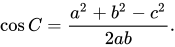
[edit]The law of cosines (known as the cosine formula, or the "cos rule") is an extension of the Pythagorean theorem to arbitrary triangles:[85]

or equivalently:
Law of tangents
[edit]The law of tangents, developed by François Viète, is an alternative to the law of cosines when solving for the unknown edges of a triangle, providing simpler computations when using trigonometric tables.[86] It is given by:
![{\displaystyle {\frac {a-b}{a+b}}={\frac {\tan \left[{\tfrac {1}{2}}(A-B)\right]}{\tan \left[{\tfrac {1}{2}}(A+B)\right]}}}](https://wikimedia.org/api/rest_v1/media/math/render/svg/a1da4e06eb6f25cd7f7fc1a7784a11a82ae53f9f)
Area
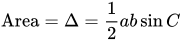
[edit]Given two sides a and b and the angle between the sides C, the area of the triangle is given by half the product of the lengths of two sides and the sine of the angle between the two sides:[85]
Trigonometric identities
[edit]Pythagorean identities
[edit]The following trigonometric identities are related to the Pythagorean theorem and hold for any value:[87]



The second and third equations are derived from dividing the first equation by and , respectively.


Euler's formula
[edit]Euler's formula, which states that , produces the following analytical identities for sine, cosine, and tangent in terms of e and the imaginary unit i:


Other trigonometric identities
[edit]Other commonly used trigonometric identities include the half-angle identities, the angle sum and difference identities, and the product-to-sum identities.[31]
See also
[edit]References
[edit]- ^ Harper, Douglas. "trigonometry". Online Etymology Dictionary. Retrieved 2022-03-18.
- ^ R. Nagel (ed.), Encyclopedia of Science, 2nd Ed., The Gale Group (2002)
- ^ Boyer (1991), p. [page needed].
- ^ Charles William Hackley (1853). A treatise on trigonometry, plane and spherical: with its application to navigation and surveying, nautical and practical astronomy and geodesy, with logarithmic, trigonometrical, and nautical tables. G. P. Putnam.
- ^ Mary Jane Sterling (24 February 2014). Trigonometry For Dummies. John Wiley & Sons. p. 185. ISBN 978-1-118-82741-3.
- ^ Ron Larson; Robert P. Hostetler (10 March 2006). Trigonometry. Cengage Learning. p. 230. ISBN 0-618-64332-X.
- ^ Boyer (1991), p. 162, "Greek Trigonometry and Mensuration".
- ^ Pimentel, Ric; Wall, Terry (2018). Cambridge IGCSE Core Mathematics (4th ed.). Hachette UK. p. 275. ISBN 978-1-5104-2058-8. Extract of page 275
- ^ Otto Neugebauer (1975). A history of ancient mathematical astronomy. 1. Springer-Verlag. p. 744. ISBN 978-3-540-06995-9.
- ^ Thurston (1996), pp. 235–236, "Appendix 1: Hipparchus's Table of Chords".
- ^ Toomer, G. (1998). Ptolemy's Almagest. Princeton University Press. Bibcode:1998ptal.book.....T. ISBN 978-0-691-00260-6.
- ^ Thurston (1996), pp. 239–243, "Appendix 3: Ptolemy's Table of Chords".
- ^ Boyer (1991), p. 215.
- ^ Jacques Sesiano (2000). "Islamic mathematics". In Selin, Helaine; D'Ambrosio, Ubiratan (eds.). Mathematics Across Cultures: The History of Non-western Mathematics. Springer Science+Business Media. p. 157. ISBN 978-1-4020-0260-1.
- ^ a b "trigonometry". Encyclopædia Britannica. Retrieved 2008-07-21.
- ^ a b Boyer 1991, p. 238.
- ^ Moussa, Ali (2011). "Mathematical Methods in Abū al-Wafāʾ's Almagest and the Qibla Determinations". Arabic Sciences and Philosophy. 21 (1). Cambridge University Press: 1–56. doi:10.1017/S095742391000007X. S2CID 171015175.
- ^ Gingerich, Owen. "Islamic astronomy." Scientific American 254.4 (1986): 74–83
- ^ a b Michael Willers (13 February 2018). Armchair Algebra: Everything You Need to Know From Integers To Equations. Book Sales. p. 37. ISBN 978-0-7858-3595-0.
- ^ "Nasir al-Din al-Tusi". MacTutor History of Mathematics archive. Retrieved 2021-01-08.
One of al-Tusi's most important mathematical contributions was the creation of trigonometry as a mathematical discipline in its own right rather than as just a tool for astronomical applications. In Treatise on the quadrilateral al-Tusi gave the first extant exposition of the whole system of plane and spherical trigonometry. This work is really the first in history on trigonometry as an independent branch of pure mathematics and the first in which all six cases for a right-angled spherical triangle are set forth.
- ^ Berggren, J. L. (October 2013). "Islamic Mathematics". the cambridge history of science. Vol. 2. Cambridge University Press. pp. 62–83. doi:10.1017/CHO9780511974007.004. ISBN 9780521594486.
- ^ "ṬUSI, NAṢIR-AL-DIN i. Biography". Encyclopaedia Iranica. Retrieved 2018-08-05.
His major contribution in mathematics (Nasr, 1996, pp. 208–214) is said to be in trigonometry, which for the first time was compiled by him as a new discipline in its own right. Spherical trigonometry also owes its development to his efforts, and this includes the concept of the six fundamental formulas for the solution of spherical right-angled triangles.
- ^ Berggren, J. Lennart (2007). "Mathematics in Medieval Islam". The Mathematics of Egypt, Mesopotamia, China, India, and Islam: A Sourcebook. Princeton University Press. p. 518. ISBN 978-0-691-11485-9.
- ^ Boyer (1991), pp. 237, 274.
- ^ "Johann Müller Regiomontanus". MacTutor History of Mathematics archive. Retrieved 2021-01-08.
- ^ N.G. Wilson (1992). From Byzantium to Italy. Greek Studies in the Italian Renaissance, London. ISBN 0-7156-2418-0
- ^ Grattan-Guinness, Ivor (1997). The Rainbow of Mathematics: A History of the Mathematical Sciences. W.W. Norton. ISBN 978-0-393-32030-5.
- ^ Robert E. Krebs (2004). Groundbreaking Scientific Experiments, Inventions, and Discoveries of the Middle Ages and the Renaissance. Greenwood Publishing Group. p. 153. ISBN 978-0-313-32433-8.
- ^ Ewald, William Bragg (2005-04-21). From Kant to Hilbert Volume 1: A Source Book in the Foundations of Mathematics. OUP Oxford. p. 93. ISBN 978-0-19-152309-0.
- ^ Dempski, Kelly (November 2002). Focus on Curves and Surfaces. Premier Press. p. 29. ISBN 978-1-59200-007-4.
- ^ a b James Stewart; Lothar Redlin; Saleem Watson (16 January 2015). Algebra and Trigonometry. Cengage Learning. p. 448. ISBN 978-1-305-53703-3.
- ^ Dick Jardine; Amy Shell-Gellasch (2011). Mathematical Time Capsules: Historical Modules for the Mathematics Classroom. MAA. p. 182. ISBN 978-0-88385-984-1.
- ^ Krystle Rose Forseth; Christopher Burger; Michelle Rose Gilman; Deborah J. Rumsey (2008). Pre-Calculus For Dummies. John Wiley & Sons. p. 218. ISBN 978-0-470-16984-1.
- ^ Weisstein, Eric W. "SOHCAHTOA". MathWorld.
- ^ Humble, Chris (2001). Key Maths : GCSE, Higher. Fiona McGill. Cheltenham: Stanley Thornes Publishers. p. 51. ISBN 0-7487-3396-5. OCLC 47985033.
- ^ A sentence more appropriate for high schools is "'Some Old Horse Came A''Hopping Through Our Alley". Foster, Jonathan K. (2008). Memory: A Very Short Introduction. Oxford. p. 128. ISBN 978-0-19-280675-8.
- ^ a b David Cohen; Lee B. Theodore; David Sklar (17 July 2009). Precalculus: A Problems-Oriented Approach, Enhanced Edition. Cengage Learning. ISBN 978-1-4390-4460-5.
- ^ W. Michael Kelley (2002). The Complete Idiot's Guide to Calculus. Alpha Books. p. 45. ISBN 978-0-02-864365-6.
- ^ Jenny Olive (18 September 2003). Maths: A Student's Survival Guide: A Self-Help Workbook for Science and Engineering Students. Cambridge University Press. p. 175. ISBN 978-0-521-01707-7.
- ^ Mary P Attenborough (30 June 2003). Mathematics for Electrical Engineering and Computing. Elsevier. p. 418. ISBN 978-0-08-047340-6.
- ^ Ron Larson; Bruce H. Edwards (10 November 2008). Calculus of a Single Variable. Cengage Learning. p. 21. ISBN 978-0-547-20998-2.
- ^ a b Elizabeth G. Bremigan; Ralph J. Bremigan; John D. Lorch (2011). Mathematics for Secondary School Teachers. MAA. ISBN 978-0-88385-773-1.
- ^ Martin Brokate; Pammy Manchanda; Abul Hasan Siddiqi (3 August 2019). Calculus for Scientists and Engineers. Springer. ISBN 9789811384646.
- ^ Serge Lang (14 March 2013). Complex Analysis. Springer. p. 63. ISBN 978-3-642-59273-7.
- ^ Silvia Maria Alessio (9 December 2015). Digital Signal Processing and Spectral Analysis for Scientists: Concepts and Applications. Springer. p. 339. ISBN 978-3-319-25468-5.
- ^ K. RAJA RAJESWARI; B. VISVESVARA RAO (24 March 2014). SIGNALS AND SYSTEMS. PHI Learning. p. 263. ISBN 978-81-203-4941-4.
- ^ John Stillwell (23 July 2010). Mathematics and Its History. Springer Science & Business Media. p. 313. ISBN 978-1-4419-6053-5.
- ^ Martin Campbell-Kelly; Mary Croarken; Raymond Flood; Eleanor Robson (2 October 2003). The History of Mathematical Tables: From Sumer to Spreadsheets. OUP Oxford. ISBN 978-0-19-850841-0.
- ^ George S. Donovan; Beverly Beyreuther Gimmestad (1980). Trigonometry with calculators. Prindle, Weber & Schmidt. ISBN 978-0-87150-284-1.
- ^ Ross Raymond Middlemiss (1945). Instructions for Post-trig and Mannheim-trig Slide Rules. Frederick Post Company.
- ^ "Calculator keys—what they do". Popular Science. Bonnier Corporation. April 1974. p. 125.
- ^ Steven S. Skiena; Miguel A. Revilla (18 April 2006). Programming Challenges: The Programming Contest Training Manual. Springer Science & Business Media. p. 302. ISBN 978-0-387-22081-9.
- ^ Intel® 64 and IA-32 Architectures Software Developer's Manual Combined Volumes: 1, 2A, 2B, 2C, 3A, 3B and 3C (PDF). Intel. 2013.
- ^ Boyer (1991), pp. xxiii–xxiv.
- ^ Nielsen (1966), pp. xxiii–xxiv.
- ^ Olinthus Gregory (1816). Elements of Plane and Spherical Trigonometry: With Their Applications to Heights and Distances Projections of the Sphere, Dialling, Astronomy, the Solution of Equations, and Geodesic Operations. Baldwin, Cradock, and Joy.
- ^ Neugebauer, Otto (1948). "Mathematical methods in ancient astronomy". Bulletin of the American Mathematical Society. 54 (11): 1013–1041. doi:10.1090/S0002-9904-1948-09089-9.
- ^ Michael Seeds; Dana Backman (5 January 2009). Astronomy: The Solar System and Beyond. Cengage Learning. p. 254. ISBN 978-0-495-56203-0.
- ^ John Sabine (1800). The Practical Mathematician, Containing Logarithms, Geometry, Trigonometry, Mensuration, Algebra, Navigation, Spherics and Natural Philosophy, Etc. p. 1.
- ^ Mordechai Ben-Ari; Francesco Mondada (2018). Elements of Robotics. Springer. p. 16. ISBN 978-3-319-62533-1.
- ^ George Roberts Perkins (1853). Plane Trigonometry and Its Application to Mensuration and Land Surveying: Accompanied with All the Necessary Logarithmic and Trigonometric Tables. D. Appleton & Company.
- ^ Charles W. J. Withers; Hayden Lorimer (14 December 2015). Geographers: Biobibliographical Studies. A&C Black. p. 6. ISBN 978-1-4411-0785-5.
- ^ H. G. ter Morsche; J. C. van den Berg; E. M. van de Vrie (7 August 2003). Fourier and Laplace Transforms. Cambridge University Press. p. 61. ISBN 978-0-521-53441-3.
- ^ Bernd Thaller (8 May 2007). Visual Quantum Mechanics: Selected Topics with Computer-Generated Animations of Quantum-Mechanical Phenomena. Springer Science & Business Media. p. 15. ISBN 978-0-387-22770-2.
- ^ M. Rahman (2011). Applications of Fourier Transforms to Generalized Functions. WIT Press. ISBN 978-1-84564-564-9.
- ^ Lawrence Bornstein; Basic Systems, Inc (1966). Trigonometry for the Physical Sciences. Appleton-Century-Crofts.
- ^ a b c John J. Schiller; Marie A. Wurster (1988). College Algebra and Trigonometry: Basics Through Precalculus. Scott, Foresman. ISBN 978-0-673-18393-4.
- ^ Dudley H. Towne (5 May 2014). Wave Phenomena. Dover Publications. ISBN 978-0-486-14515-0.
- ^ a b c d E. Richard Heineman; J. Dalton Tarwater (1 November 1992). Plane Trigonometry. McGraw-Hill. ISBN 978-0-07-028187-5.
- ^ Mark Kahrs; Karlheinz Brandenburg (18 April 2006). Applications of Digital Signal Processing to Audio and Acoustics. Springer Science & Business Media. p. 404. ISBN 978-0-306-47042-4.
- ^ Kim Williams; Michael J. Ostwald (9 February 2015). Architecture and Mathematics from Antiquity to the Future: Volume I: Antiquity to the 1500s. Birkhäuser. p. 260. ISBN 978-3-319-00137-1.
- ^ Dan Foulder (15 July 2019). Essential Skills for GCSE Biology. Hodder Education. p. 78. ISBN 978-1-5104-6003-4.
- ^ Luciano Beolchi; Michael H. Kuhn (1995). Medical Imaging: Analysis of Multimodality 2D/3D Images. IOS Press. p. 122. ISBN 978-90-5199-210-6.
- ^ Marcus Frederick Charles Ladd (2014). Symmetry of Crystals and Molecules. Oxford University Press. p. 13. ISBN 978-0-19-967088-8.
- ^ Gennady I. Arkhipov; Vladimir N. Chubarikov; Anatoly A. Karatsuba (22 August 2008). Trigonometric Sums in Number Theory and Analysis. Walter de Gruyter. ISBN 978-3-11-019798-3.
- ^ Study Guide for the Course in Meteorological Mathematics: Latest Revision, Feb. 1, 1943. 1943.
- ^ Mary Sears; Daniel Merriman; Woods Hole Oceanographic Institution (1980). Oceanography, the past. Springer-Verlag. ISBN 978-0-387-90497-9.
- ^ "JPEG Standard (JPEG ISO/IEC 10918-1 ITU-T Recommendation T.81)" (PDF). International Telecommunication Union. 1993. Retrieved 6 April 2019.
- ^ Kirsten Malmkjaer (4 December 2009). The Routledge Linguistics Encyclopedia. Routledge. p. 1. ISBN 978-1-134-10371-3.
- ^ Kamran Dadkhah (11 January 2011). Foundations of Mathematical and Computational Economics. Springer Science & Business Media. p. 46. ISBN 978-3-642-13748-8.
- ^ a b Christopher Griffith (12 November 2012). Real-World Flash Game Development: How to Follow Best Practices AND Keep Your Sanity. CRC Press. p. 153. ISBN 978-1-136-13702-0.
- ^ John Joseph Griffin (1841). A System of Crystallography, with Its Application to Mineralogy. R. Griffin. p. 119.
- ^ Dugopolski (July 2002). Trigonometry I/E Sup. Addison Wesley. ISBN 978-0-201-78666-8.
- ^ V&S EDITORIAL BOARD (6 January 2015). CONCISE DICTIONARY OF MATHEMATICS. V&S Publishers. p. 288. ISBN 978-93-5057-414-0.
- ^ a b c Cynthia Y. Young (19 January 2010). Precalculus. John Wiley & Sons. p. 435. ISBN 978-0-471-75684-2.
- ^ Ron Larson (29 January 2010). Trigonometry. Cengage Learning. p. 331. ISBN 978-1-4390-4907-5.
- ^ Peterson, John C. (2004). Technical Mathematics with Calculus (illustrated ed.). Cengage Learning. p. 856. ISBN 978-0-7668-6189-3. Extract of page 856
Bibliography
[edit]- Boyer, Carl B. (1991). A History of Mathematics (Second ed.). John Wiley & Sons, Inc. ISBN 978-0-471-54397-8.
- Nielsen, Kaj L. (1966). Logarithmic and Trigonometric Tables to Five Places (2nd ed.). New York: Barnes & Noble. LCCN 61-9103.
- Thurston, Hugh (1996). Early Astronomy. Springer Science & Business Media. ISBN 978-0-387-94822-5.
Further reading
[edit]- "Trigonometric functions". Encyclopedia of Mathematics. EMS Press. 2001 [1994].
- Linton, Christopher M. (2004). From Eudoxus to Einstein: A History of Mathematical Astronomy. Cambridge University Press.
- Weisstein, Eric W. "Trigonometric Addition Formulas". MathWorld.
External links
[edit] Definitions from Wiktionary
 Media from Commons
 News from Wikinews
 Quotations from Wikiquote
 Texts from Wikisource
 Textbooks from Wikibooks
 Resources from Wikiversity


- Khan Academy: Trigonometry, free online micro lectures
- Trigonometry by Alfred Monroe Kenyon and Louis Ingold, The Macmillan Company, 1914. In images, full text presented.
- Benjamin Banneker's Trigonometry Puzzle at Convergence
- Dave's Short Course in Trigonometry by David Joyce of Clark University
- Trigonometry, by Michael Corral, Covers elementary trigonometry, Distributed under GNU Free Documentation License


Trigonometry
View on GrokipediaFundamentals
Definition and Basic Concepts
Trigonometry is a branch of mathematics concerned with the relationships between the sides and angles of triangles, as well as the angular relationships in planar and three-dimensional figures.[9] The term "trigonometry" derives from the Greek words trigonon, meaning "triangle," and metron, meaning "measure," reflecting its origins in measuring triangular figures.[10] More broadly, trigonometric concepts extend to modeling periodic phenomena, such as waves and oscillations, through functions that repeat at regular intervals.[11] Trigonometry is broadly divided into plane trigonometry, which applies to triangles formed on a flat, Euclidean surface where the sum of angles in any triangle is exactly 180 degrees, and spherical trigonometry, which deals with triangles on the surface of a sphere, where angles sum to more than 180 degrees due to the curvature.[12] Plane trigonometry forms the foundation for most introductory studies, while spherical trigonometry is essential for applications involving globes or celestial navigation.[12] Understanding trigonometry requires familiarity with prerequisite concepts from geometry, including angles and triangles. Angles can be measured in degrees, where a full circle is 360 degrees, or in radians, where a full circle is radians, providing a more natural unit for calculus-based applications.[13] Triangles are classified by their angles as acute (all three angles less than 90 degrees), obtuse (one angle greater than 90 degrees), or right (one angle exactly 90 degrees).[14] In a right triangle, key terms include the hypotenuse, the longest side opposite the right angle; the opposite side, relative to a specific acute angle; and the adjacent side, the leg forming the angle with the hypotenuse.[15][16][17] For visualization, consider a right triangle ABC with right angle at C: side AB is the hypotenuse, side BC (opposite angle A) is the opposite side to angle A, and side AC is the adjacent side to angle A. Such labeled diagrams illustrate how angles and sides interrelate, setting the stage for exploring trigonometric ratios.Right Triangle Trigonometry
Right triangle trigonometry focuses on the relationships between the angles and sides of right-angled triangles, where one angle measures 90 degrees and the other two are acute. For an acute angle θ in such a triangle, the primary trigonometric ratios are defined relative to the side opposite θ, the side adjacent to θ (not including the hypotenuse), and the hypotenuse. The sine function is given by , the cosine by , and the tangent by .[18][19] The reciprocal trigonometric functions are defined as the inverses of these ratios: , , and .[19] These reciprocals provide alternative ways to express the same side relationships and are useful for certain calculations.[18] Specific values of these ratios can be derived from special right triangles with known side lengths. Consider a 30-60-90 triangle, where the sides are in the ratio (opposite the 30° angle, opposite the 60° angle, and hypotenuse, respectively). For the 30° angle, , , and ; for the 60° angle, , , and .[20][21] In a 45-45-90 triangle, the sides are in the ratio (legs and hypotenuse), yielding and for each acute angle.[20] These ratios enable solving for unknown sides given an angle and a known side. For example, in a right triangle with a 30° angle and hypotenuse of length 10, the opposite side is .[20] Similarly, the adjacent side is .[21] In right triangles, all acute angles lie in the first quadrant, where sine, cosine, and tangent are positive, as are their reciprocals.[22] For angles beyond acute measures, sign conventions in other quadrants determine the signs of these functions, with extensions to obtuse angles typically handled via the unit circle approach.[22]Historical Development
Ancient and Classical Contributions
The origins of trigonometry trace back to ancient Mesopotamian and Egyptian civilizations, where practical geometric techniques laid foundational groundwork for angular measurements, primarily in astronomy and surveying. In Mesopotamia, the Babylonians employed a sexagesimal (base-60) system to divide the circle into 360 degrees, facilitating calculations of angles and arcs for celestial observations, as evidenced in cuneiform tablets dating to around 1800 BCE.[23] Egyptian surveyors, known as harpedonaptai or "rope stretchers," used knotted ropes to construct right angles via the 3-4-5 Pythagorean triple, essential for reestablishing land boundaries after Nile floods, a method described in texts like the Rhind Papyrus from circa 1650 BCE.[24] These precursors emphasized empirical geometry over abstract theory, focusing on proportional relationships in triangles without formalized trigonometric functions.[25] The systematic development of trigonometry emerged in ancient Greece, with Hipparchus of Nicaea (c. 190–120 BCE) widely regarded as the field's founder due to his creation of the first known chord tables. Working in Rhodes, Hipparchus compiled a table of chords—lengths of straight lines subtending arcs in a circle—for astronomical computations, enabling precise predictions of planetary positions and eclipses.[4] His tables, covering angles in increments of 7.5 degrees up to 180 degrees with linear interpolation for intermediate values, were derived from geometric propositions and used a circle of radius 60 units, aligning with Babylonian influences.[26] This innovation shifted trigonometry from ad hoc calculations to a tabular method, primarily serving Hellenistic astronomy.[27] Building on Hipparchus's work, Claudius Ptolemy (c. 100–170 CE) advanced trigonometric tables in his seminal astronomical treatise, the Almagest, composed around 150 CE in Alexandria. Ptolemy expanded the chord table to include values for every half-degree from 0.5° to 180° in a 360° circle of radius 60, incorporating interpolation techniques and geometric proofs for accuracy.[28] His table, detailed in Book I, supported spherical astronomy, including calculations for the sun's position and planetary motions, and remained the standard reference for over a millennium.[27] Ptolemy's approach integrated chords with the unit circle concept, though still oriented toward observational data rather than general geometry.[4] In ancient India, trigonometric concepts evolved independently within astronomical contexts, with significant contributions from mathematicians like Aryabhata (476–550 CE) and Brahmagupta (c. 598–668 CE). Aryabhata introduced the earliest known sine table in his Aryabhatiya (499 CE), listing values of jya—the Sanskrit term for chord half-lengths, equivalent to the modern sine function—for angles at 3°45' intervals up to 90°, computed using geometric approximations and difference methods.[5] This table, embedded in Hindu cosmology and planetary models, emphasized sine ratios for eclipse predictions and timekeeping. Brahmagupta, in his Brahmasphutasiddhanta (628 CE), refined these by developing second-order interpolation formulas to estimate intermediate sine values from the tabulated data, enhancing precision in astronomical calculations.[5] Indian trigonometry, like its Greek counterpart, prioritized astronomy, using jya and related functions without the modern sine's abstraction, and laid groundwork for later refinements.[29]Medieval and Modern Advancements
During the Islamic Golden Age, scholars built upon ancient Greek and Indian astronomical traditions, significantly advancing trigonometry as a tool for precise calculations. Al-Battani, a 9th-century Syrian astronomer, refined Ptolemy's chord tables by introducing more accurate trigonometric values and developing methods for spherical trigonometry, which enhanced the precision of solar and lunar eclipse predictions.[30] Al-Khwarizmi, working around the same period, contributed treatises on sundials and astrolabes that incorporated early trigonometric procedures, including the use of sines and tangents derived from Indian sources to solve problems in timekeeping and celestial positioning.[31] In the 10th century, Abu al-Wafa al-Buzjani further innovated by explicitly defining the sine function in its modern form—distinct from the chord—and compiling the first comprehensive tables of sines and tangents at intervals of 15 arcminutes, which facilitated more efficient astronomical computations.[32] These developments marked a transition from empirical chord-based methods to a more algebraic approach, laying groundwork for trigonometry's broader application beyond astronomy. The European Renaissance revived and expanded these Islamic contributions through scholarly translations and original works. In the 15th century, Regiomontanus (Johann Müller) authored De triangulis omnimodis (1464), the first systematic European treatise on plane and spherical trigonometry, which organized trigonometric rules into a cohesive framework and emphasized their utility for surveying and navigation.[33] This was followed in 1551 by Georg Joachim Rheticus's Canon doctrinae triangulorum, which provided the earliest printed tables of all six trigonometric functions (sine, cosine, tangent, cotangent, secant, cosecant) with notable precision for the time.[34] In the 17th and 18th centuries, Leonhard Euler systematized trigonometry by treating functions as analytic expressions of real and complex variables, introducing modern notations like sin(x) and deriving infinite series expansions for sine and cosine in his Introductio in analysin infinitorum (1748).[35] Euler also connected trigonometry to complex numbers through his formula $ e^{i\theta} = \cos \theta + i \sin \theta $, revealing deep links between exponential and periodic functions without delving into proofs here.[36] By the 19th century, trigonometry had evolved into a general mathematical discipline, exemplified by the standardization of the radian as an angle measure by James Thomson in the 1870s; he proposed it in 1873 examination questions as the arc length subtended by a radius, offering a natural unit independent of degrees for calculus applications.[37] This progression shifted trigonometry from specialized astronomical tables to a foundational tool in analysis and geometry.Trigonometric Functions
Definitions and Ratios
Trigonometric functions can be defined for any angle using the unit circle, a circle of radius 1 centered at the origin of the coordinate plane. For an angle measured counterclockwise from the positive x-axis to a point on the unit circle, the sine function is defined as , the y-coordinate of , and the cosine function as , the x-coordinate of .[38][18] These coordinate-based definitions extend the ratios originally used for acute angles in right triangles to arbitrary angles.[39] Angles are often measured in radians, where the radian measure of a central angle is the ratio of the arc length subtended by the angle to the radius of the circle.[40] For the unit circle, this simplifies to the arc length itself, so a full revolution corresponds to radians.[41] The conversion between degrees and radians follows the relation , such that radians equals 180 degrees. This unit circle approach allows trigonometric functions to be evaluated for angles in all four quadrants, from 0 to radians (or 0° to 360°). In the first quadrant (0 to radians or 0° to 90°), both sine and cosine are positive. In the second quadrant ( to radians or 90° to 180°), sine is positive while cosine is negative. In the third quadrant ( to radians or 180° to 270°), both are negative. In the fourth quadrant ( to radians or 270° to 360°), cosine is positive while sine is negative.[42][43] The tangent function is defined as , the ratio of the y-coordinate to the x-coordinate, provided .[18] The reciprocal functions are the cosecant , provided ; the secant , provided ; and the cotangent , provided .[18] The sine and cosine functions are periodic with period radians (or 360°), meaning and for any angle .[44] Tangent has a period of radians (or 180°).[42] Common values of these functions for standard angles are summarized in the following table, expressed in exact fractional form where possible:| Angle (degrees) | Angle (radians) | |||
|---|---|---|---|---|
| 0° | 0 | 0 | 1 | 0 |
| 30° | ||||
| 45° | 1 | |||
| 60° | ||||
| 90° | 1 | 0 | undefined | |
| 180° | 0 | -1 | 0 | |
| 270° | -1 | 0 | undefined | |
| 360° | 0 | 1 | 0 |
Unit Circle and Standard Values
The unit circle is defined as the circle centered at the origin (0,0) with a radius of 1, providing a geometric framework for defining trigonometric functions for any angle in standard position.[45] For an angle θ measured counterclockwise from the positive x-axis, the coordinates of the point where the terminal side intersects the unit circle are (cos θ, sin θ), allowing direct evaluation of sine and cosine as the y- and x-coordinates, respectively.[45] This representation extends the right-triangle definitions of trigonometric ratios to all angles, including those greater than 90° or negative, by standardizing the hypotenuse to 1.[38] Key points on the unit circle correspond to standard angles, such as 0° (0 rad) at (1, 0), 30° (π/6 rad) at (√3/2, 1/2), 45° (π/4 rad) at (√2/2, √2/2), 60° (π/3 rad) at (1/2, √3/2), and 90° (π/2 rad) at (0, 1), with values in other quadrants determined by symmetry and signs.[45] These points form the basis for memorizing standard trigonometric values, as the coordinates yield exact expressions for sine, cosine, and tangent without approximation.[46] Standard values are derived from special right triangles scaled to fit the unit circle. For 30° and 60°, consider an equilateral triangle with side length 2; drawing an altitude bisects it into a 30°-60°-90° right triangle with sides 1 (opposite 30°), √3 (opposite 60°), and 2 (hypotenuse).[20] Scaling the hypotenuse to 1 gives sin 30° = 1/2, cos 30° = √3/2, sin 60° = √3/2, and cos 60° = 1/2.[46] For 45°, an isosceles right triangle with legs of length 1 has hypotenuse √2; scaling yields sin 45° = cos 45° = √2/2.[20] To determine the signs of trigonometric functions in each quadrant, the mnemonic ASTC ("All Students Take Calculus") is commonly used: all functions are positive in Quadrant I, sine and cosecant in Quadrant II, tangent and cotangent in Quadrant III, and cosine and secant in Quadrant IV.[47] This aids in assigning correct signs to values from the first quadrant when evaluating angles in other quadrants. Reference angles facilitate finding trigonometric values for non-standard angles by reducing them to acute angles (0° to 90°) in the first quadrant. The reference angle θ_R is the acute angle between the terminal side of θ and the x-axis: θ_R = θ in Quadrant I, π - θ (or 180° - θ) in Quadrant II, θ - π (or θ - 180°) in Quadrant III, and 2π - θ (or 360° - θ) in Quadrant IV.[48] The trigonometric value of θ is then the value of the reference angle, adjusted by the quadrant sign via ASTC.[48] The following table summarizes sine, cosine, and tangent values at standard angles, derived from unit circle points and special triangles, presented in both degrees and radians for key positions across all quadrants.[46][45]| Angle (°) | Angle (rad) | sin θ | cos θ | tan θ |
|---|---|---|---|---|
| 0 | 0 | 0 | 1 | 0 |
| 30 | π/6 | 1/2 | √3/2 | √3/3 |
| 45 | π/4 | √2/2 | √2/2 | 1 |
| 60 | π/3 | √3/2 | 1/2 | √3 |
| 90 | π/2 | 1 | 0 | undefined |
| 120 | 2π/3 | √3/2 | -1/2 | -√3 |
| 135 | 3π/4 | √2/2 | -√2/2 | -1 |
| 150 | 5π/6 | 1/2 | -√3/2 | -√3/3 |
| 180 | π | 0 | -1 | 0 |
| 210 | 7π/6 | -1/2 | -√3/2 | √3/3 |
| 225 | 5π/4 | -√2/2 | -√2/2 | 1 |
| 240 | 4π/3 | -√3/2 | -1/2 | √3 |
| 270 | 3π/2 | -1 | 0 | undefined |
| 300 | 5π/3 | -√3/2 | 1/2 | -√3 |
| 315 | 7π/4 | -√2/2 | √2/2 | -1 |
| 330 | 11π/6 | -1/2 | √3/2 | -√3/3 |
| 360 | 2π | 0 | 1 | 0 |