Hubbry Logo
TrihexyphenidylTrihexyphenidylMain
Open search
Trihexyphenidyl
Community hub
Trihexyphenidyl
logo
8 pages, 0 posts
0 subscribers
Be the first to start a discussion here.
Trihexyphenidyl
Trihexyphenidyl
from Wikipedia

Trihexyphenidyl
Clinical data
Trade namesArtane, Parkin,[citation needed] Pacitane, Hexymer
AHFS/Drugs.comMonograph
MedlinePlusa682160
License data
Pregnancy
category
  • AU: B1
Routes of
administration
Oral
ATC code
Legal status
Legal status
Pharmacokinetic data
Elimination half-life3.3-4.1 hours
Identifiers
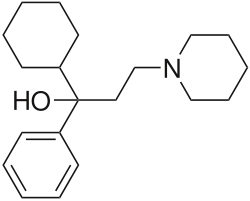
  • (RS)-1-Cyclohexyl-1-phenyl-3-(1-piperidyl)propan-1-ol
CAS Number
PubChem CID
IUPHAR/BPS
DrugBank
ChemSpider
UNII
KEGG
ChEMBL
CompTox Dashboard (EPA)
ECHA InfoCard100.005.105 Edit this at Wikidata
Chemical and physical data
FormulaC20H31NO
Molar mass301.474 g·mol−1
3D model (JSmol)
  • OC(c1ccccc1)(CCN2CCCCC2)C3CCCCC3
  • InChI=1S/C20H31NO/c22-20(18-10-4-1-5-11-18,19-12-6-2-7-13-19)14-17-21-15-8-3-9-16-21/h1,4-5,10-11,19,22H,2-3,6-9,12-17H2 checkY
  • Key:HWHLPVGTWGOCJO-UHFFFAOYSA-N checkY
  (verify)

Trihexyphenidyl (THP, benzhexol, trihex, marketed as Artane and others) is an antispasmodic drug used to treat stiffness, tremors, spasms, and poor muscle control. It is an agent of the antimuscarinic class and is often used in management of Parkinson's disease. It was approved by the FDA for the treatment of Parkinson's in the US in 1949.[2][3]

Trihexyphenidyl is a therapeutic alternative on the World Health Organization's List of Essential Medicines.[4]

Medical uses

[edit]

Trihexyphenidyl is used for the symptomatic treatment of Parkinson's disease in mono and combination therapy.[5]

Trihexyphenidyl has also been prescribed for essential tremor and akathisia.[6][7]

In pediatrics, it has been used for children with dystonia due to cerebral palsy,[8][9][10] and to control drooling.[11]

In organophosphate poisoning, trihexyphenidyl is a more effective antidote than atropine to counteract the cholinergic crisis, seizures, and neuropathology.[12]

Contraindications

[edit]

Contraindications include according to the Therapeutic Goods Administration Australia from 2022:[13]

  • Hypersensitivity to trihexyphenidyl
  • Narrow angle glaucoma
  • Ileus (disruption of the normal propulsive ability of the intestine)
  • Caution: People with obstructive diseases of the urogenital tract, people with a known history of seizures and those with potentially dangerous tachycardia

Adverse effects

[edit]

Dose-dependent side effects are frequent, but typically lessen over time as the body adapts to the medication. All of the following symptoms considered, Artane has been shown to dramatically and consistently improve neurologic defects in people aged 16–86 over the course of five years.[14] People who are older or who have psychiatric conditions may become confused or develop delirium. Side effects include but are not limited to:[15]

  • Central nervous system: drowsiness, vertigo, headache, and dizziness are frequent. With high doses nervousness, agitation, anxiety, delirium, and confusion are noted. Trihexyphenidyl may be abused due to a short acting mood-elevating and euphoric effect. The normal sleep architecture may be altered (REM sleep depression). Trihexyphenidyl may lower the seizure-threshold.
  • Peripheral side effects: dry mouth, impaired sweating, abdominal discomfort, nausea, and constipation are frequent. Tachycardia or heart palpitations (fast heart rate) may be noted. Allergic reactions are rare, but may occur. Many of these peripheral symptoms, especially considering an acute increase in anxiety with various physical complaints, as well as evidence of orthostatic hypotension and tachycardia are indicative of withdrawal, especially in people with psychiatric conditions [16]
  • Eyes: trihexyphenidyl causes mydriasis with or without photophobia. It may precipitate narrow angle glaucoma or cause blurred vision.
  • Tolerance may develop during therapy which requires dose adjustments.
  • Striated musculature and weight gain.

Overdose

[edit]

Trihexyphenidyl and other antiparkinsonian drugs are known to be substances of abuse. This is true both in abusers of other substances and in chronic schizophrenics, the latter being infrequent abusers of other drugs.[17]

Overdose mimics an atropine intoxication with dryness of mucous membranes, red face, bowel and bladder paralysis, and hyperthermia in high doses. Central nervous system consequences are agitation, confusion, and hallucinations. An untreated overdose may be fatal, particularly in children. Premortal signs are respiratory depression, arrhythmia and cardiac arrest.

A case report of 24-hour long arrhythmia was treated with verapamil.[18]

Excessive myoclonus can be complicated by rhabdomyolysis; in one case risk was increased due to concomitant use of risperidone.[19]

Interactions

[edit]
  • Other anticholinergic drugs (e.g. spasmolytics, antihistamines, TCAs) : Side effects of trihexyphenidyl may be increased.
  • Quinidine : Increased anticholinergic action (particular on AV conduction).
  • Antipsychotics : Long term use of trihexyphenidyl may mask or increase the risk of tardive dyskinesia.
  • Pethidine (meperidine) : Central effects and side effects of pethidine may be increased.
  • Metoclopramide : Action of metoclopramide is decreased.
  • Alcohol : Risk of serious intoxication.

Pharmacology

[edit]

Pharmacodynamics

[edit]

Trihexyphenidyl is an anticholinergic.[20] It is specifically an antimuscarinic and acts as a non-selective antagonist of all five muscarinic acetylcholine receptors.[20] However, its antagonistic activity is much stronger at the muscarinic acetylcholine M1 and M4 receptors, and it can be described as selective for these receptors.[20][21]

The exact mechanism of action in parkinsonian syndromes is not precisely understood, but it is known that trihexyphenidyl blocks efferent impulses in parasympathetically innervated structures like smooth muscles (spasmolytic activity), salivary glands, and eyes (mydriasis). In higher doses direct central inhibition of cerebral motor centers may contribute. In very high doses central toxicity as seen in atropine overdose is noted.

It possibly also binds to dopamine receptors.[22]

Pharmacokinetics

[edit]

Trihexyphenidyl is rapidly absorbed from the gastrointestinal tract. The onset of action is within 1 hour after oral dosing. The peak activity is noted after 2 to 3 hours.[23] The duration of action of one single dose is 6 to 12 hours in a dose dependent manner. It is excreted in the urine, probably as unchanged drug. More precise data in animals and humans have so far not been determined.[24][25]

History

[edit]

Trihexyphenidyl has been clinically relevant in trials pertaining to Parkinson's disease since 1949.[26]

In the US, the Food and Drug Association approved Artane, or its generic form Trihexyphenidyl HCL, in June 2003, for the clinical use of all types of parkinsonism.[27]

Society and culture

[edit]

Recreational use

[edit]

The neurologist Oliver Sacks reported using the drug recreationally in the 1960s.[28] He recalled taking "a large dose" knowing full well the drug was intended for people with Parkinson's. More recounts of Dr. Sacks' experiences — including experimentation with mescaline, psilocybin, LSD, and probably DMT[29] — have been compared in his book Hallucinations.

During the 1970s, trihexyphenidyl (trade name Parkan) was the most popular recreationally used prescription drug in Hungary.[30]

In a 2008 news report, trihexyphenidyl was seen to be used for recreational purposes among Iraqi soldiers and police, among other prescription drugs. The report states that the drugs were taken to relieve combat stress reaction.[31] Although that may be the case for some, others used Artane as a substitute or more intense version of LSD. This was especially prevalent in the 1960s, according to a report in "The New Yorker". Similarly to those in Iraqi forces, some of the appeal was that the individual may retain partial control while under the influence.[32] It is still diverted from its primary use, in combination with other drugs, on the Réunion island (France).[33]

Chemistry

[edit]

Trihexyphenidyl can be synthesized in two ways, one linear and one convergent synthesis.

In the first way, the initial 2-(1-piperidino)propiophenone is synthesized in turn by the aminomethylation of acetophenone using paraformaldehyde and piperidine in a Mannich reaction. In the second step the 2-(1-piperidino)propiophenone is reacted with cyclohexylmagnesium bromide in a Grignard reaction.[34]

Artane linear and convergent synthesis

Stereochemistry

[edit]

Trihexyphenidyl has a chiral center and two enantiomers. Medications are racemates.[35]

Enantiomers

CAS number: 40520-25-0

CAS number: 40520-24-9

References

[edit]
Revisions and contributorsEdit on WikipediaRead on Wikipedia
from Grokipedia
Trihexyphenidyl is a synthetic medication primarily used to manage symptoms of , including tremors, rigidity, and bradykinesia, as well as extrapyramidal side effects induced by drugs. It functions by blocking muscarinic receptors in the , thereby restoring the balance between and activity disrupted in parkinsonian states. Approved by the FDA in 1949, it is available in oral tablet and forms and is often employed as an adjunct to levodopa therapy or as monotherapy in early-stage Parkinson's. The drug's mechanism involves competitive antagonism at M1 muscarinic receptors, which inhibits parasympathetic impulses and may enhance release, leading to improved with an onset of action within 60 minutes and peak effects at 2 hours. Typical dosing begins at 1 mg daily for Parkinson's, titrated up to 6-15 mg per day in divided doses, while for drug-induced , it ranges from 5-15 mg daily; administration with food minimizes gastrointestinal upset. Off-label uses include treatment of in , though evidence for broader applications remains limited. Common adverse effects are dose-related and anticholinergic in nature, encompassing dry mouth, , , , , and confusion, particularly in elderly patients where risk is heightened; use is generally avoided in patients over 70 years due to this risk, per American Academy of Neurology guidelines. Contraindications include narrow-angle , , and conditions like prostatic or that could worsen with anticholinergic blockade; abrupt discontinuation may precipitate symptom rebound or, rarely, . Hepatotoxicity is uncommon, with no consistent association to serum enzyme elevations or acute in most reports. Monitoring for progression and cognitive changes is advised during long-term use.

Clinical Use

Medical Uses

Trihexyphenidyl is primarily indicated for the management of , including idiopathic, postencephalitic, and arteriosclerotic forms, where it helps alleviate symptoms such as tremors, rigidity, bradykinesia, and akinesia by reducing activity in the . It is used alone or as monotherapy in early-stage disease to improve muscle control and reduce stiffness, allowing for more normal body movements. As an adjunctive therapy, trihexyphenidyl is commonly combined with levodopa or other antiparkinsonian agents to enhance symptom control in patients with idiopathic or , typically at doses of 3-6 mg per day. This combination approach addresses residual motor symptoms not fully managed by levodopa alone, particularly in younger patients with prominent tremors. Trihexyphenidyl is also approved for treating induced by antipsychotic medications, such as , , and pseudoparkinsonism caused by drugs like , , or . It provides symptomatic relief for these acute reactions, though it is not recommended for prophylactic use to prevent such symptoms. Off-label applications include the management of , particularly focal or generalized forms in patients with , where it helps reduce involuntary muscle contractions. It has also been used as an adjunct in select cases of to mitigate associated dystonic tics, though evidence is limited to case reports. Additionally, trihexyphenidyl may address sialorrhea or in children with developmental disabilities. In current practice, trihexyphenidyl is less commonly used as a first-line treatment for due to the availability of more effective options like levodopa and concerns over cognitive side effects, particularly in older adults; however, it remains relevant in resource-limited settings or for tremors in younger patients.

Contraindications

Trihexyphenidyl is contraindicated in patients with to the drug or any of its components, as this can lead to severe allergic reactions. It is also absolutely contraindicated in individuals with narrow-angle glaucoma, where its effects can cause and elevate , potentially leading to blindness with prolonged use. Relative contraindications warrant cautious use and close monitoring. These include conditions such as pyloric or duodenal obstruction, obstructive uropathy, severe , and , where the drug's inhibition of parasympathetic activity can exacerbate obstructive or neuromuscular conditions, worsening gastrointestinal motility, , or . Elderly patients with face heightened risks of confusion, , and due to the drug's properties. , , and prostatic are also relative contraindications, as trihexyphenidyl may induce , arrhythmias, or in these populations. In pregnancy, trihexyphenidyl is classified as FDA Category C, indicating that animal studies have shown adverse effects on the , but there are no adequate studies; it should be used only if the potential benefit justifies the risk to the . During , the drug may suppress milk production with prolonged use, though a single dose is unlikely to affect ; caution is advised, and monitoring for decreased is recommended. Patients with require careful monitoring, as trihexyphenidyl may unmask or exacerbate underlying symptoms unless it is being used concomitantly for management.

Dosage and Administration

Trihexyphenidyl is administered orally, primarily in tablet or solution form, for the management of and associated with medications. For idiopathic or , the initial dose is 1 to 2 mg once daily, with gradual titration by 2 mg increments every 3 to 5 days until a of 5 to 15 mg per day is reached, divided into 3 to 4 doses. The maximum recommended daily dose is 15 mg, and when used concomitantly with levodopa, the dose is typically 3 to 6 mg per day in divided doses, adjusted based on symptom control. For , treatment begins with a lower initial dose of 1 mg, increased gradually to 5 to 10 mg per day in divided doses as needed for symptom relief. To minimize gastrointestinal upset, trihexyphenidyl should be taken with food, preferably in 3 to 4 divided doses throughout the day; doses exceeding 10 mg daily may require a fourth dose at . Discontinuation requires slow tapering to prevent withdrawal symptoms such as rigidity or exacerbation of parkinsonian features. In special populations, reduced doses are advised for elderly patients, starting at 0.5 to 1 mg daily with cautious due to heightened sensitivity to effects. For patients with hepatic or renal impairment, no specific dose adjustments are mandated in mild cases, but lower starting doses and close monitoring are recommended to avoid accumulation and toxicity. Ongoing monitoring includes regular evaluation of therapeutic efficacy on motor symptoms, alongside assessments of cognitive function and cumulative anticholinergic burden to detect early signs of or other central effects, particularly in older adults.

Side Effects and Safety

Adverse Effects

Trihexyphenidyl, as an agent, commonly produces peripheral effects such as dry mouth, , , urinary hesitancy or retention, , and anhidrosis, with minor side effects like dry mouth and occurring in 30 to 50% of patients and often diminishing over time with continued use. These effects are dose-dependent and result from blockade of muscarinic receptors, leading to reduced glandular secretions and relaxation. Central nervous system effects include , , drowsiness, , impairment, and hallucinations, which are more prevalent in elderly patients and increase with higher doses due to enhanced penetration of the blood-brain barrier. Hallucinations and agitation may arise from anticholinergic-induced disruption of in the . Serious adverse effects can include , particularly in vulnerable populations; precipitation of acute angle-closure through (as noted in contraindications for at-risk patients); paralytic from severe ; and heatstroke due to impaired sweating in hot environments or during . These complications require prompt medical attention to prevent life-threatening outcomes like or . Long-term use carries risks such as potential worsening of through anticholinergic modulation of dopaminergic pathways, cognitive decline in patients with via cumulative cholinergic blockade, and dependency leading to rebound upon abrupt withdrawal. Preclinical studies suggest long-term exposure may alter neuroimmune responses, contributing to age-related cognitive vulnerabilities akin to pathology. Management involves dose reduction or adjustment to minimize effects, symptomatic treatments such as for dry mouth or blurred vision, and discontinuation in cases of severe reactions, with close monitoring in elderly or cognitively impaired individuals. Tolerance often develops to milder symptoms, allowing continued therapeutic use when benefits outweigh risks.

Overdose

Trihexyphenidyl overdose manifests as severe toxicity, characterized by the classic mnemonic "hot as a , blind as a bat, dry as a , red as a beet, ," encompassing , , and anhidrosis, flushing, and or hallucinations. Additional symptoms include , , decreased bowel sounds, agitation, , seizures, , and potentially life-threatening cardiac arrhythmias or . These effects arise from excessive blockade of muscarinic receptors, amplifying the drug's antimuscarinic properties beyond therapeutic levels. Diagnosis relies primarily on clinical presentation and patient history, as symptoms mimic other anticholinergic intoxications like atropine poisoning. Serum trihexyphenidyl concentrations may support the , with fatalities reported in the range of 0.03–0.80 mg/L, particularly when combined with CNS depressants. (ECG) is essential to evaluate or arrhythmias, while ruling out differential diagnoses such as sympathomimetic toxicity or . Treatment is supportive and aimed at stabilizing vital functions, beginning with securing the airway, providing intravenous fluids for hydration, and active cooling measures for hyperthermia. Activated charcoal (1 g/kg) should be administered if ingestion occurred within 1–2 hours to reduce absorption. Benzodiazepines, such as lorazepam or diazepam (2–5 mg IV initially), are used to control agitation, seizures, or delirium without exacerbating anticholinergic effects. For severe central anticholinergic syndrome, physostigmine serves as a specific antidote, administered as 0.5–2 mg IV slowly (over 3–5 minutes, not exceeding 1 mg/min) with atropine available to counter potential cholinergic excess; repeat doses of 0.5–1 mg may be given every 10–20 minutes if needed, up to a total of 2 mg. Physostigmine use requires caution in patients with cardiac conduction abnormalities or asthma due to risks of bradycardia or bronchospasm. Urinary catheterization may be necessary for retention, and vasopressors can support hypotension if present. Prognosis is generally favorable with early intervention, as most patients recover fully without sequelae even after ingesting doses up to 300 mg; however, fatalities, though rare, can occur in the elderly, children, or those with comorbidities like respiratory compromise. Overdose symptoms often represent an intensified version of routine adverse effects like dry mouth and , but require urgent medical attention to prevent progression to or .

Drug Interactions

Trihexyphenidyl, an agent, can interact with various medications, potentially altering its efficacy or increasing the risk of adverse effects such as toxicity or sedation. These interactions primarily stem from its mechanism of blocking muscarinic acetylcholine receptors, leading to additive or antagonistic effects with other drugs affecting the system or (CNS). Concomitant use with other agents, such as benztropine, , or antidepressants (e.g., amitriptyline), results in additive anticholinergic effects, heightening the risk of toxicity including dry mouth, constipation, , and confusion. Phenothiazines (e.g., ) and antihistamines with anticholinergic properties can similarly potentiate these effects due to overlapping receptor blockade. The efficacy of trihexyphenidyl may be reduced when co-administered with drugs, such as donepezil used in management, as these agents oppose its action; this antagonism can be particularly problematic in Parkinson's patients where balanced dopaminergic- activity is crucial. CNS depressants, including alcohol and opioids (e.g., ), enhance trihexyphenidyl's properties, increasing the likelihood of drowsiness, , and impaired cognitive function. Barbiturates and cannabinoids may produce similar additive CNS depression. Antacids (e.g., aluminum hydroxide) or agents containing aluminum can decrease trihexyphenidyl's absorption by altering gastrointestinal or , potentially reducing its therapeutic effect. To manage these interactions, clinicians should consider dose adjustments for trihexyphenidyl or interacting drugs, closely monitor patients for enhanced side effects like or , and separate administration of antacids or by at least 2 hours to minimize absorption interference. Avoiding concurrent use of CNS depressants is advisable when possible, and therapeutic responses should be evaluated in cases of co-therapy.

Pharmacology

Pharmacodynamics

Trihexyphenidyl functions primarily as a selective of muscarinic receptors, exhibiting greater affinity for the M1 subtype over M2 and M3 receptors, which enables its predominant central effects due to penetration of the blood-brain barrier. This selectivity arises from its binding profile, with a reported inhibition constant (Ki) of approximately 1.3 nM at M1 receptors in cerebral cortex membranes, as determined by radioligand binding assays using [³H]-N-methylscopolamine. The drug's central action predominates because of its higher affinity for muscarinic sites in the brain compared to peripheral tissues, allowing it to modulate balance without excessive peripheral disruption at therapeutic doses. In , trihexyphenidyl exerts its therapeutic effects by restoring the dopaminergic-cholinergic imbalance in the , achieved through blockade of excitatory in the . This antagonism inhibits the overactive cholinergic transmission that exacerbates motor symptoms following depletion, thereby reducing tremors, rigidity, and bradykinesia without directly interacting with . Studies in animal models confirm that its enhancement of striatal release occurs indirectly via modulation of activity, rather than through . Peripherally, trihexyphenidyl produces effects by blocking muscarinic receptors on , leading to relaxation in organs such as the and bronchioles. This action contributes to its utility in managing drug-induced and dystonias, though it lacks significant direct affinity for , distinguishing it from other antiparkinsonian agents. The high M1 affinity also underlies potential cognitive side effects, such as , due to disruption of signaling in cortical regions.

Pharmacokinetics

Trihexyphenidyl is rapidly absorbed from the following , with an within 1 hour and peak plasma concentrations achieved in 1 to 3 hours. The drug is highly lipophilic and readily crosses the blood-brain barrier, achieving high concentrations in the , which is facilitated by intralysosomal uptake. It is moderately bound to plasma proteins, with approximately 36% to 42% binding to . Trihexyphenidyl undergoes hepatic primarily through of its alicyclic groups, producing inactive metabolites, and there are no known active metabolites. Data on specific involvement, such as , are limited, with the not identified as a major substrate for this enzyme. occurs predominantly via the kidneys, with the and its metabolites eliminated in the and to a lesser extent in the . The elimination is approximately 3 to 4 hours, allowing steady-state concentrations to be reached within 1 to 2 days of multiple dosing. Clearance may be slower in elderly patients due to age-related physiological changes, and accumulation is possible in those with renal impairment, necessitating careful monitoring.

Chemistry

Chemical Structure and Properties

Trihexyphenidyl is an organic compound classified as a tertiary amine, with the molecular formula C20_{20}H31_{31}NO for the free base form and C20_{20}H32_{32}ClNO for the commonly used hydrochloride salt. The IUPAC name of trihexyphenidyl is 1-cyclohexyl-1-phenyl-3-(piperidin-1-yl)propan-1-ol. Its structure consists of a central propan-1-ol chain where the 1-position carbon bears a hydroxyl group, a phenyl ring, and a cyclohexyl ring, while the 3-position is linked to a piperidine ring through its nitrogen atom, conferring tertiary amine functionality. The molecular weight is 301.47 g/mol for the free base and 337.93 g/mol for the hydrochloride salt. The salt manifests as a to creamy-white, nearly odorless crystalline powder. It exhibits slight in water (approximately 1 g/100 mL at 25°C), good in , and very slight in and . The melting point ranges from 247°C to 251°C, typically with . Trihexyphenidyl is sensitive to and , necessitating storage in airtight containers at to maintain stability. The contains a chiral center at the 1-position carbon of the propanol chain.

Synthesis

Trihexyphenidyl is synthesized primarily through Grignard reactions that form the characteristic tertiary alcohol , with two main routes described in the : a linear approach and a convergent approach. These methods rely on organomagnesium reagents adding to piperidine-substituted precursors, followed by acidic to liberate the . In the linear synthesis, 3-(1-piperidino)propiophenone serves as the key intermediate, which reacts with cyclohexylmagnesium bromide in an solvent to generate the desired tertiary alcohol after . This route builds the molecule step-by-step, incorporating the moiety early in the sequence. The convergent synthesis employs 3-piperidinopropiophenone as the precursor, which undergoes with cyclohexylmagnesium chloride under similar conditions, yielding trihexyphenidyl upon ; this method allows for more efficient assembly by converging advanced intermediates. Central to both routes is the organometallic step that constructs the tertiary alcohol, while the ring is incorporated via during precursor preparation, often involving N- of a suitable phenone . Industrial processes focus on producing the salt for stability and , involving treatment of the base with followed by purification through recrystallization from solvents like or acetone to achieve high purity. High-yield protocols, with overall efficiencies exceeding 60%, were optimized post-1949 to support large-scale following the compound's initial development.

Stereochemistry

Trihexyphenidyl features a single chiral center located at the carbon atom (C1) that bears the hydroxyl group, resulting in two enantiomers designated as (R)-trihexyphenidyl and (S)-trihexyphenidyl. This stereogenic center arises from the carbon atom at the 1-position of the propan-1-ol chain, which bears the hydroxyl group, a , a cyclohexyl group, and a 2-(piperidin-1-yl)ethyl group, leading to optical isomerism that influences the molecule's interaction with biological targets. The of the more active enantiomer has been established through crystallographic and spectroscopic methods, confirming the (R)-form as the levorotatory isomer. Commercially available trihexyphenidyl is formulated as a , containing a 1:1 ratio of the (R) and (S) enantiomers, with no enantiopure preparations in widespread clinical use. This racemate is the standard form administered for therapeutic purposes, reflecting the historical development and regulatory approval of the drug without separation of isomers. The enantiomers display marked stereoselectivity in their muscarinic receptor antagonism, with the (R)-enantiomer exhibiting significantly higher potency than the (S)-enantiomer. For example, at M1 muscarinic receptors in rabbit , the (R)-enantiomer shows pA2 values of 10.1 to 10.6, demonstrating 91- to 45-fold selectivity over M2 receptors, while the (S)-enantiomer is substantially less active. In assays involving muscarinic stimulation of in rat , the (R)-enantiomer has a pA2 of 7.64 compared to 5.72 for the (S)-enantiomer, highlighting differential binding affinities that favor the (R)-form at central muscarinic sites. These differences underscore the enantiomer-specific interactions, particularly at M1 subtypes implicated in effects. Enantiomer resolution for research purposes typically employs chiral chromatographic techniques, such as liquid chromatography-mass spectrometry with chiral stationary phases or electrokinetic using dextran sulfate as a chiral selector. Despite the stereoselective potency, the racemic formulation remains clinically adequate for managing parkinsonian symptoms, with no need for stereospecific dosing adjustments in standard .

History and Society

Discovery and Development

Trihexyphenidyl was synthesized in the late by researchers at Lederle Laboratories, Division of Company, as part of a screening program for agents targeting gastrointestinal disorders. The compound, a derivative, emerged from efforts to develop tertiary β-phenethylamines with enhanced antimuscarinic properties. Its and initial pharmacological evaluation were detailed in a seminal 1949 publication, which described the preparation of 1-cyclohexyl-1-phenyl-3-piperidopropan-1-ol and related analogs through of cyclohexyl phenyl ketone with β-dimethylaminopropyl chloride, followed by substitution. During development, trihexyphenidyl was identified for its potential in alleviating parkinsonian symptoms, initially through preclinical assessments in animal models of rigidity and , though early focus remained on its effects. Transitioning to human studies, clinical trials in the late demonstrated its efficacy in reducing tremors, rigidity, and akinesia, particularly in patients with —a common form following the 1918 influenza pandemic. These trials, involving oral doses starting at 1 mg daily and titrating to 5–15 mg, reported symptom relief without severe adverse effects, positioning it as a superior alternative to earlier anticholinergics like . The U.S. approved trihexyphenidyl hydrochloride in 1949 under the brand name Artane for the treatment of all forms of , including idiopathic, postencephalitic, and arteriosclerotic types, with an emphasis on symptomatic of motor impairments. Initial indications also extended to drug-induced , reflecting its broad utility. Marketed as tablets and , it quickly became a therapy before the advent of agents. Trihexyphenidyl reached peak clinical use in the and as a primary antiparkinsonian agent, prescribed to millions worldwide for its oral and tolerability. Its prominence waned following the introduction of levodopa in the late —clinically tested from and FDA-approved in —which offered superior efficacy for restoration, relegating trihexyphenidyl to adjunctive roles in managing tremor-dominant or levodopa-resistant symptoms. By the , generic versions proliferated, enhancing accessibility, though overall prescriptions declined in developed nations due to side effect profiles like . As of 2025, no major regulatory updates or reformulations have occurred; it remains a generic staple, with sustained use in developing countries for cost-effective Parkinson's management where advanced therapies are limited.

Brand Names and Availability

Trihexyphenidyl is primarily available under the brand name Artane, which was originally marketed by Lederle Laboratories (later acquired by and ), though the branded product has been discontinued , with generic trihexyphenidyl predominating. Other brand names include and in various markets. Generic formulations are widely accessible worldwide, typically as oral tablets in 2 mg and 5 mg strengths. The drug is formulated exclusively for oral administration, including immediate-release tablets and an elixir at a concentration of 2 mg/5 mL, with no intravenous, intramuscular, or topical preparations approved or available. Trihexyphenidyl requires a prescription in the United States and most countries, where it is classified as a non-controlled substance under the Controlled Substances Act, though regulatory restrictions have tightened in some regions to limit non-medical access. It is not available over-the-counter in major markets as of 2025. Globally, trihexyphenidyl is broadly accessible through low-cost generic production, with significant manufacturing occurring in and for domestic use and export to supply chains in , , and developing nations. Supply remains stable overall, though rare shortages have been reported in the 2020s amid broader disruptions from vulnerabilities, including export controls during the . In 2025, generic trihexyphenidyl tablets cost approximately $0.05 to $0.10 per unit with discount programs, while prices in range from $0.10 to $0.30 per tablet, reflecting its status as an inexpensive essential medicine.

Recreational Use

Trihexyphenidyl, an medication, possesses abuse potential due to its effects, including hallucinations, , and dissociation, particularly at high doses ranging from 10 to 50 mg or more. These psychoactive properties stem from its blockade of muscarinic receptors in the , leading to altered perceptions and mood elevation sought by users. Recreational misuse is relatively rare globally but has been documented among adolescents and young adults seeking inexpensive highs, often in psychiatric populations such as those with . Patterns include oral ingestion, sometimes smoked with tobacco, and frequent polydrug combinations with substances like , opioids, benzodiazepines, or to enhance effects. Abuse often begins with legitimate prescriptions for and escalates to supratherapeutic doses, with users reporting motivations of relaxation, increased energy, and . At recreational doses, effects manifest as intense delirium, including severe dry mouth, , , and psychosis-like states with vivid hallucinations and agitation, typically lasting 12 to 24 hours. Users may experience short-lived and dissociation, but these are overshadowed by uncomfortable physical symptoms like and . Risks of recreational use are significant, with overdose facilitated by leading to repeated dosing, potentially causing seizures, , or rare fatalities; long-term abuse is associated with and persistent . Emergency room visits related to trihexyphenidyl misuse have increased in reports from the to , particularly in regions with high access. Prevalence remains low overall, with the U.S. classifying trihexyphenidyl as having low abuse potential and not scheduling it as a , though product labels include warnings about misuse. Among vulnerable groups like patients, abuse rates can reach 6.5% to 34%.

References

Add your contribution
Related Hubs
User Avatar
No comments yet.