


Community hub
Recent from talks
Contribute something
Nothing was collected or created yet.
Water skiing
View on Wikipedia | This article needs additional citations for verification. (May 2010) |

Key Information


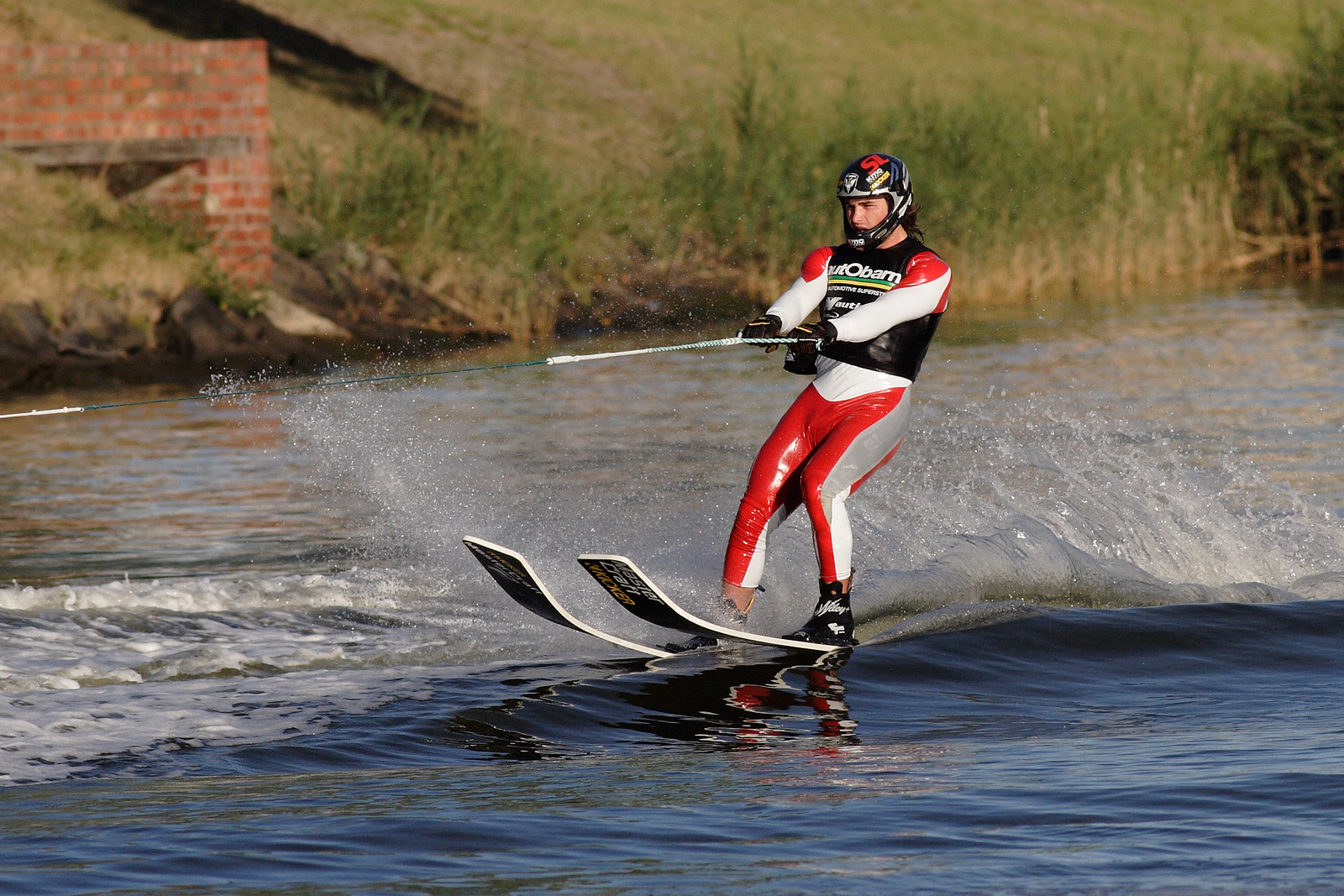
Water skiing (also waterskiing or water-skiing) is a surface water sport in which an individual is pulled behind a boat or a cable ski installation over a body of water, skimming the surface on one or two skis. The sport requires sufficient area on a stretch of water, one or two skis, a tow boat with tow rope, two or three people (depending on local boating laws),[1] and a personal flotation device. In addition, the skier must have adequate upper and lower body strength, muscular endurance, and good balance.
There are water ski participants around the world, in Asia and Australia, Europe, Africa, and the Americas.[2] In the United States alone, there are approximately 11 million water skiers and over 900 sanctioned water ski competitions every year.[3] Australia boasts 1.3 million water skiers.[4]
There are many options for recreational or competitive water skiers. These include speed skiing, trick skiing, show skiing, slaloming, jumping, barefoot skiing and wakeski. Similar, related sports are wakeboarding, kneeboarding,[5] discing, tubing, and sit-down hydrofoil.
Basic technique
[edit]
Water skiers can start their ski set in one of two ways: wet is the most common, but dry is possible. Water skiing typically begins with a deep-water start. The skier enters the water with their skis on or they jump in without the skis on their feet, having the skis floated to them, and put them on while in the water. Most times it can be easier to put the skis on when they are wet. Once the skier has their skis on they will be thrown a tow rope from the boat, which they position between their skis or, if on only one ski, to the left if right foot forward and to the right if left foot forward. In the deep-water start, the skier crouches down in the water while holding onto the ski rope; they are in a cannonball position with their legs tucked into their chest, with skis pointing towards the sky and approximately 30 cm (0.98 ft) of the ski out of the water. The skier can also perform a "dry start" by standing on the shore or a pier; however, this type of entry is recommended for professionals only. When the skier is ready (usually acknowledged by them yelling "in gear,": followed by "hit it"), the driver accelerates the boat. As the boat accelerates and takes up the slack on the rope, the skier allows the boat to pull them out of the water by applying some muscle strength to get into an upright body position.
By leaning back and keeping the legs slightly bent, the skis will eventually plane out and the skier will start to glide over the water. The skier turns by shifting weight left or right. The skier's body weight should be balanced between the balls of the feet and the heels. While being towed, the skier's arms should be relaxed but still fully extended so as to reduce stress on the arms. The handle can be held vertically or horizontally, depending on whichever position is more comfortable for the skier.
In addition to the driver and the skier, a third person known as the spotter or the observer should be present. The spotter's job is to watch the skier and inform the driver if the skier falls. The spotter usually sits in a chair on the boat facing backwards to see the skier. The skier and the boat's occupants communicate using hand signals (see the Safety section below).
Equipment
[edit]Water
[edit]
Water skiing can take place on any type of water – such as a river, lake, or ocean – but calmer waters are ideal for recreational skiing. There should be a 60-metre-wide (200 ft) skiing space and the water should be at least 1.5 to 1.8 metres (5 to 6 ft) deep. There must be enough space for the water skier to safely "get up", or successfully be in the upright skiing position. Skiers and their boat drivers must also have sufficient room to avoid hazards. Most competitive skiers ski on man-made ski lakes. The first was in Barstow, California, built by Jack Horton in 1969. The second, built by Herb O'Brien, was built in 1972 in Redmond Washington.[citation needed]
Skis
[edit]
Younger skiers generally start out on children's skis, which consist of two skis tied together at their back and front. These connections mean that less strength is necessary for the child to keep the skis together. Sometimes these skis can come with a handle to help balance the skier as well.[6] Children's skis are short – usually 110–150 centimetres (45–60 in) long[6] – reflecting the skier's smaller size. Once a person is strong enough to hold the skis together themselves there are various options depending upon their skill level and weight.
Water skiers can use two skis (one on each foot, also called "combo skiing"[7]) or one ski (dominant foot in front of the other foot,[8] also called "slalom skiing"[7]). Generally the heavier the person, the bigger the skis will be. Length will also vary based on the type of water skiing being performed; jump skis, for example, are longer than skis used in regular straight-line recreational skiing or competitive slalom and trick skiing. A trick ski is around 40 inches long and wider than combo skis. Again the skier rides it with his or her dominant foot in front. It has no fins which allows for spins to be performed.
Modern water skis have evolved from wooden barrels and snow skis to sophisticated composites of thermoplastics, aluminum, Kevlar, and carbon fiber. These materials make the skis not only high-performing but also sustainable, as manufacturers now use recycled materials to reduce waste and environmental impact. The incorporation of these advanced materials has led to skis that are incredibly strong, lightweight, and flexible, enhancing both performance and durability. Classic water skis are approximately 1.7 meters (5.5 feet) long and 15 centimeters (6 inches) wide, equipped with a stabilizing fin and rubber foot bindings for safety during falls. In contrast, skis used for trick or figure waterskiing are shorter, lack fins for complete rotation capability.[9]
Boat
[edit]
Competition skiing uses specifically designed towboats. Most towboats have a very small hull and a flat bottom to minimize wake. A true tournament ski boat will have a direct drive motor shaft that centers the weight in the boat for an optimal wake shape. However, some recreational ski boats will have the motor placed in the back of the boat (v-drive), which creates a bigger wake. Permitted towboats used for tournament water skiing are the MasterCraft ProStar 197, MasterCraft ProStar 190, Ski Nautique 200, Malibu Response TXi, and Centurion Carbon Pro.[10] These boats have ability to pull skiers for trick skiing, jumping, and slalom.[11]
Recreational boats can serve as water skiing platforms as well as other purposes such as cruising and fishing. Popular boat types include bowriders, deckboats, cuddy cabins, and jetboats.[12]
The towboat must be capable of maintaining the proper speed. Speeds vary with the skier's weight, experience level, comfort level, and type of skiing.[13] For example, a child on two skis would require speeds of 21–26 km/h (13–16 mph), whereas an adult on one ski might require as high as 58 km/h (36 mph). Barefoot skiing requires speeds of approximately 72 km/h (45 mph; 39 kn). Competition speeds have a wide range: as slow as 22 km/h (14 mph; 12 kn) up to 58 km/h (36 mph; 31 kn) for slalom water skiing, and approaching 190 km/h (120 mph; 100 kn) in water ski racing.[14]
The boat must be equipped with a ski rope and handle. The tow rope must be sufficiently long for maneuvering, with a recommended length of 23 metres (75 ft)[15] (within tolerance[16]) although length varies widely depending on the type of water skiing and the skier's skill level. Competition requirements on rope construction have changed over the years, from "quarter-inch polypropylene rope" in 1992[17] to the 2003 flexibility as long as the same specification is used "for the entire event."[18] The handle width and diameter sizes are based on skier preference, and the handle grip is a tough rubber material. Skiers will often wear gloves to assist in holding the handle at the higher speeds as well as keep from hurting their hands.[19] The rope and handle are anchored to the boat and played out at the stern. This anchor point on a recreation boat is commonly a tow ring or cleat, mounted on the boat's stern.[citation needed] For more dedicated skiers, a metal ski pylon is placed in the center of the boat in front of the engine to connect the skier. This pylon must be mounted securely, since a skilled slalom skier can put a considerable amount of tension on the ski rope and the pylon.
Safety measures
[edit]As water skiing is a potentially dangerous sport, safety is important.
There should be a 200 feet (61 m) wide skiing space and the water should be at least 5 to 6 feet (1.5 to 1.8 m) deep. The towboat should stay at least 100 feet (30 m) from docks, swim areas, and the shore, and other boats should steer clear of skiers by at least 100 feet.[15] Without proper space and visibility skiing can be extremely dangerous. Skiers should wear a life jacket regardless of swimming ability,[13] although the expectation that all skiers are also competent swimmers is advisable as well. Specially-designed life jackets or ski vests allow movement needed for the sport while still providing floatation for a downed or injured skier.[20] The most common water ski injuries involve the lower legs, such as the knee, because a fall at high speed can create irregular angles of collision between the skier's body and the water surface. Another common cause of injury is colliding with objects on or near the water, like docks.[13]
The tow boat must contain at least two people: a driver and an observer.[13] In most locales, the observer will need to be at least 12 years of age. The driver maintains a steady course, free of obstacles to the skier. The observer continually observes the skier, relays the condition of the skier to the boat driver, and if necessary, raises the "skier down" warning flag, as required, when a skier is in the water, returning to the boat, or in some localities, the entire time the skier is out of the boat.[21][22] The skier and observer should agree on a set of standard hand-signals for easy communication: stop, speed up, turn, I'm OK, skier in the water, etc.[13][23]
History
[edit]

Water skiing was invented in 1922 when Ralph Samuelson used a pair of boards as skis and a clothesline as a towrope on Lake Pepin in Lake City, Minnesota.[24] Samuelson experimented with different positions on the skis for several days until 2 July 1923. Samuelson discovered that leaning backwards in the water with ski tips up and poking out of the water at the tip was the optimal method. His brother Ben towed him and they reached a speed of 32 kilometres per hour (20 mph).[25] Samuelson spent 15 years performing shows and teaching water skiing to people in the United States.
Samuelson went through several iterations of equipment in his quest to ski on water. His first equipment consisted of barrel staves for skis.[25] He later tried snow skis,[25] but finally fabricated his own design out of lumber with bindings made of strips of leather. The ski rope was made from a long window sash cord.[25] Samuelson never patented any of his ski equipment.
The first patent for water skis was issued to Fred Waller, of Huntington, NY, on 27 October 1925, for skis he developed independently and marketed as "Dolphin Akwa-Skees." Waller's skis were constructed of kiln-dried mahogany, as were some boats at that time. Jack Andresen patented the first trick ski, a shorter, fin-less water ski, in 1940.
In 1928, Don Ibsen developed his own water skis out in Bellevue, Washington, never having heard of Samuelson or Waller. In 1941, Don Ibsen founded The Olympic Water Ski Club in Seattle, Washington. It was the first such club in America. Ibsen, a showman and entrepreneur, was one of the earliest manufacturers of water skis and was a leading enthusiast and promoter of the sport. In 1983, he was inducted into the Water Ski Hall of Fame in Winter Haven, Florida.[26]
The sport of water skiing remained an obscure activity for several years after 1922, until Samuelson performed water ski shows from Michigan to Florida. The American Water Ski Association formally acknowledged Samuelson in 1966 as the first recorded water skier in history. Samuelson was also the first ski racer, slalom skier, and the first organizer of a water ski show.[27]
Parallel to this, an avid sailor, sportsman and early adopter of water skiing, the young Swedish engineer Gunnar Ljungström (1905–1999) pioneered water skiing in slalom moves from 1929. A demonstrating behind a motorboat was made to the Swedish public at the 100th anniversary of the Royal Swedish Yacht Club in Sandhamn outside Stockholm in 1930.[28]
Water skiing gained international attention in the hands of famed promoter, Dick Pope, Sr., often referred to as the "Father of American Water Skiing" and founder of Cypress Gardens in Winter Haven, Florida. Pope cultivated a distinct image for his theme-park, which included countless photographs of the water skiers featured at the park. These photographs began appearing in magazines worldwide in the 1940s and 1950s, helping to bring international attention to the sport for the first time.[29] He was also the first person to complete a jump on water skis, jumping over a wooden ramp in 1928, for a distance of 25 feet.[30] His son, Dick Pope, Jr., is the inventor of bare-foot skiing. Both men are in the Water Ski Hall of Fame. Today, Winter Haven, Florida, with its famous Chain of Lakes, remains an important city for water skiing, with several major ski schools operating there.
Water skiing has developed over time. Water skiing tournaments and water skiing competitions have been organized. As an exhibition sport, water skiing was included in the 1972 Olympics. The first National Show Ski Tournament was held in 1974, and the first ever National Intercollegiate Water Ski Championships were held in 1979. The Home CARE US National Water Ski Challenge, the first competition for people with disabilities, was organized ten years later.
The first patented design of a water ski which included carbon fiber was that of Hani Audah at SPORT labs in 2001. Its first inclusion in tournament slalom skiing was in 2003.[31]
Disciplines
[edit]3-event tournament water skiing
[edit]In the United States, there are over 900 sanctioned water ski competitions each summer.[3] Orlando, Florida is considered to be the competitive 3-event waterskiing capital of the world.[32] Competitive water skiing consists of three events: slalom, jump, and trick.[3][33]
Slalom
[edit]
In an attempt to become as agile as possible, slalom water skiers use only one ski with feet oriented forward, one in front of the other. Slalom skis are narrow and long, at 57–70 inches (145–178 cm) depending on the height and weight of the skier. The two forward-facing bindings vary: they can be made of rubber or thick plastic, and they can be designed more like a snow ski binding or more like a roller blade boot.
Slalom skiing involves a multi-buoy course that the skier must go around in order to complete the pass. A complete slalom water ski course consists of 26 buoys. There are entrance gates at the beginning and end of the course that the skier must go between, and there are 6 turn buoys that the skier must navigate around in a zigzag pattern. The remainder of the buoys are for the driver to ensure the boat goes straight down the center of the course. For a tournament to be sanctioned as 'record capable' by the International Waterski & Wakeboard Federation (IWWF), the entire course must be surveyed prior to competition by a land surveyor to ensure its accuracy. The drivers boat path must be verified as well to ensure that all skiers are getting a fair pull.
Every consecutive[33] pass is harder than the pass before it. When a pass is completed, the boat is sped up by 3 kilometres per hour (2 mph) or the rope is shortened by specific increments. The rope is usually not shortened until the maximum speed has been reached for the division, based on the skier's gender and age (55 kilometres per hour (34 mph) for women and 58 kilometres per hour (36 mph) for men). In a tournament, the boat speeds up or the rope shortens until the skier fails to complete the slalom course by falling, not getting around a buoy, or missing an entrance or exit gate.[33]
A skier's score is based upon the number of successful buoys cleared, the speed of the boat, and the length of the rope. In a tournament, skiers choose the starting boat speed and rope length (with a maximum length of 22.86 metres (75 ft)). Professional water skiers will typically start at the max speed of 58 kilometres per hour (36 mph) with a rope that has already been shortened to 13 metres (43 ft). The skier with the most buoys wins the competition.[33]
The turn buoys are positioned 11.5 metres (38 ft) away from the center of the slalom course. As the rope is shortened beyond that, the skiers are required to use the momentum generated through their turns to swing up on the side of the boat and reach out in order to get their ski around the next buoy. At these rope lengths, the skier's body is experiencing intense isometric contractions and extreme upper body torque with loads of up to 600 kg as they begin accelerating after rounding a turn buoy. Their top speeds will generally be more than double the boat's speed, which means that the Pro men can reach speeds in excess of 116 kilometres per hour (72 mph) and each turn will generally generate around 4 g of force. Essentially, slalom water skiers are using their body as a lever, which allows them to withstand loads that would otherwise not be possible for the human body.
Jump
[edit]Water ski jumpers use two long skis to ride over a water ski jump in an attempt to travel the longest distance. In a tournament, skiers are given three attempts to hit the ramp. The winner is the skier who travels the farthest calculated[18] distance and successfully rides away.[34] There are no style points, simply distance.[33]
Water ski jumps have specific dimensions and the ramp height is adjustable. Skiers may choose their boat speed and ramp height, although there are maximums based the skier's gender and age. Professional ski jumpers have a maximum boat speed of 58 km/h (36 mph; 31 kn). The ramp height must be between 1.5 and 1.8 m (5 and 6 ft). As a professional jumper approaches the ramp they will zigzag behind the boat in a series of cuts[34] to generate speed and angle. When the jumper hits the ramp they will generally be going over 112 kilometres per hour (70 mph) and the load they have generated on the rope can be over 600 kilograms (1,300 lb).
Trick
[edit]
The Trick competition has been described as the most technical of the three classic water skiing events.[33]
Trick skiing uses small, oval-shaped or oblong water skis. Beginners generally use two skis while more advanced skiers use one.[33] The shorter, wider Trick ski has a front binding facing forward and a back binding facing at a 45°. It has a smooth bottom that allows it to turn over the surface of the water. According to official 2013 Tournament Rules for 3-event competition in the United States and the Pan-Am Games, skis used in the Tricks event must be a single ski without fins, although molded rails/grooves less than 6.4 mm (1⁄4 in) are allowed, as are a foot pad cemented to the ski as a place for the rear foot; in addition, the ski must float with all bindings, fins, etc., installed.[citation needed] The ski's configuration allows the skier to perform both surface and air tricks in quick succession.
In a tournament, skiers are given two 20-second runs during which they perform a series of their chosen tricks. In most cases, one pass is for hand tricks, which includes surface turns, rotations over the wake, and flips. The second pass is for toe tricks, which are done by doing wake turns and rotations with only a foot attaching them to the handle; the foot is either in the toehold part of the handle or, professionally, attached to the rope.[33] The toehold part of the handle does not allow the skier to let go of the handle if they lose their balance and fall into the water, therefore a person in the boat is required to release the rope from the boat using a quick release mechanism installed on the ski pylon. A trick cannot be repeated.[33] Each trick has a point value. A panel of five judges assesses which tricks were completed correctly and assigns that predetermined point value to each successfully completed trick. The skier with the most points wins.[33]
Barefoot water skiing
[edit]
A barefoot water skier should use a wetsuit instead of a life jacket because the wetsuit covers more of the body in case of a fall at high speed. The wetsuit also allows the skier to do starts in the water where they lie on their back. Unlike a normal life jacket, the "barefoot wetsuit" allows the skier to glide on their back on top of the water once they reach a high enough speed. The barefoot wetsuit is generally thicker in the back, rear, and chest for flotation and impact absorption.
Barefoot skiing requires a higher speed because the skier's feet are smaller than skis, providing less lift. A rule of thumb for barefoot water skiing speed in miles per hour is (M/10)+18=S, where M equals the skier's weight in pounds. In other words, a 175 lb (79 kg) person would have to divide 175/10, which is 17.5; then simply add 17.5+18 which equals 35.5 miles per hour (57.1 km/h).
Another tool used in barefoot water skiing is the barefoot boom. It provides a stable aluminum bar on the side of the boat where a short rope can be attached or the skier can grip the bar itself. The skier is within earshot of the people in the boat, providing a good platform for teaching. Once the bare footer is good enough, he/she will go behind the boat with a long rope.
A beginner can wear shoes to decrease the necessary speed, lessen foot injury from choppy water, learn better technique, and master the sport.
Show skiing
[edit]
Show skiing is a type of water skiing where skiers perform tricks somewhat similar to those of gymnasts while being pulled by the boat. Traditional ski show acts include pyramids, ski doubles, freestyle jumping, and swivel skiing. Show skiing is normally performed in water ski shows, with elaborate costumes, choreography, music, and an announcer. Show teams may also compete regionally or nationally. In the US, each team member must be a member of USA Water Ski to compete.
The first organized show occurred in 1928.[35] The bi-annual World Show Ski Championship was inaugurated in September 2012 in Janesville, Wisconsin.[36][37] Past competition included teams from Australia, Belgium, Canada, China, and the United States.[36]
Freestyle jumping
[edit]Freestyle jumping is often related to show skiing. The goal is to go off the jump, perform one of many stunts, and successfully land back on the water. The most common freestyle stunts – in order of usual progression – would be a heli (360°), a flip (forwards), a gainer (a back flip), and a möbius (back flip with 360°).
Ski racing
[edit]
Water ski racing consists of 1 or 2 skiers per boat who race around a set course behind boats set up for this type of event. It can occur in a 'circle' or lap format type racing or on river courses offering longer distances and higher speeds. Races can be timed events such as 20 minute races and up to 1 hour or on courses where race distance can be over 100 km in length.
Speeds vary by classes but can reach up to 200 km/h. Boats can be inboards or outboards and are generally between 19 and 21 feet in length. Outboards are commonly 300HP and Inboards around 1,300HP (majority are turbocharged).
Current format world championship racing involves men's and women's open (unrestricted), and men's and women formula 2 (limited to single rig, 300 hp outboards, as well as junior classes for under 17's. The World Championships are held every 2 years with the most recent being 2019 in Vichy, France.
Major events include the Southern 80 (Echuca Victoria Australia), the Diamond Race (Viersel Belgium), the Catalina ski race (Long Beach CA United States), and the Bridge to Bridge (Sydney Australia). Races can have anywhere from 10 boats to 150 boats competing (grouped by engine size and age classes).
Disabled
[edit]
Disabled water skiing uses equipment or other adaptations to allow disabled people to compete in standard 3 event skiing. Seated water skis, special handles, audio slalom gear, and other adaptations are all used for different disabilities.
Criticism
[edit]While water skiing is very popular, it is not universally liked. The fast, powerful boats create noise,[38] cause waves which can cause beach erosion, and sometimes hit swimmers, other boats, or marine life. People operating boats may drink alcohol, which increases the chance of accidents. Water skiing is also criticized for air pollution from the boats' engines, and the unnecessary use of fuel (usually gasoline) and the consequent impact to climate change.
See also
[edit]- Aquaplaning (sport)
- George A. Blair ("Banana George")
- Cable skiing
- List of U.S. Open of Water Skiing champions
- List of Water Ski World Championships champions
- List of Water Skiing European Champions
- List of members of the Water Ski Hall of Fame
- Masters Water Ski Tournament
- Moomba Masters Champions
- Queenie (waterskiing elephant)
- Twiggy the Water-Skiing Squirrel
- U.S. Professional Water Ski Tour
- Water Ski World Championships
Notes
[edit]- ^ "State Boating Laws: Water Skiing". U.S. Coast Guard's Boating Safety Division. Retrieved 29 August 2020.
- ^ "Regional Sites". International Waterski & Wakeboard Federation. Archived from the original on 4 October 2008.
- ^ a b c "USA Water Ski Profile". USA Water Ski. Archived from the original on 27 September 2013. Retrieved 1 October 2013.
- ^ "About Us". Australian Waterski & Wakeboard Federation. Archived from the original on 24 January 2014. Retrieved 29 October 2013.
- ^ Ritchhart, Mark (September 2009). "Kneeboarding – Fun For Everyone" (PDF). The Water Skier. USA Water Ski: 46–47. Archived from the original (PDF) on 6 January 2011.
- ^ a b Macaco, Houlihan (27 January 2011). "Children's Waterskis". Made Manual. Break Media. Archived from the original on 29 October 2013. Retrieved 23 October 2013.
- ^ a b Bostian, Julie. "Dropping a Water Ski to Go Slalom Waterskiing". About.com. Archived from the original on 13 April 2014. Retrieved 29 October 2013.
- ^ Bostian, Julie. "Determining Which Foot to Put Forward in Slalom Water Ski or Wakeboard Bindings: Are You Goofy Footed In Your Wakeboard Bindings or Slalom Water Ski Bindings?". About.com. Archived from the original on 13 April 2014. Retrieved 29 October 2013.
- ^ "Waterskiing | Equipment, Techniques & Safety | Britannica". www.britannica.com. Retrieved 6 February 2024.
- ^ American Water Ski Association Approved Tournament Towboats, 2013 (PDF), American Water Ski Association, 15 January 2013, archived (PDF) from the original on 16 September 2012
- ^ Geena (7 May 2013). "Best of Boats: Top Tournament Ski Boats 2013". Waterski Magazine. Archived from the original on 8 September 2013.
- ^ "Watersports", Boat Buyer Guide for Watersports & Recreation Boating, Discover Boating, archived from the original on 3 December 2013
- ^ a b c d e "Learn to Ski Basics" (PDF), Basic Skills Challenge Series, USA Water Ski, archived (PDF) from the original on 24 January 2014
- ^ "National Water Ski Racing Association: History and Description". USA Water Ski. Archived from the original on 21 September 2013. Retrieved 29 October 2013.
- ^ a b "Water Skiing and Diving". Boating Activities. Boat US (Boat Owners Association of the United States). 2008. Archived from the original on 15 September 2013. Retrieved 29 October 2013.
- ^ Risto (21 February 2014). "Are You Skiing with a Short Ski Rope?". Waterski Magazine. Archived from the original on 5 August 2017. Retrieved 2 November 2015.
- ^ Corson, Robert (1992). "International Water Ski Federation Tournament Manual". International Waterski & Wakeboard Federation. Archived from the original on 4 October 2013. Retrieved 1 October 2013.
- ^ a b Corson, Robert K., ed. (20 January 2003). "International Water Ski Federation 2003 Tournament Water Ski Rules (Version 1.1)". International Water Ski Federation. Archived from the original on 5 December 2010.
- ^ "Waterski Handles vs. Wakeboard Handles". WakeHouse. Retrieved 15 October 2024.
- ^ "US Coast Guard Approved Life Jackets". WaterDudes.org. 20 November 2017. Retrieved 29 August 2020.
- ^ "Public Act 098-0697". Illinois General Assembly. 1 January 2015. Archived from the original on 4 March 2016. Retrieved 2 November 2015.
- ^ Washington State Legislature (25 July 1994). "WAC 352-60-120: Water ski observer". Access Washington. Archived from the original on 18 October 2011.
- ^ "Water-Skiing Hand Signals", Pennsylvania Boating Handbook, Pennsylvania Fish & Boat Commission, retrieved 23 October 2013
- ^ "Hall of Fame". Minnesota Water Ski Association. Retrieved 29 January 2021.
- ^ a b c d "History of Water Skiing". ABC of Skiing. MaxLifestyle International Inc. Archived from the original on 21 April 2008.
- ^ "Don Ibsen". USA Water Ski & Wake Sports Foundation. Retrieved 29 August 2020.
- ^ "Ralph W. Samuelson". Water Ski Hall of Fame and Museum. Archived from the original on 26 June 2004.
- ^ Fredrik Ljungström 1875–1964 Uppfinnare och inspiratör (1999) by Olle Ljungström, Sveriges Mekanisters Riksförening, ISBN 91-630-7639-X
- ^ The Lakeland Ledger, 29 January 1988. Vol. 82 No.99 Pg11A
- ^ Pope, Dick Sr. (1958). Water Skiing. Englewood Cliffs, NJ: Prentice-Hall. p. 52.
- ^ "Water Skiing". Archived from the original on 23 March 2012. Retrieved 27 October 2011.
- ^ "How Orlando Became the Mecca of Water Skiing". Waterski Magazine. Archived from the original on 4 September 2016. Retrieved 2 May 2017.
- ^ a b c d e f g h i j "World Championship History". Water Ski World Cup (WSWC). Archived from the original on 19 October 2006.
- ^ a b "Jump Gold". Rip 'n Ride. Water Ski and Wakeboard Canada. Archived from the original on 4 October 2013. Retrieved 1 October 2013.
- ^ "National Show Ski Association: A Brief History of Show Skiing". USA Water Ski. Archived from the original on 5 November 2013.
- ^ a b Rock Aqua Jays Water Ski Club, Inc., 2014 WORLD SHOW SKI TOURNAMENT (PDF), International Waterski & Wakeboard Federation, archived (PDF) from the original on 22 October 2013, retrieved 29 October 2013
- ^ "Master Calendar of Events". USA Water Ski. 28 October 2013. Archived from the original on 20 October 2013. Retrieved 29 October 2013.
9/12 – 9/14[2014] – 2nd IWWF World Show Ski Tournament – Janesville, Wis.
- ^ "Nearby residents not fully on board with water skiing club". thestar.com. 28 June 2017. Retrieved 28 June 2023.
External links
[edit]
| Artistic and dance sports | |
|---|---|
| Ball sports | |
| Martial arts | |
| Precision sports | |
| Strength sports | |
| Trend sports | |
| Past official sports | |
| Invitational sports (never made official) | |

| Activities in water | |
|---|---|
| Activities on water | |
| Team sports | |
| Competitions | |
| International | |
|---|---|
| National | |
| Other | |

Water skiing
View on GrokipediaFundamentals
Definition and Basic Technique
Water skiing is a surface water sport in which an individual balances on one or two skis while being towed across a body of water by a motorized boat or cable system, planing on the surface through hydrodynamic lift generated by the skis at sufficient speed.[6][7] Typical entry-level speeds range from 18 to 25 miles per hour (29 to 40 km/h), allowing the skis to generate the necessary lift to support the skier's weight without submersion.[6] The core technique revolves around the deep water start, executed in water depth exceeding the skier's height to avoid ground contact. The skier dons skis fitted with adjustable bindings securing the feet, positions the skis parallel with tips elevated above the water, and grips the tow rope handle—often placed between the thighs or against the chest for stability.[6][8] Upon signaling the boat operator, acceleration begins; the skier assumes a crouched posture with knees drawn toward the chest, back slightly arched, and arms extended holding the rope taut to minimize drag.[6] As forward momentum builds and rope tension loads the skis, the skier maintains flexed knees and closed legs, gradually straightening them to rise onto the planing surface while leaning backward to counter the pulling force and distribute weight rearward over the ski edges.[6][8] This sequence leverages the boat's power to overcome initial water resistance, typically achieving upright planing within seconds if executed correctly. Once planing, fundamental control involves maintaining straight arms, centered body weight, and forward gaze to track the boat path.[9] For directional changes on two skis, the skier initiates turns by applying pressure to the outside ski's edge—pushing it outward with the corresponding foot—while leaning the upper body into the turn direction, allowing the skis to carve across the water surface.[10] Advanced progression to single slalom skiing requires first mastering two-ski stability before dropping one ski mid-run, emphasizing precise edging and handle pressure to sustain speed through wakes.[11] Proper technique minimizes fall risk by prioritizing gradual extension and balanced lean, as abrupt movements disrupt planing and cause submersion.[12]Physics and Biomechanics
The hydrodynamic lift generated by water skis enables a skier to plane across the surface, supporting the skier's weight primarily through dynamic pressure rather than buoyancy once sufficient speed is attained. The lift force arises from the skis' interaction with oncoming water flow and is modeled as , where is the drag coefficient (typically ~0.2 under turbulent conditions with Reynolds number ~10^7), is water density (1000 kg/m³), is the wetted area (~1 m² for typical skis), is relative water speed, and is the small angle of attack to the surface.[13] For a 100 kg skier at m/s (~36 km/h or 22 mph) with , N, countering gravitational force ; minimum planing speed exceeds ~4.5 m/s depending on ski design and load.[13] Drag force opposes motion, yielding ~100 N under similar conditions, with the tow rope's horizontal tension component balancing it while its vertical component supplements lift.[13][14] In maneuvers like slalom turns, the skier's pendulum swing toward the boat wake allows velocity to peak at 114–135% of boat speed (~51 km/h typical), converting potential energy from rope height into kinetic energy via tension-directed acceleration.[15][16] Centripetal force (r ~5–10 m in competitive turns) is supplied by edging the ski (roll angles up to 59°), producing lateral hydrodynamic forces and decelerations to -12.5 m/s² (~1.3g) at turn apex, followed by accelerations to +13.6 m/s² on exit.[16] Rope tension peaks at 1.4–2.7 times body weight (BW) during cuts and deep-water starts, with higher loads on the inside ski due to uneven force distribution.[15][16] Biomechanically, the skier maintains equilibrium by positioning the center of mass forward and low, flexing knees to adjust dynamically and absorb wave-induced vertical forces, while core and hip rotators counter torsional torques from asymmetric ski loads.[16] Arm extension controls rope angle, minimizing vertical tension component; excessive lean or rearward weight shifts elevate drag and rope load, as wider ski designs reduce peak loads by distributing hydrodynamic pressure more evenly.[15] In straight-line planing, thrust from boat propulsion (modeled as mass flow rate times velocity change, per Newton's second law) must exceed combined drag and gravitational components to sustain speed, with power requirements ~100 W for minimal drag scenarios.[14][13]Equipment and Requirements
Skis, Bindings, and Accessories
Water skis vary by discipline, skier weight, ability, and boat speed, with lengths and widths optimized for planing efficiency and control. Combo skis, suitable for beginners learning on two skis, typically range from 65 to 68 inches long for adults, providing ample surface area for easier starts at lower speeds. Slalom skis, used in single-ski courses, measure 61 to 69.5 inches, with specific models like the Radar Vapor scaled to skier weights from 85 to 220 pounds for optimal flex and edge hold. Jump skis extend longer, often 72 to 78 inches, to enhance stability during aerial maneuvers, while trick skis are shorter at around 54 to 60 inches, featuring flat bottoms without fins to facilitate spins and flips on the water surface.[17][18][19] Modern skis incorporate advanced materials such as fiberglass for a balance of durability and flexibility or carbon fiber over foam cores for enhanced stiffness and responsiveness, allowing precise shaping for reduced drag and improved turning. Bottom concaves generate lift and suction for better wake crossing, while side edges—often rounded to channel water flow—aid in grip without the sharpness of snow skis. Removable fins at the tail, adjustable in depth and length via fin blocks, prevent lateral sliding during straight-line tracking and modulate turn radius; deepening the fin increases bite for sharper turns but may reduce acceleration, with adjustments typically made in 0.010-inch increments for fine-tuning based on skier preference and conditions.[20][21][22][23] Bindings secure the skier's feet to the ski, with types including open-toe for easier entry and shared use, closed-toe for precise fit and heel lock, and hybrids combining rubber flexibility with hard-shell support. Slalom setups often pair a fixed front boot with a rear toe strap or adjustable RTP (rubber toe piece) for quick releases, while combo skis use dual bindings per ski for two-footed stance; materials like neoprene provide cushioning, and mounting plates allow customization for stance width.[24][25][26] Accessories enhancing ski performance and maintenance include fin kits with multiple depths for experimentation, edge protectors to prevent damage during transport, and storage bags designed to fit specific ski lengths while protecting against UV degradation and impacts. Binding hardware such as adjustable plates and liners ensures compatibility across models, and occasional edge beveling maintains hydrodynamic efficiency, though water skis require less frequent sharpening than snow variants due to their rounded profiles.[27][28][29]Boats, Tow Lines, and Propulsion
In water skiing, towboats are specialized inboard vessels engineered for low wake production and skier safety, with the propeller positioned beneath the hull to eliminate exposed blades that could cause injury upon falls. Towboats feature transom-mounted ski tow hooks for attaching the tow line, typically rust-free stainless steel U-bolt or eyebolt designs with baseplates for strength or pre-made transom brackets from brands like Attwood. These hooks should have at least 500–1000 kg break strength for safety.[30] Direct-drive inboards predominate in traditional skiing due to their balanced weight distribution and flatter wakes compared to outboards or sterndrives, which position propulsion externally and generate more turbulence.[31] For tournament competition, the USA Water Ski & Wake Sports requires boats to pass rigorous evaluations encompassing power output, acceleration to target speeds within seconds, maneuverability, and minimal wake at operational velocities, ensuring equitable conditions across events.[32][33] Tow lines consist of durable, low-stretch synthetic fibers such as pre-stretched polypropylene or ultra-high-molecular-weight polyethylene (like Dyneema or Spectra) to provide consistent tension without elongation under load, critical for precision in slalom and trick disciplines.[34][35] Standard recreational and full-line tournament ropes measure 75 feet, comprising a 70-foot mainline and 5-foot handle section with ergonomic grips, often featuring color-coded segments for progressive shortening in slalom—typically to 67 feet for the first "off," enabling skiers to navigate buoys at reduced distances from the boat path.[34][36] Propulsion systems in ski towboats employ gasoline-fueled internal combustion engines, usually V8 configurations in direct- or V-drive setups delivering 360 to 450 horsepower for reliable torque and speed maintenance under skier resistance.[37][38] These enable controlled velocities from 20-25 mph for novice barefooting or two-ski starts to 34 mph for women's slalom and 36 mph for men's, with electronic speed controls ensuring precision within 0.1 mph tolerances during passes.[39] Diesel alternatives exist for endurance but are rarer in competitive skiing due to higher weight impacting acceleration.[40]Water Body Conditions
Water body conditions significantly influence the safety and feasibility of water skiing, with empirical guidelines emphasizing sufficient depth, calm surfaces, and controlled environmental factors to minimize risks such as propeller strikes, collisions with submerged obstacles, or loss of control. Minimum water depth is typically recommended at 5 feet (1.52 meters) of obstacle-free water to prevent skiers from striking the bottom during deep-water starts, falls, or low-speed maneuvers, as shallower depths increase injury potential from impact or entanglement.[41] [42] For competitive or barefoot skiing involving jumps, depths of at least 1.5 meters are advised to accommodate aerial maneuvers and landings without bottom contact.[42] Surface conditions must prioritize flat, open water free from strong currents, undertows, or excessive roughness, as turbulent flows can destabilize skiers, exacerbate fatigue, and elevate drowning risks in the event of a fall. Ideal setups require a skiing corridor at least 200 feet (61 meters) wide—providing 100 feet of clearance on each side of the tow path—and 2,000 to 3,000 feet (610 to 914 meters) long to allow for acceleration, turns, and safe deceleration without encroaching on shorelines, swimmers, or other vessels.[43] [44] [45] Wind speeds exceeding 10 kilometers per hour (6 mph) often generate choppy waves or whitecaps, which reduce visibility, increase drag on tow lines, and heighten collision hazards, rendering conditions suboptimal for beginners or precision disciplines like slalom.[46] Water temperature affects participant endurance and hypothermia risk, with comfortable ranges of 21–29°C (70–84°F) allowing prolonged sessions without thermal protective gear; below 16°C (60°F), wetsuits or drysuits are essential to maintain core body temperature, as prolonged exposure in colder water impairs muscle function and judgment.[47] Organizations like the USA Water Ski & Wake Sports Federation implicitly endorse these parameters through safety protocols that mandate avoidance of hazardous environments, though they defer to local regulations for site-specific enforcement.[48] Compliance with such standards, derived from incident data showing higher injury rates in suboptimal conditions, ensures causal links between environmental factors and accident prevention are respected in practice.[49]Safety and Risk Assessment
Empirical Injury Data
A national database analysis of water skiing-related injuries treated in United States emergency departments from 2012 to 2022 reported 898 cases, with the majority involving Caucasian males during competitive events.[50] The head accounted for 20% of injuries (177 cases), followed by the face at 10% (93 cases) and the knee at 8% (70 cases).[50] Lower extremity injuries predominated overall, consistent with patterns observed in earlier periods.[50] From 2000 to 2007, an estimated 52,399 water skiing-related injuries occurred in United States emergency departments, averaging about 6,550 annually.[51] These figures exclude fatalities and non-hospital-treated incidents, underrepresenting total morbidity. In a 1977 California report, waterskiing directly caused 70 serious injuries and 5 deaths, highlighting risks from high-speed falls and collisions.[52] Among collegiate water skiers, a survey of 96 athletes documented 336 injuries, with the ankle and feet, knee, and head/neck regions most affected across slalom, trick, and jump disciplines.[53] Lower-extremity injuries comprised 43.9% of cases regardless of event type.[53] In competitive settings, a United Kingdom study of 45 skiers identified 71 injuries, primarily strains and sprains (64.6%), with the back and trunk injured most frequently (38.8%).[54]| Injury Site | Percentage (2012-2022 NEISS Data) | Example Count |
|---|---|---|
| Head | 20% | 177 |
| Face | 10% | 93 |
| Knee | 8% | 70 |