Hubbry Logo
Yangshao cultureYangshao cultureMain
Open search
Yangshao culture
Community hub
Yangshao culture
logo
8 pages, 0 posts
0 subscribers
Be the first to start a discussion here.
Yangshao culture
Yangshao culture
from Wikipedia
Yangshao culture
Geographical rangeMiddle reaches of Yellow River
PeriodNeolithic
Datesc. 5000 – c. 3000 BC
Major sitesShuanghuaishu, Banpo, Jiangzhai
Preceded byPeiligang culture, Baijia culture, Dadiwan culture, Cishan culture
Followed byMajiayao (3300–2000 BC)
Longshan culture (3000-1900 BC)
Shimao culture (2300-1800 BE)
Chinese name
Chinese仰韶文化
Transcriptions
Standard Mandarin
Hanyu PinyinYǎngsháo wénhuà

The Yangshao culture (Chinese: 仰韶文化; pinyin: Yǎngsháo wénhuà) was a Neolithic culture that existed extensively along the middle reaches of the Yellow River in China from around 5000 BC to 3000 BC. The Yangshao culture saw social and technological development in the region, with advancements in agriculture, architecture, and crafts.

The culture is named after the Yangshao site, the first excavated site of this culture, which was discovered in 1921 in the town of Yangshao in western Henan by the Swedish geologist Johan Gunnar Andersson (1874–1960).[1] The culture flourished mainly in Henan, as well as the neighboring provinces of Shaanxi and Shanxi.

Recent research indicates a common origin and spread of the Sino-Tibetan languages with the Cishan, Yangshao and/or Majiayao cultures.[2][3][4][5]

Origins

[edit]

After the discovery of the Yangshao site in 1921, Johan Gunnar Andersson hypothesized, based on his analysis of the pottery patterns, that the Yangshao culture was originated from Anau and Trypillian cultures, from Central Asia and Southwest Europe. His hypothesis is considered weak, as the similarity of the pottery patterns are now considered coincidental, and in 1954, it was estimated the Yangshao culture was more than 1,000 years older than the Anau culture.[6]

Later, Chinese archeologists, such as Yin Da, Shi Zhangru and Guo Baojun argued that the Yangshao culture was developed by the indigenous population from the Yellow River and transitioned to other cultures. Liang Siyong discovered a three-layer stratigraphy at the Hougang site, confirming the transaction from the Yangshao culture to the Longshan and Shang cultures.[7] It is now understood that the Yangshao culture had a big impact in the pottery culture Central Plains region, being transmitted from east to west. Some examples are the Shandong Longshan culture, considered to be its eastern branch, and the Majiayao culture, its western.[8]

Phases

[edit]
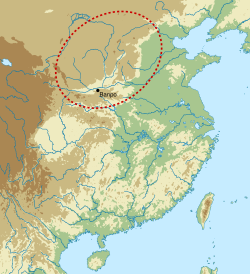
Red oval is the late Cishan and the early Yangshao cultures. After applying the linguistic comparative method to the database of comparative linguistic data developed by Laurent Sagart in 2019 to identify sound correspondences and establish cognates, phylogenetic methods are used to infer relationships among these languages and estimate the age of their origin and homeland.[5]

The Yangshao culture is conventionally divided into three phases:

  • The Early Yangshao period or Banpo phase (c. 5000–4000 BC) is represented by the Banpo, Jiangzhai, Beishouling and Dadiwan sites in the Wei River valley in Shaanxi.[9]
  • The Middle Yangshao period or Miaodigou phase (c. 4000–3500 BC) saw an expansion of the culture and population in all directions, and the development of hierarchies of settlements in some areas, such as western Henan.[10][11]
  • The Late Yangshao period (c. 3500–3000 BC) saw a greater spread of settlement hierarchies. The first wall of rammed earth in China was built around the settlement of Xishan (25 ha) in central Henan (near modern Zhengzhou).[12]

The Majiayao culture (c. 3300 – c. 2000 BCE) to the west is now considered a separate culture that developed from the middle Yangshao culture through an intermediate Shilingxia phase.[13]

Economy

[edit]

Subsistence

[edit]
Bowl of the Banpo culture (first stage of the Yangshao culture), with geometrial human face motif and fish, 4500–3500 BC, Shaanxi.[14][15][16]

The main food of the Yangshao people was millet, with some sites using foxtail millet and others proso millet.[17] The Yangshao people cultivated and consumed rice, though to a lesser extent than millet.[18][19] The exact nature of early Yangshao agriculture, small-scale slash-and-burn cultivation versus intensive agriculture in permanent fields, is currently a matter of debate. Once the soil was exhausted, residents picked up their belongings, moved to new lands, and constructed new villages.[17] During the late Yangshao period, the region became a fully settled farming society, with an economy centered on growing crops and raising animals.[19]

During the Yangshao period, advancements in farming techniques and crop cultivation led to improvements in agricultural productivity. Dryland agriculture was of importance to the Yangshao culture starting in the middle Yangshao culture period. The introduction of mixed farming across more sites played a crucial role in shifting subsistence practices away from gathering. As a result, agriculture became the dominant means of sustenance, ultimately laying the foundation for the development of an agricultural society in the Central Plain.[18]

Archaeological research indicates that beer brewing and communal feasting were integral aspects of Yangshao culture. Evidence suggests that Yangshao people produced beer primarily using common millet and rice, while foxtail millet was notably absent from the brewing process. These brewing practices, along with associated social gatherings, indicate that rice may have been a valuable resource to larger Yangshao settlements.[18]

The Yangshao people kept pigs and dogs. Sheep, goats, and cattle are found much more rarely.[20] Reared domestic pigs were the main source of meat for the Yangshao people, while a small amount of hunted animals were also included in their diet.[18] They may also have practiced an early form of sericulture.[20]

Human head-shaped mouth colored pottery bottle. Dated 4000-3500 BCE, Early Yangshao-Dadiwan culture. Excavated in Dadiwan, Gansu.[21]

The Yangshao people gradually introduced rice into young children's diets alongside foxtail millet and broomcorn millet. This practice was used for both weaning and post-weaning transitional foods, leading to variations in early childhood nutrition and distinct feeding practices among the Yangshao.[19]

Tools

[edit]

The Yangshao would hunt and fish with stone tools. Their stone tools were polished and highly specialized.[20]

During the Yangshao period, the development of stone axe types flourished in the Guanzhong Plain. By the late Yangshao period, stone axes began to show specialized functions, with some used for woodworking and others for chopping. Differences in raw materials suggest these tools were produced and used by different groups.[22]

Shihushan stone knives, produced during the Yangshao period, are rectangular and simply made, often with side notches. Usually crafted from fine sandstone, these tools were likely used to process soft materials like plants, and sometimes for cutting grains.[23]

Crafts

[edit]

The Yangshao culture crafted pottery: Yangshao artisans created fine white, red, and black painted pottery with human facial, animal, and geometric designs. Unlike the later Longshan culture, the Yangshao culture did not use pottery wheels in pottery-making. Pottery style emerging from the Yangshao culture spread westward to the Majiayao culture, and then further to Xinjiang and Central Asia.[24]

Pottery production during the Yangshao period saw development at an increased pace, leading to the creation of unique ceramic forms. One example is the jiandiping amphora, recognized by its narrow opening, cone-shaped base, and varied rim styles. The amphorae may have been used to ferment grain to create alcoholic beverages, although research also suggests that amphorae were rather used to filter impurities in alcoholic beverages.[25] The pottery patterns changed with time. In the beginning of the Yangshao culture, there was a preference for fish patterns, but it later changed to more abstract, streamlined, and geometric patterns in the middle period and monochromic fashion in the late period.[26]

The Yangshao culture produced silk to a small degree and wove hemp. Men wore loin clothes and tied their hair in a top knot. Women wrapped a length of cloth around themselves and tied their hair in a bun.[citation needed]

Structures

[edit]
Jiangzhai settlement model, Yangshao culture
A model of Jiangzhai, a Yangshao village

During the early Yangshao culture, a variety of architectural styles emerged, reflecting the development of construction techniques. Housing structures were categorized into five main types: small and medium round houses, small and medium square or rectangular houses, and large square dwellings. These buildings were constructed either as semi-subterranean homes, which provided insulation, or as ground-level structures. Based on evidence such as the presence of communal storage pits and the performance of shared tasks within public structures, it is likely that certain elements of production and distribution were managed collectively. These large public buildings may have served as hubs for community-based activities.

Middle Yangshao settlements such as Jiangzhi contain raised-floor buildings that may have been used for the storage of surplus grains. Grinding stones for making flour were also found.

In the late Yangshao period, architecture underwent significant changes. Square ground-level houses became the most common form, and longhouses with multiple rooms began to appear. Some homes featured floors covered with a layer of lime. Organizational features first seen in the middle Yangshao period persisted, including large settlements associated with public buildings resembling palaces. This period also saw the emergence of the first walled-town site in the Yellow River valley.

Excavations at various Yangshao sites have uncovered large structures that appear to have served as public ritual spaces rather than homes for elites. It was not until the late Longshan culture that substantial palace-like residences for elites were built at locations such as Guchengzhai and Taosi, indicating the early stages of residential separation between social classes.[11]

Residential homes were typically built by digging a rounded rectangular pit around one meter deep. Then they were rammed, and a lattice of wattle was woven over it. Then it was plastered with mud. The floor was also rammed down.

Next, a few short wattle poles would be placed around the top of the pit, and more wattle would be woven to it. It was plastered with mud, and a framework of poles would be placed to make a cone shape for the roof. Poles would be added to support the roof. It was then thatched with millet stalks. There was little furniture; a shallow fireplace in the middle with a stool, a bench along the wall, and a bed of cloth. Food and items were placed or hung against the walls. A pen would be built outside for animals.

Yangshao villages typically covered ten to fourteen acres and were composed of houses around a central square.[17]

Social structure

[edit]
Beishouling pottery head, 5000-3000 BCE. Baoji, Shaanxi
Liujiahe pottery head, 5000-3000 BCE, Ankang city, Shaanxi. [a]

Archaeological evidence suggests that the social organization of the Yangshao culture underwent significant changes over time. In the early Yangshao period, society was primarily structured around clans connected by blood ties. However, as private ownership emerged in the later Yangshao period, these clan-based communities gradually gave way to smaller, independent family units. The development of monogamous, self-sufficient households led to distinct economic practices, with each family managing its own production methods and resources.[19]

Although early reports suggested a matriarchal culture,[27] others argue that it was a society in transition from matriarchy to patriarchy, while still others believe it to have been patriarchal. The debate hinges on differing interpretations of burial practices.[28][29] Another interpretation is that the Yangshao culture had a parallel with a segmentary lineage system.[30] New archeological sites, specially in the Xipo site, revealed very large houses and tombs with rich furnishes. This suggest the late Yangshao culture was an early form of chiefdom.[31]

A Marxist analysis of the Yangshao site suggests that the inhabitants practiced punaluan marriage.[32]

In the Yangshao culture, it was a common mortuary practice to place deceased children in funerary urns and bury them near the foundations of houses.[11] All the children buried were girls.[32]

The discovery of a Chinese dragon statue dating back to the fifth millennium BC in the Yangshao culture makes it the world's oldest known dragon depiction,.[33]

Archaeological sites

[edit]

Yangshao, in Mianchi County, Sanmenxia, western Henan, the place which gave the culture its name, has a museum next to the archaeological site.[34] The archaeological site of the village of Banpo near Xi'an is one of the best-known ditch-enclosed settlements of the Yangshao. Another major settlement called Jiangzhai was excavated out to its limits, and archaeologists found that it was completely surrounded by a ring-ditch. Both Banpo and Jiangzhai also yielded incised marks on pottery which a few have interpreted as numerals or perhaps precursors to Chinese characters,[35] but such interpretations are not widely accepted.[36]

Artifacts

[edit]

See also

[edit]

Notes

[edit]

References

[edit]
Revisions and contributorsEdit on WikipediaRead on Wikipedia
from Grokipedia
The Yangshao culture (Chinese: 仰韶文化; pinyin: Yǎngsháo wénhuà) was a Neolithic archaeological culture that flourished along the middle reaches of the Yellow River in central China, primarily in the provinces of Henan, Shaanxi, and Shanxi, from approximately 5000 to 3000 BCE. It is renowned for its distinctive painted pottery, settled village communities, and advancements in agriculture and animal domestication, marking a pivotal phase in the development of prehistoric Chinese society. The culture's type site, discovered in 1921 at Yangshao village in Henan Province, heralded the beginnings of modern Chinese archaeology and revealed a society with over 3,000 known sites, many featuring circular or semi-circular house arrangements around central plazas. Subsistence in the Yangshao culture centered on intensive dry-land farming of millets, including foxtail (Setaria italica) and broomcorn (Panicum miliaceum), supplemented by the and of pigs and dogs, with evidence of occasional and . Artifacts such as polished stone tools, bone implements, and intricately decorated ceramics—often featuring geometric patterns, human faces, or motifs in red and black pigments on a buff background—highlight technological and artistic sophistication. The culture is divided into phases, including the early period (ca. 5000–4000 BCE) characterized by village settlements like near Xi'an, the middle Miaodigou phase with expanded trade networks, and the late period transitioning toward the around 3000 BCE. Genetically, Yangshao populations exhibited homogeneity across the middle basin, with haplogroups such as A, D, F, G, and Z, and Y-chromosome haplogroups including O, N, and C, showing no significant southern East Asian admixture and supporting a model of for their expansion across northern . This expansion influenced the formation of East Asian ancestry and laid foundations for later societies, underscoring the Yangshao's role as one of the most influential cultures in ancient .

Discovery and Origins

Initial Discovery

The Yangshao culture was first identified in 1921 during paleontological surveys led by Swedish geologist Johan Gunnar Andersson at Yangshao Village in Mianchi County, Henan Province, China. The site, initially spotted in 1920 by Chinese geologist Liu Changshan of the National Geological Survey, covered approximately 30 hectares with cultural deposits up to 4 meters thick on the southern slope of Shao Mountain. Andersson's team, which included Chinese collaborators such as geologist Yuan Fuli, conducted the inaugural excavations with permission from the Chinese government, uncovering evidence of a Neolithic settlement dating back over 5,000 years. Initial digs revealed distinctive painted pottery shards, alongside stone tools, which Andersson described as "inconceivable" in combination, marking the site's significance as a prehistoric village. These findings led to the recognition of the Yangshao culture as a distinct tradition in the middle Valley, pivotal to understanding early Chinese civilization. The painted , featuring bold geometric designs in black and red on a buff background, became emblematic of the culture and prompted immediate scholarly attention. Subsequent excavations involved prominent Chinese archaeologists, including Li Chi, who directed digs at Yangshao-related sites in southern Province in 1925 and 1926, such as Hsi-yin-ts'un. These efforts, conducted under the auspices of institutions like the Tsinghua Institute, helped train local scholars and solidified the foundations of modern Chinese archaeology by emphasizing systematic fieldwork and national control over heritage research. Li Chi's work built directly on Andersson's discoveries, expanding knowledge of the culture's distribution and contributing to its integration into broader narratives of Chinese prehistory. Andersson interpreted the Yangshao findings through a diffusionist lens, proposing that the culture originated from the West and spread eastward across , linking it to broader prehistoric networks. He drew comparisons between the painted and styles in , , and even Southeastern Europe—such as those from the Tripolye culture—suggesting influences from regions like Anau in and aligning with contemporary "ex oriente lux" theories of cultural transmission. These early views positioned Yangshao within a global context, though later Chinese-led research challenged the external origin hypothesis in favor of indigenous development.

Cultural Development

The Yangshao culture emerged indigenously in the middle reaches of the basin around 5000 BCE, marking a significant phase in the development of northern . This culture evolved directly from the earlier , which had established foundational settlements and agricultural practices in the same region during the preceding millennium. The transition reflected continuity in , including styles and settlement patterns, as communities adapted to the local landscape. The environmental context of the played a crucial role in fostering this cultural emergence, with its deep, fertile loess soils providing an ideal medium for settled agriculture following the stabilization of climates after the last Ice Age around 10,000 BCE. The plateau's aeolian deposits, rich in nutrients and easily tillable, supported reliable crop yields in a region previously prone to climatic variability. Warmer temperatures and increased precipitation during the mid- optimum further enhanced soil productivity, enabling and permanent villages. This period saw further intensification of agriculture from the earlier practices of the , with domesticated broomcorn and foxtail millets becoming central to subsistence, facilitated by the plateau's suitable conditions for . This process, building on earlier experiments in the , allowed for surplus production and . Recent genetic analyses confirm the indigenous northern origins of Yangshao populations, with homogeneity across the middle basin. However, the core development remained rooted in the basin.

Phases and Chronology

Early Phase

The Early Phase of the Yangshao culture, also known as the phase, dates to approximately 5000–4000 BCE and is primarily associated with the valley in . This initial stage marks the emergence of settled communities characterized by small, egalitarian villages that lacked evident social hierarchies. Archaeological evidence from sites like reveals a communal layout with residential areas, storage facilities, and kilns arranged around a central open space, suggesting cooperative . Villages during this phase consisted of numerous semi-subterranean houses, each averaging 4–5 meters in diameter, with uniform sizes indicating an absence of elite residences or status differentiation. These dwellings were constructed from wattle-and-daub walls and pit foundations, often clustered in groups that fostered communal activities. practices further support this egalitarian structure, as graves contained modest like and tools distributed evenly across the population, without rich signifying leaders. Subsistence relied on millet farming and animal , with basic tools and the introduction of painted marking early cultural developments.

Middle Phase

The Middle Phase of the Yangshao culture, known as the Miaodigou phase and dated to approximately 4000–3500 BCE, marked a period of significant expansion from the early phase's core areas in the middle valley to broader regions including central and parts of , facilitating greater cultural integration across the basin. This geographical spread was accompanied by the emergence of initial , as evidenced by increased settlement hierarchies and , transitioning from largely egalitarian structures to more complex social organizations with differentiated roles and resource control. Advancements in ceramic technology included specialized pottery kilns, enabling diverse vessel production. Economic developments emphasized intensified , with increased domesticated species, and tentative evidence of early production from traces of silk fibers at Yangshao sites. Inter-village trade networks began to form, inferred from the distribution of shared tool styles and exotic ceramics, indicating exchange of goods and ideas that strengthened regional connectivity without centralized control.

Late Phase

The Late Phase of the Yangshao culture, dating from approximately 3500 to 3000 BCE and also known as the Miaodigou II phase, represents a period of significant maturation characterized by expanded settlements and emerging defensive structures. During this time, communities shifted toward larger, more fortified sites, with the Xishan settlement in central covering 25 hectares and featuring the earliest known rammed-earth walls in , indicating a response to increasing security needs. Other major sites, such as Shuanghuaishu (117 hectares) and Dahecun (53 hectares), also incorporated rammed-earth enclosures and multi-circled moats, reflecting advancements in construction techniques like mature wood-skeleton and mud-wall architecture. This phase witnessed a transition to more complex , evidenced by a three-tier and population growth that strained resources, potentially fostering chiefdom-like structures with centralized leadership. Large row houses and increased wood consumption—estimated at over 1,270 cubic meters across excavated sites—suggest intensified labor coordination and social differentiation, marking a departure from earlier egalitarian patterns. The decline of the Late Yangshao culture around 3000 BCE was influenced by climatic fluctuations, including abrupt and cold events that reduced and disrupted agricultural stability in the basin. Additionally, pressures from northern nomadic groups entering the Central Plains contributed to cultural instability and site abandonments. As the culture waned, influences from the emerging became evident in pottery and tools, with the introduction of new polished stone axe types (such as Types IV, VI, and VII) and shifts toward more standardized, geometrically decorated ceramics that foreshadowed Longshan's black pottery traditions. These changes highlight a gradual technological and stylistic transition in the middle region.

Geographical Extent and Sites

Core Regions

The Yangshao culture was centered on the in the middle reaches of the valley, with its primary distribution spanning western Province, the Weihe River basin in Province, and southwestern Province. This core area benefited from the plateau's deep, fertile soils, which supported early agricultural communities despite the region's challenging . Over 5,900 archaeological sites attributed to the culture have been documented across the basin (updated counts from recent surveys), reflecting widespread but concentrated occupation. Communities adapted to the of the —characterized by low annual precipitation and high evaporation—by settling in riverine floodplains and valleys that provided natural moisture for millet cultivation. The and its tributaries, including the Weihe and Fenhe Rivers, facilitated this through seasonal flooding that deposited nutrient-rich , enabling reliance on floodwater farming supplemented by rudimentary management in fertile lowlands. Site density was notably higher near these rivers, where and hydrological stability supported denser populations and sustained farming. Although the core remained firmly in the middle region, peripheral influences extended westward into Province—evident in related Majiayao variants—and eastward toward Province, marking cultural exchanges at the fringes of the plateau. Exemplified by sites like near the in , this distribution underscores the culture's strategic focus on river-adjacent zones for environmental resilience.

Major Sites

The Yangshao site, located in Mianchi County, Henan Province, serves as the type site for the culture and was the first to be systematically excavated, marking the inception of modern Chinese archaeology. Discovered in 1920 by Liu Changshan of the National Geological Survey and excavated in 1921 by Swedish geologist Johan Gunnar Andersson along with Chinese collaborators, the site spans approximately 30 hectares with cultural deposits 2–4 meters thick, revealing stratified layers of painted pottery and stone tools that established the chronological framework for the Yangshao culture. These 1920s excavations highlighted distinct pottery stratigraphy, including fine red wares with black geometric designs, underscoring the site's role in defining Neolithic ceramic traditions along the Yellow River. The site in , Province, represents one of the most extensively preserved Yangshao settlements, offering insights into early village organization. Discovered in 1953 during construction and excavated from 1954 to 1957 by the Institute of Archaeology of the Chinese Academy of Sciences, the 50,000-square-meter site uncovered a well-preserved residential area enclosed by a defensive approximately 5–6 meters wide and deep, along with pottery kilns, storage pits, and over 40 semi-subterranean houses. The site's layout, featuring concentric zones for living, production, and burial, has been protected through the establishment of the Museum in 1958, which displays in situ remains and artifacts to educate on Yangshao communal life. The Jiangzhai site, also in near , provides evidence of evolving settlement patterns across multiple phases of Yangshao occupation. Excavated between 1972 and 1979 by the Xi'an Banpo Museum over 1.7 hectares, the site documents the Early Yangshao Banpo phase (5000–4000 BC) through three concentric ring-ditch enclosures that divided the village into five residential sectors, each clustered around central public spaces and surrounded by a moat-like ditch for defense and resource management. These features indicate phased development, with successive rebuilds reflecting clan-based and economic specialization in millet and craft production. Recent preservation efforts for these major sites emphasize national-level protection against urbanization and environmental threats. Designated a major historical and cultural site in 1961, the Yangshao site has seen over 40 households relocated and the opening of the Yangshao Village National Archaeological Park in 2021, which includes protected excavation areas and a to safeguard remains from erosion and development. Similarly, and Jiangzhai benefit from ongoing archaeological parks and institutional oversight, ensuring the integrity of their moats and enclosures amid modern expansion in the valley.

Economy

Subsistence Practices

The Yangshao culture, flourishing from approximately 5000 to 3000 BCE in north-central , relied primarily on the domestication and cultivation of millets as staple crops to sustain its communities. (Setaria italica) and broomcorn millet (Panicum miliaceum) were the core domesticated grains, with evidence from archaeobotanical remains at sites like and Jiangzhai indicating their widespread adoption by the early phase. These dry-land crops were well-suited to the plateau's semi-arid conditions, supporting sedentary village life through practices that evolved from extensive slash-and-burn methods in the early period to more productive systems by the middle and late phases. In the southern peripheries of the culture's extent, such as valley sites in western , rice (Oryza sativa) served as a supplementary crop, with ubiquity of 25-33% in flotation samples from locations like Nanjiaokou (33.3%) and Zhaiwan (25.0%), reflecting adaptive mixed cropping in wetter environments. Animal husbandry complemented millet , with domesticated pigs (Sus domesticus) and dogs (Canis familiaris) forming key components of the , as evidenced by faunal remains and isotopic analysis showing their integration into millet-fed diets by 4500–3500 BCE at sites in the valley. Chickens (Gallus gallus domesticus) appear in archaeological contexts from the period, though their domestication status remains debated, with bones identified at Neolithic sites potentially indicating early management alongside of wild . was prominent in riverine areas, particularly along the and its tributaries, where net weights, hooks, and fish bones from sites like Miaodigou underscore its role in protein procurement, often stylized in motifs. Residue analysis on vessels from Yangshao sites, such as Lingkou and Sanliquao, reveals evidence of fermented beverages brewed from millet grains, sometimes mixed with , using sprouted cereals for around 5700–4700 BP, suggesting or communal consumption practices. Foraging provided dietary diversity, with seasonal exploitation of wild and nuts supplementing cultivated resources, as indicated by carbon isotope ratios in human and animal remains from early Yangshao sites like Gouwan, which show a mixed C3/C4 plant intake including acorns, hazelnuts, and other gathered from surrounding woodlands and grasslands. This broad-spectrum strategy, evident in charred seed assemblages, helped mitigate risks from agricultural variability, particularly in the culture's formative phases when wild resources remained integral to resilience.

Tools and Technology

The Yangshao culture relied heavily on polished stone tools for agricultural and tasks, reflecting a transition from earlier chipped implements to more refined lithic technologies. Common tools included axes and adzes, with curved-blade axes prevalent in northern and southern regions, and trapeziform or claviform adzes widely distributed across southern sites. Grinding stones, such as millstones and mullers, were essential for processing grains like millet, underscoring their role in subsistence practices. Bone and antler tools supplemented stone implements, particularly for activities. At the site, an early Yangshao settlement, artifacts such as harpoons, fishhooks, awls, knives, and needles were recovered, indicating specialized organic materials for capturing aquatic resources in riverine environments. These tools highlight the culture's adaptation to diverse subsistence strategies, including and alongside . Evidence of bow-and-arrow appears in the form of stone arrowheads, which were typical across Yangshao sites and suggest advancements in methods, particularly in later phases. Metallurgy was absent during the Yangshao period, with communities depending entirely on lithic, , and materials for tool production, as no metal artifacts have been identified in securely dated contexts.

Crafts and Production

The Yangshao culture (ca. 5000–3000 BCE) featured early evidence of textile production, primarily through impressions of woven fabrics preserved on pottery surfaces. These impressions, often identified as () cloth, appear on from sites like Yangshao in Province, indicating the use of plant fibers for durable textiles suitable for clothing and other utilitarian purposes. Additionally, archaeological finds include artificially processed cocoons from sites such as Xiyin Cun in Province, dated to around 5000–3000 BCE, suggesting nascent production or experimentation with alongside hemp weaving. Pottery production in the Yangshao culture involved low-temperature firing techniques, often utilizing open pit kilns or bonfires to achieve temperatures of 600–900°C, which produced the characteristic red-slipped and painted wares. While more advanced updraft kilns emerged in some regions during the period, pit firing remained prevalent for everyday durable vessels, allowing for oxidation that resulted in the distinctive red hues and black designs on many artifacts. This method facilitated the mass production of painted pottery, with styles varying regionally but unified by motifs like human figures and geometric patterns. Ornamental production included the crafting of shell beads and jade items, reflecting specialized labor and aesthetic preferences. Marine shells, sourced from coastal regions and transported inland, were perforated and used as beads in burials and personal adornments at Yangshao sites, evidencing early decorative craftsmanship. Jade artifacts, such as small pendants and tools from Dushan jade sources in the Central Plains, underwent drilling with abrasive techniques using rotating poles and sand, as seen in examples from Province tombs. These items, often found in elite contexts, highlight the value placed on polished stone and shell ornaments for ritual or status display. Inter-regional exchange networks are indicated by the presence of marine shells and salt production residues at inland Yangshao settlements, suggesting organized trade routes connecting coastal and riverine communities. Marine shells from distant shores, including cowries, appear in northern burials, far from natural habitats, pointing to exchange systems that facilitated the movement of prestige goods. Amphorae-like vessels near saline deposits have been proposed as possible tools for processing, suggesting potential salt exploitation as a key in these interactions.

Settlements and Architecture

Village Layouts

Yangshao settlements exhibited organized spatial arrangements, often featuring concentric layouts that reflected communal planning and functional zoning. At the prominent Jiangzhai site in Province, dated to the Early Yangshao period (ca. 5000–4000 BCE), the village was structured around a central public square, with residential areas radiating outward in a centripetal pattern. This layout included over 100 houses divided into five distinct groups, each centered on a larger communal or elite house surrounded by smaller family dwellings, all oriented toward the central square to foster social cohesion. Defensive features were integral to early Yangshao village designs, primarily in the form of surrounding s and ditches that demarcated boundaries and provided protection. For instance, Jiangzhai occupied approximately 13 acres and was enclosed by a , indicating a community prepared for potential threats while maintaining an agrarian lifestyle. These enclosures evolved over time, with ditches prominent in the early phases; by the late Yangshao period (ca. 3000 BCE), some settlements incorporated rammed-earth walls for enhanced fortification. A 2025 archaeological survey identified 573 stone fortresses in Province, dating to circa 2800 BCE, highlighting the use of stone in late Yangshao fortifications along riverbanks. Population estimates for Yangshao villages, derived from house counts and spatial extent, typically ranged from 200 to 500 individuals per settlement. At Jiangzhai, the 100+ houses suggest a community of around 400–600 people, assuming average household sizes of 4–6 members based on associated artifacts and burial data. This scale supported clustered living while allowing for specialized zones beyond residences. Villages were further divided into functional zones for practical and ceremonial purposes, including areas for storage, , and waste disposal. Surrounding the central square at sites like Jiangzhai were designated spaces for communal storage pits, which doubled as refuse dumps containing tools, shards, and food remains, while the core area likely served functions evidenced by its prominent placement and lack of domestic debris. These zoned layouts optimized and social activities within the compact village footprint.

Building Types

The primary dwellings in Yangshao culture settlements were semi-subterranean houses, typically round or square in plan, excavated 0.5 to 1.5 meters into the ground for insulation against the region's climate. These structures featured wattle-and-daub walls, formed by weaving wooden stakes and branches into a lattice and coating it with mud mixed with straw or other organic materials, supported by post foundations. Roofs were thatched with reeds or grasses, sloped to shed rainwater, and often extended to form verandas; interior floors were rammed earth, with central hearths for cooking and heating. Examples from the Banpo site illustrate houses ranging from 20 to 50 square meters, accommodating small family units. Larger rectangular structures served as public buildings, interpreted as communal halls for gatherings, rituals, or administrative functions, distinguishing them from residential units by their size and central placement. At the Jiangzhai site, five such halls, each exceeding 100 square meters with multiple rooms and long doorways, faced inward toward a plaza, suggesting organized use. These buildings employed similar wattle-and-daub but on a grander scale, with evidence of partitioned interiors. Storage pits and were commonly integrated into residential areas, reflecting practical adaptations to daily needs. Subterranean pits, often 1-2 meters deep and lined with clay, stored and other provisions near houses, with over such features documented at . Pottery , small and semi-subterranean, clustered in workshop zones adjacent to dwellings for efficient production, as seen in the six at dedicated to firing ceramics. In the late phase of the Yangshao culture, construction evolved to incorporate rammed-earth foundations using local soil, compacted in layers for greater durability in larger structures. This technique appears in sites like Nanzuo, where a prominent rammed-earth building (F1) exemplifies the shift toward more stable bases amid increasing .

Social Structure

Community Organization

The Yangshao culture, spanning approximately 5000 to 3000 BCE in the middle valley, initially featured clan-based egalitarian communities organized around kinship networks in small villages. These early groups, as seen in sites like Jiangzhai, consisted of clustered house compounds housing 20–30 individuals per clan unit, with communal spaces suggesting coordinated social activities without marked . Over time, particularly in the middle phases (ca. 4200–3500 BCE), social organization evolved toward more defined family units within these clans, reflecting and intensified . Evidence points to the emergence of social differentiation and possible elites during the middle to late Yangshao periods, indicated by variations in house sizes and disparities in associated goods. Larger structures, exceeding 100 square meters, likely served communal or status-related functions, contrasting with smaller domestic dwellings and hinting at roles in village coordination. This shift toward complexity is further supported by settlement patterns showing planned layouts and increased site sizes, marking a transition from purely egalitarian structures to ones with subtle hierarchies. Scholars have proposed a possible matrilineal descent system in early Yangshao , based on patterns in burials and the central of women, though this remains debated with some evidence suggesting patrilineal elements in later phases. Labor organization emphasized communal farming practices, such as collective millet cultivation on soils, alongside emerging craft specialization in and lithic production to support growing populations. These divisions likely fostered within clans, contributing to the culture's adaptive resilience.

Burial Practices

In the Yangshao culture, infant burials were commonly conducted using large urns, often placed under the floors of houses or near residential structures, as evidenced at the site where coarse red ware 'coffin urns' with perforated lids contained child remains. This intramural placement of young deceased individuals suggests practices tied to ancestor veneration, integrating the dead into the domestic sphere to maintain familial or communal connections with the . Adult burials typically involved extended supine positions, with some flexed, within rectangular or oval pits, oriented variably but often aligned with cardinal directions, as seen in sites across the middle valley. accompanying these interments included pottery vessels for food and drink offerings, stone tools, and occasionally ornaments, intended to provision the deceased for the journey beyond or to signify personal status. At the Jiangzhai site during the early Yangshao phase (c. 5000–4500 BCE), burials were relatively uniform with minimal goods, reflecting egalitarian tendencies, whereas late-phase examples at Xipo (c. 3500–3000 BCE) show greater variation, with larger pits and more abundant offerings like multiple ceramics and ritual items indicating emerging social hierarchies. Animal motifs on grave-associated artifacts, such as shell mosaics depicting dragons, tigers, and deer at the Xishuipo site, point to possible animistic beliefs where animals embodied spiritual forces or served shamanic roles in funerary rites. These elements, including actual animal remains like mandibles in some pits, imply rituals honoring natural spirits or ensuring protection in the , though interpretations remain tied to contextual archaeological evidence rather than direct textual records.

Material Culture and Artifacts

Pottery

The Yangshao culture is renowned for its fine painted pottery, produced from finely levigated buff or light-colored clay that was coiled, burnished, and fired at low temperatures around 800–900°C. These ceramics featured decorations in black, red, and occasionally white pigments, applied before firing to create durable, vibrant designs on the vessel surfaces. Common motifs included geometric patterns such as spirals, lattices, and arcs, alongside stylized representations of fish, human faces, birds, and other animals, often arranged in symmetrical or repetitive compositions around the body of the pot. Vessel forms emphasized practicality for daily and communal use, with tripod vessels known as ding—characterized by three hollow legs for stability over fire—serving as primary cooking pots to boil millet and other foods. Basins and wide-mouthed jars provided storage and serving functions, often with flared rims and painted exteriors to facilitate handling and display. Recent analyses of vessels from the Shuanghuaishu site (late Yangshao to early Longshan, ca. 2800–2600 BCE) indicate use in alcohol production through residues. These forms evolved from earlier traditions but became standardized in Yangshao, reflecting advancements in ceramic technology without the use of wheels. The stylistic evolution of Yangshao pottery spanned its early, middle, and late phases, spanning roughly 5000–3000 BCE. In the early phase (ca. 5000–4000 BCE), designs were predominantly , typically on slip, with simple linear and geometric motifs. The middle phase (ca. 4000–3500 BCE) saw increased complexity, incorporating elements in , , and , along with more elaborate figurative patterns like interlocking and human-faced figures. By the late phase (ca. 3500–3000 BCE), decorations simplified, reverting to bolder, less intricate geometric schemes, possibly indicating shifts in cultural priorities or production efficiency. Certain motifs on Yangshao pottery, such as and faces, carried symbolic significance, potentially linked to and worship reflecting the agrarian and fishing-dependent lifestyle of the culture. These elements appeared on vessels used in communal or ceremonial contexts, suggesting pottery's role beyond utility in expressing cosmological beliefs. Production techniques, including preparation from iron oxides and carbon-based materials, were integral to achieving these effects, though detailed firing methods varied by site.

Other Artifacts

In the Yangshao culture, and stone ornaments, such as rings and pendants, were crafted from materials including and , reflecting early advancements in techniques along the middle . These items, often small and polished, served decorative and possibly functions, with examples to the 5th millennium BCE uncovered at sites like those in the Wei River valley. Among stone artifacts, early dragon motifs appeared as arrangements of molluscan shells, symbolizing cosmological or mythical elements and hinting at symbolic meanings tied to natural forces or ancestral beliefs. Bone tools formed a significant part of Yangshao , including awls, needles, arrow points, spades, and spoons, which supported daily activities like , , and food preparation. , such as pendants and loops made from local river mollusks, indicates exchange networks, as processing techniques suggest specialized production and distribution beyond immediate settlement areas. Wooden artifacts are rarely preserved due to the region's environmental conditions, but examples from waterlogged or dry contexts at Yangshao sites include combs for grooming and spindles for textile production, demonstrating woodworking skills alongside fiber processing. These items highlight practical applications in personal adornment and household crafts. Figurines of humans and animals, often carved from bone, shell, or stone, provide evidence of symbolic and possibly shamanistic practices in Yangshao society. Human figures, such as those depicting dancers on bowls from Shangsunjiazhai or bisexual forms from Liuwan, feature traits like facial tattoos, braided hair, and trance-like poses, interpreted as representations of shamans mediating between human and spiritual realms. Animal figurines, including tigers, dragons, and deer incised on shells from northern Henan burials, likely served as spirit helpers in rituals, with motifs suggesting ecstatic experiences or rebirth symbolism through X-ray style depictions. Such artifacts, frequently found as burial inclusions, underscore beliefs in shamanic figures who used animal assistants for healing, divination, or cosmic communication.

Genetic and Linguistic Studies

Population Genetics

Ancient DNA studies have revealed a high degree of genetic homogeneity among individuals associated with the Yangshao culture in Province, indicating a relatively stable population structure within the middle [Yellow River](/page/Yellow River) region during the Middle period. This homogeneity is evident in genomic analyses of multiple sites, where Yangshao individuals share consistent ancestry profiles dominated by northern East Asian components, with limited evidence of significant external admixture during the culture's core phases. Research supports a model for the expansion of Yangshao culture, where rather than the mere spread of ideas or technologies drove its widespread influence across . Ancient genomes from various Yangshao-related sites demonstrate that population movements from the Central Plains facilitated the cultural dissemination, as evidenced by shared genetic signatures in distant settlements. The ancestry of Yangshao populations traces primarily to earlier farmers of the basin, forming a continuity with local foraging-horticultural groups that transitioned to millet-based . These individuals exhibit minimal southern admixture, distinguishing them from contemporaneous River populations and underscoring a predominantly northern genetic foundation with little influence from southern East Asian sources during the culture's development. Connections to later Neolithic groups, such as the in northeastern , reveal gene flow involving Yangshao-related ancestry. Genomic data indicate that Hongshan populations incorporated substantial Yangshao farmer ancestry through migrations from the Central Plains via intermediate groups like the .

Language Connections

The Yangshao culture, flourishing in the basin from approximately 5000 to 3000 BCE, has been proposed as a key homeland for the origins of the based on linguistic phylogenies. A 2019 study using Bayesian phylogenetic analysis of 50 Sino-Tibetan languages dated the family's divergence to around 7200 years before present (BP), aligning with early millet-farming communities in northern associated with the late Cishan and initial Yangshao phases. Subsequent research has reinforced this northern origin, suggesting that the Yangshao period marked the initial split between Sinitic and Tibeto-Burman branches around 5900–6000 BP, driven by agricultural expansions. Symbolic motifs on Yangshao , including geometric patterns, animal figures, and incised marks, are interpreted by some scholars as precursors to the Chinese writing system, representing early recording or proto-script practices. These markings, found on vessels from sites like , exhibit simplicity and variability that parallel the pictographic elements in later inscriptions, though debates persist on whether they constitute true precursors or merely decorative symbols. Analysis of signs from Yangshao contexts indicates they may reflect emerging notational systems linked to administrative or needs in farming communities. Linguistic debates also connect Yangshao's millet-based agriculture to the spread of Transeurasian languages (encompassing Japonic, Koreanic, Mongolic, Tungusic, and Turkic branches), positing that farming dispersals from the region around 9000–6000 carried proto-Transeurasian vocabulary for millet cultivation. This hypothesis draws on archaeological evidence of millet domestication in pre-Yangshao sites transitioning into Yangshao expansions, correlating with linguistic reconstructions of agricultural terms shared across these families. However, the affiliation remains contested, with critics arguing that shared vocabulary may result from areal diffusion rather than common ancestry tied directly to Yangshao populations. The Yangshao culture's linguistic legacy extends to Tibeto-Burman branches through northern migrations, where populations carrying proto-Tibeto-Burman languages moved westward into the and southward into regions like and northern after 6000 . Genetic and archaeological data support multiple waves of Sino-Tibetan speakers from northern , influencing Tibeto-Burman diversification via admixture with local groups during these expansions. This migratory pattern is evidenced by linguistic phylogenies showing Tibeto-Burman clades radiating from a northern cradle contemporaneous with Yangshao cultural horizons.

Legacy and Interpretations

Influence on Successor Cultures

The Yangshao culture served as a direct precursor to the , particularly in the realms of production and settlement organization, facilitating a transitional phase in development along the valley. Late Yangshao ceramic traditions, characterized by painted wares and tripod vessels, evolved into the finer, wheel-thrown black of early Longshan sites, reflecting technological refinements and stylistic continuities evident in regions like and . Settlement patterns shifted from the dispersed, village-based clusters of Yangshao—often numbering in the dozens per sub-basin, such as 95 sites in the Sanliqiao area—to the more nucleated and fortified enclosures of Longshan, where rammed-earth walls enclosed larger communities up to 240 hectares in size, building on Yangshao's early experimentation with defensive structures at sites like Xishan (c. 3300–2800 BCE). Yangshao's emphasis on millet-based significantly influenced the spread of practices to neighboring cultures, including Majiayao in the upper region and Hongshan in the northeast. In Majiayao (c. 3300–2000 BCE), broomcorn and cultivation—core to Yangshao subsistence since around 5000 BCE—became dominant, with evidence of Yangshao cultural influence through expansions during its Miaodigou phase. Similarly, Hongshan communities (c. 4700–2900 BCE) relied on millet for up to 80% of their diet by the late phase, as indicated by isotopic analyses, with the crop's introduction likely stemming from Yangshao-mediated exchanges across northern plains, enhancing sedentary lifestyles in marginal environments. Technological legacies from Yangshao persisted into the Erlitou period (c. 1900–1500 BCE), notably in techniques and decorative motifs that underscored cultural continuity in the Central Plains. Rammed-earth , first systematically employed in Yangshao for house foundations and enclosures using , scaled up in Erlitou to form massive platforms and city walls up to two meters thick, as seen in the site's central complex, representing an from prototypes to state-level infrastructure. Painted motifs, emblematic of Yangshao with their geometric and zoomorphic designs, influenced Erlitou and aesthetics, where curvilinear patterns and symbolic elements—such as early dragon-like forms—appeared on vessels, bridging artistry to dynastic symbolism through intermediary Longshan traditions. Yangshao's ethnic interactions laid foundational patterns for the multi-ethnic composition of ancient Chinese societies, fostering integrations that shaped the core in the basin. Emerging around 5000 BCE, Yangshao communities absorbed and exchanged with diverse groups from surrounding tributaries like the Wei and Fen rivers, promoting cultural convergence that transitioned into the Longshan era and contributed to the Han ethnicity's precursors by 3000 BCE. This interplay of agricultural migrants, artisans, and traders established a unified yet pluralistic framework, influencing the multi-ethnic structure of the Chinese nation through millennia of regional amalgamations.

Modern Research Debates

One persistent in Yangshao studies concerns the society's structure, particularly whether it was matriarchal, patriarchal, or egalitarian, based on interpretations of burial practices and house arrangements at sites like . Early excavations suggested matriarchal elements, such as central houses potentially associated with female figures and burials indicating female prominence, but scholars have contested this, arguing for patriarchal influences or ambiguity in the evidence. A 2025 ancient study from the Fujia site in Province, associated with the , analyzed from 60 individuals, revealing high homogeneity in maternal lineages and matrilineal burial patterns with paternal heterogeneity; this provides comparative evidence for egalitarian matrilineal organization in related societies, though interpretations for Yangshao remain site-specific and unresolved. Paleoenvironmental data have increasingly implicated in the Yangshao culture's decline around 5000 years ago. Reconstructions from profiles and site distributions in southern indicate a shift to colder, drier conditions during the late Yangshao period (∼5.5–5 ka ), leading to a decrease in settlements near the Fenhe River and forcing migrations to higher platforms. Complementary analyses of high-resolution paleoclimate records across the basin show environmental deterioration coinciding with the transition to the Longshan period, where reduced and agricultural stress prompted adaptive subsistence changes and cultural fragmentation. Recent genomic has challenged traditional diffusionist models of Yangshao expansion, which emphasized cultural spread without significant movement. A 2025 study sequencing genome-wide data from 12 individuals at the Zhanmatun site (Qinwangzhai culture, affiliated with late Yangshao) demonstrated genetic continuity with core Yangshao populations in the middle , including shared ancestry and absence of southern influences, supporting a model driven by across northern . This evidence integrates with broader findings, indicating that Yangshao's influence on successor cultures involved substantial rather than isolated technological exchange. Preservation of Yangshao sites faces acute threats from rapid urban development in the basin, including settlements subject to degradation due to infrastructure expansion and . Scholars advocate for interdisciplinary approaches, such as virtual reality modeling combined with and , to mitigate these risks and enable sustainable exhibition without further physical disturbance.

References

Add your contribution
Related Hubs
User Avatar
No comments yet.