


Community hub
0 subscribers8 pages, 0 posts
Recent from talks
All channels
Be the first to start a discussion here.
Be the first to start a discussion here.
Be the first to start a discussion here.
Be the first to start a discussion here.
Contribute something
Welcome to the community hub built to collect knowledge and have discussions related to 1835.
Nothing was collected or created yet.
from Wikipedia
| Years |
|---|
| Millennium |
| 2nd millennium |
| Centuries |
| Decades |
| Years |


| 1835 by topic |
|---|
| Humanities |
| By country |
| Other topics |
| Lists of leaders |
| Birth and death categories |
| Establishments and disestablishments categories |
| Works category |
| Gregorian calendar | 1835 MDCCCXXXV |
| Ab urbe condita | 2588 |
| Armenian calendar | 1284 ԹՎ ՌՄՁԴ |
| Assyrian calendar | 6585 |
| Balinese saka calendar | 1756–1757 |
| Bengali calendar | 1241–1242 |
| Berber calendar | 2785 |
| British Regnal year | 5 Will. 4 – 6 Will. 4 |
| Buddhist calendar | 2379 |
| Burmese calendar | 1197 |
| Byzantine calendar | 7343–7344 |
| Chinese calendar | 甲午年 (Wood Horse) 4532 or 4325 — to — 乙未年 (Wood Goat) 4533 or 4326 |
| Coptic calendar | 1551–1552 |
| Discordian calendar | 3001 |
| Ethiopian calendar | 1827–1828 |
| Hebrew calendar | 5595–5596 |
| Hindu calendars | |
| - Vikram Samvat | 1891–1892 |
| - Shaka Samvat | 1756–1757 |
| - Kali Yuga | 4935–4936 |
| Holocene calendar | 11835 |
| Igbo calendar | 835–836 |
| Iranian calendar | 1213–1214 |
| Islamic calendar | 1250–1251 |
| Japanese calendar | Tenpō 6 (天保6年) |
| Javanese calendar | 1762–1763 |
| Julian calendar | Gregorian minus 12 days |
| Korean calendar | 4168 |
| Minguo calendar | 77 before ROC 民前77年 |
| Nanakshahi calendar | 367 |
| Thai solar calendar | 2377–2378 |
| Tibetan calendar | ཤིང་ཕོ་རྟ་ལོ་ (male Wood-Horse) 1961 or 1580 or 808 — to — ཤིང་མོ་ལུག་ལོ་ (female Wood-Sheep) 1962 or 1581 or 809 |

Wikimedia Commons has media related to 1835.
1835 (MDCCCXXXV) was a common year starting on Thursday of the Gregorian calendar and a common year starting on Tuesday of the Julian calendar, the 1835th year of the Common Era (CE) and Anno Domini (AD) designations, the 835th year of the 2nd millennium, the 35th year of the 19th century, and the 6th year of the 1830s decade. As of the start of 1835, the Gregorian calendar was 12 days ahead of the Julian calendar, which remained in localized use until 1923.
Events
[edit]January–March
[edit]- January 7 – HMS Beagle anchors off the Chonos Archipelago on her second voyage, with Charles Darwin on board as naturalist.
- January 8 – The United States public debt contracts to zero, for the only time in history.[1]
- January 24 – Malê Revolt: African slaves of Yoruba Muslim origin revolt against Brazilian owners at Salvador, Bahia.
- January 26
- Queen Maria II of Portugal marries Auguste de Beauharnais, 2nd Duke of Leuchtenberg, in Lisbon; he dies only two months later.
- Saint Paul's in Macau is largely destroyed by fire after a typhoon hits.
- January 30 – The first assassination attempt against a President of the United States is carried out against U.S. President Andrew Jackson at the United States Capitol
- February 1 – Slavery is abolished in Mauritius.
- February 20 – 1835 Concepción earthquake: Concepción, Chile, is destroyed by an earthquake. The resulting tsunami destroys the neighboring city of Talcahuano.
- March 2 – Ferdinand becomes Emperor of Austria.[2]
- March 23 – The Academia Mexicana de la Lengua (Mexican Academy of Language) is established.
April–June
[edit]- April 18 – Lord Melbourne succeeds Sir Robert Peel as Prime Minister of the United Kingdom.
- May 5
- The first railway in continental Europe is opened between Brussels and Mechelen in Belgium.
- Braulio Carrillo is sworn in as Head of State of Costa Rica.
- May 8 – Hans Christian Andersen's Fairy Tales Told for Children. First Collection. is first published..
- May 11 – Matua, High Priest (taura tupua) of the Polynesian island of Mangareva, is baptized into the Roman Catholic Church.
- May 13 – At least 224 people, most of them female convicts being transported from Cork, Ireland, to Australia, are drowned when the British barque Neva is wrecked in the Bass Strait. Only 15 people survive.[3]
- May 23 – The Mexican State of Aguascalientes is formed, by decree of President Antonio López de Santa Anna.
- June 1 – Kingston Penitentiary opens in Kingston, Ontario.
July–September
[edit]- July 14 – The universal Catholic Apostolic Church is organized, initially in the U.K.
- July 25 – James Bowman Lindsay demonstrates a constant electric light at a public meeting in Dundee, Scotland.[4][5]
- July 28 – An assassination attempt against King Louis Philippe I of France is attempted by Giuseppe Marco Fieschi, who uses a home-made volley gun and kills 10 people. The King escapes with a minor wound.
- July – The Bertelsmann company is founded by Carl Bertelsmann as a religious printer and publisher in Prussia.
- August 25 – In the U.S., The New York Sun prints the first of six installments of the Great Moon Hoax.
- August 28 – St. Vincent's Ecclesiastical Seminary, a predecessor of Castleknock College, is founded by the Vincentian community in Dublin, Ireland.
- August 30 – European settlers, landing on the north banks of the Yarra River in Victoria, Australia, found the settlement of Melbourne.
- August – H. Fox Talbot exposes the world's first known photographic negatives, at Lacock Abbey in England.[6]
- September 7 – Charles Darwin arrives at the Galápagos Islands, aboard HMS Beagle.
- September 19 – William Lloyd Garrison publishes Angelina Grimké's anti-slavery letter in The Liberator.
- September 20 – The Ragamuffin War begins in Rio Grande do Sul, Brazil.
October–December
[edit]- October 2 – The Texas Revolution – Battle of Gonzales: Mexican soldiers attempt to disarm the people of Gonzales, Texas, but encounter stiff resistance from a hastily assembled militia.
- October 3 – The Staedtler Company (pencil manufacturers) is founded by J. S. Staedtler in Nuremberg, Germany.
- October 28
- The United Tribes of New Zealand is founded at Waitangi, with the Declaration of the Independence of New Zealand.
- Texas Revolution – Battle of Concepción: The Texian Army defeats the Mexicans.
- November 12 – Construction is completed on the Wilberforce Monument in Kingston Upon Hull.[7]
- November 16 – Halley's Comet reaches perihelion, its closest approach to the Sun.
- November 27 – Two London men, James Pratt and John Smith, are hanged in front of Newgate Prison in London, after a conviction of buggery. They are the last to suffer capital punishment for homosexual acts in England.[8]
- December 5 – Start of Moriori genocide, the killing and enslavement of the indigenous people of the Chatham Islands by 500 Māori people from New Zealand.[9]
- December 7
- The Bavarian Ludwig Railway opens between Nuremberg and Fürth, with a train hauled by the English-built Der Adler ("The Eagle"), the first railway in Germany.
- Future U.S. President James K. Polk becomes Speaker of the United States House of Representatives.
- December 9 – The Army of the Republic of Texas captures San Antonio.
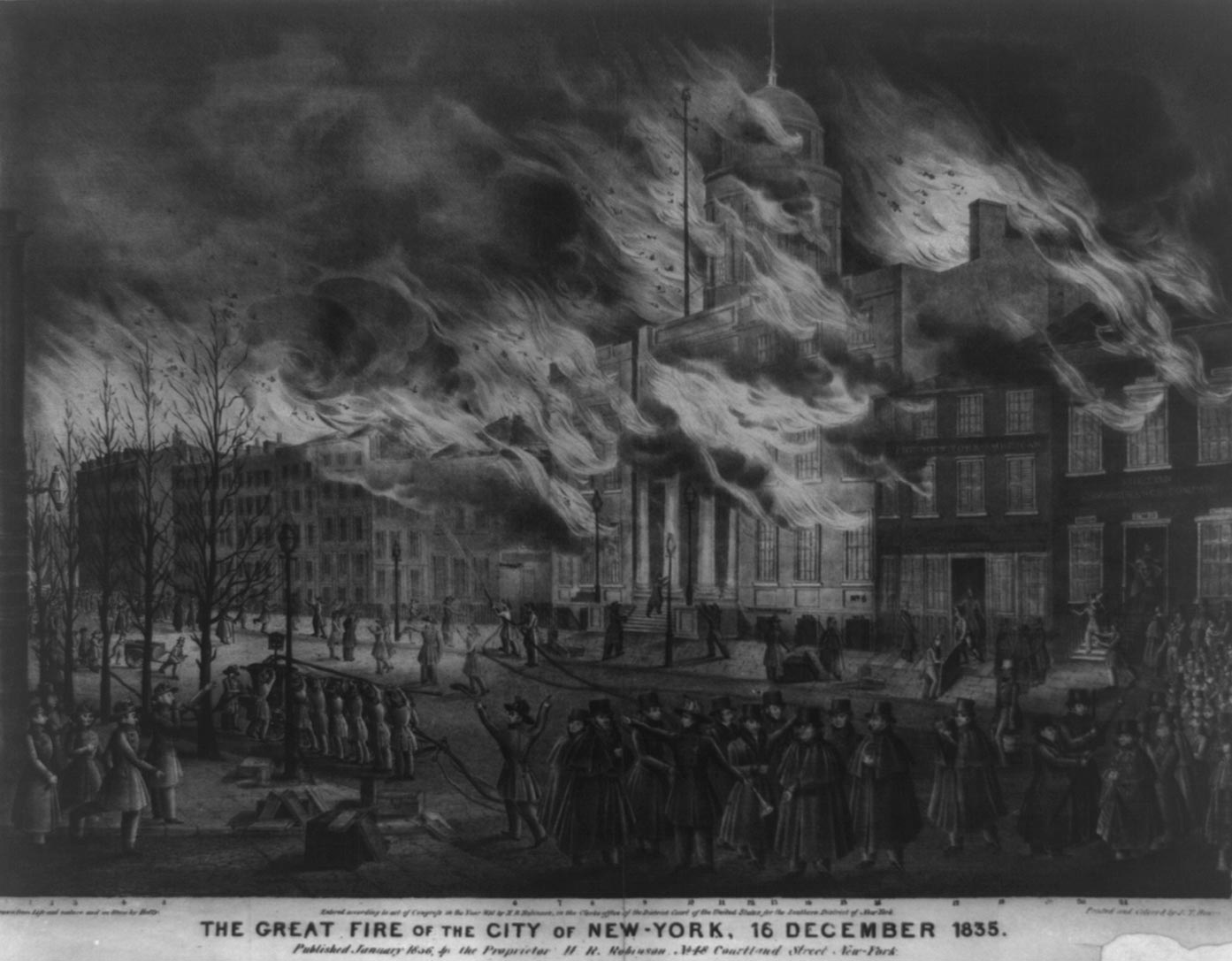
- December 16– The Great Fire of New York begins and lasts until the next day, destroying 530 buildings, including the New York Stock Exchange.[10]
- December 20 – The Texas Declaration of Independence is signed by American residents rebelling against Mexico at Goliad, Texas.
- December 21 – The Raleigh and Gaston Railroad is chartered in Raleigh, North Carolina.[11]
- December 28 — The Second Seminole War, led by Seminole Chief Osceola breaks out in the U.S. state of Florida.
- December 29 – The Treaty of New Echota is signed between the United States Government and representatives of the Cherokee Nation.
Date unknown
[edit]- The British East India Company negotiates a lease of the Darjeeling area west of the Mahananda River, from the Kingdom of Sikkim.[12]
- The British Geological Survey is founded, as the world's first national geological survey.
- Civil war erupts in Uruguay, between supporters of the Blanco and Colorado parties.
- The Cachar Levy, forerunner of the Assam Rifles, is founded in India.
- The first Bulgarian-language school opens in the Ottoman Empire.
- The French word for their language changes to français, from françois.
- Fort Cass is established, the military headquarters and site of the largest internment camps during the 1838 Trail of Tears.
- Charles-Louis Havas creates Havas, the first news agency in the world (which later spawns Agence France-Presse).
- English becomes the official language of India.
- Juan Manuel de Rosas becomes Caudillo of Argentina.
- Edward Strutt Abdy publishes his Journal of a Residence and Tour in the United States of North America: From April, 1833, to October 1834.
- David Strauss begins publication of Das Leben Jessu, kritisch bearbeitet ("The life of Jesus, critically examined") in Tübingen.
- The first Egyptian Museum in Cairo opened.
Births
[edit]January–June
[edit]
.jpg)
- January 14 – Emmy Rappe, Swedish nurse pioneer (d. 1896)
- February 13 – Mirza Ghulam Ahmad, founder of the Ahmadiyya Muslim Community (d. 1908)
- February 15
- Demetrius Vikelas, Greek International Olympic Committee president (d. 1908)
- Nguyễn Khuyến, Vietnamese Ruist scholar, poet and teacher (d. 1910)
- February 18 – César Cui, Lithuanian composer (d. 1918)
- February 22 – Jeannette Walworth, American novelist, journalist (d. 1918)
- March 12
- Simon Newcomb, Canadian-American astronomer (d. 1909)
- Sigismondo Savona, Maltese educator and politician (d. 1908)[13]
- March 14 – Giovanni Schiaparelli, Italian astronomer (d. 1910)
- March 15 – Eduard Strauss, Austrian composer (d. 1916)[14]
- March 21 – Maria Magdalena Mathsdotter, Swedish Sami educator (d. 1873)
- March 24 – Josef Stefan, Slovenian physicist, mathematician, and poet (d. 1893)
- April 1 – James Fisk, American entrepreneur (d. 1872)
- April 4 – John Hughlings Jackson, English neurologist (d. 1911)
- April 9 – King Leopold II of Belgium (d. 1909)
- May 3 – Alfred Austin, English poet (d. 1913)
- May 18 – Charles N. Sims, American Methodist preacher, third chancellor of Syracuse University (d. 1908)
- May 21 – František Chvostek, Moravian physician (d. 1884)
- June 2 – Pope Pius X (d. 1914)
- June 6 – Ștefan Fălcoianu, Romanian general and politician (d. 1905)
- June 9 – Ramón Barros Luco, 15th President of Chile (d. 1919)
- June 10 – Ferdinand IV, Grand Duke of Tuscany, (d. 1908)
- June 12 – George Atzerodt, conspirator with John Wilkes Booth, assigned to assassinate Vice President Andrew Johnson (d. 1865)
- June 15 – Adah Isaacs Menken, American actress (d. 1868)
- June 23 – Fanny Eaton, Jamaican-born artists model and domestic worker (d. 1924)
- June 24 – Johannes Wislicenus, German chemist (d. 1902)
- June 26 – Thomas W. Knox, American author, journalist (d. 1896)
July–December
[edit].jpg)
.png)

.jpg)
- July 6 – Sir George White, British field marshal (d. 1912)
- July 7 – Ernest Giles, Australian explorer (d. 1897)
- July 10 – Henryk Wieniawski, Polish composer (d. 1880)
- July 19 – Justo Rufino Barrios, 9th President of Guatemala (d. 1885)
- July 27 – Giosuè Carducci, Italian writer, Nobel Prize laureate (d. 1907)
- July 30 – Edmund Francis Dunne, American politician, jurist, and Catholic orator (d. 1904)
- July 31 – Henri Brisson, 2-time prime minister of France (d. 1912)
- August 2 – Elisha Gray, American inventor, businessman (d. 1901)
- August 6 – Hjalmar Kiærskou, Danish botanist (d. 1900)
- August 19 – Tom Wills, Australian cricketer, pioneer of Australian rules football (d. 1880)
- August 27 – Thomas Burberry, English businessman, inventor (d. 1926)
- September 1 – Raphael Kalinowski, Polish Discalced Carmelite friar, saint (d. 1907)
- October 7 – Felix Draeseke, German composer (d. 1913)
- October 9 – Camille Saint-Saëns, French composer (d. 1921)
- October 16 – William Rufus Shafter, American general (d. 1906)
- October 31 – Adolf von Baeyer, German chemist, Nobel Prize laureate (d. 1917)
- November 6 – Cesare Lombroso, Italian criminologist (d. 1909)
- November 17 – Andrew L. Harris, American Civil War hero, Governor of Ohio (d. 1915)
- November 19 – Matilda Carse, Irish-born American businesswoman, social reformer (d. 1917)
- November 21 – Rose Eytinge, American actress (d. 1911)
- November 25
- Andrew Carnegie, American industrialist, philanthropist (d. 1919)[15]
- Arthur Sewall, American politician, industrialist (d. 1900)
- November 29 – Empress Dowager Cixi of China (d. 1908)[16]
- November 30 – Mark Twain, American author, humorist (d. 1910)[17]
- December 4 – Samuel Butler, English writer (d. 1902)
- December 6 – Wilhelm Rudolph Fittig, German chemist (d. 1910)
- December 17 – Alexander Emanuel Agassiz, American scientist (d. 1910)
- December 18 – Lyman Abbott, American clergyman, author (d. 1922)
- December 28 – Sir Archibald Geikie, Scottish geologist (d. 1924)
Deaths
[edit]January–June
[edit]_-_Charles_William,_Baron_von_Humboldt_(1767-1835)_-_RCIN_404936_-_Royal_Collection.jpg)

- January 1 – Mátyás Godina, Slovene Lutheran pastor, writer, and teacher (b. 1768)
- February 8 – Guillaume Dupuytren, French anatomist, military surgeon (b. 1777)
- February 15
- Nathan Dane, American politician (b. 1752)
- Henry Hunt, British politician (b. 1773)
- March 2 – Francis II, Holy Roman Emperor (b. 1768)
- March 18 – Christian Günther von Bernstorff, Danish, Prussian statesman, diplomat (b. 1769)
- March 28 – Auguste de Beauharnais, Prince consort of Queen Maria II of Portugal (b. 1810)
- March 30 – Richard Sharp, English hat-maker, banker, merchant, poet, critic, Member of Parliament, and conversationalist
- April 1 – Józef Zeydlitz, Polish military leader (b. 1755)
- April 8 – Wilhelm von Humboldt, German linguist, philosopher (b. 1767)[18]
- April 10 – Magdalene of Canossa, Italian Catholic religious professed, saint (b. 1774)
- April 21 – Samuel Slater, American industrialist (b. 1768)
- May 8 – Francisca Zubiaga y Bernales, first lady of Peru, controversial socialite (b. 1803)
- May 13 – John Nash, English architect (b. 1752)
- June 18 – William Cobbett, English journalist, author (b. 1763)
- June 24 – Andreas Vokos Miaoulis, Greek admiral (b. 1768)
- June 25 – Ebenezer Pemberton, American educator (b. 1746)
July–December
[edit]- July 6 – John Marshall, influential American Chief Justice of the United States Supreme Court (b. 1755)
- July 15 – Izabela Czartoryska, Polish magnate princess (b. 1746)
- July 28 – Édouard Mortier, Duke of Trévise, French marshal (b. 1768)
- August 18 – Friedrich Stromeyer, German chemist (born 1776)[19]
- September 23
- Georg Adlersparre, Swedish military leader (b. 1760)
- Vincenzo Bellini, Italian composer (b. 1801)
- November 14 – James Freeman, first American clergyman to call himself a Unitarian (b. 1759)
- November 20 – Joseph von Baader, German railway pioneer (b. 1763)
- November 29 – Princess Catharina of Württemberg, wife of Jérôme Bonaparte (b. 1783)
- December 17 – Pierre Louis Roederer, French politician, economist, and historian (b. 1754)
- December 22 – David Hosack, American physician and educator, attending doctor at the Hamilton-Burr duel (b. 1769)
Unknown
[edit]- Sally Hemings – American-born slave, concubine to Thomas Jefferson (b. c. 1773)
- Ishak Efendi – Ottoman engineer, translator (b. c. 1774)
References
[edit]- ^ "Public debt history". www.publicdebt.treas.gov. Archived from the original on March 6, 2016. Retrieved January 8, 2010.
- ^ "Ferdinand (I) | Biography, Reign, & Facts | Britannica". www.britannica.com. 2025-06-25. Retrieved 2025-07-17.
- ^ Bateson, Charles (1959). The Convict Ships, 1787–1868. Glasgow: Brown, Son & Ferguson. OCLC 3778075.
- ^ Challoner, Jack; et al. (2009). 1001 Inventions That Changed The World. Hauppauge NY: Barrons Educational Series. p. 305. ISBN 978-1844036110.
- ^ "James Bowman Lindsay - Local History Centre, Leisure and Culture Dundee". Leisure and Culture Dundee. Retrieved 2 September 2024.
- ^ Robertson, Patrick (1974). The Shell Book of Firsts. London: Ebury Press. pp. 127–8. ISBN 0-7181-1279-2.
- ^ "Wilberforce Monument, Non Civil Parish - 1283041". Historic England. Archived from the original on 29 June 2017. Retrieved 1 October 2021.
- ^ Cook, Matt; Mills, Robert; Trumback, Randolph; Cocks, Harry (2007). A Gay History of Britain: Love and Sex Between Men Since the Middle Ages. Greenwood World Publishing. p. 109. ISBN 978-1846450020.
- ^ Solomon, Maui (2019-12-15). "Moriori: Still setting the record straight". E-Tangata. Archived from the original on 2021-02-17. Retrieved 2021-02-28.
- ^ "Fires, Great", in The Insurance Cyclopeadia: Being an Historical Treasury of Events and Circumstances Connected with the Origin and Progress of Insurance, Cornelius Walford, ed. (C. and E. Layton, 1876) p76
- ^ "Railroads – prior to the Civil War". North Carolina Business History. 2006. Archived from the original on July 26, 2011. Retrieved 2011-12-02.
- ^ Dasgupta, Atis (1999). "Ethnic Problems and Movements for Autonomy in Darjeeling". Social Scientist. 27 (11–12): 47–68. doi:10.2307/3518047. JSTOR 3518047.
- ^ Schiavone, Michael J. (2009). Dictionary of Maltese Biographies Vol. II G–Z. Pietà: Pubblikazzjonijiet Indipendenza. pp. 1414–1415. ISBN 9789993291329.
- ^ Randel, Don Michael (30 October 2002). The Harvard Concise Dictionary of Music and Musicians. Harvard University Press. p. 866. ISBN 978-0-674-25572-2.
- ^ "Andrew Carnegie: Biography on Undiscovered Scotland". www.undiscoveredscotland.co.uk. Retrieved 8 January 2020.
- ^ "Cixi | Biography & Facts". Encyclopedia Britannica. Retrieved 8 January 2020.
- ^ "Mark Twain | Biography & Facts". Encyclopedia Britannica. Retrieved 30 November 2020.
- ^ Doerig, Detmar (2008). "Humboldt, Wilhelm von (1767–1835)". In Hamowy, Ronald (ed.). The Encyclopedia of Libertarianism. Thousand Oaks, CA: Sage; Cato Institute. pp. 229–230. doi:10.4135/9781412965811.n141. ISBN 978-1412965804.
- ^ Biographical Index of Former Fellows of the Royal Society of Edinburgh 1783–2002 (PDF). The Royal Society of Edinburgh. July 2006. ISBN 0-902-198-84-X. Archived from the original (PDF) on 2016-03-04. Retrieved 2018-10-03.
from Grokipedia
1835 marked a tumultuous period in early American history, characterized by fiscal triumph under President Andrew Jackson, the initiation of armed resistance in Texas against Mexican centralism, violent conflicts with Native American tribes, and a catastrophic urban conflagration in New York City.[1][2][3]
On January 8, the United States achieved the distinction of having no national debt for the first and only time, a milestone accomplished through Jackson's policies of reducing government expenditures and opposing the Second Bank of the United States.[4] Later that month, on January 30, Richard Lawrence fired two pistols at Jackson in the Capitol, both misfiring in the first recorded assassination attempt on a U.S. president, underscoring the era's political volatility.[5] The Second Seminole War erupted in Florida, involving fierce guerrilla resistance by Seminole Indians against U.S. forces seeking their removal, resulting in prolonged and costly combat that highlighted the challenges of federal expansionist policies.[2]
The Texas Revolution commenced on October 2 with the Battle of Gonzales, where Texian settlers repelled Mexican troops attempting to seize a cannon, raising the improvised "Come and Take It" banner as a symbol of defiance that galvanized the independence movement.[1] This conflict escalated through late 1835, culminating in the Siege of Béxar, where Texians expelled Mexican General Martín Perfecto de Cos from San Antonio, setting the stage for the Republic of Texas's declaration of independence the following year. In December 16–17, amid subzero temperatures and gale-force winds, the Great Fire of New York ignited in a warehouse and spread uncontrollably, razing approximately 700 buildings across 17 blocks in the financial district, inflicting damages equivalent to hundreds of millions in contemporary value and prompting reforms in urban firefighting and building codes.[3] These events collectively reflected the strains of territorial ambition, economic ambition, and infrastructural vulnerability in a rapidly expanding republic.[3]
October 9 – Camille Saint-Saëns (d. 1921), French composer, organist, and pianist renowned for symphonic works including the Carnival of the Animals and Symphony No. 3, which demonstrated innovative orchestration and enduring influence on Romantic music.[85] November 25 – Andrew Carnegie (d. 1919), Scottish-born American industrialist who emigrated young and amassed fortune through steel production via the Bessemer process, exemplifying self-made capitalist success that funded vast philanthropy, including libraries and educational institutions.[86][87] November 29 – Empress Dowager Cixi (d. 1908), concubine who rose to de facto rule over Qing China for decades, wielding power through regencies and conservative policies that resisted Western reforms while navigating internal rebellions and foreign pressures.[88] November 30 – Mark Twain, born Samuel Langhorne Clemens (d. 1910), American writer from Missouri whose novels like The Adventures of Huckleberry Finn employed satirical realism to critique societal hypocrisies, drawing from Mississippi River experiences for authentic depictions of American life.[89][90]
October 9 – Camille Saint-Saëns (d. 1921), French composer, organist, and pianist renowned for symphonic works including the Carnival of the Animals and Symphony No. 3, which demonstrated innovative orchestration and enduring influence on Romantic music.[85] November 25 – Andrew Carnegie (d. 1919), Scottish-born American industrialist who emigrated young and amassed fortune through steel production via the Bessemer process, exemplifying self-made capitalist success that funded vast philanthropy, including libraries and educational institutions.[86][87] November 29 – Empress Dowager Cixi (d. 1908), concubine who rose to de facto rule over Qing China for decades, wielding power through regencies and conservative policies that resisted Western reforms while navigating internal rebellions and foreign pressures.[88] November 30 – Mark Twain, born Samuel Langhorne Clemens (d. 1910), American writer from Missouri whose novels like The Adventures of Huckleberry Finn employed satirical realism to critique societal hypocrisies, drawing from Mississippi River experiences for authentic depictions of American life.[89][90]
Events
January–March
On January 8, 1835, the United States achieved the elimination of its entire national debt for the first and only time in its history, reducing the outstanding principal to zero under President Andrew Jackson's administration.[6][7] This outcome resulted from sustained federal surpluses generated primarily by tariff revenues and sales of public lands in regions such as the Midwest and Mississippi territories, which provided the fiscal means to retire all interest-bearing obligations.[8][6] On January 30, 1835, Richard Lawrence, an unemployed house painter from England residing in Washington, D.C., attempted to assassinate President Jackson as the president exited the Capitol building following a funeral service.[9][10] Lawrence approached Jackson and fired two single-shot derringer pistols at close range, but both misfired due to faulty percussion caps or damp powder, preventing any discharge.[11] Jackson subdued Lawrence with his cane until bystanders intervened, and Lawrence was later adjudged not guilty by reason of insanity, confined until his death in 1861; he exhibited delusions, including beliefs that Jackson had orchestrated the deaths of his family members and that the debt payoff had destroyed his personal stone-cutting business prospects.[9][11][10] In early 1835, French political thinker Alexis de Tocqueville published the first volume of De la démocratie en Amérique (Democracy in America), drawing on empirical observations from his 1831 travels across the United States to analyze the structure and operations of American democratic institutions, including local governance, voluntary associations, and the separation of powers.[12] The work documented specific practices, such as township assemblies in New England and the role of juries in fostering civic equality, based on direct interviews and site visits rather than abstract theory.[12]April–June
On June 17, 1835, Jefferson Davis, a United States Army lieutenant who had graduated from the United States Military Academy at West Point in 1828 and served in the Black Hawk War, married Sarah Knox Taylor, the daughter of General Zachary Taylor, at Beechland near Louisville, Kentucky.[13][14] The union faced opposition from her father, who cited the health risks of military postings in frontier territories, prompting Davis to resign his commission effective June 30, 1835.[15] Sarah Knox Taylor Davis succumbed to malaria less than three months later, on September 15, 1835, during their honeymoon travels in Louisiana.[16] In late spring 1835, the American Anti-Slavery Society, led by figures including Arthur Tappan, launched a postal campaign distributing thousands of anti-slavery pamphlets and newspapers to addresses in the southern United States.[17] The effort, which mailed over 100,000 items by summer, aimed to disseminate factual accounts of slavery's conditions drawn from eyewitness testimonies and legal records.[18] Tensions in Florida mounted in the months leading to open conflict, as Seminole delegates who had toured potential relocation lands under the 1832 Treaty of Payne's Landing returned and rejected enforced migration, prompting U.S. agents to demand compliance amid reports of arms stockpiling by Seminole groups.[19] On June 28, 1835, James Madison, the fourth president of the United States (1809–1817) and principal framer of the U.S. Constitution, died at his Montpelier estate in Virginia at age 85 from congestive heart failure, leaving behind a legacy of contributions to federalist theory via the Federalist Papers.July–September
On August 25, 1835, The New York Sun began publishing a series of six fabricated articles claiming that British astronomer Sir John Herschel had discovered life on the Moon using a powerful new telescope in South Africa, including descriptions of lunar creatures such as bat-like winged beings and bison-like quadrupeds.[20] The hoax, authored by newspaper editor Richard Adams Locke to boost circulation amid public fascination with astronomy, continued through early September and drew widespread readership before being exposed as fiction.[21] August 30 marked the establishment of the first permanent European settlement at the site of present-day Melbourne, Australia, when members of John Batman's expedition from Van Diemen's Land (Tasmania), including surveyors Evan Evans, James Moor, and Charles Lancey, anchored near the Yarra River mouth and constructed initial huts and storehouses.[22] This followed Batman's exploratory survey in June 1835 under the auspices of the Port Phillip Association, a group seeking to expand British colonial holdings beyond Sydney, with the location initially dubbed Batmania but soon renamed Melbourne in honor of the British Prime Minister.[23] The settlement reflected broader patterns of unauthorized pastoral expansion into Indigenous lands, prompting eventual official recognition by New South Wales authorities in 1836.[22] During August and September 1835, Halley's Comet became increasingly observable as it approached perihelion, with initial telescopic detections reported from Europe, including by astronomer Dumouchel in Rome on August 5.[24] Naked-eye visibility emerged later in the period from both European and American locations, appearing low in the pre-dawn sky and prompting amateur and professional notations of its nucleus and emerging tail amid heightened anticipation of its predicted return after 76 years.[24][25] On September 15, 1835, HMS Beagle, under Captain Robert FitzRoy, reached the Galápagos Islands during its surveying voyage, with Charles Darwin aboard as naturalist; the ship first sighted San Cristóbal Island, followed by landings beginning September 16–17 where Darwin and crew collected geological samples, birds, and reptiles from the archipelago's volcanic terrain.[26] Over the subsequent weeks into October, expeditions documented specimens including tortoises and finches from multiple islands, contributing raw observational data to Darwin's notebooks without immediate interpretive synthesis.[26]October–December
On October 2, 1835, the Texas Revolution commenced with the Battle of Gonzales, where approximately 18 Texian settlers defied a detachment of Mexican troops led by Lieutenant Francisco de Castañeda, who had been ordered to retrieve a small cannon previously loaned to the settlement for defense against Native American raids.[27] The settlers raised a makeshift flag bearing the words "Come and Take It" and opened fire after the Mexicans attempted to cross the Guadalupe River, forcing Castañeda's force of about 100 soldiers to withdraw without the artillery piece after a brief exchange that resulted in one Texian wounded and no Mexican casualties reported.[28] This skirmish marked the first armed resistance against Mexican centralist authority in Texas, galvanizing local militias composed primarily of Anglo-American immigrants and Hispanic Tejanos opposed to General Antonio López de Santa Anna's abolition of the 1824 federal constitution.[29] Following the Gonzales engagement, Texian forces mobilized rapidly, capturing the Presidio La Bahía at Goliad on October 9 and initiating the Siege of Béxar against Mexican troops under General Martín Perfecto de Cos in San Antonio de Béxar by mid-October.[30] The siege intensified in December, with volunteer armies led by figures such as Edward Burleson and Benjamin R. Milam launching an assault on December 5, as Milam famously rallied troops with the call, "Who will go with old Ben Milam into San Antonio?"[31] By December 9, after street-to-street fighting that killed Milam and inflicted heavier losses on the Mexicans, Cos surrendered, evacuating his approximately 1,000 troops southward and yielding control of the Alamo fortress to the Texians, though garrisoning it proved challenging amid internal divisions.[32] In New York City, the Great Fire erupted on the night of December 16, 1835, originating in a warehouse at 25 Merchant Street amid gale-force northwest winds and sub-freezing temperatures that rendered firefighting efforts futile as water mains and hoses froze. The blaze rapidly engulfed 17 blocks in the financial district, destroying between 530 and 700 buildings including the New York Stock Exchange, the Custom House, and numerous mercantile structures, with contemporary estimates placing property losses at around $20 million.[33] Only two deaths were directly attributed to the disaster—firefighters who succumbed to the cold—though the conflagration displaced thousands and exposed vulnerabilities in urban fire prevention, prompting subsequent reforms in building materials and water supply infrastructure.[34]Date unknown
William Smith Otis, a 22-year-old civil engineer from Philadelphia, invented the steam shovel in 1835, marking an early mechanized approach to excavation that relied on a steam-powered boom and bucket to scoop and dump earth.[35] This innovation addressed limitations of manual labor and draft animals in large-scale projects like canal and railroad construction, though Otis received a U.S. patent for it only in 1839 after demonstrating its utility.[35] Independently, Samuel F.B. Morse constructed his first working model of the electromagnetic telegraph during 1835, building on concepts he had explored since 1832 to transmit electrical signals over wires for coded messaging.[36] This prototype used electromagnets to record signals on paper, predating public demonstrations and laying the foundation for practical long-distance communication systems that would transform information exchange.[36]Key Developments
Economic and Political Milestones
On January 8, 1835, the United States achieved the elimination of its entire national debt for the first and only time in history, reducing the outstanding principal from approximately $58.4 million in 1829 to zero through persistent federal budget surpluses generated primarily by high tariff revenues and booming public land sales in the West.[37][38] President Andrew Jackson's vetoes of internal improvement bills, such as the Maysville Road veto in 1830, redirected potential expenditures away from infrastructure toward debt repayment, while the Specie Circular of 1836 (preceded by earlier deposit shifts from the Second Bank of the United States to state "pet banks" starting in 1833) aimed to curb speculative inflation but contributed to the fiscal discipline enabling the surplus.[39][8] These policies reflected Jackson's view of public debt as a "moral failing," though the subsequent distribution of surplus funds to states in 1837 precipitated banking instability.[40][41] In Georgia, ongoing gold discoveries on Cherokee lands, which began with significant finds in 1828 near Dahlonega and intensified through the early 1830s, drove annual production estimates reaching up to 3,000 kilograms by the mid-1830s, comprising a substantial portion of the young U.S. gold output and fueling state pressures for land acquisition.[42] This economic incentive underlay Georgia's enforcement of existing treaties like the 1802 and 1817 agreements, which had already ceded some Cherokee territory, culminating in the coerced Treaty of New Echota signed on December 29, 1835, by a minority Cherokee faction, exchanging remaining eastern lands for $5 million and western territory despite majority opposition.[43][44] The treaty's ratification by the U.S. Senate in 1836 formalized the cession, prioritizing resource extraction over indigenous sovereignty claims.[45] The Anglo-Spanish Treaty of 1835 renewed prior anti-slave trade commitments from 1817 and 1824, declaring the trade piracy under Spanish law and authorizing mutual ship searches by naval vessels within specified equatorial zones, with captured slavers subject to adjudication by mixed commissions and penalties including vessel forfeiture.[46][47] This agreement enhanced enforcement mechanisms, enabling British cruisers to seize over 500 suspected slaving vessels in the following decades, though Spanish compliance remained inconsistent due to domestic colonial interests.[48] The treaty's provisions marked a step toward international naval cooperation against illicit trade, building on Britain's unilateral West Africa Squadron efforts.[49]Scientific and Exploratory Advances
In 1835, Halley's Comet reached perihelion on November 16.44, confirming predictions derived from Newtonian gravitational mechanics that had anticipated the passage within approximately 0.71 days.[50][51] Astronomers first detected the comet on August 5 from Rome, tracking its elongated orbit with positional data that aligned closely with orbital elements calculated from prior apparitions in 1759 and earlier returns.[24] These observations provided empirical validation of inverse-square law dynamics, as the comet's path deviated minimally from forecasted ephemerides despite non-gravitational perturbations like outgassing.[52] The year's astronomical discourse was also marked by the Great Moon Hoax, a series of six articles published in the New York Sun starting August 25, falsely attributing discoveries of lunar life forms—such as bat-like winged beings and temples—to Sir John Herschel's observations with an advanced Cape of Good Hope telescope.[21] Though fabricated by journalist Richard Adams Locke to boost circulation amid genuine interest in celestial events like Halley's approach, the hoax's exposure by September prompted public scrutiny of unverified claims, underscoring the value of corroborative evidence from multiple observers over anecdotal reports.[53] This episode catalyzed broader skepticism toward sensational astronomical assertions, emphasizing reliance on reproducible data from established instruments like refractors and reflectors. Exploration advanced through Charles Darwin's collections during the HMS Beagle's visit to the Galápagos Islands from September 15 to October 20, where he gathered specimens including mockingbirds, tortoises with morphologically distinct shell patterns across islands, finches exhibiting beak variations, iguanas, and marine reptiles alongside plant samples.[54][55] Darwin's geological surveys documented the archipelago's volcanic formations, noting active craters on islands like Albemarle and the subsidence of coral reefs indicative of uplift and erosion processes.[56] These raw empirical records—preserved in field notebooks—captured biodiversity distributions and stratigraphic layers without interpretive overlays, providing datasets on endemic species isolation tied to insular geography.[57]Controversies and Conflicts
Texas Independence Movement
The Texas Independence Movement in 1835 stemmed from escalating conflicts between Anglo-American settlers and the Mexican central government, driven by failures in governance and overreach that undermined local autonomy. Following Mexico's independence in 1821, empresarios such as Stephen F. Austin facilitated waves of Anglo immigration, with approximately 30,000 Anglos residing in Texas by 1834 compared to fewer than 5,000 Tejanos, transforming the region's demographics and economy around cotton production and self-reliant frontier life.[58] [59] These settlers, granted land under conditional contracts requiring adherence to Mexican laws including Catholicism and bans on slavery, increasingly chafed under distant rule, prioritizing cultural continuity, English common law traditions, and economic practices like slavery exemptions that Mexico inconsistently enforced after its 1829 abolition decree.[60] A pivotal trigger was President Antonio López de Santa Anna's shift to centralism in 1834, dissolving the federal Congress in October and paving the way for the Siete Leyes of 1835, which revoked the 1824 federalist constitution's state autonomies and imposed national control, effectively dismantling the Coahuila y Tejas state legislature.[30] [61] Texan conventions in 1832 and 1833 had petitioned for separate statehood to address administrative neglect and cultural mismatches, but these were rejected by Mexico City, which viewed Texas as integral territory vulnerable to U.S. expansionist threats; by 1835, settler demands escalated to armed resistance for restoring federalism and statehood under the 1824 framework, as articulated in the November 7 Declaration of the People of Texas.[62] [63] Mexican authorities, prioritizing territorial integrity amid internal rebellions like Zacatecas, perceived these moves as filibuster-instigated secession rather than legitimate grievances, exacerbating distrust.[30] The Gonzales incident on October 2, 1835, exemplified settlers' assertion of self-defense and property rights against centralist disarmament efforts, when Mexican Lieutenant Francisco de Castañeda's troops demanded return of a small cannon previously loaned for Indian defense, prompting about 140 armed locals to repel them with the defiant banner "Come and Take It" after firing the revolution's first shots in a brief skirmish with no fatalities.[1] [27] This resistance reflected first-principles reasoning on militia rights and rejection of unilateral confiscation, rooted in the settlers' frontier necessities for arms amid Mexican governance lapses in border security, contrasting with centralist aims to suppress perceived rebellions through force concentration.[28] While pro-independence advocates emphasized freedoms from dictatorship for prosperity and self-rule, Mexican perspectives framed the unrest as a betrayal enabled by lax colonization policies, highlighting causal failures in integrating disparate populations without coercive centralization.[30]Native American Resistance and Removal
The Second Seminole War began in late 1835 amid Seminole resistance to the Treaty of Payne's Landing, signed on May 9, 1832, which mandated the tribe's relocation west of the Mississippi River following a delegation's inspection of prospective lands deemed suitable.[2] Osceola, a prominent warrior who refused to sign the treaty and stabbed Indian agent Wiley Thompson in protest earlier that year, orchestrated ambushes that escalated into open conflict, driven by overlapping land claims with white settlers and the tribe's sheltering of escaped slaves, which intensified federal enforcement pressures from southern expansion.[64] On December 28, 1835, Seminole forces under Osceola ambushed Major Francis L. Dade's column of 110 U.S. soldiers en route from Fort Brooke to Fort King, killing 107 troops and two officers in the Dade Massacre, with only three survivors; simultaneous attacks killed Thompson and 30 others at Fort King, prompting immediate U.S. troop reinforcements numbering over 5,000 by war's end but marking 1835's raids as catalysts for frontier insecurity.[65] These engagements reflected causal pressures from U.S. population growth—Florida's non-Indian settlers rose from 35,000 in 1830 to demands for arable land—rendering negotiated cessions inevitable amid pre-existing Seminole internal divisions, including Creek War remnants and disease-weakened populations from prior epidemics like smallpox in the 1810s-1820s that halved regional Native numbers.[66] In Cherokee territories, the 1828-1829 gold discovery in Dahlonega, Georgia, catalyzed land cessions by inflating empirical values—yielding over 24,000 ounces annually by 1830, spurring state lotteries that distributed 160 districts to white claimants and underscoring conflict inevitability from mineral-rich overlaps with Cherokee holdings estimated at 40,000 square miles pre-1800s treaties.[67] Federal enforcement under the 1830 Indian Removal Act intensified by 1835, culminating in the Treaty of New Echota on December 29, signed by a minority faction led by Major Ridge despite Principal Chief John Ross's opposition from the majority, ceding remaining Georgia lands for $5 million and relocation west, amid Georgia's extension of state laws over tribal jurisdiction since 1829 that dissolved Cherokee autonomy.[68] This treaty, ratified amid resistance, facilitated frontier settlement by resolving dual sovereignty claims, though subsequent forced marches incurred high mortality—later data showing 4,000 Cherokee deaths from disease and exposure—but were compounded by intertribal conflicts, such as 1830s skirmishes with Creeks over hunting grounds, and demographic declines from European-introduced diseases reducing Cherokee numbers from 22,000 in 1800 to under 18,000 by 1835.[67] U.S. achievements in securing these territories enabled agricultural expansion, with Georgia's cotton output doubling post-cessions, balancing removal's costs against unchecked violence from unregulated frontiers.[68]Abolitionist Agitation and Regional Tensions
In the summer of 1835, the American Anti-Slavery Society, under the direction of brothers Arthur and Lewis Tappan, orchestrated a large-scale postal campaign distributing over 100,000 abolitionist newspapers and pamphlets to Southern addresses, including slaveholders and public officials, with the explicit aim of converting recipients to the cause of immediate emancipation.[69][70] Abolitionists framed slavery as a profound moral atrocity incompatible with Christian ethics and republican liberty, arguing that widespread dissemination of tracts detailing slave abuses—such as those in The Emancipator newspaper—would foster voluntary manumission without coercion.[71] This effort represented a strategic escalation from prior petition drives, leveraging the federal postal system's neutrality to bypass Southern censorship and directly challenge the institution's defenders.[72] The influx provoked immediate and vehement backlash across the South, where recipients perceived the materials as incendiary propaganda designed to incite slave rebellions and undermine local authority, given slavery's integral role in the regional economy—accounting for over half of export value in states like South Carolina—and social structure.[73] On July 29, 1835, in Charleston, South Carolina, a crowd of approximately 3,000, organized by a vigilance committee, stormed the post office after Postmaster Alfred Huger segregated the abolitionist mail sacks; the mob seized and publicly burned thousands of tracts along with effigies of prominent abolitionists like Arthur Tappan and William Lloyd Garrison, restoring what locals viewed as public order against perceived Northern incitement.[74][70] Similar disturbances erupted in other Southern cities, including Augusta and Nashville, prompting state legislatures to convene anti-abolition meetings that demanded federal postal authorities withhold "incendiary" publications to avert further unrest.[75] These events underscored deepening sectional tensions, as Southern leaders contended that the federal post office's carriage of such mail constituted overreach into state sovereignty over domestic institutions, potentially fracturing the union by privileging Northern moral crusades over Southern property rights and stability.[71] Postmaster General Amos Kendall, responding to Southern pleas, issued instructions on August 20, 1835, authorizing postmasters to surveil and detain abolitionist mail deemed seditious, a policy endorsed by President Andrew Jackson as necessary to preserve tranquility.[76] While abolitionists decried this as censorship violating free speech, Southern responses prefigured congressional gag rules by framing suppression not as aggression but as defensive restoration of equilibrium against unsolicited agitation that risked economic disruption and servile insurrection, evidenced by prior scares like Nat Turner's 1831 revolt.[77][78]Births
January–June
Francis II, the last Holy Roman Emperor and Emperor of Austria as Francis I, died on March 2, 1835, in Vienna at age 67 from a sudden fever.[79] [80] He ascended as Holy Roman Emperor in 1792 following the death of his father Leopold II and abdicated in 1806 amid Napoleonic pressure, formally dissolving the Holy Roman Empire on August 6 of that year to prevent its subjugation by France.[79] [81] Thereafter, he ruled Austria from 1804 until his death, maintaining Habsburg authority through conservative policies and Metternich's influence during the post-Napoleonic era.[79] [81] His eldest surviving son, Ferdinand I, succeeded him as Emperor of Austria, though Ferdinand's intellectual disabilities led to a regency under Metternich and Archduke Louis.[79] Henry Hunt, known as "Orator Hunt," a prominent British radical reformer and advocate for universal male suffrage, died on February 15, 1835, in Alresford, Hampshire, at age 61.[82] Hunt gained notoriety for leading mass meetings, including the 1819 Peterloo Massacre rally where he demanded parliamentary reform, though he escaped unscathed while others faced cavalry charges.[82] Elected MP for Preston in 1830 alongside radicals like John Wood, he served until losing his seat in the 1832 Reform Act elections, consistently pushing for expanded suffrage and repeal of the Corn Laws in Parliament.[83] His agitation influenced early working-class radicalism but drew criticism for demagogic style amid establishment fears of unrest.[82] Benjamin Tallmadge, a Continental Army officer and U.S. congressman from Connecticut, died on March 7, 1835, at age 83.[84] Tallmadge organized the Culper Spy Ring during the American Revolution, providing intelligence that aided victories like the 1780 Battle of Monmouth, and later served in the House of Representatives from 1801 to 1817 as a Federalist promoting coastal defenses and commerce.[84] His death marked the passing of a key Revolutionary figure whose espionage efforts contributed to Washington's strategic advantages against British forces.[84]July–December
![Mark Twain by AF Bradley.jpg][float-right]October 9 – Camille Saint-Saëns (d. 1921), French composer, organist, and pianist renowned for symphonic works including the Carnival of the Animals and Symphony No. 3, which demonstrated innovative orchestration and enduring influence on Romantic music.[85] November 25 – Andrew Carnegie (d. 1919), Scottish-born American industrialist who emigrated young and amassed fortune through steel production via the Bessemer process, exemplifying self-made capitalist success that funded vast philanthropy, including libraries and educational institutions.[86][87] November 29 – Empress Dowager Cixi (d. 1908), concubine who rose to de facto rule over Qing China for decades, wielding power through regencies and conservative policies that resisted Western reforms while navigating internal rebellions and foreign pressures.[88] November 30 – Mark Twain, born Samuel Langhorne Clemens (d. 1910), American writer from Missouri whose novels like The Adventures of Huckleberry Finn employed satirical realism to critique societal hypocrisies, drawing from Mississippi River experiences for authentic depictions of American life.[89][90]
Deaths
January–June
Francis II, the last Holy Roman Emperor and Emperor of Austria as Francis I, died on March 2, 1835, in Vienna at age 67 from a sudden fever.[79] [80] He ascended as Holy Roman Emperor in 1792 following the death of his father Leopold II and abdicated in 1806 amid Napoleonic pressure, formally dissolving the Holy Roman Empire on August 6 of that year to prevent its subjugation by France.[79] [81] Thereafter, he ruled Austria from 1804 until his death, maintaining Habsburg authority through conservative policies and Metternich's influence during the post-Napoleonic era.[79] [81] His eldest surviving son, Ferdinand I, succeeded him as Emperor of Austria, though Ferdinand's intellectual disabilities led to a regency under Metternich and Archduke Louis.[79] Henry Hunt, known as "Orator Hunt," a prominent British radical reformer and advocate for universal male suffrage, died on February 15, 1835, in Alresford, Hampshire, at age 61.[82] Hunt gained notoriety for leading mass meetings, including the 1819 Peterloo Massacre rally where he demanded parliamentary reform, though he escaped unscathed while others faced cavalry charges.[82] Elected MP for Preston in 1830 alongside radicals like John Wood, he served until losing his seat in the 1832 Reform Act elections, consistently pushing for expanded suffrage and repeal of the Corn Laws in Parliament.[83] His agitation influenced early working-class radicalism but drew criticism for demagogic style amid establishment fears of unrest.[82] Benjamin Tallmadge, a Continental Army officer and U.S. congressman from Connecticut, died on March 7, 1835, at age 83.[84] Tallmadge organized the Culper Spy Ring during the American Revolution, providing intelligence that aided victories like the 1780 Battle of Monmouth, and later served in the House of Representatives from 1801 to 1817 as a Federalist promoting coastal defenses and commerce.[84] His death marked the passing of a key Revolutionary figure whose espionage efforts contributed to Washington's strategic advantages against British forces.[84]July–December
![Mark Twain by AF Bradley.jpg][float-right]October 9 – Camille Saint-Saëns (d. 1921), French composer, organist, and pianist renowned for symphonic works including the Carnival of the Animals and Symphony No. 3, which demonstrated innovative orchestration and enduring influence on Romantic music.[85] November 25 – Andrew Carnegie (d. 1919), Scottish-born American industrialist who emigrated young and amassed fortune through steel production via the Bessemer process, exemplifying self-made capitalist success that funded vast philanthropy, including libraries and educational institutions.[86][87] November 29 – Empress Dowager Cixi (d. 1908), concubine who rose to de facto rule over Qing China for decades, wielding power through regencies and conservative policies that resisted Western reforms while navigating internal rebellions and foreign pressures.[88] November 30 – Mark Twain, born Samuel Langhorne Clemens (d. 1910), American writer from Missouri whose novels like The Adventures of Huckleberry Finn employed satirical realism to critique societal hypocrisies, drawing from Mississippi River experiences for authentic depictions of American life.[89][90]