Hubbry Logo
Acoustic musicAcoustic musicMain
Open search
Acoustic music
Community hub
Acoustic music
logo
8 pages, 0 posts
0 subscribers
Be the first to start a discussion here.
Acoustic music
Acoustic music
from Wikipedia

Acoustic music is music that solely or primarily uses instruments that produce sound through acoustic means, as opposed to electric or electronic means. While all music was once acoustic, the retronym "acoustic music" appeared after the advent of electric instruments, such as the electric guitar, electric violin, electric organ and synthesizer.[1] Acoustic string instrumentations had long been a subset of popular music, particularly in folk. It stood in contrast to various other types of music in various eras, including big band music in the pre-rock era, and electric music in the rock era.

Music reviewer Craig Conley suggests, "When music is labeled acoustic, unplugged, or unwired, the assumption seems to be that other types of music are cluttered by technology and overproduction and therefore aren't as pure."[2]

Types of acoustic instruments

[edit]

Acoustic instruments can be split into six groups: string instruments, wind instruments, percussion, other instruments, ensemble instruments, and unclassified instruments.[3]

String instruments have a tightly stretched string that, when set in motion, creates energy at (almost) harmonically related frequencies.

Wind instruments are in the shape of a pipe and energy is supplied as an air stream into the pipe.

Percussion instruments make sound when they are struck, as with a hand or a stick.[4]

History

[edit]

The original acoustic instrument was the human voice, which produces sound by funneling air across the vocal cords. The first constructed acoustic instrument is believed to be the flute. The oldest surviving flute is as much as 43,000 years old. The flute is believed to have originated in Central Europe.[5]

By 1800, the most popular acoustic plucked-string instruments closely resembled the modern-day guitar, but with a smaller body. As the century continued, Spanish luthier Antonio de Torres Jurado took these smaller instruments and expanded the bodies to create guitars. Guitar use and popularity grew in Europe throughout the late 18th century[6] and more acoustic instruments were crafted, such as the double bass. Its popularity later spread to cities and towns in the new United States.[6] In the 19th century, the guitar became a recognized instrument played in grand galas and concerts.[7]

As electric instruments took hold during the 20th century, many stringed instruments were redefined as acoustic. Instruments that involve striking or vibrating the strings, such as the violin, viola and cello, fall under the acoustic category. The violin became popular during the 16th and 17th centuries, due to technological advancements in building them, brought on by luthiers such as Antonio Stradivari and Andrea Amati.[8] The modern version of the instrument developed gradually from older European acoustic stringed instruments such as the lira.[citation needed]

Following the birth of rock in the 1960s, some rock bands began to experiment with acoustic songs. This would be known as acoustic rock, and many well-known artists such as Eric Clapton and Nirvana performed acoustic versions of their well-known songs in the early 1990s, which were collected on the MTV Unplugged series.

Pop music artists have also experimented with acoustic music as well, with this variant sometimes being called acoustic pop. Like acoustic rock, some acoustic pop songs have also made their way to MTV Unplugged as well. Some notable acoustic pop songs include "True" by Ryan Cabrera and "Exile" by Taylor Swift featuring Bon Iver.

By the 2000s, popular indie musicians began to identify their genre as "contemporary acoustic", in opposition to being classified as "folk music". Daniel Trilling wrote, "Folk is a word that strikes fear into the hearts of many aspiring pop musicians. Not only does it conjure up images of the terminally naff — woolly jumpers, beards, and so on — but it is also the journalist's catch-all term for legions of singer-songwriters too bland to merit a better definition."[9]

Some music interest groups in the United States use the term "acoustic music" alongside the genres of folk and Americana music, like the Ogden Friends of Acoustic Music.[10]

The International Acoustic Music Awards[11] hosts an annual competition for original songs. Their rules state that a song can be considered acoustic as long as an acoustic instrument, including voices, can be clearly heard.[12]

Acoustic music is often easier for business owners to host because there is less need for amplification and the level of volume is less intrusive. In June 2021, the city of Cambridge, Massachusetts, allowed small businesses to host acoustic concerts without applying for a live entertainment permit.[13] Cambridge defined an acoustic performance as having no amplification of sound except for one microphone, and having no more than five acoustic performers or musicians at a single venue at one time.[13]

References

[edit]

Bibliography

[edit]
[edit]
Revisions and contributorsEdit on WikipediaRead on Wikipedia
from Grokipedia
Acoustic music is a category of musical performance and composition that relies primarily on instruments and to produce through acoustic means, without electronic amplification, processing, or synthesis. The term "acoustic music" is a that arose after the advent of electric instruments in the early . This approach emphasizes the natural , , and of instruments such as guitars, violins, banjos, fiddles, and pianos, often creating an intimate and unadorned listening experience. Unlike electric or electronic music, acoustic music highlights the mechanical vibration of strings, air columns, or percussion to generate waves directly audible in the environment. Acoustic music has prehistoric origins with the human voice and early instruments like bone flutes from around 40,000 BCE; stringed instruments resembling lutes emerged in ancient around 3000 BCE and spread through cultural exchanges, such as the introduction of the to by the Moors in 711 CE. During the medieval period (500–1400 CE), acoustic traditions developed through unaccompanied vocal forms like and songs, often accompanied by early stringed instruments such as lutes and vielles with three to five courses. The Renaissance (1400–1600) saw the rise of the gittern and vihuela in Spain, leading to the four-course guitar, while the Baroque era (1600–1760) popularized five-course versions and laid groundwork for the six-string guitar. In the Classical (1730–1820) and Romantic (1815–1910) periods, innovations like Antonio de Torres' fan-bracing design refined the acoustic guitar, with composers such as Fernando Sor, Francisco Tárrega, and Andrés Segovia elevating its role in classical repertoire. In the , acoustic music experienced revivals tied to folk traditions, particularly the of the 1940s to 1960s, which popularized unamplified performances by artists like and emphasized social themes through simple instrumentation. This era contrasted with the rise of electric instruments in , rock, and blues, repositioning many stringed instruments as explicitly "acoustic" to distinguish their natural sound production. Today, acoustic music thrives across genres like folk, , indie, and classical, often featured in "unplugged" sessions and live performances that prioritize authenticity and portability.

Definition and Characteristics

Definition

Acoustic music is defined as music produced primarily by acoustic instruments and/or that generate through acoustic means, wherein mechanical vibrations of the instrument's components or cause air molecules to oscillate, creating waves that propagate naturally without electrical amplification or electronic . This relies on the instrument's physical structure—such as strings, membranes, or air columns—or the natural of the voice to produce and resonate , distinguishing it from forms that incorporate electronic or enhancement. The designation "acoustic music" functions as a retronym, a term applied retrospectively to pre-existing practices after the emergence of electric instruments in the early , particularly with innovations like the around the 1930s, which necessitated a way to differentiate unamplified traditions from amplified ones. This linguistic shift highlighted the contrast between traditional sound production and the new reliance on electromagnetic pickups, amplifiers, and speakers in electric music, where volume and are significantly altered by electrical means. For instance, an unamplified performance projects sound through its hollow body, whereas an electric counterpart requires external amplification to achieve comparable audibility in larger settings. Throughout its historical application, the term "acoustic music" has encompassed diverse traditions, including folk music's community-based, unamplified expressions using simple and instruments alongside vocals; classical music's orchestral ensembles rooted in natural resonance; and popular music's acoustic variants, such as stripped-down arrangements that emphasize intimacy over electronic production. In each context, acoustic music prioritizes the organic projection of sound, often evoking a sense of authenticity tied to pre-electric norms.

Acoustic Principles

Acoustic music relies on the physical principles of sound wave generation, where in instrument components—such as strings, air columns, and membranes—or vocal folds disturb surrounding air molecules, creating longitudinal pressure waves that propagate outward. These initiate oscillatory motion, with the vibrating element serving as the source of that couples to the air, producing compressions and rarefactions in the medium. The of this energy transfer depends on factors like the between the vibrator and air, where mismatches can lead to reflections and reduced . Central to these waves are key perceptual attributes: frequency determines pitch, corresponding to the number of cycles per second (measured in hertz), with higher frequencies yielding higher pitches; amplitude governs volume or loudness, reflecting the wave's maximum displacement from equilibrium; timbre describes the tone quality, arising from the unique waveform shape; and harmonics are integer multiples of the fundamental frequency that contribute to the overall spectral content, enriching the sound's character. In a typical sound wave, the fundamental frequency sets the perceived pitch, while the relative amplitudes of its harmonics define the timbre, allowing distinction between similar pitches from different sources. These elements combine in complex waves, often modeled via , where the sound is decomposed into sinusoidal components. Resonance plays a crucial role in amplifying these within the instrument's body, where structures like soundboards couple mechanically to the initial vibrator, enhancing output at specific eigenfrequencies through constructive interference of normal modes. The resonator's properties, such as and elasticity, determine the of these modes, which increases with , allowing efficient and across the audible range. This amplification boosts low-frequency components that would otherwise radiate poorly, contributing to the sustained and projected nature of acoustic . Human perception of these acoustic sounds is influenced by environmental factors, particularly room acoustics, where reflections from surfaces create reverberation that alters the direct-to-reverberant energy ratio and introduces temporal smearing of the . Natural decay occurs as dissipates through absorption and spreading, with reverberation time varying by room size and materials, affecting spatial cues like distance and direction. Listeners perceive these modifications subconsciously, with moderate enhancing immersion while excessive decay can blur and pitch distinctions, though mitigates some distortions in familiar settings.

Acoustic Instruments

String Instruments

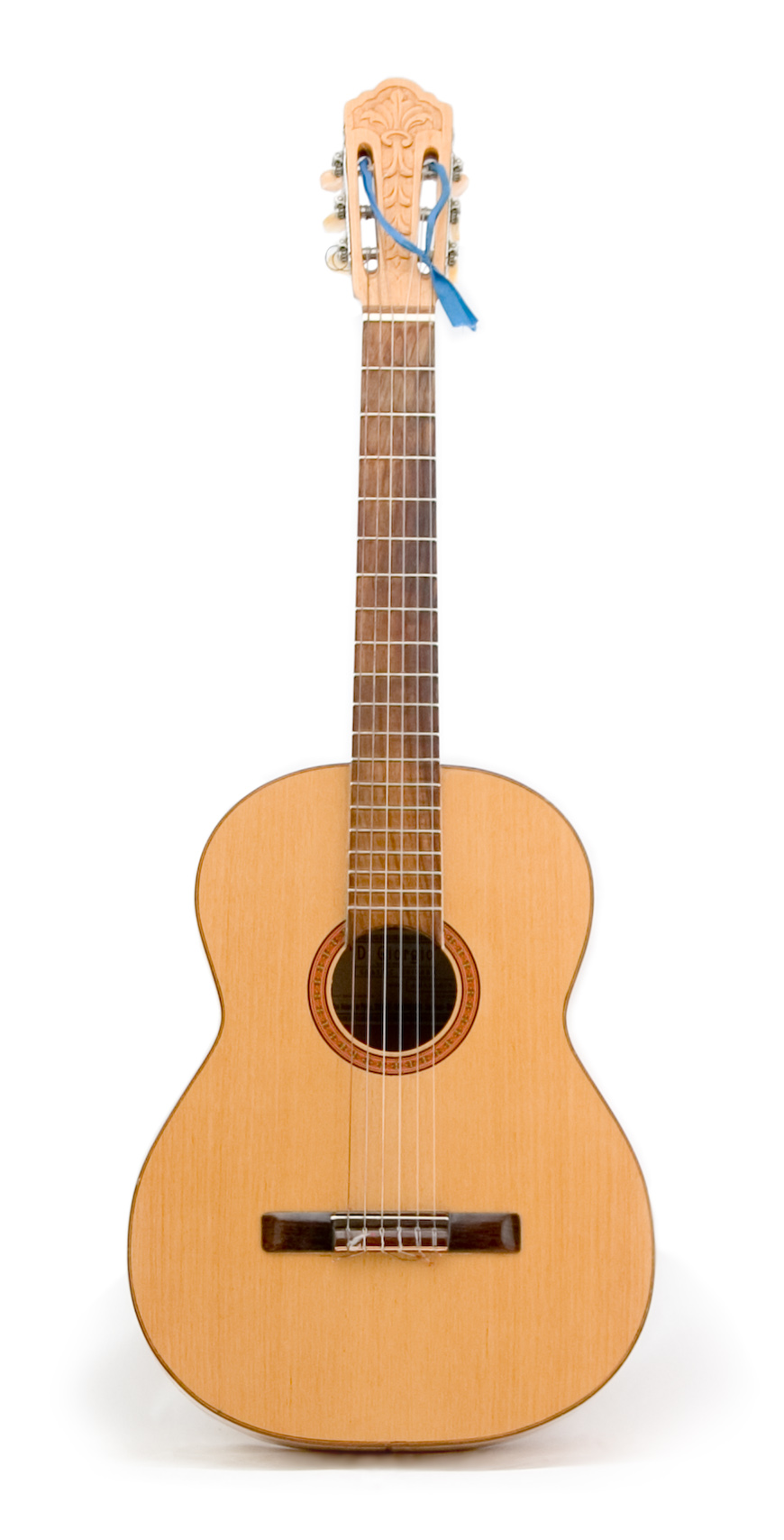
String instruments form a core category of acoustic musical instruments, where is generated by the of taut strings, typically amplified by a resonant wooden body that enhances projection and . These vibrations are excited through three primary methods: plucking, , or striking, each producing distinct tonal qualities suited to various musical traditions. The construction of these instruments emphasizes materials that optimize , such as carefully selected woods and strings of varying compositions, while tuning systems standardize pitch relationships for ensemble play and . Plucked string instruments include the guitar, a six-stringed instrument with a hollow body that allows sound to resonate freely when strings are picked or strummed. The modern evolved in the through the innovations of Spanish luthier , who expanded the body size and introduced a fan-braced soundboard design to increase volume and sustain without sacrificing clarity. The , an ancient plucked instrument dating back to around 3000 BC in Mesopotamian and Egyptian cultures, features numerous strings stretched across a triangular frame with an integrated soundbox, enabling a wide pitch range through direct finger plucking. Traditional harps rely on the varying lengths and tensions of these strings to produce ethereal, cascading tones. The , characterized by its drum-like membrane-covered body and typically five strings, originated from West African lutes like the , adapted by enslaved Africans in the Americas during the 17th century and integrated into for its bright, twangy projection. Bowed string instruments, such as those in the , generate sound by drawing a horsehair bow across the strings, causing them to rub and vibrate against a bridge that transmits energy to the instrument's body. This family encompasses the soprano violin, alto viola, tenor cello, and bass , all refined in 17th- and 18th-century , , by master luthiers including , who produced over 1,100 instruments with precise arching, varnish applications, and proportions to achieve superior projection and warmth. Stradivari's designs, often featuring tops for the soundboard and for the back and sides, set enduring standards for the family's mechanics, where on the bow creates friction to sustain continuous tones. Struck string instruments excite vibrations by impacting the strings with a solid object, blending percussion-like attack with string sustain. The exemplifies this through its hammer mechanism, devised by in 1700, where depressing a key leverages a felt-covered to strike one or more strings, with an escapement allowing the hammer to rebound quickly for clear resonance and dynamic control from pianissimo to fortissimo. The , particularly the hammered variety, consists of diatonic courses of strings stretched over a trapezoidal wooden soundboard, played by striking with lightweight hammers to evoke folk traditions across and America, evolving from medieval psalteries as a portable alternative to larger keyboard instruments. Materials play a crucial role in the mechanics and sound of these instruments, with bodies crafted from resonant woods like (for tops, prized for its lightweight stiffness) and or (for backs and sides, providing and reflection). Strings historically employed gut derived from animal intestines for its warm tone and elasticity, though modern alternatives include for classical plucked and bowed instruments to reduce tension and fingering discomfort, and for brighter projection in folk styles, often wound with alloys like for durability. Tuning systems vary but often follow perfect fourths with a third interval, as in the guitar's standard E-A-D-G-B-E configuration (from lowest to highest string), which balances playability across scales and chords while accommodating the instrument's fixed fretboard.

Wind Instruments

Wind instruments generate sound primarily through the vibration of an air column within a resonant tube, excited by mechanisms such as air jets, reeds, or lip buzzing. These instruments are classified into woodwinds, brass, and free-reed types based on their sound production methods, with pitch controlled by altering the effective length of the air column via keys, valves, or slides. Woodwind instruments, traditionally made from wood but now often including metals, rely on a player's breath to vibrate air or reeds, creating standing waves in the bore. The flute, recognized as one of the oldest musical instruments with archaeological examples of mammoth ivory flutes dating to approximately 43,000 years ago from cave in southwestern (), produces sound without a reed by directing an air jet across an edge in the embouchure hole, which splits the stream and generates an oscillating pressure wave. This edge tone excites the air column in a cylindrical bore open at both ends, producing a and even harmonics () that contribute to its clear, pure ; the lowest playable note is around middle C (262 Hz), with pitch raised by opening tone holes to shorten the effective column length. In contrast, the uses a single reed—a thin cane blade fastened to a mouthpiece—that vibrates against the lay when air is blown, intermittently closing the aperture and producing pressure pulses rich in odd harmonics due to its cylindrical bore effectively closed at the reed end. The employs a , consisting of two cane pieces bound together that beat against each other under airflow, exciting a conical bore closed at the reed, allowing all harmonics similar to the flute and yielding a reedy, nasal tone; its fundamental is around Bb3 (233 Hz). Key mechanisms on these instruments, consisting of pads and levers, open side holes to vent the air column at specific points, approximating discrete length changes for chromatic scales. Brass instruments, typically constructed from coiled metal tubing with a flared bell, produce sound through the buzzing of the player's acting as a reed against a cup-shaped mouthpiece. In the , a cylindrical-bore instrument with a narrow mouthpiece, the vibrate at high frequencies (often over 1000 Hz for upper ) to initiate oscillations, coupling with the resonances of the air column to select harmonics from the series (e.g., ratios of 2:3:4:5). The achieves pitch variation by a sliding mechanism that lengthens the mostly cylindrical tube, while the horn () features a conical bore widening gradually to the bell, providing a mellow tone through more gradual wave reflection; both use valves to insert extra tubing lengths for lowering pitch by semitones. The mouthpiece's Helmholtz resonator-like design amplifies certain resonances, and techniques—adjusting lip tension, aperture, and pressure—fine-tune the buzzing frequency to match the instrument's overtones, enabling dynamic control from soft to loud playing. The air column behaves as a closed pipe at the lips, with the bell efficiently radiating higher harmonics for the instrument's bright, projecting quality. The physics of the air column in wind instruments involves standing waves where the (approximately 343 m/s at ) determines via relations: for open pipes like the , the fundamental is twice the (f = v/2L), while closed pipes like the use four times (f = v/4L). arise from higher resonances (multiples of the fundamental), with conical bores blending characteristics of open and closed pipes for richer spectra. techniques are crucial across families: in flutes, directing the air jet's velocity and angle controls register shifts (e.g., overblowing to the second harmonic octave); in , lip buzzing sets the initial , with the player's oral cavity aiding intonation. Key and valve mechanisms alter pitch by changing the vibrating column , venting waves early in woodwinds or extending the path in to access lower harmonics. Free-reed instruments differ by using flexible metal tongues that oscillate freely through a rectangular frame without beating against it, interrupting to produce sound. The harmonica consists of a with reed plates containing pairs of tuned reeds per chamber—one for blowing, one for drawing—allowing bidirectional play; air causes the reed to swing (amplitude about 15% of its length), generating a square-like rich in odd harmonics without relying on air column resonances. Invented around 1825 by Joseph Richter, its compact design enables techniques like bending notes via oral cavity changes. The , patented in 1829 by , expands this with bellows-driven across banks of free reeds activated by buttons or keys, producing sustained tones in both push and pull directions; each reed is fixed above the frame in Western models, vibrating on one side for a delayed onset where higher harmonics build gradually, unlike the simultaneous harmonics in beating-reed instruments. This free yields a distinctive buzzy , with pitch fixed by reed tuning rather than adjustable columns.

Percussion Instruments

Percussion instruments in acoustic music are those that generate primarily through being struck, shaken, or scraped, producing via impact or on their materials. According to the Hornbostel-Sachs classification system, these fall mainly into membranophones and idiophones, with some chordophones adapted for percussive playing. These instruments emphasize rhythmic foundation, often providing pulse, texture, and dynamic contrast in ensembles without amplification. Membranophones, such as , produce when a stretched vibrates upon impact, typically from animal skin or synthetic material tensioned over a frame or body. Common examples include the , a large Japanese with heads secured by ropes or bolts, used for powerful, resonant beats in traditional performances; the , featuring rattling wires beneath its bottom head for a sharp, crisp tone; and the , which delivers deep, booming lows through its large, low-tension . These rely on membrane tension and striking force to control pitch and , with the resonating in an enclosed air chamber for projection. Idiophones generate sound through the vibration of their solid body when struck, shaken, or scraped, without membranes or strings. Examples include cymbals, thin metal plates that to produce shimmering, indefinite-pitch crashes; the , wooden bars of varying lengths struck with mallets for bright, melodic tones; and the , a similar instrument with resonator tubes beneath its hardwood bars to enhance sustain and warmth. The material's inherent properties—such as wood's elasticity or metal's —determine the sound, with no need for additional vibrating elements. Certain chordophones incorporate percussive techniques, where strings are struck rather than plucked or bowed, blending string vibration with impact-driven playing. The exemplifies this, featuring strings stretched over a trapezoidal soundboard and struck with small hammers to yield clear, metallic notes across a diatonic or chromatic range. In acoustic music, percussion instruments serve primarily rhythmic roles, establishing tempo and groove while adding timbral variety. They divide into tuned (definite pitch, like or , which can support melodies through adjustable tension or fixed bar lengths) and untuned (indefinite pitch, like snare drums or cymbals, focused on rhythmic drive without specific notes). This distinction allows tuned percussion to integrate harmonically, as in orchestral settings, while untuned variants emphasize percussive pulse in folk or ensemble contexts.

Other Instruments

The serves as the primary acoustic instrument, producing sound through the vibration of the vocal folds in the , driven by airflow from the lungs. When air is expelled, it passes through the —the space between the vocal folds—causing them to oscillate and create periodic puffs of air that generate sound waves, typically at frequencies of 100–400 Hz for speech and up to 1500 Hz for . This relies on the Bernoulli effect, where decreasing air pressure allows the folds to snap together, combined with their elastic tension, resulting in harmonics that shape through in the vocal tract. The voice's acoustic output is unamplified and direct, making it a foundational element in acoustic music across cultures. Body percussion extends acoustic sound production using the performer's own body as the instrument, generating rhythms through actions such as hands, stamping feet, snapping fingers, thighs, or slapping the chest. These techniques create percussive effects by exploiting the body's natural resonances and impacts, often without additional tools, and have been integral to musical and performance for developing rhythmic awareness. In group settings, body percussion fosters coordination, as seen in educational methods where participants echo patterns of claps and stamps to build complex polyrhythms. Found objects represent an unconventional category of acoustic instruments, where everyday items like bottles, cans, scrap metal, or wooden scraps are repurposed to produce sound through striking, rubbing, or blowing, bypassing traditional construction. These objects generate tones based on their material properties and shape, such as in hollow containers mimicking wind instruments or metallic rings from struck surfaces simulating percussion. In experimental and educational contexts, students and composers explore their acoustics by building makeshift stringed or wind devices from dorm-room detritus, highlighting principles like and variation without electronic aid. This approach emphasizes and accessibility, as found objects can be modified minimally to yield specific pitches or effects in acoustic ensembles. Keyboard instruments like the provide another distinct acoustic mechanism, classified separately from struck or bowed strings due to their plucking action controlled by a keyboard. Dating back to at least , the harpsichord produces sound when keys raise jacks fitted with quills or plectra that pluck strings, creating a bright, articulate without dynamic variation from touch strength. Often featuring multiple manuals for register changes, it relies on a soundboard to amplify the plucked vibrations, making it a staple in acoustic music for its clear .

History

Early Development

The earliest evidence of acoustic music dates to the period, with archaeological discoveries of flutes crafted from bird bones and mammoth in caves across . These instruments, found at sites like and Geissenklösterle in southwestern , are dated to between 35,000 and 43,000 years ago, indicating sophisticated craftsmanship with precisely drilled finger holes that allowed for melodic play. Bone and materials were commonly used, reflecting the of natural resources for production, and these artifacts suggest music played a role in early human social and symbolic behaviors. In ancient civilizations, acoustic instruments evolved alongside cultural practices, with notable developments in stringed devices. Egyptian harps, among the oldest known, appear in artifacts and tomb depictions from around 3000 BCE, featuring arched frames and gut strings used for in ceremonial contexts. Similarly, the Greek lyre, a portable U-shaped with a soundbox often made of tortoise shell, traces its origins to the Minoan and Mycenaean cultures around 2000 BCE, later becoming central to Homeric epics and poetic recitation. In , the Chinese , a seven-stringed zither-like instrument, emerged during the circa 1000 BCE, valued for its subtle tones produced by silk strings over a wooden body. Music served essential functions in prehistoric and ancient societies, primarily in rituals, spiritual communication, and communal gatherings. Instruments facilitated ceremonies to invoke deities or mark life events, acting as conduits between the human and divine realms, as seen in rites and Greek oracular practices. Early ensembles, combining strings, winds, and percussion, emerged in these settings to enhance collective expression and social cohesion. The transition to more organized acoustic music occurred in early urban centers like and the Indus Valley around 2500–2000 BCE, where instruments such as lyres and appear in seals, plaques, and records. Mesopotamian sources document temple ensembles and hymns notated on tablets from 1400 BCE, reflecting structured scales and ensemble performance. In the Indus Valley, trade links with suggest shared musical influences, evidenced by artifact depictions of possible stringed and percussion instruments, laying groundwork for codified traditions extending into the medieval period. During the medieval period (c. 500–1400 CE), acoustic music traditions flourished in through vocal and instrumental forms. , developed in monastic communities from the , emphasized unaccompanied sacred using natural voice resonance. and songs in southern and northern France, respectively, from the 12th–13th centuries, featured poetic lyrics accompanied by lutes, vielles (early fiddles), and early guitars or citoles with three to five strings. The introduction of the to by the Moors around 711 CE influenced the development of fretted string instruments, contributing to the rich tapestry of acoustic performance in courts and churches.

Classical and Romantic Eras

The Renaissance period marked a pivotal shift in the development of acoustic music through the emergence of the in early 16th-century , particularly in , where migrations of skilled carvers and lute-makers from South Bavaria established violin making as a distinct craft. This innovation built on earlier bowed instruments, creating the , viola, and as a cohesive family that allowed for greater expressive range in settings. Composers like advanced the use of these acoustic s in his madrigals and operas, incorporating instrumental groups such as strings and continuo to heighten dramatic and emotional effects, as seen in works like (1607), where varied orchestral textures supported vocal lines. Transitioning into the Baroque era (c. 1600–1750), orchestral development flourished with the standardization of string-dominated ensembles, emphasizing contrast between soloists and groups, as exemplified by Antonio Vivaldi's concertos like The Four Seasons (c. 1720), which showcased the 's virtuosic potential within a continuo framework. Johann Sebastian Bach further refined this orchestral form through his (1721), integrating as the continuo instrument alongside strings to create intricate polyphonic textures and dynamic interplay. The 's plucked strings provided a foundational rhythmic and harmonic support, enabling the evolution of the and forms that defined acoustic music. In the Classical and Romantic eras (c. 1750–1900), symphony orchestras expanded dramatically, with pioneering larger ensembles in his symphonies, such as the addition of , , and trombones in works like Symphony No. 5 (1808) and No. 9 (1824), which required up to 100 performers to achieve unprecedented sonic depth and emotional intensity. This orchestral growth continued in the late Romantic period with , whose symphonies, including No. 2 ("," 1894) and No. 8 (1906), demanded massive forces—often exceeding 150 musicians including expanded brass, woodwinds, and percussion—to convey vast philosophical and emotional narratives. Parallel to these orchestral advancements, evolved significantly after 1700, starting from Bartolomeo Cristofori's gravicembalo col piano e forte (c. 1700), which introduced hammer action for dynamic control, expanding to seven octaves by the mid-19th century through innovations like metal framing and felt hammers that enhanced volume and sustain in acoustic chamber and solo repertoire. Luthier innovations further enriched acoustic music during this span. , active in from the late 17th to early 18th centuries, refined design in his "golden period" (1700–1720) by adopting a grand pattern with precise proportions for superior tone and projection, as in his 1711 "" , which balanced power and clarity through meticulous wood selection and varnishing techniques. In the mid-19th century, Spanish revolutionized the guitar by enlarging the body and perfecting a symmetrical fan-braced soundboard, creating the modern that amplified volume and resonance for solo and ensemble performance.

Modern Era

In the early , acoustic music gained prominence through mechanical recording technologies that captured performances without electrical amplification. From to 1925, known as the acoustic era, sound was recorded using a large conical horn to direct vibrations onto a diaphragm linked to a , etching grooves into wax cylinders or discs; this method preserved unamplified voices and instruments but limited and orchestral fidelity. Lomax's early 20th-century collecting efforts, documenting traditional acoustic songs from cowboys, African American communities, and , laid the groundwork for the of the 1940s–1960s. This revival popularized unamplified performances by artists like , emphasizing social themes through simple instrumentation such as guitars and banjos. Following , acoustic elements began integrating into during the , marking the rise of acoustic rock as guitarists incorporated unplugged textures into electric frameworks. Bands like exemplified this shift, featuring prominent in albums such as Rubber Soul (1965), where tracks like "Norwegian Wood" highlighted fingerstyle playing and folk-inspired arrangements. This trend culminated in the late 1980s with MTV's Unplugged series, which debuted on November 26, 1989, showcasing artists performing acoustically in intimate settings; the program popularized raw, stripped-down renditions, influencing mainstream music by emphasizing acoustic authenticity over production effects. In the late 20th and early 21st centuries, indie acoustic scenes flourished, building on lo-fi aesthetics from the with artists using four-track recorders and acoustic guitars to create introspective, works. Key examples include Elliott Smith's Either/Or (1997), blending acoustic folk with indie sensibilities, and later releases like Bright Eyes' (2005), which revived narrative-driven acoustic storytelling in underground circles. Public policies also supported unamplified performances; in 2021, , enacted Ordinance #2021-14, allowing businesses in designated districts to host up to five acoustic musicians without permits from 10 a.m. to 10 p.m., provided no amplification beyond one microphone, to bolster local arts and commerce. Post-2000, acoustic music saw increased non-Western integrations through world music fusions, blending traditional global elements with Western acoustic techniques. French-Algerian guitarist Pierre Bensusan's Intuite (2001) fused Middle Eastern, Spanish, and Celtic influences via solo DADGAD-tuned guitar, while American blues artist Corey Harris collaborated with Malian musician Ali Farka Touré on Mississippi to Mali (2003), merging Delta blues guitar with West African acoustic rhythms and percussion. Indian musician Raghu Dixit further exemplified this by combining classical Indian motifs with Western folk and bluegrass on acoustic-driven tracks, performing at global festivals like Glastonbury.

Genres and Styles

Folk and Traditional

Folk and traditional acoustic music encompasses a diverse array of oral and community-based practices that have sustained cultural identities across the globe for centuries. These traditions emphasize communal participation, where music serves as a vehicle for preserving history, values, and social bonds within non-professional settings. Central characteristics include , which allows performers to adapt melodies and rhythms spontaneously during performances, fostering a dynamic and interactive experience. Regional musical scales, such as the prevalent in many Asian folk traditions, contribute to the distinctive modal structures that differentiate these styles from Western diatonic systems. lyrics are a hallmark, often narrating personal, historical, or mythical events to engage listeners and reinforce communal narratives. Prominent examples illustrate the global scope and instrumental variety of these traditions. In Appalachian bluegrass, originating from the , acoustic string instruments like the and drive high-energy ensembles that blend European, African, and Native American influences, featuring rapid improvisation and close vocal harmonies to evoke rural life and labor. African griot traditions, maintained by hereditary musicians in , utilize the kora—a 21-string harp-lute—to accompany epic recitations and genealogies, where the instrument's resonant tones underscore oral histories passed through generations. Celtic harp music from and highlights the harp's role in solo and ensemble settings, producing intricate fingerstyle patterns that accompany Gaelic songs and laments, evoking a sense of ancient heritage and emotional depth. Transmission of folk and traditional music occurs primarily through oral means, with imparted from elders to younger members during everyday interactions or occasions, ensuring continuity without reliance on written notation. This process is deeply intertwined with cultural events such as harvest festivals, weddings, and religious ceremonies, where music reinforces social cohesion and . In Appalachian communities, for instance, tunes are shared at family gatherings and local dances, adapting over time while retaining core elements. The 20th century witnessed significant revivals that brought these traditions to wider audiences, particularly the folk boom in the United States, which revitalized interest in acoustic forms amid social upheavals. Artists like drew on traditional structures and storytelling to craft songs, performing on simple and harmonica to champion civil rights and anti-war causes, thus bridging rural folk roots with urban movements. This revival, fueled by festivals and recordings, helped preserve and evolve oral traditions in a modern context.

Classical Acoustic Music

Classical acoustic music within refers to notated compositions primarily for unamplified instruments, forming the backbone of orchestral, chamber, and solo repertoires from the through contemporary periods. These works prioritize the natural timbres and dynamics of acoustic instruments such as strings, , and percussion, without electronic enhancement, to achieve expressive depth and structural clarity. Central to this tradition are formal structures like , , and , which organize acoustic into multi-movement frameworks that balance thematic development with interplay. form, featuring exposition, development, and recapitulation, underpins many first movements in these genres, allowing composers to explore key contrasts and motivic transformation through purely acoustic means. Wolfgang Amadeus Mozart exemplified classical acoustic music through his string quartets, such as the Quartet in A major, K. 464, which demonstrate intricate and sonata-form elegance in a chamber setting for , viola, , and second . These works highlight the purity of acoustic string ensembles, where balanced textures and motivic dialogue create conversational intimacy without amplification. In the late 19th and early 20th centuries, advanced impressionist music, as seen in pieces like Préludes and Images, employing whole-tone scales, parallel chords, and subtle pedaling to evoke atmospheric soundscapes on the acoustic . Debussy's innovations in and expanded the piano's acoustic potential, moving beyond traditional forms to prioritize sensory impression over rigid . The performance of classical acoustic music demands venues optimized for acoustic purity, where concert hall design plays a crucial role in preserving unamplified . Shoebox-shaped halls, like those in , enhance clarity and for symphonic works by controlling early reflections and , ensuring that orchestral acoustics reach listeners with minimal . Metrics such as strength factor (G) values of 5 to 6.5 dB at mid-frequencies indicate successful designs that support the of acoustic ensembles. This architectural focus on natural underscores the genre's reliance on venue acoustics to amplify subtle instrumental nuances. By the , classical acoustic music evolved toward , with composing works like Glassworks and his string quartets that use repetitive patterns and gradual harmonic shifts on acoustic instruments such as and strings. These pieces maintain acoustic integrity through additive processes and steady pulses, diverging from dense to emphasize timbral simplicity and listener immersion. Glass's approach, rooted in post-minimalist techniques, revitalized the canon by integrating acoustic into concert settings, influencing contemporary .

Acoustic Rock and Pop

Acoustic rock and pop emerged in the mid-20th century as rock and pop artists incorporated acoustic instrumentation to create more intimate, melodic expressions, often drawing from the movement of the 1960s. This adaptation emphasized stripped-down arrangements featuring prominent acoustic guitars, allowing for emotional depth in lyrics and harmonies. Pioneering acts like exemplified this shift, blending folk influences with rock elements in their acoustic-driven sound; their 1965 single "," re-recorded with electric elements but rooted in acoustic folk-rock, topped the chart in 1966, marking a commercial breakthrough for the genre. In the 1970s, the style evolved into , characterized by lush yet accessible productions that prioritized acoustic textures over heavy amplification. became a central figure, with his 1970 hit "Fire and Rain" from the album peaking at No. 3 on the and exemplifying the genre's introspective, guitar-led approach. dominated airwaves through the decade, with acts like Taylor and achieving widespread appeal by smoothing the edges of into radio-friendly formats. Instrumentation typically centered on the as the primary melodic instrument, supported by light percussion such as subtle drums or shakers to maintain a gentle without overpowering the vocals. A pivotal development occurred in the 1990s with the rise of "unplugged" performances, which brought acoustic interpretations of rock songs to mainstream audiences. Nirvana's 1993 MTV Unplugged in New York session, recorded on November 18, 1993, at , featured acoustic renditions of tracks like "Come as You Are" and covers such as Lead Belly's "Where Did You Sleep Last Night," showcasing the band's versatility in a raw, intimate setting. Released posthumously on November 1, 1994, the album debuted at No. 1 on the , sold over 8 million copies in the U.S., and was certified 8× Platinum by the RIAA as of 2020, revitalizing interest in acoustic rock by proving its commercial viability even for icons. This format influenced subsequent unplugged albums and live shows, emphasizing acoustic sets in both studio recordings and performances. The commercial impact of acoustic rock and pop extended to chart dominance and festival programming, where stripped-back sets highlighted artists' songwriting prowess. Albums like Simon & Garfunkel's Bridge Over Troubled Water (1970), which reached No. 1 on the , and Taylor's Sweet Baby James (1970), which peaked at No. 3, while unplugged-style releases continued to chart highly into the . Festivals increasingly featured acoustic stages or sets, such as those at events like CMA Fest, where emerging rock and pop acts perform unamplified to foster closer audience connections, boosting ticket sales and media exposure for the genre.

Contemporary Acoustic

In the , contemporary acoustic music has evolved through the indie scene, where lo-fi aesthetics emphasize raw, intimate recordings often produced in home or bedroom settings. This trend draws heavily from the influence of artists like , whose experimental approach to folk and acoustic elements in albums such as Bon Iver (2011) blended minimalism with innovative production, inspiring a wave of that prioritizes emotional authenticity over polished studio sounds. By the and into the 2020s, this lo-fi style has permeated indie music, with artists adopting DIY methods using basic acoustic instruments like guitars and banjos to create hazy, introspective tracks that resonate in the digital age. The genre's appeal lies in its accessibility, allowing emerging talents to fuse traditional acoustic roots with subtle electronic touches, fostering a sense of vulnerability and immediacy in performances and recordings. Global fusions in acoustic music have gained prominence, particularly through adaptations of traditional forms onto Western instruments like the , creating hybrid expressions. A notable example is the Sumukha , an acoustic variant developed by Carnatic musician Sampagodu Vighnaraja in 2021, which incorporates and a teflon slider to replicate the gamakas and intricate phrasing of South Indian classical music. This instrument, tuned in a s-p-sS-pP configuration without traditional drone strings, enables precise execution of ragas while maintaining the natural resonance of acoustic timbres, bridging Carnatic traditions with contemporary guitar techniques. Such innovations reflect a broader movement where acoustic integrates diverse cultural elements, allowing artists to reinterpret classical repertoires in live and recorded formats that appeal to global audiences. The digital era has significantly amplified contemporary acoustic music via streaming platforms, which curate and promote unplugged sessions and acoustic variants to highlight stripped-down arrangements. In the 2020s, services like have popularized dedicated s featuring acoustic covers and live sessions, such as "Acoustic Hits" compilations that showcase intimate reinterpretations of popular tracks, driving listener engagement through algorithmic recommendations. These platforms facilitate the discovery of niche acoustic content, including unplugged performances that emphasize vocal and purity, contributing to a revival of authentic, low-production-value music amid oversaturated digital landscapes. By prioritizing emotional depth in acoustic formats, streaming has democratized access, enabling indie artists to build followings without major label support. Sustainability trends have also shaped contemporary acoustic music, with heightened environmental awareness post-2020 prompting eco-friendly touring practices among folk and acoustic performers. Artists like Jack Johnson, known for his acoustic-driven surf folk style, have integrated green initiatives into tours such as the 2022 Meet the Moonlight Tour, partnering with REVERB to achieve zero-waste goals through recycling, composting, and carbon offsets funded by ticket proceeds. These efforts, which reduced emissions by supporting renewable energy projects, exemplify how acoustic musicians leverage smaller-scale, low-energy productions to minimize ecological footprints while raising awareness for causes like ocean conservation. This shift aligns with broader industry movements toward sustainable live events, allowing acoustic tours to serve as platforms for environmental advocacy. In 2024, acoustic music saw continued growth in indie releases and innovative gear, with highlights including diverse albums capturing acoustic guitar voices and new instrument designs enhancing portability and sustainability.

Performance Techniques

Playing Methods

Playing methods in acoustic music encompass a range of techniques tailored to the natural of unamplified instruments, primarily categorized into strings, , and percussion. These methods emphasize direct physical interaction with the instrument to produce sound, relying on the performer's control over touch, breath, and motion for tonal variety and expression. For string instruments, such as the and , techniques divide between plucked and bowed approaches. Fingerpicking on the uses the thumb and fingers to pluck strings individually or in patterns, often employing free stroke (tirando) for a lighter tone where the finger does not rest on the adjacent string, or rest stroke (apoyando) for a fuller sound by resting the finger afterward. Strumming involves sweeping the fingers or a pick across multiple strings to create rhythmic chords, with dynamic variations like alternate bass patterns enhancing complexity in acoustic settings. on instruments like the draws a bow across the strings to vibrate them, producing sustained tones; advanced variations include sul ponticello, where the bow is placed near the bridge for a bright, metallic often used for dramatic effects. Harmonics are generated by lightly touching the string at nodal points while or plucking, yielding pure, flute-like overtones—natural harmonics on open strings or artificial ones on stopped notes—to add ethereal layers without amplification. Wind instruments, including flutes and oboes, rely on breath control and oral manipulation for sound production. allows continuous tone by storing air in the cheeks and inhaling nasally while exhaling stored air, enabling extended phrases without interruption, as detailed in guides for flutists. articulates notes by briefly interrupting the with the tongue against the mouthpiece, such as in produced by rolling the "r" sound for a tremulous effect that adds texture to acoustic wind lines. enhances expressiveness through subtle pitch oscillations via diaphragm or jaw movement, imparting warmth and depth to sustained notes in unamplified . Percussion techniques focus on precise striking and control to shape rhythm and timbre on instruments like snare drums and mallet keyboards. Rudiments are foundational patterns, such as single-stroke rolls (alternating sticks for even speed) and paradiddles (rhythmic sticking sequences), standardized by the Percussive Arts Society to build coordination and velocity for acoustic ensemble roles. Mallet grips vary by instrument: the French grip holds mallets with palms facing each other for finger-independent control on marimbas, while the German grip orients palms downward for wrist-driven power on xylophones. Damping stops vibrations immediately after a strike by touching the surface with a mallet or hand, preventing unwanted and ensuring clean articulation in acoustic contexts. Expressive elements unify these methods through control of intensity and phrasing. Dynamics involve varying volume from pianissimo (very soft) to fortissimo (very loud) via breath pressure on or bow/ on strings, allowing subtle gradations that acoustically. Articulation shapes note attacks and decays—staccato for detached, crisp sounds or for smooth connections—achieved through precise , , or striking without electronic enhancement, fostering intimate communication in live settings.

Ensembles and Orchestras

Acoustic music ensembles range from intimate small groups to expansive orchestras, where the interplay of unamplified instruments creates rich sonic textures through careful coordination. Small ensembles, such as s and trios, emphasize direct interaction among performers, allowing for nuanced expression without the need for a conductor. A might feature and , balancing melodic lines with harmonic support, while a trio, like the classic comprising , , and , explores contrapuntal textures where each instrument contributes equally to the polyphonic fabric. Larger acoustic ensembles, including chamber orchestras and full orchestras, scale up these interactions to produce layered soundscapes. A chamber orchestra typically consists of 20 to 50 musicians, primarily strings with limited winds and , enabling agile performances of and Classical repertoire in versatile venues. In contrast, a full orchestra involves 80 to 100 players divided into four primary sections: strings (first and second violins, violas, cellos, double basses), woodwinds (flutes, oboes, clarinets, bassoons), (French horns, trumpets, trombones, tuba), and percussion (, , cymbals, and others), fostering symphonic depth through timbral contrasts. Achieving acoustic balance in these ensembles relies on the conductor's guidance and strategic seating arrangements to optimize sound projection and blend. The conductor directs , dynamics, and phrasing, ensuring no section dominates while adapting to the venue's for clarity and warmth. Seating typically places strings at the front for prominence, woodwinds and in the middle or rear for directional projection, and percussion at the back to integrate without overwhelming, thus enhancing overall cohesion. Non-Western acoustic ensembles highlight diverse cultural approaches to group performance, often prioritizing rhythmic cycles and vocal . The Javanese , a percussion-dominated ensemble of 20 to 30 instruments including metallophones (, ), gongs (, kempul), drums (kendhang), and auxiliary elements like the (bowed lute) and (flute), structures music around patterns and colotomic cycles led by gongs. Similarly, groups from center on 7 to 10 vocalists and instrumentalists, featuring a lead singer supported by harmonium for melody, and for rhythm, and handclaps, creating ecstatic devotional sound through call-and-response dynamics.

Recording and Production

Acoustic Recording Methods

Acoustic recording methods capture the natural sound of instruments and voices without electrical amplification, relying on mechanical or direct audio transduction to preserve the unprocessed acoustic qualities. In the pre-1920s era, these techniques primarily involved mechanical devices that funneled sound waves into a recording medium. Thomas Edison's phonograph, invented in 1877, used a tin-foil wrapped cylinder to mechanically record sound, where a diaphragm attached to a stylus etched grooves corresponding to the vibrations of sound entering a horn. By the 1880s, wax cylinders replaced tin foil, improving durability and fidelity for capturing acoustic performances such as spoken word and early music. The acoustic horn method, dominant until the mid-1920s, directed performers' sounds into a large flared metal horn connected to a diaphragm and stylus, which cut lateral grooves into a rotating wax disk or cylinder; this purely mechanical process captured the dynamic range limited by the horn's ability to gather sound energy, typically effective for louder instruments like brass but challenging for softer acoustic tones. With the advent of electrical recording in the , microphone techniques became central to capturing acoustic music's nuances, emphasizing placement to balance direct and environmental context. Close-miking involves positioning a near the source, such as 6-12 inches from an acoustic guitar's soundhole, to isolate the instrument's tone and minimize bleed from other sources, resulting in a tight, defined with reduced room . In contrast, room miking places farther away, often 3-10 feet or more, to capture natural ambiance and reverb from the recording , providing a sense of depth and spatial immersion that reflects the acoustic music's live performance quality; this approach is particularly valued for genres like classical or folk, where environmental acoustics enhance the organic feel. Blending close and room mics allows engineers to combine isolation with natural reverberation, adjustable in to tailor the acoustic fidelity without artificial effects. Analog formats like and vinyl records have historically preserved acoustic music's fidelity by maintaining a continuous representation of the sound, avoiding the quantization errors of digital methods. Introduced in the late , reel-to-reel magnetic tape recorded electrical signals from microphones onto acetate-backed tape, offering multitrack capabilities that enabled layering of acoustic instruments while retaining warmth through subtle harmonic saturation. Vinyl records, pressed from masters cut via analog lathes, reproduce acoustic details through mechanical playback, with groove modulations faithfully translating the original vibrations; their format supports a up to 20 kHz in high-quality pressings, capturing the full spectrum of unamplified instruments. These media emphasize the tactile, continuous nature of acoustic sound, contributing to the genre's enduring appeal in circles. Live recording techniques, particularly field recordings, have documented acoustic folk traditions in their natural settings since the early . In and 1940s, ethnomusicologist conducted extensive field recordings using portable disk machines to capture unamplified performances from rural American musicians, such as singers and string bands, preserving thousands of tracks, including over 6,000 sound recordings in his manuscripts collection, for the Archive of American Folk-Song. These sessions often employed a single omnidirectional in the performers' environment to record authentic acoustics, including natural echoes from homes or fields, without studio intervention. Lomax's work highlighted the portability of acoustic methods, enabling on-site documentation that maintained the cultural and sonic integrity of traditional music.

Challenges and Innovations

One of the primary challenges in acoustic recording and production has been addressing volume limitations in large venues, where natural sound decay and dispersion lead to reduced projection and uneven audibility for audiences. This issue became particularly evident as halls grew in size during the , with traditional shoebox designs like the Grosser Musikvereinssaal (1870) and Symphony Hall Boston (1900) struggling to maintain consistent sound strength across expansive spaces. To mitigate these limitations, acoustic shells were introduced as architectural solutions starting in the late , evolving through the to reflect sound more effectively toward the audience. These structures, featuring reflective panels and convex shapes, increase sound strength by over 3 decibels—equivalent to doubling the perceived volume—and enhance onstage projection by more than 5 decibels, allowing musicians to hear each other better while reducing leakage to backstage areas. Notable advancements include the Berlin Philharmonic's 1963 design, which incorporated diffused reflections to combat echo in larger halls. Noise interference posed another significant hurdle in pre-digital acoustic recording, particularly during live ensemble captures where ambient sounds, tape hiss, and editing constraints complicated achieving clean layers. In the analog era, multi-track recording emerged as a key innovation in the , enabling engineers to isolate and layer acoustic elements separately, thus allowing precise to minimize interference without relying on single-take performances. This technique, exemplified by ' use of expanded multitrack machines on albums like (1966), transformed production by building tracks incrementally—such as adding tape loops and overdubs—overcoming the noise inherent in tape-based systems and fostering creative control over acoustic textures. In the 2000s, the shift to high-fidelity digital tools addressed fidelity concerns by capturing acoustic nuances without the compression artifacts of earlier formats, with 24-bit/96kHz sampling becoming a standard for preserving dynamic range and high-frequency details in unamplified music. This resolution, offering a data rate far exceeding CD quality (e.g., 4608kbps versus 1411kbps), ensures minimal loss of the instrument's natural timbre and spatial depth, as seen in remastered acoustic albums where original analog sources were upsampled for enhanced purity. However, true benefits depend on high-resolution source material, as upsampling lower-rate recordings (e.g., 48kHz) does not fully restore lost details. Post-2020 sustainability trends have emphasized low-energy production in acoustic recording to reduce environmental impact, with studios adopting sources and eco-friendly materials to lower carbon footprints. Facilities like have adopted renewable energy sources such as and since 2017, while innovations such as Genelec's recyclable monitors and Warner Music Group's EcoRecord vinyl from recycled PET highlight reduced energy demands in analog-to-digital workflows. These practices prioritize minimal processing for acoustic purity, aligning technical efficiency with broader ecological goals in music production.

Cultural and Social Impact

Global Traditions

Acoustic music plays a central role in numerous non-Western cultural traditions, where instruments crafted from natural materials and practices emphasize communal rituals, , and spiritual connections. In , , , and among , these traditions highlight the diversity of acoustic expressions unbound by amplification, often integrating , , and to reflect environmental and social contexts. In West African traditions, the drum exemplifies acoustic percussion's rhythmic vitality, originating from the of and , where it is carved from a single piece of hardwood and topped with a goatskin head. Played with bare hands, it produces three primary tones—bass (struck with the flat palm), tone (with the heel of the hand), and slap (with the fingers)—enabling complex polyrhythms that accompany dances, ceremonies, and oral histories in ensembles like the jali griot traditions. These rhythms, numbering over 200 variations through patterns and speed, foster social cohesion and are integral to across regions from to Côte d'Ivoire. Further south in , the , known as a thumb piano, holds profound significance in Shona culture as a with metal tines mounted on a wooden board, often housed in a resonating for amplified natural sound. Central to ancestral and ceremonies called bira, the mbira's interlocking melodies—played by one or more performers—evoke meditative cycles that bridge the living and the dead, serving both sacred rituals and secular gatherings. Its cyclical patterns, with the instrument typically featuring 22 to 28 tines, underscore Shona cosmology and have been passed down orally for centuries, symbolizing cultural continuity. Across , stringed instruments define acoustic frameworks in classical and operatic forms. In Indian Hindustani music, the —a long-necked with a resonating body and up to 20 strings—anchors improvisational performances of ragas, melodic frameworks evoking specific moods or times of day, typically introduced in an unaccompanied section before rhythmic elaboration with drums. Crafted from seasoned wood and tuned to microtonal scales, the sitar's produce a shimmering sustain, embodying philosophical depth in traditions tracing back to the 13th century. In Chinese traditions, the , a two-stringed spike with a snake-skin , provides emotive melodic lines in regional and silk-and-bamboo ensembles. Bowed with horsehair between the silk strings, it excels in portraying human sentiments through glissandi and vibrato, as standardized in the 1920s by composer Liu Tianhua for modern notation while rooted in origins. In opera, the related jinghu variant leads accompaniments, its high pitch cutting through percussion to narrate epic tales, reflecting Confucian harmony and emotional restraint. Latin American acoustic traditions blend Indigenous, African, and European influences in folk ensembles. The , a small ten-stringed originating in the Bolivian around the early 18th century, features a backshell traditionally made from or wood, strummed to accompany highland songs of love, labor, and landscape in Quechua and Aymara communities. Its bright, percussive tone drives dances like the , symbolizing resistance and cultural adaptation post-conquest. In Mexican ensembles, acoustic instrumentation centers on stringed and brass elements without electronic enhancement, evolving from 19th-century rural trios in to standardized groups of 6–18 musicians by the mid-20th century. Core instruments include the guitarrón (a large for rhythmic foundation), (five-stringed high-pitched guitar for harmony), (for soaring melodies), and (for bold accents), all supporting vocal harmonies in songs celebrating , romance, and fiestas. This configuration, emphasizing unamplified projection in open spaces, underscores mariachi's role in communal celebrations. Among Australian Aboriginal peoples, the (yidaki in Yolŋu language) represents ancient acoustic wind traditions, fashioned from termite-hollowed trunks up to two meters long, producing a hypnotic drone through and vocal overtones. Originating in northern over 1,500 years ago, it accompanies and songs in ceremonies like corroborees, mimicking natural sounds to narrate Dreamtime stories of creation and law. Post-colonial preservation efforts, including archival recordings since the 1967 and community festivals, have countered the loss of up to 98% of Indigenous musical traditions by repatriating knowledge and supporting language revitalization through performance. Acoustic music has profoundly shaped popular culture, particularly through its central role in the 1960s folk revival, which emphasized unamplified instruments to convey social and political messages. Emerging in the post-World War II era, folk music drew on acoustic traditions to fuel civil rights and anti-war movements, with artists like Woody Guthrie and Pete Seeger using simple guitar accompaniments to critique societal issues in songs such as Guthrie's "This Land Is Your Land." Bob Dylan's acoustic-driven anthems, including "Blowin' in the Wind" (1962) and "The Times They Are a-Changin'" (1963), became rallying cries for activism, performed at rallies and broadcast widely to foster collective identity among youth. Joan Baez and Peter, Paul and Mary further amplified this influence, blending acoustic folk with protest themes to unite diverse audiences during the Vietnam War era. This acoustic ethos extended to landmark events like the 1969 Woodstock Music and Art Fair, where unplugged performances underscored the festival's countercultural spirit. opened with his D-40 on "Freedom/Motherless Child," setting an intimate tone amid logistical chaos, while Country Joe McDonald's Yamaha FG-150 rendition of "I-Feel-Like-I'm-Fixin'-to-Die Rag" became an iconic anti-war statement. Crosby, Stills, Nash & Young's debut featured Martin acoustics like the D-28 and D-45, blending folk harmonies with rock to captivate 400,000 attendees and symbolize communal . These sets highlighted acoustic music's emotional resonance in large-scale gatherings, influencing subsequent festivals and embedding it in the iconography of . In the realm of rock and pop, acoustic music catalyzed genre fusions and media innovations. The folk revival birthed in the mid-1960s, with ' electric adaptations of Dylan songs like "" (1965) bridging acoustic roots to mainstream appeal, while the Kingston Trio's hits popularized folk in pop charts. By the , MTV's Unplugged series revitalized acoustic formats for rock audiences, as Nirvana's 1993 —featuring stark acoustic takes on tracks from —showcased raw songcraft and sold over 10 million copies as (1994), redefining grunge's intimacy. Performances by Oasis, , and similarly exposed younger viewers to unamplified depth, boosting sales and inspiring stripped-down trends in . Acoustic music's imprint persists in film, contemporary genres, and global trends, reinforcing its cultural versatility. The 2000 soundtrack for O Brother, Where Art Thou? revived interest in acoustic folk and bluegrass, selling over 8 million copies in the U.S. by 2002 and earning a Grammy for Album of the Year, while introducing roots music to pop audiences through artists like Alison Krauss. In modern pop, singer-songwriters such as and incorporate acoustic elements in hits and live sessions, echoing the 1970s introspection of and . As of 2025, acoustic and continue to experience a revival, with increased popularity in streaming platforms, films, and cultural trends emphasizing authenticity and emotional connection amid digital production dominance.

References

Add your contribution
Related Hubs
User Avatar
No comments yet.