
Advance-fee scam
View on Wikipedia | This article needs more citations. (June 2023) |

An advance-fee scam is a form of fraud and is a common scam. The scam works by promising the victim a large sum of money in return for a small upfront payment, which the fraudster claims will be used to obtain the large sum.[1][2] If a victim makes the payment, the fraudster either invents a series of further fees for the victim to pay or simply disappears.[3][4]
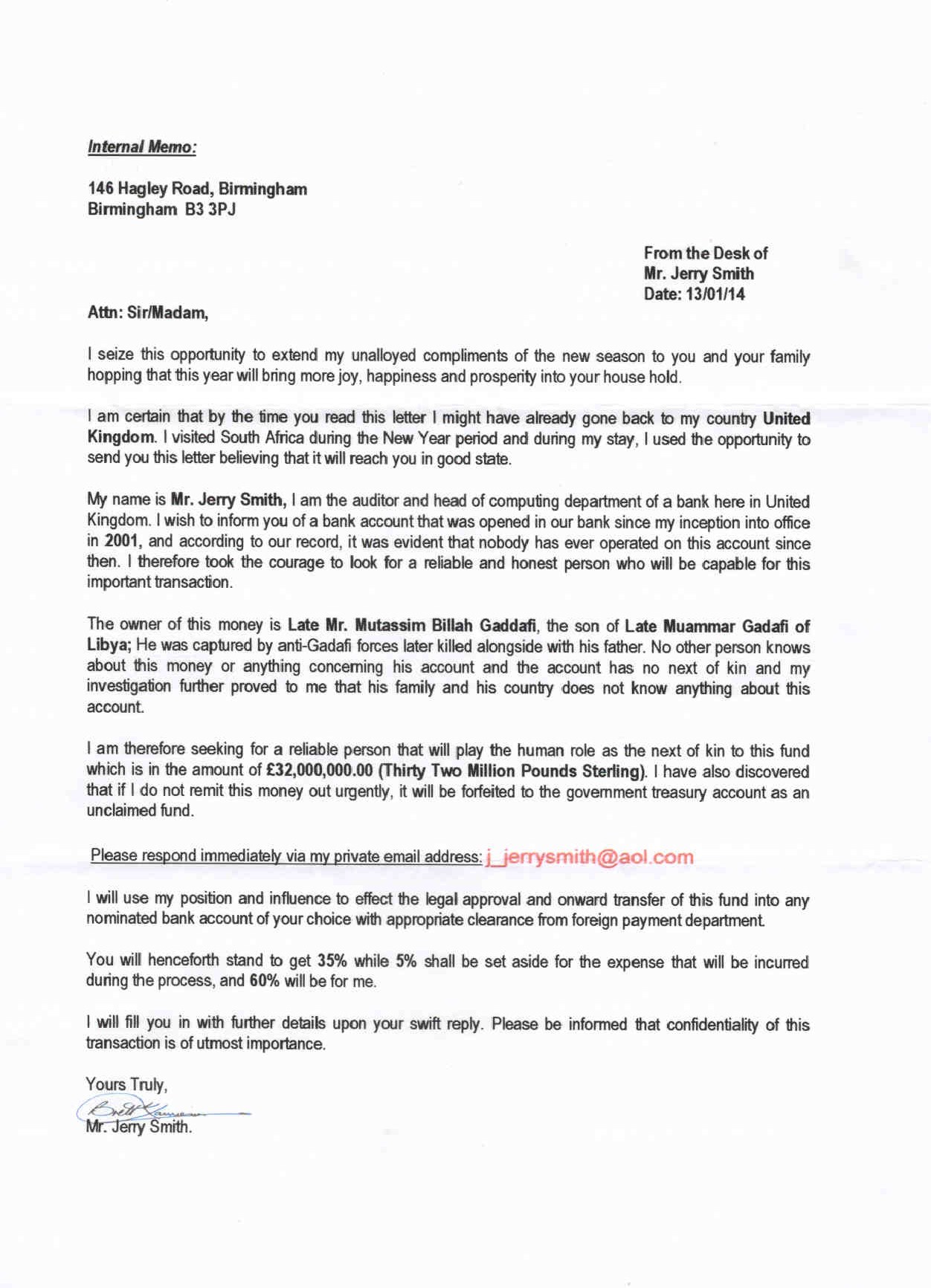
The Federal Bureau of Investigation (FBI) states that "An advance fee scheme occurs when the victim pays money to someone in anticipation of receiving something of greater value – such as a loan, contract, investment, or gift – and then receives little or nothing in return."[3] There are many variations of this type of scam, including the Nigerian prince scam, also known as a 419 scam. It is popularly known as "yahoo yahoo" in Nigeria. The number "419" refers to the section of the Nigerian Criminal Code dealing with fraud.[5] The scam has been used with fax and traditional mail and is now prevalent in online communications such as emails.[4] Other variations include the Spanish Prisoner scam and the black money scam.
Although Nigeria is most often the nation referred to in these scams, they mainly originate in other nations. Other nations known to have a high incidence of advance-fee fraud include Ivory Coast,[6] Togo,[7] South Africa,[8] the Netherlands,[9] Spain,[10] and Jamaica.[11][12]
History
[edit]The modern scam is similar to the Spanish Prisoner scam that dates back to the late 18th century.[13][14] In that con, businessmen were contacted by an individual allegedly trying to smuggle someone who is connected to a wealthy family out of a prison in Spain. The scammer promised to share money with the victim in exchange for a small amount of money to bribe prison guards.[15]
One variant of the scam may date back to the 18th or 19th century, as a very similar letter, entitled "The Letter from Jerusalem". This is illustrated in the memoirs of Eugène François Vidocq, a former French criminal and private investigator.[16] Another variant of the scam, dating back to ca. 1830, appears very similar to emails today: "Sir, you will doubtlessly be astonished to be receiving a letter from a person unknown to you, who is about to ask a favour from you..." and goes on to talk of a casket containing 16,000 francs in gold and the diamonds of a late marchioness.[17]
The modern-day transnational scam can be traced back to Germany in 1922[18] and became popular during the 1980s. There are many variants of the template letter. One of these, sent via postal mail, was addressed to a woman's husband to inquire about his health. It then asked what to do with profits from a $24.6 million investment and ended with a telephone number.[19]
Other official-looking letters were sent from a writer who said he was a director of the state-owned Nigerian National Petroleum Corporation. He said he wanted to transfer $20 million to the recipient's bank account—money that was budgeted but was never spent. In exchange for transferring the funds out of Nigeria, the recipient would keep 30% of the total. To get the process started, the scammer asked for a few sheets of the company's letterhead, bank account numbers, and other personal information.[20][21] Yet other variants have involved mention of a Nigerian prince or other member of a royal family seeking to transfer large sums of money out of the country—thus, these scams are sometimes called "Nigerian Prince emails".[22][23]
The spread of e-mail and email harvesting software significantly lowered the cost of sending scam letters by using the Internet in lieu of international post.[24][25] Although Nigeria is most often the nation referred to in these scams, they may originate in other nations as well.[26] For example, in 2007, the head of the Economic and Financial Crimes Commission stated that scam emails more frequently originated in African countries or in Eastern Europe.[27] Within the European Union, there is a high incidence of advance-fee fraud in the Netherlands[9] and Spain.[10]
The emails sent invariably feature a large number of implausible claims, as well as numerous spelling and grammatical mistakes. According to Cormac Herley, a Microsoft researcher, "By sending an email that repels all but the most gullible, the scammer gets the most promising marks to self-select."[28] Responding to Herley, a director at Nigeria's National Security Adviser said that there are more non-Nigerian scammers claiming to be Nigerian, and suggested that Nigeria's reputation for corruption is part of the allure that makes scams seem more plausible.[29] Nigeria has a reputation for being at the center of email scamming.[30][31]
Modern variations include “sugar daddy/sugar momma” schemes, some of which involve advance-fee scamming,[32] and money flipping, whereby the mark is promised a large amount of money in exchange for sending a small amount of money.[33]
A 2018 study of Nigerian hip-hop culture found that glamorization of cyber-fraud is prevalent in such music.[34] Some scammers have accomplices in the United States and abroad who move in to finish the deal once the initial contact has been made.[35]
Motives
[edit]Many scammers tend to come from poorer and more-educated backgrounds, where Internet access and better education, along with inability to afford basic necessities, drive people into committing online fraud. They could also have been influenced by social media celebrities and artists who promote scamming as a "cool" trend to quickly gain access to luxury items like sports cars and fashion.[36]
In the case of Nigeria, the rise in scamming cases was due to a boom in cybercafes, a series of economic crashes from the 1980s, and the resulting joblessness among young people in Nigeria.[37][38]
Implementation
[edit]This scam usually begins with the perpetrator contacting the victim via email, instant messaging, or social media using a fake email address or a fake social media account.[26] The fraudster then makes an offer that would allegedly result in a large payoff for the victim.[15][39] An email subject line may say something like "From the desk of barrister [Name]", "Your assistance is needed", "Important", "Dear Sir or Madam" and so on. The details vary, but the usual story is that a person, often a government or bank employee, knows of a large amount of unclaimed money or gold that they cannot access directly, usually because they have no right to it.[1][40][41]
Such people, who may be real people being impersonated by the scammer or fictitious characters played by the con artist, could include, for example, the wife or son of a deposed African leader who has amassed a stolen fortune, a bank employee who knows of a terminally ill wealthy person with no relatives or a wealthy foreigner who deposited money in the bank just before dying in a traffic accident or a plane crash (leaving no will or known next of kin),[42] a US soldier who has stumbled upon a hidden cache of gold in Iraq, a business being audited by the government, a disgruntled worker or corrupt government official who has embezzled funds, a refugee,[43] and similar characters.[41]
The money could be in the form of gold bullion, gold dust, money in a bank account, blood diamonds, a series of cheques or bank drafts, and so on.[44] The sums involved are usually in the millions of dollars, and the investor is promised a large share, typically ten to fifty percent, in return for assisting the fraudster to retrieve or expatriate the money. Although the vast majority of recipients do not respond to these emails, a small percentage do, enough to make the scam worthwhile as many millions of messages can be sent daily.[1]
To help persuade the victim to agree to the deal, the scammer often sends one or more false documents that bear official government stamps, and seals.[45] 419 scammers also often utilize fake websites and addresses to present themselves as more legitimate.[46] Multiple "people" may write or be involved in schemes as they continue, but they are often fictitious; in many cases, one person controls all the fictitious personae used in scams.[6]
Once the victim's confidence has been gained, the scammer then introduces a delay or monetary hurdle that prevents the deal from occurring as planned, such as "To transmit the money, we need to bribe a bank official. Could you help us with a loan?" or "For you to be a party to the transaction, you must have holdings at a Nigerian bank of $100,000 or more" or similar.[44] This is the money being stolen from the victim; the victim willingly transfers the money, usually through some irreversible channel such as a wire transfer, and the scammer receives and pockets it.[6]
Often but not always, delays and additional costs are added by the fraudster, always keeping the promise of an imminent large transfer alive, convincing the victim that the money the victim is currently paying would be covered several times over by the payoff.[47] The implication that these payments will be used for white-collar crime, such as bribery, and even that the money they are being promised is being stolen from a government or royal/wealthy family, often prevents the victim from telling others about the "transaction", as it would involve admitting that they intended to be complicit in an international crime.[6]
Sometimes psychological pressure is added by claiming that the scammers' side, to pay certain fees, had to sell belongings and mortgage a house or by comparing the salary scale and living conditions in their country to those in the West.[26][34] Much of the time, however, the needed psychological pressure is self-applied: once the victims have provided money toward the payoff, they feel they have a vested interest in seeing the "deal" through. Some victims even believe they can cheat the other party, and walk away with all the money instead of just the percentage they were promised.[6]
The essential fact in all advance-fee fraud operations is that the promised money transfer to the victim never happens because the money does not exist. The perpetrators rely on the fact that, by the time the victim realizes this (often only after being confronted by a third party who has noticed the transactions or conversation and recognized the scam), the victim may have sent thousands of dollars of their own money, sometimes thousands more that was borrowed or stolen, to the scammer via an untraceable and/or irreversible means such as wire transfer.[6] The scammer disappears, and the victim is left on the hook for the money sent to the scammer.
During the course of many schemes, scammers ask victims to supply bank account information. Usually this is a "test" devised by the scammer to gauge the victim's gullibility;[9] the bank account information is not used directly by the scammer, because a fraudulent withdrawal from the account is more easily detected, reversed, and traced. Scammers instead usually request that payments be made using a wire transfer service like Western Union and MoneyGram.[48] The reason given by the scammer usually relates to the speed at which the payment can be received and processed, allowing quick release of the supposed payoff. The real reason for using such money-sending services is that such wire transfers are irreversible and often untraceable. Further, these services are ideal because identification beyond knowledge of the details of the transaction is often not required, making receipt of such funds almost or entirely anonymous.[6] However, bank account information obtained by scammers is sometimes sold in bulk to other fraudsters who wait a few months for the victim to repair the damage caused by the initial scam before raiding any accounts that the victim did not close.
Telephone numbers used by scammers tend to come from burner phones. In Ivory Coast, a scammer may purchase an inexpensive mobile phone and a pre-paid SIM card without submitting any identifying information. If the scammers believe they are being traced, they discard their mobile phones and purchase new ones.[6]
The spam emails used in these scams are often sent from Internet cafés equipped with satellite internet connection. Recipient addresses and email content are copied and pasted into a webmail interface using a stand-alone storage medium, such as a memory card.[citation needed] Certain areas of Lagos, such as Festac Town, contain many cyber cafés that serve scammers; cyber cafés often lock their doors during certain times, e.g., between 10:30 p.m. and 7:00 a.m., so that scammers inside may work without fear of discovery.[49]
Nigeria also contains many businesses that provide false documents used in scams. After a scam involving a forged signature of Nigerian President Olusegun Obasanjo in summer 2005, Nigerian authorities raided a market in the Oluwole section of Lagos.[49] There, police seized thousands of Nigerian and non-Nigerian passports, 10,000 blank British Airways boarding passes, 10,000 United States Postal money orders, customs documents, false university certificates, 500 printing plates, and 500 computers.[49]
The "success rate" of the scammers is also hard to gauge, since they operate illegally and do not keep track of specific numbers. One individual estimated that he sent 500 emails per day and received about seven replies, citing that when he received a reply, he was 70 percent certain he would get the money.[35] If tens of thousands of emails are sent every day by thousands of individuals, it does not take a very high success rate to be worthwhile.[50]
The success of advance fee crimes is based on the initial persuading of the victim. The FBI reported that in 2019 there were 14,607 US citizens that were victims of advance fee scams, which collectively represented in excess of $3.5 billion worth of lost funds.[51]
Countermeasures
[edit]
In recent years, efforts have been made by governments, internet companies, and individuals to combat scammers involved in advance-fee fraud and 419 scams. In 2004, the Nigerian government formed the Economic and Financial Crimes Commission (EFCC) to combat economic and financial crimes, such as advanced-fee fraud.[52] In 2009, Nigeria's EFCC announced that they had adopted smart technology developed by Microsoft to track down fraudulent emails. They hoped to have the service, dubbed "Eagle Claw", running at full capacity to warn a quarter of a million potential victims.[30]
Some individuals participate in a practice known as scam baiting, in which they pose as potential targets and engage the scammers in lengthy dialogue so as to waste the scammer's time and decrease the time they have available for actual victims.[53] Likewise, the website Artists Against 419, set up by volunteers, offers a public database with information on scam websites. They work closely together with APWG to share their data with financial institutions and cybersecurity companies.
Common elements
[edit]Irreversible money transfers
[edit]A central element of advance-fee fraud is that the transaction from the victim to the scammer must be untraceable and irreversible. Otherwise, the victim, once they become aware of the scam, could successfully retrieve their money and alert officials who could track the accounts used by the scammer.[citation needed]
Cryptocurrencies[54] or wire transfers via Western Union and MoneyGram are ideal for this purpose. International wire transfers cannot be cancelled or reversed, and the person receiving the money cannot be tracked. Other non-cancellable forms of payment include postal money orders and cashier's cheques, but wire transfer via Western Union or MoneyGram is more common. [citation needed]
Anonymous communication
[edit]Since the scammer's operations must be untraceable to avoid identification, and because the scammer is often impersonating someone else, any communication between the scammer and his victim must be done through channels that hide the scammer's true identity. The following options in particular are widely used.
Web-based email
[edit]Because many free email services do not require valid identifying information and also allow communication with many victims in a short span of time, they are the preferred method of communication for scammers.[55] Some services go so far as to mask the sender's source IP address (Gmail being a common choice), making the scammer's country of origin more difficult to trace. While Gmail does indeed strip headers from emails, it is possible to trace an IP address from such an email. Scammers can create as many accounts as they wish and often have several at a time. In addition, if email providers are alerted to the scammer's activities and suspend the account, it is a trivial matter for the scammer to simply create a new account to resume scamming.[citation needed]
Email hijacking/friend scams
[edit]Some fraudsters hijack existing email accounts and use them for advance-fee fraud purposes. For instance, with social engineering, the fraudster impersonates associates, friends, or family members of the legitimate account owner in an attempt to defraud them.[56] A variety of techniques such as phishing, keyloggers, and computer viruses are used to gain login information for the email address.
Fax transmissions
[edit]Facsimile machines are commonly used tools of business whenever a client requires a hard copy of a document.[citation needed] They can also be simulated using web services and made untraceable by the use of prepaid phones connected to mobile fax machines or by use of a public fax machine such as one owned by a document processing business like FedEx Office/Kinko's. Thus, scammers posing as business entities often use fax transmissions as an anonymous form of communication. This is more expensive, as the prepaid phone and fax equipment cost more than email, but to a skeptical victim, it can be more believable.[citation needed]
SMS messages
[edit] |
Abusing SMS bulk senders such as WASPs, scammers subscribe to these services using fraudulent registration details and paying either via cash or with stolen credit card details. They then send out masses of unsolicited SMS messages to victims stating they have won a competition, lottery, reward, or an event and that they have to contact somebody to claim their prize. Typically, the details of the party to be contacted will be an equally untraceable email address or a virtual telephone number.
These messages may be sent over a weekend when the staff at the service providers are not working, enabling the scammer to be able to abuse the services for a whole weekend. Even when traceable, they give out long and winding procedures for procuring the reward (real or unreal) and that too with the impending huge cost of transportation and tax or duty charges. The origin of such SMS messages is often from fake websites/addresses.
Mid-2011 saw the innovation of scammers employing premium rate callback numbers for potential victims to reply to (rather than providing a website or email address). On calling the number, the victim is first reassured that 'they are a winner' and then subjected to a long series of instructions on how to collect their 'winnings'. During the message, there will be frequent instructions to 'ring back in the event of problems'. The call is always 'cut off' just before the victim has the chance to note all the details. Some victims call back multiple times in an effort to collect all the details. The scammer thus makes their money out of the fees charged for the calls.
Telecommunications relay services
[edit] | This section relies on a single source. (May 2025) |
Many scams use telephone calls to convince the victim that the person on the other end of the deal is a real, truthful person. The scammer, possibly impersonating a person of a nationality or gender other than their own, would arouse suspicion by telephoning the victim. In these cases, scammers use TRS, a US federally funded relay service where an operator or a text/speech translation program acts as an intermediary between someone using an ordinary telephone and a deaf caller using TDD or other teleprinter device. The scammer may claim they are deaf, and that they must use a relay service. The victim, possibly drawn in by sympathy for a disabled caller, might be more susceptible to the fraud.[citation needed]
FCC regulations and confidentiality laws require operators to relay calls verbatim and adhere to a strict code of confidentiality and ethics. Thus, no relay operator may judge the legality and legitimacy of a relay call and must relay it without interference. This means the relay operator may not warn victims, even when they suspect the call is a scam. MCI said about one percent of their IP Relay calls in 2004 were scams.[57]
Tracking phone-based relay services is relatively easy, so scammers tend to prefer Internet Protocol–based relay services such as IP Relay. In a common strategy, they bind their overseas IP address to a router or server located on US soil, allowing them to use US-based relay service providers without interference.
TRS is sometimes used to relay credit card information to make a fraudulent purchase with a stolen credit card. In many cases however, it is simply a means for the con artist to further lure the victim into the scam.
Invitation to visit the country
[edit]Sometimes, victims are invited to a country to meet government officials, an associate of the scammer, or the scammer themselves. Some victims who travel are instead held for ransom. Scammers may tell a victim that they do not need a visa or that the scammers will provide one.[58] If the victim does this, the scammers have the power to extort money from the victim.[58]
Sometimes victims are ransomed, kidnapped, or murdered. According to a 1995 U.S. State Department report, over fifteen persons were murdered between 1992 and 1995 in Nigeria after following through on advance-fee frauds.[58] In 1999 Norwegian millionaire Kjetil Moe was lured to South Africa by scammers and was murdered.[59][60] George Makronalli was lured to South Africa and was killed in 2004.[61][62]
Variants
[edit]There are many variations on the most common stories, and also many variations on the way the scam works. Some of the more commonly seen variants involve employment scams, lottery scams, online sales and rentals, and romance scams. Many scams involve online sales, such as those advertised on websites such as Craigslist and eBay, or property rental. This article cannot list every known and future type of advanced fee fraud or 419 scheme; only some major types are described. Additional examples may be available in the external links section at the end of this article.
Employment scams
[edit] | This section needs more citations. (July 2025) |
This scam targets people who have posted their résumés on job sites. The scammer sends a letter with a falsified company logo. The job offer usually indicates exceptional salary and benefits, and requests that the victim needs a "work permit" for working in the country, and includes the address of a (fake) "government official" to contact. The "government official" then proceeds to fleece the victim by extracting fees from the unsuspecting user for the work permit and other fees. A variant of the job scam recruits freelancers seeking work, such as editing or translation, then requires some advance payment before assignments are offered.[63]
Many[quantify] legitimate (or at least fully registered) companies work on a similar basis, using this method as their primary source of earnings. Some modelling and escort agencies tell applicants that they have a number of clients lined up, but that they require some sort of prior "registration fee", usually paid in by an untraceable method, e.g. by Western Union transfer; once the fee is paid, the applicant is informed the client has cancelled, and not contacted again.
The scammer contacts the victim to interest them in a "work-from-home" opportunity, or asks them to cash a cheque or money order that for some reason cannot be redeemed locally. In one cover story, the perpetrator of the scam wishes the victim to work as a "mystery shopper", evaluating the service provided by MoneyGram or Western Union locations within major retailers such as Wal-Mart.[64] The scammer sends the victim a forged or stolen cheque or money order as described above, the victim deposits it—banks will often credit an account with the value of a cheque not obviously false— and sends the money to the scammer via wire transfer. Later the cheque is not honoured ("bounces") and the bank debits the victim's account. Schemes based solely on cheque cashing usually offer only a small part of the cheque's total amount, with the assurance that many more cheques will follow; if the victim buys into the scam and cashes all the cheques, the scammer can steal a lot in a very short time.
Bogus job offers
[edit]More sophisticated scams advertise jobs with real companies and offer lucrative salaries and conditions with the fraudsters pretending to be recruitment agents. A bogus telephone or online interview may take place and after some time the applicant is informed that the job is theirs. To secure the job they are instructed to send money for their work visa or travel costs to the agent, or to a bogus travel agent who works on the scammer's behalf. No matter what the variation, they always involve the job seeker sending them or their agent money, credit card or bank account details.[65] A newer form of employment scam has arisen in which users are sent a bogus job offer but are not asked to give financial information. Instead, their personal information is harvested during the application process and then sold to third parties for a profit, or used for identity theft.[66][67]
Another form of employment scam involves making people attend a fake "interview" where they are told the benefits of the company. The attendees are then made to assist to a conference where a scammer will use elaborate manipulation techniques to convince the attendees to purchase products, in a similar manner to the catalog merchant business model, as a hiring requisite. Quite often, the company lacks any form of the physical catalog to help them sell products (e.g. jewelry). When "given" the job, the individual is then asked to promote the scam job offer on their own. They are also made to work for the company unpaid as a form of "training".[68] Similar scams involve making alleged job candidates pay money upfront in person for training materials or services, with the claim that upon successful completion, they will be offered a guaranteed job, which never materializes.[69]
Lottery scam
[edit]The lottery scam involves fake notices of lottery wins, although the intended victim has not entered the lottery. The "winner" is usually asked to send sensitive information such as name, residential address, occupation/position, lottery number etc. to a free email account which is at times untraceable or without any link. In addition to harvesting this information, the scammer then notifies the victim that releasing the funds requires some small fee (insurance, registration, or shipping). Once the victim sends the fee, the scammer invents another fee.
The fake cheque technique described above is also used. Fake or stolen cheque, representing a part payment of the winnings, being sent; then a fee, smaller than the amount received, is requested. The bank receiving the bad cheque eventually reclaims the funds from the victim.[citation needed]
In 2004, a variant of the lottery scam appeared in the United States: a scammer phones a victim purporting to be speaking on behalf of the government about a grant they qualify for, subject to an advance fee of typically US$250.[70]
Typical lottery scams address the person as some variation of Lucky Winner. This is a red flag, as if someone entered an actual lottery and won, the organization would know their name, and not simply call them Lucky Winner.
Online sales and rentals
[edit]Many scams involve the purchase of goods and services via classified advertisements, especially on sites like Craigslist, eBay, or Gumtree. These typically involve the scammer contacting the seller of a particular good or service via telephone or email expressing interest in the item. They will typically then send a fake cheque written for an amount greater than the asking price, asking the seller to send the difference to an alternate address, usually by money order or Western Union. A seller eager to sell a particular product may not wait for the cheque to clear, and when the bad cheque bounces, the funds wired have already been lost.[71]
Some scammers advertise phony academic conferences in exotic or international locations, complete with fake websites, scheduled agendas and advertising experts in a particular field that will be presenting there. They offer to pay the airfare of the participants, but not the hotel accommodations. They will extract money from the victims when they attempt to reserve their accommodations in a non-existent hotel.[72]
Sometimes, an inexpensive rental property is advertised by a fake landlord, who is typically out of state (or the country) and asking for the rent and/or deposit to be wired to them.[73] Or the con artist finds a property, pretends to be the owner, lists it online, and communicates with the would-be renter to make a cash deposit.[74] The scammer may also be the renter as well, in which case they pretend to be a foreign student and contact a landlord seeking accommodation. They usually state they are not yet in the country and wish to secure accommodations prior to arriving. Once the terms are negotiated, a forged cheque is forwarded for a greater amount than negotiated, and the fraudster asks the landlord to wire some of the money back.[75]
Pet scams
[edit]This is a variation of the online sales scam where high-value, scarce pets are advertised as bait on online advertising websites using little real seller verification like Craigslist, Gumtree, and JunkMail. The pet may either be advertised as being for-sale or up for adoption. Typically, the pet is advertised on online advertising pages complete with photographs taken from various sources such as real advertisements, blogs or wherever else an image can be stolen. Upon the potential victim contacting the scammer, the scammer responds by asking for details pertaining to the potential victim's circumstances and location under the pretense of ensuring that the pet would have a suitable home.[76]
By determining the location of the victim, the scammer ensures he is far enough from the victim so as to not allow the buyer to physically view the pet. Should the scammer be questioned, as the advertisement claimed a location initially, the scammer will claim work circumstances having forced him to relocate. This forces a situation whereby all communication is either via email, telephone (normally untraceable numbers) and SMS.[76]
Upon the victim deciding to adopt or purchase the pet, a courier has to be used which is in reality part of the scam. If this is for an adopted pet, typically the victim is expected to pay some fee such as insurance, food or shipping. Payment is via MoneyGram, Western Union or money mules' bank accounts where other victims have been duped into work from home scams.[76]
Numerous problems are encountered in the courier phase of the scam. The crate may be said to be too small, and the victim has the option of either purchasing a crate with air conditioning or renting one while also paying a deposit, typically called a caution or cautionary fee. The victim may also have to pay for insurance if such fees have not been paid yet. If the victim pays these fees, the pet may be said to have become sick, and a veterinarian's assistance is sought for which the victim has to repay the courier.[77]
Additionally, the victim may be asked to pay for a health certificate needed to transport the pet, and for kennel fees during the recuperation period. The further the scam progresses, the more similar the fictitious fees are to those of typical 419 scams. It is not uncommon to see customs or like fees being claimed if such charges fit into the scam plot.[77]
Numerous scam websites may be used for this scam.[78] This scam has been linked to the classical 419 scams in that the fictitious couriers used are also used in other types of 419 scams such as lotto scams.
Romance scam
[edit]One of the variants is the Romance Scam, a money-for-romance angle.[79] The con artist approaches the victim on an online dating service, an instant messenger, or a social networking site. The scammer claims an interest in the victim, and posts pictures of an attractive person.[80] The scammer uses this communication to gain confidence, then asks for money.[79] A very common example of romance scams is depicted in the fraudulent activities of these boys, popularly known as Yahoo boys in Nigeria.[81][82]
The con artist may claim to be interested in meeting the victim but needs cash to book a plane, buy a bus ticket, rent a hotel room, pay for personal-travel costs such as gasoline or a vehicle rental, or to cover other expenses.[34] In other cases, they claim they are trapped in a foreign country and need assistance to return, to escape imprisonment by corrupt local officials, to pay for medical expenses due to an illness contracted abroad, and so on.[80] The scammer may also use the confidence gained by the romance angle to introduce some variant of the original Nigerian Letter scheme,[80] such as saying they need to get money or valuables out of the country and offer to share the wealth, making the request for help in leaving the country even more attractive to the victim.
Scams often involve meeting someone on an online match-making service.[79] The scammer initiates contact with their target who is out of the area and requests money for transportation fare.[80] Scammers will typically ask for money to be sent via a money order or wire transfer due to the need to travel, or for medical or business costs.[83]
An extreme example of this is the case of a 67-year-old Australian woman, Jette Jacobs. In 2013, she traveled to South Africa to supposedly marry her scammer, Jesse Orowo Omokoh, 28, after having sent more than $90,000 to him over a three-year period.[84] Her body was discovered on February 9, 2013, under mysterious circumstances, two days after meeting up with Omokoh, who then fled to Nigeria, where he was arrested. He was found to have had 32 fake online identities. Due to lack of evidence he was not charged with murder, but was charged with fraud.[85][86]
Mobile tower installation fraud
[edit]This variant of advance-fee fraud is widespread in India and Pakistan.[87][88] The fraudster uses Internet classified websites and print media to lure the public into installing a mobile phone tower on their property, with the promise of huge rental returns. The fraudster also creates fake websites to appear legitimate. The victims part with their money in pieces to the fraudster on account of the Government Service Tax, government clearance charges, bank charges, transportation charges, survey fee etc. The Indian government is issuing public notices in media to spread awareness among the public and warn them against mobile tower fraudsters.[89][90]
Other scams
[edit]Other scams involve unclaimed property, also called "bona vacantia" in the United Kingdom. In England and Wales (other than the Duchy of Lancaster and the Duchy of Cornwall), this property is administered by the Bona Vacantia Division of the Treasury Solicitor's Department.[citation needed] Fraudulent emails and letters claiming to be from this department have been reported, informing the recipient they are the beneficiary of a legacy but requiring the payment of a fee before sending more information or releasing the money.[91] In the United States, messages are falsely claimed to be from the National Association of Unclaimed Property Administrators (NAUPA), a real organization, but one that does not and cannot by itself make payments.[92]
In one variant of 419 fraud, an alleged hitman writes to someone explaining he has been targeted to kill them. He tells them he knows the allegations against them are false, and asks for money so the target can receive evidence of the person who ordered the hit.[93]
Another variant of advanced fee fraud is known as a pigeon drop. This is a confidence trick in which the mark, or "pigeon", is persuaded to give up a sum of money in order to secure the rights to a larger sum of money, or more valuable object.[citation needed] In reality, the scammers make off with the money and the mark is left with nothing. In the process, the stranger (actually a confidence trickster) puts his money with the mark's money (in an envelope, briefcase, or bag) which the mark is then apparently entrusted with; it is actually switched for a bag full of newspaper or other worthless material. Through various theatrics, the mark is given the opportunity to leave with the money without the stranger realizing. In reality, the mark would be fleeing from his own money, which the con man still has (or has handed off to an accomplice).[94]
Some scammers go after the victims of previous scams; known as a reloading scam. For example, they may contact a victim saying they can track and apprehend the scammer and recover the money lost by the victim for a price. Or they may say a fund has been set up by the Nigerian government to compensate victims of 419 fraud, and all that is required is proof of the loss, personal information, and a processing and handling fee. The recovery scammers obtain lists of victims by buying them from the original scammers.[95]
Consequences
[edit]Estimates of the total losses due to scams are uncertain and vary widely, since many people may be too embarrassed to admit that they were gullible enough to be scammed to report the crime. A United States government report in 2006 indicated that Americans lost $198.4 million to Internet fraud in 2006, averaging a loss of $5,100 per incident.[27] That same year, a report in the United Kingdom claimed that these scams cost the economy £150 million per year, with the average victim losing £31,000.[96] As of 2019, Nigerian letter scams still annually collect $700,000 ($881,492 in 2025 dollars[97]) or $2,133 ($2,686 in 2025 dollars[97]) per person.[98]
In addition to the financial cost, many victims also suffer a severe emotional and psychological cost, such as losing their ability to trust people. One man from Cambridgeshire, UK burnt himself to death with petrol after realizing that the $1.2 million "internet lottery" that he had won was actually a scam.[99] In 2007, a Chinese student at the University of Nottingham killed herself after she discovered that she had fallen for a similar lottery scam.[100]
Other victims lose wealth and friends, become estranged from family members, deceive partners, get divorced, or commit criminal offenses in the process of either fulfilling their "obligations" to the scammers or obtaining more money.[101] In 2008, an Oregon woman lost $400,000 to a Nigerian advance-fee fraud scam, after an email told her she had inherited money from her long-lost grandfather. Her curiosity was piqued because she actually had a grandfather with whom her family had lost touch, and whose initials matched those given in the email. She sent hundreds of thousands of dollars over a period of more than two years, despite her family, bank staff and law enforcement officials all urging her to stop.[102] The elderly are particularly susceptible to online scams such as this, as they typically come from a generation that was more trusting,[103] and are often too proud to report the fraud. They also may be concerned that relatives might see it as a sign of declining mental capacity, and they are afraid to lose their independence.[104]
Victims can be enticed to borrow or embezzle money to pay the advance fees, believing that they will shortly be paid a much larger sum and be able to refund what they had misappropriated. Crimes committed by victims include credit-card fraud, check kiting, and embezzlement.[105][106][107] San Diego–based businessman James Adler lost over $5 million in a Nigeria-based advance-fee scam. While a court affirmed that various Nigerian government officials (including a governor of the Central Bank of Nigeria) were directly or indirectly involved, and that Nigerian government officials could be sued in U.S. courts under the "commercial activity" exception to the Foreign Sovereign Immunities Act, Adler was unable to get his money back due to the doctrine of unclean hands because he had knowingly entered into a contract that was illegal.[108][109]
Some 419 scams involve even more serious crimes, such as kidnapping or murder. One such case, in 2008, involves Osamai Hitomi, a Japanese businessman who was lured to Johannesburg, South Africa and kidnapped on September 26, 2008. The kidnappers took him to Alberton, south of Johannesburg, and demanded a $5 million ransom from his family. Seven people were ultimately arrested.[110] In July 2001, Joseph Raca, a former mayor of Northampton, UK, was kidnapped by scammers in Johannesburg, South Africa, who demanded a ransom of £20,000. The captors released Raca after they became nervous.[111] One 419 scam that ended in murder occurred in February 2003, when Jiří Pasovský, a 72-year-old scam victim from the Czech Republic, shot and killed 50-year-old Michael Lekara Wayid, an official at the Nigerian embassy in Prague, and injured another person, after the Nigerian Consul General explained he could not return the $600,000 that Pasovský had lost to a Nigerian scammer.[112][113][114]
The international nature of the crime, combined with the fact that many victims do not want to admit that they bought into an illegal activity, has made tracking down and apprehending these criminals difficult. Furthermore, the government of Nigeria has been slow to take action, leading some investigators to believe that some Nigerian government officials are involved in some of these scams.[115] The Nigeria government's establishment of the Economic and Financial Crimes Commission (EFCC) in 2004 helped with the issue to some degree, although issues with corruption remain.[52][116]
Despite this, there have been some recent successes in apprehending and prosecuting these criminals. In 2004, 52 suspects were arrested in Amsterdam after an extensive raid, after which almost no 419 emails were reported being sent by local internet service providers.[117] In November 2004, Australian authorities apprehended Nick Marinellis of Sydney, the self-proclaimed head of Australian 419ers who later boasted that he had "220 African brothers worldwide" and that he was "the Australian headquarters for those scams".[118] In 2008 US authorities in Olympia, Washington, sentenced Edna Fiedler to two years in prison with five years of supervised probation for her involvement in a $1 million Nigerian cheque scam. She had an accomplice in Lagos, Nigeria, who shipped her up to $1.1 million worth of counterfeit cheques and money orders with instructions on where to ship them.[119]
In popular culture
[edit]Research suggests that some Nigerian hip-hop musicians have strong connections with some Yahoo Boys (cybercriminals).[1] Due to the increased use of the 419 scams on the Internet, it has been used as a plot device in many films, television shows and books. A song, "I Go Chop Your Dollar", performed by Nkem Owoh, also became internationally known as an anthem for 419 scammers using the phrases "419 is just a game, I am the winner, you are the loser".[120] Other appearances in popular media include:
- The 2018 film Nigerian Prince follows a Nigerian-American teenager sent to Nigeria by his mother, where he connects with his cousin Pius, who runs 419 scams for a living.
- The 2016 short story The Nigerian Prince – When The Scammer Becomes The Scammed by L. Toshua Parker follows the true story of a U.S. college student and hacker in 2000 who targeted Nigerian 419 scammers and stole millions back from them.[121]
- In "A Thief in Ni-Moya", a 1981 novella from Robert Silverberg's Majipoor series, a young woman is swindled out of her savings under the pretense of fees required to inherit a large estate.[122]
- The novel I Do Not Come To You By Chance[123] by Nigerian author Adaobi Tricia Nwaubani explores the phenomenon.
- The 2006 direct-to-DVD film EZ Money features an instance of this scam as its central premise.[124]
- In the 2007 Futurama straight-to-DVD film Bender's Big Score, Professor Farnsworth falls for a lottery scam, giving away his personal details on the Internet after believing he has won the Spanish national lottery. Later, Nixon's Head falls for a "sweepstakes" letter by the same scammers, while Zoidberg is taken by an advance-fee fraud, thinking he is next of kin to a Nigerian Prince.[citation needed]
- In series 6, episode 3 of the BBC television series The Real Hustle, the hustlers demonstrated the 419 scam to the hidden cameras in the "High Stakes" episodes of the show.[125]
- In the HBO comedy series Flight of the Conchords episode "The New Cup", the band's manager, Murray, uses the band's emergency funds for what appears to be a 419 scam—an investment offer made by a Mr. Nigel Soladu, who had e-mailed him from Nigeria. However, it turns out that Nigel Soladu is a real Nigerian businessman and the investment offer is legitimate, although Murray notes that, despite Mr. Soladu having e-mailed many people for an investment, only he had taken him up on it. The band receives a 1000% profit, which they use to get bailed out of jail.[citation needed]
- The Residents included a song called "My Nigerian Friend" in their 2008 multimedia production The Bunny Boy.
- In the pilot episode, "The Nigerian Job", of Leverage, the group uses the reputation of the Nigerian scam to con a deceitful businessman.
- The 2012 novel 419 by Will Ferguson is the story of a daughter looking for the persons she believes responsible for her father's death due to suicide following a 419 scam. A follow-up to earlier novels about con men and frauds (Generica and Spanish Fly), 419 won the 2012 Giller Prize, Canada's most distinguished literary award.[126][127]
- In the video game Warframe, Nef Anyo ran an advance-fee fraud during Operation False Profit, where players attempted to reverse the scam and steal credits from him in order to bankrupt him and prevent his creation of a robotic army.
- MC Frontalot's song "Message No. 419" is about a 419 scam.[128]
- In the Vampire: The Eternal Struggle card game the Osebo clan has a card to perform a 419 Operation.
- A 2016 episode of Family Guy titled "Scammed Yankees" sees Peter Griffin and his father-in-law Carter fall victim to a 419 scam and travel to Africa to get the money back.
- Chris Okagbue, a Nigerian actor and member of the Onitsha royal family, starred in a 2026 Vaseline commercial that analogizes the Nigerian prince scam to counterfeit Vaseline products.[129][130]
See also
[edit]- Sakawa, fraud in Ghana with African traditional rituals
- Nigerian organized crime
- Pigeon drop
References
[edit]- ^ a b c d Lazarus, Suleman; Okolorie, Geoffrey U. (2019). "The Bifurcation of the Nigerian Cybercriminals: Narratives of the Economic and Financial Crimes Commission (EFCC) Agents". Telematics and Informatics. 40: 14–26. doi:10.1016/j.tele.2019.04.009. S2CID 150113120.
- ^ Lazarus, Suleman (2019). "Where Is the Money? The Intersectionality of the Spirit World and the Acquisition of Wealth". Religions. 10 (3): 146. doi:10.3390/rel10030146.
- ^ a b "Advance Fee Scams". FBI.gov. Archived from the original on 1 November 2019.
- ^ a b "Advance Fee Fraud". Encyclopædia Britannica. Archived from the original on 27 May 2023.
- ^ "Nigeria Laws: Part 6: Offences Relating to property and contracts". Nigeria Law. Archived from the original on 8 March 2005. Retrieved 22 June 2012.
- ^ a b c d e f g h "West African Advance Fee Scams". United States Department of State. Archived from the original on 14 June 2012. Retrieved 23 June 2012.
- ^ "Togo: Country Specific Information". United States Department of State. Archived from the original on 2 July 2012. Retrieved 23 June 2012.
- ^ "Advance Fee Fraud". Hampshire Constabulary. Archived from the original on 9 February 2012. Retrieved 23 June 2012.
- ^ a b c "Fraud Scheme Information". United States Department of State. Archived from the original on 13 February 2012. Retrieved 23 June 2012.
- ^ a b "Advance Fee Fraud". BBA. Archived from the original on 28 June 2012. Retrieved 23 June 2012.
- ^ Jackman, Tom (12 February 2019). "William Webster, ex-FBI and CIA director, helps feds nab Jamaican phone scammer". The Washington Post. Retrieved 12 February 2019.
- ^ Vasciannie, Stephen (14 March 2013). "Jamaica Comes Down Tough on 'Lottery Scams'". Huffington Post. Retrieved 12 February 2019.
- ^ "An old swindle revived; The "Spanish Prisoner" and Buried Treasure Bait Again Being Offered to Unwary Americans". The New York Times. 20 March 1898. p. 12. Retrieved 1 July 2010.
- ^ Old Spanish Swindle Still Brings In New U.S. Dollars, Sarasota Herald-Tribune, October 2, 1960, pg 14
- ^ a b Mikkelson, David (1 February 2010). "Nigerian Scam". Snopes. Retrieved 22 June 2012.
- ^ Vidocq, Eugène François (1834). Memoirs of Vidocq: Principal Agent of the French Police until 1827. Baltimore, Maryland: E. L. Carey & A. Hart. p. 58.
- ^ Harris, Misty (21 June 2012). "Nigerian email scams royally obvious for good reason, study says". The Province. Archived from the original on 4 January 2019. Retrieved 4 January 2019 – via Canada.com.
- ^ "Danielson And Putnam News: Danielson". Norwich Bulletin. 16 November 1922. p. 6. Retrieved 7 May 2016.
- ^ Buse, Uwe (7 November 2005). "Africa's City of Cyber Gangsters". Der Spiegel. Retrieved 22 June 2012.
- ^ Lohr, Steve (21 May 1992). "'Nigerian Scam' Lures Companies". The New York Times. Retrieved 22 June 2012.
- ^ "International Financial Scams". United States Department of State, Bureau of Consular Affairs. Retrieved 12 January 2015.
- ^ "The Nigerian Prince: Old Scam, New Twist". Better Business Bureau. Archived from the original on 26 February 2015. Retrieved 26 February 2015.
- ^ "Get smart on cybersecurity". Mozilla. Retrieved 9 February 2016.
- ^ Andrews, Robert (4 August 2006). "Baiters Teach Scammers a Lesson". Wired. Retrieved 22 June 2012.
- ^ Stancliff, Dave (12 February 2012). "As It Stands: Why Nigeria became the scam capital of the world". Times-Standard. Archived from the original on 16 February 2012. Retrieved 22 June 2012.
- ^ a b c Ibrahim, Suleman (December 2016). "Social and contextual taxonomy of cybercrime: Socioeconomic theory of Nigerian cybercriminals". International Journal of Law, Crime and Justice. 47: 44–57. doi:10.1016/j.ijlcj.2016.07.002. S2CID 152002608.
- ^ a b Rosenberg, Eric (31 March 2007). "U.S. Internet fraud at all-time high". San Francisco Chronicle. Retrieved 22 June 2012.
- ^ Herley, Cormac (2012). "Why do Nigerian Scammers Say They are from Nigeria?" (PDF). Microsoft. Archived (PDF) from the original on 22 June 2012. Retrieved 23 June 2012.
- ^ "Blatancy and latency". The Economist. 30 June 2012.
- ^ a b Staff Writer (22 October 2009). "Nigeria's anti graft police shuts 800 scam websites". Agence France-Presse. Archived from the original on 17 April 2010. Retrieved 22 June 2012.
- ^ "Nigeria shuts 800 scam websites". IOL. 23 October 2009.
- ^ "More 'sugar daddy' and 'sugar baby' sign-ups – and scams". South China Morning Post. 2 September 2020. Retrieved 15 June 2021.
- ^ "Flipping Money Scams on Social Networks!". www.foolproofme.org. Retrieved 15 June 2021.
- ^ a b c Lazarus, Suleman (August 2018). "Birds of a Feather Flock Together: The Nigerian Cyber Fraudsters (Yahoo Boys) and Hip Hop Artists". Criminology, Criminal Justice, Law & Society. 19 (2).
- ^ a b Dixon, Robyn (20 October 2005). ""I Will Eat Your Dollars"". Los Angeles Times. Festac. Retrieved 22 June 2012.
- ^ Clinton, Helen; Abumere, Princess (14 September 2021). "Hushpuppi - the Instagram influencer and international fraudster". BBC News. Retrieved 16 May 2022.
- ^ Lin, Sharon (18 April 2022). "The Long Shadow of the 'Nigerian Prince' Scam". Wired. Retrieved 16 May 2022.
- ^ Akinwotu, Emmanuel (14 June 2021). "Young, qualified and barely scraping by – inside Nigeria's economic crisis". The Guardian. Retrieved 16 May 2022.
- ^ Loriggio, Paola (March 17, 2017). "Toronto woman loses $450,000 from life savings, sale of condo to online dating scam: police". Edmonton Journal. Archived from the original on March 24, 2017. Retrieved March 23, 2017.
- ^ Wild, Jonathan (1 February 2017), "Department of Internal Affairs: England and the Countryside", Literature of the 1900s, Edinburgh University Press, doi:10.3366/edinburgh/9780748635061.003.0006, ISBN 978-0-7486-3506-1, retrieved 15 November 2020
- ^ a b "What is Advanced Fee Fraud?". Veridian Credit Union. Retrieved 2 November 2023.
- ^ "Latest e-mail uses Alaska Airlines crash victims to scam | Consumer News – seattlepi.com". Blog.seattlepi.nwsource.com. 9 November 2007. Archived from the original on 24 December 2008. Retrieved 22 February 2012.
- ^ "Zimbabwe appeal". Department of Commerce – WA ScamNet. Retrieved 9 November 2015.
- ^ a b "What is Social Engineering? | IBM". www.ibm.com. 14 June 2022. Retrieved 9 August 2024.
- ^ Longmore-Etheridge, Ann (August 1996). "Nigerian scam goes on". Security Management. 40 (8): 109. ProQuest 231127826.
- ^ "Advance Fee Scams". FightCybercrime.org. Retrieved 2 November 2023.
- ^ "Nigerian Prince scam: what is it and how it works | NordVPN". nordvpn.com. 5 May 2023. Retrieved 9 August 2024.
- ^ "Advance Fee Loan Scams | DirectLendingSolutions.com®". www.directlendingsolutions.com. Retrieved 24 September 2015.
- ^ a b c "I Will Eat Your Dollars". 29 October 2005. Archived from the original on 29 October 2005. Retrieved 22 February 2012.
- ^ Grinker, Roy R.; Lubkemann, Stephen C.; Steiner, Christopher B. (2010). Perspectives on Africa: A Reader in Culture, History and Representation. New York City: John Wiley & Sons. pp. 618–621. ISBN 978-1-4443-3522-4.
- ^ Hummer, Don; Byrne, James M. (2 March 2023). Handbook on Crime and Technology. Edward Elgar Publishing. ISBN 978-1-80088-664-3.
- ^ a b "Economic and Financial Crimes Commission (Establishment) Act of 2004" (PDF). Economic and Financial Crimes Commission (Nigeria). Archived from the original (PDF) on 28 June 2012. Retrieved 22 June 2012.
- ^ Cheng, Jacqui (11 May 2009). "Baiting Nigerian scammers for fun (not so much for profit)". Ars Technica. Retrieved 22 June 2012.
- ^ Pattison-Gordon, Jule (30 July 2025). "Fearing Scams, States Add Regulations to Crypto ATMs". Governing. Retrieved 7 June 2026.
- ^ Arehart, Christopher; Schmookler, Scott; Nemeth, Taylor (June 2021). "Guarding Against Email Social Engineering Fraud: Re-examining a Global Problem" (PDF). Chubb.com. Archived (PDF) from the original on 30 June 2021.
- ^ Gallagher, David F. (9 November 2007). "E-Mail Scammers Ask Your Friends for Money". Bits.blogs.nytimes.com. Retrieved 22 February 2012.
- ^ Sullivan, Bob (20 April 2004). "Con artists target phone system for deaf". MSNBC. Archived from the original on 30 October 2020. Retrieved 22 February 2012.
- ^ a b c United States Department of State (April 1997). "Nigerian Advance Fee Fraud (DEPARTMENT OF STATE PUBLICATION 10465)" (PDF). State Dept. Bureau of International Narcotics and Law Enforcement Affairs. Archived (PDF) from the original on 8 August 2019. Retrieved 4 January 2019.
- ^ Kjetil Moe found dead.
- ^ "The 419 Scam, or Why a Nigerian Prince Wants to Give You Two Million Dollars". informit.com. 8 February 2002.
- ^ Philip de Braun (31 December 2004). "SA cops, Interpol probe murder". News24. Retrieved 27 November 2010.
- ^ "Scam Bait – Don't let greed get you scammed". Freebies.about.com. 17 June 2010. Archived from the original on 13 February 2012. Retrieved 22 February 2012.
- ^ "Beware of scammers". www.linkedin.com. Retrieved 24 June 2022.
- ^ "Denton Woman Says Mystery Shopper Job Was Scam". Nbc5i.com. 6 November 2007. Archived from the original on 27 September 2008. Retrieved 10 June 2009.
- ^ Adams, Tony (6 March 2017). "Columbus woman warns others to beware of job phishing scams". Ledger-Enquirer. Retrieved 23 March 2017.
- ^ Shin, Annys (2 October 2007). "Taking the Bait On a Phish Scam, Job Seekers Are Targets, Victims of Sophisticated Ploy". Washington Post. Retrieved 30 March 2009.
- ^ Menn, Joseph (9 November 2007). "Sleeping on the job? Security at work-applicant sites faulted". Los Angeles Times. Retrieved 30 March 2009.
- ^ Lee, Diane (23 February 2017). "Upstate company posts salaried job ads, but isn't hiring for real positions say fmr. employees". WSPA-TV. Archived from the original on 24 March 2017. Retrieved 23 March 2017.
- ^ Kliot, Hannah (31 January 2017). "Online employment scams target college students". KSAT-TV. Retrieved 23 March 2017.
- ^ "Government Grant Scam". Snopes. 11 December 2004. Retrieved 22 February 2012.
- ^ "Craigslist Scams". fraudguides.com. Archived from the original on 5 July 2012. Retrieved 24 June 2012.
- ^ Grant, Bob (24 November 2009). "Another fake conference?". The Scientist. Retrieved 24 June 2012.
- ^ Sichelman, Lew (25 March 2012). "Rental scams can target either landlords or tenants". Los Angeles Times. Retrieved 23 June 2012.
- ^ Aho, Karen. "Renters: Beware of new twists on an old scam". MSN. Archived from the original on 12 May 2012. Retrieved 24 June 2012.
- ^ McKee, Chris (27 March 2011). "Room rental internet scam takes Eugene college students for thousands". KMTR. Archived from the original on 20 November 2012. Retrieved 24 June 2012.
- ^ a b c "AKC and Better Business Bureau Warn Consumers to Be Wary of Puppy Scams". Retrieved 29 May 2007.
- ^ a b Weisbaum, Herb. "Hound hoax: Con artists target dog lovers". NBC News. Archived from the original on 14 August 2020. Retrieved 18 June 2007.
- ^ Whittaker, Jack M; Button, Mark (28 December 2020). "Understanding pet scams: A case study of advance fee and non-delivery fraud using victims' accounts". Australian & New Zealand Journal of Criminology. 53 (4): 497–514. doi:10.1177/0004865820957077. S2CID 224966263.
- ^ a b c "Online Romance Scams Continue To Grow – Project Economy News Story". Kmbc.com. 19 May 2006. Archived from the original on 19 July 2011. Retrieved 22 February 2012.
- ^ a b c d "Singles seduced into scams online". NBC News. 28 July 2005. Archived from the original on 17 February 2013. Retrieved 22 February 2012.
- ^ "8 Signs Of A Yahoo Boy Every Lady Must Watch Out For". Dating Reporter's Blog. Archived from the original on 10 April 2021. Retrieved 5 April 2021.
- ^ Barragán, Carlos (9 June 2026). The Yahoo Boys: Love, Deception, and the Real Lives of Nigeria's Romance Scammers. Farrar, Straus and Giroux. ISBN 9780374609306.
- ^ "Attorney general: Beware of romance scams on Valentine's Day". Sentinel-Tribune. 11 February 2017. Archived from the original on 26 July 2020. Retrieved 23 March 2017.
- ^ AFP (3 February 2014). "Nigerian arrested over WA woman Jette Jacobs death". WAtoday. Retrieved 22 February 2023.
- ^ "Jette Jacobs' son visits the scene of his mother's alleged murder by a love scammer in South Africa". Archived from the original on 21 June 2014. Retrieved 8 February 2016.
- ^ "EFCC Arraigns Suspected Conman for $90,000 Romance Scam".
- ^ "Fraud of the Year: Minting Money by Acquiring Land for Towers". 9 October 2010. Retrieved 18 March 2016.
- ^ "Villagers fall prey to mobile tower scam – Times of India". The Times of India. 17 June 2015. Retrieved 18 March 2016.
- ^ "Measures to Protect Consumer Interest – Consumer Info: Telecom Regulatory Authority of India". www.trai.gov.in. Archived from the original on 12 February 2016. Retrieved 20 February 2016.
- ^ Kumar, Harish (2016). "Mass Marketing Frauds in the garb of Mobile Towers in India: Evolving a Framework to handle it". ResearchGate. doi:10.13140/RG.2.1.4630.2480. Retrieved 20 February 2016.
- ^ "Scam Email Warnings". Bona Vacantia. Archived from the original on 12 July 2012. Retrieved 24 June 2012.
- ^ Leamy, Elisabeth (16 August 2011). "Beware of Unclaimed Money Scams". ABC News. Retrieved 23 June 2012.
- ^ Mikkelson, Barbara (14 January 2007). "Hitman Scam". Snopes. Retrieved 23 June 2012.
- ^ Zak, Paul J. (13 November 2008). "How to Run a Con". Psychology Today. Retrieved 23 June 2012.
- ^ Mikkelson, David (11 August 2004). "Scam Me Twice, Shame On Me, ..." Snopes. Retrieved 24 June 2012.
- ^ "Nigeria scams 'cost UK billions'". BBC News. 20 November 2006. Retrieved 22 June 2012.
- ^ a b 1634–1699: McCusker, J. J. (1997). How Much Is That in Real Money? A Historical Price Index for Use as a Deflator of Money Values in the Economy of the United States: Addenda et Corrigenda (PDF). American Antiquarian Society. 1700–1799: McCusker, J. J. (1992). How Much Is That in Real Money? A Historical Price Index for Use as a Deflator of Money Values in the Economy of the United States (PDF). American Antiquarian Society. 1800–present: Federal Reserve Bank of Minneapolis. "Consumer Price Index (estimate) 1800–". Retrieved 29 February 2024.
- ^ Leonhardt, Megan (18 April 2019). "'Nigerian prince' email scams still rake in over $700,000 a year—here's how to protect yourself". CNBC. Retrieved 22 July 2022.
- ^ "Suicide of internet scam victim". BBC News. 30 January 2004. Retrieved 22 June 2012.
- ^ "Web scam drove student to suicide". BBC News. 2 May 2008. Retrieved 22 June 2012.
- ^ "Nigerian scam victims maintain the faith". Sydney Morning Herald. 14 May 2007. Retrieved 22 June 2012.
- ^ Song, Anna (11 November 2008). "Woman out $400K to 'Nigerian scam' con artists". KATU. Archived from the original on 18 June 2012. Retrieved 22 June 2012.
- ^ "FBI — Seniors". Federal Bureau of Investigation. 22 March 2016. Retrieved 12 May 2016.
- ^ Harzog, Beverly Blair (25 May 2012). "Protect Elderly Relatives from Credit Card Fraud". ABC News. Retrieved 23 June 2012.
- ^ Hills, Rusty; Frendewey, Matt (12 June 2007). "Former Alcona County Treasurer Sentenced to 9-14 Years in Nigerian Scam Case". State of Michigan. Archived from the original on 14 February 2012. Retrieved 23 June 2012.
- ^ Krajicek, David. "A "Perfect" Life: Mary Winkler Story". TruTV. Archived from the original on 25 November 2012. Retrieved 23 June 2012.
- ^ Liewer, Steve (5 July 2007). "Navy officer gets prison for stealing from ship safe". San Diego Union Tribune. Archived from the original on 27 June 2012. Retrieved 23 June 2012.
- ^ "Adler v. Federal Republic of Nigeria | Ninth Circuit". anylaw.com. 17 May 2000. Retrieved 6 March 2023.
- ^ Soto, Onell R. (15 August 2004). "Fight to get money back a loss". San Diego Union Tribune. Archived from the original on 2 December 2013. Retrieved 22 June 2012.
- ^ "Seven in court for 419 kidnap". News 24. 30 September 2008. Retrieved 22 June 2012.
- ^ "Kidnapped Briton tells of terror". BBC News. 14 July 2001. Retrieved 22 June 2012.
- ^ Misha Glenny (2009). McMafia. Vintage Books. pp. 138–141. ISBN 978-0-09-948125-6.
- ^ Sullivan, Bob (5 March 2003). "Nigerian scam continues to thrive". NBC News. Retrieved 22 June 2012.
- ^ Delio, Michelle (21 February 2003). "Nigerian Slain Over E-Mail Scam". Wired. Retrieved 22 June 2012.
- ^ Sine, Richard (2–8 May 1996). "Just Deposit $28 Million". Metroactive. Retrieved 23 June 2012.
- ^ Oluwarotimi, Abiodun (26 May 2012). "Nigeria: Police Force Is Corrupt, EFCC Not Sincere – U.S." AllAfrica.com. Retrieved 23 June 2012.
- ^ Libbenga, Jan (5 July 2004). "Cableco 'inside job' aided Dutch 419ers". The Register. Retrieved 23 June 2012.
- ^ Haines, Lester (8 November 2012). "Aussie 419 ringleader jailed for four years". The Register. Retrieved 23 June 2012.
- ^ "Woman gets prison for 'Nigerian' scam". United Press International. 26 June 2008. Retrieved 23 June 2012.
- ^ Libbenga, Jan (2 July 2007). "'I Go Chop Your Dollar' Star Arrested". The Register. Retrieved 23 June 2012.
- ^ Parker, L. Toshua (2016). The Nigerian Prince – When The Scammer Becomes the Scammed. Greyscale. ISBN 978-1-68489-233-4.
- ^ "Asimov's v05n13 (1981 12 21)" – via Internet Archive.
- ^ Nwaubani, Adaobi Tricia (2009). I Do Not Come to You by Chance. Hachette UK. ISBN 978-0-297-85872-0.
- ^ Carter, R.J. (26 August 2006). "DVD Review: EZ Money". The-Trades.com. Archived from the original on 5 February 2013. Retrieved 7 December 2012.
- ^ "Episode 3 of 10, Series 6: High Stakes". BBC. Retrieved 22 June 2012.
- ^ Sherlock, Tracy (20 April 2012). "Truth of 419 Internet scam really 'a sad story'". Vancouver Sun. Archived from the original on 20 June 2016. Retrieved 4 January 2019.
- ^ Quill, Greg (30 October 2012). "Will Ferguson takes Giller Prize for novel 419". Toronto Star. Archived from the original on 5 September 2017.
- ^ "MC Frontalot | Lyric | Message No. 419". frontalot.com. Retrieved 4 October 2016.
- ^ "Vaseline takes on counterfeits with a real Nigerian Prince for campaign by Leo Singapore". Roastbrief. 9 April 2026. Retrieved 9 April 2026.
- ^ Foley, Joe (6 April 2026). "Real Nigerian prince addresses those email scams in viral Vaseline ad". Creative Bloq. Retrieved 9 April 2026.
Further reading
[edit]- Ibrahim, Suleman (2016). "Social and contextual taxonomy of cybercrime: Socioeconomic theory of Nigerian cybercriminals". International Journal of Law, Crime and Justice. 47. Elsevier BV: 44–57. doi:10.1016/j.ijlcj.2016.07.002. ISSN 1756-0616. S2CID 152002608.
- Lazarus, Suleman; Okolorie, Geoffrey U. (2019). "The bifurcation of the Nigerian cybercriminals: Narratives of the Economic and Financial Crimes Commission (EFCC) agents". Telematics and Informatics. 40. Elsevier BV: 14–26. doi:10.1016/j.tele.2019.04.009. ISSN 0736-5853. S2CID 150113120.
- Lazarus, Suleman (27 February 2019). "Where Is the Money? The Intersectionality of the Spirit World and the Acquisition of Wealth". Religions. 10 (3). MDPI AG: 146. doi:10.3390/rel10030146. ISSN 2077-1444.
External links
[edit]
- US FBI Internet Crime Complaint Center Archived 2020-12-05 at the Wayback Machine
- Canadian Cybercrime
- Europol Cybercrime
- Why do Nigerian Scammers Say They are from Nigeria? by Cormac Herley of Microsoft Research
Types of fraud | |
|---|---|
| Business-related | |
| Family-related | |
| Financial-related | |
| Food-related | |
| Government-related | |
| Healthcare | |
| Other types | |

| National | |
|---|---|
| Other | |

Advance-fee scam
View on GrokipediaDefinition and Overview
Core Mechanism
An advance-fee scam is a form of fraud in which scammers promise victims access to a substantial financial gain, service, or prize in exchange for an initial payment covering purported costs such as taxes, processing fees, or legal expenses; however, the promised benefit never materializes, and the scammer absconds with the upfront funds.[9] These schemes rely on the victim's payment being made through irreversible methods like wire transfers, cryptocurrency, or prepaid cards, ensuring the scammer can retain the money without recourse.[14] The basic structure of an advance-fee scam unfolds in sequential stages initiated by unsolicited contact, often via email, phone, or mail, presenting an enticing opportunity such as a large inheritance, investment return, or lottery win. The scammer builds credibility by providing fabricated documentation or impersonating officials, then demands the initial fee to "unlock" the reward, followed by escalating requests for additional payments to address invented obstacles like customs duties or administrative hurdles.[9] This process preys on the sunk cost fallacy, where victims continue paying to avoid losing prior investments.[15] At its core, the scam exploits psychological vulnerabilities, including the allure of greed for quick wealth, manufactured urgency to prompt hasty decisions, and appeals to sympathy or authority to erode skepticism.[15] For instance, a victim might receive an email from someone posing as an attorney, claiming the recipient is heir to a multimillion-dollar estate and must pay modest "inheritance taxes" upfront to claim it; after the payment, further fees are requested, but the funds never arrive.[16] Advance-fee scams have roots in early letter-based confidence schemes but have adapted to modern digital channels.[4]Key Characteristics
Advance-fee scams are distinguished by their reliance on irreversible payment methods that hinder victims' ability to recover funds, such as wire transfers, gift cards, and cryptocurrency transactions.[17][18] These methods are favored because they are difficult or impossible to trace and reverse once completed, ensuring the scammers retain the upfront fees without recourse for the victim.[11] For instance, scammers often direct victims to send money via international wire services or to purchase and share codes for prepaid gift cards, which provide no buyer protection.[9] A hallmark of these scams is the promise of secrecy or exclusivity to foster trust and create urgency, often framing the opportunity as a confidential, once-in-a-lifetime deal unavailable through legitimate channels.[11] Scammers emphasize discretion to prevent victims from seeking external verification, warning that disclosure could jeopardize the arrangement or attract unwanted attention from authorities.[11] This tactic exploits the victim's desire for privacy, particularly in scenarios involving supposed windfalls like inheritances or hidden funds, while building a false sense of elite access.[9] Impersonation of authority figures is another core identifier, where perpetrators pose as credible entities such as government officials, bankers, lawyers, or corporate executives to instill legitimacy.[11] These fraudsters use forged documents, official-sounding titles, and counterfeit seals or letterheads to mimic trusted institutions, often claiming insider knowledge of restricted financial opportunities.[11][9] Such deception leverages the inherent trust in established roles, making the initial promise-repayment cycle appear reliable. These scams frequently originate from regions with limited enforcement capabilities, such as West Africa—particularly Nigeria—enabling global targeting of victims across continents through mass-distributed letters, emails, or faxes.[11] Operations in these areas benefit from porous borders and challenges in international law enforcement coordination, allowing scammers to reach thousands weekly without immediate disruption.[11] Victims are selected broadly, often based on publicly available contact information, with a focus on individuals perceived as financially vulnerable or isolated.[9]History
Origins and Early Forms
The roots of advance-fee scams trace back to the 16th century with the emergence of the "Spanish Prisoner" scheme, a confidence trick originating in Europe where fraudsters sent letters claiming a wealthy Spanish noble was imprisoned and unable to access a vast fortune without external assistance. Victims were enticed with promises of a share of the riches in exchange for an upfront payment to secure the prisoner's release or cover legal fees, a mechanism that preyed on greed and sympathy. This early form relied on postal correspondence to reach distant marks, establishing the core advance-fee structure that would persist for centuries.[19] By the 19th century, the scam evolved through widespread use of postal mail in Europe and the United States, adapting to target vulnerable populations such as immigrants with fabricated inheritance claims. In France, as early as 1832, variations known as "letters of Jerusalem" involved prisoners soliciting funds from affluent provincials under the guise of unlocking hidden inheritances, such as caskets filled with gold and diamonds, achieving notable success rates through mass mailings. In the U.S., the Spanish Prisoner scam gained traction by the mid-1800s, with letters promising shares of concealed treasures from imprisoned Spaniards, often distributed via expanding postal networks to exploit the hopes of newly arrived immigrants seeking financial stability. These postal-based iterations capitalized on the era's immigration waves and limited verification methods, broadening the scam's reach across continents.[20] Early variants in Nigeria emerged in the 1920s during British colonial rule, manifesting as letter frauds that predated digital communication and frequently impersonated colonial officials or local elites. One of the first documented cases occurred in 1920 in the neighboring British colony of the Gold Coast (modern-day Ghana), where P. Crentsil sent letters offering fraudulent magical or financial services for advance fees, leading to charges under the colonial penal code's fraud provisions, though he was acquitted due to insufficient evidence. In Nigeria proper, similar schemes proliferated in the interwar period, with tricksters posing as British administrators or princes to solicit funds for supposed official transactions or inheritances, intercepted by colonial postal authorities who returned thousands of fraudulent items to protect recipients. These colonial-era frauds laid the groundwork for later Nigerian advance-fee operations by leveraging imperial bureaucracy and international mail.[10] The spread of these early advance-fee scams was significantly influenced by post-World War I economic instability, including widespread poverty and unemployment in Europe, the U.S., and African colonies, which heightened desperation and susceptibility to promises of quick wealth. In the 1920s, the global aftermath of the war—marked by hyperinflation, debt burdens, and colonial resource strains—fostered environments where both perpetrators and victims turned to such schemes amid limited legitimate opportunities. For instance, in West African colonies, postwar economic pressures exacerbated by wartime disruptions contributed to the rise of local fraud networks targeting both regional and overseas marks.Modern Evolution
The modern evolution of advance-fee scams began in Nigeria during the 1970s oil boom, a period of rapid economic growth fueled by petroleum revenues that led to widespread corruption, unemployment, and social inequality. This environment gave rise to organized fraud schemes, commonly known as "419 scams" after Section 419 of the Nigerian Criminal Code, which penalizes fraudulent activities. Initially conducted via postal mail, these scams exploited international business opportunities and promises of shared windfalls from oil-related funds, marking a shift from isolated cons to systematic operations targeting foreigners.[21] By the 1990s, the widespread adoption of email transformed these scams, enabling scammers to distribute millions of unsolicited messages daily at minimal cost and vastly increasing their global reach. This digital transition, often originating from internet cafes in Nigeria and other West African countries, gave rise to groups of young fraudsters known as "Yahoo Boys," named for their prolific use of Yahoo email accounts to send 419 scam messages, turning advance-fee fraud into a mass-scale phenomenon with spammers bombarding inboxes with tales of stranded assets or inheritance claims requiring upfront fees for release. The low barrier to entry and anonymity of email allowed perpetrators to refine their narratives, leading to estimated annual losses in the hundreds of millions of dollars by the decade's end.[22][23] The 2000s saw further expansion into telephony and early social media, as scammers leveraged voice calls, SMS, and platforms like MySpace to create more interactive and urgent solicitations. Phone-based variants, such as "one-ring" scams or follow-up calls to email leads, added a layer of perceived legitimacy, while SMS enabled quick, mobile-targeted lures in regions with growing cellphone penetration. This multichannel approach amplified victimization, particularly among less tech-savvy users, and coincided with rising reports to authorities like the FBI's Internet Crime Complaint Center (IC3). In the 2010s, advance-fee scams deeply integrated with online dating platforms and job search sites, evolving into sophisticated romance and employment variants that built emotional trust before demanding fees for travel, visas, or processing. Scammers created fake profiles on sites like Match.com or LinkedIn, using stolen photos and scripted interactions to ensnare victims over months, resulting in median losses of around $2,250 per job scam case reported to the FTC. This era highlighted the scams' adaptability to digital social norms, with imposter schemes under this umbrella accounting for over 845,000 reports and $2.95 billion in U.S. losses in 2024 alone.[24][25][26] Entering the 2020s, technological advancements like artificial intelligence (AI) and cryptocurrency have propelled further innovations, with scammers employing AI-generated deepfake videos, voice cloning, and personalized chatbots to mimic trusted contacts or officials. Demands for payments in untraceable cryptocurrencies, such as Bitcoin or stablecoins, have become standard, facilitating rapid transfers and complicating recovery efforts. These adaptations have driven a surge in "pig butchering" schemes—a hybrid of romance and investment fraud—contributing to global losses from advance-fee and related scams exceeding $1 billion annually by 2024, with U.S. reports to the IC3 alone documenting over $102 million in advance-fee fraud losses that year.[27]Mechanics and Implementation
Stages of Execution
The execution of an advance-fee scam follows a structured sequence of phases aimed at gradually ensnaring the victim and securing financial gains before vanishing. This process relies on persistence and escalation to maximize extraction while minimizing detection.[4] The initial contact phase involves scammers reaching out to potential victims through unsolicited communications, such as emails, letters, or faxes, often posing as officials, lawyers, or business associates from foreign countries. These messages promise high-reward opportunities, including large inheritances, over-invoiced contracts, or investment deals requiring assistance to transfer funds. The communications emphasize urgency and confidentiality to prompt a response, typically targeting individuals via public databases or mass distributions.[4][9] Once a victim engages, the trust-building phase commences, where scammers cultivate credibility over days or weeks by sharing seemingly authentic documents, such as forged government letters, bank statements, or legal papers, delivered via courier or email. They may also fabricate personal stories or introduce intermediaries like "attorneys" to reinforce the legitimacy of the opportunity, gradually drawing the victim deeper into the narrative. This stage often exploits the victim's curiosity or greed, using anonymous channels like web-based email to maintain separation.[4][17] In the fee request phase, scammers demand an initial small payment—framed as a processing fee, tax, or administrative cost—to "unlock" the promised funds or proceed with the deal, assuring the victim that this is the final hurdle. Payments are requested via irreversible methods like wire transfers or cryptocurrency. As the victim complies, demands escalate with invented obstacles, such as additional taxes, bribes, or legal fees, leading to repeated extractions that can span months and accumulate significant losses.[4][9][17] The final extraction and disappearance phase occurs when victims either cease payments due to financial exhaustion or grow suspicious, at which point scammers abruptly cut off all contact, abandoning the victim with no recourse to the promised rewards. In some cases, victims who travel for in-person meetings face further coercion or threats to extract more funds before the perpetrators vanish completely.[4]Common Tactics
Scammers in advance-fee frauds frequently build emotional connections with victims by exploiting sympathy through fabricated sob stories, such as claims of urgent medical needs, stranded family members, or humanitarian crises requiring assistance.[28] For instance, perpetrators may pose as a distressed individual needing help to access funds from a deceased relative's estate, appealing to the victim's compassion to lower defenses.[29] Alternatively, they prey on greed by presenting too-good-to-be-true opportunities, like promises of sharing massive lottery winnings, business deals, or inheritances in exchange for minimal upfront involvement, which entices victims with visions of easy wealth.[28] These tactics often occur during initial contact stages to establish rapport and compliance.[28] To accelerate deception, scammers create a sense of urgency through imposed deadlines, threats of lost opportunities, or fabricated emergencies, such as funds expiring or legal complications arising if action is not taken immediately.[28] Examples include subject lines in emails demanding "urgent reply" or repeated communications pressuring victims to wire money quickly to avoid missing out on the windfall.[29] This psychological pressure overrides rational scrutiny, as over half of victims report being contacted multiple times before succumbing, heightening the emotional intensity.[28] Social proof is another key manipulation, where scammers provide fake testimonials, forged official documents, or introductions to supposed authorities like "bank managers" to lend credibility to the scheme.[28] For example, victims may receive counterfeit letters from "government officials" or stories of prior "successful" participants, exploiting the human tendency to trust perceived consensus.[29] In loan variants, assurances of "guaranteed approval" regardless of credit history further mimic legitimate endorsements.[17] Isolation tactics are employed to prevent external verification, with scammers advising victims to keep the "confidential opportunity" secret from family, friends, or authorities to avoid "jealousy" or interference.[28] This secrecy is reinforced through private communication channels and warnings of dire consequences like exposure or violence if disclosed, resulting in about 75% of victims not discussing the matter beforehand.[28] Such isolation deepens the victim's commitment and hinders early intervention.Communication Methods
Anonymous Channels
Scammers employing advance-fee fraud often rely on anonymous channels to initiate contact and maintain obscurity, minimizing the risk of traceability while building trust with victims. These methods prioritize low-tech or easily disposable tools that obscure the perpetrator's location and identity, allowing operations to persist across borders without immediate detection. Web-based email services provide a primary avenue for anonymity, as scammers create free, disposable accounts on platforms like Gmail, Yahoo, or Hotmail without needing verifiable personal information. These accounts enable mass distribution of fraudulent messages promising large sums in exchange for upfront fees, and they can be abandoned quickly if compromised or flagged. For instance, in scams impersonating financial authorities, perpetrators use such emails to send forged documents and urgent requests, exploiting the service's global accessibility to target victims worldwide.[30][31] Fax transmissions and postal mail serve as traditional, low-tech alternatives, particularly for early-stage outreach or high-value targets where digital trails are undesirable. These methods avoid electronic footprints, allowing scammers to send elaborate letters or faxes detailing fabricated inheritance claims or business opportunities that require advance payments for processing. Historically rooted in the "Nigerian letter" scam, postal correspondence has been used to convey official-looking documents, while faxes target businesses with premium-rate numbers to extract fees covertly. Such approaches persist in regions with limited internet infrastructure or when scammers aim to evade email filters.[32][33] For voice and text communication, scammers utilize short message service (SMS) and phone calls routed through burner SIM cards or Voice over Internet Protocol (VoIP) services to spoof caller IDs and numbers. Burner SIMs, which are prepaid and unregistered mobile cards, allow temporary use without linking to personal details, facilitating follow-up calls to pressure victims into payments. VoIP enables number spoofing from anywhere, often mimicking local or official lines to discuss scam details like wire transfers, making it challenging for authorities to trace origins. These tools are common in loan or investment variants, where scammers confirm victim compliance verbally while remaining untraceable.[34][35] Email hijacking, also known as "friend scams" or account compromise, involves scammers gaining unauthorized access to legitimate email accounts to impersonate trusted contacts, thereby bypassing initial suspicion. Once infiltrated—often via phishing or weak passwords—the compromised account sends personalized advance-fee requests, such as urgent fund transfers disguised as emergencies, leveraging the victim's social network for credibility. This method heightens anonymity by routing communications through the victim's own infrastructure, complicating detection until the account owner notices irregularities. Financial crime reports highlight its role in advance-fee schemes, where hijacked emails solicit fees for fabricated overseas dealings.[36]Technological Adaptations
Scammers in advance-fee operations increasingly rely on virtual private networks (VPNs), proxy servers, and dark web tools to conceal their IP addresses and geographic locations, enabling them to evade law enforcement and detection systems. These technologies allow fraudsters to route communications through multiple intermediaries, making it difficult to trace origins back to the perpetrators. For instance, paid IP proxy services have fueled a black market for anonymous operations. Dark web marketplaces further facilitate this by offering specialized anonymity kits and stolen credentials, which scammers integrate into their workflows to maintain operational secrecy. Social media platforms and dating applications have become prime venues for targeted outreach in advance-fee scams, where automated bots handle initial contacts to scale interactions efficiently. These bots, often powered by simple scripts or AI, create and manage fake profiles to initiate conversations, building rapport before soliciting fees. In romance variants, for example, scammers deploy networks of such accounts across sites like Tinder and TikTok, transitioning victims to private channels like WhatsApp for deeper engagement. This automation allows operators to handle hundreds of potential targets simultaneously, significantly amplifying the reach of traditional advance-fee tactics. Cryptocurrency wallets provide scammers with a mechanism for receiving untraceable payments, as the pseudonymous nature of blockchains like Bitcoin (BTC) and Ethereum (ETH) complicates reversal and tracking. In 2024-2025 trends, fraudsters have shifted toward demanding upfront "fees" in BTC or ETH for purported investment opportunities or recoveries, with pig butchering schemes alone contributing to over $5 billion in reported losses in 2024.[37] Wallets are often paired with mixers or unhosted services to further anonymize funds, directing initial deposits to virtual asset service providers (VASPs) before laundering. Reports indicate BTC remains the dominant requested currency, though ETH's use has grown in elaborate crypto-themed advance-fee frauds promising anonymous gains. Artificial intelligence tools have revolutionized message generation in advance-fee scams, producing personalized, grammatically flawless communications that mimic legitimate interactions and evade spam filters. Platforms like WormGPT enable the creation of tailored phishing emails or chat responses by analyzing victim data from social profiles, reducing the hallmarks of fraud such as poor language that trigger automated defenses. This results in higher engagement rates, with AI-driven campaigns bypassing traditional filters through contextual relevance and volume control. In 2025, such tools have been pivotal in scaling romance and investment scams, allowing scammers to maintain convincing dialogues across multiple victims without manual effort. Additionally, AI advancements like voice cloning and deepfake videos are increasingly used in real-time phone or video calls to impersonate officials or loved ones, enhancing trust in requests for advance payments.[38]Variants
Classic 419 Scams
The classic 419 scam derives its name from Section 419 of the Nigerian Criminal Code, which criminalizes fraud by false pretenses with intent to defraud.[39] This variant emerged in Nigeria during the mid-1980s, fueled by economic turmoil including the collapse of oil prices, a national debt crisis, and high unemployment rates that pushed some individuals toward illicit activities.[40] Originally circulated via letters and faxes, the scam adapted to emerging technologies like email in the 1990s, allowing for mass dissemination while maintaining its core structure of promising illicit gains from government or private sources.[41] In the typical narrative, the scammer impersonates a high-ranking official, such as a prince, banker, or widow of a deceased dignitary, claiming access to millions of dollars trapped in over-invoiced government contracts, frozen bank accounts, or unclaimed estates.[42] The victim is solicited as a trusted foreign partner to help transfer these funds out of Nigeria, in exchange for a substantial share—often 20-40%—but must first pay upfront "advance fees" to cover fabricated expenses like bribes, legal fees, taxes, or administrative costs.[4] These fees start small, such as a few hundred dollars, but escalate repeatedly as new obstacles are invented, ultimately draining the victim's resources without any payout.[43] These scams proliferated globally from the 1980s onward, with the U.S. Secret Service estimating cumulative losses exceeding $5 billion since 1989, and a 2015 FBI report attributing $12.7 billion in financial fraud losses in West Africa largely to Nigeria-based operations during that period. By the early 2000s, the schemes targeted vulnerable populations, particularly elderly or socially isolated individuals, through unsolicited mass emails sent to millions of addresses harvested from public sources or purchased lists.[3] This impersonal approach relies on volume, as even a tiny response rate yields significant profits from those who engage.Romance Scams
Romance scams represent a specialized form of advance-fee fraud where perpetrators cultivate fake romantic relationships online to manipulate victims into sending money for fabricated emergencies or future plans. Scammers typically create elaborate fake profiles on dating platforms or social media, engaging victims in prolonged conversations to foster emotional intimacy and trust before introducing financial requests. These initial appeals often involve urgent needs such as medical bills, travel expenses for a supposed family crisis, or other emergencies that exploit the victim's empathy and affection.[44][45] As the relationship deepens, scammers escalate their demands by promising a shared future together, requiring advance payments for obstacles like visa processing fees, flight tickets to meet in person, or customs duties on gifts. In scripted approaches common to these scams, perpetrators may ask victims to sell personal assets such as a family car to raise funds for fabricated needs (e.g., plane tickets or emergencies) or to borrow money to cover supposed "contract" fees, customs duties, business expenses, or other invented costs. Victims are coerced into multiple wire transfers or gift card purchases—such as iTunes or Google Play cards, where victims share the redemption codes—under the guise of overcoming these barriers, with scammers vanishing once the funds are secured. Gift cards are a frequent payment method in romance scams, with FTC data showing they were used in 24% of cases where losses were reported in 2022. Many such scams originate from Lagos, Nigeria, where scammers pose as romantic partners on dating apps or social media, building emotional trust over time before requesting victims, often international, to purchase gift cards for alleged emergencies, travel, or other needs. In some instances, scammers direct victims to buy high-value items with these gift cards and ship them to Nigeria. For example, in January 2026, Nigerian police arrested a suspect in Lagos over a ₦1 billion romance scam involving gift cards and the shipment of high-end devices to the country. This progression mirrors classic advance-fee tactics but leverages romantic bonding to sustain the deception over weeks or months.[46][47][24][48] A particularly insidious sub-variant known as "pig butchering" involves an extended grooming phase to build profound emotional attachment, followed by luring victims into fraudulent cryptocurrency investments where advance fees are demanded for "account activations" or "withdrawals." In 2024, the U.S. Federal Bureau of Investigation reported $5.8 billion in losses from cryptocurrency investment frauds, including variants like pig butchering that often originate from romantic overtures, accounting for over 41,000 complaints.[13] Overall, romance scams resulted in more than $823 million in reported U.S. losses that year, highlighting their growing scale.[49] These scams predominantly target lonely middle-aged individuals, including widows, divorcees, and those seeking companionship, who are approached via platforms like Facebook, Tinder, and other dating sites. Perpetrators exploit vulnerabilities such as social isolation to accelerate emotional investment, with middle-aged women often comprising a significant portion of victims due to their higher likelihood of engaging in online interactions for relationships. Scammers frequently use anonymous online tools to maintain secrecy during these interactions.[50][51][52] Nigerian-origin scammers frequently impersonate Americans—often as white males in business or, especially, U.S. military personnel on overseas deployment—using stolen photographs and invented backstories to gain victims' trust and exploit feelings of patriotism or sympathy for supposed service-related hardships. This impersonation tactic reduces suspicion and facilitates emotional manipulation in the scam. These operations are commonly conducted by groups known as "Yahoo Boys," young Nigerian internet fraudsters who view cybercrime as a pathway to financial success. The phenomenon is fueled by socioeconomic challenges in Nigeria, such as high youth unemployment, poverty, and a cultural "hustle" mindset that prioritizes quick wealth over traditional employment. For more detailed coverage of this variant, see Romance scam.Employment Scams
Employment scams represent a significant variant of advance-fee fraud, where perpetrators pose as legitimate employers or recruiters to lure victims with promises of employment or business opportunities, only to extract upfront payments under false pretenses. These schemes typically involve fake job offers that require victims to pay for supposed processing fees, training materials, background checks, or equipment before starting work. For instance, scammers may advertise high-paying remote positions on job boards or social media, then demand payment via wire transfer, gift cards, or cryptocurrency for "onboarding costs," after which they disappear without providing the promised job. According to the Federal Trade Commission (FTC), legitimate employers do not charge job applicants for training or hiring processes, making any such request a clear red flag.[53] In the business-oriented subset of these scams, fraudsters target entrepreneurs or independent contractors by offering lucrative deals, such as supplier contracts or e-commerce partnerships, that necessitate upfront "deposits" for supplies, licensing, or customs clearance. Victims are often convinced to send money to secure the opportunity, believing it will lead to substantial profits, but the scammers fail to deliver any goods, services, or contracts. The FTC has pursued legal action against operators of such schemes, including those promoting e-commerce business opportunities that required advance fees for store setup and marketing, resulting in permanent bans and restitution efforts. These tactics exploit the appeal of low-barrier entry into business ventures, particularly in online marketplaces.[54] The rise of remote work and freelance platforms has amplified these scams, with notable increases reported in 2024. The FBI's Internet Crime Complaint Center (IC3) documented 20,044 complaints of employment fraud that year, leading to over $264 million in losses, many involving advance-fee elements like payments for fake freelance gigs on platforms mimicking sites such as Upwork. Targets are frequently unemployed individuals or career changers seeking flexible opportunities, who are pressured to act quickly—often using urgency tactics to bypass verification—and pay via untraceable methods like gift cards. In the first half of 2024 alone, FTC data showed job scam losses exceeding $220 million, underscoring the scale of this issue in the digital job market.[13][55]Lottery and Prize Scams
Lottery and prize scams are a prominent variant of advance-fee fraud in which scammers notify victims that they have won a fictitious lottery, sweepstakes, or prize, but require upfront payments to cover supposed taxes, processing fees, shipping costs, or legal expenses before the winnings can be released. These scams typically begin with unsolicited communications via email, phone, text, or mail, often impersonating legitimate organizations such as government agencies, well-known companies, or international lotteries to build credibility. Victims are pressured to act quickly, with threats that the prize will be forfeited if fees are not paid promptly, leading to repeated demands for additional funds as new obstacles arise. A common tactic involves sending fake checks or wire transfers to victims, instructing them to deposit the funds and then wire back a portion for "fees," only for the initial check to later be identified as counterfeit, resulting in financial losses to the victim's bank account. These schemes exploit the psychological appeal of unexpected windfalls, targeting individuals through mass-distributed messages to random email lists or purchased contact databases, where the excitement of "free money" overrides caution. In the United States, prize-related scams generated tens of thousands of reports to the FTC in 2024, highlighting their prevalence.[56] One notable variant is the "black money" scam, where fraudsters claim access to large sums of currency that has been dyed black or marked during smuggling operations, promising victims a share if they fund the purchase of specialized cleaning chemicals or pay for laundering services. Scammers often arrange in-person demonstrations using sleight-of-hand tricks, such as applying a removable black substance to genuine bills to simulate the cleaning process, further convincing victims to advance fees for larger-scale operations. This variant, frequently originating from Nigerian-based networks, preys on greed by offering substantial returns on minimal initial investments.[57]Cryptocurrency Scams
Cryptocurrency advance-fee scams represent a modern evolution of traditional advance-fee fraud, where perpetrators lure victims with promises of substantial digital asset gains but require upfront payments in cryptocurrency to "unlock" or "claim" those rewards. One such tactic involves scammers claiming to have discovered private keys for dormant Bitcoin wallets containing significant unclaimed funds, pretending to control these assets and soliciting upfront "fees" or "activation" payments from victims before promising any transfers. These schemes exploit the pseudonymous nature of blockchain transactions, making it difficult to trace funds once transferred. Scammers often operate through fake websites mimicking legitimate cryptocurrency exchanges or wallets, directing victims to send small initial fees—such as 0.05 ETH to claim 5 ETH—under pretexts like processing charges or security deposits.[58][59][60] A prominent variant integrates advance-fee elements with "pig butchering" operations, where scammers build romantic or personal relationships via social media or dating apps to gain trust before steering victims toward fraudulent cryptocurrency trading platforms. Victims are encouraged to deposit funds into bogus apps that display fabricated profits, prompting larger investments; however, withdrawal attempts trigger escalating "fees" for taxes, compliance, or verification, extracting more cryptocurrency without any real returns. The Federal Bureau of Investigation identifies this as one of the most damaging cryptocurrency fraud schemes, often originating from organized groups in Southeast Asia.[61][62] In 2025, trends have shifted toward AI-powered chatbots deployed on platforms like Telegram, which promise exclusive airdrops or token distributions but demand upfront "gas fees" or unlock payments to access the rewards. These bots, often mimicking official project accounts, use automated responses to create urgency and legitimacy, leading victims to connect wallets or send small cryptocurrency amounts that scammers then steal. Kaspersky reports a surge in such Telegram-based crypto scams, with AI enhancing personalization and scalability for fraudsters.[63][64] The global impact of these scams is severe, with the FBI reporting over $5.6 billion in U.S. cryptocurrency fraud losses in 2023, predominantly from investment-related schemes like advance-fee variants. Losses in 2024 reached $5.8 billion, an increase from 2023, driven by sophisticated digital lures, and preliminary 2025 data indicates continued growth amid rising cryptocurrency adoption.[65][13][66]Rental Scams
Rental scams constitute a variant of advance-fee fraud in which perpetrators post fraudulent apartment or housing listings to solicit upfront payments from prospective renters without delivering the promised accommodation. These scams are particularly common in high-demand housing markets such as California's Los Angeles and San Francisco Bay Area regions, where competitive conditions increase pressure on tenants to act quickly. Scammers frequently post fake or hijacked listings on platforms including Craigslist, Zillow, and Facebook Marketplace, employing stolen photographs and descriptions from legitimate properties. Posing as landlords—often claiming to be out of state or abroad—they communicate primarily via email, supply forged lease documents, and pressure victims to pay application fees, security deposits, or first month's rent through untraceable methods such as wire transfers, gift cards, cryptocurrency, or mobile payment apps before permitting any in-person or virtual viewing of the property.[5][67][68] Red flags include rental prices significantly below prevailing market rates, excuses preventing in-person inspections (such as the landlord's absence), urgent demands for payment to secure the property, and instructions to remit funds to individuals rather than verified property management companies or official entities.[5][67] Authorities advise verifying listings by contacting property owners directly using independent contact information, insisting on viewing the property before any payment, and avoiding non-recoverable transfer methods to unknown parties.Grant, Refund, and Loan Scams
Scammers claim victims are eligible for government grants, tax refunds, hardship aid, loans, or similar benefits, but require upfront payment of "processing fees," "taxes," "activation fees," "insurance," or similar costs, often via quick transfer methods such as Zelle, Cash App, or wire transfers. Victims send the requested funds, but the promised money never arrives, and the scammers disappear. These are classic advance-fee frauds, exploiting hopes for financial relief or unexpected funds, and are frequently reported on BBB Scam Tracker as well as in consumer warnings from the Better Business Bureau (BBB) and Federal Trade Commission (FTC).[69][70][6] Legitimate government grants or benefits do not require upfront payments to claim or process them, and such demands are a clear indicator of fraud. Scammers may impersonate government agencies or lenders, using unsolicited contacts via phone, email, or social media to build credibility before requesting fees.Modern social media variants
In the 2020s, advance-fee scams have adapted to social media platforms such as X (formerly Twitter), TikTok, Instagram, and Facebook, where scammers create numerous fake profiles posing as wealthy philanthropists or billionaires offering "random blessings" or large cash giveaways to help the poor, disabled, or struggling individuals. A prominent example is the "Evan Kate" scam (also known as the Evan Kate billionaire giveaway, Rich Evan Kate giveaway, "Evans Kate," "Evan Katie," "Evan Kate Rose," or similar variations), where fraudsters impersonate a female billionaire philanthropist claiming to have inherited wealth (e.g., from a father's business), won the lottery, or amassed personal fortune and desiring to distribute millions (commonly $2.5 million or $50,000) to "good people," followers, or those in need. Profiles often use stolen photos and videos from real influencers, such as Supercar Blondie (Alex Hirschi), and fake proof like photoshopped bank statements or videos of supposed past recipients to appear legitimate and attractive. Tactics include:- Mass outreach by liking, commenting, or replying to posts with bait messages like "If you had the chance to receive a $2.5 million financial blessing from me, what would you do with it? Inbox me on Telegram."
- Building rapport by sharing fake proof (e.g., photoshopped bank statements, cash videos) and asking about victims' dreams or struggles.
- Directing victims to off-platform apps like Telegram for privacy and to evade moderation.
- Introducing "small" advance fees for processing, customs, shipping (e.g., FedEx), taxes, or activation (often $50–$2,500 initially, paid via gift cards, crypto, Zelle, etc.).
- Escalating with additional fees for invented issues (e.g., audits, security, bank holds), exploiting sunk cost fallacy.
- Sometimes blending with romance elements or identity theft requests (e.g., personal info for "records").