Hubbry Logo
Alcatraz IslandAlcatraz IslandMain
Open search
Alcatraz Island
Community hub
Alcatraz Island
logo
8 pages, 0 posts
0 subscribers
Be the first to start a discussion here.
Alcatraz Island
Alcatraz Island
from Wikipedia

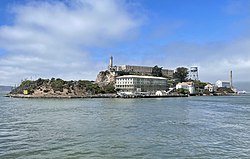
Alcatraz Island (/ˈælkəˌtræz/) is a small island about 1.25 miles offshore from San Francisco in San Francisco Bay, California, near the Golden Gate Strait.[1] The island was developed in the mid-19th century with facilities for a lighthouse, a military fortification, and a military prison. In 1934, the island was converted into a federal prison, Alcatraz Federal Penitentiary. The strong tidal currents around the island and ice-cold water temperatures made escape nearly impossible, giving the prison one of the most notorious reputations of its kind in American history.[4] The prison closed on March 21, 1963, leaving the island a major tourist attraction today.

Key Information

Beginning in November 1969, the island was occupied for more than 19 months by a group of Native Americans, initially primarily from San Francisco, who were later joined by the American Indian Movement and other urban Native Americans from other parts of the country, who were part of a wave of Native American activists organizing public protests across the US through the 1970s. In 1972, Alcatraz was transferred to the Department of Interior to become part of Golden Gate National Recreation Area. It was designated as a National Historic Landmark in 1986.

Today, the island's facilities are managed by the National Park Service as part of Golden Gate National Recreation Area. Visitors can reach the island by ferry ride from Pier 33, located between the San Francisco Ferry Building and Fisherman's Wharf. Hornblower Cruises, operating under the name Alcatraz City Cruises, is the official ferry provider to and from the island.

Alcatraz Island is the site of the abandoned federal prison, the oldest operating lighthouse on the West Coast of the United States, early military fortifications, and natural features such as rock pools and a seabird colony (mostly western gulls, cormorants, and egrets). According to a 1971 documentary on the history of Alcatraz, the island measures 1,675 feet (511 m) by 590 feet (180 m) and is 135 feet (41 m) at highest point during mean tide.[5] The total area of the island is reported to be 22 acres (8.9 ha).[1]

Landmarks on the island include the Main Cellhouse, Dining Hall, Lighthouse, the ruins of the Warden's House and Social Hall, Parade Grounds, Building 64, Water Tower, New Industries Building, Model Industries Building, and the Recreation Yard.

History

[edit]
Alcatraz Island, 1896
Alcatraz in the dawn mist, from the east. The "parade ground" is at left.
Alcatraz Island and lighthouse at sunset
The water tower and powerhouse (at right), which generated electricity for the island
A model of Military Point Alcatraz, 1866–1868, now on display at Alcatraz Island
Model of the prison circa 1952, now on display at Alcatraz Island

The first European to document the islands of San Francisco Bay was Spanish naval officer and explorer Juan Manuel de Ayala during the Spanish rule of California; he charted San Francisco Bay in 1775. He named today's Yerba Buena Island as "La Isla de los Alcatraces", which translates as "The Island of the Gannets", but is commonly believed to translate as "The Island of the Pelicans" (the modern Spanish word for pelican is pelícano),[6][7][8][9][10][11] from the archaic Spanish alcatraz ("pelican"). No gannets are native to the Pacific Coast, making the older Spanish usage more likely.

Yerba Buena Island was labeled on Ayala's 1775 chart of San Francisco Bay as "Isla de Alcatraces". The name was later applied to the rock now known as Alcatraz Island by Captain Frederick W. Beechey, an English naval officer and explorer.[12]

Over the years, the Spanish version "Alcatraz" became popular and is now widely used. In August 1827, for instance, French Captain Auguste Bernard Duhaut-Cilly wrote "... running past Alcatraze's (Pelicans) Island ... covered with a countless number of these birds. A gun fired over the feathered legions caused them to fly up in a great cloud and with a noise like a hurricane."[13] The California brown pelican (Pelecanus occidentalis californicus) is not known to nest on the island today. The Spanish built several small buildings on the island and other minor structures.[5]

Fort Alcatraz

[edit]

The earliest recorded private owner of the island of Alcatraz is Julian Workman, to whom it was given by Mexican Governor Pio Pico in June 1846, with the understanding that Workman would build a lighthouse on it.[14] Julian Workman is the baptismal name of William Workman, co-owner of Rancho La Puente and a personal friend of Pio Pico. Later in 1846, acting in his capacity as military governor of California, John C. Frémont bought the island for $5,000 in the name of the United States government from Francis Temple.[5][15][16]

In 1850, President Millard Fillmore ordered that Alcatraz Island be set aside specifically as a United States military reservation,[10] for military purposes based upon the U.S. acquisition of California from Mexico following the Mexican–American War.[17] Frémont had expected a large compensation for his initiative in purchasing and securing Alcatraz Island for the U.S. government, but the U.S. government later invalidated the sale and paid Frémont nothing. Frémont and his heirs sued for compensation during protracted but unsuccessful legal battles that extended into the 1890s.[17]

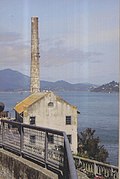
The lighthouse tower adjacent to the prison cell house

Following the acquisition of California by the United States as a result of the Treaty of Guadalupe Hidalgo (1848), which ended the Mexican–American War, and the onset of the California Gold Rush the following year, the U.S. Army began studying the suitability of Alcatraz Island for the positioning of coastal batteries to protect the approaches to San Francisco Bay. In 1853, under the direction of Zealous B. Tower, the United States Army Corps of Engineers began fortifying the island, work which continued until 1858, when the initial version of Fort Alcatraz was complete. The island's first garrison, numbering about 200 soldiers, arrived at the end of that year.

When the American Civil War broke out in 1861, the island mounted 85 cannons (increased to 105 cannons by 1866) in casements around its perimeter, though the small size of the garrison meant only a fraction of the guns could be used at one time. At this time, it also served as the San Francisco Arsenal for storage of firearms to prevent them falling into the hands of Confederate sympathizers.[18] Alcatraz, built as a "heavily fortified military site on the West Coast", was to form a "triangle of defense" with Fort Point and Lime Point, but the contemplated work on Lime Point was never built. The first operational lighthouse on the West Coast of the United States was also built on Alcatraz. During the war, Fort Alcatraz was used to imprison Confederate sympathizers and privateers on the west coast, but its guns were never fired at an enemy.[19]

Studies of the island and its fortifications have included archeological surveys relying on contemporary technology. In 2019 "Binghamton University archaeologist Timothy de Smet and colleagues located historical remains beneath the former recreation yard of the Alcatraz Federal Penitentiary." Using ground-penetrating radar (GPR) data and georectifications, Smet and colleagues discovered structures, including "a 'bombproof' earthwork traverse along with its underlying vaulted brick masonry tunnel and ventilation ducts," in surprisingly good condition.[20] Archaeologists also found the remains of ammunition magazines, and tunnels below the penitentiary that was built later.[21][22]

Because of the isolation created by the cold, strong currents of the waters of San Francisco Bay, as early as 1859, Alcatraz was used to house soldiers convicted of crimes. By 1861, the fort was the military prison for the Department of the Pacific. It housed Civil War prisoners of war (POWs) as early as that year.[citation needed]

Alcatraz citadel built in the early 1850s; 1908 photo

Starting in 1863, the military also held private citizens accused of treason, after the writ of habeas corpus in the United States was suspended. Hundreds of troops were trained on the island, with more than 350 military personnel in place by April 1861. As enlistees were assigned to units, new green troops reported for training. In early 1865, the number of men reached 433, the peak of the war.[23]

During the Civil War-era, rapid changes in artillery and fortification were generated. Alcatraz's defenses were obsolete by the postwar years. Modernization efforts, including an ambitious plan to level the entire island and construct shell-proof underground magazines and tunnels, were undertaken between 1870 and 1876 but never completed (the so-called "parade ground" on the southern tip of the island represents the extent of the flattening effort).[24] Instead, the army switched the focus of its plans for Alcatraz from coastal defense to detention, a task for which it was well suited because of its isolation.

In 1867, a brick jailhouse was built (previously inmates had been kept in the basement of the guardhouse), and in 1868, Alcatraz was officially designated as a long-term detention facility for military prisoners. The facility was later discontinued for Prisoners of War in 1846[dubiousdiscuss]. Among those incarcerated at Alcatraz were Confederates caught on the West Coast[5] and some Hopi Native American men in the 1870s, who refused orders to send their children away from their families to Indian boarding schools.[25]

In 1898, due to the Spanish–American War, the prison population rose from 26 to over 450. From 1905 to 1907 it was commanded by U.S. Army Major George W. McIver. After the 1906 San Francisco earthquake, civilian prisoners were transferred to Alcatraz for safe confinement. On March 21, 1907, Alcatraz was officially designated as the Western U.S. Military Prison, later Pacific Branch, U.S. Disciplinary Barracks, 1915.[18]

In 1909 construction began on the huge concrete main cell block, designed by Major Reuben Turner, which remains the island's dominant feature. It was completed in 1912.[18] To accommodate the new cell block, the Citadel, a three-story barracks, was demolished down to the first floor, which was below ground level. The building had been constructed in an excavated pit, creating a defensive dry moat. The first floor was incorporated as a basement to the new cell block, giving rise to the popular legend of "dungeons" below the main cell block. The US Disciplinary Barracks was deactivated in October 1933 and transferred to the Bureau of Prisons.[18]

During World War I, the prison was used to hold conscientious objectors, including Philip Grosser, who wrote a pamphlet entitled Uncle Sam's Devil's Island about his experiences.[26]

Alcatraz Federal Penitentiary

[edit]
An exterior view of the Alcatraz main cell block from the exercise yard

The United States Disciplinary Barracks on Alcatraz were acquired by the United States Department of Justice on October 12, 1933, and the island was designated as a federal prison in August 1934. Alcatraz was designed to hold prisoners who continuously caused trouble at other federal prisons.[27] At 9:40 am on August 11, 1934, the first batch of 137 prisoners arrived at Alcatraz, arriving by railroad from the United States Penitentiary in Leavenworth, Kansas, to Santa Venetia, California. They were escorted to Alcatraz, while handcuffed in high security coaches and guarded by 60 special FBI agents, U.S. Marshals and railway security officials.[5][28]

Alcatraz Island seen from San Francisco in 1955 when the penitentiary was in operation

Most of the prisoners were notorious bank robbers and murderers.[5] The prison initially had a staff of 155, including the first warden James A. Johnston and associate warden J. E. Shuttleworth, both considered to be "iron men".[5] The staff were highly trained in security, but not rehabilitation.[5]

Cell 181 in Alcatraz where Al Capone was imprisoned

During the 29 years it was in use, the prison held some of the most notorious criminals in American history,[5] including gangsters such as Al Capone, Robert Franklin Stroud (the "Birdman of Alcatraz"), George "Machine Gun" Kelly and Bumpy Johnson, and political terrorists such as Rafael Cancel Miranda, a member of the Puerto Rican Nationalist Party who attacked the United States Capitol building in 1954.[29] Others included Mickey Cohen, Arthur R. "Doc" Barker, and Alvin "Creepy" Karpis, who served more time at Alcatraz than any other inmate. It also provided housing for the Bureau of Prisons staff and their families.

Contrary to popular belief, it was possible to escape and swim all of the way to shore.[30] However, during its 29 years of operation, the penitentiary claimed that no prisoner successfully escaped. A total of 36 prisoners made 14 escape attempts, two men trying twice. 23 were caught alive, six were shot and killed during their escape, two drowned, and five are listed as "missing and presumed drowned".[31] The most violent incident occurred on May 2, 1946, when a failed escape attempt by six prisoners led to the Battle of Alcatraz. Perhaps the most famous is the intricate escape, carried out on June 11, 1962, by Frank Morris, John Anglin, and Clarence Anglin. The three men are believed to have drowned in their attempt. However, no bodies were ever found, sparking speculation that they made it to shore and escaped.

On June 11, 1962, brothers John and Clarence Anglin and Frank Morris escaped Alcatraz prison. John, Clarence, and Frank were all doing time for committing crimes such as bank robbery. They did this by digging through a vent for approximately three months, once they reached the top it took additional time to file down the bolts of the roof vents. They used sharpened spoons, a vacuum cleaner motor drill, and any other tools they could find to make the hole in the vent bigger and get through the bolted roof top vent. To fulfill their plan of escaping they made realistic dummy heads by using paper mache to disguise them while they do nightly checks. They used hair clippings to make it believable that they were still sleeping in their beds during nightly checks. Getting out of the prison was only half their plan, they had to make it 1.25 miles in shark infested waters. They created rafts out of prison rain jackets and several life preservers; they were able to contract this idea from magazines they would read while being in prison. They had come up with waterproof glue as well to keep the raft together in the water. Then they made wooden paddles out of leftover wood scraps and plywood found around the prison. To blow up their raft they stole a concertina and used it to inflate their makeshift raft. At around 10pm on June 11th 1962 they made the escape and were never seen again. A fourth prisoner, Allen West, had intended to escape with Morris and the Anglins, but failed to get out of his cell in time. He would later cooperate with the FBI during their investigation, revealing the finer details of the escape plan..[32][33]

Although most escapees were caught or drowned, in 1962, prisoner John Paul Scott made it to the shore. However, he was so weary that police found him unconscious and in hypothermic shock. The annual Escape from Alcatraz Triathlon includes a required 1.5-mile (2.4 km) swim from the island to the bay shore.[34]

Closing of the prison

[edit]

There are several reasons that Alcatraz closed as a penitentiary in 1963. The penitentiary cost much more to operate than other prisons (nearly $10 per prisoner per day, as opposed to $3 per prisoner per day at Atlanta).[35] Half a century of salt water saturation had severely eroded the buildings and three people had purportedly escaped in 1962. After its closure, George Moscone received public proposals to repurpose Alcatraz Island.[36]

Native American occupation

[edit]
A lingering sign of the 1969–1971 Native American occupation

Alcatraz Island was occupied by Native American activists for the first time on March 8, 1964. The protest, proposed by Lakota Sioux activist Belva Cottier and joined by about 35 others, was reported by, among others, the San Francisco Chronicle and the San Francisco Examiner.[37]

Beginning on November 20, 1969, a group of Native Americans called United Indians of All Tribes, mostly college students from San Francisco, occupied the island to protest federal policies related to American Indians. Some of them were children of Native Americans who had relocated in the city as part of the Bureau of Indian Affairs' (BIA) Indian termination policy, which was a series of laws and policies aimed at the assimilation of Native Americans into mainstream US society. It encouraged Native Americans to move away from the Indian reservations and into cities to take advantage of health, educational and employment opportunities. A number of employees of the Bureau of Indian Affairs also occupied Alcatraz at that time, including Doris Purdy, an amateur photographer, who later produced footage of her stay on the island.[38]

The occupiers, who stayed on the island for nearly two years, demanded that the island's facilities be adapted and new structures built for an Indian education center, ecology center, and cultural center. The American Indians claimed the island by provisions of the Treaty of Fort Laramie (1868) between the US and the Sioux; they said the treaty promised to return all retired, abandoned, or out-of-use federal lands to the native peoples from whom they were acquired. Indians of All Tribes claimed Alcatraz Island by the "Right of Discovery"; as historian Troy R. Johnson states in The Occupation of Alcatraz Island, generations of indigenous peoples knew about Alcatraz at least 10,000 years before any European knew about any part of North America. Begun by urban Indians of San Francisco, the occupation attracted other Native Americans from across the country, including American Indian Movement (AIM) urban activists from Minneapolis.

The Alcatraz cellhouse, lighthouse, and Warden's House, which was burned out during the 1969–1971 Native American occupation

During the nineteen months and nine days of occupation by the American Indians, several buildings at Alcatraz were damaged or destroyed by fire, including the lighthouse keeper's home, the warden's home, the Officers' Club,[39] the recreation hall, and the Coast Guard quarters. The origin of the fires is disputed. The US government demolished a number of other buildings (mostly apartments) after the occupation had ended. Graffiti from the period of Native American occupation is still visible at many locations on the island.[40]

During the occupation, President Richard Nixon rescinded the Indian termination policy, designed by earlier administrations to end federal recognition of many tribes and their special relationship with the US government. He established a new policy of self-determination, in part as a result of the publicity and awareness created by the occupation. The occupation ended on June 11, 1971.[41]

Alcatraz under the National Park Service

[edit]

In 1972, the National Park Service purchased Alcatraz along with Fort Mason from the U.S. Army to establish the Golden Gate National Recreation Area. Under "An Act to Establish the Golden Gate National Recreation Area" President Richard Nixon allocated $120 million for land acquisition and development of the area.[42] It has since been under the direction of the Golden Gate National Recreation Area and now operates as a tourist site and museum dedicated to its time as a federal penitentiary. Operating costs still remain one of its biggest challenges today.

On May 4, 2025, President Donald Trump proposed reopening the island's prison.[43][44] Later that night, Trump told reporters that his Alcatraz plan was "just an idea I've had" to counter the "radicalized judges [that] want to have trials for every single—think of it—every single person that's in our country illegally,"[45] a reference to his invocation of the Alien Enemies Act to conduct mass deportations of Venezuelan and Salvadoran migrants,[46] which had been blocked by multiple judges.[47]

Landmarks

[edit]

Part of the Golden Gate National Recreation Area since 1972, the entire Alcatraz Island was listed on the National Register of Historic Places in 1976.[2] In 1986 it was designated as a National Historic Landmark, the highest recognition.[3][48]

In 1993, the National Park Service published a plan entitled Alcatraz Development Concept and Environmental Assessment.[49] This plan, approved in 1980, doubled the area of Alcatraz accessible to the public, in order to enable visitors to enjoy its scenery and bird, marine, and animal life.[50]

Map of Alcatraz

Major sites in the cultural landscape include:[51]

Development

[edit]

American Indigenous groups, such as the International Indian Treaty Council, occasionally hold ceremonies on the island, most notably, their "Sunrise Gatherings" every Columbus Day and Thanksgiving Day.[52][53]

Around 2007, the Global Peace Foundation proposed to raze the prison and build a peace center in its place. Supporters collected 10,350 signatures – sufficient to have it placed as a proposition on the presidential primary ballots in San Francisco for February 5, 2008.[54] The proposed plan was estimated at US$1 billion. For the plan to pass, Congress would have to have taken Alcatraz out of the National Park Service. Critics of the plan said that Alcatraz is too rich in history to be destroyed.[55] On February 6, 2008, the Alcatraz Island Global Peace Center Proposition C failed to pass, with 72% of voters rejecting the proposition.[56]

The coastal environment of the San Francisco Bay Area has caused deterioration and corrosion of building materials throughout Alcatraz. Beginning in 2011, the National Park Service began major renovations on the island, including the installation of solar panels on the cell house roof, slope stabilization near the Warden's House, and the stabilization and rehabilitation of the outer cell house walls.

Now one of San Francisco's major tourist attractions, Alcatraz drew some 1.7 million visitors annually according to a 2018 report.[57] Visitors arrive by ferry, operated under contract by Alcatraz Cruises LLC at Pier 33.[58] The 2018 report indicated that "former prison buildings are being conserved and seismically upgraded and additional areas of the Island are opened to the public as safety hazards are removed".[57] During the COVID-19 pandemic, the buildings and the island remained closed to the public for more than a year (and ferry services were suspended), reopening in March 2021.[59]

Art

[edit]

Alcatraz has been home to several art installations. In 2014, Chinese artist/dissident Ai Weiwei staged an exhibition which explored "questions about human rights and freedom of expression" called @Large.[60] This exhibition included Lego portraits of famous political prisoners. The creation of the exhibition was featured in a 2019 documentary film, Ai Weiwei: Yours Truly.[61] In 2016, Nelson Saiers used math and prison slang as central elements in a six-month installation that called attention to the imposition of long prison sentences.[62][63]

Fauna and flora

[edit]

Habitat

[edit]
Brandt's cormorant nesting on Alcatraz Island
  • Cisterns. A bluff that, because of its moist crevices, is believed to be an important site for California slender salamanders.
  • Cliff tops at the island's north end. Containing a onetime manufacturing building and a plaza, the area is listed as important to nesting and roosting birds.
  • The powerhouse area. A steep embankment where native grassland and creeping wild rye support a habitat for deer mice.
  • Tide pools. One of the only complexes in the San Francisco Bay, the island's tide pools were created by quarrying activities, and contain a variety of typical invertebrate species.[64]
  • Western cliffs and cliff tops. Rising to heights of nearly 100 feet (30 m), they provide nesting and roosting sites for seabirds including pigeon guillemots, cormorants, Heermann's gulls, and western gulls. Harbor seals can occasionally be seen on a small beach at the base.
  • The parade grounds. Carved from the hillside during the late 19th century and covered with rubble since the government demolished guard housing in 1971, the area has become a habitat and breeding ground for black-crowned night herons, western gulls, slender salamanders, and deer mice.
  • The Agave Path, a trail named for its dense growth of agave. Located atop a shoreline bulkhead on the south side, it provides a nesting habitat for night herons.

Flora

[edit]
Flowers on Alcatraz

Gardens planted by families of the original Army post, and later by families of the prison guards, fell into neglect after the prison closure in 1963. After 40 years, they are being restored by a paid staff member and many volunteers, thanks to funding by the Garden Conservancy and the Golden Gate National Parks Conservancy. The untended gardens had become severely overgrown and had developed into a nesting habitat and sanctuary for numerous birds. Now, areas of bird habitat are being preserved and protected, while many of the gardens are being restored to their original state.

In clearing out the overgrowth, workers found that many of the original plants were growing where they had been planted – some more than 100 years ago. Numerous heirloom rose hybrids, including a Welsh rose (Bardou Job) that had been believed to be extinct, have been discovered and propagated. Many species of roses, succulents, and geraniums are growing among apple and fig trees, banks of sweet peas, manicured gardens of cutting flowers, and wildly overgrown sections of native grasses with blackberry and honeysuckle.

[edit]

Alcatraz Island appears often in media and popular culture, including films dating from 1962: Resident Evil: Death Island (2023), Slaughterhouse Rock (1988), The Book of Eli (2010), X-Men: The Last Stand (2006), Catch Me If You Can (2002), The Rock (1996), Murder in the First (1995), Escape from Alcatraz (1979), The Enforcer (1976), Point Blank (1967) , Birdman of Alcatraz (1962) and J. J. Abrams' 2012 television series Alcatraz.

It also was featured in the anime Yu-Gi-Oh! Duel Monsters, the book Al Capone Does My Shirts and the video game Tony Hawk's Pro Skater 4 as a playable level. It is also showcased as a playable racetrack in the 1997 arcade racing video game San Francisco Rush the Rock: Alcatraz Edition. Alcatraz has also been portrayed often as a safe haven or base of operations in many post-apocalyptic movies, such as The Book of Eli.

Escape from Alcatraz and The Rock are two films that show how inescapable the island is. Escape from Alcatraz is based on the true story of a few inmates trying to flee the island. The Rock is an action film featuring Alcatraz.[65]

[edit]

See also

[edit]

References

[edit]

Further reading

[edit]
[edit]
Revisions and contributorsEdit on WikipediaRead on Wikipedia
from Grokipedia

Alcatraz Island is a small, rocky island comprising 22.5 acres, located in San Francisco Bay approximately 1.25 miles offshore from the city of San Francisco, California.
Originally fortified as a military outpost in 1850, the island featured the first lighthouse on the Pacific Coast, activated in 1854, and functioned as a key harbor defense installation armed with over 100 cannons by 1859.
Designated a military prison in 1861, it held U.S. Army personnel and, during the Civil War, Confederate sympathizers, evolving into the Pacific Branch of the U.S. Military Prison by 1907 with expanded cellhouse facilities.
In 1934, following transfer to the Federal Bureau of Prisons, Alcatraz opened as a maximum-security federal penitentiary, confining notorious inmates including Al Capone under rigorous isolation protocols until its closure in 1963 owing to escalating maintenance expenses from saltwater erosion and logistical isolation.
Post-closure, Native American activists under the banner of Indians of All Tribes occupied the island from November 1969 to June 1971, asserting claims under treaties for surplus federal land and spotlighting indigenous rights issues.
Today, Alcatraz operates as a National Historic Landmark within the Golden Gate National Recreation Area, drawing over 1.5 million visitors annually via ferry for guided tours exploring its layered military, penal, and cultural history.

Geography and Geology

Location and Physical Characteristics

Alcatraz Island is located in central San Francisco Bay, California, United States, approximately 1.5 miles (2.4 kilometers) northwest of the city's Embarcadero waterfront and near the Golden Gate Strait. The island's geographic coordinates are approximately 37°49′39″N 122°25′19″W, positioning it amid strong tidal currents and cold waters averaging 50–54°F (10–12°C) year-round, which contribute to its isolation. This placement, combined with surrounding marine hazards like rip currents exceeding 4 knots and historical shark presence, rendered it strategically defensible and escape-resistant during its military and penal uses. The island spans a total land area of 22 acres (8.9 hectares), forming an irregularly shaped, rocky outcrop with a roughly triangular measuring about 1,675 feet (511 ) in length and 590 feet (180 ) at its widest point. Its terrain features steep, eroded cliffs rising sharply from the , with limited flat ground primarily along the southeastern shore where docks and were constructed. The surface consists largely of exposed and , supporting sparse historically but now hosting coastal scrub and colonies due to conservation efforts. Elevation on Alcatraz reaches a maximum of 135 feet (41 meters) above mean at its central ridge, providing panoramic views of the while exposing the island to prevailing westerly winds and frequent . The absence of natural freshwater sources and thin layer further define its austere physical profile, necessitating all provisions be transported from the mainland. These characteristics, verified through U.S. Geological Survey mappings and surveys, underscore the island's role as a formidable natural fortress.

Geological Origins and Composition

Alcatraz Island consists primarily of Lower graywacke sandstones belonging to the Alcatraz , a subunit of the broader Franciscan Complex accreted to the North American plate during along the western . These sedimentary rocks formed approximately 130–140 million years ago through deposition—underwater landslides carrying sediment from the continent into deep marine basins—resulting in thick layers of coarse, angular-grained interbedded with finer siltstones and shales. The Franciscan Complex, including the Alcatraz , records a of tectonic accretion where oceanic sediments and fragments were scraped off the subducting Farallon plate and welded onto the overriding continent, with subsequent faulting and uplift exposing these rocks in the region. The island's lithology features graywacke, a poorly sorted characterized by , , and lithic fragments in a clay-rich matrix, alongside subordinate layers from the late Franciscan assemblage. Fossils of mollusks, such as those identified in the , confirm the depositional age and origin, with at least 11 variants of graywacke in the Bay Area distinguished by fault-displaced origins. The current emergence of Alcatraz as an island occurred relatively recently, with itself forming about 10,000 years ago due to post-glacial sea-level rise inundating a tectonic lowland shaped by the San Andreas system. This tectonic setting, involving ongoing strike-slip faulting, contributes to the island's rugged and cliff stability challenges, as evidenced by historical erosion and stabilization efforts on its - cliffs.

Indigenous and Early European History

Pre-Colonial Indigenous Associations

Alcatraz Island, located in , falls within the traditional territory of the peoples, a linguistic and cultural group encompassing tribes such as the of the . Pre-colonial indigenous associations with the island date back potentially 10,000 to 20,000 years, based on oral histories preserved by descendant communities, though direct archaeological evidence is scarce due to subsequent island modifications and the perishable nature of early . The , numbering over 10,000 individuals in the region prior to European contact around 1769, maintained a economy reliant on bay resources, with Alcatraz serving incidental roles rather than as a primary settlement site. The island's primary pre-colonial function among the Ohlone was as a site for isolation or ostracization of individuals who violated tribal laws or taboos, leveraging its rocky, water-surrounded isolation to enforce social penalties without permanent habitation. Oral traditions describe sending offenders to the island, where they subsisted on available resources like bird eggs and , such as or stranded sea mammals, until reconciliation or death occurred. Adjacent groups to the north may have shared similar practices, viewing the island as a deterrent due to its harsh conditions, including limited and exposure to elements, which amplified its role in tribal justice systems. Secondary uses included occasional , food gathering expeditions, and during storms, but these were opportunistic rather than routine, as the mainland offered more reliable resources. These associations rely heavily on ethnographic reconstructions from 19th- and 20th-century oral accounts collected from mission-era survivors, whose populations had declined dramatically from and displacement post-contact, potentially introducing interpretive gaps. No substantial pre-contact artifacts, such as shell middens or diagnostic of occupation, have been documented on the island, consistent with its use as a peripheral, punitive outpost rather than a lived-in village. This contrasts with mainland sites yielding abundant evidence of seasonal camps and resource exploitation, underscoring Alcatraz's specialized, infrequent role in indigenous social mechanisms.

European Discovery and Initial Use

The first documented European encounter with Alcatraz Island occurred on August 5, 1775, when Spanish naval lieutenant Juan Manuel de Ayala, commanding the packet ship San Carlos, sailed through the and became the first European to enter . Ayala's expedition mapped the bay's features over several weeks, during which he named the island "Isla de los Alcatraces," translating to "Island of the Pelicans," owing to the large flocks of pelicans and other seabirds nesting there. This naming reflected the island's prominent rocky outcrop and bird colonies, which were noted for their abundance in Ayala's charts and descriptions, though no landing or settlement occurred at that time. Following Ayala's survey, the island remained under nominal Spanish control as part of , with minimal European activity limited to occasional exploratory visits, such as British captain George Vancouver's 1792 expedition, which documented the bay's islands but did not establish any presence on Alcatraz. After gained independence from in 1821, the island fell under Mexican jurisdiction, where it saw attempted land grants but no substantive development; for instance, in the 1830s, governor Nicolás Gutiérrez briefly granted it to José María de Bernal before revoking the title, and in 1846, governor provisionally awarded it to settler Julian Workman to settle a , though the grant was never fully utilized or confirmed amid the impending U.S. conquest. These efforts highlight the island's perceived value for potential resource extraction, like salt deposits, but its isolation and rugged terrain prevented any practical occupation. The transition to U.S. control began with the Mexican-American War's conclusion in 1848, after which California was ceded to the ; on November 6, 1850, President issued an designating Alcatraz as a reservation to safeguard amid influx and strategic vulnerabilities. This marked the island's initial American use, primarily for defensive preparations, including the construction of the West Coast's first , which became operational on December 15, 1854, to guide maritime traffic and support harbor fortifications. Early engineering surveys focused on installing artillery batteries, establishing Alcatraz as a key node in a planned triangular defense system with mainland forts, though full fortification awaited later decades.

Military Utilization

Fort Alcatraz Construction and Civil War Role

Fort Alcatraz's construction commenced in 1853 as part of the United States Army's efforts to fortify San Francisco Harbor against potential naval threats following the Mexican-American War, with initial fortifications focused on mounting heavy artillery to protect the bay's entrance. The island's strategic position, approximately 1.25 miles offshore, made it ideal for defensive batteries overlooking the Golden Gate. By 1854, the first lighthouse on the West Coast was operational on Alcatraz, aiding maritime navigation while construction progressed. The fort's development accelerated in the late 1850s, incorporating casemates and bombproof structures designed by engineer Joseph Gilbert Totten to withstand bombardment. By December 1859, the fortress was largely completed, equipped with approximately 75 heavy-caliber guns, forming a key element of the harbor's three-tiered defense system alongside Fort Point and Lime Point. That same month, Alcatraz received its first permanent military garrison, marking its dual role as both a defensive outpost and an incipient prison facility, where soldiers convicted of disciplinary offenses were confined in the basement. During the from 1861 to 1865, emerged as the Department of the Pacific's primary military prison, housing Confederate prisoners of war, sympathizers, and privateers captured on the West Coast, despite its original design against foreign invasion. Notably, in 1861, crew members from the Confederate steamer J.R. Chapman—intercepted while attempting to procure arms and incite rebellion in —were imprisoned there, alongside local civilians arrested for treasonous activities amid secessionist unrest in . artillery units from the island were deployed to the mainland to suppress potential riots and enforce Union loyalty, contributing to the fort's expansion to 105 guns by 1866. Though its batteries were never fired in combat, Alcatraz became the largest fortification west of the by war's end, underscoring its logistical importance in maintaining federal control over the Pacific theater.

Early 20th-Century Military Prison and Defenses

In the early , Alcatraz Island's role shifted decisively from harbor defense to that of a , as advancements in rendered its fortifications obsolete by 1907. The U.S. Army repurposed existing defensive structures, such as brick casemates originally designed to house , into cells, leveraging the island's steep and surrounding cold, swift currents for inherent security. This transition capitalized on the site's isolation—approximately 1.25 miles from —making escape attempts highly improbable without external aid. Major construction occurred between 1909 and 1911, when military prisoners demolished the outdated three-story —a bombproof structure built in the —and erected a new cellhouse using its basement as a foundation. Completed in 1912, this facility featured 600 single cells, making it the largest such building of its kind at the time, and was designed to accommodate the growing inmate population. In 1915, the site was formally redesignated the Pacific Branch, U.S. Disciplinary Barracks (PBUSDB), emphasizing rehabilitation over mere confinement; prisoners were organized into the Second Disciplinary Battalion in 1916 for vocational training in trades like and . The prison housed primarily U.S. Army personnel convicted by for offenses ranging from to more serious crimes, with some civilian felons segregated and transferred to Angel Island for labor. Inmate numbers fluctuated significantly, averaging 233 in 1904 and peaking at 553 in February 1912, reflecting surges from conflicts like the Spanish-American War aftermath. Daily routines were rigidly structured, including work details that contributed to island maintenance, with successful rehabilitations totaling 1,396 by June through skill-building programs. The facility earned the moniker "Uncle Sam's " following a high-profile escape attempt in , underscoring its reputation for stringent discipline. Defensive remnants, including obsolete batteries and underwater minefields planned in the 1880s but never fully activated against modern threats, were integrated into the prison's perimeter security rather than maintained for . High bluffs and sentinel posts from the fort era continued to deter breaches, while the twice considered abandoning the site—in 1906–1907 for relocation to Angel Island and again in the early 1910s amid funding debates—ultimately retaining it due to its strategic isolation and existing . By the , the focus remained on disciplinary functions, with the prison stabilizing around 400–500 annually until transfer to federal civilian control in 1933.

Federal Penitentiary Operations

Establishment and Administrative Structure

The Penitentiary at Alcatraz Island was established as the federal prison system's first maximum-security facility in response to rising and escape attempts from other institutions during the era and . In 1933, the U.S. Department of Justice transferred control of the island from the Department of War to the Bureau of Prisons, which oversaw its conversion from a military facility into a civilian penitentiary designed to isolate the most violent and escape-prone inmates. The prison officially commenced operations on August 11, 1934, when the first group of 137 inmates, selected as "hard cases" from the Penitentiary in , arrived by boat under heavy guard. Administrative authority rested with the , an agency within the Department of Justice responsible for federal correctional operations nationwide. The warden, appointed by the Bureau's director—initially Sanford Bates, succeeded by James V. Bennett in 1937—held supreme on-site command, enforcing policies emphasizing isolation, routine, and minimal privileges to deter misconduct and escapes. , a prison administrator from California's state system, served as the inaugural from January 1934 to 1948, implementing modifications to the cellhouse for single-occupancy cells and installing security enhancements like metal detectors and reinforced bars. The penitentiary's structure included a hierarchical staff of approximately 155 personnel at startup, comprising the , associate warden, lieutenants, correctional officers (around 49 guards), a , personnel, and support roles for maintenance and administration. Guards operated in rotating shifts to maintain constant , with many residing in island apartments or mainland to ensure rapid response capabilities. The facility's rated capacity was 336 inmates across four cell blocks (A through D), though it averaged 260 to 275 prisoners over its operation, representing less than 1% of the federal inmate population and underscoring its role as a selective deterrent rather than a mass incarceration site. Subsequent wardens, including Edwin B. Swope (1948–1955), Paul J. Madigan (1955–1961), and Olin G. Blackwell (1961–1963), continued oversight under Bureau directives, adapting to operational challenges like rising maintenance costs without altering the core punitive framework.

Security Protocols and Deterrence Efficacy

Alcatraz Federal Penitentiary's security relied heavily on its isolated island location in , approximately 1.25 miles from the mainland, surrounded by cold waters averaging 50-54°F with strong tidal currents exceeding 4 knots, posing lethal risks to any escape attempt by swimming. The perimeter featured high walls topped with , multiple guard towers equipped with searchlights and machine guns for 24-hour , and a siren system for alarms. Internally, the cellhouse employed tool-proof steel bars, metal detectors at entry points, and narrow corridors monitored by armed guards in elevated galleries, with inmates confined to single cells measuring about 5 by 9 feet. Daily protocols included 12 head counts, restricted privileges such as limited visitation and correspondence, and constant to prevent tool concealment or tunneling. Special lighting and locking mechanisms further controlled movement, while the psychological strain of isolation in a facility housing only the most incorrigible inmates reinforced compliance. These measures demonstrated high efficacy in deterrence, as during its 29 years of operation from 1934 to 1963, only 14 escape attempts involved 36 inmates, with none confirmed successful; most were recaptured or presumed drowned due to the bay's hazards. The low incidence of internal violence and successful containment of notorious figures like underscored the protocols' success in maintaining order, though the prison's high operational costs—exceeding $3 per inmate daily compared to $0.95 elsewhere—contributed to its closure rather than any security failure. The fortress-like design cultivated a reputation of inescapability, deterring further attempts through perceived futility.

Notable Inmates and Daily Regime

Alcatraz Federal Penitentiary housed approximately 1,576 inmates between 1934 and 1963, selected for their histories of escape attempts, disciplinary issues, or high-profile crimes that necessitated maximum-security confinement. Among the most notorious were gangsters and kidnappers whose transfers underscored the prison's role in isolating threats to federal authority. Alphonse "Al" Capone, convicted of in 1931 but infamous for bootlegging and , arrived on August 22, 1934, as inmate AZ-85 and departed in January 1939 after serving roughly four and a half years, during which he was stabbed by another inmate in June 1936 and lost privileges for rule violations. George "Machine Gun" Kelly, sentenced to life for the 1933 kidnapping of oil executive Charles Urschel, entered on September 4, 1934, as AZ-117 and remained until his 1951 transfer to Leavenworth, enduring 17 years amid boasts of past crimes that heightened his notoriety. Robert Stroud, known as the "Birdman of Alcatraz" for ornithological studies conducted at Leavenworth rather than Alcatraz—where birds were prohibited—served from December 1940 until his 1959 transfer to a medical facility, following convictions for in 1909 and murdering a prison guard in 1916; his 42 years in solitary across facilities highlighted the prison's punitive isolation. Alvin Karpis, leader of the Barker-Karpis gang responsible for multiple kidnappings including the 1933 abduction of William Hamm, held the record for longest incarceration at Alcatraz, arriving in August 1936 under a life sentence and leaving in April 1962 after 26 years, during which he briefly escaped the island's confines via transfer but returned. These inmates exemplified the facility's focus on "incorrigibles," with routines designed to enforce compliance through unrelenting structure rather than rehabilitation. The daily regime at Alcatraz emphasized rigid discipline, frequent accountability, and minimal privileges to deter misbehavior and reinforce isolation. Inmates rose at 6:30 a.m. to a morning whistle, cleaned cells, and stood for a 6:50 a.m. count, followed by marching to breakfast around 7:00 a.m. for a 20-minute meal of basic fare like oatmeal or bread. Work assignments commenced at 7:20 a.m. in industries such as laundry, tailoring, or model-making shops, continuing until 4:15 p.m. with intermittent counts, a 9:30 a.m. rest for smoking, and lunch at 11:40 a.m.; non-working prisoners returned to cells. Thirteen formal counts occurred daily, including lock-ups at noon, 4:50 p.m., 8:00 p.m., and 9:30 p.m., ensuring constant surveillance and preventing undetected absences. Recreation was limited to supervised yard time for eligible inmates, often in small groups under armed watch, contrasting with more communal activities at other prisons; correspondence and visits were heavily censored, with mail read aloud in some cases to underscore psychological control. Meals occurred in the mess hall under strict no-talking rules, and cells—measuring about 5 by 9 feet—contained only a cot, sink, toilet, and shelf, fostering . This schedule, enforced without variation, aimed to erode individual agency through monotony and oversight, contributing to the prison's reputation for psychological rigor over physical hardship alone.

Escape Attempts and Outcomes

During the 29 years Alcatraz operated as a federal penitentiary from 1934 to 1963, inmates mounted 14 separate escape attempts involving a total of 36 men, with two individuals attempting twice. Of these, 23 were recaptured, six were shot and killed during the efforts, two were confirmed drowned, and five were never accounted for and presumed drowned due to the treacherous San Francisco Bay currents, cold waters, and sharks. The prison's isolation, reinforced security measures, and natural barriers rendered successful escapes improbable, as evidenced by the high failure rate and lack of verified survivals. Early attempts often involved simplistic methods like scaling fences or exploiting fog for cover. On December 16, 1937, sawed through window bars in the industries building and vanished into dense fog while attempting to swim ashore; strong evidence, including their clothing found on nearby shores, supports the conclusion they drowned. Similar solo or small-group efforts, such as those by Joseph Bowers in 1935 or Rufus Franklin and Bates in 1937, ended in recapture or fatalities from gunfire when inmates reached the water's edge. The most violent attempt occurred May 2–4, 1946, dubbed the "Battle of Alcatraz," when six inmates—, Joseph Cretzer, Marvin Hubbard, , Miran Thompson, and —armed themselves with improvised weapons and attempted to seize control of the cellhouse to access an escape boat. The uprising killed two correctional officers and injured several others; three inmate leaders were killed in the melee, Shockley and Thompson were executed after conviction for murder, and Carnes received a life sentence but was later transferred. Cretzer, Hubbard, and Coy died during the standoff, underscoring the lethal risks of coordinated violence against fortified guards. The final and most ingeniously planned escape took place on June 11–12, 1962, involving Frank Morris and brothers John and Clarence Anglin, with accomplice Allen West unable to exit his cell in time. Over months, they chipped away at ventilation ducts using stolen tools, constructed dummy heads from soap, toilet paper, and hair to fool bed checks, and fashioned a from over 50 raincoats inflated with a . The trio climbed through the ducts to the roof, descended via a baker's chimney, and entered the bay; personal effects, including a paddle and plastic bags, washed ashore, but no bodies were recovered despite an extensive search. The FBI investigated until 1979, concluding the men likely drowned given tidal data showing debris drifting north toward the rather than Angel Island, though their ultimate fate remains unconfirmed without definitive proof of survival. West, interrogated post-recapture, provided details corroborating the plan's sophistication but its probable failure against environmental hazards.

Decommissioning and Transitional Period

Operational Closure in 1963

The United States Penitentiary at Alcatraz ceased operations on March 21, 1963, concluding 29 years of federal prison service. authorized the closure, citing unsustainable operating expenses and extensive infrastructure decay that made continued use impractical. The decision predated the June 1962 escape attempt by inmates Frank Morris and brothers John and Clarence Anglin, which did not factor into the shutdown. Daily per-inmate costs at Alcatraz averaged $10.10 in 1959—over three times the $3 rate at mainland facilities like the Federal Penitentiary—driven by the need to ferry all essentials, including fresh water and supplies, across . Saltwater exposure accelerated of the aging structures, undermining utilities, cellblocks, and foundations; by 1961, federal engineers had assessed the site as irreparable without prohibitive investments exceeding $3-5 million for basic upkeep. With inmate numbers dwindling to under 50 by early 1963, the Bureau of Prisons systematically transferred remaining prisoners to institutions such as and USP Leavenworth, emptying the facility without incident. This marked the end of active penal functions on the island, shifting focus to potential alternative uses amid ongoing debates over its remote, high-maintenance profile.

Federal Transfer and Interim Status

Following the permanent closure of the United States Penitentiary at Alcatraz on March 21, 1963, the island transitioned from Bureau of Prisons oversight to federal surplus property management. The Department of Justice formally declared Alcatraz excess federal property on April 12, 1963, prompting its referral to the General Services Administration (GSA) for disposal under surplus property protocols. A presidential advisory committee was convened shortly thereafter to assess viable future uses, reflecting federal interest in repurposing the site amid high maintenance costs and structural decay already evident at closure. The committee's evaluation, completed in 1963, recommended conveyance to the City and County of for public purposes such as a , municipal expansion, or municipal services facility, citing the island's location and historical value while avoiding outright sale to private entities. Despite this guidance, bureaucratic delays and competing interests stalled implementation; by 1964, Alcatraz was officially classified as surplus federal land available for transfer to local government under the Federal Property and Administrative Services Act of 1949. The GSA maintained nominal custody, with limited security patrols to deter trespassing, but the island's isolation and exposure to San Francisco Bay's corrosive environment accelerated deterioration of its structures, , and utilities, which had been partially decommissioned post-closure. Interim proposals emerged sporadically, including San Francisco's bids for recreational or infrastructural reuse and private developer overtures, such as oil magnate Lamar Hunt's 1969 pitch for a sports-themed complex during a Surplus Property Commission meeting. None advanced due to valuation disputes—estimated at $1.2 million—and federal reluctance to subsidize transfers without clear public benefit. The site remained vacant and underutilized, hosting occasional vandalism and brief unauthorized landings, including a symbolic 1964 claim by Native American activists under an 1868 interpretation, until the larger 1969 occupation disrupted GSA proceedings. This limbo underscored inefficiencies in federal asset disposition, as the island's strategic bay position clashed with its obsolescence for penal or military roles.

1969-1971 Occupation by Native American Activists

The occupation of Alcatraz Island stemmed from prior brief protests against federal land policies toward Native Americans. In March 1964, five Sicangu Lakota individuals landed on the island for several hours, invoking Article 12 of the 1868 Treaty of Fort Laramie—signed between the and the Great Sioux Nation—as grounds for claiming surplus . This treaty provision stipulated that any unneeded or abandoned federal property could be acquired by the Sioux for $1.25 per acre, a clause the group extended to assert rights over Alcatraz despite its location far from Sioux territories. Building on this precedent amid broader Red Power activism in the late 1960s, urban Native Americans and students in the planned a larger-scale action. Richard Oakes, a 26-year-old Mohawk activist and former , coordinated with Bay Area Indian groups and university students to target the federally owned island, which had sat vacant since the U.S. penitentiary's closure on March 21, 1963. An initial attempt on November 9, 1969, involved a small landing party that was quickly removed by authorities, but on November 20, 1969, Oakes led 79 Native Americans and 10 supporters—totaling 89 individuals—who commandeered a to reach the island undetected in the early morning. Upon arrival, the occupiers, organized as Indians of All Tribes (IAT), immediately broadcast their legal assertions via radio and a formal . They claimed Alcatraz as "Indian land" under the Treaty of Fort Laramie, arguing its decommissioned status rendered it eligible for reclamation by Native groups nationwide, not limited to the signatories. The offered to buy the 12-acre for $24 in beads and red cloth—symbolically echoing the treaty's $1.25-per-acre price adjusted for its assessed value of about $1.95 per acre—or, alternatively, at the nominal rate, positioning the action as a reclamation of unused federal assets amid ongoing termination policies that dissolved tribal recognitions. These claims, while rooted in the treaty's surplus-land clause, disregarded jurisdictional limits tying it to specific Plains tribes and lacked federal endorsement, serving primarily as a symbolic challenge to U.S. Indian policy.

Occupation Activities and Internal Conflicts

The occupiers, organized under the banner of Indians of All Tribes, established a shortly after their arrival on November 20, 1969, forming an elected council that made decisions by . Community members were assigned specific roles to sustain operations, including security patrols, sanitation duties, childcare in daycare facilities, educational instruction in makeshift schools, housing allocation, , and laundry services. Fundraising efforts involved soliciting donations from supporters on the mainland, messages via radio to garner sympathy and resources, and occasionally selling scrap materials like wire scavenged from the island, though federal authorities seized approximately 600 pounds of such items. These activities aimed to demonstrate self-sufficiency and symbolize indigenous sovereignty, with the group issuing proclamations demanding the island's transfer for use as a cultural , , and rehabilitation facility for Native Americans. Internal tensions escalated by early 1970 following the departure of initial leader Richard Oakes in , prompted by the accidental death of his 12-year-old stepdaughter from a fall on the island. This leadership vacuum intensified power struggles, resulting in the emergence of two rival factions vying for control and contributing to a loss of cohesive direction. Social disarray compounded these divisions, marked by reports of widespread drug use among residents, conflicts over resource distribution, and the influx of non-Indian interlopers— including hippies and opportunists—who diluted the occupation's original focus and strained limited supplies. By 1971, coverage shifted negatively, highlighting alleged incidents of beatings and assaults within the community, alongside deteriorating living conditions exacerbated by federal cutoffs of power and water, and a fire that damaged several structures. These internal fractures, rather than external pressures alone, accelerated the occupation's decline, reducing participant numbers from peaks of several hundred to fewer than a dozen by mid-1971.

Federal Eviction and Immediate Consequences

On June 11, 1971, federal authorities executed the eviction of the remaining occupants from Alcatraz Island, concluding the 19-month occupation by Indians of All Tribes. A combined force of U.S. Marshals, FBI agents, Coast Guard personnel, and General Services Administration special forces arrived via Coast Guard cutters and removed the final 15 individuals—comprising six men, five women, and four children—without significant resistance or injuries reported. The operation, which employed minimal force, transported the evictees to San Francisco or nearby Yerba Buena Island for processing. The occupants faced no immediate charges directly tied to the itself, though prior incidents during the occupation had led to separate arrests, such as three individuals convicted for the and sale of approximately 600 pounds of wiring from the island. Federal officials had previously warned of potential prosecutions for continued , but the prioritized swift clearance over mass legal action, with most evictees released shortly after without further detention. This approach reflected the government's strategy to avoid escalating public sympathy for the activists, amid declining occupant numbers due to internal disputes, supply shortages, and fires that had already compromised living conditions. Immediate aftermath included the securing of the island by federal agents, who assessed extensive damage to structures from , , and , including multiple buildings burned or severely deteriorated during the occupation. No precise monetary valuation was immediately publicized, but the property's federal ownership necessitated repairs before any transitional use, marking the end of unauthorized access and restoring administrative control under the General Services Administration. The drew mixed contemporary media coverage, with some outlets highlighting the activists' symbolic claims while others emphasized the trespass and property violations, though it did not provoke widespread unrest.

Assessments of Legality, Damage, and Long-Term Impact

The occupation's legal foundation rested on the occupiers' interpretation of Article VI of the 1868 Treaty of Fort Laramie between the United States and the Sioux Nation, which stipulated that surplus or "deserted" federal lands could be acquired by tribes at $1.25 per acre. Proponents, including members of Indians of All Tribes, argued that Alcatraz qualified as such after its 1963 decommissioning as a federal penitentiary, positioning the island as available for reclamation to establish a Native American cultural center. However, federal authorities, including negotiators from the General Services Administration, rejected this claim, asserting no legal validity since the treaty applied specifically to Sioux lands in the Great Plains, not universal federal property, and Alcatraz retained active uses such as a lighthouse reservation under Coast Guard jurisdiction. The occupation constituted unauthorized trespass on federal territory, prompting the government to withhold recognition and pursue eviction through administrative measures rather than immediate force. Physical damage during the 19-month occupation included widespread on structures like the and cellhouse, often in red paint proclaiming phrases such as "Indian Land" and "Red Power," which defaced historic surfaces but were later preserved by the as artifacts of the event. extended to interior fittings and utilities, with occupiers scavenging materials for makeshift housing, exacerbating the island's pre-existing decay from neglect since 1963. On June 1, 1970, simultaneous fires erupted in two locations, destroying the Officers' Club and apartment building, among other structures; the cause remained undetermined, with mutual accusations of between occupiers and federal agents, though the incidents coincided with escalating internal disputes and government withdrawal of services. These events inflicted irreversible harm to wooden and masonry elements, complicating subsequent preservation efforts and contributing to the estimated millions in repair costs borne by federal taxpayers post-eviction. Long-term impacts were predominantly symbolic and indirect, galvanizing Native American activism by demonstrating the efficacy of media-savvy occupations in shifting public discourse toward , though without securing Alcatraz itself or direct treaty enforcement. The event contributed to the abandonment of the federal termination policy—under which over 100 tribes lost recognition since the 1950s—when President formally repudiated it in 1970, paving the way for nine major legislative measures between 1970 and 1975, including the Indian Self-Determination Act of 1975, which enhanced tribal control over services. It inspired subsequent actions like the 1972 Trail of Broken Treaties caravan and the 1973 Wounded Knee occupation, fostering intertribal coalitions but also highlighting leadership fractures that diminished sustained momentum. Environmentally, the occupation accelerated structural deterioration, yet its legacy endures in heightened awareness of indigenous land claims, influencing cultural preservation policies at the site now managed as a .

National Park Service Administration

Designation as Historic Site

Following the end of the Native American occupation in 1971, Alcatraz Island was transferred to the National Park Service and incorporated into the newly established Golden Gate National Recreation Area on October 27, 1972, under the Golden Gate National Recreation Area Act signed by President Richard Nixon. This legislative action preserved the island's structures and landscape for public access and interpretation, emphasizing its layered history from military fortress to federal penitentiary. The island's historic structures were listed on the on June 23, 1976, qualifying under Criterion A for its association with significant events in American penal and , including its role as a maximum-security facility housing notorious inmates from 1934 to 1963. This designation provided federal recognition of the site's national significance and eligibility for preservation funding, though it did not alter operational management. Alcatraz Island achieved status on June 18, 1986, with the U.S. Department of the Interior designating the entire 22-acre island and its contributing resources—such as the cellhouse, , and citadel ruins—for their exceptional value in illustrating themes of coastal defense, incarceration policy, and architectural adaptation of natural terrain. This higher level of recognition, reserved for properties of transcendent national importance comprising less than 2,500 sites nationwide, underscored the island's role in federal corrections experimentation and its inaccessibility that symbolized ultimate deterrence. The landmark designation imposed stricter preservation standards, influencing subsequent restoration projects while enabling interpretive programs that highlight verified historical events over mythologized narratives.

Preservation Efforts and Tourism Infrastructure

The (NPS) administers Alcatraz Island with a preservation philosophy emphasizing stabilization of historic structures to arrest deterioration from natural elements and seismic activity, while retaining the site's authentic "ruins-in-place" character rather than full restoration. Key initiatives include the Alcatraz Island and Safety Construction Program, initiated following a 2002 , which addresses structural vulnerabilities across multiple buildings. Seismic projects, such as the $36.5 million rehabilitation of the 1939 concrete wharf completed to ensure safe docking amid earthquake risks, integrate preservation with visitor safety. Other efforts encompass the 2011–2012 overhaul of the 75-year-old to prevent collapse and the $63.6 million upgrade to the prison's hospital wing for structural integrity. Landscape preservation focuses on the island's historic gardens, cultivated by inmates and families, through a 2003 partnership involving the NPS, National Parks Conservancy, and Garden Conservancy, which documents and maintains these features without modern alterations. In 2024, a $48.6 million contract was awarded for further stabilization and rehabilitation of historic structures, underscoring ongoing investment amid environmental challenges like and bird guano accumulation. Sustainability measures, including photovoltaic panels and battery storage installed by the NPS, reduce reliance on diesel generators and mitigate carbon emissions from island operations. Tourism infrastructure centers on ferry access as the sole means of reaching the island, with round-trip service provided exclusively by Alcatraz City Cruises under NPS concession from piers in . Tickets, priced inclusively for ferry transport, cellhouse admission, and multilingual audio tours narrated by former and guards, support day and night programs accommodating variable visitor volumes. The preserved facilitates efficient disembarkation, while trails and interpretive exhibits enhance self-guided exploration without compromising structural integrity. These elements balance high-demand access—prioritizing advance reservations due to capacity limits—with preservation mandates, ensuring the site's historical narrative remains central to the visitor experience.

Recent Scientific and Mapping Initiatives

In 2024, a collaborative team led by geospatial scientist Pete Kelsey completed a comprehensive 3D mapping project of the entire 22.5-acre Alcatraz Island using terrestrial , drone-based , and , producing the largest such dataset for the site to date. This initiative enabled precise measurement of erosion rates, with initial analyses revealing up to 1-2 feet of shoreline loss in vulnerable areas over recent decades due to wave action and sediment dynamics in . The model supports predictive modeling for sea-level rise impacts, projecting potential submersion of low-lying structures by 2050 under moderate climate scenarios, informing preservation strategies. The mapping also uncovered subsurface historical features, including intact Civil War-era fortifications and potential prisoner escape conduits, verified through attribute analysis of data integrated with the 3D overlay, though these findings prioritize structural integrity over speculative escape narratives. Complementing this, U.S. Geological Survey (USGS) monitoring via a streamgage installed on the island's northeast shore in 2023 tracks tidal currents and flux, contributing to broader Bay Area hydrodynamic models that quantify Alcatraz's role in local erosion patterns. Ongoing biological research includes Multi-Agency Rocky Intertidal Network (MARINe) surveys, updated as of August 2025, documenting intertidal community shifts such as and population declines linked to warmer ocean temperatures and reduced . ornithological studies report a 40-50% rise in Brandt's nesting pairs since 2015, attributed to abundant prey from anomalous marine heatwaves, with annual censuses aiding management amid rising accumulation rates. These efforts integrate with the 3D dataset for geospatial analysis of encroachment on historic , emphasizing evidence-based restoration over unsubstantiated environmental narratives.

Biological and Environmental Features

Flora and Fauna Populations

Alcatraz Island possesses no native , having been a barren rock encrusted with bird prior to human introduction of plants by the U.S. Army, Lighthouse Service, and prison inmates. The existing vegetation derives almost entirely from historic prison gardens established in the early 20th century, supplemented by imported soils and ornamental species planted for aesthetic and practical purposes. These include succulents such as trailing iceplant () and rosea iceplant (Drosanthemum floribundum), as well as fuchsias, , pelargoniums, daffodils, fig trees, apple trees, walnut trees, and artichokes, many of which persist in restored garden plots covering limited areas of the island's 9-hectare surface. Introduced grasses and scattered non-native wildflowers, like nasturtiums and Shirley poppies, also occur but form no dominant populations, with total vegetative cover constrained by the island's rocky substrate, high winds, and salt exposure. Fauna populations on Alcatraz are overwhelmingly avian, centered on colonial-nesting seabirds that exploit the island's cliffs, , and for breeding sites unavailable on the mainland. Approximately 9-10 species breed annually, with total nesting pairs exceeding 5,000 and peak seasonal counts reaching 20,000 to 30,000 individuals, reflecting recovery from historical disturbances like military use and prison operations. The (Larus occidentalis) is the most abundant, comprising the majority of breeders through opportunistic nesting on structures and ground sites. Brandt's Cormorants (Urile penicillatus) maintain a core colony of roughly 1,000 nesting pairs historically, though recent monitoring shows increases to over 3,900 nests by 2023, likely driven by reduced mainland predation and abundant in . Other notable breeders include Snowy Egrets (Egretta thula), with record nesting pairs surpassing 2,648 in 2021; Black-crowned Night-Herons (); and smaller numbers of Pelagic Cormorants (), averaging 10-20 nests per year from 1993-2002 with no significant trend. Peregrine Falcons (Falco peregrinus) and other raptors occasionally nest or forage, preying on the dense gull populations. Over 100 bird species have been observed overall since 1980, but non-breeding migrants and visitors do not form resident populations. Terrestrial fauna is sparse: the deer mouse (Peromyscus maniculatus) is the sole native mammal, present in low numbers adapted to the island's isolation, while the (Batrachoseps attenuatus) represents the only , similarly limited by habitat scarcity. No reptiles or significant invertebrate populations have been documented as dominant. These dynamics stem from the island's position as an offshore refuge, where avian colonization follows natural fertilization and human-altered structures providing nest ledges, though populations fluctuate with food availability and climate influences on Bay ecosystems.

Habitat Dynamics and Restoration Measures

Following the closure of Alcatraz Federal Penitentiary in 1963, the island's habitat underwent significant ecological shifts as human activity diminished, allowing vegetation to regenerate on previously disturbed soils and seabirds to recolonize nesting sites. Originally supporting only sparse native grasses and shrubs due to thin soil deposits, the island's landscape had been altered by military and penal developments, but post-abandonment succession enabled opportunistic plant growth enriched by bird , transforming areas into guano-filled zones critical for coastal migratory bird resting. Seabird populations expanded notably after the early , with Brandt's cormorants establishing a major breeding on Alcatraz amid a coastward population shift, supported by abundant prey such as northern anchovies concentrated by tidal currents and river outflows into . The island now hosts thriving colonies of four species—Brandt's cormorants, pigeon guillemots, western gulls, and black oystercatchers—with nest counts reaching 3,900 in 2023, nearly doubling historic levels, though variability in anchovy stocks due to ocean warming poses ongoing threats to success. Restoration measures, initiated under National Park Service management since 1972, emphasize invasive species control and garden rehabilitation to stabilize habitats amid tourism pressures. Starting in 2003, volunteers removed extensive invasive weeds, including aggressive species like Japanese knotweed, to prevent native and historic plant displacement, while updating plant inventories and installing for a 330-foot roadside planter restocked with heirloom ivy geranium cultivars in 2005 based on archival evidence. To safeguard breeding birds, garden clearing occurs in autumn, with areas closed from February to September to protect shorebird nests, and the west-side colony is cordoned off, supplemented by volunteer-led visitor education to minimize disturbances. These efforts integrate historic preservation with ecological management, fostering resilience against climate-induced stressors like altered ocean circulation, though full native recovery remains constrained by the island's anthropogenic legacy and persistent exotic .

Cultural and Symbolic Representations

Alcatraz Island's reputation as an impregnable federal penitentiary has inspired numerous cinematic portrayals, frequently highlighting themes of isolation, rebellion, and the human limits of confinement. The 1979 film Escape from Alcatraz, directed by and starring as Frank Morris, dramatizes the real June 1962 escape attempt by Morris and brothers John and Clarence Anglin, who used makeshift tools to chisel through cell walls and flee via a into ; the film draws from J. Campbell Bruce's 1964 account of the event, emphasizing the prison's engineering and the inmates' ingenuity despite official claims of no successful escapes. Other films leverage the island's post-1963 availability for location shooting to explore fictional threats. In Michael Bay's 1996 action thriller The Rock, starring Sean Connery and Nicolas Cage, Alcatraz becomes the base for a terrorist plot by disgruntled U.S. Marines to launch VX nerve gas missiles at San Francisco, underscoring the site's strategic defensibility and proximity to the mainland. Birdman of Alcatraz (1962), directed by John Frankenheimer and featuring Burt Lancaster as Robert Stroud, depicts the long-term inmate's avian research conducted in solitary confinement from 1942 onward, based on Stroud's own writings and Guy Owen's biography, though it romanticizes his isolation for narrative effect. Television has also mythologized the site, often blending historical elements with . The 1980 NBC miniseries Alcatraz: The Whole Shocking Story recounts the 1946 "Battle of Alcatraz" escape attempt by six inmates, including armed assaults that resulted in the deaths of three guards and two attackers over two days in May, drawing from declassified FBI records for its portrayal of the ensuing siege. The 2012 Fox series Alcatraz, created by and produced by , invents a where all inmates and guards vanish only to resurface decades later, using the island's closure as a plot pivot despite contradicting verified prison evacuation logs. In literature, Alcatraz features prominently in nonfiction exposés and crime narratives rather than extensive fiction, influencing works like Bruce's Escape from Alcatraz, which details architectural flaws exploited in breakouts based on inmate interviews and blueprints, and has shaped public perceptions of the facility's vaunted security as overstated given 14 documented escape attempts from 1934 to 1962. Popular culture extends to gaming and comics, such as its role in X-Men: The Last Stand (2006), where the island houses mutant prisoners, reflecting broader motifs of containment for the uncontrollable, though these diverge from empirical prison operations focused on human federal offenders.

Artistic and Literary Interpretations

Alcatraz Island's stark isolation and history of incarceration have influenced literary works that explore themes of confinement, resilience, and the human condition. Historical fiction such as Gennifer Choldenko's "Tales from Alcatraz" series, starting with (2006), portrays life on the island through the eyes of children of prison guards, contrasting everyday family dynamics with the penitentiary's regime of solitude and control; the series earned Newbery Honor recognition for its integration of verified historical events, including interactions with inmates like . Novels like Kristina McMorris's The Edge of Lost (2015) incorporate Alcatraz's 1937 escape attempt into a broader of immigrant hardship and reckoning, employing the island's reputed inescapability as a symbol for psychological entrapment and the drive for self-reinvention. Non-fiction interpretations, such as J. Campbell Bruce's (1963), analyze documented escape efforts through inmate testimonies and official records, emphasizing the prison's engineering as a deterrent rooted in geographic and tidal realities rather than mythologized invincibility. In and reflective , Alcatraz evokes contemplative responses to its landscape and legacy, as seen in literary explorations that frame the island's rocky prominence against as a for existential limits. These works often draw on the site's pre-prison past and post-closure environmental reclamation to underscore themes of transience, though empirical accounts prioritize the penitentiary era's documented psychological toll on inmates over romanticized notions of redemption. Artistic interpretations range from inmate-created pieces to large-scale contemporary installations that repurpose the island's structures for commentary on liberty and authority. While imprisoned, John Paul Chase produced a series of ten paintings on artboard panels between 1950 and 1955, depicting a 180-degree panoramic view of Alcatraz's terrain and fortifications, preserved in collections as rare primary artifacts of internal perspective. Conceptual artist proposed a colossal drum pedal monument for the island in the 1960s, envisioning it as a monumental installation to amplify its auditory isolation in , though unrealized, highlighting early site-specific interventions. The most extensive modern artistic engagement occurred in the @LARGE: Ai Weiwei on Alcatraz exhibition (September 2014–April 2015), where Chinese artist , drawing from his own 81-day detention in 2011, installed site-specific works including enormous kites suspended in the cellhouse symbolizing thwarted political aspirations, a winged dragon in the library representing censored voices, and audio declarations of rights broadcast from the lighthouse; commissioned by FOR-SITE in collaboration with the , the exhibit attracted over 600,000 visitors and used Alcatraz's history of enforced silence to critique global suppression of dissent, grounded in Ai's firsthand experience rather than abstract ideology. Such interventions, while interpretive, align with the island's verifiable role as a symbol of state-enforced isolation, as evidenced by declassified prison records showing zero confirmed escapes in 29 years of operation.

Modern Policy Debates

Proposals for Prison Reopening

In May 2025, President announced plans to reopen and expand the former to house the nation's "most ruthless and violent offenders," directing federal agencies to initiate the process. The proposal framed the island as a symbol of law and order, aiming to restore its role as a maximum-security facility despite its closure in due to operational costs exceeding $3 per inmate daily compared to the national average of $5 at the time (unadjusted for inflation). By July 2025, U.S. Attorney General and Interior Secretary toured the site, confirming the administration's intent to repair the dilapidated structures and reopen the prison, with Burgum announcing on social media platform X that work would begin. Estimated renovation costs have been projected at up to $2 billion, excluding ongoing operations, due to the facility's exposure to saltwater corrosion, seismic vulnerabilities, and need for modern infrastructure upgrades. Opposition has been swift from California officials, with former House Speaker labeling it the "stupidest idea" and San Francisco Mayor stating there is "no realistic plan" beyond tourism, citing conflicts with the island's status under the and National Recreation Area protections. Governor Gavin Newsom's office dismissed the effort as infeasible, noting requirements for congressional legislation to override reviews and mandates. Experts in and have deemed the reopening "not realistic at all," pointing to the original shutdown's root causes—prohibitive amid eroding foundations and fog-induced wear—compounded by contemporary challenges like limited docking capacity for inmate transport and heightened escape risks in an urban bay setting. Proponents argue it could deter high-profile criminals through psychological , but analyses indicate building a new supermax facility elsewhere would cost less while avoiding federal land reallocations from recreational use. As of October 2025, no funding appropriations or environmental impact studies have advanced, leaving the proposal stalled amid legal and budgetary hurdles.

Economic and Practical Critiques

Proposals to reopen Alcatraz Island as a have faced substantial economic scrutiny, primarily due to the facility's historically elevated operating expenses, which led to its closure on March 21, 1963. At the time, the per-inmate daily cost reached approximately $10, compared to $3 at comparable mainland , driven by the necessity to barge in nearly one million gallons of fresh water weekly and transport all supplies via boat across . Modern estimates suggest renovation alone could exceed $2 billion, factoring in upgrades to meet current federal standards, while annual operations might range from $50 million to $100 million—potentially two to six times higher than mainland facilities due to persistent logistical dependencies on ferries for staff, food, and medical evacuations. Per-inmate costs could surpass $500 daily, far above the $120 to $164 average in existing . Such expenditures would divert funds from more efficient alternatives, as constructing new high-security facilities on the mainland has proven less costly; recent supermax prisons have been built for under $1 billion with capacities far exceeding Alcatraz's historical maximum of around 300 inmates. Reopening would also forfeit the island's current role as a national historic site, which generates over $60 million annually in revenue through visits exceeding 1.5 million per year, revenue that supports preservation without taxpayer subsidies. Prison policy analysts argue that these economics render the proposal inefficient for addressing overcrowding or housing violent offenders, as resources could expand existing supermax units like at lower . Practical challenges compound the economic barriers, rooted in the island's environmental degradation and infrastructural obsolescence. Saltwater exposure has caused extensive , with crumbling walls, rusted iron bars, and chronic flooding in lower levels, necessitating near-total and reconstruction rather than mere refurbishment to comply with seismic, , and codes. Water supply remains unresolved, lacking a natural source and requiring or continued shipping, while management poses acute risks; untreated historically polluted the bay, and modern treatment systems would demand costly piping or removal, vulnerable to tidal disruptions. Isolation amplifies escape risks and emergency response delays, with , currents, and complicating helicopter or boat operations, issues unmitigated by 21st-century technology without massive overhauls. Regulatory and logistical hurdles further undermine feasibility, as Alcatraz's status under the and mandates congressional overrides for alterations, processes that have stalled similar projects. Historians and experts, including those consulted by the U.S. Bureau of Prisons, contend that these factors make sustained operations untenable, viewing the island's value as better preserved for educational than repurposed amid symbolic but impractical revival efforts.

References

Add your contribution
Related Hubs
User Avatar
No comments yet.