Hubbry Logo
Avenue (landscape)Avenue (landscape)Main
Open search
Avenue (landscape)
Community hub
Avenue (landscape)
logo
8 pages, 0 posts
0 subscribers
Be the first to start a discussion here.
Avenue (landscape)
Avenue (landscape)
from Wikipedia
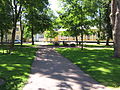
An avenue at Alexandra Park, London

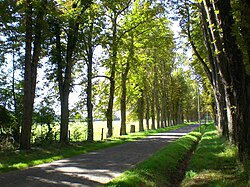
In landscaping, an avenue (from French), alameda (from Portuguese and Spanish), or allée (from French) is a straight path or road that runs between dual rows of trees or large shrubs. As its Latin origin venire ('to come') indicates, an avenue is used to emphasize the "coming to" or arrival at a landscape or architectural feature. In most cases, the trees planted in an avenue will be all of the same species or cultivar, so as to give uniform appearance along the full length of the avenue.

The French term allée is used for avenues planted in parks and landscape gardens, as well as boulevards such as the Grande Allée in Quebec City, Canada, and Karl-Marx-Allee in Berlin.

History

[edit]

The avenue is one of the oldest implements in the history of gardens. An Avenue of Sphinxes still leads to the tomb of the pharaoh Hatshepsut. Avenues similarly defined by guardian stone lions lead to the Ming tombs in China. British archaeologists have adopted highly specific criteria for "avenues" within the context of British archaeology.

Hobbema's The Avenue at Middelharnis, 1689

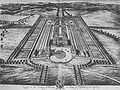
In French formal garden Baroque landscape design style, avenues of trees that were centered upon the dwelling radiated across the landscape. See the avenues in the Gardens of Versailles or Het Loo. Other late 17th-century French and Dutch landscapes,[1] in that intensely ordered and flat terrain, fell naturally into avenues; Meindert Hobbema, in The Avenue at Middelharnis (1689) presents such an avenue in farming country, neatly flanked at regular intervals by rows of young trees that have been rigorously limbed up; his central vanishing point mimics the avenue's propensity to draw the spectator forwards along it.[2]

In Austria-Hungary, the fashion for establishing representative avenues appeared as early as the Renaissance and reached its peak in the Baroque period. Avenues lined the access roads to chateaus and manors, as well as pilgrimage routes and Stations of the Cross. The manorial landscape architecture was followed by "folk landscaping" with wayside chapels, crosses and shrines accompanied by trees. Later, Maria Theresa decreed in 1752 to plant trees along the new imperial roads for economic, aesthetic, orientation and safety reasons. Most avenues were created during the reigns of Maria Theresa and Joseph II. At the turn of the 18th and 19th centuries, new landscaping came from England, and formal aesthetics were replaced by the aesthetics of the natural landscape. During Napoleonic wars, pyramidal poplars became a new element, popular due to their fast growth and distinctive shape. Also in the middle of the 19th century, when the construction of imperial roads continued, but at the same time a network of non-state side roads was created, the law ordered the planting of avenues along them, especially fruit trees and mulberries. Many baroque alleys have aged and been felled, and fruit tree alleys have become increasingly popular. At the time of the development of motoring, the oldest avenues often hinder the widening and modernization of rural roads and are the subject of dispute between conservationists and traffic safety requirements.[3]

Design

[edit]
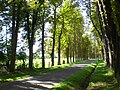
An avenue of hoop pines in Sydney, Australia

To enhance the approach to mansions or manor houses, avenues were planted along the entrance drive. Sometimes the avenues are in double rows on each side of a road. Trees preferred for avenues were selected for their height and speed of growth, such as poplar, beech, lime, and horse chestnut.[4] In the American antebellum era South, the southern live oak was typically used, because the trees created a beautiful shade canopy.

Sometimes tree avenues were designed to direct the eye toward some distinctive architectural building or feature, such as a chapels, gazebos, or architectural follies.[5]

Street name

[edit]
Alameda Dom Afonso Henriques in Lisbon, Portugal

Origin

[edit]

Avenue as a street name in French, Spanish (avenida) and other languages implies a large straight street in a city, often created as part of a large scheme of urban planning such as Baron Haussmann's remodelling of Paris or the L'Enfant Plan for Washington D.C.; "avenues" will typically be the main roads. This pattern is very often followed in the United States, indeed all the Americas, but in the United Kingdom this sense is less strong and the name is used more randomly, mostly for suburban streets developed in the 20th century, though Western and Eastern Avenues in London are main traffic arteries out of the city, if not very straight.

Cities

[edit]

In cities which have a grid-based naming system, such as the borough of Manhattan in New York City, there may be a convention that the streets called avenues run parallel in one direction – roughly north–south in the case of Manhattan – while "streets" run at 90 degrees to them across the avenues; roughly east–west in Manhattan. In Washington, DC the avenues radiate from the centre running diagonally across the grid of streets, which follows typical French usage of the name (in France "boulevards" are often main roads running round the city centre). In Phoenix, Arizona, "the avenues" can colloquially mean "the west side of town", due to the numbered north–south-running roads being called "Avenues" in the western part of the city, separated from the eastern "Streets" by a "Central Avenue". Similarly, "the avenues" in San Francisco, California refers to the Richmond District and the Sunset District, the two neighborhoods on the Pacific coast, north and south of Golden Gate Park, respectively.

In Anglophone urban or suburban settings, "avenue" is one of the usual suite of words used in street names, along with "boulevard", "circle", "court", "drive", "lane", "place", "road", "street", "terrace", "way", "gate" and so on, any of which may carry connotations as to the street's size, importance, or function. Avenues were usually lined with trees when first built, although many avenues have lost their trees to make way for overhead wiring, parking or to allow light into properties.

Notable avenues

[edit]
[edit]

See also

[edit]

References

[edit]
[edit]
Revisions and contributorsEdit on WikipediaRead on Wikipedia
from Grokipedia
In , an avenue is a straight path or roadway typically lined with evenly spaced on both sides, serving as a formal promenade that frames views, directs approaches to buildings or landmarks, and creates a of grandeur and enclosure. These features vary in scale from narrow walks to wide urban and are often surfaced with , dirt, or paving to accommodate pedestrians, carriages, or vehicles. Common include elms, oaks, beeches, and maples, selected for their canopy-forming qualities that provide shade and seasonal interest. The concept of tree-lined avenues traces its origins to European formal gardens during the , drawing inspiration from where rows of trees evoked architectural colonnades. In , known as allées, they became integral to Versailles-style landscapes in the , emphasizing and visual extension toward focal points like statues or pavilions. By the , the term "avenue" entered English usage, denoting principal walks leading to estates, as noted by diarist in 1654. In Britain, avenues gained popularity as status symbols in gardens, often planted to commemorate events or individuals, and evolved in the toward more naturalistic curves amid the movement; they also served practical purposes such as shading military routes under figures like in 18th-century . The tradition spread to colonial America by the early , appearing in designs and spaces for ceremonial and practical purposes. Avenues have served multifaceted roles beyond aesthetics, including economic functions like fruit-tree plantings along trade routes and elements for air quality, , and community enhancement during the 19th-century "urban pastoral" movement. In the , they faced challenges from road widening and wartime destruction but saw revivals, such as in post-World War II and modern commemorative plantings like those at in 1977. Notable examples include the in , a 1770s beech avenue famous for its atmospheric tunnel effect, though the trees are now in decline due to age, disease, and storms as of 2025, with ongoing preservation efforts; in , a monumental urban approach to the U.S. Capitol; and the ancient avenue in Nikko, , dating to 1625. Today, avenues continue to influence sustainable , balancing heritage preservation with ecological management.

Definition and Characteristics

Core Elements

An avenue in is fundamentally a straight, linear path or roadway engineered for processional or ceremonial movement, distinguished by its flanking rows of evenly spaced trees or shrubs on both sides, which create a defined corridor that guides the eye and foot along a deliberate axis. This emphasizes and regularity in planting, where trees are positioned at uniform intervals to form parallel lines that converge visually, enhancing depth and perspective in the overall composition. The resulting tunnel-like canopy effect, achieved through mature branching that interlaces overhead, provides shaded enclosure and a sense of grandeur, prioritizing aesthetic and spatial harmony over mere utility. Avenues exhibit significant scale variations to suit diverse contexts, ranging from narrow paths (typically 1 to 4 wide) suitable for use, to expansive urban streets exceeding 30 in breadth, capable of accommodating vehicular traffic while maintaining visual cohesion. Regardless of width, the core principle remains the prioritization of visual enclosure through the flanking , which frames the path and creates a rhythmic progression that draws the viewer forward. This enclosure is not incidental but integral, as the avenue's linear form relies on the balanced proportions of path and planting to evoke movement and arrival. Integration with the surrounding terrain is a defining trait, where the avenue typically terminates at carefully selected focal points such as monumental buildings, statues, or expansive vistas, thereby amplifying the site's inherent grandeur and reinforcing axial alignment within the . Such terminations serve to the avenue's linearity to the broader environment, transforming it from a mere connector into a compositional device that heightens spatial drama and orients the user toward key elements. These core elements trace their roots to the of formal gardens, where avenues emerged as essential tools for imposing order and ceremony on natural settings.

Variations

Avenues exhibit regional variations that reflect cultural and environmental influences while maintaining the core symmetrical planting of trees along a linear path. In Spanish landscape , the alameda represents a public promenade typically lined with poplars ( spp.), creating shaded walkways for social gatherings in urban settings. Similarly, the French allée denotes a formal garden path lined with trees, often pruned or pleached (such as or lime), integrated into designs to form enclosed, axial vistas that emphasize geometric order. Adjacent clipped hedges of boxwood or may border parterres. Functionally, avenues adapt to ceremonial or recreational purposes, altering their spatial dynamics to suit the intended use. Ceremonial avenues prioritize grandeur and alignment with , serving as processional routes that frame entrances and enhance progression, such as in royal or institutional contexts. In contrast, recreational urban promenades emphasize and , with wider zones and informal canopies that facilitate orientation and social interaction in public parks or city greenspaces. Scale further differentiates avenues, from intimate private designs to expansive ones, influencing their and experiential qualities. Intimate estate avenues, often short and enclosed, function as private approaches framing parterres or axial views within enclosed landscapes. Expansive civic boulevards, by comparison, span larger urban or scales, accommodating multiple lanes and broad vistas to connect neighborhoods and integrate with city infrastructure. Contemporary eco-variations of avenues incorporate sustainable features to address urban environmental challenges, while preserving the defining linear, tree-lined configuration. These designs often integrate materials, such as porous or pavers, beneath the tree rows to facilitate infiltration, reduce runoff, and mitigate flooding in densely developed areas. Such adaptations enhance hydrological by replenishing and minimizing erosion, particularly in high-traffic urban avenues.

Historical Development

Ancient and Early Modern Origins

The earliest precursors to avenues in emerged in ancient Egyptian and Mesopotamian civilizations, where processional ways served ceremonial functions leading to temples and sacred sites. In , these pathways often featured symmetrical alignments of trees, such as sycomore-fig and tamarisks, symbolizing , , and divine order, as seen in the lavish plantations surrounding temple complexes. For instance, avenues of trees flanked the approaches to major temples, such as those at and the funerary temple of at during the Middle Kingdom (circa 2050–1710 BCE), creating shaded, axial routes that emphasized hierarchy and ritual procession. In , similar processional routes, such as the sacred Processional Way in (circa 6th century BCE under ), highlighted urban and religious connectivity through paved streets and decorative walls. Date palms, revered as sacred trees representing life and cosmic abundance, were integral to temple gardens, orchards, and other pathways in arid landscapes, planted to provide shade and symbolize prosperity, influencing early concepts of linear, planted corridors for ceremonial movement. Roman architects later adopted and refined these ideas, incorporating avenues into gardens and urban vias to achieve and visual depth. , in his (circa 15 BCE), emphasized landscape symmetry in designs, advocating for balanced layouts where cypress trees—valued for their form and funerary symbolism—lined paths to frame views and create dramatic approaches, as evident in the expansive gardens of imperial estates like at Tivoli (2nd century CE). This use of cypresses for emphasis transformed ancient Near Eastern inspirations into formalized Roman horticultural elements, prioritizing proportion and harmony in outdoor spaces. Medieval Islamic garden traditions, rooted in Persian designs, further evolved the avenue concept through the chahar bagh (fourfold garden) layout, featuring tree-lined channels that divided paradisiacal enclosures into quadrants symbolizing the Quranic . Originating in Achaemenid Persia (6th century BCE) but formalized under Islamic rule from the 7th century CE, these gardens used axial watercourses flanked by trees like plane and for shade, reflection, and sensory delight, as in the historic in (16th century, with medieval precedents). This design spread westward via Moorish , where it influenced the verdant patios and pathways of Andalusian palaces; at the in (13th–14th centuries), cypress-lined walks and channels in the gardens evoked serene, enclosed paradises, blending Persian symmetry with local to create intimate, shaded avenues for contemplation. The marked a revival of these classical and Islamic influences in , where avenues reemerged as grand approaches to , inspired by ancient texts like and . Architects such as (1508–1580) formalized this in designs like the Villa Barbaro at (1550s), featuring long, tree-flanked axial paths that directed views toward the central structure, harmonizing architecture with landscape to evoke Roman otium (leisure). Palladio's (1570) codified these elements, drawing on symmetrical models to integrate planted avenues as extensions of the building's , emphasizing proportion and perspective in 16th-century Venetian countryside estates. This revival bridged ancient precedents with emerging humanist ideals, establishing avenues as essential for framing and elevating villa facades.

18th and 19th Century Evolution

The design of avenues in French formal gardens reached its zenith during the 17th and 18th centuries, particularly at the Palace of Versailles, where landscape architect created radiating avenues and broad axes that extended from the palace to enhance spatial grandeur and perspective. These avenues, organized around a double east-west and north-south axis established between 1661 and 1662, employed geometric perspectives and optical techniques such as to generate illusions of infinite depth on flat terrain, making distant elements appear proportionally larger to maintain visual coherence. Le Nôtre's innovations, including alignments like the later extension to the , transformed Versailles into a model of controlled vastness, influencing European practices by prioritizing axial symmetry and scale over natural irregularity. In response to the rigid formality of French gardens, the English landscape movement of the late partially rejected straight avenues in favor of more naturalistic compositions, yet adapted them through modifications to integrate human intervention with scenic variety. , a leading figure in this shift, advocated for "clumps"—strategic groupings of trees planted along or near avenues—to break monotony and create layered, painting-like effects that evoked romantic wilderness while retaining directional emphasis. In works such as his Observations on the Theory and Practice of Landscape Gardening (1805), Repton illustrated these clumps as essential for softening formal lines, promoting a balanced aesthetic that influenced estate designs across Britain and emphasized viewer experience over geometric precision. By the , avenues proliferated in European , evolving from ornamental features into multifunctional infrastructure, as exemplified by in the 1850s under . Haussmann's boulevards, such as the Avenue de l'Opéra, combined tree-lined avenues with widened streets to improve sanitation through modern sewers and aqueducts, while facilitating military access by preventing barricades during uprisings. This blend of aesthetic appeal and practical utility—addressing overcrowding and disease in medieval layouts—set a precedent for civic redesign, where avenues symbolized progress and order in rapidly industrializing cities. The concept of tree-lined avenues extended to colonial contexts in the 18th and 19th centuries, where British and French empires incorporated them into gardens and urban approaches to project imperial authority and impose structured landscapes on diverse terrains. In British India, for instance, wide, tree-shaded avenues in colonial settlements like those planned in the late 19th century evoked European order amid exotic environments, reinforcing hierarchies of power through familiar, controlled vistas. Similarly, French colonial projects featured such avenues as vegetal markers of civilization, their enduring presence symbolizing the imposition of metropolitan ideals on subjugated lands.

Design Principles

Layout and Planning

The layout of avenues in prioritizes axial alignment to create a sense of direction and grandeur, often spanning long distances with precise straightness achieved through techniques such as sighting lines and, in modern contexts, GPS for accuracy over extended terrains. This alignment draws from historical precedents like Le Nôtre's designs at Versailles, where a 3-kilometer axis was established on flat ground to unify spatial composition. To enhance perceived length, techniques, including —distorting elements to appear aligned from a specific viewpoint—and collimation, which adjusts sizes and angles to counter distance-induced shortening, are incorporated to amplify the illusion of infinity along the path. A key aspect of avenue planning involves tree spacing to contribute to canopy , commonly set at 20 to 30 feet (approximately 6 to 9 meters) for closer planting to form a cathedral-like canopy quickly, though wider spacings of 40 to 60 feet (12 to 18 meters) allow for more open growth while still achieving closure over time. These spacings ensure aesthetic harmony and functional without excessive , promoting natural upright forms in street . Integration with site topography is essential, involving grading to create level paths that follow or adapt to natural contours, such as gentle slopes for drainage or terracing on steeper inclines to maintain accessibility and visual flow. Termination points provide visual closure, often marked by architectural features like obelisks or gates that punctuate the vista and anchor the axis, as seen in early American landscapes where obelisks served as focal endpoints for avenues to enhance orientation and depth. This approach preserves the site's inherent form while directing circulation. In urban settings, avenue planning must balance multi-use functions, allocating space for sidewalks, vehicular , and occasionally equestrian paths to support diverse access while prioritizing safety and livability. Design guides emphasize that integrate walking, cycling, driving, and transit, using elements like buffered zones and crosswalks to mitigate conflicts and foster economic vitality along the avenue. Historical influences, such as radial avenues in formal gardens, inform these modern layouts by emphasizing connectivity without dominating any single mode.

Vegetation and Aesthetics

Vegetation in avenues plays a pivotal role in enhancing the sensory experience of these linear landscapes, with species selection prioritizing resilience to urban stressors while contributing to visual and olfactory appeal. Plane trees (Platanus spp.), particularly the London plane (Platanus × acerifolia), are widely favored for their exceptional tolerance to air pollution, compacted soils, and drought, making them ideal for high-traffic urban avenues where they form robust canopies that filter particulates and provide shade. Similarly, lime trees (Tilia spp.), such as the small-leaved lime (Tilia cordata), are commonly planted for their fragrant summer blossoms, which create perfumed canopies that attract pollinators and add a subtle aromatic layer to park-like avenues. Planting arrangements in avenues emphasize and to achieve a cohesive aesthetic, often employing double rows of trees on either side of the path or roadway to frame views and enclose the . Staggered patterns, where trees are offset between rows, increase canopy and promote interlocking branches for fuller shade coverage without overcrowding zones. To support soil stability and prevent along avenue edges, understory shrubs or low-growing groundcovers, such as ferns or perennials with fibrous roots, are integrated beneath the tree canopy, enhancing and reducing maintenance needs. Aesthetic objectives in avenue vegetation focus on dynamic sensory impacts, leveraging foliage and seasonal transformations to foster a sense of progression and tranquility. Spring blossoms on species like limes offer bursts of color and fragrance, transitioning to dense summer canopies that produce dappled light patterns filtering through leaves, which soften harsh urban sunlight and create inviting micro-environments. Autumn foliage displays, including vibrant golds and reds from maples or planes, provide seasonal highlights that draw visual interest, while winter silhouettes maintain structural elegance against bare branches. Ongoing maintenance is essential to preserve these aesthetic qualities, involving regular to maintain uniform canopy heights of 10-20 meters, ensuring clearance for pedestrians and vehicles while promoting balanced growth. In plantings common to avenues, disease management is critical, as uniform susceptibility heightens risks from pathogens like anthracnose in planes, necessitating vigilant monitoring, diverse replacements, and integrated pest strategies to avert widespread decline.

Naming Conventions

Etymological Origins

The term "avenue" in the context of landscape design derives from the French word avenue, entering English usage in the late 16th century to denote an "approach" or "way toward," specifically referring to straight paths or roads planted with trees leading to a country house or château. This French term originated as the feminine past participle of avenir, meaning "to come to" or "to arrive," and was initially applied to formal access routes in estate landscapes during the Renaissance period. The linguistic roots trace back to Latin advenire, meaning "to come to," composed of ad- ("to" or "toward") and venire ("to come"), which evolved through into the modern sense of a directed pathway. By the , the term had become integral to design, particularly in the works of , where avenues served as grand, symmetrical entries extending sightlines and emphasizing axial perspectives, as seen in the expansive layouts of the . Related terms in other Romance languages highlight parallel developments in tree-lined landscape features. The Spanish alameda refers to a poplar grove or shaded avenue, derived from álamo ("poplar tree") with the collective suffix -eda. In English, the cognate "alley" (from French allée) described bordered walks in formal gardens, typically narrower than avenues and suited for pedestrian use, while "avenue" denoted broader, more monumental tree-lined approaches; both terms coexisted in landscape descriptions without merging, adapting to preferences for formal and picturesque styles. Early textual references to such features appear in English accounts of French landscapes, such as John Evelyn's entry from 1644 describing the in as featuring "groves, plantations of tall trees, especially that in the middle, being of elms, the other of mulberries... a place adjoining, of near an English mile long, planted with four rows of trees," which exemplifies the tree-lined approaches that would later be termed avenues.

Usage in Urban Contexts

The adoption of the "avenue" suffix in 19th-century planned cities often signified prestige and monumental scale, distinguishing these thoroughfares from ordinary streets. In , Pierre Charles L'Enfant's plan incorporated the term for broad diagonal axes—ranging from 160 to 400 feet wide—superimposed on a grid to create vistas toward key landmarks like the U.S. Capitol, evoking French landscape traditions of grandeur. This nomenclature influenced subsequent American urban expansions, where avenues symbolized authority and elegance in layouts like those in Williamsburg and Annapolis. The cultural connotations of avenues emphasize and , stemming from their etymological in straight approach paths to or châteaux. These associations have shaped modern practices, favoring mixed-use developments along avenues to capitalize on their width and for integrating residential, commercial, and public spaces. For example, rezoning initiatives target avenues to permit higher densities while mandating and job-generating uses, fostering vibrant urban corridors. Global variations in usage reflect priorities; in , "avenida" commonly designates wide, multi-lane streets optimized for commercial activity and high traffic volumes, as seen in transformations of oversized thoroughfares into multimodal corridors. In contrast, some European cities, notably in , favor "" for expansive ring roads and Haussmann-inspired urban arteries, reserving "avenue" for more targeted, linear routes that direct movement toward specific destinations. Avenue designations impact urban policy by prioritizing environmental enhancements, such as tree-planting mandates that leverage their linear form for canopy coverage and sustainability. In , zoning regulations require one street —either pre-existing or newly planted—for every 25 feet of adjacent to development sites, promoting stormwater management, air quality improvement, and urban cooling. These policies underscore avenues' role in balancing aesthetic prestige with in contemporary city planning.

Notable Examples

European Avenues

European avenues represent a pinnacle of , blending urban functionality with aesthetic grandeur, often serving as ceremonial axes that reflect and historical evolution. These tree-lined thoroughfares, rooted in absolutist planning and later , exemplify how avenues integrated to enhance public spaces while accommodating processions, commerce, and leisure. The in traces its origins to the early 17th century, when Queen Marie de Médicis commissioned a tree-lined avenue extending from the to symbolize royal promenade and leisure. Spanning approximately 1.9 kilometers from to the , it was dramatically redesigned in the 1850s under Baron Georges-Eugène Haussmann's direction during Napoleon III's modernization of , transforming it into a wide, plane-tree-lined boulevard with uniform architecture and green medians to promote air circulation and visual harmony. This evolution positioned the as a symbol of luxury through its high-end boutiques and theaters, while also embodying revolutionary spirit as the site of military parades and key events in French history, such as the 1944 liberation celebrations. The , a 1770s avenue in , is renowned for its atmospheric effect created by intertwined branches forming a canopy over the road. In , exemplifies Prussian planning, initiated in 1647 when Elector Friedrich Wilhelm planted lime trees along a 1.5-kilometer to create a shaded route from the Stadtschloss (City Palace) to the city gate, later the , fostering a sense of imperial connectivity and prestige. The avenue's linden trees, replanted over centuries, frame neoclassical buildings and monuments, including an equestrian statue of at its eastern end, underscoring its role in embodying Prussian grandeur through disciplined symmetry and monumental sculpture. Andrássy Avenue in , constructed from 1872 to 1885 as part of the city's expansion into a modern capital, stretches 2.5 kilometers from to Heroes' Square, featuring eclectic and neo-Renaissance architecture that showcases 19th-century urban innovation. Designated a World Heritage site in 2002 for its exemplary , the avenue culminates at the , a neo-Renaissance landmark completed in 1884, which serves as a cultural terminus integrating theater, music academies, and ornate facades to highlight Budapest's artistic heritage. Its tree-lined promenades and underground railway (opened 1896) illustrate a fusion of with infrastructural advancement. A contemporary adaptation is La Rambla in , evolved in the from a seasonal streambed into a 1.2-kilometer pedestrian promenade blending avenue typology with vibrant public space, where central walkways flanked by narrow lanes encourage strolling amid street performers and markets. Lined with plane trees providing shade and seasonal foliage, it prioritizes human-scale interaction over vehicular traffic, reflecting modernist shifts toward inclusive urban realms while preserving historical layers from medieval walls to Enlightenment expansions.

North American Avenues

In North American urban landscapes, avenues have played a pivotal role in shaping city planning and embodying national identity, often drawing brief inspiration from European models of grandeur while adapting to local contexts of , , and . Pennsylvania Avenue in Washington, D.C., exemplifies this through its foundational design in the 1791 , where French engineer envisioned a grand diagonal boulevard approximately 1.9 km long linking the U.S. Capitol to the President's House (now ), serving as a symbolic axis of power and separation between legislative and executive branches. This thoroughfare was intended for ceremonial processions, hosting inaugural parades and events honoring presidents and national achievements since George Washington's 1793 Capitol cornerstone-laying march, with early enhancements under including rows of Lombardy poplar trees for aesthetic and functional shading, later supplemented by American elms and monumental features like statues and plazas that reinforce its role as America's "Main Street." Massachusetts Avenue, also in Washington, D.C., emerged in the late as a residential showcase amid the city's post-Civil War transformation, extending to about 10 km through 1880s infrastructure projects under Alexander "Boss" Shepherd that planted over 60,000 trees, including double rows of American lindens along its length to create a park-like corridor. By the 1890s, aligned with the , it became a "grand avenue" lined with opulent Beaux-Arts and neoclassical mansions for the elite, many later converted into embassies that underscore its diplomatic significance, with landscape design emphasizing long sightlines and framed views of architectural entrances to evoke an "open-air salon" fostering social and international exchange. This evolution highlights avenues' contribution to national identity by blending residential prestige with global representation, prioritizing vistas that integrate built and natural elements for pedestrian appreciation. Further south, Ocean Drive in Miami Beach represents 20th-century innovation in coastal planning, developed from the 1910s to 1930s amid two building booms that transformed former coconut plantations into a resort enclave, with the 1935-1945 surge creating a roughly 2 km iconic stretch lined by over 800 pastel-hued structures featuring streamlined forms, nautical motifs, and adaptations like "eyebrow" shades for the subtropical climate. Flanked by lush palm trees and oceanfront esplanades, it embodies tropical modernism by merging modern aesthetics with local flora, promoting tourism and leisure as cornerstones of Miami's identity as a vibrant, escapist gateway to . In a contemporary vein, Granville Street in underwent sustainable revitalization in the mid-2000s, with a 2006 redesign prioritizing pedestrians and transit over vehicles through widened sidewalks up to 8.5 meters, enhanced linear tree plantings including native species for ecological resilience, and integration with the to serve over 60,000 daily users. This approach, rooted in Vancouver's 1997 Transportation Plan, advances urban identity by fostering walkable entertainment districts and green corridors that balance density with environmental stewardship.

References

Add your contribution
Related Hubs
User Avatar
No comments yet.