


Community hub
Recent from talks
Contribute something
Nothing was collected or created yet.
Culture of Assam
View on Wikipedia
 | This article needs additional citations for verification. (June 2016) |
| Part of a series on the |
| Culture of Assam |
|---|
 |
.png)


.svg)


The culture of Assam is traditionally a hybrid one, developed due to cultural assimilation of different ethno-cultural groups under various political-economic systems in different periods of its history.
Historical perspective
[edit]The roots of culture in Assam goes back almost five thousand years when the first wave of humans, the Austroasiatic people reached the Brahmaputra valley. They mixed with the later immigrant Tibeto-Burman and the Indo-Aryan peoples out there in prehistoric times. The last wave of migration was that of the Tai/Shan who later formed the idea of Assamese culture and its identity. The Ahoms, later on, brought some more Indo-Aryans like the Assamese Brahmins and Ganaks and Assamese Kayasthas to Assam.[4]

_of_Kamalabari_Satra.jpg)
According to the epic Mahabharata and on the basis of local folklore, people of Assam (Kiratas) probably lived in a strong kingdom under the Himalayas in the era before Jesus Christ, which led to early assimilation of various Tibeto-Burman and Autro-Asiatic ethnic groups on a greater scale. Typical naming of the rivers and spatial distribution of related ethno-cultural groups also support this theory. Thereafter, western migrations of Indo-Aryans such as those of various branches of Irano-Scythians and Nordics along with mixed northern Indians (the ancient cultural mix already present in northern Indian states such as Magadha enriched the aboriginal culture and under certain stronger politico-economic systems, Sanskritisation and Hinduisation intensified and became prominent. Such an assimilated culture, therefore, carries many elements of source cultures, of which exact roots are difficult to trace and are a matter for research. However, in each of the elements of cultures in Assam, i.e. language, traditional crafts, performing arts, festivities, and beliefs, either indigenous local elements or the indigenous local elements in Sanskritised forms are always present.
It is believed that Assamese culture developed its roots over 750 years as the country of Kamarupa during the first millennium AD of Bodo-Kachari people assimilation with Aryan which is debatable as the idea of Assam as an entity was not present. The first 300 years of Kamarupa was under the great Varman dynasty, 250 years under the Mlechchha dynasty and 200 years under the Pala dynasty. The records of many aspects of the language, traditional crafts (silk, lace, gold, bronze, etc.) are available in different forms. When the Tai-Shans entered the region in 1228 under the leadership of Sukaphaa to establish Ahom kingdom in Assam for the next 600 years, again a new chapter of cultural assimilation was written, and thus the modern form of Assamese culture developed. The original Tai-Shans assimilated with the local culture adopted the language on one hand and on the other also influenced the culture with the elements from their own. Similarly, the Chutiya kingdom in eastern Assam, the Koch Kingdom in western Assam and the medieval Kachari and Jaintia kingdoms in southern Assam provided stages for assimilation at different intensities and with different cultural-mixes.
The Vaishnava Movement, a 15th-century religio-cultural movement under the leadership of Srimanta Sankardeva and his disciples, has provided another dimension to the Assamese culture.

A renewed Hinduisation in local forms took place, which was initially greatly supported by the Koch and later by the Ahom Kingdoms. The resultant social institutions such as namghar and sattra – the Vaishnav Hermitage have become part of the Assamese way of life. The movement contributed greatly towards language, literature, and performing and fine arts. On many occasions, the Vaishnav Movement attempted to introduce alien cultural attributes and modify the way of life of the common people. Brajavali, a language specially created by introducing words from other Indian languages, failed as a language but left its traces on the Assamese language. Moreover, new alien rules were also introduced changing people's food habits and other aspects of cultural life. This had a greater impact on the alienation of many ethnocultural and political groups in the later periods.
During periods when strong politico-economic systems emerged under powerful dynasties, greater cultural assimilation created common attributes of Assamese culture, while under less powerful politico-economic systems or during political disintegration, more localized attributes were created with spatial differentiation. Time-factors for such integrations differentiations have also played an important role along with the position of individual events in the entire series of events.
-
 Dunori from Assam.
 -
 Traditional painting of Assam.
 -
 Asamiya textile print design of Gamosa.
 -
 Tamul-paan of Assam.
 -
 A Bihu dancer with a horn.
 -
 Jhumura Nritya.


With a strong base of tradition and history, modern Assamese culture is greatly influenced by various events that took place in under British rule of Assam and in the Post-British Era. The language was standardized by American Missionaries according to that of the Sibsagar District, the nerve center of the Ahom politico-economic system while a renewed Sanskritisation was increasingly adopted for developing Assamese language and grammar (ব্যাকৰণ). A new wave of Western and northern Indian influence was apparent in the performing arts and literature.
Due to increasing efforts of standardization in the 19th and 20th centuries, the localized forms present in different districts and also among the remaining source-cultures with the less-assimilated ethnocultural groups have seen greater alienation. However, Assamese culture in its hybrid form and nature is one of the richest and is still under development. 20th century saw numerous self-determination and identity movement and many states were new states created in the process as most indigenous tribal communities of the state refused to accept the idea of collective Assamese identity which was imposed upon them. Many indigenous tribal communities of the state still oppose the efforts of assimilation into Assamese cultural identity.
Composition and characteristics
[edit] |
Culture in Assam in its true sense today is a 'cultural system' composed of different ethnic cultural compositions. It is more interesting to note that even many of the source-cultures of culture in Assam are still surviving either as sub-systems or as sister entities. In a broader sense, therefore, the cultural system of Assam incorporates its source-cultures and However, it is also important to keep the broader system closer to its roots.
Elements
[edit]Symbolism
[edit] |

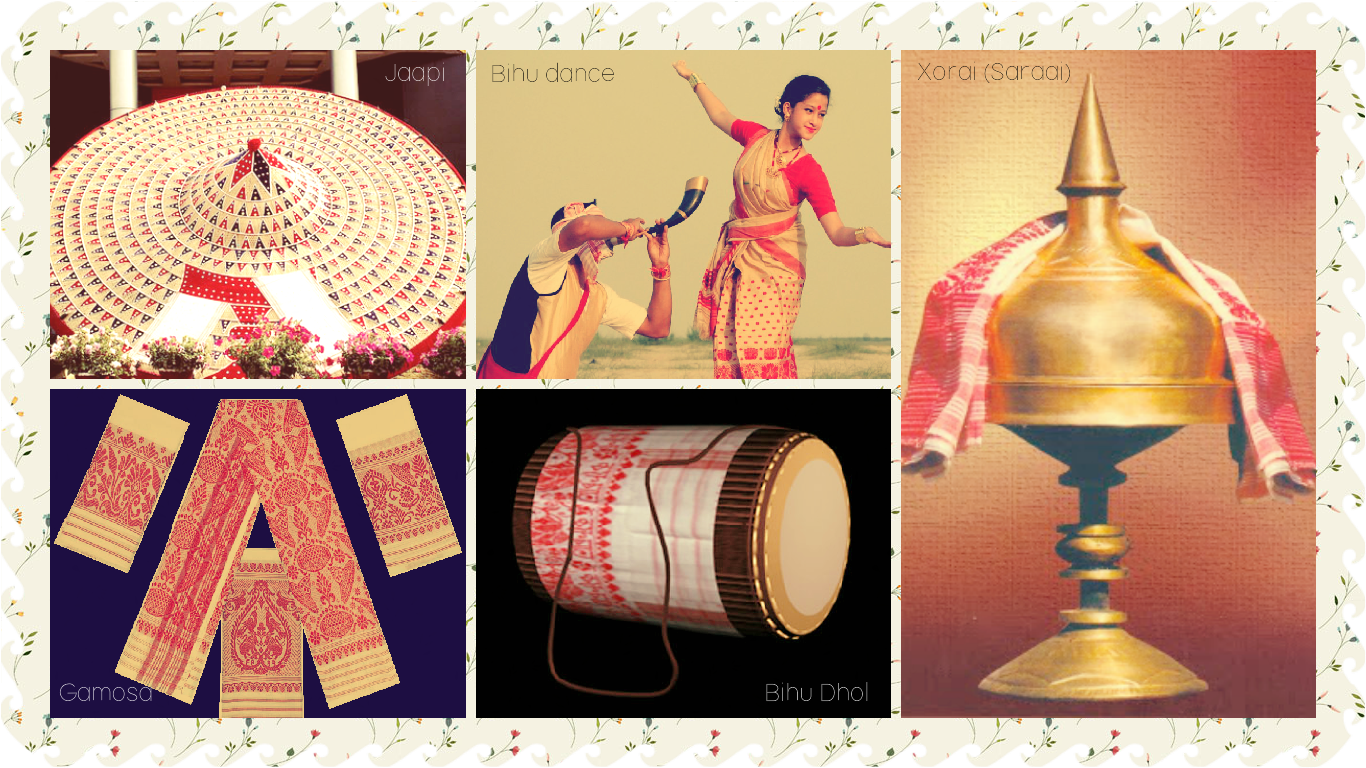
Symbolism is an important part of culture in Assam. Various elements are being used to represent beliefs, feelings, pride, identity, etc. Symbolism is an ancient cultural practice in Assam, which is still very important for the people. Tamulpan, Xorai and Gamosa are three important symbolic elements in Assamese culture.
Tamul-paan (the areca nut and betel leaves) or guapan (gua from Goi of Bodo-Chutia language) are considered as the offers of devotion, respect, and friendship. It is an ancient tradition and is being followed since time-immemorial with roots in the aboriginal culture.
Xorai, a traditional symbol of Assam, is a manufactured bell-metal object and an article of great respect and is used as a container-medium while performing respectful offerings. It is an offering tray with a stand at the bottom similar to those found in East and South East Asia. There are Xorais with or without a cover on the top. Traditionally Xorai is made of bell metal although nowadays they can be made from brass and/or silver. Hajo and Sarthebari are the most important centers of traditional bell-metal and brass crafts including Xorais. Xorais are used:
- as an offering tray for tamul-pan (betel nuts and betel leaves) to guests as a sign of welcome and thanks.
- as an offering tray for food and other items placed in front of the altar (naam ghar) for blessing by the Lord.
- as a decorative symbol in traditional functions such as during Bihu dances.
- as a gift to a person of honor during felicitations.

The Gamosa is an article of great significance for the people of Assam. Literally translated, it means 'something to wipe the body with' (Ga=body, mosa=to wipe), Its original term is Gamcha; interpreting the word "gamosa" as the body-wiping towel is misleading. It is generally a white rectangular piece of cloth with primarily a red border on three sides and red woven motifs on the fourth (in addition to red, other colors are also used). Though it is used daily to wipe the body after a bath (an act of purification), the use is not restricted to this. It is used by the farmer as a waistcloth (tongali) or a loincloth (suriya); a Bihu dancer wraps it around the head with a fluffy knot. It is hung around the neck at the prayer hall and was thrown over the shoulder in the past to signify social status. Guests are welcomed with the offering of a gamosa and tamul (betel nut) and elders are offered gamosas (bihuwaan) during Bihu. It is used to cover the altar at the prayer hall or cover the scriptures. An object of reverence is never placed on the bare ground, but always on a gamosa. One can, therefore, very well say that the gamosa symbolizes the life and culture of Assam.
Significantly the gamosa is used equally by all irrespective of religious and ethnic backgrounds.
At par with Gamosa, there are beautifully woven symbolic clothes with attractive graphic designs being used by different cultural ethno-cultural groups as well.
There were various other traditional symbolic elements and designs in use, which are now found only in literature, art, sculpture, architecture, etc. or used for only religious purposes (in particular occasions). The typical designs of assamese-lion, dragon, flying-lion, etc. were used for symbolising various purposes and occasions.
Festivals
[edit] |
There are several important indigenous traditional festivals in Assam. Bihu/Bwisagu(for Kacharis) is the most celebrated festival among all. There are various Indigenous traditional festivals as well as belonging to different indigenous communities which are celebrated every year around different corners of Assam.
Bihu
[edit]

Bihu is a series of three prominent festivals of Assam. Primarily a festival celebrated to mark the seasons and the significant points of a cultivator's life over a yearly cycle, in recent times the form and nature of celebration have changed with the growth of urban centers. Three Bihus are celebrated: Rongali, celebrated with the coming of spring and the beginning of the sowing season; Kongali, the barren Bihu when the fields are lush but the barns are empty; and the Bhogali, the thanksgiving when the crops have been harvested and the barns are full. Rongali, Kongali & Bhogali Bihu are also known as 'Bohag Bihu', 'Kati Bihu' & 'Magh Bihu' respectively. The day before each Bihu is known as uruka. There are unique features of each Bihu. The first day of 'Rongali Bihu' is called 'Goru Bihu' (the Bihu of the cows). On this day the cows are taken to the nearby rivers or ponds to be bathed with special care. Traditionally, cows are respected as sacred animals by the people of Assam. Bihu songs and Bihu dance are associated with rongali bihu.
Baisagu
[edit]Bwisagu is a very popular seasonal festival of the Bodo of Assam. Bwisagu means the start of the new year. Bwisagu is a Boro word which originated from the word "Bwisa" which means year or age, and "Agu" that means New Year.
Chunbîl Melâ (Jonbeel Mela)
[edit]Jonbeel Mela (pron:ˈʤɒnˌbi:l ˈmeɪlə) (Tiwa: Chunbîl Melâ) is a three-day annual indigenous Tiwa Community fair held the weekend of Magh Bihu at a historic place known as Dayang Belguri at Joonbeel. It is 3 km from Jagiroad in Morigaon district of Assam and 32 km from Guwahati. The National Highway connecting the mela is NH 37. The Joonbeel (Joon and Beel are Assamese terms for the Moon and a wetland respectively) is so-called because a large natural water body is shaped like a crescent moon.
Beshoma
[edit]Beshoma is a festival of Deshi people.[5] It is a celebration of sowing crop. The Beshoma starts on the last day of Chaitra and goes on until the sixth of Baisakh. With varying locations it is also called Bishma or Chait-Boishne.[6]
Ali Ai Ligang
[edit]Ali-Ai-Ligang is the spring festival of the Mising people of Assam, India. The name of the festival is made up of three terms, 'Ali', root and seed, 'Ai', fruit and 'Ligang', to sow.
Bohuwa dance
[edit]Bohuwa dance is a festival of the Sonowal Kacharis of Assam, India.
Sport
[edit]The Abhiruchi Sports Day is celebrated annually on 3 September in honour of athlete Bhogeswar Baruah,[7] and the Bhogeswar Baruah National Sports Awards are also awarded on the same day to Assam and national athletes.[8]
Music
[edit] |
Assam, being the home to many ethnic groups and different cultures, is rich in folk music. The indigenous folk music has in turn influenced the growth of a modern idiom, that finds expression in the music of such artists are Jyoti Prasad Agarwala, Bishnuprasad Rabha, Parvati Prasad Baruva, Bhupen Hazarika, Nirmalendu Choudhury & Utpalendu Choudhury, Pratima Barua Pandey, Luit Konwar Rudra Baruah, Parvati Prasad Baruva, Jayanta Hazarika, Khagen Mahanta, Beauty Sarma Baruah. Among the new generation Zubeen Garg, Angaraag Mahanta, Kalpana Patowary, Joi Barua, Jitul Sonowal and Manoj Borah are well known.
And other than traditional Assamese music Assam's capital city Guwahati has become the country's capital for rock music other than Shillong. A number of talented rock bands have formed showcasing their talents around the world.
Traditional crafts
[edit] |

Assam has maintained a rich tradition of various traditional crafts for more than two thousand years. Presently, Cane and bamboo craft, bell metal and brass craft, silk and cotton weaving, toy and mask making, pottery and terracotta work, wood craft, jewellery making, musical instruments making, etc. are remained as major traditions. Historically, Assam also excelled in making boats, traditional guns and gunpowder, colours and paints, articles of lac, traditional building materials, utilities from iron, etc.
Cane and bamboo craft provides the most commonly used utilities in daily life, ranging from household utilities, weaving accessories, fishing accessories, furniture, musical instruments to building construction materials. Traditional utilities and symbolic articles made from bell metal and brass are found in every Assamese household. The Xorai and bota have been in use for centuries to offer gifts to respected persons and are two prominent symbolic elements. Hajo and Sarthebari are the most important centers of traditional bell-metal and brass crafts. Assam is the home of several types of silks, the most prominent and prestigious being Muga, the natural golden silk is exclusive only to Assam. Apart from Muga, there are other two varieties called Pat, creamy-bright-silver colored silk, and Eri, a variety used for manufacturing warm clothes for winter. Apart from Sualkuchi, the center for the traditional silk industry, in almost every part of the Brahmaputra Valley, rural households produce silk and silk garments with excellent embroidery designs. Moreover, various ethno-cultural groups in Assam make different types of cotton garments with unique embroidery designs and wonderful color combinations.
Moreover, Assam possesses unique crafts of toy and mask making mostly concentrated in the Vaishnav Hermitage, pottery and terracotta work in Western Assam districts and woodcraft, iron craft, jewelry, etc. in many places across the region. However, we can see Assam populated because of these.
Traditional clothes and fabric of the Assamese include Suriya, Pirawn, Gamusa, Jaapi, Mekhela chador, Riha, Tongali.
Paintings
[edit] |

Painting is an ancient tradition of Assam. The ancient practices can be known from the accounts of the Chinese traveller Xuanzang (7th century CE). The account mentions that Bhaskaravarma, the king of Kamarupa has gifted several items to Harshavardhana, the king of Magadha including paintings and painted objects, some of which were on Assamese silk. Many of the manuscripts available from the Middle Ages bear excellent examples of traditional paintings. The most famous of such medieval works are available in the Hastividyarnava (A Treatise on Elephants), the Chitra Bhagawata and in the Gita Govinda. The medieval painters used locally manufactured painting materials such as the colors of hangool and haital. The medieval Assamese literature also refers to chitrakars and patuas. Traditional Assamese paintings have been influenced by the motifs and designs in the medieval works such as the Chitra Bhagawata.
There are several renowned contemporary painters in Assam. The Guwahati Art College in Guwahati is the only government institution for tertiary education. Several art-societies and non-government initiatives exist across the state and the Guwahati Artists Guild is a front-runner organization based in Guwahati along with the Guwahati art college. There is a Department of Fine Arts in Assam University Silchar, a central government organization, and its thrust area concentrates on the art and craft of northeast India with special reference to Assam.
State anthem
[edit] |
The song O Mur Apunar Dekh (অ’ মোৰ আপোনাৰ দেশ) (O my endearing country, 'desh', phonetically 'dex', with a talôibbô xô=country), composed by Rasaraj Lakshminath Bezbaroa, is popularly accepted as the state anthem of the state of Assam.
See also
[edit]- Ambubachi Mela
- Jonbeel Mela (Chunbîl Melâ)
References
[edit]- ^ "639 Identifier Documentation: aho – ISO 639-3". SIL International (formerly known as the Summer Institute of Linguistics). SIL International. Retrieved 29 June 2019.
Ahom [aho]
- ^ "Population by Religious Communities". Census India – 2001. Ministry of Home Affairs, Government of India. Retrieved 1 July 2019.
Census Data Finder/C Series/Population by Religious Communities
- ^ "Population by religion community – 2011". Census of India, 2011. The Registrar General & Census Commissioner, India. Archived from the original on 25 August 2015.
2011census/C-01/DDW00C-01 MDDS.XLS
- ^ "Assam People and Their Culture".
- ^ "Bihu – Its Myriad Colours". NORTHEAST NOW. Retrieved 8 September 2019.
- ^ "Beshoma: The 'Rongali Bihu' of Deshi Muslims | The Thumb Print - A magazine from the East". Retrieved 8 September 2019.
- ^ "42nd Abhiruchi Sports Day Celebrated Across Assam with Main Event in Guwahati". The Sentinel - of this Land, for its People. 4 September 2025. Retrieved 5 November 2025.
- ^ "Manu Bhaker, Sunil Chhetri, Lovlina honoured with Bhogeswar Baruah National Sports Awards". assamtribune.com. 4 September 2025. Retrieved 5 November 2025.
External links
[edit]
Culture of Assam
View on GrokipediaHistorical Development
Ancient and Medieval Foundations
Archaeological evidence indicates human settlements in Assam dating to the Neolithic period, with sites like Daojali Hading in Dima Hasao revealing ancient metallurgical activities and confirming prehistoric habitation around the 2nd millennium BCE.[6] These early inhabitants included speakers of Austroasiatic languages, such as ancestors of the Khasi and Munda groups, who formed the basal layer of indigenous culture through practices like megalith erection for ancestral veneration and territorial marking./Paper/5_Smita%20Devi%20Bora.pdf) Subsequent migrations of Tibeto-Burman peoples, including Bodo-Kachari groups, introduced animistic rituals and hill-valley agrarian adaptations, blending with Austroasiatic substrates to shape pre-state social structures centered on clan solidarity and riverine economies.[7] The arrival of Tai-speaking migrants under Sukaphaa in 1228 CE marked a pivotal consolidation, as the Tai-Ahom established the Ahom kingdom, which dominated the Brahmaputra Valley for six centuries until 1826.[8] This multi-ethnic polity integrated Ahom wet-rice cultivation techniques and bronze metallurgy with local Tibeto-Burman martial traditions, fostering a hierarchical society where Ahom elites patronized indigenous crafts like bell-metal work while maintaining animist-ancestor worship alongside emerging Hindu influences.[9] In the 16th century, Srimanta Sankardev (1449–1568) initiated a Bhakti movement through Ekasarana Dharma, a monotheistic Vaishnavite tradition emphasizing devotion to Krishna via congregational singing (kirtana) and ethical living, which synthesized Austroasiatic-Tibeto-Burman folk elements with Sanskritic theology.[10] Sankardev's establishment of Sattra monasteries served as centers for cultural preservation, promoting dramatic performances (Ankiya Nat) and manuscript illumination that drew on local motifs, thus embedding devotional practices into everyday rituals and reducing ritual hierarchies.[11] Ahom royal chronicles, known as Buranjis—composed initially in Ahom script from the 13th century onward—systematically recorded patronage of festivals like Me-Dam-Me-Phi (ancestor worship) and crafts such as Muga silk weaving and goldsmithing for regalia, illustrating how kings supported multi-ethnic artistic expressions to legitimize rule.[12] These texts, updated across reigns, highlight causal links between state expansion and cultural sponsorship, such as incentives for potter guilds and ritual drumming ensembles integral to court ceremonies.[13]Colonial Influences and Transformations
The Treaty of Yandabo, signed on 24 February 1826, concluded the First Anglo-Burmese War and transferred control of Assam from Burmese occupation to the British East India Company, effectively ending the 600-year Ahom dynasty and initiating direct colonial administration in the region.[14][15] This shift dismantled traditional Ahom governance structures, such as the paik system of corvée labor, replacing them with revenue collection and land surveys that prioritized British commercial interests while employing indirect rule in peripheral hill areas to minimize administrative costs and preserve local chiefly authorities.[16][17] The establishment of tea plantations from the 1830s onward transformed Assam's economy and social fabric, as wild tea plants discovered in 1823 were commercialized by British entrepreneurs, necessitating large-scale labor importation due to local reluctance for wage work.[18] Over 1 million workers, primarily Adivasi groups from Chota Nagpur and other central Indian regions, were recruited between the 1840s and 1900s through contractors, introducing new ethnic communities and cultural practices like distinct festival observances and kinship systems that intermingled with indigenous ones, thereby diversifying Assam's demographic composition and challenging traditional agrarian hierarchies.[19][20] This influx, coupled with plantation isolation, fostered hybrid social norms but also exacerbated land alienation for locals, indirectly eroding communal land-based rituals.[21] Western education and the advent of printing further reshaped cultural expression, with the first printing press arriving in 1836 under missionary auspices, facilitating the publication of Assamese texts and standardizing the script amid debates over its distinction from Bengali.[22][23] American Baptist missionaries, starting in Sadiya in 1836, promoted English-medium schools that exposed elites to Enlightenment ideas, sparking reformist literature and prose in Assamese by the 1840s, as seen in periodicals like Orunodoi (1846), which critiqued superstitions and advocated scientific rationalism.[24][25] These institutions, numbering over 100 by the 1870s, prioritized urban Assamese and Bengali intermediaries, widening cultural divides between educated classes and rural folk.[26] Colonial suppression of tribal resistance, including the Khasi uprising (1829–1833) and Singpho rebellion (1830), enforced boundary demarcations that curtailed autonomous hill practices, while partial Christian conversions among tribes like Nagas and Karbis from the 1840s altered ritual landscapes by supplanting animist ancestor worship with monotheistic hymns and Sabbath observances.[27] Missionaries documented and romanized tribal languages, enabling Bible translations but eroding oral traditions in converted communities, where church-led education supplanted shamanic healing by the late 19th century.[28][29] British policies of exclusion for hill tracts preserved some customary laws against plains' revenue demands, yet overall fostered a dual cultural evolution: modernization in valleys via print and education, contrasted with controlled hybridization in tribal peripheries.[30][31]Post-Independence Shifts and State Formation
Following India's independence in 1947, Assam initially retained its composite structure encompassing diverse ethnic territories, but subsequent reorganizations carved out new states to address ethnic demands for autonomy and cultural preservation. Nagaland was formed from the Naga Hills in 1963, Meghalaya from the Khasi, Jaintia, and Garo Hills in 1972, and Arunachal Pradesh and Mizoram in 1987, allowing these tribal groups to govern and safeguard their distinct customs, languages, and traditional practices outside Assam's Assamese-dominated framework.[32] These separations stemmed from post-independence ethnic assertions, where hill tribes resisted assimilation into the valley's Assamese cultural sphere, prioritizing self-rule to maintain animistic rituals, clan-based governance, and land tenure systems.[33] In the Brahmaputra Valley, linguistic movements in the 1960s reinforced Assamese cultural identity amid demographic pressures. The Assam Official Language Act of 1960 designated Assamese as the sole official language, a response to fears of Bengali linguistic dominance highlighted by the 1961 census, which recorded Bengali speakers at 24.7% statewide due to earlier migrations and district configurations. [34] This assertion preserved Assamese literature, script, and medium of instruction in education and administration, countering Bengali influences in re-districting debates, though it provoked agitations in the Barak Valley leading to a 1961 amendment recognizing Bengali as an associate language in Cachar, Karimganj, and Hailakandi districts.[35] Such policies embedded Assamese as the state's cultural core, fostering unity among Indo-Aryan and Tai-Ahom communities while navigating ethnic pluralism. Ethnic tribal demands culminated in the 2003 Bodoland Territorial Council (BTC) Accord, signed on February 10 between the Government of India, Assam, and Bodo representatives, establishing an autonomous self-governing body under the Sixth Schedule for the Bodo-majority areas. The BTC, covering four districts, empowered Bodos to legislate on land, forests, and cultural affairs, thereby institutionalizing protections for their matrilineal customs, Bathou faith practices, and traditional institutions like the Bwisagu festival, amid prior insurgencies driven by cultural marginalization fears.[36] This accord marked a causal shift toward decentralized governance, enabling Bodo assertions to evolve from conflict to structured preservation of indigenous identity within India's federal structure. Recent state efforts address urbanization's erosion of tribal practices through the Directorate of Indigenous and Tribal Faith and Culture, established in 2021 to document, archive, and promote vanishing customs among Assam's 14+ indigenous communities.[37] The department provides grants for cultural networks, youth engagement, and preservation of rituals like ancestor worship and shifting cultivation festivals, countering assimilation pressures from modernization and demographic changes.[38] These initiatives reflect a post-2000s policy pivot toward empirical safeguarding of empirical cultural data, prioritizing first-hand ethnographic records over generalized narratives.Demographic and Social Foundations
Ethnic Composition and Indigenous Groups
Assam's ethnic composition reflects a complex interplay of indigenous communities and historical migrations, with the 2011 Census recording a total population of 31,205,576 across diverse groups. The core population consists of the Assamese ethnic group, primarily Indo-Aryan in origin and concentrated in the Brahmaputra Valley, alongside Tibeto-Burman-speaking tribes that maintain distinct cultural identities rooted in pre-colonial habitation. Scheduled Tribes, numbering around 3.88 million or 12.4% of the population, include major communities such as the Bodo (approximately 1.4 million), Mishing (680,424), and Karbi (around 419,000), who preserve unique social structures, land-based economies, and customary governance systems.[39][40][41] Indigenous groups, particularly the plains and hill tribes, assert primacy based on ancestral ties to the region's ecology and resources, distinguishing themselves from later settler influxes. The Bodo, the largest tribal group, inhabit western Assam and have pursued autonomy to safeguard their matrilineal clans, shifting cultivation practices, and animist-derived customs against external pressures. Similarly, the Mishing, riverine dwellers in eastern districts, and Karbi, hill agriculturists, emphasize self-governance through village councils to preserve endogamous marriages and ritual economies. Assam recognizes over 100 such ethnic communities, with the Bodo-Kachari supergroup alone encompassing 19 subgroups historically dominant in the plains before valley consolidation.[42][43] Historical migrations shaped but did not displace indigeneity; the Tai-Ahom arrived in 1228 CE under Sukaphaa, establishing a kingdom through alliances and assimilation with local Kachari and Chutia groups, eventually integrating into the broader Assamese identity via intermarriage and cultural syncretism. In contrast, post-Partition undocumented immigration, primarily from East Bengal since the 1950s, introduced settler populations that have demographically strained indigenous land holdings, with estimates of 5-10 million entrants altering rural compositions and sparking identity assertions. This causal dynamic—unregulated inflows versus finite resources—prompted the 1979-1985 Assam Movement and the 2019 National Register of Citizens, which excluded 1.9 million for lacking pre-1971 documentation, highlighting tensions over settler-indigenous distinctions.[9][44][45] To address such pressures, ethnic enclaves have formalized autonomy; the Bodoland Territorial Council, established in 2003 via the Bodo Liberation Tigers' accord with the Indian government, administers 3,200 square kilometers for Bodo-majority areas, enabling control over land allotment and customary laws to mitigate dilution risks. Comparable arrangements exist for Karbi Anglong, underscoring empirical recognition of indigeneity through devolved powers rather than assimilation narratives.[46][47]Linguistic Diversity and Evolution
Assamese, an Eastern Indo-Aryan language, serves as the primary linguistic medium unifying Assam's diverse cultural identity, with its earliest literary evidence appearing in the Charyapada, a collection of 8th- to 12th-century Vajrayana Buddhist mystical poems composed in an archaic form blending proto-Assamese and early Bengali elements.[48] Despite sharing a script derived from the ancient Brahmi tradition with Bengali, Assamese evolved distinct phonological and lexical features, including unique vowel systems and vocabulary influenced by local Prakrit and Tibeto-Burman substrates, distinguishing it as a separate language rather than a dialect.[48] The Assam Official Language Act of 1960 formalized Assamese as the state's official language for administrative purposes, retaining English as an interim associate language to facilitate governance amid ethnic pluralism.[49][50] Assam's linguistic landscape encompasses multiple families, prominently Indo-Aryan (Assamese and Bengali in the Barak Valley) and Tibeto-Burman (including Bodo, spoken by the Boro people, and Mising, associated with oral epics preserving tribal histories).[2] Bodo gained co-official status statewide in 2003, reflecting its role in ethnic Boro cultural identity, while Tibeto-Burman languages like Mising maintain tonal systems and syllabic structures tied to animist folklore and communal rituals.[51] To accommodate tribal groups, the state recognized additional languages such as Karbi, Rabha, Tiwa, Deori, and Dimasa as mediums of instruction in foundational education by 2024, building on earlier provisions without elevating them to full official parity.[52] Tribal dialects face endangerment, with Deori—a Tibeto-Burman language of the Deori community—classified as critically vulnerable, spoken by fewer than 2,000 fluent users as of 2019, nearing extinction due to intergenerational shift toward Assamese, Hindi, and English in schooling and urbanization.[53] This decline stems from educational policies prioritizing dominant languages, eroding oral traditions and cultural markers, though recent initiatives aim to revitalize them through localized curricula.[54] Assamese persists as the lingua franca, fostering shared identity across groups while preserving subfamily distinctions that underpin ethnic autonomy.[2]Religious Landscape and Practices
According to the 2011 Census of India, Hinduism is the largest religion in Assam, accounting for 61.47% of the population (approximately 17.1 million adherents), followed by Islam at 34.22% (about 10.7 million), Christianity at 3.74% (around 1.2 million), and other religions and persuasions at 0.57%, which includes indigenous tribal faiths.[55] These figures reflect a landscape shaped by historical migrations, conversions, and reforms, where imported Abrahamic faiths coexist with entrenched Hindu traditions and resilient indigenous spiritual systems rooted in animism and nature veneration, often resisting full assimilation into dominant creeds.[56] The prevailing Hindu practice in Assam derives from Neo-Vaishnavism, a 15th-16th century reform movement led by Srimanta Sankardev (1449–1568), who advocated monotheistic devotion to Krishna through egalitarian congregational worship in Namghar prayer halls, sidelining Vedic rituals, idol worship, and caste hierarchies to foster broader social inclusion.[57] This Ekasarana Dharma absorbed local tribal elements, promoting bhakti via community singing and drama, which helped consolidate Assamese identity against external influences like Mughal incursions, though it did not eradicate underlying Shakta or animistic undercurrents in rural areas.[58] Islam's foothold traces to medieval Bengal Sultanate expeditions, with the first documented conversion occurring in 1206 when Ali Mech, a local Koch chieftain, embraced the faith during Bakhtiyar Khilji's invasion, followed by sporadic conversions and settlements amid Ahom-Mughal wars in the 17th century.[59] Subsequent influxes, including post-1947 Partition migrations from East Bengal, swelled the community, incorporating Sufi saints who influenced folk practices like zikirs, yet distinct adherence to Sharia norms in personal law has periodically strained communal relations in a multi-ethnic context.[60] Christianity, introduced by British Baptist missionaries in the early 19th century, predominantly affects tribal populations, with converts comprising about 42.5% of Assam's total Christian count from Scheduled Tribes, concentrated in hill districts where it rose from negligible shares in 1901 to 3.75% statewide by 2011 through targeted evangelism among animist groups.[56][61] Indigenous spiritualism endures among tribes like the Bodos, whose Bathouism—centered on the supreme deity Bathou Bwrai and veneration of five elemental principles (earth, water, fire, air, ether) symbolized by the sacred Sijou tree—emphasizes nature worship and ancestor reverence, often blending with but not subsumed by Hinduism despite centuries of contact.[62] This persistence highlights causal resistance to imported monotheisms, as tribal systems prioritize empirical harmony with the environment over doctrinal orthodoxy, with recent state recognition in 2025 affirming its distinct cultural role amid syncretic pressures from Vaishnavism and Sufism.[63][64]Core Cultural Symbols and Practices
Traditional Attire, Ornaments, and Symbolism
The traditional attire of Assamese women consists of the mekhela chador, a two-piece garment comprising a cylindrical skirt (mekhela) wrapped around the lower body and a draped upper cloth (chador), often crafted from indigenous silks such as golden Muga or white Pat.[65] This ensemble facilitates mobility in Assam's agrarian lifestyle, where women engage in rice cultivation and household tasks, with the draped style allowing practical adjustments for fieldwork.[66] Both men and women incorporate the gamocha, a rectangular handwoven towel typically measuring about 2 meters by 1 meter, adorned with red-white borders and motifs symbolizing respect and hospitality.[67] Worn as a turban, shawl, or slung over the shoulder, the gamocha serves daily utilitarian purposes like wiping sweat during farming while holding ritual significance in greetings and offerings.[68] For men, it pairs with a dhoti—a wrapped lower garment—during festivals like Bihu, emphasizing ethnic identity through embroidered patterns tied to agrarian cycles.[69][70] Among tribal groups, the Bodo community's dokhona represents a variant, a one-piece wrap measuring approximately 2.5 meters in length that covers from chest to ankle, featuring geometric agor motifs derived from natural elements to denote clan heritage and cultural continuity.[71][72] The accompanying aronai, a shorter stole, functions similarly to the gamocha for honorific presentations, underscoring functionality in rural labor.[73] Ornaments, predominantly gold, reinforce social markers; the gamkharu—a thick bangle or bracelet—is worn by married women to signify marital status, often paired with necklaces and earrings in rituals to display family wealth accumulated through agrarian prosperity.[74][75] These pieces, forged since pre-colonial eras, link personal adornment to ethnic status without altering the attire's practical form for fieldwork.[76]Cuisine, Dietary Habits, and Foodways
The cuisine and dietary habits of Assam revolve around rice as the foundational staple, cultivated extensively across the state's floodplains and serving as the primary source of carbohydrates and bulk caloric intake in daily meals, often consumed boiled, steamed, or processed into forms like flattened parboiled grains. This rice-centric diet aligns with the region's ecology, where paddy fields yield diverse indigenous varieties adapted to seasonal inundations, supplemented by vegetables, greens, and pulses for nutritional balance.[77] Non-vegetarian practices dominate, with fish harvested from the Brahmaputra and other waterways forming a dietary mainstay due to high availability and cultural preference, alongside pork prevalent among indigenous and tribal groups for its role in household rearing and protein provision; beef avoidance stems from Hindu-majority taboos, though overall vegetarianism remains rare even among Brahmin communities. Preservation methods adapted to the humid climate emphasize fermentation and alkalization, including khorisa (fermented bamboo shoots) incorporated into fish curries for tangy flavor and extended shelf life, and khar, an alkaline extract from banana plant ashes or bamboo used to tenderize tough greens and meats.[78][79][80] Ethnic distinctions shape specific foodways, such as the Mishing tribe's apong, a mildly alcoholic rice beer brewed from glutinous rice and starter cultures, integral to communal rituals and social bonding without direct festival ties. The standard Assamese thali assembles rice with side dishes, often featuring pitha—steamed or shallow-fried cakes from sticky rice flour filled with coconut and jaggery—reflecting harvest-time resourcefulness and providing dense, portable energy.[81][82] Nutritional vulnerabilities persist amid these traditions, as evidenced by the National Family Health Survey-5 (2019-21), which documented 35.3% stunting, 21.7% wasting, and 32.8% underweight prevalence among children under five in Assam—rates elevated compared to national averages and linked causally to annual Brahmaputra floods that inundate farmlands, erode soil fertility, and interrupt supply chains, thereby heightening food insecurity in rural floodplain districts.[83][84]Festivals and Communal Rituals
Bihu Cycles and Their Significance
The Bihu festivals mark the agricultural cycles central to Assamese rural life, with three main observances tied to farming seasons. Rongali Bihu, also known as Bohag Bihu, occurs in mid-April, coinciding with the Assamese New Year and the onset of sowing, featuring rituals and songs invoking fertility for bountiful harvests.[85] Kati Bihu, or Kongali Bihu, falls in October during the crop growth phase amid post-monsoon scarcity, involving lamp-lighting rites to protect plants from pests and seek prosperity.[86] Magh Bihu, called Bhogali Bihu, is held in mid-January as a thanksgiving for the autumn harvest, emphasizing community feasts and bonfires to celebrate abundance.[85] These events align with Assam's paddy cultivation rhythm, where over 75% of the population depends on agriculture.[87] Bihu's significance extends to social cohesion, as Husori groups—traditional performance troupes—visit households, fostering intergenerational ties and transmitting oral histories through geet lyrics that recount folklore, ethics, and agrarian wisdom.[88] In rural communities, these gatherings reinforce communal solidarity amid seasonal labors, with participation spanning castes and creeds in Assam's 86% rural demographic.[89] However, rising rural out-migration, fueled by youth unemployment rates among India's highest per Periodic Labour Force Surveys, strains these traditions by depleting village participation and agricultural continuity.[90] Critics argue that commercialization has eroded Bihu's authenticity, transforming rural field-based rituals into urban stage spectacles and commodified media products like CDs, prioritizing entertainment over agrarian reverence.[91][92] Sponsors and political endorsements in city events further shift focus from scarcity rites and harvest thanksgivings to branded displays, diluting symbolic depth in favor of mass appeal.[93] Despite such shifts, Bihu endures as a marker of Assamese identity, adapting while rooted in empirical farming imperatives.[94]Ethnic and Tribal Festivals
The Bodo community, comprising a significant indigenous group in Assam's Brahmaputra Valley, celebrates Bwisagu as their primary New Year festival, observed annually in mid-April coinciding with the onset of the Boro calendar's first month. This seven-day springtime event emphasizes agricultural renewal through communal feasts, folk songs, and dances performed to instruments such as the sifung (a long hornpipe), kham (drum), and serja (fiddle), fostering intergenerational transmission of oral traditions amid rituals invoking ancestral spirits for bountiful harvests.[95][96] In contrast, the Mishing tribe, concentrated in Assam's flood-prone riverine areas, marks Ali Ai Ligang in the second week of February to inaugurate the paddy sowing season, with rites entreating deities like Donyi-Polo (sun and moon) for protection against pests, floods, and crop failure. Participants plant symbolic rice seeds in rituals accompanied by gumrag (sowing dances) and feasts of rice beer and pork, reflecting adaptations to the Brahmaputra's cyclical inundations that shape their semi-nomadic agro-fishery economy.[97][98] The Karbi people of the Karbi Anglong hills observe Hacha-Kekan as a post-harvest thanksgiving in January, featuring unrestrained merrymaking with traditional dances, feasts, and community gatherings devoid of sacrificial appeasements or fear-based invocations, distinguishing it from propitiatory rites in other Karbi observances like Chojun or Rongker that involve pig offerings to ancestral deities. Ethnographic accounts from the 2010s document a qualitative erosion in such festivals' observance, attributed to urbanization, inter-ethnic intermarriage, and assimilation into broader Assamese norms, with tribal youth increasingly prioritizing state-recognized events over localized rituals.[99][100] Debates on these festivals underscore tensions between cultural preservation—viewed by tribal advocates as bulwarks against homogenizing state influences—and integrationist perspectives favoring adaptation for socioeconomic advancement, as articulated in anthropological studies emphasizing how modernization erodes ritual efficacy while enabling access to education and markets. Government initiatives, such as Assam's tribal cultural departments established post-2022, aim to document and subsidize these events, yet critics from ethnographic fieldwork highlight persistent participation gaps due to infrastructural biases favoring dominant Assamese festivals.[38][30]Performing Arts Traditions
Folk and Classical Music
Assam's folk music traditions emphasize oral transmission and communal performance, featuring wind and percussion instruments integral to seasonal and ritual contexts. The Pepa, a hornpipe crafted from buffalo horn with a bamboo reed, delivers a piercing tone central to many ensembles, while the Dhol, a double-headed cylindrical drum, establishes rhythmic foundations for harvest songs known as Bihu Geet.[101][102] These songs, sung in Assamese dialects, celebrate agrarian cycles and social bonds, often accompanied by additional tools like the Gogona (a bamboo jaw harp) and cymbals for layered textures.[103] Zikir constitutes a distinct Sufi-derived choral form among Assamese Muslims, fusing Islamic devotional lyrics with indigenous melodic patterns to evoke spiritual remembrance of Allah. Originating in the 17th century through figures like Ajan Fakir (Shah Miran), these choruses employ call-and-response structures and emphasize ethical teachings, distinguishing them from purely local folk by their doctrinal focus while adapting to regional scales.[104][105] Classical music in Assam draws from Vaishnavite reforms, notably the Borgeet (great songs) composed by Srimanta Sankardeva between 1469 and 1568, which integrate Hindustani ragas and talas for devotional expression. Performed in monastic settings, these pieces utilize string and percussion like the khol (clay drum) to render ragas such as Bhairavi or Kambhoji, preserving a structured aesthetic amid oral lineages.[106] Satriya-associated repertoires, formalized post-2000 as a classical domain, incorporate six primary ragas—including Bhairav, Sarang, and Megh—in Ojapali vocal styles, reflecting disciplined improvisation rooted in 15th-century texts.[107] Preservation initiatives since the 2010s, led by universities and cultural bodies, have digitized regional audio archives to counter erosion from urbanization, capturing variants of folk tunes through field recordings and databases.[108] Yet, observers note that Bollywood's pervasive fusions, amplified via media since the 1990s, contribute to authenticity dilution, as youth increasingly prioritize commercial hybrids over unadulterated repertoires, per analyses of shifting listening patterns.[109][110]