


Community hub
Recent from talks
Contribute something
Nothing was collected or created yet.
Utility knife
View on Wikipedia


A utility knife is any type of knife used for general manual work purposes.[1] Such knives were originally fixed-blade knives with durable cutting edges suitable for rough work such as cutting cordage, cutting/scraping hides, butchering animals, cleaning fish scales, reshaping timber, and other tasks. Craft knives are small utility knives used as precision-oriented tools for finer, more delicate tasks such as carving and papercutting.
Today, the term "utility knife" also includes small folding-, retractable- and/or replaceable-blade knives suited for use in the general workplace or in the construction industry. The latter type is sometimes generically called a Stanley knife, after a prominent brand designed by the American tool manufacturing company Stanley Works (subsequently merged into Stanley Black & Decker).
There is also a utility knife for kitchen use, which is sized between a chef's knife and paring knife.
History
[edit]The fixed-blade utility knife was developed some 500,000 years ago, when human ancestors began to make stone knives.[1] These knives were general-purpose tools, designed for cutting and shaping wooden implements, scraping hides, preparing food, and for other utilitarian purposes.[1]
By the 19th century the fixed-blade utility knife had evolved into a steel-bladed outdoors field knife capable of butchering game, cutting wood, and preparing campfires and meals. With the invention of the backspring, pocket-size utility knives were introduced[when?] with folding blades and other folding tools designed to increase the utility of the overall design. The folding pocketknife and utility tool is typified by the Camper or Boy Scout pocketknife, the Swiss Army Knife, and by multi-tools fitted with knife blades. The development of stronger locking blade mechanisms for folding knives—as with the Spanish navaja, the Opinel, and the Buck 110 Folding Hunter[citation needed]—significantly increased the utility of such knives when employed for heavy-duty tasks such as preparing game or cutting through dense or tough materials.
Contemporary utility knives
[edit] |

The fixed or folding blade utility knife is popular for both indoor and outdoor use. One of the most popular types of workplace utility knife is the retractable or folding utility knife (also known as a Stanley knife, box cutter, or by various other names). These types of utility knives are designed as multi-purpose cutting tools for use in a variety of trades and crafts. Designed to be lightweight and easy to carry and use, utility knives are commonly used in factories, warehouses, construction projects, and other situations where a tool is routinely needed to mark cut lines, trim plastic or wood materials, or to cut tape, cord, strapping, cardboard, or other packaging material.
Names
[edit]In British, Australian and New Zealand English, along with Dutch, Danish and Austrian German, a utility knife is referred to as a Stanley knife.[2] This name is a generic trademark named after Stanley Works, a manufacturer of such knives.[3] In Israel and Switzerland, these knives are known as Japanese knives. In Brazil they are known as estiletes or cortadores Olfa (the latter, being another genericised trademark[4]). In Portugal, Panama and Canada they are also known as X-Acto (yet another genericised trademark[5] ). In India, Russia, the Philippines, France, Iraq, Italy, Egypt, and Germany,[6] they are simply called cutter.[citation needed] In the Flemish region of Belgium it is called cuttermes(je) (cutter knife).[7] In general Spanish, they are known as cortaplumas (penknife, when it comes to folding blades);[citation needed] in Spain, Mexico, and Costa Rica, they are colloquially known as cutters; in Argentina and Uruguay the segmented fixed-blade knives are known as "Trinchetas".[citation needed] In Turkey, they are known as maket bıçağı (which literally translates as model knife).[8]
Other names for the tool are box cutter or boxcutter, blade knife, carpet knife, pen knife, stationery knife, sheetrock knife, or drywall knife.
Design
[edit]Utility knives may use fixed, folding, or retractable or replaceable blades, and come in a wide variety of lengths and styles suited to the particular set of tasks they are designed to perform. Thus, an outdoors utility knife suited for camping or hunting might use a broad 75 to 130 millimetres (3–5 in) fixed blade, while a utility knife designed for the construction industry might feature a replaceable utility blade for cutting packaging, cutting shingles, marking cut lines, or scraping paint.
Fixed blade utility knife
[edit]
Large fixed-blade utility knives are most often employed in an outdoors context, such as fishing, camping, or hunting. Outdoor utility knives typically feature sturdy blades from 100 to 150 millimetres (4–6 in) in length, with edge geometry designed to resist chipping and breakage.
The term "utility knife" may also refer to small fixed-blade knives used for crafts, model-making and other artisanal projects. These small knives feature light-duty blades best suited for cutting thin, lightweight materials. The small, thin blade and specialized handle permit cuts requiring a high degree of precision and control.
Retractable utility knife
[edit] |
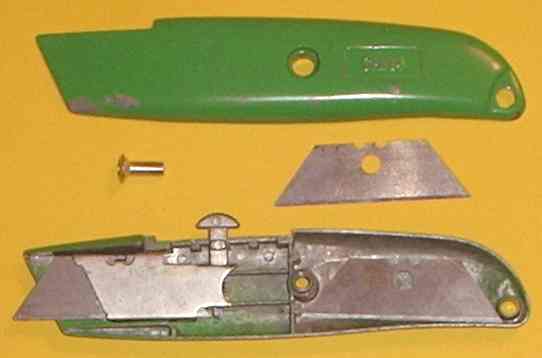
Construction utility knives, typically made from die-cast metal or robust molded plastic, have retractable and replaceable blades. The user of the knife can adjust the distance that the blade extends from the handle. For example, cutting the tape that seals a package without damaging the contents requires the blade to be extended slightly, while cutting the cardboard box requires the blade to be extended further forward.
A utility blade that has become dull can be reversed or replaced with a new one. Spare or used utility blades can be stored in the handle of some utility knife models and can be accessed by removing a bolt and opening the handle. There are also models of utility knives equipped with a quick-change feature that allows blades to be replaced without additional tools. Retractable utility knives are commonly used in construction, crafting, utility and warehouse work.
Utility knife blades
[edit]It is the material to be cut that determines which type of utility blade is required to be installed in the utility knife. In standard knives can be installed different forms of blades, varying and expanding the functionality of the knife. So the standard and universal option for craft and construction work is considered a trapezoidal blade, which is suitable for drywall, cardboard, cutting flooring covering materials, and more. There are also specialized blades for cutting roofing felt, linoleum, carpeting, foam, insulation and other building materials.
Standard blade types include:
- Trapezoidal blade: the sturdy blade is sharpened on both sides and has 2 pointed and sharp tips, so it can be turned over and reused. The most common replacement blade, suitable for universal use.
- Hook blade: a trapezoid-shaped blade that has hooks instead of pointed tips. Hook utility blades are suitable for cutting with a pulling motion such materials as roofing felt, linoleum, carpeting.
- Concave blade: similar to a hook blade, but has a more elongated hook on only one side. Suitable for cutting out details and forming shapes.
Snap-off utility knife
[edit]
Another type of utility knife is a snap-off utility knife that contains a long, segmented blade that slides out from it. As the endmost edge becomes dull, it can be broken off the remaining blade, exposing the next section, which is sharp and ready for use. The snapping is best accomplished with a blade snapper that is often built-in, or a pair of pliers, and the break occurs at the score lines, where the metal is thinnest. When all of the individual segments are used, the knife may be thrown away, or, more often, refilled with a replacement blade.
This design was introduced by Japanese manufacturer OLFA in 1956 as the world's first snap-off blade and was inspired from analyzing the sharp cutting edge produced when glass is broken and how pieces of a chocolate bar break into segments. The sharp cutting edge on these knives is not on the edge where the blade is snapped off; rather one long edge of the whole blade is sharpened, and there are scored diagonal breakoff lines at intervals down the blade. Thus each snapped-off piece is roughly a parallelogram, with each long edge being a breaking edge, and one or both of the short ends being a sharpened edge.
Box cutter knife
[edit]Another utility knife often used for cutting open boxes consists of a simple sleeve around a rectangular handle into which single-edge utility blades can be inserted. The sleeve slides up and down on the handle, holding the blade in place during use and covering the blade when not in use. The blade holder may either retract or fold into the handle, much like a folding-blade pocketknife. The blade holder is designed to expose just enough edge to cut through one layer of corrugated fibreboard, to minimize chances of damaging contents of cardboard boxes.
-
 A modern safety cutter at top, with blunted tip blade and cutting guide/tape hook. At bottom, an older style simple plastic box cutter using standard straight edged blades.
 -
 OLFA segmented blade or "snap-off blade" utility knife
 -
 Inexpensive stamped steel and aluminum box cutter with disposable blade


Use as weapon
[edit]Most utility knives are not well suited to use as offensive weapons, with the exception of some outdoor-type utility knives employing longer blades. However, even small blade type utility knives may sometimes find use as slashing weapons, particularly when used opportunistically due to their ubiquity. The 9/11 Commission report stated passengers in cell phone calls reported knives or "box-cutters" were used as weapons (also mace) in hijacking airplanes in the September 11, 2001 terrorist attacks against the United States, though the exact design of the knives used is unknown.[9][10] Two of the hijackers were known to have purchased Leatherman knives, which feature a 4-inch (10 cm) slip-joint blade, which were not prohibited on U.S. flights at the time. Those knives were not found in the possessions the two hijackers left behind.[11] Similar cutters, including paper cutters, have also been known to be used as a lethal weapon.[12]
Small work-type utility knives have also been used to commit robbery and other crimes. In June 2004, a Japanese student was slashed to death with a segmented-type utility knife.
In the United Kingdom, the law was changed (effective 1 October 2007)[13] to raise the age limit for purchasing knives, including utility knives, from 16 to 18, and to make it illegal to carry a utility knife in public without a good reason.[14]
See also
[edit]References
[edit]- ^ a b c Peterson, Harold L., Daggers and Fighting Knives of the Western World, London: Herbert Jenkins Ltd., ISBN 0-486-41743-3, p. 1
- ^ "Stanley knife". Oxford English Dictionary. Retrieved 21 March 2011.
A knife made by the Stanley Works; esp. a small utility knife with a very fine and sharp replaceable blade, typically used in do-it-yourself and craft work.
- ^ "Has stanley knife become a generic trademark?". genericides.org. Retrieved 18 February 2021.
- ^ "Has olfa become a generic trademark?". genericides.org. Retrieved 18 February 2021.
- ^ "Has x-acto become a generic trademark?". genericides.org. Retrieved 18 February 2021.
- ^ "Cutter ▶ Rechtschreibung, Bedeutung, Definition, Herkunft". Duden (in German). 26 April 2018.
- ^ "Het Vlaams Woordenboek: cuttermes".
- ^ "maket bıçağı". Türk Dil Kurumu Güncel Türkçe Sözlük. Retrieved 24 November 2015.
Genellikle maket yapımında kullanılan ince ve keskin bıçak.
- ^ "National Commission on Terrorist Attacks Upon the United States". 9-11commission.gov. Retrieved 19 September 2016.
- ^ "The 9/11 Commission report" (PDF). Archived (PDF) from the original on 9 October 2022.
- ^ Ahlers, Mike M. (27 January 2004). "9/11 panel: Hijackers may have had utility knives". CNN. Retrieved 30 May 2016.
- ^ Chong, Elena. "Death in Yishun flat: Woman remanded for psychiatric assessment". Straits Times. Retrieved 1 December 2015.
- ^ "Criminal Justice Act 1988 (1988 c. 33) Part XI, Articles with blades or..., Section 141A". legislation.gov.uk. Retrieved 7 February 2019.
Word in s. 141A(1) substituted (E.W.) (1.10.2007) by Violent Crime Reduction Act 2006 (c. 38), ss. 43(2), 66(2); S.I. 2007/2180, art. 3(j)
- ^ "Selling, buying and carrying knives". gov.uk.
External links
[edit] Media related to Utility knives at Wikimedia Commons


Utility knife
View on GrokipediaHistory
Origins and Early Development
The earliest forms of utility knives emerged as fixed-blade stone tools during the Lower Paleolithic period, with evidence of knapped flint and obsidian blades dating to approximately 2.6 million years ago in East Africa as part of the Oldowan industry.[5] These rudimentary implements, created by percussive flaking to produce sharp edges, functioned primarily for processing animal carcasses, including butchering meat and scraping hides to remove fat and hair.[6] Additional applications encompassed cutting plant materials and fibers to produce cordage for binding or weaving, as indicated by micro-wear traces on blade edges from archaeological assemblages.[7] By the Upper Paleolithic and into the Neolithic era (circa 10,000–4,000 BCE), tool refinement progressed with the production of elongated blades detached from prepared stone cores, enhancing cutting efficiency for diverse tasks such as seed processing and fiber harvesting.[8] Flint knives from this period, often hafted to bone or wood handles for ergonomic grip, exhibit resharpening marks and use-wear patterns consistent with repeated scraping and slicing in subsistence activities, predating any retractable or segmented designs.[9] Sites in Europe and the Near East yield examples, such as Neolithic flint knives from Britain dated 4,000–2,400 BCE, demonstrating sustained reliance on these tools for labor-intensive material manipulation without metal alternatives.[10] The shift to metal blades began in the Chalcolithic and Bronze Age (circa 5,000–1,200 BCE), as copper alloys supplanted stone for greater resilience against impacts in rough utility work like woodworking and hide preparation.[11] Bronze permitted thinner, harder edges that retained sharpness longer than flint, facilitating broader applications in emerging agrarian societies, though fixed-blade configurations persisted due to the absence of specialized mechanisms.[12] This material evolution, evidenced by alloy tool hoards in the Levant and Europe, marked a causal advancement in tool durability, reducing breakage rates and enabling more intensive daily use prior to iron's widespread adoption around 1,300 BCE.[13]20th-Century Innovations
In 1936, Stanley Tools introduced what is recognized as the first modern utility knife, a fixed-blade model designed for quick replacement of single-edge razor blades. This design addressed the need for efficient cutting in construction and manufacturing by allowing users to snap or break off dull sections of the blade or swap them rapidly, thereby reducing downtime compared to resharpening traditional knives.[2][14] The snap-off blade mechanism emerged in 1956 when Yoshio Okada, an electrician in postwar Japan, invented the world's first segmented disposable blade cutter, leading to the founding of OLFA Corporation. Inspired by the clean breaks of chocolate bars observed in his youth during the late 1940s, Okada developed the tool to provide consistently sharp, precise edges for tasks like stripping electrical insulation without frequent resharpening. This innovation standardized disposable blade segments, enhancing precision and safety in professional applications such as crafting and electrical work.[15][3] Following World War II, retractable blade designs proliferated in utility knives, enabling controlled extension and retraction to minimize exposure of the sharp edge during handling and storage. These mechanisms gained adoption in trades for improved safety, as they reduced the risk of accidental cuts compared to fixed-blade models, while maintaining compatibility with standard replaceable blades to support ongoing efficiency in industrial settings.[14]Recent Advancements and Modern Iterations
Post-2000 developments in utility knives emphasize folding mechanisms and rapid blade deployment to improve portability and operational speed. The Milwaukee FASTBACK line, evolving since its initial models around 2015, incorporates a press-and-flip system for one-handed opening, enabling blade activation three times faster than conventional retractable designs, which reduces deployment time in dynamic work environments.[16] Bosch's 2024 releases, including folding variants with one-button blade advance and tool-free changes via release-lock buttons, further prioritize quick-change functionality alongside onboard storage for multiple blades, facilitating sustained jobsite efficiency without frequent tool swaps.[17][18] Material innovations have introduced ceramic blades designed for enhanced safety without sacrificing cutting performance. Slice's zirconium oxide blades, featuring proprietary rounded edges, provide a finger-friendly profile that resists lacerations during handling, as the edges are safer to touch compared to steel equivalents while effectively slicing materials like cardboard.[19] These blades endure up to 11 times longer than metal counterparts before dulling, based on manufacturer testing, thereby decreasing replacement frequency and associated risks in repetitive tasks.[20] By 2025, self-retracting and ergonomic features dominate trends, driven by data on injury mitigation. Automatic retraction in models like certain Martor safety knives limits blade exposure post-cut, contributing to reported decreases in laceration incidents in workplaces adopting them over fixed blades.[21] Ergonomic grips, contoured for natural hand fit and slip resistance, reduce user fatigue in prolonged operations, as evidenced in 2020-2025 product analyses emphasizing comfort for high-volume cutting.[22] Industry observations link these advancements to broader adoption of folding retractables, prioritizing durability and safety in professional settings.[23]Design and Components
Blade Mechanisms and Types
Fixed-blade mechanisms in utility knives prioritize structural integrity for demanding cuts, as the stationary blade resists torsional forces inherent in severing dense materials like linoleum or insulation, minimizing edge wobble that could lead to imprecise incisions. The Stanley 10-299 exemplifies this design, featuring a 2-7/16-inch fixed high-carbon steel blade with an interlocking nose that locks the edge rigidly in position, enabling sustained leverage without deployment slippage.[24] [25] Retractable mechanisms, conversely, employ sliding carriages—often with ratchet or wheel locks—to expose variable blade lengths, balancing cut depth control with enclosed storage to prevent incidental contact, though repeated extensions can introduce micro-movements that erode long-term alignment under vibration.[26] This adjustability stems from the geometry of partial exposure, which aligns the edge's bevel angle dynamically with substrate thickness for optimized shear planes.[27] Snap-off systems integrate progressive edge renewal into the blade stock, where pre-scored segments of hardened steel—typically 18mm or 25mm wide—fracture along engineered weak points to expose successive facets, each maintaining a 30-degree bevel for acute penetration. Originating from Yoshio Okada's 1956 OLFA invention in postwar Japan, inspired by the clean breaks of chocolate scoring, this approach yields multiple reusable edges per insert, reducing replacement frequency by exploiting the material's controlled brittleness for on-demand sharpening without tools.[3] [28] The causal efficiency arises from localized dulling isolation, preserving distal sharpness until sequential snaps, which sustains cutting torque across extended sessions on sheet goods or films. Hook blades adapt the standard trapezoid profile with a distal curve, channeling force vectorially to slice roofing asphalt or shingles from the granule side, where the hooked terminus scores surface layers while the straight proximal edge completes separation, averting puncture into vapor barriers beneath due to the geometry's limited depth propagation.[29] [30] Serrated variants incorporate v-shaped teeth along the edge, amplifying grip on anisotropic materials like twine or drywall facings by initiating micro-tears that propagate under reciprocal motion, thereby distributing shear stress to bypass uniform resistance that straight edges encounter in fibrous composites.[31] This undulating profile enhances initial bite via wedging action, facilitating traversal of heterogeneous substrates where straight blades risk deflection or stalling. Advancements in replaceable utility blade materials include Milwaukee's general purpose utility blades, constructed from micro carbide dispersed metal (also termed iron carbide deposited metal), which offer up to three times the lifespan of standard carbon steel blades. These blades are compatible with standard utility knife designs, such as the Milwaukee Fastback II Flip Utility Knife (models 48-22-1902 and 48-22-1502), facilitating enhanced durability in professional applications.[32][33]Handle Ergonomics and Materials
Handles of utility knives are typically made from high-impact thermoplastics such as ABS or nylon, which provide lightweight construction often weighing between 60 and 100 grams to minimize hand fatigue during prolonged tasks.[34][35] Aluminum alloys are used in heavier-duty models for superior impact resistance and corrosion durability, balancing strength with manageable weight.[36] Rubberized overmolds or thermoplastic elastomers on these bases enhance slip resistance, with empirical tests demonstrating higher friction coefficients on textured rubber surfaces compared to smooth plastics or metals, thereby improving grip stability under wet or oily conditions.[37][38] Ergonomic handle designs prioritize biomechanical alignment with hand anatomy, featuring contoured profiles, finger grooves, and tapered ends to distribute pressure evenly and reduce muscle strain in repetitive cutting motions.[39] Studies on hand tool grips indicate that such shapes increase maximum voluntary contraction forces by optimizing contact area and minimizing slippage, potentially lowering exertion demands by adapting to natural finger span and palm curvature.[40] These features dampen vibration transmission to the hand, as evidenced by reduced perceived discomfort in prolonged use scenarios, without adding significant bulk.[41] Many modern handles incorporate modular elements, such as integrated compartments for storing spare blades, which maintain overall structural integrity through reinforced internal walls and do not compromise grip or balance.[42] This design allows for quick access without external carriers, supporting efficiency in professional settings while adhering to lightweight ergonomic principles.[43]Safety-Integrated Designs
Safety-integrated designs in utility knives incorporate mechanisms that mechanically limit blade exposure to reduce unintended contact with skin or objects, addressing user errors such as failure to retract blades manually. These features operate on principles where physical barriers or automatic actions interrupt potential injury pathways, such as prolonged edge accessibility during or after cuts. Self-retracting models, for instance, employ spring-loaded systems that withdraw the blade immediately upon release of a control button or upon exiting the cutting material, enclosing the edge within the handle to prevent accidental deployment.[44][45] Examples include the Milwaukee Self-Retracting Utility Knife, which retracts via button release, and Martor SECUMAX models with fully automatic retraction triggered by loss of contact with the material.[45][44] Blade locks complement retraction by securing the blade in extended or stored positions, minimizing slippage risks during handling.[46] Guarded blades feature physical shields or modified geometries that constrain cutting depth and edge sharpness toward users. Rounded-tip or blunted designs, such as those in Stanley self-retracting safety knives, reduce puncture hazards while maintaining slicing efficacy on materials like cardboard.[46] Integrated metal guards, as in the Pacific Handy Cutter EZ4, cover portions of the blade during top cuts, further limiting exposure.[47] Finger-friendly ceramic blades, pioneered by Slice, employ a proprietary grind that renders the edge asymptotically sharp—effective on materials but resistant to penetrating human skin due to its geometry and material properties.[48] Laboratory tests by Slice demonstrate these blades fail to penetrate ANSI/ISEA Level A2 or higher cut-resistant gloves, whereas standard steel blades breach up to A3 levels under similar conditions, indicating reduced laceration potential from incidental contact.[48] Such designs preserve functionality for thin materials like plastics and paper without compromising safety margins.[49] Quick-release mechanisms facilitate blade replacement with minimal manual handling of the edge, shortening exposure duration compared to screw-secured traditional models. These systems use sliding sleeves or oversized buttons for tool-free ejection and insertion, as seen in the XW Auto-Retractable Safety Utility Knife, where a sleeve slides to expose and swap blades rapidly.[50] Stanley's 6-3/8 inch Quick Change model employs a similar lever for swift changes, integrated with retraction for secure storage post-swap.[51] By design, these reduce the temporal window for cuts during maintenance, a common injury vector in fixed-blade utilities.[50][51]Applications
Industrial and Professional Uses
Utility knives are widely utilized in construction for tasks such as scoring drywall sheets to enable clean snaps along marked lines, which provides faster execution and minimal dust generation relative to circular saws that produce airborne particles requiring ventilation and cleanup.[52] These tools also facilitate trimming of insulation materials and slicing roofing felt, where 25 mm heavy-duty blades offer enhanced stiffness to resist deflection during penetration of resilient substrates.[53] In manufacturing environments, snap-off blade variants deliver progressive sharpness for repetitive precision cuts on conduit sheathing or packaging wraps, outperforming scissors by maintaining edge integrity without binding or fraying fibers.[54] In electrical and HVAC trades, utility knives excel at stripping insulation from wires and cables, achieving clean separations that avoid nicking conductors and ensure low-resistance electrical contacts essential for circuit reliability.[55] Snap-off blades particularly minimize fraying on synthetic insulations common in heating, ventilation, and air conditioning ducts, allowing for exact fits that reduce air leakage in assemblies compared to bulkier stripping pliers.[56] Models with integrated stripping notches further streamline workflows by combining incision and peeling in a single motion, enhancing throughput in high-volume installations.[57] Within warehousing and packaging operations, utility knives handle repetitive box opening and strapping severance, where robust handles and disposable blades sustain performance under thousands of daily cycles without compromising cut consistency.[58] Their design permits rapid penetration of layered cardboard and adhesives, yielding efficiency gains over fixed-blade alternatives by enabling quick blade exchanges to counteract dulling from abrasive tapes.[59] Heavy-duty variants demonstrate longevity in industrial settings, with metal-reinforced constructions outlasting plastic disposables by factors of 5 to 10 times in endurance tests for banding material severance.[58]Household and General-Purpose Uses
Utility knives find widespread application in household settings for tasks requiring precise, controlled cuts on everyday materials, such as opening packages and slicing cardboard boxes, where their retractable or snap-off blades provide safety and sharpness superior to fixed-edge alternatives like kitchen knives.[60] [61] The replaceable blade mechanism ensures consistent performance without the need for frequent sharpening, making them accessible for non-professionals handling occasional cutting needs.[62] In do-it-yourself (DIY) home projects, utility knives excel at trimming carpet edges, scoring drywall for removal, and cutting vinyl flooring or insulation, tasks that demand clean lines achievable through repeated light passes rather than forceful slicing.[63] [62] These applications leverage the tool's ergonomic handle and adjustable blade depth to minimize material waste and user fatigue during home renovations or repairs.[64] For crafts and minor repairs, utility knives are utilized to score plastics, remove adhesive labels or paint drips, and cut rope or fabric remnants, offering versatility that fixed blades lack due to dulling over varied materials.[60] [65] Their ability to handle thin, precise incisions supports hobbyist activities like model building or upholstery adjustments without requiring specialized equipment.[63] In emergency preparedness scenarios, utility knives contribute to practical utility by enabling rope cutting for shelters, branch trimming for kindling, or portioning food supplies, where blade replaceability sustains functionality in prolonged use absent professional tools.[66] [60] This adaptability stems from their compact design and multi-material cutting capability, aligning with first-aid or basic survival needs in domestic kits.[67]