


Community hub
Recent from talks
Contribute something
Nothing was collected or created yet.
Butrint
View on WikipediaButrint (Greek: Βουθρωτόν and Βουθρωτός[2], romanized: Bouthrōtón, Latin: Buthrōtum, Albanian: Butrint) was an ancient Greek polis and later Roman city and the seat of an early Christian bishopric in Epirus.
Key Information


Originally a settlement of the Greek tribe of the Chaonians,[3][4][5] it later became part of the state of Epirus and later a Roman colonia and a Byzantine bishopric. It entered into decline in Late Antiquity, before being abandoned during the Middle Ages after a major earthquake flooded most of the city. In modern times it is an archeological site in Vlorë County, Albania, some 14 kilometres (8.7 mi) south of Sarandë, close to the Greek border. It is located on a hill overlooking the Vivari Channel and is part of the Butrint National Park. Today, Bouthrotum is a Latin Catholic titular see and also features the Ali Pasha Castle.
The city is considered one of the most important archaeological sites in Albania. On the strength of the immense wealth of cultural, historical and natural value with a considerable history, Butrint was declared a UNESCO World Heritage Site in 1992 and further a National Park in 2000 under the leadership of Auron Tare, its first director.[6][7]
History
[edit]Prehistory
[edit]The earliest archaeological evidence of settled occupation dates to between 10th and 8th centuries BC, although some claim that there is earlier evidence of habitation dating from the 12th century BC.[8][need quotation to verify]
Ancient Greek period
[edit]
Excavation at Bouthroton has yielded Proto-Corinthian pottery of the 7th century and then Corinthian and Attic pottery of the 6th century, however there are no indications of a prehistoric settlement.[9] Bouthroton was in a strategically important position due its access to the Straits of Corfu, and its location at the crossroads of mainland Greece and Magna Graecia, the Greek and the "barbarian" worlds.[10] Thus, it became one of the two ancient ports in lower Chaonia, the other being Onchesmos (modern Sarandë).[11]
Bouthroton (modern day Butrint) was originally one of the major centres of the Epirote tribe of the Chaonians,[12] part of the northwestern Greek group of tribes.[13] They had close contacts to the Corinthian colony of Corcyra (modern Corfu). According to the Roman writer Virgil, its legendary founder was the seer Helenus, a son of king Priam of Troy, who had moved West after the fall of Troy with Neoptolemus and his concubine Andromache. Both Virgil and the Greek historian Dionysius of Halicarnassus recorded that Aeneas visited Bouthroton after his own escape from the destruction of Troy.

The acropolis was erected on a hill on the bank of a lake Butrint (or lake Bouthrotum). The first extension of the 7th century BC acropolis occurred during the 5th century BC.[14] During the first years of the second Peloponnesian War (413–404 BC) the Corkyreans built fortifications stretching from Ksamil to Buthrotum. Buthrotum being previously an independent city, became subject to nearby Corfu.[15]
By the 4th century BC it had grown in importance and included a theatre, a sanctuary dedicated to Asclepius and an agora. The acropolis of Bouthrotum was protected by three circuit walls. The last and outer wall was erected around 380 BC enclosing and area of 4ha. This 870m-long wall included bastions and five gates.[16] Two of the most important gates were known as Scean and Lion gate.[17] Moreover, the agora, the stoas, the residential zone and the theatre were located in a separate walled area.[14]
Several inscriptions in Buthrotum describe the organization of the Chaonians in the beginning of the 3rd cent. BC. which show that they too had an annual leader called Prostates (Greek: Προστάτης Protector).[13] The Greek calendar of Bouthroton appears in the oldest known analog computer, the so-called Antikythera Mechanism (c. 150 to 100 BC).[18][19]
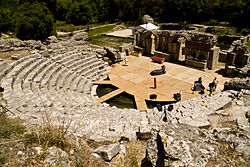
The theatre is known for the impressive number of inscriptions carved on its stones. Most of them deal with manumissions and give a great amount of details on the city during the Hellenistic era.[20] The names of those slaves were almost exclusively Greek with a few exception of Latin ones which bore Greek family names.[21]
In 228 BC Buthrotum became a Roman protectorate alongside Corfu.[22] In the middle of the second century BC Buthrotum was the centre of an independent state, possibly the "Koinon of the Prasaiboi", as listed in the list of the theorodokoi at the Oracle of Delphi.[23]
Ancient Roman period
[edit]
In the next century, it became a part of a province of Macedonia. In 44 BC, Caesar designated Buthrotum as a colony to reward soldiers who had fought for him against Pompey. Local landholder Titus Pomponius Atticus objected to his correspondent Cicero who lobbied against the plan in the Senate. As a result, only small numbers of colonists were settled.

In 31 BC, Roman Emperor Augustus fresh from his victory over Mark Antony and Cleopatra at the battle of Actium renewed the plan to make Buthrotum a veterans' colony. New residents expanded the city and the construction included an aqueduct, a Roman bath, houses, a forum complex and a nymphaeum. During that era the size of the town was doubled.[25] A number of new structures were built next to the existing ones especially around the theatre and the temple of Asklepeios.[26]
In the 3rd century AD, an earthquake destroyed a large part of the town, levelling buildings in the suburbs on the Vrina Plain and in the forum of the city centre. Excavations have revealed that city had already been in decline. However, the settlement survived into the late antique era, becoming a major port in the province of Old Epirus. The town of late antiquity included the grand Triconch Palace, the house of a major local notable that was built around 425.
Byzantine and possible Slavic period
[edit]The walls of the city were extensively rebuilt, most probably at the end of the 5th century, perhaps by Byzantine Emperor Anastasius. The Ostrogoths under Indulf raided the Ionian coast in 550 and may have attacked Buthrotum. In the end of 6th century groups of Slavs possibly arrived at Buthrotum.[27] Evidence from the excavations shows that importation of commodities, wine and oil from the Eastern Mediterranean continued into the early years of the 7th century when the early Byzantine Empire lost these provinces. During the period of Slavic invasions and population movements in the wider region Butrotum was one of the few cities in Epirus that survived and retained its status as a seat of a bishopric without interruption.[28]
Because of the scarcity of sources, it is difficult to assess whether Buthrotos was controlled by Slavs or Byzantines between the 7th to 10th centuries.[29] Byzantine written sources of that time mention that Saint Elias of Enna was detained as a spy in Bouthrotos, while Arsenios of Corfu (876–953) noted the marine wealth of the town.[30] The Grand Basilica of Buthrotum was built during the first half of the 6th century on the northeast side of the settlement.[31] Other monuments include the Acropolic Basilica (4th century), the Triconch Palace (6th century), the Baptistery with a large, complex mosaic (6th century), the Lake Gate church (9th century) and the Baptistery church (9th century).[32] Colonization by the Byzantine authorities seems to coincide during the reign of Leo VI (886–912). Imperial administrators of that time possibly governed the region from the "oikos" (Greek: οίκος, residence) from Vrina plain rather than from the citadel.[30] Archaeological records become stronger in the 10th century.[30]

The inventories of bishoprics from the 10th to 12th centuries identify the bishop of Butrint as subject to the metropolitan bishopric of Nafpaktos, the ecclesiastical province that took the name of the old provincial capital of Nicopolis.[33] Arab traveller Muhammad al-Idrisi noted in the 12th century that Buthrotum is a densely populated city with a number of markets.[34]
It remained an outpost of the Byzantine empire fending off assaults from the Normans until 1204 when following the Fourth Crusade, the Byzantine Empire fragmented, Buthrotum falling to the breakaway Despotate of Epirus. In the following centuries, the area was a site of conflict between the Byzantines, the Angevins of southern Italy, and the Venetians.
Between Angevins, Byzantine Empire and Despotate of Epirus
[edit]The fortifications were probably strengthened by Byzantine Emperor Michael I.[35]
In 1267, Charles of Anjou took control of both Butrint and Corfu, leading to further restorations of the walls and the Grand Basilica. In 1274, Byzantine forces re-entered Butrint, an act which caused conflict between the Byzantines and the Despotate of Epirus, because Despot Nikephoros considered the site to be his domain.[36] Despite deep religious differences between the Catholic Charles of Anjou and the staunchly Orthodox Nikephoros, the two allied against Byzantine Emperor Michael, and together drove the Byzantines from the area in 1278.[36] Then, pressed by Charles, Nikephoros ultimately ended up recognizing Charles' rights to all the town that Michael II had awarded to Manfred of Hohenstaufen as part of his wife Helen's dowry, as Charles was his successor, thus ceding to him Butrint as well as the entire Acroceraunian Coast from Vlora to Butrint.[36]
As part of the Angevin Regnum Albaniae
[edit]From 1284 Byzantine Emperor Andronikos II was in control of most of today's Albania and Angevin control on the Balkan mainland was limited to Butrinto, the later formed a single administrative unit together with nearby Corfu.[37] In the 14th century the site shared a similar fate with Corfu.[37] Butrint remained under Angevin rule until 1386, with only two other interruptions: in 1306, and in 1313–1331.[38] In 1305-1306 it was controlled by the Despot of Epirus, Thomas I Komnenos Doukas.[39] Butrint became Catholic after it was conquered by the Angevins, and remained so throughout the fourteenth century.[38]
Hodges argues that the "episodic" defensive investment in Butrint as a town during this period demonstrates that it still possessed an active urban population, although not one urban dwelling had been identified at the time of writing. Hodges argues this indicates that dwellings were concentrated on the slopes of the northern citadel. The Orthodox Bishopric was transferred to nearby Glyki in 1337 or 1338. The town was reduced in size during the end of the 14th century, due to the tumultuous unrest in the region.[40]
Between Venice and the Ottoman Empire
[edit]The dogal Republic of Venice purchased the area including Corfu from the Angevins in 1386; however, the Venetian merchants were principally interested in Corfu and Butrinto once again declined.
._Venetian_enclave_facing_Corfu..jpg)
By 1572 the wars between Venice and the Ottoman Empire had left Butrinto ruinous and the acropolis was abandoned, while at the order of Domenico Foscarini, the Venetian commander of Corfu, the administration of Butrinto and its environs was shifted to a small triangular fortress associated with the extensive fish weirs. The area was lightly settled afterwards, occasionally being seized by the Ottoman Turks, in 1655 and 1718, before being recaptured by the Venetians. Its fisheries were a vital contributor to the supply of Corfu, and olive growing together with cattle and timber were the principal economic activities.[41]
The Treaty of Campo Formio of 1797 split between France and Austria the territory of the Republic of Venice, which France had just occupied and abolished, and under article 5 of the treaty, Butrinto and the other former Venetian enclaves in Albania came under French sovereignty.[42]
However, in October 1798 the city was conquered by the local Ottoman Albanian ruler Ali Pasha Tepelena, and after his death, it officially became a part of the Ottoman Empire until Albania gained its independence in 1912. By that time, the site of the original city had been unoccupied for centuries and was surrounded by malarial marshes. During Ottoman rule in Epirus, the inhabitants of Butrint displayed continuous support for Greek revolutionary activities.[43]
Modern Albania
[edit]In 1913, after the end of the First Balkan War, Butrint was ceded to Greece but Italy challenged the decision and in the Treaty of London the region was given to the newly created Principality of Albania. As such Butrint was located near the southern border of the newly established Albanian state in a largely Greek-speaking territory.[44] The local Greek population was enraged and created an Autonomous Republic of Northern Epirus, for six months, before it was reluctantly ceded to Albania, with peace assured by Italian peacekeeping force until 1919.[45] Italy rejected the decision because it didn't want Greece to control both sides of the Straits of Corfu.[46]
Ecclesiastical history
[edit]Residential bishopric
[edit]
In the early 6th century, Buthrotum became the seat of a bishopric and new construction included the Buthrotum baptistery, one of the largest such paleochristian buildings of its type, and a basilica. The diocese of Buthrotum was initially a suffragan of the Metropolis of Nicopolis, the metropolitan capital of Epirus Vetus and in the papal sway, but in the 9th and 10th centuries it is listed with the suffragans of Naupaktos, which succeeded ruined Nicopolis as provincial capital and metropolis of the new Byzantine theme of Nicopolis,[47] bringing it in the sway of the Byzantine Patriarchate of Constantinople. After the 14th century, it was under the jurisdiction of the Metropolis of Ioannina.
Two of its Byzantine (pre-Eastern Schism) bishops are mentioned in extant documents:
- Stephanus signed the joint letter of the bishops of Epirus Vetus to Emperor Leo I the Thracian in the aftermath of the killing of Patriarch Proterius of Alexandria in 458
- Matthaeus signed the synodal letter of the bishops of the province to Pope Hormisdas in 516 concerning the ordination of Metropolitan John of Nicopolis.[48][49][50] It became a Latin Church see under Angevin and Venetian rule.
Latin residential bishopric
[edit]A Latin see was established circa 1250 under the Italian name Butrinto, functioning under Angevin and Venetian rule, but suppressed circa 1400. The 6th-century basilica was rebuilt by king Charles I of Naples in 1267.

- Known Latin bishops
- Nicola, O.P. (? – 1311.02.15)
- Nicola, O.P. (1311.05.23 – ?)
- Nicola da Offida, O.F.M. (? – 1349.06.15)
- Francesco (? – ?)
- Arnaldo Simone (? – 1355.02.13)
- Giacomo, O.P. (1356.10.12 – ?)
- Lazzarino, O.F.M. (1366.02.09 – ?)
Catholic titular see
[edit]Buthrotum is today listed by the Catholic Church as a Latin titular see [51] since the diocese was nominally restored in 1933 as titular bishopric of Buthrotum (Latin) / Butrinto (Curiate Italian) / Butrint (Albanian).
Following titular bishops have been nominated:
- Louis-Bertrand Tirilly, SS.CC. (1953.11.16 – 1966.06.21) as last Apostolic Vicar of Marquesas Islands
- George Frendo (7. 7. 2006 – 17. 11. 2016), O.P., Auxiliary Bishop of the Archdiocese of Tiranë–Durrës (Albania) (7. 7. 2006 – 17. 11. 2016), also Secretary General of Episcopal Conference of Albania (2016.05.05 – ...)
- Friar Giovanni Salonia, O.F.M. Cap., (10. 2. 2017 – resigned 27. 4. 2017) as Auxiliary Bishop of Archdiocese of Palermo
- Zdeněk Wasserbauer (* 16. 6. 1965), Auxiliary Bishop of Roman Catholic Archdiocese of Prague, since 19. 5. 2018
Archaeological excavations
[edit]
The first modern archaeological excavations began in 1928 when the Fascist government of Benito Mussolini's Italy sent an expedition to Butrint. The aim was geopolitical rather than scientific, aiming to extend Italian hegemony in the area. The leader was an Italian archaeologist, Luigi Maria Ugolini who despite the political aims of his mission was a good archaeologist. Ugolini died in 1936, but the excavations continued until 1943 and the Second World War. They uncovered the Hellenistic and Roman part of the city including the "Lion Gate" and the "Scaean Gate" (named by Ugolini for the famous gate at Troy mentioned in the Homeric Iliad).
After the communist government of Enver Hoxha took Albania over in 1944, foreign archaeological missions were banned. Albanian archaeologists including Hasan Ceka continued the work. Nikita Khrushchev visited the ruins in 1959 and suggested that Hoxha should turn the area into a submarine base. The Albanian Institute of Archaeology began larger scale excavations in the 1970s. Since 1993 further major excavations have taken place led by the Butrint Foundation in collaboration with the Albanian Institute of Archaeology. Recent excavations in the western defences of the city have revealed evidence of the continued use of the walls, implying the continuation of life in the town. The walls themselves certainly seem to have burnt down in the 9th century, but were subsequently repaired.
After the collapse of the communist regime in 1992, the new democratic government planned various major developments at the site. The same year remains of Butrint were included in the UNESCO list of World Heritage Sites. A major political and economic crisis in 1997 and lobbying stopped the airport plan and UNESCO placed it on the List of World Heritage in Danger because of looting, lack of protection, management and conservation. Archaeological missions during 1994–9 uncovered further Roman villas and an early Christian church.[27]
In 2004,[52] archaeological excavations continued under principal investigator, David R. Hernandez.[53]
Climate change means that the site, especially the area of the ancient theatre and Roman forum, can sometimes be covered with water, and a new management plan for both the cultural and natural assets has been implemented.[54]
Directions
[edit]The site of Butrint is accessible from Sarandë, along a road first built in 1959 for a visit by the Soviet leader Nikita Khrushchev. This road was upgraded during the summer of 2010. The construction was somewhat of an environmental disaster and may yet threaten Butrint's World Heritage Site status. The ancient city is becoming a popular tourist destination, attracting day-trippers from the nearby Greek holiday island of Corfu. Hydrofoils (30 minutes) and ferries (90 minutes) run daily between Corfu and Sarandë.
Gallery
[edit]


Notable locals
[edit]- Saint Therinus, 3rd-century saint
- Donatus of Euroea, 4th-century saint
See also
[edit]References
[edit]- ^ "Butrint". Ramsar Sites Information Service. Retrieved 25 April 2018.
- ^ Stephanus of Byzantium, Ethnica, O709.1
- ^ Borza, Eugene N. (1992). In the Shadow of Olympus: the Emergence of Macedon (Revised ed.). Princeton, New Jersey: Princeton University Press.
Speakers of these various Greek dialects settled different parts of Greece at different times during the Middle Bronze Age, with one group, the 'northwest' Greeks, developing their own dialect and peopling central Epirus. This was the origin of the Molossian or Epirotic tribes. [...] a proper dialect of Greek, like the dialects spoken by Dorians and Molossians. ... The western mountains were peopled by the Molossians (the western Greeks of Epirus).
- ^ Crew, P. Mack (1982). The Cambridge Ancient History – The Expansion of the Greek World, Eighth to Sixth Centuries BC, Part 3: Volume 3 (Second ed.). Cambridge, UK: Cambridge University Press.
That the Molossians... spoke Illyrian or another barbaric tongue was nowhere suggested, although Aeschylus and Pindar wrote of Molossian lands. That they in fact spoke greek was implied by Herodotus' inclusion of Molossi among the Greek colonists of Asia Minor, but became demonstrable only when D. Evangelides published two long inscriptions of the Molossian State, set up p. 369 BC at Dodona, in Greek and with Greek names, Greek patronymies and Greek tribal names such as Celaethi, Omphales, Tripolitae, Triphylae etc. As the Molossian cluster of tribes in the time of Hecataeus included the Orestae, Pelagones, Lyncestae, Tymphaei and Elimeotae, as we have argued above, we may be confident that they too were Greek-speaking.
- ^ Hammond, NGL (1994). Philip of Macedon. London, UK: Duckworth.
Epirus was a land of milk and animal products ... The social unit was a small tribe, consisting of several nomadic or semi-nomadic groups, and these tribes, of which more than seventy names are known, coalesced into large tribal coalitions, three in number: Thesprotians, Molossians and Chaonians ... We know from the discovery of inscriptions that these tribes were speaking the Greek language (in a West-Greek dialect).
- ^ UNESCO. "Butrint". whc.unesco.org.
- ^ "Per Shpalljen Park Kombetar Ne Mbrojtje Te Shtetit Te Zones Arkeologjike Te Butrintit" (PDF). imk.gov.al (in Albanian). Archived from the original (PDF) on 2017-10-27. Retrieved 2018-02-14.
- ^ Ceka, Neritan; transl. Pranvera Xhelo (2002). Buthrotum: Its History & Monuments. Tirana: Cetis Tirana. p. 19. ISBN 978-99927-801-2-1.
- ^ The Cambridge Ancient History, Volume 3, Part 3: The Expansion of the Greek World, Eighth to Sixth Centuries BC, p. 269, Cambridge University Press, ISBN 978-0-521-23447-4, 1982
- ^ David R. Hernandez, "Bouthrotos (Butrint) in the Archaic and Classical Periods: The Acropolis and Temple of Athena Polias", Hesperia: The Journal of the American School of Classical Studies at Athens, Vol.86, No. 2 (April–June 2017), p. 205.
- ^ Cabanes, P. (1997). "The Growth of the Cities". Epirus, 4000 Years of Greek History and Civilization. Ekdotikē Athēnōn: 92. ISBN 9789602133712.
Lower Chaonia utilized the port of Onchesmos (modern Hagioi Saranta) and Bouthrotos
- ^ Strabo. The Geography. Book VII, Chapter 7.5 (LacusCurtius).
- ^ a b Boardman, John (1994). The Cambridge Ancient History: The fourth century B.C. Cambridge University Press. p. 437. ISBN 9780521233484.
The north-west Greeks occupied a large area, extending in the west from the Gulf of Ambracia to the Gulf of Oricum ... The main groups from south to north were called Thesproti, Athamanes, Molossi, Atintanes, Chaones, Parauaei, ...
- ^ a b Ioanna, Andreou (1997). "Urban Organization". Epirus, 4000 Years of Greek History and Civilization. Ekdotikē Athēnōn: 100. ISBN 9789602133712.
Bouthrotos, which is situated on a hill on the bank of the lake of the same name, was laid out in the fifth century around an acropolis dating from the seventh century B.C. The walled area at the highest part of the hill, measuring 600x150 m. was ... The agora with its stoas, theatre etc. was organised in a separate, also fortified area.
- ^ Hammond, N. G. L (1997). "The Tribal Systems of Epirus and Neighbouring Areas down to 400 B.C." Epirus, 4000 Years of Greek History and Civilization: 56. ISBN 9789602133712.
The early years of the Second Peloponnesian War ... fortification wall in Epirus-, and it is evident that Bouthrotos, an independent city in the time of Hekataios, was made subject to Kerkyra.
- ^ Ceka, p22
- ^ Stillwell, Richard (2017). The Princeton Encyclopedia of Classical Sites. Princeton University Press. p. 175. ISBN 9781400886586.
- ^ Freeth, Tony; Bitsakis, Yanis; Moussas, Xenophon; Seiradakis, John H.; Tselikas, A.; Mangou, H.; Zafeiropoulou, M.; Hadland, R.; et al. (2006). "Decoding the ancient Greek astronomical calculator known as the Antikythera Mechanism". Nature. 444 (7119): 587–91. Bibcode:2006Natur.444..587F. doi:10.1038/nature05357. PMID 17136087.
- ^ Freeth, Tony; Jones, Alexander (2012). "The Cosmos in the Antikythera Mechanism". Institute for the Study of the Ancient World. Retrieved 19 May 2014
- ^ Pierre Cabanes, "Nouvelles inscriptions d'Albanie Méridionale (Bouthrotos et Apollonia)", Zeitschrift für Papyrologie und Epigraphik, Bd. 63 (1986), pp. 137–155.
- ^ Winnifrith, Tom (2002). Badlands, Borderlands: A History of Northern Epirus/Southern Albania. Duckworth. p. 70. ISBN 978-0-7156-3201-7.
manumission inscriptions at Butrint, where the names of slaves manumitted are almost all Greek, confirm this...family members
- ^ The Penny Cyclopædia of the Society for the Diffusion of Useful Knowledge. C. Knight. 1836.
- ^ Cabanes, P. (1997). "From Alexander Molossus to Pyrrhus: Political Developments". Epirus, 4000 Years of Greek History and Civilization. Ekdotikē Athēnōn: 122. ISBN 9789602133712.
The list of thearodokoi of Delphi in the middle of the second century34 confirms that at this period Bouthrotos was the centre of an independent state which was visited by the theoroi
- ^ Andrew M. Burnett, Michel Amandry, Pere Pau Ripollès, Roman provincial coinage. : Volume I, From the death of Caesar to the death of Vitellius 44 BC-AD 69, London/Paris, 1992, n°1394.2.
- ^ Hodges, Richard; Bowden, William; Lako, Kosta; Richard Andrews (2004). Byzantine Butrint: excavations and surveys 1994–1999. Oxbow Books. p. 54. ISBN 978-1-84217-158-5. Retrieved 8 January 2011.
- ^ Cabanes, P. (1997). "From Alexander Molossus to Pyrrhus: Political Developments". Epirus, 4000 Years of Greek History and Civilization. Ekdotikē Athēnōn: 126. ISBN 9789602133712.
"At Bouthrotos, it is enough to compare the theatre, built of grey poros, with all the Roman structures surrounding it: the skene and the neighbouring buildings, the new sanctuary of Asklepios and the areas next to it
- ^ a b Hodges, Richard; Bowden, William; Lako, Kosta; Richard Andrews (2004). Byzantine Butrint: excavations and surveys 1994–1999. Oxbow Books. p. 54. ISBN 978-1-84217-158-5. Retrieved 8 January 2011.
- ^ Chrysos, E. (1997). "The Foundation of the Themes of Kephallenia, Dyrrachion and Nikopolis". Epirus, 4000 Years of Greek History and Civilization: 188. ISBN 9789602133712.
The foundation of the theme of Nikopolis also marked the end of the transitional period associated with the Slavic invasions and settlements... only two of the old cities have survived -Hadrianoupolis, ... and Bouthrotos, for which we possess exiguous but sufficient evidence of continuity and survival.
- ^ Richard Hodges (2008). Rise and Fall of Byzantine Butrint. Butrint Foundation. p. 19.
- ^ a b c Decker, Michael J. (25 February 2016). The Byzantine Dark Ages. Bloomsbury Publishing. p. 57. ISBN 978-1-4725-3605-1.
- ^ Giakoumēs, Geōrgios K.; Vlassas, Grēgorēs; Hardy, David A. (1996). Monuments of Orthodoxy in Albania. Doukas School. p. 96. ISBN 9789607203090.
- ^ Pratt, Suzanna (2013). The impact of heritage management on local communities in the hinterland of Butrint National Park, southern Albania (Thesis). p. 17. Retrieved 25 August 2019.
- ^ Hodges, Richard; Bowden, William; Lako, Kosta (28 February 2020). Byzantine Butrint: Excavations and Surveys 1994-99. Oxbow Books. p. 69. ISBN 978-1-78570-870-1.
- ^ Prinzing, G. (1997). "Political, Social and Economic Developments". Epirus, 4000 Years of Greek History and Civilization. Ekdotikē Athēnōn: 194. ISBN 9789602133712.
- ^ Hansen, Inge Lyse; Hodges, Richard; Leppard, Sarah (2013). Butrint 4: The Archaeology and Histories of an Ionian Town. Oxbow Books. p. 277. ISBN 9781782971023.
- ^ a b c Lala, Etleva (2008). Regnum Albaniae. Pages 37-38: Nikephoros I Angelos (1271–1296)... The relations between the despot of Epiros and the king of the Regnum Albaniae varied at different times, but mostly they were cordial because they had a common enemy in Michael VIII. The relationship which developed between them is rather astonishing considering the fact that Charles was a favored vassal of the papacy while Nikephoros was Orthodox, a staunch opponent of the union of the churches and thus an enemy of papal plans in the Byzantine lands... He even used the chance to fight Michael openly, when Byzantine troops entered Butrint (1274), which Despot Nikephoros considered to be his own. Nikephoros was able to retake Butrint from the Byzantines only in 1278, and pressed by Charles, he was forced to make a formal vassal submission to him, yielding to the latter the newly recovered town as well as the port of Sopot. By recognizing Charles’ right to all the towns that Michael II had awarded to Manfred of Hohenstaufen as the dowry of Helen, Nikephoros also surrendered the port of Himara to the Anjous. As a result Charles acquired possession of the Adriatic coast from the Acroceraunian promontory (below the Bay of Vlora) down to Butrinti.
- ^ a b Hodges, Richard; Bowden, William; Lako, Kosta (28 February 2020). Byzantine Butrint: Excavations and Surveys 1994-99. Oxbow Books. p. 86. ISBN 978-1-78570-870-1.
- ^ a b Lala, Etleva (2008). Regnum Albaniae. Page 147
- ^ Kazhdan, Alexander, ed. (1991). The Oxford Dictionary of Byzantium. Oxford and New York: Oxford University Press. ISBN 978-0-19-504652-6.
{{cite encyclopedia}}: Missing or empty|title=(help) - ^ Hansen, Inge Lyse; Hodges, Richard; Leppard, Sarah (2013). Butrint 4: The Archaeology and Histories of an Ionian Town. Oxbow Books. p. 16. ISBN 9781782971023.
The episodic investment in defending Butrint as a town in the 13th and 14th centuries shows it still possessed an active urban population. Paradoxically not one urban dwelling has yet been identified. These, we may surmise, were concentrated on the slopes of the northern citadel, and perhaps on the steep south-facing lower slopes of the acropolis... In all probability the town had been dwindling in size sine the tumultuous unrest in the region during the later 14th century. Moving the bishopric to Glyki in 1337/38, however, removed a powerful urban institution, and with increasing Ottoman pressure to capture the important fishing here..."
- ^ During his short career as an ensign in a Venetian regiment, 20-year-old Casanova spent 3 days on Butrinto guarding galley slaves cutting and loading timber on 4 galleys. He mentions the objective of this once-a-year routine was mainly to 'show the flag' and safeguard Venice's rights to that nearly deserted outpost. Giacomo Casanova, Histoire de ma vie, Librairie Plon, Paris, vol II, chap V, p. 198-199.
- ^ "Treaty of Campo Formio 1797". Retrieved 8 June 2016.
- ^ Fleming, K. E. (14 July 2014). The Muslim Bonaparte: Diplomacy and Orientalism in Ali Pasha's Greece. Princeton University Press. pp. 70–71. ISBN 978-1-4008-6497-3.
... Parga, Vonitza, Preveza, and Butrinto. In 1401 the peoples of Parga had established the precedent of colluding with Venice by placing themselves voluntarily under Venetian protection, thus staying the advance of the Ottomans. ... These territories came to be known for their staunch support of the Greek revolutionary cause, and Parga colluded with the independent Orthodox peoples of Souli in their chronic battles with Ali Pasha.
- ^ Hansen, Inge Lyse; Hodges, Richard; Leppard, Sarah (2013). Butrint 4: The Archaeology and Histories of an Ionian Town. Oxbow Books. p. 1. ISBN 978-1-84217-462-3.
First it was isolated in a no mans land on the southern border of the new republic of Albania in a largely Greek-speaking territory.
- ^ Hodges, Richard (November 2016). The Archaeology of Mediterranean Placemaking: Butrint and the Global Heritage Industry. Bloomsbury Academic. p. 23. ISBN 978-1350006621.
- ^ Lyse Hansen, Inge; Hodges, Richard; Leppard, Sarah (January 2013). Butrint 4: The Archaeology and Histories of an Ionian Town. Oxbow Books. pp. 2, 309. ISBN 978-1842174623.
- ^ Heinrich Gelzer, Ungedruckte und ungenügend veröffentlichte Texte der Notitiae episcopatuum, in: Abhandlungen der philosophisch-historische classe der Bayerische Akademie der Wissenschaften, 1901, p. 557, nº 564.
- ^ Pius Bonifacius Gams, Series episcoporum Ecclesiae Catholicae, Leipzig 1931, p. 430
- ^ Michel Lequien, Oriens christianus in quatuor Patriarchatus digestus, Paris 1740, Vol. II, coll. 139-142
- ^ Konrad Eubel, Hierarchia Catholica Medii Aevi, vol. 1 Archived 2019-07-09 at the Wayback Machine, p. 143
- ^ Annuario Pontificio 2013 (Libreria Editrice Vaticana 2013 ISBN 978-88-209-9070-1), p. 855
- ^ Dame, Marketing Communications: Web // University of Notre. "David - Hernandez // Department of Classics // University of Notre Dame". Department of Classics. Retrieved 2020-09-20.
- ^ Hernandez, David R. (2017). "Bouthrotos (Butrint) in the Archaic and Classical Periods: The Acropolis and Temple of Athena Polias". Hesperia: The Journal of the American School of Classical Studies at Athens. 86 (2): 205–271. doi:10.2972/hesperia.86.2.0205. ISSN 0018-098X. JSTOR 10.2972/hesperia.86.2.0205. S2CID 164963550.
- ^ Miziri, Ela; Meshini, Mariglen; Zoto, Rudina (2023). "Butrint National Park 'Integrated Management Plan' – Combining Natural Park with Cultural Heritage". Internet Archaeology (62). doi:10.11141/ia.62.2.
Sources and external links
[edit]
- GCatholic with incumbent bio links
- 3D model of Butrint Archaeological Park


General information
[edit]- Butrint National Park
- The Butrint Foundation
- Butrinti 2000 International Festival of Theater
- Photo Albums
- Visiting Butrint
- Butrint in Albania
History articles
[edit]- More information on Butrint from The History Channel
- Rome and Albanian history from Albania.com
- Albania's Long-lost Roman City, BBC
- In Pictures: Sights of Butrint, BBC
- 176 photos from the archeological site of Butrint
- Coins from Butrint: Numismatic research on archaeological excavation - The British Museum
Further reading
[edit]- Ceka N., Butrint: A guide to the city and its monuments (Migjeni Books) Tirana 2005)
- Crowson A., "Butrint from the Air", in Current World Archaeology 14 (2006).
- Hansen, Inge Lyse and Richard Hodges, eds., Roman Butrint: An Assessment. Oxford: Oxbow Books, 2007.
- Hodges, R.; Bowden, W.; Lako, K. (2004), Byzantine Butrint: Excavations and Surveys 1994–99 (PDF), Oxford: Oxbow Books
- Richard Hodges and Matthew Logue, "The Mid-Byzantine Re-Birth of Butrint", Minerva 18, #3 (May/June 2007): 41–43.
- A. M. Liberati, L. Miraj, I. Pojani, F. Sear, J. Wilkes and B. Polci, ed. by O. J. Gilkes. The Theatre at Butrint. Luigi Maria Ugolini's Excavations at Butrint 1928-1932, (Albania Antica IV) (Supplementary volume no. 35. Published by the British School at Athens, 2003).
- Jarrett A. Lobell, Ages of Albania (Archeology magazine March/April 2006)
- Ugolini L. M., Butrinto il Mito D'Enea, gli Scavi. Rome: Istituto Grefico Tiberino, 1937 (reprint Tirana: Istituto Italiano di Cultura, 1999)
 Topics related to Butrint Topics related to Butrint | ||||||||||||||||||||||||||||||||||
|---|---|---|---|---|---|---|---|---|---|---|---|---|---|---|---|---|---|---|---|---|---|---|---|---|---|---|---|---|---|---|---|---|---|---|
| ||||||||||||||||||||||||||||||||||


| International | |
|---|---|
| National | |
| Geographic | |
| Other | |

Butrint
View on GrokipediaGeography and Site Layout
Location and Topography
Butrint occupies a hilltop site in southwestern Albania, approximately 18 kilometers south of Sarandë and close to the Greek border. The location overlooks the Vivari Channel, which links Lake Butrint to the Ionian Sea, and sits at the extremity of the Ksamil peninsula. This positioning integrates the site with surrounding water bodies, including the lake's forested shores and the channel's narrow passage.[1][4] The topography consists of a promontory rising about 42 meters above sea level, with the acropolis forming a 200 by 60 meter elongated hill divided into distinct western, central, and eastern sections. Surrounding terrain includes hilly elevations, open plains, and coastal features that create a naturally enclosed setting. The Vivari Channel's configuration enhances defensibility by limiting landward access while permitting maritime connectivity.[4][5] Adjacent lowlands feature wetlands, salt marshes, and reed beds, contributing to a varied landscape of freshwater lakes and brackish areas. These environmental elements shaped settlement patterns by necessitating drainage and elevation strategies for habitation on the higher ground. The site's peninsula form, bounded by the lake and channel, supported sheltered access points to the Ionian Sea, aiding navigational control in regional trade corridors.[1][5][6]Natural Features and Environmental Context
Lake Butrint, adjacent to the archaeological site, constitutes a brackish coastal lagoon formed by tectonic subsidence within a north-south oriented graben structure during the Pliocene-Quaternary period.[7][8] This subsidence, coupled with the lagoon's connection to the Ionian Sea via the Vivari Channel, has sustained a dynamic salinity gradient that historically facilitated fisheries, providing a vital protein source for ancient inhabitants adapting to the coastal environment.[9] Sedimentation and tectonic adjustments have periodically altered water levels and salinity, influencing agricultural viability in the surrounding alluvial plains through enhanced soil moisture retention and periodic flooding events.[10] The site's environmental context encompasses wetlands fringing the lagoon, supporting diverse aquatic and avian species, alongside Mediterranean maquis and oak woodlands on higher slopes, which buffered against erosion but underwent selective clearance for timber and fuel from early settlement phases.[11] Tectonic activity in this seismically prone Ionian zone has driven episodic mass-wasting and subsidence, with stratigraphic records from lake sediments revealing layered deposits of earthquake-induced turbidites and fault displacements that correlate with structural damages observed in the site's architecture, contributing to temporary abandonments during antiquity.[10][12] These natural hazards necessitated adaptive engineering, such as drainage works, to mitigate flooding and slope instability in the hilltop citadel.[13]Prehistoric and Mythical Origins
Early Settlements and Neolithic Evidence
Archaeological excavations at Butrint have yielded scant direct evidence of Neolithic occupation on the site itself, with stratigraphic layers lacking characteristic sherds, tools, or structures from 6000–4000 BC, in contrast to more abundant Early Neolithic finds in southern Albania's broader region.[14] Regional surveys, including discoveries in caves near Butrint and Ksamil, indicate transient human activity during this period, potentially involving seasonal hunter-gatherer exploitation of coastal and lagoon resources, though permanent settlements remain unconfirmed at the locality.[15] This paucity suggests Butrint's core area saw limited prehistoric utilization until later phases, emphasizing environmental adaptation over sustained habitation.[16] The transition to the Bronze Age marks the earliest verifiable settlements near Butrint, with Late Bronze Age (circa 1300–1000 BC) pottery and structural remains from adjacent hilltop sites like Mursi indicating small-scale communities engaged in resource gathering and defense.[17] These include fortifications of dry-stone construction, suggestive of proto-urban defensive needs amid regional instability, accompanied by hand-made ceramics featuring Illyrian-style motifs such as incised geometric patterns and lug handles.[18] Radiocarbon dating of associated charcoal and bone fragments from these contexts corroborates occupation around 1000 BC, pointing to pastoral and maritime activities exploiting the Vivari Channel's lagoons for fishing and trade precursors.[19] Early Iron Age evidence (circa 1000–800 BC) builds on this foundation, with increased pottery density and settlement continuity in the Pavllas River Valley, reflecting gradual intensification of land use without urban complexity.[20] The absence of monumental architecture or dense artifacts underscores a pattern of dispersed, environmentally attuned groups—likely pre-Greek indigenous populations—prioritizing subsistence over expansion, setting a baseline for later Greek overlay.[14] This pre-urban phase highlights causal links between topographic advantages, like natural harbors, and incremental human presence, verified through ceramic typology and limited organic dating rather than speculative narratives.[19]Legendary Foundations in Greek Mythology
In ancient Greek and Roman literary traditions, Butrint—known as Bouthrōtón in Greek and Buthrotum in Latin—was mythically linked to the Trojan War's aftermath, portraying its founding as directed by divine oracles guiding Trojan exiles. Virgil's Aeneid (Book 3, lines 289–505), composed around 19 BCE, depicts the hero Aeneas arriving at Buthrotum, which had been established by Helenus, the prophetic son of King Priam of Troy, after the city's fall circa 1184 BCE in mythic chronology. Helenus, having escaped Troy's sack with Hector's widow Andromache, whom he later married, consulted oracles that led him to this Epirote site, replicating Troy's layout as a symbolic "new Troy" fortified against Greek foes; Aeneas receives a prophecy from Helenus foretelling Rome's future glory, underscoring the site's role in the Trojan diaspora narrative.[21][22][23] This legend, echoed in earlier Hellenistic sources, served to embed Butrint within the pan-Hellenic Trojan cycle, legitimizing Greek colonial presence in Illyrian-influenced Epirus by invoking heroic ancestry rather than mere conquest. Folk etymologies tied the name Bouthrōtón to Greek roots like bous ("ox" or "cow") and trōtos ("eaten" or "devoured"), positing an oracular rite where a sacred ox was consumed or sacrificed, signaling divine favor for settlement—a motif common in foundation myths to imply ritual causation. However, linguistic analysis favors pre-Greek Illyrian origins, possibly from a term bouthos denoting a local feature like a watery pasture or lagoon, reflecting the site's marshy topography rather than a fabricated Greek gloss; this debate highlights how mythic etymologies often retrofitted indigenous names to align with Hellenic self-conception.[21] Archaeological evidence from Butrint's acropolis and environs, including Bronze Age pottery dated to circa 2000–1200 BCE, indicates continuous local occupation by pre-Hellenic communities, with no material traces of Anatolian Trojan migration or oracle-directed exile colonies—patterns absent in Epirote stratigraphy despite extensive excavations since the 1920s. These myths, emerging prominently in the Hellenistic period (post-300 BCE), function as cultural artifacts promoting kinship with mythic centers like Troy, enhancing Butrint's prestige amid Corcyrean and Chaonian interactions, without implying historical veracity or supernatural intervention; instead, they mirror causal dynamics of identity construction in contested borderlands, where narrative prestige substituted for empirical primacy.[21]Ancient Greek and Hellenistic Periods
Colonization by Corcyra and Early Polis Development
Butrint, anciently Bouthrotos, was founded in the mid-7th century BC as a Greek emporion by settlers from Corcyra (modern Corfu), functioning as a mainland outpost for trade with Chaonian tribes and oversight of the Vivari Channel strait separating the site from the island.[21] Ceramic evidence, dominated by imports from Corcyra and Corinth alongside Attic, Chian, and Samian wares, confirms active commercial networks linking the settlement to these Ionian and Corinthian spheres from its inception.[21] The site's strategic position facilitated exchange of Epirote resources like timber and livestock for Greek goods, establishing it as part of Corcyra's peraia without full colonial detachment from local populations.[24] The early settlement comprised a compact fortified enclosure of approximately 0.75 hectares atop the acropolis, with Archaic defensive walls constructed by the early 6th century BC to protect against regional threats and delineate the urban core.[21] These Cyclopean-style fortifications, incorporating local limestone, reflect initial polis organization amid a landscape of tribal interactions.[25] Concurrently, a sanctuary to Athena Polias developed on the acropolis summit, evidenced by ritual deposits and the foundations of a monumental temple transitioning from perishable materials to stone by ca. 500 BC.[26] Greek votive inscriptions from the sanctuary, dedicated to Athena and associated deities, underscore the establishment of civic cults that anchored community identity and governance structures typical of an emerging polis.[26] Artifact assemblages reveal selective integration of local Chaonian elements, such as hybrid pottery forms blending Epirote hand-built techniques with wheel-thrown Greek prototypes, indicating cultural exchange rather than dominance in early phases.[27] By the late Archaic period, these foundations supported a self-sustaining polity with religious and possibly agonistic institutions, as hinted by the temple's role in communal rituals.[26]Classical and Hellenistic Urban Expansion
In the 5th and 4th centuries BC, Butrint underwent significant urban development as a Greek-influenced polis in Epirus, marked by the construction of public infrastructure reflecting civic organization. The theater, initially built around the late 4th to early 3rd century BC, accommodated performances and assemblies, aligning with democratic practices in Greek city-states and its integration into the Epirote League formed circa 370 BC for mutual defense and coordination among Chaonian, Molossian, and Thesprotian communities.[28][29] The agora, with early phases traceable to the 4th century BC, emerged as the central marketplace and political forum, underscoring economic exchange and governance structures tied to regional alliances.[30] Hellenistic expansion accelerated after Philip II of Macedon's consolidation of Epirus following his 338 BC victory at Chaeronea, fostering stability and trade. Numismatic evidence, including coin hoards from the 3rd century BC, reveals circulation of Epirote League silver staters alongside imports, indicating commerce in amphorae for olive oil and wine transport, as well as metals, which bolstered prosperity through maritime links to Corcyra and beyond.[31][32] Greek cultural hegemony is substantiated by over 200 inscriptions in the Greek language documenting legal, religious, and dedicatory texts from the Classical onward, with archaeological contexts yielding scant non-Hellenic epigraphy or artifacts in urban cores, countering interpretations minimizing indigenous substrates amid evident Hellenization.[31][33]Roman and Late Antique Periods
Integration into Roman Empire and Infrastructure
Butrint came under Roman control following the defeat of the Macedonian king Perseus at the Battle of Pydna in 168 BC, which led to the subjugation of Epirus and the renaming of the settlement as Buthrotum in Latin usage.[22] Full integration accelerated during the late Republic, with Julius Caesar granting colonial status around 46–44 BC and settling veterans there after his campaigns against Pompey, marking a shift to direct Roman administrative oversight through land centuriation and confiscation for colonists.[34] This veteran settlement reinforced military loyalty and economic ties to Rome, transforming Buthrotum from a Hellenistic port into a structured colonia. Under Augustus (r. 27 BC–AD 14), imperial patronage further embedded Buthrotum in the provincial system, as evidenced by fragments of monumental architecture, including potential triumphal arch elements associated with the forum, and expanded veteran allocations that stabilized local governance. Key infrastructure projects, such as a 4 km aqueduct sourcing water from springs near the modern village of Xarra and channeling it across the Vrina plain via arcades to supply the urban core, exemplified Roman engineering's role in asserting control and supporting population growth.[35] Concurrently, a paved forum complex with basilica-like structures and adjacent public buildings was constructed in the Augustan era, serving as the administrative and judicial heart, while baths and a nymphaeum enhanced urban amenities tied to colonial expansion.[36] These developments, including a road bridge over the Vivari Channel, facilitated trade and resource flow, linking hydraulic mastery to imperial dominance.[22] The 1st–2nd centuries AD marked Buthrotum's economic zenith, with suburban villas on the Vrina plain indicating elite investment in agriculture and commerce, bolstered by port enhancements that positioned it as a key Straits of Corfu hub for grain, oil, and maritime exchange.[37] This prosperity stemmed from Roman incentives for veteran productivity and provincial taxation, though growth stalled post-3rd century amid economic contraction, barbarian pressures like Gothic incursions, and local disruptions, leading to reduced infrastructure maintenance and urban contraction by the early 4th century AD.[6][34]Transition to Late Antiquity and Christianization
The transition to Late Antiquity at Butrint is marked by the emergence of Christian infrastructure amid ongoing seismic and environmental challenges. Archaeological evidence from the baptistery, a centrally planned structure with a circular baptismal font, reveals mosaic pavements featuring Christian symbols such as peacocks drinking from a chalice, representing eternal life and the Eucharist; these mosaics, likely originating in the 4th century AD and renovated by the 6th century, underscore the site's role as an early episcopal center.[38][39] Butrint served as the seat of a bishopric, with its ecclesiastical status affirmed through participation in regional synods, reflecting the broader Christianization of Epirus under imperial patronage following the Edict of Milan in 313 AD.[40] A series of earthquakes between the late 3rd and 5th centuries AD inflicted substantial damage, verified by collapsed architectural strata and displaced forum pavements—particularly a major event in the 360s AD that slumped the forum's south side by nearly a meter and contributed to lagoonal inundation, prompting fortified reconstructions of public buildings.[41][6] These repairs, including reinforced walls around the theater and aqueduct, indicate resilience but also adaptation to heightened vulnerability, as evidenced by stratigraphic shifts in excavated deposits.[42] Economically, Butrint maintained trade links with the eastern Mediterranean, as shown by 5th- to 7th-century pottery assemblages including African Red Slip Ware and eastern amphorae from the Roman forum, signaling continuity in import networks despite regional disruptions.[43] However, burial evidence from late antique cemeteries points to population decline, with sparser interments and shifts toward less formalized practices compared to earlier Roman phases, suggesting reduced settlement density possibly linked to seismic events and malaria-prone marsh formation.[44] This demographic contraction contrasted with persistent elite Christian patronage, as basilical constructions overlaid pagan sites by the 6th century.[45]Medieval and Early Modern Periods
Byzantine Fortifications and Slavic Influences
The fortifications of Butrint were substantially reinforced in the mid-6th century under Emperor Justinian I (r. 527–565), including the erection of the Western Defences—a robust circuit of walls with multiple towers protecting the lower town and access from the Vivari Channel. These structures employed double-wall systems with a proteichisma (outer barrier) in select areas, reflecting advanced late antique military engineering adapted to the site's peninsula topography.[46] Concurrent with these defenses, the Triconch Palace was constructed circa 500–550 as an elite residence featuring a central courtyard flanked by three apsed halls, indicative of Byzantine administrative and residential adaptation within a fortified urban context. Numismatic evidence from excavations, including coins minted up to circa AD 600, attests to sustained economic activity and imperial oversight into the early 7th century, though single finds rather than hoards suggest no immediate catastrophe.[47][48] These enhancements aligned with Justinian's empire-wide fortification campaigns, prompted by Avar and Slavic incursions into the Balkans documented in Procopius' Wars (mid-6th century) and corroborated by regional coin hoards signaling insecurity from the 550s onward. While direct evidence of raids at Butrint remains indirect—absent from site-specific chronicles—the temporal correlation with Balkan-wide disturbances, including disrupted trade routes, underscores a causal response to external threats rather than internal policy alone.[49] Archaeological layers from the 7th–8th centuries yield pottery indicative of possible Slavic contacts, such as coarse cooking jars and lead-glazed chafing dishes recovered from Triconch Palace contexts, dated via typology and associated amphorae to circa 650–800. These artifacts, while evincing cultural exchange or peripheral settlement, occur in low quantities and fail to disrupt the site's Byzantine stratigraphic continuity or architectural core, implying limited Slavic penetration beyond coastal fringes.[50][51] The Iconoclastic era (726–843) brought further strains, with stratigraphic profiles revealing semi-abandonment phases in ecclesiastical and palatial structures by the late 8th century, marked by silt accumulation and reduced fine wares over mosaic floors. This decline, potentially exacerbated by iconoclastic purges and thematic reorganizations, transitioned Butrint toward a more defensive, less monumental profile without total depopulation.[47]Angevin, Venetian, and Ottoman Control
In 1267, Charles I of Anjou, king of Sicily and founder of the Angevin Kingdom of Albania, seized control of Butrint alongside Corfu as part of his expansionist campaigns against Byzantine and Epirote forces in the region. Angevin rule, which lasted until 1386 with brief interruptions from local despots, emphasized defensive fortifications to secure the site's strategic port position amid ongoing conflicts with the Despotate of Epirus; archaeological evidence reveals a new castle constructed at the western end of the Vivari plain in the late 13th century, reflecting heightened militarization driven by the need to protect trade routes rather than ideological expansion.[52] These enhancements, including reinforced walls around the acropolis, were motivated by Butrint's economic value as a transit point for goods between the Adriatic and Ionian Seas, though documentary records indicate limited investment beyond defense due to the kingdom's overstretched resources.[53] Following the decline of Angevin authority, Venice acquired Butrint in 1386, integrating it into its maritime empire centered on nearby Corfu and leveraging the site's position for dominance in regional trade networks documented in Venetian state archives.[54] Throughout the 14th and 15th centuries, Venetian governance, often administered by a castellan from Corfu, prioritized economic exploitation, with heavy investments in refortifying the acropolis castle—built atop earlier structures—and reconfiguring access routes to safeguard commercial shipping lanes against Ottoman and Epirote threats.[55] Archival evidence from Venice highlights Butrint's role in salt, fish, and livestock exports, underscoring causal incentives for fortification upgrades, including new houses in the Roman forum erected immediately post-conquest to support a garrison and merchant community.[56] This period saw episodic defenses against sieges, such as Suleiman the Magnificent's failed assault in 1537, preserving Venetian control into the 18th century despite mounting Ottoman pressure.[57] Ottoman forces exerted increasing influence from the mid-15th century onward through broader conquests in Albania, though Venice retained de facto possession of Butrint until temporary losses in the 17th century and final capitulation in 1798 to Ali Pasha Tepelena, an Ottoman-aligned Albanian governor.[58] Under Ottoman suzerainty, which formalized after 1798, construction remained minimal, with the primary addition being the Triangular Fortress erected between 1655 and 1660 across the Vivari Channel—initially Ottoman-built but briefly recaptured by Venice—serving as a defensive outpost that marked the site's last significant medieval military holdout.[59] Fiscal registers (tahrir defterleri) from the Ottoman period record stark depopulation, attributing decline to the site's transformation into a malarial backwater with reduced taxable households, as economic priorities shifted away from the harbor toward inland exploitation, leading to abandonment of urban areas by the 16th century.[60] These tax documents, compiled for revenue assessment, reveal a population drop from hundreds of Venetian-era taxpayers to negligible figures, driven by strategic irrelevance post-Venetian trade era rather than deliberate destruction.[61]Modern History and Albanian Era
19th-Century Rediscovery and Excavations
In the early 19th century, Butrint attracted renewed interest under Ali Pasha of Tepelene, the Ottoman governor who controlled the region from the late 18th century until his overthrow in 1822; he utilized the site's fortifications as a secondary residence and military outpost, constructing a castle at the Vivari Channel's mouth to control access to the bay and lake.[62] A notable record of this period is a 1819 painting by French artist Louis Dupré depicting Ali Pasha hunting on Lake Butrint, highlighting the site's strategic and recreational value amid Ottoman decline. These activities, rather than scholarly excavation, marked an initial modern reoccupation, with the castle serving defensive purposes until Albanian independence in 1912. European travelers and diplomats increasingly visited Butrint throughout the 19th century, documenting its overgrown ruins and recognizing their ancient significance amid the site's transformation into a small fishing village; these accounts, often romanticized yet empirically descriptive, spurred Western awareness without systematic digs.[63] Early conservation efforts were minimal and localized, focused on basic fortification maintenance during Ottoman rule, as the site's isolation limited broader intervention.[1] Systematic archaeological excavations commenced in 1928 under Italian archaeologist Luigi Maria Ugolini, commissioned by Benito Mussolini's fascist regime to underscore Italy's claimed cultural heritage in Albania; Ugolini's team prioritized empirical methods, clearing vegetation and stratigraphic analysis over prior anecdotal observations.[64] Key discoveries included the ancient theater, revealing Hellenistic construction with later Roman modifications, alongside sculptural finds such as a cuirassed warrior statue and a torso identified as the "Goddess of Butrint," which were transported to Italy for study and display.[65] Ugolini also restored the Byzantine cathedral and excavated a baptistery with intact mosaics, emphasizing stratigraphic evidence to reconstruct occupational phases while initiating site conservation against erosion. Work continued intermittently until 1939, yielding over 30 sculptural fragments including imperial busts, but was halted by World War II, after which control shifted to Albanian authorities.[64]20th-Century Preservation under Communism and Post-1991 Developments
During Enver Hoxha's communist regime (1944–1985, extending to 1991), Butrint's preservation prioritized national ideological goals over comprehensive maintenance, with access restricted by Albania's isolationism, allowing only limited domestic excavations that emphasized Illyrian origins to reinforce Albanian ethnic continuity narratives.[66][64] The site, declared a protected monument in 1948, was managed by state archaeologist Dhimosten Budina post-World War II, whose work focused on pre-Roman layers amid broader regime promotion of Illyrian heritage as ancestral to modern Albanians, often sidelining Hellenistic and Roman influences in official interpretations.[64][67] Landscape alterations, including the 1960s drainage of the Vrina Plain for state farms, preserved core structures but introduced hydrological changes risking long-term stability, reflecting utilitarian state interventions over conservation science.[6] Post-1991, the site's inscription on the UNESCO World Heritage List in 1992 spurred international involvement amid Albania's transition, enabling the Butrint Foundation's establishment in 1993 and initial conservation efforts funded by the World Monuments Fund, targeting vegetation clearance and structural repairs neglected during the regime's final isolationist phase.[1][66] A 1990s tourism surge, driven by reopened borders, increased visitor numbers from near-zero to thousands annually, boosting revenue but exacerbating wear on monuments until management frameworks solidified.[68] UNESCO's 1997 assessment documented acute threats from post-communist neglect, including unchecked overgrowth and erosion, leading to the site's endangered status until 2005 after EU and World Bank interventions stabilized conditions through targeted restorations like aqueduct reinforcement.[69] Comparative surveys from the 1980s (pre-collapse state records) versus 1990s fieldwork revealed heightened structural vulnerabilities post-1991 due to institutional vacuum, though communist-era ideological biases in excavation records complicated unbiased reassessments of site integrity.[70]Ecclesiastical History
Early Christian Bishopric and Basilicas
The bishopric of Buthrotum (modern Butrint) emerged as a suffragan see of the metropolitanate of Nikopolis in Epirus during the mid-5th century, with its earliest attestation at the Council of Chalcedon in 451 AD, where Bishop Eusebius subscribed to the council's acts as representative of the see.[71] This participation underscores the integration of the local church into the broader ecclesiastical structure of the Eastern Roman Empire, under the Byzantine rite, though it remained subordinate rather than autocephalous. Later conciliar records and notitiae episcopatuum confirm its continued existence into the early Byzantine period, reflecting the Christianization of the region amid late antique urban continuity.[38] Construction of major ecclesiastical structures accelerated in the 6th century, coinciding with the site's enclosure by late antique fortifications, including the principal Great Basilica on the acropolis, which served as the cathedral and featured a three-aisled layout with preserved sections of mosaic flooring depicting geometric and possibly symbolic motifs.[72] Additional basilical complexes, such as the Triconch Basilica and a basilica on the nearby Vrina Plain, indicate a network of worship sites supporting the bishopric's pastoral functions, with the latter dominating the extramural landscape post-fortification.[73] The adjacent baptistery, a circular structure with octagonal outer walls and intricate mosaic pavements incorporating early Christian iconography like crosses overlaid on pagan motifs, dates to the same century and exemplifies the adaptive reuse of pre-existing spaces for baptismal rites.[74] Stratigraphic evidence from excavations reveals multiple building phases for these basilicas, often involving repairs following seismic events that affected Epirus, including documented earthquakes in the 3rd and possibly 6th centuries that damaged urban infrastructure and prompted reconstructions with reused spolia and reinforced foundations.[75] These phases highlight the resilience of the bishopric amid environmental hazards, with mosaic repairs and annex additions attesting to sustained investment in liturgical spaces through the Justinianic era, before shifts in regional power dynamics.[76]Medieval Latin and Byzantine Ecclesiastical Shifts
The Latin Diocese of Butrinto (Buthrotum) was established around 1250 amid Angevin conquests in Epirus, as Western rulers imposed Catholic hierarchies on former Byzantine territories to consolidate territorial gains and papal allegiance, supplanting the prior Orthodox bishopric suffragan to Naupaktos.[77] [38] This jurisdictional pivot aligned with broader 13th-century Latin expansions, where Angevin kings, backed by papal endorsements, reoriented local churches toward Rome to counter Eastern Orthodox resilience and secure feudal loyalties in the nascent Kingdom of Albania.[77] Venetian acquisition of Butrint in 1386 perpetuated Catholic administration, with the diocese functioning under Italianate influences until circa 1400, when geopolitical erosion from Ottoman incursions and internal strife prompted its suppression as a residential see.[77] Venetian stewardship emphasized fortified Catholic outposts, linking ecclesiastical continuity to maritime trade defenses, though population decline foreshadowed abandonment.[61] By the mid-16th century, Ottoman dominance and site depopulation—evident from archival records of abandonment between 1517 and 1571—rendered active jurisdiction obsolete, shifting nominal Orthodox oversight under the Ecumenical Patriarchate amid broader Balkan Islamization pressures.[61] Post-Ottoman revival in the 20th century saw Albanian nationalists declare autocephaly for the Orthodox Church in 1922, formalized in 1937 against Phanar (Constantinople) resistance rooted in historical Greek primate claims, prioritizing ethnic-linguistic independence over supranational Orthodox unity.[78] The Catholic Church restored Buthrotum as a titular see in 1933, preserving Latin memory without residential revival.[79] These ecclesiastical realignments thus traced control fluxes, from Latin instrumentalism in Western expansions to Orthodox nationalization countering imperial legacies.Titular See and Modern Religious Significance
The diocese of Buthrotum, corresponding to the ancient site of Butrint, was restored by the Catholic Church in 1933 as a titular episcopal see, serving as a nominal jurisdiction without territorial authority or active faithful.[77] This status reflects the historical suppression of the see around 1400 following Ottoman conquests, with revival limited to honorary appointments for auxiliary or emeritus bishops.[79] Assignments have been infrequent; notable incumbents include Archbishop George Anthony Frendo, appointed titular bishop in 2006 while serving in Malta, and Bishop Zdenek Wasserbauer, appointed in 2018 as auxiliary of Prague.[80][81] In contemporary Albania, Butrint holds negligible active religious role, functioning primarily as a UNESCO-protected archaeological park rather than a site of worship or pilgrimage.[1] No major relics are associated with the location, and Vatican records confirm the absence of ongoing ecclesiastical functions or devotional practices tied to the titular see.[79] Local religious life in the surrounding Vlorë County emphasizes Albania's secular framework, with syncretic folk customs incorporating pre-Christian, Orthodox, and Bektashi Muslim elements, but without documented veneration specific to Butrint's ruins.[82] This nominal continuity underscores the see's role in preserving historical ecclesiastical memory amid Albania's post-communist religious landscape, where Catholic communities number under 10% of the population and focus on urban parishes rather than ancient sites.[82]Archaeological Discoveries and Features
Major Monuments: Theater, Forum, and Aqueduct
The theater at Butrint, constructed in the 3rd century BC during the Hellenistic era, consists of a cavea hewn into the southern slope of the acropolis with a seating capacity for approximately 2,500 spectators across multiple tiers. [28] [83] Its design adheres to classical Greek proportions, featuring radial stairways dividing the seating into wedge-shaped sections, primarily built from local limestone blocks. [84] Roman modifications in the 1st century BC, following the establishment of the colony in 44 BC, included the erection of a permanent stage (proscenium) and later enhancements to the scaenae frons in the Imperial period, adapting it for gladiatorial events and theatrical productions with added decorative elements such as columns and niches. [84] The forum, redeveloped under Roman administration, centers on a rectangular paved square measuring 20 by 72 meters, surfaced with limestone slabs and bordered by porticoes supported by columns of local stone. [85] At its eastern extremity stands a basilica from the 2nd century AD, a rectangular hall approximately 30 meters long with an apse, constructed using opus quadratum masonry and intended for judicial and commercial functions. [85] Nearby, the 2nd-century AD nymphaeum features a semicircular exedra with niches for statues, fed by conduits from the aqueduct and lined with marble revetments, exemplifying Roman hydraulic and decorative engineering for public water distribution. [86] The aqueduct, initiated in the late 1st century BC during the Augustan period, stretches about 4 kilometers from springs near Xarra to the city, employing a gravity-fed system with channels cut into bedrock and sections of terracotta pipes for underground conveyance. [35] Elevated spans, including bridges over 100 meters in length, utilize limestone rubble cores bonded with lime mortar and faced with ashlar blocks, achieving gradients of roughly 1:1000 for efficient flow. [35] [87] The Lion Gate, a Hellenistic portal to the acropolis, incorporates a monolithic lintel weighing several tons, carved limestone jambs, and a lion relief symbolizing guardianship, with precise jointing to withstand seismic stresses. [88] Complementing this, the Sluice Gate regulates water ingress from the Vivari Channel via adjustable stone barriers and channels, mitigating flooding through controlled discharge in a system of opus reticulatum-faced conduits. [89]