Hubbry Logo
Central Asian red deerCentral Asian red deerMain
Open search
Central Asian red deer
Community hub
Central Asian red deer
logo
8 pages, 0 posts
0 subscribers
Be the first to start a discussion here.
Central Asian red deer
from Wikipedia

Central Asian red deer
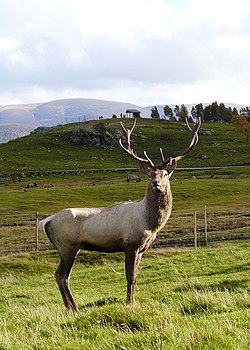
Captive stag in Highland Wildlife Park, United Kingdom
Scientific classification Edit this classification
Kingdom: Animalia
Phylum: Chordata
Class: Mammalia
Order: Artiodactyla
Family: Cervidae
Genus: Cervus
Species:
C. hanglu
Binomial name
Cervus hanglu
Wagner, 1844
Subspecies

The Central Asian red deer (Cervus hanglu), also known as the Tarim red deer, is a deer species native to Central Asia, where it used to be widely distributed, but is scattered today with small population units in several countries. It has been listed as Least Concern on the IUCN Red List since 2017.[1] It was first described in the mid-19th century.[2]

Characteristics

[edit]

The Central Asian red deer's fur is light ginger in colour.[2]

Taxonomy

[edit]

The scientific name Cervus hanglu was proposed by Johann Andreas Wagner in 1844 for a deer specimen from Kashmir that differed from the red deer (Cervus elaphus) in the shape and points of the antlers.[2] In the 19th and early 20th centuries, the following red deer specimens from Central Asia were described:

In 1951, John Ellerman and Terence Morrison-Scott recognised all these specimens as subspecies of the red deer.[8] In 2005, Peter Grubb also considered the proposed taxa as subspecies of the red deer.[9]

IUCN Red List assessors provisionally recognised its status as a distinct species in 2017.[1] The Central Asian red deer is thought to comprise three subspecies:

Phylogeny

[edit]

An analysis of mitochondrial DNA of 125 tissue samples from 50 populations of the genus Cervus included two samples from Tajikistan and three from western China. The results supported the classification of the red deer populations in Central Asia as two distinct red deer subspecies.[10] Results of a subsequent phylogenetic analysis of Cervinae tissue samples indicated that deer samples from Central Asia form a distinct clade and warrant to be raised to species level.[11] The Central Asian red deer group appears to have genetically diverged from the European red deer group during the Chibanian period between 770,000 and 126,000 years ago.[12]

The first phylogenetic analysis using hair samples of the deer population in Dachigam National Park in Jammu and Kashmir was published in 2015. Results showed that these samples form a subcluster within the Central Asian red deer group; they are genetically closer to this group than to the European red deer.[13]

References

[edit]
Revisions and contributorsEdit on WikipediaRead on Wikipedia
from Grokipedia
The (Cervus hanglu), also known as the Tarim red deer, is a large-bodied deer species adapted to arid and semi-arid environments across , where it inhabits riparian forests, river valleys, and woodlands along waterways in basins. Males typically weigh 180–250 kg and stand about 132 cm at the shoulder, featuring a short neck mane, large ears, wide hooves, and lyre-shaped antlers with five tines that can reach up to 100 cm in length; females are smaller, weighing around 160 kg and standing 122 cm tall, lacking antlers. The species exhibits seasonal coat changes, with a rich reddish-brown pelage in summer fading to dull greyish-brown in winter, accented by a white throat bib, rump patch, and tail underside. Once widely distributed from the in southern , , to mountainous regions in , , , and , the Central Asian red deer has a fragmented range that also includes the endemic subspecies (C. h. hanglu) in the high-altitude forests of , . Populations have historically declined due to habitat degradation from agriculture, , and , as well as for antlers and meat, but reintroduction and protection programs have supported recoveries in areas like the and . The species as a whole is classified as Least Concern by the (2017 assessment) with an estimated 2,000–2,500 mature individuals in stable or increasing populations in core habitats, though the subspecies remains Critically Endangered with an estimated population of 323 individuals (as of 2025) mainly confined to and surrounding areas.

Taxonomy and evolution

Taxonomy

The Central Asian red deer is classified in the family Cervidae, genus , with the binomial name Cervus hanglu proposed by Johann Andreas Wagner in 1844 based on a specimen from the type locality near Lake Mansarovar in southern . Historically, it was treated as a subspecies of the ( elaphus), under names such as Cervus elaphus hanglu and synonyms including Cervus cashmirianus and Cervus yarkandensis. In 2015, molecular analyses of mitochondrial markers provided evidence for its distinction from European red deer and other species, supporting elevation to full status; IUCN assessors formalized this recognition in 2017, designating it the Tarim red deer. Three subspecies are currently recognized: C. h. hanglu (Kashmir stag or , endemic to the region), C. h. yarkandensis (Yarkand or , from the in , ), and C. h. bactrianus (Bukhara or , from riparian areas in , , and ). The specific epithet "hanglu" derives from the local Kashmiri name "" for the Kashmir subspecies, reflecting its cultural significance in the region.

Phylogeny

The Central Asian red deer (Cervus hanglu) represents a distinct phylogenetic lineage within the genus , separate from the European red deer (Cervus elaphus) and wapiti (Cervus canadensis). Molecular analyses of have established that C. hanglu forms a monophyletic originating in , with genetic divergence from C. elaphus occurring during the middle Pleistocene, estimated at 126,000 to 781,000 years ago based on cytochrome b sequence data and calibrations. This split aligns with climatic shifts that isolated Central Asian populations, as evidenced by the absence of shared haplotypes between the lineages. Within the Central Asian clade, samples from the Kashmir stag (C. h. hanglu) form a tight subcluster, supported by 94% bootstrap values in phylogenetic trees constructed from D-loop sequences, indicating localized genetic structuring. This subcluster is nested within the broader Tarim Basin lineage, encompassing related forms like the Yarkand and Bactrian deer, and underscores the deep divergence from both European and North American cervids. Although broader phylogenies show proximity to other Asian Cervus species, such as the sika deer (Cervus nippon), detailed cytochrome b and D-loop analyses confirm C. hanglu as a unique branch with no evidence of recent admixture. Key molecular studies from 2004 and 2015 provide compelling evidence for the species-level distinction of C. hanglu, highlighting fixed genetic differences in both nuclear and mitochondrial markers. Ludt et al. (2004) identified diagnostic substitutions in the gene that separate the Central Asian from western lineages, while Mukesh et al. (2015) reported fixed indels and SNPs in and nuclear microsatellites, with genetic distances exceeding those typical of . These findings, corroborated by Bayesian models, affirm the taxonomic independence of C. hanglu. The evolutionary trajectory of C. hanglu is marked by adaptations to Central Asian isolation during Pleistocene glaciations, when ice ages fragmented habitats and confined populations to refugia like the and Himalayan foothills. This isolation fostered , leading to specialized traits for montane and semi-arid conditions, as inferred from mitogenome divergence patterns and stable demographic signals over the last 35,000 years.

Physical characteristics

Description

The Central Asian (Cervus hanglu), also known as the Tarim , is a large-bodied cervid exhibiting pronounced . Males, or stags, typically measure 190-205 cm in head-body length with a shoulder height of 125-145 cm and weigh 150-240 kg, while females, or hinds, are smaller, with a head-body length of 180-195 cm, shoulder height of 110-120 cm, and weight of 110-170 kg. Stags are notably bulkier, featuring a short mane and more robust build compared to the slender form of hinds. The species exhibits seasonal coat changes, with a reddish-brown pelage in summer fading to greyish-brown in winter, characterized by underparts, a light-colored rump patch bordered by a darker band, and a dark . The fur thickens during winter for insulation against cold climates, with subtle speckling on the hairs adding texture. Antlers are exclusive to males and are shed annually in spring, regrowing to lengths up to 100 cm, typically featuring 5 tines per side with variations among . They often include a terminal transverse fork and a long, thin bez tine, with the beam curving inward and the brow and bez tines positioned close together above the burr. Distinctive anatomical traits include large ears, wide hooves adapted for soft terrain, and prominent haunches that enhance agility in rugged landscapes. may show minor variations in coat shade or complexity, such as lighter sandy tones in the Yarkand deer.

Subspecies

The Central Asian red deer ( hanglu) is recognized as comprising three , distinguished primarily by morphological traits such as structure, coloration, and body proportions, which reflect adaptations to their respective environments. These are C. h. hanglu, C. h. yarkandensis, and C. h. bactrianus, with distinctions based on cranial measurements, pelage variations, and morphological comparisons. C. h. hanglu, commonly known as the or , exhibits a more robust build compared to other , with males featuring that typically have 5 main tines per side but can branch to 11-16 points overall and a prominent brow tine rising directly above the burr. The is dark liver-brown in winter, with darker legs and chest, and lighter underparts, contributing to its distinct appearance in forested habitats. This shows the highest degree of among the group. C. h. yarkandensis, the Yarkand or Tarim red deer, has a lighter build and shorter antlers reaching up to 90 cm in length, often with 5 tines and a forward-pointing terminal fork. Its paler coat, with a yellowish sheen and subtle dorsal stripe, is adapted to the fringes of environments, emphasizing a sleeker body proportion for mobility in arid landscapes. C. h. bactrianus, known as the or , displays an ashy-gray coat with a yellowish tinge and thicker fur suited to arid conditions, along with a grayish-white rump patch. Males are larger, reaching up to 230 kg, and possess antlers with 5-6 tines that are relatively light in color and less branched than those of C. h. hanglu. The overall body proportions are stockier, aiding endurance in steppe-like terrains. Key differences among the include variations in tine count—typically 5 in yarkandensis and bactrianus to more branched forms in hanglu—coat shades from ginger-brown to ashy-gray, and body proportions shaped by local ecological pressures, such as robustness in hanglu versus lightness in yarkandensis. These traits highlight adaptive divergence within the . Recognition of these subspecies relies on morphological comparisons, including skull dimensions and pelage patterns.

Distribution and habitat

Historical and current range

The Central Asian red deer ( hanglu) was historically widespread across riparian zones and mountainous regions of , extending from the and river basins in , , , and , through northern , to the in and the region spanning and . The subspecies C. h. bactrianus (Bactrian or deer) occupied lowland tugai forests along major rivers in the former Soviet Central Asian republics, while C. h. yarkandensis (Tarim or Yarkand deer) inhabited the desert-fringed river valleys of the in , . The nominate subspecies C. h. hanglu () ranged through the high-altitude valleys and forests of the , including the and adjacent areas in what is now northern . Over the , the species experienced severe range contraction, primarily driven by intensive hunting for meat, hides, and antlers, coupled with habitat loss from , projects, and of riparian tugai forests. This led to the near-extirpation of wild populations in much of the former Soviet Central Asian republics by the mid-20th century, with C. h. bactrianus disappearing from large parts of and . Overall, the deer's distribution fragmented dramatically, reducing its former expansive range to isolated pockets. Today, the Central Asian red deer persists in fragmented populations across its core regions. In and , small wild and reintroduced groups of C. h. bactrianus occur in the Zeravshan River basin and protected tugai areas, such as the Lower Biosphere Reserve. Reintroduced populations of C. h. bactrianus also exist in , including in and other protected areas as of 2025. The C. h. yarkandensis subspecies is confined to reserves along the Tarim, , and Qiemo river basins in , , where populations are isolated into discrete areas amid intensive human land use. In , C. h. hanglu survives primarily in the , centered on and adjacent landscapes exceeding 200 km². Seasonal altitudinal migrations of 1,000–3,000 m, typically from lowland winter ranges to higher summer elevations for foraging and calving, are now severely restricted by and barriers like roads and settlements.

Habitat requirements

The Central Asian red deer (Cervus hanglu) primarily inhabits riparian ecosystems, including dense riverine forests, floodplains, and tugai woodlands dominated by deciduous species such as poplars (Populus spp.) and willows (Salix spp.), which provide essential cover and forage bases. These habitats are typically found along major river systems in Central Asia, where the deer relies on the structural complexity of vegetation layers for concealment and thermal regulation. In arid-adjacent regions like the Tarim Basin, the species tolerates semi-desert fringes, utilizing ephemeral wetlands and reed-dominated marshes (Phragmites communis associations) for protection and proximity to water. Seasonally, the deer exhibits altitudinal migration to optimize resource availability and avoid harsh conditions. In summer, populations ascend to alpine meadows and high-elevation grasslands between 2,500 and 3,500 meters, where cooler temperatures and abundant herbaceous vegetation support needs. During winter, they migrate to lower valleys at 1,500 to 2,500 meters, favoring sheltered slopes and forested areas that offer reduced snow accumulation and access to browse. This vertical movement, often spanning 800–1,500 meters, underscores the species' dependence on connected landscapes with gradual elevation gradients. Critical habitat features include perennial water sources for hydration and , dense vegetation to deter predators, and heterogeneous plant strata supporting year-round nutritional demands.

Behavior and ecology

Social structure and activity

The Central Asian red deer displays a characterized by year-round sexual segregation, with females and their young forming stable matriarchal herds typically ranging from 5 to 20 individuals, while adult males remain solitary or associate in small bachelor groups of 2 to 5 animals. During the breeding season, temporary mixed-sex herds form as males join female groups to compete for mates. This segregation is maintained through hierarchical structures where dominance is established based on body size, age, and characteristics, particularly among males. Males defend individual territories within female ranges using prominent displays, parallel walks, and vocalizations such as deep roars to assert dominance and deter rivals. Communication among group members includes scent marking via tarsal and preorbital glands to delineate boundaries and signal status, as well as alarm barks or snorts to alert others of potential threats. clashes occur during dominance disputes, primarily among males, reinforcing the social hierarchy without frequent injury. Activity patterns are primarily crepuscular to nocturnal, with peaks in and movement during dawn and , though individuals may shift to more diurnal behaviors in secure, forested habitats and adopt fully nocturnal routines in areas disturbed by human presence. Herds during midday in shaded cover, promoting energy conservation in arid environments. Interspecific interactions reveal low tolerance for , often resulting in displacement of deer from preferred areas due to for resources in overlapping riparian zones. Predation avoidance is achieved through collective vigilance in herds, where peripheral members scan for threats while others feed or , enhancing group survival in open desert landscapes.

Diet and foraging

The Central Asian red deer (Cervus hanglu) is a herbivorous mixed feeder that consumes a diet of browse, forbs, and grasses, reflecting its adaptation to the vegetation of riparian forests and desert basins in regions such as the and . Its diet typically comprises browse including leaves, twigs, and bark from shrubs and trees such as (Salicaceae) (30–80%), alongside forbs and herbs (19–45%), and grasses (7–20%), with contributions from fruits and seeds particularly in autumn. Overall, the species utilizes numerous plant species, with key nutritional sources from protein-rich Fabaceae legumes and Asteraceae herbs. Seasonal shifts in diet composition are pronounced due to availability in Central Asia's variable . In spring (April–May), forbs and early greens dominate (up to 45%), supplemented by shrubs (24%) and grasses (20%), providing high-quality after winter . Summer sees grasses and herbaceous plants becoming predominant as animals exploit riparian and subalpine areas. By autumn (October–November), fruits and seeds increase, while winter (December–March) relies heavily on browse like bark and twigs (approaching 100% in deep ), including woody , to meet needs amid limited herbaceous growth. These patterns ensure nutritional balance, with crude protein and digestibility declining from spring to winter. Foraging occurs selectively in open meadows and forest understory, with individuals active for 7–12 hours daily, peaking and , and consuming 2–4% of body weight in fresh (9–16 kg per day depending on sex and size). This behavior targets nutrient-dense patches to optimize intake amid patchy resources. The large facilitates fermentation of fibrous mixed , enabling efficient nutrient extraction from both browse and grasses in heterogeneous landscapes. Nutritional demands drive adaptations like rumen microbial efficiency for digesting variable plant quality, supporting survival through seasonal forage scarcity in riparian habitats. However, resource competition arises from dietary overlap with , particularly on shared grasses and forbs, which intensifies in degraded pastures and contributes to forage shortages for C. hanglu populations.

Reproduction and development

Mating and breeding

The breeding season of the Central Asian red deer (Cervus hanglu) occurs during the rut from to , with males exhibiting more synchronized activity while females display dispersed estrus. This timing aligns with autumn conditions in their arid and semi-arid habitats, facilitating reproductive synchronization influenced by photoperiod and resource availability. The species employs a polygynous , in which dominant males establish harems typically comprising 5-15 females through aggressive competition and displays. During the rut, males defend these groups vigorously, spending significant time herding females to prevent defections. involves males digging , parading with elevated antlers, roaring vocally, and chasing rivals to assert dominance and attract receptive females. The gestation period lasts 230-240 days, after which females give birth. Calves are typically born from May to June in secluded areas to minimize predation risk, with most females producing a single offspring; twins are rare, occurring in less than 5% of births. Immediately following birth, females lick the calf clean to remove scent cues and begin nursing, providing essential for early immunity. Males play no role in after the rut concludes. During the rut, social groups temporarily mix as segregated herds converge, enhancing mating opportunities before resuming separation.

Growth and lifespan

Central Asian red deer calves are born after a gestation period of approximately 230-240 days, weighing between 15 and 20 kg at birth. Newborns are precocial, able to stand and follow their mothers within hours of birth, which aids in evading predators in their arid habitat. Weaning occurs gradually between 6 and 8 months, though calves remain dependent on their mothers for protection and foraging guidance for 1 to 2 years. Growth proceeds rapidly in the first year, with juveniles reaching about half adult size by 12 months. Females typically attain at 2 to 3 years of age, while males reach at 4 to 5 years, coinciding with the development of larger s necessary for breeding competition. Full development in males is achieved by around age 5, marking the onset of peak physical condition. Juvenile dispersal from the maternal group often happens at 1 to 2 years, allowing young deer to establish territories or join mixed groups. In the wild, Central Asian red deer have a lifespan of 15 to 20 years, though individuals in can live up to 25 years due to reduced predation and consistent nutrition. First-year mortality is notably high, ranging from 30% to 50%, primarily due to predation during the vulnerable neonatal and early juvenile stages. Males experience their prime breeding period between 5 and 10 years, when size and body mass are maximal, supporting successful rutting. As deer age, signs of become evident; antler size in males peaks during prime adulthood and gradually declines thereafter, reflecting reduced testosterone levels and nutritional demands. Females maintain reproductive capability until 12 to 15 years, after which decreases, contributing to lower fawn survival rates in older hinds.

Conservation

Status and populations

The Central Asian red deer (Cervus hanglu) is assessed as Least Concern at the species level by the IUCN Red List, based on a 2017 evaluation that accounts for population recoveries in some regions. However, its subspecies face varying levels of threat: the Kashmir stag (C. h. hanglu) is classified as Critically Endangered, while the Tarim red deer (C. h. yarkandensis) is considered Endangered and the Bukhara deer (C. h. bactrianus) lacks a separate assessment but benefits from the species-level status despite ongoing threats. Current population estimates indicate a total wild population exceeding 6,000 individuals across fragmented ranges, though numbers remain low relative to historical levels. The C. h. hanglu numbers approximately 289 individuals as of the 2023 , with the vast majority confined to in . The C. h. yarkandensis wild population in China's is estimated at around 2,500 individuals, reflecting a decline from over 10,000 in the mid-20th century. For C. h. bactrianus, populations in , , and surrounding areas total about 3,735–3,900 individuals, bolstered by reintroduction efforts. Overall trends show a general decline across the species due to loss and isolation, though the C. h. hanglu population has remained relatively stable yet vulnerable in its isolated since the , with monitoring via camera traps and biennial censuses revealing annual fluctuations of 10–20%. The C. h. bactrianus has experienced recovery through conservation, while C. h. yarkandensis continues to decrease amid pressures. The C. h. hanglu exhibits low resulting from historical population bottlenecks, which heightens its risk through reduced adaptability and increased . The C. h. hanglu and C. h. yarkandensis are listed under Appendix I of the Convention, prohibiting international commercial trade, while C. h. bactrianus is listed under Appendix II.

Threats

The Central Asian red deer ( hanglu), encompassing such as the (C. h. hanglu) and Tarim deer (C. h. yarkandensis), faces severe threats from loss driven by , , and , which have fragmented over 90% of its historical range and confined populations to isolated patches. In the region, encroachment for timber extraction, fuelwood collection, and development has reduced the Hangul's suitable from approximately 885 km² to just 141 km² within , exacerbating isolation and limiting dispersal. For the Tarim deer in China's , farmland expansion and have similarly degraded riparian forests, while oil exploitation disrupts desert-edge habitats essential for survival. Poaching for antlers, meat, and trophies remains a primary driver of population decline across subspecies, with historical overhunting reducing numbers by over 80% from an estimated 5,000 individuals in the early 20th century to 289 as of the 2023 census. Illegal trade persists due to demand in and as hunting trophies, particularly affecting the critically endangered amid regional instability in , which facilitates unreported killings. The Tarim deer experiences targeted fawn , further threatening its fragmented populations estimated at around 2,500 individuals. Predation by natural predators like leopards and wolves, along with dogs, primarily impacts fawns and weakens herd viability, while competition from for forage resources intensifies pressure on limited . grazing in core areas, such as those used by , not only depletes vegetation but also transmits diseases like from sheep and goats to deer populations. The Bukhara deer (C. h. bactrianus) in faces analogous competition from herds, compounded by habitat degradation in riparian zones. Additional ecological pressures include in isolated small populations, where for the is less than 50% of optimal levels, increasing susceptibility to diseases and reducing . alters migration routes by shifting vegetation patterns and water availability, particularly affecting desert-adapted Tarim deer through accelerated . Human-wildlife conflicts, such as crop raiding by deer leading to retaliatory killings, further elevate risks, especially for the in agricultural fringes of its range. Subspecies-specific vulnerabilities are pronounced: the suffers heightened poaching linked to regional conflicts, while the Tarim deer contends with industrial desertification and the Bukhara deer with ongoing illegal trade in antlers.

Protection efforts

Conservation efforts for the Central Asian red deer subspecies focus on establishing protected areas, implementing breeding and reintroduction programs, enhancing monitoring, enforcing policies, and involving communities, with varying successes across regions. In , serves as the primary protected area for the ( hanglu hanglu), designated as a in 1982 to safeguard the remaining viable population through habitat preservation and restricted human access. In , the State and Zarafshan protect the Bukhara deer (C. h. bactrianus), providing secure tugai forest habitats essential for the subspecies' survival. For the Yarkand deer (C. h. yarkandensis) in , reserves in the Tarim River Basin, including the proposed Bugur Forest Park as a national nature reserve, support isolated populations in riparian poplar forests. Captive breeding and reintroduction programs have been pivotal, particularly for the Bukhara deer, where over 100 individuals have been released since the 1980s across sites in Uzbekistan, Kazakhstan, and Tajikistan, contributing to population recovery from fewer than 900 in the late 1980s. In India, Project Hangul, launched in 1970 with support from the World Wildlife Fund, includes captive breeding at facilities like Shikargah and reintroduction efforts to expand hangul range beyond Dachigam. Anti-poaching patrols in Kashmir, initiated in the 1970s, have reduced illegal hunting through intensified monitoring during rutting and winter seasons, though challenges persist due to regional instability. Monitoring and research efforts employ biennial es conducted by India's Department of Wildlife Protection to track populations, supplemented by camera trapping for behavioral data and genetic studies to inform translocation planning and assess subspecies purity; the most recent in 2023 estimated 289 individuals. For and Yarkand deer, similar techniques, including genetic analyses of , guide habitat suitability for reintroductions and reveal adaptation to arid environments. Policy measures include strict hunting bans under India's Wildlife (Protection) Act of 1972, which lists under Schedule I for absolute protection, alongside Appendix I listing to regulate international trade. deer receive Appendix II protection, facilitating controlled reintroductions while prohibiting commercial trade. Community involvement, such as initiatives in Uzbekistan's Zeravshan Valley, supports restoration by enhancing riparian vegetation critical for deer foraging. These efforts have stabilized the hangul population from around 150 individuals in 1970 to over 300 by the 1980s, though fluctuations continue due to , with the 2023 census at 289. For Bukhara deer, reintroductions have boosted numbers to nearly 1,900 by 2011, demonstrating recovery potential. Ongoing challenges include establishing wildlife corridors to connect fragmented habitats and implementing disease control measures to prevent outbreaks in reintroduced populations.

References

Add your contribution
Related Hubs
User Avatar
No comments yet.