


Community hub
Recent from talks
Contribute something
Nothing was collected or created yet.
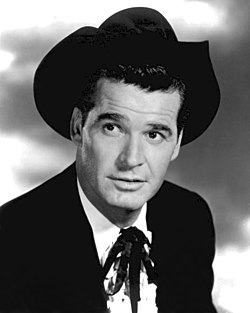
James Garner
View on Wikipedia
James Scott Garner (né Bumgarner; April 7, 1928 – July 19, 2014) was an American actor. He played leading roles in more than 50 theatrical films, which included The Great Escape (1963) with Steve McQueen; Paddy Chayefsky's The Americanization of Emily (1964) with Julie Andrews; Cash McCall (1960) with Natalie Wood; The Wheeler Dealers (1963) with Lee Remick; Darby's Rangers (1958) with Stuart Whitman; Roald Dahl's 36 Hours (1965) with Eva Marie Saint; as a Formula 1 racing star in Grand Prix (1966); Raymond Chandler's Marlowe (1969) with Bruce Lee; Support Your Local Sheriff! (1969) with Walter Brennan; Blake Edwards's Victor/Victoria (1982) with Julie Andrews; and Murphy's Romance (1985) with Sally Field, for which he received an Academy Award nomination. He also starred in several television series, including popular roles such as Bret Maverick in the ABC 1950s Western series Maverick and as Jim Rockford in the NBC 1970s private detective show, The Rockford Files.[1]
Key Information


Garner's career and popularity continued into the 21st century with films such as Space Cowboys (2000) with Clint Eastwood; the animated film Atlantis: The Lost Empire (2001) (voice work) with Michael J. Fox and Cree Summer; The Notebook (2004) with Gena Rowlands and Ryan Gosling; and in his TV sitcom role as Jim Egan in 8 Simple Rules (2003–2005).
Early life
[edit]Garner was born James Scott Bumgarner on April 7, 1928, in Norman, Oklahoma,[2] the last child of Weldon Warren Bumgarner (1901–1986) and Mildred Scott (née Meek; 1907–1933). His father was of part German ancestry,[3] and his mother, who died when he was five years old, was half Cherokee.[4][5] His older brothers were Jack Garner (1926-2011), also an actor, and Charles Warren Bumgarner (1924–1984), a school administrator.[6][7] His family was Methodist.[8] The family ran a general store at Denver Corner on the east side of Norman. After their mother's death, Garner and his brothers were sent to live with relatives.
Garner attended Wilson Elementary School, Norman Junior High and Norman High School (Norman Public Schools).[9]
Garner was reunited with his family in 1934 when his father remarried,[10] the first of several times.[11] He had a volatile relationship with one of his stepmothers, Wilma, who beat all three boys. He said that his stepmother also punished him by forcing him to wear a dress in public. When he was 14 years old, he fought with her, knocking her down and choking her to keep her from retaliating against him physically. She left the family and never returned.[12][13] His brother Jack later commented, "She was a damn no-good woman".[13] Garner's last stepmother was Grace, whom he said he loved and called "Mama Grace", and he felt that she was more of a mother to him than anyone else had been.[11]
Shortly after Garner's father's marriage to Wilma broke up, his father moved to Los Angeles, leaving Garner and his brothers in Norman. After working at several jobs he disliked, Garner joined the U.S. Merchant Marine at age 16 near the end of World War II. He liked the work and his shipmates, but he had chronic seasickness[10] and only lasted a year.[14]
Garner followed his father to Los Angeles in 1945, attending Hollywood High while helping his dad lay carpet. The next five years were back and forth between California and Oklahoma, during which Garner worked in chick hatcheries and the oil fields, as a truck driver and grocery clerk, and even as a swim trunks model for Jantzen...[14]
After World War II, Garner joined his father in Los Angeles and was enrolled at Hollywood High School, where he was voted the most popular student. A high school gym teacher recommended him for a job modeling Jantzen bathing suits.[15] It paid well ($25 an hour) but, in his first interview for the Archives of American Television,[16] he said he hated modeling. He soon quit and returned to Norman.
There he played football and basketball at Norman High School and competed on the track and golf teams.[17] However, he dropped out in his senior year. In a 1976 Good Housekeeping magazine interview, he admitted, "I was a terrible student and I never actually graduated from high school, but I got my diploma in the Army."[5]
Military service
[edit]Garner enlisted in the California Army National Guard, serving his first 7 months in California. He was deployed to Korea during the Korean War, and spent 14 months as a rifleman in the 5th Regimental Combat Team, then part of the 24th Infantry Division. He was wounded twice: in the face and hand by fragmentation from a mortar round, and in the buttocks by friendly fire from U.S. fighter jets as he dove into a foxhole. Garner would later joke that "there was a lot of room involving my rear end. How could they miss?"[18]
Garner received the Purple Heart in Korea for his initial wounding. He also qualified for a second Purple Heart (for which he was eligible, since he was hit by friendly fire which "was released with the full intent of inflicting damage or destroying enemy troops or equipment"),[19] but did not actually receive it until 1983, 32 years after the event.[15][20][21][22] This was apparently the result of an error which was not rectified until Garner appeared on Good Morning America in November 1982, with presenter David Hartman making inquiries "after he learned of the case on his television show".[18] At the ceremony where he received his second Purple Heart, Garner understated: "After 32 years, it's better to receive this now than posthumously".[23] Reflecting on his military service, Garner recalled: "Do I have fond memories? I guess if you get together with some buddies it's fond. But it really wasn't. It was cold and hard. I was one of the lucky ones."
Awards
[edit]
| |||||||||||
  | |||||||||||

|
  |

| |||||||||

|

|

| |||||||||
 
| |||||||||||
Career
[edit]Earliest acting roles (1954–1957)
[edit] | This section needs additional citations for verification. (May 2017) |
In 1954, Paul Gregory, a theatre and future film producer whom Garner had met while attending Hollywood High School, persuaded Garner to take a nonspeaking role in the Broadway production of The Caine Mutiny Court-Martial, where he was able to study Henry Fonda night after night.[10] During the week of Garner's death in 2014, TCM broadcast a marathon, July 28, of a dozen of his movies,[24][25][26][27] introduced by Robert Osborne, who said that Fonda's gentle, sincere persona rubbed off on Garner, greatly to Garner's benefit.
Garner subsequently moved to television commercials[28] and eventually to television roles. In 1955, Garner was considered for the lead role in the Western series Cheyenne, which went to Clint Walker because the casting director could not reach Garner in time (according to Garner's autobiography). Garner wound up playing an Army officer in the 1955 Cheyenne pilot titled "Mountain Fortress". His first film appearances were in The Girl He Left Behind and Toward the Unknown in 1956. Also in 1956, Garner appeared with Ralph Bellamy and Gloria Talbott in a half-hour television episode of Dick Powell's Zane Grey Theatre titled "Star Over Texas" in which a rivalry exists between Bellamy and Garner over Talbott until they're attacked by a group of Native Americans.
In 1957, he had a supporting role in the TV anthology series episode on Conflict entitled "Man from 1997," portraying Maureen's brother "Red"; the show stars Jacques Sernas as Johnny Vlakos, Gloria Talbott as Maureen, and Charlie Ruggles as elderly Mr. Boyne, a time-travelling librarian from 1997, and involved a 1997 Almanac that was mistakenly left in the past by Boyne and found by Johnny in a bookstore.[29] The series' producer Roy Huggins noted in his Archive of American Television interview that he subsequently cast Garner as the lead in Maverick due to his comedic facial expressions while playing scenes in "Man from 1997" that were not originally written to be comical (Huggins knew this because he'd written the episode himself). Garner changed his last name from Bumgarner to Garner after the studio had credited him as "James Garner" without permission. He then legally changed it upon the birth of his child, when he decided she had too many names.[16]
Maverick (1957–1960)
[edit]


After several feature film roles, including Sayonara (1957) with Marlon Brando, Garner got his big break playing the role of professional gambler Bret Maverick in the Western series Maverick from 1957 to 1960.[30] In 1959, he was nominated for the Primetime Emmy Award for Outstanding Lead Actor in a Drama Series for his performance as Bret Maverick.[2]
Only Garner and series creator Roy Huggins thought Maverick could compete with The Ed Sullivan Show and The Steve Allen Show but for two years it beat both in the time slot. The show almost immediately made Garner a household name.[10]
Garner was the lone star of Maverick for the first seven episodes but production demands forced the studio, Warner Bros., to create a Maverick brother, Bart Maverick, played by Jack Kelly. This allowed two production units to film different story lines and episodes simultaneously, necessary because each episode took an extra day to complete, meaning that eventually the studio would run out of finished episodes to air partway through the season unless another actor was added.
Critics were positive about the chemistry between Garner and Kelly and the series occasionally featured popular cross-over episodes starring both Maverick brothers as well as numerous brief appearances by Kelly in Garner episodes. This included the famous "Shady Deal at Sunny Acres," upon which the first half of the 1973 movie The Sting appears to be based, according to Roy Huggins' Archive of American Television interview. Garner and guest star Clint Eastwood staged a fistfight in an episode titled "Duel at Sundown", in which Eastwood played a vicious and cowardly gunslinger. Although Garner quit the series after the third season because of a dispute with Warner Bros.,[10] he did make one fourth-season Maverick appearance, in an episode titled "The Maverick Line" starring both Garner and Jack Kelly that had been filmed in the third season but held back to run as the season's first episode if Garner lost his lawsuit against Warner Bros. Garner won in court, left the series, and the episode was run in the middle of the season instead.
The studio attempted to replace Garner's character with a Maverick cousin who had lived in Britain long enough to gain an English accent, featuring Roger Moore as Beau Maverick, but Moore left the series after filming only 14 episodes. Warner Bros. had also hired Robert Colbert, a Garner look-alike, to play a third Maverick brother named Brent Maverick. Colbert only appeared in two episodes toward the end of the season. That left the rest of the series' run to Kelly, alternating with reruns of episodes with Garner during the fifth season. Garner still received billing during the opening series credits for these newly produced Kelly episodes, aired in the 1961–1962 season, although he did not appear in them and had left the series two years previously. The studio did, however, reverse the billing, at the beginning of each show and in advertisements during the fifth season, billing Kelly above Garner.[31]: 74
Garner played the lead role in Darby's Rangers (1958). Originally slated for a supporting role, he was given the lead when Charlton Heston turned down the part. He performed well as William Orlando Darby, who was approximately Garner's age during World War II. Following Garner's success in Maverick and Darby's Rangers, Warner Bros. gave Garner two more major theatrical films to be filmed during breaks in his Maverick shooting schedule: Up Periscope (1959) with Edmond O'Brien and the romantic drama Cash McCall (1960) with Natalie Wood.[32]
1960s
[edit]
After his acrimonious departure from Warner Bros. in 1960, Garner briefly found himself graylisted by Warner until director William Wyler hired him for a starring role in The Children's Hour (1961) with Audrey Hepburn and Shirley MacLaine, a drama about two teachers surviving scandal started by a student. After that, Garner abruptly became one of the busiest leading men in cinema. In Boys' Night Out (1962) with Kim Novak and Tony Randall and The Thrill of It All (1963) with Doris Day, he returned to comedy. Garner also starred opposite Day in Move Over, Darling, a 1963 remake of 1940's My Favorite Wife in which Garner portrayed the role originally played by Cary Grant. (The remake had begun as Something's Got to Give, but was recast and retitled after Marilyn Monroe died and Dean Martin chose to withdraw as a result.)
Next came the World War II dramas The Great Escape (1963) with Steve McQueen, Paddy Chayefsky's The Americanization of Emily (1964) with Julie Andrews, and Roald Dahl's 36 Hours (1965) with Eva Marie Saint. In the smash hit The Great Escape, Garner played the second lead for the only time during the decade, supporting fellow ex-TV series cowboy McQueen among a cast of British and American screen veterans including Richard Attenborough, Donald Pleasence, David McCallum, James Coburn, and Charles Bronson in a story depicting a mass escape from a German prisoner of war camp based on a true story. The film was released in the same month as The Thrill of It All, giving Garner two hit films at the box office at the same time. The Americanization of Emily, a literate antiwar D-Day comedy, featured a screenplay written by Paddy Chayefsky and remained Garner's favorite of all his work.[33][34] In 1963, exhibitors voted him the 16th most popular star in the US[35] and it was hoped that he might be a successor to Clark Gable.[36] He also made Mister Buddwing (1966), a picture depicting a man suddenly suffering from marital-trauma amnesia who finds himself sitting on a bench in Central Park without knowing how he got there.

By October 1964, Garner had formed his own independent film production company, Cherokee Productions.[30][37][38][39][40][41][42] He next starred in the Cherokee co-production,[43] Norman Jewison's romantic comedy The Art of Love (1965) with Dick Van Dyke and Elke Sommer. The Westerns Duel at Diablo (1966) with Sidney Poitier and Hour of the Gun (1967) with Garner as Wyatt Earp and Jason Robards Jr. as Doc Holliday followed, as well as the comedy A Man Could Get Killed (1966) with Melina Mercouri and Tony Franciosa. Grand Prix (1966), directed by John Frankenheimer and co-produced through Garner's Cherokee Productions, found him supporting Yves Montand and Eva Marie Saint around the European Grand Prix racing circuit. The expensive Cinerama epic by MGM did not fare as well as expected at the box office and, together with the poor performance of his last six films, he was blamed for the movie not doing better, which damaged Garner's theatrical film career.[36]
Compounding this, playing a Grand Prix racer - and driving Formula 3 cars in that picture's filming - gave Garner the urge to race for real,[30] distracting him from his career in front of the camera. He formed his own American International Racing team and both competed in and backed as team owner racing in numerous classes, captured in a documentary he co-produced and starred in, The Racing Scene, in 1969.
Despite opposition from some at MGM and having to plead his case, Garner played Raymond Chandler's Philip Marlowe in Marlowe,[36][44] a 1969 neo-noir featuring an early extended kung fu scene with the martial artist and actor Bruce Lee.[45] The same year, Garner scored a hit with the comedy Western Support Your Local Sheriff! with Walter Brennan and Jack Elam.
1970s
[edit]Nichols (1971–1972)
[edit]
In 1971, Garner returned to television in an offbeat series, Nichols, in which his character was killed and replaced by a less colorful twin brother at the end of the series. In one explanation for the unusual denouement, the recast as the character's somewhat more normal twin brother would have hopefully created a more popular series with few cast changes.[46] However, according to Garner's 1999 videotaped Archive of American Television interview, Garner killed his character because they had already cancelled the show and played his own twin because they had to finish the episode.[47]
Feature films
[edit]Also in 1969 he starred in Support Your Local Gunfighter! (similar to the Western spoof Support Your Local Sheriff!), while in the frontier comedy Skin Game, Garner and Louis Gossett Jr., starred as con men pretending to be a slaveowner and his slave during the pre-Civil War era.[48] The following year, Garner played a small town sheriff investigating a murder in They Only Kill Their Masters with Katharine Ross. He appeared in two Disney films also starring Vera Miles as his leading lady, One Little Indian (1973), featuring Jodie Foster in an early minor role, and The Castaway Cowboy (1974) with Robert Culp.
The Rockford Files (1974–1980)
[edit]

In the 1970s, Roy Huggins had an idea to reprise Garner's success in Maverick, only playing a modern-day private detective. Starting with the 1974 season, Garner appeared as private investigator Jim Rockford for six seasons in The Rockford Files. According to both Huggins' and co-creator Stephen J. Cannell's Archive of American Television interviews, the pair recycled many of the plots from the original Western. In the 2016 book titled TV (The Book), film and television critic Matt Zoller Seitz stated that the series gave Garner "the role he was put on earth to play",[49] which earned him the 1977 Emmy Award for Best Actor.[50] Veteran character actor Noah Beery Jr. played Rockford's father "Rocky".
Between 1978 and 1985, Garner co-starred with Mariette Hartley, who had made an Emmy-nominated appearance on The Rockford Files, in 250 TV commercials for Polaroid, a manufacturer of instant film and cameras.[51][52][53] They portrayed a bantering, bickering couple so convincingly that some viewers believed that the two were married.[54] After six seasons, The Rockford Files was cancelled in 1980. The physical toll on Garner resulted in his doctor ordering him to take some time off to rest.[55] Appearing in nearly every scene of the series, doing many of his own stunts—including one that injured his back—was wearing him out.[55] A knee injury from his National Guard days worsened in the wake of the continuous jumping and rolling, and he was hospitalized with a bleeding ulcer in 1979.[55] When Garner's physician ordered him to rest, the studio immediately cancelled The Rockford Files.
Stuart Margolin (who played Angel Martin in The Rockford Files) said that despite Garner's health problems in the later years of The Rockford Files, he would often work long shifts, unusual for a starring actor, staying to do off-camera lines with other actors, doing his own stunts despite his knee problems.[55] When Garner later made The Rockford Files television movies, he said that 22 people (with the exception of series co-star Beery, who died late in 1994) came out of retirement to participate.[55]
In July 1983, Garner filed suit against Universal Studios for US$16.5 million in connection with his ongoing dispute from The Rockford Files. The suit charged Universal with "breach of contract; failure to deal in good faith and fairly; and fraud and deceit". Garner alleged that Universal was "creatively accounting", two words that are now part of the Hollywood lexicon.[56] The suit was eventually settled out of court in 1989. As part of the agreement, Garner could not disclose the amount of the settlement.[13][57]
"The industry is like it always has been. It's a bunch of greedy people," he stated in 1990.[58] Garner sued Universal again in 1998 for $2.2 million over syndication royalties. In this suit, he charged the studio with "deceiving him and suppressing information about syndication". He was supposed to receive $25,000 per episode that ran in syndication, but Universal charged him "distribution fees". He also felt that the studio did not release the show to the highest bidder for the episode reruns.[57]
The New Maverick (1978)
[edit]Garner and Jack Kelly reappeared as Bret and Bart Maverick in a 1978 made-for-television film titled The New Maverick written by Juanita Bartlett, directed by Hy Averback, and also starring Susan Sullivan as Poker Alice. As had often been the case in episodes of the original series, Bret's brother Bart shows up only briefly toward the end.
The New Maverick served as the pilot for a failed television series, Young Maverick, featuring the adventures of Bret and Bart's younger cousin Ben Maverick, portrayed in both The New Maverick and Young Maverick by Charles Frank. The series itself, which presented Garner for only a few moments at the beginning of the first show, was canceled so rapidly that some of the episodes filmed were never broadcast in the United States. Despite the title, Frank was three years older than Garner had been at the launch of the original series.
1980s
[edit]
Bret Maverick (1981–1982)
[edit]After the abrupt disappearance of Young Maverick two seasons earlier, an attempt to make a "Maverick" series without Garner, he returned to his earlier TV role in 1981 in the revival series Bret Maverick, but NBC unexpectedly canceled the show after only one season despite reasonably good ratings. Critics noted that the scripts did not measure up to the episodes starring Garner in the first series. Jack Kelly (Bart Maverick) was slated to become a series regular had the show been picked up for another season. Kelly was presented with a stack of finished scripts featuring Bart Maverick for the upcoming second season, and he appeared in the last scene of the final episode in a surprise guest appearance.
TV movies
[edit]During the 1980s, Garner played dramatic roles in a number of television films, including Heartsounds with Mary Tyler Moore featuring the true story of a doctor (played by Garner) who is deprived of oxygen for too long during an operation and wakes up mentally impaired; Promise with James Woods and Piper Laurie, about dealing with a mentally ill adult sibling; and My Name Is Bill W. with James Woods, in which Garner portrays the founder of Alcoholics Anonymous. In 1984, he played the lead in Joseph Wambaugh's The Glitter Dome for HBO Pictures, which was directed by his Rockford Files co-star Stuart Margolin. The film generated a mild controversy for a bondage sequence featuring Garner and co-star Margot Kidder.[59] In 1984 he also starred in the movie Tank, about a soon-to-be retiring US Army Command Sergeant Major named Zack Carey who butted heads with a corrupt local sheriff after an incident with one of his deputies off base and used a privately owned Sherman tank to exact justice.
Murphy's Romance (1985)
[edit]Garner's only Oscar nomination was for Best Actor in a Leading Role for the film Murphy's Romance (1985), opposite Sally Field. Field and director Martin Ritt had to fight the studio, Columbia Pictures, to have Garner cast, since he was regarded as a TV actor by then despite having co-starred in the box office hit Victor/Victoria opposite Julie Andrews two years earlier. Columbia did not want to make the movie, because it had no "sex or violence" in it. But because of the success of Norma Rae (1979), with the same star (Field), director, and screenplay writing team (Harriet Frank Jr. and Irving Ravetch), and with Field's new production company (Fogwood Films) producing, Columbia agreed. L wanted Marlon Brando to play the part of Murphy, so Field and Ritt had to insist on Garner.[60][61][62] Part of the deal from the studio, which at that time was owned by The Coca-Cola Company, included an eight-line sequence of Field and Garner saying the word "Coke," and also having Coke signs appear prominently in the film.[63][64] In A&E's Biography of Garner, Field reported that her on-screen kiss with Garner was the best cinematic kiss she had ever experienced.[65]
Sunset (1988)
[edit]Garner played Wyatt Earp in two very different movies shot 21 years apart, John Sturges's Hour of the Gun in 1967 and Blake Edwards's Sunset in 1988. The first film was a realistic depiction of the O.K. Corral shootout and its aftermath, while the second centered around a comedic fictional adventure shared by Earp and silent movie cowboy star Tom Mix. Earp had actually worked as a consultant for Western films during the silent film era toward the end of his life. The movie features Bruce Willis as Mix in only his second movie role. Although Willis was billed over Garner, the film actually gave more screen time and emphasis to Earp.[citation needed]
For the second half of the 1980s, Garner also appeared in several of the North American market Mazda television commercials as an on-screen spokesman.[66]
1990s
[edit]In 1991, Garner starred in Man of the People, a television series about a con man chosen to fill an empty seat on a city council, with Kate Mulgrew and Corinne Bohrer.[67] Despite reasonably fair ratings, the show was canceled after only 10 episodes.
In 1993, Garner played the lead in a well-received HBO movie, the true story Barbarians at the Gate, and went on to reprise his role as Jim Rockford in eight The Rockford Files made-for-TV movies beginning the following year.[68] Practically everyone in the original cast of recurring characters returned for the new episodes except Noah Beery Jr., who had died in the interim.[69] According to Garner's memoir The Garner Files, he insisted upon being fully paid in cash before the shooting began on each of the Rockford TV-movies.
In 1994, Garner played Marshal Zane Cooper in a movie version of Maverick, with Mel Gibson as Bret Maverick (in the end it is revealed that Garner's character is the father of Gibson's Maverick) and Jodie Foster as a gambling lass with a fake Southern accent.[70]
In 1995, he played lead character Woodrow Call, an ex-lawman, in the TV miniseries sequel to Lonesome Dove entitled Streets of Laredo, based on Larry McMurtry's novel. In 1996, Garner and Jack Lemmon teamed up in My Fellow Americans, playing two former presidents who uncover scandalous activity by their successor (Dan Aykroyd) and are pursued by murderous NSA agents.[71] In addition to a major recurring role during the last part of the run of TV series Chicago Hope, Garner also starred in two short-lived series, the animated God, the Devil and Bob and First Monday, in which he played a fictional version of the Supreme Court's Chief Justice of the United States.
2000s and 2010s
[edit]In 2000, after an operation to replace both knees,[72] Garner appeared with Clint Eastwood, who had played a villain in the original Maverick series in the episode "Duel at Sundown," as astronauts in the movie Space Cowboys,[73] also featuring Tommy Lee Jones and Donald Sutherland.
In 2001, Garner voiced Commander Rourke in Atlantis: The Lost Empire. In 2002, following the death of James Coburn, Garner took over Coburn's role as TV commercial voiceover for Chevrolet's "Like a Rock" advertising campaign. Garner continued to voice the commercials until the end of the campaign. Also in 2002, he played Sandra Bullock's father in Divine Secrets of the Ya-Ya Sisterhood as Shepard James "Shep" Walker. After the death of John Ritter in 2003, Garner joined the cast of 8 Simple Rules as Grandpa Jim Egan (Cate's father)[74] and remained with the series until it finished in 2005.
In 2004, Garner starred as the older version of Ryan Gosling's character in the film version of Nicholas Sparks's The Notebook alongside Gena Rowlands as his wife, directed by Nick Cassavetes, Rowlands's son. The Screen Actors Guild nominated Garner as best actor for "Outstanding Performance by a Male Actor in a Supporting Role".[75] In 2006, Garner made his last personal appearance in the film The Ultimate Gift as billionaire Howard "Red" Stevens. In 2010, Garner voiced Shazam in Superman/Shazam!: The Return of Black Adam.[76]
Memoir
[edit]
On November 1, 2011, Simon & Schuster published Garner's autobiography The Garner Files: A Memoir. In addition to recounting his career, the memoir, co-written with nonfiction writer Jon Winokur, detailed the childhood abuses Garner suffered at the hands of his stepmother. It also offered frank, sometimes unflattering assessments of some of Garner's co-stars, particularly Steve McQueen and Charles Bronson, though he was also quite effusive in his praise for many others. In addition to recalling the genesis of most of Garner's hit films and television shows, the book also featured a section where the star provided individual critiques for every one of his acting projects accompanied by a star rating for each. (His favorite: The Americanization of Emily. His least favorite: Mister Buddwing.) Garner's three-time co-star Julie Andrews wrote the book's foreword. Lauren Bacall, Diahann Carroll, Doris Day, Tom Selleck, Stephen J. Cannell, and many other Garner associates, friends, and relatives provided their memories of the star in the book's coda.[77]
The "most explosive revelation" in his autobiography was that Garner smoked marijuana for much of his adult life. "I started smoking it in my late teens," Garner wrote.
I drank to get drunk but ultimately didn't like the effect. Not so with grass. It had the opposite effect from alcohol: it made me more tolerant and forgiving. I did a little bit of cocaine in the Eighties, courtesy of John Belushi, but fortunately I didn't like it. But I smoked marijuana for 50 years and I don't know where I'd be without it. It opened my mind and now it eases my arthritis. After decades of research I've concluded that marijuana should be legal and alcohol illegal.[77]
Awards and nominations
[edit]Garner was nominated for 15 Emmy Awards during his television career, winning twice: in 1977 as Outstanding Lead Actor in a Drama Series (The Rockford Files), and in 1987 as executive producer of Promise.[78]
For his contribution to the television industry, Garner received a star on the Hollywood Walk of Fame at 6927 Hollywood Boulevard.[73]
In 1990, he was inducted into the Western Performers Hall of Fame at the National Cowboy & Western Heritage Museum in Oklahoma City, Oklahoma. He was also inducted into the Television Hall of Fame that same year. In February 2005, he received the Screen Actors Guild's Lifetime Achievement Award.[1][73] He was also nominated for Outstanding Performance by a Male Actor in a Supporting Role that year, for The Notebook. When Morgan Freeman won that prize for his work in Million Dollar Baby, Freeman led the audience in a sing-along of the original Maverick theme song, written by David Buttolph and Paul Francis Webster.[79]
In 2010, the Television Critics Association gave Garner its annual Career Achievement Award.
Statue
[edit]On April 21, 2006, a 10-foot-tall (3.0 m) bronze statue of Garner as Bret Maverick was unveiled in Garner's hometown of Norman, Oklahoma,[73] with Garner present at the ceremony.
Personal life
[edit]Marriage and family
[edit]Despite his popularity and sociable nature, Garner was seen by others as a down-to-earth man who kept his family life private.[80]

Garner was married once, to Lois Josephine Fleischman Clarke,[81] whom he met at a party in 1956. They wed 16 days later on August 17, 1956. "We went to dinner every night for 14 nights. I was just absolutely nuts about her. I spent $77 on our honeymoon, and it about broke me."[15] According to Garner, "Marriage is like the Army; everyone complains, but you'd be surprised at the large number of people who re-enlist."[82] His wife practiced Judaism.[83]
At the time of their marriage, Clarke had a nine-year-old daughter from a previous marriage who was recovering from polio.[5] Garner and Clarke had one daughter together, Greta, nicknamed "Gigi", born on January 4, 1958.[5]
Garner and his wife Lois were still married at his death in 2014, although they had had two periods of separation: the first for three months in 1970, and the second in 1979. The couple reunited two years later in September 1981.[84][85]
Garner stated that during this second period apart he split his time between Canada and "a rented house in the Valley." In each case Garner said the separations were caused by the stress of his acting career and were not due to marital problems. In the case of The Rockford Files he was in almost every scene while in constant pain due to his arthritic knees, and under tremendous stress from the studio.[15] Garner stated that when he quit the series in 1979, he simply needed to spend time alone in order to recover.[86]
Garner's death in 2014 was less than a month before their 58th wedding anniversary. His wife died seven years later, on October 21, 2021, aged 94.
Racing
[edit]In his youth, Garner had raced with "hot cars" in "chases", but his interest in auto racing was magnified during preparations for the filming of Grand Prix. John Frankenheimer, the director and impetus behind the project, was determined to make the film as realistic as possible. He was trying to determine which actor he could focus on for high speed takes. At his disposal were the services of Bob Bondurant, a Formula 1 racer who was serving as technical consultant for the film. The first step was to place the actors in a two-seater version of a Formula 1 car to see how they would handle the high speeds. Bondurant noted that all the actors became quite frightened going over 240 kph, (149 mph) except Garner, who returned to the pit laughing like an excited child. Said Bondurant, "This is your man".[87] From there on out, all the actors were placed in a race driver training program except for Garner, whom Bonderant was assigned to personally train. Garner proved to be a good student, a hard worker and a talented driver. Compared to the other actors in the movie, Bondurant tagged Garner as being 'light years' ahead.[87] By the end of the film Bonderant asserted that Garner could compete on a Formula 1 team, and would best some of the drivers currently in the field.[88]
Following the completion of Grand Prix, Garner become involved in auto racing. From 1967 through 1969 Garner was an owner of the "American International Racers" (AIR) auto racing team.[89] Motorsports writer William Edgar and Hollywood director Andy Sidaris teamed with Garner for the racing documentary The Racing Scene, filmed in 1969 and released in 1970.[90] The team fielded cars at the Le Mans, Daytona, and Sebring endurance races, but is best known for raising public awareness in early off-road motor-sports events, in many of which Garner competed.[89] In 1978, he was one of the inaugural inductees in the Off-Road Motorsports Hall of Fame.[89]
Garner signed a three-year sponsorship contract with American Motors Corporation (AMC).[91] His shops prepared ten 1969 SC/Ramblers for the Baja 500 race.[92] Garner did not drive in this event because of a film commitment in Spain that year. Nevertheless, seven of his cars finished the grueling race, taking three of the top five places in the sedan class.[93] Garner also drove the pace car at the Indianapolis 500 race in 1975, 1977, and 1985 (see: list of Indianapolis 500 pace cars).[89]
In 1987, Garner announced plans to partner with Larry Cahill to form a racing team to compete in the 1988 Indycar season. The intention was to base the team in Cedar Rapids, Iowa, where Cahill operated his businesses. The estimated budget was $3.5 million. Plans for this team never came to fruition.[94] Cahill later formed his own team to compete in the Indy Racing League.
Golf
[edit]Garner was an avid golfer for many years. Along with his brother, Jack, he played golf in high school.[17] Jack even attempted a professional golfing career after a brief stint in the Pittsburgh Pirates baseball farm system.[95] Garner took it up again in the late 1950s to see if he could beat Jack.[15] He was a regular for years at the Pebble Beach Pro-Am.[95] In February 1990 at the AT&T Golf Tournament, he won the Most Valuable Amateur Trophy.[96] Garner appeared on Sam Snead's Celebrity Golf TV series, which aired from 1960 – 1963. These matches were 9-hole charity events pitting Snead against Hollywood celebrities.[31] He was a member of Bel Air Country Club.
American football
[edit]Garner was noted as an enthusiastic fan of the Raiders in the NFL; he regularly attended games and mixed with the players.[97] He was also present when the Raiders won Super Bowl XVIII over the Washington Redskins in January 1984 at Tampa, Florida.
University of Oklahoma
[edit]Garner was a supporter of the University of Oklahoma, often returning to Norman for school functions. When he attended Oklahoma Sooners football games, he frequently could be seen on the sidelines or in the press box. Garner received an honorary Doctor of Humane Letters degree at OU in 1995.[98]
In 2003, to endow the James Garner Chair in the School of Drama, he donated $500,000 towards a total $1 million endowment for the first endowed position at the drama school.[98][99][100]
Politics
[edit]
Garner was a strong Democratic Party supporter.
On August 28, 1963, Garner was one of several celebrities to join Martin Luther King Jr. in the "March on Washington for Jobs and Freedom."[101] In his autobiography, Garner recalled sitting in the third row listening to King's "I Have a Dream" speech.[102]
- "If there was an environmental cause, James Garner was there" — Zev Yaroslavsky[103]
In July 1964, Garner, over a master plan for a 92-square-mile Santa Monica Mountains area, engaged in a public quarrel with Karl L. Rundberg, a Los Angeles City Council member, at a council meeting.[104][105][106][107] Later, Garner, Steve McQueen and Burt Lancaster, became founding members of the Friends of the Santa Monica Mountains conservancy group, according to the book Transforming California by Stephanie S. Pincetl, but contested by Dash Stolarz, spokesperson for the state's Santa Monica Mountains Conservancy.[101][103][108]
In the 1980s, Garner worked against oil drilling offshore of Will Rogers State Beach.[109][103][106]
From 1982, Garner gave at least $29,000 to Federal campaigns, of which over $24,000 was to Democratic Party candidates, including Dennis Kucinich (for Congress in 2002), Dick Gephardt, John Kerry, Barbara Boxer, and various Democratic committees and groups.[110]
For his role in the 1985 CBS miniseries Space, the character's party affiliation was changed from Republican to Democrat, as in the book, to reflect Garner's personal views. Garner said, "My wife would leave me if I played a Republican."[111]
Friendship with Richmond Barthé
[edit]Garner became a friend, supporter and main benefactor of African-American sculptor Richmond Barthé, from the time the latter returned from Europe in 1977 and settled in Pasadena,[112] until Barthé's death in 1989.
Health issues and death
[edit]
Garner's knees became a chronic problem during the filming of The Rockford Files in the 1970s, with "six or seven knee operations during that time." In 2000, he underwent knee replacement surgery for both knees.[15]
On April 22, 1988, Garner had quintuple bypass heart surgery.[113] Though he recovered rapidly, he was advised to stop smoking. Garner eventually quit smoking 17 years later in 2005.[114] "My dad had smoked since he was 12 years old," recalled daughter Gigi Garner.[115]
Garner underwent surgery on May 11, 2008, following a stroke he had suffered two days earlier.[116] His prognosis was reported to be "very positive".[116]
On July 19, 2014, police and rescue personnel were summoned to Garner's Brentwood, Los Angeles home, where they found the actor dead at the age of 86.[117][118][119][120] He had a heart attack caused by coronary artery disease.[121] He had been in poor health since his stroke in 2008.[122]
Longtime friends Tom Selleck (who worked with Garner on The Rockford Files), Sally Field (who starred with Garner in Murphy's Romance), and Clint Eastwood (who guest-starred with Garner on Maverick and starred in Space Cowboys) reflected on his death. Selleck said, "Jim was a mentor to me and a friend, and I will miss him."[123] Field said, "My heart just broke. There are few people on this planet I have adored as much as Jimmy Garner. I cherish every moment I spent with him and relive them over and over in my head. He was a diamond."[124] Eastwood said, "Garner opened the door for people like Steve McQueen and myself."[125]
Filmography
[edit]Recognition
[edit]In 2004, Garner was given a Screen Actors Guild Life Achievement Award.
In 2006, a James Garner statue was installed at Main Street and Jones Avenue, Norman, Oklahoma.[126][127][128]
See also
[edit]


References
[edit]- ^ a b Moynihan, Michael (July 23, 2014). "James Garner in the 'Rockford Files' was an irresistible force on our TV screens". Irish Examiner.
- ^ a b Yantz, Mickel (Summer 2024). "The Maverick Comes Home to Oklahoma". Chronicles of Oklahoma. 102 (2): 192–197.
- ^ Garner attested in an interview ("Archive of American Television Interview with James Garner (Part 1 of 6)) his surname is spelled, 'Bumgarner', which derives from the German Baumgartner and Baumgärtner, in English often written Baumgardner, Bumgardner, and Bumgartner
- ^ Garner, James; Winokur, Jon; Andrews, Julie (2011). The Garner Files: A Memoir. Simon and Schuster. p. 5. ISBN 9781451642629.
- ^ a b c d
("James Garner: A Really Nice Guy makes Good". Good Housekeeping. New York City: The Hearst Corporation. March 1976. US Census records for 1900 show that Mr. Garner's maternal ancestor, Charles Meek, listed as "white", resided on the Choctaw Nation in Oklahoma. p. 46; "Jim's mother, who was half Cherokee Indian, a beautiful woman who died when he was five." p. 58. - ^ Rieger, Andy (September 15, 2011). "Jack Garner dies at age 84". Norman Transcript. Archived from the original on January 4, 2013. Retrieved September 28, 2011.
- ^ "Dame Bernice Lake dies". Variety. September 14, 2011. Retrieved September 28, 2011.
- ^ "Book Review: 'The Garner Files': Jim Rockford a Curmudgeon? Say It Ain't So!". Huntington News. Archived from the original on April 6, 2012. Retrieved April 4, 2012.
- ^ Transcript, Andy Rieger | For The (May 22, 2022). "Column: How about a Norman celebrity home tour?". Norman Transcript. Retrieved April 25, 2024.
- ^ a b c d e Sellers, Robert. "James Garner: The actor known for his portrayals of an honourable man in a dishonourable world | Obituaries | News". The Independent. Retrieved July 24, 2016.
- ^ a b Garner, James; Winokur, Jon; Andrews, Julie (2011). The Garner Files: A Memoir. Simon and Schuster. p. 15. ISBN 9781451642612.
- ^ Grobel, Lawrence. The Art of the Interview. New York: Three Rivers Press. 2004, p. 161. ISBN 1-4000-5071-5
- ^ a b c Strait, Raymond. James Garner. New York, New York: St. Martin's Press. 1985. ISBN 0-312-43967-9
- ^ a b Triplett, Gene. "The Garner files Retrospective honors actor's career". The Oklahoman. Retrieved April 25, 2024.
- ^ a b c d e f Cunneff, Tom. "Jim Dandy" Archived March 3, 2016, at the Wayback Machine. People (February 7, 2005) Retrieved on May 30, 2008
- ^ a b James Garner interview[permanent dead link] at Archive of American Television – (c/o Google Video; March 17, 1999)
- ^ a b "Proud to be an OKIE". Tulsa World (July 15, 2007)
- ^ a b "The U.S. government has finally given actor James Garner..." UPI. January 24, 1983. Retrieved December 2, 2023.
- ^ Keeran, Joshua (December 24, 2020). "Who is eligible to receive Purple Heart medal?". The Delaware Gazette. Retrieved December 2, 2023.
- ^ "Actor James Garner Receives Purple Heart 32 Years Late". The Oklahoman. January 25, 1983.
- ^ "Garner Has a Heart...30 Years Late". Philadelphia Daily News. January 25, 1983.
- ^ "Jim Garner Gets Behind a Cause". Philadelphia Daily News. May 12, 1995.
- ^ Roth, Beth Ford (July 21, 2014). "James Garner Served In Korean War, Awarded Purple Heart Twice". KPBS. Retrieved December 2, 2023.
- ^ Wiebe, Sheldon. "TCM Remembers James Garner With An all-Day Marathon, July 28th! – EclipseMagazine". Retrieved April 25, 2024.
- ^ Kiesewetter, John. "TCM salutes James Garner all day Monday". The Enquirer. Retrieved April 25, 2024.
- ^ "TCM to honor James Garner with 12-film marathon". Newsday. July 21, 2014. Retrieved April 25, 2024.
- ^ CALIFORNIAN, THE BAKERSFIELD (July 23, 2014). "TCM shakes up schedule for James Garner marathon". The Bakersfield Californian. Retrieved April 25, 2024.
- ^ Pendreigh, Brian (July 21, 2014). "Obituary: James Garner, actor". The Scotsman. Retrieved July 24, 2016.
- ^ The Man From 1997 (TV Pilot) on YouTube
- ^ a b c "James Garner, Witty, Handsome Leading Man, Dies at 86". The New York Times. July 20, 2014. Retrieved July 21, 2014.
- ^ a b Strait, Raymond (June 13, 2016). James Garner: A Biography. Crossroad Press.
- ^ "James Garner: Obituary". The Telegraph. July 20, 2014. Retrieved July 14, 2017.
- ^ "Lowly Brother Amidst The Sisterhood" Archived March 3, 2016, at the Wayback Machine Film Monthly (June 3, 2002); retrieved on June 2, 2008
- ^ Murray, Rebecca. Press Release: "James Garner Honored with the Screen Actors Guild's Life Achievement Award". Screen Actors Guild (January 29, 2005) Retrieved on June 2, 2008
- ^ 'Doris Day Heads Top 10' The Washington Post and Times-Herald (1959–1973) [Washington, D.C.] Jan 14, 1964: A27. Also 1965 Classic "36 Hours"
- ^ a b c Beaupre, Lee (May 15, 1968). "Rising Skepticism On Stars". Variety. p. 1.
- ^ "ABOUT". James Garner Animal Rescue Fund. Retrieved April 19, 2022.
- ^ "James Garner's Car Up for Charity Auction". GlobeNewswire News Room (Press release). January 17, 2022. Retrieved April 19, 2022.
- ^ "ABOUT". Cherokee Productions. Retrieved April 19, 2022.
- ^ "Cherokee Productions (Firm)". WorldCat Identities. Archived from the original on April 19, 2022. Retrieved April 19, 2022.
- ^ "Cherokee Productions". British Film Institute. Archived from the original on April 19, 2022. Retrieved April 19, 2022.
- ^ "The Los Angeles Times from Los Angeles, California on October 22, 1964 · 74". Newspapers.com. October 22, 1964. Retrieved June 2, 2021.
No Longer a Maverick: Wooing James Garner into an extended contract of any kind is difficult. Once burned, he dreads the fire, but if Metro has their way his Cherokee Productions will be making three films for the studio Garner's take $1,500,000. The first. "Caravans," with a locale in Afghanistan, involves a beautiful heiress and an adventurer. The studio admits they'll settle for this one if they can't tie up the package deal.
- ^ "The Art of Love (1965)". AFI Catalog. Retrieved April 19, 2022.
- ^ McNamara, Mary (July 20, 2014). "James Garner dies; actor changed what a hero could be like". Los Angeles Times. Retrieved July 21, 2014.
- ^ Gerstenzang, Peter (July 21, 2014). "James Garner's Five Best Sleeper Films". Village Voice. Archived from the original on July 22, 2014. Retrieved July 21, 2014.
- ^ "Appreciation: James Garner, reluctant hero". USA Today. Retrieved July 20, 2014.
- ^ Garner, James (March 17, 1999). "Interview with James Garner". Archive of American Television (Interview). Interviewed by Karen Herman, Morrie Gelman. Los Angeles, California. Retrieved July 21, 2014.
- ^ Garner, James; Winokur, Jon (2011). The Garner Files: A Memoir. Simon & Schuster. p. 258.
- ^ Sepinwall, Alan; Seitz, Matt Zoller (September 6, 2016). TV (The Book): Two Experts Pick the Greatest American Shows of All Time. Grand Central Publishing. pp. 237–238. ISBN 978-1455588190.
- ^ "James Garner | Television Academy". Emmys.com. July 19, 2014. Retrieved July 24, 2016.
- ^ "The Rockford Files" Paradise Cove (TV Episode 1979) - IMDb, retrieved March 10, 2023
- ^ "Mariette Hartley". Television Academy. Retrieved March 10, 2023.
- ^ "James Garner remembered by co-star Mariette Hartley". Chicago Tribune. July 21, 2014. Retrieved March 10, 2023.
- ^ Reilly, Sue (October 8, 1979). "It Didn't Happen in 60 Seconds, but Her Ads with Jim Garner Developed Mariette Hartley's Career". People. Retrieved March 10, 2023.
- ^ a b c d e "James Garner: Hollywood Maverick." Biography (October 2, 2000)
- ^ Johnson, Neville (July 23, 2014). "James Garner: A Lawyer Reflect0s on the Actor's Legal Legacy". The Hollywood Reporter.
- ^ a b Garner files 'Files' suit Archived January 19, 2012, at the Wayback Machine. – Reuters. – (c/o Variety; September 14, 1998). Retrieved on June 1, 2008
- ^ Leopold, Todd (July 21, 2014). "Famed actor James Garner dies at 86". CNN.
- ^ Erickson, Hal (2007). "The Glitter Dome". Movies & TV Dept. The New York Times. Archived from the original on November 9, 2007.
- ^ Cameron, Julia. – "Garner Fits Romantic Role, Not Hollywood Pigeonhole." Chicago Tribune (January 19, 1986)
- ^ Laurence, Robert P. "Garner doesn't go by the book in role in 'Breathing Lessons.'" San Diego Union-Tribune (February 6, 1994)
- ^ Rosenthal, Phil. "Garner Remains TV's Class Act." Daily News of Los Angeles (February 6, 1994). Retrieved on August 3, 2008
- ^ Baltake, Joe. "The Packaging of Hollywood of Advertising." Sacramento Bee (May 13, 1990)
- ^ "Blowing Smoke – They've Coma a Long Way, Baby, In pushing Cigarettes on Screen. Sacramento Bee (January 14, 1996). Retrieved on August 3, 2008
- ^ Nelson, Ted. "James Garner: Hollywood Maverick." A&E Biography (2000). New York: A & E Home Video; ISBN 978-0-7670-3361-9
- ^ Horovitz, Bruce (February 10, 1989). "Mazda Drops Garner to Try New Route in Commercials". Los Angeles Times. Retrieved July 22, 2014. "four-year stint as a spokesman for Mazda... contract expires in March" (i.e. March 1985–89)
- ^ Guide, TV. "Man of the People - Full Cast & Crew". TV Guide. Retrieved December 11, 2021.
- ^ Strait, Raymond (1985). James Garner. New York: St. Martin's. p. 295. ISBN 978-0-312-43967-5.
- ^ Tate, Marsha Ann; Houser, Earl (January 11, 2022). What America Watched: Television Favorites from the Cornfields to the Cosmos, 1960s-1990s. McFarland. p. 319. ISBN 978-1-4766-4465-3.
- ^ Hall, Carla (May 15, 1994). "SUMMER SNEAKS '94: Was, Is and Always a Maverick: His signatures are Rockford and Maverick – can anybody in Hollywood do cool and canny better than James Garner?". Los Angeles Times. Retrieved November 23, 2010.
- ^ "Box Office Mojo – My Fellow Americans". Retrieved September 14, 2011.
- ^ King, Susan (April 12, 2000). "At 'Chicago Hope,' They've Called In a Maverick Talent". Los Angeles Times. Retrieved July 23, 2014.
- ^ a b c d Alexander, Ella (July 20, 2014). "James Garner death: The Notebook, Maverick and Rockford Files actor dies aged 86". The Independent. Retrieved July 24, 2016.
- ^ "James Garner to Join '8 Simple Rules'". People. October 16, 2003. Retrieved December 11, 2021.
- ^ "The 11th Annual Screen Actors Guild Awards". Sagawards.org. Retrieved July 24, 2016.
- ^ "R.I.P. TV and Film Icon James Garner, 1928–2014". Comicbook.com. Retrieved July 21, 2014.
- ^ a b "James Garner: Why Steve McQueen was like my little brother". December 3, 2011. Retrieved July 20, 2014.
- ^ "James Garner". Academy of Television Arts and Sciences. Retrieved August 16, 2014.
- ^ "James Garner honored at SAG awards". Today. The Associated Press. February 6, 2005. Retrieved March 27, 2020.
- ^ "I Know A Story: Meeting James Garner, a down-to-earth star". LancasterOnline.com. August 3, 2014. Retrieved October 4, 2023.
- ^ Walsten, Jessika (July 20, 2014). "'Rockford Files' Star James Garner Dies". NextTV. Retrieved November 29, 2021.
- ^ Garner, James, with Charlie Rose. "An Hour with Actor James Garner." Charlie Rose (March 26, 2002)
- ^ "James Garner and Lois Clarke Dated for 14 Days Before Getting Married". August 18, 2017.
- ^ Beck, Marilyn (January 1, 1982). "Garner: 'I like people who care'". Bangor Daily News. Retrieved June 12, 2022.
- ^ Sellers, Robert (July 20, 2014). "James Garner: The actor known for his portrayals of an honourable man in a dishonourable world". The Independent. Retrieved June 12, 2022.
- ^ Hall, Jane (April 22, 1985). "The Man Is Back". People. Retrieved June 12, 2022.
- ^ a b Crowe, Jason (January 11, 2017). "James Garner's Grand Prix". Auto Action.
- ^ Jonathan Strailey (producer) (2006). Pushing the Limit: The Making of Grand Prix (Documentary film). Warner Bros. Entertainment Inc.
- ^ a b c d "Garner – 1978 inductee, Off-Road Hall Of Fame". Ormhof.com. April 7, 1928. Retrieved April 25, 2010.
- ^ "James Garner's "The Racing Scene"". Thisweekinmotors.com. July 20, 2014. Retrieved July 24, 2016.
- ^ Foster, Pat. Maverick's Movin' Machine: James Garner's Racing SC/Rambler". Hemmings Muscle Machines magazine (c/o Rambler Rogue Registry)
- ^ "1969 Rambler Americans in Baja" Archived August 6, 2016, at the Wayback Machine – at ArcticBoy's Baja Scramble Pictures
- ^ "Like Bounding Gazelles" Archived March 12, 2016, at the Wayback Machine Motor Trend – (c/o JavelinAMX.com). August 1969
- ^ "GARNER GETS INTO RACING ACT". Chicago Tribune. August 28, 1987.
- ^ a b Montgomery, Ed. "Maverick coming home". Archived from the original on January 8, 2013. The Norman Transcript (c/o The Weatherford Democrat; April 6, 2006)
- ^ "James Garner". WCHS TV. Archived from the original on May 19, 2009. Retrieved September 12, 2009.
- ^ "James Garner, who died at 86, was a huge Raiders fan" Archived March 9, 2016, at the Wayback MachineCBS Sports July 20, 2014. Retrieved November 29, 2021
- ^ a b "Favorite son returns for '89er Days" – The Norman Transcript – March 30, 2006
- ^ "Garner will choose movie for Norman celebration", The Norman Transcript (March 12, 2006)
- ^ Klinka, Karen (April 4, 2003). "Garner gives $500,000 for OU drama chair". The Oklahoman. Norman, OK. Retrieved January 22, 2024.
- ^ a b Leopold, Todd (July 20, 2014). "Famed actor James Garner dies at 86". CNN. Retrieved April 25, 2024.
- ^ Garner, James; Winokur, Jon (October 23, 2012). The Garner Files: A Memoir. Simon and Schuster. p. 97. ISBN 978-1-4516-4261-2.
- ^ a b c Sawicki, Emily (July 23, 2014). "Garner Remembered for 'Rockford Files,' Environmental Passion • The Malibu Times". Retrieved April 25, 2024.
- ^ "Actor James Garner is shown, July 30, 1964, Los Angeles, Calif. The actor was on hand for a City Council hearing on a controversial master plan for development of the Santa Monica Mountains which the movie folk don't want changed by proposed subdivisions and additional population. (AP Photo Stock Photo - Alamy".
- ^ "James Garner nearly got into a fight to protect Santa Monica Mountains". Los Angeles Times. July 21, 2014. Retrieved April 25, 2024.
- ^ a b Vollmer, Ted (September 19, 1988). "Many Battles but No Winner : A tenacious Occidental Petroleum Corp. and ambivalent city officials have fought to a draw for 22 years over Palisades drilling". Los Angeles Times. Retrieved April 25, 2024.
- ^ "Independent from Long Beach, California". Newspapers.com. July 30, 1964. Retrieved April 25, 2024.
- ^ Steve (December 2, 2018). "Mothers of the Santa Monica Mountains". venturacountytrails.org. Retrieved April 25, 2024.
- ^ * https://static.library.ucla.edu/oralhistory/pdf/masters/21198-zz000975hc-5-master.pdf
- ^ "NEWSMEAT - James Garner's federal campaign contributions". March 9, 2005. Archived from the original on March 9, 2005. Retrieved May 9, 2017.
- ^ Thomas, Jack. "Keep Your Eye On This Space". Boston Globe (April 13, 1985)
- ^ "Richmond Barthé". Britannica. March 2, 2025.
- ^ "Garner OK after Heart Bypass Operation." Chicago Sun-Times (April 24, 1988)
- ^ Garner, James; Jon Winokur, introduction by Julie Andrews (2011). The Garner Files: A Memoir, p. 200.
- ^ World, Jimmie Tramel Tulsa (September 23, 2023). "OKPOP celebrates acquisition of James Garner collection". Tulsa World. Retrieved April 25, 2024.
- ^ a b Gorman, Steve. "James Garner undergoes surgery after stroke" Archived January 10, 2009, at the Wayback Machine. Reuters (May 14, 2008). Retrieved on May 14, 2008
- ^ Leopold, Todd (July 21, 2014). "Famed actor James Garner dies at 86". CNN.com. Retrieved July 24, 2016.
- ^ "Leading Man, Dies at 86 James Garner, Witty, Handsome". The New York Times. July 20, 2014. Retrieved July 21, 2014.
- ^ "James Garner – obituary". Daily Telegraph. July 20, 2014. Retrieved July 21, 2014.
- ^ Natale, Richard (July 20, 2014). "James Garner of 'Maverick,' 'Rockford Files,' Dies at 86". Variety. Retrieved September 17, 2021.
- ^ "James Garner died of a massive heart attack". The Arizona Republic. July 29, 2014. Retrieved December 4, 2016.
- ^ "Actor James Garner dies aged 86". BBC News. July 20, 2014.
- ^ "James Garner: In His Own Words on The Notebook, Maverick and More". People.com. July 21, 2014. Retrieved October 23, 2017.
- ^ "Hollywood Mourns James Garner". The Hollywood Reporter. July 20, 2014. Retrieved October 23, 2017.
- ^ "Film and television world pays tribute to actor James Garner". TheGuardian.com. July 20, 2014. Retrieved October 23, 2017.
- ^ Service, Jessica BruhaNorman Transcript / CNHI News (July 21, 2014). "Family, friends recall James Garner's Norman roots". Enidnews.com. Retrieved April 25, 2024.
- ^ Cannon, Jane Glenn. "Norman gears up for Garner". The Oklahoman. Retrieved April 25, 2024.
- ^ Montgomery, Ed (April 18, 2006). "James Garner statue unveiling Friday". Norman Transcript. Retrieved April 25, 2024.
Notes
[edit]- ^ One biological child and one step child.
Bibliography
[edit]- Garner, James; Winokur, Jon (2011). The Garner Files: A Memoir. Introduction by Julie Andrews. Simon & Schuster. ISBN 978-1-4516-4260-5. OCLC 709673421.
- Riml, Walter (2013). Türk, Helma; Riml, Dr. Christian (eds.). Behind the Scenes... Gesprengte Ketten: The Great Escape. House Publication. Photos of the shooting The Great Escape.
External links
[edit]

- James Garner at the American Film Institute Catalog
- James Garner at the TCM Movie Database
- James Garner at Emmys.com
- James Garner at The Interviews: An Oral History of Television
- James Garner at the Museum of Broadcast Communications
- James Garner at IMDb
- James Garner interview (March 26, 2002) on Charlie Rose
- James Garner on Facebook
- Gigi & James Garner on Twitter
- James Garner Animal Rescue Fund

James Garner
View on GrokipediaJames Garner (born James Scott Bumgarner; April 7, 1928 – July 19, 2014) was an American actor and producer renowned for his portrayals of charismatic, reluctant heroes in both television and film over a career exceeding six decades.[1] He rose to prominence starring as gambler Bret Maverick in the Western series Maverick (1957–1962), which showcased his wry humor and roguish appeal, and later as the laid-back private detective Jim Rockford in The Rockford Files (1974–1980), earning critical acclaim for embodying the quintessential anti-hero detective.[2] Garner's film work included standout roles in war drama The Great Escape (1963) as a captured American airman and romantic comedy Murphy's Romance (1985), for which he received an Academy Award nomination for Best Actor.[1] Prior to his entertainment career, Garner served in the U.S. Merchant Marine toward the end of World War II and later in the U.S. Army during the Korean War with the 5th Regimental Combat Team, where he was wounded twice in combat, resulting in two Purple Heart awards.[3][4] His military experience informed authentic portrayals of grit and resilience in roles like his Korean War veteran characters. Garner amassed significant accolades, including two Primetime Emmy Awards—one for acting in The Rockford Files (1977) and one for producing—and three Golden Globe Awards for Maverick (1958, as Most Promising Newcomer), Decoration Day (1991), and Barbarians at the Gate (1994).[5][6] In 2004, he was honored with the Screen Actors Guild Life Achievement Award for his contributions to acting.[2] Garner's enduring legacy stems from his naturalistic style, box-office draw in over 50 films, and production ventures that emphasized character-driven storytelling, free from sensationalism.[1]
Early Life and Military Service
Childhood and Family Background
James Garner was born James Scott Bumgarner on April 7, 1928, in Norman, Oklahoma, as the youngest of three sons to Mildred Scott (née Meek), a homemaker of partial Cherokee descent, and Weldon Warren "Bill" Bumgarner, a carpet layer of partial German ancestry.[2][7] His older brothers were Charles "Charlie" Bumgarner and Jack Garner, the latter of whom later worked as a talent agent and occasional actor.[7][8] Garner's mother died when he was four years old, reportedly in an explosion or fire, leaving the family fractured and the young boys to be raised initially by relatives including their maternal grandmother.[2][1] Weldon Bumgarner remarried soon after to Wilma, whose harsh treatment of the stepchildren included physical abuse, particularly targeting Garner, prompting the brothers to seek refuge with extended family on their mother's side by the time Garner was in his early teens.[8][1] The instability of his upbringing, marked by paternal abandonment and stepparental mistreatment, led Garner to take on odd jobs from a young age, including bathing dogs and delivering ice, while attending but ultimately dropping out of high school around age 16 amid these familial disruptions.[2][8] This early self-reliance shaped his resilience, though he later reflected on the period as one of hardship without romanticizing the Cherokee heritage claims tied to his maternal line, which lacked formal tribal enrollment documentation.[9]World War II Merchant Marine Experience
James Garner joined the United States Merchant Marine at age 16 in 1944, shortly before the conclusion of World War II, after dropping out of high school.[10] [11] His service spanned 1944 to 1945, during which he contributed to the vital maritime logistics supporting Allied forces in the European theater.[10] Garner's Merchant Marine tenure involved hazardous convoy operations amid threats from German U-boats, earning him recognition for combat exposure through the Merchant Marine Combat Bar.[12] [11] For his wartime efforts, he received the Merchant Marine World War II Medal, Merchant Marine Combat Medal, and Merchant Marine Atlantic War Zone Medal.[11] [13] These awards reflect the perilous conditions faced by mariners transporting supplies across the Atlantic, where over 700 American Merchant Marine vessels were sunk and thousands of lives lost.[11] His stints in the Merchant Marine were interrupted by a seven-month period in the California National Guard, after which he returned to maritime service before the war's end.[14]Korean War Service and Injuries
James Garner, originally named James Scott Bumgarner, was drafted into the U.S. Army from the Oklahoma National Guard in 1950 and deployed to Korea as a rifleman with the 5th Regimental Combat Team, part of the 24th Infantry Division.[11] He underwent initial training stateside for approximately seven months before arriving in Korea, where he engaged in combat operations.[11] Garner served a total of about nine months in direct combat there before being honorably discharged in 1952.[15] Early in his deployment, on his second day in Korea, Garner sustained shrapnel wounds to his face and hand from an enemy mortar round, earning his first Purple Heart medal.[11] [15] Around April 21, 1951, while diving into a foxhole during a friendly fire incident from a strafing U.S. fighter aircraft, he was struck in the buttocks and upper leg, resulting in additional injuries including a dislocated shoulder and phosphorus burns; this wound qualified him for a second Purple Heart, which was formally awarded in 1983, 32 years after the event.[11] [16] [17] During guard duty on April 23, 1951, Garner's acute sense of smell detected the odor of garlic from a North Korean patrol's diet, allowing him to alert his unit and prevent an ambush beyond a nearby rise. This vigilance contributed to repelling the enemy force, though Garner later reflected on the incident in his memoir as a critical moment that may have spared greater casualties.[11] For his service, Garner received the Combat Infantryman Badge, two Purple Hearts, the Korean Service Medal, the United Nations Service Medal, and the Republic of Korea Presidential Unit Citation.[11] These injuries and experiences from the Korean War influenced his later portrayals of military characters in film and television.[3]Acting Career
Initial Roles and Breakthrough (1950s)
Following his discharge from military service in 1952, Garner relocated to Los Angeles, where he initially worked odd jobs including carpet laying while modeling and appearing in television commercials to break into acting. In the mid-1950s, he secured a studio contract with Warner Bros., which facilitated his entry into small supporting roles. His earliest credited film appearances included parts in The Girl He Left Behind (1956), a military comedy directed by Richard Quine, and Toward the Unknown (1956), a drama about experimental aircraft testing starring William Holden.[18][2] In early 1957, Garner made his television debut as the villainous Willis Peake in an episode of the Warner Bros. Western series Cheyenne, marking his first on-screen role in the studio's television output. Later that year, he appeared in a supporting capacity in the romantic drama Sayonara (released December 1957), portraying a U.S. Air Force captain opposite Marlon Brando, under director Joshua Logan; the film, adapted from James A. Michener's novel, addressed interracial marriage during the post-World War II occupation of Japan. These initial roles, though minor, showcased Garner's emerging screen presence amid Warner Bros.' stable of contract players, though none yet elevated him to prominence.[19][2] Garner's breakthrough arrived with the lead role of Bret Maverick, a shrewd, card-playing frontiersman who favored cunning over violence, in the ABC Western comedy series Maverick, which premiered on September 22, 1957. Despite his reluctance to commit to television—preferring film and bound only by his Warner Bros. contract—creator Roy Huggins cast Garner after spotting his potential in earlier auditions and small parts. The series innovated the genre by blending humor, irony, and reluctance-to-fight heroism, with Garner starring in 61 of the first 70 episodes across three seasons, alternating with Jack Kelly as Bret's brother Bart to manage production demands. Maverick quickly rose to the top of Nielsen ratings, peaking at No. 6 in its debut season and averaging over 20 million viewers per episode, establishing Garner as a household name for his laconic charm and establishing the reluctant hero archetype in 1950s television.[2][20][21]Maverick and Early Television Success
James Garner landed his breakthrough role as Bret Maverick, a shrewd, card-sharp gambler in the Old West who favored cunning over gunplay, in the ABC Western series Maverick, created by Roy Huggins. The show premiered on September 22, 1957, and immediately distinguished itself from gritty contemporaries like Gunsmoke by blending comedy, irony, and parody within the genre. Garner's portrayal emphasized Bret's reluctance for violence and preference for outsmarting foes, drawing on his own laid-back charisma to make the character relatable and enduring.[22][20] Co-starring Jack Kelly as Bret's brother Bart Maverick, the series alternated lead episodes to manage Garner's workload, a format that sustained viewer interest amid the 1950s Western television surge. Maverick aired 124 episodes over five seasons, ending July 8, 1962, and Garner's episodes in the first three seasons—approximately 70—propelled him to national fame, with the show's clever scripts and his effortless performance earning critical praise for refreshing the Western formula.[23][24] Garner himself noted the role's demands, including grueling schedules that exacerbated his Korean War knee injuries, yet it established him as television's top draw in the genre.[25] The series' success stemmed from its innovative avoidance of formulaic shootouts, instead highlighting Bret's cons and moral ambiguities, which resonated during a period when Westerns dominated prime time but faced saturation. Garner's rising stardom led to tensions with Warner Bros., culminating in his departure after the third season in 1960 amid a contract dispute; the studio suspended him without pay during the writers' strike, prompting a lawsuit Garner won, freeing him for film work while validating his stand against exploitative studio practices.[26][27] This early television triumph via Maverick not only showcased Garner's talent for dry wit and physical comedy but also launched his transition to motion pictures, where he reprised variations of the roguish persona.[28]1960s Film and Television Transitions
Following his departure from the television series Maverick after three seasons, James Garner transitioned primarily to feature films in the early 1960s. Garner informed Warner Bros. on March 10, 1960, that the studio had breached his contract, electing to terminate it amid disputes over suspended salary payments during an actors' strike.[29] He filed a cross-complaint against the studio on April 26, 1960, reiterating claims of breach, which ultimately allowed him to exit the series and pursue motion pictures.[30] This legal victory marked a pivotal shift from television stardom to cinematic roles, where Garner sought greater creative control and diverse characterizations beyond the Western gambler persona.[31] In 1961, Garner debuted in film with The Children's Hour, directed by William Wyler, portraying a schoolteacher entangled in a scandal. Subsequent roles included comedic turns in Boys' Night Out (1962) and The Thrill of It All (1963), alongside Doris Day. His breakthrough in action-drama came with The Great Escape (1963), where he played U.S. Air Force Lieutenant Bob Hendley in John Sturges' World War II epic co-starring Steve McQueen and Richard Attenborough.[31] Garner continued with romantic comedies like Move Over, Darling (1963), a remake of My Favorite Wife featuring Doris Day and Polly Bergen, and anti-war satires such as The Americanization of Emily (1964), earning critical praise for his portrayal of a cowardly lieutenant opposite Julie Andrews.[7] The mid-1960s saw Garner diversify into thrillers and Westerns, including 36 Hours (1965) with Eva Marie Saint, the racing drama Grand Prix (1966) which ignited his lifelong auto racing interest, and Hour of the Gun (1967) as Wyatt Earp. By the late 1960s, roles in Support Your Local Sheriff! (1969), a satirical Western, and Marlowe (1969), adapting Raymond Chandler's detective Philip Marlowe, highlighted his versatility amid a stalling film career that prompted considerations of television returns.[7][31] Throughout the decade, Garner maintained limited television engagements, focusing instead on establishing film prominence, though guest appearances like a 1961 Maverick episode underscored his enduring ties to the medium.[20]The Rockford Files and Peak Popularity
The Rockford Files is an American detective drama television series created by Roy Huggins and Stephen J. Cannell, starring James Garner as Jim Rockford, a freelance private investigator operating from a beat-up trailer in Malibu, California.[32] The series premiered on NBC on September 13, 1974, and ran for six seasons, concluding on January 10, 1980, with a total of 123 episodes produced.[32] Garner portrayed Rockford as a wisecracking ex-convict who avoided physical confrontations, preferring clever schemes and moral ambiguity in solving cases involving corruption and personal entanglements.[33] The show's format emphasized realistic, grounded storytelling over action spectacle, featuring Rockford's answering machine messages as narrative devices and recurring characters like his father Rocky (Noah Beery Jr.) and informant Angel (Joseph Santos).[32] Production faced challenges, including Garner's health issues from old injuries, which led to script adjustments and temporary replacements, yet the series maintained strong viewership through its blend of humor, suspense, and character depth.[34] Critically acclaimed, The Rockford Files garnered 18 Primetime Emmy nominations and secured five wins, including Outstanding Drama Series in 1978 and Outstanding Lead Actor in a Drama Series for Garner in 1977 for his performance in the episode "So Help Me God."[35] [36] Garner received five Emmy nominations overall for the role, highlighting his nuanced depiction of the reluctant hero archetype.[5] Noah Beery Jr. earned three nominations for supporting actor, underscoring the ensemble's strength.[35] This period marked the zenith of Garner's popularity, revitalizing his career following earlier studio conflicts and eclipsing his Maverick fame with broader cultural resonance.[33] The series' success stemmed from Garner's authentic everyman charm and the program's departure from formulaic detective tropes, fostering enduring appeal that influenced later procedural dramas.[37] Garner's embodiment of Rockford's weariness and wit not only drew consistent audiences but also solidified his status as a defining television leading man of the 1970s.[34]Legal Disputes with Studios
In 1960, during a Writers Guild of America strike that halted production on Maverick, Warner Bros. invoked a force majeure clause in James Garner's seven-year contract to suspend his $1,000 weekly salary, arguing the studio could not obtain scripts. Garner contested this, filing a cross-complaint on April 26, 1960, alleging breach of contract for the non-payment, which he claimed violated the agreement's terms requiring compensation unless he was personally at fault.[30][38] The California Court of Appeal ruled in Garner's favor, declaring the contract terminated effective March 10, 1960, and awarding him $1,750 in damages for unpaid salary during the suspension period. Warner Bros. appealed, but the decision freed Garner from the studio's exclusive services agreement, allowing him to pursue independent projects despite the ongoing legal battle. This outcome stemmed from the court's finding that the studio's suspension was unjustified under the contract's specific provisions, highlighting tensions over performer protections amid industry labor disruptions.[29] Garner's disputes extended to Universal Studios over The Rockford Files, where he co-produced the series under a deal entitling his production company to 37.5% of the net profits. In 1983, he filed a $16.5 million lawsuit accusing Universal of fraud, deceit, and breach of contract, claiming the studio misrepresented the show's finances—alleging a $9 million deficit after five seasons—and underpaid his share by concealing syndication revenues and inflating costs. Universal countersued, asserting Garner had effectively gone on strike by refusing to work amid the profit disagreement.[39][38] The protracted litigation, spanning six years, settled out of court in March 1989 for an undisclosed sum just before trial, reflecting Garner's persistence against studio accounting practices common in Hollywood that often minimized performer residuals through creative bookkeeping. Garner pursued further action in 1998, suing Universal again for $2.2 million in withheld syndication royalties, reiterating charges of deception and information suppression regarding The Rockford Files backend deals. These cases underscored Garner's willingness to challenge major studios on financial transparency, influencing subsequent negotiations for actors seeking profit participation.[40][38]1970s–1980s Revivals and Feature Films
Following the conclusion of The Rockford Files in January 1980, Garner faced significant health setbacks, including chronic knee injuries from his military service and the physical demands of portraying the action-oriented detective Jim Rockford, which necessitated a period of recovery and limited his return to demanding television series.[41] Despite these challenges, he had reprised his breakthrough role as Bret Maverick in the ABC television movie The New Maverick, aired on September 3, 1978, during the final season of The Rockford Files. In the film, Garner co-starred with Jack Kelly as Bart Maverick and introduced Charles Frank as cousin Ben Maverick, pursuing a scheme involving a disputed gold shipment in a comedic Western format faithful to the original series' tone.[42][43] Garner fully revived the Bret Maverick character in the NBC Western series Bret Maverick, which premiered on December 1, 1981, and concluded after one season on May 4, 1982, comprising 18 episodes. Set in the post-Civil War town of Sweetwater, the program depicted Maverick as a professional gambler establishing a saloon while engaging in card-sharp antics and romantic entanglements, blending humor with light adventure but struggling against competition from more action-heavy contemporaries, leading to its cancellation.[44][45] The series marked Garner's return to weekly television after his Rockford hiatus, though it failed to achieve the original Maverick's longevity, airing amid a shifting landscape favoring urban dramas over traditional Westerns. Parallel to these revivals, Garner maintained a steady presence in feature films throughout the period, often balancing comedic and dramatic elements reflective of his versatile persona. In the 1970s, amid his Rockford commitments, he starred in Disney's family adventure The Castaway Cowboy (1974), portraying ex-Confederate soldier Lincoln Costain who transforms a Hawaiian ranch into a cattle operation, grossing modestly at the box office.[46] Other 1970s credits included the Western comedy Support Your Local Gunfighter (1971), a sequel to his earlier hit, where he played con artist Jason McCullough recruiting an unlikely gunslinger, and the mystery-thriller They Only Kill Their Masters (1972), as detective Waldo Cade investigating a seaside killing.[47] The 1980s saw Garner shift toward more mature, character-driven roles in cinema, capitalizing on his post-Rockford recovery. He earned acclaim for Victor/Victoria (1982), directed by Blake Edwards, in which he portrayed Chicago nightclub owner King Marchand, whose pursuit of cabaret performer Victoria (Julie Andrews, in drag as Count Victor Grezhinski) provided comic tension and romantic subplot, contributing to the film's box-office success exceeding $30 million domestically.[48] In Murphy's Romance (1985), Garner played widowed pharmacist Murphy Jones aiding a struggling mother (Sally Field) on a remote Arizona ranch, a performance that garnered him his sole Academy Award nomination for Best Actor at age 57, with the film earning over $15 million.[49] Additional 1980s features encompassed Sunset (1984), a meta-Western comedy with Bruce Willis as Tom Mix, where Garner depicted aging cowboy star George Bancroft navigating Hollywood scandals; Tank (1984), as army sergeant B.D. Parker challenging corrupt officials with a homemade armored vehicle to free his son; and The Fan (1981), a thriller opposite Lauren Bacall as a theater enthusiast entangled in stalking drama.[49] These roles demonstrated Garner's range beyond light comedy, often drawing on his lived-in authority to portray resilient everymen, though none matched the cultural footprint of his television peaks.[50]1990s–2010s Late Career Works
In the 1990s, Garner focused on selective television projects and feature films, often drawing on his established persona as a wry, relatable everyman, while managing chronic health issues from prior knee surgeries and arthritis that limited his physical roles. He reprised Jim Rockford in three made-for-TV movies for CBS: The Rockford Files: I Still Love L.A. (1994), which drew 23 million viewers and featured Rockford investigating a murder tied to Los Angeles corruption; The Rockford Files: A Blessing in Disguise (1995), involving a family inheritance scam; and Godfather Knows Best (1996), centered on a mob-related favor.[51] These specials maintained the character's investigative style but adapted to Garner's reduced mobility by emphasizing dialogue-driven plots. He also appeared in the HBO biopic Barbarians at the Gate (1993) as investment banker F. Ross Johnson, earning praise for portraying the hubris behind the 1988 RJR Nabisco leveraged buyout, a role that showcased his skill in dramatic ensemble pieces.[52] Garner's feature film work in the decade included a cameo as Marshal Zane Cooper in the Western comedy Maverick (1994), directed by and starring Richard Donner, linking back to his 1950s television origins without overshadowing the leads.[46] In My Fellow Americans (1996), he co-starred with Jack Lemmon as a former U.S. president fleeing assassins, blending physical comedy with political satire in a road-trip narrative that grossed modestly but highlighted his chemistry with Lemmon.[49] The ensemble thriller Twilight (1998), directed by Robert Benton, featured Garner as aging detective Harry Ross alongside Paul Newman and Susan Sarandon, exploring themes of loyalty and regret in Los Angeles' underbelly; critics noted his understated performance as a stabilizing force amid the film's noir elements.[53] Entering the 2000s, Garner's output shifted toward voice acting and supporting roles due to advancing age and health setbacks, including multiple heart procedures. He provided the voice of Commander Rourke in Disney's animated Atlantis: The Lost Empire (2001), voicing a pragmatic expedition leader in the adventure film that earned $186 million worldwide despite mixed reviews.[54] In Space Cowboys (2000), directed by Clint Eastwood, Garner played engineer Tank Sullivan in a NASA mission story of retired astronauts, contributing to the film's $128 million box office and Golden Globe nomination for Best Supporting Actor, with his role emphasizing camaraderie among veterans.[55] though uncited per rules. Wait, no Britannica. Alternative: His portrayal drew acclaim for authenticity in technical dialogue.[49] Later projects included the romantic drama The Notebook (2004), where Garner portrayed the elderly Noah Calhoun opposite Gena Rowlands, delivering emotional depth in flashback-narrated scenes of enduring love that helped the film gross over $117 million globally.[54] He guest-starred as Jim Henick on ABC's 8 Simple Rules (2003–2005), appearing in six episodes as the grandfather offering dry humor amid family dynamics.[51] Voice work continued with Admiral Steven Beck in the animated Battle for Terra (2007) and supporting roles in The Ultimate Gift (2006), a faith-based drama. Garner's final credited role was voicing Shazam in the DC animated short Superman/Shazam!: The Return of Black Adam (2010), marking a subdued close to his six-decade career amid retirement prompted by a 2008 stroke and quadrupled bypass surgery in 1988 and later.[56] These works solidified his legacy in character-driven stories, prioritizing quality over volume.[57]Personal Life
Marriage, Family, and Relationships
Garner met Lois Josephine Fleischman Clarke at a Democratic party fundraiser in Los Angeles in April 1956; the two married two weeks later on April 17, 1956, despite initial family opposition to the union.[58][59] The marriage, which lasted until Garner's death on July 19, 2011, spanned 56 years and was Clarke's second; Garner adopted Clarke's daughter from her prior marriage, Kimberly (born c. 1945), formalizing the adoption several years into the union.[60][58] The couple had one biological child together, Greta "Gigi" Garner, born January 4, 1958.[60] Despite the longevity of their partnership, Garner and Clarke experienced two separations: a three-month rift in 1970 after 14 years of marriage, followed by reconciliation, and an 18-month separation beginning in 1979 amid tensions related to Garner's demanding filming schedule for The Rockford Files, during which unverified rumors of an extramarital affair surfaced but were not substantiated in primary accounts.[58][61] The pair reconciled in 1981, with Garner later crediting Clarke's support for his career stability and emphasizing their mutual commitment in interviews.[62] Clarke, who largely set aside her own advertising career to manage family life and Garner's business affairs, outlived him until her death on October 30, 2021, at age 98.[63] Garner maintained no other publicly documented romantic relationships, portraying himself in memoirs and public statements as a family-oriented figure who prioritized domestic stability over Hollywood's transient social scene.[64]Sports Enthusiasms and Hobbies
Garner demonstrated early athletic talent as a teenage linebacker in American football, generating discussions of potential college scholarships that were derailed by his academic performance.[65] A dedicated golfer, Garner frequently competed in celebrity events, including multiple appearances at the AT&T Pebble Beach Pro-Am and a 1960 exhibition match against Hall of Famer Sam Snead that ended in a tie.[66][67] He relished access to renowned courses and interactions with professionals but often vented frustration by discarding clubs during rounds, a habit persisting until arthritis curtailed his play in later years.[68][65] Garner's deepest sports passion emerged in auto racing, ignited during the 1966 production of Grand Prix, where he handled his own high-speed driving sequences.[69] This led to ownership of the American International Racers team from 1967 to 1969, entering vehicles in endurance races like the Daytona 24 Hours, alongside personal participation in off-road events that boosted the sport's early visibility.[70][71] He later drove the pace car at the Indianapolis 500 three times and sustained racing as a hands-on hobby, drawing from childhood interests in Oklahoma dirt-track play.[72][71]Political Views and Activism
Garner was a lifelong Democrat who described himself as a "bleeding-heart liberal."[73] He met his wife, Lois Clarke, at a 1952 party for Adlai Stevenson, the Democratic presidential candidate.[74] Garner participated in the 1963 March on Washington for Jobs and Freedom, assisting in its organization alongside Dr. Martin Luther King Jr.[75][73] As a vice president of the Screen Actors Guild (SAG) during Ronald Reagan's presidency of the union, Garner attended meetings and voted on guild matters, including support for the 1960 SAG strike against television residuals, during which he picketed.[73] In his 2011 memoir The Garner Files, he criticized Reagan's later political career and opposed actors entering politics, recounting how he declined a 1962 Republican recruitment for Congress upon revealing his Democratic affiliation.[73] Democratic leaders in California attempted to persuade him to seek the party's nomination for governor in the late 1960s, but he refused.[76] Garner's activism extended to advocating for a nuclear freeze in the 1980s and broader humanitarian causes, maintaining his Democratic principles despite potential career risks in Hollywood.[73][77] He supported the civil rights movement throughout his life, aligning with Democratic priorities on social issues.[78]Health Challenges and Death
Garner faced chronic health issues related to his heart and mobility, exacerbated by decades of physical exertion from stunt work, sports, and military service. He underwent multiple knee surgeries due to injuries from college football and film action sequences, as well as back procedures to address related pain and degeneration.[79] In 1988, he received a quintuple coronary artery bypass graft to treat advanced coronary artery disease.[80][81] A severe stroke struck on May 9, 2008, prompting emergency surgery two days later; medical reports indicated a favorable initial recovery outlook despite the event's gravity.[63] These cardiovascular problems persisted, reflecting long-term effects of atherosclerosis and prior interventions.[82] Garner died on July 19, 2014, at his Los Angeles home from acute myocardial infarction secondary to coronary artery disease, at age 86.[83][84] He was discovered unresponsive by his wife, with no signs of foul play; the death occurred less than a month before their 58th wedding anniversary.[85]Legacy and Recognition
Awards, Nominations, and Honors
Garner was nominated for the Academy Award for Best Actor for his role in Murphy's Romance (1985) at the 58th Academy Awards in 1986.[86] He received multiple nominations for the Primetime Emmy Award for Outstanding Lead Actor in a Drama Series for The Rockford Files (1974–1980), including in 1976, 1977, 1978, and 1980.[87][86]| Year | Award | Category | Work | Result |
|---|---|---|---|---|
| 1987 | Golden Globe | Best Performance by an Actor in a Miniseries or Motion Picture Made for Television | Promise (1986) | Won[6][86] |
| 1991 | Golden Globe | Best Performance by an Actor in a Miniseries or Motion Picture Made for Television | Decoration Day (1990) | Won[6][88] |
| 1994 | Golden Globe | Best Performance by an Actor in a Miniseries or Motion Picture Made for Television | Barbarians at the Gate (1993) | Won[6][86] |
Cultural Impact and Enduring Influence
James Garner's depiction of Bret Maverick in the 1957–1962 Western series Maverick introduced a card-sharp anti-hero who favored cunning and humor over gunplay, diverging from traditional heroic archetypes and contributing to the era's adult Western boom, during which 21 such series aired on network television by 1958.[92] This portrayal, characterized by self-deprecating wit and reluctance toward violence, helped elevate Westerns as a staple of American cultural heritage on screen.[93] In The Rockford Files (1974–1980), Garner's Jim Rockford embodied a grounded, ex-convict private investigator—wry, intellectually driven, and averse to physical confrontation—redefining the television detective as an accessible "unhero" rather than a infallible tough guy, thereby humanizing the genre and shaping later iterations with its blend of realism and sardonic charm.[94][33][92] The series' innovative elements, such as humorous answering machine messages, further embedded its influence on procedural storytelling.[92] Garner's overarching style—marked by naturalistic subtlety and everyman authenticity, honed under influences like Henry Fonda—bridged television and film, fostering enduring appreciation through reruns that introduced his reluctant-hero template to successive generations.[93][95] His later role as the aged Noah Calhoun in the 2004 film The Notebook extended this reach, aligning his seasoned gravitas with themes of persistent romance to captivate younger audiences amid the movie's status as a cultural touchstone for enduring love narratives.[96]