Hubbry Logo
Biblical cosmologyBiblical cosmologyMain
Open search
Biblical cosmology
Community hub
Biblical cosmology
logo
8 pages, 0 posts
0 subscribers
Be the first to start a discussion here.
Biblical cosmology
Biblical cosmology
from Wikipedia

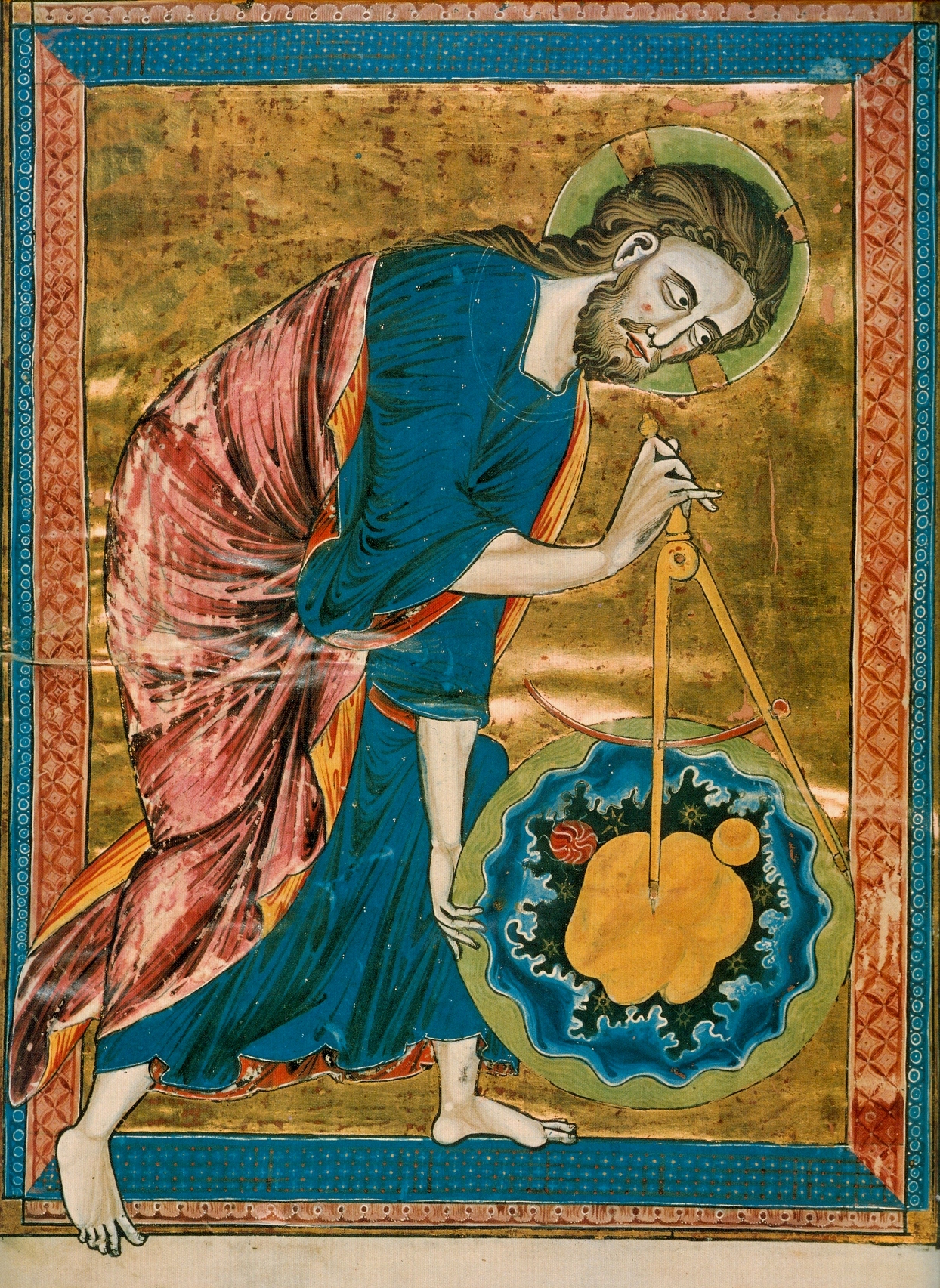
God creating the cosmos (Bible moralisée, French, 13th century)

Biblical cosmology is the biblical writers' conception of the cosmos as an organised, structured entity, including its origin, order, meaning and destiny.[1][2] The Bible was formed over many centuries, involving many authors, and reflects shifting patterns of religious belief; consequently, its cosmology is not always consistent.[3][4] Nor do the biblical texts necessarily represent the beliefs of all Jews or Christians at the time they were put into writing: the majority of the texts making up the Hebrew Bible or Old Testament in particular represent the beliefs of only a small segment of the ancient Israelite community, the members of a late Judean religious tradition centered in Jerusalem and devoted to the exclusive worship of Yahweh.[5]

The ancient Israelites envisaged the universe as a flat disc-shaped Earth floating on water, heaven above, underworld below.[6] Humans inhabited Earth during life and the underworld after death; there was no way that mortals could enter heaven, and the underworld was morally neutral;[7][8] only in Hellenistic times (after c. 330 BCE) did Jews begin to adopt the Greek idea that it would be a place of punishment for misdeeds, and that the righteous would enjoy an afterlife in heaven.[8] In this period too the older three-level cosmology in large measure gave way to the Greek concept of a spherical Earth suspended in space at the center of a number of concentric heavens.[9]

The opening words of the Genesis creation narrative (Genesis 1:1–2:3)[10] sum up the biblical editors' view of how the cosmos originated: "In the beginning God created the heavens and the earth"; Yahweh, the God of Israel, was solely responsible for creation and had no rivals, implying Israel's superiority over all other nations.[11] Later Jewish thinkers, adopting ideas from Greek philosophy, concluded that God's Wisdom, Word and Spirit penetrated all things and gave them unity.[12] Christian traditions then adopted these ideas and identified Jesus with the Logos (Word): "In the beginning was the Word, and the Word was with God, and the Word was God" (John 1:1).[13] Interpreting and producing expositions of biblical cosmology was formalized into a genre of writing among Christians and Jews called the Hexaemal literature. The genre entered into vogue in the second half of the fourth century, after it was introduced into Christian circles by the Hexaemeron of Basil of Caesarea.[14][15]

Cosmogony (origins of the cosmos)

[edit]
The Destruction of Leviathan (Gustave Doré, 1865)

Divine battle and divine speech

[edit]

Two different models of the process of creation existed in ancient Israel.[16] In the "logos" (speech) model, God speaks and shapes unresisting dormant matter into effective existence and order (Psalm 33: "By the word of YHWH the heavens were made, and by the breath of his mouth all their hosts; he gathers up the waters like a mound, stores the Deep in vaults"); in the second, or "agon" (struggle) model, God does battle with the monsters of the sea at the beginning of the world in order to mark his sovereignty and power.[17] Psalm 74 evokes the agon model: it opens with a lament over God's desertion of his people and their tribulations, then asks him to remember his past deeds: "You it was who smashed Sea with your might, who battered the heads of the monsters in the waters; You it was who crushed the heads of Leviathan, who left them for food for the denizens of the desert..."[17] In this world-view the seas are primordial forces of disorder, and the work of creation is preceded by a divine combat (or "theomachy").[18]

Creation in the "agon" model takes the following storyline: (1) God as the divine warrior battles the monsters of chaos, who include Sea, Death, Tannin and Leviathan; (2) The world of nature joins in the battle and the chaos-monsters are defeated; (3) God is enthroned on a divine mountain, surrounded by lesser deities; (4) He speaks, and nature brings forth the created world,[19] or for the Greeks, the cosmos. This myth was taken up in later Jewish and Christian apocalyptic literature and projected into the future, so that the cosmic battle becomes the decisive act at the end of the world's history:[19] thus the Book of Revelation (end of the 1st century CE) tells how, after the God's final victory over the sea-monsters, New Heavens and New Earth shall be inaugurated in a cosmos in which there will be "no more sea" (Revelation 21:1).[20]

The Genesis creation narrative (Genesis 1:1–2:3) is the quintessential "logos" creation myth. Like the "agon" model it begins with darkness and the uncreated primordial ocean:[21] God separates and restrains the waters, but he does not create them from nothing.[22] God initiates each creative act with a spoken word ("God said, Let there be..."), and finalises it with the giving of a name.[23] Creation by speech is not unique to the Old Testament: it is prominent in some Egyptian traditions.[24] There is, however, a difference between the Egyptian and Hebrew logos mythologies: in Genesis 1 the divine word of the Elohim is an act of "making into"; the word of Egyptian creator-god, by contrast, is an almost magical activation of something inherent in pre-creation: as such, it goes beyond the concept of fiat (divine act) to something more like the Logos of the Gospel of John.[24]

Naming: God, Wisdom, Torah and Christ

[edit]

In the ancient world, things did not exist until they were named: "The name of a living being or an object was ... the very essence of what was defined, and the pronouncing of a name was to create what was spoken."[24] The pre-exilic (before 586 BCE) Old Testament allowed no equals to Yahweh in heaven, despite the continued existence of an assembly of subordinate servant-deities who helped make decisions about matters on heaven and earth.[25] The post-exilic writers of the Wisdom tradition (e.g. the Book of Proverbs, Song of Songs, etc.) develop the idea that Wisdom, later identified with Torah, existed before creation and was used by God to create the universe:[4] "Present from the beginning, Wisdom assumes the role of master builder while God establishes the heavens, restricts the chaotic waters, and shapes the mountains and fields."[26] Borrowing ideas from Greek philosophers who held that reason bound the universe together, the Wisdom tradition taught that God's Wisdom, Word and Spirit were the ground of cosmic unity.[12] Christianity in turn adopted these ideas and applied them to Jesus: the Epistle to the Colossians calls Jesus "...the image of the invisible God, first-born of all creation...", while the Gospel of John identifies him with the creative word ("In the beginning was the Word, and the Word was with God, and the Word was God").[13]

Cosmography (shape and structure of the cosmos)

[edit]
The Old Testament cosmos.

Heavens, Earth, and underworld

[edit]

The Hebrew Bible depicted a three-part world, with the heavens (shamayim) above, Earth (eres) in the middle, and the underworld (sheol) below.[27] After the 4th century BCE this was gradually replaced by a Greek scientific cosmology of a spherical Earth surrounded by multiple concentric heavens.[9]

The cosmic ocean

[edit]

The three-part world of heavens, Earth and underworld floated in Tehom, the mythological cosmic ocean, which covered the Earth until God created the firmament to divide it into upper and lower portions and reveal the dry land;[28] the world has been protected from the cosmic ocean ever since by the solid dome of the firmament.[29]

The tehom is, or was, hostile to God: it confronted him at the beginning of the world (Psalm 104:6ff) but fled from the dry land at his rebuke; he has now set a boundary or bar for it which it cannot pass (Jeremiah 5:22 and Job 38:8–10).[30] The cosmic sea is the home of monsters which God conquers: "By his power he stilled the sea, by his understanding he smote Rahab!" (Job 26:12f).[30] (Rahab is an exclusively Hebrew sea-monster; others, including Leviathan and the tannin, or dragons, are found in Ugaritic texts; it is not entirely clear whether they are identical with Sea or are Sea's helpers).[31] The "bronze sea" which stood in the forecourt of the Temple in Jerusalem probably corresponds to the "sea" in Babylonian temples, representing the apsu, the cosmic ocean.[32]

In the New Testament Jesus' conquest of the stormy sea shows the conquering deity overwhelming the forces of chaos: a mere word of command from the Son of God stills the foe (Mark 4:35–41), who then tramples over his enemy, (Jesus walking on water - Mark 6:45, 47–51).[33] In Revelation, where the Archangel Michael expels the dragon (Satan) from heaven ("And war broke out in heaven, with Michael and his angels attacking the dragon..." – Revelation 12:7), the motif can be traced back to Leviathan in Israel and to Tiamat, the chaos-ocean, in Babylonian myth, identified with Satan via an interpretation of the serpent in Eden.[34]

Heavens

[edit]
The Tablet of Shamash depicting a scene in heaven, with celestial waters below, supported by a solid base, with four stars.[35]

Form and structure

[edit]

In the Old Testament the word shamayim represented both the sky/atmosphere, and the dwelling place of God.[36] The raqia or firmament – the visible sky – was a solid inverted bowl over the Earth, coloured blue from the heavenly ocean above it.[37] Rain, snow, wind and hail were kept in storehouses outside the raqia, which had "windows" to allow them in – the waters for Noah's flood entered when the "windows of heaven" were opened.[38] Heaven extended down to and was coterminous with (i.e. it touched) the farthest edges of the Earth (e.g. Deuteronomy 4:32);[39] humans looking up from Earth saw the floor of heaven, which they saw also as God's throne, as made of clear blue lapis lazuli (Exodus 24:9–10), and (Ezekiel 1:26).[40] Below that was a layer of water, the source of rain, which was separated from us by an impenetrable barrier, the firmament (Genesis 1:6–8). The rain may also be stored in heavenly cisterns (Job: 38:37) or storehouses (Deut 28:12) alongside the storehouses for wind, hail and snow.[41]

Grammatically the word shamayim can be either dual (two) or plural (more than two), without ruling out the singular (one).[42] As a result, it is not clear whether there were one, two, or more heavens in the Old Testament,[43] but most likely there was only one, and phrases such as "heaven of heavens" were meant to stress the vastness of God's realm.[39]

The Babylonians had a more complex idea of heaven, and during the Babylonian exile (6th century BCE) the influence of Babylonian cosmology led to the idea of a plurality of heavens among Jews.[44] This continued into the New Testament: Revelation apparently has only one heaven, but the Epistle to the Hebrews and the epistles to the Colossians and the Ephesians have more than one, although they don't specify how many,[45] and the apostle Paul tells of his visit to the third heaven, the place, according to contemporary thought, where the garden of Paradise is to be found.[46] The reference to the "third heaven" may refer to one of two cosmological systems present in antiquity: one where the cosmos was divided into seven heavens, and the other where the cosmos was divided into three.[47]

God and the heavenly beings

[edit]
The Archangel Michael, a member of the host of divine beings who attend God in heaven, defeating Satan, the dragon of chaos.[34]

Israel and Judah, like other Canaanite kingdoms, originally had a full pantheon of gods.[48] The chief of the old Canaanite pantheon was the god El, but over time Yahweh replaced him as the national god and the two merged.[48] The remaining gods were now subject to Yahweh: "Who in the sky is comparable to Yahweh, like Yahweh among the divine beings? A god dreaded in the Council of holy beings...?" (Psalm 89:6–9).[49] In the Book of Job the Council of Heaven, the Sons of God (bene elohim) meet in heaven to review events on Earth and decide the fate of Job.[50] One of their number is "the Satan", literally "the accuser", who travels over the Earth much like a Persian imperial spy, (Job dates from the period of the Persian empire), reporting on, and testing, the loyalty of men to God.[50]

The heavenly bodies (the heavenly host - Sun, Moon, and stars)[citation needed] were worshiped as deities, a practice which the bible disapproves and of which righteous Job protests his innocence: "If I have looked at the sun when it shone, or the moon ... and my mouth has kissed my hand, this also would be an iniquity..."[51] Belief in the divinity of the heavenly bodies explains a passage in Joshua 10:12, usually translated as Joshua asking the Sun and Moon to stand still, but in fact Joshua utters an incantation to ensure that the sun-god and moon-god, who supported his enemies, would not provide them with oracles.[52]

In the earlier Old Testament texts the bene elohim were gods, but subsequently they became angels,[53] the "messengers" (malakim), whom Jacob sees going up and down a "ladder" (actually a celestial mountain) between heaven and Earth.[54] In earlier works the messengers were anonymous, but in the Second Temple period (539 BCE–100 CE) they began to be given names, and eventually became the vast angelic orders of Christianity and Judaism.[48] Thus the gods and goddesses who had once been the superiors or equals of Yahweh were first made his peers, then subordinate gods, and finally ended as angels in his service.[48]

Paradise and the human soul

[edit]

There is no concept of a human soul, or of eternal life, in the oldest parts of the Old Testament.[8] Death is the going-out of the breath which God once breathed into the dust, all men face the same fate in Sheol, a shadowy existence without knowledge or feeling (Job 14:13; Qoheloth 9:5), and there is no way that mortals can enter heaven.[8] In the centuries after the Babylonian exile, a belief in afterlife and post-death retribution appeared in Jewish apocalyptic literature.[8] At much the same time the Bible was translated into Greek, and the translators used the Greek word paradaisos (Paradise) for the garden of God[55] and Paradise came to be located in heaven.[46]

Earth

[edit]
Babylonian Map of the World (c. 600 BCE). The Old Testament concept of the Earth was very similar: a flat circular Earth ringed by a world-ocean, with fabulous islands or mountains beyond at the "ends of the earth".[56]

Cosmic geography

[edit]

In the Old Testament period, the Earth was most commonly thought of as a flat disc floating on water.[22] The concept was apparently quite similar to that depicted in a Babylonian world-map from about 600 BCE: a single circular continent bounded by a circular sea,[57] and beyond the sea a number of equally spaced triangles called nagu, "distant regions", apparently islands although possibly mountains.[58] The Old Testament likewise locates islands alongside the Earth; (Psalm 97:1) these are the "ends of the earth" according to Isaiah 41:5, the extreme edge of Job's circular horizon (Job 26:10) where the vault of heaven is supported on mountains.[59] Other OT passages suggest that the sky rests on pillars (Psalm 75:3, 1 Samuel 2:8, Job 9:6), on foundations (Psalms 18:7 and 82:5), or on "supports" (Psalm 104:5).[60] The Book of Job imagines the cosmos as a vast tent, with the Earth as its floor and the sky as the tent itself; from the edges of the sky God hangs the Earth over "nothing", meaning the vast Ocean, securely supported by being tied to the sky (Job 26:7).[61] If the technical means by which Yahweh keeps the earth from sinking into the chaos-waters are unclear, it is nevertheless clear that he does so by virtue of his personal power.[62]

The author of Revelation assumed a flat Earth in Revelation 7:1.[63] The idea that the Earth was a sphere was developed by the Greeks in the 6th century BCE, and by the 3rd century BCE this was generally accepted by educated Romans and Greeks and even by some Jews.[64]

Temples, mountains, gardens and rivers

[edit]

In the cosmology of the ancient Near East, the cosmic warrior-god, after defeating the powers of chaos, would create the world and build his earthly house, the temple.[65] Just as the abyss, the deepest deep, was the place for Chaos and Death, so God's temple belonged on the high mountain.[66] In ancient Judah the mountain and the location of the Temple was Zion (Jerusalem),[65] the navel and center of the world (Ezekiel 5:5 and 38:12).[67] The Psalms describe God sitting enthroned over the Flood (the cosmic sea) in his heavenly palace (Psalm 29:10), the eternal king who "lays the beams of his upper chambers in the waters" (Psalm 104:3). The Samaritan Pentateuch identifies this mountain as Mount Gerizim, which the New Testament also implicitly acknowledges (John 4:20). This imagery recalls the Mesopotamian god Ea who places his throne in Apsu, the primeval fresh waters beneath the Earth, and the Canaanite god El, described in the Baal cycle as having his palace on a cosmic mountain which is the source of the primordial ocean/water springs.[68]

The point where heavenly and earthly realms join is depicted as an earthly "garden of God", associated with the temple and royal palace.[69] Ezekiel 28:12–19 places the garden in Eden on the mountain of the gods;[70] in Genesis 2–3 Eden's location is more vague, simply far away "in the east",[71] but there is a strong suggestion in both that the garden is attached to a temple or palace.[72] In Jerusalem the earthly Temple was decorated with motifs of the cosmos and the Garden,[73] and, like other ancient near eastern temples, its three sections made up a symbolic microcosm, from the outer court (the visible world of land and sea), through the Holy Place (the visible heaven and the garden of God) to the Holy of Holies (the invisible heaven of God).[74] The imagery of the cosmic mountain and garden of Ezekiel reappears in the New Testament Book of Revelation, applied to the messianic Jerusalem, its walls adorned with precious stones, the "river of the water of life" flowing from under its throne (Revelation 22:1–2).[75]

A stream from underground (a subterranean ocean of fresh water?) fertilises Eden before dividing into four rivers that go out to the entire earth (Genesis 2:5–6); in Ezekiel 47:1–12 (see Ezekiel's Temple) and other prophets the stream issues from the Temple itself, makes the desert bloom, and turns the Dead Sea from salt to fresh.[76] Yet the underground waters are ambiguous: they are the source of life-giving rivers, but they are also associated with death (Jeremiah 2:6 and Job 38:16-17 describe how the way to Sheol is through water, and its gates are located at the foot of the mountain at the bottom of the seas).[77]

Underworld

[edit]
Valley of Hinnom (or Gehenna), c. 1900. The former site of child-sacrifice and a dumping-ground for the bodies of executed criminals, Jeremiah prophesied that it would become a "valley of slaughter" and burial place; in later literature it thus became identified with a new idea of Hell as a place where the wicked would be punished.[78]

Sheol and the Old Testament

[edit]

Beneath the earth is Sheol, the abode of the rephaim (shades),[79] although it is not entirely clear whether all who died became shades, or only the "mighty dead" (compare Psalm 88:10 with Isaiah 14:9 and 26:14).[80] Some biblical passages are interpreted by some as saying that God has no presence in the underworld: "In death there is no remembrance of Thee, in Sheol who shall give Thee thanks?" (Psalm 6).[81] Others imply that the dead themselves are in some sense semi-divine, like the shade of the prophet Samuel, who is called an elohim, the same word used for God and gods.[82] Still other passages state God's power over Sheol as over the rest of his creation: "Tho they (the wicked) dig into Sheol, from there shall my hand take them..." (Amos 9:2).[83]

Intertestamental period

[edit]

The Old Testament Sheol was simply the home of all the dead, good and bad alike.[84] In the Hellenistic period the Greek-speaking Jews of Egypt, perhaps under the influence of Greek thought, came to believe that the good would go directly to God, while the wicked would really die and go to the realm of Hades, god of the underworld, where they would perhaps suffer torment.[85] The Book of Enoch, dating from the period between the Old and New Testaments, separates the dead into a well-lit cavern for the righteous and dark caverns for the wicked,[86] and provides the former with a spring, perhaps signifying that these are the "living" (i.e. a spring) waters of life.[87]

New Testament

[edit]

In the New Testament, Jesus' parable of the rich man and Lazarus reflects the idea that the wicked began their punishment in Hades immediately on dying.[85]

Satan and the end of time

[edit]

Hades in the New Testament is a temporary holding place, to be used only until the end of time, when its inhabitants will be thrown into the pit of Gehenna or the Lake of Fire (Revelation 20:10–14).[88] This lake is either underground, or will go underground when the "new earth" emerges.[88] The Satan does not inhabit or supervise the underworld – his sphere of activity is the human world – and is only to be thrown into the fire at the end of time.[88] He appears throughout the Old Testament not as God's enemy but as his minister, "a sort of Attorney-General with investigative and disciplinary powers", as in the Book of Job.[88] It was only with the early Church Fathers that he was identified with the serpent in the Garden of Eden and came to be seen as an active rebel against God, seeking to thwart the divine plan for humankind.[88]

See also

[edit]

References

[edit]

Bibliography

[edit]
[edit]
Revisions and contributorsEdit on WikipediaRead on Wikipedia
from Grokipedia
Biblical cosmology describes the structure and origins of the universe as conveyed in the Hebrew Bible and New Testament, depicting a central, disk-shaped earth resting on foundations or pillars amid primordial waters, overarched by a solid expanse known as the firmament that divides the cosmic waters into upper and lower realms, with celestial bodies affixed to or traversing this vault. This framework emerges principally from the creation narrative in Genesis 1, where forms the in six days, beginning with and culminating in humanity, emphasizing divine order imposed on chaos without reliance on rival deities or conflict motifs common in contemporaneous Near Eastern myths. Poetic and prophetic passages reinforce the 's stability—"He set the on its foundations, so that it should never be moved"—and portray the heavens as a or stretched out, underscoring a geocentric, pre-scientific aligned with ancient observational phenomenology rather than empirical measurement. Key characteristics include the three-tiered —heavens above for divine abode and celestial hosts, the earthly realm for human activity, and the () below—along with portals for rain, hail, and winds stored in the , reflecting a functional rather than mechanistic explanation of natural phenomena. While distinct from Babylonian or Egyptian cosmogonies by attributing unchallenged sovereignty to a singular creator , the model shares structural parallels such as the watery abyss and dome-like sky, suggesting cultural exchange in the . Notable controversies arise from tensions with post-Copernican astronomy and , prompting interpretive divides between literal readings—positing a young, stationary incompatible with and spherical globes—and accommodative views treating descriptions as metaphorical or phenomenological intended for theological instruction over scientific precision. Such debates persist among biblical inerrantists, who defend the text's veracity against empirical disconfirmation, and progressive scholars, whose analyses often reflect institutional predispositions favoring evolutionary timelines and .

Overview and Biblical Sources

Primary Texts and Their Scope

The primary texts articulating biblical cosmology are embedded within the (), serving theological rather than systematic scientific purposes. Genesis 1:1–2:3 provides the most structured account, portraying () as initiating creation ex nihilo through declarative speech acts over six sequential days: initial formless void and darkness (v. 2), (day 1), formation of the (raqia) to divide upper and lower waters (day 2), gathering of waters to reveal dry land and vegetation (day 3), in the firmament for signs, seasons, and light (day 4), sea creatures and birds (), land animals and humanity in God's image (day 6), followed by divine rest (day 7). This narrative emphasizes divine order imposed on chaos (tohu wabohu), with humanity stewarding the under God's rule. Complementary poetic and wisdom texts expand on these motifs without contradicting the Genesis framework. Psalm 104 enumerates God's creative provisions: stretching heavens like a tent, laying earth's foundations on waters, setting boundaries for seas, and sustaining creatures through cycles of day and night. Similarly, Proverbs 8 personifies as present at creation, witnessing the inscription of a circle on the deep's face, establishment of heavens, and securing of earth's pillars. Job 38–41 depicts interrogating Job on cosmic foundations—earth's cornerstone laying amid rejoicing stars, sea doors confining chaotic waters (), and storehouses for snow, hail, and winds—underscoring human limits in comprehending divine architecture. Prophetic books like Isaiah reinforce this scope, with Isaiah 40:12–22 measuring waters in God's palm, numbering stars, and sitting enthroned above the earth's circle (chug), while 45:18 declares earth formed not as tohu but for habitation. These texts collectively outline a cosmos of finite, ordered realms—heavens as divine expanse or tent, earth as stable disk or foundation amid waters, subterranean sheol—governed by Yahweh's unchallenged sovereignty, with no rival deities or eternal matter. The scope prioritizes purpose (God's glory and human relation to creation) over mechanistic details, assuming a phenomenological worldview shared with ancient Near Eastern contemporaries but reframed monotheistically. New Testament allusions, such as Colossians 1:16–17 on Christ's role in creating and sustaining all things, presuppose this framework without elaboration.

Evolution Across Old and New Testaments

The presents a detailed, multi-layered cosmology rooted in ancient Near Eastern motifs but adapted to emphasize Yahweh's sovereign , featuring a structured with heavens above, a flat supported by foundations or pillars, cosmic waters separated by a solid (raqia), and an (). This framework, evident in Genesis 1's ordered creation from chaos and poetic descriptions in (e.g., Psalm 104:5-9 depicting earth's stability and waters' boundaries), portrays a functional designed for divine-human interaction, with God's in the highest and celestial bodies as signs for timekeeping rather than deities. Prophetic texts like 40-55 reinforce this by contrasting Yahweh's control over creation with pagan idols' impotence, underscoring a stable, habitable world under divine decree. In contrast, the largely presupposes this inherited structure without extensive redescription, focusing instead on theological and eschatological reinterpretations amid Jewish developments and Hellenistic influences. Gospels and epistles reference heavens as plural realms (e.g., Paul's "" in :2, implying layered spiritual domains), earth as the present ordered realm, and as a temporary holding for the dead, aligning with OT but integrated into hope. Revelation's visions expand cosmically with a heavenly temple mirroring earthly tabernacles (Revelation 11:19; 15:5-8), cosmic judgments disrupting the firmament-like barriers (e.g., stars falling in Revelation 6:13), and ultimate renewal in "new heavens and new earth" (:1; cf. 65:17), shifting emphasis from static maintenance to transformative redemption through Christ. This evolution reflects a progression from OT's primary concern with origins, order, and covenantal stability—accommodating ancient phenomenological language to convey theological truths—to NT's Christ-centered , where cosmology serves . While retaining physical assumptions (e.g., ascension implying upward locality in Acts 1:9-11), NT texts spiritualize elements, portraying less as a distant vault and more as accessible ( 4:14-16; 9:24), influenced by intertestamental but prioritizing eternal kingdom over material reconfiguration. Scholarly analyses note this as divine accommodation to cultural contexts, with NT cosmology informing and mission rather than scientific mapping, evident in Peter's cosmic renewal via fire (2 Peter 3:10-13) paralleling but transcending OT motifs. Such shifts maintain continuity in monotheistic realism while adapting to fulfill prophetic trajectories toward .

Ancient Near Eastern Parallels

Shared Motifs and Structures

Biblical cosmology shares several foundational motifs with Mesopotamian, Egyptian, and Canaanite counterparts, reflecting a common ancient Near Eastern conceptual framework for the universe's structure. Central to these is the notion of a primordial watery chaos from which the ordered cosmos emerges, evident in Genesis 1's tehom (deep) paralleling the Babylonian Tiamat in the Enuma Elish, where divine action imposes order on chaotic waters rather than creating ex nihilo. Both traditions depict creation as a process of separation and division, with a divine entity dividing upper and lower waters to form habitable space. The cosmic architecture commonly features a solid or vault (raqia in Hebrew, akin to Egyptian and Mesopotamian sky domes) that holds back celestial waters above while supporting the below, regulating through gates or sluices. This envisions the as a flat, disk-like expanse floating on subterranean waters, stabilized by pillars or foundations extending into , a motif echoed in and Babylonian texts describing the world's base upon chaotic depths. Underworld realms exhibit parallels, with portrayed as a deep, shadowy pit for the dead, comparable to Mesopotamian Irkalla—a dusty, inescapable domain beneath the accessed via descents or cracks, devoid of and judgment in early depictions. Heavenly spheres similarly involve divine habitations above the , often with a cosmic mountain or assembly of gods, as in ' references to God's amid waters above, mirroring ANE motifs of elevated divine councils. These shared elements underscore a tripartite vertical axis—heavens, , underworld—embedded in the cultural milieu, though biblical texts adapt them to monotheistic emphases.

Distinctive Biblical Emphases

Biblical cosmology underscores a monotheistic framework in which a singular, transcendent exercises absolute sovereignty over creation, diverging from the polytheistic pantheons of Mesopotamian and Egyptian traditions where multiple deities vie for primacy through conflict. In contrast to the Enuma Elish, where ascends by battling the chaos goddess , Genesis presents as eternally preeminent, with no rival gods or divine assembly influencing cosmic origins. This emphasis rejects ANE theogonies—accounts of gods emerging from primordial chaos—and asserts God's otherness, as no genealogy or birth narrative precedes creation. The mode of creation further highlights biblical distinctiveness through divine fiat, where God orders the cosmos via speech acts repeated eight times in Genesis 1 (e.g., "And God said, 'Let there be light'"), without magical incantations or violence seen in Egyptian accounts like those of Thoth or Ptah. Unlike the Enuma Elish's formation from Tiamat's dismembered body, biblical texts depersonalize chaotic elements: the "deep" (tehom) in Genesis 1:2 remains inanimate and subordinate, not a divine adversary requiring defeat for order to emerge. This orderly progression—light preceding luminaries, vegetation before the sun—subverts ANE sequences tied to astral deities, framing creation as inherently good and purposeful rather than a byproduct of strife. Humanity's role embodies another key emphasis, portraying people as bearers of God's image (Genesis 1:26-27) tasked with and over creation, elevating dignity beyond the servitude to gods depicted in ANE epics like Atrahasis or Enuma Elish, where humans relieve divine labor through toil. This anthropological focus aligns with a teleological oriented toward rest and covenantal relationship, absent cyclical cultic reenactments in Babylonian rites, positioning biblical accounts as polemics demythologizing pagan cosmologies to affirm Yahweh's unchallenged rule.

Cosmogony: Origins and Creation

Divine Order in Genesis 1

In Genesis 1, the narrative depicts God imposing structured order upon an initial state of formlessness and emptiness, transforming primordial chaos into a habitable cosmos through a series of deliberate divine acts. The account opens with the earth described as tohu wabohu (formless and void), enveloped in darkness over the tehom (deep or abyssal waters), with the Spirit of God hovering above the waters, setting the stage for systematic organization rather than instantaneous formation from nothing within the chapter's framework. This progression emphasizes God's sovereignty via speech acts—"And God said"—repeated across six days, each culminating in divine evaluation: "and God saw that it was good," underscoring purposeful design over capricious disorder. The creation unfolds in a literary framework of two triads: days 1–3 establish realms of form, while days 4–6 populate them, highlighting thematic symmetry rather than strict chronological sequence in some interpretations. On day 1, is separated from darkness to form day and night; day 4 assigns luminaries (sun, , stars) to govern them. Day 2 divides upper and lower waters by a (sky); day 5 fills the skies with birds and seas with . Day 3 gathers waters to reveal dry land and yields vegetation; day 6 populates land with animals and humanity. This parallel structure, evident in the Hebrew text's repetitive formulas and chiastic echoes (e.g., reversal in fulfillment phrases like Genesis 1:17–18 mirroring 1:14–15), conveys theological intent: the as an ordered temple-like space, with humanity as its climax, created in God's for . Culminating on day 7, rests, blessing the and instituting a rhythm of work and cessation that sanctifies the ordered creation, free from ongoing labor. Unlike ancient Near Eastern myths involving divine conflict with chaos monsters, Genesis portrays non-violent mastery through , affirming monotheistic transcendence and the inherent goodness of the structured whole ("God saw everything that he had made, and indeed, it was very good"). This divine order rejects polytheistic randomness, presenting a causal chain from verbal command to empirical stability, with empirical echoes in observable cycles of , seasons, and biological . Scholarly analyses, such as those in the framework view, prioritize this literary to reconcile the text's poetic intent with scientific data on cosmic antiquity, though critics argue it underplays the narrative's historical claims.

Complementary Accounts in Psalms, Proverbs, and Job

In the poetic and wisdom literature of the , , Proverbs, and Job offer complementary perspectives on that expand upon the structured narrative of Genesis 1 by emphasizing divine artistry, wisdom's role, and the untamed aspects of creation. These accounts portray as the sovereign architect who imposes order on primordial elements through speech, power, and inscrutable purpose, rather than through conflict with rival deities, distinguishing biblical motifs from contemporary ancient Near Eastern myths. Psalm 104 presents a vivid hymn of creation, depicting as clothing himself in light and stretching the heavens like a tent curtain, while laying the earth's foundations so immovable that mountains rise and valleys sink at his rebuke. The psalm describes the gathering of chaotic waters above the and into seas, establishing boundaries that prevent inundation, followed by the provision of vegetation, seasons, and luminaries to sustain life. This elaboration highlights providence intertwined with origins, portraying creation as an ongoing divine sustenance rather than a singular event, with the formed as a playful creature amid the seas rather than a defeated foe. Proverbs 8 personifies (hokmah) as a divine present before the earth's formation, begotten by as the "first of his acts of old" and beside him as a during the establishment of heavens, horizons, and earth's foundations. rejoices in the inhabited world, delighting in humanity's realm, underscoring that creation proceeds through ordered intelligence inherent to God's nature, not arbitrary force. This portrayal complements Genesis by integrating ethical and relational dimensions into , positioning wisdom as the mediating principle ensuring cosmic stability and human . The culminates in Yahweh's whirlwind speech (chapters 38–41), where interrogates Job on laying the earth's amid cosmic rejoicing, shutting doors at creation's dawn, commanding dawn to seize earth's wicked, and storing snow, hail, and winds in heavenly treasuries. Vivid depictions extend to constellations like and Orion bound by divine hand, wild animals such as goats, donkeys, ostriches, and warhorses thriving in freedom, and the crafted with impenetrable scales and fiery breath as a display of Yahweh's unchallenged might. These rhetorical questions affirm creation's vastness and wildness beyond human comprehension, refuting reductive explanations and reinforcing monotheistic sovereignty over a purposeful yet mysterious order. Together, these texts enrich Genesis 1's systematic ordering by evoking awe at creation's dynamism—waters restrained, wisdom embodied, monsters subdued—while attributing all to Yahweh's unmediated , without polytheistic combat or emanation from chaos. Scholarly analyses note their hymnic style contrasts with Genesis's prose, serving liturgical and didactic functions to instruct on divine incomparability.

Cosmography: Structure and Layers

The Firmament and Cosmic Waters

In Genesis 1:6–8, the (Hebrew: rāqîaʿ, רָקִיעַ) is depicted as a structure created by on the second day to divide the primordial waters into two distinct realms: those below, associated with earthly seas and subterranean sources, and those above, forming a held in place. The term rāqîaʿ derives from the root rāqaʿ, meaning "to beat out" or "hammer thin," evoking the image of a , hammered metal sheet or vault stretched over the , capable of supporting celestial bodies and restraining the upper waters. This division establishes habitable space amid chaos, with the firmament named "heavens" (šāmayim) and functioning as a barrier against the upper waters, which are not mere atmospheric vapor or clouds but a vast, pre-existing chaotic sea subdued by divine . Passages like Psalm 148:4 reference "waters that be above the heavens," praising their praise of , while Job 37:18 likens the firmament to a "molten looking glass," reinforcing its solidity and reflective quality. The upper waters' role in precipitation is evident in Genesis 7:11, where "windows of the heavens" (ʾărubbôt haššāmayim) open during the , releasing torrents alongside subterranean "fountains of the great deep." Biblical cosmology thus portrays the firmament not as permeable sky but as an impermeable dome enclosing dry land below and embedding luminaries (created on day four) within or upon it, as in Genesis 1:14–17 and Ezekiel 1:22–26, where it appears as crystal-like expanse above living creatures. This structure underscores divine sovereignty over aquatic chaos, contrasting with ancient Near Eastern myths where gods battle sea monsters to impose order, though shared motifs of upper cosmic seas appear in Babylonian Enūma Eliš and Egyptian texts. Scholarly analyses, drawing from Hebrew lexicography and comparative Semitics, affirm the rāqîaʿ as a functional solid expanse in the text's phenomenological worldview, without implying scientific error but reflecting ancient observational reasoning from horizon-bound perspectives.

The Earthly Foundation and Geography

Biblical texts depict the earth as established on firm foundations laid by God during creation, emphasizing stability and immovability. In Psalm 104:5, it states, "He set the earth on its foundations, so that it should never be moved," portraying a divinely secured base preventing upheaval. Similarly, Job 38:4-6 queries, "Where were you when I laid the foundation of the earth? Tell me, if you have understanding. Who determined its measurements—surely you know! Or who stretched the line upon it? On what were its bases sunk, or who laid its cornerstone?" These passages evoke construction imagery, with bases sunk into underlying waters and a cornerstone for alignment. Isaiah 48:13 reinforces divine agency: "My hand laid the foundation of the earth, and my right hand spread out the heavens; when I call to them, they stand forth together." Further, several verses reference pillars supporting the earth, suggesting structural elements akin to ancient architectural supports. 1 Samuel 2:8 declares, "For the pillars of the earth are the Lord's, and on them he has set the world," implying the earth's stability rests on these divine pillars. This motif aligns with poetic descriptions of the earth as fixed, as in Psalm 93:1: "The world is established; it shall never be moved." Such language reflects a pre-scientific where the earth is a platform, not orbiting or rotating, but anchored against chaos. Regarding geography, biblical cosmology presents the with defined extremities, often using idiomatic expressions for its full extent rather than literal . :12 mentions gathering remnants "from the of the ," a phrase denoting remotest regions, paralleled in 7:2's "end... upon the of the land." References to "ends of the " in Deuteronomy 33:17 and elsewhere signify distant boundaries, encompassing the known inhabited world centered on . :22 describes sitting "above the circle of the ," suggesting a disk-like form viewed from above, with inhabitants as grasshoppers in scale. This circular motif, combined with foundational pillars, indicates a flattened, bounded floating amid cosmic waters, distinct from spherical modern models but consistent with phenomenological observation in ancient Hebrew thought.

The Heavenly Expanse and Divine Habitation

In the Genesis creation account, the heavenly expanse emerges on the second day as the raqia (often translated "firmament" or "expanse"), a structure formed by God to divide the primordial waters above from those below, thereby establishing a habitable space for earthly life. This expanse, designated shamayim ("heavens"), encompasses the visible sky and celestial realm where luminaries such as the sun, moon, and stars are later embedded on the fourth day. The Hebrew term raqia derives from a root implying something beaten out or spread, evoking a solid or vaulted dome-like barrier in ancient conceptualizations, though modern translations favor "expanse" to reflect its functional role in separating cosmic elements without presupposing material solidity. Beyond the physical expanse, biblical texts depict the heavens as the primary locus of divine habitation, where Yahweh's resides amid transcendent order. 66:1 declares, "Heaven is my , and the earth is my footstool," positioning the uppermost as the sovereign domain of , distinct from yet encompassing the created shamayim. reinforce this, with Psalm 11:4 stating, "The LORD is in his holy temple; the LORD's is in ," and Psalm 103:19 affirming, "The LORD has established his in the heavens." Such passages integrate the heavenly expanse with divine presence, portraying the skies not merely as atmospheric or astronomical but as a teeming with angelic hosts and the "host of " executing 's decrees (e.g., 1 Kings 22:19). This dual aspect—heavenly expanse as ordered creation and divine habitation as God's unchallenged seat—underscores monotheistic transcendence over polytheistic astral deities prevalent in Near Eastern lore. Ezekiel's visions further illustrate this, depicting a crystalline expanse above cherubim supporting God's throne-chariot, symbolizing unapproachable holiness amid mobility (Ezekiel 1:22-26; 10:1). Deuteronomy 26:15 invokes God to "look down from your holy habitation, from heaven," linking the expanse's vastness to divine oversight without conflating the created order with the Creator's essence. Rabbinic expansions, rooted in texts like the plural shamayim implying layered realms, later enumerated seven heavens, but core biblical imagery maintains three: atmospheric, stellar, and the paradisiacal throne-room (cf. 2 Corinthians 12:2, referencing paradisiacal third heaven). These descriptions prioritize functional causality—God as architect and inhabitant—over speculative mechanics, with empirical observations of sky phenomena (e.g., rain from "windows of heaven" in Genesis 7:11) integrated into theological realism.

The Underworld and Realm of the Dead

In biblical cosmology, represents the subterranean realm of the dead, positioned as the lowest stratum beneath the earth's foundations, forming part of a tripartite structure encompassing above, the habitable earth, and the underworld below. This abode accommodates the shades (rephaim) of all deceased individuals, irrespective of moral standing, in a dim, inactive existence marked by silence and separation from the living and divine vitality. Unlike later eschatological concepts of punitive , Sheol functions as a neutral repository, evoking descent into an inescapable pit or abyss, as evoked in Deuteronomy 32:22, where divine wrath extends "to the depths of Sheol." Descriptions in poetic texts portray Sheol as a cavernous domain of darkness and disorder, often accessed through gates or enveloped by the cosmic waters (tehom), echoing yet subordinating ancient Near Eastern motifs of underworld chaos under Yahweh's sovereignty. Job 10:21-22 likens it to "the land of gloom and chaos, where light is like darkness," emphasizing a shadowy, non-corporeal persistence devoid of praise or conscious activity, while such as 88:3-6 and 139:8 underscore its depth and inescapability, with the psalmist crying out from its "lowest pit." :9-11 further personifies Sheol as rousing to greet fallen kings, stirring its inhabitants in a realm of weakness and dust, highlighting a collective, undifferentiated repose rather than individualized judgment. Theologically, Sheol's integration into cosmology affirms Yahweh's dominion over death's domain, as in Amos 9:2—"Though they dig into , from there shall my hand take them"—contrasting pagan deifications of the while acknowledging mortality's finality in pre-exilic thought. Distinct from the (qeber), which denotes physical burial sites, Sheol transcends mere sepulture to embody the existential finality of human existence apart from hopes, which emerge sporadically in later prophetic texts like 32:18-32, envisioning collective descent without ethical differentiation. This framework reflects ancient Israelite realism about death's universality, prioritizing covenantal life on earth over speculation, though occasional laments imply yearning for divine rescue from its grasp.

Theological Foundations

Monotheistic Order Versus Pagan Chaos

Biblical cosmology emphasizes a singular, transcendent who imposes rational order on a pre-existing formless void through declarative speech, without conflict among divine beings or emergence from primordial chaos. In Genesis 1:2, the earth is described as "formless and empty" with over the deep, yet methodically separates elements—light from , waters above from below—to establish cosmic stability, culminating in divine rest on the seventh day. This portrayal underscores monotheistic , where creation ex nihilo or from unformed matter reflects God's unchallenged authority, contrasting sharply with polytheistic narratives that depict gods arising from and battling chaotic forces. Ancient Near Eastern pagan cosmologies, such as the Babylonian Enuma Elish (circa 18th–12th century BCE), present creation as emerging from violent strife within a pantheon born from primordial watery chaos embodied by Apsu and . Younger gods, led by , subdue the chaos goddess in battle, splitting her body to form heaven and earth, with her allies becoming celestial bodies; order arises from divine warfare and dismemberment, not serene fiat. Similarly, describe Baal's combat with the seven-headed sea serpent (a chaos monster cognate with biblical ), establishing kingship through repeated struggles against unruly cosmic threats. These accounts feature —gods begetting gods—and ongoing tension between order and personified chaos, implying an inherently unstable universe dependent on divine rivalries. The subverts such motifs by demythologizing chaos elements, portraying monsters like not as equals to but as creatures under his dominion, defeated effortlessly to affirm Yahweh's unchallenged rule. 74:13–14 and 27:1 depict crushing 's heads in past acts, while Job 41 describes its fearsome traits yet ultimate subjugation by divine power, without implying primordial threat to creation's origin. This theological reframing rejects pagan , where chaos perpetually menaces order, instead asserting a teleological purposefully structured for human habitation under one eternal Creator, free from interdivine conflicts. Scholarly analyses note these contrasts highlight biblical polemic against surrounding idolatries, privileging unipersonal divine will over multiplicity and strife.

Anthropocentric Purpose and Stewardship

In the , humanity occupies the apex of the created order, formed on the sixth day in 's image and likeness to exercise over the and its creatures, reflecting an inherently anthropocentric cosmology where the physical serves human purposes under divine sovereignty. Genesis 1:26-28 specifies that created humankind , blessing them to "be fruitful and multiply and fill the and subdue it, and have over the of the sea and over the birds of the heavens and over every living thing that moves on the ." This mandate positions humans not as incidental inhabitants but as vice-regents tasked with extending 's rule, with the 's resources ordered for human flourishing and cultivation. Theological analysis frames this dominion (Hebrew radah) as responsible governance akin to a king's authority, entailing subjugation (kabash) of the earth to prevent chaos and promote order, rather than arbitrary exploitation. As image-bearers, humans mirror God's providential care, stewarding creation to sustain population growth, agricultural development, and technological advancement in alignment with the command to fill and subdue the land. Psalm 8 elaborates this purpose, depicting God crowning humanity "with glory and honor" and placing "all [His] works under their feet," including animals and celestial bodies, underscoring the cosmos's orientation toward human dominion as a testament to divine generosity. This mandate persists post-Fall, undiminished by the curse on the ground (Genesis 3:17-19), as evidenced by reiterated commands to (Genesis 9:1-7) and the ongoing human mandate to labor and rule amid toil. Unlike pagan cosmologies marginalizing humans amid divine conflicts, centers creation's on relational covenant with through humanity, where stewardship fosters ethical rule—protecting against waste while harnessing resources for sustenance and —without elevating ecological concerns above human needs. Modern reinterpretations softening into egalitarian harmony often stem from post-20th-century environmental paradigms, diverging from the text's emphasis on hierarchical authority derived from Dei.

Eschatological Destiny

Cosmic Renewal in Prophetic Visions

In the prophetic books of the , cosmic renewal emerges as a divine act of re-creation following judgment, prominently envisioned in 65:17–25, where declares, "For behold, I create new heavens and a new earth; And the former shall not be remembered nor come to mind." This passage portrays a transformed characterized by enduring stability, communal joy in , extended human lifespan without or premature death, and ecological harmony, as "the wolf and the lamb shall feed together, The lion shall eat straw like the ox." Such imagery draws on Edenic motifs of peaceable kingdom, signaling not the annihilation of the existing order but its purification and elevation to reflect original creational intent. Isaiah 66:22 extends this vision, affirming that "the new heavens and the new earth Which I make shall remain before Me," says the ," emphasizing permanence amid prior oracles of cosmic upheaval, such as heavens vanishing like smoke in Isaiah 51:6. These prophecies integrate renewal with Yahweh's , where the created order—previously marred by and rebellion—is restored through divine initiative rather than human effort, prefiguring a where dwells without the curse of decay. Scholarly analyses interpret this as a holistic transformation of the physical , countering views of total dissolution by highlighting continuity in the renewed framework, akin to a reforged structure retaining essential form. Other prophetic texts echo elements of this renewal, though less explicitly cosmic in scope; for instance, Hosea 2:18 anticipates a covenant extending to beasts, birds, and creeping things, mirroring Isaiah's animal concord, while Joel 3:18 depicts revitalized natural abundance with mountains dripping wine and hills flowing with milk post-judgment. These visions collectively underscore a teleological arc from chaos to order, rooted in Yahweh's monotheistic rule, where cosmic elements—heavens, , waters, and fauna—participate in eschatological , free from the strife introduced after the primordial fall. This framework prioritizes empirical textual depiction over speculative accommodations to modern cosmology, affirming the prophets' portrayal of renewal as a verifiable divine promise tied to covenant fidelity.

Final Judgment and New Heavens/Earth

The final judgment concludes the eschatological sequence in biblical cosmology, portrayed in Revelation 20:11-15 as a cosmic before a great white throne, from whose presence the current heavens and earth flee, leaving no place for them. The deceased are raised for accountability, with books opened to record deeds, and a separate determining eternal destiny; those whose names are absent face the second death in the , alongside death and themselves. This event presupposes a prior millennial reign and binding of , emphasizing divine sovereignty over rebellion and the final vindication of against unrepentant . Preceding or accompanying this judgment, 2 Peter 3:7-13 describes the present heavens and reserved for destruction by on the day of and perdition of the ungodly, with elements melting in intense heat and cosmic order dissolving noisily. This cataclysmic purification—contrasting the water-based flood of —eliminates corruption, as the and its works are exposed and burned, paving the way for renewal where righteousness dwells through Christ's promise. Scholarly notes the imagery draws from Stoic-influenced apocalyptic motifs but roots in Yahweh's unchallenged control over creation's elements, ensuring not mere annihilation but . Following judgment, :1 announces a new and new succeeding the vanished first order, absent the symbolizing primordial chaos, with the holy city, , descending as God's dwelling among redeemed humanity. Here, former realities like death, mourning, crying, and pain cease entirely, as the old passes under divine declaration: "Behold, I am making all things new." Echoing 65:17's prophetic vision of new heavens and bringing joy and erasing prior distress, this consummation fulfills covenant promises of restoration, free from sin's curse, where God reverses and establishes eternal harmony. The absence of a temple underscores unmediated , with the city's dimensions—spanning 12,000 stadia cubed—symbolizing perfected communal dwelling under God's light alone.

Modern Debates and Interpretations

Literalist Defenses Against Scientific Materialism

Literalist interpreters of biblical cosmology maintain that the Genesis creation narrative describes historical events in ordinary providence, rejecting scientific materialism's presupposition of unguided natural processes operating over billions of years without divine intervention. Organizations such as Answers in Genesis and the Institute for Creation Research argue that the Hebrew text of Genesis 1 employs straightforward historical narrative, with "yom" (day) bounded by "evening and morning" indicating 24-hour periods, resulting in a universe roughly 6,000–10,000 years old when synchronized with biblical genealogies. This view counters materialist cosmology's big bang model, which posits a 13.8-billion-year-old expanding universe from a singularity, by asserting that the Bible's ex nihilo creation (Genesis 1:1) precedes and explains cosmic origins without requiring unobservable inflation or multiverses to resolve fine-tuning issues. Defenses emphasize empirical challenges to old-universe assumptions rooted in , the idea that present rates govern all past processes, which literalists claim ignores biblical catastrophes like Noah's . For instance, short-period comets like Halley's exhibit decay rates implying lifetimes under 10,000 years, as they lose material without sufficient replenishment mechanisms observed today, contradicting billions of years of solar system stability. Similarly, the moon's tidal recession from at 4 centimeters per year, extrapolated backward, would place it in contact with after just 1.4 billion years, undermining deep-time models that assume steady-state conditions over eons. diffusion rates in zircon crystals from deep-earth rocks yield ages of 1.5–6 billion years under assumed diffusion constants, but literalists argue accelerated diffusion during the aligns data with a young framework, critiquing materialist reliance on selective constants. On cosmic structure, literalists defend the biblical "" (raqia in Genesis 1:6–8) as an expanse separating waters, interpreted as the atmospheric or spatial realm rather than a solid dome, aligning with observed atmospheric layers and stellar distances without invoking ancient Near Eastern mythology. They reject accusations of geocentric or flat-earth cosmology as misreadings of phenomenological —descriptive from a vantage, akin to modern speech like "sunrise"—while affirming earth's centrality in purpose (anthropocentric design) over materialist uniformity. Against predictions, the cosmic microwave background's uniformity poses the , where distant regions share temperature without causal contact, a issue unresolved by theories that literalists view as additions presupposing no Creator. The biblical sequence—earth before (Genesis 1:14–16)—inverts chronology, with creationists proposing mature creation (e.g., in transit or in relativistic models) to account for distant starlight reaching in a young universe. These arguments frame scientific materialism as philosophically naturalistic, excluding supernatural causation a priori and thus biasing interpretations toward deep time despite anomalous data. Literalists contend that the universe's apparent antiquity results from rapid post-Fall processes and global Flood dynamics, such as accelerated radiometric decay or sediment layering, preserving biblical historicity while challenging materialism's causal closure. Proponents like those at ICR highlight ongoing big bang difficulties, including lithium abundance discrepancies and galaxy formation timelines exceeding model predictions, as evidence that empirical science does not necessitate old-age cosmology. This approach prioritizes scriptural authority as the benchmark for interpreting data, asserting that concessions to materialist timelines undermine doctrines like original sin and redemption tied to Adam's historical fall.

Phenomenological and Framework Readings

The phenomenological reading of Biblical cosmology interprets descriptions in texts like Genesis 1 as conveying observable phenomena from the perspective of ancient human observers, rather than providing a technical scientific model of the universe's structure or mechanics. For instance, the "expanse" or raqiya in Genesis 1:6–8 is understood as the visible spatial region separating waters above and below, appearing as a backdrop to earthly events, such as birds flying "on the face of the expanse of the heavens" in Genesis 1:20, which reflects the sky's visual role rather than a solid dome or precise atmospheric layer. Similarly, celestial bodies are placed "in" the expanse (Genesis 1:14–19) to denote their apparent position against the sky, aligning with sensory experience like the sun's daily motion, without implying a geocentric or flat-earth as inherent truth. This approach emphasizes that the Biblical authors accommodated language to common perceptual realities, prioritizing theological assertions—such as God's sovereign ordering of creation—over empirical cosmology, thereby avoiding conflict with modern observations like or . Proponents argue it distinguishes Biblical narrative from pagan myths, which often personify cosmic elements (e.g., chaotic deities battling for form), by presenting a non-mythic, monotheistic phenomenology where hangs "on " (Job 26:7) and serves functional purposes without inherent . Critics from literalist perspectives contend that overemphasizing phenomenology risks diluting the text's historical claims, potentially importing modern assumptions into ancient intent, though defenders maintain it upholds inerrancy by confining Biblical claims to verifiable theological domains. Complementing this, the framework reading applies particularly to the creation week in Genesis 1:1–2:3, positing a non-chronological literary structure organized into two parallel triads: days 1–3 establishing realms (light/darkness, waters/land, vegetation), paralleled by days 4–6 populating them (lights, birds/fish, land animals/humans). Originating in patristic thought, such as Augustine's observations of symmetries in City of God (circa 413–426 CE), it was formalized in the by figures like G. Rorison and advanced by Meredith G. Kline in the mid-20th century, who argued the "days" function as a metaphorical template to convey cosmic order against ancient Near Eastern chaos motifs, not a literal timeline. Kline's interpretation, detailed in works from the onward, views the framework as a "two-register" —transcendent heavenly acts overlaid on earthly providence—allowing compatibility with extended geological timelines while affirming of humanity, as Genesis 2:5 implies concurrent natural processes during forming. This reading underscores the text's polemical purpose against polytheistic origins, using topical arrangement for didactic emphasis rather than sequential history, though detractors argue it reclassifies to evade exegetical tensions with empirical data on earth's age. Both phenomenological and framework approaches thus frame Biblical cosmology as functionally theological, interpreting spatial and temporal elements through ancient literary conventions to highlight divine purpose over material causation.

Critiques of Secular Dismissals as Myth

Secular interpretations often categorize biblical cosmology, including the , as a comparable to ancient Near Eastern accounts, implying it is a non-historical shaped by cultural borrowing rather than . Critics of this dismissal contend that such classifications overlook structural and theological distinctions that elevate the biblical account beyond mythological genres, which typically feature polytheistic conflicts and emergent deities. For instance, whereas Babylonian myths like the Enuma Elish depict creation arising from divine warfare and the dismemberment of gods, Genesis portrays a singular, transcendent creating ex nihilo through sovereign speech without rivalry or chaos battles, culminating in rest rather than ongoing tension. This absence of theogonic elements—such as the birth or generational strife among gods—further differentiates Genesis from surrounding cosmologies, as the biblical exists eternally without origin or peers. Wayne Jackson argues that the narrative's use of historical , consistent with later patriarchal accounts involving verifiable figures like Abraham, precludes a purely mythic reading, treating primordial events like the formation of and Eden as foundational history rather than symbolic fable. Secular dismissals, by equating these with myths, impose anachronistic naturalism that a priori rejects agency, against the text's monotheistic claims of purposeful order. Even scholars favoring non-literal frameworks, such as C. John Collins, reject the "mere myth" label, emphasizing Genesis's historical impulse and theological intent to affirm human dignity in God's image, distinct from hierarchical pagan etiologies that justified social structures. This purposeful structure—repetitive divine commands yielding immediate order—challenges derivations from Mesopotamian lore, as Genesis inverts common motifs, like assigning luminaries a functional role subordinate to God's rule rather than deifying them. Dismissing it as myth thus reflects a bias in academic institutions toward methodological naturalism, which privileges empirical uniformitarianism over the biblical emphasis on transcendent causation, often without engaging the account's internal coherence or New Testament affirmations of its historicity, such as Jesus referencing "from the beginning of creation" in a literal sense (Matthew 19:4). Proponents further note that the biblical cosmology's integration with prophetic visions of renewal—envisioning a coherent eschatological arc from creation to new heavens and —lacks parallels in fragmented mythic cycles, suggesting a unified revelatory framework rather than folklore. Academic tendencies to label it , influenced by 19th-century higher criticism, have been critiqued for underestimating these uniques, as evidenced by mid-20th-century assessments like W.F. Albright's observation that Genesis anticipates scientific insights in its avoidance of mythological absurdities. Such dismissals, while citing cultural parallels, fail to account for the biblical narrative's demythologizing against pagan disorder, prioritizing empirical data on shared motifs over of monotheistic innovation.

References

Add your contribution
Related Hubs
User Avatar
No comments yet.