
_1X7A1577.jpg/250px-Renault_Clio_V_(2023)_1X7A1577.jpg)


_1X7A1577.jpg/2000px-Renault_Clio_V_(2023)_1X7A1577.jpg)
Community hub
Recent from talks
Contribute something
Nothing was collected or created yet.
Renault Clio
View on Wikipedia
| Renault Clio | |
|---|---|
_%E2%80%93_f_02092025.jpg) 2024 Renault Clio Techno | |
| Overview | |
| Manufacturer | Renault |
| Also called | Renault Lutecia (Japan) Mitsubishi Colt (2023–present) |
| Production | 1990–present |
| Body and chassis | |
| Class | Supermini (B) |
| Body style | 3-door hatchback (Clio I – III) 5-door hatchback (1990–present) 4-door sedan (Clio II) 5-door estate (Clio III & IV) |
| Layout | Front-engine, front-wheel-drive |
| Chronology | |
| Predecessor | Renault 5 |
The Renault Clio (/ˈkli.oʊ/) is a supermini (B-segment) car, produced by French automobile manufacturer Renault. It was launched in 1990, and entered its fifth generation in 2019. The Clio has had substantial critical and commercial success, being consistently one of Europe's top-selling cars since its launch,[1] and it is largely credited with restoring Renault's reputation and stature after a difficult second half of the 1980s. The Clio is one of only two cars, the other being the Volkswagen Golf, to have been voted European Car of the Year twice, in 1991 and 2006.
The car is named after Clio, one of the nine Muses in Greek mythology. In Japan, it is sold as the Renault Lutecia[2] because Honda retains the rights to the name Clio after establishing the Honda Clio sales channel in 1984. Lutecia is derived from the name of Lutetia, an ancient Roman city that was the predecessor of Paris. The Renault Lutecia was formerly available through Yanase Co., Ltd., but in 1999 Renault purchased a stake in Japanese automaker Nissan. Following Renault's takeover, distribution rights for the Lutecia were handed over to Nissan locations in 2000 and sold at Nissan Red Stage locations.[3]
First generation (X57; 1990)
[edit]| Clio I | |
|---|---|
.jpg) | |
| Overview | |
| Model code | X57 |
| Also called | Renault Lutecia (Japan) |
| Production | 1990–1998 (France) 1996–2001 (Colombia) |
| Assembly |
|
| Body and chassis | |
| Body style | 3/5-door hatchback |
| Powertrain | |
| Engine | |
| Transmission | 4/5-speed manual 3-speed automatic 4-speed automatic |
| Dimensions | |
| Wheelbase | 2,472 mm (97.3 in) |
| Length | 3,709 mm (146.0 in) |
| Width | 1,616 mm (63.6 in) (1990–1996) 1,625 mm (64.0 in) (1996–1998) |
| Height | 1,360 mm (53.5 in) |
| Curb weight | 930 kg (2,050 lb) |
Renault had replaced its R5 supermini with a completely redesigned model (which had similar styling to the 1972 original) in 1984, but soon afterwards began working on an all-new supermini to take the company into the 1990s. It was eventually decided that the new car would feature a name designation, rather than the numeric model designations which Renault had traditionally used – this would be adopted across the entire Renault range by 1995. Cars like the Fuego coupe (launched in 1980) had been an exception to this rule, and the last "numeric" Renault was the 19, launched in 1988, and by the end of 1996 the numeric model designations had completely disappeared from the Renault range in Western Europe.
The Clio was introduced at the Paris Motor Show in June 1990 and sales in France and the rest of the continent began then, although sales in right-hand drive Britain did not begin until March 1991. The Clio was the replacement to the hugely successful Renault 5, although this car remained in production until 1996 at a factory in Slovenia, where some versions of the Clio were later built. The Clio's suspension and floorpan were largely the same as the R5, which was derived from the R9 saloon of 1981 and R11 hatchback of 1983 – not that of the original 1972 Renault 5, despite the later R5 visually resembling the original model.
The suspension uses half-width torsion bars (full-width on higher spec models) with trailing arms at the rear, and coil sprung MacPherson struts, attached to a thick pressed steel subframe at the front. The engine range available at launch included 1.2 L and 1.4 L E-type "Energy" petrol inline-four engines (first seen in the Renault 19) and 1.7 L and 1.9 L diesel engines, both based on the F-type unit. The petrol engines gradually had their carburettors replaced with electronic fuel injection systems by the end of 1992, in order to conform to ever stricter pollutant emission regulations brought in by the EEC.
.jpg)

.jpg)

A minor trim facelift occurred after only a year of being on sale. A new "smooth" version of the Renault diamond badge (the previous "ribbed" badge was being phased out at the time) and a new front seat design were the only changes. The altered design did not constitute a new "phase". In March 1994 (at the Geneva Motor Show), the phase two model was launched, with small updates to the exterior and interior of the Clio.[5] Most noticeable was the change in the front grille from two metal ribs to a single colour-coded slat. The bump strips were made slightly larger and rounder and had the car's trim level badge incorporated into them. The badges on the tailgate strip were moved up onto the tailgate itself and the tailgate strip was given a carbon fibre look. The rear light clusters were given a slightly more rounded bubble shape, giving the Clio a more modern look. The clusters, however, are physically interchangeable with phase ones'.[citation needed]
In May 1996, with the arrival of the phase three facelifted Clio, the 1.2 L Energy engine was replaced by the 1,149 cc D7F MPi (multi point injection) DiET engine, first used in the Renault Twingo; for some time also, versions were available with the older 1239 cc "Cléon" unit from the original Twingo. The cylinder head design on the 1.4 L E-type was also slightly altered for the phase three models in a bid for better fuel economy. This resulted in the engines producing slightly less power than their earlier versions.[citation needed]
The phase three Clios have a slightly more noticeable update than the phase twos. The phase three has different, more rounded headlights, incorporating the turn signal in the unit with the headlight, and the bonnet curves more around the edges of the lights. The tailgate incorporates a third brake light and a new script "Clio" name badge, following the same typeface as contemporary Renaults. Some mechanical improvements were also made, as well as the introduction of side impact bars and airbags, which were now common features on mainstream cars across Europe.[citation needed]
Renault also released a hot hatch version of the Clio in 1991. It was aesthetically very similar, but with the addition of an 81 kW (110 PS) 1.8 L eight-valve engine, side skirts and disc brakes on all wheels. This, with multi-point fuel injection, was badged as the RSi.[5] From 1991 a lighter tuned version of this 1.8 litre engine (with single-point injection) joined the earlier 1.7 used in the very luxurious Baccara version which was sold in some continental European markets. In addition to this reasonably powerful engine, the Baccara has a luxurious interior with much leather and wood, as well as power windows, locks, etc. The Baccara was renamed "Initiale" in 1997, in line with other Renaults, differing from the Baccara mainly in the wheel design.

During 1991, a fuel injected 1.8 L 16-valve engine producing 101 kW (137 PS) (which had debuted on the Renault 19) capable of propelling the car to 209 km/h (130 mph) was introduced to the Clio engine range, known simply as the Clio 16S in France (S for "soupapes", the French word for valves), and Clio 16V in export markets. It was the successor to the Renault 5 GT Turbo, which was discontinued that year as the R5 range was pruned back.[6] As well as having a higher top speed than a regular Clio, the 16S sports wider plastic front wings, an offset bonnet vent, wider rear arches and uprated suspension and brakes, and colour-coded front mirrors and bumpers. The RSi side skirts were omitted, however. Inside, the 16V model has an extended instrument panel that houses dials for engine oil pressure, oil temperature, and oil level (which only indicates on engine start). The seats are also more supportive to match the sporting nature of the model. The non-catalyzed versions, still available in some markets, offer 100 kW (140 PS) and marginally higher performance with top speeds up to 212 km/h (132 mph) and the 0–100 km/h (62 mph) time dropping from 8 to 7.8 seconds.[6]
In December 1990, the Clio was voted European Car of the Year for 1991,[7] and soon became one of Europe's best-selling cars, as well as the first Renault to be consistently among the top-10 best sellers in the United Kingdom, where it was selling in excess of 50,000 units a year by 1995. UK sales were helped by a famous television advertising campaign by Publicis shot in France, featuring the two main characters of Papa and Nicole, played by Max Douchin and Estelle Skornik respectively.
From 1991 to 1993, trim levels were identical in every European country. Starting in 1993, trim levels designations became more varied across the various markets.[citation needed] The car was sold as the Renault Lutecia (from Lutetia, the Latin name for Paris) in Japan, as "Clio" was used there by Honda for one of their domestic marketing networks.
Clio Williams
[edit]

In 1993, Renault launched the Clio Williams as a limited edition of 3,800 cars (1,300 more than they needed for homologation purposes) with each car bearing a numbered plaque on the dash. These sold out so quickly that Renault ended up building 1,600 more.[8]
After the first series, due to the demand, Renault built the Williams 2 and 3, with more than 12,000 eventually being built. However, many new road cars were directly converted to race cars and when damaged replaced with another converted road car, which means that the actual number of road cars is significantly lower than the figures suggest.
The car was named after the then Renault-powered Formula One team WilliamsF1, though Williams had nothing to do with the design or engineering of this Clio. The modifications to the Clio 16S on which it was based were the work of Renault Sport, Renault's motorsport division. Nevertheless, this car had a Formula One link by being the sport's Safety Car in 1996.[9]
The naturally aspirated 1,998 cc (2.0 L; 121.9 cu in) DOHC 4 valves per cylinder fed by Multipoint fuel injection Inline-four engine, was rated at 108 kW; 145 hp (147 PS) at 6,100 rpm and 175 N⋅m (129 lb⋅ft) at 4,500 rpm of torque. It has a top speed of 215 km/h (134 mph)[10] equipped with performance-tuned ride and handling. Renault later released the Williams 2 and Williams 3 special editions, much to the chagrin of those owners who had been assured of the exclusivity of the "original" Williams. One common mistake people can make is thinking that the 2.0 16V (F7R) used in the Williams is simply a bored out 1.8 16V (F7P), whereas, in reality the large engine had different size valves, cams, stroked crank and engine oil cooler. Other differences between the Williams and the Clio 16S it is based on include a wider front track with wishbones similar, but not the same as the Renault 19, wider Speedline alloys, uprated (JC5) gearbox, bespoke four-to-one manifold, firmer suspension, and some cosmetic differences on the exterior and interior.[citation needed]
The differences between the three versions of the Williams were largely a reflection of phase changes across the Clio range, e.g. the gradual addition of enhanced safety features and cosmetic variations. Other than this, the Williams 1 and 2 had no sunroof and were painted in 449 Sports Blue. The final Williams 3 was painted in a slightly brighter shade of blue (432 Monaco Blue) and finally gained a sunroof which had long been standard on virtually all previous Clios. The original Williams was the lightest of the three, lacking the electrics necessary for the sunroof or the mirrors, and was the only one to support a metal plaque stating the build number.
The Renault Clio Williams was and still is a very popular rally car.[citation needed] The basic racing version (Gr.N) had racing suspension, different engine management, and a more free flowing exhaust. Power output was around 121 kW (165 PS). Roll cage was made by Matter France. Bucket seats were made by Sabelt.
The next step up was the Gr.A car, which was fitted with 16-inch Speedline 2012 rims (with optional extractors), further improvements on suspension and a more tuned engine producing between 151–162 kW (205–220 PS). Front brakes were also updated with 323 mm discs and four-pot Alcon brake calipers.
The final evolution was the Renault Clio Williams Maxi kit-car with wider arches and 17-inch Speedline 2012 rims and improved Proflex suspension. The Sodemo engine was further tuned to 184–195 kW (250–265 PS).
Engines
[edit]| Model | Engine | Displacement | Valvetrain | Fuel system | Max. power at rpm | Max. torque at rpm | Years |
|---|---|---|---|---|---|---|---|
| Petrol | |||||||
| 1.2 | E5F | 1171 cc | SOHC 8v | Carburettor | 44 kW; 59 hp (60 PS) at 6000 rpm | 85 N⋅m (63 lb⋅ft) at 3500 rpm | 1990–1993 |
| E7F | 1171 cc | Single-point fuel injection | 40 kW; 53 hp (54 PS) at 6000 rpm | 83 N⋅m (61 lb⋅ft) at 3500 rpm | 1990–1997 | ||
| C3G | 1239 cc | Single-point fuel injection | 40 kW; 53 hp (54 PS) at 6000 rpm | 83 N⋅m (61 lb⋅ft) at 3500 rpm | 1995–1996 | ||
| D7F | 1149 cc | Multi-point fuel injection | 40 kW; 53 hp (54 PS) at 5250 rpm | 93 N⋅m (69 lb⋅ft) at 2500 rpm | 1996–1998 | ||
| 43 kW; 57 hp (58 PS) at 5250 rpm | 93 N⋅m (69 lb⋅ft) at 2400 rpm | 1997–1998 | |||||
| 1.4 | E7J | 1390 cc | Single-point fuel injection | 55 kW; 74 hp (75 PS) at 5750 rpm | 107 N⋅m (79 lb⋅ft) at 3500 rpm | 1990–1998 | |
| 58 kW; 78 hp (79 PS) at 5750 rpm | 107 N⋅m (79 lb⋅ft) at 3500 rpm | 1996–1998 | |||||
| 1.7 | F2N | 1721 cc | 66 kW; 89 hp (90 PS) at 5750 rpm | 1990–1991 | |||
| 1.8 | F3P | 1794 cc | 65 kW; 87 hp (88 PS) at 5750 rpm | 142 N⋅m (105 lb⋅ft) at 2750 rpm | 1990–1996 | ||
| 1783 cc | 66 kW; 89 hp (90 PS) at 5750 rpm | 144 N⋅m (106 lb⋅ft) at 2750 rpm | 1996–1998 | ||||
| 1.8 RSi | 1794 cc | Multi-point fuel injection | 81 kW; 110 hp (110 PS) at 5500 rpm | 155 N⋅m (114 lb⋅ft) at 4250 rpm | 1993–1995 | ||
| 1783 cc | 79 kW; 106 hp (107 PS) at 5500 rpm | 150 N⋅m (111 lb⋅ft) at 2750 rpm | 1995–1998 | ||||
| 16S / 16V | F7P | 1764 cc | DOHC 16v | 101 kW; 135 hp (137 PS) at 6500 rpm | 158 N⋅m (117 lb⋅ft) at 4250 rpm | 1991–1995 | |
| 2.0 Clio Williams | F7R | 1998 cc | 110 kW; 150 hp (150 PS) at 6100 rpm | 175 N⋅m (129 lb⋅ft) at 4500 rpm | 1994–1998 | ||
| Diesel | |||||||
| 1.9 d | F8Q | 1870 cc | SOHC 8v | Indirect injection | 47 kW; 63 hp (64 PS) at 4500 rpm | 118 N⋅m (87 lb⋅ft) at 2250 rpm | 1991–1998 |
Safety
[edit]Second generation (X65; 1998)
[edit]| Clio II | |
|---|---|
 | |
| Overview | |
| Model code | X65 |
| Also called | Renault Clio Campus Renault Lutecia (Japan) Renault Mío (Argentina) Renault Symbol (Brazil) Renault Taxi Express (Colombia) Nissan Platina (Mexico) |
| Production | |
| Assembly |
|
| Designer | Patrick Le Quément (1993) |
| Body and chassis | |
| Body style | 3/5-door hatchback 4-door sedan |
| Platform | Renault A Platform (X65) |
| Related | Dacia Logan |
| Powertrain | |
| Engine | |
| Transmission | 5/6-speed manual 4-speed automatic 5-speed QuickShift automated manual |
| Dimensions | |
| Wheelbase | 2,472 mm (97.3 in) |
| Length | 3,773 mm (148.5 in) (1998–01) 4,150 mm (163.4 in) (1998–01 sedan) 3,811 mm (150.0 in) (2001–12) 4,171 mm (164.2 in) (2001–08 sedan) |
| Width | 1,639 mm (64.5 in) |
| Height | 1,417 mm (55.8 in) (hatchback) 1,437 mm (56.6 in) (sedan) |
| Curb weight | 990 kg (2,183 lb) |

_3-door_hatchback_(2015-07-24)_01.jpg)
_3-door_hatchback_(25696139476).jpg)


Design, development and introduction
[edit]Development of the second generation of Clio, (designated X65) commenced in 1991, just one year after the May 1990 launch of the first generation Clio. The initial development stage was led by Jean Terramorsi but switched head development as time and development stages went on. Pierre Beuzit became project manager of the program in 1992, and then in December 1993 a final design developed under the leadership of Patrick Le Quément was subsequently approved for pre production. In the first quarter of 1994 Renault rented a 129,600-square-foot building in Saint-Quentin-en-Yvelines, west of Paris, employing more than 600 people from both Renault itself and all of its suppliers. Renault's Guyancourt technical centre became the main hub for development of the platform at this time, becoming responsible for the chassis, suspension and drivetrain. New concepts such as making panels out of unusual materials to save in weight and repair costs were proposed, for example, the front wings were made of plastic (following criticisms of corrosion/rusting on the Clio 1 and based on technology developed for the Renault Espace) and the bonnet was made out of aluminum in some production versions for weight reduction to combat fuel costs. Forty separate teams were created, each responsible for a section of the car. In February 1997, management moved its predicted market launch by nearly a month from the 15th March 1998 to the 11th April 1998. Around the same time as this pushback, prototyping had almost been completed and pre-production units began to be constructed at Flins for final tweaks and improvements.[22][23][24]
The second generation of the Clio was officially launched on April 11, 1998 - with Renault's marketing campaign emphasizing it's much more bulbous and modern design, improved safety features, and overall better driving experience compared to its predecessor.
Trim levels at launch
[edit]At launch, 4 different engine sizes and configurations were available. A 1.2L 8V (60 hp) engine which was typically available in the entry-level trims, a 1.4L 8V (75 hp) engine, and a 1.6L 16V (90 hp) engine for those who wanted a sportier driving experience. There were 3 different trim levels, the RN, RT an RXE. They represented the base spec, mid range spec and high spec models.
The RN was the entry-level trim with essential features only, like manual windows and a simple radio.
The RT/E offered more comfort features, like power windows, central locking, and higher quality seats and door cards.
The RXE was the highest spec trim at launch, and came with features such as air conditioning, alloy wheels and 60W stereo systems.
Post launch trim levels
[edit]In 1999, Renault launched the Clio Renault Sport 172 (also known as Clio R.S. for short), with 172 hp (127 kW) produced by a 2.0L 16-valve engine, it could reach a top speed of 220 km/h (137 mph). This was named the Clio Renault Sport 172 in the UK – 172 coming from the DIN method metric horsepower measurement. The standard Clio RTE powered with by the 1.2 54 hp (40 kW) engine could reach 160 km/h (99 mph).[citation needed] The top-of-the-range Clio, however, was the 2001 mid-engine, rear-wheel drive Clio V6 Renault Sport, originally engineered by Tom Walkinshaw Racing for a one-make racing series, which placed a 230 hp (169 kW) 3.0L V6 engine, sourced from the Renault Laguna, behind the front seats, with a top speed of 235 km/h (146 mph).[citation needed] Production was at the TWR factory in Sweden. Clio V6 production over three years was approximately 1513 vehicles with 256 sold in the UK.
Renault at this time also launched two new engine configurations, A version equipped with a new 1.6L 16-valve engine, along with a refined 1.9L 8-valve turbo-diesel.[25][26] They used these engines to push their new "warm hatch" variants - the Si (Sports injection) and RSI (RenaultSport injection) trims.
The Clio Sport collection
[edit]Whilst the 172 and V6 became the flagship performance models under RenaultSport, the Si and RSI were much lesser-known variants aimed at offering sporty styling and enhanced features at a more accessible price point. Both models today are considered rare, with the Si spec being exceptionally rare. Unlike the RSI, which benefitted from the brand new 1.6 16V engine, the Si occupied an extremely unusual position in the lineup - It combined the styling an features of a performance model whilst using a diesel powertrain - a choice which was uncommon at the time as diesels were known for economy, not performance. As a result, the Si saw extremely limited production (under 8,000 units globally) which lasted just over 1 year before being pulled off the market entirely. Both trim levels featured body coloured bumpers, white instrument dials and alloy wheels, on top of all other standard and options that the highest trim Clio's came with. The Clio Si, whilst being less powerful with the new 1.9L dTi diesel engine, also carried all of the sporty design clues as the RSI did but with the addition of bucket seats in the front, and an electric back tilt sunroof.
Both of these models came with ABS, alloy wheels, both driver and passenger airbags, 60w RDS radios, rear spoilers and heat reflecting windscreens as standard options.
After this time, all the older petrol engines were upgraded to more powerful and more economical 16-valve versions.
Later on in 2000, a few minor changes were made to the Clio range, which included revised specification levels, a new instrument cluster, and a passenger airbag fitted as standard for all models.
In Japan, Renault was formerly licensed by Yanase Co., Ltd., but in 1999, Renault purchased a stake in Japanese automaker Nissan after Nissan had faced financial troubles following the collapse of the Japanese asset price bubble in 1991 and subsequent Lost Decade. As a result of Renault's purchase of interest, Yanase canceled its licensing contract with Renault in the spring of 2000, and Nissan took over as the sole licensee, hence sales of the Lutecia II in Japan were transferred from Yanase Store locations to Nissan Red Stage Store locations.
The Clio Freeway collection
[edit]Following the release of the Clio sport collection, the Clio Freeway collection was launched - it was the entry level collection of the Clio 2 in 2000, and It consisted of the base model Clio Liberte, Clio Grande, and the Clio MTV. This collection was aimed at the much more casual driver, who valued a car to get them from point A to B and nothing more.
The Clio Liberte featured a driver and passenger airbag as standard, with no other options available. The Clio Grande came with power steering, central locking, a sunroof and 60w RDS radio as standard on top of all Liberte features. The flagship of the Freeway collection was the Clio MTV, a special edition of the Renault Clio, created in collaboration with MTV, the popular music television network. This limited-edition model was aimed at younger drivers and featured unique styling and entertainment-focused features such as an MTV themed interior, MTV badging, a 64W radio system with 6 speakers as standard, and all other "medium" trim options offered around this time.
The Clio Elegance collection
[edit]The Clio Elegance Collection represented a premium line of trims designed to offer features typically found in more expensive executive cars. There were three models in the collection, the Clio Alize, the Clio Etoile and the Clio Initiale. All three included options like air conditioning, leather upholstery, power steering, electric front windows, and advanced audio systems. The Initiale trim, positioned as the flagship, featured luxury touches such as wood-effect trims and leather steering wheels. This collection was particularly popular for those seeking compact luxury, competing directly with the more youthful Sport Collection and the entry-level Freeway Collection, which focused on performance and affordability, respectively. The Elegance Collection's blend of comfort and refinement contributed to its strong sales and appeal.
Electric Clio
[edit]An electric version of the Clio was developed by Renault for an electric carshare project in Saint-Quentin-en-Yvelines in 1998. Fifty cars were produced,[27] and could be charged by plugging in or by an induction pad located in some of the town's special locations. The electric Clio had a claimed top speed of 60 mph and a range of 35–40 miles.[28] The scheme was branded Praxitèle and membership was charged at £10/month and around £3 for a 30-minute trip.
Phase 2
[edit]
.jpg)

A major facelift occurred in June 2001 (Phase 2) which saw the exterior restyled (most visibly the headlights were made more angular), the interior quality improved with a new dashboard and centre console including the availability of digital climate control air-conditioning and satellite navigation on top models and a 1.5 L common rail Diesel engine added.
2003
[edit]Major revisions were made to the mid-engine 3.0 litre V6 model in line with the facelift introduced to the regular models in 2001 including revised frontal styling, new dashboard and higher equipment levels including climate control, cruise control and xenon headlights. The power output of the engine was raised by 25 PS (18 kW) to 255 PS (188 kW), giving it a top speed of 153 mph (246 km/h) and a 0–62 mph (100 km/h) time of 5.8 seconds. Emissions are 285g/km and meet Euro IV standards 2 years before the implementation deadline. The chassis was also significantly revised with a slightly longer wheelbase and revised suspension together with larger 18 inch alloy wheels. For the Phase 2 V6, production was transferred from TWR's Swedish factory to the dedicated Renault Sport Alpine factory at Dieppe in Northern France. Production from 2003 to the end of 2005 was approximately 1309 vehicles of which 354 were sold in the UK.
On ordinary cars, an interior equipment specification change was made from this model year – fitment of a CD player as standard (as opposed to cassette) on Expression and Dynamique. It remained optional on Authentique and its Rush derivative.
Phase 3
[edit]


In 2004, Phase 3 followed starting on a 53 Plate, this was just some small changes to bring it up to date. The front bumper was changed giving it a wide lower grille and the foglights were bulged out at the side (cars not equipped with foglights remained using the older ph2 bumper), the upper grille was changed and the headlights (which previously had black background) now had grey. The 15" alloy wheels were changed and were now a 15" version of the facelift 172 model on Dynamique and Extreme models. Clear side repeaters were added, as was a colourcoded rear spoiler (again on Dynamique spec cars). In the South American market, the facelifted Clio continued to use the dashboard of the 1998 model and was never updated, except for the Colombian 2008 model that included the same interior of the European version with little changes, and continued having the same exterior as the phase II model.[citation needed]
On the inside the pattern on the seats was changed for a simpler one, and the dials were changed to do away with the fuel and water temperature needles and now featured a larger screen that included a digital version of these gauges as well as the mileage and trip computer. Climate control equipped cars were given a vent in the back of the glove box so it could be climate controlled. Under the bonnet a new 100 PS (74 kW) dCi engine was available (the 1.2 16v also received a new engine developed with Nissan). Rear disks were fitted on 1.6 16v models and DCi 100 models equipped with ESP. On this second facelift, the Clio Renault Sport's power was improved to 182 PS (134 kW) (in the UK, the designation R.S. 182 was adopted). For the first time there were two options in chassis stiffness for the R.S. model. the standard Settings (different from the non-sport models), and CUP badge chassis, 20 mm lower, larger stabilizer bars, and stiffer suspension with dark graphite alloy wheels.
At the 2006 Paris International Agricultural Show, Renault exhibited a Hi-Flex Clio II with a 1.6 L 16-valve engine. This vehicle, which addresses the Brazilian market, features Renault-developed flex-fuel technology, with a highly versatile engine that can run on fuel containing a blend of petrol and ethanol in any proportion (0% to 100% of either).
Phase 4 / 5
[edit]_%E2%80%93_Frontansicht,_1._September_2012,_Heiligenhaus.jpg)
_%E2%80%93_Heckansicht,_1._September_2012,_Heiligenhaus.jpg)
The Phase 4 Clio II, known as the Clio Campus, was introduced in 2006 and had a restyled rear end, the number plate moving from boot to bumper, and a better specification on all models.[29] This car stopped being sold in the UK in late 2008, and a revised front end was then released in April 2009 (Phase 5).[30]


The last units of the Clio II built in Mexico featured the headlights used on the Nissan Platina,[citation needed] thus becoming the third headlight design to be used in the car. This version lasted a month (January 2010) on sale, before both the Clio and Platina being replaced by the Logan and Sandero due to quality issues.[31] The second generation Clio was marketed until 2012 in France as the Clio Campus,[32] or in Slovenia as the Clio Storia.[33] It is still marketed in Colombia also as Clio Campus since 2012, with the same interior as the pre-facelifted model and a very basic equipment, without airbags or foglights.
Phase 6
[edit]
In October 2012, a new version of the Clio II, called Clio Mío,[34] was introduced at the São Paulo Motor Show, featuring the brand's new design theme.[35] Intended to be the lowest priced Renault model available in Latin America,[36] it was manufactured in Córdoba, Argentina,[37] and featured additional styling and equipment updates. It kept the dashboard of the pre-facelift version, but with new gauges and optional colour matching inserts.[36]
As of 2015, it contained about 40% Argentine parts.[38]
The Phase 6 Clio II was also offered in Maghreb, where it kept the name Clio Campus.[39] It was finally retired from production in October 2016.[40]
Sedan
[edit]

In 1999, Renault launched the saloon version of the Clio II, named Clio Symbol in Turkey and Eastern Europe, Thalia in Central Europe, Clio Classic in Asia and North Africa, Clio Sedan in Brazil and Paraguay, or Symbol in the rest of South America (except Argentina where it was called Clio). The car was intended for sale in developing countries, where saloons were traditionally preferred over hatchbacks, most notably in Eastern Europe, where the Thalia was cheaper than the Clio, but was still about 30% more expensive than the Dacia Logan, also sold by Renault as a low cost model.[citation needed] In some Latin American markets the sedan was offered as the Nissan Platina (manufactured in Aguascalientes, Mexico), with slight changes in the front of the car to make it resemble the Nissan Altima. The sedan version of the Clio was facelifted in 2002, with new exterior similar to the facelifted Clio, better equipment and safety levels.
In the fall of 2006, an improved Clio sedan has been offered, renamed in Eastern Europe as Renault Symbol. This model featured the interior of the facelifted Clio II with very minor parts commonality with Megane II, as well as new standard and optional equipment, such as automatic air conditioning and a CD player. The model earned moderate reception in the domestic market.[citation needed]
Renault introduced the second generation of the Symbol model at the 2008 Moscow Motor Show. This new model featured chrome-trimmed front grille and rear fascia, while powered by similar engines as the Dacia Logan range. It was designed for the Eastern and Central Europe, Russia, Turkey and North Africa, and it was also manufactured in Argentina for South America.
Watchdog controversy
[edit]In April 2006, the BBC's consumer affairs programme Watchdog aired details of over 1,000 incidents involving Clio IIs in which the bonnet flew open without warning while still being driven, usually at high speeds, and sometimes writing the cars off. The problem was found to be caused by the catch not being cleaned and lubricated during servicing causing it to stick in the open position. Renault investigated the issue with the aid of the Vehicle and Operator Services Agency (VOSA) and a "task force" of Renault departments to test the design but found no problem with the bonnet catch and so would not issue a recall. Renault instead wrote to owners of the model and offered to "remedy for free any catches where there has been poor maintenance".[41]
Watchdog has since claimed other experts have contacted them with accusations that Renault was expecting people to maintain a flawed part that would corrode over time and could cost lives. David Burrowes, MP, Chair of the Government's Road Safety Group, later tabled a motion in the House of Commons urging further action. Renault was accused by its Press Relations Manager Graeme Holt, who quit in protest, of downplaying the serious "fault" and putting customers' lives in danger.[42]
Engines
[edit]| Model | Code | Valvetrain | Displacement | Max. power | Max. torque | Availability |
|---|---|---|---|---|---|---|
| Petrol | ||||||
| 1.0 | D7D | SOHC 8v | 999 cc | 59 PS (43 kW; 58 hp) at 5500 rpm | 81 N⋅m (60 lb⋅ft) at 4,250 rpm | Brazil, 2000–2007 |
| D4D | SOHC 16v | 76 PS (56 kW; 75 hp) at 6000 rpm | 95 N⋅m (70 lb⋅ft) at 4250 rpm | Brazil, 2003–2005 | ||
| 1.0
(Petrol/Ethanol) |
77 PS (57 kW; 76 hp) at 6000 rpm | 100 N⋅m (74 lb⋅ft) at 4,250 rpm | Brazil, 2006–2012 | |||
| 80 PS (59 kW; 79 hp) at 5,750 rpm | 103 N⋅m (76 lb⋅ft) at 4,250 rpm | Brazil, 2013–2016 | ||||
| 1.2 | D7F | SOHC 8v | 1149 cc | 60 PS (44 kW; 59 hp) at 5,250 rpm | 93 N⋅m (69 lb⋅ft) at 2,500 rpm | 1998–2012 |
| D4F 712 | SOHC 16v | 1149 cc | 75 PS (55 kW; 74 hp) at 5,500 rpm | 105 N⋅m (77 lb⋅ft) at 3,500 rpm | 2001–2004 | |
| D4F 722 | SOHC 16v | 1149 cc | 75 PS (55 kW; 74 hp) at 5,500 rpm | 107 N⋅m (79 lb⋅ft) at 4,250 rpm | 2004–2012 | |
| 1.4 | E7J | SOHC 8v | 1390 cc | 75 PS (55 kW; 74 hp) at 5,500 rpm | 114 N⋅m (84 lb⋅ft) at 4,250 rpm | 1991–2001 |
| K7J | SOHC 8v | 1390 cc | 75 PS (55 kW; 74 hp) at 5,500 rpm | 114 N⋅m (84 lb⋅ft) at 4,250 rpm | 1998–2001 | |
| K4J | DOHC 16v | 1390 cc | 98 PS (72 kW; 97 hp) at 6,000 rpm | 127 N⋅m (94 lb⋅ft) at 3,750 rpm | 1999–2000 | |
| K4J 710 | DOHC 16v | 1390 cc | 100 PS (74 kW; 99 hp) at 6,000 rpm | 127 N⋅m (94 lb⋅ft) at 3,750 rpm | 2000–2005 | |
| 1.6 | K7M 744 | SOHC 8v | 1598 cc | 90 PS (66 kW; 89 hp) at 5,250 rpm | 131 N⋅m (97 lb⋅ft) at 2,500 rpm | 1998–2000 |
| K4M | DOHC 16v | 1598 cc | 110 PS (81 kW; 108 hp) at 5,750 rpm | 148 N⋅m (109 lb⋅ft) at 3,750 rpm | 1999–2005 | |
| 1.6 (Petrol/Ethanol) | 115 PS (85 kW; 113 hp) at 5,750 rpm | 157 N⋅m (116 lb⋅ft) at 3,750 rpm | Brazil, 2005–2009 | |||
| 2.0 R.S. | F4R 736 | DOHC 16v | 1998 cc | 172 PS (127 kW; 170 hp) at 6,250 rpm | 200 N⋅m (148 lb⋅ft) at 5,400 rpm | 1999–2004 |
| 2.0 R.S. 182 | F4R 738 | DOHC 16v | 1998 cc | 182 PS (134 kW; 180 hp) at 6,250 rpm | 200 N⋅m (148 lb⋅ft) at 5,250 rpm | 2004–2006 |
| 3.0 R.S. V6 | L7X | DOHC 24v | 2946 cc | 230 PS (169 kW; 227 hp) at 6,000 rpm | 300 N⋅m (221 lb⋅ft) at 3,750 rpm | 2000–2002 |
| 3.0 R.S. V6 | L7X | DOHC 24v | 2946 cc | 255 PS (188 kW; 252 hp) at 7,150 rpm | 300 N⋅m (221 lb⋅ft) at 4,650 rpm | 2003–2005 |
| Diesel | ||||||
| 1.5 dCi | K9K | SOHC 8v | 1461 cc | 64 PS (47 kW; 63 hp) at 3,750 rpm | 160 N⋅m (118 lb⋅ft) at 1,900 rpm | 2009–2012 |
| 1.5 dCi | K9K | SOHC 8v | 1461 cc | 65 PS (48 kW; 64 hp) at 4,000 rpm | 160 N⋅m (118 lb⋅ft) at 2,000 rpm | 2001–2005 |
| 1.5 dCi | K9K | SOHC 8v | 1461 cc | 68 PS (50 kW; 67 hp) at 4,000 rpm | 160 N⋅m (118 lb⋅ft) at 1,500 rpm | 2006–2007 |
| 1.5 dCi | K9K | SOHC 8v | 1461 cc | 82 PS (60 kW; 81 hp) at 4,000 rpm | 185 N⋅m (136 lb⋅ft) at 2,000 rpm | 2002–2005 |
| 1.5 dCi | K9K | SOHC 8v | 1461 cc | 100 PS (74 kW; 99 hp) at 4,000 rpm | 200 N⋅m (148 lb⋅ft) at 1,900 rpm | 2004–2005 |
| 1.9 dTi | F9Q | SOHC 8v | 1870 cc | 80 PS (59 kW; 79 hp) at 4,000 rpm | 160 N⋅m (118 lb⋅ft) at 2,900 rpm | 2000–2001 |
Safety
[edit]Euro NCAP
[edit]The Clio achieved a four-star Euro NCAP rating in 2000, which was class-leading at the time.[43]
| Test | Score | Rating |
|---|---|---|
| Adult occupant: | 26 |  
|
| Pedestrian: | 13 |
|
Latin NCAP
[edit]The Clio Mío in its most basic version for Latin America with no airbags received 0 stars for adult occupants and 1 star for infants from Latin NCAP in 2013.[45]
Third generation (X85; 2005)
[edit]| Clio III | |
|---|---|
 | |
| Overview | |
| Model code | X85 |
| Also called | Renault Euro Clio (Mexico) Renault Lutecia (Japan) |
| Production | 1 August 2005 – 2012[37][46][47] |
| Assembly |
|
| Body and chassis | |
| Body style | 3/5-door hatchback 5-door estate |
| Platform | Renault–Nissan B platform |
| Related | Nissan Micra Nissan Tiida Latio Renault Modus |
| Powertrain | |
| Engine | |
| Transmission | 5/6-speed manual 4-speed automatic 5-speed Quickshift automated manual |
| Dimensions | |
| Wheelbase | 2,451 mm (96.5 in) 2,575 mm (101.4 in) (estate) |
| Length | 3,986 mm (156.9 in) (2005–09) 4,032 mm (158.7 in) (2009–present) 4,233 mm (166.7 in) (estate) |
| Width | 1,707 mm (67.2 in) (2005–09) 1,720 mm (67.7 in) (2009–present) 1,719 mm (67.7 in) (estate) |
| Height | 1,497 mm (58.9 in) |
| Curb weight | 1,150 kg (2,535 lb) |


The third generation Clio was unveiled at the 2005 Frankfurt Motor Show.[48]
The Clio III uses the Nissan B platform, co-developed with Nissan (which Renault has a share in), that is shared with the Renault Modus, the Nissan Micra, and the Nissan Note. It is considerably larger and 130 kg (287 lb) heavier as well as being more expensive than the Clio II and, at nearly 4,000 mm (157 in) in length, has almost outgrown the supermini class.[citation needed]
This was the result of a decision to move the Clio upmarket.[citation needed] It also brings the trademark "Renault Card" keyless immobiliser to the Clio for the first time. Sales began throughout Europe in October 2005.
Clio came with several trims, with the Dynamique having the most variations as it comes with four versions, namely the Dynamique, Dynamique S, Dynamique SX and Dynamique TomTom. The Clio Dynamique S comes with 4-wheel disc brakes and 16-inch alloys. Several options were offered, with others that could be added later on, like a sport exhaust made by Sebring, or rear "becquet" (spoiler), to provide a sporty look.
It was voted European Car of the Year 2006, becoming the first car to win twice, defeating the rival Volkswagen Passat by just 5 points. The Clio was described by several people as the new benchmark for its category and by one judge as a "great little car that should inspire bigger ones". The trophy for the award was presented in January 2006 to the Renault chief executive at a ceremony in Italy organized by Auto Magazine.[49]
In June 2006, the sales of the third generation Clio Renault Sport started in France. The Clio Renault Sport is equipped with a new naturally aspirated 16-valve 2.0 L engine based on the earlier version used in the second generation Clio Renault Sport and a 6-speed manual gearbox. The engine develops 197 PS (145 kW) at 7250 rpm. The top speed is 215 km/h (134 mph) and 0–100 km/h (62 mph) takes 6.9 seconds.[citation needed]
An estate version called Sport Tourer in the UK was unveiled in March 2007. All Clio Estates were built in Turkey by Oyak-Renault.[50] The Clio Estate was nearly as long as the contemporary Mégane Estate, and at 439 L (15.5 cu ft), the cargo space was larger than the 420 L (14.8 cu ft) of the Mégane.[50] At the same time, Renault replaced the 1.4 L atmospheric engine with a new turbocharged 1.2 TCe version, with 101 PS (74 kW) and 145 N⋅m (107 lb⋅ft) of torque. In the 2nd, 3rd and 4th gears over 4500 rpm the turbocharger adds 5 extra HP.[citation needed]
Unlike its predecessors, the Japanese-spec Renault Lutecia III was not available at any Yanase Co., Ltd. dealership location, as Yanase had ended its import rights for Renault after Renault had acquired a stake in Nissan when the Lutecia II was still in production. Instead, the Renault Lutecia III was sold exclusively through Nissan Red Stage Store locations.
Facelift
[edit]2009
[edit]
_%E2%80%93_Heckansicht,_11._Juni_2011,_W%C3%BClfrath.jpg)

A facelifted version of the Clio III went on sale in the United Kingdom on 15 May 2009.
It featured higher quality interior materials, more equipment, and Patrick Le Quément's third and final interpretation of the Renault family face. This more expressive look signaled a move away from individual model styling, and towards a unified, familial approach; where the car's design shares common traits or themes with other models in the lineup. . .[51]
Whilst trim levels largely remained the same, new for 2009 was the Clio GT variant, a "warm hatch" intended to slot between the regular Clio and the Clio 197 R.S.. It featured a new, aggressive front bumper, as well as a black grille, extended side sills, stiffer, R.S-style suspension, a twin-tailpipe design, and a sporty lip spoiler on the rear tailgate.
The Renault Clio III also became the basis for the Renault Clio Gordini 20–34 (limited edition) introduced in the United Kingdom in 2010. The Clio Gordini 200 is equipped with a 2.0L F4R engine which develops 200 hp (147 kW). However, the limited edition is priced as low as the usual version.[52]
Following the launch of the Clio IV in 2012, the Clio III range was scaled back. However, in France and Spain, it remained on sale alongside the Clio IV as the "Clio Collection". This was positioned as a value-centric alternative to the new Clio IV, and was only available in a specification equivalent to that of the entry-level Clio III. Production of the Clio Collection lasted until 2014, marking the complete cessation of Clio III production.[37]
Engines
[edit]| Model | Code | Valvetrain | Displacement | Max. power | Max. torque | Availability |
|---|---|---|---|---|---|---|
| Petrol | ||||||
| 1.2 L | D4F 740 | SOHC 16v | 1149 cc | 76 PS (56 kW; 75 hp) | KR0x | |
| 1.2 L TCe 100 | D4FT | SOHC 16v | 1149 cc | 101 PS (74 kW; 100 hp) | 2007– | |
| 1.4 L | K4J | DOHC 16v | 1390 cc | 98 PS (72 kW; 97 hp) | BR0x | |
| 1.6 L | K4M | DOHC 16v | 1598 cc | 110 PS (81 kW; 108 hp) | ||
| 1.6 L | K4M | DOHC 16v | 1598 cc | 112 PS (82 kW; 110 hp) | 2005– | |
| 1.6 L | K4M | DOHC 16v | 1598 cc | 135 PS (99 kW; 133 hp) | 2009–2012 | |
| 2.0 L | M4R | DOHC 16v | 1997 cc | 138 PS (101 kW; 136 hp) | C/BR0x | |
| 2.0 L | F4R 830 | DOHC 16v | 1997 cc | 197 PS (145 kW; 194 hp) | R.S., 2006–09 | |
| 2.0 L | F4R 832 | DOHC 16v | 1997 cc | 204 PS (150 kW; 201 hp) | R.S., 2010– | |
| Diesel | ||||||
| 1.5 L dCi | K9K | SOHC 8v | 1461 cc | 68 PS (50 kW; 67 hp) | 2005– | |
| 1.5 L dCi | K9K | SOHC 8v | 1461 cc | 86 PS (63 kW; 85 hp) | 2005– | |
| 1.5 L dCi | K9K | SOHC 8v | 1461 cc | 90 PS (66 kW; 89 hp) | 2011– | |
| 1.5 L dCi | K9K | SOHC 8v | 1461 cc | 106 PS (78 kW; 105 hp) | 2005– | |
Safety
[edit]The Clio III was the first Clio to achieve a 5-star (adult occupant) Euro NCAP rating in 2005, only two years after the larger C-segment Mégane II in 2003.
Fourth generation (X98; 2012)
[edit]| Clio IV | |
|---|---|
_%E2%80%93_Frontansicht,_17._Mai_2013,_M%C3%BCnster.jpg) Pre-facelift Clio Hatchback | |
| Overview | |
| Model code | X98 |
| Also called | Renault Lutecia (Japan)[2] Renault Clio Génération[54] |
| Production | November 2011 – August 2020 (France) November 2011 – 11 May 2021 (Turkey) March 2018 – 2023 (Algeria) 2018–2020 (South Korea) |
| Assembly |
|
| Designer | Under the lead of Laurens van den Acker |
| Body and chassis | |
| Body style | 5-door hatchback 5-door estate |
| Platform | Renault–Nissan B platform |
| Related | Renault Captur I Nissan Micra V Renault Clio R.S. IV |
| Powertrain | |
| Engine | |
| Transmission | 5-speed manual 6-speed manual 6-speed Getrag EDC |
| Dimensions | |
| Wheelbase | 2,589 mm (101.9 in) |
| Length | 4,062 mm (159.9 in) (hatchback) 4,262 mm (167.8 in) (estate) |
| Width | 1,732 mm (68.2 in) |
| Height | 1,448 mm (57.0 in) |
| Curb weight | 980–1,071 kg (2,161–2,361 lb) |
_%E2%80%93_Heckansicht,_17._Mai_2013,_M%C3%BCnster.jpg)

.jpg)

The Clio IV was introduced at the September–October 2012 Paris Motor Show,[56] with initial marketing beginning a month later. It was originally unveiled as a concept car in the 2011 Frankfurt Motor Show. It was available as a five-door hatchback and, from early 2013, as an estate.[57] This was the first generation of Clio not to be available with a three-door hatchback variant.
Whilst the Clio was still manufactured in France, at Renault's Flins factory, the main production site was relocated to Bursa, Turkey, with the Estate model being produced solely at this site for all markets.[58][59][60]
The Clio IV was only available with five doors, with "hidden" rear door handles near the windows. Another notable difference from the previous generation was the wheelbase, which had been significantly extended, closer in length to a compact car, then that of a Supermini. The overall length and width had also increased, but these changes were less significant.
The R.S. version was launched in Mexico in 2014, and was the only French-made product in Renault's Mexican lineup.[61]
A brief time line for the Clio IV (based on the French market)
- Phase 1
Produced from October 2012 to August 2016.
- Phase 2
Produced from August 2016 to April 2019.
- Génération
Produced from April 2019 to 2020.
- October 2012: Introduced with Authentique, Expression and Dynamique
- March 2013: Introduced Estate (Authentique, Expression and Dynamique)
- April 2013: Renamed to Life, ZEN and Intens also added GT.
- September 2013: Added dCi EDC
- January 2014: Added 1.2 16V (D4F) GPL
- October 2014: Added Initiale Paris model
- March 2015: Added GT-Line (Pack Option), added Ivory paint and deleted Yellow.
- July 2015: Minor update for dashboard and steering wheel for Intens.
- April 2016: GT discontinued.
- August 2016: Introduced Phase 2.
- May 2018: Added 0.9 TCe 75.
- July 2018: Reorganize version to Trend, Limited and Intens.
- April 2019: After the commercialization of the Clio V, the Clio IV continues to be produced under the designation "Clio Génération" with only two engine options; 0.9L TCe 75 and TCe 90.
Clio R.S.
[edit]Revealed at the 2012 Paris Motor Show, the fourth-generation model eliminated the manual transmission in favour of a 6-speed EDC dual-clutch transmission (Efficient Double Clutch), developed by Renault Sport engineers. It also ditched the naturally-aspirated 2.0 unit for a 1.6 L (1,618 cc) DIG-T Nissan MR16DDT inline-four engine, developing 200 hp (147 kW) and 240 N⋅m (177 lb⋅ft) of torque.[62]
In 2016, Renault released a facelifted version featuring new LED headlights and other minor improvements. New for 2016 was the R.S. Trophy, with an uprated engine that produces 220 PS (217 bhp; 162 kW) and 280 N⋅m (207 lbf⋅ft)[63] In 2018, Renault released a limited edition R.S. 18. This model is only available in black with livery inspired by the colour scheme of the company's Formula 1 race car.[64]
Features
[edit]The Clio IV featured new equipment such as Bluetooth connectivity, Reversing Camera, and a new 'R-Link' infotainment system, with more than 50 applications, including Android & TomTom.[65] A six-speed dual-clutch transmission was also made available in early 2013.[66]
Engines
[edit]The range of petrol engines consisted of three options: a 1.2-litre 16 valve straight-four engine, with a maximum power output of 75 hp (55 kW), a turbocharged 0.9-litre 12 valve straight-3 engine, developing 90 hp (66 kW), which can have a CO2 emission level of 99 g/km and a 1.2 litre turbocharged engine which produces 120 hp (88 kW). The Renault Sport version featured a turbocharged 1.6-litre four-cylinder engine producing 200 hp (147 kW) in R.S. 200 EDC trim and 220 hp (162 kW) in R.S. 220 Trophy trim.[67][68]
The diesel range has two versions of the 1.5 dCi straight-4 engine, one of 75 hp (55 kW) and one of 90 hp (67 kW), which can have a CO2 emission level of 83 g/km.[69]
| Engine | Code | Displacement | Power | Torque | Top speed | 0–100 km/h (0–62 mph) | Combined consumption[note 1][70] | CO2 emissions | ||
|---|---|---|---|---|---|---|---|---|---|---|
| Petrol engines | ||||||||||
| 0.9 12v Energy TCe | H4Bt 400 | 898 cc | 90 hp (66 kW) at 5250 rpm | 135 N⋅m (100 lb⋅ft) at 2500 rpm | 182 km/h (113 mph) | 12.2 s | 4.5 L/100 km (63 mpg‑imp) | 104 g/km | ||
| 0.9 12v Energy TCe 99g | 185 km/h (115 mph) | 13.0 s | 4.3 L/100 km (66 mpg‑imp) | 99 g/km | ||||||
| 1.2 16v 75 | D4F 740 | 1,149 cc | 75 hp (55 kW) at 5500 rpm | 107 N⋅m (79 lb⋅ft) at 4250 rpm | 167 km/h (104 mph) | 14.5 s | 5.5 L/100 km (51 mpg‑imp) | 127 g/km | ||
| 1.2 16v Energy TCe 120[71] | H5F 408 | 1,197 cc | 120 hp (88 kW) at 5500 rpm | 205 N⋅m (151 lb⋅ft) at 2000 rpm | 199 km/h (124 mph) | 9.0 s | 5.3 L/100 km (53 mpg‑imp) | 118 g/km | ||
| 1.6 Turbo R.S.[71] | M5Mt 401 | 1,618 cc | 200 hp (147 kW) at 6050 rpm | 260 N⋅m (192 lb⋅ft) at 2000 rpm | 229 km/h (142 mph) | 6.7 s | 5.9 L/100 km (48 mpg‑imp) | 133 g/km | ||
| 1.6 Turbo R.S. Trophy[71] | 220 hp (162 kW) at 6050 rpm | 260–280 N⋅m (192–207 lb⋅ft) at 2000 rpm[note 2] | 234 km/h (145 mph) | 6.6 s | 135 g/km | |||||
| Diesel engines | ||||||||||
| 1.5 8v dCi 75 | K9K 612 | 1,461 cc | 75 hp (55 kW) at 4000 rpm | 200 N⋅m (148 lb⋅ft) at 1750 rpm | 168 km/h (104 mph) | 14.3 s | 3.6 L/100 km (78 mpg‑imp) | 95 g/km | ||
| 1.5 8v Energy dCi 90 | K9K 608 | 90 hp (66 kW) at 4000 rpm | 220 N⋅m (162 lb⋅ft) at 1750 rpm | 178 km/h (111 mph) | 11.7 s | 3.4 L/100 km (83 mpg‑imp) | 90 g/km | |||
| 1.5 8v Energy dCi 90 83g | 180 km/h (112 mph) | 12.1 s | 3.2 L/100 km (88 mpg‑imp) | 83 g/km | ||||||
Facelift
[edit]Phase 2
[edit]

In August 2016, the Phase 2 was launched. This introduced a mild cosmetic refresh including new LED headlights and tail lights (standard on high spec models and optional on mid spec), restyled front and rear bumpers, new alloy wheel designs, LED front fog lights and a new front grille. Inside, the Clio received a new steering wheel, updated versions of the MediaNav and R-Link systems (including the addition of DAB digital radio), new interior door panels including a new 4-way mirror adjustment control (the first time this saw a new design since Clio II), and a new gear knob.
In 2018, the Clio IV range for the UK market was significantly condensed. The trim levels were reduced to: Play, Iconic and GT-Line. The 1.6-litre R.S. model was dropped from the lineup, as were both 1.2-litre petrol engines and the 110 hp diesel. This left the engine range at the 0.9 TCe petrol engine available with either 75 hp or 90 hp, and the 1.5 dCi 90 hp diesel.
In France, despite being replaced by the fifth generation in 2019, the Clio IV (marketed as Renault Clio Génération) remained on offer until August 2020.[72] It was still manufactured in Turkey for some markets until May 2021.[73] After this date, the Clio IV only stays assembled in Algeria for the domestic market.[74][75]
Safety
[edit]Fifth generation (BJA; 2019)
[edit]| Clio V | |
|---|---|
 | |
| Overview | |
| Model code | BJA |
| Also called | Renault Lutecia (Japan)[2] Mitsubishi Colt (2023–present) |
| Production | October 2018–present |
| Assembly |
|
| Designer | Pierre Sabas (exterior; 2016)[78] Magali Gouraud (interior)[79] Under the lead of Laurens van den Acker |
| Body and chassis | |
| Body style | 5-door hatchback |
| Platform | Renault–Nissan CMF-B HS platform[80] |
| Related | Renault Captur II Mitsubishi ASX II Renault Symbioz Renault Arkana Mitsubishi Colt X Nissan Juke (F16) Nissan Note (E13) Nissan Kicks (P16) |
| Powertrain | |
| Engine | |
| Electric motor | 2x PMSM's (E-Tech) |
| Transmission | 5/6-speed manual 7-speed Getrag EDC dual clutch automatic E-TECH multi-mode automatic transmission with 15 combinations CVT |
| Battery | 1.2 kWh Li-ion (E-Tech hybrid) |
| Dimensions | |
| Wheelbase | 2,585 mm (101.8 in) |
| Length | 4,050 mm (159.4 in) |
| Width | 1,798 mm (70.8 in)[81] |
| Height | 1,440 mm (56.7 in) |
The fifth generation model was unveiled at the 2019 Geneva Motor Show. It was originally planned to be unveiled at the 2018 Paris Motor Show, but it was later delayed.[82] It is the first model to use the CMF-B HS platform, shared with the second-generation Renault Captur and Nissan Juke among others.
The fifth generation features an interior that uses higher quality materials and finishes (for higher trim levels) than the previous one, sporty seats and a redesigned, more compact steering wheel.[83]
On higher trim levels it can be equipped with a 9.3-inch touchscreen (with Easy Link system, compatible with Android Auto and Apple CarPlay and equipped with Google Maps and TomTom navigation), customizable instrument cluster that uses a TFT LCD, an electric parking brake, a wireless smartphone charger, hands-free parking, a 360-degree system with four cameras, lane keeping assistant, adaptive cruise control and recognition of road signs, blind spot warning and automatic emergency braking.[84][85]
-
 Clio (pre-facelift)
 -
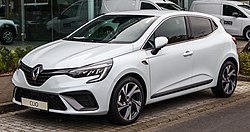 Clio RS Line
 -
 Rear view
 -
 Clio Initiale Paris
 -
 Rear view
 -
 Clio E-Tech (pre-facelift)
 -
 Interior (pre-facelift)

_%E2%80%93_f_17102021.jpg)
_%E2%80%93_h_17102021.jpg)


Facelift
[edit]On April 18, 2023, a significant facelift debuted,[86] featuring a completely redesigned front bumper with slimmer headlights and a wider checkerboard grille. The R.S. Line trim level was replaced with the Esprit Alpine trim level.[87][88]
In 2024, the Clio received an updated steering wheel with a new logo, taken from the Symbioz. [citation needed]
The Mitsubishi Colt was introduced on June 8, 2023, as a rebadged version of the facelifted Clio,[89] and it features a hybrid powertrain option [90] and a Petrol TcE 90 manual version.[91]
-
 2023 Clio (facelift, front view)
 -
 2023 Clio (facelift, rear view)
 -
 Interior (facelift)
_1X7A1577.jpg)
_1X7A1579.jpg)
_Esprit_Alpine_Automesse_Ludwigsburg_2023_1X7A0088.jpg)
Powertrain
[edit]The CMF-B modular platform enables improved efficiency and offers the option of a hybrid powertrain for the first time. Available from 2020, the E-Tech hybrid drivetrain combines a new generation 1.6-litre petrol engine with two electric motors, a multi-mode gearbox and a 1.2 kWh battery.[92]
The range of conventional engines includes new turbo petrol engines (1.0 TCe 100 and 1.3 TCe 130), along with the naturally aspirated 1.0 SCe, as well as the 1.5-litre Blue dCi diesel with an output of 85 hp (63 kW). In total, customers can choose from nine engine/gearbox combinations.
| Engine | Years | Code | Displacement | Power | Torque | Top speed | 0–100 km/h | Combined consumption | CO2 emissions | |
|---|---|---|---|---|---|---|---|---|---|---|
| Petrol engines | ||||||||||
| SCe 65 | 09/2019–08/2020 | H4D | 999 cm3 | 48 kW (65 PS) | 95 N⋅m | 160 km/h | 17.1 s | 4.9–5.1 L/100 km | 112–116 g/km | |
| since 08/2020 | 49 kW (67 PS) | |||||||||
| SCe 75 | 09/2019–08/2020 | 53 kW (72 PS) | 162 km/h | 16.4 s | 5.0–5.1 L/100 km | |||||
| TCe 90 (X-tronic) | since 08/2020 | H5D | 67 kW (91 PS) | 160 (142) N⋅m | 180 km/h (175 km/h) | 12.2 s (12.4 s) | 4.9–5.1 L/100 km (5.0–5.2 L/100 km) | 112–117 g/km (114–119 g/km) | ||
| TCe 100 (X-tronic) | 04/2020–08/2020 | 74 kW (101 PS) | 187 km/h (182 km/h) | 11.8 s (11.5 s) | 4.4–4.7 L/100 km (5.1–5.3 L/100 km) | 100–107 g/km (116–120 g/km) | ||||
| TCe 100 LPG | 06/2019–08/2020 | 160 N⋅m | 188 km/h | 12.5 s | 5.7–6.1 L/100 km | 94–100 g/km | ||||
| TCe 100 LPG | 08/2020–01/2022 | 170 N⋅m | 11.8 s | 6.7–7.0 L/100 km | 106–110 g/km | |||||
| TCe 130 | 06/2019–12/2020 | H5H | 1332 cm3 | 96 kW (130 PS) | 240 N⋅m | 200 km/h | 9.0 s | 5.2–5.5 L/100 km | 119–126 g/km | |
| TCe 140 | since 04/2021 | 103 kW (140 PS) | 260 N⋅m | 205 km/h | 9.4 s | 5.3–5.6 L/100 km | 122–128 g/km | |||
| E-Tech 140 Hybrid | 07/2020–01/2022 | H4M | 1598 cm3 | 144 N⋅m | 180 km/h (up to 75–79 km/h purely electric) | 9.9 s | 3.6–4.0 L/100 km | 82–91 g/km | ||
| E-Tech 145 Hybrid | since 01/2022 | 105 kW (143 PS) | 148 N⋅m | 175 km/h | 9.3 s | 83–90 g/km | ||||
| Diesel engines | ||||||||||
| Blue dCi 85 | 06/2019–12/2020 | K9K | 1461 cm3 | 63 kW (85 PS) | 220 N⋅m | 178 km/h | 14.7 s | 3.6–3.8 L/100 km | 95–101 g/km | |
| Blue dCi 115 | 85 kW (115 PS) | 260 N⋅m | 197 km/h | 9.9 s | ||||||
| Blue dCi 100 | since 07/2021 | 74 kW (100 PS) | 188 km/h | 11.4 s | ||||||
Safety
[edit]Sixth generation (2025)
[edit]| Clio VI | |
|---|---|
 | |
| Overview | |
| Production | October 2025-present |
| Assembly | Turkey: Bursa (Oyak-Renault) |
| Body and chassis | |
| Body style | 5-door hatchback |
| Platform | Renault–Nissan CMF-B HS platform |
| Related | Renault 5 E-Tech Renault 4 E-Tech |
| Powertrain | |
| Engine | |
| Dimensions | |
| Wheelbase | 2,591 mm (102.0 in) |
| Length | 4,116 mm (162.0 in) |
| Width | 1,768 mm (69.6 in) |
| Height | 1,451 mm (57.1 in) |
The sixth-generation Clio debuted in September 8, 2025 at the 2025 Munich Motor Show.[94]
-
 Rear view
 -
 Interior


Advertising
[edit]- In the United Kingdom, the Clio was advertised on television using the characters "Nicole" (a flirtatious young French woman played by Estelle Skornik) and "Papa" (her somewhat slow-witted father played by Max Douchin). The 1994 advert featured Vincent Cassel as Nicole's boyfriend. The commercials were very popular, with the final instalment of the series featuring comedy double act Bob Mortimer and Vic Reeves, in a sequence parodying The Graduate. In 2000, the 1991 commercial "Interesting" was named the 12th best television commercial of all time, in a poll conducted by The Sunday Times and Channel 4. Sound clips of the advert were played repeatedly on The Chris Moyles Show when it was discovered Comedy Dave and his girlfriend had named their newborn daughter Nicole.[citation needed]
- In 1999, a television advert was launched worldwide for the Renault Clio MTV Limited edition featuring a man who was saying "Get up ah!" all the time, it was actually the only sound he can hear from a Clio passing in front of his house early in the morning, then the advert shows the five men inside the Clio and moving their heads to the rhythm of the James Brown song "Get Up (I Feel Like Being a) Sex Machine". Same advertising made in Argentina with the Clio II in 2000 with this song.[95]
- The Clio II advertising campaign featured French model Hélène Mahieu, and French international footballer Thierry Henry for the Clio II facelift, both attempting to define the term va-va-voom, a term later defined by the Oxford English Dictionary as "The quality of being exciting, vigorous, or sexually attractive", although they state that it dates from the 1950s. In Brazil, the Clio had a trim level called Va Va Voom. The trim level has been discontinued. In Mexico, The Clio II's latest campaign reads "todo por mi Clio" (anything for my Clio), depicting one would give anything to keep one's Clio safe from danger.
- An advertising campaign for the Renault Clio III featured French actress Annelise Hesme and English actor Jeremy Sheffield as Sophie and Ben (respectively), trying to outdo each other over the superiority of each nation via a range of cultural aspects. This "France Vs Britain" (French car, British designers) campaign has been extended across a number of media, for example the "French Film, British Cinemas" tag for the annual Renault French Film Festival. The music used is Nina Simone's "Sinnerman".
Motorsport
[edit].jpg)
The Clio has competed in various well-known races and championships such as the Spa 24 hours and British GT. The car competed in the Spa 24 hour race in 1991, 1992, 1993, 1995, 1999 and 2000. Atlanta Motorsport competed in the GT Cup class in 2003 and 2004, both times at Donington Park. The Clio has also been entered in the Nürburgring 24 Hours and Zolder 24 Hours with varying amounts of success.
In 2001, Rob Collard entered the BTCC with a Renault Clio in the Production class, which were made up of slower, smaller cars like the Peugeot 306 GTi, the Ford Focus and Honda Accord. Throughout the season, Collard was a common contender in the middle of the field in most races. He was often seen amongst the lower-scoring Peugeot 306s like Tom Boardman and Paul O'Neill. At the end of the season, despite not participating in nine races and getting only eight finishes, initially, he finished 12th with 51 points, but due to a penalty of 5 points, his final position in the championship standings was 13th with 46 points. He scored one podium in the first race at Snetterton, with a 5th-place finish.
In 2002, Collard entered again with the Clio for the next season. Unfortunately, out of the ten races he was entered in, he only started four, with the three he finished resulted in him ending up on the podium with a 2nd place in class (7th overall) and a 1st place in class (9th overall) at the first event of the season. After four non-starts at Oulton Park and Thruxton, Collard finished 2nd in class (14th overall) at Silverstone in the first race, later retiring from the second. His last entry in the Clio was at Croft where he didn't start either race. By the end of the season, he initially had 39 points, but 5 were redacted, he remained in his 12th-place finish in the championship standings with 34 points.[96]
Rallying
[edit]

Versions of the mark-five Clio, the Renault Clio Rally4 and the Renault Clio Rally5, have been produced by Renault Sport for the Rally4 and Rally5 tiers of the Fédération Internationale de l'Automobile's Rally Pyramid.[97][98] Both are 260 millimetres (10 in) wider than their consumer counterpart, which is 40 millimetres (1.6 in) taller than the rally versions.[99][100][101] Both are two-wheel drive,[102] and have a front-axle track of 1,500 millimetres (59 in).[99][100] A rallycross variant also exists.[98]
Awards
[edit]- European Car of the Year in 1991
- European Car of the Year in 2006
- What Car? "Supermini of the Year" 2006
- Winner of El Mejor Automóvil Subcompacto (Best supermini) on Automóvil Panamericano magazine in 2002, 2003 and 2004 in Mexico
Sales
[edit]| Year | Brazil | Europe[103] |
|---|---|---|
| 2001 | 28,032[104] | |
| 2002 | 39,743[105] | |
| 2003 | 28,781[106] | 461,369 |
| 2004 | 22,588[107] | 433,375 |
| 2005 | 18,899[108] | 380,869 |
| 2006 | 19,880[109] | 431,817 |
| 2007 | 19,636[110] | 381,909 |
| 2008 | 11,007[111] | 335,951 |
| 2009 | 13,890[112] | 321,644 |
| 2010 | 30,064[113] | 348,405 |
| 2011 | 27,060[114] | 303,847 |
| 2012 | 16,546[115] | 246,672 |
| 2013 | 29,905[116] | 283,749 |
| 2014 | 20,301[117] | 299,623 |
| 2015 | 14,816[118] | 303,240 |
| 2016 | 10,869[119] | 310,944 |
| 2017 | 57[120] | 321,472 |
| 2018 | 328,860 | |
| 2019 | 317,645 | |
| 2020 | 248,602 | |
| 2021 | 199,889 | |
| 2022 | 140,631 |
References
[edit]- ^ "Renault's New Clio III: Up to 53.5 MPG". Green Car Congress. 26 June 2005. Retrieved 9 July 2010.
- ^ a b c "Model lineup: Renault Lutecia presentation" (in Japanese). Renault Japon. Retrieved 12 November 2013.
- ^ "Alliance 2022: New Plan Targets Annual Synergies of €10 Billion and Forecasts Unit Sales of 14 Million & Combined Revenues of $240 Billion". Renault–Nissan–Mitsubishi Alliance. 15 September 2017. Retrieved 24 September 2017.
- ^ "Mixed Results in the 1990s". Renault Argentina. Retrieved 11 September 2011.
The following year [1995] [...] the company responded by [...] introducing new models, including the mid-sized Mégane and the subcompact Clio.
[permanent dead link] - ^ a b Büschi, Hans-Ulrich, ed. (10 March 1994). Automobil Revue 1994 (in German and French). Vol. 89. Berne, Switzerland: Hallwag AG. p. 475. ISBN 3-444-00584-9.
- ^ a b Büschi, Hans-Ulrich, ed. (5 March 1992). Automobil Revue 1992 (in German and French). Vol. 87. Berne, Switzerland: Hallwag AG. p. 490. ISBN 3-444-00539-3.
- ^ "Rewind to 1991: Renault Clio". Evans Halshaw. Archived from the original on 9 January 2014. Retrieved 15 October 2025.
- ^ "Frank Williams put his name on a Clio". Ran When Parked. Archived from the original on 24 October 2011. Retrieved 19 July 2011.
- ^ "The CAR Top 10: F1 safety cars | CAR Magazine". carmagazine.co.uk.
- ^ "1993 Renault Clio Williams". carfolio.com. Retrieved 18 June 2018.
- ^ https://cdn.euroncap.com/media/9686/euroncap_renault_clio_1997_2stars.pdf
- ^ a b "Renault Clio Campus Bye Bye". Renault. 6 January 2012. Archived from the original on 6 February 2017. Retrieved 15 February 2012.
- ^ a b "Renault en Argentina" (in Spanish). Renault Argentina. Archived from the original on 28 August 2003. Retrieved 26 September 2011.
El lanzamiento de Mégane 2 en octubre de 1999 y de Clio 2 en marzo de 2000 rejuveneció la gama de productos nacionales.
- ^ "El Renault Clio Mío se dejará de fabricar en 2016". Argentina Auto Blog. 2015. Retrieved 19 October 2021.
La producción del Clio Mío cesará a fines de 2016, según informaron fuentes de la marca a los periodistas invitados a la celebración de la planta cordobesa.
- ^ "Ultima decada" (in Spanish). Renault Colombia. Archived from the original on 9 July 2018. Retrieved 25 March 2016.
2001: Durante el primer trimestre del año, Renault lanza el taxi Metrópoli y el Symbol. En junio, Renault lanza el Nuevo Clio.
- ^ "Envigado plant". Renault. Archived from the original on 25 April 2016. Retrieved 25 March 2016.
Models built: Clio II, Logan, Sandero, Duster
- ^ "2001 Annual Report" (PDF). Renault. 16 May 2002. Retrieved 25 March 2016.
In Mexico, Scénic has been built at Nissan's Cuernavaca plant since 2000, and Clio went into production at Nissan's Aguascalientes plant late in 2001.
- ^ "Renault México" (in Spanish). Archived from the original on 27 March 2016. Retrieved 25 March 2016.
Diciembre 2001: inicio de producción del modelo Clio en la planta de Aguascalientes de Nissan.
- ^ "Queda descontinuado el Renault Clio en este 2010" (in Spanish). Alvolante.info. 7 January 2010.
- ^ "Production of Clio returning to Renault plant in Novo mesto". The Slovenia Times. 17 March 2016. Archived from the original on 5 September 2019. Retrieved 25 March 2016.
The Novo mesto plant had produced Clio models from 1993 until last year, but then focused on the joint Renault-Daimler project of building the Twingo and Smart forfour.
- ^ "2004 Annual Report" (PDF). Renault. 25 April 2005. p. 10. Archived from the original (PDF) on 31 May 2013. Retrieved 28 January 2012.
- ^ "New Clio is blueprint for a new Renault". Automotive News. 13 December 2005.
- ^ "Mégane, Bravo: Compte a rebours pour un double lancement". 18 September 1995.
- ^ http://www.autonews.com/article/20050808000100/CUTAWAY/508080782?template=print [dead link]
- ^ "Renault Clio – 5-doors, hatchback". Auto-types.com. Archived from the original on 8 November 2012. Retrieved 10 February 2013.
- ^ Callum, White (2025). "1.9dTi introduction".
- ^ "The Clio Story: At 22, It's Come of Age". Groupe Renault. 12 July 2012. Retrieved 26 April 2020.
- ^ Rowlinson, Anthony (15 April 1998). "Follow that Praxi". Auto Express (495): 28–31.
- ^ "Renault Announces The Introduction of the Clio Campus". Car Pages. 23 October 2005. Retrieved 15 February 2012.
- ^ "Renault : Lance la nouvelle Clio Campus". Trading Sat. 15 April 2009. Archived from the original on 4 February 2013. Retrieved 15 February 2012.
- ^ "5 modelos que tuvimos en México pero los perdimos". Archived from the original on 30 March 2022. Retrieved 30 November 2020.
- ^ "Clio Campus ByeBye". Renault France. Archived from the original on 11 October 2012. Retrieved 22 November 2012.
- ^ "Clio Storia". Renault Slovenia. Retrieved 22 November 2012.[dead link]
- ^ "El Renault Clio Mío saldrá a la venta en diciembre en la Argentina" (in Spanish). Autoblog.com.ar. 22 October 2012. Retrieved 5 June 2013.
- ^ "2012 São Paulo Motor Show: Novo Clio, Fluence GT and D-Cross in the spotlight". Renault. 22 October 2012. Archived from the original on 26 October 2012. Retrieved 22 November 2012.
- ^ a b "Renault Clio Mío: A la venta en Argentina en Diciembre" [On sale in Argentina in December]. Autodato (in Spanish). 23 October 2012. Retrieved 5 June 2013.
- ^ a b c "Renault Clio". Renault. Archived from the original on 15 July 2014. Retrieved 29 November 2012.
Previous generations of Clio continue their careers across the world. Under the heading "Collection", Clio III is manufactured in the Flins (France) and Valladolid (Spain) plants. In Latin America, Clio II took advantage of a restyling to adopt the brand's new design identity. Revealed at the 2012 Sao Paulo Motor Show, this car is manufactured in Cordoba (Argentina).
- ^ www.eldia.com, Diario El Dia de La Plata. "Diario El Dia de La Plata www.eldia.com". www.eldia.com.
- ^ D., Nawel (12 March 2014). "Salon automobile d'Alger 2014 / Clio Campus restylée". Algérie 360 (in French). Archived from the original on 5 April 2023.
- ^ eric (25 October 2016). "Adieu Clio Mio – Deudeuchmania". Deudeuchmania.over-blog.com. Retrieved 16 March 2022.
- ^ "Renault denies Clio bonnet faults". What Car?. 15 March 2007. Archived from the original on 27 July 2011. Retrieved 21 August 2010.
- ^ "Whistleblower reveals car giant Renault's cover-up to Watchdog". The Market Oracle. 28 March 2007. Retrieved 16 April 2012.
- ^ "View Comparable". Euro NCAP. Retrieved 10 February 2013.
- ^ https://cdn.euroncap.com/media/9800/euroncap_renault_-clio_2000_4stars.pdf
- ^ "Official results of the Renault Clio Mio – NO Airbags 2013". Latin NCAP.
- ^ "Gamme Véhicules Particuliers". Renault France. Archived from the original on 26 March 2014. Retrieved 25 March 2016.
- ^ "Vehiculos Turismos". Renault España. Archived from the original on 20 November 2014. Retrieved 25 March 2016.
- ^ "CDN Frankfurt Motor Show 2005 – Page 4". Auto news and reviews. CarDesignNews.com. Archived from the original on 25 May 2013. Retrieved 2 April 2013.
- ^ "Car of the Year 2006: Renault Clio". Car of the year. 21 November 2005. Archived from the original on 21 April 2012. Retrieved 23 May 2012.
- ^ a b Doucet, Philippe (4 January 2008). "Clio Estate, la malle turque" [Clioe Estate, the Turkish box]. Le Figaro (in French). Archived from the original on 8 December 2008.
- ^ "All-new Clio gets Laguna look". Auto Express. 24 February 2008. Retrieved 21 March 2008.
- ^ "Le Sorcier". CarsToday.in. 21 June 2010. Archived from the original on 5 July 2010. Retrieved 24 June 2010.
- ^ https://cdn.euroncap.com/media/8684/euroncap_renault_clio_2005_5stars.pdf
- ^ Sentis, Mathieu (13 February 2020). "Essai Renault Clio Génération: faut-il encore acheter une Clio 4 ?". www.largus.fr.
- ^ "Clio TCe 120 GT". auto-types.com. Archived from the original on 9 October 2019. Retrieved 4 January 2014.
- ^ "Paris motor show: Renault Clio 4". Autocar. 27 September 2012. Retrieved 28 November 2012.
- ^ "Renault Clio 4 Estate – Mondial 2012: Déjà l'heure du break". L'Automobile Magazine. 27 September 2012. Retrieved 28 November 2012.
- ^ "L'usine de Flins démarre la production de la Clio IV, nouveau fer der lance de Renault". La Tribune. 6 September 2012. Retrieved 28 November 2012.
- ^ "INTERVIEW – "Avec la Clio IV, Oyak-Renault devient pour la première fois site de production principal"". lepetitjournal.com (in French). Retrieved 27 August 2022.
- ^ "Renault Clio Estate". Renault. Retrieved 29 November 2012.
The Renault Clio Estate is built at the ISO 14001 certified Bursa plant in Turkey.
- ^ Autocosmos (10 October 2014). "Renault Clio R.S. 200 llega a México desde $379,900 pesos". Autocosmos.
- ^ "RenaultUK". press.renault.co.uk. Retrieved 11 November 2016.
- ^ "RenaultUK". press.renault.co.uk. Retrieved 11 November 2016.
- ^ "Clio R.S. 18". RenaultSport.com.[dead link]
- ^ "RLink". Renault. Retrieved 21 October 2012.
- ^ "New Renault Clio: love-at-first-sight styling, and packed with innovations". Renault. 3 July 2012. Archived from the original on 6 November 2012. Retrieved 29 November 2012.
- ^ "Paris motor show: Renaultsport Clio". Autocar. 28 September 2012. Retrieved 29 November 2012.
- ^ "Clio Renault Sport". www.press.renault.co.uk. Retrieved 17 July 2025.
- ^ "Technical specifications. New Renault Clio" (PDF). ClioIV.com. 13 September 2012. Archived from the original (PDF) on 21 March 2016. Retrieved 29 November 2012.
- ^ Worthington, Simon (18 July 2015). "Citroen C1 cars use far more fuel than makers claim, according to new research". Mirror Online. Archived from the original on 16 December 2017.
- ^ a b c "Renault Clio brochure" (PDF). Archived from the original (PDF) on 7 November 2017.
- ^ "Renault Clio 4: la Clio Generation a quitté la chaîne de production". www.largus.fr. Retrieved 17 August 2022.
- ^ "Renault Clio 4, bayrağı Yeni Clio ve Yeni Clio Hibrit'e devretti" (PDF). oyak-renault.com (in Turkish). 14 May 2021. Retrieved 27 August 2022.
- ^ "Industrie auto. Renault dans l'impasse depuis deux ans en Algérie – L'argus PRO". www.largus.fr. Retrieved 17 August 2022.
- ^ "Document d'enregistrement universel 2021" (PDF). Renault Group (in French). March 2022. Archived from the original (PDF) on 14 December 2022. Retrieved 17 August 2022.
- ^ https://www.euroncap.com/en/results/renault/clio/10944
- ^ "Group Renault - Facts & Figures" (PDF). March 2020. Archived from the original (PDF) on 6 August 2020.
- ^ "Interview Pierre Sabas, designer extérieur Clio V (+ Vidéos)". lignesauto.fr. 1 April 2019. Retrieved 25 May 2021.
- ^ "Interview Magali Gouraud, designer intérieur Clio V (+ Vidéos)". lignesauto.fr. 1 April 2019. Retrieved 25 May 2021.
- ^ "Renault Clio 5 – Mondial 2019: Déjà l'heure du break". Archived from the original on 28 December 2019. Retrieved 6 September 2018.
- ^ "All-New CLIO – Dimensions & Specifications – Renault UK". renault.co.uk.
- ^ "The new TCe 100 engine underlines the versatility of the all-new Clio". group.renault.com. 5 March 2019. Retrieved 12 August 2020.
- ^ Gnaticov, Cristian (28 January 2019). "First Look Inside 2020 Renault Clio Reveals Striking Tech-Heavy Approach". Carscoops.
- ^ Davis, Brett (29 January 2019). "2019 Renault Clio interior goes big on technology". Performance Drive. Archived from the original on 19 January 2021.
- ^ James Brodie (30 October 2019). "New Renault Clio 2019 review". Auto Express.
- ^ "New 2023 Renault Clio E-Tech revamp reveals sharp look". Auto Express. 18 April 2023.
- ^ "2024 Renault Clio Debuts Major Facelift And Esprit Alpine Version". Motor1.com. 18 April 2023.
- ^ Chilton, Chris (18 April 2023). "Facelifted Renault Clio Is A Supermini Survivor With New Alpine Trim Option". Carscoops.
- ^ Adrian Padeanu (4 April 2023). "2024 Mitsubishi Colt Teased For June 8 Debut, Already Looks Familiar". Motor1.com.
- ^ Pappas, Thanos (4 April 2023). "2023 Mitsubishi Colt Debuts On June 8 As Renault Clio's Twin With Hybrid Option". Carscoops.
- ^ "Versions and prices - Clio E-Tech full hybrid - Renault". www.renault.co.uk. Retrieved 13 June 2025.
- ^ Mihalascu, Dan (9 January 2020). "Renault Releases Captur Plug-In Hybrid And Clio Hybrid, PHEV Has 50 Km EV Range". Carscoops.
- ^ https://www.euroncap.com/en/results/renault/clio/35877
- ^ Chilton, Chris (8 September 2025). "The World's Favorite Renault Just Arrived And Its Nose Might Make You Blink Twice". Carscoops.com. Archived from the original on 8 September 2025.
- ^ "Renault Clio MTV – Get Up (2000, Argentina)". 1 September 2011. Retrieved 21 October 2012 – via YouTube.
- ^ "Rob Collard - Driver Profile - BTCCPages.com". Archived from the original on 9 April 2009. Retrieved 20 February 2025.
- ^ "New Renault Clio Rally4 cleared for ERC action". European Rally Championship. 2 April 2021. Retrieved 10 July 2021.
- ^ a b Lindroos, Pontus (23 March 2020). "Renault Clio Rally5 gets WRC debut at Rally Mexico". thecheckeredflag.co.uk. Retrieved 10 July 2021.
- ^ a b "Clio Rally4, born to win". Renault Sport. 18 January 2021. Retrieved 10 July 2021.[dead link]
- ^ a b "New Clio Rally on display on the Monte-Carlo". Renault Sport. 21 January 2021. Archived from the original on 10 July 2021. Retrieved 10 July 2021.
- ^ "Renault Clio Hatchback 1.3 TCe 130 R.S. Line 5dr EDC". Auto Express. Retrieved 22 July 2021.
- ^ Lindroos, IDA WOOD (29 January 2021). "New Renault Clio trophy joins ERC bill for". dirtfish.com. Retrieved 17 July 2021.
- ^ "Renault Clio sale figures Europe". 27 February 2025.
- ^ "Brazil 2001". Best Selling Cars Blog. 3 February 2022. Archived from the original on 22 November 2011. Retrieved 6 January 2023.
- ^ "Brazil 2002". Fenabrave. 3 February 2022. Archived from the original on 16 June 2008. Retrieved 2 March 2025.
- ^ "Brazil 2003" (PDF). Fenabrave. 3 February 2022. Retrieved 6 January 2023.
- ^ "Brazil 2004". Fenabrave. 3 February 2022. Retrieved 6 January 2023.
- ^ "Brazil 2005". Fenabrave. 3 February 2022. Retrieved 6 January 2023.
- ^ "Brazil 2006". Fenabrave. 3 February 2022. Retrieved 6 January 2023.
- ^ "Brazil 2007". Fenabrave. 3 February 2022. Retrieved 6 January 2023.
- ^ "Brazil 2008". autoo. 3 February 2022. Retrieved 6 January 2023.
- ^ "Brazil 2009". autoo. 3 February 2022. Retrieved 6 January 2023.
- ^ "Brazil 2010". autoo. 3 February 2022. Retrieved 6 January 2023.
- ^ "Brazil 2011". autoo. 3 February 2022. Retrieved 6 January 2023.
- ^ "Brazil 2012". autoo. 3 February 2022. Retrieved 6 January 2023.
- ^ "Brazil 2013". autoo. 3 February 2022. Retrieved 6 January 2023.
- ^ "Brazil 2014". autoo. 3 February 2022. Retrieved 6 January 2023.
- ^ "Brazil 2015". autoo. 3 February 2022. Retrieved 6 January 2023.
- ^ "Brazil 2016". autoo. 3 February 2022. Retrieved 6 January 2023.
- ^ "Brazil 2017". autoo. 3 February 2022. Retrieved 6 January 2023.
External links
[edit]
- Official website (UK)

| Current models | |
|---|---|
| Discontinued models | |
| Related | |

Renault Clio
View on GrokipediaThe Renault Clio is a supermini hatchback manufactured by the French automaker Renault since 1990, initially launched as the successor to the Renault 5 in the B-segment market.[1][2]
It has progressed through six generations, with the latest introduced in 2025 featuring updated styling, hybrid powertrains, and enhanced safety systems, maintaining its reputation for compact efficiency and urban practicality.[3][4]
Cumulative sales have surpassed 17 million units worldwide, underscoring its commercial dominance in Europe where it frequently tops monthly registration charts.[4][5]
The Clio has secured the European Car of the Year award twice—first in 1991 for its innovative design and value, and again in 2006 for improvements in quality, safety, and comfort.[6][7][8]
Defining characteristics include sporty derivatives such as the Clio Williams and Renault Sport models, which emphasize agile handling and performance tuning derived from Renault's motorsport involvement.[9]
First Generation (1990–1998)
Design and Launch
The first-generation Renault Clio was unveiled at the Paris Motor Show in October 1990 as the direct successor to the Renault 5 supermini, which had reached the end of its production cycle.[10][6] Developed under the leadership of Patrick le Quément, Renault's vice president of industrial design since 1987, the Clio marked a shift toward more conventional supermini styling after previous models influenced by external designers like Italdesign Giugiaro.[11][12] The name "Clio" derived from the Greek muse of history, reflecting Renault's intent to create a model with lasting appeal in the B-segment market.[10] Available exclusively as a three- or five-door hatchback, the Clio measured 3,709 mm in length, 1,616 mm in width, and 1,395 mm in height, providing a compact footprint optimized for urban maneuverability while offering enhanced interior space over the Renault 5.[13][14] Its exterior featured rounded, aerodynamic lines with a high-mounted tailgate for practicality, though critics noted the design as competent yet unremarkable, adhering to prevailing supermini conventions without bold innovation.[11] The interior prioritized light and airy ergonomics, with excellent all-around visibility and simple, functional trim levels aimed at budget-conscious families and first-time buyers.[15] Positioned as an affordable entry in the fiercely competitive European small car segment, the Clio emphasized efficiency, reliability, and versatility from launch, with initial sales focusing on markets in France and broader Europe where it quickly gained traction as a practical daily driver.[1][16] Production commenced at Renault's Flins plant in France shortly after the debut, supporting rapid market rollout amid high demand for economical front-wheel-drive hatchbacks.[17]Variants and Special Editions
The first-generation Renault Clio (1990–1998) was available primarily as a three-door or five-door hatchback, with trim levels including the base RL, mid-range RN, and higher-spec RT, which offered enhanced equipment such as improved seating and interior features.[14] Engine options spanned 1.1-liter to 1.4-liter petrol units in select markets, alongside 1.7-liter petrol and 1.8-liter diesel variants, though special editions emphasized distinct styling or performance tuning over standard powertrains.[14] The Baccara edition, introduced in 1991, represented a luxury-oriented variant with premium features like leather upholstery, burr walnut dashboard inserts, air conditioning, and electric windows, priced over 100,000 French francs, limiting its production to small numbers.[1][18] Its high cost positioned it near compact executive models, appealing to buyers seeking refinement in a supermini.[19] Performance-focused special editions included the Clio Williams, launched in 1993 as a homologation special for rallying, with 3,800 units produced featuring a widened body, 2.0-liter 16-valve engine delivering 150 horsepower at 6,100 rpm and 129 lb-ft of torque at 4,500 rpm, and distinctive blue paint with white accents.[20][21][22] This model achieved 0-100 km/h in approximately 8.2 seconds, establishing benchmarks for hot hatches of the era.[23] Additional limited editions enhanced market appeal through themed styling and accessories, such as the Chipie, Be Bop, MTV, Oasis, Night & Day, and Aida models, which incorporated unique badging, upholstery, and alloy wheels while retaining core mechanical specifications.[1] These variants contributed to the Clio's versatility, with over 1.2 million first-generation units sold by 1998 across diverse configurations.[1]Engines and Performance
The first-generation Renault Clio (1990–1998) featured a selection of inline-four petrol and diesel engines, primarily derived from Renault's "Energy" family, emphasizing efficiency and modest performance for supermini applications. At launch in 1990, petrol variants included the 1.2-liter (1,171 cc) E5F/E7F engine delivering 54–58 horsepower (40–43 kW) at around 5,300–5,500 rpm and 90 Nm of torque at 2,800 rpm, suitable for urban driving with 0–100 km/h acceleration in approximately 13–15 seconds and top speeds near 160 km/h.[24][25] The 1.4-liter (1,390 cc) E7J unit offered 80 horsepower (59 kW), providing improved performance with 0–100 km/h in about 11 seconds and a top speed of 170 km/h.[26] Diesel engines comprised the 1.7-liter (1,760 cc) F2N and 1.9-liter (1,870 cc) units, producing 57–65 horsepower (42–48 kW) with torque outputs around 110–140 Nm, prioritizing fuel economy over acceleration, achieving 0–100 km/h in 15–17 seconds and top speeds of 150–160 km/h; these were naturally aspirated and known for reliability in European markets.[27]| Engine | Displacement | Power | Torque | 0–100 km/h | Top Speed |
|---|---|---|---|---|---|
| 1.2 L Petrol (E7F) | 1,171 cc | 58 PS (43 kW) | 90 Nm | ~14 s | ~165 km/h |
| 1.4 L Petrol (E7J) | 1,390 cc | 80 PS (59 kW) | ~110 Nm | ~11 s | ~170 km/h |
| 1.9 L Diesel | 1,870 cc | 64 PS (47 kW) | ~130 Nm | ~16 s | ~155 km/h |
| 2.0 L Williams (F3R) | 1,998 cc | 150 PS (110 kW) @ 6,100 rpm | 175 Nm @ 4,500 rpm | 7.8–8.0 s | 215 km/h |
Safety and Initial Reception
The first-generation Renault Clio (1990–1998) incorporated fundamental passive safety features for its era, such as three-point seat belts across front seats, energy-absorbing bumpers, and a reinforced passenger compartment to mitigate intrusion during collisions.[32] Driver and passenger airbags were introduced as optional equipment starting in 1992 for higher trims in select European markets, though not standard on base models until later phases.[15] Anti-lock braking systems (ABS) became available from 1991, enhancing control in emergency stops, but active safety aids like electronic stability control were absent.[32] In independent crash testing, the Clio earned a two-star rating from Euro NCAP in 1997 for adult occupant protection, reflecting average performance with good head and leg protection in frontal impacts but higher risks of chest injury due to suboptimal restraint systems and structure deformation.[33] Side impact tests similarly yielded two stars, with criticisms centered on inadequate thoracic protection from door intrusions, aligning with the era's limited standards before widespread adoption of side airbags.[34] These results underscored the Clio's competent but unexceptional safety profile compared to contemporaries, prioritizing affordability over advanced crashworthiness.[32] Launched in June 1990 as a replacement for the outdated Renault 5, the Clio received positive initial reviews for its stylish design, compact yet roomy interior, and competitive pricing, positioning it as a practical urban supermini.[35] Automotive journalists highlighted its agile handling, economical engines, and build quality improvements over its predecessor, contributing to brisk early sales exceeding expectations in Europe.[15] The model clinched the 1991 European Car of the Year award, lauded for innovative styling, generous equipment levels, and value, which propelled it to become one of the continent's top-selling vehicles within its first year.[35] By 1998, over 1.5 million units had been produced, affirming its commercial success despite minor reliability critiques in some long-term tests.[36]Second Generation (1998–2012)
Development and Phase Updates
The second-generation Renault Clio was developed to succeed the first-generation model by incorporating a more rounded, bulbous exterior design for improved spaciousness and a modern aesthetic, while increasing overall length by about 6 cm to enhance refinement and safety features.[37][38] It debuted on 11 April 1998, marking a shift toward greater interior room and family-friendly utility in the supermini segment.[1] Minor revisions arrived in 2000, including an updated instrument cluster and standard front passenger airbag, which helped secure a four-star Euro NCAP safety rating—the class-leading score at the time.[10][2] A significant Phase 2 facelift followed in August 2001, featuring a redesigned front fascia, higher-quality interior materials, and modifications to over 50% of the vehicle's structural components, by which point cumulative sales exceeded 1.7 million units.[39][40] Phase 3 updates from August 2003 introduced subtle exterior and interior tweaks for a streamlined appearance, alongside refinements to engine options and suspension tuning.[41] Further minor facelifts occurred in 2004, 2006, and 2009, incorporating updated styling cues, improved electronics, and efficiency enhancements to sustain competitiveness.[39] Production of the second-generation model persisted until 2012 in certain markets, overlapping with the third generation's rollout and serving budget-oriented buyers through continued availability as rebadged or simplified variants.[42]Body Styles and Trim Levels
The second-generation Renault Clio (1998–2012) was primarily offered in three-door and five-door hatchback body styles, with production spanning three phases featuring minor updates to styling and equipment.[43] These configurations catered to urban drivers seeking compact supermini dimensions, measuring approximately 3.77 meters in length for Phase I models.[38] In select markets, including Eastern Europe and South America, sedan (four-door) and estate (five-door wagon) variants were available, often marketed as the Renault Symbol or Clio Symbol, sharing the same platform but with extended rear sections for increased practicality. However, the core European lineup focused on the hatchback forms, with no convertible or coupe variants produced.[43] Trim levels varied by market, phase, and engine choice, typically progressing from basic entry-level options to higher-specification packs emphasizing comfort and aesthetics. In the UK and much of Europe during Phase I (1998–2001), trims included the no-frills RN (basic equipment like steel wheels and manual windows), mid-range RT (adding power steering and central locking), and upscale RX or Grande (featuring alloy wheels, body-colored bumpers, and air conditioning availability).[44] The 2001 Phase II facelift introduced streamlined naming such as Expression (standard with ABS and dual airbags) and Dynamique (including electric windows, CD player, and fog lamps), with Privilege as the premium trim offering leather upholstery options and enhanced audio systems.[45] Phase III (2005–2012) retained similar hierarchies but incorporated updated features like revised dashboards and optional navigation, maintaining Dynamique as a popular mid-tier choice across 3- and 5-door bodies.[46] Sport-oriented trims, such as the Clio Sport (1.2L or 2.0L) in Phase I and Renault Sport 172 (2.0L 172 hp) from 2001, differentiated via lowered suspension, 16-inch alloys, and performance seats, available exclusively in three-door hatchback form for enhanced handling dynamics.[38] These variants prioritized driving engagement over family utility, with production limited compared to standard trims; for instance, the RS 172 accounted for under 5% of UK sales in its debut year.[45] Across phases, trim progression allowed customization, with higher levels often bundling safety features like traction control, reflecting Renault's response to Euro NCAP demands.[46]Engines and Powertrain Evolution
The second-generation Renault Clio (Clio II) debuted in March 1998 with a selection of inline-four petrol engines derived from Renault's Energy family, including the 1.2-litre D7F (1,149 cc) producing 58 PS (43 kW) at 5,500 rpm and 93 Nm of torque, and the 1.4-litre K4J (1,390 cc) delivering 75 PS (55 kW) at 5,500 rpm and 118 Nm.[47] [38] Diesel options at launch comprised the 1.9-litre naturally aspirated F8Q (1,870 cc) at 65 PS (48 kW) and a turbocharged variant at around 80 PS, both using indirect injection for compliance with early Euro 2 emissions standards.[38] All models employed front-wheel drive with a transverse engine layout and five-speed manual transmissions as standard, while a four-speed automatic was optionally available on lower-output petrol variants for urban-oriented buyers.[38] [48] ![2001 Renault Sport Clio (X65)][float-right] The 2001 Phase 2 facelift marked a significant evolution in the powertrain lineup, prioritizing efficiency and refinement through the adoption of multi-point fuel injection and 16-valve cylinder heads across most petrol engines.[2] This included upgraded 1.2-litre (D4F 16v, 1,149 cc) at 75 PS (55 kW), 1.4-litre (K4J 16v, 1,390 cc) at 98 PS (72 kW) and 133 Nm, and a new 1.6-litre (K4M 16v, 1,598 cc) producing 110 PS (81 kW) for higher trims.[49] [2] Diesel propulsion advanced with the replacement of the 1.9-litre units by the compact 1.5-litre K9K dCi (1,461 cc) common-rail turbo-diesel, initially rated at 82 PS (60 kW) and 200 Nm, enabling fuel economy improvements to around 4.5 L/100 km combined while meeting Euro 3 norms.[50] Performance-oriented Renault Sport models introduced a 2.0-litre F4R 16v petrol engine (1,998 cc) tuned to 172 PS (127 kW) and 200 Nm, paired with a reinforced five-speed manual and limited-slip differential for enhanced traction.[46] Transmission choices expanded slightly with the optional Quickshift automated manual on select diesels, simulating shifts via an electro-hydraulic clutch actuator for smoother low-speed operation without a full torque converter. By the Phase 3 revision in 2005, engines were recalibrated for Euro 4 emissions compliance, featuring electronic enhancements like variable valve timing on petrol units and particulate filters on diesels, with the 1.5 dCi power rising modestly to 86 PS (63 kW) in base forms and up to 105 PS (77 kW) in GT Line variants for better mid-range torque (240 Nm).[50] Petrol options retained the 16v architecture but benefited from refined ECUs for slight torque gains, such as 145 Nm on the 1.4-litre, supporting 0-100 km/h acceleration in under 11 seconds for mid-range models.[51] The Renault Sport variant evolved further, with the 2.0-litre F4R progressing to 179 PS in 2004 and 197 PS (145 kW) by 2006, incorporating revised cams and intake for higher rev limits up to 7,250 rpm, while six-speed manuals became available on top diesels.[46] Overall, these updates reduced CO2 outputs to below 120 g/km on efficient dCi models and improved NVH levels through lighter components, reflecting Renault's shift toward modular, emissions-focused powertrains amid tightening regulations.[49]Safety Ratings
The second-generation Renault Clio (Clio II) was awarded a four-star overall safety rating by Euro NCAP following tests conducted in 2000.[52] [53] This result reflected strong performance in side impact protection, achieving a very high score without the benefit of side airbags, and a creditable outcome in frontal offset deformable barrier tests at 64 km/h, where occupant compartment integrity was maintained with moderate chest loading for the driver.[53] [54] Pedestrian protection scored lower, consistent with early 2000s protocols emphasizing bonnet and bumper impacts, though specific quantitative breakdowns from the era's scoring (pre-percentage system) highlighted areas for improvement in vulnerable road user safeguards.[52] No dedicated child occupant rating was formalized at the time, but the tests incorporated restraint compatibility assessments. The rating positioned the Clio II as competitive in its supermini segment, outperforming many contemporaries without advanced active safety features like electronic stability control, which were absent as standard.[55] Subsequent facelifts (Phases II and III, 2001–2012) did not undergo re-testing by Euro NCAP, but incremental enhancements included standardizing front passenger airbags from around 2000 and optional side curtain airbags in higher trims by Phase III, alongside reinforced structures derived from the original design.[56] No equivalent ratings exist from North American agencies like NHTSA or IIHS, as the model was not sold there.[57] Real-world data from European insurance claims corroborated the lab results, with the Clio II showing average injury risk in minor collisions but benefits from its rigid passenger cell in severe crashes.[58]Early Controversies
The second-generation Renault Clio, launched in 1998, faced immediate safety scrutiny through multiple recalls targeting early production models. Vehicles manufactured from January 1, 1998, to December 28, 1999, were recalled because the accelerator cable could fracture, leading to abrupt engine power loss and potential loss of vehicle control.[59] Affected cars underwent repairs involving the installation of a reinforced accelerator cable.[60] This issue, stemming from material fatigue in the cable, highlighted early quality control lapses in the model's throttle mechanism.[61] Braking system defects compounded these concerns, with 1999–2000 model-year Clios recalled due to a faulty brake servo non-return valve that risked reducing braking assistance under certain conditions.[62] Renault initiated inspections and replacements to address the valve's potential failure, which could compromise stopping distances in emergency situations.[61] These recalls, affecting thousands of units, drew criticism for exposing vulnerabilities in core safety systems shortly after production ramp-up.[60] A more protracted controversy involved the bonnet latch mechanism, with faults traceable to early designs but gaining prominence through consumer reports in the mid-2000s. The BBC's Watchdog program documented over 1,000 complaints of bonnets detaching at highway speeds, obscuring drivers' vision and causing crashes, including one instance where a bonnet strike shattered the windshield.[63][64] In 2007, a former Renault manager whistleblew, claiming the company had known of the latch's inadequacy since pre-launch testing but prioritized cost over redesign, dismissing incidents as user error related to maintenance or improper securing.[65][66] Renault countered that the clips were not inherently defective and urged owners to ensure proper closure and lubrication, though the episode fueled perceptions of delayed accountability.[63][67]Third Generation (2005–2013)
Design and Facelifts
The third-generation Renault Clio, internally designated BB0 for the three-door and BB1 for the five-door variants, debuted in June 2005 with a design emphasizing refinement and spaciousness over the youthful sportiness of prior models. Measuring 3,986 mm in length, 1,707 mm in width, and 1,496 mm in height, it stood as one of the larger superminis in its class, prioritizing interior room for five occupants.[68] Exterior styling adopted smoother, more aerodynamic lines with a bolder front grille and integrated fog lights, aiming to project maturity while maintaining compact proportions suitable for urban use.[69] A mid-cycle facelift arrived in early 2009, introducing subtle yet noticeable exterior revisions to enhance visual dynamism and road stance. The updated model grew slightly to 4,027 mm in length—an increase of 41 mm—and 1,715 mm in width, with a redesigned front bumper featuring a larger lower air intake positioned below the license plate for improved airflow and aesthetics.[70] Rear modifications included extended light clusters along the waistline, revised bumpers with integrated reverse lights, and triangular foglamps repositioned to the corners, contributing to a more streamlined profile.[71] [72] Interior updates focused on technology and trim enhancements, incorporating higher-quality materials and optional features like the integrated TomTom Carminat navigation system, which embedded GPS functionality into the dashboard for better usability without aftermarket modifications.[73] These changes, produced until 2012, addressed initial criticisms of dated cabin design while preserving the model's core mechanical architecture.[74]Key Variants
The third-generation Renault Clio (Clio III) was available primarily as a three-door or five-door supermini hatchback, with an optional five-door estate body style marketed as the Clio Grandtour or Sport Tourer in select markets.[75] [76] The hatchback variants emphasized compact urban usability, measuring approximately 3.77 meters in length, while the estate extended cargo practicality with 439 liters of boot space behind the rear seats, expandable to 1,277 liters with seats folded, versus the hatchback's 288 to 1,038 liters.[75] Trim levels varied by region and evolved over the production run from 2005 to 2012, starting with basic Authentique or Extreme entry points and ascending to mid-range Expression and Dynamique options, which added features like air conditioning and alloy wheels, up to premium GT, Privilege, and Initiale trims offering leather upholstery, navigation, and enhanced audio systems.[75] These trims were paired with front-wheel drive and manual or automatic transmissions across petrol engines from 75 bhp 1.2-liter units to 128 bhp 1.6-liter versions, and diesels like the 86 or 106 bhp 1.5 dCi.[76] The standout performance variant was the Clio Renaultsport 200, introduced in 2006 with a naturally aspirated 2.0-liter inline-four engine delivering 197 horsepower and 151 lb-ft of torque, achieving 0-62 mph in 6.9 seconds and a top speed of 139 mph. [75] It featured a six-speed manual gearbox, limited-slip differential, and optional Cup pack with 40 kg lighter weight, stiffer suspension, and 312 mm ventilated front brakes for improved handling on track.[75] This hot hatch represented Renault's focus on accessible sportiness, though it lacked turbocharging found in later generations.Engines
The third-generation Renault Clio (2005–2013) was powered by a selection of inline-four petrol and diesel engines, primarily from Renault's K-series family, with displacements ranging from 1.1 to 2.0 liters and outputs from 65 to 197 horsepower.[77] These engines were paired with five-speed manual transmissions as standard, with some markets offering four-speed automatics for lower-output variants. Fuel efficiency varied, with petrol units achieving around 40–50 mpg (combined) and diesels up to 60 mpg under NEDC testing, reflecting the era's emphasis on compact economy cars.[78] Petrol engines included the entry-level 1.2-liter D4F (1149 cc), producing 75 PS (55 kW) at 5500 rpm and 105 Nm of torque at 4250 rpm, suitable for urban driving with multi-point fuel injection.[78] The mid-range 1.4-liter K4J (1390 cc) delivered 98 PS (72 kW) at 5750 rpm and 127 Nm at 4250 rpm, offering a balance of performance and refinement via DOHC 16-valve setup.[79] Higher-spec models featured the 1.6-liter K4M (1598 cc) with 110 PS (81 kW) at 5750 rpm and 151 Nm at 4250 rpm, emphasizing smoother highway capability.[80] The performance-oriented Clio Renault Sport variant used a 2.0-liter F4R (1998 cc) naturally aspirated engine, generating 197 PS (145 kW) at 7250 rpm and 200 Nm at 5500 rpm, enabling 0–100 km/h acceleration in 6.9 seconds.[81] Diesel options centered on the 1.5-liter K9K dCi turbodiesel (1461 cc), available in emissions-compliant variants with common-rail injection and variable-geometry turbochargers. The base 1.5 dCi produced 68 PS (50 kW) at 4000 rpm and 160 Nm at 1700 rpm, prioritizing fuel economy over power.[82] Mid-tier versions offered 85–86 PS (63 kW) at 3750 rpm with 200 Nm at 1900 rpm, improving low-end torque for better drivability.[83] Later models, including post-2009 facelifts, introduced eco2-tuned diesels with slightly refined outputs around 90 PS while meeting Euro 4/5 standards.[84]| Engine Type | Displacement | Power Output | Torque | Notes |
|---|---|---|---|---|
| Petrol 1.2 D4F | 1149 cc | 75 PS @ 5500 rpm | 105 Nm @ 4250 rpm | Multi-point injection, base economy option[78] |
| Petrol 1.4 K4J | 1390 cc | 98 PS @ 5750 rpm | 127 Nm @ 4250 rpm | DOHC 16v, mid-range balance[79] |
| Petrol 1.6 K4M | 1598 cc | 110 PS @ 5750 rpm | 151 Nm @ 4250 rpm | Higher refinement for manuals[80] |
| Petrol 2.0 F4R (RS) | 1998 cc | 197 PS @ 7250 rpm | 200 Nm @ 5500 rpm | Naturally aspirated, sport variant[81] |
| Diesel 1.5 K9K dCi | 1461 cc | 68–86 PS @ 3750–4000 rpm | 160–200 Nm @ 1700–1900 rpm | Turbocharged, variable outputs for efficiency[82][83] |
Safety and Testing
The third-generation Renault Clio, tested by Euro NCAP in 2005, received five stars for adult occupant protection, reflecting strong performance in frontal and side impact tests where the structure effectively absorbed energy and restrained occupants with minimal intrusion into the cabin.[85] [86] It earned four stars for child occupant protection, benefiting from Isofix anchors and compatibility with child restraint systems, though some tests showed marginal head protection for rear-facing seats.[85] [86] Pedestrian protection scored one star out of four, due to the vehicle's stiff bonnet and lack of energy-absorbing elements, resulting in high impact forces on head and leg contacts.[85] [87] Standard safety equipment included dual front airbags, anti-lock braking system (ABS) with electronic brakeforce distribution (EBD), and seatbelt pretensioners with load limiters across the range.[88] [89] Higher trims and later models added side torso airbags, curtain airbags, and electronic stability control (ESC), contributing to the vehicle's overall restraint system.[89] [90] The 2009 facelift introduced no structural changes to passive safety but enhanced the Renault System for Restraint and Protection (SRP3) with refined airbag deployment logic, maintaining the original crash performance.[91] In Australia, the Australasian NCAP (ANCAP) rated the Clio four stars overall in 2006, aligning with Euro NCAP's occupant scores but noting similar pedestrian vulnerabilities.[88] No U.S. Insurance Institute for Highway Safety (IIHS) ratings were conducted, as the model was not sold there, and German ADAC tests focused on endurance rather than crashworthiness, with no standout issues reported for this generation.[92] Real-world data from European insurance claims indicated average injury risk for superminis, with the Clio's rigid chassis providing good frontal protection but limited mitigation for side impacts without optional airbags.[89]Fourth Generation (2012–2019)
Technological Features
The fourth-generation Renault Clio introduced Renault's R-LINK multimedia system, featuring a 7-inch touchscreen interface that provided access to navigation via TomTom with real-time traffic updates, Bluetooth telephony, USB and auxiliary media connectivity, and internet-enriched applications on select trims.[93] This marked the model's first widespread adoption of touchscreen technology in the supermini class, enhancing user interaction compared to prior button-based systems.[2] The base MediaNav variant offered similar core functions including satellite navigation, radio, and hands-free calling, but with fewer online capabilities.[94] Additional electronic conveniences included an optional reversing camera integrated into the infotainment display for improved visibility during maneuvers, and the hands-free key card system for contactless entry and ignition.[95] Electronic stability program (ESP) with traction control became standard across the range from launch, incorporating rollover mitigation sensors for enhanced vehicle dynamics management.[93] The 2016 mid-cycle facelift expanded technological options with three updated connected systems: the plug-and-play smart R&GO for basic smartphone mirroring, improved MediaNav Evolution with faster processing and better multimedia integration, and R-Link Evolution offering premium features like optional Bose audio amplification.[96][97] These enhancements focused on usability and compatibility with emerging mobile ecosystems, though the systems retained a resistive touchscreen responsive to multitouch gestures.[98]Performance Variants
The Renault Clio IV's performance-oriented variant was the Clio R.S. 200 EDC, introduced in 2013 as the flagship model developed by Renault Sport.[99] It featured a turbocharged 1.6-liter inline-four engine (code M5Mt) producing 200 horsepower (147 kW) at 6,000 rpm and 240 Nm of torque available from 1,750 rpm, paired exclusively with a six-speed dual-clutch EDC automatic transmission equipped with steering-wheel-mounted paddle shifters.[99][100] This setup enabled a 0-100 km/h acceleration time of 6.7 seconds and a top speed of 230 km/h, positioning it competitively against rivals like the Ford Fiesta ST and Volkswagen Polo GTI in the hot hatch segment.[99] Chassis enhancements included Renault Sport-specific tuning with a lowered suspension, stiffer springs, and retuned shock absorbers for improved handling, complemented by larger 340 mm front brake discs with four-piston calipers and 300 mm rear discs.[101] The R.S. Drive mode selector allowed drivers to switch between Normal, Sport, and Race settings, adjusting engine response, steering weight, and ESC behavior, with Stop & Start functionality disabled in the latter two modes for consistent performance.[100] Standard equipment encompassed 17-inch alloys, Recaro sport seats, and a digital instrument cluster with telemetry data logging for track use.[101] In 2015, Renault introduced the limited-edition Clio R.S. 220 Trophy, upgrading the engine to 220 horsepower (162 kW) and 280 Nm of torque through ECU remapping, revised turbo mapping, and an optional hydraulic suspension pack for sharper cornering.[102] This variant achieved 0-100 km/h in 6.4 seconds while retaining the EDC transmission and adding unique styling elements like gloss black accents and 18-inch wheels.[103] Special editions such as the Monaco GP pack further differentiated trims with cosmetic upgrades, but core mechanicals remained aligned with the 200 EDC base.[104] Production of the Clio IV R.S. lineup concluded around 2016, succeeded by the fifth-generation model.[99]| Variant | Engine | Power/Torque | 0-100 km/h | Top Speed |
|---|---|---|---|---|
| R.S. 200 EDC (2013–2016) | 1.6L turbo I4 | 200 hp / 240 Nm | 6.7 s | 230 km/h |
| R.S. 220 Trophy (2015) | 1.6L turbo I4 | 220 hp / 280 Nm | 6.4 s | 230 km/h |
Powertrains
The fourth-generation Renault Clio (2012–2019) featured a selection of small-displacement petrol and diesel engines designed for efficiency and compliance with Euro 5 and later Euro 6 emissions standards, with power outputs ranging from 75 PS to 220 PS across standard and performance variants.[105] Petrol options emphasized turbocharging for better low-end torque in smaller units, while diesels focused on fuel economy through common-rail direct injection and variable-geometry turbochargers.[106] Transmissions included five- and six-speed manuals as standard, with optional six-speed Efficient Dual Clutch (EDC) automatics on higher-output models for smoother urban driving.[95] Petrol engines comprised naturally aspirated and turbocharged inline-four configurations. The base 1.2-litre 16-valve unit delivered 75 PS at 5,500 rpm and 105 Nm of torque, paired exclusively with a five-speed manual.[107] Turbocharged variants included the 0.9-litre TCe three-cylinder engine producing 90 PS at 5,500 rpm and 135–140 Nm (with overboost), available from launch in 2012.[108] A more potent 1.2-litre TCe four-cylinder offered 120 PS at 5,500 rpm and 190 Nm, introduced in 2013 and mated to either a six-speed manual or EDC transmission.[109] The Renault Sport variant utilized a 1.6-litre TCe engine with 200 PS at 6,000 rpm and 240 Nm, uprated to 220 PS in the 2018 Trophy edition, both with a six-speed manual and launch control.[105] Diesel powertrains centered on the 1.5-litre dCi inline-four, available in 75 PS (at 4,000 rpm, 200 Nm), 90 PS (at 4,000 rpm, 220 Nm from 1,750 rpm), and 110 PS (at 4,000 rpm, 260 Nm) tunes, all featuring start-stop systems for reduced consumption.[110] The 90 PS version offered a six-speed EDC option from 2013, while the 110 PS diesel, added in 2016, paired with a six-speed manual for better highway efficiency, achieving around 3.5 L/100 km combined.[109] These engines used a six-speed manual as default, with the EDC providing quicker shifts but occasional reports of reliability concerns in early units.[111]| Engine Type | Displacement | Power (PS) | Torque (Nm) | Transmission Options | Notes |
|---|---|---|---|---|---|
| Petrol 1.2 16V | 1,149 cc | 75 | 105 | 5-speed manual | Naturally aspirated, base model[107] |
| Petrol 0.9 TCe | 898 cc | 90 | 135–140 | 5-speed manual | Turbocharged 3-cyl., Euro 6 from 2015[108] |
| Petrol 1.2 TCe | 1,197 cc | 120 | 190 | 6-speed manual/EDC | Turbocharged, direct injection[95] |
| Petrol 1.6 TCe (RS) | 1,618 cc | 200–220 | 240 | 6-speed manual | Turbocharged, performance-tuned[105] |
| Diesel 1.5 dCi | 1,461 cc | 75–110 | 200–260 | 5/6-speed manual, 6-speed EDC (90/110 PS) | Common-rail turbo diesel[112][113] |
Facelift Changes
The facelift for the fourth-generation Renault Clio was unveiled on 13 June 2016 and went on sale in markets such as the UK from October 2016.[114][115] This mid-cycle update introduced subtle exterior revisions, including a wider front grille, redesigned lower air intake and bumpers, and Pure Vision full-LED headlights with integrated C-shaped daytime running lights and a three-slat internal design.[116][117][118] Restyled door mirrors and new color options were also added, contributing to a marginally more mature appearance without altering the overall body dimensions or practicality.[119][118] Interior modifications focused on material quality and trim, with increased use of soft-touch plastics, added chrome accents, and minor tweaks to the steering wheel, center console, tunnel, and door panels.[120][118] Infotainment choices expanded to three systems—R&Go, Media Nav, and Renault R-Link Evolution—offering improved connectivity options on higher trims.[121] These changes enhanced perceived refinement without significant structural alterations.[122] Powertrain updates were limited but included a new 1.5-litre dCi diesel variant producing 110 PS (81 kW), mated to a six-speed manual transmission for better efficiency; existing petrol and diesel engines remained largely unchanged, with some paired to an optional six-speed EDC dual-clutch automatic.[98][109] The facelift prioritized evolutionary refinements over radical redesigns, maintaining the model's competitive positioning in the supermini segment.[123][124]Safety Performance
The fourth-generation Renault Clio earned a five-star overall safety rating from Euro NCAP when tested in 2012, reflecting strong performance under the protocols in effect at that time.[125] The vehicle scored 88% for adult occupant protection, with the passenger compartment remaining stable during the frontal offset deformable barrier impact at 64 km/h; dummy measurements indicated good safeguarding of critical body regions, including knees and femurs for both driver and passenger.[125] Side barrier and pole tests also demonstrated adequate chest and head protection, though marginal risk to the driver's chest was noted in the pole impact.[125] Child occupant protection reached 89%, supported by effective restraint systems and Isofix anchors on outer rear seats; the tested model used forward- and rear-facing child seats that provided good crash performance for 1.5-year-old and 3-year-old dummies, with low risk of head or neck injury.[125] Vulnerable road user protection scored 66%, with the bonnet offering maximum points for head impact mitigation in 48% of tested areas, but poorer results on rigid components like the windscreen base; pedestrian-friendly features were limited compared to later standards.[125] Safety assist technologies contributed a 99% score, driven by standard electronic stability control (ESC), which performed effectively in dynamic handling tests, and seatbelt reminders across all seats; electronic brake distribution and emergency brake assist were also fitted as standard, enhancing pre-crash mitigation.[125] However, advanced driver aids like autonomous emergency braking were not standard on base models tested, limiting active safety potential.[125] The rating remained valid for variants produced until the end of 2018, though subsequent Euro NCAP protocol updates—emphasizing stricter active safety and real-world scenarios—would likely yield a lower assessment today.[125] [126] Several recalls addressed potential safety defects during the production run, including risks of front brake hose abrasion from wheelarch liners, which could impair braking, and fuel system leaks from delivery module issues; owners were advised to inspect via VIN checks.[127] [128] No comprehensive real-world crash fatality data specific to this generation stands out in European statistics, but the model's supermini segment positioning correlates with higher urban exposure to low-speed impacts rather than high-energy collisions.[129]Spare wheel location
For the fourth generation Renault Clio (2012–2019), the emergency spare wheel is located under the vehicle. Access it from the luggage compartment by using the mechanism (e.g., rotating a plastic piece or unscrewing a nut and operating a handle) to lower the spare wheel to the ground. Note that some versions may have a tyre repair kit instead of a spare wheel.[130]Fifth Generation (2019–2025)
Initial Launch and Design
The fifth-generation Renault Clio, internally designated as Clio V, was first revealed on January 28, 2019, ahead of its public debut at the Geneva International Motor Show in March 2019.[131][132] This model marked the initial application of the Renault-Nissan-Mitsubishi Alliance's new CMF-B modular platform, which Renault described as enabling enhanced structural rigidity, improved aerodynamics, and better interior space utilization compared to the prior B-platform.[133][134] The platform's design facilitated a lower center of gravity and optimized weight distribution, contributing to superior handling dynamics and fuel efficiency from launch.[133] Externally, the Clio V adopted an evolutionary styling approach with sharper, more angular lines influenced by Renault's recent design language, including distinctive C-shaped LED daytime running lights at the front and redesigned rear light clusters for a wider stance appearance.[132] The body measured 4,048 mm in length, 14 mm shorter than its predecessor, while the wheelbase increased slightly to improve rear passenger space without compromising the supermini footprint.[135] Aerodynamic refinements, such as sculpted underbody panels and active grille shutters, achieved a drag coefficient of 0.31, aiding compliance with stricter emissions standards.[134] Interior design emphasized premium materials and digital integration, with options for vertical 7-inch or 9.3-inch touchscreen infotainment systems under the EASY LINK system, supporting wireless Apple CarPlay and Android Auto connectivity.[136] Eight interior ambiance schemes and nine exterior color choices were offered at launch, positioning the Clio as a more upscale supermini rival to models like the Volkswagen Polo.[137] The CMF-B platform's flexibility allowed for higher-quality cabin finishes, including soft-touch surfaces and optional ambient lighting, reflecting Renault's aim to elevate perceived value in the segment.[131]Powertrain Options
The fifth-generation Renault Clio (2019–2025) featured a diverse lineup of front-wheel-drive powertrains, emphasizing efficiency and compliance with Euro 6 emissions standards, with petrol and diesel options available from launch in 2019 and the E-Tech full hybrid introduced in 2020.[138][139] Petrol engines dominated later models as diesels were phased out by 2023 in many markets due to tightening emissions regulations and shifting demand toward electrification.[140] Transmissions included five- and six-speed manuals, a CVT for select petrol variants, and a seven-speed EDC dual-clutch automatic for higher-output units and the hybrid.[141][142] Petrol engines comprised naturally aspirated and turbocharged three-cylinder units. The entry-level 1.0 SCe produced 65 PS (48 kW) at 6,250 rpm and 95 Nm of torque, paired exclusively with a five-speed manual, achieving combined fuel economy of around 5.0 L/100 km.[143] The turbocharged 1.0 TCe was offered in 90 PS (66 kW, 160 Nm) and 100 PS (74 kW, 160–170 Nm) variants; the former typically used a five-speed manual, while the latter added a CVT option for smoother urban driving, with 0–100 km/h acceleration in 11.5 seconds for the CVT model.[140][141] In the 2023 models with the 1.0 TCe engine, the serpentine belt (also known as the accessory belt or poly-V belt) is located at the front of the engine in the engine bay. It is visible immediately upon opening the hood, positioned on the right-hand side (passenger side in LHD vehicles) when facing the engine. The belt runs around the crankshaft pulley, alternator, air conditioning compressor, and other accessories, with an automatic tensioner. No major covers need to be removed to view or access it for inspection. A more potent 1.3 TCe delivered 130 PS (96 kW, 240 Nm), mated to the EDC automatic, enabling 0–100 km/h in under 9 seconds and suiting performance-oriented trims.[142] Diesel powertrains utilized the 1.5 Blue dCi four-cylinder engine in 85 PS (63 kW, 220 Nm) and 100–115 PS (74–85 kW, 260 Nm) outputs, both with a six-speed manual and superior torque for motorway efficiency, returning up to 4.2 L/100 km combined.[144][145] These were discontinued in Europe by 2023 amid low sales and regulatory pressures favoring petrol-hybrids.[146] The E-Tech full hybrid combined a 1.6-litre Atkinson-cycle petrol engine with two electric motors and a 1.2 kWh battery, yielding 140 PS (103 kW) system output and 205 Nm from the electric motor alone, using a multi-mode automatic transmission without a clutch for seamless EV-petrol transitions.[147] It prioritized electric driving for up to 80% of urban cycles, achieving 4.3 L/100 km combined and 0–100 km/h in 9.9 seconds.[148] By the 2023 facelift, it became the flagship powertrain, updated to 145 PS in some markets.[149]| Engine | Type | Power (PS) | Torque (Nm) | Transmission | Fuel Economy (L/100 km, combined) |
|---|---|---|---|---|---|
| 1.0 SCe | Petrol, NA, 3-cyl | 65 | 95 | 5-speed manual | ~5.0[143] |
| 1.0 TCe | Petrol, turbo, 3-cyl | 90–100 | 160–170 | 5-speed manual / CVT | 4.8–5.2[140][141] |
| 1.3 TCe | Petrol, turbo, 4-cyl | 130 | 240 | 7-speed EDC auto | ~5.5[142] |
| 1.5 Blue dCi | Diesel, turbo, 4-cyl | 85–115 | 220–260 | 6-speed manual | 4.0–4.2[144] |
| 1.6 E-Tech | Full hybrid | 140–145 | 205 (electric) + petrol | Multi-mode auto | 4.3[147][149] |