Hubbry Logo
Direct currentDirect currentMain
Open search
Direct current
Community hub
Direct current
logo
8 pages, 0 posts
0 subscribers
Be the first to start a discussion here.
Direct current
Direct current
from Wikipedia
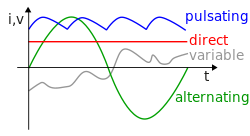
Direct current (DC) (red line). The vertical axis shows current or voltage and the horizontal 't' axis measures time and shows the zero value.

Direct current (DC) is one-directional flow of electric charge. An electrochemical cell is a prime example of DC power. Direct current may flow through a conductor such as a wire, but can also flow through semiconductors, insulators, or even through a vacuum as in electron or ion beams. The electric current flows in a constant direction, distinguishing it from alternating current (AC). A term formerly used for this type of current was galvanic current.[1]

The abbreviations AC and DC are often used to mean simply alternating and direct, as when they modify current or voltage.[2][3]

Direct current may be converted from an alternating current supply by use of a rectifier, which contains electronic elements (usually) or electromechanical elements (historically) that allow current to flow only in one direction. Direct current may be converted into alternating current via an inverter.

Direct current has many uses, from the charging of batteries to large power supplies for electronic systems, motors, and more. Very large quantities of electrical energy provided via direct-current are used in smelting of aluminum and other electrochemical processes. It is also used for some railways, especially in urban areas. High-voltage direct current is used to transmit large amounts of power from remote generation sites or to interconnect alternating current power grids.

History

[edit]
Brush Electric Company's central power plant with dynamos generating direct current to power arc lamps for public lighting in New York. Beginning operation in December 1880 at 133 West Twenty-Fifth Street, the high voltages it operated at allowed it to power a 2-mile (3.2 km) long circuit.[4]

Direct current was produced in 1800 by Italian physicist Alessandro Volta's battery, his Voltaic pile.[5] The nature of how current flowed was not yet understood. French physicist André-Marie Ampère conjectured that current travelled in one direction from positive to negative.[6] When French instrument maker Hippolyte Pixii built the first dynamo electric generator in 1832, he found that as the magnet used passed the loops of wire each half turn, it caused the flow of electricity to reverse, generating an alternating current.[7] At Ampère's suggestion, Pixii later added a commutator, a type of "switch" where contacts on the shaft work with "brush" contacts to produce direct current.

The late 1870s and early 1880s saw electricity starting to be generated at power stations. These were initially set up to power arc lighting (a popular type of street lighting) running on very high voltage (usually higher than 3,000 volts) direct current or alternating current.[8] This was followed by the widespread use of low voltage direct current for indoor electric lighting in business and homes after inventor Thomas Edison launched his incandescent bulb based electric "utility" in 1882. Because of the significant advantages of alternating current over direct current in using transformers to raise and lower voltages to allow much longer transmission distances, direct current was replaced over the next few decades by alternating current in power delivery. In the mid-1950s, high-voltage direct current transmission was developed, and is now an option instead of long-distance high voltage alternating current systems. For long distance undersea cables (e.g. between countries, such as NorNed), this DC option is the only technically feasible option. For applications requiring direct current, such as third rail power systems, alternating current is distributed to a substation, which utilizes a rectifier to convert the power to direct current.

Various definitions

[edit]
Types of direct current

The term DC is used to refer to power systems that use only one electrical polarity of voltage or current, and to refer to the constant, zero-frequency, or slowly varying local mean value of a voltage or current.[9] For example, the voltage across a DC voltage source is constant as is the current through a direct current source. The DC solution of an electric circuit is the solution where all voltages and currents are constant. Any stationary voltage or current waveform can be decomposed into a sum of a DC component and a zero-mean time-varying AC component; the DC component is defined to be the expected value, or the average value of the voltage or current over all time.

Although DC stands for "direct current", DC often refers to "constant polarity". Under this definition, DC voltages can vary in time, as seen in the raw output of a rectifier or the fluctuating voice signal on a telephone line.

Some forms of DC (such as that produced by a voltage regulator) have almost no variations in voltage, but may still have variations in output power and current.

Circuits

[edit]

A direct current circuit is an electrical circuit that consists of any combination of constant voltage sources, constant current sources, and resistors. In this case, the circuit voltages and currents are independent of time. A particular circuit voltage or current does not depend on the past value of any circuit voltage or current. This implies that the system of equations that represent a DC circuit do not involve integrals or derivatives with respect to time.

If a capacitor or inductor is added to a DC circuit, the resulting circuit is not, strictly speaking, a DC circuit. However, most such circuits have a DC solution. This solution gives the circuit voltages and currents when the circuit is in DC steady state. Such a circuit is represented by a system of differential equations. The solution to these equations usually contain a time varying or transient part as well as constant or steady state part. It is this steady state part that is the DC solution. There are some circuits that do not have a DC solution. Two simple examples are a constant current source connected to a capacitor and a constant voltage source connected to an inductor.

In electronics, it is common to refer to a circuit that is powered by a DC voltage source such as a battery or the output of a DC power supply as a DC circuit even though what is meant is that the circuit is DC powered.

In a DC circuit, a power source (e.g. a battery, capacitor, etc.) has a positive and negative terminal, and likewise, the load also has a positive and negative terminal. To complete the circuit, positive charges need to flow from the power source to the load. The charges will then return to the negative terminal of the load, which will then flow back to the negative terminal of the battery, completing the circuit. If either the positive or negative terminal is disconnected, the circuit will not be complete and the charges will not flow.

In some DC circuit applications, polarity does not matter, which means you can connect positive and negative backwards and the circuit will still be complete and the load will still function normally. However, in most DC applications, polarity does matter, and connecting the circuit backwards will result in the load not working properly.

Applications

[edit]

Domestic and commercial buildings

[edit]
This symbol which can be represented with Unicode character U+2393 (⎓) is found on many electronic devices that either require or produce direct current.

DC is commonly found in many extra-low voltage applications and some low-voltage applications, especially where these are powered by batteries or solar power systems (since both can produce only DC).

Most electronic circuits or devices require a DC power supply.

Domestic DC installations usually have different types of sockets, connectors, switches, and fixtures from those suitable for alternating current. This is mostly due to the lower voltages used, resulting in higher currents to produce the same amount of power.

It is usually important with a DC appliance to observe polarity, unless the device has a diode bridge to correct for this.

Automotive

[edit]

Most automotive applications use DC. An automotive battery provides power for engine starting, lighting, the ignition system, the climate controls, and the infotainment system among others. The alternator is an AC device which uses a rectifier to produce DC for battery charging. Most highway passenger vehicles use nominally 12 V systems. Many heavy trucks, farm equipment, or earth moving equipment with Diesel engines use 24 volt systems. In some older vehicles, 6 V was used, such as in the original classic Volkswagen Beetle. At one point a 42 V electrical system was considered for automobiles, but this found little use. To save weight and wire, often the metal frame of the vehicle is connected to one pole of the battery and used as the return conductor in a circuit. Often the negative pole is the chassis "ground" connection, but positive ground may be used in some wheeled or marine vehicles. In a battery electric vehicle, there are usually two separate DC systems. The "low voltage" DC system typically operates at 12V, and serves the same purpose as in an internal combustion engine vehicle.[10] The "high voltage" system operates at 300-400V (depending on the vehicle), and provides the power for the traction motors.[11] Increasing the voltage for the traction motors reduces the current flowing through them, increasing efficiency.

Telecommunication

[edit]

Telephone exchange communication equipment uses standard −48 V DC power supply. The negative polarity is achieved by grounding the positive terminal of power supply system and the battery bank. This is done to prevent electrolysis depositions. Telephone installations have a battery system to ensure power is maintained for subscriber lines during power interruptions.

Other devices may be powered from the telecommunications DC system using a DC-DC converter to provide any convenient voltage.

Many telephones connect to a twisted pair of wires, and use a bias tee to internally separate the AC component of the voltage between the two wires (the audio signal) from the DC component of the voltage between the two wires (used to power the phone).

High-voltage power transmission

[edit]

High-voltage direct current (HVDC) electric power transmission systems use DC for the bulk transmission of electrical power, in contrast with the more common alternating current systems. For long-distance transmission, HVDC systems may be less expensive and suffer lower electrical losses.

Other

[edit]

Applications using fuel cells (mixing hydrogen and oxygen together with a catalyst to produce electricity and water as byproducts) also produce only DC.

Light aircraft electrical systems are typically 12 V or 24 V DC similar to automobiles.

See also

[edit]

References

[edit]
[edit]
Revisions and contributorsEdit on WikipediaRead on Wikipedia
from Grokipedia
Direct current (DC) is the unidirectional flow of through a conductor, maintaining a constant direction and magnitude under steady-state conditions. Unlike (AC), which periodically reverses direction, DC provides a steady voltage suitable for powering devices that require consistent polarity. It is typically generated by sources such as batteries, photovoltaic cells, and fuel cells, where electrons move from regions of higher to lower . Historically, DC emerged as a foundational technology in the late 19th century, with Thomas Edison developing early electrical systems based on direct current for lighting and power distribution in the 1880s. Edison's Pearl Street Station in New York City, operational from 1882, marked one of the first commercial DC power plants, though limitations in long-distance transmission—due to significant voltage drop over wires—led to the "War of the Currents" against Nikola Tesla and George Westinghouse's advocacy for AC. Despite AC's dominance in grid-scale power by the early 20th century, DC persisted and evolved, particularly with advancements in rectification technology during the mid-20th century that enabled high-voltage direct current (HVDC) systems for efficient long-distance transmission. In modern applications, DC is indispensable for low-voltage electronics, including computers, smartphones, and LEDs, where it powers integrated circuits and digital components directly from batteries or converted AC supplies. It also drives electric vehicles, like solar panels, and emerging DC microgrids for buildings and data centers, offering advantages in efficiency and reduced conversion losses. High-voltage DC transmission lines, such as those used in interconnections between asynchronous grids, minimize energy losses over thousands of kilometers compared to AC lines.

Fundamentals

Definition and Characteristics

Direct current (DC) is the unidirectional flow of , where electrons move consistently in one direction through a conductor, maintaining a constant polarity between the positive and negative terminals. In ideal DC systems, both the voltage and current remain steady over time, without reversal or periodic variation. This contrasts with (AC), where the direction of flow reverses cyclically. A key characteristic of DC is its fixed polarity, defined by the conventional current direction from the positive terminal to the negative terminal, although the actual movement of electrons occurs in the opposite direction, from negative to positive. When visualized on an , a pure DC signal appears as a straight horizontal line at a constant voltage level, reflecting the absence of fluctuations. DC circuits are governed by fundamental electrical quantities, including current (denoted by the symbol I and measured in amperes, A), voltage (denoted by V and measured in volts, V), and resistance (measured in ohms, Ω). Typical examples of DC sources include common batteries, such as the 1.5 V AA alkaline cell used in portable devices and the 12 V lead-acid battery in automotive applications, both providing steady unidirectional power for low-voltage .

Types of Direct Current

Direct current (DC) can deviate from its ideal steady-state form in practical scenarios, leading to several categorized types based on variations in magnitude, direction, or superimposed components. Pure DC refers to a steady unidirectional flow of with constant magnitude and direction over time, typically produced by sources like batteries or regulated power supplies. Pulsating DC maintains a unidirectional flow but exhibits varying magnitude, often resulting from the rectification of (AC) without sufficient smoothing filters. This type arises in processes like half-wave rectification, where only one half-cycle of the input AC waveform passes through, producing a series of pulses in the output. For instance, the output of a half-wave rectifier circuit yields a highly pulsating DC waveform with significant amplitude variations. Ripple in DC describes a small alternating component superimposed on the otherwise steady unidirectional flow, commonly observed in filtered rectifier outputs. This AC ripple is quantified by the ripple factor, defined as the ratio of the root mean square (RMS) value of the AC component to the average value of the DC component, often expressed as a percentage to assess the smoothness of the output. A full-wave rectifier combined with a capacitor filter, for example, reduces ripple to a low level, resulting in a DC output closer to pure form but still containing minor periodic fluctuations. Interrupted direct current, also known as faradic current in applications, consists of unidirectional flow with periodic interruptions creating short pulses, preventing a continuous . This form is utilized in specialized contexts such as , where short pulses (0.1 to 1 ms duration at 50-100 Hz) create controlled interruptions to stimulate tissues without sustained flow.

Historical Development

Early Experiments and Discoveries

The invention of the by in 1800 represented a pivotal breakthrough in the generation of direct current, providing the first reliable source of steady, continuous through the electrochemical reaction of stacked and silver discs separated by brine-soaked cardboard. This device, often considered the progenitor of the modern battery, produced a constant flow of electricity rather than the fleeting sparks of observed in earlier experiments, enabling sustained applications for the first time. Building on Volta's innovation, conducted early demonstrations of lighting in 1807 and 1808 at the Royal , utilizing large banks of batteries to pass direct current between carbon electrodes, creating a brilliant arc of light spanning several inches. These experiments highlighted the practical potential of direct current for illumination, as the steady flow from the batteries sustained the high-temperature plasma discharge, producing light far brighter than any contemporary source. In 1820, discovered the magnetic effects of electric currents during a , observing that a direct current from a battery caused a nearby needle to deflect, thereby establishing the fundamental link between and . Ørsted's setup involved connecting a wire to the battery and noting the needle's consistent deviation toward the wire, with the effect reversing upon current direction change, confirming that the steady direct current generated a surrounding . This revelation, published in a pamphlet, relied entirely on the continuous nature of battery-supplied direct current to produce observable, repeatable magnetic phenomena. Michael Faraday extended these insights in 1831 through experiments on , initially employing direct current from batteries to energize coils around iron rings, which induced currents in secondary circuits when the was altered by connecting or disconnecting the battery. Faraday's demonstrations, such as moving a near a coil connected to a , produced detectable induced currents, laying the groundwork for understanding how changing —often initiated by direct current sources—could generate . These works marked a conceptual transition from isolated static charges and frictional to reliable, chemically sustained direct currents as the foundation for electromagnetic research.

Commercialization and Standards

In the 1880s, spearheaded the commercialization of direct current (DC) power systems, aiming to provide centralized electric lighting to urban areas. His company, the Edison Electric Illuminating Company, constructed the in , New York, which began operations on September 4, 1882, as the world's first commercial DC generating plant. This facility used steam engines to drive dynamos producing DC at 110 volts, initially powering 59 customers with about 400 incandescent lamps across a one-square-mile district, marking the birth of a practical urban electric distribution network. Edison's push for DC ignited the "War of the Currents," a fierce rivalry in the late 1880s and early 1890s against (AC) proponents and , who advocated for AC's advantages in long-distance transmission. Edison promoted DC through aggressive tactics, including public demonstrations where he electrocuted animals—such as dogs and an named Topsy in 1903—using AC to highlight its perceived dangers and sway public and regulatory opinion toward DC safety at low voltages. Despite these efforts, AC gained traction after Westinghouse secured contracts for the 1893 in and the hydroelectric project in 1895, demonstrating AC's efficiency for widespread power delivery. Early DC distribution systems, like those from Pearl Street, relied on low-voltage networks (typically 100-120 volts) buried underground in cities such as New York, , and , to minimize transmission losses over short distances. However, these systems faced inherent limitations: DC could not be efficiently stepped up or down using transformers, restricting service radii to about one mile from the generating station due to significant and power loss in lines, which proved inadequate for expanding urban grids. By the early , these constraints, combined with AC's scalability, led to the gradual decommissioning of most DC plants, with New York's last major station closing in 1930. Amid the shift to AC dominance, efforts to standardize DC practices emerged through international bodies. The (IEC), founded in 1906, issued its first list of electrical terms, definitions, and symbols—including the straight-line notation for DC circuits—by 1914, promoting uniformity in documentation. Similarly, the (AIEE, predecessor to IEEE), established in 1884, began formal standardization in 1898, adopting DC-related symbols and safety guidelines in its early codes, which influenced global practices by the 1910s. In , a 48-volt DC standard for powering exchanges was established in the early , chosen for its balance of safety (below the 50-volt threshold for human shock hazard) and sufficient voltage for reliable battery-backed operation in early networks. Post-1900, DC systems declined sharply as AC became the grid standard, but DC persisted in niche applications requiring stable, low-voltage supply, such as , , and the aforementioned telecom infrastructure, where 48V DC remains prevalent for its reliability during outages. This endurance in specialized sectors laid the groundwork for DC's later revival in and renewables, underscoring its enduring utility despite broader obsolescence in central power distribution.

Generation Methods

Chemical and Electrochemical Sources

Chemical and electrochemical sources generate direct current through reactions in electrochemical cells, where is converted into via the flow of electrons from oxidation at the to reduction at the . In these cells, the anode material loses electrons during oxidation, creating a surplus that flows through an external circuit as direct current, while the cathode gains electrons through reduction, completing the reaction with an facilitating transport. The electrochemical principles governing this process follow , which relate the reacted to the charge passed; the theoretical capacity can be expressed as Q=nFEQ = nFE, where nn is the number of electrons transferred per reaction, FF is the (approximately 96,485 C/mol), and EE is the cell potential in volts, yielding energy capacity in joules. Primary batteries, which are non-rechargeable, rely on irreversible chemical reactions to produce direct current until the reactants are depleted. The -carbon battery, a common example, operates at a nominal voltage of 1.5 V through the oxidation of and reduction of in an electrolyte, providing cost-effective power for low-drain devices. Alkaline batteries improve upon this by using electrolyte, offering longer service life and higher due to reduced and better stability, making them suitable for intermittent high-drain applications like remote controls. Secondary batteries, or rechargeable cells, generate direct current via reversible redox reactions, allowing repeated charge-discharge cycles by applying an external voltage to reverse the process. Lead-acid batteries, widely used in vehicles for starting and auxiliary power, consist of cells with a nominal voltage of 2 V each, based on lead dioxide and spongy lead electrodes in sulfuric acid electrolyte, delivering high surge currents despite lower energy density compared to newer technologies. Lithium-ion batteries, in contrast, achieve a nominal cell voltage of 3.7 V through intercalation of lithium ions between graphite anode and layered cathode materials like lithium cobalt oxide, providing high energy density (up to 250 Wh/kg) that enables compact, long-lasting power for portable electronics and electric vehicles. Fuel cells produce direct current continuously by sustaining electrochemical reactions with external fuel and oxidant supplies, avoiding the finite capacity of batteries. Hydrogen-oxygen fuel cells, such as types, generate electricity through the oxidation of at the and reduction of oxygen at the , yielding water as the primary byproduct and efficiencies up to 60% in converting to electrical power. This direct current output supports applications requiring steady power without recharging interruptions. Capacitors and supercapacitors serve as short-term direct current storage devices, accumulating charge electrostatically rather than through chemical reactions, for rapid discharge in pulsed applications. Conventional capacitors store energy according to E=12CV2E = \frac{1}{2} CV^2, where CC is capacitance in farads and VV is voltage, providing quick bursts of direct current but with low energy density (typically <1 Wh/kg). Supercapacitors, or ultracapacitors, enhance this with high surface-area electrodes and electrolyte double-layers, achieving energy densities up to 10 Wh/kg while maintaining fast charge-discharge rates over millions of cycles, ideal for bridging power gaps in hybrid systems.

Electromechanical and Solid-State Generation

Electromechanical generation of direct current primarily relies on the principles of electromagnetic induction, where mechanical motion in a magnetic field induces a voltage. The foundational prototype, known as Faraday's disk or homopolar generator, was developed by in 1831 through experiments demonstrating that rotating a copper disk between the poles of a permanent magnet produces a continuous direct current via the motion of conductors in a magnetic field. This unipolar design generates DC without the need for commutation in its basic form, though early versions like the 1884 "long-legged Mary Anne" dynamo incorporated mechanical rectification for practical output. Modern DC generators, often called dynamos, build on these principles by using a rotating armature within a stationary magnetic field to induce alternating current in the coils, which is then converted to direct current via a commutator. The commutator, a segmented ring with brushes, mechanically rectifies the output, ensuring unidirectional flow. Brushed DC generators employ carbon brushes for electrical contact, which can wear over time but provide simple, cost-effective operation suitable for applications like automotive alternators adapted for DC. In contrast, brushless designs use electronic commutation via sensors and inverters, eliminating mechanical wear for higher reliability and efficiency in modern systems such as wind turbines or electric vehicles. DC generators are classified by field winding configurations to suit varying load characteristics. In shunt-wound generators, the field coils are connected in parallel with the armature, providing stable voltage regulation under constant speed but with voltage drop under load due to armature reaction. Series-wound types connect the field in series with the armature, yielding high starting torque and current at low speeds, ideal for traction applications, though voltage rises with load. Compound-wound generators combine both shunt and series fields for a balance, offering cumulative compounding for improved load handling in industrial motors and generators. Solid-state generation converts alternating current to direct current through semiconductor devices, bypassing mechanical components for greater efficiency and longevity. Diodes, p-n junction semiconductors, allow current in one direction, forming the basis of rectifiers that block negative AC cycles. A half-wave rectifier uses a single diode to pass only the positive AC half-cycle, resulting in a pulsating DC output with an average value of Vdc=VpeakπV_{dc} = \frac{V_{peak}}{\pi}, though it suffers from low efficiency around 40.6% due to unused waveform portions. Full-wave bridge rectifiers, employing four diodes in a bridge configuration, utilize both AC half-cycles to produce a smoother DC output with an average voltage of Vdc=2VpeakπV_{dc} = \frac{2 V_{peak}}{\pi}, achieving higher efficiency near 81.2% and reduced ripple for power supplies. These circuits are integral to modern AC-DC adapters and industrial converters, with silicon diodes offering forward voltages of about 0.7 V and reverse breakdown prevention exceeding 1000 V in high-power applications. Photovoltaic cells generate direct current directly from sunlight via the photovoltaic effect in semiconductor materials like silicon. When photons strike the p-n junction, they excite electrons across the bandgap, creating electron-hole pairs that separate under the built-in electric field to produce a voltage and current. Solar panels, arrays of such cells, exhibit characteristic current-voltage (I-V) curves that define performance: the curve plots current against voltage, showing short-circuit current IscI_{sc} proportional to irradiance, open-circuit voltage VocV_{oc} around 0.6 V per cell, and a maximum power point where fill factor (ratio of maximum to ideal power) typically ranges 70-80% for commercial modules. These nonlinear curves shift with temperature and light intensity, enabling DC output from 12-48 V in standard panels for off-grid or grid-tied systems. Thermoelectric generators produce direct current from temperature gradients using the Seebeck effect, discovered by Thomas Johann Seebeck in 1821, where a voltage arises across a junction of two dissimilar materials due to differential thermal diffusion of charge carriers. In practice, TEGs consist of p-type and n-type semiconductor thermocouples connected electrically in series and thermally in parallel between hot and cold sides, generating DC voltages proportional to the temperature difference ΔT\Delta T, with Seebeck coefficients around 200-300 μV/K for bismuth telluride modules. Output currents are low, typically milliamps per cm², but efficiencies of 5-10% make them suitable for waste heat recovery in spacecraft or remote sensors, where solid-state reliability avoids moving parts.

Circuit Analysis

Basic Principles and Laws

Direct current (DC) circuits are governed by fundamental principles that describe the relationships between voltage, current, and resistance in steady-state conditions, where quantities do not vary with time. The primary law is Ohm's law, which states that the voltage drop VV across a resistor is directly proportional to the current II flowing through it, with the constant of proportionality being the resistance RR, expressed as V=IRV = IR. This relationship arises from the definition of resistance as the ratio of voltage to current for a given conductor, assuming ohmic behavior where RR remains constant independent of VV and II. From Ohm's law, the power PP dissipated in a resistor can be derived as P=VIP = VI, which substitutes to P=I2RP = I^2 R or P=V2RP = \frac{V^2}{R}. These expressions quantify the rate of energy conversion into heat in DC resistive elements, essential for analyzing circuit efficiency and thermal limits. For more complex circuits, provide the foundational rules for analysis. Kirchhoff's current law (KCL) asserts that the algebraic sum of currents entering a node equals zero, reflecting conservation of charge at any junction. Similarly, Kirchhoff's voltage law (KVL) states that the algebraic sum of voltages around any closed loop is zero, embodying conservation of energy in the circuit. These laws, derived from in the steady-state limit, enable systematic solving of network equations. In series circuits, where resistors share the same current, the equivalent resistance ReqR_{eq} is the sum of individual resistances: Req=RiR_{eq} = \sum R_i. For parallel circuits, where resistors share the same voltage, the equivalent resistance is given by the reciprocal of the sum of reciprocals: 1Req=1Ri\frac{1}{R_{eq}} = \sum \frac{1}{R_i}. These formulas simplify multi-resistor networks to single equivalents for DC analysis. A common application is the voltage divider, consisting of two series resistors R1R_1 and R2R_2 across an input voltage VinV_{in}, where the output voltage across R2R_2 is Vout=VinR2R1+R2V_{out} = V_{in} \frac{R_2}{R_1 + R_2}. This rule derives from applying KVL and Ohm's law, dividing the total voltage proportionally to the resistances. DC circuit analysis typically focuses on steady-state behavior, where currents and voltages are constant after initial transients decay, contrasting with transient analysis that accounts for time-varying responses in circuits with energy-storage elements. Steady-state solutions assume time-independent conditions, allowing direct application of the above laws without differential equations.

Passive Components

Passive components form the foundation of DC circuit design by managing current, voltage, and energy without amplification. Resistors are essential for limiting current flow and dividing voltages according to Ohm's law, with their resistance values typically indicated by a color code system standardized by the Electronic Industries Alliance (EIA). This code uses colored bands on the resistor body to denote the resistance in ohms and tolerance, such as black for 0, brown for 1, and red for 2, allowing quick identification in assembly. Power ratings, measured in watts, specify the maximum continuous power dissipation (P = I^2 R) to prevent overheating; common ratings include 1/8 W for low-power applications and 5 W for higher loads, ensuring safe operation under specified conditions. Capacitors in DC circuits primarily serve to block direct current while allowing alternating signals to pass, due to their charging behavior that creates an open circuit at steady-state DC. They are widely used in power supplies for filtering ripple, where electrolytic or ceramic types store charge to smooth voltage fluctuations from rectified AC sources, maintaining stable DC output. For instance, in decoupling applications, capacitors reduce noise by shunting high-frequency components to ground, with capacitance values selected based on the ripple frequency and desired attenuation. Inductors, conversely, exhibit low DC resistance (primarily from wire winding) but store energy in their magnetic field when current flows, quantified by the formula 12LI2\frac{1}{2} LI^2, where L is inductance in henries and I is current in amperes. This energy storage property makes them useful in DC-DC converters for current smoothing, though their DC resistance contributes to minor power losses.

Active Components

Active components introduce control and amplification to DC circuits, enabling signal processing and power management. Diodes are semiconductor devices that conduct current preferentially in one direction; in forward bias, they drop approximately 0.7 V for silicon types and allow flow above this threshold, while in reverse bias, they block current until breakdown. Zener diodes, designed for operation in reverse breakdown, provide precise voltage regulation by maintaining a constant voltage across their terminals (e.g., 5.1 V Zener), commonly used in shunt configurations to stabilize DC supplies against variations. Transistors, particularly bipolar junction transistors (BJTs), amplify or switch DC signals; NPN types conduct when the base-emitter junction is forward-biased (positive base relative to emitter), sourcing current to the collector, while PNP types operate with opposite polarities, sinking current. In switching applications, BJTs saturate fully on or off to minimize power loss, whereas in basic amplification, they operate in the active region to provide current gain (β typically 100-300).

Circuit Configurations

Common DC circuit configurations integrate passive and active components for reliable operation. Voltage regulators ensure constant output voltage; linear regulators like the LM7805 IC dissipate excess input voltage as heat via a pass transistor, offering simplicity and low noise but limited efficiency (e.g., 40-60% at 12 V input to 5 V output), suitable for low-power applications. Switching regulators, in contrast, use inductors and capacitors to store and release energy efficiently (up to 90%), employing pulse-width modulation for step-up or step-down conversion, though they introduce ripple that requires additional filtering. RC low-pass filters, formed by a resistor in series and capacitor to ground, smooth DC signals by attenuating high-frequency noise, with the time constant τ = RC determining the response (e.g., 10 ms for ripple reduction in power supplies). Protection elements include fuses, which melt at rated current to interrupt faults, and circuit breakers, which thermally or magnetically trip to open the circuit, both essential for preventing overcurrent damage in DC systems. Multistage circuits enhance performance through component combinations. Darlington pairs connect two BJTs (typically NPN) with the emitter of the first to the base of the second, achieving high current gain (β_total ≈ β1 × β2, often >10,000) for driving loads like relays with minimal base current, though at the cost of increased saturation voltage. Bridge configurations, using four diodes in a arrangement, convert bidirectional signals to unidirectional DC flow, providing full-wave rectification with output voltage approximately input peak minus two diode drops, commonly referenced in without delving into generation.

Safety Considerations

Safety in DC circuits emphasizes preventing hazards from improper connections and faults. Polarity protection guards against reverse voltage, which can damage components; methods include series diodes (adding forward drop) or P-channel MOSFETs that conduct only in correct polarity, ensuring low loss and automatic blocking. Grounding connects one circuit side (often negative) to or , providing a low-impedance path for fault currents to safely dissipate, reducing shock risk and enabling protective device operation, as per standards like OSHA guidelines. These measures, combined with proper fusing, maintain system integrity in diverse DC applications.

Practical Applications

Power Supply and Distribution

Direct current (DC) plays a vital role in low-voltage power supply within buildings, where it powers numerous modern devices and systems more efficiently than (AC) in certain applications. Universal Serial Bus (USB) ports, standardized at 5 V DC, provide a ubiquitous low-voltage supply for charging portable and powering peripherals in residential and commercial spaces. (PoE) extends this capability by delivering up to 48 V DC alongside data over twisted-pair Ethernet cables, supporting devices like IP cameras, wireless access points, and increasingly, LED lighting fixtures. This integration reduces wiring complexity and enables centralized , with PoE systems limited to under 100 W per port for safety and efficiency in building environments. In domestic and commercial settings, AC-to-DC adapters and chargers are essential for converting mains to the DC required by most , such as laptops, smartphones, and appliances. These adapters typically output voltages from 5 V to 20 V, stepping down 120 V or 240 V AC through rectification and circuits to meet device specifications. Solar microgrids further enhance DC utilization in off-grid or hybrid systems, where photovoltaic panels generate DC power directly, bypassing initial AC conversion for loads like and small appliances, thereby improving overall efficiency in remote or sustainable installations. High-voltage direct current (HVDC) transmission represents a cornerstone of large-scale power distribution, particularly for interconnecting grids over long distances where AC systems incur higher losses. HVDC offers advantages over high-voltage alternating current (HVAC), including reduced transmission losses due to the absence of reactive power compensation needs and the ability to use fewer conductors, making it ideal for spans exceeding 500 km. Converter stations at each end of HVDC lines employ to transform AC to DC and vice versa; line-commutated converters (LCC) traditionally use thyristors for high-power applications, while voltage-source converters (VSC) utilize insulated-gate bipolar transistors (IGBTs) for more flexible, black-start capable systems. HVDC systems vary in configuration to suit specific needs: monopolar setups use a single high-voltage conductor with ground or metallic return paths, often as an initial phase for expansion; bipolar configurations employ positive and negative polarity conductors for balanced operation and higher capacity, minimizing ; back-to-back systems connect asynchronous AC grids over short distances via directly coupled converters without long transmission lines. A prominent example is China's Changji-Guquan line, operational since 2018, which transmits 12 GW at ±1,100 kV over 3,293 km from to , demonstrating UHVDC's role in integrating sources into distant load centers. Transmission losses in HVDC are primarily ohmic, governed by I2RI^2 R where II is current and RR is resistance, without the additional AC-specific losses from —which confines current to conductor surfaces at high frequencies—or inductive reactance. Modern HVDC systems achieve end-to-end efficiencies exceeding 95%, with line losses typically under 3.5% per 1,000 km, enabling reliable bulk power delivery for national grids.

Transportation and Mobility

(DC) plays a central role in automotive electrical systems, where 12V or 24V DC batteries power essential components such as starters, lights, and engine control units (ECUs). These low-voltage DC systems, standardized by the Society of Automotive Engineers (SAE), ensure reliable operation in vehicles by converting alternator-generated (AC) to DC via rectifiers. In heavy-duty trucks and commercial vehicles, 24V DC systems provide higher power capacity for robust accessories, reducing wiring weight and improving efficiency. Electric vehicles (EVs) rely heavily on high-voltage DC batteries, typically ranging from 300V to 800V, to store and deliver to electric motors through inverters that convert DC to AC for propulsion. These lithium-ion batteries, charged via onboard DC-DC converters, maintain stable voltage for optimal performance and , which recaptures as DC to recharge the pack. Fast DC charging standards like (up to 400 kW with 1000 V and 400 A in version 2.0) and (CCS, up to 350 kW) enable rapid replenishment, reducing downtime compared to AC charging. In rail and tram systems, DC electrification is widely used for efficient power delivery in urban and suburban transport. Third-rail systems supply DC at 600V to 1500V for metro lines, minimizing overhead infrastructure in tunnels, while overhead catenary wires provide 750V to 3000V DC for high-speed trains, allowing precise control of traction motors. These configurations, adopted since the early 20th century but refined for modern efficiency, reduce energy losses in short-haul operations compared to AC systems. Aerospace and marine applications leverage DC for its simplicity and reliability in mobile environments. Aircraft typically use 28V DC systems to power , lighting, and actuators, with more (MEA) designs shifting auxiliary functions to DC for weight savings over hydraulic systems. In ships, DC propulsion motors and battery hybrids offer fuel efficiency gains, particularly in electric ferries and , where variable-speed DC drives optimize performance across load conditions. Emerging trends in transportation include 48V systems, which integrate DC batteries to assist starting and enable in conventional vehicles, achieving up to 15% savings without full electrification. Wireless DC charging pilots, using inductive pads to transfer power at 3-20 kW, are being tested for dynamic charging on roads, potentially extending EV range by eliminating plugs. These advancements build on battery technologies for higher , supporting broader adoption in sustainable mobility.

Electronics and Communication

In consumer electronics, direct current (DC) is essential for powering portable devices that rely on battery storage and low-voltage operation. Smartphones typically use lithium-ion batteries with a nominal voltage of 3.7 V to provide stable DC power for processors, displays, and sensors, enabling efficient energy delivery without the need for continuous AC conversion. Similarly, laptops employ external AC adapters that convert mains power to DC outputs, commonly at 19 V, to charge internal batteries and supply regulated voltage to the motherboard and peripherals. Integrated circuits (ICs) in these devices, such as those implementing logic gates, require precise stable DC rails—often at 1.8 V, 3.3 V, or 5 V—to ensure reliable switching and prevent signal noise from disrupting binary operations. In computing infrastructure like data centers, DC distribution at 48 V has emerged as a preferred to minimize conversion losses and enhance efficiency. This approach delivers power directly to servers via busbars, bypassing multiple AC-to-DC transformations that occur in traditional setups. pioneered widespread adoption in 2016 by contributing a 48 V DC rack specification to the , enabling backups and reducing overall system complexity. By centralizing rectification at the facility level, 48 V DC systems avoid the inefficiencies of per-server power supplies, achieving notable energy savings. Telecommunication networks also depend heavily on DC for reliability and backup capabilities. Legacy telephone exchanges and central offices use -48 V DC supplies, derived from rectifiers and supported by lead-acid or lithium-ion batteries, to power switching equipment and ensure uninterrupted service during outages. In modern fiber optic systems, transceivers convert electrical signals to optical ones using DC-biased lasers, where a steady DC current modulates light pulses for data transmission over long distances without AC interference. DC plays a critical role in within and communication systems, providing bias voltages to maintain operational . In amplifiers, a shifts the input signal to the optimal quiescent point, preventing and enabling accurate amplification of audio or signals. Analog-to-digital converters (ADCs) similarly require DC biasing to center the input signal within the conversion range, ensuring full-scale utilization and minimizing quantization errors during digitization. These DC applications yield significant efficiency gains, particularly in high-density environments like data centers. Studies show that server-level DC distribution versus traditional AC can reduce power supply unit (PSU) losses by 10-15%, as it eliminates redundant conversions and allows for more streamlined cooling. Overall, such optimizations contribute to 10-20% total energy savings in computing and telecom infrastructures by prioritizing direct DC delivery where possible.

Specialized and Emerging Uses

In industrial applications, direct current is essential for processes requiring precise control over material deposition and arc stability. utilizes DC to achieve uniform metal deposition on substrates by applying a constant that drives metal ions from the to the through an solution, ensuring even coating thickness and minimizing defects like pitting or uneven layers. Similarly, employs DC to form a protective oxide layer on metals such as aluminum, where a steady —typically around 1.2 A/dm²—facilitates controlled oxidation for enhanced resistance and durability. In , DC power sources maintain stable arc lengths despite variations in electrode-to-workpiece distance, producing consistent heat input for processes like , which is widely used in heavy fabrication and repair. This stability reduces spatter and improves weld quality in industrial settings such as and pipeline . Medical applications leverage low-level DC for targeted therapeutic interventions. Defibrillators often employ biphasic DC waveforms, which deliver truncated exponential pulses in opposite directions to restore cardiac rhythm with lower energy levels—typically 150-200 J—compared to monophasic alternatives, reducing myocardial damage while achieving higher success rates in ventricular fibrillation cases. Transcutaneous electrical nerve stimulation (TENS) units apply low-voltage pulsed currents, usually 1-80 mA at 2-150 Hz, to stimulate sensory nerves and block pain signals via the gate control theory, providing non-invasive relief for chronic conditions like arthritis and back pain. Neural implants, such as deep brain stimulators, rely on low-voltage DC pulses—often in the microampere range—to modulate neural activity precisely, enabling treatments for Parkinson's disease and epilepsy by delivering controlled electrical signals directly to brain tissue without inducing tissue damage. The integration of renewables with DC systems supports efficient, localized . DC microgrids, powered by solar photovoltaic arrays and turbines, distribute power directly without AC conversion losses, making them ideal for off-grid communities in remote areas where they can achieve up to 95% in energy utilization and provide reliable to thousands of households. Post-2020 pilots have demonstrated blockchain-verified DC trading, such as a 2023 project in a photovoltaic-based DC microgrid that enabled among prosumers, ensuring secure, transparent exchanges of surplus while reducing reliance on centralized utilities. In space and defense, DC transmission is critical for high-reliability power systems. Satellites primarily use DC to route electricity from solar arrays—generating up to 20 kW—to rechargeable batteries, employing unregulated bus voltages around 28-100 V to minimize conversion inefficiencies during eclipses and ensure uninterrupted operation for missions lasting years. Directed energy weapons, including high-power lasers, draw from DC supplies to power solid-state or systems, delivering focused beams with kilowatt-level outputs for target engagement, as seen in U.S. Department of Defense prototypes that achieve precise, speed-of-light effects against drones and missiles. Emerging uses of DC extend to advanced technologies demanding high efficiency and low noise. Cryogenic systems for , operating at millikelvin temperatures, incorporate DC power for precise control of dilution refrigerators and heaters, enabling stable qubit coherence times exceeding 100 microseconds in superconducting processors by minimizing thermal fluctuations. In 5G infrastructure, base stations increasingly adopt DC power supplies to enhance efficiency, reducing conversion losses by up to 20% compared to AC systems and supporting dense deployments with power demands up to 10 kW per site while integrating renewable sources.

References

Add your contribution
Related Hubs
User Avatar
No comments yet.