


Community hub
Recent from talks
Contribute something
Nothing was collected or created yet.
Counterterrorism
View on Wikipedia
| Part of a series on |
| Counterterrorism and Countering violent extremism |
|---|
 |
|

Counterterrorism (alternatively spelled: counter-terrorism), also known as anti-terrorism, relates to the practices, military tactics, techniques, and strategies that governments, law enforcement, businesses, and intelligence agencies use to combat or eliminate terrorism and violent extremism.[1]
If an act of terrorism occurs as part of a broader insurgency (and insurgency is included in the definition of terrorism) then counterterrorism may additionally employ counterinsurgency measures. The United States Armed Forces uses the term "foreign internal defense" for programs that support other countries' attempts to suppress insurgency, lawlessness, or subversion, or to reduce the conditions under which threats to national security may develop.[2][3][4]
History
[edit]The first counterterrorism body to be formed was the Special Irish Branch of the Metropolitan Police, later renamed the Special Branch after it expanded its scope beyond its original focus on Fenian terrorism. Various law enforcement agencies established similar units in the United Kingdom and elsewhere.[5]
The International Conference of Rome for the Social Defense Against Anarchists has been identified as the first international conference against terrorism.[6]
The first tactical counterterrorism unit was GSG 9 of the West German Federal Border Protection (Bundesgrenzschutz), which was later renamed the Federal Police (Bundespolizei) in 2005. GSG 9 was formed shortly after and in response to the Olympic Munich massacre of 1972.[7]
Counterterrorist forces expanded with the perceived growing threat of terrorism in the late 20th century. After the September 11 attacks, Western governments made counterterrorism efforts a priority. This included more extensive collaboration with foreign governments, shifting tactics involving red teams,[8] and preventive measures.[9]
Although terrorist attacks affecting Western countries generally receive a disproportionately large share of media attention,[10] most terrorism occurs in less developed countries.[11] Government responses to terrorism, in some cases, tend to lead to substantial unintended consequences,[12][vague] such as what occurred in the above-mentioned Munich massacre.[further explanation needed]
Planning
[edit]Intelligence, surveillance, and reconnaissance
[edit]
Most counterterrorism strategies involve an increase in policing and domestic intelligence gathering. Central techniques include intercepting communications and location tracking. New technology has expanded the range of military and law enforcement options for intelligence gathering. Many countries increasingly employ facial recognition systems in policing.[13][14][15]
Domestic intelligence gathering is sometimes directed to specific ethnic or religious groups, which are the sources of political controversy. Mass surveillance of an entire population raises objections on civil liberties grounds. Domestic terrorists, especially lone wolves, are often harder to detect because of their citizenship or legal status and ability to stay under the radar.[16]
To select the effective action when terrorism appears to be more of an isolated event, the appropriate government organizations need to understand the source, motivation, methods of preparation, and tactics of terrorist groups. Good intelligence is at the heart of such preparation, as well as a political and social understanding of any grievances that might be solved. Ideally, one gets information from inside the group, a very difficult challenge for human intelligence operations because operational terrorist cells are often small, with all members known to one another, perhaps even related.[17]
Counterintelligence is a great challenge with the security of cell-based systems, since the ideal, but the nearly impossible, goal is to obtain a clandestine source within the cell. Financial tracking can play a role, as a communications intercept. However, both of these approaches need to be balanced against legitimate expectations of privacy.[18]
Legal contexts
[edit]In response to the growing legislation.

- The United Kingdom has had counterterrorism legislation in place for more than thirty years. The Prevention of Violence Act 1938 was brought in response to an Irish Republican Army (IRA) campaign of violence under the S-Plan. This act had been allowed to expire in 1953. It was repealed in 1973 to be replaced by the Prevention of Terrorism Acts, a response to the Troubles in Northern Ireland. From 1974 to 1989, the temporary provisions of the act were renewed annually. Their original counterterrorism legislation was used to predict future IRA attacks and respond accordingly based on their predictions. For example, if British Security Forces attacked, they predicted the IRA would target civilian areas as a response.[19]
- In 2000 the Acts were replaced with the more permanent Terrorism Act 2000, which contained many of their powers, and then the Prevention of Terrorism Act 2005.
- The Anti-terrorism, Crime and Security Act 2001 was formally introduced into the Parliament on November 19, 2001, two months after the September 11, 2001 attacks in the United States. It received royal assent and went into force on December 13, 2001. On December 16, 2004, the Law Lords ruled that Part 4 was incompatible with the European Convention on Human Rights. However, under the terms of the Human Rights Act 1998, it remained in force. The Prevention of Terrorism Act 2005 was drafted to answer the Law Lords ruling and the Terrorism Act 2006 creates new offenses related to terrorism, and amends existing ones. The act was drafted in the aftermath of the 7 July 2005 London bombings and, like its predecessors, some of its terms have proven to be highly controversial.
Since 1978 the UK's terrorism laws have been regularly reviewed by a security-cleared Independent Reviewer of Terrorism Legislation, whose often influential reports are submitted to Parliament and published in full.

- U.S. legal issues surrounding this issue include rulings on the domestic employment of deadly force by law enforcement agencies.
- Search and seizure is governed by the Fourth Amendment to the United States Constitution.
- The U.S. passed the Patriot Act after the September 11 attacks, as well as a range of other legislation and executive orders relating to national security.
- The Department of Homeland Security was established to consolidate domestic security agencies to coordinate counterterrorism and national response to major natural disasters and accidents.
- The United States Coast Guard's mission, only military branch with law enforcement jurisdiction to board and seize "The direct or indirect supply, sale, or transfer of weapons to terrorist organizations violates U.N. Security Resolution 2216 (as extended and renewed by resolutions 2675 and 2707) and international law."[20]
- The Posse Comitatus Act limits domestic employment of the United States Army and the United States Air Force, requiring Presidential approval before deploying the Army or the Air Force. Department of Defense policy also applies this limitation to the United States Marine Corps and the United States Navy, because the Posse Comitatus Act does not cover naval services, even though they are federal military forces. The Department of Defense can be employed domestically on Presidential order, as was done during the Los Angeles riots of 1992, Hurricane Katrina, and the Beltway Sniper incidents.
- External or international use of lethal force would require a Presidential finding.
- In February 2017, sources claimed that the Trump administration intends to rename and revamp the U.S. government program Countering Violent Extremism (CVE) to focus solely on Islamist extremism.[21]

- Australia has passed several counterterrorism acts. In 2004, a bill comprising three acts Anti-terrorism Act, 2004, (No 2) and (No 3) was passed. Then Attorney-General, Philip Ruddock, introduced the Anti-terrorism bill, 2004 on March 31. He described it as "a bill to strengthen Australia's counter-terrorism laws in a number of respects – a task made more urgent following the recent tragic terrorist bombings in Spain." He said that Australia's counterterrorism laws "require review and, where necessary, updating if we are to have a legal framework capable of safeguarding all Australians from the scourge of terrorism." The Australian Anti-Terrorism Act 2005 supplemented the powers of the earlier acts. The Australian legislation allows police to detain suspects for up to two weeks without charge and to electronically track suspects for up to a year. The Australian Anti-Terrorism Act of 2005 included a "shoot-to-kill" clause. In a country with entrenched liberal democratic traditions, the measures are controversial and have been criticized by civil libertarians and Islamic groups.[22]

- Israel monitors a list of designated terrorist organizations and has laws forbidding membership in such organizations and funding or helping them.
- On December 14, 2006, the Israeli Supreme Court ruled targeted killings were a permitted form of self-defense.[23]
- In 2016 the Israeli Knesset passed a comprehensive law against terrorism, forbidding any kind of terrorism and support of terrorism, and setting severe punishments for terrorists. The law also regulates legal efforts against terrorism.[24]
Human rights
[edit]
One of the primary difficulties of implementing effective counterterrorist measures is the waning of civil liberties and individual privacy that such measures often entail, both for citizens of, and for those detained by states attempting to combat terror.[25] At times, measures designed to tighten security have been seen as abuses of power or even violations of human rights.[26]
Examples of these problems can include prolonged, incommunicado detention without judicial review or long periods of 'preventive detention';[27] risk of subjecting to torture during the transfer, return and extradition of people between or within countries; and the adoption of security measures that restrain the rights or freedoms of citizens and breach principles of non-discrimination.[28] Examples include:
- In November 2003, Malaysia passed new counterterrorism laws, widely criticized by local human rights groups for being vague and overbroad. Critics claim that the laws put the fundamental rights of free expression, association, and assembly at risk. Malaysia persisted in holding around 100 alleged militants without trial, including five Malaysian students detained for alleged terrorist activity while studying in Karachi, Pakistan.[28]
- In November 2003, a Canadian-Syrian national, Maher Arar, publicly alleged that he had been tortured in a Syrian prison after being handed over to the Syrian authorities by the U.S.[28]
- In December 2003, Colombia's congress approved legislation that would give the military the power to arrest, tap telephones, and carry out searches without warrants or any previous judicial order.[28]
- Images of torture and ill-treatment of detainees in U.S. custody in Iraq and other locations have encouraged international scrutiny of U.S. operations in the war on terror.[29]
- Hundreds of foreign nationals remain in prolonged indefinite detention without charge or trial in Guantánamo Bay, despite international and U.S. constitutional standards some groups believe outlaw such practices.[29]
- Hundreds of people suspected of connections with the Taliban or Al-Qaeda remain in long-term detention in Pakistan or in U.S.-controlled centers in Afghanistan without trial.[29]
- China has used the "war on terror" to justify its policies in the predominantly Muslim Xinjiang Uyghur Autonomous Region to stifle Uyghur identity.[29]
- In Morocco, Saudi Arabia, Tunisia, Yemen, and other countries, scores of people have been arrested and arbitrarily detained in connection with suspected terrorist acts or links to opposition armed groups.[29]
- Until 2005, eleven men remained in high security detention in the UK under the Anti-Terrorism, Crime and Security Act 2001.[29]
- United Nations experts condemned the misuse of counterterrorism powers by the Egyptian authorities following the arrest, detention, and designation of human rights activists Ramy Shaath and Zyad El-Elaimy as terrorists. The two activists were arrested in June 2019, and the first-ever renewal of remand detention for Shaath came for the 21st time in 19 months on 24 January 2021. Experts called it alarming, and demanded the urgent implementation of the Working Group's opinion and removal of the two's names from the "terrorism entities' list.[30]
Many argue that such violations of rights could exacerbate rather than counter the terrorist threat.[28] Human rights activists argue for the crucial role of human rights protection as an intrinsic part to fight against terrorism.[29][31] This suggests, as proponents of human security have long argued, that respecting human rights may indeed help us to incur security. Amnesty International included a section on confronting terrorism in the recommendations in the Madrid Agenda arising from the Madrid Summit on Democracy and Terrorism (Madrid March 8–11, 2005):
Democratic principles and values are essential tools in the fight against terrorism. Any successful strategy for dealing with terrorism requires terrorists to be isolated. Consequently, the preference must be to treat terrorism as criminal acts to be handled through existing systems of law enforcement and with full respect for human rights and the rule of law. We recommend: (1) taking effective measures to make impunity impossible either for acts of terrorism or for the abuse of human rights in counter-terrorism measures. (2) the incorporation of human rights laws in all anti-terrorism programs and policies of national governments as well as international bodies."[29]
While international efforts to combat terrorism have focused on the need to enhance cooperation between states, proponents of human rights (as well as human security) have suggested that more effort needs to be given to the effective inclusion of human rights protection as a crucial element in that cooperation. They argue that international human rights obligations do not stop at borders, and a failure to respect human rights in one state may undermine its effectiveness in the global effort to cooperate to combat terrorism.[28]
Preemptive neutralization
[edit]Some countries see preemptive attacks as a legitimate strategy. This includes capturing, killing, or disabling suspected terrorists before they can mount an attack. Israel, the United Kingdom, the United States, and Russia have taken this approach, while Western European states generally do not.[citation needed]
Another major method of preemptive neutralization is the interrogation of known or suspected terrorists to obtain information about specific plots, targets, the identity of other terrorists, whether or not the interrogation subjects himself is guilty of terrorist involvement. Sometimes more extreme methods are used to increase suggestibility, such as sleep deprivation or drugs.[citation needed] Such methods may lead captives to offer false information in an attempt to stop the treatment, or due to the confusion caused by it.[citation needed] In 1978 the European Court of Human Rights ruled in the Ireland v. United Kingdom case that such methods amounted to a practice of inhuman and degrading treatment, and that such practices were in breach of the European Convention on Human Rights Article 3 (art. 3).[citation needed]
Non-military
[edit]
The human security paradigm outlines a non-military approach that aims to address the enduring underlying inequalities which fuel terrorist activity. Causal factors need to be delineated and measures implemented which allow equal access to resources and sustainability for all people. Such activities empower citizens, providing "freedom from fear" and "freedom from want".[citation needed]
This can take many forms, including the provision of clean drinking water, education, vaccination programs, provision of food and shelter and protection from violence, military or otherwise. Successful human security campaigns have been characterized by the participation of a diverse group of actors, including governments, NGOs, and citizens.[citation needed]
Foreign internal defense programs provide outside expert assistance to a threatened government. FID can involve both non-military and military aspects of counterterrorism.[citation needed]
A 2017 study found that "governance and civil society aid is effective in dampening domestic terrorism, but this effect is only present if the recipient country is not experiencing a civil conflict."[32]
Military
[edit]
Terrorism has often been used to justify military intervention in countries where terrorists are said to be based. Similar justifications were used for the U.S. invasion of Afghanistan and the second Russian invasion of Chechnya.
Military intervention has not always been successful in stopping or preventing future terrorism, such as during the Malayan Emergency, the Mau Mau uprising, and most of the campaigns against the IRA during the Irish Civil War, the S-Plan, the Border Campaign, and the Troubles in Northern Ireland. Although military action can temporarily disrupt a terrorist group's operations temporarily, it sometimes does not end the threat completely.[33]
Repression by the military in itself usually leads to short term victories, but tend to be unsuccessful in the long run (e.g., the French doctrine used in colonial Indochina and Algeria[34]), particularly if it is not accompanied by other measures. However, new methods such as those taken in Iraq have yet to be seen as beneficial or ineffectual.[35]
Preparation
[edit]Target hardening
[edit]Whatever the target of terrorists, there are multiple ways of hardening the targets to prevent the terrorists from hitting their mark, or reducing the damage of attacks. One method is to place hostile vehicle mitigation to enforce protective standoff distance outside tall or politically sensitive buildings to prevent car bombings. Another way to reduce the impact of attacks is to design buildings for rapid evacuation.[36]
Aircraft cockpits are kept locked during flights and have reinforced doors, which only the pilots in the cabin are capable of opening. UK railway stations removed their garbage bins in response to the Provisional IRA threat, as convenient locations for depositing bombs. Scottish stations removed theirs after the 7 July 2005 London Bombings as a precautionary measure. The Massachusetts Bay Transportation Authority purchased bomb-resistant barriers after the September 11 attacks.

Due to frequent shelling of Israel's cities, towns, and settlements by artillery rockets from the Gaza Strip (mainly by Hamas, but also by other Palestinian factions) and Lebanon (mainly by Hezbollah), Israel has developed several defensive measures against artillery, rockets, and missiles. These include building a bomb shelter in every building and school, but also deploying active protection systems such as the Arrow ABM, Iron Dome and David's Sling, which intercept the incoming threat in the air. Iron Dome has successfully intercepted hundreds of Qassam rockets and Grad rockets fired by Palestinians from the Gaza Strip.[37][38]
A more sophisticated target-hardening approach must consider industrial and other critical industrial infrastructure that could be attacked. Terrorists do not need to import chemical weapons if they can cause a major industrial accident such as the Bhopal disaster or the Halifax Explosion. Industrial chemicals in manufacturing, shipping, and storage thus require greater protection, and some efforts are in progress.[39]
Equipping likely targets with containers of pig lard has been used to discourage attacks by suicide bombers. The technique was apparently used on a limited scale by British authorities in the 1940s. The approach stems from the idea that Muslims perpetrating the attack would not want to be "soiled" by the lard in the moment before dying.[40] The idea has been suggested more recently as a deterrent to suicide bombings in Israel.[41] However, the actual effectiveness of this tactic is likely limited. A sympathetic Islamic scholar could issue a fatwa proclaiming that a suicide bomber would not be polluted by the swine products.
Command and control
[edit]For a threatened or completed terrorist attack, an Incident Command System (ICS) may be invoked to control the various services that may need to be involved in the response. ICS has varied levels of escalation, such as might be required for multiple incidents in a given area (e.g. 2005 London bombings or the 2004 Madrid train bombings), or all the way to a National Response Plan invocation if national-level resources are needed. For example, a national response might be required for a nuclear, biological, radiological, or significant chemical attack.
Damage mitigation
[edit]Fire departments, perhaps supplemented by public works agencies, utility providers, and heavy construction contractors, are most apt to deal with the physical consequences of an attack.
Local security
[edit]Again under an incident command model, local police can isolate the incident area, reducing confusion, and specialized police units can conduct tactical operations against terrorists, often using specialized counterterrorist tactical units. Bringing in such units will typically involve civil or military authority beyond the local level.
Medical services
[edit]Emergency medical services are capable of triaging, treating, and transporting the more severely affected individuals to hospitals, which typically have mass casualty and triage plans in place for terrorist attacks.
From the local to the national level, public health agencies may be designated to deal with identification or mitigation of possible biological attacks, including chemical or radiological contamination.
Tactical units
[edit]
Counterterrorism agencies
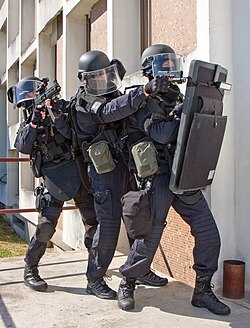
[edit]Many countries have dedicated counterterrorist units trained to handle terrorist threats. Besides various security agencies, there are police tactical units whose role is to directly engage terrorists and prevent terrorist attacks. Such units perform both in preventive actions, hostage rescue, and responding to ongoing attacks. Countries of all sizes can have highly trained counterterrorist teams. Tactics, techniques, and procedures for manhunting are under constant development.
These units are specially trained in military tactics and are equipped for close-quarters combat, with emphasis on stealth and performing the mission with minimal casualties. The units include assault teams, snipers, EOD experts, dog handlers, and intelligence officers. Most of these measures deal with terrorist attacks that affect an area or threaten to do so, or are lengthy situations such as shootouts and standoffs that allow the counterterrorist units to assemble and respond; it is harder to deal with shorter incidents such as assassinations, reprisal attacks, or bombings due to the short warning time and the quick exfiltration of the perpetrators.[42]
The majority of counterterrorism operations at the tactical level are conducted by state, federal, and national law enforcement or intelligence agencies. In some countries, the military may be called in as a last resort. For countries whose military is legally permitted to conduct domestic law enforcement operations, this is not an issue, and such counterterrorism operations are conducted by their military.
Counterterrorist operations
[edit]Some counterterrorist actions of the 20th and 21st centuries are listed below. See list of hostage crises for a more extended list, including hostage-takings that did not end violently.
| Incident | Main locale | Hostage nationality | Kidnappers /hijackers |
Counterterrorist force | Results | |
|---|---|---|---|---|---|---|
| 1972 | Sabena Flight 571 | Tel Aviv-Lod International Airport, Israel | Mixed | Black September | Sayeret Matkal | 2 hijackers killed, 1 passenger died from wounds during raid. 2 passengers and 1 commando injured. 2 kidnappers captured. All other 96 passengers rescued. |
| 1972 | Munich massacre | Munich, West Germany | Israeli | Black September | German Federal Border Guard | All hostages murdered; 5 kidnappers and 1 West German police officer killed. 3 kidnappers captured and released. This fatal result was the reason for the foundation of the German special counterterrorism unit GSG9 |
| 1975 | AIA building hostage crisis | AIA building, Kuala Lumpur, Malaysia | Mixed. American and Swedish | Japanese Red Army | Special Actions Unit | All hostages released, all kidnappers flown to Libya. |
| 1976 | Operation Entebbe | Entebbe airport, Uganda | Israelis and Jews. Non-Jewish hostages were released shortly after capture. | PFLP | Sayeret Matkal, Sayeret Tzanhanim, Sayeret Golani | All 7 hijackers, 45 Ugandan troops, 3 hostages, and 1 Israeli soldier were killed. 100 hostages rescued |
| 1977 | Lufthansa Flight 181 | Initially over the Mediterranean
Sea, south of the French coast; subsequently Mogadishu International Airport, Somalia |
Mixed | PFLP | GSG 9, Special Air Service consultants | 1 hostage killed before the raid; 3 hijackers killed and 1 captured. 90 hostages rescued. |
| 1980 | Casa Circondariale di Trani Prison riot[citation needed] | Trani, Italy | Italian | Red Brigades | Gruppo di intervento speciale (GIS) | 18 police officers rescued, all terrorists captured. |
| 1980 | Iranian Embassy siege | London, UK | Mostly Iranian but some British | Democratic Revolutionary Movement for the Liberation of Arabistan | Special Air Service | 5 kidnappers killed, 1 kidnapper captured. 1 hostage killed prior to raid, 1 hostage killed by kidnapper during raid; 24 hostages rescued. 1 SAS operative received minor burns. |
| 1979-1981 | Iran hostage crisis | Tehran, Iran | Americans | Muslim Student Followers of the Imam's Line | United States Army Special Forces, Delta Force, 75th Infantry Regiment (Ranger), CIA Special Activities Division, 1st Special Operations Wing | 8 US servicemen killed & 4 injured 1 Iranian civilian (alleged by Iranian Army) killed in Operation Eagle Claw. Negotiation finished in 1981. 53 hostages released. |
| 1981 | Garuda Indonesia Flight 206 | Don Mueang Airport, Bangkok, Thailand | Mostly Indonesian, some Europeans/Americans | Komando Jihad | Kopassus assault group, RTAF securing perimeter | 5 hijackers killed (2 likely killed extrajudicially after raid),1 Kopassus operative killed, 1 pilot fatally wounded by terrorist, all hostages rescued. |
| 1982 | Operation Winter Harvest | Padua, Italy | American | Red Brigades | U.S. Army Intelligence Support Activity (ISA), Delta Force and Nucleo Operativo Centrale di Sicurezza (NOCS) | Hostage saved, capture of the entire terrorist cell. |
| 1983 | Turkish embassy attack | Lisbon, Portugal | Turkish | Armenian Revolutionary Army | GOE | 5 hijackers, 1 hostage, and 1 police officer killed, 1 hostage and 1 police officer wounded. |
| 1985 | Achille Lauro hijacking | MS Achille Lauro off the Egyptian coast | Mixed | Palestine Liberation Organization | U.S. military, Navy SEALs turned over to Italian special forces (Gruppo di intervento speciale) | 1 hostage killed during hijacking, 4 hijackers convicted in Italy |
| 1986 | Pudu Prison siege | Pudu Prison, Kuala Lumpur, Malaysia | Two doctors | Prisoners | Special Actions Unit | 6 kidnappers captured, 2 hostages rescued |
| 1988 | Mothers Bus | Hijacked between Beer Sheva and Dimona, Israel | 11 passengers | Palestinian Liberation Organization | YAMAM | 3 hijacker killed, 3 hostages killed, 8 hostages rescued |
| 1993 | Indian Airlines Flight 427 | Hijacked between Delhi and Srinagar, India | 141 passengers | Islamic terrorist (Mohammed Yousuf Shah) | National Security Guard | 1 hijacker killed, all hostages rescued. |
| 1994 | Air France Flight 8969 | Marseille, France | Mixed | Armed Islamic Group of Algeria | GIGN | 4 hijackers killed. 3 hostages killed before the raid, 229 hostages rescued |
| 1996 | Japanese embassy hostage crisis | Lima, Peru | Japanese and guests (800+) | Túpac Amaru Revolutionary Movement | Peruvian military and police mixed forces | All 14 kidnappers, 1 hostage, and 2 rescuers killed. |
| 1996 | Mapenduma hostage crisis | Mapenduma, Indonesia | Mixed (19 Indonesians, 4 British, 2 Dutch, & 1 German) | Kelly Kwalik's Free Papua Movement (OPM) Group | Kopassus's SAT-81 Gultor CT Group, Kostrad's Infantry Battalion, Penerbad (Army Aviation) Mixed Forces | 8 kidnappers killed, 2 kidnappers captured. 2 hostages killed by kidnappers, 24 hostages rescued. 5 soldiers killed in helicopter accident. |
| 2000 | Sauk Siege | Perak, Malaysia | Malaysian (2 police officers, 1 soldier and 1 civilian) | Al-Ma'unah | Grup Gerak Khas and 20 Pasukan Gerakan Khas, mixed forces | 2 hostages, 2 rescuers, and 1 kidnapper killed. Other 28 kidnappers captured. |
| 2001–2005 | Pankisi Gorge crisis | Pankisi Gorge, Kakheti, Georgia | Mixed, Al-Qaeda and Chechen rebels led by Ibn al-Khattab | 2,400 troops, 1,000 police officers | Terrorism threats in the gorge were repressed. | |
| 2002 | Moscow theater hostage crisis | Moscow, Russia | Mixed, mostly Russian (900+) | Special Purpose Islamic Regiment | Spetsnaz | All 39 kidnappers and 129–204 hostages killed. 600–700 hostages freed. |
| 2004 | Beslan school siege | Beslan, North Ossetia-Alania, Russia | Russian | Riyad-us Saliheen | MVD (including OMON), Russian army (including Spetsnaz), Russian police (Militsiya) | 334 hostages killed and hundreds wounded. 10–21 rescuers killed. 31 kidnappers killed, 1 captured. |
| 2007 | Siege of Lal Masjid | Islamabad, Pakistan | Students and Islamist Militia | Pakistan Army and Rangers, Special Service Group | 91 students/militia members killed, 50 captured. 10 SSG and 1 Ranger killed; 33 SSG, 3 Rangers, 8 soldiers wounded. 204 civilians injured. | |
| 2007 | Kirkuk Hostage Rescue[citation needed] | Kirkuk, Iraq | Turkman child | Islamic State of Iraq and Al Qaeda | PUK's Kurdistan Regional Government's Counter Terrorism Group | 5 kidnappers arrested, 1 hostage rescued[citation needed] |
| 2008 | Operation Jaque | Colombia | Mixed | Revolutionary Armed Forces of Colombia | Columbian military | 15 hostages rescued. 2 kidnappers captured |
| 2008 | Operations Dawn | Gulf of Aden, Somalia | Mixed | Somali pirates and militants | PASKAL and mixed international forces | Negotiation finished. 80 hostages released. RMN, including PASKAL navy commandos with mixed international forces patrolling the Gulf of Aden during this festive period.[43][44][45] |
| 2008 | 2008 Mumbai attacks | Multiple locations in Mumbai city | Indian Nationals, Foreign tourists | Ajmal Qasab and other Pakistani nationals affiliated to Laskar-e-taiba | National Security Guard, MARCOS, Mumbai Police, Rapid Action Force | 141 Indian civilians, 30 foreigners, 15 police officers, and two NSG commandos were killed. 9 attackers killed, 1 attacker captured. 293 individuals injured |
| 2009 | Maersk Alabama hijacking | Gulf of Aden, Somalia. | 23 crew | Somali pirates | U.S. Navy, SEAL Team Six | 3 kidnappers killed and 1 captured. All hostages rescued. |
| 2009 | 2009 Lahore Attacks | Multiple locations in Lahore city | Pakistan | Lashkar-e-Taiba | Police Commandos, Army Rangers Battalion | March 3, The Sri Lankan cricket team attack – 6 members of the Sri Lankan cricket team were injured, 6 Pakistani police officers and 2 civilians killed.
March 30, the Manawan Police Academy in Lahore attack – 8 gunmen, 8 police personnel and 2 civilians killed, 95 people injured, 4 gunmen captured.[citation needed] |
| 2011 | Operation Dawn of Gulf of Aden | Gulf of Aden, Somalia | Koreans, Myanmar, Indonesian | Somali pirates and militants | Republic of Korea Navy Special Warfare Flotilla (UDT/SEAL) | 4+ kidnappers killed or missing (Jan 18). 8 kidnappers killed, 5 captured. All hostages rescued. |
| 2012 | Lopota Gorge hostage crisis | Lopota Gorge, Georgia | Georgians | Ethnic Chechen, Russian, and Georgian militants | Special Operations Center, SOD, KUD, army special forces | 2 KUD members and one special forces corpsman killed, 5 police officers wounded. 11 kidnappers killed, 5 wounded, and 1 captured. All hostages rescued. |
| 2013 | 2013 Lahad Datu standoff | Lahad Datu, Sabah, Malaysia | Malaysians | Royal Security Forces of the Sultanate of Sulu and North Borneo (Jamalul Kiram III's faction) | Malaysian Armed Forces, Royal Malaysia Police, Malaysian Maritime Enforcement Agency and joint counterterrorist forces, Philippine Armed Forces | 8 police officers (including 2 PGK commandos) and one soldier killed, 12 others wounded. 56 militants killed, 3 wounded, and 149 captured. All hostages rescued. 6 civilians killed and one wounded. |
| 2017 | 2017 Isani flat siege | Isani district, Tbilisi, Georgia | Georgians | Chechen militants | State Security Service of Georgia, police special forces | 3 militants killed, including Akhmed Chatayev. 1 special forces officer killed during skirmishes. |
| 2024 | Operation Golden Hand | Rafah, Gaza Strip | Israeli | Hamas | YAMAM and Shin Bet with support from the Israel Defense Forces | 67–100+ Palestinians killed, all hostages rescued. |
Designing counterterrorist systems
[edit] | This section's tone or style may not reflect the encyclopedic tone used on Wikipedia. (June 2021) |
The scope for counterterrorism systems is very large in physical terms and in other dimensions, such as type and degree of terrorist threats, political and diplomatic ramifications, and legal concerns. Ideal counterterrorist systems use technology to enable persistent intelligence, surveillance and reconnaissance missions, and potential actions. Designing such a system-of-systems comprises a major technological project.[46]
A particular design problem for counterterrorist systems is the uncertainty of the future: the threat of terrorism may increase, decrease or remain the same, the type of terrorism and location are difficult to predict, and there are technological uncertainties. A potential solution is to incorporate engineering flexibility into system design, allowing for flexibility when new information arrives. Flexibility can be incorporated in the design of a counter-terrorism system in the form of options that can be exercised in the future when new information is available.[46]
Law enforcement
[edit]While some countries with longstanding terrorism problems have law enforcement agencies primarily designed to prevent and respond to terror attacks,[47] in other nations, counterterrorism is a relatively more recent objective of law enforcement agencies.[48][49]
Though some civil libertarians and criminal justice scholars have criticized efforts of law enforcement agencies to combat terrorism as futile and expensive[50] or as threats to civil liberties,[50] other scholars have analyzed the most important dimensions of the policing of terrorism as an important dimension of counter-terrorism, especially in the post-9/11 era, and have discussed how police view terrorism as a matter of crime control.[48] Such analyses highlight the civilian police role in counterterrorism next to the military model of a war on terror.[51]
American law enforcement
[edit]
Pursuant to passage of the Homeland Security Act of 2002, federal, state, and local law enforcement agencies began to systemically reorganize.[52][53] Two primary federal agencies, the Department of Justice (DOJ) and the Department of Homeland Security (DHS), house most of the federal agencies that are prepared to combat domestic and international terrorist attacks. These include the Border Patrol, the Secret Service, the Coast Guard and the FBI.
Following suit from federal changes pursuant to 9/11, however, most state and local law enforcement agencies began to include a commitment to "fighting terrorism" in their mission statements.[54][55] Local agencies began to establish more patterned lines of communication with federal agencies. Some scholars have doubted the ability of local police to help in the war on terror and suggest their limited manpower is still best utilized by engaging community and targeting street crimes.[50]
While counter-terror measures (most notably heightened airport security, immigrant profiling[56] and border patrol) have been adapted during the last decade, to enhance counter-terror in law enforcement, there have been remarkable limitations to assessing the actual utility/effectiveness of law enforcement practices that are ostensibly preventative.[57] Thus, while sweeping changes in counterterrorist rhetoric redefined most American post 9/11 law enforcement agencies in theory, it is hard to assess how well such hyperbole has translated into practice.
In intelligence-led policing (ILP) efforts, the most quantitatively amenable starting point for measuring the effectiveness of any policing strategy (i.e.: Neighborhood Watch, Gun Abatement, Foot Patrols, etc.) is usually to assess total financial costs against clearance rates or arrest rates. Since terrorism is such a rare event phenomena,[58] measuring arrests or clearance rates would be a non-generalizable and ineffective way to test enforcement policy effectiveness. Another methodological problem in assessing counterterrorism efforts in law enforcement hinges on finding operational measures for key concepts in the study of homeland security. Both terrorism and homeland security are relatively new concepts for criminologists, and academicians have yet to agree on the matter of how to properly define these ideas in a way that is accessible.
Military
[edit]
Given the nature of operational counterterrorism tasks, national military organizations do not generally have dedicated units whose sole responsibility is the prosecution of these tasks. Instead the counterterrorism function is an element of the role, allowing flexibility in their employment, with operations being undertaken in the domestic or international context.
In some cases the legal framework within which they operate prohibits military units conducting operations in the domestic arena; United States Department of Defense policy, based on the Posse Comitatus Act, forbids domestic counterterrorism operations by the U.S. military. Units allocated some operational counterterrorism tasks are frequently special forces or similar assets.
In cases where military organisations do operate in the domestic context, some form of formal handover from the law enforcement community is regularly required, to ensure adherence to the legislative framework and limitations. For instance, during the 1980 Iranian Embassy siege, the Metropolitan Police formally turned responsibility over to the British Army's Special Air Service when the situation went beyond police capabilities.
See also
[edit]- Civilian casualty ratio
- Civil defense
- Counterinsurgency
- Counter-IED efforts
- Counterjihad
- Deradicalization
- Explosive detection
- Extrajudicial execution
- Extraordinary rendition
- Fatwa on Terrorism
- Global Initiative to Combat Nuclear Terrorism
- Industrial antiterrorism
- Informant
- Infrastructure security
- International counter-terrorism operations of Russia
- Irregular warfare
- Manhunt (law enforcement)
- Manhunt (military)
- Paramilitary
- Preventive State
- Security increase
- Sociology of terrorism
- Special Activities Division, Central Intelligence Agency
- Targeted killing
- Terrorism Research Center
- War among the people
- War on terror
References
[edit]- ^ Stigall, Dan E.; Miller, Chris; Donnatucci, Lauren (October 7, 2019). "The 2018 National Strategy for Counterterrorism: A Synoptic Overview". American University National Security Law Brief. SSRN 3466967.
- ^ "Introduction to Foreign Internal Defense" (PDF). U.S. Air Force Doctrine. February 1, 2020.
- ^ "Introduction to Foreign Internal Defense" (PDF). Curtis E. Lemay Center for Doctrine Development and Education. Archived from the original (PDF) on January 24, 2017. Retrieved July 10, 2019.
- ^ "Differences Between Foreign Internal Defense (FID) and Counter Insurgency (COIN)". SOFREP.
- ^ Tim Newburn, Peter Neyroud (2013). Dictionary of Policing. Routledge. p. 262. ISBN 9781134011551.
- ^ "The first international conference on terrorism: Rome 1898". The Battle against Anarchist Terrorism. Cambridge University Press. December 5, 2013. pp. 131–184. doi:10.1017/cbo9781139524124.008. ISBN 978-1-139-52412-4.
- ^ "Conception for the Establishment and Employment of a Border-Guard for Special Police Action (GSG9)" (PDF). September 19, 1972. Archived (PDF) from the original on October 9, 2022. Retrieved September 9, 2017.
- ^ Shaffer, Ryan (2015). "Counter-Terrorism Intelligence, Policy and Theory Since 9/11". Terrorism and Political Violence. 27 (2): 368–375. doi:10.1080/09546553.2015.1006097. S2CID 145270348.
- ^ "Preventive Counter-Terrorism Measures and Non-Discrimination in the European Union: The Need for Systematic Evaluation". The International Centre for Counter-Terrorism – The Hague (ICCT). July 2, 2011. Archived from the original on October 18, 2017. Retrieved September 6, 2016.
- ^ "Which Countries' Terrorist Attacks Are Ignored By The U.S. Media?". FiveThirtyEight. 2016.
- ^ "Trade and Terror: The Impact of Terrorism on Developing Countries". Federal Reserve Bank of St. Louis. 2017.
- ^ Sexton, Renard; Wellhausen, Rachel L.; Findley, Michael G. (2019). "How Government Reactions to Violence Worsen Social Welfare: Evidence from Peru". American Journal of Political Science. 63 (2): 353–367. doi:10.1111/ajps.12415. ISSN 1540-5907. S2CID 159341592.
- ^ Lin, Patrick K. (2021). "How to Save Face & the Fourth Amendment: Developing an Algorithmic Auditing and Accountability Industry for Facial Recognition Technology in Law Enforcement". SSRN Electronic Journal. doi:10.2139/ssrn.4095525. ISSN 1556-5068. S2CID 248582120.
- ^ Garvie, Clare (May 26, 2022), "Face Recognition and the Right to Stay Anonymous", The Cambridge Handbook of Information Technology, Life Sciences and Human Rights, Cambridge University Press, pp. 139–152, doi:10.1017/9781108775038.014, ISBN 9781108775038, retrieved August 16, 2023
- ^ "Why facial recognition use is growing amid the Covid-19 pandemic". South China Morning Post. November 18, 2020. Retrieved August 16, 2023.
- ^ Hoffman, Bruce; Ware, Jacob (June 21, 2020). "The Challenges of Effective Counterterrorism Intelligence in the 2020s". Lawfare.
- ^ Feiler, Gil (September 2007). "The Globalization of Terror Funding" (PDF). Begin-Sadat Center for Strategic Studies, Bar-Ilan University: 29. Mideast Security and Policy Studies No. 74. Retrieved November 14, 2007.
{{cite journal}}: Cite journal requires|journal=(help) - ^ "Counter-Terrorism Module 12 Key Issues: Surveillance & Interception".
- ^ Gill, Paul; Piazza, James A.; Horgan, John (May 26, 2016). "Counterterrorism Killings and Provisional IRA Bombings, 1970–1998". Terrorism and Political Violence. 28 (3): 473–496. doi:10.1080/09546553.2016.1155932. S2CID 147673041.
- ^ "USCENTCOM Seizes Iranian Advanced Conventional Weapons Bound for Houthis". U.S. Central Command. Retrieved January 22, 2024.
- ^ Exclusive: Trump to focus counter-extremism program solely on Islam – sources, Reuters 2017-02-02
- ^ "Proposals to further strengthen Australia s counter-terrorism laws 2005".
- ^ Summary of Israeli Supreme Court Ruling on Targeted Killings Archived February 23, 2013, at the Wayback Machine December 14, 2006
- ^ "Terror bill passes into law". The Jerusalem Post. June 16, 2016. Retrieved June 16, 2016.
- ^ "Accountability and Transparency in the United States' Counter-Terrorism Strategy". The International Centre for Counter-Terrorism – The Hague (ICCT). January 22, 2015. Archived from the original on October 18, 2017. Retrieved September 6, 2016.
- ^ "Fighting Terrorism Without Violating Human Rights". HuffPost. March 21, 2016.
- ^ de Londras, Detention in the War on Terrorism: Can Human Rights Fight Back? (2011)
- ^ a b c d e f Human Rights News (2004): "Human Rights and Counter-Terrorism", in the Briefing to the 60th Session of the UN Commission on Human Rights. online
- ^ a b c d e f g h Amnesty International (2005): "Counter-terrorism and criminal law in the EU. online
- ^ "UN experts call for removal of rights defenders Ramy Shaath and Zyad El-Elaimy from 'terrorism entities' list". OHCHR. Retrieved February 11, 2021.
- ^ "Preventive Counter-Terrorism Measures and Non-Discrimination in the European Union: The Need for Systematic Evaluation". The International Centre for Counter-Terrorism-The Hague (ICCT). July 2, 2011. Archived from the original on October 18, 2017. Retrieved September 6, 2016.
- ^ Savun, Burcu; Tirone, Daniel C. (2018). "Foreign Aid as a Counterterrorism Tool – Burcu Savun, Daniel C. Tirone". Journal of Conflict Resolution. 62 (8): 1607–1635. doi:10.1177/0022002717704952. S2CID 158017999.
- ^ Pape, Robert A. (2005). Dying to Win: The Strategic Logic of Suicide Terrorism. Random House. pp. 237–250.
- ^ Trinquier, Roger (1961). "Modern Warfare: A French View of Counterinsurgency". Archived from the original on January 12, 2008.
1964 English translation by Daniel Lee with an Introduction by Bernard B. Fall
- ^ Nagl, John A.; Petraeus, David H.; Amos, James F.; Sewall, Sarah (December 2006). "Field Manual 3–24 Counterinsurgency" (PDF). US Department of the Army. Retrieved February 3, 2008.
While military manuals rarely show individual authors, David Petraeus is widely described as establishing many of this volume's concepts.
{{cite journal}}: Cite journal requires|journal=(help) - ^ Ronchi, E. (2015). "Disaster management: Design buildings for rapid evacuation". Nature. 528 (7582): 333. Bibcode:2015Natur.528..333R. doi:10.1038/528333b. PMID 26672544.
- ^ Robert Johnson (November 19, 2012). "How Israel Developed Such A Shockingly Effective Rocket Defense System". Business Insider. Retrieved November 20, 2012.
- ^ "IDF's 'David's Sling' missile system used to shoot down rocket barrage". The Jerusalem Post. May 10, 2023. ISSN 0792-822X. Retrieved May 10, 2023.
- ^ Weiss, Eric M. (January 11, 2005). "D.C. Wants Rail Hazmats Banned: S.C. Wreck Renews Fears for Capital". The Washington Post. p. B01.
- ^ "Suicide bombing 'pig fat threat". BBC News. February 13, 2004. Retrieved January 2, 2010.
- ^ "Swine: Secret Weapon Against Islamic Terror?". ArutzSheva. December 9, 2007.
- ^ Stathis N. Kalyvas (2004). "The Paradox of Terrorism in Civil Wars" (PDF). Journal of Ethics. 8 (1): 97–138. doi:10.1023/B:JOET.0000012254.69088.41. S2CID 144121872. Archived from the original (PDF) on October 11, 2006. Retrieved October 1, 2006.
- ^ Crewmen tell of scary ordeal Archived October 8, 2008, at the Wayback Machine The Star Sunday October 5, 2008.
- ^ No choice but to pay ransom Archived December 5, 2008, at the Wayback Machine The Star Monday September 29, 2008
- ^ "Ops Fajar mission accomplished". The Star. October 10, 2008. Archived from the original on October 24, 2008. Retrieved November 7, 2008.
- ^ a b Buurman, J.; Zhang, S.; Babovic, V. (2009). "Reducing Risk Through Real Options in Systems Design: The Case of Architecting a Maritime Domain Protection System". Risk Analysis. 29 (3): 366–379. Bibcode:2009RiskA..29..366B. doi:10.1111/j.1539-6924.2008.01160.x. PMID 19076327. S2CID 36370133.
- ^ Juergensmeyer, Mark (2000). Terror in the Mind of God: The Global Rise of Religious Violence. Berkeley, CA: University of California Press.
- ^ a b Deflem, Mathieu. 2010. The Policing of Terrorism: Organizational and Global Perspectives. New York: Routledge.
- ^ Deflem, Mathieu and Samantha Hauptman. 2013. "Policing International Terrorism." Pp. 64–72 in Globalisation and the Challenge to Criminology, edited by Francis Pakes. London: Routledge. [1]
- ^ a b c Helms, Ronald; Costanza, S E; Johnson, Nicholas (February 1, 2012). "Crouching tiger or phantom dragon? Examining the discourse on global cyber-terror". Security Journal. 25 (1): 57–75. doi:10.1057/sj.2011.6. ISSN 1743-4645. S2CID 154538050.
- ^ Michael Bayer. 2010. The Blue Planet: Informal International Police Networks and National Intelligence. Washington, DC: National Intelligence Defense College. [2] Archived October 18, 2017, at the Wayback Machine
- ^ Costanza, S.E.; Kilburn, John C. Jr. (2005). "Symbolic Security, Moral Panic and Public Sentiment: Toward a sociology of Counterterrorism". Journal of Social and Ecological Boundaries. 1 (2): 106–124.
- ^ Deflem, M (2004). "Social Control and the Policing of Terrorism Foundations for a sociology of Counterterrorism". American Sociologist. 35 (2): 75–92. doi:10.1007/bf02692398. S2CID 143868466.
- ^ DeLone, Gregory J. 2007. "Law Enforcement Mission Statements Post September 11." Police Quarterly 10(2)
- ^ Mathieu Deflem. 2010. The Policing of Terrorism: Organizational and Global Perspectives. New York: Routledge.
- ^ Ramirez, D., J. Hoopes, and T.L. Quinlan. 2003 "Defining racial profiling in a post-September 11 world." American Criminal Law Review. 40(3): 1195–1233.
- ^ Kilburn, John C. Jr.; Costanza, S.E.; Metchik, Eric; Borgeson, Kevin (2011). "Policing Terror Threats and False Positives: Employing a Signal Detection Model to Examine Changes in National and Local Policing Strategy between 2001–2007". Security Journal. 24: 19–36. doi:10.1057/sj.2009.7. S2CID 153825273.
- ^ Kilburn, John C. Jr. and Costanza, S.E. 2009 "Immigration and Homeland Security" published in Battleground: Immigration (Ed: Judith Ann Warner); Greenwood Publishing, Ca.
Further reading
[edit]- Arreguín-Toft, Ivan. "Tunnel at the End of the Light: A Critique of U.S. Counter-terrorist Grand Strategy," Cambridge Review of International Affairs, Vol. 15, No. 3 (2002), pp. 549–563.
- Ivan Arreguín-Toft, "How to Lose a War on Terror: A Comparative Analysis of a Counterinsurgency Success and Failure," in Jan Ångström and Isabelle Duyvesteyn, Eds., Understanding Victory and Defeat in Contemporary War (London: Frank Cass, 2007).
- Bakker, Edwin, and Tinka Veldhuis. A Fear Management Approach to Counter-Terrorism (International Centre for Counter-Terrorism – The Hague, 2012) Archived April 2, 2015, at the Wayback Machine
- Barton, Mary S. Counterterrorism between the Wars: An International History, 1919-1937 (Oxford University Press, 2020) online book review
- Berger, J.M. Making CVE Work: A Focused Approach Based on Process Disruption Archived July 28, 2020, at the Wayback Machine, (International Centre for Counter-Terrorism – The Hague, May 2016
- Besenyo, Janos. Low-cost attacks, unnoticeable plots? Overview on the economical character of current terrorism, Strategic Impact (ROMANIA) (ISSN: 1841–5784) (eISSN: 1824–9904) 62/2017: (Issue No. 1) pp. 83–100.
- Deflem, Mathieu. 2020. "Responses to Terror: Policing and Countering Terrorism in the Modern Age." In The Handbook of Collective Violence: Current Developments and Understanding, eds. C.A. Ireland, et al. Abingdon, UK: Routledge.
- Deflem, Mathieu, and Stephen Chicoine. 2019. "Policing Terrorism." In The Handbook of Social Control, edited by Mathieu Deflem. Hoboken, NJ: Wiley-Blackwell.
- Deflem, Mathieu and Shannon McDonough. 2015. "The Fear of Counterterrorism: Surveillance and Civil Liberties Since 9/11." Society 52(1):70–79.
- Gagliano Giuseppe, Agitazione sovversiva, guerra psicologica e terrorismo (2010) ISBN 978-88-6178-600-4, Uniservice Books.
- Ishmael Jones, The Human Factor: Inside the CIA's Dysfunctional Intelligence Culture (2008, revised 2010) ISBN 978-1-59403-382-7, Encounter Books.
- James Mitchell, "Identifying Potential Terrorist Targets" a study in the use of convergence. G2 Whitepaper on terrorism, copyright 2006, G2. Counterterrorism Conference, June 2006, Washington D.C.
- James F. Pastor, "Terrorism and Public Safety Policing:Implications for the Obama Presidency" (2009, ISBN 978-1-4398-1580-9, Taylor & Francis).
- Jessica Dorsey, Christophe Paulussen, Boundaries of the Battlefield: A Critical Look at the Legal Paradigms and Rules in Countering Terrorism (International Centre for Counter-Terrorism – The Hague, 2013) Archived October 22, 2020, at the Wayback Machine
- Judy Kuriansky (Editor), "Terror in the Holy Land: Inside the Anguish of the Israeli-Palestinian Conflict" (2006, ISBN 0-275-99041-9, Praeger Publishers).
- Lynn Zusman (Editor), "The Law of Counterterrorism" (2012, ISBN 978-1-61438-037-5, American Bar Association).* Marc Sageman, Understanding Terror Networks (Philadelphia, PA: University of Pennsylvania Press, 2004), ISBN 0-8122-3808-7.
- Newton Lee, Counterterrorism and Cybersecurity: Total Information Awareness (Second Edition) (Switzerland: Springer International Publishing, 2015), ISBN 978-3-319-17243-9.
- Merari, Ariel. "Terrorism as a Strategy in Insurgency," Terrorism and Political Violence, Vol. 5, No. 4 (Winter 1993), pp. 213–251.
- Sinkkonen, Teemu.Political Responses to Terrorism (Acta Universitatis Tamperensis, 2009), ISBN 978-9514478710.
- Vandana, Asthana., "Cross-Border Terrorism in India: Counterterrorism Strategies and Challenges," ACDIS Occasional Paper (June 2010), Program in Arms Control, Disarmament, and International Security (ACDIS), University of Illinois
External links
[edit]

Counterterrorism
View on GrokipediaDefinition and Principles
Defining Terrorism and Counterterrorism
Terrorism is commonly characterized as the premeditated use of unlawful violence or threats of violence against non-combatants to achieve political, ideological, religious, or social objectives through the creation of fear and intimidation beyond the immediate victims. This conceptualization emphasizes the psychological impact intended to coerce governments or populations, distinguishing it from conventional warfare or criminality. Academic analyses highlight that while no single definition commands universal agreement, an emerging legal consensus identifies terrorism as criminal violence aimed at intimidating populations or coercing governments or international organizations.[12][13] Efforts to codify terrorism legally reveal persistent challenges, including political sensitivities over labeling state actions as terrorism and exclusions of certain motivations, which can lead to inconsistent application across jurisdictions. In the United States, 18 U.S.C. § 2331 defines international terrorism as activities involving violent acts or acts dangerous to human life that violate federal or state criminal laws, occurring primarily outside U.S. jurisdiction, and intended to intimidate or coerce a civilian population, influence government policy by intimidation or coercion, or affect government conduct through mass destruction, assassination, or kidnapping. Domestic terrorism follows a parallel structure under the same statute, focusing on acts within U.S. borders intended to coerce civilian populations or influence policy through similar means. These definitions prioritize intent and targeting of civilians, excluding lawful combatants in armed conflicts.[14][15] Counterterrorism refers to the coordinated set of proactive and reactive measures employed by states and international bodies to detect, prevent, disrupt, and mitigate terrorist activities, encompassing intelligence gathering, border security, financial tracking, and kinetic operations. U.S. government frameworks, such as those from the National Counterterrorism Center, integrate analysis of terrorist threats with operational responses to fuse intelligence and neutralize risks across domestic and international domains. The approach underscores causal disruption—targeting recruitment networks, propaganda dissemination, and logistical support—rather than solely post-incident response, as evidenced by post-2001 enhancements in global counterterrorism cooperation under frameworks like the UN Global Counter-Terrorism Strategy.[1][16] Such strategies recognize terrorism's asymmetric nature, where perpetrators exploit societal vulnerabilities to amplify impact disproportionate to resources expended.[5]First-Principles Foundations
Terrorism fundamentally constitutes a strategy of coercion wherein sub-state actors deliberately target non-combatants to generate fear, thereby pressuring governments or societies into concessions on political, ideological, or religious objectives. This approach leverages asymmetry, allowing numerically inferior forces to amplify impact beyond military proportionality by exploiting public aversion to casualties and disrupting normalcy. Counterterrorism, in response, derives from the imperative to neutralize this coercive mechanism by denying terrorists both the means and the perceived efficacy of violence, thereby restoring deterrence and societal resilience. Empirical analyses of terrorist campaigns, such as those by al-Qaeda and ISIS, demonstrate that groups thrive on operational impunity and narrative victories, underscoring the need to prioritize capability disruption over reactive measures alone.[7][17] At the causal level, terrorism persists through interlocking enablers: recruitment fueled by ideological indoctrination, financing via illicit networks, and safe havens permitting planning and execution. First-principles reasoning identifies ideology—often absolutist doctrines framing violence as morally imperative—as the primary driver of individual commitment, rather than mere socio-economic deprivation, which statistical reviews show correlates weakly with participation in ideologically motivated groups. For instance, jihadist terrorism's global spread since the 1980s correlates more strongly with Salafi-jihadist interpretations promoting perpetual conflict against perceived apostates than with poverty metrics, as evidenced by recruits from affluent backgrounds in Europe and the West. Counterterrorism thus demands targeted ideological contestation, such as exposing doctrinal inconsistencies or highlighting operational failures, alongside physical denial of resources, to erode the rational calculus favoring violence.[17][18] Strategic foundations emphasize preemptive action grounded in intelligence to interdict plots before execution, as post-attack responses invariably yield suboptimal outcomes in terms of lives saved and political leverage ceded. Data from counterinsurgency operations, including U.S.-led efforts in Iraq and Afghanistan, reveal that decapitation strikes against leadership—eliminating figures like Abu Musab al-Zarqawi in 2006—temporarily fracture command structures and deter emulation, though sustained effects require parallel erosion of support bases. This approach aligns with causal realism by addressing root incentives: terrorists calculate risks versus rewards, and credible threats of elimination shift equilibria toward disbandment or dormancy, as observed in the decline of operational tempo for groups under persistent pressure. Conversely, overreliance on non-kinetic tools like development aid, absent enforcement, fails to alter behavior when ideologues view material incentives as insufficient against transcendental goals.[5][7]Historical Context
Pre-Modern and Early Modern Examples
In the first century CE, the Sicarii, a radical Jewish faction during the Roman occupation of Judea, employed targeted assassinations with concealed daggers (sicae) against Roman officials and Jewish collaborators in crowded public spaces to sow fear and incite rebellion.[19] Roman authorities responded with intensified military suppression, including searches, arrests, and public executions; during the First Jewish-Roman War (66–73 CE), legions under Vespasian and Titus besieged Jerusalem in 70 CE, destroying the Second Temple and killing or enslaving over a million people, effectively dismantling Sicarii networks.[20] Surviving Sicarii retreated to Masada, where Roman forces under Flavius Silva besieged the fortress in 73 CE, prompting the group's mass suicide rather than surrender, marking the end of their operations.[19] During the medieval period, the Nizari Ismaili sect, known as the Hashashin or Assassins, operated from fortified strongholds like Alamut in Persia from the late 11th to 13th centuries, using selective murders of political and religious leaders to eliminate rivals and expand influence amid Sunni-Shia conflicts and Crusades.[21] Efforts by figures like Saladin to counter them through sieges and reprisals largely failed due to the Assassins' dispersed cells and psychological impact of their killings, but the Mongol Empire under Hulagu Khan launched a decisive campaign in 1253–1256 CE, conquering Nizari territories after the Khwarazmian collapse.[22] In November 1256 CE, Mongol forces besieged Alamut, prompting Imam Rukn al-Din Khurshah to surrender; the Mongols then razed the fortress, destroyed its library of over 100,000 volumes, and executed key leaders, eradicating the centralized Assassin state.[21][22] In early modern Europe, the Gunpowder Plot of 1605 exemplified Catholic resistance to Protestant rule in England, where conspirators including Robert Catesby and Guy Fawkes planned to demolish the House of Lords with 36 barrels (about 2.5 tons) of gunpowder during King James I's state opening on November 5, aiming to assassinate him and nobles to spark a Catholic uprising.[23] The plot was thwarted by intelligence from an anonymous letter to Baron Monteagle, prompting a search of Westminster Palace vaults that uncovered the cache and led to Fawkes's arrest with matches in hand.[24] Eight principal plotters were tried for high treason in January 1606 and executed by hanging, drawing, and quartering, while broader countermeasures included the 1606 Oath of Allegiance enforcing loyalty to the crown over the Pope, fines on recusant Catholics, and restrictions on their movements and education to prevent recurrence.[23] These measures reflected a shift toward preemptive surveillance and legal deterrence in response to ideologically motivated plots.[24]20th Century Developments
Following World War II, counterterrorism efforts initially focused on counterinsurgency against communist guerrillas in colonial territories. In the Malayan Emergency from 1948 to 1960, British forces implemented a comprehensive strategy including population resettlement into protected villages, intelligence gathering through surrendered insurgents, and military operations, resulting in over 6,700 insurgents killed, 1,287 captured, and 2,702 surrendered.[25] This approach emphasized winning civilian support alongside kinetic actions, contributing to the defeat of the Malayan Communist Party.[26] In contrast, during the Algerian War from 1954 to 1962, French counterterrorism involved widespread use of torture and collective punishment against Front de Libération Nationale (FLN) fighters and sympathizers, which alienated the population and failed to prevent Algerian independence despite tactical successes.[27] The 1960s and 1970s saw a surge in international terrorism, particularly aircraft hijackings and attacks by Palestinian groups, prompting the creation of specialized counterterrorism units. The 1972 Munich Olympics massacre, where Black September terrorists killed 11 Israeli athletes, exposed deficiencies in German police capabilities and led to the formation of Grenzschutzgruppe 9 (GSG 9) within the Federal Border Police in April 1973 to handle hostage rescues and sieges.[28] In the United Kingdom, the Special Air Service (SAS) expanded its counter-revolutionary warfare role in the 1970s to combat Irish Republican Army (IRA) bombings, conducting undercover operations and ambushes that neutralized key threats.[29] Iconic operations demonstrated evolving tactics. Israel's Operation Entebbe on July 4, 1976, involved Sayeret Matkal commandos flying 4,000 kilometers to Uganda, rescuing 102 hostages from a hijacked [Air France](/page/Air France) flight held by Palestinian and German terrorists, with one commando killed and minimal civilian casualties.[30] In the United States, responses to hijackings included the Federal Aviation Administration's initiation of passenger screening in 1973, while the creation of Delta Force in 1977 marked a shift toward dedicated hostage rescue capabilities, though early efforts like the 1980 Iran hostage rescue mission failed.[31] These developments reflected a transition from broad counterinsurgency to precise, intelligence-driven interventions against non-state actors.Post-9/11 Era and Global Shifts
The September 11, 2001, attacks by al-Qaeda, which killed 2,977 people in New York, Washington, D.C., and Pennsylvania, prompted a fundamental reconfiguration of counterterrorism paradigms worldwide.[32] President George W. Bush declared a "Global War on Terror" on September 20, 2001, shifting from reactive law enforcement to proactive military and intelligence operations against non-state actors.[33] This included the U.S. invasion of Afghanistan on October 7, 2001, under Operation Enduring Freedom, aimed at dismantling al-Qaeda and ousting the Taliban regime that harbored them, with initial coalition forces numbering around 110,000 by late 2001.[32] NATO invoked Article 5 for the first time in its history on September 12, 2001, facilitating international contributions to the Afghan campaign.[5] Domestically, the USA PATRIOT Act, enacted on October 26, 2001, expanded surveillance powers, allowing roving wiretaps, access to business records, and enhanced information sharing between intelligence and law enforcement agencies.[34][35] The creation of the Department of Homeland Security in 2002 centralized U.S. efforts, while the Iraq War launched in March 2003—initially justified by alleged weapons of mass destruction and terrorism ties—further globalized operations, though subsequent inquiries found no stockpiles of WMDs.[32] Drone strikes emerged as a key tactic, with the U.S. conducting over 540 strikes in Pakistan alone from 2004 to 2018, targeting al-Qaeda leaders like Osama bin Laden, killed on May 2, 2011.[36] Globally, nations adapted: the UK passed the Terrorism Act 2006 after the July 7, 2005, London bombings (52 deaths), emphasizing prevention over prosecution; Australia formed a National Counter Terrorism Committee in 2002.[37] Threats evolved from al-Qaeda's hierarchical structure to ISIS's decentralized affiliates after its 2014 caliphate declaration, which controlled territory in Iraq and Syria until territorial defeat in 2019, yet inspired lone-actor attacks like the 2015 Paris assaults (130 deaths).[38][39] U.S. strategy under President Obama emphasized countering violent extremism and targeted killings, reducing large-scale plots but facing criticism for civilian casualties in drone operations estimated at 800-1,700 in non-battlefield settings from 2009-2016.[40] The 2021 U.S. withdrawal from Afghanistan enabled Taliban resurgence, allowing al-Qaeda reconstitution, as evidenced by UN reports of training camps by 2023.[41] By 2025, counterterrorism reflects hybrid threats, integrating cyber defenses and partnerships against resurgent jihadist networks, with RAND analyses noting sustained focus on homeland security fusion centers post-9/11.[42][43]Strategic Approaches
Intelligence and Surveillance Operations
Intelligence and surveillance operations constitute the foundational pillar of modern counterterrorism, enabling the identification, tracking, and disruption of threats prior to execution through proactive collection and analysis of information. These efforts rely on a spectrum of methods, including human intelligence (HUMINT) via informant networks and clandestine operations, signals intelligence (SIGINT) intercepting communications, and geospatial intelligence from satellites and drones. Post-9/11, the U.S. Intelligence Community underwent structural reforms, such as the establishment of the National Counterterrorism Center in 2004 to fuse data across agencies, addressing pre-attack silos that contributed to intelligence failures.[44] Empirical assessments indicate that such operations have prevented numerous attacks, though exact figures remain partially classified due to operational sensitivities; declassified U.S. government summaries attribute disruptions to over 50 potential events via NSA-led SIGINT alone between 2001 and 2013.[45] SIGINT capabilities, primarily under the National Security Agency (NSA), have demonstrated tangible impact in foiling plots by monitoring foreign communications under authorities like Section 702 of the Foreign Intelligence Surveillance Act, renewed in 2018. Declassified examples include the 2009 disruption of a New York City subway bombing plot by tracking al-Qaeda operative Najibullah Zazi's overseas contacts, and prevention of an attack on a Danish newspaper in 2010 via intercepted instructions from Yemen.[46] Similarly, SIGINT contributed to neutralizing a 2009 al-Qaeda cell in Pakistan planning strikes against the U.S., as well as averting a 2006 transatlantic aircraft liquid explosives plot through Anglo-American intercepts.[46] In 2024, FBI officials reported using Section 702 surveillance to thwart an imminent ISIS-inspired attack on U.S. soil, underscoring ongoing utility despite congressional debates over warrant requirements.[47] Critics, including analyses questioning bulk metadata programs' direct efficacy, argue that targeted querying yields more value than indiscriminate collection, with limited public evidence linking mass surveillance to independent disruptions beyond tipped leads.[48] HUMINT remains indispensable for penetrating closed networks where technical means falter, often providing the "little data" breakthroughs in tip-offs and defections that cascade into broader operations. The CIA's HUMINT-driven tracking of Osama bin Laden exemplifies this, culminating in his 2011 Abbottabad raid after years of cultivating sources in Pakistan and analyzing detainee interrogations, which yielded the courier network pivotal to his location.[49] FBI human sources have similarly motivated informants through incentives like reduced sentences or payments, disrupting domestic cells; a 2016 assessment highlighted their role in over 100 U.S. cases since 2001, though risks of fabrication necessitate rigorous vetting.[50] International cooperation amplifies these efforts, with the Five Eyes alliance (U.S., UK, Canada, Australia, New Zealand) enabling seamless SIGINT and HUMINT sharing that has bolstered counterterrorism against al-Qaeda and ISIS affiliates, as evidenced by joint disruptions of European travel pipelines to Syria from 2014 onward.[51] Technological advancements, including AI-assisted pattern recognition in vast datasets, have enhanced surveillance efficiency, but causal realism underscores that human judgment integrates raw data into actionable insights—overreliance on automation risks missing contextual nuances exploited by adaptive adversaries. Official tallies, such as Heritage Foundation's documentation of 50+ foiled U.S.-targeted plots from 2001 to 2012 involving intelligence leads, align with DNI claims of systemic prevention, though academic studies caution that attribution challenges and selection bias in declassifications may inflate perceived success rates without comprehensive metrics.[52] Mainstream reporting often emphasizes privacy erosions from programs like PRISM, revealed in 2013, potentially understating operational wins due to institutional preferences for civil liberties narratives over security imperatives.[53]Preemptive Neutralization Tactics
Preemptive neutralization tactics in counterterrorism involve intelligence-driven operations to eliminate or capture high-value terrorist targets and disrupt imminent plots before attacks occur, aiming to degrade organizational capabilities and prevent casualties. These tactics prioritize actionable intelligence to target leaders, planners, or infrastructure, distinguishing them from reactive measures by focusing on causal disruption of threats at their source. Empirical assessments indicate short-term reductions in attack frequency and lethality, though long-term organizational resilience varies by group structure.[54] Targeted killings, often executed via airstrikes or ground operations, exemplify preemptive neutralization, with Israel employing this policy extensively against Palestinian groups during the Second Intifada (2000–2005). From 2000 to 2004, Israel conducted over 200 assassination attempts, targeting approximately half against Hamas operatives, resulting in the elimination of key figures such as Salah Shehadeh in 2002 and Ahmed Yassin in 2004. These operations correlated with a decline in suicide bombing fatalities, as surviving leaders adopted underground postures that hampered operational tempo, and combined with barriers like the security fence, prompted temporary Hamas ceasefires. Stock market data from the period showed positive abnormal returns following successful assassinations, signaling investor perceptions of enhanced security and policy efficacy.[55][56][57] The United States has utilized drone strikes as a primary preemptive tool against Al-Qaeda affiliates, conducting thousands of operations in Pakistan, Yemen, and Somalia since 2004, which killed an estimated 2,200–3,500 militants, including leaders like Ayman al-Zawahiri on August 1, 2022. These strikes disrupted command structures and plot planning, with U.S. assessments crediting them for preventing attacks on Western targets by forcing leaders into hiding and limiting mobility. However, outcomes include occasional civilian casualties and debates over regeneration, as decentralized groups like Al-Qaeda adapted through succession. Special forces raids complement drones, such as the 2017 Yakla raid in Yemen targeting AQAP, which yielded intelligence on bomb-making despite operational costs.[58][59] Effectiveness hinges on intelligence precision and follow-through; studies show targeted killings reduce immediate threats but require integration with broader strategies to avoid leadership vacuums fostering radicalization. In Israel's case, post-assassination attack rates dropped temporarily, with multivariate analyses confirming deterrence effects beyond mere operational pauses. U.S. drone programs similarly demonstrated tactical success in neutralizing plotters, though metrics on prevented attacks remain classified and contested. Preemptive tactics demand high evidentiary thresholds to minimize errors, as misidentifications can erode legitimacy, yet causal evidence supports their role in altering terrorist cost-benefit calculations.[60][56]Military and Kinetic Interventions
Military and kinetic interventions in counterterrorism involve the direct application of armed force to eliminate terrorists, destroy their infrastructure, and disrupt operations, often through airstrikes, special forces raids, and ground campaigns. These actions prioritize immediate threat neutralization over long-term political solutions, drawing on the causal reality that physical elimination of combatants reduces operational capacity in the short term. However, empirical analyses indicate mixed outcomes, with successes in degrading specific networks offset by challenges like leadership regeneration and potential radicalization from collateral damage.[61][62] Following the September 11, 2001, attacks, the United States initiated Operation Enduring Freedom on October 7, 2001, launching airstrikes and special operations to dismantle al-Qaeda and oust the Taliban regime in Afghanistan that sheltered them. Coalition forces, including U.S. troops supported by Northern Alliance proxies, toppled the Taliban government by December 2001, capturing or killing thousands of fighters and disrupting al-Qaeda's core training camps. Despite these gains, the Taliban regrouped into an insurgency, controlling significant territory by 2021 when U.S. forces withdrew, highlighting kinetic operations' limitations in achieving enduring stability without sustained ground presence.[63][64] Targeted killings via drone strikes and raids represent precision kinetic tools, exemplified by the May 2, 2011, U.S. Navy SEAL raid in Abbottabad, Pakistan, which resulted in Osama bin Laden's death and seizure of intelligence materials revealing al-Qaeda's operational weaknesses. From 2004 to 2018, U.S. drones conducted over 500 strikes in Pakistan alone, killing an estimated 2,000-4,000 militants, including high-value targets like Baitullah Mehsud in 2009. Captured al-Qaeda documents analyzed post-strikes show temporary disruptions in plotting and communications, though overall terrorism incidents in targeted areas exhibited short-term increases before declining, suggesting effectiveness in leadership decapitation but not network eradication.[65][62][66] Against the Islamic State (ISIS), Operation Inherent Resolve, commencing August 2014, combined coalition airstrikes with ground support to Kurdish and Iraqi forces, liberating over 110,000 square kilometers of territory by 2019 and defeating ISIS's self-proclaimed caliphate. In 2016, U.S.-led forces dropped 24,287 bombs on ISIS targets in Iraq and Syria, contributing to the recapture of Mosul and Raqqa. These interventions reduced ISIS's conventional military capabilities, with territorial losses correlating to a 90% drop in global attacks claimed by the group from 2015 peaks, though sleeper cells and affiliates persisted, underscoring kinetic successes in spatial control but vulnerabilities to asymmetric resurgence.[67][68] Israel employs frequent kinetic operations against Hamas and Hezbollah, such as Operation Guardian of the Walls in May 2021, involving airstrikes that destroyed over 1,500 Hamas rocket launchers and tunnels, and post-October 7, 2023, campaigns eliminating key leaders like Yahya Sinwar. These actions have degraded rocket firing rates—Hezbollah's barrages fell from thousands annually pre-2024 to reduced capacities after targeted strikes on Nasrallah in September 2024—but Hezbollah retains substantial arsenal estimates of 150,000 rockets, indicating repeated interventions yield tactical wins yet face challenges from fortified underground networks and proxy resupply. Empirical patterns show such operations deter large-scale attacks temporarily by raising costs, though cycles of escalation persist due to ideological drivers unaddressed by force alone.[59][69][70]Law Enforcement and Judicial Measures
Law enforcement agencies play a central role in counterterrorism by conducting intelligence-led investigations, surveillance, and arrests to disrupt plots before execution. In the United States, the Federal Bureau of Investigation (FBI) has led efforts under enhanced post-9/11 authorities, resulting in thousands of terrorism-related arrests and hundreds of convictions primarily through the criminal justice system rather than military tribunals. For instance, between 2001 and 2018, U.S. authorities secured convictions in cases involving material support for terrorism under 18 U.S.C. § 2339A and § 2339B, often targeting individuals who had not yet committed violent acts but posed imminent threats based on communications and planning evidence.[71][72] In the United Kingdom, police powers under the Terrorism Act 2000 enable proactive arrests, with 2024 marking a five-year high in terrorism-related detentions, exceeding prior years amid rising threats from Islamist and extreme right-wing ideologies. The Crown Prosecution Service reports high conviction rates, often over 90% for charged cases, facilitated by specialized courts and evidence from intercepted communications; notable examples include the 2005 London bombers' trials and subsequent disruptions of plots like the 2017 Manchester Arena attack precursors.[73][74] Across Europe, Europol coordinates via the European Counter Terrorism Centre, reporting 380 arrests for jihadist terrorism in 2023 alone, with convictions emphasizing penalties for preparatory acts such as recruitment and financing.[75] Judicial measures prioritize deterrence through lengthy sentences and asset forfeiture, though challenges persist in attributing prevented attacks solely to arrests due to classified intelligence. Empirical data indicate the criminal justice model's effectiveness in low-casualty disruptions—U.S. post-9/11 policies correlated with zero successful large-scale foreign-directed attacks on domestic soil until recent lone-actor incidents—but critics note reliance on informant-driven stings, which comprise a significant portion of cases without overt violence.[6][76] International cooperation, including extraditions under mutual legal assistance treaties, bolsters these efforts; for example, the U.S. has repatriated and prosecuted dozens of foreign fighters from Syria via standard federal courts, yielding sentences averaging 20-30 years.[77] This approach contrasts with military models by emphasizing rule-of-law compliance, yet requires balancing evidentiary admissibility with national security imperatives to avoid acquittals from procedural challenges.[3]Operational Preparation
Target Hardening and Infrastructure Protection
![Transparent garbage bins implemented at Central Station to prevent concealment of explosives in public transport infrastructure][float-right] Target hardening encompasses physical and procedural measures designed to deter, delay, or mitigate terrorist attacks on vulnerable sites by increasing the difficulty and risk for perpetrators. These strategies, rooted in situational crime prevention principles adapted to terrorism, include barriers, reinforced structures, surveillance systems, and access controls to protect both soft targets—such as public gatherings and transportation hubs—and critical infrastructure like power grids, water supplies, and communication networks.[78][79] In practice, target hardening gained prominence after the September 11, 2001, attacks, prompting the U.S. Department of Homeland Security to develop the National Infrastructure Protection Plan, which identifies 16 critical sectors and advocates risk-assessed fortifications such as blast-resistant glazing, perimeter fencing, and vehicle barriers to safeguard assets essential for societal function. For instance, following the 2016 vehicle-ramming attack in Nice, France, that killed 86 people, numerous European cities installed retractable bollards and Jersey barriers along promenades and markets, reducing the feasibility of similar assaults by creating standoff distances of at least 30 meters.[80][81][82] Empirical assessments indicate that such measures contribute to lower attack success rates; a 2023 mixed-methods study analyzing global terrorist incidents found that hardened targets experienced fewer fatalities and disruptions compared to unsecured ones, with defensive layers like metal detectors at airports credited for thwarting over 90% of detected threats since their post-9/11 expansion. Similarly, the U.S. Government Accountability Office reported in 2023 that integrated hardening in critical sectors, including cybersecurity-physical hybrids for utilities, has demonstrably reduced vulnerability to hybrid threats, though complete prevention remains elusive due to adaptive terrorist tactics.[83][84][85] At transportation nodes, innovations like transparent refuse containers—deployed in stations such as Sydney's Central Station post-2005 London bombings—enhance visibility to detect concealed devices, exemplifying low-cost hardening that complements intelligence without impeding public flow. The European Union's Critical Entities Resilience Directive, effective from 2024, mandates such protections across member states' infrastructure against terrorist risks, emphasizing redundancy in energy and transport to ensure operational continuity during incidents. While critics note potential displacement to softer targets, layered hardening, when combined with intelligence, has empirically correlated with a 40-60% drop in successful urban attacks in fortified Western cities from 2001 to 2020.[86][6]Command Structures and Response Protocols
Command structures in counterterrorism emphasize unified leadership to integrate military, law enforcement, intelligence, and emergency services, minimizing response delays during fast-evolving incidents. The U.S. National Incident Management System (NIMS), established under Homeland Security Presidential Directive 5 in 2003 and updated through FEMA guidelines, employs the Incident Command System (ICS) for scalable command hierarchies featuring incident commanders, unified command for multi-agency operations, and defined roles like operations, planning, logistics, and finance/administration sections.[87] This framework applies to terrorism responses by prioritizing scene security, life safety, and incident stabilization, with the FBI assuming lead for federal investigations and hostage scenarios under the National Response Framework.[88] In the United Kingdom, Counter Terrorism Policing operates under a collaborative model integrating regional forces with MI5 intelligence, utilizing the Gold-Silver-Bronze command structure for operational control—Gold for strategic oversight, Silver for tactical coordination, and Bronze for on-scene execution—aligned with national policing standards to handle threats like vehicle rammings or bombings.[89] This protocol, informed by post-7/7 London bombings reviews, mandates immediate armed response units deployment and cordon establishment, with escalation to military support via the Armed Forces Act if needed, emphasizing rapid intelligence fusion to disrupt ongoing plots.[90] Israel's counterterrorism command integrates the Israel Defense Forces (IDF) for external threats, Shin Bet for internal security and preemptive arrests, and Yamam for urban hostage rescues, coordinated under the National Security Council and Prime Minister's direct oversight to enable seamless civilian-military transitions. Protocols prioritize preemptive neutralization, as evidenced by over 30 senior Hamas figures eliminated in Gaza operations since October 2023, followed by rapid site clearance and forensic preservation to counter secondary devices.[91] Response protocols universally incorporate threat assessment phases: initial lockdown to protect bystanders, tactical neutralization of active threats by specialized units like SWAT or equivalent, and parallel medical evacuation under protected perimeters, drawing from Joint Counterterrorism Awareness and Training (JCAT) guidelines that stress assuming multiple attack vectors in terrorist scenarios.[92] Empirical data from incidents, such as the 2015 Paris attacks, highlight failures in siloed commands leading to delayed reinforcements, underscoring the causal necessity of pre-exercised interoperability for reducing casualties—NIMS-adopting U.S. cities reported 20-30% faster containment in simulated drills post-2010.[93] These structures evolve through after-action reviews, prioritizing empirical metrics like response time over procedural compliance alone.Damage Mitigation and Recovery
Damage mitigation in counterterrorism encompasses immediate tactical and operational measures to curtail ongoing harm during or immediately following an attack, including containment of blast effects, rapid medical triage, and suppression of secondary hazards like fires or structural collapses. For instance, in the September 11, 2001, attacks on the Pentagon, first responders implemented hasty triage zones and debris stabilization to prevent further casualties amid collapsing sections, saving an estimated additional lives through coordinated evacuation and firefighting efforts despite the initial impact killing 125 on-site.[94] Similarly, following the July 7, 2005, London bombings, which killed 52 civilians and injured over 700 via coordinated suicide devices on public transport, emergency services activated surge capacity protocols for mass casualty decontamination and hemorrhage control, reducing potential fatalities from untreated injuries by prioritizing blast wound management.[95] These actions draw from empirical lessons emphasizing pre-positioned resources and interoperable communications to minimize exponential damage from improvised explosive devices, which often amplify effects through shrapnel and overpressure.[96] Recovery phases prioritize restoration of societal functions, economic stability, and victim welfare, informed by data on cascading effects like reduced GDP growth and elevated mental health burdens. The 9/11 attacks, for example, induced a 0.5% contraction in U.S. real GDP for 2001 and a 0.11% rise in unemployment through disrupted aviation and financial sectors, prompting federal interventions such as the $40 billion Emergency Supplemental Appropriations Act to rebuild infrastructure and sustain air travel viability.[97] Psychologically, post-attack cohorts exhibit PTSD prevalence rates up to 30% among direct survivors, though most exposed individuals—often over 70%—do not develop chronic disorders, underscoring the value of targeted screenings over universal interventions to avoid iatrogenic harm.[98] Counterterrorism recovery frameworks thus integrate community resilience building, such as enhanced victim compensation under the U.S. Office for Victims of Crime programs, which provide financial aid and counseling to mitigate long-term disability claims averaging thousands per case in mass violence events.[99] Empirical evaluations highlight that resilient recovery hinges on decentralized command structures and redundant infrastructure, as seen in post-London bombing reforms that bolstered hospital surge capacities and public-private partnerships for rapid rail system reinstatement within days, limiting economic losses to under 1% of quarterly GDP.[95] However, systemic challenges persist, including underreported secondary traumas from media amplification, where meta-analyses of disaster responses indicate elevated anxiety disorders persisting 1-2 years post-event without proactive behavioral health integration.[100] Effective strategies also incorporate forensic mitigation during recovery, such as blast residue analysis to inform future hardening, ensuring iterative improvements in urban vulnerability reduction without overreliance on unverified threat models.[101]Legal and Ethical Frameworks
Domestic Counterterrorism Laws
In the United States, the USA PATRIOT Act, enacted on October 26, 2001, in response to the September 11 attacks, expanded federal surveillance and investigative powers to target domestic terrorism threats.[102] Provisions include roving wiretaps allowing interception of communications across devices, Section 215 orders for accessing business records relevant to foreign intelligence investigations, and eased restrictions on sharing grand jury and wiretap information between criminal and intelligence agencies.[103] These measures facilitated over 5,000 terrorism-related arrests and convictions by 2011, according to Department of Justice data, though civil liberties advocates argue they enabled bulk metadata collection later deemed unconstitutional by federal courts in 2015.[104] Subsequent laws, such as the 2006 reauthorization and the 2015 USA FREEDOM Act, modified Section 215 to end bulk collection while preserving targeted queries, reflecting ongoing debates over balancing security and privacy.[105] The United Kingdom's Terrorism Act 2000 established a permanent framework defining terrorism as the use or threat of serious violence or disruption intended to influence government or intimidate the public for political, religious, or ideological causes.[106] It proscribes over 80 organizations, criminalizing membership or support, and empowers police with extended detention periods up to 14 days for suspects without charge, later increased temporarily to 28 days under the 2006 Terrorism Act before reverting.[107] Schedule 7 allows border examinations without suspicion, leading to 3,000 stops annually by 2023, with data showing it supported investigations into plots like the 2005 London bombings.[108] Post-2001 amendments, including the 2006 Act's provisions for asset freezes and glorification offenses, have resulted in hundreds of convictions, though independent reviews note disproportionate impacts on certain communities without commensurate threat reduction evidence.[109] Australia enacted over 50 counterterrorism laws since 2001, beginning with the Security Legislation Amendment (Terrorism) Act 2002, which criminalized preparatory acts like collecting funds or training for terrorist organizations.[110] The 2005 Anti-Terrorism Act introduced control orders and preventative detention for up to 48 hours without charge, upheld by the High Court despite challenges, and preventive detention was extended post-2014 Sydney attacks.[111] These enabled 100 terrorism offense prosecutions by 2021, disrupting plots including the 2015 Anzac Day attack plan, with foreign fighter returns numbering over 100 by 2023.[112] The 2014 Counter-Terrorism Legislation Amendment expanded metadata retention mandates for telecoms, aiding intelligence but criticized for lacking sunset clauses in empirical effectiveness assessments.[113] Israel's 2016 Counter-Terrorism Law codified definitions of terrorism acts and organizations, replacing fragmented emergency regulations, and imposed penalties up to life imprisonment for funding or incitement.[114] It authorizes administrative detentions without trial for up to six months, renewable, and asset seizures, applied in over 500 cases annually against threats from groups like Hamas.[115] The law's provisions for designating "terror support" entities have facilitated preemptive actions, contributing to a decline in suicide bombings from 60 in 2002 to near zero by 2010, per security data, though human rights analyses question its proportionality in non-combatant applications.[116]International Agreements and Sovereignty Issues
The United Nations has adopted 19 sectoral conventions and protocols addressing specific aspects of terrorism since 1963, including the 1997 International Convention for the Suppression of Terrorist Bombings, which criminalizes bombings targeting civilians or government facilities and entered into force in 2001 after 22 ratifications, and the 1999 International Convention for the Suppression of the Financing of Terrorism, which mandates states to freeze terrorist assets and prosecute financiers, entering force in 2002 with over 180 parties as of 2023.[117][118] These instruments emphasize universal jurisdiction, extradition obligations, and cooperation in intelligence sharing, but lack a comprehensive definition of terrorism, allowing states to interpret exclusions for "national liberation" movements, which has hindered uniform enforcement.[119] The 2006 UN Global Counter-Terrorism Strategy, adopted by consensus in General Assembly Resolution 60/288, outlines four pillars: addressing conditions conducive to terrorism spread, preventing and combating terrorism through measures like border controls and law enforcement capacity-building, building states' capabilities without undermining sovereignty, and ensuring respect for human rights and rule of law.[120] Reviewed biennially, the strategy promotes multilateral cooperation but relies on voluntary national implementation, with over 190 states committing yet facing challenges from non-ratifying holdouts like Iran and Syria on key financing protocols, reducing its coercive power.[121] Regional frameworks, such as NATO's 2002 Military Concept for Defense Against Terrorism invoking Article 5 post-9/11 for collective operations, further integrate agreements by authorizing cross-border actions with allied consent, as seen in Afghanistan where sovereignty was effectively pooled under ISAF from 2001 to 2014.[5] Sovereignty tensions arise primarily from enforcement gaps, where agreements' extradition and prosecution mandates clash with territorial integrity principles under UN Charter Article 2(4), prohibiting intervention without consent.[122] Unilateral counterterrorism measures, such as U.S. drone strikes in Pakistan's Federally Administered Tribal Areas—totaling over 400 from 2004 to 2018, killing an estimated 2,200-3,500 militants alongside 150-900 civilians—have provoked formal sovereignty protests despite tacit Pakistani government approvals, justified by Washington under Article 51 self-defense against non-state actors harbored by unwilling hosts.[123] Similarly, extraordinary rendition programs, involving CIA captures and transfers of suspects from sovereign territories like Italy (e.g., Abu Omar's 2003 abduction) to third-country detention sites, bypass mutual legal assistance treaties, leading to European Court of Human Rights rulings against Italy in 2014 for violating extradition protocols and sovereignty norms.[124] These issues underscore causal realities in counterterrorism: multilateral agreements foster cooperation but often prove insufficient against states or territories (e.g., pre-2021 Taliban Afghanistan) that invoke sovereignty to shield operatives, necessitating preemptive or extraterritorial actions whose legality hinges on imminent threat doctrines rather than host consent. Empirical data from U.S. operations indicate such interventions disrupted al-Qaeda cores effectively—reducing attack capacities by 60-80% in targeted regions per declassified assessments—yet amplified diplomatic frictions and radicalization risks when perceived as sovereignty erosions, as Pakistani public opinion polls post-strikes showed 80%+ viewing U.S. actions as violations.[125][126] International bodies like the UN Security Council have condemned non-state terrorism while deferring to state sovereignty, but resolutions such as 1373 (2001) impose binding asset-freeze duties without enforcement mechanisms, highlighting agreements' reliance on national will over supranational authority.[120]Human Rights Trade-Offs and Empirical Realities
Counterterrorism measures frequently entail trade-offs with civil liberties, including expanded surveillance, prolonged detention without trial, and coercive interrogation methods, justified by the imperative to avert catastrophic attacks. Empirical assessments indicate that such policies have contributed to a marked decline in successful large-scale terrorist operations on U.S. soil since September 11, 2001, with no comparable foreign-directed Islamist attacks occurring despite persistent threats. This contrasts with Europe, where less comprehensive domestic surveillance and detention frameworks correlated with multiple high-casualty incidents, such as the 2004 Madrid bombings (191 deaths) and 2015 Paris attacks (130 deaths).[6] Analyses attribute part of the U.S. success to post-9/11 reforms prioritizing prevention over reaction, though quantifying exact causation remains challenging due to classified operations and counterfactual scenarios.[127] Bulk metadata collection under the USA PATRIOT Act and NSA programs exemplifies privacy-security trade-offs, enabling rapid threat identification but raising Fourth Amendment concerns. Former NSA Director Keith Alexander testified in 2013 that these efforts thwarted over 50 potential terrorist plots globally, including disruptions of New York subway bombing plans and a European airliner threat.[128] FBI assessments affirm the Act's tools facilitated steady progress in preempting terrorism by enhancing information sharing across agencies, reducing silos that hindered pre-9/11 intelligence.[129] Critics, including human rights advocates, argue overreach fosters errors and chills dissent, yet data on prevented incidents—drawn from declassified summaries—suggest net efficacy, with U.S. foreign-directed plots declining sharply post-implementation. Sources like the Brennan Center highlight potential counterproductive effects from overcollection, but such claims often rely on selective reviews amid acknowledged intelligence gaps.[35] Indefinite detention at Guantanamo Bay represents a due process trade-off, detaining high-value suspects outside standard judicial oversight to neutralize ongoing threats. The Office of the Director of National Intelligence's 2025 summary reports that, of approximately 730 former detainees released or transferred, confirmed reengagement in terrorism stands at around 17%, with rates lower for those held longer under stricter protocols, indicating effective incapacitation during peak threat periods.[130] This compares favorably to general U.S. prisoner recidivism rates exceeding 60% within three years, underscoring detention's role in preventing recidivist attacks absent rehabilitation challenges unique to ideologically committed terrorists.[131] Human rights organizations decry the facility's conditions as violations enabling radicalization, yet empirical recidivism data—verified through multi-agency intelligence—demonstrates sustained risk reduction for retained high-threat individuals, with no released detainee linked to a successful U.S. homeland attack. Enhanced interrogation techniques (EITs), including waterboarding, traded against prohibitions on cruel treatment to extract time-sensitive intelligence from resistant captives. The 2014 Senate Intelligence Committee report, led by Democrats, concluded EITs yielded no unique actionable intelligence leading to Osama bin Laden's location, labeling them ineffective and reliant on exaggerated CIA claims.[132] Conversely, CIA reviews assert EITs prompted key detainee disclosures, such as Abu Zubaydah's identification of Jose Padilla and Khalid Sheikh Mohammed's (KSM) confirmation of courier networks pivotal to bin Laden's 2011 raid, corroborated by declassified timelines.[133] Empirical validation is contested, with meta-analyses on interrogation efficacy favoring non-coercive rapport-building for long-term yields but acknowledging short-term utility in high-stakes scenarios against hardened operatives.[134] Institutional biases influence narratives: Senate findings prioritized ethical critiques amid political pressures, while agency defenders emphasize operational successes amid existential threats, with data showing EITs facilitated dozens of disruptions despite moral costs. Overall, these trade-offs reflect causal realities where unchecked rights prioritization risks vulnerability, as evidenced by pre-9/11 intelligence failures enabling 2,977 deaths. Post-9/11 metrics—zero equivalent-scale attacks, dismantled al-Qaeda cores—substantiate that calibrated infringements enhanced resilience, though perpetual vigilance against abuse remains essential to sustain public legitimacy.[135]Technological Integration
Advanced Surveillance and Data Analytics
Advanced surveillance in counterterrorism encompasses the systematic collection and analysis of vast datasets from communications, financial transactions, travel records, and public spaces to identify potential threats. Technologies include signals intelligence (SIGINT) programs that aggregate metadata—such as call durations, locations, and IP addresses—alongside content from intercepted communications, often authorized under frameworks like the U.S. Foreign Intelligence Surveillance Act (FISA) amendments.[136] Data analytics employs machine learning algorithms to detect anomalies, map social networks, and forecast risks by modeling behavioral patterns associated with known terrorist activities, such as radicalization indicators or logistical preparations.[137] These methods prioritize causal links, like repeated contacts between suspects and known operatives, over correlative noise, though algorithmic biases can amplify errors if training data reflects incomplete historical attacks.[138] Key implementations include the U.S. National Security Agency's (NSA) PRISM program, initiated in 2007, which facilitated collection of internet communications from providers like Google and Microsoft under Section 702 of FISA, targeting non-U.S. persons abroad but incidentally capturing domestic data.[139] Bulk telephony metadata programs, upheld until 2015, analyzed phone records to trace connections, contributing to disruptions like the 2009 New York subway bombing plot by Najibullah Zazi, where metadata linked him to al-Qaeda handlers in Pakistan.[140] Internationally, Israel's Unit 8200 integrates SIGINT with predictive analytics for preemptive strikes, while the UK's GCHQ employs Tempora for cable tapping, yielding actionable intelligence on plots like the 2017 Manchester Arena bombing precursors through network graphing.[141] Facial recognition systems, deployed at borders and airports, match images against watchlists; the U.S. Department of Homeland Security reported over 200 identifications of high-risk individuals in fiscal year 2024 using AI-enhanced biometrics.[142] Empirical assessments of effectiveness reveal contributions to threat disruption but limited standalone prevention of major attacks. NSA Director Keith Alexander testified in 2013 that surveillance programs thwarted over 50 potential plots globally, including 10 in the U.S., by enabling early interventions in financing and travel schemes.[140] [143] However, a 2013 White House review panel concluded that the bulk metadata program stopped zero attacks, attributing most successes to targeted queries rather than mass collection, with independent analyses like ProPublica's identifying only 13 terrorism-related disruptions from NSA efforts between 2001 and 2013, often involving traditional tips over analytics.[144] [48] Predictive analytics in counterterrorism, akin to crime forecasting, shows promise in simulations but faces high false-positive rates—potentially 100,000 per genuine threat—due to terrorism's rarity and non-linear precursors, as modeled in algorithmic critiques.[145] Recent AI integrations, such as graph neural networks for entity resolution, have enhanced detection in case studies like disrupting ISIS online recruitment cells by 2020, though verifiable metrics remain classified or contested.[146] Challenges persist in balancing scale with precision; over-reliance on unverified data correlations risks resource diversion, as seen in the NYPD's post-9/11 demographics program, which yielded no convictions despite mapping Muslim communities.[147] Advances in federated learning allow agencies to query distributed datasets without centralization, mitigating privacy erosions while preserving utility for causal inference in threat chains.[137] Government sources emphasize operational yields, such as pre-empting lone-actor attacks via behavioral baselines, but academic evaluations, often from privacy-focused institutions, highlight underreported failures, underscoring the need for declassified audits to validate claims amid incentives for overstatement.Cyber and Digital Countermeasures
Terrorist organizations exploit digital platforms for propaganda dissemination, recruitment, financing, and operational planning, necessitating specialized countermeasures to degrade their online capabilities. Groups such as the Islamic State (ISIS) leveraged Twitter extensively in 2014, maintaining an estimated 46,000-90,000 Twitter accounts for English-language propaganda, enabling rapid global reach to potential recruits.[148] This digital asymmetry allows small numbers of actors to amplify influence far beyond physical constraints, with ISIS producing over 100,000 social media items monthly at peak.[149] Content moderation and takedown operations form a core response, with tech platforms suspending millions of accounts linked to terrorism. Twitter alone suspended 125,000 accounts promoting terrorism, including many ISIS-affiliated ones, between mid-2014 and early 2016, contributing to a sharp decline in ISIS's verified media output from over 200 items per day in 2015 to near zero by 2018.[150] European efforts, via the EU Internet Referral Unit established in 2015 under Europol, have referred over 2 million items of suspected terrorist content for removal since inception, achieving removal rates exceeding 90% through mandatory timelines under EU Regulation 2021/784.[151] [152] These actions disrupt propaganda cycles empirically, as measured by reduced retweet volumes and follower growth for extremist networks post-enforcement.[153] Disrupting encrypted communications and financing flows complements takedowns; U.S. and allied intelligence have targeted dark web forums and cryptocurrency wallets used by groups like ISIS, freezing millions in illicit funds via Financial Action Task Force standards integrated into counterterrorism financing regimes.[77] International cooperation, mandated by UN Security Council Resolutions 2178 (2014) and 2396 (2017), facilitates cross-border data sharing to counter terrorists' exploitation of information and communications technologies (ICTs).[154] However, adaptations by terrorists—shifting to end-to-end encrypted apps like Telegram or decentralized web services—limit long-term efficacy, with studies showing propaganda persistence despite suspensions.[155] Defending against cyberterrorism targeting critical infrastructure involves layered cybersecurity protocols, as terrorists may conduct disruptive attacks on power grids or transport systems to amplify physical terror. The U.S. Cybersecurity and Infrastructure Security Agency (CISA) advocates mitigations like multi-factor authentication, vulnerability patching, and network segmentation, which have prevented escalation in simulated terrorist scenarios.[156] [157] Rare confirmed incidents, such as attempted hacks on Saudi Aramco by al-Qaeda affiliates in 2012, underscore the need for these measures, though most threats remain aspirational due to terrorists' limited technical sophistication compared to state actors.[158] Empirical evaluations indicate that proactive infrastructure hardening, including real-time threat intelligence sharing via DHS fusion centers, reduces vulnerability windows, with no major U.S. critical infrastructure disruptions attributed to terrorist cyberattacks since 9/11.[159] Challenges persist in balancing these defenses with privacy concerns, as over-reliance on automated detection risks false positives, yet data shows targeted interventions yield net security gains without widespread overreach.[85]Emerging Technologies like AI and Drones
Artificial intelligence (AI) has been integrated into counterterrorism operations primarily for enhancing intelligence analysis, predictive modeling, and real-time threat detection, with machine learning algorithms processing vast datasets to identify patterns in terrorist communications, financial transactions, and behavioral indicators. For instance, post-9/11, U.S. agencies employed advanced analytics and AI to augment counterterrorism apparatuses, enabling faster identification of anomalies in surveillance data that human analysts might overlook.[160] In 2021, the United Nations Office of Counter-Terrorism highlighted AI's role in accelerating threat assessments across sectors, though implementation varies by jurisdiction due to data privacy constraints.[161] Empirical evaluations indicate AI improves accuracy in forecasting attacks, as seen in European law enforcement applications where machine learning reduced false positives in radicalization detection by up to 30% in controlled pilots, but overreliance risks amplifying biases from training data sourced from potentially skewed institutional records.[162] Unmanned aerial vehicles (UAVs), commonly known as drones, serve as a cornerstone of modern counterterrorism through intelligence, surveillance, and reconnaissance (ISR) missions, as well as precision kinetic strikes, minimizing risks to operating personnel while enabling operations in remote or hostile environments. The U.S. conducted over 14,000 drone strikes in counterterrorism campaigns from 2004 to 2020, primarily targeting al-Qaeda and ISIS affiliates in Pakistan, Yemen, and Somalia, resulting in the elimination of approximately 3,000 militants including high-value targets like Anwar al-Awlaki in 2011.[163] Effectiveness metrics show drones disrupt terrorist networks by disrupting leadership continuity, with a 2016 Air University analysis concluding they provide a force multiplier in asymmetric warfare, though complementary ground operations are essential for sustained territorial control.[59] Independent assessments, such as those from the Bureau of Investigative Journalism, estimate 800 to 1,700 civilian deaths from U.S. strikes in Pakistan alone between 2004 and 2018, highlighting discrepancies with official figures that often classify unverified casualties as combatants, a practice criticized for undercounting collateral damage due to reliance on remote intelligence.[40] The convergence of AI and drones amplifies capabilities, with AI enabling autonomous target recognition, swarm coordination, and adaptive flight paths to evade defenses, as demonstrated in U.S. "over-the-horizon" strategies adopted in 2021 for post-Afghanistan operations.[164] Israeli forces, for example, integrated AI-driven drones during 2021's Operation Guardian of the Walls, using real-time data fusion for precision intercepts against Hamas rocket launches, reducing response times to minutes.[165] However, ethical challenges persist, including the opacity of AI decision-making—termed the "black box" problem—which complicates accountability in lethal autonomous systems, potentially violating international humanitarian law principles like distinction between combatants and civilians.[166] Proliferation risks are acute, as terrorist groups like ISIS have adapted commercial drones for attacks, with over 100 documented ISIS drone incursions against coalition forces by 2017, underscoring the dual-use dilemma where counterterrorism innovations empower adversaries absent robust export controls.[167] Public legitimacy studies reveal that perceived civilian harm erodes support for drone programs, with surveys indicating tolerance drops below 50% when strike accuracy falls under 90%, necessitating verifiable post-strike assessments to maintain operational efficacy.[168]Effectiveness Evaluation
Empirical Metrics and Data on Outcomes
The Global Terrorism Index (GTI) for 2024 reports that terrorism deaths worldwide reached 8,352 in 2023, a 22% increase from 2022 but 23% below the 2015 peak of approximately 11,000, with attacks numbering 3,350, down 22% from the prior year, indicating higher lethality per incident. In regions targeted by sustained counterterrorism operations, such as Iraq, deaths declined 99% from the 2007 peak, attributed to the territorial defeat of the Islamic State (ISIS) through coalition military efforts and enhanced intelligence cooperation that degraded the group's operational capacity. Similarly, ISIS-attributed deaths fell 17% to 1,636, the lowest since 2014, reflecting ongoing targeted killings, financial disruptions, and loss of safe havens. However, in the Sahel region, deaths rose sharply despite interventions, underscoring limitations where governance vacuums persist.[169] In the United States, post-9/11 counterterrorism policies, including enhanced surveillance, border controls, and interagency fusion centers, correlated with significant reductions in terrorist attacks against American targets. Analysis of Global Terrorism Database records from 1981 to 2020 shows an immediate post-9/11 drop in the number of attacks and successful attacks domestically, with no upward trend thereafter, alongside sustained international declines in successful attacks, victims, and victim rates outside the U.S. Annual U.S. terrorism fatalities averaged fewer than 10 in most years post-2001, compared to the 2,977 on September 11, 2001 alone, with federal disruptions preventing numerous plots, such as over 50 jihadist-inspired attempts foiled by 2012 through FBI-led operations.[6][52][170] Israel's security barrier, constructed primarily from 2002 to 2006, exemplifies physical countermeasures' impact, reducing suicide bombings originating from the northern West Bank by over 90%, from peaks of dozens annually during the Second Intifada (2000–2005, with 138 in 2002 alone) to near elimination post-completion, as bombers faced increased detection and interception risks. In Western countries overall, the GTI notes a 55% drop in attacks to 23 and 22% in deaths to 21 in 2023, the lowest in 15 years, linked to proactive intelligence and deradicalization efforts that curtailed organized plots. These outcomes highlight counterterrorism's efficacy in disrupting high-lethality operations but reveal challenges against decentralized or opportunistic threats.[171][169]Successful Case Studies
The Israeli commando raid at Entebbe Airport in Uganda on July 4, 1976, exemplified successful counterterrorism through rapid deployment and precise execution, rescuing 102 of 106 hostages held by Palestinian and German terrorists who had hijacked Air France Flight 139.[172] The operation involved elite Sayeret Matkal forces flying over 4,000 kilometers, neutralizing all seven hijackers and over 40 Ugandan soldiers guarding the site, with only one Israeli soldier and three hostages killed in the assault.[172] This outcome demonstrated the feasibility of long-range hostage rescue, contributing to a decline in aircraft hijackings in subsequent years by signaling resolve against such tactics.[173] In October 1977, West Germany's GSG 9 counterterrorism unit conducted Operation Feuerzauber, storming a hijacked Lufthansa Flight 181 in Mogadishu, Somalia, on October 18, freeing all 86 remaining passengers and crew without casualties among them or the rescuers.[174] The hijacking by four Popular Front for the Liberation of Palestine members demanded the release of imprisoned Red Army Faction terrorists; GSG 9's assault killed three hijackers, with the fourth subdued, showcasing effective training and surprise tactics in a foreign jurisdiction with Somali military support.[174] The operation's success bolstered confidence in specialized units and indirectly pressured the RAF, as two freed prisoners were later killed in a related standoff at Mogadishu.[174] Peru's counterterrorism campaign against the Shining Path (Sendero Luminoso) achieved major success following the capture of leader Abimael Guzmán on September 12, 1992, which fragmented the Maoist insurgent group responsible for over 30,000 deaths since 1980.[175] Guzmán's arrest, executed by Peruvian intelligence via surveillance of his Lima safehouse, prompted mass surrenders and a sharp decline in attacks, reducing Shining Path's active membership from thousands to remnants confined to remote areas.[175] Empirical data indicate terrorist violence in Peru dropped by over 90% post-capture, validating intelligence-driven leadership targeting over broader military sweeps that had previously fueled recruitment.[176] The U.S. operation eliminating Al Qaeda leader Osama bin Laden on May 2, 2011, in Abbottabad, Pakistan, disrupted the group's core command structure, leading to operational setbacks and a shift toward decentralized affiliates.[177] SEAL Team Six's raid, informed by years of CIA intelligence on bin Laden's courier network, confirmed his death via DNA and materials seized, which revealed internal fractures and failed plots.[178] While Al Qaeda's global attack tempo decreased immediately after, with no major spectaculars matching 9/11, analysts note the strike's symbolic and morale impact accelerated the core's degradation, though affiliates like AQAP persisted.[179][177]Failures and Lessons Learned
The September 11, 2001, terrorist attacks by al-Qaeda, which killed 2,977 people, stemmed from critical intelligence failures, including the CIA and FBI's inability to share information on hijackers despite prior warnings about threats to aviation.[180][181] The 9/11 Commission identified silos between agencies and a lack of imagination in assessing al-Qaeda's operational evolution as key factors, with specific leads on suspects like Khalid al-Mihdhar not pursued domestically. These lapses allowed 19 hijackers to enter the U.S. and train without detection, underscoring the need for integrated analysis over fragmented collection. Subsequent failures highlighted persistent gaps in addressing radicalization and external threats. In the 2008 Mumbai attacks, Lashkar-e-Taiba militants killed 166 people in a coordinated assault, despite Indian intelligence receiving multiple warnings of a seaborne operation from U.S. and local sources, which were dismissed due to poor coordination and underestimation of the group's capabilities.[182][183] The 2009 Fort Hood shooting by U.S. Army Major Nidal Hasan, who killed 13 and wounded 32 after communicating with al-Qaeda cleric Anwar al-Awlaki, exposed failures to intervene despite documented radicalization signals, partly due to institutional reluctance to profile based on ideological indicators.[184][185] The rise of the Islamic State (ISIS) after the 2011 U.S. troop withdrawal from Iraq represented a strategic counterterrorism shortfall, as intelligence underestimated the group's ability to exploit governance vacuums and sectarian divides, enabling territorial control over 100,000 square kilometers by 2014 and inspiring global attacks.[186][187] The 2021 U.S. withdrawal from Afghanistan accelerated Taliban control, fostering al-Qaeda reconstitution and ISIS-K operations, including the August 2021 Kabul airport bombing that killed 13 U.S. service members and over 170 Afghans, due to over-reliance on Afghan forces and diminished on-ground intelligence.[188][189] Key lessons emphasize structural reforms and realistic threat assessment. Post-9/11 reforms, such as creating the Department of Homeland Security and the National Counterterrorism Center, improved inter-agency data sharing, reducing domestic plots through fusion centers, though gaps in human intelligence persist.[180] Prioritizing ideological drivers of jihadist networks over purely kinetic responses has proven essential, as evidenced by ISIS's exploitation of unmet governance needs in Syria and Iraq.[187][190] Withdrawals without sustained over-the-horizon capabilities risk territorial resurgence, necessitating hybrid strategies blending special operations, proxies, and regional partnerships while avoiding indefinite occupations that fuel insurgencies.[191][192] Failures often trace to underweighting causal factors like religious motivations and state fragility, demanding empirical evaluation of policies against measurable outcomes like attack prevention rates rather than political timelines.[193]Controversies and Alternative Views
Civil Liberties Concerns vs. Security Imperatives
The tension between civil liberties and counterterrorism imperatives emerged prominently after the September 11, 2001, attacks, which killed 2,977 people and prompted expansive U.S. legislation like the USA PATRIOT Act, signed into law on October 26, 2001. This act broadened federal surveillance authorities, including roving wiretaps and access to business records under Section 215, aimed at disrupting terrorist networks by enabling quicker intelligence sharing between domestic law enforcement and foreign intelligence agencies. Proponents, including the Department of Justice, argued these tools were essential for preventing attacks, citing their role in over 50 global plot disruptions attributed to enhanced surveillance capabilities by 2013. However, critics contended that such expansions eroded Fourth Amendment protections against unreasonable searches, as bulk data collection often lacked individualized suspicion, leading to incidental collection of millions of Americans' communications without proven necessity for national security gains.[104][128] Empirical assessments of surveillance efficacy reveal limited unique contributions from bulk programs. The Privacy and Civil Liberties Oversight Board's 2014 report on the NSA's Section 215 telephony metadata program—collecting call records from U.S. telecoms—found it played a role in only two terrorism-related investigations out of thousands, with no instances where it was the sole factor in averting an attack; alternative targeted methods could have achieved similar results. Independent analyses, such as one by New America Foundation reviewing 225 post-9/11 foiled plots and incidents, identified bulk collection as pivotal in just one case, underscoring that traditional investigative techniques like informants and tips were far more decisive in thwarting threats. These findings challenge claims of indispensability, suggesting that mass surveillance imposed disproportionate privacy costs—estimated to affect over 300 million phone records daily—for marginal security benefits, potentially fostering public distrust in institutions without causal linkage to reduced terrorism incidence.[194][195] Detention policies further exemplified the trade-off, with Guantanamo Bay opening in January 2002 to hold "enemy combatants" outside standard U.S. judicial processes, detaining 779 individuals by 2009, of whom 730 were released without charges, including many low-level fighters or innocents captured via bounties with unreliable intelligence. Practices like indefinite detention without trial and enhanced interrogation techniques, including waterboarding applied 183 times to Khalid Sheikh Mohammed, violated due process and international prohibitions on torture, as documented in the 2014 Senate Select Committee on Intelligence report, which concluded such methods yielded fabricated intelligence and radicalized more individuals than they neutralized. While intended to extract actionable intelligence for security—contributing to plots like the 2006 transatlantic aircraft conspiracy—causal evidence links these infringements to heightened anti-U.S. sentiment, with no comprehensive data demonstrating net prevention of attacks outweighing the erosion of habeas corpus rights upheld in Boumediene v. Bush (2008).[196] Broader post-9/11 measures, such as no-fly list expansions to over 1 million entries by 2019 and fusion center data-sharing, amplified concerns over discriminatory profiling, disproportionately affecting Muslim Americans; a 2019 Government Accountability Office review found thousands of U.S. citizens erroneously listed, complicating travel and employment without commensurate terrorism disruptions. Security advocates point to foiled plots, like the 2009 New York subway bombing attempt disrupted via FISA warrants enabled by PATRIOT Act tools, as vindication, yet longitudinal studies indicate declining U.S. homeland attacks—from 2,541 global incidents in 2014 to fewer targeted successes post-reforms—stem more from kinetic operations abroad and community policing than domestic liberty curtailments. This empirical pattern supports targeted, warrant-based approaches over blanket infringements, aligning security with constitutional constraints to avoid counterproductive overreach that undermines societal resilience against ideological threats.[197]Root Causes Debate and Ideological Realities
The debate over the root causes of terrorism centers on competing explanations, with one perspective emphasizing socio-economic factors such as poverty, inequality, and lack of education as primary drivers, while empirical analyses increasingly highlight ideological motivations and political constraints as more direct causal mechanisms. Proponents of socio-economic determinism, often advanced in policy circles post-9/11, argued that alleviating poverty could reduce terrorism by addressing underlying grievances, as articulated by figures like UN Secretary-General Kofi Annan in 2005, who linked global poverty eradication to countering extremism. However, rigorous econometric studies have consistently found no robust causal connection between poverty levels and terrorist activity; for instance, cross-national data from 1986–2001 show that countries with higher GDP per capita experience more terrorism, and individual perpetrators, including suicide bombers, frequently hail from middle- or upper-class backgrounds rather than impoverished ones.[198][199][200] A seminal analysis by economists Alan Krueger and Jitka Malečková examined data on Hezbollah militants killed in action (1990s) and Palestinian suicide bombers (2000–2002), revealing that attackers were disproportionately educated and from higher socioeconomic strata compared to the general population, with no evidence that poverty or low education predicts participation in or public support for terrorism. Similarly, surveys of public opinion in the West Bank and Gaza Strip during the Second Intifada indicated that opposition to violence correlated more with individual opportunity costs (like employment prospects) than absolute deprivation, underscoring that economic incentives alone do not explain mobilization. These findings challenge narratives prioritizing material deprivation, as terrorist organizations often recruit from educated urban populations capable of sophisticated operations, such as the 9/11 hijackers, most of whom held university degrees and came from stable families in middle-class settings.[200][201][202] Ideological factors emerge as the predominant driver in empirical assessments of radicalization pathways, particularly for jihadist terrorism, where Salafi-jihadist doctrines frame violence as a religious obligation (fard ayn) against perceived apostate regimes and Western influences. Studies of global jihadist networks, including al-Qaeda and ISIS affiliates, document how ideological indoctrination—via online propaganda, mosques, and networks—transforms grievances into actionable commitment, with recruits citing theological justifications like defensive jihad over economic hardship. For example, psychological profiles of foreign fighters in Syria and Iraq (2011–2019) reveal that ideological affinity, not psychopathology or poverty, best predicts sustained engagement, as evidenced by the overrepresentation of European nationals from welfare states among ISIS ranks. Counterterrorism analyses further note that restricting political freedoms, such as civil liberties in authoritarian states, correlates positively with domestic terrorism incidence, suggesting that suppressed non-violent outlets funnel dissent into ideological extremism.[203][17][204] This ideological primacy informs deradicalization efforts, which prioritize ideological disengagement over economic aid; programs like Saudi Arabia's (post-2003) have rehabilitated over 80% of participants by challenging jihadist narratives through religious scholars, yielding recidivism rates below 20% as of 2015, compared to higher failure in purely socio-economic interventions. Yet, the persistence of socio-economic explanations in some academic and media discourse—despite contradictory data—reflects a reluctance to confront uncomfortable ideological realities, such as the incompatibility of certain interpretations of political Islam with pluralistic societies, potentially undermining counterterrorism by diverting resources from ideological countermeasures. Empirical realism thus demands focusing on causal mechanisms verifiable through perpetrator data and radicalization trajectories, rather than unproven correlations with inequality.[17][205][206]Political Narratives and Media Distortions
In counterterrorism discourse, political narratives shaped by ideological priorities in government and media institutions frequently obscure the ideological roots of jihadist violence, favoring euphemistic language that dilutes causal analysis. For example, the Obama administration systematically shifted from terms like "Islamic terrorism" or "jihad" to "violent extremism" or "countering violent extremism" (CVE) in official policy documents and speeches starting around 2009, aiming to build partnerships with Muslim communities but criticized for evading the doctrinal motivations cited in jihadist manifestos and recruitment materials.[207] This reframing, echoed in subsequent CVE programs, has been argued to hinder threat assessment by treating Islamist ideology as one factor among many, rather than a primary driver substantiated by perpetrators' own statements invoking Quranic justifications for violence.[208] Such sensitivities extended to operational training, where in 2011, the FBI, under Director Robert Mueller, reviewed over 1,000 training documents and purged references to "jihad," "Islam," or related doctrines in terrorism contexts following advocacy from groups like the Islamic Society of North America, which deemed them offensive.[209] This action removed materials linking historical Islamic texts to modern jihadist tactics, despite empirical patterns in attacks like the 2009 Fort Hood shooting, where perpetrator Nidal Hasan explicitly cited religious imperatives in communications. Critics, including congressional testimony, contended this sanitized approach impaired agents' ability to recognize ideological indicators, potentially contributing to intelligence gaps in cases involving self-radicalized individuals.[207] Media reporting often amplifies these distortions by preemptively emphasizing backlash risks over perpetrator motives. After the 2017 Manchester Arena bombing, which killed 22 and was claimed by ISIS as retaliation against Western interventions, UK outlets like the BBC highlighted a 689% spike in anti-Muslim hate crimes in the following weeks, framing the story around societal prejudice rather than the attacker's documented adherence to Salafi-jihadist ideology.[210] Similar patterns emerged post-2015 Paris attacks, where coverage in outlets like The Guardian devoted significant space to fears of Islamophobia, correlating with studies showing media-induced spikes in anti-Muslim attitudes but underplaying jihadist propaganda's role in recruitment.[211] This selective focus, attributable in part to institutional aversion to profiling narratives, can mislead public priorities away from ideological countermeasures like deradicalization targeting supremacist interpretations of Islam. In contrast, narratives around right-wing terrorism foreground ideological coherence, even as data reveals disparities: Islamist attacks accounted for over 3,000 U.S. fatalities since 2001 (primarily 9/11), dwarfing right-wing totals, yet recent discourse, influenced by post-2016 political polarization, has elevated domestic right-wing threats in policy emphasis despite fewer plots yielding mass casualties.[212] Empirical analyses, such as those from the Global Terrorism Database, indicate right-wing incidents outnumbered Islamist ones in the U.S. from 2010-2019, but lethality metrics favor sustained vigilance against both without the relativistic framing that equates disparate threats.[213] Mainstream media's systemic left-leaning orientation, documented in content audits, contributes to this asymmetry by amplifying non-Islamist ideologies while contextualizing jihadism through socioeconomic or psychological lenses, undermining first-principles evaluation of doctrinal incentives.[214]Current Challenges and Prospects
Evolving Threats Including Domestic and Hybrid
Domestic terrorism threats have evolved with a marked increase in ideologically motivated attacks by individuals or small groups radicalized online, often without direct ties to foreign organizations. In the United States, the Department of Homeland Security's 2025 Homeland Threat Assessment identifies domestic violent extremists (DVEs) as a principal concern, with actors across racial, ethnic, and political motivations targeting critical infrastructure, government facilities, and public gatherings.[215] The FBI and DHS report that domestic terrorist incidents and plots against government targets driven by partisan beliefs tripled over the five years preceding 2024, encompassing anti-government sentiments from both left- and right-leaning extremists.[216] Data from the Center for Strategic and International Studies indicates a rise in left-wing violence alongside persistent racially or ethnically motivated extremism, with lone actors conducting low-tech assaults like vehicle rammings or shootings.[217] In Europe, Europol's 2024 Terrorism Situation and Trend Report (TE-SAT) documented 58 terrorist attacks across 14 member states, including completed, failed, and foiled incidents, with jihadist terrorism remaining the dominant threat despite growth in ethno-nationalist and other domestic variants.[218] Hybrid threats integrate terrorist tactics with state-sponsored irregular warfare, cyber operations, and disinformation to undermine societies below the threshold of open conflict. NATO characterizes hybrid activities as combining conventional and unconventional methods, including terrorism as an asymmetric tool to exploit vulnerabilities in allied nations.[219] In this context, actors like Russia employ a crime-terror nexus, leveraging criminal networks for sabotage, propaganda, and proxy violence in Europe, as evidenced by coordinated disinformation campaigns amplifying domestic unrest.[220] Europol analyses highlight the hybrid dimension in recent TE-SAT reports (2021-2024), where jihadist networks blend physical attacks with online radicalization and cyber-enabled planning, targeting critical infrastructure through multi-domain approaches.[221] The U.S. Intelligence Community's 2025 Annual Threat Assessment warns of foreign adversaries using hybrid tactics to incite domestic extremism, such as through social media amplification of grievances leading to lone-wolf actions.[222] These threats evolve rapidly, with terrorists adopting commercial drones for reconnaissance or attacks and AI for propaganda dissemination, complicating attribution and response.[223] The convergence of domestic and hybrid elements manifests in scenarios where foreign influence operations radicalize local actors, as seen in heightened threats following geopolitical events like the 2023-2024 Israel-Hamas conflict, which spurred antisemitic incidents and calls for violence in Western cities.[224] Counterterrorism agencies emphasize resilience through enhanced intelligence sharing and monitoring of online spaces, yet challenges persist due to encrypted communications and the diffusion of tactics via open-source materials.[225] Overall, these evolving dynamics demand adaptive strategies prioritizing empirical threat prioritization over ideological framing, with jihadist networks retaining global operational capacity despite territorial losses.[226]Recent Developments 2024-2025
In 2024, global terrorism fatalities rose by 11 percent, driven primarily by intensified violence from the four deadliest groups, including the Islamic State (IS) and its affiliates, amid a broader spread of attacks to 66 countries from 58 the previous year.[227] The IS, lacking significant territorial control in the Middle East, maintained its status as the world's most lethal terrorist organization through insurgent operations, propaganda, and inspiration of lone-actor attacks, particularly in the West where such incidents have become predominant.[226] In Europe, authorities reported 58 terrorist attacks across 14 EU member states, with 34 completed, five failed, and 19 foiled, reflecting ongoing jihadist threats alongside ethno-nationalist and left-wing extremism.[218] The fall of the Assad regime in Syria in December 2024 introduced new dynamics in counterterrorism efforts. Hay'at Tahrir al-Sham (HTS), leading the transitional government, conducted operations against residual IS cells, including arrests in provinces like Deir ez-Zor, building on prior successes in HTS-controlled areas where IS activity was suppressed.[228] However, an estimated 2,500 IS fighters remain active in Syria and Iraq, exploiting fragmentation to launch attacks on the new government and civilians, raising concerns of resurgence amid power vacuums.[229] In October 2025, the United Kingdom delisted HTS from its terrorism designations, citing its counterterrorism actions, though U.S. assessments emphasize sustained vigilance against IS exploitation of instability.[230] In the United States, Islamist extremist incidents targeting the homeland increased in 2024, including attempted vehicular attacks, while domestic violent extremists and foreign actors called for infrastructure sabotage.[231][215] The Department of Homeland Security's 2025 assessment highlighted persistent threats from IS-inspired plots and domestic ideologies, prompting National Security Presidential Memorandum-7 in September 2025 to enhance coordination against domestic terrorism and organized political violence.[232] Globally, a six-country INTERPOL-AFRIPOL operation in 2025 yielded 83 arrests for terrorism financing in Africa, disrupting networks linked to groups like Al-Shabaab.[233] U.S. intelligence noted renewed counterterrorism operations removing IS leaders, yet warned of the group's adaptive global threat despite waning international focus.[222][234]Policy Implications for Future Resilience
Effective counterterrorism policies for enhancing future resilience emphasize intelligence-driven disruption of networks over reactive measures, as systematic reviews indicate that proactive interventions, such as targeted killings and financial sanctions, have reduced terrorist capabilities in cases like al-Qaeda's core structure post-2001, where operational tempo dropped by over 80% following sustained pressure.[235] Empirical assessments underscore the need for adaptive strategies that prioritize empirical outcomes, including real-time data analytics to counter lone-actor threats, which accounted for 73% of Islamist attacks in Western Europe from 2015 to 2020 despite comprising a minority of total incidents.[235] Policymakers should integrate lessons from territorial defeats of groups like ISIS, where coalition airstrikes and ground operations in 2017-2019 liberated 95% of held territory, demonstrating that denying safe havens builds long-term deterrence absent overextended nation-building efforts that failed in Afghanistan by 2021.[187] Resilience demands fortified domestic architectures, including enhanced vetting of immigration from high-risk regions and mandatory reporting of radical indicators in communities, as evidenced by the U.S. intelligence community's 2025 assessment highlighting persistent domestic violent extremism fueled by online propaganda, with incidents rising 357% from 2010 to 2021.[222] [236] Investments in AI-enabled surveillance and predictive modeling, calibrated against privacy thresholds proven effective in Israel's model—where preemptive arrests averted over 90% of planned attacks from 2015-2020—offer scalable templates, provided they avoid the pitfalls of overly broad data collection that yielded marginal returns in post-9/11 bulk metadata programs.[237] Border security enhancements, such as biometric screening implemented in Australia post-2014, reduced undetected crossings by 40%, underscoring causal links between porous frontiers and attack facilitation.[238] Addressing ideological drivers requires policies rejecting unsubstantiated "root causes" narratives like poverty, which meta-analyses show correlate weakly with recruitment (r<0.1 across datasets), in favor of confronting supremacist doctrines through targeted information operations that have empirically disrupted propaganda networks, as seen in the 60% decline in ISIS social media output after 2016 platform deprioritizations.[198] Deradicalization initiatives must be rigorously evaluated, with evidence from programs like the UK's Prevent showing recidivism rates exceeding 20% in some cohorts, implying a shift toward containment over rehabilitation for high-risk individuals.[239] International cooperation, while vital for sharing signals intelligence—as in the Five Eyes alliance's role in foiling 50+ plots since 2010—should prioritize bilateral ties with aligned states over multilateral bodies prone to dilution by consensus, ensuring resilience against hybrid threats like cyber-enabled radicalization projected to intensify through 2025.[222] [226]- Key Policy Pillars:
- Intelligence Fusion: Mandate cross-agency platforms with real-time analytics, building on post-9/11 fusions that prevented an estimated 4,000 attacks globally.[240]
- Target Hardening: Allocate resources to critical infrastructure, where cost-benefit analyses reveal $1 invested yields $5-10 in averted losses, per DHS modeling.[241]
- Ideological Counteroffensives: Develop state-backed narratives exposing doctrinal inconsistencies, informed by behavioral studies showing narrative disruption halves recruitment efficacy.[242]