Hubbry Logo
Interventionism (politics)Interventionism (politics)Main
Open search
Interventionism (politics)
Community hub
Interventionism (politics)
logo
8 pages, 0 posts
0 subscribers
Be the first to start a discussion here.
Interventionism (politics)
from Wikipedia
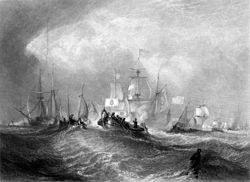
An illustration of William of Orange of the Dutch Republic landing at Brixham to depose James II of England during the Glorious Revolution in 1688.

Interventionism, in international politics, is the interference of a state or group of states into the domestic affairs of another state for the purposes of coercing that state to do something or refrain from doing something.[1] The intervention can be conducted through military force or economic coercion. A different term, economic interventionism, refers to government interventions into markets at home.[2]

Military intervention, which is a common element of interventionism, has been defined by Martha Finnemore in the context of international relations as "the deployment of military personnel across recognized boundaries for the purpose of determining the political authority structure in the target state". Interventions may be solely focused on altering political authority structures, or may be conducted for humanitarian purposes, or for debt collection.[3]

Interventionism has played a major role in the foreign policies of Western powers, particularly during and after the Victorian era. The New Imperialism era saw numerous interventions by Western nations in the Global South, including the Banana Wars. Modern interventionism grew out of Cold War policies, where the United States and the Soviet Union intervened in nations around the world to counter any influence held there by the other nation.[4] Historians have noted that interventionism has always been a contentious political issue in the public opinion of countries which engaged in interventions.[5]

According to a dataset by Alexander Downes, 120 leaders were removed through foreign-imposed regime change between 1816 and 2011.[6] A 2016 study by Carnegie Mellon University political scientist Dov Haim Levin (who now teaches at the University of Hong Kong) found that the United States intervened in 81 foreign elections between 1946 and 2000, with the majority of those being through covert, rather than overt, actions.[7][8] Multilateral interventions that include territorial governance by foreign institutions also include cases like East Timor and Kosovo, and have been proposed (but were rejected) for the Palestinian territories.[9] A 2021 review of the existing literature found that foreign interventions since World War II tend to overwhelmingly fail in achieving their purported objectives.[10]

Foreign-imposed regime change

[edit]

Studies by Alexander Downes, Lindsey O'Rourke, and Jonathan Monten indicate that foreign-imposed regime change seldom reduces the likelihood of civil war, violent removal of the newly imposed leader,[6] and the probability of conflict between the intervening state and its adversaries,[11] and does not increase the likelihood of democratization unless regime change comes with pro-democratic institutional changes in countries with favorable conditions for democracy.[12] Downes argues:[6]

The strategic impulse to forcibly oust antagonistic or non-compliant regimes overlooks two key facts. First, the act of overthrowing a foreign government sometimes causes its military to disintegrate, sending thousands of armed men into the countryside where they often wage an insurgency against the intervener. Second, externally-imposed leaders face a domestic audience in addition to an external one, and the two typically want different things. These divergent preferences place imposed leaders in a quandary: taking actions that please one invariably alienates the other. Regime change thus drives a wedge between external patrons and their domestic protégés or between protégés and their people.

Research by Nigel Lo, Barry Hashimoto, and Dan Reiter has contrasting findings, as they find that interstate "peace following wars last longer when the war ends in foreign-imposed regime change".[13] However, research by Reiter and Goran Peic finds that foreign-imposed regime change can raise the probability of civil war.[14]

By country

[edit]

China

[edit]
The People's Republic of China has intervened in foreign countries on numerous occasions. Traditionally, official stances by China included a non-intervention approach, though as it became an emerging power, it has utilized intervention tactics.[15]

Cuba

[edit]
The small island nation of Cuba had impacts throughout the world

Cuba intervened into numerous conflicts during the Cold War. The country sent medical and military aid into foreign countries to aid Socialist governments and rebel groups. These interventionist policies were controversial and resulted in isolation from many countries.[16] Due to the ongoing Cold War, Cuba attempted make allies across Latin America and Africa. Cuba believed it had more freedom to intervene in Africa as the U.S. was more concerned about Latin America.[17] Still, the US was strongly opposed to Cuban involvement in Africa and continued Cuban intervention was a major source of tension.[18] Cuban intervention was often confidential and all Cuban doctors and soldiers were forced to keep their location confidential.[19]

In Latin America, Cuba supported numerous rebel movements, including in Nicaragua, and in Bolivia where Che Guevara attempted to foment an insurgency. In 1959, Cuba unsuccessfully invaded Panama and the Dominican Republic. Within Africa, Cuba supported numerous independence movements, including in Angola, Guinea-Bissau, and Mozambique. Che Guevara also went to the Democratic Republic of the Congo (Zaire) to support the Simba rebellion. Cuba's largest foreign interventions were in Angola in support of the MPLA and in Ethiopia in support of Mengistu Haile Mariam during the Ogaden War.[18] Cuba also intervened militarily in the Arab world including in Yemen, Algeria, Iraq,[20] and in support of Syria during the October 1973 War. They also supported the People's Revolutionary Government during the United States invasion of Grenada. While most Cuban military interventions were Soviet-backed, Cuba often worked independently and at times even supported opposing sides.[18] General Leopoldo Cintra Frías, who served in both Angola and Ethiopia, stated, "The Soviets were never able to control us although I think that was their intention on more than one occasion."[20]

Cuban foreign policy was motivated by both idealism and realpolitik.[17] It publicly justified its interventions into foreign conflicts for a number of reasons; to spread their revolutionary ideas, aid "liberation movements" fighting for independence,[17] and to protect the territorial sovereignty of allied nations. Cuban leader Fidel Castro stated: "Our Revolution is not a revolution of millionaires. Instead, it is one carried out by the poor, and is one which dreams of ensuring the well-being not only of our own poor, but rather of all the poor in this world. And that is why we talk of internationalism."[21] Cuba was the only economically lesser developed nation with extensive military intervention in Africa.[18] Cuba was a strong supporter of the Organization for African Unity's emphasis on border protection and African independence.[18]

Following the dissolution of the Soviet Union in 1991 and facing the economic difficulties during the Special Period, Cuba continued to maintain a presence in Africa, including the service of many doctors.[18] Cuban medical internationalism was a prominent feature of their interventions alongside military aspects. Medical internationalism consisted of four prevailing approaches: emergency response medical teams sent overseas; establishment abroad of public health systems for providing free health care for local residents; taking in foreign patients to Cuba for free treatment; and providing medical training for foreigners, to Cuba and overseas.[22] All Cuban doctors overseas were volunteers.[19]

Egypt

[edit]

Egypt has intervened in Libya.

Ethiopia

[edit]

Ethiopia has intervened in Somalia.

France

[edit]

France has intervened in Libya and in West Africa.

India

[edit]

India has intervened in Sri Lanka.

Indonesia

[edit]

Indonesia has intervened in East Timor.

Iran

[edit]

Iran has intervened in Iraq and in Syria.

Israel

[edit]

Nigeria

[edit]

Nigeria has shown the will to intervene in the affairs of other sub Saharan African countries since independence. It is said that one of the reasons Yakubu Gowon was removed from office had been the squandering of Nigeria's resources in such far-away lands as Grenada and Guyana, with no returns, economic or political for Nigeria. The philosophy of subsequent military governments in Nigeria was that in an increasingly interdependent world, a country cannot be an island.[23]

Russia

[edit]
Pro-Russian bot farm in Ukraine, 2022

Cyberwarfare by Russia comprises denial-of-service campaigns, hacking operations, disinformation programs, and state-directed online repression, including participation of state-sponsored teams in political blogs, internet surveillance using SORM technology, and other active measures, executed by Russian security and intelligence agencies since the 1990s to advance Kremlin geopolitical objectives.[24][25]

Russian doctrine frames these operations within an informatsionnoye protivoborstvo (IPb), or information confrontation, approach that fuses technical network actions with psychological measures.[26] Units of the GRU, FSB, and SVR oversee hacker collectives such as APT28, APT29, Sandworm, Turla, and Star Blizzard that target governments, infrastructure, and civil society across Europe, North America, and Asia.[27][28][29][30][31][32][33][34][35][36][37]

Prominent operations include the 2007 distributed denial-of-service attacks on Estonia,[38] cyber strikes that accompanied the 2008 war with Georgia,[39] sustained intrusions into Ukrainian elections and power grids,[40][41] and the 2017 NotPetya malware campaign that caused global financial losses, while the campaigns also targeted democratic contests in the United States, Germany, and across the European Union and sustained covert influence networks such as Voice of Europe.[31][32][42][43][44]

International responses range from sanctions and coordinated attribution statements to the creation of NATO's Cooperative Cyber Defence Centre of Excellence in Tallinn[45] and joint action following the Viasat attack during the 2022 invasion of Ukraine.[46][47][31]

Saudi Arabia

[edit]

Saudi Arabia has led interventions in Bahrain and in Yemen.

Soviet Union

[edit]
Eastern Bloc
Over the course of its history, the Soviet Union intervened in foreign countries on numerous occasions.

Turkey

[edit]

Turkey has intervened in Cyprus, in Libya and in Syria.

United Arab Emirates

[edit]

The UAE has intervened in Sudan and in Yemen.

United States

[edit]
U.S. Marines raise the U.S. flag over Veracruz, Mexico during the Banana Wars

The United States has been involved in hundreds of interventions in foreign countries throughout its history, engaging in nearly 400 military interventions between 1776 and 2023, with half of these operations occurring since 1950 and over 25% occurring in the post-Cold War period.[48] Common objectives of U.S. foreign interventions have revolved around economic opportunity, protection of U.S. citizens and diplomats, territorial expansion, counterterrorism, fomenting regime change and nation-building, promoting democracy and enforcing international law.[48]

There have been two dominant ideologies in the United States about foreign policy—interventionism, which encourages military and political intervention in the affairs of foreign countries—and isolationism, which discourages these.[49]

The 19th century formed the roots of United States foreign interventionism, which at the time was largely driven by economic opportunities in the Pacific and Spanish-held Latin America along with the Monroe Doctrine, which saw the U.S. seek a policy to resist European colonialism in the Western Hemisphere. The 20th century saw the U.S. intervene in two world wars in which American forces fought alongside their allies in international campaigns against Imperial Japan, Imperial and Nazi Germany, and their respective allies. The aftermath of World War II resulted in a foreign policy of containment aimed at preventing the spread of world communism. The ensuing Cold War resulted in the Truman, Eisenhower, Kennedy, Carter, and Reagan Doctrines, all of which saw the U.S. engage in espionage, regime change, proxy wars, and other clandestine activity internationally against affiliates and puppet regimes of the Soviet Union.

After the Soviet Union collapsed in 1991, the U.S. emerged as the world's sole superpower and, with this, maintained interventionist policies in Africa, Eastern Europe, and the Middle East. Following the September 11 attacks in 2001, the Bush Administration launched the "war on terror" in which the U.S. waged international counterterrorism campaigns against various extremist groups—such as al-Qaeda and the Islamic State—in various countries. The Bush Doctrine of preemptive war saw the U.S. invade Afghanistan in 2001 and Iraq in 2003. In addition, the U.S. expanded its military presence in Africa and Asia via status of forces agreements and a revamped policy of foreign internal defense. The Obama administration's 2012 "Pivot to East Asia" strategy sought to refocus U.S. geopolitical efforts from counter-insurgencies in the Middle East to improving American diplomatic influence and military presence in East Asia. The "Pivot to Asia" fomented a policy shift towards countering China's rising influence and perceived expansionism in the South China Sea—a trajectory continued by the Trump (2017–2021, 2025–present) and Biden administrations under the Free and Open Indo-Pacific (FOIP) strategy.

The United States Navy serves as a key element of United States global power projection and its ability to conduct foreign interventions. As a blue-water navy, it has been involved in anti-piracy activity in international and foreign territory throughout its history, from the Barbary Wars to combating modern piracy off the coast of Somalia and other regions.

See also

[edit]

References

[edit]

Further reading

[edit]
[edit]
Revisions and contributorsEdit on WikipediaRead on Wikipedia
from Grokipedia
Interventionism in politics refers to the deliberate use or threat of coercive measures, such as military force, economic sanctions, or diplomatic pressure, by one state to interfere in the domestic political affairs of another sovereign state, aiming to influence, alter, or replace its government, policies, or institutions. This approach stands in contrast to non-interventionism, which prioritizes respect for state sovereignty and limits engagement to mutual consent or self-defense, and has been a recurring feature of international relations since the era of imperial expansion. Historically, interventionism has manifested in diverse forms, from 19th-century European powers' in and to 20th-century superpower rivalries during the , where the and backed proxy regimes or directly invaded to counter ideological threats, as seen in events like the Soviet intervention in Afghanistan (1979–1989) and U.S. actions in (1983). Proponents have invoked justifications ranging from humanitarian protection against atrocities to securing strategic resources or containing adversaries, yet empirical analyses reveal that such interventions often yield limited success in achieving durable political transformations, with foreign-imposed regime changes succeeding in establishing stable, aligned governments in fewer than one-third of cases since 1945, frequently resulting in prolonged instability, civil wars, or backlash against the intervener. The doctrine remains controversial due to its tension with principles of enshrined in instruments like the UN Charter, which generally prohibits interference in internal affairs except in cases of or Security Council authorization, and because causal evidence links many interventions to unintended escalations of violence or empowerment of non-state actors, undermining the interveners' initial objectives despite claims of moral imperatives. Defining characteristics include its authority-oriented nature—targeting the target's power structures rather than mere border disputes—and its tendency to provoke resistance from local populations, as interventions disrupt established social orders and invite accusations of , even when framed as liberatory. In contemporary debates, interventionism intersects with discussions of great-power competition, where rising powers like and critique Western variants while pursuing their own coercive influences, highlighting the policy's persistence amid evolving global norms.

Definition and Conceptual Framework

Core Principles and Distinctions

Interventionism in politics refers to the whereby a state actively interferes in the domestic or of another sovereign entity, often employing coercive measures such as military action, economic leverage, or political to influence outcomes aligned with its interests. This approach contrasts with doctrines emphasizing restraint, prioritizing instead the assertion of power to shape international dynamics. At its foundation, interventionism operates on the premise that state sovereignty is not absolute in an anarchic global system, where unchecked developments in one nation can generate externalities threatening others' security or prosperity. Central to interventionist principles is the realist emphasis on national self-interest, defined through tangible metrics like military capabilities, access, and structures rather than abstract imperatives. Proponents argue that states must preemptively counter potential threats—such as the rise of hostile regimes or disruptions to routes—since inaction permits adversaries to consolidate power, as evidenced by historical precedents like the failure to contain expansionist powers prior to major conflicts. This calculus demands discriminating assessments of costs versus benefits, favoring interventions where the intervener holds decisive advantages in force projection or local s, thereby minimizing risks of overextension. Key distinctions emerge between interventionism and , the latter advocating political and military noninvolvement to uphold norms and avoid the domestic costs of foreign entanglements, such as fiscal burdens or public backlash. permits defensive responses or multilateral but rejects proactive meddling, presuming that external stability arises from mutual respect for borders rather than engineered outcomes. Interventionism, by contrast, views such restraint as potentially self-defeating, as power vacuums invite aggression; for instance, realist analyses contend that permitting territorial conquests or ideological expansions without challenge erodes the balance of power, compelling costlier corrections later. Further delineations separate interventionism from , which entails broader disengagement including economic decoupling and alliance avoidance, as pursued by the in the to evade European entanglements. While seeks insulation from global interdependence, interventionism embraces selective engagement, recognizing that modern economies and technologies render complete detachment impractical and strategically naive. Interventionism also differs from , the latter implying permanent or colonial domination for exploitation, whereas the former typically aims for temporary stabilization or regime adjustment to restore favorable equilibria without direct . These boundaries underscore interventionism's instrumental nature: not boundless aggression, but calibrated actions grounded in empirical threat assessments and power asymmetries.

Types of Political Intervention

Political interventionism in international relations is typically classified by the methods employed to influence or alter the internal or external affairs of another , ranging from coercive force to subtler pressures. Common categorizations distinguish between military intervention, involving the deployment of armed forces; economic intervention, utilizing financial levers such as sanctions or aid; diplomatic or political intervention, encompassing negotiations, recognition policies, or support for specific factions; and , framed as responses to crises like or mass atrocities, though often debated for ulterior motives. These types can overlap, with interventions classified further as overt or covert depending on visibility and acknowledgment. Military intervention entails the direct or indirect use of armed forces to achieve political objectives, such as , territorial control, or deterrence of threats. This form breaches most explicitly and carries high risks of escalation, as evidenced by over 390 U.S. interventions since 1776, many aimed at protecting strategic interests rather than purely defensive aims. Examples include invasions or airstrikes, where intervening states justify actions under or pretexts, but empirical analyses show frequent alignment with resource or geopolitical gains over stated humanitarian goals. Economic intervention employs fiscal tools to coerce behavioral changes without kinetic action, including sanctions, trade embargoes, or conditional that target a state's to pressure its . For instance, comprehensive sanctions can reduce GDP by 2-5% annually in targeted nations, as modeled in econometric studies, though their in altering is mixed, often harming civilian populations disproportionately while regimes adapt via evasion networks. This type leverages interdependence in global , with interveners like the U.S. imposing over 10,000 sanctions since 2000, frequently tied to rationales amid critiques of favoring allies. Diplomatic and political intervention involves non-coercive or low-coercion tactics like official statements, meddling, proxy support, or withholding recognition to sway outcomes. These can include funding opposition groups or leveraging international forums, as in cases where states influence foreign s through or financial channels, with documented instances rising post-Cold War due to digital tools. Unlike military actions, these maintain but still infringe on , with causal evidence linking them to when perceived as external meddling. Humanitarian intervention, a contested subtype, purports to protect civilians from severe abuses via military or other means, gaining traction after events like the 1994 , where non-intervention led to 800,000 deaths. Proponents cite moral imperatives, yet realist critiques highlight inconsistencies, such as reluctance in resource-poor conflicts versus action in strategically vital ones, with UN-authorized cases limited to eight since 1945 and frequent failures to secure lasting stability. Empirical data from post-intervention zones, like in 2011, reveal worsened chaos, underscoring causal risks of power vacuums over benevolent outcomes.

Historical Evolution

Pre-Modern and Colonial Era Interventions

The Achaemenid Persian Empire conducted interventions in Greek city-state politics during the 5th and 4th centuries BCE, notably by providing financial aid to amid the (431–404 BCE) to undermine Athenian hegemony, as part of a strategy to exploit divisions among rivals without direct conquest. Similarly, the Roman Republic's involvement in the (214–148 BCE) began as alliances with Greek leagues against , evolving into direct military actions that dismantled Hellenistic monarchies and imposed Roman oversight, marking an early instance of external powers reshaping regional governance through selective support and coercion. Medieval Europe saw collective interventions exemplified by the (1095–1291 CE), where papal-led coalitions from , , and the deployed forces into the to dislodge Muslim control over and establish Latin kingdoms, driven by religious ideology intertwined with territorial ambitions; these efforts temporarily altered Levantine political structures but ultimately failed to sustain European dominance, contributing instead to enhanced state centralization in participating regions through war mobilization and institutional adaptations. The colonial era from the 16th to 19th centuries featured systematic interventions by Iberian, Dutch, British, and French powers into Asia, Africa, and the Americas, often under commercial charters or royal mandates to secure trade routes and resources. Portugal's early interventions in Indian Ocean polities, such as the 1509 seizure of Goa from the Bijapur Sultanate, combined naval blockades with alliances to monopolize spice trade, while Spain's 1519–1521 conquest interventions in the Aztec Empire involved exploiting internal factions to topple Moctezuma II's regime. In Africa, the 1884–1885 Berlin Conference formalized European interventions by partitioning the continent among powers like Britain and France, bypassing local sovereignty to preempt conflicts over resource-rich territories, leading to proxy wars and imposed protectorates. British actions in China during the Opium Wars (1839–1842 and 1856–1860) enforced treaty ports through gunboat diplomacy, exemplifying how economic coercion underpinned political reconfiguration in non-Western states. These interventions blurred conquest and influence, prioritizing extractive control over indigenous autonomy.

20th Century: World Wars and Cold War Dynamics

The ' entry into on April 6, 1917, represented a pivotal shift from longstanding isolationist policies to direct military intervention, driven by Germany's resumption of —which sank the on May 7, 1915, killing 128 Americans—and the Zimmermann Telegram proposing a German-Mexican against the U.S. Over 2 million American troops deployed to by 1918, bolstering Allied forces and contributing to the on November 11, 1918, though the intervention's long-term efficacy remains debated due to the ' destabilizing reparations, which totaled 132 billion gold marks imposed on . European powers had engaged in mutual interventions earlier, such as Britain's 1914 following Germany's invasion of neutral , enforcing commitments that escalated the conflict from a regional Balkan crisis to global scale. World War II amplified interventionism through formalized alliances combating Axis expansionism. Initial U.S. neutrality, codified in the Neutrality Acts of 1935–1939, gave way to indirect support via the Act of March 11, 1941, providing $50.1 billion in aid (equivalent to over $700 billion in 2023 dollars) to Britain, the , and before direct entry. The Japanese on December 7, 1941, prompted U.S. declarations of war against on December 8 and and on December 11, mobilizing 16 million personnel for campaigns including the North African landings on November 8, 1942, and Normandy invasion on June 6, 1944, which facilitated the liberation of . Soviet interventions, such as the 1941 counteroffensive after Operation Barbarossa's launch on June 22, and Allied operations like the Italian campaign starting July 10, 1943, culminated in Axis defeats: 's unconditional surrender on May 8, 1945, and 's on September 2, 1945, averting further territorial conquests that had already encompassed 20% of the world's population under Axis control by 1942. The Cold War era entrenched ideological interventionism, with the U.S. and USSR pursuing and expansion through proxy conflicts and direct suppressions to shape global alignments. The U.S. enunciated the on March 12, 1947, authorizing $400 million in aid to and to counter communist insurgencies, setting a precedent for over 70 interventions by 1990 aimed at forestalling Soviet influence. Key U.S. actions included the intervention from June 25, 1950, to July 27, 1953, where 1.8 million UN troops under U.S. command repelled North Korea's invasion of , restoring the pre-war boundary at the 38th parallel despite 36,000 U.S. fatalities; and escalation in from 1965, deploying 500,000 troops by 1968 against North Vietnamese forces backed by the USSR and , though withdrawal occurred in 1973 following 58,000 U.S. deaths and South Vietnam's fall in 1975. Soviet interventions focused on consolidating the Eastern Bloc, as depicted in maps of its core members including Poland, East Germany, Czechoslovakia, Hungary, Romania, Bulgaria, and Albania until 1961. The USSR crushed the Hungarian Revolution on November 4, 1956, deploying 200,000 troops and 2,500 tanks to oust reformer Imre Nagy, resulting in 2,500–3,000 Hungarian deaths and mass emigration; similarly, the Prague Spring invasion on August 20–21, 1968, involved 500,000 Warsaw Pact forces to depose Alexander Dubček's reforms, killing 137 Czechs and Slovaks while installing a loyal regime. The Soviet Afghan intervention from December 24, 1979, to February 15, 1989, committed 115,000 troops against mujahideen rebels supported by U.S. Stinger missiles, incurring 15,000 Soviet deaths and contributing to economic strain that hastened the USSR's 1991 dissolution. These actions reflected mutual efforts to export political systems—capitalist democracy versus communism—often prioritizing strategic denial over local stability, with empirical data showing containment succeeded in Western Europe via the 1948–1949 Berlin Airlift and Marshall Plan's $13 billion reconstruction but faltered in Asia and Africa amid decolonization.

Post-Cold War: Neoliberal and Humanitarian Shifts

Following the dissolution of the Soviet Union in December 1991, the emerged as the preeminent global power, facilitating a doctrinal shift in interventionism toward promoting neoliberal economic reforms and democratic alongside humanitarian rationales. This era saw interventions increasingly framed as efforts to integrate unstable regions into a characterized by free markets, , and multilateral institutions like and the UN, often involving economic conditionalities from bodies such as the IMF and World Bank that emphasized , , and fiscal . Such approaches diverged from by prioritizing the export of Western-style , as evidenced by U.S.-led coalitions enforcing market-oriented transitions in post-communist states and conflict zones. Humanitarian justifications gained prominence, with interventions invoked to avert mass atrocities, though often selectively applied and intertwined with geopolitical aims. The 1991 , initiated by a U.S.-led coalition under UN Security Council Resolution 678 on January 17, expelled Iraqi forces from but extended into no-fly zones over northern from April 1991 to protect Kurdish populations from Saddam Hussein's reprisals, marking an early post-Cold War blend of security and humanitarian motives. Similarly, the UN-authorized Operation Restore Hope in , launched December 9, 1992, aimed to secure aid deliveries amid famine exacerbated by civil , involving 28,000 U.S. troops initially; however, into disarmament efforts culminated in the October 3-4, 1993, Battle of Mogadishu, resulting in 18 U.S. deaths and U.S. withdrawal by March 1994. In the , NATO's from August 30 to September 20, 1995, involved 3,515 sorties to halt Bosnian Serb advances, leading to the Dayton Accords on December 14, 1995, while the 1999 campaign, conducted March 24 to June 10 without explicit UN approval, comprised 38,000 combat troops to counter Yugoslav , displacing over 800,000 . These actions reflected a normative evolution, yet non-interventions, such as the from April to July 1994 where over 800,000 Tutsis and moderate Hutus were killed without significant Western military response, underscored inconsistencies driven by risk assessments and domestic political costs. The formalization of humanitarian interventionism occurred with the Responsibility to Protect (R2P) doctrine, originating from the International Commission on Intervention and State Sovereignty's 2001 report and endorsed by UN member states in the September 2005 World Summit Outcome Document, which affirmed state sovereignty as contingent on protecting populations from genocide, war crimes, ethnic cleansing, and crimes against humanity, authorizing collective international action if states fail. R2P's first major invocation was UN Security Council Resolution 1973 on March 17, 2011, authorizing a no-fly zone and civilian protection in Libya amid Muammar Gaddafi's crackdown on protesters, enabling NATO's Operation Unified Protector from March 19 to October 31, 2011, which contributed to Gaddafi's overthrow on October 20 but precipitated prolonged instability, including the rise of militias and slave markets in post-intervention chaos. Neoliberal elements persisted in these operations through parallel efforts to impose market reforms, as in post-Yugoslav privatization drives under international oversight, though empirical outcomes often revealed tensions between humanitarian rhetoric and the causal realities of power projection, with interventions frequently exacerbating factional divisions rather than fostering stable liberal orders.

Theoretical Underpinnings

Realist Critiques and National Interest Focus

Realist scholars in contend that political interventions, particularly military ones, must be subordinated to the core national interests of the intervening state, defined primarily in terms of survival, security, and relative power maintenance in an anarchic global system. , a foundational classical realist, argued that rationality demands defining objectively through power capabilities rather than subjective or ideological preferences, warning that deviations invite strategic disaster. In his 1967 essay "To Intervene or Not to Intervene," described intervention as a traditional tool of statecraft but emphasized its legitimacy only when it advances vital interests without overextending resources or disrupting power balances, critiquing unchecked applications as folly akin to imperial overreach. This focus on national interest leads realists to skepticism toward humanitarian or democratic promotion interventions, viewing them as often veiled pursuits of hegemony or naive impositions of universal values onto self-interested actors. , a prominent neorealist, has lambasted U.S. interventions in (2003) and (2011) as emblematic of "liberal " failures, asserting they squandered military capital on peripheral regime changes that neither neutralized existential threats nor enhanced American , instead fostering and great-power rivals like and . Realists argue such actions ignore the structural imperatives of , where states prioritize survival over , rendering moral crusades unsustainable absent overwhelming power advantages—evident in the prolonged U.S. commitments yielding minimal strategic gains by 2021 in . Empirical patterns reinforce realist cautions: interventions misaligned with , such as Vietnam's escalation from 1965 onward, depleted U.S. resources without altering regional power dynamics, as presciently opposed on grounds of disproportionate costs to peripheral stakes. Proponents of realism advocate restraint, prioritizing deterrence and alliances that preserve balance-of-power equilibria over transformative missions, as unchecked interventionism risks domestic backlash and opportunity costs, exemplified by the $8 trillion U.S. post-9/11 expenditures correlating with diminished global influence against rising peers. This paradigm insists on causal realism: interventions succeed rarely when tethered to definable, power-based interests but falter when abstracted into ethical imperatives, underscoring the primacy of over in statecraft.

Liberal and Idealist Justifications

Liberal internationalism provides a foundational justification for interventionism by positing that states advance their long-term interests through the global promotion of liberal values, including democratic institutions, , and , often requiring military action when diplomatic efforts falter. This perspective holds that a world order built on these principles reduces conflict by fostering interdependence and accountability, with interventions serving to counteract authoritarian regimes that threaten this stability. For instance, liberal theorists argue that targeted interventions can preempt wider instability by replacing illiberal governments with ones aligned to rule-of-law principles. Central to these justifications is the , which empirically observes that established democracies have not fought interstate wars against each other since , attributing this to domestic mechanisms like electoral accountability that deter aggressive foreign policies. Advocates extend this to interventionism by claiming that democratizing interventions expand a "zone of peace," as newly installed democratic governments would integrate into a liberal order less prone to conflict; this rationale underpinned U.S. policies in the and , where military actions were framed as seeding perpetual peace through . Idealist approaches complement by emphasizing moral imperatives over pragmatic interests, asserting that nations should conduct in alignment with ethical universals such as individual and , thereby justifying interventions to rectify profound moral wrongs like mass atrocities. This view, traceable to Woodrow Wilson's post-World War I advocacy for interventions to secure global and , posits that failing to act against tyrannical regimes perpetuates ethical failures and undermines human progress. Humanitarian intervention represents a synthesis of these strands, where liberals and idealists argue that sovereignty yields to the higher duty of protecting civilians from or , as non-intervention enables unchecked violations that destabilize regions. The frames such actions as fulfilling correlative obligations to , with multilateral endorsements like NATO's 1999 Kosovo campaign cited as precedents where force prevented predicted mass deaths exceeding 100,000. This justification gained formal traction in the norm, adopted at the 2005 UN World Summit, which mandates collective intervention when states manifestly fail to safeguard populations.

Justifications and Rationales

Security and Strategic Imperatives

Security and strategic imperatives form a core rationale for political interventionism, particularly within realist frameworks that emphasize state survival in an anarchic international system where threats must be preempted or contained to safeguard vital interests. Proponents argue that interventions are warranted when foreign actors pose direct risks to , such as harboring terrorists or enabling proliferation of weapons of mass destruction, necessitating preemptive or reactive action to neutralize capabilities before they materialize into attacks. For instance, the U.S. invasion of on October 7, 2001, was justified as against al-Qaeda, which orchestrated the killing 2,977 people, with the Taliban regime providing safe haven; this aligned with Article 51 of the UN Charter permitting force in response to armed attacks. Strategic considerations extend beyond immediate threats to encompass long-term balance-of-power dynamics and resource security, where interventions prevent adversaries from dominating key regions that could shift global equilibria against the intervener. The Truman Doctrine, announced by President Harry S. Truman on March 12, 1947, pledged U.S. economic and military aid—initially $400 million—to Greece and Turkey to counter Soviet influence, establishing containment as a doctrine to halt communist expansion without direct confrontation, which underpinned interventions like the Korean War (1950–1953) to repel North Korean invasion backed by China and the USSR. Realists posit such actions preserve alliances and deter domino effects, as unchecked aggression in one theater could embolden further encroachments, eroding the intervener's relative power. Access to critical resources like oil exemplifies strategic imperatives, where disruptions could cascade into economic vulnerabilities and coercive leverage. In the 1991 Gulf War, a U.S.-led coalition expelled Iraqi forces from Kuwait on February 28, 1991, after Saddam Hussein's August 2, 1990, invasion threatened to consolidate control over 20% of global oil reserves, potentially enabling Baghdad to manipulate prices and supply as a weapon against Western economies; the Bush administration's National Security Strategy highlighted that securing Persian Gulf oil flows enhanced U.S. and allied energy independence amid dependencies on imports exceeding 40% of consumption. Critics from idealist perspectives question whether such motives prioritize material gains over ethical norms, but realists counter that neglecting these imperatives invites strategic encirclement or resource denial, as evidenced by the 1973 Arab oil embargo's quadrupling of prices and induction of global recession. Empirical data from declassified documents affirm that while humanitarian rhetoric often accompanies operations, underlying calculations frequently hinge on power projection to maintain deterrence and favorable geoeconomic positions.

Humanitarian and Democratic Promotion Claims

Humanitarian intervention is justified by advocates as a necessary response to sovereign states' failure to protect their populations from mass atrocities, including , war crimes, , and . This rationale emphasizes a moral and ethical duty for the to act when domestic authorities perpetrate or permit such violations, potentially overriding traditional norms of non-interference and . The (R2P) doctrine, formally adopted by member states at the 2005 World Summit, codifies this approach in three pillars: the primary responsibility of states to safeguard their citizens, international assistance to build capacity, and collective action—including coercive measures as a last resort—should a state manifestly fail in this duty. Proponents argue that unchecked atrocities erode global order and human dignity, necessitating timely intervention to avert larger-scale suffering, as seen in the international response to the 1994 , where non-intervention contributed to approximately 800,000 deaths. Specific instances underscore these claims, such as the -led Operation Allied Force in from March 24 to June 10, 1999, which targeted Yugoslav forces amid reports of against Kosovar Albanians, displacing over 1.4 million people and resulting in thousands of civilian deaths. officials, including U.S. President , framed the 78-day air campaign as a humanitarian imperative to halt systematic repression, asserting that diplomatic efforts had exhausted alternatives and that UN Security Council was politically unfeasible due to Russian and Chinese opposition. Similarly, the 2011 intervention in under UN Security Council Resolution 1973 authorized a and civilian protection measures, justified by Muammar Gaddafi's threats of mass reprisals against protesters during the Arab Spring uprising, with estimates of potential casualties in the tens of thousands if unchecked. Advocates maintain these actions prevented imminent catastrophe, prioritizing over strict legalism. Democratic promotion claims posit that fostering representative governments abroad enhances global stability, drawing on , which empirical studies since the 1970s have observed a near-absence of wars between established democracies, attributing this to shared norms, transparent decision-making, and public aversion to conflict costs. Interventionists, particularly in the liberal tradition tracing to Woodrow Wilson's post-World War I advocacy for , argue that replacing authoritarian regimes with democratic institutions reduces aggression, promotes , and aligns with by creating reliable partners less prone to or proliferation. This rationale influenced U.S. policy under President , who in his January 20, 2005, second inaugural address declared the "advance of freedom" as a core imperative, contending that democracy's expansion would undermine tyranny's appeal worldwide. The 2003 U.S.-led invasion of exemplifies this justification, with Bush administration officials citing the ouster of Saddam Hussein's Ba'athist regime—responsible for an estimated 300,000 deaths through purges, wars, and chemical attacks—as a catalyst for democratic transformation in the , potentially inspiring reforms in , , and beyond. National Security Advisor articulated in a December 2000 article that promoting in unstable regions prevents failed states from becoming terrorist havens, while the post-invasion aimed to establish elections, a constitution, and parliamentary institutions by 2005. Proponents of this view, including neoconservative thinkers like , maintained that short-term costs paled against long-term gains in regional peace and U.S. security, echoing successes in democratizing and after 1945.

Empirical Assessments: Successes

Documented Cases of Stabilizing Outcomes

The Allied occupation of following , initiated in 1945 under the , resulted in the establishment of a stable democratic government and sustained economic growth. U.S.-led reforms, including , currency reform via the in 1948, and the Marshall Plan's infusion of approximately $1.4 billion in aid from 1948 to 1952, dismantled authoritarian structures and fostered institutional rebuilding. By 1955, had joined and experienced the (economic miracle), with GDP growth averaging 8% annually from 1950 to 1960, transitioning from rubble to a cornerstone of European stability without relapse into conflict. Similarly, the U.S.-led from 1945 to 1952 under General implemented constitutional changes, land reforms redistributing 6 million acres to tenant farmers, and demilitarization, yielding a pacifist framework under Article 9 of the 1947 . These measures, supported by $2.2 billion in U.S. , eradicated imperial and enabled rapid industrialization; Japan's GDP per capita rose from $190 in 1945 to over $1,000 by 1955, establishing a stable parliamentary aligned with Western interests and free from internal upheaval or . The 1983 U.S. invasion of , Operation Urgent Fury, ousted a Marxist-Leninist following a coup and internal strife, restoring constitutional order within weeks via 7,600 troops. Post-intervention elections in December 1984 installed a democratic , with no subsequent coups or ; Grenada's economy stabilized, achieving consistent GDP growth averaging 3-4% annually through the 1990s, supported by U.S. aid exceeding $50 million and integration into democratic norms. NATO's 1995 intervention in , including with over 3,500 airstrikes, compelled belligerents to the Dayton Accords, ending the 1992-1995 war that claimed 100,000 lives. The subsequent (IFOR) and Stabilization Force (SFOR), deploying 60,000 troops initially, enforced ceasefires, disarmed militias, and facilitated refugee returns exceeding 1 million by 2004, yielding relative ethnic partition-based stability without resumption of large-scale violence, as evidenced by Bosnia's GDP growth from $2.6 billion in 1996 to $14.6 billion by 2019 under EU-aligned institutions. These cases, comprising a minority of interventions—U.S. objectives met in approximately 63% of 145 examined from -2016 but with declining rates for ambitious post-Cold War efforts—typically involved total prior defeat of adversaries, extensive non-military commitments, and pre-existing societal capacities for , contrasting with failures in fragmented contexts.

Factors Contributing to Rare Positive Results

Empirical evaluations of military interventions, such as those compiled in the RAND Corporation's analysis of 145 U.S. operations from to 2016, reveal that political objectives were achieved in approximately 63 percent of cases, though this figure encompasses many limited coercive actions rather than transformative efforts, with full stabilizing successes proving rarer due to challenges in post-conflict . Key among contributing factors is the alignment of intervention strategy with narrowly defined, achievable objectives, avoiding overambitious goals like extensive , which correlate with diminished outcomes; for combat-oriented interventions, deployment of substantial ground forces coupled with technical superiority facilitates rapid dominance and objective fulfillment. Pre-intervention planning, including realistic assessments of required resources, further enhances efficacy by mitigating under-resourcing, a common pitfall in protracted engagements. In humanitarian military interventions, short-term effectiveness—measured by lives saved and crisis mitigation—hinges on intervener-controlled elements such as overwhelming local military superiority, swift deployment to preempt escalation, and adaptive strategies combining deterrence, protection, and logistics support. Operations like INTERFET in East Timor (1999), which rapidly secured areas with Australian-led forces numbering in the thousands and UN authorization, saved an estimated 5,000–10,000 lives through quick consent-based action and robust troop presence, underscoring how political will to accept risks and credible threats deter perpetrator advances. Effective civil-military coordination, including with non-governmental organizations, amplifies aid delivery and civilian protection, as seen in Kosovo's Operation Allied Harbor (1999), where NATO's post-bombing refugee support enabled returns amid up to 50,000 troops. Sustained positive results, when they occur, increasingly depend on local participation, which fosters legitimacy and reduces resistance; scholarly assessments of cases like Bosnia and indicate that interventions incorporating local elites or communities in planning yield lower conflict recurrence by building , contrasting with top-down approaches that provoke dissonance and failure. Host-nation institutional and governmental support further bolster stability operations, per RAND findings, as external efforts alone falter without endogenous capacity to maintain order post-withdrawal. Multilateral frameworks, providing burden-sharing and international endorsement, occasionally mitigate unilateral overreach, though empirical patterns emphasize that these factors rarely converge amid complex local dynamics and intervener domestic constraints.

Empirical Assessments: Failures and Consequences

High-Profile Regime Change Setbacks

The 2003 U.S.-led invasion of aimed to remove Saddam Hussein's regime but resulted in prolonged instability, with coalition forces toppling the government on April 9, 2003, only for an to emerge amid de-Baathification and the dissolution of the Iraqi army, exacerbating sectarian divisions between Sunni and Shia populations. The failure to secure weapons of mass destruction stockpiles, initially cited as a primary justification, undermined the intervention's legitimacy, while reconstruction efforts faltered due to inadequate planning for post-conflict , leading to an estimated 200,000 civilian deaths by 2011 and the rise of , which evolved into by 2014. U.S. military casualties exceeded 4,400 deaths and 31,000 wounded, with total costs surpassing $2 trillion by 2020, as power vacuums enabled warlordism and corruption in the new Iraqi political order. In , the 2011 NATO-led intervention, authorized under UN Security Council Resolution 1973 for civilian protection, expanded to facilitate the overthrow of , who was captured and killed on October 20, 2011, after rebels advanced with airstrike support. The absence of a coherent post-regime stabilization plan created a fragmented state, with rival militias controlling territories and oil revenues, sparking in 2014 and ongoing factional that displaced over 1 million people and fueled migrant crises across the Mediterranean. Proliferation of Gaddafi-era weapons stockpiles, including MANPADS, armed insurgent groups across and the , contributing to terrorist safe havens and , as Libya's GDP per capita fell from $12,000 in 2010 to under $7,000 by 2020 amid disrupted oil production. The U.S.-led in , launched October 7, 2001, dismantled the regime by December 2001 through airstrikes and proxies, but persistent guerrilla tactics and safe havens in prevented decisive victory, leading to a 20-year that cost over 2,400 U.S. military lives and $2.3 trillion in expenditures. efforts faltered due to in the Afghan government, ethnic factionalism, and insufficient local buy-in, culminating in the 's rapid offensive in August 2021, which captured on August 15 after U.S. withdrawal, reversing gains in women's rights and while enabling Al-Qaeda's resurgence. These outcomes highlighted systemic challenges in imposing centralized governance on tribal societies, with opium production surging to record levels—over 9,000 tons annually by 2020—undermining economic stabilization. Across these cases, operations frequently generated unintended escalations, such as empowering extremist networks through breakdowns, as evidenced by a analysis of post-2001 interventions showing consistent patterns of prolonged conflict and democratic backsliding rather than stable transitions. Empirical reviews indicate that external overthrows succeed in fostering liberal democracies in fewer than 20% of instances since , often due to ignoring local power dynamics and overestimating military coercion's capacity to engineer political order.

Patterns of Unintended Instability and Blowback

Military interventions often generate power vacuums when regimes are toppled without viable successors or institutional frameworks, enabling insurgencies, civil wars, or the emergence of extremist groups. In , the 2003 U.S.-led and subsequent de-Baathification and disbandment of the Iraqi army under Order No. 2 on May 23, 2003, dismantled state structures, fostering and allowing to evolve into by exploiting governance failures and Sunni disenfranchisement. The 2011 U.S. troop withdrawal exacerbated this vacuum, as seized roughly one-third of Iraqi territory by 2014, controlling cities like until a U.S.-led coalition intervened again. Similar dynamics unfolded in Libya following the 2011 NATO intervention, authorized by UN Security Council Resolution 1973 on March 17, 2011, which aimed to protect civilians but facilitated Muammar Gaddafi's overthrow without a stabilization plan. The resulting fragmentation empowered militias and jihadist factions, leading to dual governments, ongoing since 2014, and state fragility indexed by the Fund for Peace's metrics, with Libya ranking among the world's most unstable nations by 2021. This instability spilled over regionally, contributing to arms proliferation, migration surges to exceeding 1 million arrivals in 2015, and safe havens for groups like ISIS affiliates. Blowback manifests as retaliatory violence or empowered adversaries from prior support, a pattern traced to U.S. aid to Afghan mujahideen during the 1979–1989 Soviet occupation, which armed future figures and contributed to the 9/11 attacks via networks like those of . In Afghanistan's 2001–2021 intervention, initial successes against the eroded due to corruption in the Afghan government, insufficient focus, and Pakistan's sanctuary provision, culminating in the 's 2021 resurgence and rapid capture of on August 15, 2021, after U.S. withdrawal. Empirical analyses indicate foreign-imposed regime changes succeed in only about 25–30% of cases since 1900, with failures amplifying instability through unleashed ethnic or sectarian fissures, as seen in Iraq's Sunni-Shiite divides post-2003. These patterns recur because interventions underestimate local social fabrics and overstate post-conflict feasibility; for instance, U.S. efforts in and cost over $2 trillion combined by 2020 yet failed to prevent authoritarian or terrorist havens, per SIGAR reports. Covert actions compound risks, as CIA terminology of "blowback" from 1950s operations highlights unintended domestic repercussions from abroad, often via radicalized returnees or proxy escalations. Overall, such outcomes underscore causal chains where short-term tactical gains yield long-term strategic deficits, including eroded deterrence and resource drains without proportional security benefits.

Major Criticisms and Debates

Violations of Sovereignty and Self-Determination

Foreign military interventions frequently contravene the principle of state sovereignty by deploying force against the territorial integrity or political independence of target nations, as explicitly prohibited under Article 2(4) of the United Nations Charter, which states that all members shall "refrain in their international relations from the threat or use of force" except in narrowly defined exceptions such as self-defense or Security Council authorization. Interventions justified on humanitarian grounds or for regime change often bypass these requirements, resulting in unauthorized incursions that override the target state's authority over its domain. For example, the 1965 U.S. military occupation of the Dominican Republic involved direct interference to prevent a perceived communist takeover, establishing control that supplanted local governance and breached the nation's sovereign right to manage internal affairs. The right to , enshrined in Article 1(2) of the UN as a foundational purpose allowing peoples to "freely determine their political status" and develop without external coercion, is similarly undermined by interventionist actions that impose foreign-preferred outcomes on domestic populations. Such impositions disrupt organic political processes, substituting external decisions for those of the affected populace and often prolonging conflict rather than resolving it through internal mechanisms. In the context of dynamics, Soviet-led interventions, such as the 1956 invasion of and the 1968 occupation of , suppressed reformist movements seeking greater , enforcing ideological conformity at the expense of national . Contemporary instances further illustrate these patterns, including Russia's 2022 full-scale invasion of , which involved territorial annexations and efforts to install compliant administrations, directly challenging Ukraine's sovereign borders and the Ukrainian people's right to independent governance as affirmed in UN resolutions. Critics, drawing from international legal analyses, argue that even interventions framed as protective—such as NATO's 1999 Kosovo operation without UN Security Council endorsement—erode the normative framework of , creating selective precedents where powerful states act unilaterally while decrying similar actions by adversaries. This selectivity is compounded by biases in academic and media institutions, which frequently portray Western-led interventions as legitimate extensions of global order while emphasizing violations by non-Western powers, despite the Charter's universal application. Ultimately, recurrent breaches foster a system where serves as a privilege for the strong rather than a universal entitlement, incentivizing defensive alliances and arms buildups among weaker states.

Economic, Moral, and Strategic Costs

The economic burdens of interventionism are substantial, encompassing direct expenditures, care, and interest on borrowed funds. Post-9/11 U.S. interventions in , , and related operations have incurred approximately $8 trillion in total costs as of 2023, including over $2 trillion in direct appropriations and trillions more in future obligations for and servicing. These outlays represent opportunity costs, diverting resources from domestic priorities; for instance, spending generates fewer jobs per dollar than equivalent investments in healthcare, , or , with studies showing domestic programs yield 1.5 times more . Such fiscal commitments exacerbate national , constraining fiscal flexibility for non-security needs like alleviation or . Morally, interventionism confronts profound ethical dilemmas, particularly regarding civilian harm and the justification of preemptive or regime-change actions. Modern wars inherently risk deaths, yet interventions like the 2003 invasion and 2011 operation have resulted in disproportionate casualties, challenging utilitarian claims of net humanitarian benefit by killing those ostensibly protected. Ethical critiques emphasize the moral repugnance of targeting or collaterally endangering innocents, as immunity under is violated when operations escalate conflicts without clear proportionality. Moreover, the use of tactics such as drone strikes or renditions in interventions raises concerns over and extrajudicial killings, eroding the interveners' moral authority and fostering global perceptions of hypocrisy. Strategically, interventions frequently produce blowback and long-term instability, undermining the interveners' security objectives. The U.S.-led of created a that enabled the rise of and , costing thousands of additional lives and billions in stabilization efforts while alienating regional allies. Similarly, the 2011 NATO intervention in dismantled Gaddafi's regime but precipitated a decade of civil war, arms proliferation, and migrant crises that destabilized and . Historical precedents like eroded U.S. credibility, divided partners, and drained resources without achieving sustainable order, illustrating how overreach invites prolonged insurgencies and shifts power to adversaries. These outcomes highlight causal patterns where external impositions ignore local dynamics, amplifying resentment and radicalization rather than fostering stability.

Ideological Motivations and Selective Application

Interventionism is frequently justified through ideological lenses such as , which posits that exporting democratic institutions and universally advances global stability and moral progress. Proponents, including neoconservative thinkers, argue that military actions can reshape authoritarian regimes into liberal democracies, as articulated in post-Cold War doctrines emphasizing the "end of history" where democratic values prevail. However, empirical analysis reveals these motivations often align with strategic imperatives rather than consistent application; for instance, U.S. interventions correlate more strongly with high threats or geopolitical rivalry than uniform human rights advocacy, per quantitative studies of post-1945 cases. Critics from realist perspectives contend that ideological rationales mask power maximization, where interventions serve to maintain or economic advantages, such as securing resource flows or countering rival influences, rather than genuine altruism. This is evident in Cold War-era actions, where the U.S. supported anti-communist dictatorships in —overthrowing democratically elected governments in (1973) and (1954)—despite professed commitments to , prioritizing ideological over democratic consistency. Similarly, European powers invoked humanitarian pretexts in (2011) under UN Resolution 1973 but refrained from comparable action in , where civilian deaths exceeded 500,000 by 2020, highlighting how ideological appeals bend to alliance structures and domestic political costs. The selective application undermines claims of principled interventionism, as responses to crises vary starkly by perpetrator identity and intervener interests; the UN Security Council authorized intervention in (1999) against amid ethnic cleansing of 800,000 but failed to act decisively in (1994), where 800,000 Tutsis were killed, due to fears of precedent-setting and resource strain. Such patterns persist: Western states condemned and sanctioned Myanmar's Rohingya genocide (2017 onward, displacing 700,000) while maintaining arms sales to amid its Yemen campaign (2015–present, causing over 377,000 deaths), reflecting alliances over . This inconsistency fosters perceptions of bias, with academic critiques noting that interventions target weaker states while overlooking abuses by strategic partners, eroding the normative credibility of humanitarian doctrines. Realist analyses further attribute selectivity to cognitive and ideological filters that prioritize threats to the intervener's worldview, such as liberal biases amplifying interventions against illiberal foes while downplaying allied flaws.

Contemporary Practices by Key Actors

United States: From Post-9/11 to Recent Restraints

Following the September 11, 2001, terrorist attacks, the United States enacted the Authorization for Use of Military Force (AUMF) on September 18, 2001, granting broad presidential authority to combat al-Qaeda and associated forces, which underpinned subsequent interventions. This initiated the invasion of Afghanistan on October 7, 2001, to dismantle al-Qaeda and remove the Taliban regime, followed by the Iraq invasion on March 20, 2003, justified by claims of weapons of mass destruction and ties to terrorism that later proved unsubstantiated. The George W. Bush administration expanded operations to include drone strikes in Pakistan starting in 2004, special forces raids, and support for counterterrorism in Yemen and Somalia, framing these as part of the Global War on Terror. By 2011, under Barack Obama, interventions included NATO-led airstrikes in Libya to enforce a no-fly zone and protect civilians, resulting in Muammar Gaddafi's overthrow but subsequent civil war and regional instability. Operations against the Islamic State in Iraq and Syria (ISIS) commenced in 2014 with airstrikes and advisory roles, peaking at around 5,000 U.S. troops in Iraq by 2017. These efforts incurred substantial human and financial costs, with the Watson Institute's Costs of War project estimating over $8 trillion in U.S. expenditures by 2021, including future veterans' care, and more than 900,000 direct deaths across war zones, including 7,000 U.S. service members and contractors. Instability persisted, as the Iraq invasion contributed to the emergence of ISIS from al-Qaeda in Iraq remnants, while Afghanistan's 20-year occupation ended with the Taliban's return to power in August 2021, underscoring failures in nation-building and counterinsurgency. Obama pursued a doctrine of targeted killings via drones—over 500 strikes by 2016—and limited ground commitments, exemplified by the 2009 Afghanistan troop surge followed by drawdowns, alongside rhetoric against "doing stupid things" in foreign entanglements. The Donald Trump administration (2017–2021) emphasized restraint under an "America First" approach, reducing U.S. troop levels in from 14,000 to 2,500 by 2020 and ordering a partial withdrawal from in 2019, despite internal opposition, to avoid open-ended commitments. No major new wars were initiated, though targeted actions like the January 2020 killing of Iranian general occurred without escalation to . The administration completed the withdrawal on August 30, 2021, fulfilling a Trump-era agreement but amid chaotic evacuation and advances, marking a symbolic end to large-scale ground interventions. However, it sustained proxy support, providing over $175 billion in aid to following Russia's 2022 and military assistance to during the 2023–ongoing Gaza conflict, without deploying combat troops. By 2024–2025, trends indicate growing U.S. restraint amid public war fatigue and fiscal pressures, with polls showing majority opposition to troop deployments for defending or . The incoming second Trump administration in 2025 prioritizes reducing alliances and conflicts with rivals like and , focusing resources on great-power competition rather than Middle Eastern regime changes or counterinsurgencies. This shift reflects empirical lessons from post-9/11 outcomes, where interventions often amplified and state fragility rather than achieving lasting stability, prompting a reorientation toward deterrence and over unilateral military action.

Russia and China: Hybrid and Assertive Models

Russia employs a hybrid model of interventionism that integrates conventional military operations with irregular tactics, including proxy forces, cyberattacks, disinformation campaigns, and private military companies (PMCs) to achieve strategic objectives while maintaining plausible deniability. This approach was evident in the 2008 intervention in Georgia, where Russian forces supported separatist regions in and amid hybrid aggression involving local proxies and external tools to destabilize the government. In , Russia annexed in 2014 using unmarked "little green men" operatives alongside cyber intrusions and propaganda to mask direct involvement, followed by support for Donbas separatists. The 2015 intervention in demonstrated a shift to overt airpower support for the Assad regime, combined with ground forces to secure territorial gains and test military hardware, enabling Russia to reassert influence in the at minimal cost relative to Western commitments. In , Russia's hybrid tactics rely heavily on PMCs like the , which deployed thousands of contractors to countries such as the , , and starting in the late 2010s to prop up allied regimes, extract resources like gold and diamonds, and counter Western influence. operations, involving up to 1,000 personnel in by 2021 and resource concessions in exchange for basing rights, exemplified deniable until the group's partial dissolution after Prigozhin's 2023 , succeeded by the state-linked Africa Corps. These interventions prioritize securing geopolitical footholds and economic benefits over ideological transformation, often exploiting local instability rather than initiating , as seen in where backed Khalifa Haftar's forces from 2018 onward. China's interventionism manifests as an assertive model emphasizing economic leverage, gray-zone maritime tactics, and calibrated military posturing to advance territorial claims and regional dominance without full-scale invasions. The Belt and Road Initiative (BRI), launched in 2013, has extended over $1 trillion in loans to more than 150 countries by 2023, fostering dependency through infrastructure projects that yield strategic assets, such as the 99-year lease of Sri Lanka's Hambantota port in 2017 after debt default. In the South China Sea, China has militarized artificial islands since 2013, deploying anti-ship missiles and fighter jets on features like Mischief Reef, while using coast guard and maritime militia vessels for persistent harassment of rivals' operations, asserting control over disputed waters claimed by multiple nations. Toward Taiwan, China's assertiveness has intensified in the 2020s with over 1,700 PLA aircraft incursions into Taiwan's by mid-2023, alongside large-scale naval exercises simulating blockades, as responses to perceived provocations like U.S. arms sales and Taiwanese elections. This "" diplomacy, coupled with economic coercion—such as bans on Taiwanese pineapple imports in 2021—aims to isolate the island and deter independence without immediate kinetic escalation, reflecting a preference for salami-slicing tactics over overt conquest. Both powers' models contrast with liberal interventionism by focusing on gains, such as resource access and buffer zones, often yielding mixed outcomes: Russia's gains in and have bolstered alliances but incurred sanctions and losses in , while China's BRI expansions have enhanced connectivity yet sparked debt sustainability concerns in recipient states.

Other Powers: EU, Regional Interventions

The conducts interventions primarily through its (CSDP), which encompasses civilian and military missions aimed at , conflict prevention, and stabilization rather than full-scale . As of 2025, the EU maintains 12 civilian and 8 military missions across , , and , with over 40 operations launched since 2003. These efforts focus on capacity-building, such as training local forces, border management, and rule-of-law support, but have yielded mixed results; for instance, a decade of EU involvement in the —including military training in —correlated with rising instability, jihadist expansion, and eventual withdrawals by European contributors amid coups and . In , the 's Border Assistance Mission (EUBAM Libya), extended in 2023, prioritizes migration control and border security over political resolution, reflecting a shift away from explicit amid ongoing factional conflict. Similarly, naval operations in the , launched in 2024 to counter Houthi threats to shipping, emphasize without ground engagements. In the , EUFOR Althea in , ongoing since 2004, provides stabilization but has not prevented ethnic tensions or governance breakdowns. Experiences from CSDP missions in , alongside broader Western efforts in and , highlight recurring challenges: limited local buy-in, dependency on host governments, and unintended empowerment of adversaries, leading to calls for more integrated EU approaches. Regional powers pursue more unilateral and assertive interventions, often driven by security threats, resource control, and influence projection. has conducted multiple cross-border operations since 2016, including in to counter Kurdish militias and establish buffer zones; parliamentary mandates for Syrian, Iraqi, and Lebanese deployments were extended through 2028 in October 2025, sustaining troop presence of thousands. In , deployed forces and drones starting January 2020 to support the , securing maritime agreements and countering rivals like and , though this prolonged the without decisive victory. These actions have created Turkish zones but escalated proxy confrontations, with over 10,000 Syrian opposition fighters integrated into operations by 2025. Saudi Arabia and the United Arab Emirates (UAE) led a coalition intervention in Yemen from March 2015, aiming to restore the recognized government against Houthi forces backed by Iran; by 2025, a decade later, the campaign involved airstrikes, blockades, and ground support, resulting in over 377,000 deaths (direct and indirect) and a stalemate, with Houthis retaining control of Sana'a and expanding Red Sea attacks. The UAE, diverging from Riyadh, pursued ground operations in southern Yemen and extended influence into the Horn of Africa via bases in Somaliland and Eritrea, securing ports and countering Iranian presence, though this fueled local conflicts and accusations of mercenary use. Such regional efforts underscore causal patterns of blowback: initial military gains often yield prolonged insurgencies, humanitarian crises, and dependency on external arms, with Yemen's intervention exemplifying how containment goals evolve into quagmires amid proxy dynamics.

References

Add your contribution
Related Hubs
User Avatar
No comments yet.