


Community hub
Recent from talks
Contribute something
Nothing was collected or created yet.
Enantiornithes
View on Wikipedia
| Enantiornithes | |
|---|---|

| |
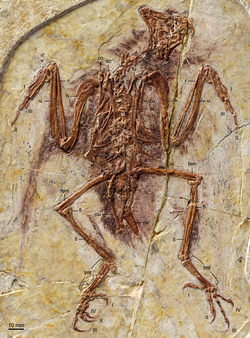
| Fossil specimen of a bohaiornithid (Zhouornis hani) | |
Scientific classification 
| |
| Kingdom: | Animalia |
| Phylum: | Chordata |
| Class: | Reptilia |
| Clade: | Dinosauria |
| Clade: | Saurischia |
| Clade: | Theropoda |
| Clade: | Avialae |
| Clade: | Ornithothoraces |
| Clade: | †Enantiornithes Walker, 1981 |
| Subgroups | |
and see text | |
The Enantiornithes, also known as enantiornithines or enantiornitheans in literature, are a group of extinct avialans ("birds" in the broad sense), the most abundant and diverse group known from the Mesozoic era.[3][4][5] Almost all retained teeth and clawed fingers on each wing, but otherwise looked much like modern birds externally. Over seventy species of Enantiornithes have been named, but some names represent only single bones, so it is likely that not all are valid. The Enantiornithes became extinct at the Cretaceous–Paleogene boundary, along with Hesperornithes and all other non-avian dinosaurs.
Discovery and naming
[edit]The first Enantiornithes to be discovered were incorrectly referred to modern bird groups. For example, the first known species of Enantiornithes, Gobipteryx minuta, was originally considered a paleognath related to ostriches and tinamou.[6] The Enantiornithes were first recognized as a distinct lineage, or "subclass" of birds, by Cyril A. Walker in 1981. Walker made this discovery based on some partial remains from the late Cretaceous period of what is now Argentina, which he assigned to a new genus, Enantiornis, giving the entire group its name. Since the 1990s, many more complete specimens of Enantiornithes have been discovered, and it was determined that a few previously described "birds" (e.g. Iberomesornis, Cathayornis, and Sinornis) were instead Enantiornithes.
The name "Enantiornithes" means "opposite birds", from Ancient Greek enantios (ἐνάντιος) "opposite" + ornithes (ὄρνιθες) "birds" . The name was coined by Cyril Alexander Walker in his landmark paper which established the group.[7] In his paper, Walker explained what he meant by "opposite":
Perhaps the most fundamental and characteristic difference between the Enantiornithes and all other birds is in the nature of the articulation between the scapula [...] and the coracoid, where the 'normal' condition is completely reversed.[7]
This refers to an anatomical feature – the articulation of the shoulder bones – which has a concave-convex socket joint between the scapula (shoulder blade) and coracoid (the primary bone of the shoulder girdle in vertebrates other than mammals) that is the reverse of that of modern birds. Specifically, in the Enantiornithes, the scapula is concave and dish-shaped at this joint, and the coracoid is convex.[3]: 249–50 In modern birds, the coracoscapular joint has a concave coracoid and convex scapula.[8][9]
Walker was not clear on his reasons for giving this name in the etymology section of his paper, and this ambiguity led to some confusion among later researchers. For example, Alan Feduccia stated in 1996:
The birds are so named because, among many distinctive features, there is a unique formation of the triosseal canal and the metatarsals are fused proximally to distally, the opposite of that in modern birds[10]
Feduccia's point about the tarsometatarsus (the combined upper foot and ankle bone) is correct, but Walker did not use this reasoning in his original paper. Walker never described the fusion of the tarsometatarsus as opposite, but rather as "Only partial". Also, it is not certain that Enantiornithes had triosseal canals, since no fossil preserves this feature.[3]
As a group, the Enantiornithes are often referred to as "enantiornithines" in literature. However, several scientists have noted that this is incorrect, because following the standard rules for forming the names of animal groups, it implies reference only to the subfamily Enantiornithinae. Following the naming conventions used for modern birds as well as extinct groups, it has been pointed out that the correct term is "enantiornithean".[11][12]
Origin and range
[edit]Praeornis, from the Oxfordian-Kimmeridgian of Kazakhstan, may have been the earliest known member of Enantiornithes according to Agnolin et al. (2017).[13]
Birds with confidently identified characteristics of Enantiornithes found in Albian of Australia, Maastrichtian of South America, and Campanian of Mexico (Alexornis[14]), Mongolia and western edge of prehistoric Asia suggest a worldwide distribution of this group or in the relatively warm regions, at least.[15] Enantiornithes have been found on every continent except Antarctica. Fossils attributable to this group are exclusively Cretaceous in age, and it is believed that the Enantiornithes became extinct at the same time as their non-avialan dinosaur relatives. The earliest known Enantiornithes are from the Early Cretaceous of Spain (e.g. Noguerornis) and China (e.g. Protopteryx) and the latest from the Late Cretaceous of North and South America (e.g. Avisaurus and Enantiornis). The widespread occurrence of this group suggests that at least some Enantiornithes were able to cross oceans under their own power; they are the first known avialan lineage with a global distribution.
Description
[edit]
Many fossils of Enantiornithes are very fragmentary, and some species are only known from a piece of a single bone. Almost all specimens that are complete, in full articulation, and with soft tissue preservation are known from Las Hoyas in Cuenca, Spain and the Jehol group in Liaoning (China). Extraordinary remains of Enantiornithes have also been preserved in Burmese amber deposits dated to 99 million years ago and include hatchlings described in 2017[16] and 2018,[17] as well as isolated body parts such as wings[18][19][20] and feet.[19][21] These amber remains are among the most well-preserved of any mesozoic dinosaur. Fossils of this clade have been found in both inland and marine sediments, suggesting that they were an ecologically diverse group.
Enantiornithes appear to have included waders, swimmers, granivores, insectivores, fishers, and raptors. The vast majority of Enantiornithes were small, between the size of a sparrow and a starling,[22] however display considerable variation in size with some species. The largest species in this clade include Pengornis houi,[23] Xiangornis shenmi,[24] Zhouornis hani,[22] and Mirarce eatoni,[25] (with the latter species being described as similar in size to modern turkeys,) although at least a few larger species may have also existed, including a potentially crane-sized species known only from footprints in the Eumeralla Formation (and possibly also represented in the Wonthaggi Formation by a single furcula).[26] Among the smallest described specimens are unnamed hatchlings, although the holotype specimens of Parvavis chuxiongensis[27] and Cratoavis cearensis[28] are comparable in size to small tits or hummingbirds.
Skull
[edit]
Given their wide range of habitats and diets, the cranial morphology of Enantiornithes varied considerably between species. Skulls of Enantiornithes combined a unique suite of primitive and advanced features. As in more primitive avialans like Archaeopteryx, they retained several separate cranial bones, small premaxillae (bones of the snout tip) and most species had toothy jaws rather than toothless beaks. Only a few species, such as Gobipteryx minuta, were fully toothless and had beaks. They also had simple quadrate bones, a complete bar separating each orbit (eye hole) from each antorbital fenestra, and dentaries (the main toothed bones of the lower jaw) without forked rear tips. A squamosal bone is preserved in an indeterminate juvenile specimen, while a postorbital is preserved in Shenqiornis and Pengornis. In modern birds these bones are assimilated into the cranium. Some Enantiornithes may have had their temporal fenestrae (holes in the side of the head) merged into the orbits as in modern birds due to the postorbitals either not being present or not being long enough to divide the openings.[29] A quadratojugal bone, which in modern birds is fused to the jugal, is preserved in Pterygornis.[30] The presence of these primitive features of the skull would have rendered the Enantiornithes capable of only limited cranial kinesis (the ability to move the jaw independent of the cranium).[31]
Wing
[edit]_fig._1.png)
As a very large group of birds, the Enantiornithes displayed a high diversity of different body plans based on differences in ecology and feeding, reflected in an equal diversity of wing forms, many paralleling adaptations to different lifestyles seen in modern birds. In general, the wings of Enantiornithes were advanced compared to more primitive avialans like Archaeopteryx, and displayed some features related to flight similar to those found in the lineage leading to modern birds, the Ornithuromorpha. While most Enantiornithes had claws on at least some of their fingers, many species had shortened hands, a highly mobile shoulder joint, and proportional changes in the wing bones similar to modern birds. Like modern birds, Enantiornithes had alulas, or "bastard wings", small forward-pointing arrangements of feathers on the first digit that granted higher maneuverability in the air and aided in precise landings.[32]
Several wings with preserved feathers have been found in Burmese amber. These are the first complete Mesozoic dinosaur remains preserved this way (a few isolated feathers are otherwise known, unassigned to any species), and one of the most exquisitely preserved dinosaurian fossils known.[33] The preserved wings show variations in feather pigment and prove that Enantiornithes had fully modern feathers, including barbs, barbules, and hooklets, and a modern arrangement of wing feather including long flight feathers, short coverts, a large alula and an undercoat of down.[18]
One fossil of Enantiornithes shows wing-like feather tufts on its legs, similar to Archaeopteryx. The leg feathers are also reminiscent of the four-winged dinosaur Microraptor, however differ by the feathers being shorter, more disorganized (they do not clearly form a wing) and only extend down to the ankle rather than along the foot.[34]
Tail
[edit]
Clarke et al. (2006) surveyed all fossils of Enantiornithes then known and concluded that none had preserved tail feathers that formed a lift-generating fan, as in modern birds. They found that all avialans outside of Euornithes (the clade they referred to as Ornithurae) with preserved tail feathers had only short coverts or elongated paired tail plumes. They suggested that the development of the pygostyle in Enantiornithes must have been a function of tail shortening, not the development of a modern tail feather anatomy. These scientists suggested that a fan of tail feathers and the associated musculature needed to control them, known as the rectrical bulb, evolved alongside a short, triangular pygostyle, like the ones in modern birds, rather than the long, rod- or dagger-shaped pygostyles in more primitive avialans like the Enantiornithes. Instead of a feather fan, most Enantiornithes had a pair of long specialized pinfeathers similar to those of the extinct Confuciusornis and certain extant birds-of-paradise.[35]
However, further discoveries showed that at least among basal Enantiornithes, tail anatomy was more complex than previously thought. One genus, Shanweiniao, was initially interpreted as having at least four long tail feathers that overlapped each other[36] and might have formed a lift-generating surface similar to the tail fans of Euornithes,[37] though a later study indicates that Shanweiniao was more likely to have rachis-dominated tail feathers similar to feathers present in Paraprotopteryx.[38] Chiappeavis, a primitive pengornithid, had a fan of tail feathers similar to that of more primitive avialans like Sapeornis, suggesting that this might have been the ancestral condition, with pinfeathers being a feature evolved several times in early avialans for display purposes.[38] Another species of Enantiornithes, Feitianius, also had an elaborate fan of tail feathers. More importantly, soft tissue preserved around the tail was interpreted as the remains of a rectrical bulb, suggesting that this feature was not in fact restricted to species with modern-looking pygostyles, but might have evolved much earlier than previously thought and been present in many Enantiornithes.[39] At least one genus of Enantiornithes, Cruralispennia, had a modern-looking pygostyle but lacked a tail fan.[40]
Biology
[edit]Diet
[edit]
Given the wide diversity of skull shape among Enantiornithes, many different dietary specializations must have been present among the group. Some, like Shenqiornis, had large, robust jaws suitable for eating hard-shelled invertebrates. The short, blunt teeth of Pengornis were likely used to feed on soft-bodied arthropods.[29] The strongly hooked talons of Bohaiornithidae suggest that they were predators of small to medium-sized vertebrates, but their robust teeth instead suggest a diet of hard-shelled animals.[2]
A few specimens preserve actual stomach contents. Unfortunately, none of these preserve the skull, so direct correlation between their known diet and snout/tooth shape cannot be made. Eoalulavis was found to have the remains of exoskeletons from aquatic crustaceans preserved in its digestive tract,[41] and Enantiophoenix preserved corpuscles of amber among the fossilized bones, suggesting that this animal fed on tree sap, much like modern sapsuckers and other birds. The sap would have fossilized and become amber.[42] However, more recently it has been suggested that the sap moved post-mortem, hence not representing true stomachal contents. Combined with the putative fish pellets of Piscivorenantiornis turning out to be fish excrement, the strange stomachal contents of some species turning out to be ovaries and the supposed gastroliths of Bohaiornis being random mineral precipitates, only the Eoalulavis displays actual stomach contents.[43]
A study on paravian digestive systems indicates that known Enantiornithes lacked a crop and a gizzard, didn't use gastroliths and didn't eject pellets. This is considered at odds with the high diversity of diets that their different teeth and skull shapes imply,[44] though some modern birds have lost the gizzard and rely solely on strong stomachal acids.[45] An example was discovered with what was suspected to be gastroliths in the what would have been the fossil's stomach, re-opening the discussion of the use of gastroliths by Enantiornithes. X-ray and scanning microscope inspection of the rocks determined that they were actually chalcedony crystals, and not gastroliths.[46]
Longipterygidae is the most extensively studied family in terms of diet due to their rather unusual rostral anatomy, with long jaws and few teeth arranged at the jaw ends. They have variously been interpreted as piscivores,[47] probers akin to shorebirds[48] and as arboreal bark-probers.[49] A 2022 study however does find them most likely to be generalistic insectivores (sans possibly Shengjingornis due to its larger size, poorly preserved skull and unusual pedal anatomy), being too small for specialised carnivory and herbivory; the atypical rostrum is tentatively speculated to be unrelated to feeding ecology.[50] However a posterior study has found them to be herbivorous, including the presence of gymnosperm seeds in their digestive system.[51]
.png)
Avisaurids occupied a niche analogous to modern birds of prey, having the ability to lift small prey with their feet in a manner similar to hawks or owls.[52][53]
Predation
[edit]A fossil from Spain reported by Sanz et al. in 2001 included the remains of four hatchling skeletons of three different species of Enantiornithes. They are substantially complete, very tightly associated, and show surface pitting of the bones that indicates partial digestion. The authors concluded that this association was a regurgitated pellet and, from the details of the digestion and the size, that the hatchlings were swallowed whole by a pterosaur or small theropod dinosaur. This was the first evidence that Mesozoic avialans were prey animals, and that some Mesozoic pan-avians regurgitated pellets like owls do today.[54]
Life history
[edit]
Known fossils of Enantiornithes include eggs,[55][56] embryos,[57] and hatchlings.[58] An embryo, still curled in its egg, has been reported from the Yixian Formation.[59] Juvenile specimens can be identified by a combination of factors: rough texture of their bone tips indicating portions which were still made of cartilage at the time of death, relatively small breastbones, large skulls and eyes, and bones which had not yet fused to one another.[60] Some hatchling specimens have been given formal names, including "Liaoxiornis delicatus"; however, Luis Chiappe and colleagues considered the practice of naming new species based on juveniles detrimental to the study of Enantiornithes, because it is nearly impossible to determine which adult species a given juvenile specimen belongs to, making any species with a hatchling holotype a nomen dubium.[60]
Together with hatchling specimens of the Mongolian Gobipteryx[61] and Gobipipus,[62][63] these finds demonstrate that hatchling Enantiornithes had the skeletal ossification, well-developed wing feathers, and large brain which correlate with precocial or superprecocial patterns of development in birds of today. In other words, Enantiornithes probably hatched from the egg already well developed and ready to run, forage, and possibly even fly at just a few days old.[60]
Findings suggests Enantiornithes, especially the toothed species, had a longer incubation time than modern birds.[64][65]
Analyses of Enantiornithes bone histology have been conducted to determine the growth rates of these animals. A 2006 study of Concornis bones showed a growth pattern different from modern birds; although growth was rapid for a few weeks after hatching, probably until fledging, this small species did not reach adult size for a long time, probably several years.[66] Other studies have all supported the view that growth to adult size was slow, as it is in living precocial birds (as opposed to altricial birds, which are known to reach adult size quickly).[41] Studies of the rate of bone growth in a variety of Enantiornithes has shown that smaller species tended to grow faster than larger ones, the opposite of the pattern seen in more primitive species like Jeholornis and in non-avialan dinosaurs.[67] Some analyses have interpreted the bone histology to indicate that Enantiornithes may not have had fully avian endothermy, instead having an intermediate metabolic rate.[68] However a 2021 study rejects the idea that they had less endothermic metabolisms than modern birds.[69]
Evidence of colonial nesting has been found in Enantiornithes, in sediments from the Late Cretaceous (Maastrichtian) of Romania.[70] Evidence from nesting sites shows that Enantiornithes buried their eggs like modern megapodes, which is consistent with their inferred superprecocial adaptations.[71]
A 2020 study on a juvenile's feathers further stresses the ontological similarities to modern megapodes, but cautions several differences such as the arboreal nature of most Enantiornithes as opposed to the terrestrial lifestyle of megapodes.[72]
It has been speculated that superprecociality in Enantiornithes might have prevented them from developing specialised toe arrangements seen in modern birds like zygodactyly.[73]
Although the vast majority of histology studies and known remains of Enantiornithes point to superprecociality being the norm, one specimen, MPCM-LH-26189, seems to represent an altricial juvenile, implying that like modern birds Enantiornithes explored multiple reproductive strategies.[74]
Flight
[edit]Because many Enantiornithes lacked complex tails and possessed radically different wing anatomy compared to modern birds, they have been the subject of several studies testing their flight capabilities.
Traditionally, they have been considered inferior flyers, due to the shoulder girdle anatomy being assumed to be more primitive and unable to support a ground-based launching mechanism,[75] as well as due to the absence of rectrices in many species.[35][37][76]
However, several studies have shown that they were efficient flyers, like modern birds, possessing a similarly complex nervous system and wing feather ligaments. Additionally, the lack of a complex tail appears to not have been very relevant for avian flight as a whole - some extinct birds like lithornids also lacked complex tail feathers but were good flyers,[77] and they appear to have been capable of a ground based launching.[78]
Enantiornithes resemble Ornithuromorphs in many anatomical features of the flight apparatus, but a sternal keel is absent in the basal-most members, only a single basal taxon appears to have had a triosseal canal, and their robust pygostyle seems unable to support the muscles that control the modern tail feathers involved in flight.[79] Though some basal Enantiornithes exhibit ancestral flight apparatuses, by the end of the Mesozoic many Enantiornithes had several features convergent with the Neornithes including a deeply keeled sternum, a narrow furcula with a short hypocleidium, and ulnar quill knobs that indicate increased aerial abilities.[80][81]
At least Elsornis appears to have become secondarily flightless.[82]
Classification
[edit]Some researchers classify Enantiornithes, along with the true birds, in the class Aves. Others use the more restrictive crown group definition of Aves (which only includes neornithes, anatomically modern birds), and place Enantiornithes in the more inclusive group Avialae. Enantiornithes were more advanced than Archaeopteryx, Confuciusornis, and Sapeornis, but in several respects they were more primitive than modern birds, perhaps following an intermediate evolutionary path.
A consensus of scientific analyses indicates that Enantiornithes is one of two major groups within the larger group Ornithothoraces. The other ornithothoracine group is Euornithes or Ornithuromorpha, which includes all living birds as a subset. This means that Enantiornithes were a successful branch of avialan evolution, but one that diversified entirely separately from the lineage leading to modern birds.[3] One study has however found that the shared sternal anatomy was acquired independently and such a relationship needs to be reexamined.[83]
Enantiornithes classification and taxonomy has historically been complicated by a number of factors. In 2010, paleontologists Jingmai O'Connor and Gareth Dyke outlined a number of criticisms against the prevailing practices of scientists failing to describe many specimens in enough detail for others to evaluate thoroughly. Some species have been described based on specimens which are held in private collections, making further study or review of previous findings impossible. Because it is often unfeasible for other scientists to study each specimen in person given the worldwide distribution of the Enantiornithes, and due to the many uninformative descriptions which have been published on possibly important specimens, many of these specimens become "functional nomina dubia".[84] Furthermore, many species have been named based on extremely fragmentary specimens, which would not be very informative scientifically even if they were described sufficiently. Over one-third of all named species are based on only a fragment of a single bone. O'Connor and Dyke argued that while these specimens can help expand knowledge of the time span or geographic range of the Enantiornithes and it is important to describe them, naming such specimens is "unjustifiable".[84]
Relationships
[edit]Enantiornithes is the sister group to Euornithes, and together they form a clade called Ornithothoraces (though see above). Most phylogenetic studies have recovered Enantiornithes as a monophyletic group distinct from the modern birds and their closest relatives. The 2002 phylogenetic analysis by Clarke and Norell, though, reduced the number of Enantiornithes autapomorphies to just four.[85]
Enantiornithes systematics are highly provisional and notoriously difficult to study, due to their small size[28] and the fact that Enantiornithes tend to be extremely homoplastic, or very similar to each other in most of their skeletal features due to convergent evolution rather than common ancestry.[38] What appears fairly certain by now is that there were subdivisions within Enantiornithes possibly including some minor basal lineages in addition to the more advanced Euenantiornithes. The details of the interrelationship of all these lineages, indeed the validity of most, is disputed, although the Avisauridae, for one example, seem likely to constitute a valid group. Phylogenetic taxonomists have hitherto been very reluctant to suggest delimitations of clades of Enantiornithes.[86]
One such delineation named the Euenantiornithes, was defined by Chiappe (2002) as comprising all species closer to Sinornis than to Iberomesornis. Because Iberomesornis is often found to be the most primitive or basal member of the Enantiornithes, Euenantiornithes may be an extremely inclusive group, made up of all Enantiornithes except for Iberomesornis itself. Despite being in accordance with phylogenetic nomenclature, this definition of Euenantiornithes was severely criticized by some researchers, such as Paul Sereno, who called it "a ill-defined clade [...] a good example of a poor choice in a phylogenetic definition".[86]
The cladogram below was found by an analysis by Wang et al. in 2015, updated from a previous data set created by Jingmai O'Connor.[30]
| Ornithothoraces |
| ||||||||||||||||||


The cladogram below is from Wang et al., 2022, and includes most named taxa and recovers several previously-named clades. Letters on branches indicate the positions of "wildcard" taxa, those which have been recovered in multiple disparate positions.[87]
| Enantiornithes | |
| l |
Key to letters:
b = Boluochia
c = Cathayornis
e = Enantiophoenix
f = Houornis
h = Longipteryx
i = Parabohaiornis
j = Pterygornis
l = Vorona
m = Yuanjiawaornis
n = Yungavolucris
List of genera
[edit]Enantiornithes taxonomy is difficult to evaluate, and as a result few clades within the group are consistently found by phylogenetic analyses. Most Enantiornithes are not included in any specific family, and as such are listed here. Many of these have been considered Euenantiornithes, although the controversy behind this name means that it is not used consistently in studies of Enantiornithes.[citation needed]
| Name | Year | Formation | Location | Notes | Images |
|---|---|---|---|---|---|
| Abavornis | 1998 | Bissekty Formation (Late Cretaceous, Turonian to Coniacian) |  Uzbekistan Uzbekistan
|
One of many fragmentary Bissekty Enantiornithes, known only from coracoids | |
| Alethoalaornis | 2007 | Jiufotang Formation (Early Cretaceous, Aptian) |  China China
|
Poorly known | |
| Alexornis | 1976 | La Bocana Roja Formation (Late Cretaceous, Campanian) |  Mexico Mexico
|
One of the first Enantiornithes known. Once thought to be an ancient relative of rollers and woodpeckers | 
|
| Avimaia | 2019 | Xiagou Formation (Early Cretaceous, Aptian) | China
|
One specimen from this genus died with an unlaid egg in its body | 
|
| Bauxitornis | 2010 | Csehbánya Formation (Late Cretaceous, Santonian) |  Hungary Hungary
|
Fragmentary but unique in the structure of its tarsometatarsus | 
|
| Brevirostruavis | 2021 | Jiufotang Formation (Early Cretaceous, Aptian) | China
|
Possessed an enlarged hyoid that suggests a feeding specialization similar to hummingbirds, honeyeaters, and woodpeckers | 
|
| Castignovolucris | 2023 | Unnamed formation (Late Cretaceous, Campanian) |  France France
|
May have been the size of a Canada goose | |
| Catenoleimus | 1998 | Bissekty Formation (Late Cretaceous, Turonian to Coniacian) | Uzbekistan
|
One of many fragmentary Bissekty Enantiornithes, known only from a coracoid | |
| Cathayornis | 1992 | Jiufotang Formation (Early Cretaceous, Aptian) | China
|
One of the first Jehol biota Enantiornithes described. Known from many species, although some are now placed into their own genera. May have had a similar appearance and lifestyle to a pitta | 
|
| Concornis | 1992 | Las Hoyas (Early Cretaceous, Barremian) |  Spain Spain
|
One of the most complete Las Hoyas Enantiornithes | 
|
| Cratoavis[88] | 2015 | Santana Formation (Early Cretaceous, Aptian) |  Brazil Brazil
|
A very well-preserved South American member of the group, complete with ribbon-like tail feathers | |
| Cruralispennia[40] | 2017 | Huajiying Formation (Early Cretaceous, Hauterivian) | China
|
Had an unusual ornithuromorph-like pygostyle and brush-like thigh feathers. One of the oldest Enantiornithes | 
|
| Cuspirostrisornis | 1997 | Jiufotang Formation (Early Cretaceous, Aptian) | China
|
Originally mistakenly believed to have possessed a pointed beak | 
|
| Dalingheornis | 2006 | Yixian Formation (Early Cretaceous, Aptian) | China
|
Was well-adapted for climbing due to its heterodactyl feet, like those of a trogon | |
| Dunhuangia[89] | 2015 | Xiagou Formation (Early Cretaceous, Aptian) | China
|
A genus of Enantiornithes from the Changma basin, an area which is unusually dominated by ornithuromorphs | |
| Elbretornis | 2009 | Lecho Formation (Late Cretaceous, Maastrichtian) |  Argentina Argentina
|
Only known from wing bones. May be synonymous with other Lecho formation Enantiornithes | |
| Elektorornis | 2019 | Burmese Amber (Late Cretaceous, Cenomanian) |  Myanmar Myanmar
|
Known from a foot preserved in amber with an elongated middle toe | |
| Enantiornis | 1981 | Lecho Formation (Late Cretaceous, Maastrichtian) | Argentina
|
Although only known from a few bones, this genus is the namesake of Enantiornithes. It was also one of the largest and last representative of the group prior to their extinction | |
| Eoalulavis | 1996 | Las Hoyas (Early Cretaceous, Barremian) | Spain
|
Preserves feathers including an alula, a specialized type of feather which controls air flow over the wing | |
| Eocathayornis | 2002 | Jiufotang Formation (Early Cretaceous, Aptian) | China
|
Once considered to be a basal close relative of Cathayornis, although now considered to be more distantly related | |
| Eoenantiornis | 1999 | Yixian Formation (Early Cretaceous, Aptian) | China
|
Well-preserved but inconsistent in phylogenetic placement | 
|
| Evgenavis | 2014 | Ilek Formation (Early Cretaceous, Barremian) |  Russia Russia
|
Known only from a tarsometatarsus which shares some features with those of Enantiornithes | |
| Explorornis | 1998 | Bissekty Formation (Late Cretaceous, Turonian to Coniacian) | Uzbekistan
|
One of many fragmentary Bissekty Enantiornithes, known only from coracoids | |
| Falcatakely | 2020 | Maevarano Formation (Late Cretaceous, Maastrichtian) |  Madagascar Madagascar
|
Developed a massive snout with only a single tooth, despite retaining a "primitive" skull arrangement in contrast to modern birds | 
|
| Feitianius[39] | 2015 | Xiagou Formation (Early Cretaceous, Aptian) | China
|
Possessed an elaborate set of tail feathers, unlike the paired ribbon-like feathers of most Enantiornithes | 
|
| Flexomornis | 2010 | Woodbine Formation (Late Cretaceous, Cenomanian) |  United States ( United States ( Texas) Texas)
|
One of the oldest North American avialans found, albeit known only from fragmentary remains | |
| Fortipesavis | 2021 | Burmese amber (Late Cretaceous, Cenomanian) | Myanmar
|
Had an enlarged outer toe that may have been an adaptation for perching | |
| Fortunguavis[90] | 2014 | Jiufotang Formation (Early Cretaceous, Aptian) | China
|
Had robust bones, including feet and claws which may have been adapted for climbing trees | |
| Grabauornis[91] | 2015 | Yixian Formation (Early Cretaceous, Barremian) | China
|
The proportions of the wings of this genus of Enantiornithes as well as the presence of an alula suggest that it was a good flier | |
| Gracilornis | 2011 | Jiufotang Formation (Early Cretaceous, Aptian) | China
|
A possible relative of Cathayornis with characteristically slender bones | |
| Gurilynia | 1999 | Nemegt Formation (Late Cretaceous, Maastrichtian) |  Mongolia Mongolia
|
A poorly known genus of Enantiornithes, but evidently a large and late-surviving member of the group | |
| Hollanda[92] | 2010 | Barun Goyot Formation (Late Cretaceous, Campanian) | Mongolia
|
Originally identified as an ornithuromorph but since reinterpreted as a genus of Enantiornithes closely related to Lectavis.[93] | 
|
| Holbotia[94] | 2015 | Andaikhudag Formation (Early Cretaceous, Aptian) | Mongolia
|
Considered a small pterosaur since its discovery in 1977 until it received a formal description in 2015. Possessed unique neck vertebrae and a primitive palate | |
| Houornis | 1997 | Jiufotang Formation (Early Cretaceous, Aptian) | China
|
Once considered to be dubious or a species of Cathayornis, although a 2015 study considered it to be a valid genus[95] | |
| Huoshanornis | 2010 | Jiufotang Formation (Early Cretaceous, Aptian) | China
|
May have been a very maneuverable flier due to the structure of its hand and sternum | |
| Iberomesornis | 1992 | Las Hoyas (Early Cretaceous, Barremian) | Spain
|
One of the first genera of Enantiornithes known from decent remains. Also one of the oldest and most primitive members of the group | 
|
| Imparavis[96] | 2024 | Jiufotang Formation (Early Cretaceous, Aptian) | China
|
The earliest known enantiornithine with a toothless beak | |
| Incolornis | 1998 | Bissekty Formation (Late Cretaceous, Turonian to Coniacian) | Uzbekistan
|
One of many fragmentary Bissekty Enantiornithes, known only from coracoids. One species was once considered to belong to Enantiornis | |
| Junornis[97] | 2017 | Yixian Formation (Early Cretaceous, Aptian) | China
|
So well preserved that its flight pattern could be reconstructed using the proportions of its feathers and wings | 
|
| Kizylkumavis | 1984 | Bissekty Formation (Late Cretaceous, Turonian to Coniacian) | Uzbekistan
|
One of the many fragmentary Bissekty Enantiornithes, known only from a humerus fragment | 
|
| Largirostrornis | 1997 | Jiufotang Formation (Early Cretaceous, Aptian) | China
|
Possibly related to Cuspirostrisornis or a synonym of Cathayornis | |
| Lectavis | 1993 | Lecho Formation (Late Cretaceous, Maastrichtian) | Argentina
|
A large and long-legged member of the group, proportionally similar to modern shorebirds |  |
| Lenesornis | 1996 | Bissekty Formation (Late Cretaceous, Turonian to Coniacian) | Uzbekistan
|
One of many fragmentary Bissekty Enantiornithes, known only from a synsacrum fragment. Originally considered to belong to Ichthyornis | |
| Liaoningornis | 1996 | Yixian Formation (Early Cretaceous, Aptian) | China
|
Originally believed to be an ornithuran, but now considered a relative of Eoalulavis | |
| Longchengornis | 1997 | Jiufotang Formation (Early Cretaceous, Aptian) | China
|
May have been a synonym of Cathayornis | |
| Magnusavis[98] | 2024 | Hell Creek Formation (Late Cretaceous, Maastrichtian) | United States ( Montana) Montana)
|
A large enantiornithine closely related to avisaurids | |
| Martinavis | 2007 | Grès à Reptiles Formation, Lecho Formation (Late Cretaceous, Maastrichtian) | France Argentina
|
Although known only from humeri, this genus was large and lived in a broad range | |
| Microenantiornis | 2017 | Jiufotang Formation (Early Cretaceous, Aptian) | China
|
A small member of the group which possessed several primitive and derived features compared to other Enantiornithes | |
| Mirusavis | 2020 | Yixian Formation (Early Cretaceous, Barremian to Aptian) | China
|
Holotype was a small osteologically immature female preserved with medullary bone tissue | |
| Monoenantiornis[99] | 2016 | Yixian Formation (Early Cretaceous, Aptian) | China
|
Known from a juvenile specimen which depicts how various features developed in Enantiornithes as they age | |
| Musivavis | 2022 | Jiufotang Formation (Early Cretaceous, Aptian) | China
|
Most similar to bohaiornithids but also has features of other groups of Enantiornithes | |
| Nanantius | 1986 | Toolebuc Formation (Early Cretaceous, Albian) |  Australia Australia
|
Fragmentary, but may have been a seabird because remains from this genus have been found as ichthyosaur gut content | |
| Navaornis | 2024 | Adamantina Formation (Late Cretaceous, Santonian to Campanian) | Brazil
|
The first toothless enantiornithean from South America, known from a three-dimensionally preserved skull | 
|
| Noguerornis | 1989 | El Montsec (Early Cretaceous, Barremian) | Spain
|
Preserves impressions of a propatagium, a skin flap on the shoulder which forms part of a wing | |
| Novavis[100] | 2025 | Xiagou Formation (Early Cretaceous, Aptian) | China
|
An Icterus-sized bird with an unusually small pubis bone | |
| Orienantius | 2018 | Huajiying Formation (Early Cretaceous, Hauterivian) | China
|
Many soft tissue details of specimens from this genus were revealed by UV light | |
| Otogornis | 1993 | Yijinholuo Formation (Early Cretaceous) | China
|
Poorly known | |
| Paraprotopteryx | 2007 | Qiaotou member of the Huajiying Formation (Early Cretaceous, Aptian?) | China
|
Seemingly had four ribbon-like tail feathers instead of only two as in most Enantiornithes | |
| Parvavis[101] | 2014 | Jiangdihe Formation (Late Cretaceous, Turonian to Santonian) | China
|
Small but fully mature at the time of its death. One of only a few Chinese Enantiornithes dated to the Late Cretaceous | 
|
| Piscivorenantiornis[102] | 2017 | Jiufotang Formation (Early Cretaceous, Aptian) | China
|
Known from a disarticulated skeleton preserved overlying a piece of stomach content composed of fish bones, which may have been its last meal | |
| Protopteryx | 2000 | Huajiying Formation (Early Cretaceous, Hauterivian) | China
|
One of the oldest and most primitive members of the group | _NMNS.jpg)
|
| Pterygornis[30] | 2016 | Jiufotang Formation (Early Cretaceous, Aptian) | China
|
One disarticulated skeleton from this genus possesses well-preserved bones of the skull, including a quadratojugal | |
| Qiliania | 2011 | Xiagou Formation (Early Cretaceous, Aptian) | China
|
Some of this genus's remains include well-preserved hindlimbs. the species names, Q. graffini, is named after Greg Graffin from the band Bad Religion | |
| Sazavis | 1989 | Bissekty Formation (Late Cretaceous, Turonian to Coniacian) | Uzbekistan
|
One of many fragmentary Bissekty Enantiornithes, known only from a tibiotarsus (shin bone) | 
|
| Shangyang | 2019 | Jiufotang Formation (Early Cretaceous, Aptian) | China
|
Unusually, the premaxillae of this genus were fused | |
| Sinornis | 1992 | Jiufotang Formation (Early Cretaceous, Aptian) | China
|
One of the first Jehol biota Enantiornithes described. Similar to Cathayornis but usually considered to be distinct | 
|
| Xiangornis | 2012 | Jiufotang Formation (Early Cretaceous, Aptian) | China
|
The hand of this genus was similar to that of ornithuromorphs, likely through convergent evolution. A large member of the group | |
| Yatenavis[103] | 2022 | Chorrillo Formation (Late Cretaceous, Maastrichtian) | Argentina
|
The southernmost known member of Enantiornithes and one of the youngest members of the group | |
| Yuanjiawaornis[104] | 2015 | Jiufotang Formation (Early Cretaceous, Aptian) | China
|
One of the largest Enantiornithes known from decent remains | |
| Yungavolucris | 1993 | Lecho Formation (Late Cretaceous, Maastrichtian) | Argentina
|
Had a large and unusually wide tarsometatarsal (ankle bone) | 
|
| Yuornis | 2021 | Qiupa Formation (Late Cretaceous, Maastrichtian) | China
|
A large, toothless genus of Enantiornithes, one of the most-well preserved members from the Late Cretaceous. | 
|
Longipterygidae
[edit]The Longipterygidae was a family of long-snouted early Cretaceous Enantiornithes, with teeth only at the tips of the snout. They are generally considered to be fairly basal members of the group.[36]
| Name | Year | Formation | Location | Notes | Images |
|---|---|---|---|---|---|
| Boluochia | 1995 | Jiufotang Formation (Early Cretaceous, Aptian) | China
|
Originally mistakenly believed to have possessed a hooked beak | |
| Camptodontornis | 2010 | Jiufotang Formation (Early Cretaceous, Aptian) | China
|
Originally called Camptodontus, although that genus name is occupied by a beetle | |
| Dapingfangornis | 2006 | Jiufotang Formation (Early Cretaceous, Aptian) | China
|
May have had a thornlike structure on its forehead | |
| Longipteryx | 2001 | Jiufotang Formation (Early Cretaceous, Aptian) | China
|
The most common and well-known member of the family | 
|
| Longirostravis | 2004 | Yixian Formation (Early Cretaceous, Aptian) | China
|
Like other longipterygids, it possessed a thin snout which may have been used for probing for invertebrates in mud or bark | 
|
| Rapaxavis | 2009 | Jiufotang Formation (Early Cretaceous, Aptian) | China
|
Specialized for perching due to the structure of its feet |
|
| Shanweiniao | 2009 | Yixian Formation (Early Cretaceous, Aptian) | China
|
Acquired multiple tail feathers which may have been capable of generating lift as in modern birds | 
|
| Shengjingornis | 2012 | Jiufotang Formation (Early Cretaceous, Aptian) | China
|
A large member of the family |
Pengornithidae
[edit]The Pengornithidae was a family of large early Enantiornithes. They had numerous small teeth and numerous primitive features which are lost in most other Enantiornithes.[1] Mostly known from the early Cretaceous of China, with putative Late Cretaceous taxa from Madagascar.[105]
| Name | Year | Formation | Location | Notes | Images |
|---|---|---|---|---|---|
| Chiappeavis[38] | 2015 | Jiufotang Formation (Early Cretaceous, Aptian) | China
|
Possessed a fan-shaped tail composed of many feathers | 
|
| Eopengornis | 2014 | Huajiying Formation (Early Cretaceous, Hauterivian) | China
|
The oldest known member of the family, and one of the oldest putative genera of Enantiornithes known. Possessed extremely well-preserved tail ribbons | |
| Parapengornis[106] | 2015 | Jiufotang Formation (Early Cretaceous, Aptian) | China
|
Proposed to have a woodpecker-like lifestyle due to features of the foot and tail | 
|
| Pengornis | 2008 | Jiufotang Formation (Early Cretaceous, Aptian) | China
|
The first pengornithid discovered, and also one of the largest members of the Enantiornithes known from decent remains | |
| Yuanchuavis | 2021 | Jiufotang Formation (Early Cretaceous, Aptian) | China
|
Possesses an elaborate "pintail" tail fan longer than its body, which may have had a display function | 
|
Bohaiornithidae
[edit]Bohaiornithids were large but geologically short-lived early Enantiornithes, with long, hooked talons and robust teeth with curved tips. They may have been equivalent to birds of prey, although this interpretation is open to much debate.[2] The monophyly of this group is doubtful, and it may actually be an evolutionary grade.[107]
| Name | Year | Formation | Location | Notes | Images |
|---|---|---|---|---|---|
| Beiguornis | 2022 | Longjiang Formation (Early Cretaceous, Aptian) | China
|
Had a short but robust manual ungual | |
| Bohaiornis | 2011 | Jiufotang Formation (Early Cretaceous, Aptian) | China
|
Originally considered to have been preserved with gastroliths, although later these were found to be mineral concretions |
|
| Gretcheniao | 2019 | Yixian Formation (Early Cretaceous, Barremian) | China
|
Adapted for flapping, rather than soaring, flight. Its describers suggest paraphyly or polyphyly of Bohaiornithidae | 
|
| Linyiornis[108] | 2016 | Jiufotang Formation (Early Cretaceous, Aptian) | China
|
A possible member of the family, known from a well-preserved skeleton complete with structures believed to be developing eggs | |
| Longusunguis | 2014 | Jiufotang Formation (Early Cretaceous, Aptian) | China
|
A fairly typical member of the family | 
|
| Neobohaiornis[109] | 2024 | Jiufotang Formation (Early Cretaceous, Aptian) | China
|
Half the size of Bohaiornis | |
| Parabohaiornis | 2014 | Jiufotang Formation (Early Cretaceous, Aptian) | China
|
A close relative of Bohaiornis | |
| Shenqiornis | 2010 | Qiaotou member of the Huajiying Formation (Early Cretaceous, Aptian?) | China
|
The first known member of the family, although not considered a close relative of Bohaiornis until a few years later. Preserves a large postorbital bone | |
| Sulcavis | 2013 | Yixian Formation (Early Cretaceous, Aptian) | China
|
A close relative of Shenqiornis with grooved enamel on its teeth, unique among fossil birds | 
|
| Zhouornis | 2013 | Jiufotang Formation (Early Cretaceous, Aptian) | China
|
A large member of the family with a well-preserved braincase |
|
Gobipterygidae
[edit]Some members of the group are obscure or poorly described and may be synonymous with its type species, Gobipteryx minuta.
| Name | Year | Formation | Location | Notes | Images |
|---|---|---|---|---|---|
| Gobipteryx | 1974 | Barun Goyot Formation (Late Cretaceous, Campanian) | Mongolia
|
A toothless advanced genus of Enantiornithes, possessing a robust beak which convergently evolved with those of modern birds | |
| Jibeinia | 1997 | Qiaotou member of the Huajiying Formation (Early Cretaceous, Aptian?) | China
|
Poorly known and described from a skeleton which has now been lost. May have been synonymous with Vescornis | |
| Vescornis | 2004 | Qiaotou member of the Huajiying Formation (Early Cretaceous, Aptian?) | China
|
A small and short-snouted genus of Enantiornithes which may be synonymous with Jibeinia |
Avisauridae
[edit]Avisauridae is subjected to two differing definitions of varying inclusiveness. The more inclusive definition, which follows Cau & Arduini (2008), is used here. Avisaurids were a long-lasting and widespread family of Enantiornithes, which are mainly distinguished by specific features of their tarsometatarsals (ankle bones). The largest and most advanced members of the group survived in North and South America up until the end of the Cretaceous, yet are very fragmentary compared to some earlier taxa.
| Name | Year | Formation | Location | Notes | Images |
|---|---|---|---|---|---|
| Avisaurus | 1985 | Hell Creek Formation (Late Cretaceous, Maastrichtian) | United States ( Montana)
|
The eponymous avisaurid, as well as one of the largest members of the family. Originally considered a non-avialan dinosaur | 
|
| Elsornis | 2007 | Djadochta Formation (Late Cretaceous, Campanian) | Mongolia
|
Although incomplete, its skeleton possesses three-dimensional preservation. Possibly flightless due to its wing proportions | |
| Enantiophoenix | 2008 | Ouadi al Gabour Formation (Late Cretaceous, Cenomanian) |  Lebanon Lebanon
|
Was once believed to have fed on tree sap as it was preserved in association with amber beads, however this was later determined as an artefact of preservation and not an indicator of diet | |
| Gettyia | 2018 | Two Medicine Formation (Late Cretaceous, Campanian) | United States ( Montana)
|
A new genus for Avisaurus gloriae | |
| Halimornis | 2002 | Mooreville Chalk Formation (Late Cretaceous, Campanian) | United States ( Alabama) Alabama)
|
Would have lived in a coastal environment | |
| Intiornis | 2010 | Las Curtiembres Formation (Late Cretaceous, Campanian) | Argentina
|
Although closely related to some of the largest avisaurids, members of this genus were very small birds | 
|
| Mirarce | 2018 | Kaiparowits Formation (Late Cretaceous, Campanian) | United States ( Utah) Utah)
|
The most complete known North American avisaurid | 
|
| Mystiornis | 2011 | Ilek Formation (Early Cretaceous, Barremian to Aptian) | Russia
|
Possesses a myriad of features from various groups in Paraves, although most closely resembles avisaurids among sampled groups | |
| Neuquenornis | 1994 | Bajo de la Carpa Formation (Late Cretaceous, Santonian) | Argentina
|
Possessed long wings and a reverse hallux, indicating good flight and perching abilities | |
| Soroavisaurus | 1993 | Lecho Formation (Late Cretaceous, Maastrichtian) | Argentina
|
A very close relative of Avisaurus |
Dubious genera and notable unnamed specimens
[edit]- Gobipipus reshetovi: Described in 2013 from embryo specimens within eggshells from the Barun Goyot Formation of Mongolia. These specimens were very similar to embryonic Gobipteryx specimens, although the describers of Gobipipus (a set of controversial paleontologists including Evgeny Kurochkin and Sankar Chatterjee) consider it distinct.[110]
- Hebeiornis fengningensis: A synonym of Vescornis due to having been described from the same specimen. Despite having been described in 1999, 5 years prior to the description of Vescornis, the description was so poor compared to the description of Vescornis that the latter name is considered to take priority by most authors. As a result, the name Hebeiornis is considered a nomen nudum ("naked name").
- "Proornis" is an informally-named bird from North Korea. It may not be a member of Enantiornithes.
- Liaoxiornis delicatus: Described in 1999 from a specimen of Enantiornithes found in the Yixian Formation. This specimen was originally considered to be a tiny adult, but later found to be a hatchling. Other specimens have henceforth been assigned to the genus. Due to a lack of distinguishing feature, many paleontologists have considered this genus an undiagnostic nomen dubium.
- "Wasaibpanchi": A supposed member of Enantiornithes from Pakistan; the describing paper is of dubious status.
- LP-4450: A juvenile of an indeterminate specimen of Enantiornithes from the El Montsec Formation of Spain. Its 2006 description studied the histology of the skeleton, while later studies reported a squamosal bone present in the specimen but unknown in other Enantiornithes.
- IVPP V 13939: Briefly described in 2004, this Yixian Enantiornithes specimen had advanced pennaceous feathers on its legs, similar to (albeit shorter than) those of other paravians such as Microraptor and Anchiornis.[34]
- DIP-V-15100 and DIP-V-15101: Two different wings from hatchling specimens which were described in 2015. They attracted a significant amount of media attention upon their description. They were preserved in exceptional details due to having been trapped within Burmese amber for approximately 99 million years.[18]
- HPG-15-1: A partial corpse of an Enantiornithes hatchling also preserved in Burmese amber. Although indeterminate, it attracted even more media attention than the two wings upon its description in 2017.[16]
- CUGB P1202: An indeterminate juvenile bohaiornithid from the Jiufotang Formation. A 2016 analysis of its feathering found elongated putative melanosomes, suggesting that a large portion of its feathering was iridescent.
- DIP-V-15102: Another corpse of an indeterminate hatchling preserved in Burmese amber. Described in early 2018.[17]
- MPCM-LH-26189 a/b: A partial skeleton of a hatchling from Las Hoyas in Spain, including both slab and counter-slab components. Its 2018 description revealed how various features developed in Enantiornithes as they aged. Such features include the ossification of the sternum from various smaller bones, and the fusion of tail vertebrae into a pygostyle.
References
[edit]- ^ a b c Wang, X.; O'Connor, J. K.; Zheng, X.; Wang, M.; Hu, H.; Zhou, Z. (2014). "Insights into the evolution of rachis dominated tail feathers from a new basal enantiornithine (Aves: Ornithothoraces)". Biological Journal of the Linnean Society. 113 (3): 805–819. doi:10.1111/bij.12313.
- ^ a b c Wang, Min; Zhou, Zhong-He; O'Connor, Jingmai K.; Zelenkov, Nikita V. (2014). "A new diverse enantiornithine family (Bohaiornithidae fam. nov.) from the Lower Cretaceous of China with information from two new species" (PDF). Vertebrata PalAsiatica. 52 (1): 31–76.
- ^ a b c d Chiappe, Luis M.; Walker, Cyril A. (2002). "Skeletal Morphology and Systematics of the Cretaceous Euenantiornithes (Ornithothoraces: Enantiornithes)". In Chiappe, Luis M.; Witmer, Lawrence M. (eds.). Mesozoic Birds: Above the Heads of Dinosaurs. University of California Press. pp. 240–67. ISBN 978-0-520-20094-4.
- ^ Chiappe, Luis M. (2007). Glorified Dinosaurs: The Origin and Early Evolution of Birds. Hoboken, New Jersey: John Wiley and Sons. ISBN 978-0-471-24723-4.[page needed]
- ^ O'Connor, Jingmai K.; Chiappe, Luis M.; Gao, Chunling; Zhao, Bo (September 2011). "Anatomy of the Early Cretaceous Enantiornithine Bird Rapaxavis pani". Acta Palaeontologica Polonica. 56 (3): 463–475. doi:10.4202/app.2010.0047. S2CID 55311115.
- ^ Elzanowski, Andrzej (1974). "Preliminary note on the palaeognathous bird from the Upper Cretaceous of Mongolia" (PDF). Palaeontologia Polonica. 29: 103–9. S2CID 53487062.
- ^ a b Walker, C.A. (1981). "New subclass of birds from the Cretaceous of South America". Nature. 292 (5818): 51–3. Bibcode:1981Natur.292...51W. doi:10.1038/292051a0. S2CID 4340858.
- ^ Hope, Sylvia (2002). "The Mesozoic Radiation of Neornithes". In Chiappe, Luis M.; Witmer, Lawrence M. (eds.). Mesozoic Birds: Above the Heads of Dinosaurs. University of California Press. pp. 339–88. ISBN 978-0-520-20094-4.
- ^ Mayr, G. (2021). "The coracoscapular joint of neornithine birds—extensive homoplasy in a widely neglected articular surface of the avian pectoral girdle and its possible functional correlates". Zoomorphology. 140 (2): 217–28. doi:10.1007/s00435-021-00528-2. S2CID 236397491.
- ^ Feduccia, Alan (1996). The Origin and Evolution of Birds. New Haven: Yale University Press. ISBN 978-0-300-06460-5.[page needed]
- ^ Harris, Jerald D.; Lamanna, Matthew C.; You, Hai-lu; Ji, Shu-an; Ji, Qiang (18 May 2006). "A second enantiornithean (Aves: Ornithothoraces) wing from the Early Cretaceous Xiagou Formation near Changma, Gansu Province, People's Republic of China". Canadian Journal of Earth Sciences. 43 (5): 547–554. Bibcode:2006CaJES..43..547H. doi:10.1139/e06-007.
- ^ You, Hai-lu; Lamanna, Matthew C.; Harris, Jerald D.; Chiappe, Luis M.; O'Connor, Jingmai; Ji, Shu-an; Lü, Jun-chang; Yuan, Chong-xi; Li, Da-qing; Zhang, Xing; Lacovara, Kenneth J.; Dodson, Peter; Ji, Qiang (16 June 2006). "A Nearly Modern Amphibious Bird from the Early Cretaceous of Northwestern China". Science. 312 (5780): 1640–1643. Bibcode:2006Sci...312.1640Y. doi:10.1126/science.1126377. PMID 16778053. S2CID 42723583.
- ^ Agnolin, F.L., Rozadilla, S., and Ismar de Souza Carvalho (2017). Praeornis sharovi Rautian, 1978 a fossil feather from the early Late Jurassic of Kazakhstan. Historical Biology. doi:10.1080/08912963.2017.1413102
- ^ Pierce Brodkorb (1976). Discovery of a Cretaceous bird, apparently ancestral to the orders Coraciiformes and Piciformes (Aves: Carinatae) [File size 70 MB] (PDF). Vol. 27. Smithsonian Contributions to Paleobiology. pp. 67–73. Archived from the original (PDF) on 19 October 2014.
- ^ L. A. Nesov, A. A. Yarkov (1989). Новые птицы мел-палеогена СССР и некоторые замечания по истории возникновения и эволюции класса (New Cretaceous-Paleogene birds of USSR and some remarks about history of the origin and evolution of class) (PDF) (in Russian). Vol. 197. USSR Academy of scienses. p. 82. Archived (PDF) from the original on 27 March 2019.
- ^ a b Xing, Lida; O'Connor, Jingmai K.; McKellar, Ryan C.; Chiappe, Luis M.; Tseng, Kuowei; Li, Gang; Bai, Ming (September 2017). "A mid-Cretaceous enantiornithine (Aves) hatchling preserved in Burmese amber with unusual plumage". Gondwana Research. 49: 264–277. Bibcode:2017GondR..49..264X. doi:10.1016/j.gr.2017.06.001.
- ^ a b Xing, Lida; O'Connor, Jingmai K.; McKellar, Ryan C.; Chiappe, Luis M.; Bai, Ming; Tseng, Kuowei; Zhang, Jie; Yang, Haidong; Fang, Jun; Li, Gang (February 2018). "A flattened enantiornithine in mid-Cretaceous Burmese amber: morphology and preservation". Science Bulletin. 63 (4): 235–243. Bibcode:2018SciBu..63..235X. doi:10.1016/j.scib.2018.01.019. PMID 36659012.
- ^ a b c Xing, Lida; McKellar, Ryan C.; Wang, Min; Bai, Ming; O'Connor, Jingmai K.; Benton, Michael J.; Zhang, Jianping; Wang, Yan; Tseng, Kuowei; Lockley, Martin G.; Li, Gang; Zhang, Weiwei; Xu, Xing (28 June 2016). "Mummified precocial bird wings in mid-Cretaceous Burmese amber". Nature Communications. 7 (1) 12089. Bibcode:2016NatCo...712089X. doi:10.1038/ncomms12089. PMC 4931330. PMID 27352215.
- ^ a b Xing, Lida; McKellar, Ryan C.; O'Connor, Jingmai K.; Bai, Ming; Tseng, Kuowei; Chiappe, Luis M. (30 January 2019). "A fully feathered enantiornithine foot and wing fragment preserved in mid-Cretaceous Burmese amber". Scientific Reports. 9 (1): 927. Bibcode:2019NatSR...9..927X. doi:10.1038/s41598-018-37427-4. PMC 6353931. PMID 30700773.
- ^ Xing, Lida; McKellar, Ryan C.; O'Connor, Jingmai K. (June 2020). "An unusually large bird wing in mid-Cretaceous Burmese amber". Cretaceous Research. 110 104412. Bibcode:2020CrRes.11004412X. doi:10.1016/j.cretres.2020.104412. S2CID 213510021.
- ^ Xing, Lida; O'Connor, Jingmai K.; Chiappe, Luis M.; McKellar, Ryan C.; Carroll, Nathan; Hu, Han; Bai, Ming; Lei, Fumin (2019-07-22). "A New Enantiornithine Bird with Unusual Pedal Proportions Found in Amber". Current Biology. 29 (14): 2396–2401.e2. doi:10.1016/j.cub.2019.05.077. ISSN 0960-9822. PMID 31303484. S2CID 195887085.
- ^ a b Zhang, Zihui; Chiappe, Luis M.; Han, Gang; Chinsamy, Anusuya (2013). "A large bird from the Early Cretaceous of China: new information on the skull of enantiornithines". Journal of Vertebrate Paleontology. 33 (5): 1176–89. Bibcode:2013JVPal..33.1176Z. doi:10.1080/02724634.2013.762708. S2CID 84677039.
- ^ Zhou, Zhonghe; Clarke, Julia; Zhang, Fucheng (May 2008). "Insight into diversity, body size and morphological evolution from the largest Early Cretaceous enantiornithine bird". Journal of Anatomy. 212 (5): 565–77. doi:10.1111/j.1469-7580.2008.00880.x. PMC 2409080. PMID 18397240.
- ^ Hu, Dongyu; Xu, Xing; Hou, Lianhai; Sullivan, Corwin (2012). "A New Enantiornithine Bird from the Lower Cretaceous of Western Liaoning, China, and Its Implications for Early Avian Evolution". Journal of Vertebrate Paleontology. 32 (3): 639–45. Bibcode:2012JVPal..32..639H. doi:10.1080/02724634.2012.652321. S2CID 85942925.
- ^ Atterholt, Jessie; Hutchison, J. Howard; O'Connor, Jingmai K. (13 November 2018). "The most complete enantiornithine from North America and a phylogenetic analysis of the Avisauridae". PeerJ. 6 e5910. doi:10.7717/peerj.5910. PMC 6238772. PMID 30479894.
- ^ Martin, Anthony J.; Vickers-Rich, Patricia; Rich, Thomas H.; Hall, Michael; Angielczyk, Kenneth (January 2014). "Oldest known avian footprints from Australia: Eumeralla Formation (Albian), Dinosaur Cove, Victoria". Palaeontology. 57 (1): 7–19. Bibcode:2014Palgy..57....7M. doi:10.1111/pala.12082.
- ^ Wang, Min; Zhou, Zhonghe; Xu, Guanghui (2014-01-01). "The first enantiornithine bird from the Upper Cretaceous of China". Journal of Vertebrate Paleontology. 34 (1): 135–145. Bibcode:2014JVPal..34..135W. doi:10.1080/02724634.2013.794814. ISSN 0272-4634. S2CID 85255564.
- ^ a b Carvalho, Ismar; Novas, Fernando; Agnolin, Federico; Isasi, Marcelo; Freitas, Francisco; Andrade, José (2015-06-05). "A new genus and species of enantiornithine bird from the Early Cretaceous of Brazil". Brazilian Journal of Geology. 45 (2): 161–171. doi:10.1590/23174889201500020001.
- ^ a b O'Connor, Jingmai K.; Chiappe, Luis M. (28 February 2011). "A revision of enantiornithine (Aves: Ornithothoraces) skull morphology". Journal of Systematic Palaeontology. 9 (1): 135–157. Bibcode:2011JSPal...9..135O. doi:10.1080/14772019.2010.526639. S2CID 86503357.
- ^ a b c Wang, Min; Hu, Han; Li, Zhiheng (21 August 2015). "A new small enantiornithine bird from the Jehol Biota, with implications for early evolution of avian skull morphology". Journal of Systematic Palaeontology. 14 (6): 481–497. doi:10.1080/14772019.2015.1073801. S2CID 83603202.
- ^ Wang, Min; Hu, Han (January 2017). "A Comparative Morphological Study of the Jugal and Quadratojugal in Early Birds and Their Dinosaurian Relatives". The Anatomical Record. 300 (1): 62–75. doi:10.1002/ar.23446. PMID 28000410. S2CID 3649504.
- ^ Chiappe, Luis M. (2009). "Downsized Dinosaurs: The Evolutionary Transition to Modern Birds". Evolution: Education and Outreach. 2 (2): 248–56. doi:10.1007/s12052-009-0133-4.
- ^ Becker, Rachel (28 June 2016). "Bird wings trapped in amber are a fossil first from the age of dinosaurs". Nature. doi:10.1038/nature.2016.20162. S2CID 88601510.
- ^ a b Zhang, Fucheng; Zhou, Zhonghe (October 2004). "Palaeontology: Leg feathers in an Early Cretaceous bird". Nature. 431 (7011): 925. Bibcode:2004Natur.431..925Z. doi:10.1038/431925a. PMID 15496911. S2CID 4322054.
- ^ a b Clarke, Julia A.; Zhou, Zhonghe; Zhang, Fucheng (March 2006). "Insight into the evolution of avian flight from a new clade of Early Cretaceous ornithurines from China and the morphology of Yixianornis grabaui". Journal of Anatomy. 208 (3): 287–308. doi:10.1111/j.1469-7580.2006.00534.x. PMC 2100246. PMID 16533313.
- ^ a b O'Connor, Jingmai K.; Wang, Xuri; Chiappe, Luis M.; Gao, Chunling; Meng, Qingjin; Cheng, Xiaodong; Liu, Jinyuan (12 March 2009). "Phylogenetic support for a specialized clade of Cretaceous enantiornithine birds with information from a new species". Journal of Vertebrate Paleontology. 29 (1): 188–204. Bibcode:2009JVPal..29..188O. doi:10.1080/02724634.2009.10010371. S2CID 196607241.
- ^ a b Chiappe, Luis M.; Bo, Zhao; O'Connor, Jingmai K.; Chunling, Gao; Xuri, Wang; Habib, Michael; Marugan-Lobon, Jesus; Qingjin, Meng; Xiaodong, Cheng (2014). "A new specimen of the Early Cretaceous bird Hongshanornis longicresta: insights into the aerodynamics and diet of a basal ornithuromorph". PeerJ. 2 e234. doi:10.7717/peerj.234. PMC 3898307. PMID 24482756.
- ^ a b c d O'Connor, Jingmai K.; Wang, Xiaoli; Zheng, Xiaoting; Hu, Han; Zhang, Xiaomei; Zhou, Zhonghe (January 2016). "An Enantiornithine with a Fan-Shaped Tail, and the Evolution of the Rectricial Complex in Early Birds". Current Biology. 26 (1): 114–119. doi:10.1016/j.cub.2015.11.036. PMID 26748849.
- ^ a b O'Connor, Jingmai K.; Li, Da-Qing; Lamanna, Matthew C.; Wang, Min; Harris, Jerald D.; Atterholt, Jessie; You, Hai-Lu (30 December 2015). "A new Early Cretaceous enantiornithine (Aves, Ornithothoraces) from northwestern China with elaborate tail ornamentation". Journal of Vertebrate Paleontology. 36 (1) e1054035. doi:10.1080/02724634.2015.1054035. S2CID 85800831.
- ^ a b Wang, Min; O'Connor, Jingmai K.; Pan, Yanhong; Zhou, Zhonghe (2017-01-31). "A bizarre Early Cretaceous enantiornithine bird with unique crural feathers and an ornithuromorph plough-shaped pygostyle". Nature Communications. 8 14141. Bibcode:2017NatCo...814141W. doi:10.1038/ncomms14141. PMC 5290326. PMID 28139644.
- ^ a b Sanz, José L.; Chiappe, Luis M.; Buscalioni, Angela D. (1995). "The Osteology of Concornis lacustris (Aves: Enantiornithes) from the Lower Cretaceous of Spain and a Reexamination of its Phylogenetic Relationships". American Museum Novitates (3133): 1–23. hdl:2246/3667.
- ^ Dalla Vecchia, Fabio M.; Chiappe, Luis M. (2003). "First avian skeleton from the Mesozoic of northern Gondwana". Journal of Vertebrate Paleontology. 22 (4): 856–60. doi:10.1671/0272-4634(2002)022[0856:FASFTM]2.0.CO;2. JSTOR 4524284. S2CID 130143737.
- ^ O'Connor, Jingmai K. (1 January 2019). "The trophic habits of early birds". Palaeogeography, Palaeoclimatology, Palaeoecology. 513: 178–195. Bibcode:2019PPP...513..178O. doi:10.1016/j.palaeo.2018.03.006. S2CID 133781513.
- ^ O'Connor, Jingmai K.; Zhou, Zhonghe; Smith, Andrew (6 November 2019). "The evolution of the modern avian digestive system: insights from paravian fossils from the Yanliao and Jehol biotas". Palaeontology. 63 (1): 13–27. doi:10.1111/pala.12453.
- ^ Houston, David C.; Copsey, J. A. (1994). "Bone digestion and intestinal morphology of the Bearded Vulture". The Journal of Raptor Research. 28 (2): 73–78.
- ^ "Short Crystal: Quartz and the Fossilized Bird | GeoRarities". 2021-03-12. Retrieved 2021-05-06.
- ^ O'Connor, Jingmai K.; Zhou, Zhonghe; Zhang, Fucheng (28 February 2011). "A reappraisal of Boluochia zhengi (Aves: Enantiornithes) and a discussion of intraclade diversity in the Jehol avifauna, China". Journal of Systematic Palaeontology. 9 (1): 51–63. doi:10.1080/14772019.2010.512614. S2CID 84817636.
- ^ Lianhai Hou; LuisM. Chiappe; Fucheng Zhang; Cheng-Ming Chuong (2004). "New Early Cretaceous fossil from China documents a novel trophic specialization for Mesozoic birds". Naturwissenschaften. 91 (1): 22–25. Bibcode:2004NW.....91...22H. doi:10.1007/s00114-003-0489-1. PMC 4382005. PMID 14740099.
- ^ Morschhauser, E. M.; Varricchio, D.J.; Gao, C.; Liu, J.; Wang, Z.; Cheng, X. & Meng, Q. (2009). "Anatomy of the Early Cretaceous bird Rapaxavis pani, a new species from Liaoning Province, China". Journal of Vertebrate Paleontology. 29 (2): 545–554. doi:10.1671/039.029.0210. S2CID 84643293.
- ^ Miller, Case Vincent; Pittman, Michael; Wang, Xiaoli; Zheng, Xiaoting; Bright, Jen A. (2022). "Diet of Mesozoic toothed birds (Longipterygidae) inferred from quantitative analysis of extant avian diet proxies". BMC Biology. 20 (1): 101. doi:10.1186/s12915-022-01294-3. PMC 9097364. PMID 35550084.
- ^ O'Connor, J.; Clark, A.; Herrera, F.; Yang, X.; Wang, X.; Zheng, X.; Hu, H.; Zhou, Z. (2024). "Direct evidence of frugivory in the Mesozoic bird Longipteryx contradicts morphological proxies for diet". Current Biology. doi:10.1016/j.cub.2024.08.012.
- ^ Clark AD, Atterholt J, Scannella JB, Carroll N, O'Connor JK (2024) New enantiornithine diversity in the Hell Creek Formation and the functional morphology of the avisaurid tarsometatarsus. PLoS ONE 19(10): e0310686. https://doi.org/10.1371/journal.pone.0310686
- ^ "Earliest known fossil examples of predatory birds discovered: New species may have hunted like modern hawks and owls". phys.org. Retrieved 2024-10-12.
- ^ Sanz, José L.; Chiappe, Luis M.; Fernádez-Jalvo, Yolanda; Ortega, Francisco; Sánchez-Chillón, Begoña; Poyato-Ariza1, Francisco J.; Pérez-Moreno, Bernardino P. (February 2001). "An early Cretaceous pellet". Nature. 409 (6823): 998–1000. Bibcode:2001Natur.409..998S. doi:10.1038/35059172. PMID 11234054. S2CID 663531.
{{cite journal}}: CS1 maint: numeric names: authors list (link) - ^ Mikhailov, Konstantin E. (1991). "Classification of fossil eggshells of amniotic vertebrates" (PDF). Acta Palaeontologica Polonica. 36 (2): 193–238.
- ^ Mikhailov, Konstantin E. (1996). "New Genera of Fossil Eggs from the Upper Cretaceous of Mongolia". Paleontological Journal. 30 (2): 246–8.
- ^ Elżanowski, Andrzej (1981). "Embryonic bird skeletons from the late Cretaceous of Mongolia" (PDF). Palaeontologia Polonica. 42: 147–79.
- ^ Sanz, José L.; Chiappe, Luis M.; Pérez-Moreno, Bernardino P.; Moratalla, José J.; Hernández-Carrasquilla, Francisco; Buscalioni, Angela D.; Ortega, Francisco; Poyato-Ariza, Francisco J.; Rasskin-Gutman, Diego; Martı́nez-Delclòs, Xavier (June 6, 1997). "A Nestling Bird from the Lower Cretaceous of Spain: Implications for Avian Skull and Neck Evolution". Science. 276 (5318): 1543–6. doi:10.1126/science.276.5318.1543.
- ^ Zhou, Zhonghe; Zhang, Fucheng (October 22, 2004). "A Precocial Avian Embryo from the Lower Cretaceous of China". Science. 306 (5696): 653. doi:10.1126/science.1100000. PMID 15499011. S2CID 34504916.
- ^ a b c Chiappe, Luis M.; Shu'an, Ji; Qiang, Ji (2007). "Juvenile Birds from the Early Cretaceous of China: Implications for Enantiornithine Ontogeny". American Museum Novitates (3594): 1–46. doi:10.1206/0003-0082(2007)3594[1:JBFTEC]2.0.CO;2. hdl:2246/5890. S2CID 85871695.
- ^ Elżanowski, Andrzej (1995). "Cretaceous birds and avian phylogeny". Courier Forschungsinstitut Senckenberg. 181: 37–53.
- ^ Kurochkin, E. N.; Chatterjee, S.; Mikhailov, K. E. (December 2013). "An embryonic enantiornithine bird and associated eggs from the cretaceous of Mongolia". Paleontological Journal. 47 (11): 1252–1269. Bibcode:2013PalJ...47.1252K. doi:10.1134/S0031030113110087. S2CID 86747842.
- ^ Kurochkin, E. N.; Chatterjee, S.; Mikhailov, K. E. (19 December 2013). "An embryonic enantiornithine bird and associated eggs from the cretaceous of Mongolia". Paleontological Journal. 47 (11): 1252–1269. Bibcode:2013PalJ...47.1252K. doi:10.1134/S0031030113110087. S2CID 86747842.
- ^ Dinosaur incubation periods directly determined from growth-line counts in embryonic teeth show reptilian-grade development - PNAS
- ^ The origin of the bird's beak: new insights from dinosaur incubation periods
- ^ Cambra-Moo, Oscar; Buscalioni, Ángela Delgado; Cubo, Jorge; Castanet, Jacques; Loth, Marie-Madeleine; de Margerie, Emmanuel; de Ricqlès, Armand (2006). "Histological observations of Enantiornithine bone (Saurischia, Aves) from the Lower Cretaceous of Las Hoyas (Spain)". Comptes Rendus Palevol. 5 (5): 685–91. Bibcode:2006CRPal...5..685C. doi:10.1016/j.crpv.2005.12.018.
- ^ O'Connor, Jingmai K.; Wang, Min; Zheng, Xiao-Ting; Wang, Xiao-Li; Zhou, Zhong-He (2014). "The histology of two female Early Cretaceous birds" (PDF). Vertebrata PalAsiatica. 52 (1): 112–28.
- ^ Chiappe, L.M. (1995). "The phylogenetic position of the Cretaceous birds of Argentina: Enantiornithes and Patagopteryx deferrariisi". Courier Forschungsinstitut Senckenberg. 181: 55–63.
- ^ Cubo, Jorge; Buscalioni, Angela D.; Legendre, Lucas J.; Bourdon, Estelle; Sanz, Jose L.; Ricqlès, Armand (2021). "Palaeohistological inferences of resting metabolic rates in Concornis and Iberomesornis (Enantiornithes, Ornithothoraces) from the Lower Cretaceous of las Hoyas (Spain)". Palaeontology. 65. doi:10.1111/pala.12583. S2CID 245082389.
- ^ Dyke, Gareth; Vremir, Mátyás; Kaiser, Gary; Naish, Darren (June 2012). "A drowned Mesozoic bird breeding colony from the Late Cretaceous of Transylvania". Die Naturwissenschaften. 99 (6): 435–42. Bibcode:2012NW.....99..435D. CiteSeerX 10.1.1.394.9006. doi:10.1007/s00114-012-0917-1. PMID 22575918. S2CID 1396792.
- ^ Fernández, Mariela S.; García, Rodolfo A.; Fiorelli, Lucas; Scolaro, Alejandro; Salvador, Rodrigo B.; Cotaro, Carlos N.; Kaiser, Gary W.; Dyke, Gareth J.; Farke, Andrew A. (17 April 2013). "A Large Accumulation of Avian Eggs from the Late Cretaceous of Patagonia (Argentina) Reveals a Novel Nesting Strategy in Mesozoic Birds". PLOS ONE. 8 (4) e61030. Bibcode:2013PLoSO...861030F. doi:10.1371/journal.pone.0061030. PMC 3629076. PMID 23613776.
- ^ O'Connor, Jingmai K.; Falk, Amanda; Wang, Min; Zheng, Xiao-Ting (2020). "First report of immature feathers in juvenile Enantiornithes from the Early Cretaceous Jehol avifauna". Vertebrata PalAsiatica. 58: 24–44. doi:10.19615/j.cnki.1000-3118.190823.
- ^ Clark, Alexander D.; O'Connor, Jingmai K. (15 June 2021). "Exploring the Ecomorphology of Two Cretaceous Enantiornithines With Unique Pedal Morphology". Frontiers in Ecology and Evolution. 9 654156. doi:10.3389/fevo.2021.654156.
- ^ Kaye, Thomas G.; Pittman, Michael; Marugán-Lobón, Jesús; Martín-Abad, Hugo; Sanz, José Luis; Buscalioni, Angela D. (21 March 2019). "Fully fledged enantiornithine hatchling revealed by Laser-Stimulated Fluorescence supports precocial nesting behavior". Scientific Reports. 9 (1): 5006. Bibcode:2019NatSR...9.5006K. doi:10.1038/s41598-019-41423-7. PMC 6428842. PMID 30899080.
- ^ Padian, Kevin; Chiappe, Luis M. (11 January 2007). "The origin and early evolution of birds" (PDF). Biological Reviews. 73 (1): 1–42. doi:10.1111/j.1469-185x.1997.tb00024.x. S2CID 86007060.
- ^ Zhou, Shuang; Zhou, Zhong-He; O'Connor, Jingmai K. (2012). "A new basal beaked ornithurine bird from the Lower Cretaceous of Western Liaoning, China" (PDF). Vertebrata PalAsiatica. 50 (1): 9–24.
- "New basal beaked ornithurine bird found from the lower cretaceous of Western Liaoning, China". Phys.org. February 13, 2012.
- ^ Houde, Peter W. (1988). "Paleognathous Birds from the Early Tertiary of the Northern Hemisphere". Publications of the Nuttall Ornithological Club (Cambridge Massachusetts, USA: Nuttall Ornithological Club) 22
- ^ Navalón, Guillermo; Marugán-Lobón, Jesús; Chiappe, Luis M.; Luis Sanz, José; Buscalioni, Ángela D. (6 October 2015). "Soft-tissue and dermal arrangement in the wing of an Early Cretaceous bird: Implications for the evolution of avian flight". Scientific Reports. 5 (1) 14864. Bibcode:2015NatSR...514864N. doi:10.1038/srep14864. PMC 4594305. PMID 26440221.
- ^ Brusatte, Stephen L.; O'Connor, Jingmai K.; Jarvis, Erich D. (5 October 2015). "The Origin and Diversification of Birds". Current Biology. 25 (19): R888–898. Bibcode:2015CBio...25.R888B. doi:10.1016/j.cub.2015.08.003. hdl:10161/11144. ISSN 1879-0445. PMID 26439352. S2CID 3099017.
- ^ Atterholt, Jessie; Hutchison, J. Howard; O'Connor, Jingmai K. (2018). "The most complete enantiornithine from North America and a phylogenetic analysis of the Avisauridae". PeerJ. 6 e5910. doi:10.7717/peerj.5910. ISSN 2167-8359. PMC 6238772. PMID 30479894.
- ^ Wang, Xia; McGowan, Alistair J.; Dyke, Gareth J.; Turvey, Samuel T. (7 December 2011). "Avian Wing Proportions and Flight Styles: First Step towards Predicting the Flight Modes of Mesozoic Birds". PLOS ONE. 6 (12) e28672. Bibcode:2011PLoSO...628672W. doi:10.1371/journal.pone.0028672. PMC 3233598. PMID 22163324.
- ^ Chiappe, Luis M.; Suzuki, Shigeru; Dyke, Gareth J.; Watabe, Mahito; Tsogtbaatar, K.; Barsbold, Rinchen (January 2007). "A new Enantiornithine bird from the Late Cretaceous of the Gobi desert". Journal of Systematic Palaeontology. 5 (2): 193–208. Bibcode:2007JSPal...5..193C. doi:10.1017/S1477201906001969. S2CID 85391743.
- ^ Zheng, Xiaoting; Wang, Xiaoli; O'Connor, Jingmai; Zhou, Zhonghe (9 October 2012). "Insight into the early evolution of the avian sternum from juvenile enantiornithines". Nature Communications. 3 (1): 1116. Bibcode:2012NatCo...3.1116Z. doi:10.1038/ncomms2104. PMID 23047674.
- ^ a b O'Connor, Jingmai; Dyke, Gareth (2010). "A Reassessment of Sinornis santensis and Cathayornis yandica (Aves: Enantiornithes)". Records of the Australian Museum. 62: 7–20. doi:10.3853/j.0067-1975.62.2010.1540.
- ^ Clarke, Julia A.; Norell, Mark A. (2002). "The Morphology and Phylogenetic Position of Apsaravis ukhaana from the Late Cretaceous of Mongolia". American Museum Novitates (3387): 1–46. CiteSeerX 10.1.1.693.8475. doi:10.1206/0003-0082(2002)387<0001:TMAPPO>2.0.CO;2. S2CID 52971055.
- ^ a b Sereno, P.C. (2005) TaxonSearch: Stem Archosauria Archived 2007-02-19 at the Wayback Machine. Version 1.0, 2005-NOV- 7. Retrieved 2006-OCT-02.
- ^ Wang, Xuri; Cau, Andrea; Luo, Xiaoling; Kundrát, Martin; Wu, Wensheng; Ju, Shubin; Guo, Zhen; Liu, Yichuan; Ji, Qiang (2022-02-11). "A new bohaiornithid-like bird from the Lower Cretaceous of China fills a gap in enantiornithine disparity". Journal of Paleontology. 96 (4): 961–976. Bibcode:2022JPal...96..961W. doi:10.1017/jpa.2022.12. ISSN 0022-3360. S2CID 247432530.
- ^ Carvalho; Novas; Agnolín; Isasi; Freitas; Andrade (2015). "A new genus and species of enantiornithine bird from the Early Cretaceous of Brazil". Brazilian Journal of Geology. 45 (2): 161–171. doi:10.1590/23174889201500020001.
- ^ Wang, Li; O'Connor, Zhou; You (2015). "Second species of enantiornithine bird from the Lower Cretaceous Changma Basin, northwestern China with implications for the taxonomic diversity of the Changma avifauna". Cretaceous Research. 55: 56–65. Bibcode:2015CrRes..55...56W. doi:10.1016/j.cretres.2015.01.008.
- ^ Wang, M.; O'Connor, J. K.; Zhou, Z. (2014). "A new robust enantiornithine bird from the Lower Cretaceous of China with scansorial adaptations". Journal of Vertebrate Paleontology. 34 (3): 657–671. Bibcode:2014JVPal..34..657W. doi:10.1080/02724634.2013.812101. S2CID 85313872.
- ^ Dalsätt, J.; Ericson, P. G.; Zhou, Z. (2015). "A New Enantiornithes (Aves) from the Early Cretaceous of China". Acta Geologica Sinica. 86 (2): 801–807. doi:10.1111/1755-6724.12270. S2CID 131170912.
- ^ Bell, Alyssa K.; Chiappe, Luis M.; Erickson, Gregory M.; Suzuki, Shigeru; Watabe, Mahito; Barsbold, Rinchen; Tsogtbaatar, K. (February 2010). "Description and ecologic analysis of Hollanda luceria, a Late Cretaceous bird from the Gobi Desert (Mongolia)". Cretaceous Research. 31 (1): 16–26. Bibcode:2010CrRes..31...16B. doi:10.1016/j.cretres.2009.09.001.
- ^ Hartman, Scott; Mortimer, Mickey; Wahl, William R.; Lomax, Dean R.; Lippincott, Jessica; Lovelace, David M. (10 July 2019). "A new paravian dinosaur from the Late Jurassic of North America supports a late acquisition of avian flight". PeerJ. 7 e7247. doi:10.7717/peerj.7247. PMC 6626525. PMID 31333906.
- ^ Zelenkov, Nikita V.; Averianov, Alexander O. (13 June 2015). "A historical specimen of enantiornithine bird from the Early Cretaceous of Mongolia representing a new taxon with a specialized neck morphology". Journal of Systematic Palaeontology. 14 (4): 319–338. doi:10.1080/14772019.2015.1051146. S2CID 85784633.
- ^ Wang, M.; Liu, D. (2015). "Taxonomical reappraisal of Cathayornithidae (Aves: Enantiornithes)". Journal of Systematic Palaeontology. 14: 1–19. doi:10.1080/14772019.2014.994087. S2CID 86665059.
- ^ Wang, Xiaoli; Clark, Alexander D.; O'Connor, Jingmai K.; Zhang, Xiangyu; Wang, Xing; Zheng, Xiaoting; Zhou, Zhonghe (2024-02-27). "First Edentulous Enantiornithine (Aves: Ornithothoraces) from the Lower Cretaceous Jehol Avifauna". Cretaceous Research. 159 (in press) 105867. doi:10.1016/j.cretres.2024.105867. ISSN 0195-6671.
- ^ Liu, Di; Chiappe, Luis M.; Serrano, Francisco; Habib, Michael; Zhang, Yuguang; Meng, Qinjing; Shawkey, Matthew (11 October 2017). "Flight aerodynamics in enantiornithines: Information from a new Chinese Early Cretaceous bird". PLOS ONE. 12 (10) e0184637. Bibcode:2017PLoSO..1284637L. doi:10.1371/journal.pone.0184637. PMC 5636078. PMID 29020077.
- ^ Clark, Alexander D.; Atterholt, Jessie; Scannella, John B.; Carroll, Nathan; O'Connor, Jingmai K. (2024-10-09). Pinheiro, Felipe Lima (ed.). "New enantiornithine diversity in the Hell Creek Formation and the functional morphology of the avisaurid tarsometatarsus". PLOS One. 19 (10) e0310686. doi:10.1371/journal.pone.0310686. ISSN 1932-6203. PMC 11463745. PMID 39383133.
- ^ Hu, Han; O'Connor, Jingmai K. (14 November 2016). "First species of Enantiornithes from Sihedang elucidates skeletal development in Early Cretaceous enantiornithines". Journal of Systematic Palaeontology. 15 (11): 909–926. doi:10.1080/14772019.2016.1246111. S2CID 89551799.
- ^ O'Connor, Jingmai K.; Atterholt, Jessie; Clark, Alexander D.; Zhou, Linqi; Peng, Cuo; Zhang, Xiaoqin; You, Hailu (2025-01-17). "A new enantiornithine (Aves: Ornithothoraces) from the Lower Cretaceous Xiagou Formation with unusually short pubes". Geobios. doi:10.1016/j.geobios.2024.11.003. ISSN 0016-6995.
- ^ Wang, Min; Zhou, Zhonghe; Xu, Guanghui (7 January 2014). "The first enantiornithine bird from the Upper Cretaceous of China". Journal of Vertebrate Paleontology. 34 (1): 135–145. Bibcode:2014JVPal..34..135W. doi:10.1080/02724634.2013.794814. S2CID 85255564.
- ^ Wang, Min; Zhou, Zhonghe (12 April 2017). "A morphological study of the first known piscivorous enantiornithine bird from the Early Cretaceous of China". Journal of Vertebrate Paleontology. 37 (2) e1278702. Bibcode:2017JVPal..37E8702W. doi:10.1080/02724634.2017.1278702. S2CID 89858642.
- ^ Hu, Dongyu; Liu, Ying; Li, Jinhua; Xu, Xing; Hou, Lianhai (July 2015). "Yuanjiawaornis viriosus, gen. et sp. nov., a large enantiornithine bird from the Lower Cretaceous of western Liaoning, China". Cretaceous Research. 55: 210–219. Bibcode:2015CrRes..55..210H. doi:10.1016/j.cretres.2015.02.013.
- ^ O'Connor, Patrick M.; Turner, Alan H.; Groenke, Joseph R.; Felice, Ryan N.; Rogers, Raymond R.; Krause, David W.; Rahantarisoa, Lydia J. (10 December 2020). "Late Cretaceous bird from Madagascar reveals unique development of beaks". Nature. 588 (7837): 272–276. Bibcode:2020Natur.588..272O. doi:10.1038/s41586-020-2945-x. PMID 33239782. S2CID 227174405.
- ^ Hu, Han; O'Connor, Jingmai K.; Zhou, Zhonghe; Farke, Andrew A. (3 June 2015). "A New Species of Pengornithidae (Aves: Enantiornithes) from the Lower Cretaceous of China Suggests a Specialized Scansorial Habitat Previously Unknown in Early Birds". PLOS ONE. 10 (6) e0126791. Bibcode:2015PLoSO..1026791H. doi:10.1371/journal.pone.0126791. PMC 4454694. PMID 26039693.
- ^ Chiappe, Luis M.; Qingjin, Meng; Serrano, Francisco; Sigurdsen, Trond; Min, Wang; Bell, Alyssa; Di, Liu (25 October 2019). "New Bohaiornis-like bird from the Early Cretaceous of China: enantiornithine interrelationships and flight performance". PeerJ. 7 e7846. doi:10.7717/peerj.7846. PMC 6816414. PMID 31667014.
- ^ Wang, Yan; Wang, Min; O'Connor, Jingmai K.; Wang, Xiaoli; Zheng, Xiaoting; Zhang, Xiaomei (11 January 2016). "A new Jehol enantiornithine bird with three-dimensional preservation and ovarian follicles". Journal of Vertebrate Paleontology. 36 (2) e1054496. Bibcode:2016JVPal..36E4496W. doi:10.1080/02724634.2015.1054496. S2CID 85807045.
- ^ Shen, Caizhi; Clark, Alexander D.; Fang, Hui; Chen, Shaokun; Jiang, Hongxia; Ji, Qiang; O'Connor, Jingmai K. (2024-12-28). "A new diminutive species of bohaiornithid enantiornithine (Aves: Ornithothoraces) from the Lower Cretaceous Jehol Group, northern China". Scientific Reports. 14 (1): 31363. doi:10.1038/s41598-024-82869-8. ISSN 2045-2322. PMC 11682239.
- ^ Kurochkin, E. N.; Chatterjee, S.; Mikhailov, K. E. (19 December 2013). "An embryonic enantiornithine bird and associated eggs from the cretaceous of Mongolia". Paleontological Journal. 47 (11): 1252–1269. Bibcode:2013PalJ...47.1252K. doi:10.1134/s0031030113110087. S2CID 86747842.
External links
[edit] Media related to Enantiornithes at Wikimedia Commons
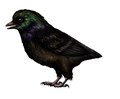

| Anatomy | |||||||||||||||||||||||||||||||||||||||||||||||||||||||||||||||||||
|---|---|---|---|---|---|---|---|---|---|---|---|---|---|---|---|---|---|---|---|---|---|---|---|---|---|---|---|---|---|---|---|---|---|---|---|---|---|---|---|---|---|---|---|---|---|---|---|---|---|---|---|---|---|---|---|---|---|---|---|---|---|---|---|---|---|---|---|
| Behaviour | |||||||||||||||||||||||||||||||||||||||||||||||||||||||||||||||||||
| Evolution | |||||||||||||||||||||||||||||||||||||||||||||||||||||||||||||||||||
| Fossil birds |
| ||||||||||||||||||||||||||||||||||||||||||||||||||||||||||||||||||
| Human interaction | |||||||||||||||||||||||||||||||||||||||||||||||||||||||||||||||||||
| Lists | |||||||||||||||||||||||||||||||||||||||||||||||||||||||||||||||||||
| |||||||||||||||||||||||||||||||||||||||||||||||||||||||||||||||||||


Enantiornithes
View on GrokipediaHistory and nomenclature
Discovery history
The earliest recognized fossils attributable to Enantiornithes date to the 1970s, when isolated avian bones from the Late Cretaceous were initially misclassified as belonging to modern bird groups. In 1974, the genus Gobipteryx was described from the Barun Goyot Formation in Mongolia's Gobi Desert, based on specimens collected during joint Polish-Mongolian expeditions and erroneously placed among galliform birds. Similarly, in 1976, Alexornis was named from the El Rosario area in Baja California, Mexico, representing the first North American enantiornithine but initially interpreted as an early neornithine bird, possibly related to Coraciiformes or Piciformes. These finds hinted at an undescribed diversity of Mesozoic birds but lacked the context to define the clade.[5] The formal recognition of Enantiornithes occurred in 1981, when Cyril A. Walker described new skeletal material from the Upper Cretaceous Lecho Formation in northern Argentina as a distinct avian subclass, naming it Enantiornithes ("opposite birds") for the reversed articulation between the scapula and coracoid. This discovery, based on specimens including partial skeletons with diagnostic features like a perforated humeral head and reduced outer metatarsal, established the group as a major Mesozoic radiation. Subsequent excavations in the 1980s in Patagonia, Argentina, uncovered additional material, such as elements later assigned to the family Neuquenornithidae (e.g., Neuquenornis volans from the Anacleto Formation, originally noted in late 1970s field surveys but formally described in 1994), expanding the known South American record.[6][7] A major surge in discoveries began in the 1990s with the unearthing of exceptionally preserved specimens from the Early Cretaceous Jehol Biota in Liaoning Province, China, particularly the Yixian and Jiufotang Formations. These lagerstätten, revealed through local mining and systematic paleontological expeditions, yielded hundreds of articulated enantiornithine skeletons, many with feathers, soft tissues, and growth stages including hatchlings that illuminated ontogenetic development—such as the retention of teeth and wing claws into adulthood. Key early examples include Sinornis santensis (1992) and Cathayornis yandica (1992), which demonstrated the clade's arboreal adaptations and dietary diversity.[8] Beyond these core regions, significant sites include Las Hoyas in the La Huérguina Formation of Spain, where Barremian-aged (ca. 125 Ma) deposits have produced juvenile enantiornithines since the 1980s, including the nestling Eoalulavis (1995) preserving pycnofibers. In Mexico, additional material from sites like La Huasteca in Coahuila has contributed to the record since the 2000s, with isolated elements reinforcing North American diversity. Post-2020 discoveries in mid-Cretaceous (ca. 99 Ma) Burmese amber from Myanmar's Kachin State have preserved rare soft tissues, such as immature feathers, foot structures, and even gastric contents in specimens like isolated enantiornithine wings and tails, offering unprecedented insights into plumage and locomotion. Recent findings as of 2025 include new avisaurid taxa from the Late Cretaceous Hell Creek Formation in North America and diminutive bohaiornithids from China, further highlighting North American and Asian diversity.[9][10][11][12] By 2025, over 100 genera of Enantiornithes have been described, with the feathered Jehol specimens fundamentally reshaping views of early avian evolution by highlighting their global dominance and mosaic traits bridging non-avian dinosaurs and modern birds.Naming and classification
The clade Enantiornithes was coined in 1981 by Cyril A. Walker in his description of Cretaceous avian fossils from Argentina, with the name deriving from the Greek enantios ("opposite") and ornithes ("birds"), referring to the reversed articulation between the scapula and coracoid—a feature opposite to that in modern birds.[6] Walker initially classified Enantiornithes as a distinct subclass of Aves, separate from previously recognized groups like Archaeornithes and Neornithes, based on unique postcranial features such as a reduced outer metatarsal and a highly modified pectoral girdle.[6] Subsequent discoveries, particularly well-preserved specimens from the Early Cretaceous Jehol Biota of China in the 1990s, prompted a refinement of this classification, elevating Enantiornithes to a monophyletic clade within the larger group Ornithothoraces (or sometimes Euornithes), positioned as the sister group to the lineage leading to modern birds. This shift was driven by cladistic analyses that resolved early uncertainties, transforming initial perceptions of Enantiornithes as a potentially polyphyletic assemblage of disparate forms in the 1980s into a robustly supported monophyletic radiation. The clade is diagnosed by several synapomorphies, including a strut-like coracoid with a procoracoid process, a keeled sternum featuring caudal marginal notches, and a fully reversed hallux adapted for perching. Recent phylogenetic updates from 2023 to 2025, incorporating time-calibrated trees and new basal taxa such as Paraprotopteryx, have further stabilized its position within Avialae while refining estimates of its early diversification in the Late Jurassic to Early Cretaceous.[3]Evolutionary history
Origins and phylogeny
Enantiornithes originated in the Early Cretaceous around 145 million years ago, evolving from archaeopterygid-like ancestors within the broader Avialae clade. Phylogenetic analyses using total-evidence dating estimate their divergence from the sister group Euornithes near the Jurassic-Cretaceous boundary. The oldest confirmed enantiornithine fossils date to the late Hauterivian to early Barremian stage approximately 131 million years ago, represented by taxa like Protopteryx fengningensis from the Huajiying Formation in China.[13] Within the avian phylogeny, Enantiornithes occupy a basal position in Ornithothoraces, forming the sister group to Euornithes, the lineage leading to modern birds; this relationship is supported by shared derived traits such as the presence of a fused clavicular complex (furcula) and a pygostyle formed by fusion of the terminal caudal vertebrae.[14] Key synapomorphies defining Enantiornithes include pleurocoelous (laterally pneumatized) dorsal vertebrae, elongate uncinate processes on the thoracic ribs that overlap adjacent ribs, and retention of a robust alular digit (manus digit I) with phalangeal formula often resembling 2-2-3-3-x.[14] The internal phylogeny of Enantiornithes reveals a basal diversification in the Early Cretaceous, with longipterygids and pengornithids representing some of the earliest diverging lineages, known from the Aptian-Albian stages. Recent discoveries, such as the diminutive bohaiornithid Neobohaiornis lamadongensis from the Jiufotang Formation, further illustrate the early size diversity within bohaiornithids.[12] These basal groups gave rise to a broader radiation encompassing piscivorous forms (e.g., longipterygids with elongate rostra and pointed teeth suited for grasping fish), arboreal species (e.g., pengornithids with strong manual claws for climbing), and terrestrial ground-dwellers (e.g., bohaiornithids adapted for predation on larger prey).[3] Phylogenetic analyses consistently recover these clades near the base, with subsequent branches leading to more specialized families like avisaurids and joeydromids.[14] Recent phylogenetic debates since 2020 have focused on the position of Iberomesornis romerali, a Barremian enantiornithine from Spain, with updated analyses using micro-CT data placing it as basal within the clade rather than as a stem ornithothoracine, emphasizing its mosaic of primitive and derived traits.[15] Additionally, total-evidence dating approaches incorporating stratigraphic and morphological data indicate a rapid radiation of Enantiornithes shortly after the Jurassic-Cretaceous boundary, characterized by heterogeneous rates of morphological evolution that accelerated in early diverging lineages.[16]Temporal and geographic distribution
Enantiornithes first appeared in the fossil record during the Early Cretaceous, with the oldest known specimens dating to the late Hauterivian to early Barremian stage approximately 131 million years ago.[5] Their temporal range extended through the remainder of the Cretaceous, with fossils documented up to the Maastrichtian stage at 66 million years ago, coinciding with the Cretaceous-Paleogene boundary.[5] No enantiornithine fossils have been recovered from Paleogene deposits, confirming their complete extinction at the end of the Cretaceous.[5] The group achieved its peak diversity during the mid-Cretaceous, particularly in the Albian to Cenomanian stages (approximately 113–94 million years ago), when avian diversity broadly recovered following earlier fluctuations.[17] Approximately 80% of known enantiornithine taxa originate from Asia, primarily China and Mongolia, reflecting the exceptional preservation in these regions.[5] Geographically, Enantiornithes exhibited a predominantly Laurasian distribution, with abundant fossils from northeastern China, North America, and Europe, though sparser records indicate a presence in Gondwana, including South America, Antarctica, and Australia.[5][18] Key fossil-bearing formations highlight this distribution pattern. In Asia, the Yixian Formation of China (Aptian, ~125 million years ago) and the overlying Jiufotang Formation (~120 million years ago) have yielded numerous well-preserved specimens, contributing significantly to the early diversification of the clade.[5] In North America, the Two Medicine Formation (Campanian, ~80 million years ago) preserves enantiornithines alongside other Mesozoic avians, while in South America, the Lecho Formation of Argentina (Campanian, ~80 million years ago) documents their Gondwanan occurrence.[5] Recent discoveries underscore the late persistence of Enantiornithes in Gondwana. In 2024, the new taxon Navaornis hestiae was described from the Adamantina Formation in southeastern Brazil (Late Santonian to early Campanian, ~85–75 million years ago), representing one of the most complete enantiornithine skulls from the region and indicating their survival into the Late Cretaceous in southern continents.[18] These findings affirm the global reach of Enantiornithes but also highlight the absence of post-boundary records, reinforcing their extinction at the K-Pg event.[18][5]Anatomy
Skull and dentition
The skulls of Enantiornithes are characterized by a generally unfused construction, retaining primitive features such as a small premaxilla, a postorbital bone, and a squamosal not incorporated into the braincase.[19] The quadrate bone is primitive, featuring a single-headed otic process and a bicondylar mandibular process, and exhibits flexibility that supports limited cranial kinesis in some taxa, an intermediate condition between non-avian dinosaurs and modern birds.[20] Unlike the toothless rhamphothecae of euornithines, most enantiornithines retained teeth along the margins of the premaxilla, maxilla, and dentary, with the number of tooth positions varying from absent in rare cases like Gobipteryx and the Late Cretaceous Navaornis hestiae—which also shows rare fused premaxillae and unfused frontals/parietals alongside a derived cranial geometry approaching crown birds—to up to 13 in Pengornis.[19][18] Dentition in Enantiornithes is highly variable and often heterodont, reflecting diverse feeding strategies. Longipterygids, for example, possess conical, slightly recurved teeth that are smaller in the anterior positions, adaptations consistent with a piscivorous diet.[21][22] In contrast, bohaiornithids exhibit robust, conical teeth lacking serrations but with pointy, curved tips and greater posterior size gradients, suited for raptorial predation on tougher prey; the diminutive 2024-described Neobohaiornis lamadongensis (~55 g body mass) further exemplifies this with basally robust, apically pinched teeth that are smaller rostrally.[21][22][12] Tooth replacement follows a polyphyodont pattern, with new teeth forming lingually and migrating labially, as evidenced by micro-CT scans of Brazilian specimens.[21] The orbits are the largest cranial openings and are aligned laterally with the rostrum and braincase, suggesting enhanced visual capabilities.[19] Preserved sclerotic rings, such as those in Longipteryx, fill much of the orbit and indicate diurnal activity patterns.[22] The braincase remains largely unfused in early taxa, with caudally directed foramen magnum, but shows progressive fusion in Late Cretaceous forms like Gobipteryx.[19] Endocasts reveal variations from basal conditions resembling Archaeopteryx to more derived morphologies approaching euornithines, including an expanded floccular lobe of the cerebellum that likely aided vestibular balance during flight; Navaornis hestiae endocast shows an intermediate expanded telencephalon. Amber inclusions from the mid-Cretaceous of Myanmar preserve soft tissues of juvenile enantiornithines, including feathers adjacent to the beak region that suggest partial rhamphothecal covering in some individuals.[23]Postcranial skeleton
The postcranial skeleton of Enantiornithes exhibits several distinctive features in the axial and thoracic regions that distinguish it from both non-avian theropods and modern neornithine birds, reflecting adaptations for flight and respiration within a Mesozoic avian framework. The vertebral column includes a cervical series of 8–11 vertebrae, which are pleurocoelous with lateral pneumatic fossae indicating invasion by air sacs for lightweight construction and efficient gas exchange. Thoracic vertebrae possess uncinate processes—elongated, overlapping projections that articulate with the ribs to enhance ribcage rigidity and facilitate bellows-like ventilation, a system integral to the avian air-sac breathing mechanism but calibrated to the group's relatively higher vertebral count overall. Caudal vertebrae are heterocoelous, with saddle-shaped articular facets promoting tail flexibility, and distally fuse into a robust pygostyle for rectricial support.[24][25][26] The sternum, ossifying late in ontogeny from multiple centers, forms a broad plate with an asymmetric keel that extends caudally and is often more developed on the left side, optimizing muscle leverage for wing upstroke. Its caudal margin features paired notches or open emarginations, providing attachment sites for the longissimus caudae muscles and the pygostyle, which anchor the tail feathers essential for flight control. The furcula is V-shaped with broad rami and a prominent, blade-like hypocleidium extending ventrally, functioning as a spring-like element during the flight cycle but differing from the more parabolic U-shape in extant birds. In adults, the scapula and coracoid articulate firmly at the glenoid but fuse in some taxa, with the coracoid bearing a procoracoid foramen that accommodates the supracoracoid tendon for powering the wing downstroke.[27][27][28] The synsacrum comprises 10–15 fused vertebrae, incorporating posterior thoracic, lumbar, sacral, and anterior caudal elements into a elongated, robust block that bolsters pelvic stability for both perching and terrestrial support. This extensive fusion, exceeding that in many neornithines (typically 7–11 vertebrae), underscores variations in load-bearing and respiratory dynamics, as the incorporated uncinate processes and air sacs likely enabled distinct thoracic expansion patterns during locomotion and flight.[29][30]Wings and flight apparatus
The wings of enantiornithes were adapted for flight through an elongated humerus featuring a prominent deltopectoral crest, which served as a key anchor for flight muscles such as the deltoideus and pectoralis.[31] This crest was typically shallow and extended for more than 40% of the humeral length in taxa like Protopteryx fengningensis, longer than in comparably sized modern birds, facilitating a semi-rigid wing structure supported by primary and secondary flight feathers.[31] The overall forelimb retained primitive theropod features while showing avian specializations, including a fused carpometacarpus in adults that provided rigidity to the hand skeleton.[30] Enantiornithes uniquely retained three clawed manual digits among early birds, with the alula (formed by digit I) being particularly prominent and often bearing 3–5 feathers for aerodynamic control during low-speed maneuvers; in the diminutive bohaiornithid Neobohaiornis lamadongensis, the alular digit is notably reduced.[32][12] The carpometacarpus included a strong extensor process on the alular metacarpal in some taxa, such as Xiangornis shenmi, enhancing extension of the alular digit and contributing to wing flexibility. Claws on all three digits were functional, though reduced in size compared to non-avian theropods, allowing for potential perching or prey manipulation alongside flight.[33] Feathers in enantiornithes were fully pennaceous, with primaries and secondaries exhibiting modern vanes, barbs, barbules, and hooklets for effective lift and propulsion; examples include primaries up to 20 cm in length in Longipteryx species, alongside contour feathers covering the body.[33] Fossils from the Jehol Biota preserve evidence of molting, including sequential replacement of wing feathers in juveniles and immature plumage stages, indicating a complex, bird-like molt cycle that likely supported sustained flight capability.[34] Muscle scars on the humerus and ulna, such as the impressio musculi brachialis on the ulna and the extended deltopectoral crest, indicate adaptations for a powerful downstroke powered by the pectoralis muscle, essential for takeoff and sustained flapping.[31] In avisaurids like Mirarce eatoni, reinforced elements including a deeply keeled sternum and ulnar quill knobs provided bracing for the flight apparatus, supporting agile maneuvers convergent with those in modern neornithines. Variations in wing structure reflected ecological diversity; arboreal forms such as Eopengornis exhibited manus proportions allowing opposed positioning of the alula relative to digits II and III, akin to zygodactyl-like grasping for perching.[3] Piscivorous taxa, including Eoalulavis, often had relatively shorter wings suited to precise diving or hovering over water, differing from the elongated wings of aerial insectivores.[3]Tail and pelvic region
The tail of enantiornithines was generally abbreviated compared to more basal avialans, consisting of 6–10 free caudal vertebrae followed by a fused pygostyle formed from the distalmost elements, rather than the 20+ free vertebrae seen in non-enantiornithine early birds.[35] This structure supported a fan-shaped array of rectrices in many derived forms, as demonstrated by the exceptionally preserved specimen of Longipteryx chaoyangensis, which reveals a short pygostyle anchoring a broad tail fan similar to that in modern birds.[36] The pygostyle itself was small, broad, and often forked with a V-shaped notch, differing from the more robust, platelike form in neornithines; this morphology likely accommodated rectricial bulbs for feather support, though with a potentially reversed articulation of the proximal vertebrae relative to modern avian tails.[37] In the pelvic region, the synsacrum incorporated a variable number of vertebrae (typically 10–12), with a broad, elongate ilium that expanded dorsally and a pubis directed posteriorly, often remaining unfused to the ischium in basal taxa like Pengornis houi but showing increasing fusion in later Cretaceous forms.[35] [38] The acetabulum was perforate, facilitating hip mobility, while the overall pelvic architecture supported robust hindlimb attachments.[30] The hindlimbs featured a sturdy femur with a gently caudally bowed shaft and a straight, elongate tibiotarsus exceeding the femur in length, accompanied by a reduced fibula that tapered distally without reaching the tarsals.[31] The feet were anisodactyl, with digits II–IV directed anteriorly and a large, fully reversed hallux (digit I) subequal in length to digit III, bearing a recurved ungual for enhanced grip on branches, indicative of arboreal perching adaptations.[39] In terrestrial-oriented groups such as avisaurids, the hallux was relatively shorter and the tarsometatarsus more robust—with features like a mediolateral width >20% of length and a m. tibialis cranialis tubercle at ~30% down metatarsal II—suggesting ground-foraging capabilities while retaining some climbing proficiency.[40][41] These hindlimb features underpinned agile locomotion, including perching and short-distance terrestrial movement.[42]Paleobiology
Locomotion and flight
Enantiornithes exhibited powered flight in adulthood, supported by advanced skeletal features such as a keeled sternum for flight muscle attachment and robust coracoids and furculae that anchored the shoulder girdle. These adaptations enabled intermittent flapping flight, including bounding and flap-gliding styles typical of small modern birds under 300 grams. Aerodynamic modeling of well-preserved specimens, such as those from the Early Cretaceous, reveals that their short, broad wings with long primary feathers provided high lift-to-drag ratios, facilitating efficient short-distance travel but limiting sustained soaring in most taxa.[1][4] Hatchling fossils demonstrate that juvenile enantiornithines were highly precocial, emerging with fully developed remiges and a well-ossified skeleton capable of supporting flapping or gliding within days of hatching. For instance, amber-preserved specimens from Myanmar show functional wing feathers alongside downy body plumage, indicating early locomotor independence, though likely restricted to short bursts compared to adults. This contrasts with more altricial modern birds and underscores the evolutionary precocity of enantiornithine development.[43][2] On the ground, enantiornithines employed bipedal locomotion with a crouched posture, akin to extant birds, where the center of mass was positioned over the hips for stable striding. Arboreal species displayed climbing adaptations, including elongated pedal phalanges, curved claws, and a reversed hallux for perching and gripping branches, as seen in taxa like Fortunguavis xiaotaizicus. Evidence for aquatic locomotion is limited but present in some forms with broadened toes suggestive of paddling, potentially aiding wading or brief swimming in shoreline environments.[1][44] Recent biomechanical studies (2022–2024) using musculoskeletal modeling and comparative anatomy confirm that enantiornithines relied on burst flight capabilities similar to pheasants or quails, with power margins sufficient for takeoff and short evasions but insufficient for long-distance migration. These analyses highlight how their pygostylian tails and asymmetric flight feathers optimized maneuverability in forested habitats, rather than endurance over open expanses.[1][45]Diet and ecology
Enantiornithes exhibited a remarkable diversity of feeding strategies, reflecting adaptations to various ecological niches during the Cretaceous. Small, arboreal species such as Shenqiornis from the Early Cretaceous Jehol Biota of China are inferred to have been primarily insectivorous, based on claw morphology and jaw mechanics that suggest prey capture in forested understories.[46] Larger forms within the Bohaiornithidae family, including Longusunguis, displayed carnivorous habits, with robust teeth and powerful claws indicating predation on small vertebrates or eggs, as supported by quantitative reconstructions of jaw function and pedal ecology.[3] Piscivory is evidenced in taxa like Piscivorenantiornis inusitatus, where fish remains in the stomach contents confirm a diet focused on aquatic prey, facilitated by blade-like teeth in related longipterygids.[47] Seed-eating and frugivory further expanded enantiornithine trophic diversity, particularly among longipterygids. Recent discoveries in Longipteryx chaoyangensis reveal gymnosperm seeds preserved as gut contents, providing direct evidence of frugivory and highlighting mutualistic roles in seed dispersal within Early Cretaceous forests, contrary to prior inferences of piscivory based solely on cranial morphology.[48] Gastroliths in some specimens, such as those associated with bohaiornithids, have been proposed to support granivory by aiding digestion of hard plant matter, though their identification remains debated and indirect.[49] Cranial adaptations, including variably toothed beaks, underscore this dietary breadth, enabling exploitation from soft-bodied invertebrates to tougher plant resources.[3] Ecologically, enantiornithines occupied a wide array of niches, from understory insectivores to coastal piscivores and arboreal frugivores, mirroring the versatility of modern avian guilds. Their high taxonomic diversity in the Jehol Biota suggests competitive speciation driven by rapid morphological evolution within 25 million years of their origin, allowing coexistence with pterosaurs and early euornithines through niche partitioning in small-animal-dominated food webs. Recent discoveries, such as the diminutive bohaiornithid Neobohaiornis lamadongensis from 2025, further support this inferred dietary and ecological breadth among small-bodied forms.[3][12] In Gondwana, enantiornithine remains are rarer with minimal overlap in assemblages, indicating sparser distributions and potentially limited competition compared to Laurasian ecosystems.[50] This global ubiquity underscores their role as key components of Cretaceous terrestrial communities.[51]Reproduction and growth
Fossil evidence indicates that enantiornithine hatchlings were highly precocial, emerging from eggs with well-developed feathers, advanced skeletal ossification, and the ability to move independently shortly after hatching. Specimens from Early Cretaceous deposits, such as the Las Hoyas site in Spain, preserve perinates with large brains, fledged primary remiges on the wings, and forelimb proportions suggestive of early mobility and limited flight capability, contrasting with the altricial condition of many modern birds.[2] Similarly, embryonic and hatchling remains from the Yixian Formation in China show curled embryos within eggs and fully feathered juveniles capable of thermoregulation and locomotion, supporting a precocial lifestyle that minimized post-hatching parental dependency.[1] Enantiornithine eggshells exhibit a microstructure akin to that of modern birds, featuring distinct mammillary, prismatic, and external calcareous layers that facilitate gas exchange through microscopic pores, along with a preserved cuticle composed of calcium phosphate nanospheres likely aiding in antimicrobial protection during incubation. A notable specimen of the enantiornithine Avimaia schweitzerae from the Yixian Formation preserves an unlaid egg within the abdominal cavity, demonstrating these avian-like features despite the egg's abnormal double-layered structure due to oviductal retention. Clutch sizes are inferred to be small, typically 2–4 eggs, based on associated fossil egg accumulations and comparisons with precocial modern avian relatives, though direct evidence remains sparse.[52] Growth in enantiornithines was characterized by rapid initial post-hatching rates followed by a protracted phase with periodic interruptions, as revealed by bone histology showing multiple lines of arrested growth (LAGs) in long bones like the tibia and femur. These LAGs indicate seasonal or environmental pauses in deposition, resulting in overall slower skeletal maturation compared to neornithine birds, often taking several years to reach adult size. Sexual maturity was achieved early, prior to full skeletal completion, with medullary bone deposits in female specimens signaling reproductive activity during ongoing growth, potentially within the first year based on histological transitions from highly vascular to parallel-fibered bone.[30][53] Evidence for parental care is limited, primarily inferred from the precocial nature of hatchlings suggesting minimal investment beyond incubation and nesting site selection. Colonial nesting is documented in Late Cretaceous enantiornithine assemblages from Romania, where accumulations of eggs and skeletal remains imply group breeding in waterside environments, potentially enhancing protection but without direct traces of brooding behavior. No confirmed instances of adult brooding or extended post-hatching care have been identified, though the presence of medullary bone in multiple individuals hints at seasonal reproductive cycles with some maternal physiological commitment.[54] Recent histological analyses, including those from 2021 onward, confirm determinate growth patterns in enantiornithines, where skeletal development ceased at a genetically programmed size, differing from the indeterminate growth seen in many reptiles and aligning with the avian condition. Studies of subadult specimens from the Jehol Biota reveal ontogenetic shifts in bone texture and vascularity, supporting a multiphase growth strategy that balanced rapid early development with extended maturation for flight refinement.[55]Predation and extinction
Enantiornithes served as prey for small theropod dinosaurs, particularly juveniles targeted by dromaeosaurids and troodontids, which were agile carnivores adapted to hunting small vertebrates in arboreal or terrestrial environments. Direct fossil evidence includes a specimen of the dromaeosaurid Microraptor zhaoianus preserving the remains of a partially digested enantiornithine bird in its abdominal cavity, indicating active predation on arboreal individuals.[56] Stomach contents from other maniraptoran theropods, such as dromaeosaurids, further support that enantiornithines formed part of the diet of these predators, with bite marks and ingested bones occasionally preserved in association with enantiornithine fossils.[57] The fossil record of Enantiornithes reveals a high rate of juvenile mortality, with a significant proportion of known specimens representing immature individuals. This overrepresentation suggests intense selective pressures on young birds, potentially from nest predation by small theropods or environmental hazards such as flooding in nesting habitats. Precocial development in enantiornithines, where hatchlings were mobile but still vulnerable, likely exacerbated these risks, as evidenced by numerous partial skeletons of unfledged juveniles preserving flight feathers in early growth stages. Enantiornithes underwent complete extinction at the Cretaceous-Paleogene (K-Pg) boundary approximately 66 million years ago, with no post-boundary fossils known, in stark contrast to certain neornithine lineages that survived and radiated afterward. Hypotheses for their demise include relatively lower resting metabolic rates compared to modern birds, inferred from bone histology showing slower growth and less dense vascularization, which may have reduced their resilience to environmental stressors. Additionally, their reproductive strategy involved exposed, ground-level nests—often simple scrapes or platforms—leaving eggs and precocial young susceptible to predation and climatic extremes, unlike the more concealed or burrowed nests of surviving neornithines.[59][60][61] The Chicxulub asteroid impact triggered a prolonged global winter, characterized by dust and sulfate aerosols blocking sunlight, which collapsed terrestrial food chains by halting photosynthesis and decimating insect populations. This disruption disproportionately affected Enantiornithes, whose precocial young relied heavily on abundant soft-bodied insects for initial foraging, leading to widespread nest failure and population crashes. In contrast, some neornithines with more generalist diets, including access to seeds and harder plant material, could endure the scarcity.[62] Recent phylogenetic and ecological models highlight niche conservatism in Enantiornithes, where phylogenetic inertia limited their ability to shift to post-impact habitats like open grasslands, unlike more adaptable euornithine birds that exploited emerging niches. This conservatism, coupled with specialization in forested, insect-rich environments, contributed to their selective extinction during the recovery phase.[63]Systematics and diversity
Phylogenetic relationships
Enantiornithes represents a major clade within Avialae, positioned as the sister group to Euornithes (which encompasses Ornithuromorpha and more crownward lineages) inside the broader radiation Ornithothoraces.[64] The total group Avialae includes more basal taxa such as Archaeopteryx, marking Enantiornithes as a derived branch stemming from early theropod dinosaurs.[65] This placement highlights their role as one of the earliest successful avian radiations, distinct from the lineage leading to modern birds (Neornithes).[1] Phylogenetic support for this positioning derives from cladistic analyses emphasizing shared derived traits within Ornithothoraces, including a keeled sternum that facilitated flight muscle attachment, a key innovation for powered flight in early birds.[27] However, Enantiornithes exhibit plesiomorphic retention of teeth and a heterocoelous cervical vertebrae structure, contrasting with the edentulous skulls and more derived vertebral morphology of Euornithes.[66] Outgroup comparisons further contextualize their position: Enantiornithes are more derived than basal paravians like Anchiornis, which lack advanced avian flight adaptations, but less derived than basal neornithines such as Vegavis, reflecting an intermediate stage in avian evolution.[67] Due to their complete extinction at the Cretaceous-Paleogene boundary, no molecular proxies exist to corroborate these morphological phylogenies.[64] Early phylogenetic debates centered on whether Enantiornithes occupied a more basal position relative to all Euornithes or formed a distinct sister clade; some pre-2010 analyses suggested broader tooth-bearing affinities across Avialae. In contrast, analyses from the 2020s, incorporating expanded morphological datasets, robustly recover Enantiornithes as sister to the Euornithes clade that includes Ichthyornithes and Hesperornithiformes, underscoring their divergence as a pivotal event in Mesozoic avian diversification.[12] Recent 2025 studies integrating large-scale matrices of Mesozoic avian fossils indicate a Late Jurassic divergence for Enantiornithes, around 147 million years ago, aligning with sparse early records and supporting their monophyly with strong statistical backing, including bootstrap values exceeding 95%.[68] These findings reinforce the clade's early origin within Avialae while briefly noting internal family-level relationships as variably resolved across analyses.[69]Major families and genera
Enantiornithes comprise over 100 described genera assigned to approximately 15 families, though taxonomic placements remain fluid and many taxa are considered incertae sedis, including basal forms such as Protopteryx from the Early Cretaceous Yixian Formation of China.[12] This diversity spans the Cretaceous, with over 80 named species, though many are based on fragmentary material and their validity is debated.[12] The Longipterygidae, known from Early Cretaceous deposits in China (ca. 125 Ma), are characterized by elongate rostra and restricted dentition, as exemplified by Longipteryx, which exhibits adaptations potentially linked to piscivory or frugivory.[70] This family includes at least six genera from the Yixian and Jiufotang Formations, highlighting early morphological specialization within Enantiornithes.[70] Pengornithidae represents one of the basal-most enantiornithine clades, featuring large-bodied, arboreal forms from the Early Cretaceous of China, such as Pengornis and Eopengornis, with evidence of primitive scansorial adaptations and hints of early rhamphotheca development alongside teeth.[35][71] These birds, dated to near 125 Ma, suggest a habitat favoring tree-climbing, contributing to the group's initial radiation.[35] Bohaiornithidae, another prominent Early Cretaceous family from northeastern China (124–119 Ma), includes robust predators like Bohaiornis, Longusunguis, and Parabohaiornis, with up to seven genera known for powerful dentition and claws indicative of carnivorous or generalist diets.[3][12] Their diverse morphologies underscore trophic specialization within the clade.[3] Avisauridae documents enantiornithine presence in the Southern Hemisphere, particularly during the Late Cretaceous, with key taxa such as Avisaurus from South American deposits like the Lecho Formation in Argentina, featuring advanced flight apparatus suited to diverse environments.[72] This family, including Neuquenornis from Patagonia, exemplifies Gondwanan diversity and convergence with neornithine sternal structures.[72][41] Other notable families include Concornithidae, represented by seed-eating forms like Concornis from the Early Cretaceous of Spain, suggesting granivorous niches.[73] Neuquenornithidae highlights additional Gondwanan endemics, building on avisaurid distributions. Dubious genera, such as the originally named "Enantiornis," have been reassigned to Avisauridae based on tarsometatarsal morphology.[74] Recent additions, including new bohaiornithid taxa from 2024 and species like Novavis from 2025, continue to refine family boundaries and elevate diversity estimates.[12][75]References
- https://www.[researchgate](/page/ResearchGate).net/publication/338355119_First_report_of_immature_feathers_in_juvenile_enantiornithines_from_the_Early_Cretaceous_Jehol_avifauna