


Community hub
Recent from talks
Contribute something
Nothing was collected or created yet.
Eric Harris and Dylan Klebold
View on Wikipedia
Key Information


| Part of a series of articles on the |
| Columbine High School massacre |
|---|
 |
|
Location: Perpetrators: Eric Harris and Dylan Klebold |
Eric David Harris (April 9, 1981 – April 20, 1999) and Dylan Bennet Klebold (/ˈkliːboʊld/ KLEE-bohld; September 11, 1981 – April 20, 1999) were American high school seniors and mass murder duo who perpetrated the massacre at Columbine High School on April 20, 1999, in Columbine, Colorado. Harris and Klebold killed 13 students and one teacher and wounded 23 others.[b] After killing most of their victims in the school's library, they died by suicide. At the time, it was the deadliest high school shooting in U.S. history.[c] It remains one of the most infamous massacres due to the pair inspiring many other school attacks, mass shootings, and bombings.
The ensuing media frenzy and moral panic led to "Columbine" becoming a byword for school shootings, and becoming one of the most infamous mass shootings ever perpetrated in the United States.[3][4]
Harris and Klebold were both born in 1981. Harris was born in Wichita, Kansas, but moved around frequently as a child due to his father's occupation in the United States Air Force, while Klebold was born and raised near Columbine. Harris's family eventually settled in Colorado in 1992. Shortly after, Harris and Klebold met while they were in the 7th grade. Over time, they became increasingly close. By the time they were juniors in high school, they were described as inseparable. There are differing reports; some say Harris and Klebold were very unpopular students once they were upperclassmen, as well as frequent targets of bullying, while others say they were not near the bottom of the school's social hierarchy and that each had many friends, along with active social lives. Columbine High School was alleged to have an intense "jock culture", which saw popular students, mainly athletes, benefit from special treatment from faculty and other students.[5]
According to their journal entries, Harris and Klebold seem to have begun planning the attack by May 1998, nearly a year before the attack. Throughout the next eleven months, Harris and Klebold meticulously built explosives and gathered an arsenal of weapons. Both Harris and Klebold each left behind several journal writings and home videos, ones they made both alone and together, foreshadowing the massacre and explaining their motives. Harris and Klebold hoped this content would be viewed by the public extensively and inspire followers, although much of the evidence has never been released by authorities.
Harris and Klebold often wore trench coats in school, and in general, as part of their everyday outfits, so after the massacre, it was widely believed Harris and Klebold were part of a clique in school called the "Trenchcoat Mafia", a group of misfits in the school who supposedly rebelled against the popular students.[6] This turned out to be untrue, as neither Harris nor Klebold had any affiliation with the group.[7][8] The pair's aforementioned writings and videos gave insight into their rationale for the shooting. The FBI concluded that Harris was a psychopath, who exhibited narcissistic traits, unconstrained aggression, and a lack of empathy, while Klebold was concluded to be an angry depressive with a vengeful attitude toward individuals who he believed had mistreated him.[9] However, neither Harris nor Klebold were formally diagnosed with any personality disorders prior to the attack,[10] so this conclusion is often debated. In the following years, various media outlets attributed multiple motivating factors to the attack, including bullying, mental illness, racism, psychiatric medication, and violence in music, movies, and video games. Despite these conclusions, the exact motive for the attack remains inconclusive.
Harris and Klebold have become pop culture icons, with the pair often portrayed, referenced and seen in film, television, video games, music and books. Many killers since the shooting have taken inspiration from the pair (dubbed the Columbine effect), either hailing them as heroes or expressing sympathy for them. Harris and Klebold also have a fanbase, who have coined the term "Columbiners", who write fan fiction and draw fan art of them. Others have also dressed as the duo for cosplay or Halloween.[11]
Early life
[edit]Eric Harris
[edit]Eric David Harris was born on April 9, 1981, in Wichita, Kansas. Harris's parents were both born and raised in Colorado. His mother, Katherine Ann Poole, was a homemaker. His father, Wayne Harris, was working in the United States Air Force as a transport pilot. In 1983, the family moved to Dayton, Ohio, when Harris was two years old. Six years later, the family relocated to Oscoda, Michigan. Michigan pastor William Stone lived across the street from the Harris family while they were located in Oscoda. Stone recalled them as "great neighbors" and often saw Wayne very engaged with his sons.[12] The Harris family then moved to Plattsburgh, New York, in 1991. During his time at Stafford Middle School, Harris played Little League Baseball, regularly went to birthday parties and was "part of the crowd". Kyle Ross, a former classmate of Harris, said, "He was just a typical kid."[13] The Harris family finally settled back in Littleton, Colorado the next year when Wayne retired from the military.[14]
On a 1997 English class assignment, Harris wrote about how difficult the move was from New York to Colorado. "It was the hardest moving from Plattsburgh. I have the most memories from there", Harris continued. "When I left (his friends) I felt alone, lost and even agitated that I had spent so much time with them and now I have to go because of something I can't stop."[15] Harris, in a basement tape, blamed his father for moving the family around, forcing Harris to "start out at the bottom of the ladder."[16] Harris had a chest deformity known as pectus excavatum, in which the breastbone sinks into the chest. This made Harris reluctant to take his shirt off in gym class as other students ridiculed him. Harris had two cosmetic surgeries at age 12 and 13 to repair the deformity. The sunken chest was still mildly observable during his autopsy.[17][18]
The Harris family lived in rented accommodations for the first three years that they lived in the Littleton area. While Harris was in 7th grade, he met Klebold. In 1996, the Harris family purchased and settled at a house south of Columbine High School. Harris's older brother, Kevin, attended college at the University of Colorado.[19][20] Harris's father took a job with Flight Safety Services Corporation and Harris's mother became a caterer.[21][22]
Harris entered Columbine High School in 1995 as a freshman. Columbine had just gone through a major renovation and expansion.[23] From all accounts, he had many friends and was left forward and mid-field on the Columbine soccer team for his freshman and sophomore year. Josh Swanson, one of his teammates, said that Harris was a "solid" soccer player who enjoyed the sport a lot.[24][25] During his freshman year, Harris met Tiffany Typher. They had German class together.[26] Typher later recounted that Harris quickly wooed her. Harris asked her to homecoming and she accepted. After the event, it appeared that Typher was no longer interested in seeing Harris anymore, for reasons never disclosed. When Typher refused to socialize with Harris again, Harris staged a fake suicide, sprawling on the ground with fake blood splashed all over him. When Typher saw him on the ground, she began to scream for help, at which point Harris and his friends began laughing, prompting Typher to storm off, shouting at Harris to get psychological help.[27]
Dylan Klebold
[edit]Dylan Bennet Klebold was born on September 11, 1981, in Lakewood, Colorado, to Thomas and Sue Klebold.[14] On the day after the shooting, Klebold's mother remembered that shortly after Klebold's birth, she described what felt like a shadow cast over her, warning her that this child would bring her great sorrow. "I think I still make of it what I did at that time. It was a passing feeling that went over very quickly, like a shadow." Sue said in an interview with Colorado Public Radio. Klebold was soon diagnosed with pyloric stenosis, a condition in which the opening between the stomach and small intestines thickens, causing severe vomiting during the first few months of life.[28]
Klebold's parents had met when they were both studying art at Ohio State University. After they both graduated, they married in 1971, with their first child, Byron, being born in 1978. Thomas had initially worked as a sculptor, but then moved over to engineering to be more financially stable.[29] Sue had worked in assistance services with disabled children. Furthermore, Klebold's parents were pacifists and attended a Lutheran church with their children. Both Klebold and his older brother attended confirmation classes in accordance with the Lutheran tradition.[30] As had been the case with his older brother, Klebold was named after a renowned poet, Dylan Thomas.[31] Klebold attended Normandy Elementary School for first and second grade and then transferred to Governor's Ranch Elementary School where he was part of the Challenging High Intellectual Potential Students program for gifted children. According to reports, Klebold was exceptionally bright as a young child, although he appeared somewhat sheltered in elementary school.[32] When he transitioned to Ken Caryl Middle School, he found it difficult. Fellow classmates recalled Klebold being painfully shy and quiet, often to an uncomfortable degree.[33] Klebold's parents were unconcerned with the fact that Klebold found the changing of schools uneasy, as they assumed it was just regular behavior among young adolescents.[34] At the family home, the Klebolds also observed some rituals in keeping with Klebold's maternal great-grandfather's Jewish heritage.[30][35]
During his earlier school years, Klebold played baseball, soccer and T-ball. Klebold was in Cub Scouts with friend Brooks Brown, whom he was friends with since first grade. Brown lived near the house Harris's parents had bought when they finally settled in Littleton, and rode the same bus as Harris. Shortly after, Klebold had met Harris and the pair quickly became best friends. Later, Harris introduced Klebold to his friend Nathan Dykeman, who also attended their middle school, and they all became a tight-knit group of friends.[36]
Background
[edit]Personalities
[edit]Both Harris and Klebold worked together as cooks at a Blackjack Pizza, a mile south from Columbine High School. Harris was eventually promoted to shift leader.[37] He and his group of friends were interested in computers,[38] and were enrolled in a bowling class.[39]
Some described Harris as charismatic, and others described him as nice and likable.[40][41] Harris also often bragged about his ability to deceive others, once stating in a tape that he could make anyone believe anything.[42] By his junior year, Harris was also known to be quick to anger, and threatened people with bombs.[40][43] Classmates also related that Harris was fascinated by war, and wrote out violent fantasies about killing people he did not like.[41]
Klebold was described by his peers and adults as painfully shy. Klebold often was fidgety whenever someone new talked to him, rarely opening up to people.[44] Klebold was also exceptionally nervous in front of women.[45] In the last year of his life, many noted a change in Klebold's behavior. Unlike before, Klebold became short-tempered, often prone to sudden outbursts of anger.[33]
Friendship
[edit]Much of the information on Harris and Klebold's friendship is unknown, on their interactions and conversations, aside from the Basement Tapes, of which only transcripts have been released, aside from a short audio clip recorded surreptitiously by a victim's father. The pair claimed they were going to make copies of the tapes to send to news stations, but never did so.[42] Harris and Klebold met at Ken Caryl Middle School during their seventh grade year. Over time, they became increasingly close, hanging out by often going out bowling, carpooling and playing the video game Doom over a private server connected to their personal computers. By their junior year of high school, the boys were described as inseparable. Chad Laughlin, a close friend of Harris and Klebold, said that they always sat alone together at lunch and often kept to themselves.[46]
A rumor eventually started that Harris and Klebold were gay and romantically involved, due to the time the pair spent together. It is unknown if they were aware of this rumor.[47] Judy Brown believed Harris was more emotionally dependent on Klebold, who was more liked by the broader student population.[48] In his journals, however, Klebold wrote that he felt that he was not accepted or loved by anyone. Due to these feelings, Klebold possibly sought validation from Harris. Klebold's mother believes Harris's rage, intermingled with Klebold's self-destructive personality, caused the boys to feed off of each other and enter in what eventually became an unhealthy friendship.[49]
Columbine High School
[edit]At Columbine High School, Harris and Klebold were active in school play productions, operated video productions and became computer assistants, maintaining the school's computer server.[14] According to early accounts of the shooting, they were very unpopular students and targets of bullying. While sources do support accounts of bullying specifically directed toward Harris and Klebold,[50][51][52] accounts of them being outcasts have been reported to be false, since both of them had a close knit group of friends.[53][54]
Harris and Klebold were initially reported to be members of a clique that was called the "Trenchcoat Mafia", despite later confirmation that the pair had no connection to the group and furthermore did not appear in the group's photo in Columbine High's 1998 yearbook.[55][56] Harris's father erroneously stated that his son was "a member of what they call the Trenchcoat Mafia" in a 9-1-1 call he made on the day of the shooting.[57] Klebold attended the high school prom three days before the shootings with a classmate named Robyn Anderson.[58]
Harris and Klebold linked their personal computers on a network and played video games over the Internet. Harris created a set of levels for the game Doom, which later became known as the "Harris levels". The levels are downloadable over the internet through Doom WADs. Harris had a web presence under the handle "REB" (short for Rebel, a nod to the nickname of Columbine High's sports teams) and other online aliases, including "Rebldomakr", "Rebdoomer", and "Rebdomine". Klebold went by the names "VoDKa" and "VoDkA", after the alcoholic beverage. Harris had various websites that hosted Doom and Quake files, as well as team information for those with whom he gamed online. The sites openly espoused hatred for people in their neighborhood and the world in general. When the pair began experimenting with pipe bombs, they posted results of the explosions on the websites. The website was shut down by America Online after the shootings and was preserved for the FBI.[59]
Initial criminal activity
[edit]On the night of January 30, 1998, Harris and Klebold broke into a locked van to steal computers and other electronic equipment. A short while after a Jefferson County sheriff's officer drove upon the two boys parked further down road at another park entrance and since the park area was closed by that time of night, the arresting deputy decided to further inspect them. The deputy announced his presence as one of the boys prepared to move the stolen goods into the trunk of the car. Harris shortly after admitted to theft after the deputy asked about where the equipment came from.[60] They were later charged with mischief, breaking and entering, trespassing, and theft. They both left good impressions on juvenile officers, who offered to expunge their criminal records if they agreed to attend a diversionary program which included community service and psychiatric treatment. Harris was required to attend anger management classes where, again, he made a favorable impression. The boys' probation officer discharged them from the program a few months ahead of schedule for good behavior. Regarding Harris, it was remarked that he was "a very bright individual who is likely to succeed in life", while Klebold was said to be intelligent, but "needs to understand that hard work is part of fulfilling a dream."[61]
Several months later on April 30, Harris handed over the first version of a letter of apology he wrote to the owner of the van, which he completed the next month.[62] In the letter, Harris expressed regret about his actions; however, in one of his journal entries dated April 12, he wrote: "Isn't america supposed to be the land of the free? how come, If im free, I cant deprive some fucking dumbshit from his possessions If he leaves them sitting in the front seat of his fucking van in plain sight in the middle of fucking nowhere on a fri-fucking-day night? Natural selection. Fucker should be shot. [sic]".[63][64]
Hitmen for Hire
[edit]When an economics class had Harris make an ad for a business, he and Klebold made a video called Hitmen for Hire on December 8, 1998, which was released in February 2004. It depicts them as part of the Trench Coat Mafia, a clique in the school who wore black trench coats, extorting money for protecting preps from bullies.[65] They were apparently not a part of the Trench Coat Mafia, but were friends with some of its members.[66][d] They wore black trench coats on the day of the massacre, and the video seemed a kind of dress rehearsal, showing them walking the halls of the school, and shooting bullies outside with fake guns.[71]
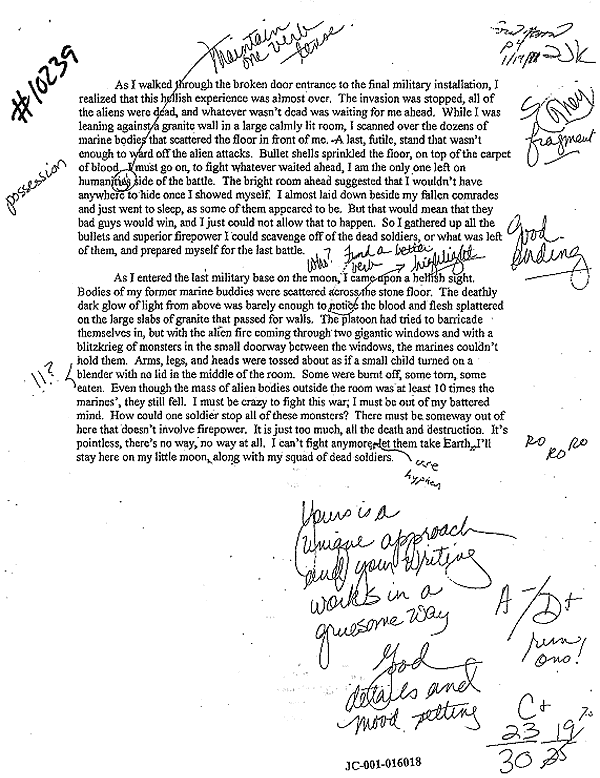
Both also displayed themes of violence in their creative writing projects; of a Doom-based story written by Harris on January 17, 1999, Harris's teacher said: "Yours is a unique approach and your writing works in a gruesome way — good details and mood setting."[72][73]
Acquiring arms
[edit]Harris and Klebold were unable to legally purchase firearms due to their both being underage at the time. Klebold then enlisted Robyn Anderson, an 18-year-old Columbine student and old friend of Klebold's, to make a straw purchase of two shotguns and a Hi-Point carbine for the pair. In exchange for her cooperation with the investigation that followed the shootings, no charges were filed against Anderson.[74] After illegally acquiring the weapons, Klebold sawed off his Savage 311-D 12-gauge double-barrel shotgun, shortening the overall length to approximately 23 inches (580 mm). Meanwhile, Harris's Savage-Springfield 12-gauge pump shotgun was sawn off to around 26 inches (660 mm).[75]
The shooters also possessed a TEC-DC9 semi-automatic handgun, which had a long history. The manufacturer of the TEC-DC9 first sold it to Miami-based Navegar Incorporated. It was then sold to Zander's Sporting Goods in Baldwin, Illinois, in 1994. The gun was later sold to a firearms dealer, Larry Russell, in Thornton, Colorado. In violation of federal law, Russell failed to keep records of the sale, yet he determined that the purchaser of the gun was twenty-one years of age or older. Two men, Mark Manes and Philip Duran, were convicted of supplying weapons to the two.[76]
The bombs used by the pair varied and were crudely made from carbon dioxide canisters, galvanized pipe, and metal propane tanks. The CO2 and pipe bombs were primed with matches placed at one end of their fuses. Both had striker tips on their sleeves. When they rubbed against the bomb, the match head lit the fuse. The weekend before the shootings, Harris and Klebold had purchased propane tanks and other supplies from a hardware store for a few hundred dollars. Several residents of the area claimed to have heard glass breaking and buzzing sounds from the Harris family's garage, which later was concluded to indicate they were constructing pipe bombs.[77]
More complex bombs, such as the one that detonated on the corner of South Wadsworth Boulevard and Ken Caryl Avenue, had timers. The two largest bombs built were found in the school cafeteria and were made from small propane tanks. Only one of these bombs went off, only partially detonating.[14] It was estimated that if any of the bombs placed in the cafeteria had detonated properly, the blast could have caused extensive structural damage to the school and would have resulted in hundreds of casualties.[78]
Massacre
[edit]
On April 20, 1999, just weeks before Harris and Klebold were both due to graduate,[79] Brooks Brown, who was smoking a cigarette outside during lunch break, saw Harris arrive at school. Brown had severed his friendship with Harris a year earlier after Harris had thrown a chunk of ice at his car windshield. Brown reconciled with Harris just prior to the shooting. Brown approached Harris near his car and scolded him for skipping his morning classes, because Harris was always serious about schoolwork and being on time. Harris replied, "It doesn't matter anymore." Harris followed up a few seconds later, "Brooks, I like you now. Get out of here. Go home."[80] Brown, who felt uneasy, quickly left the school grounds. At 11:19 am, he heard the first gunshots after he had walked some distance away from the school, and informed the police via a neighbor's cell phone.[81]
By that time, Klebold had already arrived at the school in a separate car, and the two boys left two duffel bags, each containing a 20-pound propane bomb, inside the cafeteria. Their original plans indicated that when these bombs detonated, Harris and Klebold would be waiting at their cars and would shoot, stab and throw bombs at survivors of the initial explosion as they ran out of the school. At noon, this would be followed by bombs set up in their personal cars detonating, killing first responders and others on scene.[82] When these devices failed to detonate, Harris and Klebold resorted to gunning down their classmates and teachers. It was the deadliest high school shooting in U.S history until it was surpassed by the Stoneman Douglas High School shooting committed by Nikolas Cruz on February 14, 2018.[83][84] Harris was responsible for nine of the fourteen confirmed deaths (Rachel Scott, Daniel Rohrbough,[85] Anne Marie Hochhalter–who was initially left paraplegic and eventually died from her injuries in 2025–[86][87][88][89] teacher Dave Sanders, Steve Curnow, Cassie Bernall, Isaiah Shoels, Kelly Fleming, and Daniel Mauser), while Klebold was responsible for the remaining five (Kyle Velasquez, Matthew Kechter, Lauren Townsend, John Tomlin, and Corey DePooter). There were 23 injured (20 of them by the shooters), most in critical condition.[90][91]
Suicide
[edit]At 12:02 pm, Harris and Klebold returned to the library. Of the 56 library hostages, 34 remained unharmed, all of whom escaped after Harris and Klebold left the library initially. Investigators later found that Harris and Klebold had enough ammunition to have killed them all.[92] This was 20 minutes after their lethal shooting spree had ended, leaving 12 students dead, one teacher dying, and another 24 students and staff injured. Ten of their victims had been killed in the library.[93] It is believed they came back to the library to watch their car bombs detonate, which had been set up to explode at noon.[93] This did not happen, as the aforementioned bombs failed. Harris and Klebold went to the west windows and opened fire on the police outside. No one was injured in the exchange. Between three and six minutes later, they walked to the bookshelves near a table where Patrick Ireland lay badly wounded and coming in and out of consciousness. Student Lisa Kreutz, injured in the earlier library attack, was also in the room, unable to move.[94]
By 12:08 pm, Harris and Klebold had killed themselves. In a subsequent interview, Kreutz recalled hearing a comment such as, "You in the library", around this time. Harris sat down with his back to a bookshelf and fired his shotgun through the roof of his mouth; Klebold went down on his knees and shot himself in the left temple with his TEC-9. An article by The Rocky Mountain News stated that Patti Nielson overheard them shout "One! Two! Three!" in unison, just before a loud boom.[95] Nielson said that she had never spoken with either of the writers of the article,[96] and evidence suggests otherwise. Just before shooting himself, Klebold lit a Molotov cocktail on a nearby table, underneath which Ireland was lying, which caused the tabletop to momentarily catch fire. Underneath the scorched film of material was a piece of Harris's brain matter, suggesting Harris had shot himself by this point.[97][98]
Suggested rationales
[edit]There was controversy over whether Harris and Klebold should be memorialized. Some were opposed, saying that it glorified murderers, while others argued that Harris and Klebold were also victims. Atop a hill near Columbine High School, crosses were erected for Harris and Klebold along with those for the people they killed,[99] but the father of victim Daniel Rohrbough cut them down, saying that murderers should not be memorialized in the same place as victims.[100]
Overview
[edit]Harris and Klebold wrote some about how they would carry out the massacre, and less about why. Klebold penned a rough outline of plans to follow on April 20, and another slightly different one in a journal found in Harris's bedroom.[101] In one entry on his computer, Harris referenced the Oklahoma City bombing, and they mentioned their wish to outdo it by causing the most deaths in US history. They also mentioned how they would like to leave a lasting impression on the world with this kind of violence.[102] Much speculation occurred over the date chosen for their attack. The original intended date of the attack may have been April 19; Harris required more ammunition from Mark Manes, who did not deliver it until the evening of April 19.[103][104][105]
Harris and Klebold were both avid fans of KMFDM, an industrial band led by German multi-instrumentalist Sascha Konietzko. It was revealed that lyrics to KMFDM songs ("Son of a Gun", "Stray Bullet" and "Waste") were posted on Harris's website,[106] and that the date of the massacre, April 20, coincided with both the release date of the album Adios[107] and the birthday of Adolf Hitler.[108] Harris noted the coincidence of the album's title and April release date in his journal.[64] In response, KMFDM's Konietzko issued a statement that KMFDM was "against war, oppression, fascism and violence against others" and that "none of us condone any Nazi beliefs whatsoever".[109]
An April 22, 1999, article in The Washington Post described Harris and Klebold:
They hated jocks, admired Nazis and scorned normalcy. They fancied themselves devotees of the Gothic subculture, even though they thrilled to the violence denounced by much of that fantasy world. They were white supremacists, but loved music by anti-racist rock bands.[110]
The attack occurred on Hitler's birthday, which led to speculation in the media. Some people, such as Robyn Anderson, who knew the perpetrators, stated that the pair were not obsessed with Nazism nor did they worship or admire Hitler in any way. Anderson stated, in retrospect, that there were many things the pair did not tell friends. In his journal, Harris mentioned his admiration of what he imagined to be natural selection, and wrote that he would like to put everyone in a super Doom game and see to it that the weak die and the strong live.[64] On the day of the massacre, Harris wore a white T-shirt with the words "Natural selection" printed in black.[54]
Bullying
[edit]At the end of Harris's last journal entry, he wrote: "I hate you people for leaving me out of so many fun things. And no don't fucking say, 'Well that's your fault,' because it isn't, you people had my phone number, and I asked and all, but no. No no no don't let the weird-looking Eric KID come along, ooh fucking nooo."[54] However, in another entry by Eric in his journal, he stated that even if he were complimented and respected more by his peers, the attack would've still, in all likelihood, occurred.[111]
Similarly, Klebold wrote in his journal both about perceived rejection, bullying others, his desire to belong, and his extreme contempt for others. In January 1997, he wrote, "I am GOD compared to some of those un-existable [sic] brainless zombies," referring to his perception of the morons of the world. In March 1997, he wrote, "I do shit to supposedly ‘cleanse’ myself in a spiritual, moral sort of way... trying not to ridicule/make fun of people ([name omitted] at school), yet it does nothing to help my life morally."[112]
Klebold said on the Basement Tapes, "You've been giving us shit for years. You're fucking gonna pay for all the shit! We don't give a shit. Because we're gonna die doing it."[113][42] However, they also stated on the tapes that nobody is to blame and nobody could have prevented the attack.[114]
Accounts from various parents and school staffers describe bullying at the school as "rampant".[115] Nathan Vanderau, a friend of Klebold, and Alisa Owen, Harris's eighth-grade science partner, reported that Harris and Klebold were constantly picked on. Vanderau noted that a "cup of fecal matter" was thrown at them.[116] "People surrounded them in the commons and squirted ketchup packets all over them, laughing at them, calling them faggots", Brooks Brown says. "That happened while teachers watched. They couldn't fight back. They wore the ketchup all day and went home covered with it."[50] In his book No Easy Answers: The Truth Behind Death at Columbine, Brown wrote that Harris was born with mild chest indent. This made him reluctant to take his shirt off in gym class, and other students would laugh at him.[51]
"A lot of the tension in the school came from the class above us", Chad Laughlin states. "There were people fearful of walking by a table where you knew you didn't belong, stuff like that. Certain groups certainly got preferential treatment across the board. I caught the tail end of one really horrible incident, and I know Dylan told his mother that it was the worst day of his life." That incident, according to Laughlin, involved seniors pelting Klebold with "ketchup-covered tampons" in the commons.[52] However, other commentators have disputed the theory that bullying was the motivating factor.[117] Jeff Kass who has also published a book on the attack believes that bullying wasn't the cause.[118] Peter Langman also argues against bullying being the cause of the attack.[119][111] Other researchers have concurred.[120]
Journals and investigation
[edit]Harris began keeping a journal in April 1998, a short time after the pair was charged with breaking into a van, for which each received ten months of juvenile intervention counseling and community service in January 1998. They began to formulate plans then, as reflected in their journals.[104]
Harris wanted to join the United States Marine Corps, but his application was rejected shortly before the shootings because he was taking the drug fluvoxamine, an SSRI antidepressant, which he was required to take as part of court-ordered anger management therapy. Harris did not state in his application that he was taking any medications. According to the recruiting officer, Harris did not know about this rejection. Though some friends of Harris suggested that he had stopped taking the drug beforehand,[121] the autopsy reports showed low therapeutic or normal (not toxic or lethal) blood-levels of fluvoxamine in his system, which was around 0.0031–0.0087 mg/ml,[122] at the time of death.[123] After the shootings, opponents of contemporary psychiatry like Peter Breggin[124] claimed that the psychiatric medications prescribed to Harris after his conviction may have exacerbated his aggressiveness.[125]
Klebold entitled his journal A Virtual Book: EXISTENCES. Klebold's first journal entry was March 31, 1997, over a year prior to when Harris began his own writings, and in it, he talks about his depression and suicidal thoughts, over two years prior to the massacre.[126] For the rest of his writings, Klebold often wrote about his view that he and Harris were "god-like" and more highly evolved than every other human being, but his secret journal records the aforementioned self-loathing and suicidal intentions. Page after page was covered in hearts, as he was secretly in love with a Columbine student. Although both had difficulty controlling their anger, Klebold's anger had led to his being more prone to serious trouble than Harris. After their arrest, which both recorded as the most traumatic thing they had ever experienced, Klebold wrote a letter to Harris, saying how they would have so much fun getting revenge and killing police, and how his wrath from the January arrest would be "god-like". On the day of the massacre, Klebold wore a black T-shirt which had the word "WRATH" printed in red.[54] It was speculated that revenge for the arrest was a possible motive for the attack, and that the pair planned on having a massive gun battle with police during the shooting. Klebold wrote that life was no fun without a little death, and that he would like to spend the last moments of his life in nerve-wracking twists of murder and bloodshed. He concluded by saying that he would kill himself afterward in order to leave the world that he hated and go to a better place. Klebold was described as being "hotheaded, but depressive and suicidal".[9]
Some of the home-recorded videos, called "The Basement Tapes", have reportedly been destroyed by police. Harris and Klebold reportedly discussed their motives for the attacks in these videos and gave instructions in bomb making. Police cite the reason for withholding these tapes as an effort to prevent them from becoming "call-to-arms" and "how-to" videos that could inspire copycat killers.[127] Some people have argued that releasing the tapes would be helpful, in terms of allowing psychologists to study them, which in turn could possibly help identify characteristics of future killers.[128]
Media accounts
[edit]Initially,[55] the shooters were believed to be members of a clique that called themselves the "Trench Coat Mafia", a small group of Columbine's self-styled outcasts who wore heavy black trench coats. Early reports described the members as also wearing German slogans and swastikas on their clothes.[55] Additional media reports described the Trench Coat Mafia as a cult with ties to the neo-Nazi movement which fueled a media stigma and bias against the Trench Coat Mafia. The Trench Coat Mafia was a group of friends who hung out together, wore black trench coats, and prided themselves on being different from the 'jocks' who had been bullying the members and who also coined the name Trench Coat Mafia.[129] The trench coat inadvertently became the members' uniform after a mother of one of the members bought it as a present.[55]
Investigation revealed that Harris and Klebold were only friends with one member of the group, Kristin Thiebault, and that most of the primary members of the Trench Coat Mafia had left the school by the time that Harris and Klebold committed the massacre. Most did not know the shooters, apart from their association with Thiebault, and none were considered suspects in the shootings or were charged with any involvement in the incident.[55]
Marilyn Manson was blamed by the media in the wake of the Columbine shooting, and responded to criticism in an interview with Michael Moore, in which he was asked, "If you were to talk directly to the kids at Columbine and the people in the community, what would you say to them if they were here right now?", to which he replied, "I wouldn't say a single word to them—I would listen to what they have to say, and that's what no one did", referring to people ignoring red flags that rose from Harris and Klebold prior to the shooting.[130]
Psychological analysis
[edit]Although early media reports attributed the shootings to a desire for revenge on the part of Harris and Klebold for bullying that they received, subsequent psychological analysis indicated Harris and Klebold harbored serious psychological problems. Harris and Klebold were never diagnosed with any mental disorders, which is overwhelmingly uncommon in mass shooters.[131] According to Supervisory Special Agent Dwayne Fuselier, the FBI's lead Columbine investigator and a clinical psychologist, Harris exhibited a pattern of grandiosity, contempt, and lack of empathy or remorse, distinctive traits of psychopaths that he concealed through deception. Fuselier adds that Harris engaged in mendacity not merely to protect himself, as Harris rationalized in his journal, but also for pleasure, as seen when Harris expressed his thoughts in his journal regarding how he and Klebold avoided prosecution for breaking into a van. Other leading psychiatrists concur that Harris was a psychopath.[9]
According to psychologist Peter Langman, Klebold displayed signs of schizotypal personality disorder – he struck many people as odd due to his shy nature, appeared to have had disturbed thought processes and constantly misused language in unusual ways as evidenced by his journal. He appeared to have been delusional, viewed himself as "god-like", and wrote that he was "made a human without the possibility of BEING human." He was also convinced that others hated him and felt like he was being conspired against, even though according to many reports, Klebold was loved by his family and friends.[132]
Lawsuits
[edit]In April 2001, the families of more than 30 victims were given shares in a $2,538,000 settlement by the families of the perpetrators, and the two men convicted of supplying the weapons used in the massacre. The Harrises and the Klebolds contributed $1,568,000 to the settlement from their own homeowners' policies, Manes contributed $720,000, and Duran contributed $250,000. The Harrises and the Klebolds were ordered to guarantee an additional $32,000 be available against any future claims. Manes was ordered to hold $80,000 against future claims, and Duran was ordered to hold $50,000.[133]
One family had filed a $250-million lawsuit against the Harrises and Klebolds in 1999 and did not accept the 2001 settlement terms. A judge ordered the family to accept a $366,000 settlement in June 2003.[134][135] In August 2003, the families of five other victims received undisclosed settlements from the Harrises and Klebolds.[134]
Reaction of Sue Klebold
[edit]Sue Klebold, mother of Dylan Klebold, initially was in denial about Klebold's involvement in the massacre, believing he was tricked by Harris into doing it, among other things. Six months later, she saw the Basement Tapes made by Harris and Klebold and acknowledged that Klebold was equally responsible for the killings.[136] She spoke about the Columbine High School massacre publicly for the first time in an essay that appeared in the October 2009 issue of O: The Oprah Magazine. In the piece, Klebold wrote: "For the rest of my life, I will be haunted by the horror and anguish Dylan caused", and "Dylan changed everything I believed about myself, about God, about family, and about love." Stating that she had no clue of her son's intentions, she said: "Once I saw his journals, it was clear to me that Dylan entered the school with the intention of dying there."[137] In Andrew Solomon's 2012 book Far from the Tree, she acknowledged that on the day of the massacre, when she discovered that Klebold was one of the shooters, she prayed he would kill himself (before committing mass murder). "I had a sudden vision of what he might be doing. And so while every other mother in Littleton was praying that her child was safe, I had to pray that mine would die before he hurt anyone else."[138]
In February 2016, Klebold published a memoir, titled A Mother's Reckoning, about her experiences before and after the massacre.[139][140] It was co-written by Laura Tucker and included an introduction by National Book Award winner Andrew Solomon. It received very favorable reviews, including from the New York Times Book Review.[141] It peaked at No. 2 on The New York Times Best Seller list.[142]
On February 2, 2017, Klebold posted a TED Talk titled, "My son was a Columbine shooter. This is my story."[143] As of January 2024, the video has over 12.1 million views. The site listed Klebold's occupation as "activist", and stated: "Sue Klebold has become a passionate agent working to advance mental health awareness and intervention."[144]
Legacy
[edit]ITV describes the legacy of Harris and Klebold as deadly, as they have inspired several instances of mass killings in the United States and globally. Napa Valley Register have called the pair "cultural icons".[145] Author of Columbine, Dave Cullen, called Harris and Klebold the fathers of the movement for disenfranchised youth.[146] Harris and Klebold have also, as CNN referred to, left their inevitable mark on pop culture.[147]
Copycats
[edit]The Columbine shooting influenced several subsequent school shootings, with many praising Harris and Klebold.[148] Cho Seung-Hui, who perpetrated the Virginia Tech shooting, called them "martyrs".[149] In some cases, it has led to the closure of entire school districts.[150] According to psychiatrist E. Fuller Torrey of the Treatment Advocacy Center, a legacy of the Columbine shootings is its "allure to disaffected youth".[151]
Ralph Larkin examined twelve major school shootings in the US in the following eight years and found that in eight of those, "the shooters made explicit reference to Harris and Klebold."[152] Larkin wrote that the Columbine massacre established a "script" for shootings. "Numerous post-Columbine rampage shooters referred directly to Columbine as their inspiration; others attempted to supersede the Columbine shootings in body count."[153]
A 2015 investigation by CNN identified "more than 40 people ... charged with Columbine-style plots." A 2014 investigation by ABC News identified "at least 17 attacks and another 36 alleged plots or serious threats against schools since the assault on Columbine High School that can be tied to the 1999 massacre." Ties identified by ABC News included online research by the perpetrators into the Columbine shooting, clipping news coverage and images of Columbine, explicit statements of admiration of Harris and Klebold, such as writings in journals and on social media, in video posts,[e] and in police interviews, timing planned to an anniversary of Columbine, plans to exceed the Columbine victim counts, and other ties.[155] 60 mass shootings have been carried out, where the perpetrators had made at least a single reference to Harris and Klebold.[156]
In 2015, Canadian journalist Malcolm Gladwell writing in The New Yorker magazine proposed a threshold model of school shootings in which Harris and Klebold were the triggering actors in "a slow-motion, ever-evolving riot, in which each new participant's action makes sense in reaction to and in combination with those who came before."[152][157]
In 2024, Natalie Rupnow, who carried out the Abundant Life Christian School shooting in Madison, Wisconsin, was revealed to have worn a KMFDM shirt like Harris, which suggested that she may have intended to copycat Harris when she carried out the shooting.[158]
Fandom
[edit]Harris and Klebold have also spawned a fandom who call themselves "Columbiners", mostly apparent on blogging site Tumblr. While some just have a scholarly interest in the pair or the event, the vast majority of these individuals, mostly young women, express a sympathetic, or sometimes even sexual interest, in Harris and Klebold.[159] There has been homoerotic art drawn of the two, fan fiction created on the pair's future together had they not gone through with the shooting and costumes created on the outfits Harris and Klebold sported the day of the shootings.[160]
"I relate to their feelings of hopelessness, being angry and not being able to change it, and wanting to be accepted and appreciated", an 18-year-old Tumblr user wrote on Harris and Klebold. "No one noticed they were struggling, and no one took their suffering seriously", added another user. A news site called "All That's Interesting" said on the fandom, "Many of these Columbiners have no positive feelings about the massacre, but are instead focused on the troubled inner lives of its perpetrators because they see themselves in them."[160] The fandom has received criticism for heroizing Harris and Klebold and allegedly inspiring shooting plots such as the Halifax mass shooting plot.[161]
Media about the duo
[edit]The 2002 Michael Moore documentary film Bowling for Columbine focuses heavily on a perceived American obsession with handguns, its grip on Jefferson County, Colorado, and its role in the shooting.
In 2004, the shooting was dramatized in the documentary Zero Hour, in which Harris and Klebold are played by Ben Johnson and Josh Young, respectively.[162]
In 2005, game designer Danny Ledonne created a role-playing video game where the player assumes the role of Harris and Klebold during the massacre, entitled Super Columbine Massacre RPG!.[163] The game received substantial media backlash for allegedly glorifying the pair's actions. The father of one victim remarked to the press that the game "disgusts me. You trivialize the actions of two murderers and the lives of the innocent."[164]
The 2016 biographical film I'm Not Ashamed, based on the journals of Rachel Scott, includes glimpses of Harris's and Klebold's lives and of interactions between them and other students at Columbine High School. Harris is played by David Errigo Jr. and Klebold is played by Cory Chapman.[165]
Fiction inspired by the duo
[edit]The 2003 Gus Van Sant film Elephant depicts a fictional school shooting, some of whose details were based on the Columbine massacre, such as one scene in which one of the young killers walks into the evacuated school cafeteria and pauses to take a sip from a drink left behind, as Harris did during the shooting.[116][166] In the film, the killers are called "Alex and Eric" after the actors who portray them, Alex Frost and Eric Deulen.
In the 2003 Ben Coccio film Zero Day, which was inspired by the Columbine shooting, two shooters are played by Andre Keuck and Cal Robertson and called "Andre and Calvin" after their actors.[167]
See also
[edit]Notes
[edit]- ^ Neither Harris nor Klebold used their knives during the shooting.
- ^ Harris and Klebold directly wounded 20 people by gunfire; three others received injuries related to the attack.
- ^ Many early reports said the Columbine massacre was the worst school-related massacre in U.S. history.[2] However, the 1927 Bath School disaster (a bombing) left 44 dead. The 1966 University of Texas tower shooting was the deadliest school shooting at the time. It remained the deadliest public school shooting in American history until the 2012 Sandy Hook elementary school shooting and the deadliest high school shooting until the 2018 Stoneman Douglas High School shooting.
- ^ They did not appear in a group photo of the Trench Coat Mafia in the yearbook.[67][68][69] However, Harris's father stated that his son was "a member of what they call the Trench Coat Mafia" in the 9-1-1 call he made on April 20, 1999.[70]
- ^ In 2012, sociologist Nathalie E. Paton of the National Center for Scientific Research in Paris analyzed the videos created by post-Columbine school shooting perpetrators. A recurring set of motifs was found, including explicit statements of admiration and identification with previous perpetrators. Paton said the videos serve the perpetrators by distinguishing themselves from their classmates and associating themselves with the previous perpetrators.[152][154]
References
[edit]- ^ "2010 Census – Census Block Map: Columbine CDP, CO Archived March 4, 2016, at the Wayback Machine" U.S. Census Bureau. Retrieved on April 25, 2015. The school's location is on Pierce Street, which runs north-south through Columbine, roughly one mile west of the Littleton city limit.
- ^ "Columbine – Tragedy and Recovery". extras.denverpost.com. The Denver Post. Archived from the original on May 2, 2021. Retrieved May 14, 2021.
- ^ Springhall, John (1999). "Violent Media, Guns and Moral Panics: The Columbine High School Massacre, 20 April 1999". Paedagogica Historica. 35 (3): 621–641. doi:10.1080/0030923990350304. Archived from the original on July 11, 2022. Retrieved July 11, 2022.
- ^ McPadden, Mike (April 20, 2018). "After So Many More Mass Shootings, Why is Columbine Still Such a Cultural Touchstone?". Investigation Discovery. Archived from the original on July 11, 2022. Retrieved July 11, 2022.
- ^ "Dissecting Columbine's Cult of the Athlete". The Washington Post. June 12, 1999. Archived from the original on October 9, 2014. Retrieved June 4, 2022.
- ^ Garrison, Robert (April 12, 2019). "Columbine High School shooting focused on "Trench Coat Mafia"". The Lamar Ledger. Archived from the original on September 21, 2021. Retrieved December 12, 2020.
- ^ Margaritoff, Marco (March 8, 2019). "The Full Story Behind Columbine High School Shooters Eric Harris And Dylan Klebold". allthatisinteresting.com. Archived from the original on November 12, 2020. Retrieved December 12, 2020.
- ^ Brockell, Gillian (April 20, 2019). "Bullies and black trench coats: The Columbine shooting's most dangerous myths". The Washington Post. Archived from the original on May 28, 2019. Retrieved December 12, 2020.
- ^ a b c Cullen, Dave (April 20, 2004). "The Depressive and the Psychopath: At last we know why the Columbine killers did it". Slate. Archived from the original on October 4, 2018. Retrieved December 12, 2020.
- ^ Sancier, Greg (April 18, 2014). "Looking into the minds of Eric Harris and Dylan Klebold". police1.com. Archived from the original on January 26, 2021. Retrieved December 12, 2020.
- ^ Joyce, Kathleen (November 2, 2018). "2 Kentucky high school girls suspended after dressing up as Columbine shooters for Halloween". Fox News. Archived from the original on November 8, 2020. Retrieved December 12, 2020.
- ^ "Mich. pastor recalls Harris family". UPI Archives. April 23, 1999. Archived from the original on September 29, 2021. Retrieved February 19, 2022.
- ^ "Lethal Geeks Were Made for Each Other". April 22, 1999. Archived from the original on June 4, 2020. Retrieved July 13, 2020.
- ^ a b c d "Suspects Text". CNN. Archived from the original on July 26, 2012. Retrieved September 8, 2011.
- ^ Kass, Jeff (February 18, 2014). Columbine: A True Crime Story. Conundrum Press. ISBN 9781938633270. Archived from the original on September 21, 2021. Retrieved November 10, 2020 – via Google Books.
- ^ Li, David K. (April 22, 1999). "Lethal Geeks Were Made For Each Other". New York Post. Archived from the original on June 4, 2020. Retrieved July 10, 2020.
- ^ "Eric Harris's Autopsy Report". School Shooters .info. Archived from the original on December 5, 2022. Retrieved August 4, 2022.
- ^ Michael S. Rosenwald (October 23, 2021) [2016-04-20]. "'Damaged masculinity' may help explain Columbine and other mass shootings". The Washington Post. Washington, D.C. ISSN 0190-8286. OCLC 1330888409. Archived from the original on September 6, 2022. Retrieved August 4, 2022.[please check these dates]
- ^ Briggs, Bill; Blevins, Jason (May 2, 1999). "A Boy With Many Sides". Denver Post. Archived from the original on October 27, 2011. Retrieved September 8, 2011.
- ^ "Columbine killer envisioned crashing plane in NYC". CNN. December 6, 2001. Archived from the original on October 6, 2011. Retrieved September 12, 2011.
- ^ Santiago, Ellyn (April 17, 2019). "Eric Harris' Parents & Brother, Wayne, Kathy & Kevin Harris: 5 Fast Facts You Need to Know". Heavy.com. Archived from the original on November 12, 2020. Retrieved November 8, 2020.
- ^ Belluck, Pam; Wilgoren, Jodi (June 29, 1999). "Shattered Lives – A special report.; Caring Parents, No Answers, In Columbine Killers' Pasts". The New York Times. Archived from the original on January 26, 2021. Retrieved November 7, 2020.
- ^ "SWAT_MOVE_TEXT". CNN. Archived from the original on January 24, 2020. Retrieved July 12, 2020.
- ^ "Portrait of two teens reveals a lot of gray". The Christian Science Monitor. May 3, 1999. Archived from the original on June 11, 2020. Retrieved June 11, 2020.
- ^ "Eric Harris". www.biography.com. Archived from the original on April 14, 2020. Retrieved July 12, 2020.
- ^ "The Denver Post Online – Columbine – Tragedy and Recovery". extras.denverpost.com. Archived from the original on February 25, 2018. Retrieved July 12, 2020.
- ^ "^^ Eric David Harris ^^". Archived from the original on July 23, 2019. Retrieved August 22, 2019.
- ^ Dukakis, Andrea (February 16, 2016). "'I'll Never Know If I Could Have Prevented It,' Says Mother Of Columbine Shooter". Colorado Public Radio. Archived from the original on August 5, 2020. Retrieved July 25, 2020.
- ^ "Life and death of a follower". Archived from the original on June 16, 2019. Retrieved July 13, 2020.
- ^ a b Leppek, Chris (April 30, 1999). "Dylan Klebold led life of religious contradictions". Archived from the original on March 29, 2007. Retrieved October 19, 2018.
- ^ A Mother's Reckoning: Living in the Aftermath of the Columbine Tragedy p. 84
- ^ "Dylan Klebold – Columbine School Shooting, Parents & Journal". www.biography.com. June 18, 2020. Archived from the original on December 1, 2020. Retrieved December 20, 2020.
- ^ a b C Shepard. "^^ Dylan Bennet Klebold ^^". Acolumbinesite.com. Archived from the original on July 23, 2019. Retrieved February 19, 2022.
- ^ "^^ Dylan Bennet Klebold ^^". Archived from the original on July 23, 2019. Retrieved August 22, 2019.
- ^ Culver, Virginia (April 28, 1999). "Klebolds 'loneliest people on the planet'" Archived September 21, 2013, at the Wayback Machine. The Denver Post.
- ^ "Suspects_Text". CNN. Archived from the original on May 8, 2019. Retrieved September 24, 2019.
- ^ "Portrait of two teens reveals a lot of gray". The Christian Science Monitor. May 3, 1999. Archived from the original on June 11, 2020. Retrieved July 13, 2020.
- ^ "The Columbine Shooters". CBS News. April 8, 2009. Archived from the original on November 11, 2018. Retrieved July 13, 2020.
- ^ "A boy with many sides". Archived from the original on June 7, 2019. Retrieved July 13, 2020.
- ^ a b "Psychologists say Harris, Klebold became deadly mix". Archived from the original on November 7, 2020. Retrieved July 13, 2020.
- ^ a b c Langman, Peter (July 29, 2014). "Transcript of the Columbine "Basement Tapes"" (PDF). schoolshooters.info. Archived (PDF) from the original on July 15, 2015. Retrieved April 13, 2024.
- ^ Kohn, David (April 17, 1999). "Columbine: Were There Warning Signs?". CBS News. Archived from the original on July 6, 2020. Retrieved July 6, 2020.
- ^ "Dave Cullen on the Columbine killer Dylan Klebold". TheGuardian.com. April 24, 2009. Archived from the original on October 19, 2020. Retrieved October 18, 2020.
- ^ "The reluctant killer | Columbine". The Guardian. April 24, 2009. Archived from the original on October 19, 2020. Retrieved February 19, 2022.
- ^ Prendergast, Alan (April 17, 2009). "Forgiving my Columbine High School friend, Dylan Klebold". Westword. Archived from the original on June 21, 2019. Retrieved June 30, 2019.
- ^ Hari, Johann (January 15, 2004). "The cult of Eric and Dylan". The Independent. Archived from the original on May 30, 2019. Retrieved March 21, 2020.
- ^ XxSlenderMotoxX (November 9, 2012). "Zero Hour – Massacre at Columbine High". Archived from the original on June 13, 2019. Retrieved June 30, 2019 – via YouTube.
- ^ Vodka'sHypnosis (April 24, 2016). "Sue Klebold's Interview: After Words With Sue Klebold – BOOK TV". Archived from the original on December 8, 2019. Retrieved June 30, 2019 – via YouTube.
- ^ a b Prendergast, Alan (July 13, 2000). "The Missing Motive". Denver Westword News. Archived from the original on July 28, 2012. Retrieved May 26, 2012.
- ^ a b Brown, Brooks; Merritt, Rob (2002). No Easy Answers: The Truth Behind Death at Columbine. New York City: Lantern Books. ISBN 978-1-59056-031-0. Archived from the original on May 31, 2017. Retrieved November 13, 2019.
- ^ a b Prendergast, Alan (April 17, 2009). "Forgiving my Columbine High School friend, Dylan Klebold". Denver Westword Post. Archived from the original on April 20, 2009. Retrieved May 26, 2012.
- ^ Brooks, David (April 24, 2004). "The Columbine Killers". The New York Times. Archived from the original on February 4, 2017.
- ^ a b c d Toppo, Greg (April 14, 2009). "10 years later, the real story behind Columbine". USA Today. Archived from the original on April 15, 2009. Retrieved April 14, 2009.
- ^ a b c d e Wilgoren, Jodi (April 25, 1999). "Terror in Littleton: the Group; Society of Outcasts Began With a $99 Black Coat". The New York Times. Archived from the original on June 26, 2017.
- ^ "Who are the Trenchcoat Mafia?". BBC News. April 21, 1999. Archived from the original on September 2, 2013.
- ^ Kass, Jeff (2009). Columbine: A True Crime Story. Denver, Colorado: Ghost Road Publishing Group. ISBN 978-0-9816525-6-6. Archived from the original on January 5, 2014. Retrieved September 23, 2016.
- ^ Bartels, Linda; Crowder, Carla (August 22, 1999). "Fatal Friendship". Denver Rocky Mountain News. Archived from the original on December 5, 2008. Retrieved June 1, 2008.
- ^ "Harris hinted at violence to come". CNN. April 22, 1999. Archived from the original on August 26, 2012. Retrieved August 15, 2012.
- ^ "Originals to Evidence" (PDF). acolumbinesite.com. Archived from the original (PDF) on March 16, 2013. Retrieved September 11, 2023.
- ^ Bachman, Ronet D.; Schutt, Russell K.; Plass, Peggy S. (December 19, 2015). Fundamentals of Research in Criminology and Criminal Justice: With Selected Readings. SAGE Publications. ISBN 9781506326696. Archived from the original on November 7, 2020. Retrieved July 13, 2020.
- ^ "Eric Harris Juvenille Diversion File" (PDF). schoolshooters.info. Archived from the original (PDF) on October 14, 2014. Retrieved October 15, 2014.
- ^ Cullen, Dave. "Eric's big lie". Columbine Online. Archived from the original on January 19, 2011.
- ^ a b c Shepard, Cyn. "Columbine shooter Eric Harris' Journals and Writing". Acolumbinesite.com. Archived from the original on September 4, 2015. Retrieved October 31, 2016.
- ^ Kass 2009, pp. 197–199
- ^ Cullen, Dave (September 23, 1999). "Inside the Columbine High investigation". Salon. Archived from the original on May 17, 2017. Retrieved May 15, 2012.
- ^ Wilgoren, Jodi (April 25, 1999). "TERROR IN LITTLETON: THE GROUP; Society of Outcasts Began With a $99 Black Coat". The New York Times. ISSN 0362-4331. Archived from the original on June 26, 2017. Retrieved January 12, 2022.
- ^ "BBC News | Americas | Who are the Trenchcoat Mafia?". news.bbc.co.uk. Archived from the original on July 19, 2022. Retrieved January 12, 2022.
- ^ Greene, Susan; Post, Bill Briggs | The Denver (April 21, 1999). "Columbine High School shooting focuses on "Trench Coat Mafia"". Archived from the original on July 19, 2022. Retrieved July 19, 2022.
{{cite web}}: CS1 maint: multiple names: authors list (link) CS1 maint: numeric names: authors list (link) - ^ Kass 2009, p. 219
- ^ "Hitmen For Hire · Eric Harris School Assignment". columbine-guide.com. Archived from the original on October 16, 2018. Retrieved July 19, 2022.
- ^ Shepard, Cyn. "Eric's writing: Creative writing story". A Columbine Site. Archived from the original on March 3, 2016.
- ^ Shepard, Cyn. "Gunfire in the halls". A Columbine Site. Archived from the original on September 17, 2010. Retrieved August 24, 2008.
- ^ "Gunman's prom date airs story". Archived from the original on June 10, 2019. Retrieved July 13, 2020.
- ^ "How they were equipped that day". CNN. Archived from the original on December 2, 2009. Retrieved November 25, 2009.
- ^ Pankratz, Howard; Simpson, Kevin (November 13, 1999). "Judge gives Manes 6 years". The Denver Post. Archived from the original on October 20, 2014. Retrieved December 11, 2013.
- ^ "The Bombs: The Columbine Guide-Eric Harris & Dylan Klebold Sue". columbine-guide. Archived from the original on September 23, 2020. Retrieved July 4, 2020.
- ^ Bartels, Lynn (April 12, 2002). "At 'perfect' school, student sat next to bomb". Rocky Mountain News. Archived from the original on April 20, 2008. Retrieved August 24, 2008.
- ^ Rimer, Sara (April 24, 1999). "Terror in Littleton: The Seniors; In Horrific Circumstance, Sense of Lost Pomp". The New York Times. Archived from the original on December 8, 2019. Retrieved December 8, 2019.
- ^ Brown, Brooks (April 18, 2007). "Columbine Survivor With Words for Virginia Students". NPR. Archived from the original on December 8, 2008. Retrieved August 24, 2008.
- ^ "Friend of Columbine Killers Still Seeking Answers". Monroe, CT Patch. November 27, 2012. Archived from the original on June 11, 2020. Retrieved June 11, 2020.
- ^ Donnelly, Keryn (January 20, 2018). "The chance mistake that saved hundreds of lives on the day of the Columbine shooting". Mamamia.com.au. Archived from the original on January 1, 2020. Retrieved January 1, 2020.
- ^ Morris, Sam (February 15, 2018). "Mass shootings: what are the deadliest attacks in the US?". The Guardian. Archived from the original on February 15, 2018. Retrieved February 16, 2018.
- ^ Earl, Jennifer (February 14, 2018). "Florida school shooting among 10 deadliest in modern US history". Fox News. Archived from the original on February 15, 2018. Retrieved February 15, 2018.
- ^ "Daniel Lee Rohrbough". A Columbine Site. Archived from the original on December 9, 2015. Retrieved December 26, 2015.
- ^ Slevin, Colleen (February 18, 2025). "Columbine survivor Anne Marie Hochhalter, who forgave gunman's mother, dies at 43". The Associated Press. Retrieved February 19, 2025.
Hochhalter was found in her home in suburban Denver on Sunday. Her family suspects she died of natural causes stemming from her injuries in the 1999 shooting in which 12 students and a teacher were killed.
- ^ "Cause of death for my daughter, Anne Marie Hochhalter, has been released by the Jefferson County Coroner's Office. I'm sharing this for family and friends who may see some things in the media that may be, or may not be, totally accurate. I thought folks might like to know". March 11, 2025. Retrieved March 11, 2025.
- ^ "(Westminster, CO, Shot On 4/14/04--) Anne Marie Hochhalter, 22, receives physical therapy by home health aide Sandy Johnson in her home Wednesday April 14, 2004. Hochhalter was shot twice by Eric Harris at Columbine High School leaving her a T12 parapleg". Denver Public Library Digital Collections. Retrieved March 14, 2025.
- ^ "A survivors story: 10 years after Columbine".
- ^ "13 Victims killed at Columbine High School". www.acolumbinesite.com. Archived from the original on September 20, 2020. Retrieved June 11, 2020.
- ^ "Injured and Survivors of the Columbine High School shooting". www.acolumbinesite.com. Archived from the original on February 16, 2020. Retrieved June 11, 2020.
- ^ "Findings of Library Events". Jefferson County Sheriff's Office (Colorado). CNN International. Archived from the original on February 22, 2020. Retrieved March 21, 2020.
- ^ a b Berg Olsen, Martine (April 20, 2019). "Remembering the 13 victims of Columbine High School massacre 20 years on". Metro.co.uk. Archived from the original on March 21, 2020. Retrieved March 21, 2020.
- ^ "Injured and Survivors of the Columbine High School shooting". www.acolumbinesite.com. Archived from the original on April 25, 2020. Retrieved June 11, 2020.
- ^ Bartels, Lynn; Carla Crowder (1999). "Fatal Friendship". The Rocky Mountain News. Archived from the original on February 21, 2001. Retrieved September 10, 2017.
- ^ Progress Report, Case # 99-16215 Archived September 4, 2015, at the Wayback Machine pp. 98–99
- ^ Columbine Report documents, p. JC-001-008937
- ^ Krabbé, Tim (2012). Wij Zijn Maar Wij Zijn Niet Geschift. Prometheus. p. 30. ISBN 9789044620542.
- ^ Fong, Tillie (April 28, 1999). "Crosses for Harris, Klebold join 13 others". Rocky Mountain News. Archived from the original on May 12, 2008. Retrieved August 24, 2008.
- ^ Zewe, Charles (May 1, 1999). "Authorities say Columbine shooters acted alone". CNN. Archived from the original on February 11, 2007. Retrieved June 22, 2007.
- ^ "Columbine Documents" (PDF). Rocky Mountain News. Archived from the original (PDF) on September 10, 2008. Retrieved August 24, 2008.
- ^ "Columbine killers' diaries offer chilling insight". msnbc.com. July 7, 2006. Archived from the original on August 5, 2018. Retrieved July 20, 2018.
- ^ Hinton, Sam (2012). "Troubled Children: Dealing with Anger and Depression". Psychology of Children: Coping with the Dangerous Threats. Hammond. p. 20. ISBN 978-0-275-98207-2.
- ^ a b Ryckman, Lisa (May 16, 2000). "Demonic plan was months in making". Rocky Mountain News. Archived from the original on January 25, 2009.
- ^ "The Denver Post Online – Columbine – Tragedy and Recovery". Archived from the original on June 7, 2019. Retrieved December 20, 2020.
- ^ Wilson, Scott (2008). "Columbine". Great Satan's Rage. Manchester, England: Manchester University Press. pp. 138–139. ISBN 978-0-7190-7463-9. Archived from the original on September 21, 2021. Retrieved January 31, 2011.
- ^ "KMFDM And Rammstein Speak Out About Columbine". MTV Networks. April 23, 1999. Archived from the original on February 9, 2012. Retrieved January 31, 2011.
- ^ "Music Linked To Killings?". Philadelphia Daily News. Knight Ridder. April 22, 1999. Archived from the original on May 23, 2013. Retrieved January 31, 2011.
- ^ Boehlert, Eric (April 23, 1999). "An Old Debate Emerges in Wake of School Shooting". Rolling Stone. New York City: Wenner Media. Archived from the original on July 14, 2014. Retrieved March 31, 2010.
- ^ Duggan, Paul; Shear, Michael D.; Fisher, Marc (April 22, 1999). "Shooter Pair Mixed Fantasy, Reality". The Washington Post. p. A1. Archived from the original on June 4, 2011. Retrieved August 27, 2017.
- ^ a b Langman, Peter (February 3, 2016). "Eric Harris: The Search for Justification" (PDF). Archived (PDF) from the original on November 20, 2021.
If people would give me more compliments all of this might still be avoidable... but probably not.
- ^ "Dylan Klebold's Journal and Other Writings Transcribed and Annotated". SchoolShooters.info. Archived from the original on December 31, 2023. Retrieved December 31, 2023.
- ^ "Massacre at Columbine High". Zero Hour. Season 1. Episode 3. 2004. History. Archived from the original on January 8, 2015. Retrieved June 23, 2014.
- ^ ""Transcript of the Columbine "Basement Tapes"" (PDF). Archived (PDF) from the original on July 15, 2015. Retrieved October 6, 2018."There is nothing you guys could have done to prevent any of this. There is nothing that anyone could have done to prevent this. No one is to blame except me and Vodka [Klebold's nickname]. Our actions are a two man war against everyone else."
- ^ Pankratz, Howard (October 3, 2000). "Columbine bullying no myth, panel told". Denver Post. Archived from the original on June 7, 2013.
- ^ a b Investigative Reports: Columbine: Understanding Why on YouTube. A&E. 2002
- ^ Brockell, Gillian (April 20, 2019). "Bullies and black trench coats: The Columbine shooting's most dangerous myths". The Washington Post. Archived from the original on April 21, 2019.
- ^ Chen, Stephanie (April 20, 2009). "Debunking the myths of Columbine, 10 years later". CNN. Archived from the original on November 13, 2023.
- ^ Langman, Peter (July 31, 2014). "The Search for Truth at Columbine" (PDF). schoolshooters.info. Archived (PDF) from the original on November 20, 2021. Retrieved April 13, 2024.
- ^ Mears, Daniel P.; Moon, Melissa M.; Thielo, Angela J. (2017). "Columbine Revisited: Myths and Realities About the Bullying–School Shootings Connection". Victims & Offenders. 12 (6): 939–955. doi:10.1080/15564886.2017.1307295. S2CID 148745392. Archived from the original on November 20, 2021. Retrieved November 20, 2021.
- ^ Gibbs, Nancy; Timothy Roche (December 20, 1999). "The Columbine Tapes". Time. Archived from the original on February 8, 2009. Retrieved February 11, 2009.
- ^ Winek, Charles L.; et al. (2001). "Drug and chemical blood-level data 2001" (PDF). Forensic Science International. 122 (2–3): 107–123. doi:10.1016/s0379-0738(01)00483-2. PMID 11672964. Archived (PDF) from the original on August 6, 2013. Retrieved July 24, 2013.
- ^ Shepard, Cyn. "Eric David Harris". A Columbine Site. Archived from the original on October 12, 2011. Retrieved June 4, 2013.
- ^ Breggin, Peter R. (April 30, 1999). "Was School Shooter Eric Harris Taking Luvox?". Archived from the original on September 28, 2011. Retrieved February 10, 2009.
- ^ Larkin, Ralph W. (2007). Comprehending Columbine. Temple University Press. p. 119. ISBN 978-1-59213-491-5.
- ^ Langman, Peter (March 24, 2019). "Dylan Klebold's Journal and Other Writings" (PDF). schoolshooters.info. Archived (PDF) from the original on June 11, 2021. Retrieved October 1, 2021.
- ^ Duwe, Grant (2007). Mass and Serial Murder in America. Jefferson, North Carolina: McFarland & Company. p. 41. ISBN 978-3-31944280-8.
- ^ Prendergast, Alan (February 2, 2015). "Columbine Killers' Basement Tapes Destroyed". Westword. Archived from the original on July 23, 2020. Retrieved June 11, 2020.
- ^ Brown, Brooks; Merritt, Rob (2002). No easy answers: The truth behind death at Columbine. Lantern Books. pp. 68–70. ISBN 1590560310. Retrieved September 23, 2016.
- ^ Michael Moore interviewing Marilyn Manson (October 11, 2002). Bowling for Columbine (Documentary). Los Angeles, California: MGM.
- ^ "Looking into the minds of Eric Harris and Dylan Klebold". Police1. April 18, 2014. Archived from the original on June 11, 2020. Retrieved June 11, 2020.
- ^ Langman, Peter (2016) [2010], Rampage School Shooters: A Typology (PDF), archived (PDF) from the original on July 12, 2019, retrieved July 12, 2019
- ^ Janofsky, Michael (April 20, 2001). "$2.53 Million Deal Ends Some Columbine Lawsuits". The New York Times. Archived from the original on January 24, 2014. Retrieved January 13, 2014.
- ^ a b "Columbine High School Shootings Fast Facts". CNN. September 19, 2013. Archived from the original on October 13, 2014. Retrieved January 13, 2014.
- ^ "$250 million Columbine lawsuit filed". CNN. May 27, 1999. Archived from the original on January 13, 2014. Retrieved January 13, 2014.
- ^ "'Dylan had killed children in cold blood': Life after the Columbine massacre". TheGuardian.com. February 14, 2016. Archived from the original on August 21, 2019. Retrieved July 27, 2019.
- ^ Klebold, Susan (November 2009). "I Will Never Know Why". O, The Oprah Magazine. Archived from the original on February 18, 2016. Retrieved October 21, 2009.
- ^ "Columbine Shooter Dylan Klebold's Parents Speak Out". November 14, 2012. Archived from the original on November 29, 2012. Retrieved December 9, 2012.
- ^ "Columbine shooter Dylan Klebold's mother to hold first TV interview". ABC News. July 23, 2015. Archived from the original on January 6, 2016. Retrieved December 26, 2015.
- ^ Klebold, Sue (2016). A Mother's Reckoning: Living in the Aftermath of Tragedy. Amazon.com. ISBN 978-1101902752.
- ^ "Inside The New York Times Book Review Podcast: 'A Mother's Reckoning'". The New York Times. February 26, 2016. Archived from the original on March 25, 2016. Retrieved February 4, 2017.
- ^ "#2 New York Times bestseller: "Mesmerizing, heart-stopping. I beseech"". lauratuckerbooks.com. Archived from the original on October 29, 2016. Retrieved February 4, 2017.
- ^ Klebold, Sue (February 2, 2017). "My son was a Columbine shooter. This is my story". Archived from the original on February 4, 2017. Retrieved February 4, 2017.
- ^ Klebold, Sue. "A Note from Sue Klebold". amothersreckoning.com. A Mother's Reckoning. Archived from the original on August 14, 2020. Retrieved August 1, 2020.
- ^ "Columbine killers becoming cultural icons to some, researchers say". April 16, 2001. Archived from the original on June 29, 2019. Retrieved June 29, 2019.
- ^ "Columbine, Colorado". YouTube. April 29, 2018. Archived from the original on November 7, 2020. Retrieved September 6, 2019.
- ^ "Columbine left its indelible mark on pop culture - CNN.com". www.cnn.com. Archived from the original on October 30, 2019. Retrieved September 6, 2019.
- ^ Gibbs, Nancy; Roche, Timothy (December 20, 1999). "The Columbine Tapes" (PDF). Time. Archived from the original (PDF) on December 7, 2012. Retrieved June 30, 2019.
- ^ "Shooter: 'You have blood on your hands'". CNN. April 18, 2007. Archived from the original on October 18, 2014. Retrieved October 15, 2014.
- ^ "Intermittent Explosive Disorder". mayhem.net. Archived from the original on December 20, 2010. Retrieved March 11, 2011.
- ^ Drash, Wayne (November 3, 2015). "The massacre that didn't happen". CNN. Archived from the original on April 2, 2017. Retrieved April 2, 2017.
- ^ a b c Gladwell, Malcolm (October 19, 2015). "Thresholds of Violence, How school shootings catch on". The New Yorker. Archived from the original on March 27, 2017. Retrieved April 1, 2017.
- ^ Larkin, Ralph W. (2009). "The Columbine legacy: Rampage shootings as political acts". American Behavioral Scientist. 52 (9). Thousand Oaks, California: SAGE Publishing: 1309–1326. doi:10.1177/0002764209332548. S2CID 144049077. Archived from the original on April 3, 2017. Retrieved April 2, 2017.
- ^ Paton, Nathalie E. (2012). "Media participation of school shooters and their fans: Navigating between self-distinction and imitation to achieve individuation" (PDF). In Muschert, Glenn W.; Sumiala, Johanna (eds.). School shootings: Mediatized violence in a global age. Vol. 7. Emerald Group Publishing. pp. 203–229. ISBN 9781780529196. Archived (PDF) from the original on April 18, 2017. Retrieved April 2, 2017.
- ^ Thomas, Pierre; Levine, Mike; Cloherty, Jack; Date, Jack (October 7, 2014). "Columbine Shootings' Grim Legacy: More Than 50 School Attacks, Plots". ABC News. Archived from the original on April 17, 2017. Retrieved April 2, 2017.
- ^ Langman, Peter. "The Influence of Columbine" (PDF). schoolshooters.info. Archived (PDF) from the original on February 21, 2020. Retrieved April 13, 2024.
- ^ Weller, Chris (October 13, 2015). "Malcolm Gladwell says the school shooting epidemic is like a slow-moving riot". Business Insider. Archived from the original on April 18, 2017. Retrieved April 2, 2017.
- ^ Tan, Sarah (December 17, 2024). "Natalie Rupnow Pictured Wearing Same Shirt As Columbine Shooter". International Business Times UK. Archived from the original on December 17, 2024. Retrieved December 17, 2024.
- ^ "Inside the World of Columbine-Obsessed Tumblr Bloggers". Vice.com. February 24, 2015. Archived from the original on June 23, 2019. Retrieved June 23, 2019.
- ^ a b "Enter The World Of Online Fans Who Are Infatuated With The Columbine Shooters". All That's Interesting. April 19, 2019. Archived from the original on June 23, 2019. Retrieved June 23, 2019.
- ^ Monroe, Rachel (August 20, 2019). "The cult of Columbine: how an obsession with school shooters led to a murder plot". The Guardian. Archived from the original on March 21, 2020. Retrieved June 11, 2020 – via www.theguardian.com.
- ^ "Massacre at Columbine High". Archived from the original on March 3, 2020. Retrieved July 25, 2020 – via www.imdb.com.
- ^ Vaughan, Kevin; Brian Crecente (May 16, 2006). "Video game reopens Columbine wounds; Parents of victims are horrified; creator says it's for 'real dialogue'". Rocky Mountain News. Archived from the original on June 14, 2006. Retrieved January 9, 2015.
- ^ Staff (May 20, 2006). "Columbine game disgusts families". The Evening Standard. p. 14.
- ^ "'I'm Not Ashamed' is better than it looks (but also bad and offensive)". Metro US. October 21, 2016. Archived from the original on July 3, 2020. Retrieved July 2, 2020.
- ^ Doland, Angela (May 21, 2003). "2003: Shades of Columbine". CBS News. Archived from the original on November 20, 2010. Retrieved June 10, 2010.
- ^ Roeder, Amy (September 1, 2002). "Zero Score". New England Film. Archived from the original on February 5, 2010.

Further reading
[edit]- Brown, Brooks; Rob Merritt (2002). No Easy Answers: The Truth Behind Death at Columbine. Lantern Books. ISBN 1-59056-031-0.
- Cullen, Dave (2009). Columbine. TwelveBooks. ISBN 978-0-446-54693-5.
- Daggett, Chelsea (November 2015). "Eric Harris and Dylan Klebold: Antiheroes for outcasts" (PDF). Participations: Journal of Audience & Reception Studies. 12 (2). ISSN 1749-8716. Archived from the original (PDF) on June 6, 2020. Retrieved August 23, 2020.
- Larkin, Ralph W. (2007). Comprehending Columbine. Temple University Press. ISBN 978-1-59213-491-5.
- Rico, Andrew Ryan (September 1, 2015). "Fans of Columbine shooters Eric Harris and Dylan Klebold". Transformative Works and Cultures. 20. doi:10.3983/twc.2015.0671.
External links
[edit]
Eric Harris and Dylan Klebold
View on GrokipediaIndividual Backgrounds
Eric Harris
Eric David Harris was born on April 9, 1981, in Wichita, Kansas, to Wayne Harris, a U.S. Air Force transport pilot, and Katherine "Kathy" Harris.[7][8] The family, including Eric's older brother Kevin, relocated frequently due to Wayne's military career, living in places such as Plattsburgh, New York, where Eric participated in Little League baseball.[7] Wayne retired from the Air Force in 1993, after which the family settled in Littleton, Colorado.[7][8] Harris attended Columbine High School starting in 1996, where he was described as a strong student with good grades and interests in computers and soccer.[7] Initially outgoing and preppy in attire, he later adopted a more withdrawn demeanor, dressing in dark clothing and long coats.[7] In January 1998, Harris and his friend Dylan Klebold were arrested for breaking into a parked van and stealing electronics, leading to participation in a juvenile diversion program that included community service and anger management counseling.[8] Harris complied superficially with the program requirements but continued documenting intense personal grievances and violent fantasies in private journals.[9] Analyses of Harris's writings and behavior, including entries expressing desires to commit mass violence and a sense of god-like superiority, have led researchers to characterize him as exhibiting psychopathic traits such as lack of empathy, grandiosity, and manipulative tendencies.[10] These journals, spanning over a year, reveal a fixation on revenge against perceived persecutors and admiration for figures like Adolf Hitler, though no formal psychiatric diagnosis was conducted prior to his death on April 20, 1999.[9][10]Dylan Klebold
Dylan Bennet Klebold was born on September 11, 1981, in Denver, Colorado.[11] He was the second son of Thomas Klebold, who worked in the mortgage business, and Susan Klebold, who managed a small gift basket operation from their home in Jefferson County.[11] His older brother, Byron, preceded him by several years.[12] The family participated in a local Methodist church, but Klebold exhibited minimal religious engagement.[11] In elementary and middle school, Klebold was regarded by educators as intelligent, affable, and socially connected, with one 8th-grade teacher recalling his consistent cheerfulness and friendships.[11] He transferred through several local schools before enrolling at Columbine High School in Littleton, where he became a senior by 1999.[13] Academically diligent, he achieved a 3.8 grade point average and received acceptances from multiple universities, including the University of Arizona, with aspirations in computer engineering.[11] [10] By high school, descriptions shifted to portray Klebold as reserved, introverted, and awkward in larger groups, maintaining a tight-knit circle that included Eric Harris, whom he befriended around 1993 after the Harris family relocated nearby.[11] He shared interests in video games like Doom and part-time employment at Blackjack Pizza alongside Harris.[11] No records indicate significant disciplinary issues or overt social isolation in his school file prior to adolescence.[14] Jefferson County Sheriff's Office documents, including Klebold's personal journals, later disclosed persistent suicidal thoughts and depressive symptoms emerging at least two years before April 20, 1999, contradicting early public assumptions of sudden rage or pervasive bullying as primary drivers.[15] [14] Forensic psychologist Peter Langman, analyzing over 27,000 pages of these records, attributed Klebold's behavior to major depression rather than external victimization, noting the absence of corroborated evidence for chronic abuse or targeting by peers.[14] [16] His writings emphasized internal despair and fantasies of death, with entries spanning 1997 onward revealing a gradual escalation unaddressed by family or school interventions.[15]Family Environments
Harris Family Dynamics
The Harris family resided in a suburban home in Littleton, Colorado, after relocating there in 1993 following Wayne Harris's military career postings, which included moves from Wichita, Kansas (Eric's birthplace in 1981), to Beavercreek, Ohio (1983), Oscoda, Michigan (circa 1989), and Plattsburgh, New York (1992).[17] Wayne, a retired U.S. Air Force transport pilot, worked as a subcontractor for the military, while Kathy served as a homemaker; their older son, Kevin (born circa 1978), attended college during Eric's high school years.[7] The family's frequent relocations—totaling at least five states—resulted in Eric attending seven schools prior to enrolling at Columbine High School in 1995, contributing to documented challenges in his social adjustment as noted in his later basement tapes.[18] Wayne Harris maintained a 60-page journal logging Eric's disciplinary issues from the mid-1990s onward, focusing on anger management problems, thefts, and interpersonal conflicts, such as a April 19, 1997, incident where neighbors accused Eric of damaging property with snowballs, which Wayne attributed to external targeting rather than fully accepting Eric's responsibility.[19][20] In response to verified misbehavior, including a January 1998 van break-in committed with Dylan Klebold, the family enforced punishments like restricting television, phone, computer, and video game access, imposing a 10 p.m. "lights out" rule to address Eric's irregular sleep and poor academic focus, and requiring him to surrender weapons in a September 1998 school assignment context.[20] Wayne expressed frustration in the journal over Eric's lack of motivation, urging him to demonstrate a desire for success through improved conduct.[20] Despite these interventions, the family did not report certain discoveries, such as Wayne's disposal of a pipe bomb found in Eric's room months before the April 20, 1999, attack, citing Eric's enrollment in a juvenile diversion program for prior offenses.[19] Neighbors and acquaintances perceived the Harrises as a model military family—structured, involved in family discussions (e.g., on policy issues like concealed carry), and supportive of Eric's activities, including a multi-day college scouting trip—with no substantiated reports of physical or emotional abuse in investigative documents.[21] Wayne's journal reflects a parenting approach emphasizing accountability and self-correction within a disciplined household, though it also reveals defensiveness against external accusations of parental fault.[19]Klebold Family Dynamics
Thomas and Susan Klebold married in 1971 and resided in a suburban home in Littleton, Colorado, where they raised two sons: Byron Jacob Klebold, born on October 23, 1978, and Dylan Bennet Klebold, born on September 11, 1981. The family maintained a gun-free household, eschewing even toy guns, and neighbors recalled the Klebold children, including Dylan and older brother Byron, participating in typical suburban activities such as playing in community pools during elementary school years.[21] Thomas Klebold, a former geophysicist, later operated a mortgage business from home and engaged in property maintenance and rental, though his career was impacted by a rheumatoid arthritis diagnosis that strained family finances.[22][23] Susan Klebold developed an interest in supporting individuals with mental disabilities through her work, though specific pre-1999 employment details remain limited in public records; post-Columbine, she became an advocate for mental health awareness and suicide prevention. The parents described their home as a stable haven, with Dylan portrayed in retrospect by his mother as a quiet, compliant child who adhered to rules and avoided overt rebellion, though she later acknowledged missing indicators of his underlying depression and suicidal ideation that he concealed from the family.[21][22] In a 2004 interview, Thomas and Susan Klebold stated they saw no signs their son was "beyond hope" prior to the attack and expressed no need for forgiveness from victims' families, emphasizing their perception of Dylan as non-violent until evidence emerged otherwise.[24] Family dynamics appeared outwardly conventional and supportive, with the Klebolds cooperating fully with investigators after April 20, 1999, including permitting searches of their home; however, Dylan's journals and basement tapes later revealed he harbored private resentments, such as discomfort when his parents unexpectedly entered his room while he tried on a trench coat.[25] Critics of Susan Klebold's 2016 memoir A Mother's Reckoning argue it presents an idealized view of the family's normalcy while minimizing parental oversight of Dylan's escalating isolation and associations, though the book attributes his actions primarily to undetected mental health struggles rather than familial dysfunction.[26] No verified evidence from official investigations points to abusive or neglectful parenting as a causal factor, contrasting with narratives in some media accounts that question the depth of parental awareness amid Dylan's prior minor legal troubles, including a 1998 van break-in for which the family secured diversion counseling.[21]Pre-Columbine Activities
High School Experiences
Eric Harris transferred to Columbine High School in Littleton, Colorado, following his family's relocation to the area in 1993 due to his father's Air Force assignment.[27] Dylan Klebold, born in Denver on September 11, 1981, had attended schools in the district since childhood, including Columbine as a long-term student.[11] Both were enrolled as seniors during the 1998–1999 academic year, with Harris turning 18 on April 9, 1999, and Klebold aged 17.[28] Academically, Harris performed well, earning mostly As, maintaining strong attendance, and excelling in math and technology-related subjects.[10] Klebold, identified for the Challenging High Intellectual Potential Students (CHIPS) program in third grade, was similarly gifted in math and computers, achieving acceptance to the University of Arizona for computer engineering despite periodic struggles with depression impacting his focus.[10] Their friendship, which deepened through shared technical hobbies like programming and video game design (including Harris's custom Doom levels), provided mutual support amid these pursuits.[10] Socially, Harris and Klebold maintained a close-knit group of acquaintances rather than being isolated loners, with Harris appearing more outgoing—attending parties, dating briefly, and smoking or drinking with peers—while Klebold remained shy and self-conscious, securing a prom date with classmate Robyn Anderson in April 1999.[10] They loosely affiliated with the "Trench Coat Mafia," a informal cluster of students favoring black trench coats, industrial music, and edgy aesthetics, but held no leadership roles and distanced themselves from its core.[29] Early media narratives of them as bullied victims have been refuted by investigative reviews; instead, they often acted as aggressors, with Harris displaying a volatile temper that alienated classmates through belligerence and intimidation—such as reducing a student to tears over fears of school attendance—and both engaging in harassment like picking on younger students or defacing lockers with obscenities.[4][30][10] One cited incident of Harris being shoved into lockers occurred in his senior year but postdated the onset of attack planning by months, undermining claims of retaliatory motive.[30] Beyond academics, their high school routine included off-campus jobs at Blackjack Pizza, where they bonded further, and leisure activities like bowling league participation and attending school events such as football games and dances, presenting an outwardly unremarkable teenage existence.[10]Early Criminal Behavior
In January 1998, Eric Harris and Dylan Klebold, along with two acquaintances, broke into a parked van belonging to a local business in Littleton, Colorado, and stole electronic equipment including computers, monitors, and tools valued at several thousand dollars.[7] The theft was discovered when the van's owner reported missing items, leading to an investigation that identified the perpetrators through fingerprints and witness accounts.[31] Both Harris, then 16, and Klebold, then 17, admitted to their involvement after being confronted by authorities.[32] Harris and Klebold faced felony charges of theft, criminal mischief, and criminal trespassing, offenses that could have resulted in up to three years in juvenile detention and fines ranging from $1,000 to $100,000 per count.[7] Instead of formal prosecution, they were enrolled in Jefferson County's Juvenile Diversion Program in March 1998, a restorative justice initiative for first-time, nonviolent offenders aimed at avoiding a permanent criminal record through supervised community service, counseling, and educational requirements.[33] The program, which lasted until February 1999, required Harris and Klebold to complete 45 hours of community service each, attend anger management classes, and reimburse the victim for damages exceeding $1,800.[32] Harris complied minimally, performing tasks like cleaning parks, while expressing resentment toward the process in private writings; Klebold participated more cooperatively but showed little remorse.[31] This incident marked the only documented criminal offense for either individual prior to the Columbine attack, with no prior arrests or juvenile records noted for Klebold and Harris having no earlier convictions.[34] During the diversion period, Harris confided to his assigned officer about experiencing homicidal and suicidal ideation, though these disclosures were not escalated as imminent threats under program protocols.[31] The episode highlighted early patterns of rule-breaking and entitlement in their behavior, but authorities viewed it as typical juvenile delinquency rather than indicative of escalating violence.[33]Hitmen for Hire Website and Initial Fantasies
In December 1998, Eric Harris and Dylan Klebold produced a short video titled Hitmen for Hire (originally conceived as Revenge for Hire) as part of an economics class assignment requiring students to create an advertisement for a fictional business.[35] In the video, Harris and Klebold portrayed themselves as professional hitmen available for hire to protect bullied students from antagonists, dressed in black trench coats and sunglasses while roaming the hallways of Columbine High School with prop firearms.[35] A classmate, Eric Veik, appeared as a bullied victim who hires the duo, offering to "pay anything" for protection, while another student, Michael Vendegnia, played the role of the bully. The hitmen outline their services with a pricing structure: $20 per day for in-school protection and $1,000 to "relocate" targets off school grounds, implying lethal removal.[35] Additional footage shows the pair driving around Denver, further emphasizing their mercenary personas.[35] The video served as an early public manifestation of Harris and Klebold's shared preoccupation with violent revenge against perceived persecutors, particularly bullies, and has been described by analysts as a symbolic dress rehearsal for their later actions.[35] Harris, who directed the project, drew from influences like the film Pulp Fiction in styling the hitmen characters, blending hyper-masculine bravado with threats of retribution.[35] Classmates viewed the submission, which depicted confronting and eliminating "bad guys," but it elicited no formal intervention from school staff despite its explicit violent themes.[35] Harris's personal websites, hosted under handles like "REB" (short for Rebel) on platforms such as AOL and WBS.net, provided an outlet for earlier expressions of rage and fantasies predating the video.[36] These sites, active from at least 1997, primarily featured content related to video games like Doom and Quake—including custom WAD files, clan pages for the "Rebel Clan," and deathmatch discussions—but also included "pissed hate rants" targeting individuals like classmate Brooks Brown and broader grievances about society.[36][37] One rant threatened violence in response to personal slights, while others documented nighttime "pranks" involving explosives conducted with Klebold (under "VoDkA") and another associate ("KiBBz").[36] Post-event investigations revealed apocalyptic imagery, bomb-related diagrams, and lyrics from bands like KMFDM on these pages, reflecting Harris's growing fixation on destruction, though full contents were sealed by the FBI and no complete archives exist.[38][36] Harris's handwritten journals, beginning in April 1998, documented initial violent fantasies in detail, including desires for mass killing, war fascination, and explicit scenarios of murdering those he disliked.[39] Entries described sadistic acts, such as tearing apart victims' bodies or forcing unnatural deaths, often framed as natural selection or divine judgment.[39] By November 1998, these escalated to writings about violent sexual fantasies intertwined with homicide.[39] Klebold's contributions to their joint ideation were more subdued initially, focusing on depressive resentment rather than proactive violence, though he echoed Harris's themes in shared activities like the hitmen video and explosive pranks.[40] These online and written outlets reveal a progression from abstract revenge fantasies—rooted in perceived social rejection—to structured depictions of execution, with the Hitmen for Hire video bridging imaginative rants to performative threats.[39]Attack Preparation
Ideological and Personal Motivations
Eric Harris exhibited a narcissistic and sadistic worldview, framing himself as a superior being tasked with accelerating natural selection by eliminating the "unfit." In his writings, he invoked Darwinian concepts to justify mass killing, stating, "Natural selection needs a boost, like me with a shotgun," and positioned the attack as a means to "kick natural selection up a few notches."[41] He repeatedly affirmed godlike status, writing "Ich bin Gott" ("I am God") multiple times and aspiring to "feel like God... having everyone being OFFICIALLY lower than me."[41] This pseudoscientific ideology merged with personal contempt for humanity, as Harris expressed broad hatred—"I want to kill everyone except about 5 people"—and a drive to "destroy as much as possible," motivated by desires for infamy and unchecked power rather than targeted revenge.[41] Forensic analyses characterize him as psychopathic, with antisocial traits evident in his calculated cruelty and lack of empathy, debunking narratives centering bullying as the primary cause, since records show he also victimized peers.[30][5] Dylan Klebold's motivations arose from chronic depression, suicidal despair, and social isolation, viewing death as liberation from an unbearable existence. Journal entries convey acute loneliness: "Oooh god I want to die sooo bad... such a sad desolate lonely unsalvageable I feel I am," and frame suicide positively: "Thinking of suicide gives me hope, that I’ll be in my place wherever I go after this life."[42] He perceived himself as an outsider amid peers' fulfillment—"I don’t fit in here... I see jocks having fun, friends, women, LIVEZ... like ignorance = bliss"—fostering resentment that escalated to violent fantasies.[42] The planned massacre represented "the ultimate revenge," coded as NBK, with Klebold writing, "NBK will be the ultimate revenge... They will know when gods get pissed off," though his role was secondary, influenced by Harris amid a mutual suicide pact.[42][5] Their combined drives—Harris's ideological elitism and destructive ambition paired with Klebold's emotional collapse—propelled preparations for an apocalyptic event exceeding school confines, envisioned as a bombing to eclipse the Oklahoma City attack in scale and terror, targeting indiscriminate annihilation for symbolic dominance.[5][30]Acquisition of Weapons and Explosives
Eric Harris and Dylan Klebold, both underage for certain firearm purchases under federal law, obtained their weapons through straw purchases by an adult acquaintance and direct illegal sales from older individuals. Robyn Anderson, an 18-year-old friend of Klebold who attended the prom with him, purchased three of the four guns at the Tanner Gun Show in December 1998 from unlicensed private sellers: a Savage-Springfield 67H 12-gauge pump-action shotgun, a Savage-Springfield 311-D 12-gauge double-barrel shotgun, and a Hi-Point 995 9mm carbine rifle.[43] [44] These transactions exploited Colorado's lack of background checks for private sales at gun shows, constituting illegal straw purchases since Anderson bought the firearms on behalf of the minors with intent to transfer them immediately.[43] The fourth weapon, an Intratec TEC-DC9 semi-automatic pistol, was sold directly to Klebold by Mark Manes, a 22-year-old acquaintance met through a pizza parlor job, for $500 cash in early 1999; Manes knew Klebold was underage but proceeded with the sale.[43] [45] Philip Duran, Manes' associate, facilitated aspects of the TEC-DC9's availability and later pleaded guilty to related federal charges including possession of a sawed-off shotgun used in practice sessions with the perpetrators.[46] The perpetrators modified the shotguns by shortening their barrels to approximately 15 inches using tools in Harris's garage, enhancing concealability but rendering them illegal short-barreled shotguns under federal regulations.[43] Harris and Klebold practiced with these weapons in rural areas, including footage showing them firing at targets with Manes, Duran, and others present, though the adults claimed ignorance of the attack plans.[47] No background checks were required for the private sales, highlighting enforcement gaps in pre-1999 gun show regulations.[43] For explosives, Harris and Klebold manufactured over 90 pipe bombs and match-grade diversionary devices using readily available materials purchased from hardware stores, sporting goods outlets, and hobby shops starting in late 1998.[48] Components included PVC pipes, end caps, fuses, and black powder derived from disassembled fireworks or hobby rocket motors, with total assembly costs estimated under $200; these were tested in remote fields, as documented in their journals and videos.[48] The two large propane bombs placed in the school cafeteria consisted of 20-pound commercial propane tanks filled with a gasoline-propane mixture, augmented with nails and metal fragments for shrapnel, and wired to simple kitchen-timer detonators; the tanks were legally purchased from local suppliers like hardware stores without arousing suspicion.[48] Additional smaller bombs used CO2 cartridges packed with explosives for propulsion. These homemade devices, while crude, were central to their plan for mass casualties via blast effects rather than gunfire alone.[48]Planning Timeline
The planning for the Columbine High School attack by Eric Harris and Dylan Klebold began in earnest in early 1998, evolving from initial violent fantasies documented in their journals into a coordinated effort to acquire weapons, construct explosives, and rehearse tactics over the subsequent months.[49] Harris's journal entries from April 1998 onward explicitly targeted the school and outlined revenge against perceived social slights, while both perpetrators referenced "NBK" (Natural Born Killers) as a code for their scheme.[50] By late 1998, they had procured bomb-making materials and firearms through straw purchasers, marking a shift from ideation to material preparation.[49] Key milestones in their preparation included:- March 1998: Harris's journal first specifies Columbine High School as the target, reflecting focused intent on the institution.[49]
- April 10, 1998: Harris documents societal disdain and hints at violent retribution in his journal.[50]
- July 29, 1998: Harris affirms commitment to "NBK," planning mass casualties while sparing a few, and mentions acquiring explosives and weapons.[50]
- November 1998: Procurement of pipe bomb materials; initial construction of small explosives begins. Robyn Anderson, an 18-year-old friend, purchases two 12-gauge shotguns—a double-barrel Savage-Springfield 67 and a pump-action Winchester 1300—at a gun show on Harris and Klebold's behalf.[49][44]
- November 17, 1998: Harris records the purchase of the shotguns and a 9mm Hi-Point carbine rifle, describing it as a "point of no return."[50]
- December 1998: Additional guns acquired via friend Mark Manes, including steps toward obtaining a TEC-DC9 handgun.[49]
- December 29, 1998: Harris notes acquisition of the TEC-9, six timed clocks, 39 small "cricket" bombs (CO2 cartridge devices), 24 pipe bombs, and ongoing napalm production.[50]
- January 23, 1999: Klebold pays Manes $300 as down payment for the TEC-DC9 semi-automatic handgun.[49]
- January–March 1999: Production of the "Hitmen for Hire" video series, displaying weapons, bombs, and mock attacks; explosives testing conducted and filmed in remote areas.[49]
- March 1999: Construction and field-testing of larger propane-based bombs (up to 20 pounds each), intended for the school cafeteria; videos capture rehearsals targeting the school structure.[49]
- April 3, 1999: Harris updates bomb inventory in his journal, confirming readiness of timed devices, crickets, pipe bombs, and napalm.[49]
- April 11–12, 1999: Final basement videotapes recorded, detailing attack logistics, weapon assignments, and expectations of high casualties from initial explosions followed by shootings.[49]
- April 19, 1999: Manes supplies 100 rounds of 9mm ammunition to Harris, completing last-minute arming.[49]
The Massacre
Chronology of the Event
Eric Harris arrived at Columbine High School's south junior parking lot at approximately 11:00 a.m. on April 20, 1999, parking his 1986 gray Honda Civic. Dylan Klebold arrived shortly after at 11:10 a.m. in the southwest senior parking lot with his 1982 black BMW. At 11:10 a.m., the school bell rang, signaling the start of the "A" lunch period, with 270-300 students gathered in the cafeteria.[49] Harris and Klebold entered the cafeteria at 11:14 a.m., carrying duffel bags containing two 20-pound propane bombs, which they placed near lunch tables before exiting. These bombs were set with timers but failed to detonate fully due to faulty wiring. At 11:19 a.m., the perpetrators positioned themselves on the west exterior steps and initiated the attack by shouting "GO! GO!" and firing shotguns, killing Rachel Scott and injuring Richard Castaldo. Over the next few minutes, they continued shooting outside the west entrance and near the cafeteria, killing Daniel Rohrbough and injuring Lance Kirklin, Sean Graves, and Anne Marie Hochhalter.[49] Jefferson County Sheriff's Deputy Neil Gardner arrived at the scene by 11:22 a.m. and exchanged gunfire with Harris from the south parking lot. Harris and Klebold then entered the school through the west entrance around 11:24 a.m., with Harris firing at Gardner and another deputy responding from a broken window. At 11:25 a.m., teacher Patti Nielson called 911 from inside the school, reporting shots fired originating from the library area as students evacuated the cafeteria. Dave Sanders was shot in the hallway at 11:26 a.m. while assisting students.[49] The gunmen entered the library at 11:29 a.m., yelling "Get up!" before opening fire, killing ten individuals including Kyle Velasquez and Corey DePooter, and injuring twelve others. They left the library at 11:36 a.m., moving through the science area where they taped an explosive to a storage room door but did not enter, and proceeded to throw another device inside. By 11:44 a.m., they returned to the cafeteria, where Harris shot at a propane bomb, causing a partial detonation that activated the sprinklers and started a fire.[49] Harris and Klebold continued roaming the administrative offices, art area, and kitchen between 11:47 a.m. and 11:59 a.m., firing sporadically. They returned to the library around 12:00 p.m., shooting out windows at responding law enforcement and paramedics from 12:02 p.m. to 12:05 p.m. Between 12:05 p.m. and 12:08 p.m., both perpetrators committed suicide inside the library with self-inflicted gunshot wounds. SWAT teams entered the library at 3:22 p.m., discovering the bodies along with survivor Lisa Kreutz.[49]Tactics Employed
Eric Harris and Dylan Klebold initiated their assault on Columbine High School at 11:19 a.m. on April 20, 1999, by firing upon students outside the west entrance before entering the building, employing a hybrid strategy of mass bombing followed by targeted shootings to maximize casualties. Their core tactic centered on two 20-pound propane bombs placed in duffel bags in the cafeteria, timed to detonate at 11:17 a.m. amid a crowd of approximately 488 students during lunch, with the intent to collapse the structure and trap victims for subsequent gunfire; these devices failed due to faulty wiring, prompting a shift to improvised detonations via small arms fire that yielded only partial explosions around 11:46-11:47 a.m.[49][51] Complementing the explosives, the perpetrators carried firearms concealed under black trench coats, discharging a total of 188 rounds in a rampage that emphasized high-density areas like the library, where they entered at 11:29 a.m. and killed 10 of their 13 victims by methodically targeting individuals hiding under tables, often after verbal taunts. Harris wielded a Hi-Point 9mm carbine rifle, firing 96 rounds, and a Savage-Springfield 12-gauge pump shotgun with 25 rounds, primarily in the library; Klebold used an Intratec TEC-DC9 9mm handgun (55 rounds) and a Stevens 12-gauge double-barrel shotgun (12 rounds), focusing shots inside the school.[49][52] To amplify chaos and divert responders, they deployed diversionary pipe bombs three miles away at South Wadsworth Boulevard, which exploded at 11:21 a.m. as planned, alongside smaller CO2 cartridge bombs ("crickets"), hand-thrown pipe bombs, and Molotov cocktails scattered throughout hallways, the library, and cafeteria stairwells—some of which detonated, igniting minor fires and activating alarms. Additional timed explosives in their vehicles (Klebold's BMW and Harris's Honda) were set for noon but also malfunctioned, leaving 95 total devices across the site, including 27 pipe bombs and 11 propane containers, underscoring a bomb-centric plan undermined by technical unreliability.[53][51][49]| Perpetrator | Firearm | Rounds Fired | Primary Use Location |
|---|---|---|---|
| Eric Harris | Hi-Point 9mm carbine | 96 | Throughout school, including library |
| Eric Harris | Savage-Springfield 12-gauge shotgun | 25 (21 in library) | Library and hallways |
| Dylan Klebold | Intratec TEC-DC9 9mm handgun | 55 | Inside school, library |
| Dylan Klebold | Stevens 12-gauge shotgun | 12 (6 in library) | Library and exterior |