


Community hub
Recent from talks
Contribute something
Nothing was collected or created yet.
Eurozone
View on Wikipedia
| Policy of | European Union |
|---|---|
| Type | Monetary union |
| Currency | Euro |
| Established | 1 January 1999 |
| Member states | |
| Governance | |
| Monetary authority | Eurosystem |
| Political oversight | Eurogroup |
| Statistics | |
| Area | 2,801,552 km2 (1,081,685 sq mi)[1] |
| Population | 351,379,988 (1 January 2025)[2] |
| Density | 125/km2 (323.7/sq mi) |
| GDP (nominal) | €14.372 trillion €40,990 (per capita) (2023)[3] |
| Interest rate | 2.5%[4] |
| Inflation | 2.4% (February 2025)[5] |
| Unemployment | 6.2% (January 2025)[6] |
| Trade balance | €310 billion trade surplus[7] |


The euro area,[8] commonly called the eurozone (EZ), is a currency union of 20 member states of the European Union (EU) that have adopted the euro (€) as their primary currency and sole legal tender, and have thus fully implemented Economic and Monetary Union policies.
The 20 eurozone members are: Austria, Belgium, Croatia, Cyprus, Estonia, Finland, France, Germany, Greece, Ireland, Italy, Latvia, Lithuania, Luxembourg, Malta, the Netherlands, Portugal, Slovakia, Slovenia, and Spain.
The largest economies in the eurozone are France and Germany, whose combined economic output accounts for almost half of the zone’s total.[9] A number of non-EU member states, namely Andorra, Monaco, San Marino, and Vatican City have formal agreements with the EU to use the euro as their official currency and issue their own coins.[10][11][12] In addition, Kosovo and Montenegro have adopted the euro unilaterally, relying on euros already in circulation rather than minting currencies of their own.[13] These six countries, however, have no representation in any eurozone institution.[14]
The Eurosystem is the monetary authority of the eurozone, the Eurogroup is an informal body of finance ministers that makes fiscal policy for the currency union, and the European System of Central Banks is responsible for fiscal and monetary cooperation between eurozone and non-eurozone EU members. The European Central Bank (ECB) makes monetary policy for the eurozone, sets its base interest rate, and issues euro banknotes and coins. Since the 2008 financial crisis, the eurozone has established and used provisions for granting emergency loans to member states in return for enacting economic reforms.[15] The eurozone has also enacted some limited fiscal integration; for example, in peer review of each other's national budgets. The issue is political and in a state of flux in terms of what further provisions will be agreed for eurozone change.
The eurozone comprises about half the countries in geographical Europe.[16] Within the European Union (EU), seven member states have not yet adopted the euro and continue to use their own national currencies: Bulgaria, the Czech Republic, Denmark, Hungary, Poland, Romania, and Sweden. Of these, all except Denmark are legally committed to adopting the euro once they meet the required convergence criteria.[17] Bulgaria has been approved to become the 21st eurozone member effective 1 January 2026.[18] To date, no country has left the eurozone, and there are no formal provisions for either voluntary withdrawal or expulsion.[19]
Territory
[edit]Eurozone
[edit]
In 1998, eleven member states of the European Union had met the euro convergence criteria, and the eurozone came into existence with the official launch of the euro (alongside national currencies) on 1 January 1999 in those countries: Austria, Belgium, Finland, France, Germany, Ireland, Italy, Luxembourg, the Netherlands, Portugal, and Spain. Greece qualified in 2000 and was admitted on 1 January 2001.[citation needed]
These twelve founding members introduced physical euro banknotes and euro coins on 1 January 2002. After a short transition period, they took out of circulation and rendered invalid their pre-euro national coins and notes.[citation needed]
Between 2007 and 2023, eight new states have acceded: Croatia, Cyprus, Estonia, Latvia, Lithuania, Malta, Slovakia, and Slovenia. Bulgaria has been approved to accede effective 1 January 2026.
| State | ISO code | Adopted on 1 Jan of |
Population in 2024[20] |
Nominal GNI in 2023 | Pre-euro currency |
Conversion rate of euro to pre-euro currency[21] |
Pre-euro currency was also used in |
Territories where euro is not used | ||
|---|---|---|---|---|---|---|---|---|---|---|
| (USD millions)[22] | As fraction of eurozone total |
Per capita in 2023 in USD | ||||||||
 Austria Austria
|
AT | 1999[23] | 9,158,750 | 502,500 | 3.24% | 55,030 | schilling | 13.7603 | ||
 Belgium Belgium
|
BE | 1999[23] | 11,832,049 | 643,394 | 4.15% | 54,580 | franc | 40.3399 | Luxembourg | |
 Croatia Croatia
|
HR | 2023[24] | 3,861,967 | 79,478 | 0.51% | 20,590 | kuna | 7.53450 | ||
 Cyprus Cyprus
|
CY | 2008[25] | 933,505 | 30,557 | 0.20% | 32,960 | pound | 0.585274 | Northern Cyprus[a] | |
 Estonia Estonia
|
EE | 2011[26] | 1,374,687 | 37,843 | 0.24% | 27,620 | kroon | 15.6466 | ||
 Finland Finland
|
FI | 1999[23] | 5,603,851 | 297,225 | 1.92% | 53,230 | markka | 5.94573 | ||
 France France
|
FR | 1999[23] | 68,401,997 | 3,085,396 | 19.92% | 45,180 | franc | 6.55957 | Andorra Monaco |
New Caledonia[b] French Polynesia[b] Wallis and Futuna[b] |
 Germany Germany
|
DE | 1999[23] | 83,445,000 | 4,563,533 | 29.46% | 54,800 | Mark | 1.95583 | Kosovo Montenegro |
|
 Greece Greece
|
GR[c] | 2001[27] | 10,397,193 | 235,041 | 1.52% | 22,590 | drachma | 340.750 | ||
 Ireland Ireland
|
IE | 1999[23] | 5,343,805 | 419,126 | 2.71% | 78,970 | pound | 0.787564 | ||
 Italy Italy
|
IT | 1999[23] | 58,989,749 | 2,237,146 | 14.44% | 37,920 | lira | 1936.27 | San Marino Vatican City |
|
 Latvia Latvia
|
LV | 2014[28] | 1,871,882 | 42,484 | 0.27% | 22,630 | lats | 0.702804 | ||
 Lithuania Lithuania
|
LT | 2015[29] | 2,885,891 | 72,021 | 0.46% | 25,080 | litas | 3.45280 | ||
 Luxembourg Luxembourg
|
LU | 1999[23] | 672,050 | 55,965 | 0.36% | 83,980 | franc | 40.3399 | Belgium | |
 Malta Malta
|
MT | 2008[30] | 563,443 | 19,208 | 0.12% | 34,750 | lira | 0.429300 | ||
 Netherlands Netherlands
|
NL | 1999[23] | 17,942,942 | 1,118,008 | 7.22% | 62,540 | guilder | 2.20371 | Aruba[d] Curaçao[e] Sint Maarten[e] Caribbean Netherlands[f] | |
 Portugal Portugal
|
PT | 1999[23] | 10,639,726 | 276,643 | 1.79% | 26,150 | escudo | 200.482 | ||
 Slovakia Slovakia
|
SK | 2009[31] | 5,459,781 | 123,670 | 0.80% | 22,790 | koruna | 30.1260 | ||
 Slovenia Slovenia
|
SI | 2007[32] | 2,123,949 | 65,430 | 0.42% | 30,860 | tolar | 239.640 | ||
 Spain Spain
|
ES | 1999[23] | 48,610,458 | 1,587,224 | 10.25% | 32,830 | peseta | 166.386 | Andorra | |
| Eurozone total | EZ[g] | — | 350,077,581 | 15,491,903 | 100.00% | 44,304 | — | — | — | See above |
Dependent territories of EU member states not part of the EU
[edit]Three French dependent territories that are not part of the EU have adopted the euro, with France ensuring eurozone laws are implemented:
- Territorial collectivity of Saint Barthélemy
- Overseas Collectivity of Saint-Pierre and Miquelon
- French Southern and Antarctic Lands
Non-member usage
[edit]
- European Union member states (special territories not shown)
- 20 in the eurozone1 acceding member, effective 1 January 2026 (Bulgaria)5 not in ERM II, but committed to join the eurozone on meeting the convergence criteria (Czech Republic, Hungary, Poland, Romania, and Sweden)
- Non–EU member states
With formal agreement
[edit]The euro is also used in countries outside the EU. Four states (Andorra, Monaco, San Marino, and Vatican City) have signed formal agreements with the EU to use the euro and issue their own coins.[33][34] Nevertheless, they are not considered part of the eurozone by the ECB and do not have a seat in the ECB or Euro Group.
Akrotiri and Dhekelia (located on the island of Cyprus) belong to the United Kingdom, but there are agreements between the United Kingdom and Cyprus[citation needed] and between United Kingdom and EU[citation needed] about their partial integration with Cyprus and partial adoption of Cypriot law, including the usage of euro in Akrotiri and Dhekelia.[citation needed]
Several currencies are pegged to the euro, some of them with a fluctuation band and others with an exact rate. The Bosnia and Herzegovina convertible mark was once pegged to the Deutsche mark at par, and continues to be pegged to the euro today at the Deutsche mark's old rate (1.95583 per euro). The Bulgarian lev was initially pegged to the Deutsche Mark at a rate of BGL 1000 to DEM 1 in 1997, and has been pegged at a rate of BGN 1.95583 to EUR 1 since the introduction of the euro and the redenomination of the lev in 1999. The West African and Central African CFA francs are pegged exactly at 655.957 CFA to 1 EUR. In 1998, in anticipation of Economic and Monetary Union of the European Union, the Council of the European Union addressed the monetary agreements France had with the CFA Zone and Comoros, and ruled that the ECB had no obligation towards the convertibility of the CFA and Comorian francs. The responsibility of the free convertibility remained in the French Treasury.
Without formal agreement
[edit]Kosovo and Montenegro unilaterally adopted the euro as their sole currency without an agreement and, therefore, have no issuing rights.[34] These states are not considered part of the eurozone by the ECB. However, sometimes the term eurozone is applied to all territories that have adopted the euro as their sole currency.[35][36][37] Further unilateral adoption of the euro (euroisation), by both non-euro EU and non-EU members, is opposed by the ECB and EU.[38]
Historical eurozone enlargements and exchange-rate regimes for EU members
[edit]The chart below provides a full summary of all applying exchange-rate regimes for EU members, since the birth, on 13 March 1979, of the European Monetary System with its Exchange Rate Mechanism and the related new common currency ECU. On 1 January 1999, the euro replaced the ECU 1:1 at the exchange rate markets. During 1979–1999, the Deutsche Mark functioned as a de facto anchor for the ECU, meaning there was only a minor difference between pegging a currency against the ECU and pegging it against the Deutsche Mark.

Sources: EC convergence reports 1996-2014, Italian lira, Spanish peseta, Portuguese escudo, Finnish markka, Greek drachma, Sterling
The eurozone was established with its first 11 member states on 1 January 1999. The first enlargement of the eurozone, to Greece, took place on 1 January 2001, one year before the euro physically entered into circulation. The next enlargements were to states which joined the EU in 2004, and then joined the eurozone on 1 January of the year noted: Slovenia in 2007, Cyprus in 2008, Malta in 2008, Slovakia in 2009, Estonia in 2011, Latvia in 2014, and Lithuania in 2015. Croatia, which acceded to the EU in 2013, adopted the euro in 2023.
All new EU members joining the bloc after the signing of the Maastricht Treaty in 1992 committed to adopt the euro under the terms of their accession treaties once they comply with the five economic convergence criteria. The last of these is the exchange rate stability criterion, which requires having been an ERM-member for a minimum of two years without the presence of "severe tensions" for the currency exchange rate.
In September 2011, a diplomatic source close to the euro adoption preparation talks with the seven remaining new member states who had yet to adopt the euro at that time (Bulgaria, the Czech Republic, Hungary, Latvia, Lithuania, Poland, and Romania), claimed that the monetary union (eurozone) they had thought they were going to join upon their signing of the accession treaty may very well end up being a very different union, entailing a much closer fiscal, economic, and political convergence than originally anticipated. This changed legal status of the eurozone could potentially cause them to conclude that the conditions for their promise to join were no longer valid, which "could force them to stage new referendums" on euro adoption.[39]
Future enlargement
[edit]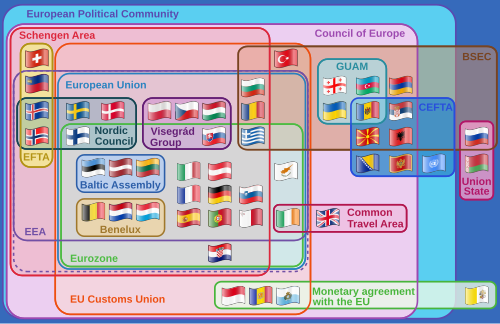
Seven countries (Bulgaria, the Czech Republic, Denmark, Hungary, Poland, Romania, and Sweden) are EU members but do not use the euro. Bulgaria has been approved to adopt the single currency effective 1 January 2026.
Before joining the eurozone, a state must spend at least two years in the European Exchange Rate Mechanism (ERM II). As of January 2023, the central bank of Denmark and the Bulgarian central bank participate in ERM II.
Denmark obtained a special opt-out in the Maastricht Treaty, and thus is legally exempt from joining the eurozone unless its government decides otherwise, either by parliamentary vote or referendum. The United Kingdom likewise had an opt-out prior to withdrawing from the EU in 2020.
The remaining six countries have committed to adopt the euro in future, once they meet the convergence criteria. They should join as soon as they do so, which include being part of ERM II for two years. Sweden, which joined the EU in 1995 after the Maastricht Treaty was signed, rejected euro adoption in a 2003 referendum and since then the country has intentionally avoided fulfilling the adoption requirements by not joining ERM II, which is voluntary.[40][41] Bulgaria joined ERM II on 10 July 2020.[42]
Interest in joining the eurozone increased in Denmark, and initially in Poland, as a result of the 2008 financial crisis. In Iceland, there was an increase in interest in joining the European Union, a pre-condition for adopting the euro.[43] However, by 2010 the debt crisis in the eurozone caused interest from Poland, as well as the Czech Republic, Denmark and Sweden to cool.[44]
On 4 June 2025, the European Commission announced Bulgaria's compliance with the convergence criteria to adopt the euro on 1 January 2026.[45] In the context of Bulgaria's adoption of the euro, the Polish government under Donald Tusk has expressed a lack of economic readiness to join, whereas the newly elected Polish president Karol Nawrocki said that he is explicitly against Poland's future adoption of the euro.[46]
On 8 July 2025, the European Parliament endorsed Bulgaria's entry in the Eurozone[47] and the Council of the European Union adopted the final 3 legislative acts required for the admission.[48]
Expulsion and withdrawal
[edit]In the opinion of journalist Leigh Phillips and Locke Lord's Charles Proctor,[49][50] there is no provision in any European Union treaty for an exit from the eurozone. In fact, they argued, the Treaties make it clear that the process of monetary union was intended to be "irreversible" and "irrevocable".[50] However, in 2009, a European Central Bank legal study argued that, while voluntary withdrawal is legally not possible, expulsion remains "conceivable".[51] Although an explicit provision for an exit option does not exist, many experts and politicians in Europe have suggested an option to leave the eurozone should be included in the relevant treaties.[52]
On the issue of leaving the eurozone, the European Commission has stated that "[t]he irrevocability of membership in the euro area is an integral part of the Treaty framework and the Commission, as a guardian of the EU Treaties, intends to fully respect [that irrevocability]."[53] It added that it "does not intend to propose [any] amendment" to the relevant Treaties, the current status being "the best way going forward to increase the resilience of euro area Member States to potential economic and financial crises."[53] The European Central Bank, responding to a question by a Member of the European Parliament, has stated that an exit is not allowed under the Treaties.[54]
Likewise there is no provision for a state to be expelled from the euro.[55] Some, however, including the Dutch government, favour the creation of an expulsion provision for the case whereby a heavily indebted state in the eurozone refuses to comply with an EU economic reform policy.[56]
In a Texas law journal, University of Texas at Austin law professor Jens Dammann has argued that even now EU law contains an implicit right for member states to leave the eurozone if they no longer meet the criteria that they had to meet in order to join it.[57] Furthermore, he has suggested that, under narrow circumstances, the European Union can expel member states from the eurozone.[58]
Administration and representation
[edit]
The monetary policy of all countries in the eurozone is managed by the European Central Bank (ECB) and the Eurosystem which comprises the ECB and the central banks of the EU states who have joined the eurozone. Countries outside the eurozone are not represented in these institutions. Whereas all EU member states are part of the European System of Central Banks (ESCB), non EU member states have no say in all three institutions, even those with monetary agreements such as Monaco. The ECB is entitled to authorise the design and printing of euro banknotes and the volume of euro coins minted, and its president is currently Christine Lagarde.
The eurozone is represented politically by its finance ministers, known collectively as the Eurogroup, and is presided over by a president, currently Paschal Donohoe. The finance ministers of the EU member states that use the euro meet a day before a meeting of the Economic and Financial Affairs Council (Ecofin) of the Council of the European Union. The Group is not an official Council formation but when the full EcoFin council votes on matters only affecting the eurozone, only Euro Group members are permitted to vote on it.[59][60][61]
Since the 2008 financial crisis, the Euro Group has met irregularly not as finance ministers, but as heads of state and government (like the European Council). It is in this forum, the Euro summit, that many eurozone reforms have been decided upon. In 2011, former French President Nicolas Sarkozy pushed for these summits to become regular and twice a year in order for it to be a 'true economic government'.[62]
Reform
[edit]In April 2008 in Brussels, future European Commission President Jean-Claude Juncker suggested that the eurozone should be represented at the IMF as a bloc, rather than each member state separately: "It is absurd for those 15 countries not to agree to have a single representation at the IMF. It makes us look absolutely ridiculous. We are regarded as buffoons on the international scene".[63] In 2017 Juncker stated that he aims to have this agreed by the end of his mandate in 2019.[64] However, Finance Commissioner Joaquín Almunia stated that before there is common representation, a common political agenda should be agreed upon.[63]
Leading EU figures including the commission and national governments have proposed a variety of reforms to the eurozone's architecture; notably the creation of a Finance Minister, a larger eurozone budget, and reform of the current bailout mechanisms into either a "European Monetary Fund" or a eurozone Treasury. While many have similar themes, details vary greatly.[65][66][67][68]
Economy
[edit]
Comparison table
[edit]| Population (2023) | GDP (Local currency) (2023) | GDP (US$) (2023) | |
|---|---|---|---|
 China China
|
1410 million | CNY 126.1 trillion | US$17.7 trillion |
 Eurozone Eurozone
|
349 million | EUR 14.4 trillion | US$15.6 trillion |
 United States United States
|
335 million | USD 26.9 trillion | US$26.9 trillion |
| Economy | Nominal GDP (billions in USD) – Peak year as of 2020
| ||||||||
|---|---|---|---|---|---|---|---|---|---|
| (01) United States (Peak in 2019) | |||||||||
| (02) China (Peak in 2020) | |||||||||
| (03) Eurozone (Peak in 2008)
|
|||||||||
| (04) Japan (Peak in 2012) | |||||||||
| (05) United Kingdom (Peak in 2007) | |||||||||
| (06) India (Peak in 2019) | |||||||||
| (07) Brazil (Peak in 2011) | |||||||||
| (08) Russia (Peak in 2013) | |||||||||
| (09) Canada (Peak in 2013) | |||||||||
| (10) Korea (Peak in 2018) | |||||||||
| (11) Australia (Peak in 2012) | |||||||||
| (12) Mexico (Peak in 2014) | |||||||||
| (13) Indonesia (Peak in 2019) | |||||||||
| (14) Turkey (Peak in 2013) | |||||||||
| (15) Saudi Arabia (Peak in 2018) | |||||||||
| (16) Switzerland (Peak in 2019) | |||||||||
| (17) Argentina (Peak in 2017) | |||||||||
| (18) Taiwan (Peak in 2020) | |||||||||
| (19) Poland (Peak in 2018) | |||||||||
| (20) Sweden (Peak in 2013) | |||||||||
|
The 20 largest economies in the world including eurozone as a single entity, by nominal GDP (2020) at their peak level of GDP in billions US$. The values for EU members that are not also eurozone members are listed both separately and as part of the EU.[70] | |||||||||
Inflation
[edit]HICP figures from the ECB, overall index:[71]
|
|
|
|
|
Interest rates
[edit]Interest rates for the eurozone, set by the ECB since 1999.[72] Levels are in percentages per annum. Between June 2000 and October 2008, the main refinancing operations were variable rate tenders, as opposed to fixed rate tenders. The figures indicated in the table from 2000 to 2008 refer to the minimum interest rate at which counterparties may place their bids.[73]

Public debt
[edit]The following table states the ratio of public debt to GDP in percent for eurozone countries given by EuroStat.[74] The euro convergence criterion is to not exceed 60%.
| Country | 2007 | 2008 | 2009 | 2010 | 2011 | 2012 | 2013 | 2014 | 2015 | 2016 | 2017 | 2018 | 2019 | 2020 | 2021 | 2022[75] | 2023[76] | 2024[77] |
|---|---|---|---|---|---|---|---|---|---|---|---|---|---|---|---|---|---|---|
| Eurozone | 64.9 | 69.6 | 80.2 | 85.7 | 87.6 | 91.0 | 93.0 | 93.1 | 91.2 | 90.4 | 87.9 | 85.8 | 83.8 | 97.2 | 95.6 | 94.2 | 89.9 | 87.4 |
| Austria | 64.7 | 68.7 | 79.7 | 82.7 | 82.4 | 81.9 | 81.3 | 84.0 | 84.9 | 82.8 | 78.5 | 74.1 | 70.6 | 83.3 | 82.8 | 82.7 | 78.2 | 81.8 |
| Belgium | 87.0 | 93.2 | 99.6 | 100.3 | 103.5 | 104.8 | 105.5 | 107.0 | 105.2 | 105.0 | 102.0 | 99.8 | 97.7 | 112.8 | 108.2 | 108.3 | 108.0 | 104.7 |
| Cyprus | 53.5 | 45.5 | 53.9 | 56.3 | 65.8 | 80.3 | 104.0 | 109.1 | 108.9 | 107.1 | 97.5 | 100.6 | 91.1 | 115.0 | 103.6 | 95.2 | 79.4 | 65.0 |
| Croatia | 37.2 | 39.1 | 48.4 | 57.3 | 63.7 | 69.4 | 80.3 | 83.9 | 83.3 | 79.8 | 76.7 | 73.3 | 71.1 | 87.3 | 79.8 | 74.3 | 64.4 | 57.6 |
| Estonia | 3.7 | 4.5 | 7.0 | 6.6 | 5.9 | 9.8 | 10.2 | 10.6 | 9.7 | 9.4 | 9.0 | 8.4 | 8.6 | 19.0 | 18.1 | 16.7 | 18.2 | 23.6 |
| Finland | 34.0 | 32.6 | 41.7 | 47.1 | 48.5 | 53.6 | 56.2 | 59.8 | 63.1 | 63.1 | 61.4 | 59.0 | 59.5 | 69.0 | 65.8 | 72.1 | 73.8 | 82.1 |
| France | 64.3 | 68.8 | 79.0 | 81.7 | 85.2 | 90.6 | 93.4 | 94.9 | 95.8 | 96.5 | 97.0 | 98.4 | 97.5 | 114.6 | 112.9 | 113.1 | 111.9 | 113.0 |
| Germany | 63.7 | 65.5 | 72.4 | 81.0 | 78.3 | 81.1 | 78.7 | 75.6 | 71.2 | 68.1 | 64.1 | 61.9 | 58.9 | 68.7 | 69.3 | 67.2 | 64.8 | 62.5 |
| Greece | 103.1 | 109.4 | 126.7 | 146.2 | 172.1 | 161.9 | 178.4 | 180.2 | 176.9 | 180.8 | 178.6 | 181.2 | 180.7 | 206.3 | 193.3 | 182.1 | 165.5 | 153.6 |
| Ireland | 23.9 | 42.4 | 61.8 | 86.8 | 109.1 | 119.9 | 119.9 | 104.2 | 93.8 | 72.8 | 68.0 | 63.6 | 57.2 | 58.4 | 56.0 | 51.4 | 43.6 | 40.9 |
| Italy | 99.8 | 106.2 | 112.5 | 115.4 | 116.5 | 126.5 | 132.5 | 135.4 | 132.7 | 132.0 | 131.8 | 134.8 | 134.3 | 155.3 | 150.8 | 150.2 | 140.6 | 135.3 |
| Latvia | 8.0 | 18.6 | 36.6 | 47.5 | 42.8 | 42.2 | 40.0 | 41.6 | 36.4 | 40.6 | 40.1 | 36.4 | 36.7 | 43.3 | 44.8 | 41.6 | 41.4 | 46.8 |
| Lithuania | 15.9 | 14.6 | 29.0 | 36.2 | 37.2 | 39.7 | 38.7 | 40.5 | 42.7 | 40.1 | 39.7 | 34.1 | 35.9 | 46.6 | 44.3 | 39.6 | 37.4 | 38.2 |
| Luxembourg | 7.7 | 15.4 | 16.0 | 20.1 | 19.1 | 22.0 | 23.7 | 22.7 | 21.4 | 20.8 | 23.0 | 21.0 | 22.3 | 24.8 | 24.4 | 25.4 | 25.7 | 26.3 |
| Malta | 62.3 | 61.8 | 67.8 | 67.6 | 69.9 | 65.9 | 65.8 | 61.6 | 63.9 | 57.6 | 50.8 | 45.8 | 40.7 | 53.4 | 57.0 | 55.1 | 49.3 | 47.4 |
| Netherlands | 42.7 | 54.7 | 56.5 | 59.0 | 61.7 | 66.3 | 67.7 | 67.9 | 65.1 | 61.8 | 56.7 | 52.4 | 48.5 | 54.3 | 52.1 | 50.9 | 45.9 | 43.3 |
| Portugal | 68.4 | 75.6 | 83.6 | 96.2 | 111.4 | 129.0 | 131.4 | 132.9 | 129.0 | 130.1 | 125.7 | 122.2 | 116.6 | 135.2 | 127.4 | 123.4 | 107.5 | 94.9 |
| Slovakia | 30.1 | 28.6 | 41.0 | 43.3 | 43.3 | 51.8 | 54.7 | 53.6 | 52.9 | 51.8 | 50.9 | 49.4 | 48.1 | 59.7 | 63.1 | 60.3 | 58.6 | 59.3 |
| Slovenia | 22.8 | 21.8 | 36.0 | 40.8 | 46.6 | 53.6 | 70.0 | 80.3 | 83.2 | 78.5 | 73.6 | 70.4 | 65.6 | 79.8 | 74.7 | 73.5 | 71.4 | 67.0 |
| Spain | 35.6 | 39.7 | 52.7 | 60.1 | 69.5 | 86.3 | 95.8 | 100.7 | 99.2 | 99.0 | 98.3 | 97.6 | 95.5 | 120.0 | 118.4 | 116.1 | 109.8 | 101.8 |
Fiscal policies
[edit].png)
The primary means for fiscal coordination within the EU lies in the Broad Economic Policy Guidelines which are written for every member state, but with particular reference to the 20 current members of the eurozone. These guidelines are not binding, but are intended to represent policy coordination among the EU member states, so as to take into account the linked structures of their economies.
For their mutual assurance and stability of the currency, members of the eurozone have to respect the Stability and Growth Pact, which sets agreed limits on deficits and national debt, with associated sanctions for deviation. The Pact originally set a limit of 3% of GDP for the yearly deficit of all eurozone member states; with fines for any state which exceeded this amount. In 2005, Portugal, Germany, and France had all exceeded this amount, but the Council of Ministers had not voted to fine those states. Subsequently, reforms were adopted to provide more flexibility and ensure that the deficit criteria took into account the economic conditions of the member states, and additional factors.
The Fiscal Compact[78][79] (formally, the Treaty on Stability, Coordination and Governance in the Economic and Monetary Union),[80] is an intergovernmental treaty introduced as a new stricter version of the Stability and Growth Pact, signed on 2 March 2012 by all member states of the European Union (EU), except the Czech Republic, the United Kingdom,[81] and Croatia (subsequently acceding the EU in July 2013). The treaty entered into force on 1 January 2013 for the 16 states which completed ratification prior of this date.[82] As of 1 April 2014, it had been ratified and entered into force for all 25 signatories.
Olivier Blanchard suggests that a fiscal union in the eurozone can mitigate devastating effects of the single currency on the eurozone peripheral countries. But he adds that the currency bloc will not work perfectly even if a fiscal transfer system is built, because, he argues, the fundamental issue about competitiveness adjustment is not tackled. The problem is, since the eurozone peripheral countries do not have their own currencies, they are forced to adjust their economies by decreasing their wages instead of devaluation.[83]
Bailout provisions
[edit]The 2008 financial crisis prompted several reforms in the eurozone. One was a U-turn on the eurozone's bailout policy that led to the creation of a specific fund to assist eurozone states in trouble. The European Financial Stability Facility (EFSF) and the European Financial Stability Mechanism (EFSM) were created in 2010 to provide, alongside the International Monetary Fund (IMF), a system and fund to bail out members. However, the EFSF and EFSM were temporary, small and lacked a basis in the EU treaties. Therefore, it was agreed in 2011 to establish a European Stability Mechanism (ESM) which would be much larger, funded only by eurozone states (not the EU as a whole as the EFSF/EFSM were) and would have a permanent treaty basis. As a result of that its creation involved agreeing an amendment to TEFU Article 136 allowing for the ESM and a new ESM treaty to detail how the ESM would operate. If both are successfully ratified according to schedule, the ESM would be operational by the time the EFSF/EFSM expire in mid-2013.
In February 2016, the UK secured further confirmation that countries that do not use the Euro would not be required to contribute to bailouts for eurozone countries.[84]
Peer review
[edit]In June 2010, a broad agreement was finally reached on a controversial proposal for member states to peer review each other's budgets prior to their presentation to national parliaments. Although showing the entire budget to each other was opposed by Germany, Sweden and the UK, each government would present to their peers and the Commission their estimates for growth, inflation, revenue and expenditure levels six months before they go to national parliaments. If a country was to run a deficit, they would have to justify it to the rest of the EU while countries with a debt more than 60% of GDP would face greater scrutiny.[85]
The plans would apply to all EU members, not just the eurozone, and have to be approved by EU leaders along with proposals for states to face sanctions before they reach the 3% limit in the Stability and Growth Pact. Poland has criticised the idea of withholding regional funding for those who break the deficit limits, as that would only impact the poorer states.[85] In June 2010 France agreed to back Germany's plan for suspending the voting rights of members who breach the rules.[86] In March 2011 was initiated a new reform of the Stability and Growth Pact aiming at straightening the rules by adopting an automatic procedure for imposing of penalties in case of breaches of either the deficit or the debt rules.[87][88]
Criticism
[edit]In 1997, Arnulf Baring expressed concern that the European Monetary Union would make Germans the most hated people in Europe. Baring suspected the possibility that the people in Mediterranean countries would regard Germans and the currency bloc as economic policemen.[89]
In 2001, James Tobin thought that the euro project would not succeed without making drastic changes to European institutions, pointing out the difference between the US and the eurozone.[90] Concerning monetary policies, the system of Federal Reserve banks in the US aims at both growth and reducing unemployment, while the ECB tends to give its first priority to price stability under the Bundesbank's supervision. As the price level of the currency bloc is kept low, the unemployment level of the region has become higher than that of the US since 1982.[90] Concerning fiscal policies, 12% of the US federal budget is used for transfers to states and local governments. The US government does not impose restrictions on state budget policies, whereas the Maastricht Treaty requires each eurozone member country to keep its budget deficit below 3% of its GDP.[90]
In 2008, a study by Alberto Alesina and Vincenzo Galasso found that the adoption of euro promoted market deregulation and market liberalization.[91][92] Furthermore, the euro was also linked to wage moderation, as wage growth slowed down in countries that adopted the new currency.[91] Oliver Hart, who received the Nobel Memorial Prize in Economic Sciences in 2016, criticized the euro, calling it a "mistake" and emphasising his opposition to monetary union since its inception.[93] He also expressed opposition to European integration, arguing that the European Union should instead focus on decentralisation as it has "gone too far in centralising power".[93] In 2018, a study based on DiD methodology found that the adoption of euro produced no systematic growth effects, as no growth-enhancing effects were found when compared to European economies outside the eurozone.[94]
The eurozone has also been criticized for deepening inequality in Europe, particularly between the richest and poorest countries.[95] According to a study by Bertelsmann Stiftung, countries such as Austria and the Netherlands benefited significantly from the common currency, while southern and eastern European members of the eurozone gained very little,[96] and some countries are considered to have suffered adverse effects from adopting the euro.[97] In an article for Politico, Joseph Stiglitz argues that "[t]he result for the eurozone has been slower growth, and especially for the weaker countries within it. The euro was supposed to usher in greater prosperity, which in turn would lead to renewed commitment to European integration. It has done just the opposite — increasing divisions within the EU, especially between creditor and debtor countries."[97] Matthias Matthijs believes that the euro resulted in a "winner-take-all" economy, as national income differences between eurozone members have widened further.[98] He argues that countries such as Austria and Germany have gained from the eurozone at the expense of southern countries like Italy and Spain.[98]
By adopting the euro and abandoning their national currencies, eurozone countries gave up their ability to conduct independent monetary policy; as such, monetary policies used to combat recession, such as monetary stimulus or currency devaluation, are no longer available.[98] During the European debt crisis, several eurozone countries (Greece, Italy, Portugal, Ireland, Spain, and Cyprus) were unable to repay their debt without third-party intervention by the European Central Bank and the International Monetary Fund.[99] In order to grant the bailout, the ECB and the IMF forced the affected countries to adopt strict austerity measures.[98] The European bailouts were largely about shifting exposure from banks onto European taxpayers,[100][101][102] and exacerbated issues such as high unemployment and poverty.[103][104]
In 2019, a study from the Centre for European Policy concluded that while some countries had gained from adopting the euro, several countries were poorer than they would have been had they not adopted it, with France and Italy being particularly affected.[105][106] The publication prompted a large number of reactions, pushing its authors to put out a statement clarifying some points.[107] In 2020, a study from the University of Bonn reached a different conclusion: the adoption of the euro made "some mild losers (France, Germany, Italy, and Portugal) and a clear winner (Ireland)".[108] Both studies used the synthetic control method to estimate what might have happened if the euro hadn't been adopted.
See also
[edit]
- Capital Markets Union
- Economic and Monetary Union of the European Union
- European banking union
- Single Euro Payments Area
- List of acronyms associated with the eurozone crisis
- List of people associated with the eurozone crisis
- Sixpack (European Union law)
- Special territories of members of the European Economic Area
- Open Balkan
- Craiova Group
Notes
[edit]- ^ The self-declared Turkish Republic of Northern Cyprus is not recognised by the EU and uses the Turkish lira. However, the euro does circulate widely.[citation needed]
- ^ a b c French Pacific territories use the CFP franc, which is pegged to the euro at the rate of 1 franc to 0.00838 euro.
- ^ The European Union internally uses the code EL for Greece, a deviation from the ISO 3166-1 standard.
- ^ Aruba is part of the Kingdom of the Netherlands, but not of the EU. It uses the Aruban florin, which is pegged to the US dollar at the rate of 1 dollar to 1.79 florins.
- ^ a b Used the Netherlands Antillean guilder until the introduction of the Caribbean guilder on 31 March 2025, after the change was delayed several times. "CBCS wants to have the Caribbean guilder introduced by 2025". Curaçao Chronicle. 16 March 2022. Retrieved 2 August 2022. "Frequent Asked Questions". Centrale Bank Curaçao & Sint Maarten. Retrieved 2 August 2022. Both are pegged to the US dollar at the rate of 1 dollar to 1.79 guilders.
- ^ Uses the US dollar.
- ^ EZ is not assigned, but is reserved for this purpose, in ISO-3166-1.
References
[edit]- ^ Land cover overview by NUTS 2 regions Eurostat
- ^ "Population on 1 January". Eurostat.
- ^ a b "Gross domestic product at market prices (Current prices and per capita)". Eurostat. Retrieved 28 July 2016.
- ^ "ECB Cuts interest rates". 6 March 2025.
- ^ Euro area annual inflation and its main components - estimated Eurostat
- ^ Harmonised unemployment rate by gender – total Eurostat
- ^ "Eurozone Current Account Surplus Falls In December". 18 February 2022.
- ^ "Countries, languages, currencies". Interinstitutional style guide. the EU Publications Office. Retrieved 2 February 2009.The euro area Archived 6 August 2013 at the Wayback Machine, European Central Bank
- ^ "Why France and Germany's political chaos spells trouble for Europe's economy". Fast Company.
- ^ "Agreements on monetary relations (Monaco, San Marino, the Vatican and Andorra)". European Communities. 30 September 2004. Retrieved 12 September 2006.
- ^ "The government announces a contest for the design of the Andorran euros". Andorra Mint. 19 March 2013. Archived from the original on 22 August 2013. Retrieved 26 March 2013.
- ^ "Nouvelles d'Andorre" (in French). 1 February 2013. Archived from the original on 4 October 2013. Retrieved 2 February 2013.
- ^ "The euro outside the euro area". Europa (web portal). Retrieved 15 February 2021.
- ^ A glossary (Archived 14 May 2013 at the Wayback Machine) issued by the ECB defines "euro area", without mention of Monaco, San Marino, or the Vatican.
- ^ "Financial assistance to EU Member States | Fact Sheets on the European Union | European Parliament". www.europarl.europa.eu. 30 April 2024. Retrieved 30 August 2024.
- ^ "European countries don't actually use the Euro!". 9 April 2025.
- ^ "Who can join and when?". European Commission – European Commission. Retrieved 2 December 2020.
- ^ Strupczewski, Jan (4 June 2025). "EU gives Bulgaria green light to adopt euro from start of 2026". Reuters. Retrieved 18 June 2025.
- ^ Fox, Benjamin (1 February 2013). "Dutch PM: Eurozone needs exit clause". EUobserver.com. Retrieved 18 June 2013.
- ^ Cite error: The named reference
population_jan_2024was invoked but never defined (see the help page). - ^ "EU countries and the euro". European Commission. Retrieved 2 December 2022.
- ^ "GNI, Atlas method (current US$) | Data | Table (update date unknown)". Retrieved 2025-05-01.
- ^ a b c d e f g h i j k "COUNCIL DECISION of 3 May 1998 in accordance with Article 109j(4) of the Treaty". Official Journal of the European Union. L (139/30). 11 May 1998. Retrieved 27 October 2014.
- ^ "Council Decision (EU) 2022/1211 of 12 July 2022 on the adoption by Croatia of the euro on 1 January 2023". Official Journal of the European Union. L (187/31). 12 July 2022. Retrieved 2 January 2023.
- ^ "COUNCIL DECISION of 10 July 2007 in accordance with Article 122(2) of the Treaty on the adoption by Cyprus of the single currency on 1 January 2008". Official Journal of the European Union. L (186/29). 18 July 2007. Retrieved 27 October 2014.
- ^ "COUNCIL DECISION of 13 July 2010 in accordance with Article 140(2) of the Treaty on the adoption by Estonia of the euro on 1 January 2011". Official Journal of the European Union. L (196/24). 28 July 2010. Retrieved 27 October 2014.
- ^ "COUNCIL DECISION of 19 June 2000 in accordance with Article 122(2) of the Treaty on the adoption by Greece of the single currency on 1 January 2001". Official Journal of the European Union. L (167/19). 7 July 2000. Retrieved 27 October 2014.
- ^ "COUNCIL DECISION of 9 July 2013 on the adoption by Latvia of the euro on 1 January 2014". Official Journal of the European Union. L (195/24). 18 July 2013. Retrieved 27 October 2014.
- ^ "COUNCIL DECISION of 23 July 2014 on the adoption by Lithuania of the euro on 1 January 2015". Official Journal of the European Union. L (228/29). 31 July 2014. Retrieved 31 December 2014.
- ^ "COUNCIL DECISION of 10 July 2007 in accordance with Article 122(2) of the Treaty on the adoption by Malta of the single currency on 1 January 2008". Official Journal of the European Union. L (186/32). 18 July 2007. Retrieved 27 October 2014.
- ^ "COUNCIL DECISION of 8 July 2008 in accordance with Article 122(2) of the Treaty on the adoption by Slovakia of the single currency on 1 January 2009". Official Journal of the European Union. L (195/24). 24 July 2008. Retrieved 27 October 2014.
- ^ "COUNCIL DECISION of 11 July 2006 in accordance with Article 122(2) of the Treaty on the adoption by Slovenia of the single currency on 1 January 2007". Official Journal of the European Union. L (195/25). 15 July 2006. Retrieved 27 October 2014.
- ^ "Agreements on monetary relations (Monaco, San Marino, the Vatican and Andorra)". European Communities. 30 September 2004. Retrieved 12 September 2006.
- ^ a b "The euro outside the euro area". Europa (web portal). Retrieved 15 February 2021.
- ^ "European Foundation Intelligence Digest". Europeanfoundation.org. Archived from the original on 26 August 2007. Retrieved 30 May 2010.
- ^ "Euro used as legal tender in non-EU nations". International Herald Tribune. 1 January 2007. Archived from the original on 10 December 2008. Retrieved 22 November 2010.
- ^ "The eurozone's 13th member". BBC News. 11 December 2001. Retrieved 30 May 2010.
- ^ "Unilateral Euroization By Iceland Comes With Real Costs And Serious Risks". Lawofemu.info. 15 February 2008. Archived from the original on 14 March 2012. Retrieved 28 February 2015.
- ^ "New EU members to break free from euro duty". Euractiv.com. 13 September 2011. Retrieved 7 September 2013.
- ^ "Sverige sa nej till euron" (in Swedish). Swedish Parliament. 28 August 2013. Archived from the original on 19 September 2017. Retrieved 12 August 2014.
- ^ "Information on ERM II". European Commission. 22 December 2009. Retrieved 16 January 2010.
- ^ "Bulgaria, Croatia take vital step to joining euro". Reuters. 10 July 2020. Retrieved 11 July 2020.
- ^ Dougherty, Carter (1 December 2008). "Buffeted by financial crisis, countries seek euro's shelter". International Herald Tribune. Archived from the original on 22 December 2022. Retrieved 2 December 2008.
- ^ "Czechs, Poles cooler to euro as they watch debt crisis". Reuters. 16 June 2010. Retrieved 18 June 2010.
- ^ "Bulgaria meets criteria to join the euro area on 1 January 2026".
- ^ "Bulgaria prepares to join the euro — but Poland couldn't be less interested". 4 June 2025.
- ^ "Parliament endorses Bulgaria's adoption of the euro | News | European Parliament". 8 July 2025.
- ^ url=https://www.consilium.europa.eu/en/press/press-releases/2025/07/08/bulgaria-ready-to-use-the-euro-from-1-january-2026-council-takes-final-steps/
- ^ "Brussels: No one can leave the euro" Archived 24 December 2020 at the Wayback Machine by Leigh Phillips, EUobserver, 8 September 2011
- ^ a b "The Eurozone crisis – the final stage? Archived 1 July 2018 at the Wayback Machine" by Charles Proctor, Locke Lord, 15 May 2012
- ^ "Withdrawal and Expulsion from the EU and EMU : Some reflections Archived 20 January 2013 at the Wayback Machine" by Phoebus Athanassiou, Principal Legal Counsel with the Directorate-General for Legal Service, ECB, 2009
- ^ "German advisory council calls for exit option in the eurozone" Archived 5 December 2020 at the Wayback Machine by Daniel Tost, EurActiv, 29 July 2015
- ^ a b Text Archived 14 November 2020 at the Wayback Machine of response by Olli Rehn, European Commissioner for Economic and Monetary Affairs and the Euro, on behalf of the European Commission, to question submitted by Claudio Morganti, Member of the European Parliament, 22 June 2012
- ^ Text Archived 17 November 2020 at the Wayback Machine of message by Mario Draghi, ECB, to Claudio Morganti, Member of the European Parliament, 6 November 2012
- ^ Athanassiou, Phoebus (December 2009) Withdrawal and Expulsion from the EU and EMU, Some Reflections Archived 20 January 2013 at the Wayback Machine (PDF), European Central Bank. Retrieved 8 September 2011
- ^ Phillips, Leigh (7 September 2011). "EUobserver / Netherlands: Indebted states must be made 'wards' of the commission or leave euro". Euobserver.com. Retrieved 20 May 2014.
- ^ Dammann, Jens (10 February 2012). "The Right to Leave the Eurozone". U of Texas Law, Public Law Research Paper. 2013. 48 (2). SSRN 2262873.
- ^ Dammann, Jens (26 August 2015). "Paradise Lost: Can the European Union Expel Countries from the Eurozone". Vanderbilt Journal of Transnational Law. 2016. 49 (2). SSRN 2827699.
- ^ Treaty of Lisbon (Provisions specific to member states whose currency is the euro), EurLex Archived 27 March 2009 at the Wayback Machine
- ^ "An economic government for the eurozone?" (PDF). Federal Union. Archived from the original (PDF) on 17 July 2011. Retrieved 26 February 2011.
- ^ Protocols, Official Journal of the European Union
- ^ Elliott, Larry; Wearden, Graeme (17 August 2011). "Merkel and Sarkozy push for greater European co-operation". The Guardian. ISSN 0261-3077. Retrieved 30 August 2024.
- ^ a b Elitsa Vucheva (15 April 2008). "Eurozone countries should speak with one voice, Juncker says". EU Observer. Retrieved 26 February 2011.
- ^ "Commission wants single eurozone seat at IMF plan adopted by end of mandate" Archived 27 December 2017 at the Wayback Machine, Euractiv, 7 December 2017
- ^ "Macron is right — the eurozone needs a finance minister" Archived 7 November 2017 at the Wayback Machine, Financial Times, 28 September 2017
- ^ Europe should have its own economy and finance minister, says EC Archived 27 December 2017 at the Wayback Machine, theguardian 6 December 2017
- ^ "Large number of EU finance ministers want euro zone budget: Dijsselbloem" Archived 27 December 2017 at the Wayback Machine, Reuters, 6 November 2017
- ^ "Spain urges sweeping reforms on eurozone to correct flaws" Archived 27 December 2017 at the Wayback Machine, Financial Times, 14 June 2017
- ^ "Report for Selected Countries and Subjects". www.imf.org.
- ^ Figures from the October 2020 update of the International Monetary Fund's World Economic Outlook Database. [1] Archived 20 January 2021 at the Wayback Machine
- ^ "Annual average rate of change, neither seasonally nor working day adjusted". Archived from the original on 6 October 2022. Retrieved 23 August 2022.
- ^ "Official interest rates". European Central Bank. 8 June 2022. Retrieved 19 June 2022.
- ^ Key ECB interest rates Archived 11 August 2013 at the Wayback Machine, ECB
- ^ "General government gross debt – annual data (table code: teina225)". Eurostat. Retrieved 29 August 2022.
- ^ "Government debt down to 94.2% of GDP in euro area - European Union". Retrieved 12 January 2023.
- ^ Government debt down to 89.9% of GDP in euro area. 22 January 2024. Retrieved 26 January 2024.
- ^ "Government debt at 87.4% of GDP in euro area". 22 April 2025. Retrieved 13 May 2025.
- ^ Nicholas Watt (31 January 2012). "Lib Dems praise David Cameron for EU U-turn". The Guardian. London. Retrieved 5 February 2012.
- ^ "The fiscal compact ready to be signed". European Commission. 31 January 2012. Archived from the original on 22 October 2012. Retrieved 5 February 2012.
- ^ "Referendum to be held on Fiscal Treaty". RTÉ News. 28 February 2012.
- ^ "EU summit: All but two leaders sign fiscal treaty". BBC News. 2 March 2012. Retrieved 2 March 2012.
- ^ "Fiscal compact enters into force 21/12/2012 (Press: 551, Nr: 18019/12)" (PDF). European Council. 21 December 2012. Archived (PDF) from the original on 23 December 2012. Retrieved 21 December 2012.
- ^ Fiscal union will never fix a dysfunctional eurozone, warns ex-IMF chief Blanchard Archived 18 February 2018 at the Wayback Machine Mehreen Khan, The Daily Telegraph (London), 10 October 2015
- ^ "European Council meeting (18 and 19 February 2016) – Conclusions". European Commission. Retrieved 14 May 2016.
- ^ a b EU agrees controversial peer review of national budgets, EU Observer
- ^ Willis, Andrew (15 June 2010) Merkel: Spain can access aid if needed, EU Observer
- ^ "Council reaches agreement on measures to strengthen economic governance" (PDF). Archived (PDF) from the original on 25 August 2011. Retrieved 18 May 2011.
- ^ Jan Strupczewski (15 March 2011). "EU finmins adopt tougher rules against debt, imbalance". Uk.finance.yahoo.com. Yahoo! Finance. Archived from the original on 24 April 2023. Retrieved 18 May 2011.
- ^ This Prediction about the Euro Deserves a ‘Nostradamus Award’ Archived 8 December 2015 at the Wayback Machine W. Richter, Wolf Street, 16 July 2015
- ^ a b c J. Tobin, Policy Opinions, 31 (2001)
- ^ a b Alesina, Alberto; Galasso, Vincenzo; Ardagna, Silvia (May 2008). "The Euro and Structural Reforms" (PDF). NBER Working Paper. 1 (14479). doi:10.3386/w14479.
- ^ Belsie, Laurent (April 2009). "The Euro, Wages, and Prices". NBER. The Digest. Retrieved 26 February 2023.
- ^ a b Rodríguez, Carmen (December 2016). Sam Morgan (ed.). "Nobel economics prize winner: 'The euro was a mistake'". Euractiv. Retrieved 26 February 2023.
- ^ Ioannatos, Petros E. (June 2018). "Has the Euro Promoted Eurozone's Growth?" (PDF). Journal of Economic Integration. 33 (2): 1388–1411. doi:10.11130/jei.2018.33.2.1389. S2CID 158295739.
- ^ Karnitschnig, Matthew (22 April 2020). "The eurozone's problem country: Germany". Politico. Retrieved 27 February 2023.
- ^ Escritt, Thomas (8 May 2019). Gareth Jones (ed.). "Germany, wealthy regions are biggest winners of EU single market: report". Reuters. Retrieved 27 February 2023.
- ^ a b Stiglitz, Joseph (26 June 2018). "How to exit the eurozone". Politico. Retrieved 27 February 2023.
- ^ a b c d Matthijs, Matthias (2016). "The Euro's "Winner-Take-All" Political Economy: Institutional Choices, Policy Drift, and Diverging Patterns of Inequality". Politics & Society. 44 (3). SAGE Publications: 393–422. doi:10.1177/0032329216655317. S2CID 220681429.
- ^ Copelovitch, Mark; Frieden, Jeffry; Walter, Stefanie (14 March 2016). "The Political Economy of the Euro Crisis". Comparative Political Studies. 49 (7): 811–840. doi:10.1177/0010414016633227. ISSN 0010-4140. S2CID 18181290.
- ^ Featherstone, Kevin (23 March 2012). "Are the European banks saving Greece or saving themselves?". Greece@LSE. LSE. Retrieved 27 March 2012.
- ^ "Greek aid will go to the banks". Die Gazette. Presseurop. 9 March 2012. Archived from the original on 3 December 2012. Retrieved 12 March 2012.
- ^ Whittaker, John (2011). "Eurosystem debts, Greece, and the role of banknotes" (PDF). Lancaster University Management School. Archived from the original (PDF) on 25 November 2011. Retrieved 2 April 2012.
- ^ Cavero, Gonzalo; Cortés, Irene Martín (September 2013). "The true cost of austerity and inequality: Greece Case Study" (PDF). Oxfam Case Study. ISBN 9781780774046.
- ^ Coppola, Frances (31 August 2018). "The Terrible Human Cost Of Greece's Bailouts". Forbes. Archived from the original on 9 August 2022. Retrieved 27 February 2023.
- ^ Nicole Ng, "CEP study: Germans gain most from euro introduction", Deutsche Welle, 25 February 2019, accessed 05/03/19.
- ^ Gasparotti, Alessandro; Kullas, Matthias (February 2019). "20 Years of the Euro: Winners and Losers" (PDF). cepStudy. Archived (PDF) from the original on 19 November 2019.
- ^ "Statement on reactions to the study 20 years of euro". Centrum für europäische Politik. 19 December 2022. Archived from the original on 31 January 2023.
- ^ Gabriel, Ricardo Duque; Pessoa, Ana Sofia (1 December 2020). "Adopting the Euro: A Synthetic Control Approach". SSRN. doi:10.2139/ssrn.3563044. S2CID 219969338. SSRN 3563044.
External links
[edit]

- Eurozone official portal (archived 9 June 2012)
- European Central Bank
- European Commission – Economic and Financial Affairs – Eurozone
Euro topics | |||||||||
|---|---|---|---|---|---|---|---|---|---|
| General | |||||||||
| Administration | |||||||||
| Fiscal provisions | |||||||||
| Economy | |||||||||
| International status | |||||||||
| Denominations |
| ||||||||
| Coins by country with minting rights |
| ||||||||
| Adoption by country |
| ||||||||
| |||||||||
| History |
| ||||||||

| International | |
|---|---|
| National | |
| Other | |

Eurozone
View on GrokipediaEstablishment and Historical Development
Founding Treaties and Initial Launch
The Treaty on European Union, signed on 7 February 1992 in Maastricht, Netherlands, and entering into force on 1 November 1993, established the European Union and defined the framework for Economic and Monetary Union (EMU).[9][10] This treaty amended prior agreements, including the Treaty establishing the European Economic Community, and introduced convergence criteria—such as price stability, sound public finances, exchange rate stability, and convergence of long-term interest rates—that member states needed to satisfy for participation in the final stage of EMU.[11] The Maastricht Treaty also created the European Central Bank (ECB) and the European Monetary Institute as precursors to centralized monetary policy.[12] EMU progressed in three stages as outlined in the treaty. Stage One, from 1 July 1990 to 31 December 1993, focused on liberalizing capital movements, reducing exchange rate fluctuations, and enhancing economic policy coordination without a common currency.[13] Stage Two, from 1 January 1994 to 31 December 1998, involved the establishment of the European Monetary Institute to oversee monetary policy convergence and prepare for the single currency, while prohibiting monetary financing of public deficits.[14] During this period, the European Council assessed member states' readiness based on the convergence criteria. Stage Three commenced on 1 January 1999, marking the irrevocable conversion of national currencies to the euro for eleven initial member states: Belgium, Germany, Ireland, Spain, France, Italy, Luxembourg, the Netherlands, Austria, Portugal, and Finland.[15][16] The euro replaced the European Currency Unit (ECU) as the unit of account, enabling monetary union with the ECB assuming responsibility for setting interest rates and conducting foreign exchange operations, while national currencies remained in circulation for cash transactions until 2002.[17] Greece joined as the twelfth member on 1 January 2001 after meeting the criteria, preceding the physical introduction of euro notes and coins on 1 January 2002.[18] The United Kingdom and Denmark secured opt-outs from participation, allowing them to retain their national currencies indefinitely.[11]Early Enlargements and Opt-Outs
The Eurozone initially comprised 11 member states—Austria, Belgium, Finland, France, Germany, Ireland, Italy, Luxembourg, the Netherlands, Portugal, and Spain—that satisfied the convergence criteria outlined in the Maastricht Treaty and adopted the euro for electronic transactions on 1 January 1999.[1] These countries transitioned to euro banknotes and coins as legal tender on 1 January 2002, replacing national currencies at fixed conversion rates.[16] Greece, having achieved the required criteria by late 2000 despite prior shortfalls in budget deficit and debt levels, became the 12th member on 1 January 2001, participating in the physical currency changeover a year later.[19] Subsequent revelations indicated that Greece had employed derivative swaps and other financial engineering to temporarily mask its fiscal deficits below the 3% GDP threshold during the assessment period, a practice later criticized for undermining the integrity of entry requirements.[20] Under the Maastricht Treaty of 1992, Denmark and the United Kingdom negotiated permanent opt-outs from the third stage of Economic and Monetary Union, exempting them from the obligation to adopt the euro despite EU membership. Denmark's exemption stemmed from a 1992 referendum rejecting the treaty, leading to the Edinburgh Agreement that preserved the opt-out while allowing participation in other EU policies; the country maintains the krone, pegged to the euro via the Exchange Rate Mechanism II.[21] The UK's opt-out became moot following its 2020 departure from the EU via Brexit. Sweden, which acceded to the EU in 1995 after the treaty's ratification, lacks a formal opt-out but has effectively deferred euro adoption since a 2003 referendum rejected it by 55.9%, with subsequent governments avoiding fulfillment of convergence criteria such as central bank independence and exchange rate stability.[22] The first enlargements beyond the founding group followed the EU's 2004 expansion, which added ten new members, several of whom pursued euro adoption. Slovenia, the smallest and first post-2004 entrant, met all convergence criteria and joined the Eurozone on 1 January 2007, converting from the tolar at a fixed rate of 239.640 tolar per euro.[23] Cyprus and Malta followed on 1 January 2008, increasing membership to 15; both satisfied inflation, deficit, debt, and interest rate benchmarks, with Cyprus transitioning from the pound and Malta from the lira.[24] These accessions emphasized adherence to the Stability and Growth Pact's fiscal rules, though early monitoring highlighted vulnerabilities in smaller economies' banking sectors and external dependencies.Major Crises and Institutional Responses
The European sovereign debt crisis emerged in late 2009 when Greece disclosed its budget deficit had reached 12.7% of GDP, far exceeding the Eurozone's 3% Stability and Growth Pact limit, revealing years of fiscal misrepresentation and high public debt levels around 127% of GDP. This triggered market panic, with Greek bond yields surging above 7% by early 2010, signaling default risk and prompting contagion to other peripheral economies like Ireland, Portugal, Spain, and Italy, where banking sector weaknesses and housing bubbles amplified vulnerabilities.[25] By mid-2012, Eurozone-wide GDP had contracted, unemployment peaked at 12% area-wide, and fears of euro disintegration intensified as interbank lending froze and capital flight from southern members accelerated.[26] Institutional responses began with ad hoc measures, including the European Commission's coordination of bilateral loans to Greece totaling €110 billion in May 2010, supported by IMF funding under a troika framework imposing structural reforms and austerity to restore fiscal sustainability. The temporary European Financial Stability Facility (EFSF) was established in June 2010 with €440 billion in lending capacity, later evolving into the permanent European Stability Mechanism (ESM) in October 2012, providing bailout funds conditional on macroeconomic adjustment programs for Ireland (€67.5 billion in 2010), Portugal (€78 billion in 2011), and others.[27] The European Central Bank (ECB) intervened decisively by expanding liquidity operations, including long-term refinancing operations (LTROs) disbursing over €1 trillion to banks in late 2011 and early 2012 to prevent credit crunches, while purchasing sovereign bonds on secondary markets under the Securities Markets Programme (SMP) starting in May 2010, totaling €218 billion by 2012.[26] A pivotal ECB action came in July 2012 when President Mario Draghi pledged to do "whatever it takes" to preserve the euro, leading to the outright monetary transactions (OMT) program, which promised conditional unlimited bond purchases for countries under ESM programs, restoring market confidence and lowering peripheral yields without significant actual purchases. Complementary reforms included the 2012 Treaty on Stability, Coordination and Governance (Fiscal Compact), ratified by 25 EU states including all Eurozone members, enforcing balanced budgets and automatic correction mechanisms.[27] The crisis also spurred the Banking Union, with the ECB assuming supervisory roles over major banks via the Single Supervisory Mechanism in November 2014, aiming to sever sovereign-bank loops exposed during the turmoil.[28] Subsequent shocks tested these mechanisms. The COVID-19 pandemic in 2020 prompted the ECB's €1.35 trillion Pandemic Emergency Purchase Programme (PEPP) from March 2020 to March 2022, alongside targeted longer-term refinancing operations, while the EU issued common debt through NextGenerationEU, raising €806.9 billion (in 2021 prices) for grants and loans to support recovery without violating no-bailout clauses.[29] The 2022 energy crisis, triggered by Russia's invasion of Ukraine, drove inflation to 10.6% Eurozone-wide by October 2022 and recession risks, eliciting ECB rate hikes from negative territory to 4.5% by late 2023 and activation of the Transmission Protection Instrument (TPI) in July 2022 to counter unwarranted yield fragmentation.[30] These responses highlighted evolving fiscal-monetary coordination, though debates persist on their sustainability given persistent debt ratios exceeding 90% of GDP in several members as of 2023.[26]Membership and Territorial Scope
Current Member States
The Eurozone, officially known as the euro area, consists of 20 member states as of October 2025, all of which are European Union countries that have adopted the euro as their official currency.[31] These states participate in the European Central Bank's monetary policy and use the euro for all transactions, having phased out their previous national currencies on specified adoption dates.[32] The member states, listed alphabetically with their euro adoption dates, are presented in the following table:| Country | Adoption Date |
|---|---|
| Austria | 1 January 1999 |
| Belgium | 1 January 1999 |
| Croatia | 1 January 2023 |
| Cyprus | 1 January 2008 |
| Estonia | 1 January 2011 |
| Finland | 1 January 1999 |
| France | 1 January 1999 |
| Germany | 1 January 1999 |
| Greece | 1 January 2001 |
| Ireland | 1 January 1999 |
| Italy | 1 January 1999 |
| Latvia | 1 January 2014 |
| Lithuania | 1 January 2015 |
| Luxembourg | 1 January 1999 |
| Malta | 1 January 2008 |
| Netherlands | 1 January 1999 |
| Portugal | 1 January 1999 |
| Slovakia | 1 January 2009 |
| Slovenia | 1 January 2007 |
| Spain | 1 January 1999 |
Territories and Non-Standard Inclusions
The Eurozone includes overseas territories and dependencies of member states where the euro functions as legal tender, reflecting their administrative integration with the parent country despite geographical distance from Europe. For France, the overseas departments and regions—Guadeloupe, Martinique, French Guiana, Réunion, and Mayotte—are classified as outermost regions of the EU, fully participating in the single market and monetary union since the euro's introduction in 1999 for electronic transactions and 2002 for cash. These territories, with a combined population exceeding 2.5 million as of 2023, contribute to France's Eurozone statistics on GDP and inflation, though their economies rely heavily on tourism, agriculture, and subsidies from the metropole. Similarly, Portugal's autonomous regions of the Azores and Madeira, and Spain's Canary Islands, operate within the Eurozone framework as EU outermost regions, adopting the euro upon its launch and benefiting from special fiscal adjustments under EU treaties to address their insular and remote status.[34][16] Certain territories exhibit non-standard status due to partial exclusions from EU competencies while still using the euro as integral parts of member states. Spain's autonomous cities of Ceuta and Melilla, located on the North African coast, have employed the euro since 2002 as Spanish sovereign territory, with residents holding EU citizenship; however, they fall outside the EU's customs territory, common commercial policy, and value-added tax regime per Spain's accession protocol, subjecting them to distinct trade arrangements with Morocco and tariff-free access to the EU for most goods. France's collectivity of Saint Pierre and Miquelon, situated off Canada's coast, transitioned to the euro on 1 January 2002, replacing a local franc pegged to the French currency, despite its designation as an overseas country and territory (OCT) excluded from the EU's internal market; its approximately 6,000 residents use euro notes and coins issued by France, with the territory maintaining close economic ties to North America. Similarly, Saint-Barthélemy, a French overseas collectivity in the Caribbean with around 10,000 residents, adopted the euro in 2002 as an OCT outside the EU proper, using euro currency issued by France. These smaller French OCTs are not included in official Eurozone population figures, which total approximately 353 million; their combined population under 20,000 is negligible in this context.[35][36] Non-EU microstates represent further non-standard inclusions through bilateral or multilateral monetary agreements enabling euro usage under ECB supervision, distinct from unilateral adopters. Monaco has used the euro since 1 January 2002 via a 2001 agreement with France, permitting limited coin minting; San Marino formalized its adoption in 2002 through agreements with Italy and the EU, issuing themed euro coins annually; Vatican City followed suit in 2004 with an EU accord, renowned for its collector euro issues; and Andorra entered a 2011 monetary agreement with the EU, officially adopting the euro on 1 April 2012 after decades of dual-currency use with the Spanish peseta and French franc. These arrangements, covering populations under 100,000 combined, ensure alignment with ECB monetary policy without full EU membership, including rights to produce commemorative coins subject to approval. In contrast, unilateral users such as Montenegro (since 2002) and Kosovo (de facto since 2002) circulate euro cash without formal agreements or minting privileges, operating outside official Eurozone governance.[37][16]Usage Outside EU Membership
The euro is used as legal tender in several non-EU sovereign entities through formal monetary agreements with the European Union, which grant these microstates the right to adopt the currency and, in limited cases, issue their own euro-denominated coins. Andorra formalized its use of the euro via a 2011 monetary agreement with the EU, following informal adoption since 2002, allowing it to mint collector coins but not circulating currency.[37] Monaco, San Marino, and Vatican City similarly operate under agreements dating to 2001–2012, integrated through ties to France and Italy respectively; these entities have adopted the euro since its launch in 2002 and possess limited coining rights, with Vatican City notably issuing euros featuring papal imagery under a special arrangement.[37] These agreements enable participation in the euro payments system but exclude these states from Eurozone decision-making bodies like the European Central Bank (ECB), meaning they lack influence over monetary policy while benefiting from the currency's stability.[37] In contrast, Montenegro and Kosovo employ the euro as a de facto currency without EU agreements, having unilaterally adopted it in 2002 amid post-Yugoslav transitions to replace unstable local tender.[37] Montenegro, with a population of approximately 620,000, declared the euro its sole legal tender by law in 2002, facilitating trade with Eurozone neighbors but exposing it to risks like inability to conduct independent monetary policy or access ECB liquidity during crises, as evidenced by its reliance on imported euros during the 2008–2009 financial downturn.[37] Kosovo, a partially recognized state with around 1.8 million residents, followed suit informally, using the euro for over 90% of transactions despite lacking formal recognition from the ECB; this has stabilized inflation but complicated fiscal autonomy, with no seigniorage revenue and vulnerability to external euro supply fluctuations.[37] Neither entity can mint euros, leading to dependence on cross-border inflows, and efforts to formalize status—such as Montenegro's EU accession push aiming for euro integration by 2028—remain stalled by broader membership hurdles.[37] The British Sovereign Base Areas (SBAs) of Akrotiri and Dhekelia on Cyprus, overseas territories under UK sovereignty comprising about 254 square kilometers and home to roughly 15,000 residents excluding military personnel, also use the euro as legal tender despite non-EU status post-Brexit.[38] Established in 1960 as military enclaves within EU-member Cyprus, the SBAs adopted the euro upon Cyprus's 2008 entry into the Eurozone, with transactions conducted in euros alongside British forces' use of pounds; this arrangement reflects geographic and economic integration rather than formal agreement, permitting euro circulation without UK or EU policy input.[38] Overall, these non-EU usages total under 3 million people and represent marginal euro circulation volume—estimated at less than 0.1% of the ECB's total—highlighting the currency's appeal for small economies seeking stability without full institutional alignment.[37]Prospects for Future Enlargement
As of October 2025, the Eurozone comprises 20 member states, with Bulgaria poised to become the 21st upon adopting the euro on January 1, 2026, following confirmation of its compliance with the Maastricht convergence criteria by the European Commission and European Central Bank in June 2025.[39] To join, non-euro EU states must satisfy requirements including price stability (inflation not exceeding 1.5 percentage points above the three best-performing EU states), sound public finances (budget deficit below 3% of GDP and public debt under 60% of GDP or declining toward it), exchange rate stability via at least two years in ERM II, and convergence of long-term interest rates (within 2 percentage points of the three best-performing states).[33] Political commitment and national legislative alignment are also prerequisites, though historical precedents like Greece's 2001 entry—despite marginal compliance—highlight risks of incomplete convergence leading to later imbalances.[39] Bulgaria entered ERM II in July 2020 and has maintained its currency board peg to the euro since 1997, facilitating steady progress. In its June 2025 convergence assessment, the ECB noted Bulgaria's 12-month average inflation at 2.1% (below the reference value of 2.6%), budget deficit at 2.8% of GDP, and public debt at 24.1% of GDP, all meeting criteria; interest rates converged at 2.3% and exchange rates showed no tensions.[39] Legislative approvals followed in July 2025, with the lev's fixed rate set at 1.95583:1 euro, enabling a smooth transition despite public concerns over potential price hikes.[33] Romania, which joined ERM II in 2024, faces delays due to persistent inflation exceeding 5% in 2024 assessments and public debt rising to 52.3% of GDP amid fiscal pressures. The European Commission reported in June 2024 that while exchange rate and interest rate criteria were broadly met, price stability and fiscal sustainability required further reforms, with no firm adoption date set; projections suggest possible entry no earlier than 2030 if structural deficits persist. Among remaining non-euro EU states, Denmark holds a permanent treaty opt-out and maintains no adoption plans, citing sovereignty preferences despite meeting economic criteria. Sweden lacks an opt-out but has indefinitely postponed entry since a 2003 referendum rejected it, with current policy requiring parliamentary approval absent, and inflation divergence noted in 2024 reviews. Poland, Czechia, and Hungary show varying political hurdles: Poland's government has expressed intent to target eventual adoption but cites high public debt (49.5% of GDP in 2024) and inflation as barriers, with no timeline; Czechia and Hungary similarly lag on fiscal convergence and exhibit euroskeptic resistance, potentially delaying entry beyond 2030 without policy shifts.| Country | ERM II Entry | Key Barriers | Projected Timeline |
|---|---|---|---|
| Bulgaria | July 2020 | None (criteria met) | January 2026[39] |
| Romania | 2024 | Inflation >5%, rising debt | 2030 or later |
| Sweden | None | No political mandate post-2003 referendum | Indefinite |
| Poland | None | Fiscal deficits, political debate | Post-2030 possible |
| Czechia | None | Exchange rate volatility | Post-2030 possible |
| Hungary | None | Euroskeptic government, deficits | Indefinite |
| Denmark | None (opt-out) | Treaty exemption | None planned |
Monetary and Fiscal Institutions
European Central Bank and Monetary Policy
The European Central Bank (ECB) was established on June 1, 1998, as the central institution responsible for conducting the monetary policy of the euro area, following the institutional provisions of the Maastricht Treaty and the launch of Economic and Monetary Union (EMU) stage three.[40] Its primary mandate, enshrined in Article 127(1) of the Treaty on the Functioning of the European Union, is to maintain price stability, defined as achieving a symmetric inflation rate of 2% over the medium term, measured by the Harmonised Index of Consumer Prices (HICP).[41] [42] Without prejudice to this objective, the ECB supports the general economic policies of the European Union, promoting sustainable growth and employment, though price stability remains hierarchically primary to avoid fiscal-monetary policy conflicts.[41] The ECB operates within the Eurosystem, comprising the ECB and the national central banks of euro area member states, with monetary policy decisions taken by the Governing Council, which includes the ECB Executive Board and the governors of national central banks.[43] This structure ensures a supranational approach to policy, independent from national governments and EU institutions, with the ECB's capital subscribed by national central banks to insulate it from direct fiscal influence.[43] The ECB's legal independence, prohibiting monetary financing of public deficits and requiring policy justification through transparent communication, has been credited with anchoring inflation expectations, though critics argue that prolonged low-interest environments post-2008 encouraged fiscal indiscipline in high-debt states without corresponding structural reforms. [44] Standard monetary policy implementation relies on a framework of interest rate corridors, open market operations, standing facilities, and minimum reserve requirements to steer short-term money market rates and influence broader economic conditions.[45] The key policy rate, the main refinancing operations rate, guides liquidity provision through weekly auctions, while standing facilities provide overnight access to funds at penalty rates to bound market volatility.[45] Forward guidance on future policy paths complements these tools, signaling intent to maintain accommodative conditions as needed to meet the inflation target.[46] In response to the 2008 global financial crisis and the ensuing sovereign debt crisis, the ECB deployed unconventional measures, including enhanced liquidity provision via longer-term refinancing operations and, from January 2015, large-scale asset purchase programs (quantitative easing, or QE) totaling over €2.6 trillion by 2018, aimed at lowering long-term yields and easing credit conditions.[47] [48] These interventions, including targeted longer-term refinancing operations (TLTROs) and negative deposit facility rates introduced in 2014, supported bank lending and stabilized markets but raised concerns over balance sheet expansion—peaking at €8.8 trillion by 2022—and potential distortions to asset prices without addressing underlying competitiveness divergences across member states.[46] [49] Empirical analyses indicate QE reduced sovereign bond spreads by 50-100 basis points in stressed economies, though transmission varied by country due to banking sector fragmentation.[50] Facing inflation surges exceeding 10% in 2022 driven by energy shocks and supply disruptions, the ECB reversed course with aggressive rate hikes, lifting the deposit facility rate from -0.5% in July 2022 to 4% by September 2023, marking the fastest tightening cycle in its history to restore price stability.[51] By July 2025, headline inflation had moderated toward the 2% target, prompting stabilization of rates amid balanced risks, with projections indicating sustained convergence barring renewed shocks.[52] [42] The 2025 strategy review reaffirmed the symmetric 2% target while emphasizing flexibility in response to volatile geopolitical and supply-side factors, underscoring the ECB's commitment to data-dependent decisions over rigid rules.[42] Despite effectiveness in curbing inflation, debates persist on whether one-size-fits-all policy adequately accommodates divergent national cycles, with evidence of uneven transmission in smaller open economies.[53]Eurogroup and Intergovernmental Coordination
The Eurogroup consists of the finance ministers from the 20 euro area member states, along with the European Commissioner for Economic and Monetary Affairs and the President of the European Central Bank. It operates as an informal body that convenes prior to meetings of the Economic and Financial Affairs Council (ECOFIN) to address economic and financial policies specific to the eurozone, such as fiscal stances and crisis responses. Established in 1997, the Eurogroup facilitated coordinated decision-making during the sovereign debt crisis of the 2010s by enabling rapid consensus among member states on bailout conditions and policy adjustments.[54] The presidency of the Eurogroup is elected by its members for a renewable term of two and a half years, with the role involving chairing meetings, setting agendas, developing work programs, and representing the euro area in international forums like the IMF and World Bank. Paschal Donohoe, Ireland's Minister for Finance, has held the presidency since 2020 and was confirmed for a third term on July 7, 2025, effective from July 13, 2025. This intergovernmental structure allows for candid discussions outside formal EU treaty constraints but has drawn criticism for limited transparency and accountability, as meetings occur in camera without public minutes or transcripts.[55][56][57] Beyond the Eurogroup, intergovernmental coordination in the eurozone relies on separate treaties to enforce fiscal discipline and crisis management, supplementing EU-level mechanisms like the Stability and Growth Pact. The Treaty on Stability, Coordination and Governance (TSCG), signed on March 2, 2012, by 25 EU member states (including all euro area countries), mandates balanced budgets, with structural deficits not exceeding 0.5% of GDP and automatic correction mechanisms for breaches. Ratified and entering into force for euro states on January 1, 2013, the TSCG established the Euro Summit of heads of state or government to meet at least twice yearly, enhancing high-level oversight of fiscal convergence.[58][59] The European Stability Mechanism (ESM), operational since October 8, 2012, under an intergovernmental treaty among euro area states, provides a permanent firewall with up to €500 billion in lending capacity for financial assistance programs conditioned on policy reforms. Governed by its board of directors (national finance ministers or designees), the ESM has disbursed over €300 billion in loans to countries like Greece, Ireland, and Portugal during the debt crisis, with decisions requiring mutual agreement that underscores the consensus-driven nature of intergovernmental action. These mechanisms, while enabling swift responses to asymmetric shocks, highlight tensions between national sovereignty and collective stability, as evidenced by prolonged negotiations over ESM reforms to expand its role in banking supervision.[60][61]Stability and Growth Pact Enforcement
The Stability and Growth Pact (SGP), formalized through European Council resolutions and regulations in 1997, mandates that Eurozone member states maintain annual budget deficits no exceeding 3% of GDP and public debt levels at or approaching 60% of GDP, with enforcement primarily through the Excessive Deficit Procedure (EDP).[62] Under the EDP, countries breaching these thresholds face recommendations to correct imbalances, potential deposit requirements, and fines up to 0.5% of GDP if non-compliant, though such penalties have never been imposed due to repeated suspensions by the Council of the EU.[63] This framework aims to prevent fiscal imbalances from undermining monetary union stability, but empirical evidence shows enforcement has been inconsistent, with deficits averaging 3.1% of GDP across EU states from 1999 to 2007 despite rules in place.[64] Early enforcement faltered prominently in 2003 when France and Germany exceeded the 3% deficit limit—reaching 4.1% and 4.0% of GDP, respectively—yet the Economic and Financial Affairs Council (ECOFIN) voted against sanctions recommended by the European Commission, citing economic slowdowns and prioritizing growth over discipline.[62] This political override, driven by influence from major economies, eroded credibility and prompted a 2005 reform that introduced greater flexibility, allowing deficits up to 3% even amid cyclical downturns if debt sustainability was assured, effectively weakening preventive aspects.[65] By 2009, amid the global financial crisis, 14 Eurozone countries had activated EDPs, with Greece's deficit surging to 15.4% of GDP, exposing how lax prior enforcement contributed to vulnerabilities without adequate adjustment mechanisms.[63] Post-crisis reforms sought to bolster enforcement: the 2011 "Six-Pack" regulations enhanced surveillance via scoreboard indicators and reverse qualified majority voting to limit Council vetoes; the 2013 "Two-Pack" added pre-emptive monitoring for Eurozone states; and the 2012 Treaty on Stability, Coordination and Governance (Fiscal Compact) required balanced budgets in national law, ratified by 20 Eurozone members by 2014.[62] Despite these, compliance remained uneven; for instance, Italy's debt-to-GDP ratio climbed from 116% in 2011 to 155% by 2023, with EDP recommendations often extended without fines due to growth concessions.[65] The COVID-19 pandemic led to activation of the SGP's general escape clause in 2020, suspending EDPs through 2023 and enabling deficits averaging 8.5% of GDP in 2020, after which aggregate Eurozone debt reached 101% of GDP by 2022.[62] A major overhaul adopted in April 2024, effective from 2025, shifts focus to a net expenditure rule limiting growth in public spending adjusted for inflation, alongside country-specific multi-year fiscal-structural plans spanning 4-7 years tailored to debt levels—requiring high-debt states (>90% GDP) to reduce by 1% annually and medium-debt ones (>60%) by 0.5%, with escape clauses for exceptional events.[62] Implementation began with net expenditure trajectories submitted in late 2024, but early assessments in 2025 highlighted challenges, as 13 countries invoked national escape clauses for defense-related spending amid geopolitical tensions, prompting Council activation of flexibility for 15 states in July 2025 to avoid new EDPs despite breaches.[66] Critics argue this perpetuates enforcement dilemmas, as politically sensitive exemptions for large economies like France (deficit 5.5% in 2023) undermine causal incentives for fiscal restraint, fostering moral hazard where breaches by influential members evade consequences.[65] As of October 2025, only a handful of EDPs remain abated, with ongoing debates over reinstating stricter procedures to address persistent high debts in Italy, Greece, and France exceeding 140%, 160%, and 110% of GDP, respectively.[67]Economic Structure and Performance
Overall Economic Indicators and Comparisons
The Eurozone, comprising 20 member states as of 2025, accounts for approximately 14% of global GDP in nominal terms, with a combined economy valued at around €15 trillion (about $16.5 trillion USD) in 2024.[68] Real GDP growth in the euro area slowed to 0.1% quarter-on-quarter in the second quarter of 2025, down from 0.6% in the first quarter, reflecting subdued domestic demand amid high energy costs and geopolitical uncertainties.[69] Annual GDP growth is projected at 0.9% for 2025 by consensus forecasts, with revisions downward from earlier estimates due to persistent structural rigidities and weaker export performance.[70]| Indicator | Eurozone (2025 est.) | United States (2025 est.) | Notes |
|---|---|---|---|
| Real GDP Growth (annual %) | 0.9–1.0 | 2.0–2.5 | Eurozone lags due to lower productivity and investment; US benefits from tech-driven efficiency gains.[71][72] |
| Unemployment Rate (%) | 6.3 | 4.1 | Eurozone's rate reflects labor market resilience but higher structural unemployment in southern members.[73] |
| GDP per Capita (PPP, USD) | ~$50,000 | ~$85,000 | Gap widened post-2008; Europe's lower hours worked and regulatory burdens contribute.[74] |
| Labor Productivity Growth (annual avg. since 2000) | ~0.75% | ~1.5% | Euro area trails US by half a percentage point annually, driven by smaller firm sizes and innovation deficits.[75] |
Inflation Dynamics and Interest Rate Policies
The European Central Bank's (ECB) monetary policy framework targets a symmetric 2% inflation rate over the medium term, measured by the Harmonised Index of Consumer Prices (HICP) for the euro area aggregate. This approach aims to anchor inflation expectations while supporting price stability, though it has faced criticism for potentially overlooking persistent divergences across member states with varying economic cycles. Pre-pandemic inflation hovered below target, averaging 1.1% annually from 2015 to 2019, prompting prolonged unconventional measures like negative interest rates and quantitative easing (QE) to stimulate demand amid sluggish growth and fiscal constraints under the Stability and Growth Pact. Inflation accelerated sharply from 2021 onward due to a confluence of factors: pent-up demand from fiscal stimulus and lockdowns, supply chain bottlenecks, and exogenous energy price shocks following Russia's invasion of Ukraine in February 2022, which amplified imported inflation given the eurozone's heavy reliance on Russian gas and oil. HICP inflation rose to 2.6% in 2021, surged to a peak of 10.6% in October 2022—the highest since the euro's inception—and averaged 8.4% for the year, with core inflation (excluding energy and food) reaching 5.5%. Disinflation ensued through 2023 and 2024 as supply chains normalized, energy prices moderated via diversification efforts like LNG imports, and tighter policy curbed demand; annual HICP fell to 5.4% in 2023 and approximately 2.5% in 2024. By September 2025, year-on-year HICP stood at 2.2%, edging above the prior month's 2.0% but remaining near target amid sticky services inflation around 4%.[78][79] In response, the ECB pivoted from accommodation to restriction, ending net asset purchases under the Pandemic Emergency Purchase Programme (PEPP) in March 2022 and the Asset Purchase Programme (APP) in July 2022, while initiating rate hikes. The deposit facility rate, previously at -0.5%, was raised by 50 basis points in July 2022, followed by four 75-basis-point hikes through October 2022, reaching 2% by December 2022; further increases brought it to a peak of 4% in September 2023. This aggressive tightening, totaling 450 basis points, aimed to realign inflation expectations but strained peripheral economies with higher debt burdens, highlighting the limitations of a uniform policy for divergent cycles—e.g., Germany's near-zero inflation in late 2022 contrasted with Baltic states exceeding 20%.[80] From June 2024, as inflation converged toward 2%, the ECB commenced normalization with successive 25-basis-point cuts, reducing the deposit rate to 3.75% by September 2024, 3% by December 2024, and further to 2% by mid-2025, pausing thereafter to assess wage growth and fiscal impulses. As of September 11, 2025, key rates remained unchanged, with the Governing Council emphasizing data dependence amid risks of renewed upside from geopolitical tensions or downside from slowing growth projected at 0.9% for 2025. These dynamics underscore causal links between energy dependence, policy lags, and the eurozone's structural rigidities, such as limited labor mobility, which exacerbate inflationary heterogeneity without fiscal offsets.[81]| Year | Annual HICP Inflation (%) |
|---|---|
| 2020 | 0.3 |
| 2021 | 2.6 |
| 2022 | 8.4 |
| 2023 | 5.4 |
| 2024 | 2.5 |
| 2025 | ~2.0 (projected to date) |
Public Debt Trajectories and Fiscal Discipline
The Eurozone's public debt-to-GDP ratio has persistently exceeded the Maastricht Treaty's 60% threshold since the early 2000s, averaging 87.1% at the end of 2024 and rising to 88.2% by Q2 2025, driven by successive crises and structural fiscal imbalances.[82][83] Pre-2008, ratios hovered around 68-70% amid convergence efforts, but the global financial crisis triggered sharp increases, with cumulative rises of over 38 percentage points in Italy and 42 in France by 2022.[84] The COVID-19 pandemic exacerbated this, suspending fiscal rules and adding 10-20 percentage points in many members through emergency spending, though post-2022 stabilization efforts yielded modest declines in deficits to 3.1% of GDP in 2024.[82][85]| Country | Debt-to-GDP Ratio (2024) |
|---|---|
| Greece | 153.6% |
| Italy | 135.3% |
| France | 113.0% |
| Belgium | ~105% (est.) |
| Spain | ~107% (est.) |
| Germany | ~66% |
| Netherlands | ~50% |
| Eurozone Avg. | 87.1% |
Trade Balances and Competitiveness Gaps
The euro area as a whole has maintained a current account surplus with the rest of the world, recording €255 billion in 2025 (1.6% of GDP), down from €407 billion in 2024, reflecting aggregate export strength in goods like machinery and vehicles.[92] However, profound internal divergences persist, with core economies such as Germany and the Netherlands generating large surpluses—Germany's averaging 7-8% of GDP annually in recent years—while peripheral states like Italy, Spain, and Greece incur chronic deficits, often exceeding 2-3% of GDP.[93] These imbalances, which intensified after euro adoption in 1999, arise from asymmetric adjustments under a single currency, where exchange rate flexibility is absent, forcing reliance on relative price and wage dynamics for rebalancing.[94] Competitiveness gaps, measured by unit labor costs (ULC) and real effective exchange rates (REER), underpin these trade disparities. From 1999 to 2009, Germany's ULC stagnated due to wage restraint negotiated via labor market reforms like the Hartz measures, enhancing export competitiveness, whereas ULC rose by 20-35% in southern eurozone countries amid credit-fueled booms and weaker productivity gains.[95] [96] REER indicators confirm this: peripheral economies experienced real appreciations of 10-20% against Germany pre-crisis, eroding their non-price competitiveness in tradable sectors.[97] Causally, low ECB interest rates post-2002 amplified capital inflows to deficit countries, inflating domestic costs without corresponding productivity improvements, while Germany's high savings rate and investment in manufacturing sustained surplus generation.[98] Post-sovereign debt crisis adjustments via fiscal austerity and internal devaluation partially narrowed ULC gaps—southern ULC fell 10-20% relative to Germany from 2010-2015—but convergence stalled amid sluggish growth and rigid labor markets.[99] By 2023, euro area manufacturing ULC remained elevated compared to global peers, with intra-eurozone trade deficits in the south reflecting persistent structural rigidities rather than transient shocks.[100] Germany's surpluses, often critiqued as demand-draining by institutions like the IMF, stem fundamentally from productivity advantages and fiscal prudence, though they highlight the euro's inability to accommodate divergent national saving-investment balances without cross-border flows.[101] [102] In December 2025, the euro area current account recorded a seasonally and working day-adjusted surplus of €15 billion, up from €9 billion in November, comprising a goods surplus of €20 billion, services surplus of €14 billion, primary income deficit of €4 billion, and secondary income deficit of €16 billion, according to ECB data released on February 19, 2026, amid pressures from energy imports and softening global demand, yet internal gaps endure due to uneven wage and productivity trajectories.[103]| Country Group | Avg. Current Account Balance (% GDP, 2019-2023) | Key ULC Change (1999-2009) |
|---|---|---|
| Germany | +7.2% | Stable (~0%) |
| Netherlands | +8.5% | +5-10% |
| Italy | -1.8% | +25% |
| Spain | -0.5% | +30% |
| Greece | -6.5% (pre-adjustment peaks) | +35% |
Financial Crises and Bailout Mechanisms
Sovereign Debt Crisis Origins and Impacts
The Eurozone sovereign debt crisis originated from a combination of pre-existing fiscal vulnerabilities and the amplifying effects of the 2008 global financial crisis. Several peripheral Eurozone countries, including Greece, Ireland, Portugal, and Spain, had accumulated high public and private debt levels during the early 2000s boom following euro adoption in 1999, which lowered borrowing costs through interest rate convergence but masked underlying competitiveness gaps.[105] In Greece, government debt-to-GDP reached approximately 113% by 2009, exacerbated by statistical revisions revealing prior underreporting of deficits that violated the Stability and Growth Pact's 3% limit.[106] Ireland and Spain experienced banking sector collapses tied to real estate bubbles, forcing governments to nationalize private debts, while Portugal suffered from chronic low productivity and external imbalances.[25] The euro's design, lacking fiscal union or flexible exchange rates, prevented currency devaluation to restore competitiveness, channeling adjustments through painful internal deflation.[107] The crisis intensified in late 2009 when Greece disclosed larger-than-admitted budget shortfalls, sparking investor flight and soaring bond yields across the periphery.[108] By early 2010, Greece lost market access, prompting the first bailout package of €110 billion from the EU, ECB, and IMF (the "Troika"), conditional on austerity measures.[109] Similar programs followed for Ireland (€85 billion in November 2010) due to banking rescues, Portugal (€78 billion in May 2011), and later Spain for its banks, totaling over €400 billion in official lending.[25] These interventions averted immediate defaults but imposed fiscal consolidation, including spending cuts and tax hikes, which deepened recessions: Greece's GDP contracted by over 25% from 2008-2013, with unemployment peaking at 27.5%; Ireland saw 14% GDP drop and 15% unemployment; Portugal and Spain faced 8-10% contractions and youth unemployment above 50%.[110][107] Eurozone-wide impacts included contagion risks to core countries like Italy, whose debt-to-GDP exceeded 120%, prompting ECB actions such as long-term refinancing operations (LTROs) in 2011-2012, which reduced periphery yields by 400-1000 basis points.[111] The crisis exposed design flaws in the monetary union, fueling debates on moral hazard from bailouts without political union, and led to institutional reforms like the European Stability Mechanism.[112] Economically, it widened divergences, with northern surplus countries like Germany facing criticism for trade imbalances contributing to periphery deficits, though causal analysis attributes primary responsibility to domestic fiscal indiscipline and structural rigidities rather than external demand alone.[113] Politically, austerity sparked protests, government changes, and eurosceptic movements, yet the euro endured without breakups, highlighting the high sunk costs of reversal.[114]Bailout Programs and Conditionality
The Eurozone's bailout programs were established to provide emergency financial assistance to member states unable to access capital markets during the sovereign debt crisis, primarily through the temporary European Financial Stability Facility (EFSF) from June 2010 and the permanent European Stability Mechanism (ESM) from October 2012. These mechanisms offered loans conditional on policy adjustments to address underlying fiscal and structural imbalances, with the ESM requiring unanimous approval from euro area finance ministers and compliance monitoring.[115] Assistance often involved coordination with the International Monetary Fund (IMF), forming the "Troika" (later "Quadriga" including the ESM) for program design and oversight.[112] Key programs targeted Greece, Ireland, Portugal, Cyprus, and Spain's banking sector. Ireland received an €85 billion package in November 2010, comprising €22.5 billion from the IMF, €22.5 billion bilaterally from euro area states, and the balance from EFSF commitments, to cover banking sector losses and fiscal needs until mid-2013.[116] Portugal secured €78 billion in May 2011, with €26 billion from the EFSF, €19 billion from the IMF, and additional bilateral loans, addressing public debt exceeding 90% of GDP and budget deficits.[116] Greece underwent three successive programs: €110 billion in May 2010 (€80 billion EU/€30 billion IMF), €130 billion in March 2012 incorporating private sector involvement (PSI) debt restructuring, and €86 billion from the ESM in August 2015, totaling over €280 billion in EU disbursements by program end in August 2018.[109] Spain accessed €100 billion for financial sector recapitalization in June 2012, with €41.3 billion disbursed via the ESM by January 2014. Cyprus obtained €10 billion in March 2013, including €9 billion from the ESM, following banking collapse exposures to Greece.[115] Conditionality attached to these programs mandated rigorous fiscal consolidation, targeting primary budget surpluses through expenditure reductions (e.g., public sector wage cuts, pension reforms) and tax hikes, alongside structural reforms to boost competitiveness. Measures included labor market flexibilization, such as easing hiring/firing rules and collective bargaining decentralization in Greece and Portugal; privatization of state assets (e.g., Greece's €50 billion target by 2015); and financial sector cleanups, like Ireland's asset guarantees and Cyprus's bank resolution imposing losses on uninsured depositors.[117] [118] Programs featured quarterly reviews by the Troika, with disbursements tranches withheld for non-compliance, as occurred in Greece's repeated negotiations.[119] While aimed at restoring debt sustainability—evidenced by Ireland and Portugal exiting markets by 2013–2014—these pro-cyclical policies deepened recessions, with Greece's GDP contracting 25% cumulatively and unemployment peaking at 27.5% in 2013, though compliance enabled eventual stabilization without widespread defaults.[120] [112] Empirical assessments indicate austerity reduced deficits but structural reforms faced implementation hurdles due to domestic resistance, contributing to political volatility.[118]Post-Crisis Reforms and Ongoing Vulnerabilities
Following the sovereign debt crisis peaking in 2012, the Eurozone implemented structural reforms to enhance financial stability, fiscal discipline, and crisis resolution mechanisms. The European Banking Union, comprising the Single Supervisory Mechanism (SSM) established in November 2014 and the Single Resolution Mechanism (SRM) operational from January 2016, centralized oversight of significant banks under the European Central Bank (ECB), which directly supervises institutions holding over 80% of euro area banking assets, and provided a framework for orderly bank resolutions to minimize taxpayer costs.[121] These measures aimed to break the sovereign-bank nexus by reducing national discretion in supervision and resolution, with the SSM conducting annual Supervisory Review and Evaluation Processes (SREP) to enforce capital requirements.[122] Fiscal governance was reinforced through the "Six-Pack" regulations adopted in December 2011 and the "Two-Pack" in May 2013, which strengthened the Stability and Growth Pact (SGP) by introducing binding enforcement, such as automatic corrective arms for excessive deficits and macroeconomic imbalance procedures targeting current account and competitiveness disparities. The European Stability Mechanism (ESM), formalized as a permanent intergovernmental entity in October 2012 with €500 billion in lending capacity backed by national guarantees, succeeded temporary facilities like the European Financial Stability Facility (EFSF) and enabled conditional bailout programs, as utilized in Greece (up to €289 billion total disbursements through 2018). Complementing these, the ECB's Outright Monetary Transactions (OMT) program, announced in September 2012, authorized unlimited purchases of short-term sovereign bonds from crisis-hit states subject to ESM conditionality, stabilizing bond yields without actual purchases due to its signaling effect. A further evolution occurred with the fiscal rules reform agreed by EU member states on December 20, 2023, and entering application from 2024, which introduced multi-year expenditure targets and net expenditure paths to replace rigid deficit benchmarks, aiming for debt sustainability while allowing flexibility for investments, though critics note enforcement remains nationally driven and vulnerable to political discretion. These reforms collectively reduced immediate tail risks, as evidenced by the absence of sovereign defaults post-2012 and improved banking resilience during the 2023 regional banking stresses, where SSM interventions prevented spillovers. Despite these advancements, structural vulnerabilities persist, rooted in incomplete integration and divergent national economies. Public debt ratios remain elevated, with euro area government debt averaging 88.7% of GDP in 2024, projected by the IMF to stabilize or modestly rise excluding Germany to 102% by 2030, particularly burdensome in high-debt peripherals like Italy (140% of GDP) and Greece (160%), where interest payments strain budgets amid sluggish growth below 1% annually.[123] The Banking Union's third pillar, a common deposit insurance scheme (EDIS), remains unimplemented due to opposition from surplus countries fearing moral hazard, leaving national schemes exposed to sovereign risks and fragmenting depositor protection.[124] Economic divergences exacerbate fragilities, with persistent competitiveness gaps—evident in unit labor cost increases of over 20% in southern states versus stagnation in the north since 2010—fueling trade imbalances and constraining ECB policy transmission, as monetary tightening in 2022-2023 disproportionately hit indebted economies via higher refinancing costs. Political fragmentation hinders deeper fiscal risk-sharing, such as a genuine union with automatic stabilizers, while reliance on ECB tools like OMT introduces dependency risks, as bond markets still price in country-specific premia (e.g., Italian 10-year spreads at 130 basis points over German bunds in mid-2025), signaling unresolved default probabilities.[125] Empirical assessments indicate that while reforms mitigated acute crises, they have not eliminated cyclical vulnerabilities, with firm debt service ratios deteriorating to 25% of income in 2024 amid stagnant net earnings, underscoring the need for structural convergence absent in the current framework.[123]Criticisms and Structural Challenges
Economic Imbalances and Divergences
The Eurozone's member states display persistent economic divergences, particularly in current account balances, unit labor costs, labor productivity, and GDP per capita levels, despite the shared monetary policy framework. These disparities, which intensified before the 2010 sovereign debt crisis, reflect structural differences in wage bargaining systems, productivity growth trajectories, and export orientations, compounded by the absence of exchange rate adjustments to address competitiveness gaps. Northern "core" economies like Germany and the Netherlands have maintained large current account surpluses—often exceeding 6-8% of GDP—driven by restrained unit labor cost growth and high productivity, while southern "periphery" countries such as Greece, Italy, and Spain historically ran deficits up to 10% of GDP pre-crisis, though these have narrowed post-2012 through internal devaluation and export reorientation.[126][127] The euro area's aggregate current account balance returned to surplus in 2023 at around 3% of GDP, projected to rise further in 2024 amid energy import declines, but intra-eurozone gaps persist, with core surpluses funding periphery financing needs via capital flows.[128] Unit labor costs (ULC), calculated as total labor compensation per unit of output, highlight competitiveness divergences: from 1999 to 2009, ULC in periphery countries rose 20-30% faster than in Germany, eroding export shares, whereas post-crisis austerity and wage moderation achieved partial convergence, with eurozone ULC growth averaging 3.6% year-on-year in Q2 2024 but varying sharply by country—e.g., higher in France and Italy due to rigid labor markets versus restraint in Germany.[129] Labor productivity gaps exacerbate this: core economies like Germany exhibit hourly productivity levels 20-40% above the eurozone average, supported by vocational training and R&D investment, while periphery nations lag due to lower capital intensity and service-sector dominance, limiting catch-up despite EU funds.[130] These ULC and productivity trends underscore causal links to trade imbalances, as higher ULC in low-productivity economies fuels import dependence without nominal devaluation options.[131] GDP per capita divergences further illustrate structural challenges: in 2023, Luxembourg led at over €100,000 (PPS), Germany at €59,930, and Ireland at similar highs due to multinational effects, while Greece trailed at €25,000 and Italy at €38,000, reflecting cumulative productivity shortfalls and fiscal legacies rather than temporary cycles.[132] Projections for 2024-2025 anticipate modest eurozone-wide growth of 0.9-1.1%, but with divergences persisting—core growth outpacing periphery by 0.5-1 percentage points—due to varying exposure to global trade and energy shocks.[133] The EU's Macroeconomic Imbalance Procedure flags excessive imbalances, yet enforcement remains limited, allowing divergences to strain the monetary union's cohesion without automatic stabilizers like fiscal transfers.[134] Empirical analyses attribute these patterns to domestic policy choices, including wage-setting institutions and product market regulations, over external factors alone, challenging narratives of symmetric shocks in a heterogeneous bloc.[126]| Indicator | Core Example (Germany, 2023) | Periphery Example (Italy, 2023) | Eurozone Average |
|---|---|---|---|
| Current Account Balance (% GDP) | +7.0 | +1.0 | +3.0 |
| Unit Labor Cost Growth (YoY, recent) | +2.5% | +4.0% | +3.6% |
| GDP per Capita (USD) | 59,930 | ~38,000 | ~38,565 (proj. 2025) |
Moral Hazard and Transfer Union Dynamics
The concept of moral hazard in the Eurozone manifests as fiscally weaker member states anticipating bailouts or liquidity support from the European Central Bank (ECB) or stronger economies, thereby diminishing incentives for structural reforms or fiscal restraint. This arises from the monetary union's design, which lacks a full fiscal union or automatic adjustment mechanisms like currency devaluation, while the no-bailout clause in the Maastricht Treaty has been circumvented through mechanisms such as ECB outright monetary transactions and the European Stability Mechanism (ESM). During the sovereign debt crisis (2009–2012), peripheral countries like Greece and Portugal accumulated deficits financed indirectly by core states via TARGET2 payment imbalances, where the Bundesbank's claims against the ECB exceeded €1 trillion by mid-2012, effectively collateralizing intra-eurozone lending without explicit voter approval.[137][138] TARGET2 dynamics exemplify transfer-like effects, as creditor central banks (e.g., Germany's) hold unsecured claims on the ECB equivalent to net lending to debtor countries, replacing withdrawn private capital flows and enabling sustained imbalances without immediate correction. Economist Hans-Werner Sinn has critiqued this as creating "enhanced moral hazard," where investment risks are collectivized across the union, encouraging deficit spending in peripherals as ECB liquidity acts as a de facto lender of last resort without equivalent fiscal oversight. Empirical evidence includes the persistence of high public debt ratios post-bailout—Greece's debt-to-GDP reached 206% in 2020 despite €289 billion in official loans from 2010–2018—suggesting incomplete adjustment due to softened budget constraints.[139][140][141] Debates over a "transfer union" highlight risks of permanent fiscal redistribution from net contributors like Germany and the Netherlands to recipients in the south and east, amplified by programs such as NextGenerationEU (€750 billion in grants and loans approved in 2020), which some analysts view as shifting from conditional bailouts to unconditional transfers, potentially exacerbating moral hazard by rewarding pre-existing imbalances. Estimates of implicit net present value transfers during the crisis range from 0.5% to several percent of GDP for bailout recipients like Ireland and Cyprus, derived from below-market interest rates on ESM and ECB facilities. While proponents argue conditionality (e.g., austerity mandates) mitigates hazards, critics note enforcement gaps, as seen in Italy's debt rising to 140% of GDP by 2023 amid limited competitiveness gains.[142][143][144] These dynamics have fueled political tensions, with northern electorates perceiving ECB policies as covert subsidies that undermine fiscal discipline, as evidenced by the divergence between liability (national borrowing) and control (shared currency benefits). Quantitative analyses indicate TARGET2 balances, which rebounded to €1.2 trillion net creditor positions for core countries by 2022 amid energy shocks, correlate with unaddressed current account divergences rather than symmetric shocks, reinforcing causal links to moral hazard over mere insurance. Reforms like the 2024 EU fiscal framework aim to impose ex-ante debt brakes, but skeptics, including Sinn, warn that without breaking the ECB's role as implicit guarantor, transfer pressures will recur in future downturns.[145][146]Political Tensions and Democratic Legitimacy
The Eurozone's architecture, featuring a shared monetary policy under the supranational European Central Bank (ECB) alongside nationally controlled fiscal policies, has engendered persistent tensions between member states' democratic processes and EU-level decision-making. Critics argue that this setup amplifies a democratic deficit, as unelected technocrats at the ECB wield significant influence over national economies without direct accountability to voters, particularly evident during the sovereign debt crisis when ECB interventions prioritized financial stability over national preferences.[147] For instance, the ECB's unconventional monetary policies post-2010, such as bond purchases and liquidity provisions, effectively shaped fiscal outcomes in debtor nations while bypassing parliamentary oversight, fostering perceptions of eroded sovereignty.[148] A stark illustration occurred in Greece's 2015 bailout referendum, where 61.3% of voters rejected austerity measures proposed by the Eurogroup, European Commission, ECB, and IMF, signaling public opposition to externally imposed conditions. Despite this democratic expression, Prime Minister Alexis Tsipras's government capitulated to a revised bailout package with harsher terms just eight days later, underscoring how Eurozone membership constraints can override national referenda outcomes and fuel accusations of a "transfer union" dynamic where creditor states like Germany dictate terms to peripherals.[149] [150] This episode exacerbated North-South divides, with northern electorates viewing southern bailouts as moral hazard risks, while southern publics resented the loss of fiscal autonomy, contributing to volatile politics and declining trust in EU institutions.[151] The resultant legitimacy crisis has propelled the rise of populist and Euroskeptic movements across the Eurozone, as economic divergences from the monetary union—absent full fiscal or political integration—amplify grievances over supranational overreach. In countries like Italy and France, parties challenging ECB orthodoxy and fiscal rules gained traction post-crisis, attributing domestic hardships to the euro's rigid framework, which limits national monetary adjustments and enforces convergence criteria often perceived as ideologically driven toward austerity.[152] Empirical analyses link the Great Recession's asymmetric impacts within the Eurozone to heightened populism, with voters in high-debt states favoring anti-EU platforms that promise sovereignty reclamation, while creditor nations' support for integration wanes amid bailout fatigue.[153] These tensions reveal a core causal mismatch: the Eurozone's incomplete union demands policy coordination that clashes with national democratic mandates, eroding legitimacy without compensatory mechanisms like elected fiscal oversight.[154]Reform Debates and Alternative Proposals
Reform debates within the Eurozone center on enhancing fiscal discipline while addressing persistent economic divergences and crisis vulnerabilities, with proposals ranging from incremental adjustments to more ambitious integrations. In December 2023, EU member states agreed on a revised economic governance framework aimed at bolstering debt sustainability through medium-term fiscal-structural plans tailored to national circumstances, while promoting growth-oriented investments; this replaced elements of the Stability and Growth Pact with net expenditure targets and escape clauses for severe downturns.[155] [156] Critics argue this framework maintains insufficient enforcement mechanisms, as compliance relies on peer pressure rather than automatic stabilizers, potentially perpetuating high-debt trajectories in countries like Italy and Greece where public debt exceeded 140% of GDP in 2024.[156] A key contention involves completing the Banking Union, initiated post-2012 crisis with the Single Supervisory Mechanism and Single Resolution Mechanism but lacking a unified deposit insurance scheme (EDIS). Proponents, including the Single Resolution Board, contend that EDIS would sever the sovereign-bank doom loop by mutualizing deposit guarantees up to €100,000 per account, reducing fragmentation and enhancing resilience; however, opposition from Germany and the Netherlands persists due to fears of moral hazard and disproportionate burden-sharing, stalling progress as of 2025.[157] [158] Empirical evidence from stress tests shows that incomplete integration leaves smaller banks vulnerable, contributing to subdued cross-border lending and credit growth averaging under 3% annually since 2014.[158] Debates on fiscal capacity pit ordoliberal principles of national responsibility against calls for supranational tools to counter asymmetric shocks. German-influenced ordoliberalism, emphasizing strict rules and liability, has shaped post-crisis reforms like the Fiscal Compact, prioritizing austerity over transfers to avoid a "transfer union" that could incentivize fiscal profligacy; this view holds that causal imbalances stem from domestic policy failures rather than structural flaws.[159] [160] In contrast, proposals for Eurobonds or "Blue Bonds"—limited to 60% of GDP per country without joint liability—seek a safe asset to deepen markets and stabilize yields, potentially mobilizing €5.6 trillion in liquidity without full mutualization, though skeptics highlight persistent German resistance rooted in constitutional constraints and historical aversion to debt pooling.[161] [162] [163] Alternative proposals include a central fiscal capacity for stabilization, such as rainy's day funds or investment-oriented transfers, estimated to require 2-5% of Eurozone GDP to mitigate cycles effectively, but these face hurdles from net contributor nations wary of permanent redistribution.[164] Radical options, like orderly exits (e.g., "Italexit"), have surfaced amid Italy's stagnation—GDP per capita growth under 0.5% annually since 2000—but analyses indicate severe devaluation risks, capital flight, and litigation costs exceeding €1 trillion, rendering them economically unviable absent broad consensus.[165] [166] These debates underscore unresolved tensions: deeper integration risks eroding incentives for reform, while status quo adjustments fail to close competitiveness gaps, as evidenced by unit labor cost divergences widening 10-15% between core and periphery since 2010.[158]Recent Developments and Future Outlook
Recovery from COVID-19 and Energy Shocks
The Eurozone experienced a severe contraction in 2020 due to COVID-19 lockdowns and supply disruptions, with GDP declining by 6.6% compared to 2019 levels.[167] This downturn was deeper than the EU average of 5.7%, reflecting the region's integration and exposure to tourism-dependent economies like Spain and Greece. Fiscal responses included national stimulus packages and the European Commission's €750 billion NextGenerationEU recovery fund, launched in July 2020, which provided grants and loans through the Recovery and Resilience Facility (RRF) to support investment in digitalization, green transitions, and reforms.[29] The European Central Bank (ECB) expanded asset purchases via the Pandemic Emergency Purchase Programme (PEPP), injecting over €1.8 trillion to stabilize bond markets and maintain low borrowing costs.[168] Recovery accelerated in 2021, with GDP rebounding 5.9%, driven by vaccination campaigns, reopening of services, and pent-up demand, though output remained below pre-pandemic trends in several member states.[167] The RRF disbursements, totaling €225 billion in grants by 2024, contributed an estimated 0.4-0.9% uplift to Eurozone GDP by 2026, with larger effects in high-debt countries like Italy through productivity-enhancing investments.[169] However, labor market scarring persisted, with unemployment peaking at 8.7% in late 2020 before easing to 6.6% by mid-2022, as short-time work schemes mitigated job losses but delayed structural adjustments.[168] Disparities emerged, with northern economies like Ireland surpassing 2019 levels by 13% by early 2021, while southern states lagged due to prolonged tourism restrictions.[168] The 2022 Russian invasion of Ukraine triggered an energy shock, disrupting natural gas supplies and causing wholesale prices to surge over 400% from pre-war levels, exacerbating inflation that reached 10.6% in October 2022.[170] This compounded post-COVID vulnerabilities, slowing growth to 3.4% in 2022 before contracting output in energy-intensive sectors like German manufacturing, where industrial production fell 5.3% year-on-year.[170] EU measures included the REPowerEU plan in May 2022, accelerating LNG imports from the US and Norway, which covered 45% of gas needs by 2023, and demand-reduction mandates that curbed consumption by 18% during peak crisis periods.[170] The ECB shifted to aggressive rate hikes, lifting the deposit facility rate from -0.5% to 4% by September 2023, which helped anchor inflation expectations but strained indebted households and firms.[171] By 2023-2024, the Eurozone achieved a fragile stabilization, with GDP growth at 0.4% in 2023 amid recessionary pressures in Germany, offset by resilience in services and southern exports.[172] Inflation moderated to 2.4% by late 2024, reflecting base effects, supply chain normalization, and fiscal targeted support like energy price caps in countries such as France and Italy, though these added to public debt averaging 88% of GDP.[171] Projections for 2025 indicate 1.2% growth, supported by ECB rate cuts and RRF-funded infrastructure, but hampered by weak external demand from China and lingering competitiveness gaps in energy-dependent industries.[172] Recovery remains uneven, with core countries facing deindustrialization risks while peripherals benefit from tourism and EU transfers, highlighting persistent structural divergences.[173]2024-2025 Economic Projections
The Eurozone's real GDP growth reached 0.9% in 2024, reflecting a modest recovery amid lingering effects from energy price volatility and subdued external demand.[70] Projections for 2025 indicate acceleration to approximately 1.2%, driven by stabilizing wage growth, easing monetary policy, and gradual improvements in private consumption, though tempered by weak investment and trade uncertainties.[172][174] Extending to 2026, projections anticipate euro area GDP growth of 0.9-1.6%, supported by investments but challenged by export pressures.[175][176] Recent February 2026 indicators reflect resilient activity amid mixed signals. The flash HCOB Composite PMI rose to 51.9 on February 20, beating expectations of 51.5 and up from 51.3 in January, driven by manufacturing PMI at a 44-month high of 50.8 (up from 49.5) and services at 51.8, signaling accelerating private sector growth and improved demand.[177] However, the Economic Sentiment Indicator fell to 98.3, down from 99.3 and missing expectations near 99.8.[178] These developments suggest moderate Q1 2026 expansion around 0.2%, supporting a stable ECB rate path through 2026 despite waning confidence and low inflation, with January HICP at 1.7%.[179] In February 2026, the EUR/USD exchange rate stands at approximately 1.19, with forecasts indicating further US dollar weakening throughout the year, potentially reaching 1.20-1.25 by year-end. This weakening is seen as negative for the Eurozone economy, as it makes European exports more expensive and less competitive.[180][181] The European Central Bank (ECB) and International Monetary Fund (IMF) align on this outlook, attributing the uptick to resilient labor markets but cautioning against downside risks from geopolitical tensions and fiscal tightening.[172] Headline inflation in the Eurozone averaged around 2.4% in 2024, nearing the ECB's 2% target after declines from prior peaks. In December 2025, headline inflation declined to 2.0% year-over-year, matching the ECB target, with core inflation easing to 2.3%; components included services at +3.4%, food, alcohol and tobacco at +2.6%, non-energy industrial goods at +0.4%, and energy at -1.9%.[182] Forecasts for 2025 project a further moderation to 2.1%, supported by falling energy costs and anchored inflation expectations, with core inflation (excluding energy and food) expected to converge toward the target as wage pressures ease.[183][133] Projections for 2026 indicate inflation near 2%.[175][176] The ECB emphasizes that disinflation remains on track, though vulnerabilities persist from potential supply shocks or renewed services inflation.[172] Unemployment remained historically low at around 6.3% through mid-2025, with 2024 averages similarly stable near 6.4%, bolstered by robust employment gains despite uneven sectoral recoveries.[184] Projections anticipate little change in 2025, holding steady at 6.2-6.3%, as labor market tightness supports consumption but highlights structural rigidities in southern member states.[185][186] Fiscal performance showed the Eurozone government deficit narrowing to 3.1% of GDP in 2024 from 3.5% in 2023, aided by revenue growth outpacing expenditure amid post-pandemic normalization.[82] For 2025, estimates suggest further reduction to about 2.8-3.0% of GDP, reflecting compliance efforts under the Stability and Growth Pact, though elevated debt levels—averaging over 90% of GDP—constrain maneuverability and expose vulnerabilities to interest rate persistence.[187]| Indicator | 2024 Outturn | 2025 Projection | Key Sources |
|---|---|---|---|
| Real GDP Growth (%) | 0.9 | 1.2 | ECB, IMF |
| Headline Inflation (%) | 2.4 | 2.1 | ECB, EC |
| Unemployment Rate (%) | 6.4 | 6.3 | Eurostat, Deloitte |
| Fiscal Deficit (% GDP) | 3.1 | 2.9 | Eurostat, Fitch |