


Community hub
Recent from talks
Contribute something
Nothing was collected or created yet.
Falcon 9
View on Wikipedia
 | |
_(cropped).jpg) | |
| Function | Medium-lift launch vehicle |
|---|---|
| Manufacturer | SpaceX |
| Country of origin | United States |
| Cost per launch | US$69.85 million (2025)[1] |
| Size | |
| Height | |
| Diameter | 3.7 m (12 ft)[2] |
| Mass | |
| Stages | 2 |
| Capacity | |
| Payload to LEO | |
| Orbital inclination | 28.5° |
| Mass |
|
| Payload to GTO | |
| Orbital inclination | 27.0° |
| Mass |
|
| Payload to Mars | |
| Mass | FT: 4,020 kg (8,860 lb)[1] |
| Associated rockets | |
| Based on | Falcon 1 |
| Derivative work | Falcon Heavy |
| Launch history | |
| Status |
|
| Launch sites |
|
| Total launches |
|
| Success(es) |
|
| Failure(s) | 2 (v1.1: CRS-7, FT Block 5: Starlink Group 9-3) |
| Partial failure | 1 (v1.0: CRS-1) |
| Notable outcome | 1 (FT: AMOS-6 pre-flight destruction) |
| Landings | 508 / 519 attempts |
| First flight |
|
| Last flight | |
| First stage | |
| Height | 39.6 m (130 ft) v1.0 41.2 m (135 ft) v1.1 & FT |
| Powered by | |
| Maximum thrust | |
| Specific impulse | |
| Burn time | |
| Propellant | LOX / RP-1 |
| Second stage | |
| Height | 2.4 m (7 ft 10 in) v1.0 13.6 m (45 ft) v1.1 and FT short nozzle 13.8 m (45 ft) FT |
| Powered by |
|
| Maximum thrust | |
| Specific impulse | |
| Burn time | |
| Propellant | LOX / RP-1 |
Falcon 9 is a partially reusable, two-stage-to-orbit, medium-lift launch vehicle[d] designed and manufactured in the United States by SpaceX. The first Falcon 9 launch was on June 4, 2010, and the first commercial resupply mission to the International Space Station (ISS) launched on October 8, 2012.[14] In 2020, it became the first commercial rocket to launch humans to orbit.[15] The Falcon 9 has been noted for its reliability and high launch cadence,[16][17][18] with 550 successful launches, two in-flight failures, one partial failure and one pre-flight destruction. It is the most-launched American orbital rocket in history.
The rocket has two stages. The first (booster) stage carries the second stage and payload to a predetermined speed and altitude, after which the second stage accelerates the payload to its target orbit. The booster is capable of landing vertically to facilitate reuse. This feat was first achieved on flight 20 in December 2015. As of October 26, 2025, SpaceX has successfully landed Falcon 9 boosters 508 times.[e] Individual boosters have flown as many as 31 flights.[19] Both stages are powered by SpaceX Merlin engines,[f] using cryogenic liquid oxygen and rocket-grade kerosene (RP-1) as propellants.[20][21]
The heaviest payloads flown to geostationary transfer orbit (GTO) were Intelsat 35e carrying 6,761 kg (14,905 lb), and Telstar 19V with 7,075 kg (15,598 lb). The former was launched into an advantageous super-synchronous transfer orbit,[22] while the latter went into a lower-energy GTO, with an apogee well below the geostationary altitude.[23] On January 24, 2021, Falcon 9 set a record for the most satellites launched by a single rocket, carrying 143 into orbit.[24]
Falcon 9 is human-rated for transporting NASA astronauts to the ISS, certified for the National Security Space Launch program[25] and the NASA Launch Services Program lists it as a "Category 3" (Low Risk) launch vehicle allowing it to launch the agency's most expensive, important, and complex missions.[26]
Several versions of Falcon 9 have been built and flown: v1.0 flew from 2010 to 2013, v1.1 flew from 2013 to 2016, while v1.2 Full Thrust first launched in 2015, encompassing the Block 5 variant, which has been in operation since May 2018.
Development history
[edit]Conception and funding
[edit]In October 2005, SpaceX announced plans to launch Falcon 9 in the first half of 2007.[27] The initial launch would not occur until 2010.[28]
SpaceX spent its own capital to develop and fly its previous launcher, Falcon 1, with no pre-arranged sales of launch services. SpaceX developed Falcon 9 with private capital as well, but did have pre-arranged commitments by NASA to purchase several operational flights once specific capabilities were demonstrated. Milestone-specific payments were provided under the Commercial Orbital Transportation Services (COTS) program in 2006.[29][30] The NASA contract was structured as a Space Act Agreement (SAA) "to develop and demonstrate commercial orbital transportation service",[30] including the purchase of three demonstration flights.[31] The overall contract award was US$278 million to provide three demonstration launches of Falcon 9 with the SpaceX Dragon cargo spacecraft. Additional milestones were added later, raising the total contract value to US$396 million.[32][33]
In 2008, SpaceX won a Commercial Resupply Services (CRS) contract in NASA's Commercial Orbital Transportation Services (COTS) program to deliver cargo to ISS using Falcon 9/Dragon.[33][34] Funds would be disbursed only after the demonstration missions were successfully and thoroughly completed. The contract totaled US$1.6 billion for a minimum of 12 missions to ferry supplies to and from the ISS.[35]
In 2011, SpaceX estimated that Falcon 9 v1.0 development costs were approximately US$300 million.[36] NASA estimated development costs of US$3.6 billion had a traditional cost-plus contract approach been used.[37] A 2011 NASA report "estimated that it would have cost the agency about US$4 billion to develop a rocket like the Falcon 9 booster based upon NASA's traditional contracting processes" while "a more commercial development" approach might have allowed the agency to pay only US$1.7 billion".[38]
In 2014, SpaceX released combined development costs for Falcon 9 and Dragon. NASA provided US$396 million, while SpaceX provided over US$450 million.[39]
Congressional testimony by SpaceX in 2017 suggested that the unusual NASA process of "setting only a high-level requirement for cargo transport to the space station [while] leaving the details to industry" had allowed SpaceX to complete the task at a substantially lower cost. "According to NASA's own independently verified numbers, SpaceX's development costs of both the Falcon 1 and Falcon 9 rockets were estimated at approximately $390 million in total."[38]
Development
[edit]SpaceX originally intended to follow its Falcon 1 launch vehicle with an intermediate capacity vehicle, Falcon 5.[40] The Falcon line of vehicles are named after the Millennium Falcon, a fictional starship from the Star Wars film series.[41] In 2005, SpaceX announced that it was instead proceeding with Falcon 9, a "fully reusable heavy-lift launch vehicle", and had already secured a government customer. Falcon 9 was described as capable of launching approximately 9,500 kilograms (20,900 lb) to low Earth orbit and was projected to be priced at US$27 million per flight with a 3.7 m (12 ft) payload fairing and US$35 million with a 5.2 m (17 ft) fairing. SpaceX also announced a heavy version of Falcon 9 with a payload capacity of approximately 25,000 kilograms (55,000 lb).[42] Falcon 9 was intended to support LEO and GTO missions, as well as crew and cargo missions to the ISS.[40]
Testing
[edit]The original NASA COTS contract called for the first demonstration flight in September 2008, and the completion of all three demonstration missions by September 2009.[43] In February 2008, the date slipped into the first quarter of 2009. According to Musk, complexity and Cape Canaveral regulatory requirements contributed to the delay.[44]
The first multi-engine test (two engines firing simultaneously, connected to the first stage) was completed in January 2008.[45] Successive tests led to a 178-second (mission length), nine engine test-fire in November 2008.[46] In October 2009, the first flight-ready all-engine test fire was at its test facility in McGregor, Texas. In November, SpaceX conducted the initial second stage test firing, lasting forty seconds. In January 2010, a 329-second (mission length) orbit-insertion firing of the second stage was conducted at McGregor.[47]
The elements of the stack arrived at the launch site for integration at the beginning of February 2010.[48] The flight stack went vertical at Space Launch Complex 40, Cape Canaveral,[49] and in March, SpaceX performed a static fire test, where the first stage was fired without launch. The test was aborted at T−2 due to a failure in the high-pressure helium pump. All systems up to the abort performed as expected, and no additional issues needed addressing. A subsequent test on March 13 fired the first-stage engines for 3.5 seconds.[50]
Production
[edit]In December 2010, the SpaceX production line manufactured a Falcon 9 (and Dragon spacecraft) every three months.[51] By September 2013, SpaceX's total manufacturing space had increased to nearly 93,000 m2 (1,000,000 sq ft), in order to support a production capacity of 40 rocket cores annually.[52] The factory was producing one Falcon 9 per month as of November 2013[update].[53]
By February 2016 the production rate for Falcon 9 cores had increased to 18 per year, and the number of first stage cores that could be assembled at one time reached six.[54]
Since 2018, SpaceX has routinely reused first stages, reducing the demand for new cores. In 2023, SpaceX performed 91 launches of Falcon 9 with only 4 using new boosters and successfully recovered the booster on all flights. The Hawthorne factory continues to produce one (expendable) second stage for each launch.
Launch history
[edit]Notable flights and payloads
[edit] | This section may require cleanup to meet Wikipedia's quality standards. The specific problem is: Many flights/payloads do not seem especially notable. (June 2024) |
.jpg)
- Flight 1, Dragon Spacecraft Qualification Unit — June 4, 2010, first flight of Falcon 9 and first test of Dragon,
- Flight 3, Dragon C2+ — first cargo delivery to the International Space Station,
- Flight 4, CRS-1 — first operational cargo mission to the ISS, and the first demonstration of the rocket's engine-out capability due to the failure of a first-stage Merlin engine,
- Flight 6, CASSIOPE — first v1.1 rocket, first launch from Vandenberg AFB, first attempt at propulsive return of the first stage,
- Flight 7, SES-8 — first launch to geosynchronous transfer orbit (GTO), first non-governmental payload,
- Flight 9, CRS-3 — added landing legs, first fully controlled descent and vertical ocean touchdown,
- Flight 15, Deep Space Climate Observatory (DSCOVR) — first mission injecting spacecraft into Sun–Earth L1 point,
- Flight 19, CRS-7 — total loss of mission due to structural failure and helium overpressure in the second stage,
- Flight 20, Orbcomm OG-2 — first vertical landing of an orbital-class rocket booster,
- Flight 23, CRS-8 — first vertical landing achieved on an autonomous spaceport drone ship at sea,
- AMOS-6 — total vehicle and payload loss prior to static fire test (would have been Flight 29),
- Flight 30, CRS-10 — first launch from LC-39A at the Kennedy Space Center,
- Flight 32, SES-10 — first reflight of a previously flown orbital class booster (B1021, previously used for SpaceX CRS-8), first recovery of a fairing,[55][56]
- Flight 41, X-37B OTV-5 — first launch of a spaceplane,
- Flight 54 Bangladesh Satellite-1 — first flight of the Block 5 version,
- Flight 58 Telstar 19V — heaviest communications satellite delivered to GEO, at the time,[57][g]
- Flight 69 Crew Dragon Demo-1 — first launch of the Crew Dragon (did not carry astronauts),
- Flight 72, RADARSAT Constellation — most valuable commercial payload put into orbit,[59][60][61]
- Flight 81 — Starlink launch, was a successful flight, but had the first recovery failure of a previously flown and recovered booster,
- Flight 83 — successful Starlink launch, saw the first failure of a Merlin 1D first-stage engine during ascent, and the second ascent engine failure on the rocket following CRS-1 on flight 4,
- Flight 85, Crew Dragon Demo-2 — first crewed launch of the Crew Dragon, carrying two astronauts,
- Flight 98, Crew-1 — first crewed operational launch of the Crew Dragon, holding the record for the longest spaceflight by a US crew vehicle,
- Flight 101, CRS-21 — first launch of the Cargo Dragon 2, an uncrewed variant of the Crew Dragon,
- Flight 106, Transporter-1 — first dedicated smallsat rideshare launch arranged by SpaceX,[h] set the record of the most satellites launched on a single launch with 143 satellites, surpassing the previous record of 108 satellites held by the November 17, 2018, launch of an Antares,
- Flight 108 — routine Starlink launch which experienced early shut-down of a first-stage Merlin 1D engine during ascent due to damage, but still delivered the payload to the target orbit,
- Flight 126, Inspiration4 — first orbital spaceflight of an all-private crew,
- Flight 129, DART — first planetary defense mission against near-Earth objects,
- Flight 134, CRS-24 — 100th successful vertical landing of an orbital-class rocket, on the sixth anniversary of the first landing in 2015,
- Flight 232 — 200th overall successful booster landing,
- Flight 236 — first launch with a fairing half flying for the tenth time,[62]
- Flight 300 — 200th consecutive successful vertical landing for the orbital class Falcon booster,
- Flight 323 — B1062 becomes the first Falcon 9 booster to fly and land 20 times; this was preceded by certification of boosters to fly that often, double the initial goal,[63]
- Flight 328 — 300th consecutive successful Falcon 9 mission.
- Flight 354 — Starlink Group 9–3 — Second stage failed to relight, Starlink satellites deployed into lower orbit than planned. This resulted in loss of all 20 Starlink satellites.[64]
Notable payloads
[edit]- AMOS-17
- Bangabandhu Satellite-1
- Beresheet lunar lander
- Boeing X-37
- Crew and Cargo Dragon
- Double Asteroid Redirection Test (DART)
- EchoStar 23
- Euclid
- GPS IIIA launches
- Iridium NEXT constellation
- Launches for the US National Reconnaissance Office, NROL
- Maxar Worldview Legion[65]
- Odysseus IM-1
- Orbcomm OG2
- RADARSAT Constellation
- SES-10
- Sirius XM launches
- SpaceX Starlink
- Transiting Exoplanet Survey Satellite (TESS)
- Zuma
Design
[edit]F9 is a two-stage, LOX/RP-1-powered launch vehicle.
Specifications
[edit]- First stage
| Height | 41.2 m / 135.2 ft |
| Height (with interstage) | 47.7 m / 156.5 ft |
| Diameter | 3.7 m / 12 ft |
| Empty mass | 25,600 kg / 56,423 lb |
| Propellant mass | 395,700 kg/ 872,369 lb |
| Structure type | LOX tank: monocoque |
| Fuel tank: skin and stringer | |
| Structure material | Aluminum lithium skin; aluminum domes |
| Landing Legs | Number: 4 |
| Material: carbon fiber; aluminum honeycomb | |
| Number of Merlin engines | 9 sea level |
| Propellant | LOX / RP-1 |
| Thrust at sea Level | 7,607 kN / 1,710,000 lbf |
| Thrust in vacuum | 8,227 kN / 1,849,500 lbf |
| Specific Impulse (sea-level) | 283 sec. |
| Specific Impulse (vacuum sec) | 312 sec. |
| Burn time | 162 sec. |
| Ascent Attitude Control – Pitch, Yaw | Gimbaled engines |
| Ascent Attitude Control – Roll | Gimbaled engines |
| Coast/Descent Attitude Control | Nitrogen gas thrusters and grid fins |
- Second stage
| Height | 13.8 m / 45.3 ft |
| Diameter | 3.7 m / 12.1 ft |
| Empty mass | 3,900 kg / 8,598 lb |
| Propellant mass | 92,670 kg / 204,302 lb |
| Structure type | LOX tank: monocoque |
| Fuel tank: skin and stringer | |
| Structure material | Aluminum lithium skin; aluminum domes |
| Number of Merlin engines | 1 vacuum |
| Propellant | LOX / RP-1 |
| Thrust | 981 kN / 220,500 lbf |
| Specific Impulse (vacuum) | 348 sec |
| Burn Time | 397 sec |
| Ascent Attitude Control – Pitch, Yaw | Gimbaled engine and nitrogen gas thrusters |
| Ascent Attitude Control – Roll | Nitrogen gas thrusters |
| Coast/Descent Attitude Control | Nitrogen gas thrusters |
Engine
[edit]
Both stages are equipped with Merlin 1D rocket engines. Every Merlin engine produces 854 kN (192,000 lbf) of thrust.[66] They use a pyrophoric mixture of triethylaluminum-triethylborane (TEA-TEB) as an engine igniter.[67]
The booster stage has 9 engines, arranged in a configuration that SpaceX calls Octaweb.[68] The second stage of the Falcon 9 has 1 short or regular nozzle, Merlin 1D Vacuum engine version.
Falcon 9 is capable of losing up to 2 engines and still complete the mission by burning the remaining engines longer.
Each Merlin rocket engine is controlled by three voting computers, each having 2 CPUs which constantly check the other 2 in the trio. The Merlin 1D engines can vector thrust to adjust trajectory.
Tanks
[edit]The propellant tank walls and domes are made from an aluminum–lithium alloy. SpaceX uses an all friction-stir welded tank, for its strength and reliability.[4] The second stage tank is a shorter version of the first stage tank. It uses most of the same tooling, material, and manufacturing techniques.[4]
The F9 interstage, which connects the upper and lower stages, is a carbon-fibre aluminium-core composite structure that holds reusable separation collets and a pneumatic pusher system. The original stage separation system had twelve attachment points, reduced to three for v1.1.[69]
Fairing
[edit]
Falcon 9 uses a payload fairing (nose cone) to protect (non-Dragon) satellites during launch. The fairing is 13 m (43 ft) long, 5.2 m (17 ft) in diameter, weighs approximately 1900 kg, and is constructed of carbon fiber skin overlaid on an aluminum honeycomb core.[71] SpaceX designed and fabricates fairings in Hawthorne. Testing was completed at NASA's Plum Brook Station facility in spring 2013 where the acoustic shock and mechanical vibration of launch, plus electromagnetic static discharge conditions, were simulated on a full-size test article in a vacuum chamber.[72] Since 2019, fairings are designed to re-enter the Earth's atmosphere and are reused for future missions.
Control systems
[edit]SpaceX uses multiple redundant flight computers in a fault-tolerant design. The software runs on Linux and is written in C++.[73] For flexibility, commercial off-the-shelf parts and system-wide radiation-tolerant design are used instead of rad-hardened parts.[73] Each stage has stage-level flight computers, in addition to the Merlin-specific engine controllers, of the same fault-tolerant triad design to handle stage control functions. Each engine microcontroller CPU runs on a PowerPC architecture.[74]
Legs/fins
[edit]Boosters that will be deliberately expended do not have legs or fins. Recoverable boosters include four extensible landing legs attached around the base.[75]
To control the core's descent through the atmosphere, SpaceX uses grid fins that deploy from the vehicle[76] moments after stage separation.[77] Initially, the V1.2 Full Thrust version of the Falcon 9 were equipped with grid fins made from aluminum, which were eventually replaced by larger, more aerodynamically efficient, and durable titanium fins. The upgraded titanium grid fins, cast and cut from a single piece of titanium, offer significantly better maneuverability and survivability from the extreme heat of re-entry than aluminum grid fins and can be reused indefinitely with minimal refurbishment.[78][79][80]
Versions
[edit]
The Falcon 9 has seen five major revisions: v1.0, v1.1, Full Thrust (also called Block 3 or v1.2), Block 4, and Block 5.
V1.0 flew five successful orbital launches from 2010 to 2013. The much larger V1.1 made its first flight in September 2013. The demonstration mission carried a small 500 kg (1,100 lb) primary payload, the CASSIOPE satellite.[69] Larger payloads followed, starting with the launch of the SES-8 GEO communications satellite.[81] Both v1.0 and v1.1 used expendable launch vehicles (ELVs). The Falcon 9 Full Thrust made its first flight in December 2015. The first stage of the Full Thrust version was reusable. The current version, known as Falcon 9 Block 5, made its first flight in May 2018.
V1.0
[edit]
F9 v1.0 was an expendable launch vehicle developed from 2005 to 2010. It flew for the first time in 2010. V1.0 made five flights, after which it was retired. The first stage was powered by nine Merlin 1C engines arranged in a 3 × 3 grid. Each had a sea-level thrust of 556 kN (125,000 lbf) for a total liftoff thrust of about 5,000 kN (1,100,000 lbf).[4] The second stage was powered by a single Merlin 1C engine modified for vacuum operation, with an expansion ratio of 117:1 and a nominal burn time of 345 seconds. Gaseous N2 thrusters were used on the second-stage as a reaction control system (RCS).[82]
Early attempts to add a lightweight thermal protection system to the booster stage and parachute recovery were not successful.[83]
In 2011, SpaceX began a formal development program for a reusable Falcon 9, initially focusing on the first stage.[77]
V1.1
[edit]
.jpg)
V1.1 is 60% heavier with 60% more thrust than v1.0.[69] Its nine (more powerful) Merlin 1D engines were rearranged into an "octagonal" pattern[84][85] that SpaceX called Octaweb. This is designed to simplify and streamline manufacturing.[86][87] The fuel tanks were 60% longer, making the rocket more susceptible to bending during flight.[69]
The v1.1 first stage offered a total sea-level thrust at liftoff of 5,885 kN (1,323,000 lbf), with the engines burning for a nominal 180 seconds. The stage's thrust rose to 6,672 kN (1,500,000 lbf) as the booster climbed out of the atmosphere.[3]
The stage separation system was redesigned to reduce the number of attachment points from twelve to three,[69] and the vehicle had upgraded avionics and software.[69]
These improvements increased the payload capability from 9,000 kg (20,000 lb) to 13,150 kg (28,990 lb).[3] SpaceX president Gwynne Shotwell stated the v1.1 had about 30% more payload capacity than published on its price list, with the extra margin reserved for returning stages via powered re-entry.[88]
Development testing of the first stage was completed in July 2013,[89][90] and it first flew in September 2013.
The second stage igniter propellant lines were later insulated to better support in-space restart following long coast phases for orbital trajectory maneuvers.[91] Four extensible carbon fiber/aluminum honeycomb landing legs were included on later flights where landings were attempted.[92][93][94]
SpaceX pricing and payload specifications published for v1.1 as of March 2014[update] included about 30% more performance than the published price list indicated; SpaceX reserved the additional performance to perform reusability testing. Many engineering changes to support reusability and recovery of the first stage were made for v1.1.
Full Thrust
[edit].jpg)
The Full Thrust upgrade (also known as FT, v1.2 or Block 3),[95][96] made major changes. It added cryogenic propellant cooling to increase density allowing 17% higher thrust, improved the stage separation system, stretched the second stage to hold additional propellant, and strengthened struts for holding helium bottles believed to have been involved with the failure of flight 19.[97] It offered a reusable first stage. Plans to reuse the second-stage were abandoned as the weight of a heat shield and other equipment would reduce payload too much.[98] The reusable booster was developed using systems and software tested on the Falcon 9 prototypes.
The Autonomous Flight Safety System (AFSS) replaced the ground-based mission flight control personnel and equipment. AFSS offered on-board Positioning, Navigation and Timing sources and decision logic. The benefits of AFSS included increased public safety, reduced reliance on range infrastructure, reduced range spacelift cost, increased schedule predictability and availability, operational flexibility, and launch slot flexibility".[99]
FT's capacity allowed SpaceX to choose between increasing payload, decreasing launch price, or both.[100]
Its first successful landing came in December 2015[101] and the first reflight in March 2017.[102] In February 2017, CRS-10 launch was the first operational launch utilizing AFSS. All SpaceX launches after March 16 used AFSS. A June 25 mission carried the second batch of ten Iridium NEXT satellites, for which the aluminum grid fins were replaced by larger titanium versions, to improve control authority, and heat tolerance during re-entry.[78]
Block 4
[edit]In 2017, SpaceX started including incremental changes to the Full Thrust, internally dubbed Block 4.[103] Initially, only the second stage was modified to Block 4 standards, flying on top of a Block 3 first stage for three missions: NROL-76 and Inmarsat-5 F5 in May 2017, and Intelsat 35e in July 2017.[104] Block 4 was described as a transition between the Full Thrust v1.2 Block 3 and Block 5. It includes incremental engine thrust upgrades leading to Block 5.[105] The maiden flight of the full Block 4 design (first and second stages) was the SpaceX CRS-12 mission on August 14.[106]
Block 5
[edit]In October 2016, Musk described Block 5 as coming with "a lot of minor refinements that collectively are important, but uprated thrust and improved legs are the most significant".[107] In January 2017, Musk added that Block 5 "significantly improves performance and ease of reusability".[108] The maiden flight took place on May 11, 2018,[109] with the Bangabandhu Satellite-1 satellite.[110]
Capabilities
[edit]Performance
[edit]| Version | v1.0 (retired) | v1.1 (retired) | Full Thrust[8] | |
|---|---|---|---|---|
| Block 3 and Block 4 (retired) | Block 5 (active)[111][112] | |||
| Stage 1 engines | 9 × Merlin 1C | 9 × Merlin 1D | 9 × Merlin 1D (upgraded)[113] | 9 × Merlin 1D (upgraded) |
| Stage 2 engines | 1 × Merlin 1C Vacuum | 1 × Merlin 1D Vacuum | 1 × Merlin 1D Vacuum (upgraded)[96][113] | 1 × Merlin 1D Vacuum (upgraded) (short or regular nozzle) |
| Max. height (m) | 53[114] | 68.4[3] | 70[2][96] | 70 |
| Diameter (m) | 3.66[115] | 3.66[116] | 3.66[96] | 3.66 |
| Initial thrust | 3.807 MN (388.2 tf) | 5.9 MN (600 tf)[3] | 6.804 MN (693.8 tf)[2][96] | 7.6 MN (770 tf)[117] |
| Takeoff mass | 318 t (701,000 lb)[114] | 506 t (1,116,000 lb)[3] | 549 t (1,210,000 lb)[2] | 549 t (1,210,000 lb) |
| Fairing diameter (m) | —[i] | 5.2 | 5.2 | 5.2 |
| Payload to LEO (kg) (from Cape Canaveral) |
8,500–9,000[114] | 13,150[3] | 22,800 (expendable)[1][j] | ≥ 22,800 (expendable) ≥ 17,400 (reusable)[k] |
| Payload to GTO (kg) | 3,400[114] | 4,850[3] | 8,300[1] (expendable) About 5,300[120][121] (reusable) |
≥ 8,300 (expendable) ≥ 5,800 (reusable)[122] |
| Success ratio | 5 / 5[l] | 14 / 15[m] | 36 / 36 (1 precluded)[n] | 496 / 497 |
Reliability
[edit]As of October 26, 2025, Falcon 9 had achieved 550 out of 553 full mission successes (99.5%). SpaceX CRS-1 succeeded in its primary mission, but left a secondary payload in a wrong orbit, while SpaceX CRS-7 was destroyed in flight. In addition, AMOS-6 disintegrated on the launch pad during fueling for an engine test. Block 5 has a success rate of 99.8% (496/497). For comparison, the industry benchmark Soyuz series has performed 1880 launches[124] with a success rate of 95.1% (the latest Soyuz-2's success rate is 94%),[125] the Russian Proton series has performed 425 launches with a success rate of 88.7% (the latest Proton-M's success rate is 90.1%), the European Ariane 5 has performed 117 launches with a success rate of 95.7%, and Chinese Long March 3B has performed 85 launches with a success rate of 95.3%.
F9's launch sequence includes a hold-down feature that allows full engine ignition and systems check before liftoff. After the first-stage engine starts, the launcher is held down and not released for flight until all propulsion and vehicle systems are confirmed to be operating normally. Similar hold-down systems have been used on launch vehicles such as Saturn V[126] and Space Shuttle. An automatic safe shut-down and unloading of propellant occur if any abnormal conditions are detected.[4] Prior to the launch date, SpaceX sometimes completes a test cycle, culminating in a three-and-a-half second first stage engine static firing.[127][128] F9 has triple-redundant flight computers and inertial navigation, with a GPS overlay for additional accuracy.[4]
Since the middle of 2024, the Falcon 9 has been involved in a number of mission anomalies, which have raised reliability concerns about the rocket.[129] In July 2024 the upper stage engine of the Falcon 9 malfunctioned during the launch of the Starlink Group 9-3 mission, resulting in the total loss of the payload and the Federal Aviation Administration grounding the rocket for two weeks.[130] In August 2024 a Falcon 9 booster tipped over and was destroyed during landing after a successful Starlink launch, resulting in the first unsuccessful booster landing in over three years for SpaceX. The rocket was briefly grounded for two days.[131] In September 2024, after the successful launch of the Crew-9 mission, the upper stage engine again malfunctioned during a deorbit burn, causing it to reenter outside its designed zone and resulting in another grounding of the Falcon fleet. This anomaly occurred only ten days before the planned launch date of NASA's flagship Europa Clipper mission, which had a limited launch window and required two burns of the rocket's upper stage, prompting NASA to participate in the investigation and convene its own independent anomaly review board.[132][133][134] Europa Clipper eventually launched successfully on October 14.[135] These anomalies were mentioned on NASA's Aerospace Safety Advisory Panel 2024 Annual Report, which warned that SpaceX's fast cadence of launches may "interfere with sound judgment, deliberate analysis, and careful implementation of corrective actions", while also praising the company's "openness with NASA and willingness to address each situation".[136]
In February 2025, another upper stage malfunction occurred after the launch of the Starlink Group 11-4 mission, which prevented the stage from executing its planned deorbit burn. It remained in orbit for two weeks before eventually falling near the city of Poznań, Poland in an uncontrolled reentry. Similar to the July 2024 failure, this anomaly was also caused by a liquid oxygen leak in the upper stage's engine.[137] In March 2025, a Falcon 9 booster was lost when it caught fire and tipped over after a droneship landing following a Starlink launch.[129] This failure was blamed on a fuel leak that occurred inside one of the first stage engines during ascent.[138] Space journalist Eric Berger has argued that the main factor behind the recent anomalies is SpaceX's "ever-present pressure to accelerate, even while taking on more and more challenging tasks", noting that the company may have reached "the speed limit for commercial spaceflight". He also noted that SpaceX is under intense pressure to develop its super-heavy Starship rocket, with many talented engineers being moved off from the Falcon and Dragon programs onto Starship.[139]
Engine-out capability
[edit]Like the Saturn family of rockets, multiple engines allow for mission completion even if one fails.[4][140] Detailed descriptions of destructive engine failure modes and designed-in engine-out capabilities were made public.[141]
SpaceX emphasized that the first stage is designed for "engine-out" capability.[4] CRS-1 in October 2012 was a partial success after engine number 1 lost pressure at 79 seconds, and then shut down. To compensate for the resulting loss of acceleration, the first stage had to burn 28 seconds longer than planned, and the second stage had to burn an extra 15 seconds. That extra burn time reduced fuel reserves so that the likelihood that there was sufficient fuel to execute the mission dropped from 99% to 95%. Because NASA had purchased the launch and therefore contractually controlled several mission decision points, NASA declined SpaceX's request to restart the second stage and attempt to deliver the secondary payload into the correct orbit. As a result, the secondary payload reentered the atmosphere.[142]
Merlin 1D engines have suffered two premature shutdowns on ascent. Neither has affected the primary mission, but both landing attempts failed. On an March 18, 2020, Starlink mission, one of the first stage engines failed 3 seconds before cut-off due to the ignition of some isopropyl alcohol that was not properly purged after cleaning.[143] On another Starlink mission on February 15, 2021, hot exhaust gasses entered an engine due to a fatigue-related hole in its cover.[144] SpaceX stated the failed cover had the "highest... number of flights that this particular boot [cover] design had seen."[145]
Reusability
[edit]
SpaceX planned from the beginning to make both stages reusable.[146] The first stages of early Falcon flights were equipped with parachutes and were covered with a layer of ablative cork to allow them to survive atmospheric re-entry. These were defeated by the accompanying aerodynamic stress and heating.[83] The stages were salt-water corrosion-resistant.[146]
In late 2011, SpaceX eliminated parachutes in favor of powered descent.[147][148] The design was complete by February 2012.[77]
Powered landings were first flight-tested with the suborbital Grasshopper rocket.[149] Between 2012 and 2013, this low-altitude, low-speed demonstration test vehicle made eight vertical landings, including a 79-second round-trip flight to an altitude of 744 m (2,441 ft). In March 2013, SpaceX announced that as of the first v1.1 flight, every booster would be equipped for powered descent.[93]
Post-mission flight tests and landing attempts
[edit].jpg)
For Flight 6 in September 2013, after stage separation, the flight plan called for the first stage to conduct a burn to reduce its reentry velocity, and then a second burn just before reaching the water. Although not a complete success, the stage was able to change direction and make a controlled entry into the atmosphere.[150] During the final landing burn, the RCS thrusters could not overcome an aerodynamically induced spin. The centrifugal force deprived the engine of fuel, leading to early engine shutdown and a hard splashdown.[150]
After four more ocean landing tests, the CRS-5 booster attempted a landing on the ASDS floating platform in January 2015. The rocket incorporated (for the first time in an orbital mission) grid fin aerodynamic control surfaces, and successfully guided itself to the ship, before running out of hydraulic fluid and crashing into the platform.[151] A second attempt occurred in April 2015, on CRS-6. After the launch, the bipropellant valve became stuck, preventing the control system from reacting rapidly enough for a successful landing.[152]
The first attempt to land a booster on a ground pad near the launch site occurred on flight 20, in December 2015. The landing was successful and the booster was recovered.[153][154] This was the first time in history that after launching an orbital mission, a first stage achieved a controlled vertical landing. The first successful booster landing on an ASDS occurred in April 2016 on the drone ship Of Course I Still Love You during CRS-8.
Sixteen test flights were conducted from 2013 to 2016, six of which achieved a soft landing and booster recovery. Since January 2017, with the exceptions of the centre core from the Falcon Heavy test flight, Falcon Heavy USAF STP-2 mission, the Falcon 9 CRS-16 resupply mission and the Starlink-4, 5, and 19 missions,[155][156] every landing attempt has been successful. Two boosters have been lost or destroyed at sea after landing: the center core used during the Arabsat-6A mission,[157] and B1058 after completing a Starlink flight.[158]
Relaunch
[edit].jpg)
The first operational relaunch of a previously flown booster was accomplished in March 2017[159] with B1021 on the SES-10 mission after CRS-8 in April 2016.[160] After landing a second time, it was retired.[161] In June 2017, booster B1029 helped carry BulgariaSat-1 towards GTO after an Iridium NEXT LEO mission in January 2017, again achieving reuse and landing of a recovered booster.[162] The third reuse flight came in November 2018 on the SSO-A mission. The core for the mission, Falcon 9 B1046, was the first Block 5 booster produced, and had flown initially on the Bangabandhu Satellite-1 mission.[163]
In May 2021 the first booster reached 10 missions. Musk indicated that SpaceX intends to fly boosters until they see a failure in Starlink missions.[164][165] As of October 26, 2025, the record is 31 flights by the same booster.
Recovery of fairings
[edit]SpaceX developed payload fairings equipped with a steerable parachute as well as RCS thrusters that can be recovered and reused. A payload fairing half was recovered following a soft-landing in the ocean for the first time in March 2017, following SES-10.[56] Subsequently, development began on a ship-based system involving a massive net, in order to catch returning fairings. Two dedicated ships were outfitted for this role, making their first catches in 2019.[166] However, following mixed success, SpaceX returned to water landings and wet recovery.[167]
Recovery of second stages
[edit]Despite public statements that they would endeavor to make the second-stage reusable as well, by late 2014, SpaceX determined that the mass needed for a heat shield, landing engines, and other equipment to support recovery of the second stage was prohibitive, and abandoned second-stage reusability efforts.[98][168]
Launch sites
[edit].jpg)
The Falcon 9 launches from three orbital launch sites: Space Launch Complex 40 (SLC-40) at Cape Canaveral Space Force Station in Florida (operational since 2007),[169] Space Launch Complex 4E (SLC-4E) of Vandenberg Space Force Base in California (operational since 2013),[170][150] and Launch Complex 39A (LC-39A) of the Kennedy Space Center in Florida (operational since 2017).[171]
SpaceX has designated specific roles for each launch site based on mission profiles. SLC-40 serves as the company's high-volume launch pad for missions to medium-inclination orbits (28.5–55°). SLC-4E is optimized for launches to highly inclined polar orbits (66–145°). LC-39A is primarily reserved for complex missions, such as Crew Dragon or Falcon Heavy launches. However, in 2024, SLC-40 was upgraded to accommodate Crew Dragon launches as a backup to LC-39A.[172]
On April 21, 2023, the United States Space Force granted SpaceX permission to lease Vandenberg Space Launch Complex 6 (SLC-6). This will become SpaceX's fourth orbital launch site, providing a second pad for highly inclined polar orbit launches and enabling Falcon Heavy launches from the West Coast.[173]
Pricing
[edit]At the time of the Falcon 9's maiden flight in 2010, the advertised price for commercial satellite launches using the v1.0 version was $49.9–56 million.[4] Over the years, the price increased, keeping pace with inflation. By 2012, it rose to $54–59.5 million,[174] followed by $56.5 million for the v1.1 version in 2013,[175] $61.2 million in 2014,[176] $62 million for the Full Thrust version in 2016,[177] and $69.85 million for the Block 5 version in 2025.[1]
Government contracts typically involve higher prices, determined through competitive bidding processes. For instance, Dragon cargo missions to the ISS cost $133 million under a fixed-price contract with NASA, which included the spacecraft's use.[178] Similarly, the 2013 DSCOVR mission for NOAA, launched aboard a Falcon 9, cost $97 million.[179] As of 2020, U.S. Air Force launches using the Falcon 9 cost $95 million due to added security requirements.[180] Because of the higher prices charged to government customers, in 2020, Roscosmos administrator Dmitry Rogozin accused SpaceX of price dumping in the commercial marketplace.[181]
The declining costs of Falcon 9 launches prompted competitors to develop lower-cost launch vehicles. Arianespace introduced the Ariane 6, ULA developed the Vulcan Centaur, and Roscosmos focused on the Proton-M.[182] ULA CEO Tory Bruno stated that in their estimates, each booster would need to fly ten times to break even on the additional costs of designing and operating reusable rockets.[183] Musk countered, asserting that Falcon 9's recovery and refurbishment costs were under 10%, achieving breakeven after just two flights and yielding substantial savings by the third.[184]
As of 2024, SpaceX's internal costs for a Falcon 9 launch are estimated between $15 million[185] and $28 million,[184] factoring in workforce expenses, refurbishment, assembly, operations, and facility depreciation.[186] These efficiencies are primarily due to the reuse of first-stage boosters and payload fairings.[187] The second stage, which is not reused, is believed to be the largest expense per launch, with the company's COO stating that each costs $12 million to produce.[188]
Rideshare payload programs
[edit].jpg)
SpaceX provides two rideshare programs, regularly scheduled Falcon 9 flights for small satellite deployment: Transporter and Bandwagon. The Transporter program started in 2021 and specializes in delivering payloads to sun-synchronous orbits, primarily serving Earth observation missions, with flights typically operating every four months. The Bandwagon program started in 2024, offers access to mid-inclination orbits of approximately 45 degrees, with flights typically operating every six months.[189][190] Unlike traditional secondary payload arrangements, these programs do not rely on a primary mission. Instead, SpaceX provides a unique "cake topper" option for larger satellites between 500 and 2,500 kilograms (1,100 and 5,500 lb).[191] Price for 50 kg payload is US$300,000 to SSO.[192]
SpaceX also offers more traditional rideshares where small satellites piggyback on the launch of a large primary payload.[189] In the past, the company has offered clients the option to mount payloads using the EELV Secondary Payload Adapter (ESPA) ring, the same interstage adapter first used for launching secondary payloads on US DoD missions that use the Evolved Expendable Launch Vehicles (EELV) Atlas V and Delta IV.[193]
Even though the Falcon 9 is a medium-lift launch vehicle, through these programs, SpaceX has become the leading provider of rideshare launches. Given the company's frequent launch cadence and low prices, operators of small-lift launch vehicles have found it difficult to compete.[191]
Public display of Falcon 9 vehicles
[edit]
SpaceX first put a Falcon 9 (B1019) on public display at their headquarters in Hawthorne, California, in 2016.[194]
In 2019, SpaceX donated a Falcon 9 (B1035) to Space Center Houston, in Houston, Texas. It was a booster that flew two missions, "the 11th and 13th supply missions to the International Space Station [and was] the first Falcon 9 rocket NASA agreed to fly a second time".[195][196]
In 2021, SpaceX donated a Falcon Heavy side booster (B1023) to the Kennedy Space Center Visitor Complex.[197]
In 2023, a Falcon 9 (B1021)[198] has been put on public display outside Dish Network's headquarters in Littleton, Colorado.[199]
Influence on space industry
[edit]The Russian space agency has launched the development of Soyuz-7 which shares many similarities with Falcon 9, including a reusable first stage that will land vertically with the help of legs.[200] The first launch is planned for 2028–2030.[201]
China's Beijing Tianbing Technology company is developing Tianlong-3, which is benchmarked against Falcon 9.[202] In 2024, China's central government designated commercial space as a key industry for support, with the reusable medium-lift launchers being necessary to deploy China's planned low Earth orbit communications megaconstellations.[202]
See also
[edit]
Notes
[edit]- ^ Height measured to the top of the payload fairing. Height is 65.7 m (216 ft) with Dragon 2 and 63.7 m (209 ft) with Dragon 1.[2]
- ^ Height measured to the top of the payload fairing. Height is 63.4 m (208 ft) with Dragon 1.[3]
- ^ Height measured to the top of the payload fairing. Height is 47.8 m (157 ft) with Dragon 1.[4]
- ^ If launched in expendable configuration, Falcon 9 has a theoretical payload capability of a heavy-lift launch vehicle
- ^ Landing success details at List of Falcon 9 and Falcon Heavy launches
- ^ Upper stage uses a different version of the engine, Merlin Vacuum, which is much larger due to nozzle extension, and cannot work at sea level
- ^ Jupiter 3/EchoStar XXIV has a larger mass, when comparing both initial mass (~9,200 kg vs. 7,076 kg) and dry mass (5,817 kg vs. 3,031 kg)[58]
- ^ The first dedicated smallsat rideshare launch was flight 64, SSO-A: SmallSat Express, arranged by Spaceflight, Inc. (a division Spaceflight Industries at the time). It carried two SHERPA dispensers and nothing else.
- ^ The Falcon 9 v1.0 only launched the Dragon spacecraft; it was never launched with the clam-shell payload fairing.
- ^ Payload was restricted to 10,886 kg (24,000 lb) due to structural limit of the payload adapter fitting (PAF).[118]
- ^ Heaviest explicitly confirmed payload has been 17,400 kg.[119]
- ^ On SpaceX CRS-1, the primary payload, Dragon, was successful. A secondary payload was placed in an incorrect orbit because of a changed flight profile due to the malfunction and shut-down of a single first-stage engine. Likely enough fuel and oxidizer remained on the second stage for orbital insertion, but not enough to be within NASA safety margins for the protection of the International Space Station.[123]
- ^ The only failed mission of the Falcon 9 v1.1 was SpaceX CRS-7, which was lost during its first stage operation due to an overpressure event in the second stage oxygen tank.
- ^ One rocket and payload were destroyed before launch, during preparation for a routine static fire test.
References
[edit]- ^ a b c d e f g "Capabilities & Services" (PDF). SpaceX. 2025. Archived (PDF) from the original on August 6, 2025. Retrieved August 29, 2025.
- ^ a b c d e f g h i j k "Falcon 9 (2015)". SpaceX. November 16, 2012. Archived from the original on December 9, 2015. Retrieved December 3, 2015.
- ^ a b c d e f g h i j k l m n o p "Falcon 9 (2013)". SpaceX. November 16, 2012. Archived from the original on November 29, 2013. Retrieved December 4, 2013.
- ^ a b c d e f g h i j k l m n o p q "Falcon 9 Overview (2010)". SpaceX. Archived from the original on December 22, 2010. Retrieved May 8, 2010.
- ^ "Due to continued design improvements, this Falcon 9 carried its highest ever payload of 17.5 tons of useful load to a useful orbit". X (formerly Twitter). Archived from the original on February 26, 2024. Retrieved April 11, 2024.
- ^ Clark, Stephen (December 17, 2018). "Air Force requirements will keep SpaceX from landing Falcon 9 booster after GPS launch". Spaceflight Now. Archived from the original on May 20, 2019. Retrieved May 17, 2019.
- ^ Seemangal, Robin (May 4, 2018). "SpaceX Test-Fires New Falcon 9 Block 5 Rocket Ahead of Maiden Flight (Updated)". Popular Mechanics. Archived from the original on April 7, 2019. Retrieved February 2, 2019.
- ^ a b Graham, William (December 21, 2015). "SpaceX returns to flight with OG2, nails historic core return". NASASpaceFlight. Archived from the original on December 22, 2015. Retrieved December 22, 2015.
The launch also marked the first flight of the Falcon 9 Full Thrust, internally known only as the "Upgraded Falcon 9"
- ^ Graham, Will (September 29, 2013). "SpaceX successfully launches debut Falcon 9 v1.1". NASASpaceFlight. Archived from the original on September 29, 2013. Retrieved September 29, 2013.
- ^
 This article incorporates text from this source, which is in the public domain: "Detailed Mission Data – Falcon-9 ELV First Flight Demonstration". NASA. Archived from the original on October 16, 2011. Retrieved May 26, 2010.
- ^ "Falcon 9 (2016)". SpaceX. November 16, 2012. Archived from the original on July 15, 2013. Retrieved May 3, 2016.
- ^ a b "Falcon 9". SpaceX. November 16, 2012. Archived from the original on May 1, 2013. Retrieved September 29, 2013.
- ^ "SpaceX Falcon 9 Upper Stage Engine Successfully Completes Full Mission Duration Firing" (Press release). SpaceNews. March 10, 2009. Archived from the original on December 13, 2014. Retrieved December 12, 2014.
- ^ Amos, Jonathan (October 8, 2012). "SpaceX lifts off with ISS cargo". BBC News. Archived from the original on November 20, 2018. Retrieved June 3, 2018.
- ^ "NASA and SpaceX launch astronauts into new era of private spaceflight". May 30, 2020. Archived from the original on December 12, 2020. Retrieved December 8, 2020.
- ^ Berger, Eric (February 3, 2022). "The Falcon 9 may now be the safest rocket ever launched". Ars Technica. Archived from the original on April 25, 2023. Retrieved May 21, 2023.
- ^ "The Download: Falcon 9's future, and Big Tech's climate goals". July 18, 2024. Archived from the original on August 19, 2024. Retrieved August 19, 2024.
- ^ "SpaceX rocket failure highlights need for multiple launch options: 'Falcon 9 is not invulnerable'". July 25, 2024. Archived from the original on August 19, 2024. Retrieved August 19, 2024.
- ^ "SpaceX launches Falcon 9 first-stage booster on record-breaking 19th flight". Spaceflight Now. December 23, 2023. Archived from the original on December 23, 2023. Retrieved December 24, 2023.
- ^ Malik, Tariq (January 19, 2017). "These SpaceX Rocket Landing Photos Are Simply Jaw-Dropping". Space.com. Archived from the original on June 20, 2019. Retrieved June 20, 2019.
- ^ Thomas, Rachael L. "SpaceX's rockets and spacecraft have really cool names. But what do they mean?". Florida Today. Archived from the original on June 25, 2019. Retrieved June 20, 2019.
- ^ Todd, David (July 6, 2017). "Intelsat 35e is launched into advantageous super-synchronous transfer orbit by Falcon 9". Seradata. Archived from the original on July 28, 2020. Retrieved July 28, 2020.
- ^ Kyle, Ed (July 23, 2018). "2018 Space Launch Report". Space Launch Report. Archived from the original on July 23, 2018. Retrieved July 23, 2018.
07/22/18 Falcon 9 v1.2 F9-59 Telstar 19V 7.075 CC 40 GTO-.
- ^ Wattles, Jackie (January 24, 2021). "SpaceX launches 143 satellites on one rocket in record-setting mission". CNN. Archived from the original on January 24, 2021. Retrieved January 24, 2021.
- ^ Kucinski, William. "All four NSSL launch vehicle developers say they'll be ready in 2021". Sae Mobilus. Archived from the original on October 29, 2019. Retrieved October 29, 2019.
- ^ Wall, Mike (November 9, 2018). "SpaceX's Falcon 9 Rocket Certified to Launch NASA's Most Precious Science Missions". Space.com. Archived from the original on October 29, 2019. Retrieved October 29, 2019.
- ^ "SpaceX reveals Falcon 1 Halloween date". NASASpaceflight. October 10, 2005. Archived from the original on January 31, 2019. Retrieved January 31, 2019.
- ^ Administration, National Aeronautics and Space (2014). Commercial Orbital Transportation Services: A New Era in Spaceflight. Government Printing Office. ISBN 978-0-16-092392-0. Archived from the original on May 26, 2023. Retrieved May 20, 2022.
- ^ This article incorporates text from this source, which is in the public domain: David J. Frankel (April 26, 2010). "Minutes of the NAC Commercial Space Committee" (PDF). NASA. Archived (PDF) from the original on March 13, 2017. Retrieved June 24, 2017.
- ^ a b This article incorporates text from this source, which is in the public domain: "COTS 2006 Demo Competition". NASA. January 18, 2006. Archived from the original on June 22, 2017. Retrieved June 24, 2017.
- ^ This article incorporates text from this source, which is in the public domain: "Space Exploration Technologies (SpaceX)". NASA. October 24, 2016. Archived from the original on October 24, 2016. Retrieved June 24, 2017.
- ^ This article incorporates text from this source, which is in the public domain: "Statement of William H. Gerstenmaier Associate Administrator for Space Operations before the Committee on Science, Space and Technology Subcommittee on Space and Aeronautics U.S. House of Representatives" (PDF). U.S. House of Representatives. May 26, 2011. Archived (PDF) from the original on September 8, 2016. Retrieved September 8, 2016.
- ^ a b SpaceX (December 15, 2010). "SpaceX's Dragon spacecraft successfully re-enters from orbit" (Press release). Archived from the original on October 6, 2014. Retrieved October 2, 2014.
- ^ Money, Stewart (March 12, 2012). "Competition and the future of the EELV program (part 2)". The Space Review. Archived from the original on October 6, 2014. Retrieved October 2, 2014.
"The government is the necessary anchor tenant for commercial cargo, but it's not sufficient to build a new economic ecosystem", says Scott Hubbard, an aeronautics researcher at Stanford University in California and former director of NASA's Ames Research Center in Moffett Field, California.
- ^ SpaceX (December 23, 2008). "NASA selects SpaceX's Falcon 9 booster and Dragon spacecraft for cargo resupply" (Press release). Archived from the original on March 23, 2017. Retrieved March 31, 2017.
- ^ "The Facts About SpaceX Costs". spacex.com. May 4, 2011. Archived from the original on March 28, 2013.
- ^ This article incorporates text from this source, which is in the public domain: "Falcon 9 Launch Vehicle NAFCOM Cost Estimates" (PDF). nasa.gov. August 2011. Archived (PDF) from the original on March 2, 2012. Retrieved February 28, 2012.
- ^ a b "SpaceX goes there—seeks government funds for deep space". Ars Technica. July 13, 2017. Archived from the original on July 15, 2017.
- ^ Shotwell, Gwynne (June 4, 2014). Discussion with Gwynne Shotwell, President and COO, SpaceX. Atlantic Council. Event occurs at 12:20–13:10. Archived from the original on January 25, 2017. Retrieved June 8, 2014.
"NASA ultimately gave us about $396 million; SpaceX put in over $450 million ... [for an] EELV-class launch vehicle ... as well as a capsule".
- ^ a b David, Leonard (September 9, 2005). "SpaceX tackles reusable heavy launch vehicle". MSNBC. NBC News. Archived from the original on May 21, 2021. Retrieved April 17, 2020.
- ^ Malik, Tariq (May 4, 2019). "It's Star Wars Day and SpaceX Just Launched Its Own 'Falcon' Into Space". Space.com. Archived from the original on June 18, 2023. Retrieved June 18, 2023.
- ^ "SpaceX Announces the Falcon 9 Fully Reusable Heavy Lift Launch Vehicle" (Press release). SpaceX. September 8, 2005. Archived from the original on August 15, 2008.
- ^ This article incorporates text from this source, which is in the public domain: "Space Act Agreement between NASA and Space Exploration Technologies, Inc., for Commercial Orbital Transportation Services Demonstration" (PDF). NASA. May 30, 2006. Archived (PDF) from the original on March 13, 2017. Retrieved June 24, 2017.
- ^ Coppinger, Rob (February 27, 2008). "SpaceX Falcon 9 maiden flight delayed by six months to late Q1 2009". Flight Global. Archived from the original on March 2, 2008. Retrieved February 28, 2008.
- ^ "SpaceX Conducts First Multi-Engine Firing of Falcon 9 Rocket" (Press release). SpaceX. January 18, 2008. Archived from the original on January 3, 2010. Retrieved March 4, 2010.
- ^ "SpaceX successfully conducts full mission-length firing of its Falcon 9 launch vehicle" (Press release). SpaceX. November 23, 2008. Archived from the original on February 9, 2009. Retrieved November 24, 2008.
- ^ "Merlin Vacuum Engine Test". Youtube. November 12, 2010. Archived from the original on February 12, 2015. Retrieved February 23, 2015.
- ^ "SpaceX announces Falcon 9 assembly underway at the Cap". Orlando Sentinel. February 11, 2010. Archived from the original on February 17, 2010. Retrieved February 12, 2010.
- ^ "Updates". SpaceX. February 25, 2010. Archived from the original on August 17, 2011. Retrieved June 4, 2010.
- ^ Kremer, Ken (March 13, 2010). "Successful Engine Test Firing for SpaceX Inaugural Falcon 9". Universe Today. Archived from the original on March 15, 2010. Retrieved June 4, 2010.
- ^ Denise Chow (December 8, 2010). "Q & A with SpaceX CEO Elon Musk: Master of Private Space Dragons". Space.com. Archived from the original on August 18, 2017. Retrieved June 24, 2017.
- ^ Shanklin, Emily (September 24, 2013). "Production at SpaceX". SpaceX. Archived from the original on April 3, 2016. Retrieved September 29, 2013.
- ^ Svitak, Amy (March 10, 2014). "SpaceX Says Falcon 9 To Compete For EELV This Year". Aviation Week. Archived from the original on March 10, 2014. Retrieved March 11, 2014.
Within a year, we need to get it from where it is right now, which is about a rocket core every four weeks, to a rocket core every two weeks... By the end of 2015, says SpaceX president Gwynne Shotwell, the company plans to ratchet up production to 40 cores per year.
- ^ Foust, Jeff (February 4, 2016). "SpaceX seeks to accelerate Falcon 9 production and launch rates this year". SpaceNews. Archived from the original on February 9, 2016. Retrieved February 6, 2016.
- ^ Grush, Loren (March 30, 2017). "SpaceX makes aerospace history with successful launch and landing of a used rocket". The Verge. Archived from the original on March 30, 2017. Retrieved May 2, 2017.
- ^ a b Lopatto, Elizabeth (March 30, 2017). "SpaceX even landed the nose cone from its historic used Falcon 9 rocket launch". The Verge. Archived from the original on June 30, 2017. Retrieved March 31, 2017.
- ^ "SpaceX Falcon 9 sets new record with Telstar 19V launch from SLC-40". nasaspaceflight.com. July 21, 2018. Archived from the original on July 22, 2018. Retrieved February 2, 2019.
- ^ Krebs, Gunter D. "Jupiter 3 / EchoStar 24". Gunter's Space Page. Archived from the original on May 17, 2022. Retrieved November 26, 2023.
- ^ Ralph, Eric (June 13, 2019). "SpaceX Falcon 9 bids temporary goodbye to West Coast in launch and landing photos". Teslarati. Archived from the original on June 13, 2020. Retrieved June 13, 2020.
- ^ Ralph, Eric (June 12, 2019). "SpaceX's Falcon 9 sticks foggy booster recovery at California landing zone". Teslarati. Archived from the original on November 17, 2020. Retrieved June 13, 2020.
- ^ "Launch of SpaceX Falcon 9 Block 5 with RADARSAT Constellation". Spacetv. June 12, 2019. Archived from the original on March 2, 2021. Retrieved June 13, 2020.
- ^ Romera, Alejandro Alcantarilla (June 23, 2023). "SpaceX record-breaking first half of 2023 following Starlink launch". NASASpaceFlight.com. Archived from the original on June 23, 2023. Retrieved September 22, 2023.
- ^ Pearlman, Robert (April 13, 2024). "SpaceX launches Starlink satellites on record 20th reflight of a Falcon 9 rocket first stage". space.com. Archived from the original on April 13, 2024. Retrieved May 6, 2024.
- ^ Wall, Mike (July 12, 2024). "SpaceX Falcon 9 rocket suffers failure during Starlink satellite launch". Archived from the original on July 12, 2024. Retrieved July 12, 2024.
- ^ "Maxar Successfully Launches Fifth and Sixth WorldView Legion Satellites | Maxar". www.maxar.com. Retrieved February 5, 2025.
- ^ "Falcon User's Guide" (PDF). SpaceX. April 2020. Archived (PDF) from the original on December 2, 2020. Retrieved June 28, 2021.
- ^ Mission Status Center, June 2, 2010, 19:05 UTC Archived May 30, 2010, at the Wayback Machine, SpaceflightNow, accessed 2010-06-02, Quotation: "The flanges will link the rocket with ground storage tanks containing liquid oxygen, kerosene fuel, helium, gaserous nitrogen and the first stage ignitor source called triethylaluminum-triethylborane, better known as TEA-TAB".
- ^ Shanklin, Emily (April 12, 2013). "Octaweb". SpaceX. SpaceX News. Archived from the original on July 3, 2017. Retrieved August 2, 2013.
- ^ a b c d e f Klotz, Irene (September 6, 2013). "Musk Says SpaceX Being "Extremely Paranoid" as It Readies for Falcon 9's California Debut". Space News. Archived from the original on September 13, 2013. Retrieved September 13, 2013.
- ^ "Falcon Payload User's Guide, 2021" (PDF). SpaceX. Retrieved November 28, 2024.
- ^ "Falcon 9 Launch Vehicle Information". Spaceflight101. Archived from the original on October 12, 2018. Retrieved October 12, 2018.
- ^ Mangels, John (May 25, 2013). "NASA's Plum Brook Station tests rocket fairing for SpaceX". Cleveland Plain Dealer. Archived from the original on June 4, 2013. Retrieved May 27, 2013.
- ^ a b Svitak, Amy (November 18, 2012). "Dragon's "Radiation-Tolerant" Design". Aviation Week. Archived from the original on December 3, 2013. Retrieved November 22, 2012.
- ^ "Schedule". Archived from the original on February 25, 2015.
- ^ "Landing Legs". SpaceX News. April 12, 2013. Archived from the original on July 3, 2017. Retrieved August 2, 2013.
The Falcon Heavy first stage center core and boosters each carry landing legs, which will land each core safely on Earth after takeoff.
- ^ Kremer, Ken (January 27, 2015). "Falcon Heavy Rocket Launch and Booster Recovery Featured in Cool New SpaceX Animation". Universe Today. Archived from the original on August 25, 2017. Retrieved February 12, 2015.
- ^ a b c Simberg, Rand (February 8, 2012). "Elon Musk on SpaceX's Reusable Rocket Plans". Popular Mechanics. Archived from the original on June 24, 2017. Retrieved June 24, 2017.
- ^ a b @elonmusk (June 25, 2017). "Flying with larger & significantly upgraded hypersonic grid fins. Single piece cast & cut titanium. Can take reentry heat with no shielding" (Tweet). Retrieved November 30, 2023 – via Twitter.
- ^ @elonmusk (June 26, 2017). "New titanium grid fins worked even better than expected. Should be capable of an indefinite number of flights with no service" (Tweet). Retrieved November 30, 2023 – via Twitter.
- ^ @elonmusk (December 9, 2018). "As far as we know, it's the largest single piece titanium casting in the world. Major improvement over the old aluminum grid fins, as the titanium doesn't need heat shielding or even paint" (Tweet). Retrieved November 30, 2023 – via Twitter.
- ^ Forrester, Chris (2016). Beyond Frontiers. Broadgate Publications. p. 12.
- ^ "Falcon 9 Launch Vehicle Payload User's Guide, 2009" (PDF). SpaceX. Archived from the original (PDF) on April 29, 2011. Retrieved February 3, 2010.
- ^ a b "Musk ambition: SpaceX aim for fully reusable Falcon 9". NASAspaceflight.com. January 12, 2009. Archived from the original on June 5, 2010. Retrieved May 9, 2013.
"With Falcon I's fourth launch, the first stage got cooked, so we're going to beef up the Thermal Protection System (TPS). By flight six we think it's highly likely we'll recover the first stage, and when we get it back we'll see what survived through re-entry, and what got fried, and carry on with the process. That's just to make the first stage reusable, it'll be even harder with the second stage – that has got to have a full heatshield, it'll have to have deorbit propulsion and communication".
- ^ This article incorporates text from this source, which is in the public domain: "The Annual Compendium of Commercial Space Transportation: 2012" (PDF). Federal Aviation Administration. February 2013. Archived (PDF) from the original on February 24, 2017. Retrieved June 24, 2017.
- ^ Clark, Stephen (May 18, 2012). "Q&A with SpaceX founder and chief designer Elon Musk". Spaceflight Now. Archived from the original on January 19, 2017. Retrieved June 24, 2017.
- ^ Shanklin, Emily (July 29, 2013). "Octaweb". SpaceX. Archived from the original on August 2, 2013. Retrieved June 24, 2017.
- ^ "Falcon 9's commercial promise to be tested in 2013". Spaceflight Now. Archived from the original on October 18, 2016. Retrieved June 24, 2017.
- ^ de Selding, Peter (March 27, 2014). "SpaceX Says Requirements, Not Markup, Make Government Missions More Costly". SpaceNews. Archived from the original on October 1, 2021. Retrieved June 24, 2017.
- ^ Leone, Dan (July 16, 2013). "SpaceX Test-fires Upgraded Falcon 9 Core for Three Minutes". Space News. Archived from the original on February 20, 2015. Retrieved June 24, 2017.
- ^ Bergin, Chris (June 20, 2013). "Reducing risk via ground testing is a recipe for SpaceX success". NASASpaceFlight. Archived from the original on June 7, 2017. Retrieved June 24, 2017.
- ^ Svitak, Amy (November 24, 2013). "Musk: Falcon 9 Will Capture Market Share". Aviation Week. Archived from the original on November 28, 2013. Retrieved November 28, 2013.
SpaceX is currently producing one vehicle per month, but that number is expected to increase to '18 per year in the next couple of quarters'. By the end of 2014, she says SpaceX will produce 24 launch vehicles per year.
- ^ Shanklin, Emily (July 29, 2013). "Landing Legs". SpaceX. Archived from the original on August 6, 2013. Retrieved June 24, 2017.
- ^ a b Lindsey, Clark (March 28, 2013). "SpaceX moving quickly towards fly-back first stage". NewSpace Watch. Archived from the original on April 16, 2013. Retrieved March 29, 2013.
- ^ Messier, Doug (March 28, 2013). "Dragon Post-Mission Press Conference Notes". Parabolic Arc. Archived from the original on May 31, 2013. Retrieved March 30, 2013.
- ^ Shotwell, Gwynne (February 3, 2016). Gwynne Shotwell comments at Commercial Space Transportation Conference. Commercial Spaceflight. Event occurs at 2:43:15–3:10:05. Archived from the original on December 21, 2021. Retrieved February 4, 2016.
- ^ a b c d e "Falcon 9 Launch Vehicle Payload User's Guide, Rev. 2.0" (PDF). October 21, 2015. Archived from the original (PDF) on March 14, 2017. Retrieved June 24, 2017.
- ^ Foust, Jeff (December 15, 2015). "SpaceX Preparing for Launch of "Significantly Improved" Falcon 9". SpaceNews. Archived from the original on August 18, 2017. Retrieved June 24, 2017.
- ^ a b Ananian, C. Scott (October 24, 2014). Elon Musk MIT Interview. Event occurs at 14:20. Archived from the original on February 2, 2015. Retrieved July 16, 2017 – via YouTube.
- ^ "45th SW supports successful Falcon 9 EchoStar XXIII launch". 45th Space Wing. March 16, 2017. Archived from the original on July 13, 2017. Retrieved June 24, 2017.
- ^ Gwynne Shotwell (March 21, 2014). Broadcast 2212: Special Edition, interview with Gwynne Shotwell (audio file). The Space Show. Event occurs at 08:15–11:20. 2212. Archived from the original (mp3) on March 22, 2014. Retrieved March 22, 2014.
- ^ Grush, Loren (December 21, 2015). "SpaceX successfully landed its Falcon 9 rocket after launching it to space". The Verge. Archived from the original on June 28, 2017. Retrieved June 24, 2017.
- ^ Dean, James (March 31, 2017). "Reusable Falcon 9 rocket a triumph for SpaceX, Elon Musk". USA Today. Archived from the original on August 27, 2017. Retrieved June 24, 2017.
- ^ Henry, Caleb (June 29, 2017). "SpaceX's Final Falcon 9 Design Coming This Year, 2 Falcon Heavy Launches in 2018". Space.com. Archived from the original on June 29, 2017. Retrieved June 29, 2017.
- ^ "SpaceX Falcon 9 v1.2 Data Sheet". Space Launch Report. August 14, 2017. Archived from the original on August 25, 2017. Retrieved August 21, 2017.
- ^ Gebhardt, Chris (August 16, 2017). "Home Forums L2 Sign Up ISS Commercial Shuttle SLS/Orion Russian European Chinese Unmanned Other Falcon 9 Block 4 debut a success, Dragon arrives for Station berthing". NASASpaceFlight. Archived from the original on August 16, 2017. Retrieved August 16, 2017.
- ^ Graham, William (August 14, 2017). "SpaceX Falcon 9 launches CRS-12 Dragon mission to the ISS". NASASpaceFlight.com. Archived from the original on August 15, 2017. Retrieved July 9, 2022.
- ^ Boyle, Alan (October 23, 2016). "SpaceX's Elon Musk geeks out over Mars interplanetary transport plan on Reddit". GeekWire. Archived from the original on June 18, 2017. Retrieved June 24, 2017.
- ^ Berger, Eric (January 22, 2017). "SpaceX may be about to launch its final expendable rocket". Ars Technica. Archived from the original on September 3, 2017. Retrieved June 24, 2017.
- ^ Cooper, Ben (April 25, 2018). "Rocket Launch Viewing Guide for Cape Canaveral". launchphotography.com. Archived from the original on February 9, 2016. Retrieved May 2, 2018.
- ^ Clark, Stephen (April 24, 2018). "SpaceX set to debut Falcon 9 rocket upgrades with launch next week". Spaceflight Now. Archived from the original on April 29, 2018. Retrieved May 2, 2018.
- ^ Kyle, Ed. "SpaceX Falcon 9 v1.2 Data Sheet". spacelaunchreport.com. Archived from the original on August 25, 2017. Retrieved August 23, 2017.
- ^ "Fiche Technique: Falcon-9" [Technical data sheet: Falcon 9]. Espace & Exploration (in French). No. 39. May 2017. pp. 36–37. Archived from the original on August 21, 2017. Retrieved June 27, 2017.
- ^ a b Foust, Jeff (August 31, 2015). "SpaceX To Debut Upgraded Falcon 9 on Return to Flight Mission". SpaceNews. Archived from the original on September 1, 2015. Retrieved September 18, 2015.
- ^ a b c d "Space Launch report, SpaceX Falcon Data Sheet". Archived from the original on July 16, 2011. Retrieved July 29, 2011.
- ^ "Falcon 9 v1.0 Launch Vehicle". SpaceFlight101. Archived from the original on July 6, 2017. Retrieved June 24, 2017.
- ^ "Falcon 9 v1.1 & F9R Launch Vehicle Overview". SpaceFlight101. Archived from the original on July 5, 2017. Retrieved June 24, 2017.
- ^ SpaceX (May 11, 2018). "Bangabandhu Satellite-1 Mission". Archived from the original on December 25, 2018. Retrieved February 2, 2019 – via YouTube.
- ^ "Falcon 9 Launch Vehicle Payload User's Guide" (PDF). October 21, 2015. Archived from the original (PDF) on March 14, 2017. Retrieved November 29, 2015.
- ^ @spacex (January 26, 2023). "Falcon 9 launches to orbit 56 Starlink satellites—weighing in total more than 17.4 metric tons—marking the heaviest payload ever flown on Falcon" (Tweet). Retrieved January 27, 2023 – via Twitter.
- ^ Bergin, Chris (February 8, 2016). "SpaceX prepares for SES-9 mission and Dragon's return". NASA Spaceflight. Archived from the original on June 2, 2017. Retrieved February 9, 2016.
The aforementioned Second Stage will be tasked with a busy role during this mission, lofting the 5300 kg SES-9 spacecraft to its Geostationary Transfer Orbit.
- ^ Opall-Rome, Barbara (October 12, 2015). "IAI Develops Small, Electric-Powered COMSAT". DefenseNews. Archived from the original on May 6, 2016. Retrieved October 12, 2015.
At 5.3 tons, AMOS-6 is the largest communications satellite ever built by IAI. Scheduled for launch in early 2016 from Cape Canaveral aboard a Space-X Falcon 9 launcher, AMOS-6 will replace AMOS-2, which is nearing the end of its 16-year life.
- ^ Krebs, Gunter. "Telkom-4". Gunter's Space Page. Gunter. Archived from the original on May 15, 2019. Retrieved August 7, 2018.
- ^ Clark, Stephen (October 11, 2012). "Orbcomm craft falls to Earth, company claims total loss". Spaceflight Now. Archived from the original on October 24, 2016. Retrieved June 24, 2017.
- ^ "Liste de tous les lancements Soyouz". kosmonavtika.com. June 24, 2021. Archived from the original on June 24, 2021.
- ^ This article incorporates text from this source, which is in the public domain: "Estimating the Reliability of a Soyuz Spacecraft Mission" (PDF). NASA. January 2010. Figure 2: Historical Rocket Launch Data (Soyuz Rocket Family). Archived (PDF) from the original on February 16, 2015. Retrieved May 4, 2015.
- ^ This article incorporates text from this source, which is in the public domain: "Hold-Down Arms and Tail Service Masts". NASA. Archived from the original on November 2, 2016. Retrieved June 24, 2017.
- ^ Clark, Stephen (December 20, 2014). "Falcon 9 completes full-duration static fire". Spaceflight Now. Archived from the original on June 5, 2015. Retrieved May 10, 2015.
SpaceX conducts the static fire test — that typically ends with a 3.5-second engine firing — before every launch to wring out issues with the rocket and ground systems. The exercise also helps engineers rehearse for the real launch day.
- ^ Clark, Stephen. "Starlink satellite deployments continue with successful Falcon 9 launch". Spaceflight Now. Archived from the original on October 17, 2020. Retrieved July 27, 2020.
- ^ a b "Falcon 9 booster lost after droneship landing".
- ^ "Falcon 9 suffers upper stage engine failure". July 12, 2024.
- ^ "Falcon 9 booster lost in rare unsuccessful landing". August 28, 2024.
- ^ "Engineers investigate another malfunction on SpaceX's Falcon 9 rocket". September 30, 2024.
- ^ "SpaceX grounds its Falcon rocket fleet after upper stage misfire – Spaceflight Now".
- ^ "Europa Clipper ready for launch". October 14, 2024.
- ^ "Falcon Heavy launches NASA's Europa Clipper mission". October 14, 2024.
- ^ "NASA's Aerospace Safety Advisory Panel Releases 2024 Annual Report - NASA".
- ^ "Propellant leak blamed for Falcon 9 upper stage uncontrolled reentry".
- ^ Foust, Jeff (March 8, 2025). "Fuel leak blamed for Falcon 9 booster loss after landing". SpaceNews.
- ^ Berger, Eric (March 10, 2025). "What's behind the recent string of failures and delays at SpaceX?". Ars Technica.
- ^ Michael Belfiore (September 1, 2009). "Behind the Scenes With the World's Most Ambitious Rocket Makers". Popular Mechanics. Archived from the original on December 13, 2016. Retrieved June 24, 2017.
- ^ "Updates: December 2007". Updates Archive. SpaceX. Archived from the original on January 4, 2011. Retrieved December 27, 2012.
"Once we have all nine engines and the stage working well as a system, we will extensively test the "engine out" capability. This includes explosive and fire testing of the barriers that separate the engines from each other and from the vehicle. ... It should be said that the failure modes we've seen to date on the test stand for the Merlin 1C are all relatively benign – the turbo pump, combustion chamber and nozzle do not rupture explosively even when subjected to extreme circumstances. We have seen the gas generator (that drives the turbo pump assembly) blow apart during a start sequence (there are no checks in place to prevent that from happening), but it is a small device, unlikely to cause major damage to its own engine, let alone the neighbouring ones. Even so, as with engine nacelles on commercial jets, the fire/explosive barriers will assume that the entire chamber blows apart in the worst possible way. The bottom close-out panels are designed to direct any force or flame downward, away from neighbouring engines and the stage itself. ... we've found that the Falcon 9's ability to withstand one or even multiple engine failures, just as commercial airliners do, and still complete its mission is a compelling selling point with customers. Apart from the Space Shuttle and Soyuz, none of the existing [2007] launch vehicles can afford to lose even a single thrust chamber without causing loss of mission".
- ^ de Selding, Peter B. (October 15, 2012). "Orbcomm Craft Launched by Falcon 9 Falls out of Orbit". Space News. Archived from the original on May 12, 2015. Retrieved October 15, 2012.
Orbcomm requested that SpaceX carry one of their small satellites (weighing a few hundred pounds, versus Dragon at over 12,000 pounds)... The higher the orbit, the more test data [Orbcomm] can gather, so they requested that we attempt to restart and raise altitude. NASA agreed to allow that, but only on condition that there be substantial propellant reserves, since the orbit would be close to the International Space Station. It is important to appreciate that Orbcomm understood from the beginning that the orbit-raising maneuver was tentative. They accepted that there was a high risk of their satellite remaining at the Dragon insertion orbit...
- ^ "SpaceX engine issue on last Starlink mission caused by cleaning fluid according to Elon Musk". April 23, 2020. Archived from the original on February 3, 2021. Retrieved April 24, 2020.
- ^ Clark, Stephen. "Component fatigue caused early shutdown of Merlin engine on last SpaceX launch – Spaceflight Now". Archived from the original on April 22, 2021. Retrieved January 25, 2023.
- ^ Bergin, Chris [@NASASpaceflight] (March 1, 2021). "Falcon 9 B1059.6 landing failure update. A Merlin engine boot (a life leader) developed a hole and sent hot gas to 'where it wasn't supposed to be' and shut down during first stage flight. Not enough thrust for landing" (Tweet). Retrieved January 25, 2023 – via Twitter.
- ^ a b Lindsey, Clark S. "Interview* with Elon Musk". HobbySpace. Archived from the original on June 4, 2010. Retrieved June 17, 2010.
- ^ "Elon Musk says SpaceX will attempt to develop fully reusable space launch vehicle". The Washington Post. September 29, 2011. Archived from the original on October 1, 2011. Retrieved October 11, 2011.
Both of the rocket's stages would return to the launch site and touch down vertically, under rocket power, on landing gear after delivering a spacecraft to orbit.
- ^ Wall, Mike (September 30, 2011). "SpaceX Unveils Plan for World's First Fully Reusable Rocket". SPACE.com. Archived from the original on October 10, 2011. Retrieved October 11, 2011.
- ^ Boyle, Alan (December 24, 2012). "SpaceX launches its Grasshopper rocket on 12-story-high hop in Texas". MSNBC Cosmic Log. Archived from the original on March 3, 2016. Retrieved December 25, 2012.
- ^ a b c Graham, William (September 29, 2013). "SpaceX successfully launches debut Falcon 9 v1.1". NASAspaceflight. Archived from the original on September 29, 2013. Retrieved September 29, 2013.
- ^ Clark, Stephen (January 10, 2015). "Dragon successfully launched, rocket recovery demo crash lands". Archived from the original on January 10, 2015. Retrieved May 5, 2015.
- ^ Norris, Guy (April 16, 2015). "SpaceX Checks Throttle Valve After Flawed Falcon 9 Recovery Attempt". Archived from the original on September 1, 2017. Retrieved June 24, 2017.
- ^ Wall, Mike (December 21, 2015). "Wow! SpaceX Lands Orbital Rocket Successfully in Historic First". Space.com. Archived from the original on November 28, 2018. Retrieved May 8, 2016.
- ^ @SpaceX (December 22, 2015). "The Falcon 9 first stage landing is confirmed. Second stage continuing nominally" (Tweet). Retrieved May 8, 2016 – via Twitter.
- ^ Foust, Jeff (February 16, 2021). "SpaceX launches Starlink satellites, but booster landing fails". SpaceNews. Retrieved December 28, 2023.
- ^ Atkinson, Ian (March 18, 2020). "SpaceX successfully launches sixth Starlink launch despite engine issue". NASASpaceFlight.com. Archived from the original on February 10, 2021. Retrieved December 28, 2023.
- ^ "Falcon Heavy core booster tips over in rough seas after drone ship landing – Spaceflight Now". Archived from the original on April 15, 2019. Retrieved December 28, 2023.
- ^ "Historic SpaceX Falcon 9 booster topples over and is lost at sea – Spaceflight Now". Archived from the original on December 27, 2023. Retrieved December 28, 2023.
- ^ Clark, Stephen (February 18, 2017). "Launch Schedule". Spaceflight Now. Archived from the original on December 24, 2016. Retrieved February 20, 2017.
- ^ Payer, Markus (March 30, 2017). "SES-10 launched successfully on SpaceX's flight-proven Falcon 9 rocket" (Press release). SES S.A. Archived from the original on April 8, 2017. Retrieved June 24, 2017.
- ^ Leahy, Bart (April 4, 2017). "Twice-launched Falcon 9 first stage returned to Port Canaveral". SpaceFlight Insider. Archived from the original on May 17, 2017. Retrieved June 28, 2017.
- ^ Clark, Stephen (May 5, 2017). "Bulgaria's first communications satellite to ride SpaceX's second reused rocket". Spaceflight Now. Archived from the original on May 6, 2017. Retrieved May 5, 2017.
- ^ "Prelaunch Preview: SpaceX | Spaceflight SSO-A". Everyday Astronaut. November 11, 2018. Archived from the original on December 16, 2018. Retrieved December 16, 2018.
- ^ "SpaceX to resume Starlink flights, stretching reused Falcon rockets to their limits". spaceflightnow.com. April 27, 2021. Archived from the original on April 30, 2021. Retrieved April 30, 2021.
- ^ "SpaceX launches 60 Starlink satellites in record 10th liftoff (and landing) of reused rocket". space.com. May 9, 2021. Archived from the original on May 11, 2021. Retrieved May 12, 2021.
- ^ Ralph, Eric (June 25, 2019). "SpaceX successfully catches first Falcon Heavy fairing in Mr. Steven's/Ms. Tree's net". Teslarati.com. Archived from the original on June 26, 2019. Retrieved June 25, 2019.
- ^ Berger, Eric (April 9, 2021). "Rocket Report: SpaceX abandons catching fairings..." Ars Technica. Archived from the original on April 20, 2021. Retrieved April 23, 2021.
- ^ Borogove, Russell (July 31, 2015). "reuse – How does SpaceX plan to achieve reusability of the Falcon 9 *second* stage?". StackExchange. Archived from the original on December 22, 2015. Retrieved January 5, 2016.
- ^ Gebhardt, Chris (April 12, 2017). "Falcon Heavy build up begins; SLC-40 pad rebuild progressing well". NASASpaceFlight. Archived from the original on May 17, 2017. Retrieved June 15, 2017.
- ^ Simburg, Rand (June 16, 2010). "SpaceX Press Conference". Archived from the original on December 18, 2010. Retrieved June 16, 2010.. Musk quote: "We will never give up! Never! Reusability is one of the most important goals. If we become the biggest launch company in the world, making money hand over fist, but we're still not reusable, I will consider us to have failed".
- ^ "SpaceX Poised to Launch from Historic Pad 39A". Smithsonian Air & Space. February 17, 2017. Archived from the original on February 18, 2017. Retrieved February 18, 2017.
- ^ Clark, Stephen (March 20, 2024). "SpaceX's workhorse launch pad now has the accoutrements for astronauts". Ars Technica. Retrieved March 21, 2024.
- ^ "SPACE LAUNCH DELTA 30 TO LEASE SPACE LAUNCH COMPLEX 6 TO SPACE X". Vandenberg Space Force Base. April 24, 2023. Archived from the original on June 9, 2023. Retrieved June 10, 2023.
- ^ "Falcon 9 Overview (2012)". SpaceX. November 16, 2012. Archived from the original on March 23, 2012. Retrieved September 28, 2013.
- ^ Spacexcmsadmin (November 28, 2012). "Capabilities & Services (2013)". SpaceX. Archived from the original on August 2, 2013.
- ^ Spacexcmsadmin (November 28, 2012). "Capabilities & Services (2014)". SpaceX. Archived from the original on June 7, 2014.
- ^ Spacexcmsadmin (March 24, 2022). "Capabilities & Services (2016)". SpaceX. Archived from the original on May 5, 2016.
- ^ "Why the US can beat China: the facts about SpaceX costs". May 4, 2011. Archived from the original on March 28, 2013.
- ^ "SpaceX books first two launches with U.S. military". December 12, 2012. Archived from the original on October 29, 2013.
- ^ Sheetz, Michael (April 16, 2020). "Elon Musk touts low cost to insure SpaceX rockets as edge over competitors". CNBC. Retrieved December 10, 2024.
- ^ "Russia will cut space launch prices by 30 percent in response to SpaceX predatory pricing". Archived from the original on April 12, 2020. Retrieved April 12, 2020.
- ^ Ralph, Eric (March 14, 2018). "SpaceX to fly reused rockets on half of all 2018 launches as competition lags far behind". teslarati.com. Archived from the original on August 8, 2018. Retrieved February 2, 2019.
- ^ @thesheetztweetz (April 17, 2020). "ULA CEO Tory Bruno's view on the economics of reusing rockets by propulsive flyback" (Tweet). Archived from the original on May 8, 2021. Retrieved September 10, 2020 – via Twitter.
- ^ a b "SpaceX: Elon Musk breaks down the costs of reusable rockets". Archived from the original on August 23, 2020. Retrieved September 10, 2020.
- ^ Berger, Eric (December 2, 2024). "Falcon 9 reaches a flight rate 30 times higher than shuttle at 1/100th the cost". Ars Technica. Retrieved December 4, 2024.
- ^ Lionnet, Pierre (June 7, 2024). "SpaceX and the categorical imperative to achieve low launch cost". SpaceNews. Retrieved December 10, 2024.
- ^ Berger, Eric (June 26, 2024). "Some European launch officials still have their heads stuck in the sand". Ars Technica. Retrieved June 27, 2024.
- ^ "Fireside Chat with SpaceX President & COO Gwynne Shotwell". YouTube. August 6, 2024.
- ^ a b Foust, Jeff (August 10, 2023). "SpaceX to offer mid-inclination smallsat rideshare launches". SpaceNews. Archived from the original on March 1, 2024. Retrieved August 19, 2024.
- ^ Foust, Jeff (April 8, 2024). "SpaceX launches first mid-inclination dedicated rideshare mission". SpaceNews. Archived from the original on September 2, 2024. Retrieved August 19, 2024.
- ^ a b Foust, Jeff (August 16, 2024). "SpaceX launches Transporter-11 smallsat rideshare mission". SpaceNews. Archived from the original on September 2, 2024. Retrieved August 19, 2024.
- ^ Foust, Jeff (August 22, 2011). "New opportunities for smallsat launches". The Space Review. Archived from the original on December 23, 2011. Retrieved September 27, 2011.
SpaceX ... developed prices for flying those secondary payloads ... A P-POD would cost between $200,000 and $325,000 for missions to LEO, or $350,000 to $575,000 for missions to geosynchronous transfer orbit (GTO). An ESPA-class satellite weighing up to 180 kilograms would cost $4–5 million for LEO missions and $7–9 million for GTO missions, he said.
- ^ "SpaceX puts historic flown rocket on permanent display". Archived from the original on February 16, 2017. Retrieved May 10, 2019.
- ^ Berger, Eric (May 10, 2019). "Old Falcon 9 rockets done firing their engines will now inflame imaginations". Ars Technica. Archived from the original on May 10, 2019.
- ^ "SpaceX Falcon 9 booster exhibit – Now open". Archived from the original on December 12, 2020. Retrieved December 6, 2020.
- ^ Locke, Jared (October 2, 2021). "[Update: New arrival footage] SpaceX Falcon Heavy Booster arrives at Kennedy Space Center Visitor Complex for permanent display". Space Explored. Archived from the original on February 6, 2023.
- ^ Edwards, Jon [@edwards345] (October 30, 2023). "2021" (Tweet). Retrieved December 18, 2023 – via Twitter.
- ^ Lynn, Nate (October 28, 2023). "SpaceX rocket escorted through Colorado". KUSA-TV. Archived from the original on September 2, 2024. Retrieved October 30, 2023.
- ^ "Роскосмос в погоне за SpaceX: сможем ли догнать Маска?".
- ^ "Первый пуск метановой ракеты "Амур" планируется в 2028-2030 годах". Tacc.
- ^ a b "China's Space Pioneer pushes towards launch despite static-fire debacle". July 31, 2024.

External links
[edit]

- Falcon 9 official page
- SAOCOM 1B | Launch and Landing
- Test firing of two Merlin 1C engines connected to Falcon 9 first stage, Movie 1, Movie 2 (January 18, 2008)
- Press release announcing design (September 9, 2005)
- SpaceX hopes to supply ISS with new Falcon 9 heavy launcher (Flight International, September 13, 2005)
- SpaceX launches Falcon 9, With A Customer Archived June 11, 2007, at the Wayback Machine (Defense Industry Daily, September 15, 2005)
| Spacecraft |  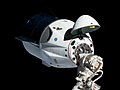 | ||||||
|---|---|---|---|---|---|---|---|
| Hardware | |||||||
| Missions |
| ||||||
| |||||||
| Launch vehicles |
| ||||||||
|---|---|---|---|---|---|---|---|---|---|
| Spacecraft |
| ||||||||
| Test vehicles |
| ||||||||
| Rocket engines | |||||||||
| Lists of missions | |||||||||
| Launch facilities | |||||||||
| Landing sites |
| ||||||||
| Other facilities | |||||||||
| Support |
| ||||||||
| Contracts | |||||||||
| R&D programs | |||||||||
| Key people |
| ||||||||
| Related | |||||||||
* denotes unflown vehicles or engines, and future missions or sites. † denotes failed missions, destroyed vehicles, and abandoned sites.
| |||||||||

Falcon 9
View on GrokipediaDevelopment
Conception and Funding
The Falcon 9 was conceived in late 2005 as SpaceX's medium-lift launch vehicle to support cargo and crew missions to low Earth orbit, particularly for NASA's International Space Station resupply needs via the Dragon spacecraft. Announced in November 2005, the design emphasized vertical integration, in-house manufacturing, and cost reduction through simplified engineering compared to traditional aerospace contractors, with an initial target for first launch in early 2007—delayed to June 2010 due to technical challenges and funding dependencies.[10] The rocket's architecture drew from lessons learned in the smaller Falcon 1 program, scaling up to nine Merlin engines in the first stage for redundancy and higher payload capacity, while prioritizing propulsive landing concepts for eventual reusability, though initial flights focused on reliability over recovery. On September 29, 2011, SpaceX announced a detailed concept for a fully reusable Falcon 9.[11][4] Development funding combined private investment from SpaceX, primarily backed by Elon Musk's personal capital from prior ventures, with milestone-based government contracts. SpaceX invested over $450 million of its own funds into the combined Falcon 9 and Dragon development, exceeding NASA's contributions and reflecting the company's risk-tolerant approach amid near-bankruptcy risks post-Falcon 1 failures in 2006–2008.[12] In September 2006, NASA awarded SpaceX a $278 million Commercial Orbital Transportation Services (COTS) contract under the Space Act Agreement, later expanded to $396 million by 2011, to demonstrate Falcon 9's cargo delivery capabilities through three progressively complex milestones, including orbital insertion, rendezvous, and ISS berthing.[13] This partnership de-risked development by tying payments to verifiable achievements, such as engine tests completed by November 2007, while SpaceX retained intellectual property rights.[4] Subsequent funding solidified via the December 2008 Commercial Resupply Services (CRS) contract, valued at $1.6 billion for at least 12 Dragon missions to the ISS, providing operational revenue to amortize Falcon 9 costs post-certification.[8] Private capital, including Musk's infusions totaling around $100 million initially for SpaceX overall, enabled persistence through early setbacks, underscoring a model where entrepreneurial risk capital complemented selective public milestones rather than full government subsidization. This hybrid approach contrasted with legacy providers' cost-plus contracts, enabling SpaceX to achieve first flight within 4.5 years of conception at a fraction of competitors' per-pound costs.[14]Early Design and Testing
The Falcon 9's initial design emphasized vertical takeoff with potential for propulsive recovery, drawing on lessons from the Falcon 1 program to achieve higher payload capacity through clustered Merlin engines and lightweight aluminum-lithium structures. Development commenced from a clean-sheet approach in November 2005, culminating in the first launch attempt by June 2010, with the first stage configured as a 3.66-meter diameter cylinder housing nine sea-level Merlin 1C engines in a redundant "octaweb" arrangement—eight surrounding a central engine—to enable continued flight despite a single engine failure.[10] The second stage utilized a single Merlin Vacuum engine, with both stages employing RP-1 and liquid oxygen propellants stored in common bulkhead tanks to minimize mass.[4] Merlin engine maturation for Falcon 9 involved extensive ground testing, with test-stand firings of the Merlin 1C variant underway by March 2007 to validate thrust levels exceeding 100,000 lbf per engine under flight-like conditions.[15] By late 2008, SpaceX integrated the engines into the first stage prototype for a full-mission-duration static fire test on November 25, lasting nearly three minutes and producing a combined 855,000 lbf of thrust, confirming structural integrity and throttle control across the cluster.[16] Pre-launch ground testing intensified in early 2010 at Cape Canaveral's Space Launch Complex 40. A scheduled 3.5-second hot-fire static test on March 9 aborted at T-minus 2 seconds due to a high-pressure helium regulator failure, prompting rapid anomaly resolution and system redundancies.[17] The subsequent test on March 13 successfully ignited all nine Merlin 1C engines to full thrust, validating pre-flight readiness without vehicle movement.[4] These efforts underscored SpaceX's iterative testing philosophy, prioritizing empirical validation over simulation to mitigate risks in the unproven engine-out design.Production Scaling
SpaceX established its primary Falcon 9 manufacturing operations at the Hawthorne, California facility in 2008, repurposing a former Northrop Grumman site into a multi-building complex that now spans 10 structures for rocket assembly, engine production, and integration.[18][19] Early production rates were modest, scaling from initial prototypes to one complete Falcon 9 rocket per month by late 2013 to fulfill NASA Commercial Resupply Services contracts and commercial satellite deployments. By the mid-2010s, capacity expanded to support up to 40 first-stage cores annually, enabling a buildup of inventory for higher launch tempos and the introduction of Falcon Heavy.[20][21] The transition to the Block 5 configuration in 2018 marked a pivotal shift in scaling strategy, prioritizing design improvements for booster reusability—such as stronger propellant tanks and simplified refurbishment—over mass production of new first stages. This allowed SpaceX to reduce new booster fabrication to a replacement rate of approximately 2–3 units per year by the early 2020s, as individual boosters achieved up to 31 flights through iterative landings and inspections. In 2017, the Hawthorne factory produced a peak of 15 Block 3 and 4 cores, but post-Block 5 output declined as reuse extended hardware lifespan, with only 9 new Block 5 boosters shipped in 2018 and around 10 planned for 2020.[22][23][24] Second stages, remaining expendable, necessitated continuous production aligned with launch cadence; the Hawthorne facility manufactures one per mission, scaling output to exceed 100 units annually by 2025 to sustain over 130 Falcon family launches in 2024 and projected triple-digit totals thereafter. By November 2022, SpaceX had shipped its 200th second stage, reflecting a near-doubling of production from 2021 levels and a subsequent 67% year-over-year increase to match rising demand from Starlink deployments and government missions. This dual approach—reusability for first stages and high-volume second-stage output—has minimized marginal costs while enabling operational scaling without linear hardware proliferation.[25][26][27]Technical Architecture
First Stage Structure
The first stage of the Falcon 9 is a reusable cylindrical booster powered by nine Merlin 1D engines arranged in a circular pattern at its base, delivering a total sea-level thrust of 7,605 kN (1,710,000 lbf).[2][1] The structure features aluminum-lithium alloy propellant tanks produced via friction stir welding, with a monocoque design for the liquid oxygen (LOX) tank and skin-and-stringer construction for the RP-1 fuel tank, separated by a common dome.[2][1] A double-wall transfer tube facilitates LOX flow between tanks.[2] The stage has a diameter of 3.66 m.[2] The interstage, fixed to the forward end of the first stage tank, consists of a composite overwrapped structure with an aluminum honeycomb core and carbon fiber face sheets, incorporating pneumatic pushers for stage separation.[2] Four titanium grid fins mounted near the top provide aerodynamic control during descent.[2] At the base, four deployable carbon composite landing legs enable propulsive landings on drone ships or ground pads.[2] In the Block 5 configuration, introduced in 2018, the first stage incorporates reinforced tank walls and higher structural margins to support repeated reentries and landings, enabling boosters to achieve 10 or more flights with minimal refurbishment.[2][22] This design prioritizes durability, with the thrust structure and engine integration optimized for both ascent performance and recovery stresses.[1]Second Stage and Propulsion
The Falcon 9 second stage is a single-engine upper stage designed to perform orbital insertion burns after separation from the first stage, delivering payloads to precise trajectories including low Earth orbit, geostationary transfer orbit, and beyond. Constructed as a shorter variant of the first-stage tank set, it utilizes aluminum-lithium alloy skins with aluminum domes, sharing manufacturing techniques, tooling, and materials for cost efficiency and structural integrity under cryogenic conditions. The stage measures 13.8 meters in length and 3.7 meters in diameter, with an empty mass of approximately 3,900 kg.[2][3] It carries about 92,670 kg of cryogenic propellants: liquid oxygen (LOX) as the oxidizer and rocket-grade kerosene (RP-1) as the fuel, stored in pressurized tanks to support engine operation. The stage's propulsion system centers on a single Merlin Vacuum (MVac) engine, a turbopump-fed, gas-generator cycle unit optimized for vacuum performance with a fixed nozzle expansion ratio of 165:1. This engine produces 981 kN (220,500 lbf) of thrust at full power, with a vacuum specific impulse of 348 seconds, enabling burn durations sufficient for mission requirements such as multi-burn profiles for complex orbits.[2][3][28] Ignition reliability for restarts—critical for coast-and-burn sequences—is achieved via dual redundant pyrophoric igniters using triethylaluminum-triethylborane (TEA-TEB), which spontaneously ignite upon propellant flow without external spark systems. The engine throttles down to approximately 64% of maximum thrust (about 140,679 lbf) for velocity adjustments and deorbit maneuvers, including the post-payload deployment Contamination and Collision Avoidance Maneuver (CCAM) to mitigate space debris risks. Attitude control during unpowered coasts and fine pointing is provided by a gaseous nitrogen (GN2) reaction control system, ensuring stability without continuous main engine firing.[2] Iterative enhancements across Falcon 9 versions, such as the transition to Full Thrust (v1.2) and Block 5, have included minor tank volume increases and material optimizations for the second stage, but the core Merlin Vacuum design remains consistent, prioritizing restart capability and efficiency over reusability, as the stage is typically expended after mission completion. This configuration supports payload capacities up to 22,800 kg to low Earth orbit in fully expendable mode, with demonstrated performance in over 300 launches as of 2025.[2][1]Merlin Engine Details
The Merlin engines power both stages of the Falcon 9 rocket, with nine sea-level optimized Merlin 1D engines on the first stage and one Merlin Vacuum engine on the second stage. These engines burn rocket-grade kerosene (RP-1) and liquid oxygen (LOX) in an open gas-generator cycle, where turbopump exhaust gases drive the propellant pumps and are then dumped overboard.[1][4] The design incorporates a pintle-style injector, originally inspired by the Apollo Lunar Module descent engine, which enables deep throttling down to approximately 40-57% of maximum thrust for precise landing maneuvers and orbit insertions.[4][29] Each sea-level Merlin 1D produces approximately 845 kN (190,000 lbf) of thrust at liftoff, contributing to a total first-stage thrust exceeding 7.6 MN (1.7 million lbf) across nine engines.[1] The specific impulse at sea level is 282 seconds, reflecting the trade-offs of the gas-generator cycle's lower efficiency compared to staged combustion engines but prioritizing simplicity, reliability, and cost-effectiveness in development.[30] The Merlin 1D features a regeneratively cooled nozzle and chamber, with the turbopump operating at up to 36,000 RPM to deliver propellants at high chamber pressures around 10.8 MPa.[29] The Merlin Vacuum variant, used on the second stage, employs an extended nozzle to optimize expansion in vacuum conditions, achieving 981 kN (220,500 lbf) of thrust and a specific impulse of approximately 348 seconds.[1] This engine supports multiple restarts, with a nominal burn time of 397 seconds, enabling deployment of payloads to various orbits including geostationary transfer orbits.[31] The nozzle extension increases the engine's expansion ratio, enhancing efficiency but requiring careful integration to avoid flow separation issues during atmospheric ascent.[1] Development of the Merlin engine began in the early 2000s, with initial Merlin 1A tests in 2003 focusing on thrust chamber firings and turbopump validation.[32] Iterative upgrades through versions 1B, 1C, and 1D improved thrust by nearly 50% from early models, reaching full operational capability by 2013 with enhanced reliability for reusability.[33] The engines' high thrust-to-weight ratio, exceeding 150 for the vacuum version, stems from lightweight materials and efficient design, enabling the Falcon 9's reusability paradigm without excessive mass penalties.[33]Fairing and Avionics Systems
The Falcon 9 payload fairing consists of two halves that encapsulate and protect satellites or other cargo during atmospheric ascent.[2] The standard fairing measures 5.2 meters in diameter and 13.2 meters in height, while an extended variant reaches 18.7 meters in height for larger payloads.[2] Constructed as a composite structure with an aluminum honeycomb core sandwiched between carbon fiber face sheets, the fairing provides structural integrity and thermal protection, exhibiting an emissivity of approximately 0.9.[2] [1] Fairing separation occurs approximately three minutes after launch, triggered when aerothermal heating falls below 1,135 W/m², using pneumatic pushers and a helium circuit for low-shock jettison in the standard configuration.[1] [2] SpaceX deploys parachutes to the halves for recovery, initially attempting mid-air catches with nets on support ships before transitioning to soft splashdowns, enabling reuse; by February 2025, fairing halves had been reflown on 307 missions with a 100% success rate in recovery operations.[2] [1] The avionics systems employ a fault-tolerant three-string architecture, incorporating redundant flight computers, GPS receivers, and inertial measurement units (IMUs) for guidance, navigation, and control.[2] These systems manage propulsion controllers, valve operations, pressurization, and stage separation, with the second stage featuring gaseous nitrogen thrusters for attitude control and roll maneuvering.[2] A C-band transponder supports range safety tracking, while an autonomous flight termination system ensures safe abort capabilities.[2] Vehicle software runs on triple-redundant x86 processors executing Linux instances, with flight code implemented in C++ for real-time operations including engine-out detection and trajectory adjustments.[34] The design supports human-rated reliability through hardware-in-the-loop testing and modular control for mission-specific profiles.[2]Version Iterations
v1.0 and v1.1
The Falcon 9 v1.0 represented the initial production variant of the two-stage launch vehicle, with its maiden flight occurring on June 4, 2010, from Cape Canaveral's Space Launch Complex 40, successfully placing a Dragon spacecraft qualification unit into low Earth orbit despite minor second-stage performance shortfalls.[35][36] This version featured a first stage powered by nine Merlin 1C engines arranged in a 3-6-0 configuration, delivering a combined sea-level thrust of approximately 1.1 million pounds-force (4.9 MN).[35][37] The rocket stood about 53 meters tall at liftoff and offered a payload capacity of around 9,000 kg to low Earth orbit (LEO).[37][38] Over five launches between 2010 and early 2013, including the first Commercial Resupply Services missions to the International Space Station, v1.0 demonstrated reliable orbital insertion capabilities, though it lacked provisions for stage recovery.[35] The v1.1 upgrade, introduced to enhance performance and pave the way for reusability experiments, debuted on September 29, 2013, with the CASSIOPE mission from Vandenberg Air Force Base.[39] Key modifications included stretched propellant tanks in both stages for increased fuel volume, Merlin 1D engines replacing the 1C variant with higher thrust—approximately 145,000 lbf (645 kN) per engine at sea level—and an octagonal "octaweb" engine arrangement for improved thrust vector control redundancy.[37][39] The vehicle grew to 69.2 meters in height, achieved about 60% greater liftoff thrust totaling around 1.3 million pounds-force (5.8 MN), and supported payloads up to 10.5 metric tons to LEO, enabling more demanding geostationary transfer orbit insertions like SES-8 in December 2013.[37][35] Additional refinements encompassed redundant flight computers, helium cold-gas thrusters for second-stage attitude control, and structural changes to the interstage and grid fins precursors, though full landing legs were not yet integrated.[40] This iteration flew through 2016, conducting 15 missions with high reliability, setting the stage for subsequent full-thrust developments by optimizing for higher energy missions and initial recovery testing.[35]Full Thrust (v1.2/Block 4)
The Falcon 9 Full Thrust variant, also designated v1.2 and encompassing Block 4 configurations, debuted with its maiden flight on December 22, 2015, carrying the Orbcomm OG-2 Mission 2 payload from Cape Canaveral Space Launch Complex 40.[41] This upgrade from the v1.1 version incorporated higher-thrust Merlin 1D engines, expanded propellant tank volumes through axial stretching, and structural enhancements using aluminum-lithium alloys, yielding approximately 30% greater payload performance overall.[42] The first stage featured nine Merlin 1D engines arranged in an octaweb configuration, delivering a total sea-level liftoff thrust of about 7.75 meganewtons, while the second stage employed a single Merlin 1D Vacuum engine with a stretched tank for increased delta-v capability.[43] These modifications enabled reusable operations with reduced margins in some missions, supporting payloads up to roughly 13 metric tons to geosynchronous transfer orbit in expendable mode.[43] Block 4 iterations refined the Full Thrust design through iterative manufacturing and testing, incorporating stronger interstage materials, upgraded nitrogen cold-gas thrusters for precise reentry control, and enhanced grid fins for improved landing accuracy during booster recoveries.[43] The variant supported densified liquid oxygen propellants to boost density and effective mass fraction, alongside a gross liftoff mass approaching 564 metric tons excluding payload.[43] Reusability was a core focus, with the first Full Thrust booster (B1019) achieving a successful return-to-launch-site landing on its debut flight, marking the initial onshore recovery of an orbital-class booster.[41] Subsequent Block 4 boosters demonstrated progressive reuse, culminating in the historic reflights such as the SES-10 mission on March 30, 2017, which reused a previously flown first stage (B1021) for the first time in orbital launch history.[2] Operationally, Block 4 vehicles flew 36 missions from late 2015 through mid-2018, transitioning from initial validation to routine cadence while advancing recovery techniques like droneship landings for high-velocity ocean returns.[44] Notable achievements included the heaviest geosynchronous transfer orbit payload to date with Hispasat 30W-6 at over 6 metric tons in March 2018, leveraging an expendable first stage configuration.[43] The final Block 4 launch occurred on June 3, 2018, with the SES-12 mission, after which SpaceX shifted to Block 5 for further reusability optimizations like engine thrust upratings and landing leg redesigns.[45] Reliability improved across the series, with no launch failures post-initial development phases, though pad anomalies like the September 2016 AMOS-6 incident highlighted risks in static-fire testing.[2]Block 5 Enhancements
The Falcon 9 Block 5 configuration debuted on May 11, 2018, during the Bangabandhu-1 mission, marking the culmination of iterative upgrades to the Full Thrust (v1.2) architecture with a focus on maximizing reusability, structural durability, and operational reliability while freezing the core design to redirect resources toward Starship development.[22][2] This version incorporates refinements informed by prior flight data, aiming for first-stage reusability targets of 10 flights with minimal refurbishment and up to 100 flights with maintenance, thereby reducing turnaround times to as little as 24-48 hours in operational goals.[46][22] Propulsion enhancements center on uprated Merlin 1D engines, with the first stage generating a total sea-level thrust of 7,686 kN (1.73 million lbf) across nine engines and the second-stage Merlin Vacuum engine producing 981 kN (220,000 lbf) in vacuum—a 5% thrust increase over Block 4 equivalents—achieved through higher chamber pressures and optimized nozzles without altering the overall engine count or layout.[2][22] These changes, combined with slight increases in propellant loading via densification techniques, extend delta-v margins for demanding trajectories while maintaining compatibility with existing infrastructure.[2] Reentry and recovery systems received targeted upgrades for repeated exposure to aero-thermal stresses: grid fins transitioned to cast and machined titanium construction from prior aluminum or steel variants, providing greater temperature resistance and enabling indefinite reuse without deformation or replacement after landings.[22] Enhanced thermal protection coatings and heat shielding encase the engine base and interstage, mitigating plasma heating damage during hypersonic descent and reducing post-flight inspections.[2] Landing legs were redesigned as lighter, self-leveling structures with integrated retraction mechanisms operable by ground crews via latches, eliminating reliance on external clamps for drone-ship stabilization and simplifying disassembly for refurbishment.[46][22] Avionics and structural elements further bolster longevity, including redundant systems, upgraded composite overwrapped pressure vessels (COPVs) for helium storage to prevent rupture risks observed in earlier anomalies, and a bolted octaweb thrust structure for faster engine access during maintenance.[2] Black-painted composite overwrapped components on the interstage, legs, and raceways improve thermal management and visual distinction from legacy boosters.[22] These modifications collectively support human-rating certification under NASA standards, with added safety margins for crewed missions like Crew Dragon, while enabling payload capacities of 22,800 kg to low Earth orbit and sustained launch cadences exceeding 100 annually as demonstrated post-2018.[2][22]Operational Deployment
Launch Infrastructure
SpaceX operates Falcon 9 launches from three dedicated facilities: Launch Complex 39A (LC-39A) at NASA's Kennedy Space Center in Florida, Space Launch Complex 40 (SLC-40) at Cape Canaveral Space Force Station in Florida, and Space Launch Complex 4E (SLC-4E) at Vandenberg Space Force Base in California.[47] These sites feature specialized infrastructure including reinforced launch mounts capable of withstanding the rocket's thrust, water-based sound suppression and deluge systems to mitigate acoustic loads, and umbilical towers for propellant loading, electrical power, and command links.[48] LC-39A, originally constructed in the 1960s for Saturn V rockets, was leased by SpaceX from NASA in December 2014 following modifications that included demolition of legacy structures, installation of a new flame trench and launch platform, and erection of a 300-foot orbital launch mount tower in 2016.[49] The pad supports both Falcon 9 and Falcon Heavy configurations, with additional features like a crew access arm and payload integration hangars. The site's first Falcon 9 mission launched on February 19, 2017, carrying a Dragon spacecraft for the CRS-10 resupply to the International Space Station.[49] SLC-40, formerly used for Titan IV launches, was refurbished by SpaceX starting in 2007 and hosted its initial Falcon 9 flight on June 4, 2010. Following the September 2016 AMOS-6 pad anomaly that destroyed a Falcon 9 booster, SpaceX invested approximately $50 million in upgrades completed by late 2017, including a redesigned launch mount, enhanced deluge system, and improved structural reinforcements to enable higher launch rates.[50] The pad now handles the majority of Falcon 9 missions from Florida, with automated quick-disconnect systems for rapid stack integration and turnaround.[48] SLC-4E at Vandenberg facilitates launches into polar and sun-synchronous orbits, with SpaceX assuming control in 2015 after adapting the pad from Delta II operations. Infrastructure includes a mobile service tower for vertical integration, hold-down posts synchronized to the Merlin engines' ignition sequence, and a flame duct for exhaust diversion. The first Falcon 9 launch from SLC-4E occurred on January 8, 2017, with the Iridium-1 mission.[47] All sites incorporate redundancy in fueling systems and emergency abort capabilities to enhance operational reliability.[48]Mission Chronology and Cadence
The Falcon 9 conducted its inaugural launch on June 4, 2010, from Cape Canaveral Space Launch Complex 40, successfully deploying a Dragon spacecraft qualification unit into low Earth orbit as a demonstration of the rocket's baseline capabilities.[10] This flight marked the culmination of development starting from a clean-sheet design in November 2005, achieving orbital insertion on the first attempt despite prior challenges with the smaller Falcon 1 vehicle.[10] Subsequent early missions focused on refining reliability, with the v1.0 variant completing five flights total between 2010 and March 2013, including the first operational cargo delivery to the International Space Station via the CRS-1 mission on October 8, 2012.[35] Launch cadence remained low during this period, averaging fewer than three per year, constrained by iterative hardware improvements and certification requirements for NASA Commercial Resupply Services contracts.[35] Transition to the v1.1 configuration in late 2013 enabled expanded payload capacity and stretched the rocket's operational envelope, yielding six launches in 2014 despite a June 2015 failure during CRS-7 that destroyed the payload due to a strut failure in the second stage.[35] A pivotal milestone arrived on December 21, 2015, with the first successful propulsive landing of a Falcon 9 first stage post-orbital insertion during the ORBCOMM-2 mission, initiating the reusability paradigm that would drive cadence growth by reducing turnaround times and costs. Routine recoveries followed, with eight launches in 2016 and 18 in 2017, as SpaceX iterated on landing precision and booster refurbishment; by 2017, missions included the first reflight of a recovered booster on March 30 during SES-10.[51] The introduction of Block 5 in 2018 standardized reusability features like improved grid fins and stronger landing legs, facilitating 21 launches that year and accelerating to 26 in 2020, which included the first crewed orbital flight with Demo-2 on May 30.[52] Cadence surged thereafter amid Starlink constellation deployments and commercial demand, reaching 61 launches in 2022, 96 in 2023, and a record 138 Falcon family missions in 2024, predominantly Falcon 9.[7] In 2025, SpaceX sustained elevated tempo, achieving its 500th Falcon 9 launch in July and surpassing 133 missions by late October, with projections exceeding 140 for the year enabled by booster reuse rates averaging 10-20 flights per core.[52][53] Entering 2026, the milestone of the 600th Falcon 9 mission occurred on February 14 with a launch from Vandenberg Space Force Base deploying 24 Starlink satellites; SpaceX referenced the Valentine's Day occasion by tweeting "Falcon 9, will you be my Valentine?" with the phrase also featured in launch commentary: "Go Starlink Falcon 9. Will you be my valentine?".[54] This progression reflects causal factors like vertical integration, rapid prototyping, and market dominance in small-to-medium lift, outpacing competitors by factors of 10-20 in annual flights while maintaining a 99%+ success rate across 600+ missions as of February 2026.[7][55]| Year | Approximate Falcon 9 Launches | Key Factors Influencing Cadence |
|---|---|---|
| 2010-2013 | 5 (v1.0 total) | Developmental testing and NASA certification delays.[35] |
| 2014-2016 | 6-8 annually | v1.1 upgrades; initial recovery attempts post-2015 CRS-7 anomaly.[35] |
| 2017-2019 | 13-21 annually | Routine landings; Block 5 qualification.[7] |
| 2020-2022 | 26-61 annually | Crewed flights; Starlink ramp-up.[52] |
| 2023-2025 | 96+ annually | Reusability maturity; high-volume manifests.[53][7] |
Key Missions and Payloads
The Falcon 9's inaugural flight took place on June 4, 2010, from Cape Canaveral Space Launch Complex 40, deploying the Dragon spacecraft qualification unit into low Earth orbit to validate orbital insertion capabilities.[10] This mission marked the rocket's debut as a medium-lift vehicle capable of handling diverse payloads, paving the way for subsequent NASA contracts. The first operational cargo delivery to the International Space Station occurred during the SpaceX CRS-1 mission on October 7, 2012, with the Dragon cargo variant carrying approximately 882 kg of supplies, experiments, and equipment to the orbiting laboratory. These early missions demonstrated Falcon 9's reliability for crewed precursor operations, achieving a successful splashdown recovery of the Dragon capsule. Reusability milestones began with the first successful first-stage landing on December 21, 2015, during the ORBCOMM-2 mission, which deployed 11 second-generation OG2 communication satellites into a 725 km orbit; the booster touched down vertically at Landing Zone 1 after orbital payload delivery.[56] The historic reflights of recovered boosters commenced with the SES-10 mission on March 30, 2017, launching the SES-10 geostationary communications satellite to serve Latin America from a supersynchronous transfer orbit, utilizing the previously flown B1021 core from the CRS-8 mission.[57] This achievement validated the structural integrity and performance of refurbished hardware, reducing launch costs through iterative reuse. Crewed missions highlighted Falcon 9's human-rating, with the Demo-2 flight on May 30, 2020, from Kennedy Space Center Launch Complex 39A, carrying NASA astronauts Douglas Hurley and Robert Behnken aboard the Crew Dragon Endeavour to the ISS for a 64-day stay, marking the first U.S. crewed orbital launch since the Space Shuttle retirement.[58] Subsequent operational crew rotations, such as Crew-1 in November 2020, have utilized Falcon 9 for regular NASA astronaut transport under the Commercial Crew Program. Private human spaceflight debuted with the Inspiration4 mission on September 15, 2021, launching four civilians in a Crew Dragon to a 585 km orbit for three days, the first all-civilian orbital crew.[59] Major payload deployments include the initial Starlink constellation batch on May 24, 2019, which lofted 60 v1.0 satellites into a 550 km shell for global broadband internet coverage, initiating SpaceX's satellite internet network now comprising thousands of spacecraft across numerous Falcon 9 missions. Commercial geostationary satellite launches, such as Arabsat-6A in April 2019 and AMOS-17 in August 2019, showcased Falcon 9's geosynchronous transfer orbit performance with payloads exceeding 6,000 kg. By October 2025, Falcon 9 has executed over 400 missions, with key payloads encompassing national security satellites like NROL-87 in 2022 and ongoing ISS resupply under CRS-2 contracts totaling more than 30 flights.[60]Reusability Framework
Booster Recovery Operations
Falcon 9 booster recovery operations center on propulsive vertical landings of the first stage following payload deployment. After separation from the upper stage, typically at altitudes around 70-100 km, the booster performs a flip maneuver using nitrogen cold gas thrusters to reorient engine-downward. For return-to-launch-site (RTLS) profiles, a boostback burn reignites select Merlin engines to reverse trajectory toward the launch pad; downrange missions omit this burn to conserve propellant for maximal payload mass. Subsequent entry and landing burns further decelerate the stage, achieving touchdown velocities under 5 m/s.[1][61] Aerodynamic control during reentry relies on four hypersonic grid fins mounted near the interstage, constructed from titanium for heat resistance, which vector lift by adjusting descent trajectory and attitude. These fins, actuated hydraulically, enable precise guidance without additional fuel expenditure. Four carbon fiber landing legs deploy pneumatically seconds before touchdown, providing stability on landing zones or drone ships. The process demands synchronized propulsion from up to three engines during the final landing burn, with onboard avionics handling real-time adjustments via GPS and inertial measurements.[1][2] RTLS landings occur at concrete pads like Landing Zone 1 or 2 at Cape Canaveral Space Force Station, reserved for lighter payloads where fuel margins permit the ~200-300 km return flight. Drone ship landings, on vessels such as Of Course I Still Love You or A Shortfall of Gravitas, support heavier missions by positioning recovery ~600-1000 km downrange in oceanic zones, reducing boostback fuel needs by up to 20-30% of reserves. The choice optimizes performance: RTLS sacrifices ~3-4% payload capacity relative to expendable profiles, while drone ships align closer to full capability.[62][63] The inaugural successful booster recovery was an RTLS on December 21, 2015, during the Orbcomm-2 mission from Cape Canaveral, demonstrating feasibility after prior test failures. SpaceX took approximately five years from the Falcon 9's initial flight in 2010 to achieve this first successful land-based recovery in late 2015, following multiple prior failures in recovery attempts. By August 2025, SpaceX had executed over 400 drone ship landings, with overall recovery success exceeding 95% across thousands of attempts since inception. Post-landing, crews secure the booster via clamps, defuel residuals, and transport it—drone ship recoveries via ocean tow to port, then road haul; RTLS via crawler—to facilities in Florida or Texas for nondestructive testing, engine removal, and refurbishment, enabling reuse within 1-2 months. Reflown boosters have maintained 100% mission success as of early 2025. SpaceX achieved this reliability through engineering iteration following early recovery failures, particularly the hard landings and explosions of 2015-2016. Teams analyzed flight data to pinpoint issues in engine restarts, attitude control, and landing mechanisms, leading to design optimizations such as titanium grid fins for improved heat resistance and steering, enhanced variable thrust on Merlin engines for finer deceleration control, and advanced thermal shields to safeguard components during atmospheric reentry. High-frequency testing, including rapid ground simulations and successive flights, facilitated quick implementation of fixes, transitioning to over 99% success rates and enabling extensive booster reusability.[56][62][2][1]Fairing and Upper Stage Recovery
The Falcon 9 payload fairings, two carbon fiber halves measuring 13.1 meters in height and 5.2 meters in diameter, protect the upper stage and satellite during ascent through the atmosphere. Jettisoned approximately three minutes after liftoff at altitudes exceeding 100 km, the fairings separate via pneumatic pushers and deploy steerable parafoils along with cold gas thrusters to achieve a controlled descent velocity of around 5 m/s for ocean splashdown. Recovery operations utilize specialized vessels equipped with cranes, such as GO Ms. Tree and GO Ms. Chief, which locate the fairings via GPS and retrieve them from the water; early efforts included net-based mid-air catches, but SpaceX shifted to "wet recovery" after determining that water landings facilitate easier refurbishment without compromising structural integrity.[1] [64] [65] Fairing recovery development accelerated after debris from early missions washed ashore in 2015, leading to upgrades like reinforced attachment points and recovery hardware. The first intact recoveries occurred during the STP-2 mission on June 25, 2019, with both halves retrieved undamaged. Initial reuse followed on November 11, 2019, during a Starlink deployment, and by 2025, recovered fairings have supported hundreds of missions, with individual halves achieving up to 15 or more flights after cleaning, non-destructive testing, and minimal repairs. This reusability yields cost savings of approximately $6 million per set, representing about 10% of a standard Falcon 9 launch expense, while enabling faster launch cadences through reduced manufacturing demands. Success rates exceed 90% for recoverable trajectories, though failures occur due to parachute malfunctions or rough seas.[64] [66] [67] Upper stage recovery, in contrast, remains unrealized for Falcon 9 operations. SpaceX President Gwynne Shotwell announced plans in 2017 for soft-water landings of the second stage by late 2018, leveraging propulsive descent akin to first-stage methods. These efforts were ultimately canceled owing to prohibitive engineering hurdles: reentry speeds surpassing 7 km/s demand robust heat shielding, adding hundreds of kilograms that erode payload margins by 10-20%; retained propellant for landing further diminishes performance; and the impending Starship program, designed for full reusability including upper stages, rendered Falcon 9 upgrades uneconomical. Falcon 9 upper stages, comprising a Merlin 1D Vacuum engine and aluminum-lithium tanks, execute deorbit burns post-payload deployment to target uninhabited ocean zones, ensuring atmospheric disposal without recovery attempts. This approach prioritizes reliability and debris mitigation over marginal cost benefits, given the stage's lower value relative to boosters.[68] [69]Reusability Performance Data
Falcon 9 first-stage boosters have demonstrated high reusability, with 523 successful landings out of 546 recovery attempts as of late 2025, achieving a 95.79% success rate.[7] Block 5 boosters, operational since 2018, exhibit even greater reliability, recording 499 landings from 505 attempts for a 98.81% rate.[7] These figures reflect iterative improvements in landing precision, grid fin control, and cold gas thruster performance, enabling consistent propulsive recoveries on drone ships or landing pads.[70] Cumulative booster reuses total 488 instances, underscoring the scalability of refurbishment processes that inspect structural integrity, replace worn components like heat shield tiles, and test Merlin engines without full overhauls for low-wear flights.[7] The most flights by a single booster reached 31 for B1067, surpassing prior records set in 2025 through phased certifications extending operational limits from an initial 10 flights to 40.[7][71] Refurbishment turnaround averages approximately 40 days, with some boosters achieving reflight in under 30 days via streamlined inspections focused on flight data telemetry rather than exhaustive disassembly.[72]| Metric | Value | Source |
|---|---|---|
| Total Booster Landings | 523/546 (95.79%) | [7] |
| Block 5 Landings | 499/505 (98.81%) | [7] |
| Booster Reuses | 488 | [7] |
| Maximum Flights per Booster | 31 (B1067) | [7] |
| Average Turnaround Time | ~40 days | [72] |
| Certification Limit | Up to 40 flights | [71] |
Capabilities Assessment
Payload and Performance Specs
The Falcon 9 Block 5 first stage is powered by nine Merlin 1D engines, generating 7,686 kN of thrust at sea level, while the second stage employs a single Merlin Vacuum engine producing 981 kN of vacuum thrust.[2] Specific impulse for the first-stage engines stands at approximately 311 seconds at sea level, with the second-stage engine achieving 348 seconds in vacuum.[2] The Falcon 9 Block 5 typically reaches the Kármán line at 100 km altitude in approximately 3.6 minutes after liftoff, consistent with ascent profiles for modern orbital launch vehicles which generally cross this boundary in 3-4 minutes. The vehicle measures 70 meters in height and 3.7 meters in diameter, with a launch mass of 549,054 kg.[1] Payloads are typically encapsulated in a 5.2-meter diameter fairing, either standard (13.1 meters usable length) or extended (for larger satellites), which separates after second-stage ignition.[2] The vehicle supports partial reusability of the first stage and fairing.[1] Payload capacity varies by orbit, launch site inclination (typically 28.5°–55° from Cape Canaveral or Vandenberg), and reusability profile, with expendable mode maximizing mass to orbit by forgoing booster recovery.[2] Reusability reserves propellant for first-stage landing, reducing capacity: return-to-launch-site (RTLS) missions prioritize proximity landings but limit performance, while drone ship landings enable higher payloads due to extended range. Typical reusable configurations yield approximately 17,500 kg to LEO and 5,500 kg to GTO.[1] As of 2025, the majority of Falcon 9 launches employ partial reusability via drone ship, with expendable profiles rare except for high-mass or high-energy missions.[2]| Configuration | LEO (kg) | GTO (kg) |
|---|---|---|
| Expendable | 22,800 | 8,300 |
| RTLS | 13,000 | 4,850 |
| Drone Ship Landing | 18,300 | 6,400 |
Reliability and Anomaly Analysis
The Falcon 9 launch vehicle has achieved a mission success rate of approximately 99.5% across more than 550 flights as of October 2025, reflecting iterative design refinements and robust telemetry analysis following early anomalies.[75] This rate encompasses full successes where payloads reach intended orbits, with Block 5 variants—introduced in 2018—exhibiting near-perfect performance at approximately 99.77%.[76] Reliability stems from causal factors such as engine-out redundancy in the first stage's nine Merlin engines, enabling continued ascent despite single or dual failures, and comprehensive pre-flight testing that identifies potential issues prior to launch.[2] Major anomalies have been infrequent but instructive, primarily concentrated in early development phases. The most significant in-flight failure occurred on June 28, 2015, during the CRS-7 mission, when a second-stage composite overwrapped pressure vessel (COPV) ruptured at T+139 seconds due to a failed steel strut under dynamic loads, causing loss of vehicle and payload.[77] A pre-launch anomaly on September 1, 2016, during static fire testing for the AMOS-6 mission, resulted from autoignition of liquid oxygen within a COPV, triggered by accumulated friction heat in the helium pressurant system; this incident destroyed the vehicle on the pad and prompted redesigns including improved COPV liners and fill protocols.[78] These events, analyzed via high-fidelity telemetry and physical testing, led to hardware upgrades that eliminated recurrence, with no comparable COPV failures in subsequent hundreds of missions.| Date | Mission | Anomaly Type | Root Cause | Corrective Actions |
|---|---|---|---|---|
| June 28, 2015 | CRS-7 | In-flight failure | Strut fatigue leading to COPV burst | Enhanced strut materials and qualification testing; refined second-stage helium system architecture[77] |
| September 1, 2016 | AMOS-6 | Pre-launch explosion | COPV autoignition from helium-induced friction | COPV redesign with PEEK liners, slower fill rates, and acoustic monitoring[78] |
Redundancy and Engine-Out Capability
The Falcon 9 first stage utilizes nine Merlin 1D engines in a clustered configuration—eight surrounding a central engine—to achieve propulsion redundancy during ascent. This arrangement enables the vehicle to tolerate the failure or shutdown of up to two engines while maintaining sufficient thrust and control to reach orbit for the majority of missions, a capability derived from the engines' individual throttlability (down to 40% thrust) and gimballing for vectoring.[2][81] The design prioritizes statistical reliability through multiplicity rather than perfecting a single large engine, as clustering proven smaller units reduces development risk and cost compared to scaling up for inherent fault tolerance in fewer engines.[82] This engine-out capability has been validated in flight, including a Merlin engine shutdown during the October 8, 2012, CRS-1 mission (Falcon 9 v1.0 Flight 3), where the vehicle compensated via remaining engines and completed payload delivery to the International Space Station without loss of mission objectives.[83] No first-stage engine cluster failures have resulted in mission termination across more than 500 launches as of October 2025, underscoring the robustness of the redundant architecture under operational stresses like high cadence and reusability.[84] The second stage employs a single Merlin 1D Vacuum engine with dual redundant igniters for restart reliability, providing limited propulsion redundancy focused on ignition rather than outage tolerance, as the stage operates in vacuum post-separation.[85] Overall, the system's redundancy stems from empirical testing and iterative design refinements at SpaceX's facilities, emphasizing fault-tolerant control algorithms that redistribute thrust and attitude via the flight computer in real-time.[2]Commercial Dynamics
Pricing and Contract Models
SpaceX structures Falcon 9 launch contracts as firm fixed-price agreements, encompassing vehicle procurement, payload integration, range coordination, and third-party liability insurance, with dedicated mission managers overseeing execution from award through post-flight analysis.[2] Pricing is negotiated case-by-case and not publicly fixed, but commercial dedicated launches to low Earth orbit have been quoted at approximately $67 million as of 2022-2023, reflecting adjustments for inflation and materials amid high reusability rates.[86][87] Government contracts, such as those with NASA or the U.S. Space Force, command premiums for enhanced reliability certification and custom requirements, averaging $92-103 million per mission in recent awards.[88][89] Rideshare programs target small satellite deployments, leveraging surplus capacity on dedicated customer flights or Transporter missions to sun-synchronous orbits, with pricing at roughly $6,000-6,500 per kilogram as of 2023-2025, enabling costs as low as $325,000 for minimal payloads.[90][91][92] These models prioritize volume over marginal dedicated pricing, though underutilization of primary payload mass on some missions limits per-kilogram efficiencies for rideshare participants.[93] Early NASA Commercial Resupply Services contracts, awarded in 2008 for $1.6 billion across multiple Falcon 9/Dragon missions, established fixed-price precedents that subsidized development while enforcing cost discipline.[4] Subsequent U.S. government awards, like 2025 Space Force selections at $143 million per mission for select Falcon 9 tasks, underscore premiums for national security payloads despite reusability-driven internal cost reductions estimated below $30 million per flight.[94][95]Cost Reductions from Reusability
Reusability in the Falcon 9 primarily targets the first-stage booster, which comprises the majority of the vehicle's manufacturing expenses, enabling SpaceX to amortize these costs across multiple launches rather than expending a new booster per mission. This approach contrasts with traditional expendable rockets, where the full production cost is incurred for each flight. By recovering and refurbishing boosters, SpaceX reduces the per-launch cost attributable to the booster from its full build price—estimated at around $25–30 million—to a fraction after the initial use, incorporating refurbishment expenses that are significantly lower.[96][97] As of October 2025, Falcon 9 boosters have demonstrated exceptional durability, with the record set at 31 flights for booster B1067 and many active boosters averaging over 10 missions. This high reuse rate translates to substantial savings; for instance, amortizing a $30 million booster over 10 flights, with refurbishment costs estimated at $1–5 million per turnaround, yields an effective booster cost per launch of under $5 million after the first flight. SpaceX reports 488 booster reuses to date, underscoring the scalability of this model in driving down marginal costs. Elon Musk has noted that recovery and reuse operations add less than 10% to the cost of a new booster, while payload penalties from landing propellant are around 40% or less.[6][7][98] The overall marginal cost for a reused Falcon 9 launch has been estimated by Musk at approximately $15 million, encompassing a new second stage (about $10 million), propellant ($200,000–300,000), and operations, compared to over $50–60 million for an expendable equivalent prior to widespread reusability. This reduction has not been fully reflected in customer pricing, which remains around $67–70 million, allowing SpaceX to achieve higher margins and fund further development, but it has undeniably lowered the internal economics of space access. Analyses indicate per-booster savings approaching $450 million through extensive reuse, enabling competitive pricing and increased launch cadence.[99][100][101]Rideshare and Multi-Manifest Programs
SpaceX's SmallSat Rideshare Program deploys small satellites via Falcon 9 launches, offering standardized interfaces for payloads up to ESPA-class size and targeting orbits such as Sun-Synchronous Orbit (SSO) on dedicated Transporter missions.[92] Initiated with pricing expansions in September 2019, the program set rates as low as $1 million for up to 200 kg, enabling access for operators unable to afford full Falcon 9 manifests costing around $62 million.[102][103] By March 2023, base pricing rose to $6,500 per kg after prior adjustments from $5,500 per kg, with a minimum of $325,000 for 50 kg to SSO and proportional rates for additional mass or alternative orbits like mid-inclination LEO, GTO, or TLI.[90][92] The inaugural Transporter-1 mission launched on January 24, 2021, from Cape Canaveral, deploying a record 143 spacecraft into SSO, including CubeSats and microsats from over 30 operators.[103] Follow-on missions maintained high payload counts, such as Transporter-2 on June 30, 2021, from SLC-40, which carried diverse smallsats via dispensers compatible with the program's guidelines.[104] By June 2025, Transporter-14 achieved liftoff from SLC-40 with 70 customer payloads to SSO, demonstrating sustained cadence amid growing demand.[105] These missions utilize flight-proven dispensers and separation systems, with payloads integrated via third-party providers like Exolaunch, which handled 59 satellites across 30+ customers on Transporter-15 in September 2025.[106] Multi-manifest configurations extend rideshare opportunities beyond dedicated Transporter flights, pairing secondary small payloads with primary missions to optimize vehicle capacity. For instance, on August 26, 2025, Falcon 9 launched a primary Luxembourg-based Earth imaging satellite alongside seven rideshare payloads from various operators, illustrating shared fairing use without dedicated smallsat focus.[107] Such arrangements, governed by the Rideshare Payload User's Guide, accommodate ESPA-compatible spacecraft on non-SSO trajectories, including GTO or mid-inclination orbits via Bandwagon-series missions.[108] This approach has facilitated over 1,000 smallsat deployments cumulatively by 2024, yielding per-kilogram costs orders of magnitude below traditional dedicated launches while leveraging Falcon 9's reusability for operational efficiency.[92][109]Controversies and Scrutiny
Technical Failures and Root Causes
The Falcon 9 launch vehicle has achieved a high success rate, with only two full in-flight failures, two partial failures, and one pre-flight destruction amid over 400 launches as of February 2026. These incidents prompted detailed investigations by SpaceX, the Federal Aviation Administration (FAA), and NASA, revealing root causes tied to structural weaknesses, pressure vessel anomalies, and fluid system leaks, often addressed through design modifications and enhanced testing protocols.[77][110] On June 28, 2015, during the CRS-7 mission, the Falcon 9 v1.1 experienced a catastrophic failure 139 seconds after liftoff from Cape Canaveral, resulting in the loss of the Dragon spacecraft and its cargo bound for the International Space Station. Telemetry data indicated an overpressure event in the second-stage liquid oxygen (LOX) tank, causing structural rupture and vehicle breakup. SpaceX's investigation identified the proximate cause as the failure of a single axial strut securing a helium composite overwrapped pressure vessel (COPV) inside the LOX tank; the strut, designed for a 2,000-pound load, separated under dynamic flight loads around 200 pounds due to manufacturing defects in its adhesive bonds. A NASA Independent Review Team corroborated this, noting the strut failure liberated the COPV, which then impacted the tank wall, initiating the pressure spike; they emphasized that while SpaceX's root cause analysis was credible, broader strut qualification testing deficiencies contributed, leading to redesigned struts with improved materials and non-destructive evaluation.[77][111][112] The September 1, 2016, AMOS-6 pre-launch anomaly destroyed a Falcon 9 Full Thrust booster and its payload satellite during a static-fire test on Pad 39A at Kennedy Space Center, with the explosion occurring in the second-stage LOX tank. SpaceX's multi-month investigation, supported by FAA oversight, pinpointed a COPV breach as the initiator: gaseous oxygen accumulated in a void between the COPV's carbon-fiber overwrap and polymer liner during LOX loading and pressurization, leading to friction-induced ignition and rapid energy release that propagated to the tank's aluminum-LOX interface. This "oxygen fire" mechanism, distinct from prior COPV issues, stemmed from inadequate void management in the manufacturing process; remedial actions included refined COPV loading sequences, enhanced non-destructive inspections, and material tweaks to prevent liner-overwrap separation.[110][113] More recently, on July 11, 2024, during the Starlink Group 9-3 mission, a Falcon 9 Block 5 upper stage suffered an in-flight anomaly post-payload deployment, failing its deorbit burn and leaving the stage in an unintended orbit. Initial analysis by SpaceX indicated a LOX leak in the Merlin Vacuum engine's pneumatic system, causing insufficient thrust and attitude control loss; the leak originated from a cracked pressure line interface, exacerbated by thermal stresses during ascent. The FAA-mandated investigation confirmed no public safety risks but required corrective actions like improved line inspections and redundancy enhancements before resuming flights on July 27, 2024. This event, while not resulting in payload loss, highlighted vulnerabilities in reused upper-stage components under high-cycle operations.[114][115] On February 2, 2026, during a Starlink mission launched from Vandenberg Space Force Base, the Falcon 9 Block 5 upper stage experienced an off-nominal condition after deploying its payload of satellites, failing to perform the planned deorbit burn and leaving the stage in an unintended orbit. SpaceX conducted an investigation, resulting in a brief stand-down, and returned to flight successfully on February 7, 2026, with another Falcon 9 launch from Vandenberg Space Force Base. The FAA reviewed the mishap, confirming no public safety risks, with corrective actions implemented prior to resumption.[116][117]| Incident | Date | Vehicle Version | Root Cause | Consequences and Fixes |
|---|---|---|---|---|
| CRS-7 | June 28, 2015 | v1.1 | Defective strut failure liberating COPV in second-stage LOX tank | Mission loss; redesigned struts with better bonding and testing[77] |
| AMOS-6 | September 1, 2016 | Full Thrust | COPV oxygen accumulation and ignition in LOX tank during static fire | Pad/vehicle destruction; updated COPV processes and inspections[110] |
| Starlink 9-3 | July 11, 2024 | Block 5 | LOX leak from cracked engine pressure line | Partial failure (upper stage orbit); enhanced line integrity checks[114] |
| Starlink mission | February 2, 2026 | Block 5 | Off-nominal upper stage condition | Partial failure (deorbit failure); brief stand-down, investigation, and resumption of flights[116][117] |
Regulatory Delays and FAA Interactions
The Federal Aviation Administration (FAA) regulates commercial space launches under its Office of Commercial Space Transportation, mandating mishap investigations for Falcon 9 flights involving anomalies that could impact public safety, such as engine failures, stage malfunctions, or recovery issues. These probes require SpaceX to submit root cause analyses, corrective actions, and data, often resulting in temporary groundings until the FAA approves license modifications or return-to-flight determinations. While Falcon 9 has achieved over 350 successful launches since 2010 with a reliability exceeding 98%, isolated anomalies have triggered such reviews, contributing to schedule disruptions amid SpaceX's high-cadence operations.[1] In 2024, the FAA grounded the Falcon 9 fleet three times due to second-stage and recovery anomalies. On July 11, a liquid oxygen leak in the second stage during Starlink Group 9-3 deployment caused 20 satellites to enter a decaying orbit, leading to a nationwide grounding on July 12; SpaceX identified the issue as a cracked pressure line liner and implemented hardware changes, with the FAA closing the investigation via license amendment by late August after 50 days. On August 28, a booster hard landing during the Starlink Group 8-6 mission prompted another grounding, resolved within three days on August 31 after SpaceX's rapid anomaly review and FAA concurrence on corrective actions. The third incident occurred on September 29 post-Crew-9 launch, where an off-nominal deorbit burn due to a faulty attitude control thruster risked uncontrolled reentry; the FAA grounded operations on September 30, enforcing a full investigation that delayed returns until October 11, when corrective software and hardware mitigations were verified.[119][120] These episodes highlighted tensions between FAA oversight and SpaceX's iterative development model, with company president Gwynne Shotwell noting in congressional testimony that regulatory timelines can extend beyond necessary safety margins, potentially hindering U.S. competitiveness against less-regulated foreign providers.[47] The FAA has countered that its processes align with statutory requirements under 51 U.S.C. § 509, emphasizing empirical risk assessments over expediency, though average mishap closure times averaged 93 days in recent years despite targets of 120.[121] No public safety incidents resulted from these Falcon 9 events, but they deferred dozens of missions, including commercial and national security payloads, underscoring the trade-offs in balancing rapid reusability with federal accountability.[122]Environmental Claims and Labor Critiques
SpaceX maintains that the Falcon 9's booster reusability substantially mitigates environmental impacts by reducing the need for manufacturing new first stages for each mission, thereby lowering resource extraction, energy use in production, and associated emissions compared to expendable launch vehicles.[123] Life-cycle assessments indicate that reusable rocket fleets, such as those employing Falcon 9's design principles, can achieve lower carbon footprints per kilogram of payload to orbit, particularly when optimizing propellant choices and recovery rates exceeding 75% of hardware value.[124][125] Critiques, however, emphasize that reusability enables higher launch cadences—Falcon 9 conducted over 100 missions in 2023 alone—which amplify per-site effects like sonic booms from booster landings, atmospheric injection of black carbon and aluminum oxides potentially harming stratospheric ozone, and noise pollution disrupting local ecosystems.[126] At Vandenberg Space Force Base, U.S. Fish and Wildlife Service monitoring linked Falcon 9 launches to disturbances in southern sea otters and western snowy plovers abandoning nesting sites, prompting calls for stricter mitigations amid plans for up to 120 annual launches.[127] Federal Aviation Administration environmental assessments for Falcon 9 operations, such as at SLC-40, have repeatedly issued findings of no significant impact after mitigations like launch window restrictions, though environmental groups contend these reviews insufficiently model cumulative long-term effects from orbital debris accumulation and frequent reentries.[128][48] Labor critiques of Falcon 9 production center on allegations of a high-pressure manufacturing environment at SpaceX's Hawthorne facility, where rapid iteration for reusable boosters has been linked to safety oversights and retaliatory practices. Former technician Jason Blasdell sued in 2017, claiming wrongful termination after raising concerns about managerial decisions affecting rocket assembly quality and worker safety.[129] In 2025, two ex-employees filed federal lawsuits alleging firings after reporting work-related injuries and inadequate accommodations during Falcon 9 component fabrication, including failure to address ergonomic hazards and pressure to work through pain.[130][131] The National Labor Relations Board charged SpaceX in January 2024 with unlawfully terminating eight employees in 2022 for circulating an open letter decrying CEO Elon Musk's distractions from core engineering priorities, including Falcon 9 reliability efforts; the letter argued such behavior undermined recruitment and retention in a field demanding intense focus.[132][133] SpaceX countered by suing the NLRB, asserting its structure violates separation of powers through unremovable administrative law judges and board members, a claim validated in August 2025 when the Fifth Circuit Court of Appeals enjoined proceedings, deeming the agency's framework likely unconstitutional and halting enforcement against the company.[134][135] This legal standoff underscores broader disputes over whether SpaceX's non-union model, emphasizing merit-based advancement and long hours to meet launch schedules, fosters innovation or enables suppression of dissent on labor standards.[136]Broader Influence
Market Disruption and Economic Impacts
The introduction of reusable first stages on the Falcon 9 has fundamentally disrupted the commercial launch market by enabling significantly lower per-launch costs and higher flight rates compared to traditional expendable rockets. Prior to widespread reusability, launch costs for medium-lift vehicles typically exceeded $150 million per mission, but Falcon 9 reusable launches have been priced at approximately $67 million, representing a reduction of up to 65% relative to disposable alternatives like the ULA Atlas V, which costs around $160 million.[137][138] This cost advantage stems from recovering and refurbishing up to 75% of the vehicle's value, including the first stage and fairings, allowing SpaceX to amortize manufacturing expenses over multiple flights—boosters have achieved up to 30 reuses by mid-2025, yielding 70-80% overall cost savings.[125][139] Falcon 9's dominance is evident in its market share, capturing over 87% of global orbital launch mass in 2024 through the Falcon family, with 134 launches that year, including 45 for commercial and government customers.[140] This high cadence—enabled by rapid turnaround times and reliability exceeding 99%—has eroded competitors' positions, compelling entities like United Launch Alliance (ULA) and Arianespace to pursue partial reusability programs such as Vulcan Centaur and Ariane 6, though these lag in cost competitiveness, with ULA missions still priced substantially higher.[95] SpaceX's pricing, starting at $62 million for standard Falcon 9 missions, has pressured rivals to cut rates or risk contract losses, as seen in U.S. Department of Defense awards favoring Falcon 9 over more expensive options despite certification hurdles.[87][141] Economically, Falcon 9's model has democratized access to space, reducing cost per kilogram to low Earth orbit to about $2,720, facilitating mega-constellations like Starlink and spurring investment in downstream satellite industries.[142] While SpaceX retains substantial margins without fully passing savings to customers—due to limited competition—the net effect has been a contraction in legacy providers' revenues and a shift toward vertical integration in the sector, with reusability driving broader innovation despite initial skepticism from established players reliant on government-subsidized expendable systems.[89][95]Comparisons to Legacy Systems
The Falcon 9's partial reusability distinguishes it from legacy expendable launch vehicles such as the Ariane 5, Delta IV, Atlas V, and Proton-M, which discard all stages after each flight, leading to higher per-launch costs dominated by new hardware fabrication. By recovering and refurbishing the first stage—capable of up to 20 or more flights per booster—the Falcon 9 achieves effective marginal costs far below those of expendable systems, where each mission requires complete vehicle replacement. This approach has empirically reduced the cost per kilogram to low Earth orbit (LEO) to approximately $2,500–$2,720/kg for Falcon 9, compared to $10,500/kg for Ariane 5 and $13,100/kg for Delta IV Heavy.[137][143] Launch pricing reflects these efficiencies: a Falcon 9 mission typically costs $62–67 million, versus $150–175 million for Ariane 5, $350 million for Delta IV Heavy, $100–180 million for Atlas V (depending on configuration), and $65–100 million for Proton-M.[87][143] While legacy providers cite government subsidies and specialized payloads as partial justifications for higher prices, the Falcon 9's commercial pricing model—driven by high-volume production and rapid turnaround—has pressured competitors, with expendable systems unable to match reusability-driven marginal cost reductions without similar innovations.[95] In payload performance, the Falcon 9 Block 5 delivers up to 22,800 kg to LEO in reusable mode (or 26,000 kg expendable), comparable to Ariane 5's 20,000 kg to LEO or Atlas V's 18,850 kg maximum, but with superior geostationary transfer orbit (GTO) flexibility at 8,300 kg reusable.[143] Legacy vehicles like Proton-M offer similar GTO capacity (around 6,500 kg) but at lower reliability and higher failure risks due to less iterative testing. Reliability metrics underscore Falcon 9's edge: over 350 successful launches by mid-2025 yield a success rate exceeding 98%, surpassing Ariane 5's 95% (from 117 flights) and Proton-M's historical 90–95% amid corrosion and quality issues in Russian manufacturing.[137] Delta IV and Atlas V achieve 95–100% rates in fewer flights, but their low cadence (under 10 per year combined) contrasts with Falcon 9's 100+ annual launches, enabling rapid anomaly resolution through flight data accumulation.[138]| Launch Vehicle | Approx. Cost per Launch (USD) | Payload to LEO (kg, max) | Reusability | Success Rate (%) | Typical Annual Launches (peak era) |
|---|---|---|---|---|---|
| Falcon 9 Block 5 | 62–67 million | 22,800 (reusable) | First stage (10–20+ flights) | >98 | 100+ |
| Ariane 5 | 150–175 million | 20,000 | None | 95 | 8–10 |
| Delta IV Heavy | 350 million | 28,800 | None | 100 (limited flights) | 2–4 |
| Atlas V | 100–180 million | 18,850 | None | >95 | 5–10 |
| Proton-M | 65–100 million | 22,800 | None | 90–95 | 10–15 |
Role in SpaceX Ecosystem Evolution
The Falcon 9 rocket has served as the cornerstone of SpaceX's operational ecosystem, transitioning the company from a nascent entrant reliant on expendable launches to a vertically integrated entity capable of sustaining high-cadence missions and funding ambitious downstream programs. Introduced in 2010 with its first successful orbital flight, Falcon 9 evolved through variants—including v1.1, Full Thrust, and the standardized Block 5 configuration introduced in 2018—that prioritized booster recovery via propulsive landings on drone ships or ground pads, achieving over 310 successful landings and 284 reuses by mid-2024. This reusability regime drastically lowered marginal launch costs, enabling SpaceX to conduct 73 missions in 2023 alone and surpass 500 Falcon family launches by the second quarter of 2025, a cadence unattainable with traditional expendable rockets.[141][52][144] Falcon 9's reliability—evidenced by a 99.18% success rate across hundreds of flights—directly facilitated the maturation of complementary systems within SpaceX's ecosystem. It has been the primary launcher for the Dragon family of spacecraft, supporting NASA contracts under the Commercial Resupply Services and Commercial Crew programs since 2012, which delivered consistent revenue streams estimated to contribute billions annually through the mid-2020s and validated human spaceflight capabilities with Crew Dragon's debut orbital crewed mission in 2020. Concurrently, Falcon 9's capacity for deploying large satellite batches underpinned the rapid buildup of the Starlink constellation, with missions accounting for the majority of launches by 2025; for instance, a single October 2025 flight added 28 V2 Mini satellites to an orbiting network exceeding 8,600 units, generating substantial income from broadband services that offset development costs for broader initiatives.[141][145][146][144] In the broader evolutionary arc, Falcon 9's proven reusability and launch tempo provided the financial and engineering foundation for Starship's development, with revenues from Falcon operations—totaling around $4.2 billion in 2024 launches—subsidizing parallel R&D into fully reusable heavy-lift systems aimed at Mars colonization. The iterative refinements in Falcon 9, such as grid fin deployments for precise recoveries and reduced turnaround times to weeks, instilled a culture of rapid prototyping and data-driven improvements that permeates SpaceX's infrastructure, including in-house engine production and autonomous flight software, ensuring Falcon 9 remains the reliable workhorse even as Starship prototypes undergo testing. This progression underscores Falcon 9's causal role in scaling SpaceX's ecosystem from government-dependent contracts to a self-sustaining model blending commercial satellite deployments, crewed operations, and interplanetary ambitions.[147][95]References
- spaceflightnow.com/2024/08/28/faa-grounds-spacexs-falcon-9-rocket-following-landing-mishap/