



Community hub
Recent from talks
Contribute something
Nothing was collected or created yet.
California State University, Fresno
View on Wikipedia
California State University, Fresno (branded as Fresno State) is a public university in Fresno, California, United States. It is part of the California State University system.[8] The university had a fall 2020 enrollment of 25,341 students.[4] It offers 60 bachelor's degree program, 45 master's degree programs, 3 doctoral degree programs, 12 certificates of advanced study, and 2 different teaching credentials.[9][10] The university is classified among "R2: Doctoral Universities – High research activity".[11][12] Fresno is a Hispanic-Serving Institution (HSI)[13] and is eligible to be designated as an Asian American Native American Pacific Islander-Serving Institution (AANAPISI).[14]
Key Information


The university's facilities include an on-campus planetarium, on-campus raisin and wine grape vineyards, and a commercial winery where student-made wines have won over 300 awards since 1997.[15][16] Members of Fresno State's nationally ranked equestrian team[17] have the option of housing their horses on campus, next to indoor and outdoor arenas. Fresno State has a 50,000-square-foot (4,600 m2) Student Recreation Center[18] and the third-largest library (by square footage) in the California State University system.[19]
History
[edit]California State University, Fresno was founded as the Fresno State Normal School in 1911 with Charles Lourie McLane as its first president.[20] It was one of about 180 "normal schools" founded by state governments to train teachers for the rapidly growing public common schools. Some closed but most steadily expanded their role and became state colleges in the early 20th century and state universities in the late 20th century.[21]
.jpg)
The original campus was what is now Fresno City College. In 1956, Fresno State moved its campus to its present location in the northeast part of the city; FCC bought the old campus and moved back in.[22] It became Fresno State College in 1949, when it was authorized to grant bachelor's degrees. It became a charter institution of the State College System of California, forerunner of the California State University System, in 1961. In 1972, the name was officially changed to California State University, Fresno.[20]
Even after changing its official name to "California State University, Fresno", the school has long been called "Fresno State" for short, particularly in athletics. In recent years, "Fresno State" has been accepted as first reference for news stories. The university now recommends use of "Fresno State" in most contexts, stating "California State University, Fresno is the official name, but should only be used for specific audiences or international audiences."[23]
Campus
[edit]The greater campus extends from Valley Children's Stadium on the west boundary to Highway 168 on the east side. The University Agricultural Laboratory designates the northern boundary of the campus, while Shaw Avenue designates the southern edge.
Fresno State Library
[edit]
The Fresno State Library is a main resource for recorded knowledge and information supporting the teaching, research, and service functions of Fresno State.[24]
The library was opened in 2009. It houses 1,000,000 books in its 327,920 sq ft (30,465 m2).[25] The shelves amount to over 20 miles (32 km) in length.[25] It is currently the third largest library in the CSU system (in terms of square footage) and the largest academic building on the Fresno State campus.[25] The five-story building features seating areas for almost 4,000 people, group study rooms, wireless Internet access and a Starbucks.[26]
The Fresno State Library features a number of special collections such as the Arne Nixon Center, a research center for the study of children's and young adult literature, and the Central Valley Political Archive.[27]
Michael Gorman, the former dean of the Library, was the president of the American Library Association in 2005–2006.[28]
Academics
[edit]| 2023 | 2022 | 2021 | 2020 | 2019 | 2018 | 2017 | 2016 | 2015 | 2014 | 2013 | 2012 | |
|---|---|---|---|---|---|---|---|---|---|---|---|---|
| Freshman Applicants | 29,936 | 18,682 | 15,231 | 15,488 | 18,122 | 18,476 | 17,920 | 18,735 | 19,938 | 18,956 | 17,580 | 16,242 |
| Admits | 25,671 | 17,703 | 14,816 | 15,446 | 10,501 | 10,630 | 10,646 | 10,031 | 10,406 | 11,256 | 10,523 | 9,444 |
| % Admitted | 85 | 95 | 97 | 90 | 58 | 58 | 59.4 | 53.5 | 59.8 | 59.9 | 58.1 | 60.4 |
| Enrolled | 7,536 | 3,426 | 3,428 | 3,679 | 3,331 | 3,534 | 3,447 | 3,258 | 3,674 | 3,532 | 3,265 | 3,139 |
| Average GPA[a] | 3.45 | 3.52 | 3.49 | 3.48 | 3.57 | 3.53 | 3.46 | 3.46 | 3.34 | 3.35 | 3.31 | 3.30 |
| Average SAT Composite[b] | 1001 | 1023 | 1007 | 1007 | 1041 | 1028 | 949 | 915 | 905 | 915 | 928 | 930 |
Fresno State was the first of all 23 CSU campuses to offer an individual-campus doctorate.[34] At the graduate level, Fresno State also offers the following nationally ranked programs: part-time MBA, Physical Therapy, Nursing, Speech-Language Pathology, and Social Work.
A joint doctoral program in collaboration with San Jose State University for a Doctor of Nursing Practice (DNP) degree is administered through Fresno State.[35]
In May 2019, the university saw the largest graduating class in its history, with over 6,200 graduates.[36]
Accreditation
[edit]
California State University, Fresno is accredited by the WASC Senior College and University Commission. The five engineering programs in the Lyles College of Engineering are each accredited by the Engineering Accreditation Commission of ABET. The Craig School of Business is AACSB accredited. The university is classified by the U.S. Federal government as an Asian American Native American Pacific Islander-Serving Institution (AANAPISI),[37] and a Hispanic-serving institution (HSI) because the Hispanic undergraduate full-time-equivalent student enrollment is greater than 25%.[38]
Schools and colleges
[edit]
- Jordan College of Agricultural Sciences and Technology
- College of Arts and Humanities
- Craig School of Business
- Kremen School of Education and Human Development
- Lyles College of Engineering
- College of Health and Human Services
- College of Science and Mathematics
- College of Social Sciences
Smittcamp Family Honors College
[edit]The Smittcamp Family Honors College is a program providing top high school graduates a fully paid President's Scholarship, which includes tuition and housing, as well as other amenities for the duration of their studies. Admission to the Smittcamp Family Honors College is highly competitive. Candidates must have a minimum 3.8 GPA, rank in the top 10% of their high school graduating class, or have a combined SAT score of 1200 or an average ACT English and Mathematics score of 27.[39]
Smittcamp Honors Scholars must also complete rigorous academic and community service requirements. Smittcamp Honors College students receive priority registration for all courses, regular interaction with the university president, and special honors recognition at commencement.[40]
Rankings
[edit]| Academic rankings | |
|---|---|
| National | |
| Forbes[41] | 185 |
| U.S. News & World Report[42] | 179 |
| Washington Monthly[43] | 22 |
| WSJ/College Pulse[44] | 337 |
| Global | |
| U.S. News & World Report[45] | 1391 |
| Top Performers on Social Mobility | 31 |
| Best Undergraduate Engineering Programs | 44 (At schools where doctorate not offered) |
| Top Public Schools | 97 |
| Best Colleges for Veterans | 124 |
| Nursing | 254 |
| Economics | 255 |
| Program | Ranking |
|---|---|
| Rehabilitation Counseling | 33 |
| Physical Therapy | 132 |
| Public health | 137 |
| Social Work | 142 |
| Speech–Language Pathology | 175 |
| Public Affairs | 179 |
- In its 2022 rankings, U.S. News & World Report ranked Fresno State 250th out of 443 U.S. national universities and tied for 124th in its ranking of 227 "Top Public Schools".[48]
- In its 2022 rankings, U.S. News & World Report also ranked Fresno State tied for 30th in "Top Performers on Social Mobility" among national universities and tied for 49th in the nation in its "Best Undergraduate Engineering Programs" at schools where doctorates are not offered.[49]
- Money magazine ranked Fresno State 62nd in the country out of 739 schools evaluated for its 2020 "Best Colleges for Your Money" edition[50] and 40th in its list of the 50 best public schools in the U.S.[51]
- In 2024, Washington Monthly ranked Fresno State 22nd out of 438 schools on its National Universities list, and 9th on the social mobility rankings. Washington Monthly assesses the quality of schools based on social mobility, research, and promoting public service.
- In 2025, Forbes magazine's "America's Top Colleges" list ranked Fresno State 185th out of 500 universities, liberal arts colleges, and service academies nationwide. Fresno State was also ranked 82nd among public colleges and 42nd in the west.
- In 2017, U.S. News & World Report ranked Fresno State first in the nation in its list of best public universities in graduation rate performances.[52]
Student life
[edit]| Race and ethnicity[53] | Total | ||
|---|---|---|---|
| Hispanic | 61.3% | ||
| White | 14.6% | ||
| Asian | 11.7% | ||
| Foreign national | 3.6% | ||
| Black | 3.0% | ||
| Unknown | 2.8% | ||
| Two or more races | 2.6% | ||
| Native American | 0.3% | ||
| Native Hawaiian/Pacific Islander | 0.1% | ||
| Economic diversity[54] | |||
| Low-income[c] | 59% | ||
| Affluent[d] | 41% | ||
Student Involvement Center
[edit]The Student Involvement Center[55] provides services, programs and co-curricular educational activities.[56] Some key events the Student Involvement Center plan are Convocation, Homecoming Week, and Commencement.
Fraternity and sorority life
[edit]- Fraternities and sororities has been part of Fresno State for nearly one hundred years and includes 42 single-sex fraternities and sororities consisting of over 1,420 men and women.[57] The Student Involvement Center is charged with advising the four Greek Councils at Fresno State: the Interfraternity Council (IFC), the Panhellenic Association (PHA), the National Pan-Hellenic Council (NPHC), and the United Sorority & Fraternity Council (USFC).
Associated Students, Inc. (ASI)
[edit]ASI is the recognized student body government at Fresno State.[58] Twenty students are elected each year and serve annual terms.[59] ASI provides funding for student-related projects on campus and grants for graduate and undergraduate student research and projects.[58]
Student Recreation Center
[edit]

In February 2006, the Student Recreation Center opened. Construction costs were paid for and operating funds are derived from a semester student-use fee. While an Association entity, the Student Recreation Center is under the direction of the Division of Student Affairs. The Student Recreation Center is adjacent to the Save Mart Center arena.[60] The center has four full-size basketball courts, dance and fitness studios.[60]
University Student Union
[edit]The original student union was opened in 1968; it was built to accommodate a studenty body of 10,000 students. The building is 52,000 square feet and has three levels.[61]
Athletics
[edit]
.jpg)
Fresno State is a member of the NCAA Division I Mountain West Conference. The university's 22 varsity sports teams are known as the Bulldogs, and the school's colors are cardinal red and blue. Fresno State has made several runs at NCAA tournaments in basketball, football, soccer, tennis, baseball, softball, and volleyball.
In 2017, Fresno State resurrected its wrestling program after an 11-year hiatus.[62] joining the Big 12 Conference.[63] The Bulldogs added equestrianism, recognized as a women-only sport in the NCAA Emerging Sports for Women program, to their Big 12 membership in 2019.[64] Fresno State dropped three sports at the end of the 2020–21 school year—women's lacrosse, men's tennis, and wrestling for a second time.[65] The equestrian program remains in the Big 12.
The Fresno State–San Diego State football rivalry is an American college football rivalry between the Fresno State Bulldogs football team of Fresno and San Diego State Aztecs football team of San Diego State University. The winner of the game receives the "Old Oil Can" trophy.
Media
[edit]FresnoStateNews is an online source of information about current events affecting Fresno State students, faculty and staff.[66]
The FresnoState Magazine is published twice per year from the Office of University Communications. It is both a print and online publication that features current events at Fresno State, Alumni Association events and alumni achievements.[67]
The Collegian is the campus student-run newspaper. It is published during the fall and spring semesters. The online edition features video, podcasts and photo galleries.[68]
KFSR Radio is the campus radio station. KFSR's broadcast license is owned by California State University, Fresno. KFSR is a listener-supported, non-profit, public radio station. It broadcasts at 90.7 FM and streams online at www.kfsr.org. It operates 24 hours a day, 365 days a year, and plays jazz, blues and a wide range of specialty shows.
Fresno State Focus is the campus student-run, weekly broadcast put on by the Media, Communications, and Journalism department. The news team changes each semester, and has been involved in several projects that extend beyond the campus.[69]
ROTC
[edit]Two branches of the military are represented on campus at Fresno State: Army and Air Force. The Army unit on campus is known as the Bulldog Battalion.[70] The Air Force ROTC Detachment on campus, Detachment 35, is one of the oldest in the nation. Founded in 1948, only one year after the signing of the National Defense Act of 1947 which established the U.S. Air Force as a separate branch of the military, Detachment 35 has won numerous awards.[71] In July 2008, Detachment 35 was awarded the "High Flight" award, naming it the top mid-sized detachment in the entire southwest region of the United States. Just a few months later, Detachment 35 was named best mid-sized detachment in the nation and awarded the "Right of Line" award, the highest honor for a detachment.[72]
Alumni
[edit]A number of notable Fresno State alumni have served in state and federal positions, become major athletes, or found their mark in business and media, including Paul George, basketball athlete and Joy Covey, the original CFO of Amazon.com.[73]
- Notable Fresno State alumni include:
-

-
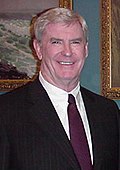
 Timothy P. White, the seventh chancellor of the California State University
 -
-
 Cruz Bustamante, former American politician
 -
 Ashley Swearengin, former mayor of Fresno and current president and CEO of the Central Valley Community Foundation
 -

-
 Jim Nielsen, currently serving in the California State Senate
 -
 Jim Costa, American politician
 -
 Gary Soto, poet and novelist
 -
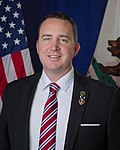 Devon Mathis, member of the California State Assembly
 -
 David Carr, American former professional football athlete
 -
![Davante Adams, professional football player[74]](//upload.wikimedia.org/wikipedia/commons/thumb/9/9c/Davante_Adams.jpg/250px-Davante_Adams.jpg) Davante Adams, professional football player[74]
Davante Adams, professional football player[74] -
 Derek Carr, professional football player
 -
 Trent Dilfer, professional football player and analyst
 -
 Aaron Judge, professional baseball player
 -
 Ryan Mathews, professional football player
 -
 Lane Kiffin, professional football coach


![Davante Adams, professional football player[74]](https://en.wikipedia.org/wiki/File:Davante_Adams.jpg)


.JPG)

Notes
[edit]- ^ Average High School GPA of Applicants
- ^ On a 1600 Scale
- ^ The percentage of students who received an income-based federal Pell grant intended for low-income students.
- ^ The percentage of students who are a part of the American middle class or wealthier.
References
[edit]- ^ As of June 30, 2024. "Public NCSE Tables". www.nacubo.org. Retrieved May 23, 2025.
- ^ "2024-25 Changes Impacting Fresno State's Operating Fund Budget" (PDF). California State University, Fresno. Archived (PDF) from the original on February 25, 2025. Retrieved November 24, 2024.
- ^ "Data" (PDF). Fresno State Facts 2024. Retrieved May 24, 2025.
- ^ a b c d "Data". Fresno State University. Retrieved May 24, 2025.
- ^ "Five-Year Capital Improvement Program 2013/14 through 2017/18" (PDF). California State University. p. 61. Archived (PDF) from the original on September 23, 2015. Retrieved March 30, 2013.
- ^ "College Navigator - California State University-Fresno". nces.ed.gov.
- ^ "Primary Colors". California State University, Fresno Office of University Brand Strategy and Marketing. Archived from the original on March 7, 2019. Retrieved March 13, 2019.
- ^ "America's Top Colleges". Forbes. Retrieved March 1, 2015.
- ^ "Master's Degrees". fresnostate.edu. Archived from the original on March 20, 2014. Retrieved April 12, 2014.
- ^ "Credential Programs". fresnostate.edu. Archived from the original on March 20, 2014. Retrieved April 12, 2014.
- ^ "California State University-Fresno". Indiana University. 2022. Retrieved January 31, 2022.
- ^ Radke, Charles (February 24, 2022). "Carnegie elevates Fresno State's research classification". Fresno State News. Retrieved November 2, 2023.
- ^ Bell, Lisa (October 30, 2023). "State Department designates Fresno State as a Fulbright HSI leader". Fresno State News. Retrieved November 2, 2023.
- ^ "College of Social Sciences". socialsciences.fresnostate.edu. Retrieved November 2, 2023.
- ^ "Fresno State wines win record 49 medals". Western Farm Press. September 8, 2009.
- ^ "Pride Points, Unique Facilities, Hands-on". Fresno State website. California State University, Fresno. Retrieved April 25, 2014.
- ^ "NCEA 2013–2014 Rankings". National Collegiate Equestrian Association. March 24, 2014.
- ^ "Facility". auxiliary.com. Archived from the original on September 8, 2019. Retrieved April 12, 2014.
- ^ "Systemwide Digital Library Content | CSU". Calstate.edu. Archived from the original on February 24, 2019. Retrieved August 18, 2014.
- ^ a b [1] Archived February 10, 2009, at the Wayback Machine
- ^ Christine Ogren, The American State Normal School: 'An Instrument of Great Good' (Palgrave Macmillan, 2005) pp. 1–5, 213–235; online.
- ^ [2] Archived August 20, 2008, at the Wayback Machine
- ^ "Editorial Style Guide". University Marketing and Communications, Fresno State. Archived from the original on February 27, 2021. Retrieved May 17, 2024.
- ^ "Academics". fresnostate.edu. Archived from the original on March 20, 2014. Retrieved April 12, 2014.
- ^ a b c "Facilities Management". Csufresno.edu. Archived from the original on April 9, 2012. Retrieved March 1, 2015.
- ^ "Fresno State Library". Csufresno.edu. Archived from the original on June 19, 2015. Retrieved March 1, 2015.
- ^ [3] Archived December 19, 2008, at the Wayback Machine
- ^ Anonymous (June 17, 2011). "Michael Gorman recounts his library life in new memoir". News and Press Center. Retrieved January 28, 2018.
- ^ "Applicants, Admits, Enrolleesfrom Fall 2011 to Fall 2016". California State University, Fresno. Retrieved May 8, 2017.
- ^ "First-Time Freshmen High School GPA from Fall 2011 to Fall 2016". California State University, Fresno. Retrieved May 8, 2017.
- ^ "First-Time Freshmen SAT Composite (M+CR) Scores from Fall 2011 to Fall 2016". California State University, Fresno. Archived from the original on March 2, 2021. Retrieved May 8, 2017.
- ^ "Workbook: Applicants". tableau.fresnostate.edu. Retrieved November 2, 2023.
- ^ "Workbook: Application_with systemwide". tableau.calstate.edu. Retrieved November 7, 2024.
- ^ "Fresno State". calstate.edu. Archived from the original on February 18, 2020. Retrieved July 20, 2010.
- ^ "SJSU and Fresno State Launch Joint Doctor of Nursing Practice Program". SJSU Today. Archived from the original on February 22, 2014. Retrieved September 8, 2016.
- ^ "University Commencement Ceremony". fresnostate.edu. Retrieved September 19, 2019.
- ^ "NCATE Accreditation". California State University, Fresno. Archived from the original on April 24, 2014. Retrieved April 24, 2014.
- ^ "HACU Member Hispanic-Serving Institutions (HSIs)". Hispanic Association of Colleges and Universities. Retrieved March 1, 2015.
- ^ "President's Honors Scholarship Application". fresnostate.edu. Retrieved March 1, 2015.
- ^ "President's Honors Scholarship Information". fresnostate.edu. Retrieved March 1, 2015.
- ^ "America's Top Colleges 2025". Forbes. September 6, 2025. Retrieved October 3, 2025.
- ^ "2025-2026 Best National Universities Rankings". U.S. News & World Report. September 23, 2025. Retrieved October 3, 2025.
- ^ "2024 National University Rankings". Washington Monthly. August 25, 2024. Retrieved August 29, 2024.
- ^ "2025 Best Colleges in the U.S." The Wall Street Journal/College Pulse. September 4, 2025. Retrieved October 3, 2025.
- ^ "2025-2026 Best Global Universities Rankings". U.S. News & World Report. June 17, 2025. Retrieved June 17, 2025.
- ^ "California State University - Fresno Rankings". U.S. News & World Report. Retrieved September 24, 2020.
- ^ "California State University–Fresno - U.S. News Best Grad School Rankings". U.S. News & World Report. Retrieved September 24, 2020.
- ^ "2022 Top Public Schools -National Universities". U.S. News & World Report. Retrieved March 20, 2023.
- ^ "California State University – Fresno Rankings". U.S. News & World Report. Retrieved September 25, 2020.
- ^ "The Best Colleges in America, Ranked by Value". Money. August 25, 2020.
- ^ "Best Public Colleges". Money. August 25, 2020. Archived from the original on November 19, 2021. Retrieved September 25, 2020.
- ^ "U.S. News ranks Fresno State as nation's best public university – The Collegian". September 14, 2016. Archived from the original on October 4, 2018. Retrieved October 15, 2018.
- ^ "Headcount Enrollment from Fall 2021 to Fall 2024". Retrieved May 24, 2025.
- ^ "College Scorecard: California State University-Channel Islands". United States Department of Education. Retrieved May 8, 2022.
- ^ "Student Involvement". fresnostate.edu. Retrieved June 15, 2018.
- ^ "Fresno State Student Involvement Core Purpose, Values and Mission" (PDF). Retrieved June 14, 2018.
- ^ "Greek Life". fresnostate.edu. Archived from the original on June 15, 2018. Retrieved June 15, 2018.
- ^ a b "ASI Home". csufresno.edu. Archived from the original on October 15, 2007. Retrieved February 22, 2010.
- ^ "Documents & Information". Archived from the original on February 10, 2010. Retrieved April 12, 2014.
- ^ a b "Student Recreation Center". California State University, Fresno. Archived from the original on February 13, 2018. Retrieved April 22, 2014.
- ^ "University Student Union". fresnostate.edu. Retrieved September 20, 2019.
- ^ "Fresno State Wrestling Makes Its Return - FloWrestling". www.flowrestling.org. November 20, 2017. Retrieved November 2, 2023.
- ^ "Big 12 Wrestling Championship - Big 12 Conference". big12sports.com. Retrieved November 2, 2023.
- ^ "Fresno State Joins Big 12 Equestrian" (Press release). Big 12 Conference. May 2, 2019. Retrieved May 17, 2024.
- ^ "Fresno State Athletics Announces Program Changes" (Press release). Fresno State Bulldogs. October 16, 2020. Retrieved October 17, 2020.
- ^ "The official news site of Fresno State. Complete coverage of all major news events at California State University, Fresno". FresnoStateNews.com. Retrieved March 1, 2015.
- ^ "FresnoState Magazine – Interactive Version". Fresnostatenews.com. Archived from the original on April 13, 2010. Retrieved March 1, 2015.
- ^ "The Collegian | Fresno State's student-run newspaper since 1922". Collegian.csufresno.edu. Archived from the original on April 8, 2005. Retrieved March 1, 2015.
- ^ "Meet The Fresno State Focus Crew". Fresno State Focus. May 6, 2022. Retrieved November 2, 2023.
- ^ "Department of Military Science & Leadership Army ROTC". California State University, Fresno. Retrieved April 20, 2014.
- ^ Uribes, Tom (June 27, 2014). "New Commander for AFROTC Detachment". Fresno State News. Retrieved March 7, 2015.
- ^ "Air Force ROTC". Csufresno.edu. June 3, 2014. Archived from the original on April 14, 2012. Retrieved March 1, 2015.
- ^ Streitfeld, David (September 19, 2013). "Former Amazon Executive Dies in Bicycle Accident". The New York Times. Archived from the original on November 29, 2014. Retrieved April 22, 2014.
- ^ "Davante Adams (WR): Bio, News, Stats & more". Las Vegas Raiders. Retrieved September 29, 2022.
External links
[edit]
- Official website

- Fresno State Athletics website
- "Interim Committee of Twenty-Five of the California Conference on Government and Taxation—Report on The Fresno State College (Report No. 56)," September 13, 1937

Located in: Fresno, California | |||||||
| Facilities | | ||||||
| Athletics |
| ||||||
| Related | |||||||


_logo.svg)

36°48′48″N 119°45′00″W / 36.81333°N 119.75000°W
| International | |
|---|---|
| National | |
| Geographic | |
| Artists | |
| Other | |
California State University, Fresno
View on GrokipediaCalifornia State University, Fresno, commonly referred to as Fresno State, is a public university located in Fresno, California, that serves as the central higher education hub for the agriculturally dominant San Joaquin Valley.[1] Founded in 1911 as Fresno State Normal School to train teachers, it evolved into a comprehensive institution offering advanced degrees by 1949 and integrated into the 23-campus California State University system.[2] With a total enrollment of approximately 24,000 students, primarily undergraduates, the university emphasizes accessible education for diverse populations, including as a Hispanic-Serving Institution.[3][4] Fresno State provides over 100 degree programs at the bachelor's and master's levels, with select doctoral offerings, particularly excelling in fields aligned with regional needs such as agricultural sciences, viticulture, engineering, and business, the latter holding AACSB accreditation.[5] As the leading producer of bachelor's degrees in the Central Valley, it welcomed its largest-ever incoming class in fall 2024, underscoring its role in workforce development amid the area's economic reliance on farming and related industries.[6] The institution has garnered recognition for social mobility and public service, ranking second nationally in Washington Monthly's 2025 assessment of universities promoting access and outcomes for underrepresented students.[7] Despite these strengths, Fresno State has faced significant scrutiny over its handling of sexual misconduct and harassment complaints, including high-profile cases involving leadership that contributed to the resignation of former CSU Chancellor Joseph I. Castro in 2022 and prompted system-wide Title IX reforms in 2024.[8][9] These incidents highlight institutional challenges in accountability and compliance, as documented in independent audits and lawsuits alleging retaliation and inadequate investigations.[10][11]
History
Founding and Early Development (1911–1949)
The Fresno State Normal School was founded in April 1911 through a state appropriation of $10,000 to train teachers for California's public schools, particularly in the underserved Central Valley region.[12] Classes opened on September 11, 1911, with 150 students enrolled in a two-year curriculum focused exclusively on teacher preparation, all programs administered under a single Division of Education.[12][13] Charles L. McLane served as the inaugural president from 1911 to 1927, overseeing operations from the initial campus at University and North Van Ness avenues in Fresno.[14][15] In 1916, the Old Administration Building was constructed as the school's first permanent facility, symbolizing its commitment to institutional growth amid shared facilities with the adjacent Fresno Junior College, which McLane had helped establish the prior year.[16] Statewide reforms in 1921 converted normal schools into four-year teachers colleges, enabling Fresno State to award bachelor's degrees and expand its pedagogical focus while incorporating foundational courses in subjects like psychology.[17][18] The institution's library was established at inception to support educational training, reflecting the era's emphasis on resource-backed instruction.[19] Successive leadership under Frank W. Thomas from 1927 to 1948 fostered incremental development, including curriculum diversification beyond strict teacher training, though enrollment and facilities remained modest relative to later expansions.[15] By the late 1940s, accumulated changes in scope and structure prompted a 1949 redesignation to Fresno State College, marking the end of its normal school phase.[20]Transition to College Status and Growth (1949–1972)
In 1949, Fresno State Teachers College was renamed Fresno State College and authorized to confer bachelor's degrees in fields beyond teacher education, marking its evolution from a primarily vocational normal school to a comprehensive liberal arts institution. This transition coincided with the introduction of advanced degree programs, including the first master's degrees awarded that year. Under President Arnold E. Joyal, who served from 1948 to 1964, the college began offering graduate-level education in disciplines such as English and speech arts.[21][22][23] The postwar period brought rapid physical and academic expansion, driven by California's population boom and increased demand for higher education. The institution relocated its agricultural operations to the current Shaw Avenue campus in 1954, followed by the dedication of the new main campus in 1958 after $30 million in construction. Key facilities included the Music Building (opened 1954), the central Library Building (opened 1956 with capacity for 250,000 volumes), and subsequent library expansions in 1963 and 1968 that increased holdings to 750,000 volumes. Enrollment surged, reaching approximately 7,000 students by 1957, reflecting broader state investments in public colleges amid the baby boom generation's entry into higher education.[22][14] Administrative reorganization supported this growth: the college shifted from divisions to structured schools in 1965, including the School of Agriculture and School of Arts and Sciences, while joining the State College System of California as a charter institution around 1963. By the late 1960s, facilities like the University Student Union (opened 1968, designed for 10,000 students) underscored the scale of development. President Norman A. Baxter, serving from 1970, oversaw the final phase before the 1972 redesignation as California State University, Fresno, aligning it with the restructured statewide system.[14][22][24][23]Modern University Era and Key Milestones (1972–present)
In 1972, Fresno State College was redesignated California State University, Fresno, coinciding with the California State College system's statewide transition to university status, which facilitated broader graduate education and research capacities.[25][17] This change reflected the institution's maturation amid California's expanding higher education demands, with enrollment already surpassing 15,000 students by the late 1960s and continuing upward trajectory into the university phase. Under president Harold H. Haak (1980–1991), the university prioritized infrastructure and program diversification, laying groundwork for subsequent expansions in faculty and student services amid state budget fluctuations.[23] John D. Welty's extended tenure (1991–2013) marked a period of accelerated growth, including enhanced academic offerings in fields like agriculture and health sciences; enrollment exceeded 20,000 for the first time in fall 2001, underscoring the campus's role as a regional access point for higher education.[23][26] Welty's initiatives emphasized retention and program quality, contributing to the development of specialized centers focused on Central Valley industries such as viticulture. Joseph I. Castro's presidency (2013–2020) advanced student success metrics through targeted advising and pathway reforms, aligning with systemwide graduation initiatives amid fiscal recoveries post-recession.[23] Saúl Jiménez-Sandoval, appointed in 2021, has steered efforts toward enrollment vitality and community partnerships, yielding a record incoming undergraduate cohort of 6,541 in fall 2024—comprising 3,676 freshmen and 2,865 transfers—bolstering the university's output of bachelor's degrees in the Central Valley.[6] Total headcount has approached 25,000, reflecting sustained demand despite statewide enrollment pressures.[27] Academic milestones include the establishment of three doctoral programs by the 2010s, concentrating over half of such offerings in select colleges and supporting advanced training in education, physical therapy, and related disciplines.[28] Facilities expansions, such as library digitization projects commencing in 2014, have preserved institutional records while enhancing research access.[29] These developments affirm Fresno State's evolution into a comprehensive public university, prioritizing empirical workforce alignment over expansive research ambitions typical of elite institutions.Campus and Facilities
Location and Physical Layout
California State University, Fresno is situated at 5241 North Maple Avenue, Fresno, California 93740, on the northeast edge of the city near the foothills of the Sierra Nevada mountains.[30] [31] The main campus encompasses 388 acres (157 hectares) in a large urban environment, with coordinates approximately 36.8133° N, 119.7461° W.[3] [32] An adjacent 1,011-acre (409-hectare) University Farm supports agricultural and veterinary programs, bringing the total controlled land to about 1,399 acres.[31] [3] The campus layout centers on a core academic quadrangle surrounded by administrative, classroom, and laboratory buildings, many constructed between the mid-20th century and present day, totaling over 46 structures on the main site.[33] Residential halls and student housing are positioned to the north and east, while athletic facilities, including Bulldog Stadium and the Save Mart Center arena, occupy southern and eastern peripheries.[34] The design incorporates green spaces, including an arboretum with more than 100 tree species integrated throughout the grounds.[35] Parking lots and service roads facilitate access, with strict enforcement of permits.[30] The University Farm, located separately, features specialized units for livestock, crops, and research, distinct from the compact main campus configuration.Academic and Support Buildings
The academic buildings at California State University, Fresno, encompass a mix of older structures that have undergone remodeling and newer facilities designed to support teaching, research, and departmental operations across the university's colleges. Approximately 62% of campus buildings exceed 60 years in age, reflecting ongoing maintenance challenges amid deferred infrastructure needs.[36] Key academic facilities include those dedicated to science, engineering, business, and other disciplines, often featuring specialized laboratories, classrooms, and faculty offices to facilitate hands-on learning and interdisciplinary collaboration. In the College of Science and Mathematics, the Science Building houses upper-division and graduate-level teaching and research spaces for the Biology and Chemistry departments, including specialized labs, departmental offices, and small classrooms emphasizing close student-faculty interaction.[37] Adjacent, the Science II Building, completed in fall 2004, contains classrooms, teaching labs, and offices for Computer Science, Earth and Environmental Sciences, and Psychology, along with the dean's office; it features a central courtyard for events and science-themed murals depicting prehistoric life forms installed in March 2005.[37] McLane Hall, one of the campus's original buildings, has been remodeled multiple times to include general chemistry and biology labs, Physics department facilities, and offices for the Smittcamp Family Honors College, with modern lecture halls equipped for electronically enhanced teaching.[37] The Lyles College of Engineering operates from facilities expanded in the 1990s with a new 52,217-square-foot building, marking a significant development for engineering, construction management, and architectural studies programs through advanced labs and classrooms.[38] The Peters Business Building, constructed around 1989–1990, primarily accommodates the Craig School of Business with offices, classrooms, and a large lecture auditorium, while the third floor hosts Mathematics department spaces, enabling multi-disciplinary use.[37][39] Support buildings include the Joyal Administration Building, which serves central university administrative functions, and facilities managed by the Facilities Management department to maintain campus infrastructure, ensuring operational efficiency despite aging assets requiring $86.5 million in recent improvements like HVAC upgrades to academic structures such as Social Sciences and Conley Art buildings completed in August 2016.[40][41]Library and Information Resources
The Henry Madden Library is the central academic library at California State University, Fresno, providing resources for teaching, learning, research, and intellectual discovery. Originally constructed in 1956 with additions in 1965 and 1994, it underwent a major renovation completed in 2009, resulting in a facility of approximately 365,000 square feet that seats about 3,000 users and attracts 1.5 million visitors annually.[19][42] The library holds the distinction of being the largest academic library between Los Angeles and San Francisco.[43] Its physical collection exceeds 1.5 million volumes, supplemented by over 500,000 electronic books and access to more than 120,000 electronic journals, alongside substantial holdings in periodicals and microforms.[44][45] Distinctive collections include the Special Collections Research Center, which encompasses rare books, manuscripts, specialized book sets, and the University Archives documenting institutional history.[46] Digital resources feature ScholarWorks at Fresno State for institutional repositories and digitized materials available worldwide.[47] Services encompass circulation of materials, research assistance via librarians, interlibrary loans, and technology-equipped study spaces including computing labs and collaborative areas. The library supports faculty and students through information literacy instruction, open-access publishing funds, and preservation efforts for unique archival content, such as COVID-19 response documentation.[48][49]Housing and Infrastructure Developments
The California State University, Fresno (Fresno State) initiated construction on its first new on-campus student housing project in over 50 years with a ceremonial groundbreaking on December 6, 2024.[50] This $59 million development, funded primarily through a $33.7 million state student housing grant and additional California State University auxiliary contributions, will provide 228 apartment-style beds in a four-story building emphasizing affordability, family-friendly units, and sustainability features such as energy-efficient design.[51] [52] Upon completion in summer 2026, with student move-in targeted for fall 2026, the project—designed by architectural firm SVA Architects—will expand on-campus housing capacity to 1,543 beds across 10 buildings, addressing persistent demand amid regional housing shortages.[53] [54] In parallel, Fresno State advanced major infrastructure upgrades through the Central Utility Plant Replacement (CUPR) project, achieving substantial completion on October 31, 2024.[55] This public-private partnership, the first of its kind for major utility infrastructure in the California State University system, replaced and modernized the campus's central utility plant, hot- and cold-water distribution networks, and integrated energy conservation measures including solar panels, resulting in a 33% reduction in energy consumption and independence from Pacific Gas and Electric Company (PG&E) service.[56] [57] The initiative ensures long-term maintenance of critical equipment for 30 years post-completion, supporting broader campus sustainability goals amid rising operational demands.[58] Additional infrastructure efforts include ongoing renovations such as the Anthropology Research Photo Lab and the Donald E. Gumz Enology Research and Teaching Winery, alongside historical improvements like 2019 roadway enhancements, sewer pipe replacements, and heating, ventilation, and air conditioning (HVAC) system upgrades to maintain functional campus facilities.[59] [60] These developments reflect Fresno State's response to deferred maintenance needs, estimated in the millions across the CSU system, by leveraging state bonds and partnerships to prioritize essential physical infrastructure.[61]Academics
Colleges, Schools, and Departments
California State University, Fresno structures its academic offerings through eight colleges and schools under the Division of Academic Affairs, each administering undergraduate and graduate programs across specialized departments. This organization supports regionally focused education, research, and service, particularly aligned with Central California's agricultural, industrial, and social needs.[62] The Jordan College of Agricultural Sciences and Technology emphasizes practical training in agriculture, food systems, and related technologies to enhance environmental quality and economic vitality. Its six departments include Agricultural Business, Animal Sciences and Agricultural Education, Food Science and Nutrition, Industrial Technology, Plant Science, and Viticulture and Enology.[63][64] The College of Arts and Humanities fosters creative expression and humanistic inquiry through disciplines in the performing and visual arts, literature, and communication. Departments encompass Armenian Studies, Art, Design, and Art History; Communication; English; Linguistics; Media, Communications, and Journalism; Philosophy; and Theatre and Dance.[65][66] The Craig School of Business prepares students for competitive business roles with a focus on regional and global markets, offering programs in management, finance, and logistics. Key departments include Accountancy, Economics, Finance, Information Systems and Decision Sciences, Management, and Marketing.[67] The Kremen School of Education and Human Development trains leaders in pedagogy, administration, and counseling, prioritizing ethical and equity-oriented practices. Departments cover Curriculum and Instruction, Educational Leadership, and Special Education, Rehabilitation, and School Psychology.[68] The Lyles College of Engineering delivers engineering education tailored to infrastructure demands in California's Central Valley, with departments in Civil Engineering, Computer Engineering, Electrical and Computer Engineering, and Mechanical Engineering.[69] The College of Health and Human Services provides accredited professional training in health sciences and social services, featuring departments such as Communicative Sciences and Deaf Studies, Kinesiology, Nursing, Physical Therapy, Public Health, Recreation Administration, and Social Work.[70] The College of Science and Mathematics advances foundational and applied sciences for careers in research, health, and environmental management. Departments include Biology, Chemistry, Computer Science, Earth and Environmental Sciences, Mathematics, and Physics.[71] The College of Social Sciences examines human behavior, societies, and policy through interdisciplinary lenses, with departments in Anthropology, Criminology, Geography and City Planning, History, Political Science, Psychology, and Sociology.[72]Degree Programs and Enrollment Statistics
California State University, Fresno offers 74 undergraduate degree programs, 49 post-baccalaureate programs, and three doctoral programs, with an emphasis on applied learning in fields such as agriculture, business, engineering, health sciences, and the liberal arts.[73] The post-baccalaureate offerings include approximately 50 master's degrees alongside credentials and certificates, while the doctoral programs consist of the Doctor of Education in Educational Leadership (Ed.D.), Doctor of Physical Therapy (D.P.T.), and Doctor of Nursing Practice (D.N.P.).[74] [75] These programs are housed within the university's eight colleges and schools, providing pathways from associate transfers to advanced professional training.[76] Total enrollment at Fresno State reached 24,310 students in fall 2024, comprising roughly 21,900 undergraduates and 2,400 postgraduates, reflecting a student-faculty ratio of 23:1.[77] [78] The fall 2024 incoming class marked a record with 6,541 new students—3,676 freshmen and 2,865 transfers—indicating sustained growth amid broader California State University system enrollment patterns that have stabilized post-pandemic.[6] Undergraduate enrollment has hovered around 22,000 in recent years, supported by the university's role as a primary degree producer in the Central Valley.[77]Accreditation and Quality Assurance
California State University, Fresno holds regional accreditation from the WASC Senior College and University Commission (WSCUC), which evaluates institutional effectiveness, academic quality, and compliance with standards through periodic reviews.[79] The university's current status is fully accredited, with the most recent Commission action affirming compliance on April 15, 2025, and no notices of concern or sanctions reported. It is also recognized by the California State Board of Education, ensuring alignment with state educational standards.[80] Programmatic accreditations cover specialized fields, verifying curriculum rigor, faculty qualifications, and student outcomes. The Craig School of Business maintains AACSB accreditation for its undergraduate and graduate business programs, a distinction held by fewer than 6% of institutions worldwide.[5] In health-related disciplines, the College of Health and Human Services programs include CCNE accreditation for nursing degrees (B.S.N., M.S.N., D.N.P., and post-graduate certificates), CAPTE for the Doctor of Physical Therapy, CEPH for the M.S. in Public Health, CSWE for B.A. and M.S.W. in Social Work, and CAA for the M.A. in Speech-Language Pathology.[81] The Kremen School of Education and Human Development is accredited by AAQEP for teacher preparation programs and CACREP for counseling, alongside California Commission on Teacher Credentialing approval.[82] Additional accreditations encompass COAPRT for recreation administration and therapy, CAATE for athletic training, and CED for deaf education.[81] Quality assurance at Fresno State integrates WSCUC's standards-based evaluation, focusing on student achievement metrics such as graduation rates and program completion, alongside internal assessments for continuous improvement.[79] The accreditation process mandates evidence of effective teaching, resource allocation, and ethical governance, with the next comprehensive review scheduled for fall 2025 to reaffirm institutional integrity.[79] These mechanisms prioritize empirical outcomes over subjective narratives, ensuring degrees retain transferability and eligibility for federal aid.[83]Rankings, Performance Metrics, and Value Assessments
In the 2026 U.S. News & World Report rankings, California State University, Fresno is tied for #183 among National Universities, #100 among Top Public Schools, and #52 among Best Value Schools.[84] It also ranks tied for #30 in social mobility, reflecting its effectiveness in graduating students from lower-income backgrounds.[85] Washington Monthly's 2025 rankings place Fresno State #2 nationally among all colleges for value relative to tuition costs, prioritizing metrics like graduation rates, net price affordability, and post-graduation success in securing family-sustaining jobs.[7] Performance metrics indicate moderate student outcomes compared to national benchmarks. The six-year graduation rate for first-time, full-time freshmen cohorts is approximately 55%, with a freshman retention rate of 78%.[86] Alternative data from institutional reports show a 65% six-year graduation rate and 87% retention, though these vary by cohort and demographic subgroups, such as Pell Grant recipients achieving 53.1% graduation in recent cycles.[87][88] System-wide CSU data for 2024 report overall bachelor's graduation rates around 65% within six years, with Fresno State contributing to incremental improvements but persistent equity gaps for underrepresented groups.[89] Value assessments highlight Fresno State's affordability within the CSU system, where net prices average under $7,000 annually for in-state students after aid.[77] Return-on-investment analyses, factoring in lifetime earnings premiums over high school graduates, position CSU campuses like Fresno State favorably, with graduates recouping costs within a decade and achieving median early-career earnings around $45,000.[90][91] A 2025 California-specific mobility index ranks Fresno State in the top five for advancing low- and moderate-income students via price-to-earnings premiums.[92] These evaluations emphasize empirical post-enrollment outcomes over prestige, though critics note that ROI calculations undervalue non-monetary benefits and may overstate gains amid regional labor market constraints in the Central Valley.[93]Research and Innovation
Research Centers and Institutes
California State University, Fresno hosts nearly 50 centers and institutes that emphasize applied research, educational outreach, and community services tailored to Central Valley priorities, including agriculture, water resources, public health, and economic policy.[94] These entities facilitate interdisciplinary collaboration among faculty, students, and regional stakeholders, often securing external funding for projects that address practical challenges such as sustainable farming practices and resource management.[95] Student involvement in these centers provides hands-on experience, contributing to workforce development in key industries.[94] Prominent research-oriented institutes within the Jordan College of Agricultural Sciences and Technology include the California Agricultural Technology Institute (CATI), which coordinates applied research and development across multiple facilities on the university's 1,000-acre agricultural laboratory to advance technologies for California's agriculture sector.[96] [97] The Center for Irrigation Technology (CIT), affiliated with CATI, conducts independent testing, applied research, and educational programs to improve irrigation efficiency, water conservation, and energy use in agriculture.[98] [95] The Viticulture and Enology Research Center (VERC) focuses on developing and deploying emerging technologies to enhance grape production, wine quality, and industry profitability, serving the raisin, table grape, and wine sectors through lab services and field trials.[99] [100] The Institute for Food and Agriculture (IFA) supports agribusiness with economic analyses, grower training, and technology transfer initiatives to boost productivity and market competitiveness.[101] [95] The Jordan Agriculture Research Center (JARC), established via a $29.5 million donation, enables advanced investigations into agricultural practices, food systems, and natural resource management.[95] In water and environmental research, the California Water Institute (CWI) performs studies on water quality, supply integration, and policy recommendations to inform regional decision-making.[95] The Water, Energy and Technology (WET) Center aids innovators in commercializing solutions for water-efficient and energy-saving agricultural technologies through training and networking.[95] [102] Health and policy institutes, such as the Central California Center for Health and Human Services (CCCHHS) under the College of Health and Human Services, conduct interdisciplinary research and data analysis on welfare and public health disparities affecting Central California's diverse population.[95] [103] The Central Valley Health Policy Institute (CVHPI) generates evidence-based research and trains leaders on healthcare access and equity issues.[95] The Institute for Leadership and Public Policy examines political and economic conditions in the San Joaquin Valley to guide policy reforms.[95] Other notable centers include the Central Valley Health Policy Institute for health disparities research and the Fresno State Transportation Institute, which investigates multimodal transit systems in partnership with engineering, business, and local government entities.[95] These institutes collectively position Fresno State as a hub for regionally relevant, evidence-driven research outputs.[94]Funding, Outputs, and Collaborations
Fresno State has experienced consistent growth in external research funding, primarily from federal, state, and private sources supporting projects in agriculture, water resources, health, and education. In the 2023-24 fiscal year, the university secured a record $78.3 million through 434 grants and contracts, marking a 10.8% increase from the previous year and the sixth consecutive annual record.[104] Prior years reflect this upward trend, with $70.7 million awarded in 2022-23 via 434 grants and $54.7 million in 2021-22 from 418 awards, including notable allocations such as $5 million from the California Energy Commission for water and energy initiatives.[105][106] These funds facilitate faculty-led research, student internships, and mentorship programs across disciplines.[104] Research outputs include doctoral degrees and intellectual property developments, though comprehensive publication metrics are not centrally aggregated in public reports. In 2022-23, Fresno State awarded 25 research doctoral degrees, reflecting outputs from funded projects.[107] The university maintains policies for patenting inventions, with examples including plant varieties such as the 'Scarlet Royal' grapevine and 'Seleno-Red' Opuntia, developed through agricultural research initiatives.[108][109][110] Research expenditures totaled $11.4 million in 2022-23, supporting these activities amid broader CSU system trends.[107] Collaborations span academic, governmental, and industry partners, enhancing project scope and funding access. Fresno State participates in CSU multi-campus affinity groups addressing topics like agriculture and education, and specific initiatives include a cybersecurity workforce pilot with California State Universities San Bernardino and San José State to address regional shortages.[111][112] Internationally, it signed a 2019 agreement with Punjab Agricultural University for joint agricultural research, while domestic efforts involve the Enhancing CCC-CSU-UC Collaboration (EC3) to deploy resources for workforce development.[113][114] Industry ties, such as through the Ag One Foundation, connect corporate sponsors with student talent in agriculture, and government partnerships include NATO-funded studies on food security via the Global Agriculture and Food Security Initiative.[115][116]Intellectual Property and Technology Transfer
The intellectual property framework at California State University, Fresno, is governed by the university's Intellectual Property Policy, detailed in Academic Policy Manual (APM) 540, which addresses ownership, disclosure, and commercialization of inventions, discoveries, innovations, and copyrightable works produced by employees, students, or using university facilities. Under this policy, the university asserts ownership over intellectual property created within the scope of employment or substantially supported by university resources, while creators retain rights to scholarly works like traditional academic publications unless exceptions apply. Sponsored research agreements may impose additional obligations, such as mandatory disclosures or rights transfers, requiring prior approval from the university's Patent and Copyright Board to ensure alignment with institutional interests.[117][108][118] The Patent and Copyright Board, comprising faculty, administrators, and external experts, serves as the primary deliberative body for evaluating invention disclosures, assessing patentability, and recommending strategies for protection, licensing, or assignment. This process facilitates technology transfer by guiding inventors through patent filings, often in coordination with the California State University system's broader intellectual property resources, though campus-level decisions predominate for Fresno State-generated assets. The Office of Research and Sponsored Programs (ORSP) provides administrative support, including assistance with invention disclosures, compliance with federal regulations like Bayh-Dole Act requirements for federally funded inventions, and connections to external patent counsel when university resources are engaged.[108][119][120] Fresno State's technology transfer efforts have yielded specific patents, particularly in agricultural and environmental applications suited to the Central Valley's challenges. In September 2013, the university secured four U.S. patents for cultivated varieties of drought-tolerant cactus plants (Opuntia species) developed to thrive in selenium-contaminated soils prevalent in the San Joaquin Valley, enabling potential commercialization for forage or ornamental uses in arid, polluted regions. More recently, in October 2024, engineering faculty member Hovannes Kulhandjian obtained a patent for an innovative firefighting technology designed to improve suppression efficiency in wildfire scenarios, reflecting ongoing faculty-driven inventions with practical regional relevance. These outputs underscore a focus on applied research commercialization, though comprehensive metrics on licensing agreements or revenue generation specific to Fresno State remain limited in public disclosures, consistent with the CSU system's decentralized approach to campus IP management.[121][122][123]Student Life
Demographics and Enrollment Composition
In fall 2024, California State University, Fresno had a total enrollment of 24,310 students.[78] Undergraduate students comprised the majority, numbering 21,889, while graduate and postbaccalaureate enrollment accounted for the remainder.[77] The institution experienced growth in its incoming freshman class, welcoming 3,676 first-time freshmen, marking the largest cohort in its history and contributing to overall stability amid varying trends across the California State University system.[6] Gender distribution among undergraduates skewed female, with 58.3% identifying as women and 41.5% as men, alongside a small portion (0.2%) in other gender categories.[77] This pattern aligns with broader enrollment dynamics in the CSU system, where female students constitute over half of the total population.[124] Racial and ethnic demographics reflect the diverse population of California's Central Valley, with Hispanic or Latino students forming the largest group. The following table summarizes the enrolled student population based on recent Integrated Postsecondary Education Data System (IPEDS) reporting:| Race/Ethnicity | Percentage | Approximate Number (out of ~24,000) |
|---|---|---|
| Hispanic or Latino | 60.2% | 14,444 |
| White | 15.9% | 3,810 |
| Asian | 11.6% | 2,793 |
| Two or More Races | 6.25% | 1,500 |
| Black or African American | 2.93% | 702 |
| Unknown | 2.22% | 533 |
| American Indian or Alaska Native | 0.557% | 134 |
| Native Hawaiian or Other Pacific Islander | 0.265% | 64 |
Campus Organizations and Involvement
California State University, Fresno maintains over 200 active student clubs and organizations, encompassing academic, cultural, recreational, professional, and special interest groups that foster leadership, networking, and skill development among participants.[128] These entities enable students to pursue shared values, identities, and hobbies through events, projects, and collaborations, with participation open to all enrolled students irrespective of race, sex, color, ethnicity, or national origin.[128] Involvement occurs via the Fresno State ENGAGE platform for discovering and joining groups, while new clubs register during designated periods from the fourth week to the last Monday of instruction each fall and spring semester.[128][129] The Student Involvement Center coordinates these activities from the Resnick Student Union, offering advisory support, event planning resources, and access to the Club Hub for operational guidance, including fundraising eligibility and on-campus reservations.[130][131] Annual re-registration ensures ongoing recognition and privileges, such as funding access and facility use, promoting sustained organizational accountability.[131] Associated Students, Incorporated (ASI) functions as the primary student governance body, comprising an elected senate that advocates for student needs, allocates resources, and oversees 27 campus-wide committees addressing academics, events, and services.[132] ASI distributes 5,000 blue books and Scantrons yearly, logs 1,400 community service hours annually, and grants $33,000 in funding for sponsored activities and emerging clubs, enhancing extracurricular engagement.[132] Through initiatives like the Bulldog Blog and social media updates, ASI amplifies student voices in university decision-making.[132]Residential and Recreational Facilities
Fresno State Student Housing provides on-campus accommodations for approximately 1,315 students across nine buildings, with capacity expanding to 1,543 beds upon completion of a new facility in fall 2026.[133] Housing options include community-style residence halls with double and triple occupancy rooms in co-ed buildings featuring shared gender-designated bathrooms, and suite-style units offering 1-3 bedroom configurations with private showers and limited singles.[134] All rooms are furnished, equipped with high-speed internet and air conditioning, and supported by 24-hour residential life staff.[134] The university broke ground in December 2024 on its first new student housing project since the late 1960s, a $53.7 million, 80,000-square-foot, four-story apartment building adding 228 beds in 1-4 bedroom units targeted at upperclassmen and student-parents.[135] Funded by a $33.7 million state grant and $20 million in university revenue bonds, the project emphasizes affordability and sustainability, including shared study spaces, laundry facilities, and residential advisor suites.[136] Housing amenities encompass a swimming pool, on-site fitness center, university dining hall, computer lab, laundry rooms, and over 360 annual social and educational programs organized by staff.[137] These facilities are located within walking distance of key campus resources such as the library, bookstore, and student union.[137] The Student Recreation Center (SRC), spanning over 50,000 square feet, serves as the primary campus recreational hub, offering free access to enrolled students via ID card.[138] Key features include two large gymnasiums with four NCAA-regulation basketball and volleyball courts for pick-up games and intramurals; multi-level fitness areas with cardio machines, free weights, cable equipment, and stretching zones; two group fitness studios for classes like Zumba; a 1/8-mile indoor suspended track; two racquetball courts; table tennis areas; and locker rooms with showers and towel service options.[138] A 50-meter lap pool supports limited fitness swimming sessions, typically evenings on weekdays, excluding times reserved for athletic events.[138] Faculty and staff require paid memberships for entry.[138]Fraternity, Sorority, and Greek Life
Fraternity and Sorority Life at California State University, Fresno, consists of 38 single-sex chapters governed by four councils: the Interfraternity Council (IFC) for traditionally housed men's fraternities, the College Panhellenic Association (PHA) for National Panhellenic Conference (NPC) sororities, the United Sorority and Fraternity Council (USFC) for multicultural organizations, and the National Pan-Hellenic Council (NPHC) for historically African American fraternities and sororities.[139] These groups have operated on campus for over 95 years, providing leadership development, social engagement, and community service opportunities.[139] As of fall 2023, the Greek community comprised 769 undergraduate members with a collective grade point average (GPA) of 2.78, compared to the campus undergraduate average of 2.88.[140] Women's chapters averaged 2.95, while men's averaged 2.78; the PHA reported the highest council GPA at 2.98, followed by USFC at 2.86 and IFC at 2.58.[140] The PHA governs five NPC sororities and one affiliate chapter, all of which maintain chapter houses.[141][142] Recruitment occurs primarily in the fall semester, with IFC and PHA hosting structured events from September 16–21, 2025, USFC conducting tabling and tours September 8–19, 2025, and NPHC beginning informational sessions September 15, 2025.[139] Membership selection processes emphasize anti-hazing policies and transparency, with chapter reports publicly available detailing membership totals, GPAs, and recognition status.[143][139]| Council | Focus | Example Chapters (Fall 2023 GPA) |
|---|---|---|
| IFC | Men's fraternities | Sigma Alpha Epsilon (2.93), Sigma Chi (2.89), Lambda Chi Alpha (2.83)[140] |
| PHA | Women's NPC sororities | Delta Gamma (3.17), Kappa Alpha Theta (3.12), Kappa Kappa Gamma (3.03)[140] |
| USFC | Multicultural | Sigma Alpha Zeta (3.53), Sigma Alpha (3.36), Alpha Pi Sigma (3.30)[140] |
| NPHC | Historically Black | Not detailed in aggregate reports; promotes cooperative programming and forums[144] |