Hubbry Logo
search
logo
298562

Game drive system

logo
Community Hub0 Subscribers
Read side by side
from Wikipedia
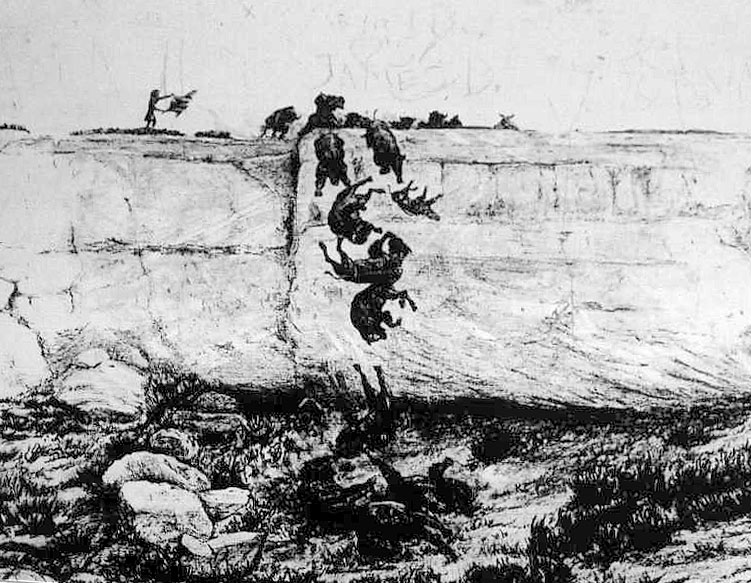
A "buffalo jump", where bison are driven over a cliff

The game drive system is a hunting strategy in which game are herded into confined or dangerous places where they can be more easily killed. It can also be used for animal capture as well as for hunting, such as for capturing mustangs. The use of the strategy dates back into prehistory. Once a site is identified or manipulated to be used as a game drive site, it may be repeatedly used over many years.[1] Examples include buffalo jumps and desert kites.

Game drives

[edit]
Itasca Bison Site, Itasca State Park, Minnesota

In the Rocky Mountain National Park, for instance, there are archeological remains from about 3,850 and 3,400 B.C. of 42 low-walled stone structures or cairns, up to hundreds of feet in length, built for game drive systems. These slight walls served as devices that permitted hunters to direct or herd game animals—like bison, sheep, deer, or elk—toward men waiting with weapons. Up to twenty-five people may have been needed to execute the game drive. Hunters may have killed the animals using darts, atlatl, spear throwers, or spears tipped with stone projectile points.[1]

The Jones-Miller Bison Kill Site is an example of how the terrain was used about 8,000 B.C. as a game drive site. Remains of 300 bison were found in an arroyo, or draw, above the Arikaree River basin. It was believed that the bison were strategically driven into an area difficult for the bison to traverse and easier to kill on three occasions. Because many of the animals were nursing calves, it is estimated that the kills occurred in late fall or winter.[2][3][4] Waldo Rudolph Wendel said in 1986 that it was the "most carefully studied bison kill" site.[5]

Buffalo jump

[edit]

A buffalo jump is an example of a game drive system. Hunters herded the bison and drove them over the cliff, breaking their legs and rendering them immobile. Tribe members waiting below closed in with spears and bows to finish the kills. The Blackfoot Indians called the buffalo jumps "pishkun", which loosely translates as "deep blood kettle". This type of hunting was a communal event which occurred as early as 12,000 years ago and lasted until at least 1500 AD, around the time of the introduction of horses. The broader term game jumps includes buffalo jumps and cliffs used for similarly hunting other herding animals, such as reindeer. The Blackfeet believed that if any buffalo escaped these killings then the rest of the buffalos would learn to avoid humans, which would make hunting even harder.[6]

References

[edit]
Revisions and contributorsEdit on WikipediaRead on Wikipedia
from Grokipedia
A game drive system is a prehistoric communal hunting strategy in which groups of hunters construct low stone walls, cairns, and concealed blinds to herd large ungulates—such as elk, deer, bighorn sheep, or caribou—into confined kill zones, often leveraging natural topography like cliffs or valleys to facilitate ambushes and mass kills with projectile weapons.[1][2] These systems emerged as early as approximately 11,000 years before present (B.P.) during the Late Paleoindian period, with confirmed evidence around 9,000–11,000 BP, and persisted into the Late Prehistoric era (up to around A.D. 1700–1800 in some North American regions), reflecting adaptations to seasonal animal migrations and environmental constraints in alpine, subalpine, and tundra landscapes.[1] Geographically, they are most prominently documented across North America, with major concentrations in the Colorado Rocky Mountains' Front Range (e.g., Rollins Pass sites), the Great Basin, the Great Plains, and the Central Canadian Arctic (e.g., Bathurst Inlet), where similar structures extend to Greenlandic Inuit traditions into the mid-20th century, though similar systems are documented in regions such as Southwest Asia (desert kites) and Europe.[1][2][3] Key structural elements include sinuous or V-shaped drive walls extending up to 1 kilometer in length and up to 0.6 meters in height, spaced cairns to direct animal movement, and semi-circular stone blinds (typically 1–3 meters in diameter) positioned for close-range hunting, enabling multiple participants to coordinate drives during late summer or autumn when game congregated in open terrains.[1] Notable examples include the Olson site (5BL147) and Murray site in Colorado's Continental Divide, which feature extensive rock alignments and over 80 blinds across multi-site complexes, as well as Arctic systems like those at Bathurst Inlet employing arcuate breastworks and inukhuit cairns for caribou procurement.[1][2] Artifacts such as Mount Albion Complex projectile points and debitage from these sites indicate on-site tool maintenance and minimal carcass processing before transport to nearby camps.[1] Archaeologically, game drive systems highlight sophisticated landscape engineering and social organization among Paleoindian, Archaic, and later indigenous groups, providing evidence of rotary seasonal mobility, resource optimization, and cultural continuity in harsh environments, with abandonment often linked to factors like the introduction of horses or firearms in the protohistoric period.[1][2]

Overview

Definition

A game drive system is a prehistoric communal hunting strategy in which groups of hunters herded large game animals—such as bison, deer, elk, sheep, or caribou—into confined spaces, dangerous terrain like cliffs, or pre-arranged ambush zones to facilitate collective killing or capture. This approach leveraged the predictability of animal movements and the landscape's natural features to concentrate herds, allowing for higher yields than solitary pursuits.[4][1] Central to the strategy are human-orchestrated drives using visual cues (such as flagging or hand signals), auditory signals (shouts or noise-makers), and physical barriers like linear stone walls, brush fences, or cairns to direct and funnel animals toward kill areas, rather than relying on individual tracking or passive snares. Hunters positioned in concealed blinds or at convergence points then dispatched the disoriented herd with spears, arrows, or by driving them over edges. This method starkly contrasts with stalking, which targets isolated animals through stealthy individual effort, or static trapping without active herding.[5][1][4] Game drive systems demanded tight coordination among participants, typically involving small to medium-sized groups of 10 to 25 hunters or more, drawn from extended bands or macrobands, to manage the drive and processing. These events were often seasonal, timed to animal migrations in late summer, autumn, or spring when herds were dense and forage patterns predictable, transforming hunts into key communal gatherings that reinforced social ties. Examples of traps include natural cliffs or constructed enclosures, where the final containment occurred.[6][1][4]

Historical Development

Game drive systems trace their origins in North America to at least 11,000 years ago in the late Paleo-Indian period, when early human groups developed communal hunting strategies to target large megafauna in post-glacial landscapes. Archaeological evidence from sites across the Great Plains and surrounding regions indicates that these initial systems involved driving herds toward natural traps or cliffs, adapting to the availability of species like ancient bison as humans dispersed following the retreat of the Ice Age. This period marked the foundational use of coordinated group efforts to overcome the challenges of hunting mobile, dangerous prey with limited technology.[7] Usage of game drive systems reached its peak during the Archaic and Woodland periods (approximately 8,000–1,000 B.C.), coinciding with significant environmental changes after the Ice Age, including warmer climates that shifted megafauna migration patterns and increased bison populations on the Plains. During this era, hunter-gatherer societies refined these techniques, constructing more elaborate drive lanes and traps to exploit seasonal herd movements, which supported growing populations and seasonal aggregations. The efficiency of these methods allowed for surplus processing and storage, reflecting adaptations to diverse ecosystems from prairies to foothills.[8] By around 1,500 A.D., game drive systems began to decline in North America due to a combination of overhunting pressures, the introduction of horses by European explorers that enabled more individualistic and mobile hunting styles, and the adoption of firearms that diminished the need for large communal drives. These changes, alongside transitions to pastoralism and trade economies influenced by colonial contact, disrupted traditional practices and led to reduced reliance on cliff jumps and drive lanes.[9] Parallel developments occurred globally, with independent emergence of game drive systems in arid and alpine environments worldwide between 9,000 and 3,000 B.C., such as the monumental desert kites in the Middle East and Central Asia used to funnel gazelle into enclosures during the Holocene Humid Period. These structures highlight convergent evolutionary responses to similar ecological challenges in regions like the Arabian Peninsula and Eurasian steppes.

Techniques and Components

Driving Mechanisms

Driving mechanisms in game drive systems primarily involved the construction of linear barriers to guide animal herds toward convergence points, exploiting both landscape features and targeted behavioral responses. These barriers typically consisted of spaced cairns—low piles of rocks at intervals of 3 to 7 meters—forming visual lines that appeared continuous to animals, often supplemented by brush fences made from piled vegetation, logs, or stakes for added opacity and durability, or in some cases low stone walls. Natural topography, such as river valleys, slopes, or ridges, was integrated to create V-shaped or funnel-like drivelines that narrowed progressively, channeling herds over distances of up to 1-2 kilometers in length. In the North American Plains, for instance, such structures at sites like the Two Medicine River demonstrated reinforcements with rock piles in erosion-prone areas to prevent escapes, while ethnographic accounts from Blackfoot and Crow hunters describe similar setups using dung or brush to mimic solid barriers.[10][11] Hunters played specialized roles in executing the drive, with groups of drivers positioned along the outer flanks of the drivelines to herd animals forward. Drivers employed vocalizations such as shouting or mimicking calf bleats to induce panic, waved hides or robes to startle and direct the herd, and occasionally ignited fires or used smoke signals—sometimes fueled by cow dung—to create confusion and momentum, leveraging wind direction to push smoke toward the animals. Ambushers, meanwhile, concealed themselves in rock blinds or at the drivelines' narrow ends, ready to intercept the converging herd. These tactics were communal endeavors, often involving dozens of participants, as documented in 19th-century ethnographic records of Plains tribes like the Piegan and Assiniboine, where young men served as runners to initiate and maintain the drive.[10][12] The effectiveness of these mechanisms hinged on a deep understanding of prey behavior, particularly the herd instincts of ungulates like bison or gazelles, which prompted them to follow lead animals or mill in tight groups when panicked. Drives were timed to coincide with seasonal migration routes, such as autumn movements along predictable valleys, when herds were larger and more cohesive, amplifying responses to perceived predator threats through noise, movement, or fire. This behavioral manipulation reduced the need for direct pursuit, allowing hunters to conserve energy while maximizing yields. Archaeological evidence from prehistoric sites, including the Olson game drive in Colorado, supports these practices through preserved drivelines and associated kill zones dating back over 6,000 years, with evidence from the Late Archaic and later periods.[13][10] For the final dispatch at convergence points, hunters used projectile weapons suited to mass kills, including atlatls with darts for greater range and force in prehistoric contexts, transitioning to bows, arrows, and spears in later periods. Ethnographic parallels from Northern Plains groups highlight spears as versatile for close-range slaughter within enclosures. These drivelines integrated seamlessly with endpoint traps to contain and slaughter the herded animals efficiently.[5][10]

Trap Types

In game drive systems, trap types represent the terminal structures designed to facilitate the capture or slaughter of herded animals, often integrating with natural topography or constructed features to maximize efficiency in communal hunts. These endpoints vary in design to suit different terrains and prey species, ranging from lethal falls to contained processing areas.[14] Cliff jumps, such as buffalo jumps, involve driving herds toward precipices where animals plummet to their death, resulting in mass fatalities from impact. This method exploits steep natural drops, with drive lanes funneling prey to the edge, allowing hunters to process carcasses below without direct confrontation. Archaeological evidence indicates these traps were used for large ungulates like bison, enabling efficient procurement of hundreds of animals in single events.[15] Enclosures and corrals consist of stone or wooden barriers forming pens for live capture, selective slaughter, or on-site processing. Typically circular or funnel-shaped with converging wings, these structures contain driven animals within confined spaces, where hunters could dispatch them using spears or clubs. Constructed from local materials like rock piles or timber, corrals supported communal efforts by holding multiple individuals for sustained harvesting.[14] Pits and ambushes utilize natural depressions or excavated holes combined with hunter blinds for trapping and spearing prey. Animals are herded into camouflaged pits, where falls injure or immobilize them, while concealed hunters in adjacent blinds deliver fatal strikes. These setups often incorporate guide fences with gaps leading to the pits, enhancing the funneling effect in varied landscapes.[16] Desert kites are specialized aerial funnel systems adapted to open arid terrains, featuring long converging stone walls that direct gazelles or ibex into central enclosures with integrated pit-traps. The walls, sometimes kilometers in length, create a V- or W-shaped convergence ending in cells or pits for capture, allowing mass trapping without cliffs. Variations include open kites without full enclosures and ring-shaped ones for containment, emphasizing passive guidance toward lethal endpoints.[17][18]

Regional Variations

North American Examples

In North America, game drive systems were extensively employed by Indigenous peoples to hunt large ungulates, particularly bison (Bison bison), across the Great Plains and Rocky Mountains. These systems capitalized on the seasonal migrations of bison herds, especially during the fall when animals moved from summer grazing grounds to winter ranges, allowing hunters to channel them toward natural or constructed traps like cliffs or enclosures. A prominent example is the Head-Smashed-In Buffalo Jump in southern Alberta, Canada, where Blackfoot (Siksika) hunters constructed drive lanes lined with stone cairns to guide herds over a 10-18 meter cliff, yielding stratified bone beds spanning over 5,600 years of use from approximately 3,800 BCE to the mid-19th century.[19][20] Similar bison drives in the Great Plains, such as the Ulm Pishkun site in Montana, involved coordinated efforts by multiple hunters to stampede dozens to hundreds of animals at once, with archaeological evidence revealing kill sites containing thousands of articulated skeletons processed for meat, hides, and tools. Alpine variants of game drive systems adapted to high-elevation terrains in the Rocky Mountains of Colorado and Wyoming targeted mountain sheep (Ovis canadensis) and elk (Cervus canadensis), utilizing natural topography and rock alignments above 3,000 meters. In northern Colorado's Front Range, sites like the Olson game drive (5BL147) feature extensive networks of low stone walls and blinds along ridgelines, dating back to the Archaic period (ca. 5,000-1,000 BCE), which funneled herds into ambushes during summer hunts when animals ascended to alpine meadows.[21] In Wyoming's Bighorn Mountains, comparable systems near the Continental Divide include cairn-lined drive lanes and pit traps at elevations exceeding 3,200 meters, as documented in surveys of prehistoric hunting complexes, emphasizing communal strategies suited to rugged, snow-patched landscapes that limited individual pursuits. These high-altitude features often integrated with vision quest sites, reflecting the integration of hunting with spiritual practices among groups like the Shoshone and Ute. Underwater archaeological evidence from the Great Lakes further illustrates the antiquity and versatility of North American game drives. The Drop 45 Drive Lane beneath Lake Huron, discovered in 2014, consists of a 21-meter-long stone alignment and associated hunting blinds dating to approximately 9,000 years ago (ca. 7,000 BCE), used by Paleoindian hunters to direct migrating caribou (Rangifer tarandus) across what was then an ice-free corridor on the Alpena-Amberley Ridge.[4] This submerged structure, the most complex known in the Great Lakes, highlights adaptations to post-glacial environments where rising water levels preserved intact features invisible on land. In the Central Canadian Arctic, game drive systems targeted caribou migrations using arcuate breastworks and inukhuit cairns, as seen at Bathurst Inlet sites, which persisted into Inuit traditions until the mid-20th century. These tundra adaptations, documented through ethnographic and archaeological surveys, involved communal drives across open landscapes during seasonal crossings.[2] Cultural ties to Plains tribes, notably the Blackfoot Confederacy, underscore the ceremonial dimensions of these systems. The term pishkun, meaning "deep blood kettle" in Blackfoot, referred to buffalo jump complexes like Head-Smashed-In, where hunts were preceded by rituals involving medicine bundles, songs, and offerings to ensure success and honor the bison's spirit, embedding the practice within broader cosmological beliefs about reciprocity with nature.[20] These ceremonies, performed by society leaders, reinforced social cohesion and were integral to the annual cycle of communal buffalo procurement that sustained tribal economies and traditions for millennia.[19]

Middle Eastern and Asian Examples

In the arid landscapes of the Middle East, particularly in Jordan, Saudi Arabia, and Syria, game drive systems are exemplified by desert kites—large-scale, low stone wall structures designed to funnel herds of gazelles and ibex into enclosures for mass capture or slaughter. These funnels typically consist of two converging walls, often several kilometers long, leading to a star-shaped or circular enclosure that serves as the kill zone, with walls averaging 20-50 cm in height and constructed from local limestone in single- or double-faced dry masonry.[22][23][24] Individual guiding walls extend up to 4 km, though chains of interconnected kites can span tens of kilometers across desert plateaus and escarpments, exploiting natural topography like wadis or hidden corridors to direct animals eastward or toward pits up to 2 m deep.[22][23] Dating to the Neolithic period, with the earliest examples from the Late Pre-Pottery Neolithic B (around 8,000–7,000 BCE), desert kites were primarily employed by pastoral nomads during the Holocene Humid Period (ca. 9,000–4,000 BCE), when wetter conditions supported larger game populations in open deserts.[22][24] Archaeological excavations, such as those at Jibal al-Khashabiyeh and Jibal al-Ghadiwiyat in Jordan's southeastern Badia, have uncovered faunal remains confirming gazelle hunting, with radiocarbon dates from charcoal in pit cells ranging from 8,562–7,712 cal BCE (cautiously) to 7,297–6,712 cal BCE (securely).[24] Usage persisted into the Bronze Age among nomadic groups, as evidenced by associated rock carvings and Safaitic inscriptions, reflecting adaptations to shifting climates and mobile lifestyles that integrated hunting with early herding practices.[23] The scale and distribution of desert kites were first recognized through aerial reconnaissance in the 1920s, but modern satellite imagery, including Google Earth, has revealed hundreds of sites—over 550 in Jordan alone and at least 350 newly mapped across northern Saudi Arabia, southern Iraq, eastern Jordan, and southern Syria.[25][23] These discoveries highlight concentrations in regions like the Al Labbah plateau in Saudi Arabia's Nafud desert, where kites extend over 400 km eastward from known Jordanian examples, demonstrating organized communal efforts requiring substantial labor for construction and maintenance.[22] In Central Asia, similar kite structures appear in the steppes and deserts of Kazakhstan and Uzbekistan, part of the broader Aralo-Caspian distribution. These Asian variants, documented through the GlobalKites project, feature linear walls funneling saiga antelope and other ungulates into traps, with over 1,000 identified in the region dating to the Neolithic and Bronze Age (ca. 7,000–3,000 BCE). They reflect adaptations to vast open terrains, with chains spanning up to 100 km, and are linked to pastoralist societies via associated petroglyphs and faunal evidence.[17][26] Economically, desert kites facilitated the procurement of meat, hides, and bones, which supported nomadic camps and early settlements by enabling food preservation and surplus generation during seasonal migrations.[22] This hunting strategy likely contributed to proto-trade networks in the Near East, as processed gazelle products could be exchanged for goods in emerging pastoral economies, underscoring the kites' role in sustaining mobile societies amid resource-scarce environments.[23]

European Examples

Recent discoveries of game drive systems in prehistoric Europe center on monumental dry-stone structures identified on the Adriatic Karst Plateau, spanning regions of Slovenia, Croatia, and adjacent areas. These megastructures, dated to the Mesolithic period between approximately 8,000 and 6,000 B.C., feature extensive funnel-shaped stone walls—ranging from 530 meters to 3.5 kilometers in length—that channeled herds of red deer toward natural traps such as cliffs or dolines (sinkholes). Built by post-glacial hunter-gatherers, the walls, typically 1 to 1.5 meters wide and less than 1 meter high, integrated with the rugged karst topography to facilitate interception during seasonal animal migrations.[27] Airborne laser scanning (LiDAR) surveys conducted in 2025 across an 870 km² area revealed at least four such systems, marking them as the earliest known large-scale hunting architectures in Europe. These structures demonstrate sophisticated landscape engineering, where low walls funneled ungulates into concealed enclosures 8 to 10 meters wide beneath escarpments, enabling efficient communal harvests. Zooarchaeological evidence from nearby Mesolithic sites, such as Pupićina Cave, confirms red deer as the primary target, with faunal assemblages indicating intensive, seasonal exploitation by organized groups. The systems' design reflects adaptations to the open, upland Mediterranean environments, contrasting with denser forested terrains elsewhere.[27] While bearing resemblance to global desert kite structures in the Middle East—both employing linear walls for mass ungulate drives—the Karst examples are tailored to temperate European conditions, emphasizing vertical cliffs over flat desert funnels. In scale and coordination, they parallel Scandinavian pitfall systems used for elk and reindeer hunting, which also required collective labor across vast areas but relied on excavated traps rather than wall-guided chutes. These European variants underscore the Mesolithic innovation in communal resource management, abandoned before the Late Bronze Age around 4,000 years ago.[27]

Archaeological and Cultural Significance

Key Discoveries and Sites

One of the most significant archaeological discoveries illuminating prehistoric game drive systems in North America is the Jones-Miller Bison Kill Site in northeastern Colorado, excavated in the 1970s. This Paleo-Indian site, associated with the Hell Gap complex and dated to approximately 8,000 BCE, yielded the remains of over 300 Bison antiquus individuals, along with atlatl projectile points and processing tools, providing direct evidence of organized communal drives into a natural arroyo trap.[28][29] The faunal assemblage, including dental eruption patterns, indicates late-fall hunting events, highlighting seasonal strategies that maximized herd vulnerability during migration.[30] This site's preservation of bone-bed stratigraphy and artifact clustering has advanced understandings of early cooperative hunting tactics, demonstrating how Paleo-Indians engineered landscapes for mass kills without permanent structures.[31] In the Colorado Rockies, the Olson Site (5BL147), a multi-component alpine game drive complex in the James Peak Wilderness, exemplifies high-elevation hunting adaptations from the Late Archaic period, with primary use spanning approximately 1880–800 BCE based on radiocarbon-dated charcoal from blinds and hearths.[13] Spanning over 28 hectares, the site features 1,307 meters of low rock walls, 45 hunting blinds, and 17 cairns designed to funnel multi-species game—primarily bighorn sheep but also elk and deer—upslope toward an intercept basin at 3,600 meters elevation.[13] Excavations revealed ground stone tools and lithic scatters indicating on-site processing, while lichenometric dating of walls points to remodeling into the Late Prehistoric period (ca. AD 655 and 1125), underscoring long-term cultural continuity in communal strategies.[32] These findings have been pivotal in recognizing alpine zones as persistent hubs for social aggregation and resource exploitation, contrasting with lowland narratives.[1] Further south along the Continental Divide, the Monarch Pass Game Drive system near Salida, Colorado, represents one of the southernmost documented high-altitude examples, with boulder alignments and concealed blinds targeting big game during the Archaic period, potentially in use from around 3000 BCE to AD 1500 as evidenced by projectile point typology and limited radiocarbon assays.[33] Documented through surveys in the 1990s, the site's extensive dry-laid walls—some exceeding 200 meters—channel animals into natural chutes at timberline elevations above 3,500 meters, yielding faunal evidence of bighorn sheep and deer processing.[34] This discovery expanded the known geographic range of alpine drive systems, revealing adaptations to rugged terrains that integrated topography with minimal material investment, and informed reconstructions of mobility patterns in the southern Rockies.[35] In a striking transcontinental parallel, 2025 lidar surveys on Slovenia's Karst Plateau in the Adriatic hinterland uncovered four previously unknown monumental dry-stone megastructures, dating to the Neolithic or earlier based on morphological analogies to dated systems.[27] These vast enclosures, spanning hundreds of meters with converging walls up to 1.5 meters high, mirror desert kite designs and facilitated large-scale game drives for ungulates across the karst landscape, as confirmed by ground-truthing and topographic integration analysis.[36] The airborne laser scanning revealed their scale—totaling over 10 kilometers of walls—hidden under vegetation, challenging prior assumptions about European prehistoric hunting as small-scale and providing the earliest evidence of organized, landscape-altering systems on the continent.[37] This breakthrough, led by researchers from the University of Ljubljana, has prompted reevaluations of Eurasian hunting networks and their technological exchanges.[38]

Societal Role and Legacy

Game drive systems played a pivotal role in the communal organization of prehistoric and historic Indigenous societies, particularly among Plains tribes like the Blackfoot, where they necessitated coordinated labor division among participants. Hunters, often young men, drove herds into traps or over cliffs, while women and children processed the carcasses by skinning, butchering, and preparing meat and hides at nearby camps, ensuring efficient utilization of the kill.[10] These hunts were typically preceded by rituals to invoke success and spiritual protection, such as offerings of bison tongues collected during drives, which were used in ceremonies like the Blackfoot Sun Dance to renew communal bonds and honor the buffalo's life-giving role.[39] Resource sharing was integral, with the yields distributed across the tribe to support collective survival, fostering social cohesion during seasonal gatherings.[40] Economically, game drives provided essential bulk protein through dried or pemmican-stored meat, enabling tribes to endure harsh winters in marginal environments like the high plains and Rockies where agriculture was impractical.[10] Hides supplied materials for clothing, shelter, and tools, while bones and sinews contributed to implements, creating a multifaceted resource base that sustained larger populations than solitary hunting could support.[11] This efficiency in resource acquisition underpinned population growth and sociopolitical complexity in resource-scarce landscapes, as evidenced by the scale of engineered drive systems in alpine zones.[11] The legacy of game drives extends to modern archaeology, where they have shaped understandings of prehistoric cooperation by illustrating how foragers coordinated large-scale efforts under resource pressure, as seen in studies of communal bison hunting trajectories.[41] These systems highlight emergent social structures, influencing research on human behavioral ecology and collective action in hunter-gatherer societies.[42] Today, protections at sites like those in Rocky Mountain National Park involve restricting access and discontinuing interpretive tours to preserve fragile structures, recognizing their cultural significance to descendant communities.[43] However, knowledge gaps persist, with game drives understudied outside North American contexts, prompting calls for global comparative research to explore variations in cooperative hunting worldwide, such as in Andean vicuña drives or Adriatic megastructures.[44][3]

References

User Avatar
No comments yet.