Hubbry Logo
GuelmaGuelmaMain
Open search
Guelma
Community hub
Guelma
logo
8 pages, 0 posts
0 subscribers
Be the first to start a discussion here.
Guelma
Guelma
from Wikipedia

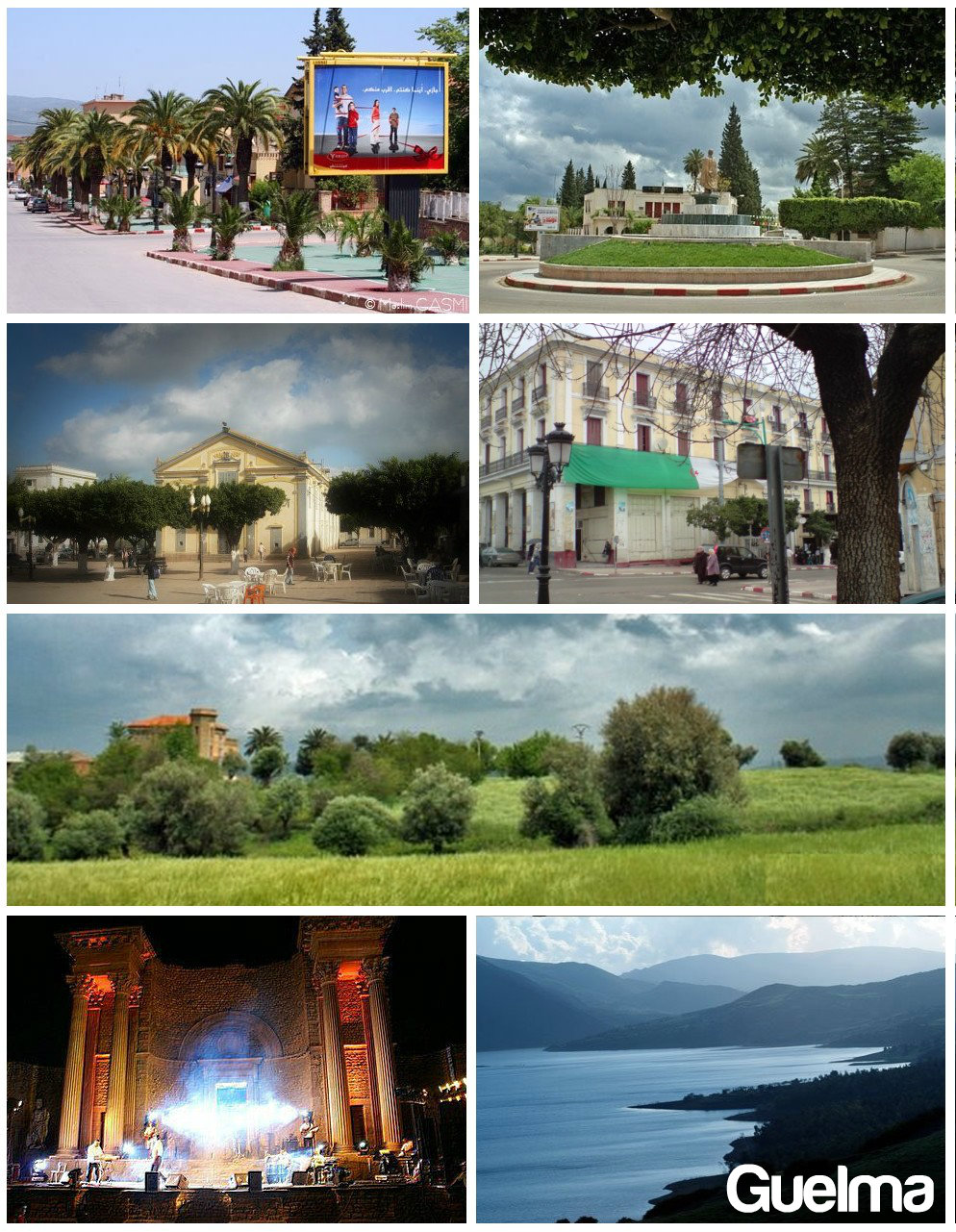
Guelma (Arabic: قالمة Qālima; Algerian Arabic: ڨالمة; Algerian pronunciation: Arabic pronunciation: [ɡelmæ]) is the capital of Guelma Province and Guelma District, located in north-eastern Algeria, about 65 kilometers from the Mediterranean coast. Its location corresponds to that of ancient Calama.

Key Information

History

[edit]
The Roman theater of Guelma

Antiquity

[edit]

Though Guelma was settled from early prehistory, it was first established as a town under the Phoenicians, who called it Malaca, probably a Phoenician word meaning "salt" (sharing a common etymology with Málaga in Spain). Later, the Romans settled the area and renamed it Calama, part of the Roman province of Numidia. Calama prospered during the rise of Christianity; Saint Possidius was bishop of Guelma during the 5th century.

Later, the Vandal invasion devastated the area. When the Byzantines settled in the area, they built city walls to protect the community from further invasions. It was located in the Byzantine Exarchate of Africa. However, after the successful Islamic conquest of Algeria, the area was long abandoned as a formal settlement, even much later, during Ottoman rule.

People in front of Guelma's train station (19th century postcard)

French rule

[edit]

Guelma was re-established as a formal settlement during the French invasion and colonisation of Algeria, after seven centuries of abandonment. The annexation of the area began with the advancing of the French Army going to Constantine from Annaba. (France claimed that its occupation of Constantine wade north-eastern Algeria officially a part of France.) The Army discovered (and temporarily occupied) the ruins of Calama from 10 to 15 November 1836 under the command of general Bertrand Clausel.

Guelma was established as a city in 1836 and developed by French settlers.[1]

Its communal constitution dates from 17 June 1854. A modern city quickly developed around the Roman ruins, first inside the restored Byzantine city walls, later also outside the walls, which continued to function during these times. There was also development near the railroad, which crossed the city from the west to the east. The Roman theater of Guelma was restored in 1905 under the rule of mayor M. Joly. The city had a high percentage of European settlers during these times, supported by the French colonial policy.

During the Sétif massacre of 8 May 1945, numerous settlers were killed. Guelma's oldest religious building that is still used for worship is the El-Atik Mosque, or "The Great Mosque Of Guelma" , built in 1837. Guelma has also had a synagogue, which served local Jews, and a church on the place de Saint Augustin, which served Christian European settlers. Most of the French and many other European were Roman Catholic.

Post-independence

[edit]
General view of Guelma

After the Independence of Algeria, both the European settlers and the indigenous Jews left, and the synagogue and the church were converted into mosques. The population of Guelma grew at a rapid pace.

Geography

[edit]
Nearby snow-covered Mount Maouna

Guelma is situated at the heart of a major agricultural region, 290 m above sea level and surrounded by mountains (Maouna, Dbegh, Houara). The region is very fertile because of the Seybouse River and a large dam that provides a vast irrigation scheme. It occupies a strategic geographic position as a crossroads in north-eastern Algeria, linking the coast of Wilaya of Annaba, El Taref and Skikda to inland areas such as Wilaya of Constantine, Oum El Bouagui and Souk-Ahras.

Climate

[edit]

Guelma has a hot-summer Mediterranean climate (Köppen climate classification Csa). In winter there is more rainfall than in summer. The average annual temperature in Guelma is 17.2 °C (63.0 °F). About 557 mm (21.93 in) of precipitation falls annually.

Climate data for Guelma
Month Jan Feb Mar Apr May Jun Jul Aug Sep Oct Nov Dec Year
Mean daily maximum °C (°F) 14.3
(57.7)
15.4
(59.7)
18.1
(64.6)
20.5
(68.9)
25.2
(77.4)
30.5
(86.9)
34.4
(93.9)
34.5
(94.1)
29.8
(85.6)
24.9
(76.8)
19.3
(66.7)
15.7
(60.3)
23.6
(74.4)
Mean daily minimum °C (°F) 3.6
(38.5)
4.6
(40.3)
6.1
(43.0)
8.0
(46.4)
11.4
(52.5)
15.0
(59.0)
17.8
(64.0)
18.9
(66.0)
16.9
(62.4)
12.8
(55.0)
9.2
(48.6)
5.8
(42.4)
10.8
(51.5)
Average precipitation mm (inches) 82
(3.2)
60
(2.4)
55
(2.2)
44
(1.7)
40
(1.6)
25
(1.0)
3
(0.1)
12
(0.5)
26
(1.0)
49
(1.9)
70
(2.8)
91
(3.6)
557
(21.9)
Source: Climate-Data.org, Climate data

Industry

[edit]

The city's industries include the manufacture of cycles and mopeds, sugar refinement, ceramics, canning, and semolina milling. Guelma is also known for some traditional industries such as knitting and pottery.

Tourism

[edit]
Hot springs

Nearby tourist attractions include hot springs, Hammam Debagh (20 minutes away from Guelma), and Hammam Ouled Ali, which contains two resorts and provides services for tourists. Local hotels include: Hotel Mermoura, Hotel Tarik, Hotel Chelala (Hammam Debagh) which is the second hottest spring in the world with 98 °C (208 °F) , Hotel la Couronne, the tourist complex of El Baraka (includes hotel A/B), and the tourist complex of Bouchahernie.

Guelma's Olympic Stadium

Sports

[edit]

The city has various sports facilities: the Olympic Stadium, Municipal Stadium, an Olympic swimming pool and a multi-sports hall. Football is the most popular sport in the city, as in all the cities of the country. Guelma has several football clubs:

  • Espérance Sportive de Guelma known as ES Guelma (founded in 1939)
  • The Olympic Football Guelma (founded in 1947)
  • L'Ettardji Sarri Madinet Guelma (founded on 8 September 1977)

Media

[edit]

There are no local TV channels or newspapers in Guelma, however, Radio Algérie operates a radio channel in Guelma.[2]

Notable people

[edit]

References

[edit]
[edit]
Revisions and contributorsEdit on WikipediaRead on Wikipedia
from Grokipedia
Guelma is a city in northeastern and the capital of Guelma Province, located approximately 500 kilometers east of in a fertile valley irrigated by the Seybouse River. Originally established as the Roman colony of Calama in the province of , the city features preserved archaeological remains including a and ancient baths that testify to its historical significance as a center of antiquity. With a municipal estimated at around 124,000, Guelma functions primarily as an agricultural hub, producing crops such as olives and peppers amid its verdant surroundings, while also leveraging natural hot springs for thermal tourism and limited light manufacturing. The region's thermal waters, notably at Hammam Debagh, have drawn visitors for therapeutic purposes, complementing the site's and contributing to local economic activity beyond farming.

History

Antiquity and Pre-Islamic Period

Calama, the ancient predecessor of Guelma, emerged as a settlement within the Berber kingdom of prior to Roman dominance, though archaeological evidence for pre-Roman structures remains sparse and primarily indicative of local tribal organization around natural strongpoints. The site transitioned under Roman control following the annexation of in 46 BCE, evolving into a colonia by the late 1st or early CE, strategically positioned in the fertile northeastern region for agricultural production, particularly grain, which supported imperial supply lines. Key Roman infrastructure included a theater constructed in the early CE, capable of seating thousands and exemplifying the city's administrative and cultural integration into the province of , later reassigned to Africa Proconsularis. Aqueducts, , and other underscored Calama's role as a outpost and trade nexus, with veteran settlers bolstering defenses amid regional instabilities. The city's prominence is evidenced by epigraphic records of civic patrons and imperial dedications, reflecting a prosperous . Following the Vandal conquest around 429 CE, Calama experienced decline but was reclaimed by Byzantine forces in 533–534 CE during Belisarius's campaign against . Under , general oversaw extensive fortifications, including a and walls, to counter Berber revolts and secure the frontier, integrating Calama into the Byzantine defensive network until the Arab invasions of the disrupted control. These late antique adaptations highlight the site's enduring tactical value amid shifting imperial powers.

Islamic and Ottoman Era

Following the Arab Muslim conquests of in the mid-7th century, the Guelma region—known in antiquity as Calama—was incorporated into the Umayyad province of by around 698 CE, as Umayyad forces under completed the subjugation of Byzantine-held territories in the . Local Berber tribes, initially resistant, gradually integrated through and intermarriage, fostering a Berber-Arab cultural synthesis observable in the retention of Berber toponyms alongside Arabic influences in regional and artifacts such as inscribed from early Islamic sites in eastern . Under successive dynasties governing , including the Berber (972–1148 CE), which controlled eastern from capitals like Ashir and , and the (1229–1574 CE), centered in but extending authority over Guelma's territory, the area functioned primarily as a rural agricultural settlement rather than a major urban center. cultivation persisted as a key economic activity, leveraging the fertile soils of the Guelma plain for production that supported local , though the urban fabric of ancient Calama had largely declined into scattered villages amid tribal confederations. From the early , with the Ottoman incorporation of in 1525 CE, Guelma fell within the , the easternmost administrative division under an Ottoman-appointed responsible for tax collection on agricultural yields and maintaining order through alliances with semi-autonomous Berber tribes. This structure provided relative stability via decentralized governance but permitted frequent tribal revolts against authority, as documented in Ottoman fiscal registers emphasizing tribute from and harvests rather than direct provincial control.

French Colonial Development

Following the French conquest of eastern , including the capture of nearby Constantine in 1837, Guelma emerged as a key settlement site for European colons, with administrative reorganization transforming it into a modern commune by the mid-19th century. rapidly expanded, prioritizing cash crops such as grains and in the fertile Constantine department, where Europeans controlled approximately 30% of by 1900 and accounted for over two-thirds of total agricultural output through intensive plowing, , and access to markets. These efforts boosted regional production, with yields rising amid favorable policies that integrated local farms into French export networks, though specific Guelma and grain export volumes from the remain sparsely documented beyond departmental aggregates showing steady growth in shipments to . Infrastructure investments, including roads and railways, facilitated this economic shift by linking Guelma to Constantine and coastal ports, enabling efficient transport of goods and migration. Colonial railways, expanded after , positively influenced indigenous and agricultural activity in the Constantine post-1900 by enhancing market access and settlement patterns, though pre-1900 impacts were limited by terrain and initial military priorities. improvements in the Tell supported and cultivation, contributing to overall departmental output increases of around 1.7% annually for cereals between 1850 and 1910. Urbanization accelerated, with Guelma's expanding alongside inflows, reflecting broader eastern Algerian trends where European rural s numbered 15,000 out of 109,000 total Europeans by 1848. Land policies, however, entrenched exploitative dynamics, as post-1871 confiscations seized over 500,000 hectares from indigenous tribes in eastern , funneled to colons via the 1873 Warnier Law, which imposed French property regimes and accelerated transfers from Algerian fellahs to European owners in areas like Guelma's surrounding communes. This created rigid social hierarchies favoring settlers, who benefited from state-backed titles while locals faced displacement and . Balancing these, colonial administration introduced measures and schools—such as agricultural training facilities in Guelma—primarily serving Europeans, yielding improved settler and rates amid overall gains like hospitals and paved urban centers.

The 1945 Sétif-Guelma Events

On May 8, 1945, coinciding with celebrations of , approximately 1,500 young Algerian nationalists affiliated with the Parti du Peuple Algérien (PPA) organized a demonstration in , waving banned Algerian flags to demand independence from French colonial rule. The event initially remained peaceful, but tensions escalated regionally after clashes in nearby , where police gunfire against demonstrators triggered retaliatory violence by Algerian crowds against European settlers. In Guelma, this manifested on May 9–10 as armed Algerian groups targeted and killed 12 Europeans, contributing to a broader toll of about 103 European civilian deaths across the Sétif-Guelma-Kherrata area, including women and children in some instances. These attacks involved direct assaults on unarmed settlers, framing the initial phase as rather than solely a response to state repression. French authorities responded with a combination of , militias, and aerial support, viewing the incidents as an uprising threatening colonial . In the , repression relied heavily on locally formed militias numbering up to 280 members, backed by police and , which conducted summary executions and mass killings from May 9 to June 26, with peak intensity in the first two weeks; regular army units arrived later under Colonel Monniot on May 15 but played a secondary . Estimated Algerian deaths in the Guelma area alone ranged from 1,500 to 2,000, primarily attributed to militia actions rather than formal military operations. Across the events, French official figures from reported around 1,500 total Algerian fatalities, while historians drawing on archival and eyewitness data, such as Charles-Robert Ageron and Jean-Pierre Peyroulou, place the overall toll between 6,000 and 8,000; Algerian nationalist accounts claim up to 45,000, a figure critiqued by scholars for relying on unverified oral histories susceptible to in post-independence narratives. The clashes stemmed from mutual escalations: Algerian demands for self-rule amid wartime promises of clashed with French insistence on order, leading to civilian-targeted on both sides and subsequent indiscriminate reprisals. French justifications emphasized against a coordinated that endangered isolated communities, whereas Algerian perspectives frame the response as genocidal colonial terror, though empirical data underscores the precipitating role of attacks on non-combatants. These events radicalized nationalist movements, sowing seeds for the 1954 of Independence by highlighting irreconcilable tensions, yet they were rooted in reciprocal breakdowns rather than unilateral aggression.

Algerian War of Independence and Immediate Aftermath

Guelma's location in the Nord-Constantinois region positioned it as a key area for Front de Libération Nationale (FLN) guerrilla operations during the Algerian War of Independence from November 1, 1954, to March 18, 1962. As part of Wilaya II (Nord-Constantinois), the FLN established maquis units in the surrounding rural and hilly terrain, launching ambushes on French military patrols and supply lines to disrupt efforts. These tactics aligned with broader FLN strategies in eastern , where fighters exploited the landscape for hit-and-run attacks, though Guelma itself avoided large-scale pitched battles documented in military records. French forces responded with intensified operations, including sweeps through the Guelma countryside and the establishment of regroupement centers that displaced thousands of rural Muslim inhabitants from villages to fortified camps between and 1961. This , aimed at severing FLN logistics and intelligence networks, affected populations in the Constantine department, leading to overcrowding, disease outbreaks, and agricultural disruption in areas near Guelma; estimates indicate over 2 million Algerians nationwide were regrouped, with significant impacts in eastern wilayas like Wilaya II. Urban areas in Guelma experienced limited direct combat but suffered infrastructure strain from troop movements and occasional FLN , contributing to demographic shifts as families fled . Following the on March 18, 1962, and Algeria's independence declaration on July 5, 1962, approximately 10,000 European settlers (pieds-noirs) in and around Guelma evacuated to France amid rising insecurity and FLN reprisals against perceived collaborators. This exodus, part of the broader departure of nearly 900,000 Europeans from , left the local economy and administration dominated by the Muslim majority, with abandoned properties and businesses marking the transition. Initial handover to Algerian authorities brought celebrations of liberation, but optimism was quickly overshadowed by internal FLN factional disputes and targeted violence against harkis (Algerian auxiliaries to French forces), resulting in hundreds of deaths in eastern Algeria during summer 1962 purges.

Post-Independence Economic and Social Changes

Following in 1962, Algeria's government pursued aggressive land reforms, including the of former colonial estates and the establishment of self-managed farms (autogestion) under Ahmed Ben Bella's administration, which redistributed approximately 2.7 million hectares of by 1967 but led to widespread abandonment as departed en masse. In Guelma Province, a key agricultural region centered on s, cereals, and , this transition replaced skilled private operators with inexperienced state-managed collectives, resulting in sharp productivity declines; national agricultural output per capita stagnated or fell amid , with the sector's GDP share dropping from over 20% in the to around 10% by the due to inefficiencies in collectivized systems lacking market incentives. Local yields in eastern provinces like Guelma suffered similarly, exacerbated by underinvestment in and , as state policies prioritized urban industrialization over rural viability. These economic disruptions spurred significant social shifts, including mass rural-to-urban migration from Guelma's countryside, where farm consolidations into state enterprises displaced smallholders and day laborers, contributing to a national rural exodus that swelled urban populations by over 50% between 1966 and 1987. In Guelma, this manifested as depopulation of peripheral villages and increased reliance on subsidies to buffer imports, masking underlying agrarian decay; by the late , under Houari Boumediene's reforms merging collectives into state farms, productivity shortfalls forced to import over 70% of its needs, straining local economies dependent on crops like Guelma's olives. Such policies, rooted in socialist central planning, empirically failed to sustain pre-independence output levels, as evidenced by FAO assessments of yield stagnation in rain-fed Mediterranean . The 1990s intensified these challenges, with Islamist insurgencies targeting rural infrastructure in eastern wilayas including Guelma, where attacks on farms and transport routes disrupted harvests and displaced thousands, compounding a national economic contraction of up to 5% annually amid violence that killed over 150,000. Guelma emerged as a flashpoint for clashes between government forces and groups like the Armed Islamic Group, leading to localized destruction of groves and losses, further eroding agricultural resilience already weakened by decades of state mismanagement. Post-2000 recovery efforts under included limited of state farms and incentives for private , enabling modest rebounds in Guelma's sector through foreign partnerships and adoption, with provincial output rising approximately 20% in key crops by the mid-2010s. However, hydrocarbon dependence persisted, funding subsidies that propped up consumption but hindered diversification; by the 2020s, Guelma faced ongoing rates exceeding national averages of 12%, hovering around 15-20% locally due to youth joblessness and sluggish rural investment, underscoring persistent structural failures despite oil windfalls. These trends challenge claims of seamless post-independence progress, revealing causal links between statist interventions, conflict legacies, and enduring underperformance in a ill-suited to import-reliant models.

Geography

Location and Topography

Guelma is situated in northeastern , serving as the capital of Guelma Province and Guelma District. The city lies at coordinates approximately 36°27′N 7°26′E, at an elevation of 305 meters above . It is positioned about 57 kilometers southwest of by straight-line distance, though the driving route measures around 76 kilometers. The of Guelma encompasses fertile plains interspersed with of the Tell Atlas , which characterizes much of northern Algeria's . Several wadis, or seasonal river valleys, cross the region, contributing to its hydrological features that include natural springs. This landscape reflects the broader geomorphic patterns of the Algerian Tell, where sedimentary basins and fault systems influence local relief. Guelma lies within a seismically active zone of the Tell Atlas, where tectonic interactions between the African and Eurasian plates generate risks. Historical and instrumental records document seismic events in the Algerian Tell Atlas, underscoring the area's vulnerability to ground shaking and associated hazards. The urban core of Guelma spans a compact area amid these dynamic geological features, with the surrounding covering 4,101 square kilometers.

Climate and Environmental Features

Guelma exhibits a with hot, dry summers and mild, wetter winters, classified as Csa under the Köppen-Geiger system. Average annual temperatures hover around 18.8°C, with highs peaking at 34°C and averages near 10°C. totals approximately 557 mm annually, concentrated primarily from to March, while summers from June to August remain largely rainless. The region features notable thermal springs, including those in the vicinity of Aïn El Beïda, characterized by hydrochemical facies such as (Na-Cl) and (Na-SO4), with elevated mineralization supporting geothermal and therapeutic properties. These springs emerge from deep aquifers in northeastern Algeria's Tell Atlas, with temperatures often exceeding ambient levels due to geothermal gradients. Environmental challenges include recurrent risks, as evidenced by standardized precipitation indices in northern Algerian basins, and trends tracked via data, with Guelma province losing 166 hectares of natural in 2024 from a 2020 baseline of 55,500 hectares. Such losses correlate with anthropogenic factors like and land conversion, compounding vulnerability in semi-arid conditions without predominant attribution to climatic shifts alone.

Demographics

The population of Guelma commune stood at 120,841 inhabitants according to the 2008 Algerian census conducted by the Office National des Statistiques (ONS). This figure reflected a modest annual growth rate of 1.0% from the 1998 census, driven primarily by natural increase amid post-independence stabilization following of and wartime disruptions. Earlier data from the immediate post-independence period indicate a base of approximately 50,000 residents around 1966, with subsequent expansion fueled by rural-to-urban migration as agricultural reforms and infrastructure development drew populations from surrounding areas in the Guelma wilaya. By the early , local administrative estimates placed the city's at around 127,400, suggesting continued but decelerating growth aligned with national trends averaging 2-3% annually in prior decades. The commune's reached approximately 2,000-2,700 inhabitants per square kilometer in , concentrated in an of about 45 km², indicative of intensified settlement in the city center post-colonial reconstruction. Projections based on analyses anticipate further increases, potentially reaching 200,000-250,000 by 2030, as sectoral expansions accommodate natural growth and peripheral integration, though constrained by limits. Migration patterns have shaped these trends, with net inflows from rural wilaya zones during the 1970s-1990s offsetting outflows of seeking opportunities abroad amid persistent local gaps. Recent decades show rising among younger demographics, particularly to via irregular routes, as a response to stalled post-independence industrialization and demographic pressures exceeding local absorption capacity. This has moderated net growth rates to below 1.5% annually in recent estimates, contrasting earlier surges tied to independence-era and .

Ethnic, Linguistic, and Religious Composition

The population of Guelma is ethnically homogeneous, consisting predominantly of individuals of Arab-Berber descent, who form over 99% of residents, reflecting the national composition where nearly all trace origins to Berber roots with extensive . This Arab-Berber identity predominates in eastern , including Guelma Province, with limited European or other minorities remaining after . Linguistically, (Darija), a of , serves as the primary spoken language for the overwhelming majority, used in daily life, commerce, and informal communication. , particularly the Chaoui , are spoken by a minority in Guelma and adjacent rural areas of the region, though official promotion of has reinforced its dominance since independence. French persists in administrative, educational, and professional settings as a legacy of colonial rule, but its use has declined amid policies. Religiously, Guelma's residents are nearly unanimously Sunni Muslims following the of , comprising over 99% of the population in line with Algeria's overall demographics. A small Jewish community, numbering several hundred in the early , largely emigrated to France and during the 1950s and after independence in 1962, leaving negligible remnants today. Post-colonial cultural integration has emphasized this Sunni Arab-Berber Muslim homogeneity, though the civil conflict involving Islamist insurgencies introduced localized sectarian tensions without altering the core composition.

Economy

Agriculture and Natural Resources

Guelma wilaya's agricultural economy centers on cultivation, which dominates rural production alongside cereals and fruits. A 2022 assessment of the -growing sector in the wilaya's rural communes documented steady expansion in planted areas and output, supporting Algeria's position as a major producer. Local cultivars such as Blanquette de Guelma contribute to the national germplasm, valued for their adaptation to northeastern conditions. Cereals, particularly , form another pillar, with the eastern inland region—including Guelma—accounting for approximately 35% of Algeria's acreage as of 2019 data from the Ministry of . Natural resources in Guelma include abundant thermal springs, part of over 240 such features across , with local waters exhibiting temperatures from 20°C to 94°C and varying mineralization levels suitable for geothermal evaluation. Hydrogeochemical studies of these springs indicate compositions, often with high and content, originating from deep circulation in the Guelma basin's fractured aquifers. While minerals like phosphates occur regionally, thermal waters represent the primary exploitable resource, with potential for low-enthalpy applications despite limited commercial development data. Agricultural productivity faces constraints from and land fragmentation. Unequal access in schemes exacerbates differentiation among farms, concentrating holdings while marginalizing smaller operators in Guelma's irrigated areas. laws contribute to plot subdivision, hindering and efficient resource use across Algerian , including Guelma, where fragmented parcels limit . markets partially mitigate water reallocation in Guelma's schemes, but systemic and strain supplies amid national import reliance for grains.

Industry and Manufacturing

The manufacturing sector in Guelma wilaya centers on agro-food processing, capitalizing on local agricultural surpluses such as grains, tomatoes, and vegetables for industrial transformation. Key activities include milling, processing, , and production of , with facilities like Moulins SAFIA, SARL, handling milling operations and Filiale Céréales et Conserv eries de l'Est, , focusing on cereals and preserves. An factory in Guelma processes up to 10 tons per hour of and 8-10 tons per hour of cubes, supported by 3,000-ton raw material storage. Industrial processing has expanded notably, with the wilaya's basin dedicated to transformation activities amid growing production areas exceeding 3,600 hectares, enabling output for paste and related products. Similarly, processing targets industrial yields, with projections of 236,000 quintals from 782 hectares in recent harvests, underscoring value-added steps in vegetable-derived . Agri-food industries overall have proliferated across Guelma's territory, integrating milling, conservation, and derivative production to process regional staples. Beyond agro-processing, the wilaya hosts 127 firms in Guelma city alone, including grain and oilseed milling operations, though remains constrained by 's hydrocarbon-centric , limiting diversification into sectors like metals or machinery. mills exist in areas such as Heliopolis but represent a minor share compared to food-related activities. The Direction de l'Industrie, established in 2022, oversees and for these operations, with around 3,000 registered industrial production entities province-wide as of recent counts. State oversight predominates, with private initiatives sparse amid broader economic challenges to industrialization.

Tourism and Services Sector

Guelma's tourism revolves around its Roman archaeological sites and thermal springs, which hold significant potential for cultural and wellness visitors. The Roman Theatre, erected in the 1st century CE under Roman rule, accommodates up to 4,500 spectators and exemplifies preserved ancient architecture in the region. Nearby, the Hammam Debagh complex, situated 22 kilometers west of the city along the Oued Bou Hamdane, features mineral-rich hot springs renowned for therapeutic properties, drawing interest for balneotherapy amid volcanic rock formations and gorges. These attractions contribute to Algeria's broader recovery, with national arrivals surpassing 3.5 million foreign visitors in 2024, yet Guelma-specific deficiencies—such as limited accommodations and accessibility—constrain visitor inflows and heritage valorization. Regional reports highlight insufficient marketing and site maintenance as barriers, perpetuating underutilization despite natural and historical endowments. The services sector, including retail outlets and banking institutions, supports local commerce but grows modestly amid Algeria's pervasive informal economy, estimated to undermine formal diversification efforts through unregulated activities. In Guelma, informal trade dominates daily transactions, limiting structured service expansion despite national pushes for to formalize operations. Banking modernization, including electronic systems, offers potential integration, though penetration remains uneven in provincial areas like Guelma.

Government and Administration

Local Governance Structure

Guelma serves as the administrative center of (), a structure common to 's 58 provinces, where a , appointed by the , holds executive authority over provincial affairs, including coordination of public services, , and . The wilaya encompasses 10 (daïras), each managed by a sub-prefect, and 34 communes, with Guelma commune directly under the provincial oversight. This centralized model subordinates local decisions to national directives from , constraining independent policy-making. At the commune level, Guelma's municipal assembly is elected by residents, a practice reintroduced with multi-party local elections starting in following constitutional reforms amid economic unrest. These assemblies select a president () responsible for local services like and , though their powers remain limited by the wali's authority and national laws. Elections occur every five years, but outcomes often favor the ruling National Liberation Front or allied parties, reflecting the dominant-party system's influence on local representation. Local governance funding derives primarily from transfers, which constitute the bulk of wilaya and commune budgets, supplemented by minor local taxes on property and commerce that generate limited revenue due to weak collection mechanisms. This fiscal dependence—estimated at over 70% from state allocations in many provinces—undermines , as funds are earmarked for national priorities rather than local needs, leading to delays in project execution. Empirical studies highlight inefficiencies, including bureaucratic overlap between levels and poor inter-agency coordination. Corruption poses a systemic challenge, with 's 2023 Corruption Perceptions Index score of 34 out of 100 indicating pervasive issues in , including networks in local contracting and . authorities exhibit high risks of graft, as evidenced by reports of favoritism in and accountability gaps, where elected officials face limited oversight beyond central audits. These factors contribute to empirical inefficiencies, such as stalled maintenance and uneven service delivery, despite formal efforts since the 2016 reforms.

Administrative Role and Challenges

Guelma functions as the administrative capital of Guelma Province, coordinating governance across 10 districts (daïras) and 34 communes, with a primary emphasis on integrating rural areas into provincial development plans through oversight of local infrastructure and agricultural support programs. This role involves implementing central government directives on resource distribution and public services, particularly in underserved rural communes that constitute much of the province's territory. Persistent challenges include bureaucratic delays in administrative processes, where officials often prolong approvals to extract informal payments or favors, undermining efficient as documented in studies of Algerian . further complicates operations, with decisions favoring political loyalists over merit-based allocation, a pattern prevalent in Algeria's rentier economy and linked to centralized control over provincial budgets. Financial dependency on exacerbates these issues, limiting local authorities' ability to address rural needs independently. Echoing the 2019 Hirak protests, which demanded enhanced to empower wilayas like Guelma, ongoing calls for reduced central oversight have yielded limited reforms, as the national regime maintains tight fiscal and policy reins, resulting in stalled progress per analyses of post-Hirak . Over-centralization and inadequate local capacities continue to hinder effective rural coordination, despite nominal attempts at devolving minor powers.

Culture and Heritage

Historical Sites and Archaeology

Guelma, ancient Calama, preserves significant Roman-era structures, including a constructed in the late 2nd to early 3rd century AD during the reigns of emperors or . The , seating approximately 3,500 to 4,500 spectators, features a rectangular stage and was designated a in 1900. Other Roman remnants include baths, forums, and architectural elements such as triumphal arches, reflecting the city's role as a colonia in the province of . Early Christian sites at Calama encompass basilica foundations and artifacts like sarcophagi and inscriptions, evidencing its status as a bishopric associated with figures such as Optatus and Possidius. These remains, alongside the archaeological garden and displaying mosaics, statues, and marble sculptures, form part of the "Itinéraires Augustiniens" on UNESCO's Tentative List since 2002, linking sites tied to St. Augustine's influence in the central . Archaeological excavations have uncovered evidence of extensive networks, particularly in white and gray architectural marbles imported from quarries in , , and for buildings like baths and sculptures during the 2nd to 5th centuries AD. Isotopic analyses of figural sculptures confirm sourcing from distant Mediterranean provenance, indicating Calama's integration into imperial economic circuits. Later Islamic heritage includes the El-Atik Mosque (Ibn Khaldoun), one of Guelma's oldest continuously used religious structures, blending Ottoman architectural influences with later modifications from the French colonial period post-1830. While no major survives intact, remnants of Ottoman-era fortifications and mosques underscore the site's transitional history from Roman to Islamic rule.

Traditions, Religion, and Daily Life

The of Guelma adheres predominantly to , the state religion of , with religious practices centering on the five daily prayers, congregational prayers at local mosques, and observance of major Islamic holidays. , marking the end of fasting, involves communal prayers at dawn followed by feasting on sweets like makroud and family visits, typically celebrated for three days starting on the first day of as determined by lunar sighting. , commemorating Prophet Ibrahim's willingness to sacrifice his son, features ritual animal slaughter—often sheep or goats—distributed among family, neighbors, and the needy, with public holidays extending to June 6, 2025, in recent observance. These festivals reinforce communal bonds but occur amid broader Algerian religious , where Islamist movements have historically pressured for stricter veiling and segregation norms, though enforcement varies locally. Daily life in Guelma revolves around structures, where the patriarchal household remains the core social unit, with senior males typically directing decisions on , , and finances under patrilineal . Women are traditionally expected to prioritize , child-rearing, and in dress and behavior to uphold , reflecting empirical patterns in Algerian surveys showing lower female workforce participation in rural eastern provinces compared to urban centers. roles emphasize male provision and protection, with legally permitted but rare, practiced by under 5% of households nationwide due to economic constraints and . Urban residents in Guelma exhibit moderated conservatism, with women increasingly accessing and markets, yet rural outskirts retain stricter segregation influenced by Salafist preaching that critiques Western individualism as eroding familial piety. Culinary traditions draw heavily from Berber heritage in the region, featuring as a staple derived from Guelma's extensive groves, used in dishes like soup with lamb and vegetables or tagine stews slow-cooked with dried fruits and spices. , a Berber-originated base, is prepared weekly in homes, often topped with sausage or chicken on Fridays, symbolizing shared labor in steaming and serving rituals passed through female lineages. Chaoui Berber , prevalent among eastern Algerian communities including Guelma's periphery, infuses oral tales of mountain spirits and pastoral heroes recited during winter gatherings, blending pre-Islamic with Islamic moral lessons to teach resilience against hardship. These practices persist despite urban shifts toward processed foods, maintaining causal ties to agrarian self-sufficiency amid Islamist advocacy for "authentic" Arab-Islamic purity over Berber elements.

Media and Cultural Institutions

Guelma's media landscape is dominated by state-affiliated outlets, with no independent local television channels or newspapers operating in the city. Residents primarily access information through national broadcasters and the local Radio Guelma station, an affiliate of the public broadcaster Radio Algérie, which transmits on 97.6 MHz FM and 106.5 MHz to deliver news, talk programs, and regional content. This setup reflects 's broader media environment, where state control limits independent , leading to on sensitive historical events such as the 1945 Guelma massacres, during which French forces killed thousands of Algerian protesters and civilians in the region. Algeria's press freedom ranking of 136 out of 180 countries in the 2024 underscores systemic restrictions, including legal penalties for and content deemed threatening to national unity, which disproportionately affect coverage of colonial-era atrocities and . In Guelma, these constraints amplify reliance on narratives, with private or online media facing or shutdowns for deviating from lines. Internet access supplements traditional media, with Algeria's penetration rate reaching 76.9% of the population in 2023, though the government enforces by blocking websites critical of the regime and monitoring user activity under laws like the 2023 Information Law, which prohibits foreign investment in media and expands state oversight. Cultural institutions in Guelma center on preservation efforts tied to the city's ancient heritage, including the Central Library of the Université 8 Mai 1945 Guelma, founded in late 1986 and expanded in 1999 to house resources on Berber, Roman, and local history. Small-scale museums adjacent to archaeological sites display Roman mosaics, statues, and epigraphic artifacts, fostering limited public engagement with pre-Islamic cultural layers despite state prioritization of post-colonial narratives over potentially contentious Berber-Roman interpretations. These facilities operate under national cultural policies that emphasize official heritage promotion, with arts programming often channeled through rather than autonomous local theaters or galleries.

Infrastructure and Development

Transportation and Connectivity

Guelma connects to Constantine, approximately 75 km west, and , about 80 km northeast, primarily via national roads such as the N16 and N80, facilitating road travel times of around 1.5 hours to Constantine and 55 minutes to Annaba under normal conditions. A 63 km bypass motorway project linking Guelma directly to Annaba and the East-West Highway commenced construction to enhance freight and passenger mobility, with completion targeted within two years from initiation. The Guelma railway station, established as part of the Bône-Guelma railway network in the late , provides rail links along the Annaba-Constantine corridor within Algeria's 5,200 km national rail system managed by SNTF. Despite ongoing national efforts to electrify and modernize lines, rail usage in the region lags behind road options, contributing to reliance on buses for most intercity passenger transport. Guelma lacks a dedicated airport, with regional air travel dependent on facilities in Constantine (Mohamed Boudiaf International Airport) or Annaba, underscoring buses as the dominant mode for accessible regional connectivity. Infrastructure challenges, including deferred maintenance on roads and rails, create bottlenecks that hinder efficient trade flows, though recent highway expansions aim to alleviate these constraints.

Education, Health, and Utilities

The Université 8 Mai 1945 Guelma, elevated to full university status in 2001, serves as the primary higher education institution in the , offering degrees in , , and related natural sciences through its Faculty of Nature and Life Sciences and and Sciences. in Guelma was recorded at 77.5% in 2008, lower than the national adult rate of 81.4% in 2018, with persistent gaps in rural attainment. School dropout rates are notably high in rural areas of Guelma and broader , driven by geographic isolation, , and limited , contributing to annual national figures exceeding 400,000 dropouts as of 2018. Public health facilities in Guelma include Hôpital Hakim Okbi, Hôpital Du Dr Durbon, and a dedicated pediatric and gynecology , forming part of Algeria's universal coverage network but often strained by demand and resource limitations. Thermal complexes such as Debagh and Chellala provide curative mineral waters for , respiratory issues, and dermatological treatments, functioning as both local clinics and health sites with facilities for thermotherapy, rehabilitation, and massages. Algeria's national electrification rate reached 100% by 2023, extending to Guelma Province with near-universal access. Water utilities face acute pressures in Guelma, where rising demand—projected to increase from 13.1 million cubic meters in 2008 to 20.09 million by 2050—combines with aging pipes causing pressure drops and contamination, siltation in dams like Hammam Debagh, and overexploitation of aquifers, resulting in frequent rationing and supply intermittency.

Sports and Community Life

Local Sports and Facilities

Football dominates local sports in Guelma, with Espérance Sportive de Guelma (ES Guelma) as the primary club competing in Algeria's regional leagues, including recent participation in the Algeria Cup. The team plays home matches at Boudjemaa Souidani Stadium, a multi-use venue primarily for football with a capacity of 15,000 spectators. Additional facilities support community athletics, including venues for and multi-sport events, though football remains the focus of organized competition. Local leagues, governed by the Ligue de Wilaya de Football de Guelma, feature teams from surrounding areas in divisions like Honneur Seniors. Traditional equestrian activities, such as and fantasia—a synchronized horseback display with volleys—persist in eastern Algeria's rural communities, reflecting Berber and heritage during festivals. These practices tie into Guelma's agricultural lifestyle but see limited formal integration with modern club s.

Community Events and Recreation

Guelma's community events often revolve around state-organized promoting local handicrafts and , such as the national open-air handicrafts exhibition held in May 2025, which featured traditional Algerian crafts and served as a to the nation's historical legacy. These gatherings, coordinated by entities like the Direction of Tourism and Handicrafts, emphasize generational crafts including and , drawing participants from across to showcase and sell artisanal products. While not strictly annual, such events provide platforms for economic and social interaction, though they remain largely formal and government-backed rather than grassroots initiatives. Recreational activities in Guelma center on natural sites like the Hammam Debagh hot springs, located 22 kilometers west of the city, where locals and families engage in therapeutic bathing amid formations and scenic gorges. These springs, with their warm waters, facilitate outings focused on relaxation and benefits, often including family-oriented visits to nearby waterfalls and natural trails. The site's popularity as a primary tourist destination underscores its role in everyday recreation, though infrastructure limitations and seasonal access constrain larger communal uses. The of the 1990s, known as the "Black Decade," significantly curtailed communal gatherings and social activities across the country, including in Guelma, due to widespread and security concerns that persisted into the early . This period of instability led to a decline in organic community events, with residents prioritizing safety over public assemblies, resulting in subdued recreational participation until post-reconciliation recovery efforts in the . Today, while state-supported events have revived some , informal family-based leisure at natural sites like the hot springs represents a cautious return to pre-war norms, reflecting ongoing caution shaped by .

Notable Individuals

Ancient and Historical Figures

Possidius (c. 370–c. 430), a Numidian , held the see of Calama from approximately 397 until his death. As a disciple and close friend of , he played a key role in the North African church's opposition to the Donatist schism and pagan resurgence, enduring attacks on his clergy amid regional violence around 408–409. Following Augustine's death during the Vandal siege of Hippo in 430, Possidius composed the Vita Sancti Augustini, the earliest biography of the theologian, detailing his life, works, and ecclesiastical struggles based on firsthand knowledge. Preceding Possidius, Victor served as Bishop of Calama and represented the see at the Council of Carthage in 407, where African bishops addressed Pelagian doctrines, and again in 419 amid ongoing doctrinal disputes. Earlier, Donatus occupied the episcopal seat by 305, attending the Council of Arles in 314 to affirm Nicene orthodoxy against Donatist influences in the region. These figures reflect Calama's prominence as a Christian center in Roman Proconsularis, where bishops navigated imperial, schismatic, and later Vandal pressures until the city's decline post-439.

Modern and Contemporary Notables

Slimane Benaïssa (born December 11, 1943, in Guelma) is an Algerian , actor, director, and pioneer of popular theater in Algeria, known for works blending Berber oral traditions with modern drama. Of Mozabite father and Chaoui mother, he studied and before turning to and theater, founding troupes that performed across in the post-independence era. Facing Islamist threats during the civil war, Benaïssa exiled himself to France in 1993, where he continued producing critically acclaimed plays critiquing and , such as Codes Noirs. During the Algerian War of Independence (1954–1962), Guelma emerged as a hotspot of resistance, contributing an estimated 5,000 martyrs to the National Liberation Front (FLN) cause amid French reprisals following the 1945 Sétif-Guelma massacres. One such figure was Souidani Boudjemaa, a local topographer and FLN militant executed by French forces; the municipal stadium bears his name in commemoration of his role in organizing logistics and recruitment in the region. Farid Ghazi (born March 16, 1974, in ) represented internationally as a forward, earning caps in the late and early while playing for domestic clubs and contributing to the national team's qualification efforts for major tournaments. His career highlighted 's tradition of producing athletic talent amid the province's agricultural economy, though post-retirement, he faced limited recognition compared to urban-based stars.

References

Add your contribution
Related Hubs
User Avatar
No comments yet.