Hubbry Logo
Hamiltonian (quantum mechanics)Hamiltonian (quantum mechanics)Main
Open search
Hamiltonian (quantum mechanics)
Community hub
Hamiltonian (quantum mechanics)
logo
7 pages, 0 posts
0 subscribers
Be the first to start a discussion here.
Contribute something
Hamiltonian (quantum mechanics)
from Wikipedia

In quantum mechanics, the Hamiltonian of a system is an operator corresponding to the total energy of that system, including both kinetic energy and potential energy. Its spectrum, the system's energy spectrum or its set of energy eigenvalues, is the set of possible outcomes obtainable from a measurement of the system's total energy. Due to its close relation to the energy spectrum and time-evolution of a system, it is of fundamental importance in most formulations of quantum theory.

The Hamiltonian is named after William Rowan Hamilton, who developed a revolutionary reformulation of Newtonian mechanics, known as Hamiltonian mechanics, which was historically important to the development of quantum physics. Similar to vector notation, it is typically denoted by , where the hat indicates that it is an operator. It can also be written as or .

Introduction

[edit]

The Hamiltonian of a system represents the total energy of the system; that is, the sum of the kinetic and potential energies of all particles associated with the system. The Hamiltonian takes different forms and can be simplified in some cases by taking into account the concrete characteristics of the system under analysis, such as single or several particles in the system, interaction between particles, kind of potential energy, time varying potential or time independent one.

Schrödinger Hamiltonian

[edit]

One particle

[edit]

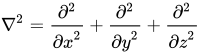
By analogy with classical mechanics, the Hamiltonian is commonly expressed as the sum of operators corresponding to the kinetic and potential energies of a system in the form where is the potential energy operator and is the kinetic energy operator in which is the mass of the particle, the dot denotes the dot product of vectors, and is the momentum operator where a is the del operator. The dot product of with itself is the Laplacian . In three dimensions using Cartesian coordinates the Laplace operator is


Although this is not the technical definition of the Hamiltonian in classical mechanics, it is the form it most commonly takes. Combining these yields the form used in the Schrödinger equation: which allows one to apply the Hamiltonian to systems described by a wave function . This is the approach commonly taken in introductory treatments of quantum mechanics, using the formalism of Schrödinger's wave mechanics.

One can also make substitutions to certain variables to fit specific cases, such as some involving electromagnetic fields.

Expectation value

[edit]

It can be shown that the expectation value of the Hamiltonian which gives the energy expectation value will always be greater than or equal to the minimum potential of the system.

Consider computing the expectation value of kinetic energy:

Hence the expectation value of kinetic energy is always non-negative. This result can be used to calculate the expectation value of the total energy which is given for a normalized wavefunction as: which complete the proof. Similarly, the condition can be generalized to any higher dimensions using divergence theorem.

Many particles

[edit]

The formalism can be extended to particles: where is the potential energy function, now a function of the spatial configuration of the system and time (a particular set of spatial positions at some instant of time defines a configuration) and is the kinetic energy operator of particle , is the gradient for particle , and is the Laplacian for particle n:

Combining these yields the Schrödinger Hamiltonian for the -particle case:

However, complications can arise in the many-body problem. Since the potential energy depends on the spatial arrangement of the particles, the kinetic energy will also depend on the spatial configuration to conserve energy. The motion due to any one particle will vary due to the motion of all the other particles in the system. For this reason cross terms for kinetic energy may appear in the Hamiltonian; a mix of the gradients for two particles: where denotes the mass of the collection of particles resulting in this extra kinetic energy. Terms of this form are known as mass polarization terms, and appear in the Hamiltonian of many-electron atoms (see below).

For interacting particles, i.e. particles which interact mutually and constitute a many-body situation, the potential energy function is not simply a sum of the separate potentials (and certainly not a product, as this is dimensionally incorrect). The potential energy function can only be written as above: a function of all the spatial positions of each particle.

For non-interacting particles, i.e. particles which do not interact mutually and move independently, the potential of the system is the sum of the separate potential energy for each particle,[1] that is

The general form of the Hamiltonian in this case is: where the sum is taken over all particles and their corresponding potentials; the result is that the Hamiltonian of the system is the sum of the separate Hamiltonians for each particle. This is an idealized situation—in practice the particles are almost always influenced by some potential, and there are many-body interactions. One illustrative example of a two-body interaction where this form would not apply is for electrostatic potentials due to charged particles, because they interact with each other by Coulomb interaction (electrostatic force), as shown below.

Schrödinger equation

[edit]

The Hamiltonian generates the time evolution of quantum states. If is the state of the system at time , then

This equation is the Schrödinger equation. It takes the same form as the Hamilton–Jacobi equation, which is one of the reasons is also called the Hamiltonian. Given the state at some initial time (), we can solve it to obtain the state at any subsequent time. In particular, if is independent of time, then

The exponential operator on the right hand side of the Schrödinger equation is usually defined by the corresponding power series in . One might notice that taking polynomials or power series of unbounded operators that are not defined everywhere may not make mathematical sense. Rigorously, to take functions of unbounded operators, a functional calculus is required. In the case of the exponential function, the continuous, or just the holomorphic functional calculus suffices. We note again, however, that for common calculations the physicists' formulation is quite sufficient.

By the *-homomorphism property of the functional calculus, the operator is a unitary operator. It is the time evolution operator or propagator of a closed quantum system. If the Hamiltonian is time-independent, form a one parameter unitary group (more than a semigroup); this gives rise to the physical principle of detailed balance.

Dirac formalism

[edit]

However, in the more general formalism of Dirac, the Hamiltonian is typically implemented as an operator on a Hilbert space in the following way:

The eigenkets of , denoted , provide an orthonormal basis for the Hilbert space. The spectrum of allowed energy levels of the system is given by the set of eigenvalues, denoted , solving the equation:

Since is a Hermitian operator, the energy is always a real number.

From a mathematically rigorous point of view, care must be taken with the above assumptions. Operators on infinite-dimensional Hilbert spaces need not have eigenvalues (the set of eigenvalues does not necessarily coincide with the spectrum of an operator). However, all routine quantum mechanical calculations can be done using the physical formulation.[clarification needed]

Expressions for the Hamiltonian

[edit]

Following are expressions for the Hamiltonian in a number of situations.[2] Typical ways to classify the expressions are the number of particles, number of dimensions, and the nature of the potential energy function—importantly space and time dependence. Masses are denoted by , and charges by .

Free particle

[edit]

The particle is not bound by any potential energy, so the potential is zero and this Hamiltonian is the simplest. For one dimension: and in higher dimensions:

Constant-potential well

[edit]

For a particle in a region of constant potential (no dependence on space or time), in one dimension, the Hamiltonian is: in three dimensions

This applies to the elementary "particle in a box" problem, and step potentials.

Simple harmonic oscillator

[edit]

For a simple harmonic oscillator in one dimension, the potential varies with position (but not time), according to: where the angular frequency , effective spring constant , and mass of the oscillator satisfy: so the Hamiltonian is:

For three dimensions, this becomes where the three-dimensional position vector using Cartesian coordinates is , its magnitude is

Writing the Hamiltonian out in full shows it is simply the sum of the one-dimensional Hamiltonians in each direction:

Rigid rotor

[edit]

For a rigid rotor—i.e., system of particles which can rotate freely about any axes, not bound in any potential (such as free molecules with negligible vibrational degrees of freedom, say due to double or triple chemical bonds), the Hamiltonian is: where , , and are the moment of inertia components (technically the diagonal elements of the moment of inertia tensor), and , , and are the total angular momentum operators (components), about the , , and axes respectively.

Electrostatic (Coulomb) potential

[edit]

The Coulomb potential energy for two point charges and (i.e., those that have no spatial extent independently), in three dimensions, is (in SI units—rather than Gaussian units which are frequently used in electromagnetism):

However, this is only the potential for one point charge due to another. If there are many charged particles, each charge has a potential energy due to every other point charge (except itself). For charges, the potential energy of charge due to all other charges is (see also Electrostatic potential energy stored in a configuration of discrete point charges):[3] where is the electrostatic potential of charge at . The total potential of the system is then the sum over : so the Hamiltonian is:

Electric dipole in an electric field

[edit]

For an electric dipole moment constituting charges of magnitude , in a uniform, electrostatic field (time-independent) , positioned in one place, the potential is: the dipole moment itself is the operator

Since the particle is stationary, there is no translational kinetic energy of the dipole, so the Hamiltonian of the dipole is just the potential energy:

Magnetic dipole in a magnetic field

[edit]

For a magnetic dipole moment in a uniform, magnetostatic field (time-independent) , positioned in one place, the potential is:

Since the particle is stationary, there is no translational kinetic energy of the dipole, so the Hamiltonian of the dipole is just the potential energy:

For a spin-12 particle, the corresponding spin magnetic moment is:[4] where is the "spin g-factor" (not to be confused with the gyromagnetic ratio), is the electron charge, is the spin operator vector, whose components are the Pauli matrices, hence

Charged particle in an electromagnetic field

[edit]

For a particle with mass and charge in an electromagnetic field, described by the scalar potential and vector potential , there are two parts to the Hamiltonian to substitute for.[1] The canonical momentum operator , which includes a contribution from the field and fulfils the canonical commutation relation, must be quantized; where is the kinetic momentum. The quantization prescription reads so the corresponding kinetic energy operator is and the potential energy, which is due to the field, is given by

Casting all of these into the Hamiltonian gives

Energy eigenket degeneracy, symmetry, and conservation laws

[edit]

In many systems, two or more energy eigenstates have the same energy. A simple example of this is a free particle, whose energy eigenstates have wavefunctions that are propagating plane waves. The energy of each of these plane waves is inversely proportional to the square of its wavelength. A wave propagating in the direction is a different state from one propagating in the direction, but if they have the same wavelength, then their energies will be the same. When this happens, the states are said to be degenerate.

It turns out that degeneracy occurs whenever a nontrivial unitary operator commutes with the Hamiltonian. To see this, suppose that is an energy eigenket. Then is an energy eigenket with the same eigenvalue, since

Since is nontrivial, at least one pair of and must represent distinct states. Therefore, has at least one pair of degenerate energy eigenkets. In the case of the free particle, the unitary operator which produces the symmetry is the rotation operator, which rotates the wavefunctions by some angle while otherwise preserving their shape.

The existence of a symmetry operator implies the existence of a conserved observable. Let be the Hermitian generator of :

It is straightforward to show that if commutes with , then so does :

Therefore,

In obtaining this result, we have used the Schrödinger equation, as well as its dual,

Thus, the expected value of the observable is conserved for any state of the system. In the case of the free particle, the conserved quantity is the angular momentum.

Hamilton's equations

[edit]

Hamilton's equations in classical Hamiltonian mechanics have a direct analogy in quantum mechanics. Suppose we have a set of basis states , which need not necessarily be eigenstates of the energy. For simplicity, we assume that they are discrete, and that they are orthonormal, i.e.,

Note that these basis states are assumed to be independent of time. We will assume that the Hamiltonian is also independent of time.

The instantaneous state of the system at time , , can be expanded in terms of these basis states: where

The coefficients are complex variables. We can treat them as coordinates which specify the state of the system, like the position and momentum coordinates which specify a classical system. Like classical coordinates, they are generally not constant in time, and their time dependence gives rise to the time dependence of the system as a whole.

The expectation value of the Hamiltonian of this state, which is also the mean energy, is where the last step was obtained by expanding in terms of the basis states.

Each actually corresponds to two independent degrees of freedom, since the variable has a real part and an imaginary part. We now perform the following trick: instead of using the real and imaginary parts as the independent variables, we use and its complex conjugate . With this choice of independent variables, we can calculate the partial derivative

By applying the Schrödinger equation and using the orthonormality of the basis states, this further reduces to

Similarly, one can show that

If we define "conjugate momentum" variables by then the above equations become which is precisely the form of Hamilton's equations, with the s as the generalized coordinates, the s as the conjugate momenta, and taking the place of the classical Hamiltonian.

See also

[edit]

References

[edit]

Further reading

[edit]
[edit]
Revisions and contributorsEdit on WikipediaRead on Wikipedia
from Grokipedia
In quantum mechanics, the Hamiltonian (denoted as H^\hat{H}) is a self-adjoint operator acting on the Hilbert space of a physical system, representing the total energy as the sum of kinetic and potential energy contributions. In the position representation, for a single particle in one dimension, it takes the form H^=22md2dx2+V(x)\hat{H} = -\frac{\hbar^2}{2m} \frac{d^2}{dx^2} + V(x), where the first term is the kinetic energy operator and V(x)V(x) is the potential energy function. The Hamiltonian governs the dynamical evolution of quantum states via the time-dependent Schrödinger equation, iψt=H^ψi \hbar \frac{\partial \psi}{\partial t} = \hat{H} \psi, where ψ\psi is the wave function and \hbar is the reduced Planck's constant. For time-independent potentials, the stationary states are the eigenfunctions of H^\hat{H}, with eigenvalues giving the discrete or continuous energy spectrum of the system. Originally developed in by in the 1830s as a function of position and to describe and generate , the Hamiltonian was adapted to during the 1920s through the formalisms of and wave mechanics. This quantization replaces classical variables with non-commuting operators, preserving the energy-generating role while incorporating quantum principles like . Key applications of the Hamiltonian include solving for bound states in atoms and molecules, for approximate solutions, and time-independent formulations for eigenvalues in extensions. Its Hermitian nature ensures real eigenvalues, aligning with the nature of in measurements.

Fundamentals

Definition and Role

In quantum mechanics, the Hamiltonian operator, denoted as H^\hat{H}, is the self-adjoint operator corresponding to the total energy of a physical system, encompassing both kinetic and potential contributions. It is defined as H^=T^+V^\hat{H} = \hat{T} + \hat{V}, where T^\hat{T} is the operator and V^\hat{V} is the operator. This operator plays a central role as the generator of time evolution for quantum states, dictating how the system propagates in time according to the fundamental dynamical laws./18%3A_The_Transition_to_Quantum_Physics/18.03%3A_Hamiltonian_in_Quantum_Theory) The expectation value of the Hamiltonian in a given ψ|\psi\rangle yields the average total of the , computed as H^=ψH^ψ\langle \hat{H} \rangle = \langle \psi | \hat{H} | \psi \rangle, assuming the state is normalized. This quantity provides a probabilistic measure of , reflecting the uncertainty inherent in quantum measurements. The Hermitian nature of H^\hat{H} is a key property, guaranteed by the requirement that energy observables must yield real-valued outcomes; non-Hermitian operators would produce complex eigenvalues, which are physically inadmissible for energy levels. The concept of the Hamiltonian draws from , where it was introduced by as the energy function in terms of and momenta, reformulating Newtonian dynamics. In the quantum context, this framework was pioneered by in late 1925 through , where operators replaced classical variables to satisfy quantum commutation relations, and independently by in 1926 via wave mechanics, establishing the operator's role in eigenvalue problems for bound states.

Classical Origins

In classical mechanics, the Hamiltonian function H(p,q)H(\mathbf{p}, \mathbf{q}) represents the total energy of a system in terms of generalized momenta p\mathbf{p} and coordinates q\mathbf{q}, typically decomposed as the sum of kinetic energy T(p)T(\mathbf{p}), which depends only on momenta, and potential energy V(q)V(\mathbf{q}), which depends only on coordinates: H(p,q)=T(p)+V(q).H(\mathbf{p}, \mathbf{q}) = T(\mathbf{p}) + V(\mathbf{q}). This formulation, introduced by William Rowan Hamilton in his 1834 essay, reformulates Newtonian dynamics in phase space, providing a symmetric treatment of coordinates and momenta that reveals conserved quantities and symmetries more readily than Lagrangian mechanics. The dynamics are governed by Hamilton's equations, q˙i=Hpi,p˙i=Hqi,\dot{q}_i = \frac{\partial H}{\partial p_i}, \quad \dot{p}_i = -\frac{\partial H}{\partial q_i}, which generate the time evolution of the system and ensure energy conservation when HH is time-independent. A key extension of the Hamiltonian framework is the Hamilton-Jacobi equation, a first-order for the principal characteristic function S(q,t)S(\mathbf{q}, t): St+H(q,Sq)=0.\frac{\partial S}{\partial t} + H\left(\mathbf{q}, \frac{\partial S}{\partial \mathbf{q}}\right) = 0. Hamilton outlined this in his 1834 work, with refining it in 1837 to emphasize its role in solving integrable systems. The equation facilitates canonical transformations—symplectic mappings (q,p)(Q,P)(\mathbf{q}, \mathbf{p}) \to (\mathbf{Q}, \mathbf{P}) that preserve the structure of Hamilton's equations—by generating new variables where the transformed Hamiltonian simplifies, often becoming independent of the new coordinates or time, thus yielding explicit solutions via . For instance, in central force problems, it transforms the Hamiltonian into action-angle variables, highlighting periodic motions and adiabatic invariants central to classical . The transition from classical to quantum mechanics builds on this foundation through the correspondence principle, which posits that quantum behavior approaches classical limits for large quantum numbers. In 1926, Paul Dirac formalized canonical quantization rules, replacing classical Poisson brackets {qi,pj}=δij\{q_i, p_j\} = \delta_{ij} with commutators [q^i,p^j]=iδij[ \hat{q}_i, \hat{p}_j ] = i \hbar \delta_{ij} for operators q^i\hat{q}_i and p^j\hat{p}_j, and specifically mapping position to multiplication by qq and momentum to i-i \hbar \nabla in the quantum Hamiltonian operator. This procedure quantizes the classical H(p,q)H(\mathbf{p}, \mathbf{q}) directly into H^(p^,q^)\hat{H}(\hat{\mathbf{p}}, \hat{\mathbf{q}}), ensuring the quantum theory reproduces classical equations in the 0\hbar \to 0 limit. Earlier, Werner Heisenberg's 1925 matrix mechanics introduced the quantum Hamiltonian as an infinite matrix whose elements encode transition amplitudes between stationary states, enabling calculations of spectral lines without reference to unobservable electron orbits and marking the first operational use of a Hamiltonian in quantum theory.

Formal Representations

Schrödinger Formalism

In the Schrödinger formalism of , the Hamiltonian operator describes the total energy of a quantum system in the position representation, where states are represented by wavefunctions ψ(r). For a single particle of mass m in a potential V(r), the Hamiltonian takes the form H^=22m2+V(r),\hat{H} = -\frac{\hbar^2}{2m} \nabla^2 + V(\mathbf{r}), where ħ is the reduced Planck's constant and ∇² is the Laplacian operator. This operator form arises directly from the quantization of the classical Hamiltonian, with the replaced by -iħ∇ in position space. This single-particle Hamiltonian extends naturally to many-particle systems, where the total Hamiltonian is the sum of terms for each particle and the , which includes both external potentials and interactions between particles. For N particles with masses m_i and coordinates r_i, the operator is H^=i=1N(22mii2+Vext(ri))+i<jVint(ri,rj),\hat{H} = \sum_{i=1}^N \left( -\frac{\hbar^2}{2m_i} \nabla_i^2 + V_{\text{ext}}(\mathbf{r}_i) \right) + \sum_{i < j} V_{\text{int}}(\mathbf{r}_i, \mathbf{r}_j), with the wavefunction ψ(r_1, ..., r_N) depending on all particle positions. This form accounts for indistinguishable particles through symmetrization or antisymmetrization of the wavefunction, as required by quantum statistics. The expectation value of the Hamiltonian, representing the average total energy, is computed as the integral over the configuration space: H^=ψH^ψdV,\langle \hat{H} \rangle = \int \psi^* \hat{H} \psi \, dV, where the wavefunction is normalized such that ∫ |ψ|² dV = 1 to ensure probabilistic interpretation. In closed systems without external influences, the Hamiltonian is time-independent, leading to stationary states as solutions to the time-independent Schrödinger equation; time-dependent forms arise from perturbations, such as external fields, but their treatment involves additional approximations.

Dirac Formalism

In the Dirac formalism, the Hamiltonian is represented as a self-adjoint operator Ĥ acting on the of quantum states, where state vectors are denoted using bra-ket notation. For an energy eigenstate |ψ⟩ with eigenvalue E, the eigenvalue equation takes the form Ĥ |ψ⟩ = E |ψ⟩, encapsulating the total energy of the system in a basis-independent manner. This abstract operator approach emphasizes the algebraic structure of quantum mechanics, treating observables as linear operators on the vector space without reference to specific representations. A key feature of the Hamiltonian in this formalism is its spectral decomposition, arising from the spectral theorem for self-adjoint operators: Ĥ = ∑_n E_n |n⟩ ⟨n|, where {|n⟩} forms a complete orthonormal basis of energy eigenstates and the E_n are the corresponding eigenvalues. This decomposition allows the Hamiltonian to be expressed purely in terms of its projectors onto eigenspaces, facilitating computations of expectation values and time evolution in abstract terms. Commutation relations further highlight the Hamiltonian's role in dynamics; for any observable operator Â, the commutator [Ĥ, Â] determines compatibility, and if [Ĥ, Â] = 0, then  is conserved under time evolution, reflecting underlying symmetries of the system. The Dirac formalism also provides a natural framework for the of time evolution, where state vectors remain fixed while operators transform as Â(t) = e^{i Ĥ t / ℏ}  e^{-i Ĥ t / ℏ}. This unitary conjugation shifts the time dependence from states to operators, contrasting with the in which states evolve via |ψ(t)⟩ = e^{-i Ĥ t / ℏ} |ψ(0)⟩ while operators are time-independent. The bra-ket notation, introduced by Dirac, streamlines these expressions and enables seamless transitions between pictures. This operator-centric approach, formalized in Dirac's 1930 monograph and refined with the 1939 introduction of bra-ket notation, laid the groundwork for relativistic quantum theories by abstracting away coordinate-dependent details.

Relation to the Schrödinger Equation

The time-dependent Schrödinger equation governs the evolution of the quantum state vector ψ(t)|\psi(t)\rangle in the Hilbert space, expressed as itψ(t)=H^ψ(t),i \hbar \frac{\partial}{\partial t} |\psi(t)\rangle = \hat{H} |\psi(t)\rangle, where H^\hat{H} is the Hamiltonian operator and \hbar is the reduced Planck's constant. This equation arises from the postulate that the time evolution of an isolated quantum system is unitary, preserving the norm of the state vector. For a time-independent Hamiltonian, the unitary time evolution operator is U(t)=eiH^t/U(t) = e^{-i \hat{H} t / \hbar}, such that ψ(t)=U(t)ψ(0)|\psi(t)\rangle = U(t) |\psi(0)\rangle. Differentiating this with respect to time yields the time-dependent Schrödinger equation, confirming that the Hamiltonian generates infinitesimal time translations in the quantum dynamics. For systems with stationary states, where the Hamiltonian does not explicitly depend on time, the time-independent Schrödinger equation emerges through separation of variables. Assume a product form for the wave function ψ(r,t)=ϕ(r)eiEt/\psi(\mathbf{r}, t) = \phi(\mathbf{r}) \, e^{-i E t / \hbar}, where ϕ(r)\phi(\mathbf{r}) depends only on position and EE is a constant. Substituting into the time-dependent equation separates the time and spatial parts, resulting in the eigenvalue equation H^ϕn=Enϕn\hat{H} |\phi_n\rangle = E_n |\phi_n\rangle for the energy eigenstates ϕn|\phi_n\rangle with eigenvalues EnE_n, the possible energy levels of the system. This form highlights the Hamiltonian's role in determining the stationary states and discrete spectrum for bound systems. Solving the time-independent Schrödinger equation typically involves treating it as an eigenvalue problem, where exact solutions exist for simple potentials like the harmonic oscillator, but numerical or approximate methods are required for more complex cases. For weakly perturbed systems, where the Hamiltonian is H^=H^0+λV^\hat{H} = \hat{H}_0 + \lambda \hat{V} with small λ\lambda, time-independent perturbation theory provides corrections to the unperturbed eigenvalues and eigenstates of H^0\hat{H}_0, expanding in powers of λ\lambda. This approach, essential for applications in atomic and molecular physics, was originally developed to handle deviations from solvable models. The Schrödinger equation, both time-dependent and time-independent forms, was proposed by in 1926 as part of his wave mechanics formulation, which demonstrated mathematical equivalence to Heisenberg's matrix mechanics through shared eigenvalue spectra and dynamics.

Specific Forms

Free Particle

In quantum mechanics, the Hamiltonian for a free particle of mass mm, which experiences no potential, is purely kinetic and expressed as H^=p^22m\hat{H} = \frac{\hat{\mathbf{p}}^2}{2m}, where p^\hat{\mathbf{p}} is the momentum operator. In the position representation, this becomes the differential operator H^=22m2\hat{H} = -\frac{\hbar^2}{2m} \nabla^2, leading to the time-independent 22m2ψ=Eψ-\frac{\hbar^2}{2m} \nabla^2 \psi = E \psi. The energy eigenvalues form a continuous spectrum given by E=2k22mE = \frac{\hbar^2 k^2}{2m}, where k\mathbf{k} is the wave vector related to momentum by p=k\mathbf{p} = \hbar \mathbf{k}; this reflects the absence of discrete energy levels due to the unbounded nature of the system. The corresponding eigenfunctions are plane waves, ψk(r)=1(2π)3/2eikr\psi_{\mathbf{k}}(\mathbf{r}) = \frac{1}{(2\pi)^{3/2}} e^{i \mathbf{k} \cdot \mathbf{r}}, which are normalized in the sense of Dirac delta functions over infinite space, satisfying ψk(r)ψk(r)d3r=δ3(kk)\int \psi_{\mathbf{k}}^*(\mathbf{r}) \psi_{\mathbf{k}'}(\mathbf{r}) d^3 r = \delta^3(\mathbf{k} - \mathbf{k}'). For practical calculations in a finite volume V=L3V = L^3, such as a cubic box with periodic boundary conditions, the wave vectors are discretized as k=2πL(nx,ny,nz)\mathbf{k} = \frac{2\pi}{L} (n_x, n_y, n_z) with integers nin_i, and the wave functions are normalized to unity within the box: ψk(r)=1Veikr\psi_{\mathbf{k}}(\mathbf{r}) = \frac{1}{\sqrt{V}} e^{i \mathbf{k} \cdot \mathbf{r}}
Add your contribution
Related Hubs
Contribute something
User Avatar
No comments yet.