


Community hub
Recent from talks
Contribute something
Nothing was collected or created yet.
Sexual selection
View on Wikipedia

Sexual selection is a mechanism of evolution in which members of one sex choose mates of the other sex to mate with (intersexual selection), and compete with members of the same sex for access to members of the opposite sex (intrasexual selection). These two forms of selection mean that some individuals have greater reproductive success than others within a population, for example because they are more attractive or prefer more attractive partners to produce offspring. Successful males benefit from frequent mating and monopolizing access to one or more fertile females. Females can maximise the return on the energy they invest in reproduction by selecting and mating with the best males.
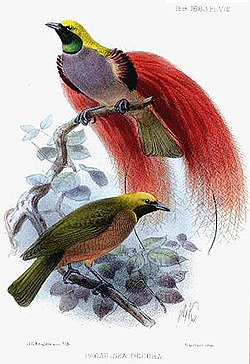
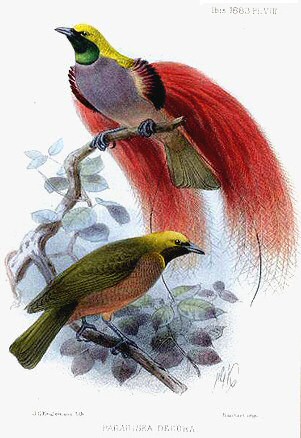
The concept was first articulated by Charles Darwin who wrote of a "second agency" other than natural selection, in which competition between mate candidates could lead to speciation. The theory was given a mathematical basis by Ronald Fisher in the early 20th century. Sexual selection can lead males to extreme efforts to demonstrate their fitness to be chosen by females, producing sexual dimorphism in secondary sexual characteristics, such as the ornate plumage of birds-of-paradise and peafowl, or the antlers of deer. Depending on the species, these rules can be reversed. This is caused by a positive feedback mechanism known as a Fisherian runaway, where the passing-on of the desire for a trait in one sex is as important as having the trait in the other sex in producing the runaway effect. Although the sexy son hypothesis indicates that females would prefer male offspring, Fisher's principle explains why the sex ratio is most often 1:1. Sexual selection is widely distributed in the animal kingdom, and is also found in plants and fungi.
History
[edit]Darwin
[edit]
Sexual selection was first proposed by Charles Darwin in On the Origin of Species (1859) and developed in The Descent of Man, and Selection in Relation to Sex (1871), as he felt that natural selection alone was unable to account for certain types of non-survival adaptations. He once wrote to a colleague that "The sight of a feather in a peacock's tail, whenever I gaze at it, makes me sick!" His work divided sexual selection into male–male competition and female choice.[1][2]
... depends, not on a struggle for existence, but on a struggle between the males for possession of the females; the result is not death to the unsuccessful competitor, but few or no offspring.[3]
... when the males and females of any animal have the same general habits ... but differ in structure, colour, or ornament, such differences have been mainly caused by sexual selection.[3]
These views were to some extent opposed by Alfred Russel Wallace, mostly after Darwin's death. He accepted that sexual selection could occur, but argued that it was a relatively weak form of selection. He argued that male–male competitions were forms of natural selection, but that the "drab" peahen's coloration is itself adaptive as camouflage. In his opinion, ascribing mate choice to females was attributing the ability to judge standards of beauty to animals (such as beetles) far too cognitively undeveloped to be capable of aesthetic feeling.[4]

Darwin's ideas on sexual selection were met with scepticism by his contemporaries and not considered of great importance, until in the 1930s biologists decided to include sexual selection as a mode of natural selection.[6] Only in the 21st century have they become more important in biology; the theory is now seen as generally applicable and analogous to natural selection.[7] A ten-year study, experimentally varying sexual selection on flour beetles with other factors held constant, showed that sexual selection protected even an inbred population against extinction.[5]
Fisherian runaway
[edit]Ronald Fisher, the English statistician and evolutionary biologist, developed his ideas about sexual selection in his 1930 book The Genetical Theory of Natural Selection. These include the sexy son hypothesis, which might suggest a preference for male offspring, and Fisher's principle, which explains why the sex ratio is usually close to 1:1. The Fisherian runaway describes how sexual selection accelerates the preference for a specific ornament, causing the preferred trait and female preference for it to increase together in a positive feedback runaway cycle.[8] He remarked that:[9]
... plumage development in the male, and sexual preference for such developments in the female, must thus advance together, and so long as the process is unchecked by severe counterselection, will advance with ever-increasing speed. In the total absence of such checks, it is easy to see that the speed of development will be proportional to the development already attained, which will therefore increase with time exponentially, or in geometric progression. —Ronald Fisher, 1930[8]

This causes a dramatic increase in both the male's conspicuous feature and in female preference for it, resulting in marked sexual dimorphism, until practical physical constraints halt further exaggeration. A positive feedback loop is created, producing extravagant physical structures in the non-limiting sex. A classic example of female choice and potential runaway selection is the long-tailed widowbird. While males have long tails that are selected for by female choice, female tastes in tail length are still more extreme with females being attracted to tails longer than those that naturally occur.[10] Fisher understood that female preference for long tails may be passed on genetically, in conjunction with genes for the long tail itself. Long-tailed widowbird offspring of both sexes inherit both sets of genes, with females expressing their genetic preference for long tails, and males showing off the coveted long tail itself.[9]
Richard Dawkins presents a non-mathematical explanation of the runaway sexual selection process in his book The Blind Watchmaker.[9] Females that prefer long tailed males tend to have mothers that chose long-tailed fathers. As a result, they carry both sets of genes in their bodies. That is, genes for long tails and for preferring long tails become linked. The taste for long tails and tail length itself may therefore become correlated, tending to increase together. The more tails lengthen, the more long tails are desired. Any slight initial imbalance between taste and tails may set off an explosion in tail lengths. Fisher wrote that:
The exponential element, which is the kernel of the thing, arises from the rate of change in hen taste being proportional to the absolute average degree of taste. —Ronald Fisher, 1932[11]

The female widowbird chooses to mate with the most attractive long-tailed male so that her progeny, if male, will themselves be attractive to females of the next generation—thereby fathering many offspring that carry the female's genes. Since the rate of change in preference is proportional to the average taste amongst females, and as females desire to secure the services of the most sexually attractive males, an additive effect is created that, if unchecked, can yield exponential increases in a given taste and in the corresponding desired sexual attribute.[9]
It is important to notice that the conditions of relative stability brought about by these or other means, will be far longer duration than the process in which the ornaments are evolved. In most existing species the runaway process must have been already checked, and we should expect that the more extraordinary developments of sexual plumage are not due like most characters to a long and even course of evolutionary progress, but to sudden spurts of change. —Ronald Fisher, 1930[8]
Since Fisher's initial conceptual model of the 'runaway' process, Russell Lande and Peter O'Donald have provided detailed mathematical proofs that define the circumstances under which runaway sexual selection can take place.[12][13] Alongside this, biologists have extended Darwin's formulation; Malte Andersson's widely accepted[14] 1994 definition is that "sexual selection is the differences in reproduction that arise from variation among individuals in traits that affect success in competition over mates and fertilizations".[10][14] Despite some practical challenges for biologists, the concept of sexual selection is "straightforward".[14]
Modern theory
[edit]Reproductive success
[edit]
The reproductive success of an organism is measured by the number of offspring left behind, and by their quality or probable fitness.[16][17][18] Sexual preference creates a tendency towards assortative mating or homogamy. The general conditions of sexual discrimination appear to be (1) the acceptance of one mate precludes the effective acceptance of alternative mates, and (2) the rejection of an offer is followed by other offers, either certainly or at such high chance that the risk of non-occurrence is smaller than the chance advantage to be gained by selecting a mate. Bateman's principle states that the sex which invests the most in producing offspring becomes a limiting resource for which the other sex competes, illustrated by the greater nutritional investment of an egg in a zygote, and the limited capacity of females to reproduce; for example, in humans, a woman can only give birth every ten months, whereas a male can become a father numerous times in the same period.[19] More recently, researchers have doubted whether Bateman was correct.[20]
Honest signalling
[edit]The handicap principle of Amotz Zahavi, Russell Lande and W. D. Hamilton, holds that the male's survival until and through the age of reproduction with seemingly maladaptive traits is taken by the female as a signal of his overall fitness. Such handicaps might prove he is either free of or resistant to disease, or that he possesses more speed or a greater physical strength that is used to combat the troubles brought on by the exaggerated trait.[21][22][23] Zahavi's work spurred a re-examination of the field and several new theories. In 1984, Hamilton and Marlene Zuk introduced the "Bright Male" hypothesis, suggesting that male elaborations might serve as a marker of health, by exaggerating the effects of disease and deficiency.[24]
Male intrasexual competition
[edit]
Male–male competition occurs when two males of the same species compete for the opportunity to mate with a female. Sexually dimorphic traits, size, sex ratio,[26] and the social situation[27] may all play a role in the effects male–male competition has on the reproductive success of a male and the mate choice of a female. Larger males tend to win male–male conflicts.[28] Males take many risks in such conflicts, so the value of the resource must be large enough to justify those risks.[29][30] Winner and loser effects further influence male behaviour.[31] Male–male competition may also affect a female's ability to select the best mates, and therefore decrease the likelihood of successful reproduction.[32]
Multiple models
[edit]More recently, the field has grown to include other areas of study, not all of which fit Darwin's definition of sexual selection. A "bewildering"[33] range of models variously attempt to relate sexual selection not only to the fundamental[33] questions of anisogamy and parental roles, but also to mechanisms such as sex ratios – governed by Fisher's principle,[34] parental care, investing in sexy sons, sexual conflict, and the "most-debated effect",[33] namely mate choice.[33] Elaborated characteristics that might seem costly, like the tail of the Montezuma swordfish (Xiphophorus montezumae), do not always have an energetics, performance or even survival cost; this may be because "compensatory traits" have evolved in concert with the sexually selected traits.[35]
Toolkit of natural selection
[edit]
Sexual selection may explain how characteristics such as feathers had survival value at an early stage in their evolution. The earliest proto-birds such as Protarchaeopteryx had well-developed feathers but could not fly. The feathers may have served as insulation, helping females incubate their eggs, but if proto-bird courtship combined displays of forelimb feathers with energetic jumps, then the transition to flight could have been relatively smooth.[36]
Sexual selection may sometimes generate features that help cause a species' extinction, as has historically been suggested for the giant antlers of the Irish elk (Megaloceros giganteus) that became extinct in Holocene[37] Eurasia[15] (although climate-induced habitat deterioration and anthropogenic pressure are now considered more likely causes).[38] It may, however, also do the opposite, driving species divergence—sometimes through elaborate changes in genitalia[39]—such that new species emerge.[40][41] Sexual selection often interacts with natural selection to drive speciation.[42]
Sex role reversal
[edit]Darwin addressed sex role reversal in The Descent of Man, with females undergoing selection by male mating partners.[43] Darwin and then others described reversed sex roles in the barred buttonquail (Turnix suscitator).[43] Expected sex hierarchy norms were similarly subverted among pipefish (Syngnathinae) and seahorses (Hippocampus).[44] Females of these species are generally larger, more colorful, and more aggressive than males.[43]
In different taxa
[edit]Sexual selection is widely distributed among the eukaryotes, occurring in plants, fungi, and animals. Since Darwin's pioneering observations on humans, it has been studied intensively among the insects, spiders, amphibians, scaled reptiles, birds, and mammals, revealing many distinctive behaviours and physical adaptations.[45]
In mammals
[edit]Darwin conjectured that heritable traits such as beards, hairlessness, and steatopygia in different human populations are results of sexual selection in humans.[46] Humans are sexually dimorphic; females select males using factors including voice pitch, facial shape, muscularity, and height.[47][48]
Among the many instances of sexual selection in mammals is extreme sexual dimorphism, with males as much as six times heavier than females, and male fighting for dominance among elephant seals. Dominant males establish large harems of several dozen females; unsuccessful males may attempt to copulate with a harem male's females if the dominant male is inattentive. This forces the harem male to defend his territory continuously, not feeding for as much as three months.[49][50]
Also seen in mammals is sex-role reversal, as in the highly social meerkats, where a large female is dominant within a pack, and female–female competition is observed. The dominant female produces most of the offspring; the subordinate females are nonbreeding, providing altruistic care to the young.[51][52]
In arthropods
[edit]Sexual selection occurs in a wide range of spider species, both before and after copulation.[53] Post-copulatory sexual selection involves sperm competition and cryptic female choice. Sperm competition occurs where the sperm of more than one male competes to fertilise the egg of the female. Cryptic female choice involves the expelling of a male's sperm during or after copulations.[54]
Many forms of sexual selection exist among the insects. Parental care is often provided by female insects, as in bees, but male parental care is found in belostomatid water bugs, where the male, after fertilizing the eggs, allows the female to glue her eggs onto his back. He broods them until the nymphs hatch 2–4 weeks later. The eggs are large and reduce the ability of the male to fertilise other females and catch prey, and increases its predation risk.[55]
Among the fireflies (Lampyrid beetles), males fly in darkness and emit a species-specific pattern of light flashes, which are answered by perching receptive females. The colour and temporal variation of the flashes contribute to success in attracting females.[56][57][58] Among the beetles, sexual selection is common. In the mealworm beetle, Tenebrio molitor, males release pheromones to attract females to mate.[59] Females choose mates based on whether they are infected, and on their mass.[60]
In molluscs
[edit]Postcopulatory intersexual selection occurs in Idiosepius paradoxus, the Japanese pygmy squid. Males place their spermatangia on an external location on the female's body. The female physically removes spermatangia of males she is presumed to favour less.[61][62]
In amphibians and reptiles
[edit]Many amphibians have annual breeding seasons with male–male competition. Males arrive at the water's edge first in large numbers, and produce a wide range of vocalizations to attract mates. Among frogs, the fittest males have the deepest croaks and the best territories; females select their mates at least partly based on the depth of croaking. This has led to sexual dimorphism, with females larger than males in 90% of species, and male fighting to access females.[63][64] Spikethumb frogs are suggested to engage in male-male competition with their elongated prepollex to maintain their mating site.[65] The prepollex, which serves as a rudimentary digit, contains a projecting spine that may be used during this combat, leaving scars on the heads and forelimbs of other males.[66]
Many different tactics are used by snakes to acquire mates. Ritual combat between males for the females they want to mate with includes topping, a behaviour exhibited by most viperids, in which one male twists around the vertically elevated fore body of its opponent and forcing it downward. Neck biting is common while the snakes are entwined.[67][68]
In birds
[edit]Birds have evolved a wide variety of mating behaviours and many types of sexual selection. These include intersexual selection (female choice) and intrasexual competition, where individuals of the more abundant sex compete with each other for the privilege to mate. Many species, notably the birds-of-paradise, are sexually dimorphic; the differences such as in size and coloration are energetically costly attributes that signal competitive breeding. Conflicts between an individual's fitness and signalling adaptations ensure that sexually selected ornaments such as coloration of plumage and courtship behaviour are honest traits. Signals must be costly to ensure that only good-quality individuals can present these exaggerated sexual ornaments and behaviours. Males with the brightest plumage are favoured by females of multiple species of bird.[69][70][71]
Many bird species make use of mating calls, the females preferring males with songs that are complex and varied in amplitude, structure, and frequency. Larger males have deeper songs and increased mating success.[72][73][74][75]
In plants and fungi
[edit]Flowering plants have many secondary sexual characteristics subject to sexual selection including floral symmetry if pollinators visit flowers assortatively by degree of symmetry,[76] nectar production, floral structure, and inflorescences, as well as sexual dimorphisms.[77][78][79]
Fungi appear to make use of sexual selection, although they also often reproduce asexually. In the Basidiomycetes, the sex ratio is biased towards males, implying sexual selection there. Male–male competition to fertilise occurs in fungi including yeasts. Pheromone signaling is used by female gametes and by conidia, implying male choice in these cases. Female–female competition may also occur, indicated by the much faster evolution of female-biased genes in fungi.[45][80][81][82]
- Example sexual selection mechanisms in the named taxa
-
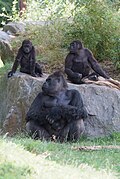 Among mammals, the male gorilla is much larger than the female.
 -
 Males of many spiders, such as this Phidippus putnami, have elaborate courtship displays.
 -
 A male Abedus indentatus belostomatid bug carries eggs on its back.
 -
 Each firefly species attracts mates with its own flash pattern.
 -
 Male Dendropsophus microcephalus calling
 -
 Territorial fight in the Indian rat snake, Ptyas mucosa
 -
 Male Victoria's riflebird displaying to a female
 -
 A male satin bowerbird guards its bower from rival males in the hope of attracting females with its decorations.
 -
 Male southern elephant seals fighting on Macquarie Island for the chance to mate
 -
 Citronella flower's symmetry may have been subject to sexual selection by its pollinators.
 -
 Male moor frogs become blue to signal their fitness to females.


.jpg)
.jpg)

_(cropped).jpg)


References
[edit]- ^ Darwin, Charles (1858). "On the Tendency of Species to form Varieties; and on the Perpetuation of Varieties and Species by Natural Means of Selection" (PDF). Journal of the Proceedings of the Linnean Society of London. Zoology. 3 (9): 46–50. doi:10.1111/j.1096-3642.1858.tb02500.x. Archived (PDF) from the original on 22 October 2012.
- ^ Mendelson, Tamra C.; Safran, Rebecca J. (2021). "Speciation by sexual selection: 20 years of progress". Trends in Ecology & Evolution. 36 (12): 1153–1163. Bibcode:2021TEcoE..36.1153M. doi:10.1016/j.tree.2021.09.004. PMID 34607719.
- ^ a b Darwin, Charles (1859). On the Origin of Species (1st edition). Chapter 4, p. 88. "And this leads me to say a few words on what I call Sexual Selection. This depends ..." "Archived copy". Archived from the original on 2011-11-05. Retrieved 2011-05-22.
{{cite web}}: CS1 maint: archived copy as title (link) - ^ Wallace, Alfred Russel (1892). "Note on Sexual Selection (S459: 1892)". Charles Smith. Archived from the original on 17 February 2017. Retrieved 13 January 2017.
- ^ a b Population benefits of sexual selection explain the existence of males phys.org May 18, 2015 Report on a study by the University of East Anglia Archived August 21, 2015, at the Wayback Machine
- ^ Miller, G. F. (2000). The Mating Mind: How sexual choice shaped the evolution of human nature. London: Heinemann. p. 24. ISBN 978-0-434-00741-7.
- ^ Hosken, David J.; House, Clarissa M. (January 2011). "Sexual Selection". Current Biology. 21 (2): R62 – R65. Bibcode:2011CBio...21..R62H. doi:10.1016/j.cub.2010.11.053. PMID 21256434. S2CID 18470445.
- ^ a b c Fisher, R. A. (1930) The Genetical Theory of Natural Selection. Oxford University Press, ISBN 0-19-850440-3, Chapter 6.
- ^ a b c d Dawkins, Richard (1996). The Blind Watchmaker: Why the Evidence of Evolution Reveals a Universe Without Design. Norton. pp. Chapter 8, Explosions and Spirals. ISBN 978-0-393-31570-7.
- ^ a b Andersson, M. (1994). Sexual Selection. Princeton University Press. pp. 115–117. ISBN 0-691-00057-3.
- ^ Ronald Fisher in a letter to Charles Galton Darwin, 22 November 1932, cited in Fisher, R. A., Bennett, J. H. 1999. The genetical theory of natural selection: A complete variorum edition, Oxford University Press, Oxford, p. 308
- ^ Lande, Russell (1981). "Models of speciation by sexual selection on polygenic traits". PNAS. 78 (6): 3721–3725. Bibcode:1981PNAS...78.3721L. doi:10.1073/pnas.78.6.3721. PMC 319643. PMID 16593036.
- ^ O'Donald, Peter (1980). Genetic Models of Sexual Selection. Cambridge University Press. ISBN 978-0-521-22533-5.
- ^ a b c Kokko, H.; Jennions, M. D. (18 July 2014). "The Relationship between Sexual Selection and Sexual Conflict". Cold Spring Harbor Perspectives in Biology. 6 (9) a017517. Cold Spring Harbor Laboratory. doi:10.1101/cshperspect.a017517. ISSN 1943-0264. PMC 4142970. PMID 25038050.
- ^ a b Gould, Stephen Jay (1974). "Origin and Function of 'Bizarre' Structures – Antler Size and Skull Size in 'Irish Elk', Megaloceros giganteus". Evolution. 28 (2): 191–220. doi:10.2307/2407322. JSTOR 2407322. PMID 28563271.
- ^ Orr, H. A. (August 2009). "Fitness and its role in evolutionary genetics". Nature Reviews Genetics. 10 (8): 531–9. doi:10.1038/nrg2603. PMC 2753274. PMID 19546856.
- ^ Starr, Cecie (2013). Biology: The Unity & Diversity of Life. Cengage Learning. p. 281.
- ^ Vogt, Yngve (January 29, 2014). "Large testicles are linked to infidelity". Phys.org. Archived from the original on January 31, 2014. Retrieved January 31, 2014.
- ^ Bateman, Angus J. (1948). "Intra-sexual selection in Drosophila". Heredity. 2 (Pt. 3): 349–368. doi:10.1038/hdy.1948.21. PMID 18103134.
- ^ Newcomer, Scott D.; Zeh, Jeanne A.; Zeh, David W. (31 August 1999). "Genetic benefits enhance the reproductive success of polyandrous females". PNAS. 96 (18): 10236–10241. Bibcode:1999PNAS...9610236N. doi:10.1073/pnas.96.18.10236. PMC 17872. PMID 10468592.
- ^ Zahavi, Amotz (1975). "Mate selection—A selection for a handicap". Journal of Theoretical Biology. 53 (1): 205–214. Bibcode:1975JThBi..53..205Z. doi:10.1016/0022-5193(75)90111-3. PMID 1195756.
- ^ Zahavi, Amotz (1977). "The cost of honesty". Journal of Theoretical Biology. 67 (3): 603–605. Bibcode:1977JThBi..67..603Z. doi:10.1016/0022-5193(77)90061-3. ISSN 0022-5193. PMID 904334.
- ^ Zahavi, Amotz; Zahavi, Avishag (1997). The handicap principle: a missing piece of Darwin's puzzle (PDF). New York: Oxford University Press. ISBN 978-0-19-510035-8. OCLC 35360821.
- ^ Hamilton, W. D.; Zuk, M. (1982). "Heritable true fitness and bright birds: a role for parasites?". Science. 218 (4570): 384–387. Bibcode:1982Sci...218..384H. doi:10.1126/science.7123238. PMID 7123238.
- ^ Williamson, E. A.; Butynski, T. M. (2013). "Gorilla beringei eastern gorilla". In Butynski, T. M.; Kingdon, J.; Kalina, J. (eds.). Mammals of Africa. Vol. 2. Primates. London, New Delhi, New York, Sydney: Bloomsbury. pp. 45–53. ISBN 978-1-4081-8996-2.
- ^ Weir, Laura K. (2012-11-22). "Male–male competition and alternative male mating tactics influence female behavior and fertility in Japanese medaka (Oryzias latipes)". Behavioral Ecology and Sociobiology. 67 (2): 193–203. doi:10.1007/s00265-012-1438-9. S2CID 15410498.
- ^ Proctor, D. S.; Moore, A. J.; Miller, C. W. (2012-03-09). "The form of sexual selection arising from male–male competition depends on the presence of females in the social environment". Journal of Evolutionary Biology. 25 (5): 803–812. doi:10.1111/j.1420-9101.2012.02485.x. PMID 22404372. S2CID 594384.
- ^ Otronen, Merja (1984-08-01). "Male contests for territories and females in the fly Dryomyza Anilis". Animal Behaviour. 32 (3): 891–898. doi:10.1016/S0003-3472(84)80167-0. S2CID 53188298.
- ^ Nelson-Flower, Martha J.; Ridley, Amanda R. (2015-09-24). "Male–male competition is not costly to dominant males in a cooperatively breeding bird". Behavioral Ecology and Sociobiology. 69 (12): 1997–2004. Bibcode:2015BEcoS..69.1997N. doi:10.1007/s00265-015-2011-0. ISSN 0340-5443. S2CID 15032582.
- ^ Luo, Zhenhua; Li, Chenliang; Wang, Hui; et al. (2016-02-23). "Male–male competition drives sexual selection and group spawning in the Omei treefrog, Rhacophorus omeimontis". Behavioral Ecology and Sociobiology. 70 (4): 593–605. Bibcode:2016BEcoS..70..593L. doi:10.1007/s00265-016-2078-2. ISSN 0340-5443. S2CID 13912038.
- ^ Zeng, Yang; Zhou, Feng-Hao; Zhu, Dao-Hong (2018-06-26). "Fight outcome briefly affects the reproductive fitness of male crickets". Scientific Reports. 8 (1): 9695. Bibcode:2018NatSR...8.9695Z. doi:10.1038/s41598-018-27866-4. PMC 6018733. PMID 29946077.
- ^ Cayuela, Hugo; Lengagne, Thierry; Kaufmann, Bernard; Joly, Pierre; Léna, Jean-Paul (2016-06-24). "Larval competition risk shapes male–male competition and mating behavior in an anuran". Behavioral Ecology. 27 (6) arw100. doi:10.1093/beheco/arw100.
- ^ a b c d Kokko, Hanna; Jennions, Michael D.; Brooks, Robert (2006). "Unifying and Testing Models of Sexual Selection" (PDF). Annual Review of Ecology, Evolution, and Systematics. 37 (1): 43–66. doi:10.1146/annurev.ecolsys.37.091305.110259. hdl:1885/22652.
- ^ Hamilton, W. D. (1967). "Extraordinary sex ratios". Science. 156 (3774): 477–488. Bibcode:1967Sci...156..477H. doi:10.1126/science.156.3774.477. PMID 6021675.
- ^ Oufiero, Christopher E. (May 2015). "Sexual Selection, Costs, and Compensation". University of California Riverside. Archived from the original on 6 June 2014.
- ^ Clarke, J. (9 May 2013). "Feathers Before Flight". Science. 340 (6133): 690–692. Bibcode:2013Sci...340..690C. doi:10.1126/science.1235463. PMID 23661746. S2CID 31802107.
- ^ van der Plicht, J.; Molodin, V. I.; Kuzmin, Y. V.; Vasiliev, S. K.; Postnov, A. V.; Slavinsky, V. S. (15 April 2015). "New Holocene refugia of giant deer (Megaloceros giganteus Blum.) in Siberia: updated extinction patterns". Quaternary Science Reviews. 114: 182–188. Bibcode:2015QSRv..114..182V. doi:10.1016/j.quascirev.2015.02.013. ISSN 0277-3791.
- ^ Lister, Adrian M.; Stuart, Anthony J. (2019-01-01). "The extinction of the giant deer Megaloceros giganteus (Blumenbach): New radiocarbon evidence". Quaternary International. SI: Quaternary International 500. 500: 185–203. Bibcode:2019QuInt.500..185L. doi:10.1016/j.quaint.2019.03.025. ISSN 1040-6182.
- ^ Eberhard, William G. (24 March 2009). "Evolution of genitalia: theories, evidence, and new directions" (PDF). Genetica. 138 (1): 5–18. doi:10.1007/s10709-009-9358-y. PMID 19308664. S2CID 1409845.
- ^ Hosken, David J.; Stockley, Paula. "Sexual selection and genital evolution Archived 12 October 2017 at the Wayback Machine." Trends in Ecology & Evolution 19.2 (2004): 87–93.
- ^ Arnqvist, Göran. "Comparative evidence for the evolution of genitalia by sexual selection Archived 27 January 2012 at the Wayback Machine." Nature 393.6687 (1998): 784.
- ^ Maan, M.E.; Seehausen, O. "Ecology, sexual selection and speciation". Ecology Letters, 2011 Jun; 14(6). pp. 591-602. doi: 10.1111/j.1461-0248.2011.01606.x. PMID 21375683.
- ^ a b c Eens, Marcel; Pinxten, Rianne (2000). "Sex-role reversal in vertebrates: behavioural and endocrinological accounts" (PDF). Behavioural Processes. 51 (1–3): 135–147. doi:10.1016/S0376-6357(00)00124-8. PMID 11074317.
- ^ Vincent, Amanda; Ahnesjö, Ingrid; Berglund, Anders; Rosenqvist, Gunilla (1992). "Pipefishes and seahorses: are they all sex role reversed?". Trends in Ecology and Evolution. 7 (7): 237–241. Bibcode:1992TEcoE...7..237V. doi:10.1016/0169-5347(92)90052-D. PMID 21236017.
- ^ a b Nieuwenhuis, B. P. S.; Aanen, D. K. (2012). "Sexual selection in fungi". Journal of Evolutionary Biology. 25 (12): 2397–2411. doi:10.1111/jeb.12017. PMID 23163326. S2CID 5657743.
- ^ Darwin, Charles (1882). The Descent of Man and Selection in Relation to Sex. London: John Murray. p. 578.
- ^ Buss, David (2019). "Women's Long-Term Mating Strategies". Evolutionary Psychology: The New Science of the Mind (Sixth ed.). Routledge. ISBN 978-0-429-59006-1.
- ^ Feinberg, D. R.; Jones, B. C.; Law Smith, M. J.; et al. (1 February 2006). "Menstrual cycle, trait estrogen level, and masculinity preferences in the human voice". Hormones and Behavior. 49 (2): 215–222. doi:10.1016/j.yhbeh.2005.07.004. PMID 16055126. S2CID 14884832.
- ^ Perrin, William F.; Würsig, Bernd; Thewissen, J. G. M., eds. (2008). "Earless Seals". Encyclopedia of Marine Mammals (2nd ed.). Burlington, Massachusetts: Academic Press. p. 346. ISBN 978-0-12-373553-9.
- ^ McCann, T. S. (1981). "Aggression and sexual activity of male Southern elephant seals, Mirounga leonina". Journal of Zoology. 195 (3): 295–310. doi:10.1111/j.1469-7998.1981.tb03467.x.
- ^ Clutton-Brock, T. H.; Hodge, S. J.; Spong, G. (2006). "Intrasexual competition and sexual selection in cooperative mammals". Nature. 444 (7122): 1065–8. Bibcode:2006Natur.444.1065C. doi:10.1038/nature05386. PMID 17183322. S2CID 4397323.
- ^ Clutton-Brock, T. H.; Russell, A. F.; Sharpe, L. L. (2004). "Behavioural tactics of breeders in cooperative meerkats". Animal Behaviour. 68 (5): 1029–1040. doi:10.1016/j.anbehav.2003.10.024. S2CID 53175143.
- ^ Eberhard, William G. (16 June 2009). "Postcopulatory sexual selection: Darwin's omission and its consequences". Proceedings of the National Academy of Sciences. 106 (supplement 1): 10025–10032. doi:10.1073/pnas.0901217106. PMC 2702800. PMID 19528642.
- ^ Peretti, A. V.; Eberhard, W. G. (2010). "Cryptic female choice via sperm dumping favours male copulatory courtship in a spider". Journal of Evolutionary Biology. 23 (2): 271–281. doi:10.1111/j.1420-9101.2009.01900.x. PMID 20487130. S2CID 9110472.
- ^ Gilbert, James D. J.; Manica, Andrea (30 April 2015). "The evolution of parental care in insects: A test of current hypotheses". Evolution. 69 (5): 1255–1270. doi:10.1111/evo.12656. PMC 4529740. PMID 25825047. S2CID 17791711.
- ^ Lewis, Sara M.; Cratsley, Christopher K. (January 2008). "Flash Signal Evolution, Mate Choice, and Predation in Fireflies". Annual Review of Entomology. 53 (1): 293–321. doi:10.1146/annurev.ento.53.103106.093346. PMID 17877452. S2CID 16360536.
- ^ Branham, Marc A.; Wenzel, John W. (December 2001). "The Evolution of Bioluminescence in Cantharoids (Coleoptera: Elateroidea)". The Florida Entomologist. 84 (4): 565. doi:10.2307/3496389. JSTOR 3496389.
- ^ Martin, Gavin J.; Branham, Marc A.; Whiting, Michael F.; Bybee, Seth M. (February 2017). "Total evidence phylogeny and the evolution of adult bioluminescence in fireflies (Coleoptera: Lampyridae)". Molecular Phylogenetics and Evolution. 107: 564–575. Bibcode:2017MolPE.107..564M. doi:10.1016/j.ympev.2016.12.017. PMID 27998815.
- ^ Pölkki, Mari; Krams, Indrikis; Kangassalo, Katariina; Rantala, Markus J. (2012-06-23). "Inbreeding affects sexual signalling in males but not females of Tenebrio molitor". Biology Letters. 8 (3): 423–425. doi:10.1098/rsbl.2011.1135. ISSN 1744-9561. PMC 3367757. PMID 22237501.
- ^ Worden, Bradley D.; Parker, Patricia G. (2005-11-05). "Females prefer noninfected males as mates in the grain beetle Tenebrio molitor: evidence in pre- and postcopulatory behaviours". Animal Behaviour. 70 (5): 1047–1053. doi:10.1016/j.anbehav.2005.01.023.
- ^ Sato, Noriyosi; Yoshida, Masa-aki; Kasugai, Takashi (2016-11-17). "Impact of cryptic female choice on insemination success: Larger sized and longer copulating male squid ejaculate more, but females influence insemination success by removing spermatangia". Evolution. 71 (1): 111–120. doi:10.1111/evo.13108. ISSN 0014-3820. PMID 27805265. S2CID 8866473.
- ^ Sato, Noriyosi; Kasugai, Takashi; Munehara, Hiroyuki (2013-03-01). "Sperm transfer or spermatangia removal: postcopulatory behaviour of picking up spermatangium by female Japanese pygmy squid". Marine Biology. 160 (3): 553–561. Bibcode:2013MarBi.160..553S. doi:10.1007/s00227-012-2112-5. hdl:10069/31698. ISSN 1432-1793. S2CID 253740276.
- ^ Phelps, S.; Rand, A.; Ryan, M. (2006). "A cognitive framework for mate choice and species recognition". The American Naturalist. 167 (1): 28–42. Bibcode:2006ANat..167...28P. doi:10.1086/498538. PMID 16475097. S2CID 15851718.
- ^ Wells, Kentwood D.; Schwartz, Joshua J. (2006). "The Behavioral Ecology of Anuran Communication". Hearing and Sound Communication in Amphibians (PDF). Springer Handbook of Auditory Research. Vol. 28. New York: Springer. pp. 44–86. doi:10.1007/978-0-387-47796-1_3. ISBN 978-0-387-32521-7. S2CID 160384362.
- ^ Gonzalez-Mollinedo, S.; Marmol-Kattan, A. (2020). "The underground sex life of the Guatemalan Spike-thumb Frog (Plectrohyla guatemalensis)". Neotropical Biology and Conservation. 15 (4): 551–559. doi:10.3897/neotropical.15.e57142.
- ^ Duellman, W.E.; Campbell, J.A. (1992). "Hylid frogs of the genus Plectrohyla: systematics and phylogenetic relationships" (PDF). Museum of Zoology, University of Michigan (181).
- ^ Shine, Richard; Langkilde, Tracy; Mason, Robert T. (2004). "Courtship tactics in garter snakes: How do a male's morphology and behaviour influence his mating success?". Animal Behaviour. 67 (3): 477–483. doi:10.1016/j.anbehav.2003.05.007. S2CID 4830666.
- ^ Blouin-Demers, Gabriel; Gibbs, H. Lisle; Weatherhead, Patrick J. (2005). "Genetic evidence for sexual selection in black ratsnakes, Elaphe obsoleta". Animal Behaviour. 69 (1): 225–34. doi:10.1016/j.anbehav.2004.03.012. S2CID 3907523.
- ^ Saino, Nicola; Romano, Maria; Rubolini, Diego; et al. (2013). "Sexual Dimorphism in Melanin Pigmentation, Feather Coloration and Its Heritability in the Barn Swallow (Hirundo rustica)". PLOS ONE. 8 (2) e58024. Bibcode:2013PLoSO...858024S. doi:10.1371/journal.pone.0058024. PMC 3585210. PMID 23469134.
- ^ Edwards, D.B. (2012). "Immune investment is explained by sexual selection and pace-of-life, but not longevity in parrots (Psittaciformes)". PLOS ONE. 7 (12) e53066. Bibcode:2012PLoSO...753066E. doi:10.1371/journal.pone.0053066. PMC 3531452. PMID 23300862.
- ^ Doutrelant, C.; Grégoire, A.; Midamegbe, A.; Lambrechts, M.; Perret, P. (January 2012). "Female plumage coloration is sensitive to the cost of reproduction. An experiment in blue tits". Journal of Animal Ecology. 81 (1): 87–96. Bibcode:2012JAnEc..81...87D. doi:10.1111/j.1365-2656.2011.01889.x. PMID 21819397.
- ^ Hall, L.; Kingma, S. A.; Peters, A. (2013). "Male songbird indicates body size with low-pitched advertising songs". PLOS ONE. 8 (2) e56717. Bibcode:2013PLoSO...856717H. doi:10.1371/journal.pone.0056717. PMC 3577745. PMID 23437221.
- ^ Pfaff, J. A.; Zanette, L.; MacDougall-Shackleton, S. A.; MacDougall-Shackleton, E. A. (22 August 2007). "Song repertoire size varies with HVC volume and is indicative of male quality in song sparrows (Melospiza melodia)". Proceedings of the Royal Society B. 274 (1621): 2035–40. doi:10.1098/rspb.2007.0170. PMC 2275172. PMID 17567560.
- ^ Nemeth, E.; Kempenaers, B.; Matessi, G.; Brumm, H. (2012). "Rock sparrow song reflects male age and reproductive success". PLOS ONE. 7 (8) e43259. Bibcode:2012PLoSO...743259N. doi:10.1371/journal.pone.0043259. PMC 3426517. PMID 22927955.
- ^ Mikula, P.; Valcu, M.; Brumm, H.; Bulla, M.; Forstmeier, W.; Petrusková, T.; Kempenaers, B.; Albrecht, T (2021). "A global analysis of song frequency in passerines provides no support for the acoustic adaptation hypothesis but suggests a role for sexual selection". Ecology Letters. 24 (3): 477–486. Bibcode:2021EcolL..24..477M. doi:10.1111/ele.13662. PMID 33314573. S2CID 229176172.
- ^ Møller, Anders Pape; Eriksson, Mats (1995). "Pollinator Preference for Symmetrical Flowers and Sexual Selection in Plants". Oikos. 73 (1): 15–22. Bibcode:1995Oikos..73...15M. doi:10.2307/3545720. JSTOR 3545720.
- ^ Ashman, Tia-Lynn; Delph, Lynda F. (1 August 2006). "Trait selection in flowering plants: how does sexual selection contribute?". Integrative and Comparative Biology. 46 (4): 465–472. doi:10.1093/icb/icj038. PMID 21672758.
- ^ Moore, Jamie C.; Pannell, John R. (2011). "Sexual selection in plants". Current Biology. 21 (5): R176 – R182. Bibcode:2011CBio...21.R176M. doi:10.1016/j.cub.2010.12.035. PMID 21377091. S2CID 18044399.
- ^ Wilson, Mary F. (June 1979). "Sexual Selection In Plants". The American Naturalist. 113 (6): 777–790. Bibcode:1979ANat..113..777W. doi:10.1086/283437. S2CID 84970789.
- ^ Leonard, Janet L. (1 August 2006). "Sexual selection: lessons from hermaphrodite mating systems". Integrative and Comparative Biology. 46 (4): 349–367. doi:10.1093/icb/icj041. PMID 21672747.
- ^ Beekman, Madeleine; Nieuwenhuis, Bart; Ortiz-Barrientos, Daniel; Evans, Jonathan P. (19 October 2016). "Sexual selection in hermaphrodites, sperm and broadcast spawners, plants and fungi". Philosophical Transactions of the Royal Society B: Biological Sciences. 371 (1706) 20150541. The Royal Society. doi:10.1098/rstb.2015.0541. ISSN 0962-8436. PMC 5031625. PMID 27619704.
- ^ Whittle, Carrie A.; Johannesson, Hanna (20 August 2013). "Evolutionary Dynamics of Sex-Biased Genes in a Hermaphrodite Fungus". Molecular Biology and Evolution. 30 (11). Oxford University Press: 2435–2446. doi:10.1093/molbev/mst143. PMID 23966547.
Further reading
[edit]- Richards, Evelleen (2017). Darwin and the Making of Sexual Selection. Chicago: University of Chicago Press. ISBN 978-0-226-43690-6.


| Basic concepts | |
|---|---|
| Geographic modes | |
| Isolating factors | |
| Hybrid concepts | |
| Speciation in taxa | |

| Biological terms | |
|---|---|
| Sexual reproduction | |
| Sexuality | |
| Sexual system | |
| Patterns | .jpg) | |
|---|---|---|
| Causes | ||
| People | ||
| Related | ||

- ^ Eens, Marcel; Pinxten, Rianne (Oct 2000). "Sex-Role Reversal in Vertebrates: Behavioural and Endocrinological Accounts". Behavioural Processes. 51 (1–3): 135–147. doi:10.1016/s0376-6357(00)00124-8. PMID 11074317.
- ^ Emlen, Stephen T; Oring, Lewis W (July 1977). "Ecology, Sexual Selection, and the Evolution of Mating Systems". Science. 197 (4300): 215–223. Bibcode:1977Sci...197..215E. doi:10.1126/science.327542. PMID 327542.
- ^ Fritzsche, Karoline; et al. (Aug 2021). "The 150th Anniversary of the Descent of Man: Darwin and the Impact of Sex-Role Reversal on Sexual Selection Research". Biological Journal of the Linnean Society. 134 (3): 525–540. doi:10.1093/biolinnean/blab091.
- ^ Gwynne, Darryl T. (1985). "Role-reversal in katydids: Habitat influences reproductive behaviour (Orthoptera: Tettigoniidae, Metaballus sp.)". Behavioral Ecology and Sociobiology. 16 (4): 355–361. Bibcode:1985BEcoS..16..355G. doi:10.1007/BF00295549.
- ^ Merrell, David J. (Dec 1960). "Mating Preferences in Drosophila". Evolution. 14 (4): 525–526. doi:10.2307/2406000. JSTOR 2406000.
- ^ Vincent, Amanda; Ahnesjö, Ingrid; Berglund, Anders; Rosenqvist, Gunilla (July 1992). "Pipefishes and Seahorses: Are They All Sex Role Reversed?". Trend in Ecology and Evolution. 7 (7): 237–241. Bibcode:1992TEcoE...7..237V. doi:10.1016/0169-5347(92)90052-d. PMID 21236017.
- ^ Williams, George C; Dawkins, Richard (2019). Adaptation and natural selection: A critique of some current evolutionary thought. Princeton, N.J: Princeton University Press.