


Community hub
Recent from talks
Contribute something
Nothing was collected or created yet.
Blockade of the Gaza Strip
View on Wikipedia
 Map illustrating the blockade on the Gaza Strip | |
| Date | Full blockade: June 2007 – present |
|---|---|
| Duration | 18 years, 4 months |
| Location | Gaza Strip |
| Cause | Isolate Hamas after its takeover, prevent weapons smuggling and attacks, and exert political pressure |
| Participants | Israeli security forces Egyptian Border Guard |
| Blockade of the Gaza Strip |
|---|
The restrictions on movement and goods in Gaza imposed by Israel date to the early 1990s.[1] After Hamas took over in 2007, Israel significantly intensified existing movement restrictions and imposed a complete blockade on the movement of goods and people in and out of the Gaza Strip.[2] In the same year, Egypt closed the Rafah border crossing.[3] The blockade's stated aims are to prevent the smuggling of weapons into Gaza and exert economic pressure on Hamas.[1] While the blockade's legality has not been adjudicated in court, human rights groups believe it would be deemed illegal and that it is a form of collective punishment, as it restricts the flow of essential goods, contributes to economic hardship, and limits Gazans' freedom of movement.[2][4] The land, sea, and air blockade isolated Gaza from the rest of the occupied Palestinian territory and the world.[5] The blockade and its effects have led to the territory being called an "open-air prison".[6][7]
Exit and entry into Gaza by sea or air is prohibited. There are only three crossings in and out of Gaza, two of them controlled by Israel and one by Egypt. Israel heavily regulates Palestinians' movement through Erez, with applications considered only for a small number of laborers (less than 5% of the number considered in 2000) and for limited medical and humanitarian reasons.[8] Israel's military cooperation with Egypt and its control of the population registry (through which it controls who can obtain the necessary travel documents) gives it influence over movement through Rafah.[9] Imports are heavily restricted, with "dual use" items permitted only as part of donor projects. This includes construction material and computer equipment. Exports are also heavily restricted, with the main impediment to economic development in Gaza being Israel's ban on virtually all exports from the Strip.[10]
Israel blockaded the Gaza Strip at various levels of intensity in 2005–2006. Israeli-imposed closures date to 1991.[11][12][13][14][15] In 2007, after Hamas seized control of the Gaza Strip, Israel imposed an indefinite blockade of Gaza that remains in place, on the grounds that Fatah and Palestinian Authority forces had fled the Strip and were no longer able to provide security on the Palestinian side.[16] Israel has said the blockade is necessary to protect itself from Palestinian political violence and rocket attacks, and to prevent dual use goods from entering Gaza.[17]
Israel has been accused of violating or failing to fulfill specific obligations it has under various ceasefire agreements[18][19][20] to alleviate or lift the blockade.[21] "Crossings were repeatedly shut and buffer zones were reinstated. Imports declined, exports were blocked, and fewer Gazans were given exit permits to Israel and the West Bank."[22][23][24][25][26][27][28] Human rights groups, international community representatives, and legal professionals have decried the blockade as a form of collective punishment in contravention of international law, specifically the Fourth Geneva Convention. Rights groups have held Israel mainly responsible as the occupying power.[29][30]
Background
[edit]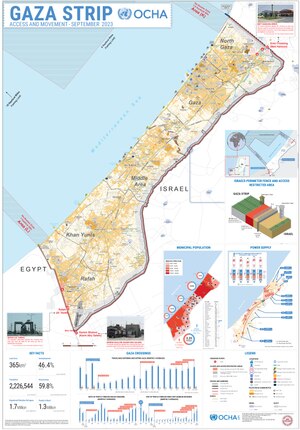
Israeli imposed closure on the movement of goods and people to and from Gaza dates back to 1991 when Israel cancelled the general exit permit for Palestinians in the occupied territories. This policy was initially temporary, but developed into a permanent administrative measure in March 1993 after heightened levels of violence by Palestinians inside Israel. Since then, the closure has become an institutionalized system in Gaza (and the West Bank), and has varied in intensity but never been completely lifted.[31] As the closure was coming into place, academics and diplomats were already describing it as a form of collective punishment,[32][33][34] a trend that continues in more recent times.[35][36] For example, between 1993 and 1996, total closure was imposed on the Gaza Strip for a cumulative 342 days. During periods of total closure, Israel enforced a complete ban on any movement of people or goods between Gaza and Israel, the West Bank and foreign markets. The economic impact of these closures during 1996 alone was estimated by the World Bank as amounting to losses of almost 40% of Gaza's GNP.[37] In 1994, Israel built the Gaza–Israel barrier as a security measure, despite this, Israeli security establishment has described the closure as having limited value against extremist attacks.[37][38] Since then, there are four border crossings between Israel and the Gaza Strip through the barrier: the Kerem Shalom, Karni, Erez, and Sufa crossings. All goods bound for Gaza as well as exports passing through Israel must use one of these crossings, and undergo security inspection before being permitted to enter or leave Gaza.
In 2005, Israel withdrew its settlers and forces from the Gaza Strip, redeploying its military along the border. Following Hamas' electoral victory and subsequent military confrontation with opposing party Fatah which led to Hamas taking control over all of Gaza in 2007, Israel further tightened restrictions in an attempt to exert economic pressure on Hamas. With this new tightening of restrictions, all trade was ceased and the entrance of goods was limited to a "humanitarian minimum", allowing only those good which are "essential to the survival of the civilian population".[39] Israeli security officials have described the ban on exports as "a political decision to separate Gaza from the West Bank" further describing it as a matter of "political-security" and a form of "economic warfare".[40][41][42]
Additionally, starting in 2009, Egypt built an underground Egypt–Gaza barrier along the Egypt–Gaza border. The stated aim was to block smuggling tunnels. The Rafah Border Crossing is the only lawful crossing point between Egypt and Gaza, and was manned by PA security forces and the European Union Border Assistance Mission Rafah.[43] All humanitarian and other supplies passing through Israel or Egypt must pass through these crossings after security inspection.
Until 2013, there were hundreds of smuggling tunnels dug under the Egypt-Gaza border to smuggle goods, including fuel, into Gaza to bypass the blockade.
2005–2006 blockades
[edit]On 12 September 2005, the final day of the Israeli withdrawal, international politicians such as France's Foreign Minister Philippe Douste-Blazy and Jordan's Deputy Prime Minister Marwan Muasher warned of Gaza being turned into an open-air prison.[44][45] Four days later, Mahmoud Abbas stated to the UN General Assembly:
It is incumbent upon Israel to turn this unilateral withdrawal into a positive step in a real way. We must quickly resolve all outstanding major issues, including the Rafah border crossing with Egypt, the airport and the seaport, as well as the establishment of a direct link between the Gaza Strip and the West Bank. Without this, Gaza will remain a huge prison.[46]
Following the disengagement, human rights groups alleged that Israel frequently blockaded Gaza in order to apply pressure on the population "in response to political developments or attacks by armed groups in Gaza on Israeli civilians or soldiers".[47] The special envoy of the Quartet James Wolfensohn noted that "Gaza had been effectively sealed off from the outside world since the Israeli disengagement [August–September 2005], and the humanitarian and economic consequences for the Palestinian population were profound. There were already food shortages. Palestinian workers and traders to Israel were unable to cross the border".[48]
On 15 January 2006, the Karni crossing – the sole point for exports of goods from Gaza – was closed completely for all kinds of exports.[49][50] The greenhouse project suffered a huge blow, as the harvest of high-value crops, meant to be exported for Europe via Israel, was essentially lost (with a small part of the harvest donated to local institutions).[50][51][52] Moreover, closing of Karni cut off the so-far resilient textile and furniture industries in Gaza from their source of income.[53] Starting February 2006, the Karni crossing was sporadically open for exports, but the amount of goods allowed to be exported was minuscule compared to the amount of goods imported[54] (which, in turn, barely supported Gaza's needs).[55][54] Between 1 January and 11 May, more than 12,700 tonnes of produce were harvested in Gaza's greenhouses, almost all of it destined for export; out of it, only 1,600 tonnes (less than 13%) were actually exported.[51]
Sanctions on Hamas-led PA governments
[edit]The election for the Palestinian Legislative Council took place on 25 January 2006, and was won by Hamas. The election took place during a full blockade of Gaza.[56][50][57][54][a] After the PLC was sworn in on 18 February 2006,[58] in addition to its blockade of the Gaza Strip, Israel imposed other sanctions on the PA, including withholding the PA's tax revenue (collected by Israel on the PA's behalf), and imposing travel restrictions on Hamas PLC members. Israel's position is that Hamas is a terrorist organisation that has vowed to destroy Israel, and is responsible for the death of hundreds of its citizens, and neither wanted to have any direct relations with the other.[citation needed] On 20 February, Hamas leader Ismail Haniyeh was nominated to form a new PA government, which was sworn in on 29 March.
Besides Israel's position in relation to a Hamas-led PA government, following the election, the Quartet on the Middle East had stated that continued aid to and dialogue with the PA under a Hamas government was conditional on Hamas agreeing to three conditions: recognition of Israel, the disavowal of violent actions, and acceptance of previous agreements between Israel and the PA, including the Oslo Accords. Haniyeh refused to accept these conditions, and the Quartet stopped all dialogue with the PA and especially any member of the Hamas government, ceased providing aid to the PA and imposed sanctions against the PA under Hamas.[59] Though initially opposed by the United States, a Quartet member, the US government agreed in April 2006 to discontinue $400 million of foreign aid to the PA. Instead the US redirected $100 million to the United Nations and other non-Palestinian groups, but no aid money was given directly to the government of Mahmoud Abbas.[60]
As noted by Wolfensohn (and also in an EU paper), withholding of the PA's own tax revenue – an action taken by Israel alone, not by the Quartet – was more damaging than the ceasing of international aid to the PA. These taxes, collected in Palestine (both in the West Bank and Gaza) by Israeli authorities, were supposed to be transferred to the PA's budget. By releasing or withholding these revenues, Israel was able, in the words of the International Crisis Group, to "virtually turn the Palestinian economy on and off".[61] Israel withheld these transfers from the PA until June 2007.[62][63] Withholding the tax revenue by Israel meant that the PA lacked money to pay its employees, including the police, further destabilizing the situation in Gaza.[64]
In March 2007, Fatah agreed to join Hamas in a PA unity government, also headed by Haniyeh. Shortly after, in June, Hamas took control of the Gaza Strip during the Battle of Gaza,[65] seizing PA government institutions in the Strip and replacing Fatah and other PA officials with Hamas members.[66]
Following the takeover, in the West Bank, President Mahmoud Abbas officially dissolved the Haniyeh-led PA government, suspended parts of the Basic Law, and created a new PA government by decree, without approval of the PLC. This government was recognized by the international community, and international relations and aid to the PA government in the West Bank resumed, the economic sanctions were lifted, and Israel resumed the transfer of tax revenue to it.
In the autumn of 2007, Israel designated the Gaza Strip, under Hamas control, as a hostile entity, and instituted a series of sanctions which encompassed power reductions, stringent import restrictions, and border closures.[7] In January 2008, in response to ongoing rocket attacks on its southern communities, Israel expanded its sanctions, fully sealing its border with the Gaza Strip and temporarily halting fuel imports.[7] Later in January, following nearly a week of the heightened Israeli blockade, Hamas militants dismantled sections of the barrier along the Gaza Strip-Egypt border, which was closed from Hamas's takeover in mid-2007 until 2011, creating openings that, as per estimations, allowed hundreds of thousands of Gazans to cross into Egypt to procure food, fuel, and other goods unattainable due to the blockade. Egyptian President Hosni Mubarak temporarily allowed the border breach to mitigate civilian suffering in Gaza, prior to initiating efforts to reestablish the border.[7]
History
[edit]
Early 2000s
[edit]During the Second Intifada, Israel blockaded the Palestinian territories, including the Gaza Strip, several times.[67][68] In Gaza, the blockade caused unemployment to skyrocket to 85%. Christian Aid reported that malnourishment among children doubled in one year due to the blockade.[69] Clinics run by Middle East Council of Churches also reported treating increasing numbers of underweight and malnourished children.[69]
June 2007 – January 2008
[edit]In June 2007, Hamas took control of the Gaza Strip in the Battle of Gaza,[65] and removed Fatah officials. Following the Hamas takeover, the sanctions put in place after Hamas's 2006 electoral victory were dramatically tightened. Truck transits, which had been 12,000 per month in 2005, were reduced to 2,000 by November of that year, when in a further measure, in the context of Hamas rocket fire and Israeli attacks, food supplies were halved, fuel imports slashed and foreign currency restricted by the latter.[70]
Following the Hamas takeover in Gaza, Egypt and Israel largely sealed their border crossings with Gaza, on the grounds that Fatah had fled and the PA was no longer providing security on the Palestinian side.[16]
In July 2007, Israeli officials stated they had been planning to open the Rafah border crossing to allow stranded Palestinians to return, but claimed that this plan had been cancelled after Hamas threatened to fire on the refugees.[71]
A Jerusalem Post article mentioned Hamas' complaints that since June 2008 the PA no longer granted passports to Gazans, thereby "preventing tens of thousands of Palestinians from being able to travel abroad".[72]
Egypt, fearing a spill-over of Hamas-style militancy into its territory, kept its border with Gaza largely sealed.[73] Israel sealed the border completely on 17 January in response to rocket attacks on southern Israel and Palestinian militant attacks on crossing points between Israel and Gaza.[74][75]
The Egyptian government feared also that Iran wanted to establish a base in its territory as well as in Gaza through its proxy Hezbollah following the 2009 Hezbollah plot in Egypt.[76][77]
January 2008 breach of the Egypt-Gaza border
[edit]On 22 January 2008, Gazans clashed with Egyptian police in front of the border, demanding that the Rafah Border Crossing be opened. The clashes included live fire, and there were injuries on both sides. Fifty women managed to cross, and Egyptian police responded with a water cannon assault. Additional Egyptian security forces arrived, and managed to restore calm and prevent further crossing.[78]
The breach of the Gaza–Egypt border began on 23 January 2008, after gunmen in the Gaza Strip set off an explosion near the Rafah Border Crossing, destroying part of the former Israeli Gaza Strip barrier. The United Nations estimated that as many as half of the population of the Gaza Strip crossed the border into Egypt seeking food and supplies.[79] Israel said that militants had exploited the breach in the border wall to send armed men into the Sinai to infiltrate Israel across the Sinai-Israel border. Egyptian troops at first permitted the crossing[73] but did not allow Palestinians to travel further than El Arish. On 25 January, Egyptian forces blocked almost all illegal entry points to stem the flow of Gazans pouring in, and Egyptian riot police erected barbed wire and chain-link fences along the border. Palestinians used a bulldozer to knock down the fence and once again flooded in. Egyptian border police began stopping Palestinians from crossing and sealed the road from Rafah to El Arish. On 28 January, Egyptian security forces and Hamas militants strung barbed wire across one of the breaches, sealing it off. The Egyptians began repairing one of the two remaining breaches on 29 January, and closed the border with the Gaza Strip on 3 February 2008.
June 2008 attempt at easing restrictions
[edit]Under a ceasefire agreement between Israel and Hamas in June 2008, Israel agreed to lift its blockade of Gaza Strip. At Egypt's request, Israel did not always respond to Palestinian ceasefire violations by closing the border.[80]
Israel accused Hamas of transporting weapons into Gaza via tunnels to Egypt, failing to stop rocket attacks, and noted that Hamas would not continue negotiating the release of Israeli hostage Gilad Shalit, who had been held by Hamas since 2006.[81] Hamas' decision alienated it from the government of Egypt, which had linked the opening of the Gaza-Egypt border crossing to Shalit's release.[82] In the early stage of the ceasefire, Israeli officials had stated that they found "a certain sense of progress" on Shalit's release.[83]
The UN recorded seven Israel Defense Forces (IDF) violations of the ceasefire between 20 and 26 June, and three violations by Palestinian groups not affiliated with Hamas between 23 and 26 June.[84] On 18 December, the Izz ad-Din al-Qassam Brigades, the military wing of Hamas, reported 185 Israeli violations during the lull period.[85] The Intelligence and Terrorism Information Center reported a total of 223 rockets and 139 mortar shells fired from Gaza during the lull, including 20 rockets and 18 mortar shells before 4 November.[86] It noted that "Hamas was careful to maintain the ceasefire" until 4 November, when the ceasefire was "seriously eroded."[87] Rocket fire decreased by 98 percent in the four-and-a-half months between 18 June and 4 November, compared to the four-and-a-half-months preceding the ceasefire.[88] Hamas denied responsibility for the rocket fire during the lull. Human Rights Watch reported that Hamas security forces demonstrated an ability to curb rocket fire while some people detained for rocket fire were released without explanation.[89]
In August 2008, the first NGO-organized attempts to breach Israel's maritime closure of the Gaza Strip occurred when two vessels, containing activists from the Free Gaza Movement and International Solidarity Movement, sailed from Cyprus towards Gaza, carrying hearing aids and balloons. The boats reached Gaza on 23 August 2008 after the Israeli government allowed the boats free passage.[90] Four more voyages occurred from October until December 2008, as passengers were transported another boat called the "Dignity", a 66-foot yacht owned by the Free Gaza Movement.[91] The Dignity was rammed three times while it was sailing in international waters by the Israeli Navy and significant damage was incurred.[92]
On 28 October 2008, the Dignity, carrying 26 activists and medical supplies, docked in a strip harbor without interference. Israel had initially decided to stop the vessel, but the decision was made to let it through just before it reached Gaza.[91] The Dignity sailed to Gaza four times before it was attacked on 30 December 2008 in international waters, as it sailed towards Gaza to deliver medicine and medical help.[93]
In August 2008, it was reported that Israel despite the ceasefire was still allowing in very few goods.[94] A WikiLeaks cable from the US embassy in Tel Aviv dated 3 November 2008 revealed that Israel still maintained the economy of the Gaza strip "on the brink of collapse" without "pushing it over the edge". The cable said that "Israeli officials have confirmed to Embassy officials on multiple occasions that they intend to keep the Gazan economy functioning at the lowest level possible consistent with avoiding a humanitarian crisis."[95]
2008–2009 Gaza war and aftermath
[edit]
In January 2009, after the first phase of the Gaza War, Israel said it would allow in some humanitarian aid, but will continue its economic blockade in order to weaken the power of Hamas.[96] In June 2009, on the second anniversary of the blockade, 38 United Nations and non-governmental humanitarian organisations issued a joint press release calling for "free and uninhibited access for all humanitarian assistance in accordance with the international agreements and in accordance with universally recognised international human rights and humanitarian law standards".[97] As of July 2009, Israel said it is making the humanitarian relief efforts in Gaza one of its top priorities.[98] The amount of goods Israel allows into Gaza is one quarter of the pre- blockade flow.[97]
Mark Regev, spokesman for Israeli Prime Minister Ehud Olmert stated "We want to make sure that reconstruction for the people of Gaza is not reconstruction for the Hamas regime." U.S. State Department spokesman Robert Wood said on 25 February that "Aid should never be used as a political weapon. We'll try to push to get into Gaza as many supplies as possible."[99]

The Olmert cabinet had decided in March 2009 that food and medical supplies to Gaza would be allowed through unfettered. This was met with resistance by Israel's Defense Ministry, which controls the border crossings.[100] An Israeli military spokesperson said that each item was decided on an individual basis and that food was being let through daily. According to NGO Gisha, the amount of food entering Gaza is as of May 2009, about 25% of the pre-June 2007 figures. A UN study has found that Gazan families are eating fewer meals a day and mainly relying on carbohydrates such as rice and flour because protein foods are expensive or unavailable. Chicken eggs have doubled in price due to the destruction of chicken coops during the Gaza War.[100]
February 2009 Hamas-UNRWA incident
[edit]On 3 February, 3,500 blankets and over 400 food parcels were confiscated by Hamas police personnel from an UNRWA distribution center. On the following day, the UN Emergency Relief Coordinator demanded that the aid be returned immediately.[101] In a separate incident on 5 February, Hamas seized 200 tons of food from UNRWA aid supplies. The following day, UNRWA suspended its activities in Gaza. Hamas issued a statement stating that the incident was a misunderstanding between the drivers of the trucks and had been resolved through direct contact with the UNRWA.[102] On 9 February, UNRWA lifted the suspension on the movement of its humanitarian supplies into Gaza, after the Hamas authorities returned all of the aid supplies confiscated.[103]
2010–2011 freedom flotillas
[edit]- May 2010 Gaza flotilla raid
On 31 May 2010, the Israeli Navy seized an aid convoy of six ships known as the "Gaza Freedom Flotilla".[104] aiming to break through the blockade, carrying humanitarian aid and construction materials. The flotilla had declined an Israeli request to change course to the port of Ashdod, where the Israeli government had said it would inspect the aid and deliver (or let humanitarian organizations deliver) Israeli-approved items to Gaza.[105]

Israeli Shayetet 13 naval commandos boarded the ships from speedboats and helicopters launched from three missile ships, while the flotilla was still in international waters.[106] On the MV Mavi Marmara, the main ship of the convoy, passengers attacked and managed to capture three soldiers.[107] Israeli soldiers responded with rubber bullets and live ammunition from soldiers in helicopters and on the ship. Several of the activists were shot in the head by Israeli forces, some from behind and at close range.[108] Israel was accused of using disproportionate force. On other ships, soldiers were met with passive resistance which was easily suppressed with non-lethal techniques. Nine passengers were killed and dozens wounded. Nine soldiers were also injured, two of them seriously. All of the ships were seized and towed to Ashdod, while passengers were imprisoned in Israel and then deported to their home countries.[109][110][111][112][113][114] The MV Rachel Corrie, a seventh ship that had been delayed, set sail from Malta on the same day of the flotilla's interception. Israeli naval vessels shadowed the Rachel Corrie, and after it ignored three warnings, Israeli commandos boarded the ship from speedboats, arrested the crew, and forced it to sail to Ashdod.[115]
- Freedom Flotilla II
Following the Gaza flotilla raid, a coalition of 22 NGOs assembled in July 2011 a flotilla of 10 vessels and 1,000 activists to breach the blockade.
The vessels docked in Greece in preparation for the journey to Gaza. However, the Greek government announced that it would not allow the vessels to leave for Gaza,[116] and the Hellenic Coast Guard stopped three vessels attempting to evade the travel ban and leave port. On 7 July, most activists left for home, leaving only a few dozen to continue the initiative.[117] On 16 July, the French yacht Dignite Al Karama was allowed to leave port after informing Greek authorities that its destination was Alexandria, Egypt. Instead, the yacht headed directly for Gaza. The Israeli Navy stopped the Dignite Al Karama about 65 kilometers off Gaza. After the boat was warned and refused to turn back, it was surrounded by three Israeli naval vessels and boarded by Shayetet 13 commandos, who took it over. The boat was then taken to Ashdod.[118] Ultimately, the Freedom Flotilla sailing did not take place.
- November 2011 flotilla
On 4 November 2011, the Israeli Navy intercepted two vessels heading towards Gaza in a private initiative to break the blockade. Shayetet 13 commandos boarded the vessels from speedboats and took them over with no resistance. The vessels were then taken to Ashdod port.[119]
June 2010 easing of the blockade
[edit]Facing mounting international calls to ease or lift their blockade in response to the 2010 Gaza flotilla raid, Egypt and Israel lessened the restrictions starting in June 2010. Israel announced that it will allow all strictly civilian goods into Gaza while preventing weapons and what it designates as "dual-use" items from entering Gaza.[120] Egypt partly opened the Rafah border crossing from Egypt to Gaza, primarily for people, but not for supplies, to go through.[121] The Israeli NGO Gisha Legal Center for Freedom of Movement reported in a July 2010 publication[122] that Israel continues to prevent normal functioning of the Gazan economy. Israel continues to severely restrict and/or prevent people from entering or exiting Gaza according to Gisha.[123][124][125] The United Nations Office for the Coordination of Humanitarian Affairs (UNOCHA) conducted an assessment of the humanitarian impact of the easing of the blockage in January and February 2011 and concluded that they did not result in a significant improvement in people's livelihoods.[126] The World Bank estimated in 2015 that the GDP losses caused by the blockade since 2007 was above 50%, and entailed large welfare losses.
On 1 June 2010, the Rafah border crossing from Egypt to Gaza was partially opened. Egypt's foreign ministry has made it clear that the crossing will remain open mainly for people, not for aid, to go through.[121] Several aid trucks began making it into Gaza during the following morning including some carrying power generators from the Egyptian Red Crescent, and hundreds of Gazans who had been staying in Egypt returned home, although little traffic, human or cargo, flowed from Gaza to Egypt.[127] On 3 June, the manager of the Gaza side of the Rafah crossing, Salameh Barakeh, explained that the crossing is open for the free travel of patients, foreign passport holders, those with residency status in other countries, students and internationals.[128] The Arab Physicians Union officials submitted a request to Egyptian authorities on 3 June 2010 to send 400 tons of food, blankets, electric generators for hospitals and construction material from Egypt to Gaza, but their request was denied by Egyptian authorities without specific reason. Emad Gad, political analyst at Egyptian Al-Ahram Center for Political and Strategic Studies, believes the government should keep the Rafah border under control because opening it completely could allow weapons smuggling or illegal financial transactions.[121]
On 17 June 2010, Israel's Prime Minister's Office announced that Israel's security cabinet had agreed to relax Israel's blockade on the Gaza Strip, and issued an English-language press release, according to which a decision to ease the blockade had been made. The English text reads: "It was agreed to liberalize the system by which civilian goods enter Gaza [and] expand the inflow of materials for civilian projects that are under international supervision." However, no binding decision has been made during the cabinet meeting, and an announcement issued in Hebrew did not mention any such decision. The Prime Minister's office said that a meeting would be held soon, and expressed hope that a binding decision will be taken then.[129]
International response to easing of restrictions
[edit]Tony Blair, who welcomed Israel's decision to ease the restrictions on behalf of the Quartet on the Middle East, said that the Quartet – the UN, US, EU, and Russia – would continue talks with Israel "to flesh out the principles". Suggesting that "items of ordinary daily life, including materials for the construction of homes, infrastructure and services as the UN have asked" should be allowed to enter Gaza, he stated that "the decision to allow foodstuffs and household items is a good start".[130] A spokesperson for the Secretary-General of the United Nations declared that the Secretary-General would be encouraged that the Israeli government is reviewing its policy towards Gaza. He added that the United Nations would continue to seek a fundamental change in policy as agreed by the Quartet. Hamas spokesperson Sami Abu Zuhri said that Israel's decision would have been designed to "beautify" the blockade and mislead public opinion.[131][132]
A British Foreign Office spokesman said: "It is good that Israel is giving serious consideration to resolving these issues, [b]ut further work is needed. We need to see the additional steps still to be announced." EU officials also said they were disappointed by the decision.[131] German Minister of Economic Cooperation and Development Dirk Niebel said that the Israeli announcement was "not sufficient". During a visit to the country, Niebel intended to visit a sewage treatment plant being financed with German development aid, but was denied entry into the Gaza strip by Israel. He commented that the Israeli government sometimes would "not make it easy for its friends to explain why it behaves the way it does."[133] A spokesperson for Israel's Foreign Ministry responded that Israel would have been obliged to allow any other European minister entry if it had allowed Niebel to visit the Gaza strip, thus conferring additional legitimacy to the Hamas government.[134]
Chris Gunness from UNRWA criticised Israel's move to ease the blockade as not being adequate, saying that
Even if the blockade is eased it remains illegal under international law as it is a collective form of punishment on a civilian population. Eighty percent of Gaza's population is aid-dependent. Allowing more aid in is perpetuating this dependency and not addressing the issue of self-sufficiency or the root causes of the crisis. What have not been addressed by the easing of the closure are the issues of exports as well as the limited number of crossings open to facilitate the flow of goods. Operation Cast Lead destroyed at least 60,000 homes and structures which need to be urgently repaired and rebuilt. The easing of the blockade is not addressing this adequately.[135]
Maxwell Gaylard, UN Deputy Special and Humanitarian Coordinator for the Middle East also criticised Israel, saying "Permitting mayonnaise and potato chips into Gaza is really irrelevant in dealing with the underlying issues. What we need to see is an improvement in Gaza's water, sanitation, power grid, educational and health sectors. Gaza's economy is shot to pieces and its infrastructure is extremely fragile."[135]
New blockade policy by Israel
[edit]On 20 June 2010, Israel's Security Cabinet approved a new system governing the blockade that would allow practically all non-military or dual-use items to enter the Gaza strip. According to a cabinet statement, Israel would "expand the transfer of construction materials designated for projects that have been approved by the Palestinian Authority, including schools, health institutions, water, sanitation and more – as well as (projects) that are under international supervision."[17] Despite the easing of the land blockade, Israel will continue to inspect all goods bound for Gaza by sea at the port of Ashdod.[136]
Israeli Prime Minister Benjamin Netanyahu said that the decision enabled Israel to focus on real security issues and would eliminate "Hamas' main propaganda claim,"[137] and that it would strengthen the case for keeping the sea blockade in place.[138] He also said the decision would have been coordinated with the United States and with Tony Blair, the representative of the Quartet for the Middle East.[137] Blair characterized the decision as a "very significant step forward", but added that the decision needs to be implemented.[17] In a statement, the Quartet said that the situation remained "unsustainable and unacceptable" and maintained that a long-term solution was urgently needed.[139][140] The UNRWA called for a complete lift of the Gaza blockade, expressing concern that the new policy would continue to limit Gaza's ability to develop on its own.[140] The European Union's representative for foreign policy, Catherine Ashton, welcomed the decision. She called the step "a significant improvement" and expressed the expectation that the measures take effect as soon as possible, adding that "more work remains to be done."[141] The U.S. government welcomed the decision, expressing the belief that the easing would significantly improve the lives of Gaza Strip residents and prevent weapons smuggling.[17] It expressed its intention to contribute to an international effort to "explore additional ways to improve the situation in Gaza, including greater freedom of movement and commerce between Gaza and the West Bank."[142] Hamas dismissed the measures as trivial and "media propaganda", and demanded a complete lifting of the blockade, including the removal on all restrictions on the import of construction material.[17] Israeli Arab member of Knesset Hanin Zoabi commented that the easing of the blockade would prove that "it is not a security blockade, but a political one," adding that the flotilla "succeeded in undermining the blockade's legitimacy."[143]
The U.S., United Nations, European Union and Russia in 2010 were jointly consulting with Israel, the Palestinian Authority and Egypt on additional measures, described by the United States Department of State as a "fundamental change in policy" toward the Gaza strip.[138]
Lieberman Proposal
[edit]On 2 June 2010 a letter in the London newspaper The Times suggested the establishment of a permanent humanitarian sea corridor linking Cyprus with Gaza.[144] In July 2010, a similar proposal emerged from Israel's foreign minister Avigdor Lieberman who proposed it as part of an initiative to shift full responsibility over the Gaza Strip to the international community. He announced that he planned to discuss the idea, which was labelled a "personal initiative" with the EU Foreign Minister Catherine Ashton.[145][146]
Lieberman proposed that units of the French Foreign Legion and commando units from EU member states be sent in to secure the Gaza border crossings to prevent the smuggling of weapons, and that the border with Israel be sealed. Ships that underwent inspections in Cyprus or Greece would be allowed to dock in Gaza and unload humanitarian cargoes. The EU would help improve and build civilian infrastructure, and Gaza would become a fully independent entity.[147]
Lieberman, then defense minister, proposed a similar maritime corridor plan to Cyprus in 2018,[148] at a time when a number of such options were being considered in Israel.[149][150]
Humanitarian impact assessment
[edit]In January and February 2011, the United Nations Office for the Coordination of Humanitarian Affairs (UNOCHA) conducted an assessment of the effects of the measures to ease the access restrictions.[126] They concluded that they did not result in a significant improvement in people's livelihoods.[126]
They found that a limited reactivation of the private sector resulted from the increased availability of consumer goods and some raw materials but the "pivotal nature of the remaining restrictions" and the effects of three years of strict blockade prevented a significant improvement in livelihoods.[126] Although the unemployment rate in Gaza fell from 39.3% to 37.4% in the second half of 2010 there were significant food price rises.[126] There was little or no improvement in food insecurity rates in Gaza which continued to affect 52% of the population.[126] Few of the 40,000 housing units needed to replace homes lost during Operation Cast Lead and for natural population growth could be built as a result of the ongoing restrictions on importing building materials.[126] The approval of over 100 projects funded by international organizations intended to improve the "extremely deteriorated" water and sanitation, education and health services, followed the easing of the blockade.[126] The implementation of these projects was delayed by the entry approval process for materials and the limited opening of the Karni crossing.[126] OCHA found that there had been no improvement in the quality of services provided to the population of the Gaza Strip as a result of the projects so far.[126] There was no significant increase in the number of exit permits granted by Israel to allow access to the outside world including other parts of the Palestinian territories.[126] Permits continued to be issued by Israel only on an exceptional basis with 106–114 per day being issued during the second half of 2010.[126] OCHA described Egypt's move to regularly operate its crossing with Gaza for special categories of people as a "significant, albeit limited, improvement".[126]
They concluded that the easing of restrictions was "a step in the right direction" but called on Israel to fully abolish the blockade including removing restrictions on the import of construction materials and the exports of goods, and to lift the general ban on the movement of people between Gaza and the West Bank via Israel in order to comply with what they described as international humanitarian and human rights law obligations.[126]
According to the World Health Organization, the shortage of essential medicines and equipment has been the primary obstacle to providing adequate health care in the Gaza Strip since the 2012 conflict. Gazan hospitals had a shortage of more than 50% of "medical consumables" even before the conflict. Workers in some hospitals reported having to sterilize and re-use single-use equipment due to the lack of critical items. Palestinian hospitals are unable to meet the need of their patients due to economic underdevelopment and the varying strictness of the Israeli blockade.[151] According to B'Tselem, Restrictions on Movement the blockade, which not only restricts Gazans' access to Israel but also communication between Gaza and the West Bank, has denied Gazan fishermen access to 85% of the waters they have been guaranteed access to.[152]
During the 2014 Israel–Gaza Conflict, 108,000 people were displaced, almost all of whom are still living in UNWRA refugee camps or inadequate improvised shelters. 28 schools, numerous wells, and other important civil infrastructure like major sewage and electricity plants were destroyed during Operation Protective Edge.[153] Since then over 2,000 truckloads of materials for reconstruction have been allowed into Gaza, but according to a UN estimate, 735 truckloads per day, for three years, would be necessary to rebuild all the damaged infrastructure.[154]
Further easing (2011–2013)
[edit]Following the Egyptian Revolution of 2011, Egypt for some time opened the Rafah border crossing permanently as of 28 May 2011. A limited number of women of all ages and men aged below 18 and above 40 were able to enter Egypt without a visa,[155] although there are still severe restrictions on the movement of personnel and goods to and from Gaza.[156][157] In 2012 Egypt started supplying fuel to the Gaza Strip, to help ease a lengthy fuel crisis arising from a dispute between Egypt and the Hamas government in Gaza over whether Gaza can trade with Egypt openly, or only via Israel.[158]
In 2013 Israel eased its regulation on the entering of construction material into Gaza. The regulation was an attempt to reduce rocket fire in the south.[159]
Prior to a Gaza visit, scheduled for April 2013, Turkey's Prime Minister Recep Tayyip Erdogan explained to Turkish newspaper Hürriyet that the fulfilment of three conditions by Israel was necessary for friendly relations to resume between Turkey and Israel: an apology for the raid (Prime Minister Netanyahu had delivered an apology to Erdogan by telephone on 22 March 2013), the awarding of compensation to the families affected by the raid, and the lifting of the Gaza blockade by Israel. The Turkish prime minister also explained in the Hürriyet interview, in relation to the April 2013 Gaza visit, "We will monitor the situation to see if the promises are kept or not."[160] At the same time, Netanyahu affirmed that Israel would only consider exploring the removal of the Gaza blockade if peace ("quiet") is achieved in the area.[161]
During the Gaza war
[edit]On 9 October 2023, Israel intensified its blockade of the Gaza Strip when it announced a "total blockade", blocking the entry of food, water, medicine, fuel and electricity after the October 7 attacks and the ensuing Gaza war.[162][163] The blockade has been credited with contributing significantly to the Gaza genocide.[164][165][166] Israel has conditioned its lifting of the blockade with the return of the hostages abducted by Hamas,[167] which has been criticized as collective punishment and an apparent war crime.[168][169][170] As of August 2025, 27 European countries and over 100 international aid organizations have called for an end to Israel's blockade of aid into Gaza.[171][172]
A few weeks after 9 October 2023, Israel eased the complete blockade, but still continued to severely restrict the amount of aid entering the Gaza Strip. The first supplies entered on 21 October 2023.[173] The blockade exacerbated Gaza's humanitarian crisis.[174] In January 2024, Israeli authorities blocked 56% of humanitarian aid to northern Gaza.[175] On 9 February 2024, UNRWA's director Philippe Lazzarini said that Israel had blocked food for 1.1 million Palestinians in Gaza.[176]
During the January 2025 Gaza war ceasefire, Israel relaxed aid restrictions, allowing much more aid than previously.[177] On 2 March 2025, however, Israel completely blocked all supplies from entering the territory, making it the longest complete closure in the history of the blockade.[177][178] Since 26 May 2025, the United States- and Israeli-backed Gaza Humanitarian Foundation has facilitated limited and largely ineffective aid distribution, marred by mass killings that resulted in over 1,400 Palestinian deaths.[179]
The blockade has created famine conditions in the Gaza Strip, which was exacerbated by Israeli airstrikes targeting food infrastructure and restrictions on humanitarian aid.[180] In a number of incidents, Israeli protesters, including settlers, blocked aid trucks carrying humanitarian aid heading towards the Gaza Strip, and in some cases attacked them.[181][182]Famine
[edit]The population of the Gaza Strip is undergoing a famine as a result of an Israeli blockade during the Gaza war that prevents basic essentials and humanitarian aid from entering Gaza,[183][184][185] as well as airstrikes that have destroyed food infrastructure, such as bakeries, mills, and food stores, causing a widespread scarcity of essential supplies.[b] Humanitarian aid has also been blocked by protests at borders and ports. Increasing societal breakdown in Gaza, including looting, has also been cited as a barrier to the provision of aid.
As of August 2025, Integrated Food Security Phase Classification (IPC) projections show 100% of the population are experiencing "high levels of acute food insecurity", and 32% are projected to face Phase 5 catastrophic levels by 30 September 2025.[187] On 22 August 2025, the IPC said that famine is taking place in one of the five governorates in the Gaza Strip: specifically, the Gaza Governorate which includes Gaza City. The IPC added that, within the next month, famine was likely to also occur in both the Deir al-Balah Governorate and Khan Yunis Governorate. The IPC had insufficient data on the North Gaza Governorate for a classification but concluded that conditions were likely similar or worse than in the Gaza Governorate.[187][188] Within the next 6 weeks as of 16 August, the number of people in IPC Phase 5 is expected to rise from 500,000 to over 640,000.[189]
Israel has been accused of using starvation as a weapon of war to commit genocide against the Palestinian people in Gaza.[190] On 21 November 2024, the International Criminal Court issued arrest warrants for Israeli prime minister Benjamin Netanyahu and former defence minister Yoav Gallant due to "reasonable grounds" that they bear criminal responsibility for "the war crime of starvation as a method of warfare".[191][192] The United States "fundamentally reject[ed]" the ICC decision to issue the warrants.[193] The genocide has been recognized by a United Nations special committee[194] and commission of inquiry, Amnesty International, and other experts and human rights organisations.[190][195]
On 22 October 2025, the International Court of Justice found that Israel is obliged to guarantee sufficient food to Gazans and to allow UNRWA to operate in Gaza.[196][197]Border crossings
[edit]At the end of 2023, there were two open border crossings with Israel (Kerem Shalom border crossing and Erez), with an additional option via an Israel-Egypt crossing (Nitzana), and two border crossings with Egypt (Rafah Crossing and Salah al-Din Gate 4 km northwest of Rafah Crossing).[198] On 12 March 2024, as a "pilot project", the 96th gate in the security fence (near Kibbutz Be'eri) was used by a convoy of six trucks taking humanitarian aid to northern Gaza under IDF protection.[199]
Military impact
[edit]The Israeli government justifies the blockade as a security measure. According to Sara Roy, Israeli security officials have said the blockade has limited value against extremist attacks.[31] Ghazi Hamad, a senior Hamas member, said in 2024 that the blockade made importing components for Hamas weapons industry a challenge. Machine tools and explosives were either labeled for civilian use or hidden inside shipments of food or other goods.[200] Jerome Slater described the blockade as a form of continuing Israeli control over the Strip,[201] adding that "most Palestinian terrorism almost certainly would have ended" if Israel had ceased to occupy the West Bank and Gaza,[202] and considered it probable that the policy of deliberate impoverization creates as much terrorism as it deters.[203]
Socioeconomic impact
[edit]The worsening economic and humanitarian situation raised great concern abroad. According to the UN Conference on Trade and Development (UNCTAD), in January 2003, the Israeli blockade and closures had drained as much as US$2.4 billion out of the economy of the West Bank and the Gaza Strip.[204]
Throughout 2006, the Karni crossing was only partially operational, costing Palestinians $500,000 a day, as less than 10% of the Gaza Strip's minimal daily export targets were achieved. Basic food commodities were severely depleted, bakeries closed and food rationing was introduced.[205]
The World Bank estimated in 2015 that the GDP losses caused by the blockade since 2007 was above 50%, and entailed large welfare losses. Gaza's manufacturing sector, once significant, shrunk by as much as 60% in real terms, due to the wars in the past 20 years and the blockade. Gaza's exports virtually disappeared since the imposition of the 2007 blockade. It stated that "solutions have to be found to enable faster inflow of construction materials into Gaza", while taking into account "legitimate security concerns of neighboring countries."[206]
In May 2015, the World Bank reported that the Gaza economy was on the "verge of collapse". 40% of Gaza's population lived in poverty, even though around 80% received some sort of aid. It said the restrictions had to be eased to allow construction materials "to enter in sufficient quantities" and to allow exports. "The economy cannot survive without being connected to the outside world", The World Bank said the tightened restrictions meant the construction sector's output was reduced by 83%.[207]
Role in turning Gaza into an "open-air prison"
[edit]Several rights groups have characterized the situation in Gaza as an "open-air prison",[208][6] including the United Nations,[209] Human Rights Watch,[29] and the Norwegian Refugee Council.[210] This characterization was often cited by a number of human rights activists, politicians, and media news outlets reporting on the Gaza-Israel conflict and the wider Palestinian–Israeli conflict.[211][212][213][214][215][216] Former British Prime Minister David Cameron,[217] US Senator Bernie Sanders,[218] former Israeli diplomat Gideon Levy,[219] and Israeli historian Ilan Pappe have endorsed this characterization as well.[220]
In 2022, Human Rights Watch issued a report on the situation in the Gaza Strip, which it called an "open-air prison" due to the blockade and held Israel responsible as the occupying power, and to a lesser degree Egypt, which has restricted movement of Palestinians through its border.[29] The report highlighted how this blockade has led to humanitarian crises, namely shortages of essential supplies, limited access to healthcare, and high levels of poverty and unemployment among the Palestinian population in Gaza.[29] It claimed that Israel has formed a formal policy of separation between Gaza and the West Bank, despite both forming parts of the Palestinian territories.[29] The Israeli blockade on Gaza has restricted the freedom of movement of Gaza Palestinians to both the West Bank and the outside world; in particular, Palestinian professionals were most impacted by these restrictions, as applying for travel permit takes several weeks.[29]
The Norwegian Refugee Council report issued in 2018 called the territory "the world's largest open-air prison", highlighting in it several figures, including lack of access to clean water, to reliable electrical supply, to health care, food and employment opportunities.[210] It lamented the fact that a majority of Palestinian children in Gaza suffer from psychological trauma, and a portion of which suffer from stunted growth.[210]
Economic effects
[edit]Following the implementation of the blockade, Israel halted all exports from the Gaza Strip. Israeli human rights organization Gisha, the Legal Center for Freedom of Movement, obtained an Israeli government document which says "A country has the right to decide that it chooses not to engage in economic relations or to give economic assistance to the other party to the conflict, or that it wishes to operate using 'economic warfare'".[221] Sari Bashi, the director of Gisha, said that this showed that Israel was not imposing its blockade for its stated reasons of a security measure to prevent weapons from entering Gaza, but rather as collective punishment for the Palestinian population of Gaza.[221]
In November 2010, the Israeli government allowed Gaza to resume agricultural exports, while still banning industrial exports. Shortly afterward, Gazan farmers began exporting strawberries, peppers, carnations, and cherry tomatoes. The exports travel to Europe via Israel, and Israel then transfers the money to agricultural cooperatives, which in turn pay the Palestinian farmers. The exports were implemented with aid from the Netherlands, which was monitored by the Israeli defense establishment.[222]
It is estimated that in November, less than 20,000 liters of fuel per week entered Gaza via the tunnels, compared to nearly 1 million liters per day until June 2013. The Gaza Power Plant (GPP), which had been supplying 30 percent of the electricity available in Gaza, has been exclusively dependent on Egyptian diesel smuggled through the tunnels, since early 2011. On 1 November, after depleting its fuel reserves, the GPP was forced to shut down, triggering power outages of up to 16 hours per day, up from 8–12 hours prior to that.[223]
The World Bank estimated in 2015 that the GDP losses caused by the blockade since 2007 was above 50%, and entailed large welfare losses. Gaza's manufacturing sector, once significant, shrunk by as much as 60 percent in real terms, due to the wars in the past 20 years and the blockade. Gaza's exports virtually disappeared since the imposition of the 2007 blockade. It stated that "solutions have to be found to enable faster inflow of construction materials into Gaza", while taking into account "legitimate security concerns of neighboring countries."[206]
Movement of people
[edit]Because of the widespread violence within Israel during the Second Intifada that began in September 2000, Israel closed all entry points between Israel and the Palestinian territories, including the Gaza Strip, and closed the Gaza International Airport. On 9 October 2001, all movement of people and goods between Israel and the Palestinian territories was halted, and a complete internal closure came into effect on 14 November 2001.[224]

The Intifada came to an end in February 2005, and Israel forces and settlers left the Gaza Strip by 1 September 2005 as part of Israel's unilateral disengagement plan. To improve the movement of people and economic activity in the Gaza Strip, Israel and the PA on 15 November 2005 signed an "Agreement on Movement and Access" (AMA). The AMA provided for the reopening of the Rafah crossing with Egypt, which was to be monitored by the PA and the European Union. Only people with Palestinian identity cards or foreign nationals, subject to Israeli oversight, were to be permitted to cross.[225][226] In mid-November 2005, Israel started allowing some workers and traders to enter Israel via the Erez crossing, if they had Israeli-issued permits; however, until 21 January 2006, the crossing was open on less than 50% of working days on average.[227][57]
Palestinians were invariably banned from traveling between Gaza and the West Bank. Following the Israeli disengagement from Gaza in September 2005, Israel "[established] a domestic legal framework apparently aimed at sealing off Gaza from Israel and from the West Bank"[228] Israel had previously agreed, as part of the Oslo Accords, to treat Gaza and the West Bank as a single territorial unit, a position upheld by the Israeli High Court.[228] However, following the 2005 disengagement, Israel adopted the position that Gaza residents have "no vested right" to cross into the West Bank; and that although there is "a certain connection" between the Gaza Strip and the West Bank, it "does not give Gaza residents a right to enter [the West Bank]".[228] Those Gaza residents who did not try to cross the territory of Israel proper, but instead traveled around it, using the "long and expensive" route via Egypt and Jordan to travel from Gaza to the West Bank, were still turned back by Israeli border personnel at the Allenby Bridge when attempting to enter the West Bank from Jordan.[228] This policy was still in place as of 2014: Gaza residents, except in rare "humanitarian" cases, are not allowed to enter the West Bank – even if they do not travel via Israel proper but around it, trying to enter via the Allenby Bridge.[229]
AMA stipulated the opening hours of crossings between Gaza and Israel and the number of trucks/truckloads to pass through them.[230] It also stipulated that bus convoys, carrying Palestinians from Gaza to the West Bank and vice versa, would start on 15 December 2005; and truck convoys, carrying goods on the same route, would start on 15 January 2006.[53] This agreement was not upheld, as neither bus nor truck convoys started by their respective dates.[53] Israel first announced that according to its interpretation, Israel was only obliged to run a "test" or "pilot" bus route and only for Palestinians meeting certain Israeli-specified requirements, then delayed this pilot project "indefinitely".[228] The part of the agreement concerning opening hours and throughput of border crossings was not implemented either.[230][54]
The Palestinians claim that Israel did not honor AMA in relation to movement of people between Gaza and the West Bank. The bus convoys between Gaza and the West Bank (which were to start on 15 December 2005) never started.[53][228]
Gazans are invariably banned from entering the West Bank, and Israel adopted the position that they have no legal right to do so. This position has not changed since 2005.[228][229]
Land blockade
[edit]The Muslim Brotherhood in the Egyptian parliament wished to open trade across the border with Gaza in 2012, a move said to be resisted by Egypt's Tantawi government.[231]
Goods blocked
[edit]In the "Failing Gaza"[232] report, Amnesty International and other organizations wrote that cement, glass, steel, bitumen, wood, paint, doors, plastic pipes, metal pipes, metal reinforcement rods, aggregate, generators, high voltage cables and wooden telegraph poles were "high priority reconstruction materials currently with no or highly limited entry into Gaza through official crossings."[232] A 2009 UN report by Kevin M. Cahill called the restrictions "Draconian", and said that reconstruction efforts were being undermined by Israel's refusal to permit the importation of steel, cement or glass, among other building materials, and its policy of restricted importation of lentils, pasta, tomato paste and juice, as well as batteries for hearing aids for deaf children. He said that despite the restrictions, UNRWA had been able to provide a basic food supply to over a million refugees in the Gaza Strip. He added that he "visited a food station where hundreds of displaced persons waited to collect their meager staples of rice, sugar, lentils and cooking oil. While this program may save people from starvation, it is a diet that does not prevent the highest level of anemia in the region, with alarming rates of childhood stunting due to inadequate nutrition."[233]
The Palestinians who negotiated the 2008 cease-fire believed that commerce in Gaza was to be restored to the levels preceding Israel's 2005 withdrawal and Hamas's electoral victory.[234][235] Israeli policy tied the easing of the blockade to success in reducing rocket fire.[236] Israel permitted a 20% increase in goods trucked into Gaza in the pre-lull period, up from 70 to 90 truckloads a day,[234] including not only humanitarian supplies but also clothes, shoes, refrigerators, and construction materials.[237] Fuel supplies increased from 55 MW worth to 65 MW worth.[237] BBC News reported on 11 November that Gaza was then receiving only 28% of the amount of goods traded before the Hamas takeover.[237]
Over the one-month period from 4 November to 8 December, approximately 700 truck loads of goods went into Gaza, accounting for approximately 1/40th of estimated pre-blockade commerce.[235]
Israel stated that food imports into the Strip were limited by its inability to operate at border checkpoints.[237] It accused Hamas of exacerbating fuel shortages by leading labor union strikes by power plant workers.[237] It has also accused Hamas of underfunding the Gaza health care system, and then blaming the situation on Israel despite supposed free trade of medical supplies. Shipments of permitted medical supplies have expired due to the lengthy process required for passage through border crossings, requiring their destruction.[238] Israel states that travel restrictions on Gazans is necessary to protect national security, citing the cases of three Gazans who claimed to require medical attention in Israel but who were in fact planning attacks in Israel.[237]
Tunnels
[edit].jpg)
The Gaza smuggling tunnels are mainly located at Rafah, on the border with Egypt. The tunnels connect the Egyptian town of Rafah with the Palestinian refugee camp of Rafah. As a result of the blockade, these tunnels became a vital supply artery for Gaza.[239][240] They are used for various purposes, such to transport people (in and out) and commercial materials like medicine, food and clothes, cigarettes, alcohol, and vehicle parts into Gaza.[241][242] They are also used to smuggle illegal arms (including rockets, mortars and explosives) to Gaza militants.[241][242] Often cars are sliced into four parts and transported across and re-assembled in Gaza.[240] Ahead of the Islamic festival, Eid al-Adha, they were used to transport live cattle.[240]
According to a tunnel operator, Israel bombards tunnels from the air, while Egypt either pumps poisonous gases and water or detonates explosives to destroy tunnels. During the Gaza War, Israel destroyed most of the tunnels, reducing their number to 150 (from 3,000) as of late 2009.[240] Egypt is constructing an underground steel barrier to prevent circumvention of the blockade through tunnels.
The UN estimates unemployment has risen from 32.5% in September, to around 40%. In addition to people directly employed by tunnels, the shortage of materials has stopped the majority of construction projects in Gaza and left many jobless.[243]
Following the removal of Egyptian president Mohamed Morsi from office, Egypt's military had destroyed most of the 1,200 tunnels used for smuggling food, weapons and other goods into Gaza.[244] After protest sit-ins in Egypt supporting Morsi were dispersed, the border crossing was closed 'indefinitely'.[245]
Buffer zone
[edit]In October 2014, days after an attack in which 33 Egyptian soldiers were killed, Egypt announced it may create a buffer zone between Palestinian Rafah and Egyptian Rafah, where most tunnels were believed to be.[246][247] Initially, the width of the buffer zone was 500 meter but on 18 November 2014, Egypt said it would expand it to 1 km.[248] On 29 December 2014, the buffer zone was extended again to 5 km.[249]
Egyptian authorities began implementing phase two in the flattening of large swaths of Egyptian Rafah where over 2,000 families lived, and widened the buffer zone. According to Egyptian reports, the second phase involved destroying everything standing across an additional 500 meters from the border area, on top of the 500 meters already cleared several months earlier.[250]
Effects of land blockade on Gaza
[edit]There have been several reports and studies analysing the effect of the blockade on Gaza.
In July 2008, an UNRWA report on the situation in Gaza stated that "the number of households in Gaza below the consumption poverty line continued to grow, reaching 51.8% in 2007 (from 50.7% in 2006)".[251] In the same year, a Palestinian Bureau of Statistics study concluded that 80% of families in Gaza were living below the poverty line.[252] A World Health Organization assessment conducted in 2009 claimed that the level of anemia in babies (9–12 months) was as high as 65%, while a Socio-economic and Food Security Survey Report stated that 61% of Gazans are food insecure and reliant on humanitarian aid. Of those that are food insecure, 65% are children under 18 years. Lastly, a European Network of Implementing Development Agencies (EUNIDA) report notes that, because of the security buffer zone imposed around Gaza as part of the blockade, as of June 2009, 46% of agricultural land was either inaccessible or out of production.[253]
On 14 June 2010, the International Committee of the Red Cross noted that the increasing scarcity of items has led to rises in cost of goods while quality has fallen.[254] There is also "an acute electricity crisis", where electricity supplies are "interrupted for seven hours a day on average". As a consequence, they note that public services, particularly health services, have suffered, posing "a serious risk to the treatment of patients". In addition, medical equipment is difficult to repair, and medical staff cannot leave to gain more training. Lastly, the ICRC note that sanitation is suffering, because construction projects lack the equipment needed, or the equipment is of poor quality. Only 60% of the population is connected to a sewerage collection system, with the rest polluting the Gaza aquifer. As a result, water is largely "unfit for consumption".[30]
A 25 May 2010 United Nations Development Programme report stated that, as a result of the blockade, most of Gaza's manufacturing industry has closed, and unemployment stood at an estimated 40%, a decrease on previous years. The blockade has also prevented much needed construction, noting that almost "none of the 3,425 homes destroyed during Cast Lead have been reconstructed, displacing around 20,000 people". Less than 20% "of the value of the damages to educational facilities has been repaired", only "half of the damage to the power network has been repaired", "no repair has been made to the transport infrastructure", "a quarter of damaged farmland has been rehabilitated and only 40% of private businesses have been repaired".[255]
An August 2012 report by UNRWA of the blockade's effects and general trends in Gaza forecasted that the region's population growth would outpace developments in economic infrastructure. In its press release, UN humanitarian coordinator Maxwell Gaylard said, "Gaza will have half a million more people by 2020 while its economy will grow only slowly. In consequence, the people of Gaza will have an even harder time getting enough drinking water and electricity, or sending their children to school."[256]
A UN OCHA 2015 report stated that "longstanding access restrictions imposed by Israel have undermined Gaza's economy, resulting in high levels of unemployment, food insecurity and aid dependency," and that "Israeli restrictions on the import of basic construction materials and equipment have significantly deteriorated the quality of basic services, and impede the reconstruction and repair of homes."[257]
Naval blockade
[edit]The Israeli Navy enforces a maritime blockade of the Port of Gaza and the coastline.[258][259]
Under the Oslo II Accord, activities of the Palestinian Naval Police are restricted to 6 nautical miles (11 km) from the coast.[260] Under the 1994 Gaza–Jericho Agreement, which was not implemented, Palestinian fishing was to be permitted up to 20 nautical miles (37 km) offshore.[261] In 2007, Israel restricted fishermen travel to 6 nautical miles (11 km) offshore. Israeli officials said the restrictions were necessary because of past incidents of Palestinians using fishing boats for smuggling and attacks. Israeli patrol boats regularly patrol Gaza's coastline and fire on Palestinian fishing vessels that go beyond the permitted distance from shore.[261] In July 2018, Israel further restricted the Gaza fishing space to 3 nautical miles (5.6 km).[262]
Israel has intercepted a number of vessels attempting to bring supplies into Gaza, claiming that they may be providing goods that may be used to build arms. A humanitarian mission organised by the Free Gaza Movement, with Cynthia McKinney and Mairead Maguire on board, was intercepted by Israel attempting to sail to Gaza. They were deported but the supplies were later delivered to Gaza over land by truck.
On 29 April 2014, Gaza's Ark, a vessel being converted in Gaza from a fishing boat to carry cargo to Europe, was sunk by an explosion following a telephone warning to the guard, who was uninjured.[263][264] The organisers of the project suspect that Israel forces are responsible.[265]
Between 2000 and 2018, Al Mezan Center for Human Rights has documented 1,283 incidents involving Palestinian fishermen, including 1,192 shooting incidents that led to the death of 8 fishermen and to the injury of 134 fishermen. During these incidents, 656 fishermen were detained, and 209 boats were confiscated.[266][unreliable source?]
Effect on the fishing industry
[edit]The sea blockade has caused damage to Gaza fishing industry.
The UN Office for the Coordination of Humanitarian Affairs has estimated that Gaza fishermen need to journey at least 12–15 nautical miles from shore to catch larger shoals, and sardines in particular are 6 nmi (11 km) offshore. Shoals closer to shore have been depleted. The total catch pre-blockade in 1999 was nearly 4,000 tons, this was reduced to 2,700 tons in 2008. In the 90s, the Gaza fishing industry was worth $10 million annually or 4% of the total Palestinian economy; this was halved between 2001 and 2006. 45,000 Palestinians were employed in the fishing industry, employed in jobs such as catching fish, repairing nets and selling fish. Fish also provided much-needed animal protein to Gazans' diet.[267]
The International Committee of the Red Cross also notes that "90% of Gaza's 4000 fishermen are now considered either poor (with a monthly income of between US$100 and US$190) or very poor (earning less than US$100 a month), up from 50% in 2008." Nezar Ayyash, head of Gaza's fishermen's union, is quoted as saying that he has been arrested and his boat confiscated several times.[30] According to the Palestinian Fishermen's Syndicate, there are 3,800 registered fishermen in the Gaza Strip. Only 2,000 of them are currently working as a result of restrictions, constant attacks and growing cost of fishing equipment.
Energy restrictions
[edit]Almost all of Gaza's liquid fuel and about half of its electricity are supplied by Israel, while Gaza's sole power plant runs on crude diesel imported via Israel. In normal times, Israel exempts from the blockade fuel for the power plant as well as for essential services such as hospitals, and does not cut electricity supplies. However, during times of conflict, Israel has disrupted supplies. In late October 2007, in response to persistent rocket fire on southern Israel, Israel cut diesel exports to Gaza by 15% and gasoline exports by 10%, and created targeted electrical outages for 15 minutes after a rocket attack. According to Israeli officials, the energy flow to hospitals and Israeli shipments of crude diesel to Gaza's sole power plant was unaffected. The Israeli government argued that these limited energy cuts were a non-violent way to protest against Hamas rocket attacks.[268]
The following day, Attorney General of Israel Menachem Mazuz suspended the electricity cuts, and the Israeli Supreme Court gave the government three days to justify its energy cuts policy.[269]
On 1 December 2007, the Israeli Supreme Court ruled that the electricity cuts were unlawful, and ordered the Israeli military to stop them by the following day. In its ruling, however, the court allowed Israel to continue reducing its diesel and gasoline shipments to Gaza.[270]
Control of Gazan air space
[edit]The Oslo Accords interim peace agreements expressly give Israel security control over Gazan airspace and coastal waters.[271] Gazan air space is controlled by radar.[261] There are regular overflights by Israeli fighter jets and a surveillance balloon is tethered near the Erez crossing. Unmanned aerial vehicles patrol the sky for surveillance,[261] also engaging in missile strikes targeting people and infrastructure; these drones produce a nearly constant buzzing noise audible from the ground and are therefore referred to by Palestinians in Gaza as zanana.[272]
Limitation of basic goods
[edit]Israel allows limited humanitarian supplies from aid organizations into the Gaza Strip, but not dual-use items, which can also be used for military purposes. According to the Coordinator of Government Activities in the Territories of the Israel Defense Forces, in May 2010, this included over 1.5 million litres of diesel fuel and gasoline, fruits and vegetables, wheat, sugar, meat, chicken and fish products, dairy products, animal feed, hygiene products, clothing and shoes.[273]
According to Gisha, items that have at various times been denied importation into Gaza in 2010 include ordinary consumer goods such as jam, candles, books, musical instruments, shampoo, A4 paper, and livestock such as chicken, donkeys, and cows.[274][275] The UN Office for the Coordination of Humanitarian Affairs (COGAT) also lists wheelchairs, dry food items, crayons, stationery, and soccer balls as shipments that Israeli authorities have prevented from entering Gaza.[276][277][278] International aid group Mercy Corps said it was blocked from sending 90 tons of macaroni and other foodstuffs. After international pressure, Israeli authorities said that they were giving the shipment a green light.[99] Israel was also reported to have prevented aid groups from sending in other items, such as paper, art supplies, tomato paste and lentils.[279] Because of an Israeli ban on the importation of construction materials such as cement and steel, which could be used to build bunkers for military use by Hamas, the UN Relief and Works Agency started to build mud brick homes.[280]
Aid agencies say that while food and other essential supplies pile up in warehouses and await trucks at crossing points, Israel's COGAT, which controls access to Gaza, routinely rejects or delays shipments, often without explanation. Humanitarian workers and officials describe the approval process as arbitrary and sometimes contradictory. Even minor issues, such as a single item deemed problematic, can result in the entire truck being turned back, forcing it to restart a lengthy clearance process that may take weeks. Items have been rejected as "luxuries", including chocolate croissants, or flagged as potential dual-use goods: a truckload of green sleeping bags was turned away because COGAT associated the color with the military.[281][282]
Limitation system
[edit]In September 2007, the Israeli cabinet voted to tighten the restrictions on the Gaza strip. The cabinet decision stated, "the movement of goods into the Gaza Strip will be restricted; the supply of gas and electricity will be reduced; and restrictions will be imposed on the movement of people from the Strip and to it."[283]
In January 2010, the Israeli group Gisha took Israeli authorities to court, forcing them to reveal which goods were permitted and which goods were not. The Israeli government replied that canned fruit, fruit juices and chocolate are blocked, while at the same time canned meat, canned tuna, mineral water, sesame paste, tea and coffee are allowed into the Gaza Strip.[284] Banned items also included coriander, shampoo and shoes.[283][285]
In October 2010, papers were released which revealed a system to maintain the minimum level of basic goods entering the Strip. It contained upper and lower warning lines, identifying surpluses and shortages of listed products in Gaza.[286]
In October 2012, an Israeli court forced Israel's Coordinator of Government Activities in the Territories (COGAT) to release a document that detailed "red lines" for "food consumption in the Gaza strip" during the 2007 blockade. According to the COGAT, the document was a rough draft, and never actually implemented. He want on further to say that there was never even any discussion after the document had been drafted. The document calculates the minimum number of calories necessary to keep Gazans from malnutrition and avoid a humanitarian crisis. This number was converted to a number of daily truckloads, the number being decreased to account for food produced in Gaza, and further on the basis of "culture and experience" of the Gazans. This reduction, if implemented, would have resulted in an increase in sugar and a decrease in fruits, vegetables, milk, and meat.[283] Gisha, an Israeli human-rights group, said that in fact the number of truckloads allowed into Gaza was less than stipulated in the calculation. The UN said that if the policy was intended to cap food imports, it would go against humanitarian principles. The body responsible for the calculation said its intent was to ensure no shortages occur, not to cap food imports. Israeli officials now acknowledge the restrictions were partly meant to pressure Hamas by making the lives of Gazans difficult.[287]
Israel limits the amount of load the trucks may carry, ostensibly for security reasons. In the past, the total height of goods stacked on trucks was not allowed to exceed 1.2 meters. The Israeli authorities did, however, not explain why they did not use to its full potential the scanner, donated by the Dutch government and calibrated according to the military's specifications, which can scan at a height of 2 meters. In February 2016, the allowed height was increased to 1.5 meters.[288]
Legality of the blockade
[edit]While the blockade's legality has not been adjudicated in court, several non-judicial entities have expressed opinions. International law regards a blockade as an act of war.[289] Laws of war define a blockade as encirclement of an area and prevention of access to it with the aim to make the enemy surrender through deprivation and isolation. It is a legitimate means of warfare. Security Council Resolution 1373, adopted on 28 September 2001 after the September 11 attacks on the United States, obliges all member states to prohibit making resources available to militant organizations. The Fourth Geneva Convention allows humanitarian assistance to be denied if there is a serious concern that it will be delivered to those who are not innocent civilians and create an advantage for the enemy.[290]
Former UN Secretary-General Ban Ki-moon, the United Nations Human Rights Council (UNHRC),[291] and other human rights organizations have criticized the blockade. In 2011, a panel of UN experts concluded that the naval blockade of Gaza constituted collective punishment and in doing so violated international law, contradicting a previous UN investigation that declared it was legal.[292]
The International Committee of the Red Cross (ICRC) termed Israel's blockade of Gaza "collective punishment" in violation of international humanitarian law. In 2010 it also called the blockade a violation of the Geneva Conventions and called for its lifting.[293]
The 2010 UNHRC Report on the Flotilla Incident also noted that the naval blockade and other travel restrictions imposed on the Gaza Strip had tripled "abject poverty" among refugees in the territory, making 61 per cent of households food insecure causing "disproportionate damage to the civilian population".[294]
These views are supported by further legal analyses. A multi-referenced University of California, Hastings College of the Law analysis in 2009 recorded:
Under customary international law, a blockade is an act of war. It is employed to cut off communications and supplies of an enemy. While the modern concept extends beyond its original and exclusive maritime roots to include both land and technological blockades, the consistent feature is that a blockade's purpose has been to deprive a military adversary of necessary supplies. A belligerent imposing a blockade upon a region consisting of a civilian population must allow the free passage of relief consignments to the civilian population. In fact, the legality of a blockade under customary international law hinges on the requirement that aid for the civilian population be met with free passage.
The reasons cited for Israel's refusal to allow passage of basic necessities are untenable. Israel claimed that its restrictions were necessary to put pressure on Hamas officials to halt or substantially hinder the firing of rockets into Southern Israel. However, there is no reasonable relationship between depriving Gazan civilians of subsistence items and the suppression of Hamas' rocket launchings against Israeli towns. Israel's duties to "protected persons" as an occupier of the Gaza Strip under Article 55 of the Fourth Geneva Convention require that it allow the passage of all aid, foodstuffs, and water given the severity of the humanitarian crisis. The blockade appears to have clearly violated this provision of the law of occupation.
Israel's blockade, which by the launching of Operation Cast Lead had persisted for eighteen months, violated international law in another respect. Under Article 33 of the Fourth Geneva Convention: "No protected person may be punished for an offence he or she has not personally committed. Collective penalties and likewise all measures of intimidation or of terrorism . . . against protected persons and their property are prohibited." This article prohibits the use of collective punishment of protected persons, the breach of which constitutes war crimes. "Protected persons" [include] civilian individuals who find themselves, in case of an armed conflict or occupation, in the hands of a power of which they are not nationals[, not citizens of a neutral country in the territory of a belligerent nation, and not nationals of a co-belligerent state.][295]
George Bisharat highlighted that Israel instituted the blockade against the Gaza Strip not in response to a violent attack, but rather in response to Hamas's ascension to exclusive authority in the Gaza Strip, and earlier in response to the Hamas victory in the 2006 Palestinian elections. According to Bisharat, Israel engaged in an act of war and violated its legal obligations long before launching Operation Cast Lead in 2008.[289]
A 2011 policy paper by Foundation for Political, Economic and Social Research stated that the "arguments that conditions required for declaring a blockade are actually met in the case of Israeli blockade of Gaza" were both inadequate and a misinterpretation of international law. In addition, Israel's overarching argument directed at Gazans that "you have elected Hamas, now endure its consequences" amounted to collective punishment and was illegal.[296]
Law professor Noura Erakat wrote in 2012 that Israel's blockade was "illegal pursuant to international humanitarian law because it contravenes its obligations towards a civilian population living under its occupation" and said this had been covered at length by various commentators and human rights organizations.[297]
The Global International Humanitarian Law Centre of Diakonia published in 2014 that:
... as outlined by the Hague Regulations (1899/1907), a territory is considered occupied when it is placed under the effective control of a hostile army. The Gaza Strip remains under belligerent occupation as Israel continues to retain effective control over significant aspects of civil life in the Gaza Strip on a daily basis as well as directly exercising certain elements of governing control over the territory and the people of the Gaza Strip. For as long as Israel maintains effective control over the Gaza Strip, it must fully comply with its obligations under IHL and IHRL, as the occupying power. This includes providing for the welfare of the occupied Palestinian population therein.[298]
Filippo Grandi, Commissioner General of the UNRWA, said in 2014 that "Israel's blockade is illegal and [it] must be lifted ... the siege on the Gaza Strip which has been imposed on the Gaza Strip for more than half a decade is considered the longest in history; longer than that of Sarajevo, Berlin and Leningrad", adding that "the world should not forget about the security of the people of Gaza ... Their security is worth the same as everybody else's security so we appeal to the humanitarian sense of all."[299]
UNRWA also referred to the blockade as illegal as it entered its tenth year in June 2016, saying that it was one of "the principle causes of the socio-economic and psychosocial crisis in Gaza".[300] Amnesty International called in 2017 for the lifting of the "illegal blockade", warning of a "looming humanitarian catastrophe".[301]
Reactions
[edit]Palestinian
[edit]Fatah
[edit]Linked with the conflict following his party's loss in the 2006 election, Palestinian President Mahmoud Abbas approved the Egyptian border restrictions by the new regime, purportedly aimed at protecting Egypt from danger. In 2014 and subsequent years, Abbas supported Egypt's crackdown on smuggling tunnels and welcomed the flooding of the tunnels by Egypt in coordination with the PA.[302][303][304]
In 2010, Abbas declared that he opposed lifting the Israeli naval blockade of the Gaza Strip because this would bolster Hamas. Egypt also supported this position.[305]
In 2016, Abbas objected to the entrance of Qatari fuel to the Gaza electricity plant via Israel, because his PA would be unable to collect taxes on the fuel.[306]
In 2016 most Palestinian parties welcomed Turkish initiatives to end the strict Israeli siege on the Gaza Strip by building a seaport for the movement of people and goods. This step was condemned by Fatah and the PA, a senior Fatah leader saying that his movement would not allow this to happen, while the Fatah Executive Committee said this was an Israeli trick to separate Gaza from the West Bank. In turn a Hamas official condemned the PA's position; "This position proves that the PA is part of the Israeli-led siege which has been imposed on Gaza for ten years".[307]
In 2017, the PA government imposed its own sanctions against Gaza, including, among other things, cutting off salaries to thousands of PA employees, as well as financial assistance to hundreds of families in the Gaza Strip. The PA initially said it would stop paying for the electricity and fuel that Israel supplies to the Gaza Strip, but after a year partially backtracked.[308]
Israel
[edit] Israel
Since 2005, Israel asserts that it ended its occupation of Gaza when it disengaged from the coastal strip in 2005.[309] After Israel's unilateral disengagement plan from the Gaza strip, Israel no longer has troops stationed within Gaza. Israel has retained control over Gaza's airspace and coastline, and over its own border with the territory. Egypt has control of its border with Gaza. Israel and Egypt also control the flow of goods in and out. Israel controls fuel imports to Gaza, and also controls the majority of electricity used in Gaza (approximately 60%), which it supplies from the Israeli electrical grid.[75][310] There have been a series of attacks by Israeli ground forces such as the 2008–2009 Israel–Gaza conflict, as well as rocket attacks on Israel and cross-border attacks by Gazan militant groups against Israeli troops.
Israel
Since 2005, Israel asserts that it ended its occupation of Gaza when it disengaged from the coastal strip in 2005.[309] After Israel's unilateral disengagement plan from the Gaza strip, Israel no longer has troops stationed within Gaza. Israel has retained control over Gaza's airspace and coastline, and over its own border with the territory. Egypt has control of its border with Gaza. Israel and Egypt also control the flow of goods in and out. Israel controls fuel imports to Gaza, and also controls the majority of electricity used in Gaza (approximately 60%), which it supplies from the Israeli electrical grid.[75][310] There have been a series of attacks by Israeli ground forces such as the 2008–2009 Israel–Gaza conflict, as well as rocket attacks on Israel and cross-border attacks by Gazan militant groups against Israeli troops.
In September 2007, citing an intensification of Qassam rocket attacks, Israel restricted the transfer of electricity, fuel, and other supplies into Gaza. Israel stated that the purpose of the blockade was to pressure Hamas into ending the rocket attacks and to deprive them of the supplies necessary for the continuation of rocket attacks.[311][312][313] Israel argues that it is not legally responsible for Gaza beyond whatever is necessary to avoid a humanitarian crisis.[75]
According to a US Congressional Research Service report:
While there are differing views in Israel concerning the Gaza blockade ... most Israelis equate security with survival and peace. Israel's leaders appear to believe that the blockade of the Gaza Strip [among other security and deterrence measures], have brought about a quiet. ... As of the date of the Gaza flotilla incident, no Israeli had been killed in a terrorist or in a cross-border rocket attack in more than a year. Therefore, the Israeli government is reluctant to abandon the blockade tactic ... from its perspective.[314]
Israeli Prime Minister Netanyahu maintained that the blockade is necessary to prevent weapons from reaching Gaza, saying, "it's our obligation—as well as our right in accordance to international law and to common sense—to prevent these weapons from entering by air, sea, and land." Of the Gaza Freedom Flotilla, he said: "Had the blockade been breached, this flotilla would have been followed by dozens, by hundreds of ships. The amount of weapons that can be transported aboard a ship is totally different from what we saw get through the tunnels." He argued that the consequences of Israel's failure to maintain the blockade would be "an Iranian port in Gaza, only a few dozen kilometers from Tel Aviv and Jerusalem."[314]
According to an Israeli government document:
A country has the right to decide that it chooses not to engage in economic relations or to give economic assistance to the other party to the conflict, or that it wishes to operate using 'economic warfare'.[221]
An Israeli government spokesman added in 2010 that the blockade is intended to bring about a political goal and that Israel "could not lift the embargo altogether as long as Hamas remains in control" of Gaza.[221]
Speaking in 2006, Dov Weisglass, an advisor to Israeli Prime Minister Ehud Olmert, allegedly said that, "The idea is to put the Palestinians on a diet, but not to make them die of hunger."[315] Although this quote is widely reported, the original quote appears to have been: "It's like an appointment with a dietician. The Palestinians will get a lot thinner, but won't die."[316] Weisglass has denied this report.[317]
According to US diplomatic cables obtained by the WikiLeaks organization, diplomats stationed in the US embassy in Tel Aviv were briefed by Israelis on the blockade of the Gaza Strip. One of the cables states that "as part of their overall embargo plan against Gaza, Israeli officials have confirmed (...) on multiple occasions that they intend to keep the Gazan economy on the brink of collapse without quite pushing it over the edge".[318]
Egypt
[edit] Egypt
Egypt's argument is that it cannot open Rafah crossing unless the Palestinian Authority headed by Mahmoud Abbas controls the crossing and international monitors are present. Egypt Foreign Minister Ahmed Aboul Gheit said Hamas wants the border opened because it would represent Egyptian recognition of the group's control of Gaza. "Of course this is something we cannot do," he said, "because it would undermine the legitimacy of the Palestinian Authority and consecrate the split between Gaza and the West Bank."[319]
Egypt
Egypt's argument is that it cannot open Rafah crossing unless the Palestinian Authority headed by Mahmoud Abbas controls the crossing and international monitors are present. Egypt Foreign Minister Ahmed Aboul Gheit said Hamas wants the border opened because it would represent Egyptian recognition of the group's control of Gaza. "Of course this is something we cannot do," he said, "because it would undermine the legitimacy of the Palestinian Authority and consecrate the split between Gaza and the West Bank."[319]
According to Sharif Elmusa, Associate Professor of Political Science at the American University in Cairo, Israel wants Gaza to fade into Egypt. Egyptian authorities are determined to avoid opening the Rafah crossing without ending the Israeli siege, which would ultimately serve Israel's goal of displacing the Gaza problem onto Egypt. Secondly it is Cairo's concern that under Hamas rule violence can spill into Sinai and threaten tourism, leaving Egypt vulnerable to US and Israeli accusations of ineffectively fighting terrorism.[320]
Following the events of the Gaza flotilla raid in May 2010, after Egypt opened its borders with Gaza, it was reported that former Egyptian President Hosni Mubarak was caught between the need to appease growing public anger at Israel's actions and the necessity of maintaining his close relationship with Israel. This friendship was needed to secure more than $2bn of American aid annually, money on which many analysts believe Mubarak's former regime depended.[127]
While Israel contends that the blockade is necessary to prevent smuggling of weapons into Gaza, Egypt argues that it is needed to prevent smuggling of them from Gaza into the Sinai.[321]
In the 2014 Israel-Gaza conflict, Israel claimed that over 30 underground attack tunnels were discovered under the Gaza-Israel border which are used by militants in order to infiltrate Israel. It also claimed that over 600,000 tons of cement required to construct the tunnels was originally designated for humanitarian aid and diverted.[322]
United States
[edit] United States Although the United States officially supports the blockade,[323] in February 2010 Secretary of State Hillary Clinton urged Israeli Minister of Defence Ehud Barak to ease the blockade. The US has long pressed Israel to ease restrictions on Gaza.[324] Of the Gaza flotilla raid on 31 May 2010, Clinton said, "The situation in Gaza is unsustainable and unacceptable."[325] Of the impending second Gaza flotilla, she said, "the Gaza flotilla is not necessary or useful."[326] In June 2010, Clinton said the humanitarian needs in the Hamas-controlled area must be met along with legitimate Israeli security concerns.[327]
The United Nations
[edit] United Nations
On 24 January 2008, the United Nations Human Rights Council released a statement calling for Israel to lift its siege on the Gaza Strip, allow the continued supply of food, fuel, and medicine, and reopen border crossings.[328] According to The Jerusalem Post, this was the 15th time in less than two years the council condemned Israel for its human rights record regarding the Palestinian territories.[329] The proceedings were boycotted by Israel and the United States. Prior to this, U.N. Undersecretary-General for Humanitarian Affairs, John Holmes, described the blockade as "collective punishment", saying, "We all understand the security problems and the need to respond to that but collective punishment of the people of Gaza is not, we believe, the appropriate way to do that."[330]
United Nations
On 24 January 2008, the United Nations Human Rights Council released a statement calling for Israel to lift its siege on the Gaza Strip, allow the continued supply of food, fuel, and medicine, and reopen border crossings.[328] According to The Jerusalem Post, this was the 15th time in less than two years the council condemned Israel for its human rights record regarding the Palestinian territories.[329] The proceedings were boycotted by Israel and the United States. Prior to this, U.N. Undersecretary-General for Humanitarian Affairs, John Holmes, described the blockade as "collective punishment", saying, "We all understand the security problems and the need to respond to that but collective punishment of the people of Gaza is not, we believe, the appropriate way to do that."[330]
On 15 December 2008, following a statement in which he described the embargo on Gaza as a crime against humanity, United Nations Special Rapporteur Richard A. Falk was prevented from entering the Palestinian territories by Israeli authorities and expelled from the region.[331] The Israeli Ambassador to the United Nations Itzhak Levanon[332] said that the mandate of the Special Rapporteur was "hopelessly unbalanced", and "redundant at best and malicious at worst".[333]
In August 2009, U.N. human rights chief Navi Pillay criticised Israel for the blockade in a 34-page report, calling it a violation of the rules of war.[334]
In March 2010, United Nations Secretary-General Ban Ki-moon stated that the blockade of Gaza is causing "unacceptable suffering" and that families were living in "unacceptable, unsustainable conditions".[335]
A UN Fact Finding mission in September 2009 led by South African Judge Richard Goldstone (the Goldstone report) concluded that the blockade was possibly a crime against humanity, and recommended that the matter be referred to the International Criminal Court if the situation has not improved in six months.
In May 2010, the UN Office for the Coordination of Humanitarian Affairs stated that the formal economy in Gaza has collapsed since the imposition of the blockade.[336] They also stated that the "restrictions imposed on the civilian population by the continuing blockade of the Gaza Strip amount to collective punishment, a violation of international humanitarian law."[253]
In June 2010, United Nations envoy to the Middle East and former UK Prime Minister Tony Blair said:
The policy of Gaza is counter-productive and what [Israel] should be doing is allow material in to rebuild homes and sanitation and power and water systems and allow business to flourish. Nor do we in fact do damage to the position of Hamas by harming people in Gaza. People are harmed when the quality of service is poor and people cannot work.[337]
He also called for Hamas to stop the "terrorism coming out of Gaza".[337] In the same month, Robert Serry, the UN special envoy for Middle East peace process, said:
The flotilla crisis is the latest symptom of a failed policy. The situation in Gaza is unsustainable and the current policy is unacceptable and counter-productive, and requires a different, more positive strategy. The closure and blockade of the Gaza Strip needs to come to an end. There is now a welcome international consensus on Gaza.[338]
In the September 2011 Palmer Report, the UN investigative committee for the 2010 Flotilla to Gaza said that Israel's naval blockade of Gaza was legal under international law, but criticised the nature of the Israeli raid.[339][340] Later that same month, five independent U.N. rights experts reporting to the U.N. Human Rights Council rejected that conclusion, saying the blockade had subjected Palestinians in Gaza to collective punishment in "flagrant contravention of international human rights and humanitarian law."[292]
European Union
[edit] European Union
In May 2011, EU Commissioner for Humanitarian Aid Kristalina Georgieva said the European Union and the United Nations were "calling for the immediate, sustained and unconditional opening of crossings for the flow of humanitarian aid, commercial goods and persons.", after she and UN Under Secretary-General for Humanitarian Affairs and Emergency Relief Valerie Amos had a meeting in Tel Aviv with Israeli Defence Minister Ehud Barak.[341] She then said in an interview with Israel's Ynet that she believes that the "humanitarian crisis...was artificially created because of the blockade," but added that the idea of a flotilla is not the correct action to take: "We are not in favor of attempts to help people in this way."[342]
European Union
In May 2011, EU Commissioner for Humanitarian Aid Kristalina Georgieva said the European Union and the United Nations were "calling for the immediate, sustained and unconditional opening of crossings for the flow of humanitarian aid, commercial goods and persons.", after she and UN Under Secretary-General for Humanitarian Affairs and Emergency Relief Valerie Amos had a meeting in Tel Aviv with Israeli Defence Minister Ehud Barak.[341] She then said in an interview with Israel's Ynet that she believes that the "humanitarian crisis...was artificially created because of the blockade," but added that the idea of a flotilla is not the correct action to take: "We are not in favor of attempts to help people in this way."[342]
Turkey
[edit] Turkey
Turkish Prime Minister Recep Tayyip Erdoğan made harsh comments against the blockade, especially following the Gaza flotilla raid. Erdoğan raised the possibility of trying to forcibly breach the blockade by sending the Turkish Navy to escort any future flotilla or by trying to visit Gaza himself. The Turkish government made it clear that it opposes the blockade and regards it as illegal, and before the flotilla raid, issued a demand for safe passage. However, Turkish Foreign Minister Ahmet Davutoğlu said that Turkey was willing to normalize relations with Israel if it lifted the blockade.[343] Following Israel's easing of the blockade, the Turkish Foreign Ministry called it "a positive but insufficient step", and said that "Turkey considers that Israel's inhuman blockade of Gaza represents a threat to regional peace and stability and considers that the blockade must be entirely lifted.[344]
Turkey
Turkish Prime Minister Recep Tayyip Erdoğan made harsh comments against the blockade, especially following the Gaza flotilla raid. Erdoğan raised the possibility of trying to forcibly breach the blockade by sending the Turkish Navy to escort any future flotilla or by trying to visit Gaza himself. The Turkish government made it clear that it opposes the blockade and regards it as illegal, and before the flotilla raid, issued a demand for safe passage. However, Turkish Foreign Minister Ahmet Davutoğlu said that Turkey was willing to normalize relations with Israel if it lifted the blockade.[343] Following Israel's easing of the blockade, the Turkish Foreign Ministry called it "a positive but insufficient step", and said that "Turkey considers that Israel's inhuman blockade of Gaza represents a threat to regional peace and stability and considers that the blockade must be entirely lifted.[344]
Ireland
[edit] Ireland
After visiting Gaza in March 2010, Irish foreign minister Micheál Martin described the Israeli blockade of Palestinian-ruled Gaza as "inhumane and unacceptable" and called on the European Union and other countries to increase pressure on Israel to lift the blockade. Martin was the first EU foreign minister to enter Gaza in over a year. He said that all that is being achieved through the blockade is to "enrich Hamas and marginalize even further the voices of moderation."[345]
Ireland
After visiting Gaza in March 2010, Irish foreign minister Micheál Martin described the Israeli blockade of Palestinian-ruled Gaza as "inhumane and unacceptable" and called on the European Union and other countries to increase pressure on Israel to lift the blockade. Martin was the first EU foreign minister to enter Gaza in over a year. He said that all that is being achieved through the blockade is to "enrich Hamas and marginalize even further the voices of moderation."[345]
United Kingdom
[edit] United Kingdom
David Cameron, the UK Prime Minister, during Prime Minister's Questions, stated that "Friends of Israel – and I count myself a friend of Israel – should be saying to the Israelis that the blockade actually strengthens Hamas's grip on the economy and on Gaza, and it's in their own interests to lift it and allow these vital supplies to get through. ... We should do everything we can through the UN, where resolution 1860 is absolutely clear about the need to end the blockade and to open up Gaza."[346] In July 2010, Cameron called on Israel to relax the blockade. He said "Humanitarian goods and people must flow in both directions. Gaza cannot and must not be allowed to remain a prison camp."[347][348] In response, Ephraim Sneh, former Israeli minister, said: "Cameron is right – Gaza is a prison camp, but those who control the prison are Hamas. I'm totally against the double standards of a nation which fights the Taliban but is showing its solidarity with their brothers, Hamas.[347]
United Kingdom
David Cameron, the UK Prime Minister, during Prime Minister's Questions, stated that "Friends of Israel – and I count myself a friend of Israel – should be saying to the Israelis that the blockade actually strengthens Hamas's grip on the economy and on Gaza, and it's in their own interests to lift it and allow these vital supplies to get through. ... We should do everything we can through the UN, where resolution 1860 is absolutely clear about the need to end the blockade and to open up Gaza."[346] In July 2010, Cameron called on Israel to relax the blockade. He said "Humanitarian goods and people must flow in both directions. Gaza cannot and must not be allowed to remain a prison camp."[347][348] In response, Ephraim Sneh, former Israeli minister, said: "Cameron is right – Gaza is a prison camp, but those who control the prison are Hamas. I'm totally against the double standards of a nation which fights the Taliban but is showing its solidarity with their brothers, Hamas.[347]
Nick Clegg, the Deputy Prime Minister of the United Kingdom speaking after the Gaza flotilla raid, criticized the blockade saying "So the events of the last 24/48 hours confirm in my mind, as they do if you hear what William Hague and David Cameron have done and everyone in Government, the view that the blockade on Gaza is neither sustainable nor tenable in its present form."[349] He also commented that "If we needed any confirmation about the unjustified and untenable blockade of Gaza, we have been reminded overnight of the need to lift this blockade. What is going on in Gaza is a humanitarian catastrophe. While of course Israel has every right to defend itself and its citizens from attack, we must now move towards lifting the blockade from Gaza as soon as possible."[350]
William Hague, the Foreign Secretary, said in a prepared speech to the House of Commons that the blockade of Gaza was "unacceptable and unsustainable", and that it was "the view of the British government, including the previous government, that restrictions on Gaza should be lifted – a view confirmed in United Nations security council resolution 1860 which called for sustained delivery of humanitarian aid and which called on states to alleviate the humanitarian and economic situation", and that "current Israeli restrictions are counterproductive for Israel's long term security".[351]
Acting Labour Leader Harriet Harman also stated that "This blockade must end."[346]
Humanitarian organizations
[edit]Human Rights Watch argues that Israel is still an occupying power and is responsible for Gaza under the 1949 Fourth Geneva Convention, which seeks to protect the civilian population.[75][29]
Amnesty International said that "The blockade constitutes collective punishment under international law and must be lifted immediately," and that as the occupying power, Israel has a duty under international law to ensure the welfare of Gaza's inhabitants, including their rights to health, education, food and adequate housing.[352]
On 7 March 2008, several international aid groups, including Amnesty International, CARE International UK, and Oxfam, issued a report saying that the humanitarian situation in the Gaza Strip was more acute than at any time since the beginning of the Israeli occupation in 1967. While critical of Palestinian militants firing rockets from Gaza into Israel, and acknowledging that "Israel has the right and obligation to protect its citizens", they said that as the "occupying power in Gaza" it also has a legal duty to ensure Gaza civilians have access to food, clean water, electricity and medical care. They urged Israel to lift the blockade, characterizing it as collective punishment against the 1.5 million residents of the territory.[353]
According to the ICRC, "The hardship faced by Gaza's 1.5 million people cannot be addressed by providing humanitarian aid. The only sustainable solution is to lift the closure."[30] The ICRC has also referred to the blockade as "a collective punishment imposed in clear violation of Israel's obligations under international humanitarian law".[30]
In May 2015, the Euro-Mediterranean Human Rights Monitor issued a report discussing the situation in Gaza nine months after the 2014 Israel–Gaza conflict. The report touched on the continuity of Gaza blockade was on the cost of relief, recovery and reconstruction due to last summer's war which reached $4 billion, as international donors pledged $3.5 billion for Gaza's reconstruction, only $954 million had been disbursed as of early April. The report also shed light on the UNRWA financial crises that threatened the stability of its operation in Gaza which probably further affect the humanitarian situation in Gaza Strip. The report accused the Egyptian authorities in joining Israel in imposing a siege on Gaza. According to the report, Egypt had closed Rafah crossing 66% of the time in 2014, 100 days from the beginning of 2015 to May of the same year. As the world's attention has shifted away to other pressing issues, the report warned that, if the international community does not re-shoulder its responsibilities, Gaza will blow up into another war. The Euro-Mediterranean Human Rights Monitor urgently calls on the international community to take a practical steps to end the blockade on Gaza. The monitor also called the Egyptian government to open Rafah crossing, without any restrictions. Finally the monitor called for Support the Palestinian call for a commercial seaport in Gaza that guarantees the free import and export of goods and private international travel.[354]
Non-governmental organizations
[edit]Justus Weiner and Avi Bell of the pro-Israeli lobby group JCPA said that Israel's combat actions and blockade cannot be considered collective punishment. They cite Article 75(4)(b) of Protocol I Additional to the Geneva Conventions of 12 August 1949, which says the bar on collective punishment forbids the imposition of criminal-type penalties on individuals or groups on the basis of another's guilt, or the commission of acts that would otherwise violate the rules of distinction and/or proportionality.[355] According to Weiner and Bell, the blockade does not "involve the imposition of criminal-type penalties or the violation of the rules of distinction and proportionality."[356]
The Islamic Action Front (IAF), a Jordanian Islamist group, criticized Egypt for the blockade and accused it of "collaborating" with Israel and the United States. "The Egyptian authorities are ...increasing the suffering of the Palestinians in Gaza by building the steel wall and closing the border crossings with Gaza," said Hamzah Mansour, a member of the Shura Council of the IAF.[357]
Gideon Rose of the Council on Foreign Relations has written that the blockade serves a secondary aim, which is to undermine Hamas by making life unpleasant for Gaza's residents.[358]
Individuals
[edit]- Former U.S. president Jimmy Carter – In June 2009, Carter met with Hamas leaders in Gaza for three hours. Before his meeting with former Palestinian Prime Minister Ismail Haniyeh and other Hamas officials, Carter spoke forcefully against the economic blockade of Gaza. He told a crowd at an awards ceremony for UN refugee school pupils:[359]
The responsibility for this terrible human rights crime lies in Jerusalem, Cairo, Washington, and throughout the international community. This abuse must cease; the crimes must be investigated; the walls must be brought down, and the basic right of freedom must come to you.
- Pope Benedict XVI – During a May 2009 visit to Bethlehem, Benedict mentioned Gazans, saying: "Please be assured of my solidarity with you in the immense work of rebuilding which now lies ahead and my prayers that the embargo will soon be lifted."[100]
- In August 2014, at the height of the 2014 Israel–Gaza conflict, Carter and former president of Ireland Mary Robinson called for a UN-mandated lifting of the blockade.[360]
International relief
[edit]Following the 2014 Gaza War, a donors conference was held in Egypt where different countries committed to donate total sum of US$5.4 billion.[361] In September 2014, Turkey proposed sending a powership to Gaza to ease the shortage of electricity,[362] but in December 2014 Israel rejected the proposal stating that the infrastructure in Gaza was not compatible with the ship.[363]
See also
[edit]

Notes
[edit]- ^ Wolfensohn, who was the special envoy of the Quartet at that time, makes the connection between the nonfulfillment of the border-crossings agreement and the election results. He also points out it was not the only reason of such election results.
- ^ According to B'Tselem, the famine risk is a direct outcome of Israeli policy: "This reality is not a byproduct of war, but a direct result of Israel's declared policy. Residents now depend entirely on food supplies from outside Gaza, as they can no longer produce almost any food themselves. Most cultivated fields have been destroyed, and accessing open areas during the war is dangerous in any case. Bakeries, factories and food warehouses have been bombed or shut down due to lack of basic supplies, fuel and electricity."[186]
References
[edit]- ^ a b "Light at the End of Their Tunnels? Hamas and the Arab Uprisings" (PDF). International Crisis Group. 14 August 2012. p. 38, note 283. Archived (PDF) from the original on 2 September 2012. Retrieved 18 January 2024.
The prime minister is comfortable with limited economic growth in Gaza, particularly as a way to modify Hamas's urge to get into trouble. We still want there to be a discrepancy between economic life in Gaza and the West Bank, but we no longer feel it needs to be so large.
- ^ a b "Gaza Up Close". Gisha – Legal Center for Freedom of Movement. 2023. Archived from the original on 1 March 2024. Retrieved 18 January 2024.
- ^ "Egypt to reopen Gaza strip crossing for first time since 2007". The Guardian. 25 May 2011. ISSN 0261-3077. Retrieved 12 October 2024.
- ^ "Palmer Report Did Not Find Gaza Blockade Legal, Despite Media Headlines". Amnesty International USA. 6 September 2011. Archived from the original on 9 December 2023. Retrieved 18 January 2024.
- ^ "The Gaza Strip | The humanitarian impact of 15 years of blockade – June 2022". www.unicef.org. Archived from the original on 6 March 2025. Retrieved 8 March 2025.
- ^ a b Multiple sources:
- Cook, Jonathan (27 October 2014). "How Israel is turning Gaza into a super-max prison". The National (Abu Dhabi). Archived from the original on 20 December 2014.
One Israeli analyst has compared the proposed solution to transforming a third-world prison into a modern US super-max incarceration facility.
- "Noam Chomsky: My Visit to Gaza, the World's Largest Open-Air Prison". Truthout. 9 November 2012. Archived from the original on 24 October 2015.
And it hardly takes more than a day in Gaza to appreciate what it must be like to try to survive in the world's largest open-air prison
- Cameron, David (20 July 2014). "Havens Are Few, if Not Far, for Palestinians in Gaza Strip". The New York Times. Archived from the original on 8 July 2017.
Prime Minister David Cameron of Britain in 2010 called Gaza "an open-air prison", drawing criticism from Israel.
- Dawber, Alistair (13 April 2013). "Tales from Gaza: What is life really like in 'the world's largest outdoor prison'?". The Independent. Archived from the original on 13 August 2017.
Locals call it "the world's biggest prison", and it's not difficult to understand why ... Mr Jnead's children, and their prospects in what is often referred to as the world's largest open prison, is top of his concerns.
- Chehab, Zaki (2007). Inside Hamas: The Untold Story of Militants, Martyrs and Spies. I. B. Tauris. p. 182. ISBN 978-0-85771-360-5. Archived from the original on 2 November 2022.
The Rafiah crossing is the gateway to what Palestinians refer to as their open-air prison – the Gaza Strip.
- Anna Ball, 'Impossible Intimacies,' in Anastasia Valassopoulos (ed.) Arab Cultural Studies: History, Politics and the Popular, Routledge 2013 pp71-91 p.73: "...Gaza Strip Barrier, a structure that has sealed Gaza's border with Israel and has led to Gaza's description as ″the world's largest open-air prison",
- Cook, Jonathan (27 October 2014). "How Israel is turning Gaza into a super-max prison". The National (Abu Dhabi). Archived from the original on 20 December 2014.
- ^ a b c d "Blockade of Gaza Strip". Britannica. Archived from the original on 14 November 2023. Retrieved 17 October 2023.
In autumn 2007 Israel declared the Gaza Strip under Hamas a hostile entity and approved a series of sanctions that included power cuts, heavily restricted imports, and border closures. In January 2008, facing sustained rocket assaults into its southern settlements, Israel broadened its sanctions
- ^ Exits by Palestinians from Gaza via Erez Crossing – Gisha. (December 26, 2023). Retrieved from https://gisha.org/en/exits-by-palestinians-via-erez-crossing-to-israel-the-west-bank-and-abroad
- ^ FAQs – Gisha. (2023, November 26). Retrieved from https://gisha.org/en/faqs
- ^ The Gaza Strip: The Political Economy of De-development, 3rd ed., by Sara Roy.Washington, DC: Institute for Palestine Studies, 2016.
- ^ El-Prince, Maryam (13 November 2023). "Gaza Conflict Cascading Effects: The Rafah Question". The Cairo Review of Global Affairs. Archived from the original on 26 January 2025. Retrieved 4 December 2023.
- ^ "Israel halts talks with P.A on Bus convoys between Gaza and W. Bank". International Middle East Media Center. 8 December 2005. Archived from the original on 13 November 2024. Retrieved 4 December 2023.
- ^ "Israel threatens Gaza siege". Al Jazeera. 9 December 2005. Archived from the original on 2 December 2024. Retrieved 4 December 2023.
- ^ "Landmark day on Gaza-Egypt border". BBC News. 26 November 2005. Archived from the original on 1 December 2024. Retrieved 4 December 2023.
- ^ "Explainer: Gaza – One Of The Most Densely Populated Places On Earth Scarred By War". NDTV.com. Archived from the original on 8 October 2023. Retrieved 7 January 2024.
- ^ a b Kershner, Isabel (14 December 2007). "Abbas's Premier Tells Israel to Reopen Gaza". The New York Times. Archived from the original on 30 November 2011.
- ^ a b c d e Benhorin, Yitzhak (20 June 2010). "Cabinet: All non-military items can enter Gaza freely". Ynet news. Associated Press. Archived from the original on 23 June 2010. Retrieved 21 June 2010.
- ^ Jones, Stephen (22 January 2009). "Gaza: The conflict between Israel and Hamas" (PDF). House of Commons Library.
- ^ "Gaza: Israel Hamas ceasefire agreement in full". The Daily Telegraph. 2012. Archived from the original on 23 June 2018. Retrieved 22 June 2018.
- ^ Page, Rob (2014). "Gaza ceasefire agreement" (PDF). House of Commons Library. Archived (PDF) from the original on 22 June 2018. Retrieved 22 June 2018.
- ^ "Conditions for a ceasefire: Why Hamas fires those rockets". The Economist. 19 July 2014. Archived from the original on 22 July 2014. Retrieved 22 July 2014.
After the last big Israeli effort to stop the rockets, in November 2012, it was agreed that, along with a ceasefire, the blockade of Gaza would gradually be lifted and the crossings into Egypt and Israel would be opened. The ceasefire generally held, but the siege continued.
- ^ Sherwood, Harriet (30 November 2010). "Israel accused over 'cruel' Gaza blockade". The Guardian. Archived from the original on 21 June 2018.
According to today's report, Dashed Hopes: Continuation of the Gaza Blockade, imports of construction materials are 11% of the 2007 pre-blockade levels. Despite having agreed to allow in materials for the United Nations Relief and Works Agency to rebuild its schools and clinics damaged or destroyed in the three-week war in 2008–09, Israel has permitted only 7% of the necessary amount.
- ^ Hartberg, Martin (2012). Beyond Ceasefire: Ending the blockade of Gaza. Oxfam. p. 2. ISBN 978-1-78077-229-5.
- ^ Ian Bickerton, The Arab-Israeli Conflict: A Guide for the Perplexed, A&C Black, 2012 p.238:'In June 2008 Israel increased the severity of the blockade after Egypt brokered a ceasefire . .'The exchange of rockets launched a retaliatory aerial assaults increased late in 2008 with Hamas and Israeli blaming each other for a breakdown in the ceasefire. The evidence suggests Israel broke the ceasefire with a raid into the Gaza Strip that killed six Hamas men on 4 Novembneer- the night of the presidential election in the USA.
- ^ Noam Chomsky, in Elliot N. Dorff, Danya Ruttenberg, Louis E Newman (eds.), Jewish Choices, Jewish Voices: War and National Security Archived 18 October 2017 at the Wayback Machine Jewish Publication Society, 2010 p.26 :'There were some partial ceasefires. But Israel maintained the siege and then violated ceasefire agreements directly. The most important instance of this was in 2008. Right before the Israeli invasion, there was a ceasefire. It was observed completely by Hamas. The Israeli government concedes that there was not a single Hamas rocket fired during the ceasefire. Israel nevertheless maintained the siege, and in November 2008, Israeli just invaded Gaza outright and killed half a dozen Hamas activists. After that, rockets started.'
- ^ Thrall, Nathan (21 August 2014). "Hamas's Chances". London Review of Books. Vol. 36, no. 16. pp. 10–12. Archived from the original on 19 June 2018.
with 21 November 2012 ceasefire agreement Israel undertook to 'end attacks against Gaza by land, sea and air – including the 'targeting of individuals' (assassinations, typically by drone-fired missile) – and that the closure of Gaza would essentially end as a result of Israel's 'opening the crossings and facilitating the movements of people and transfer of goods, and refraining from restricting residents' free movements and targeting residents in border areas' but Israel therefore saw little incentive in upholding its end of the deal. In the three months following the ceasefire, its forces made regular incursions into Gaza, strafed Palestinian farmers and those collecting scrap and rubble across the border, and fired at boats, preventing fishermen from accessing the majority of Gaza's waters. . . Israel had committed to holding indirect negotiations with Hamas over the implementation of the ceasefire but repeatedly delayed them . . The talks never took place. The lesson for Hamas was clear. Even if an agreement was brokered by the US and Egypt, Israel could still fail to honour it.
- ^ Withnall, Adam (14 August 2014). "Israel-Gaza conflict: Israel 'breaks ceasefire in minutes' as eight-year-old girl killed in air strike". The Independent. Archived from the original on 21 June 2018.
- ^ Munayyer, Yousef (2014). "Israel/Gaza Cease-Fire Dynamics Breakdown". The Jerusalem Fund. Archived from the original on 21 June 2018.
- ^ a b c d e f g "Gaza: Israel's 'Open-Air Prison' at 15". Human Rights Watch. 12 October 2023. Archived from the original on 12 October 2023. Retrieved 12 October 2023.
- ^ a b c d e "Gaza closure: not another year!". ICRC. 14 June 2010. Archived from the original on 15 June 2010. Retrieved 1 June 2010.
- ^ a b Roy 2016, p. 346.
- ^ "Israel's Closure of the West Bank and Gaza Strip". Refworld. Archived from the original on 26 December 2024. Retrieved 24 October 2024.
- ^ "SECURITY COUNCIL MEETS IN RESPONSE TO SECURITY MEASURES IMPOSED BY ISR"L ON WEST BANK, GAZA | Meetings Coverage and Press Releases". press.un.org. Archived from the original on 25 December 2024. Retrieved 24 October 2024.
- ^ Haberman, Clyde (27 April 1993). "Gazans Suffering Under Israeli Closing". The New York Times. Archived from the original on 26 May 2015. Retrieved 24 October 2024.
- ^ Guarnieri, Mya (29 June 2011). "The blockade on Gaza began long before Hamas came to power". +972 Magazine. Archived from the original on 19 January 2025. Retrieved 24 October 2024.
- ^ "Gaza Strip: A beginner's guide to an enclave under blockade". Al Jazeera. Archived from the original on 9 February 2025. Retrieved 24 October 2024.
- ^ a b Sara M. Roy (2016). The Gaza Strip. Institute for Palestine Studies USA, Incorporated. pp. 360, 364. ISBN 978-0-88728-321-5.
- ^ Gaza fence was not designed to prevent mass assault on its own, builder said in 2018. (19 October 2023). Retrieved from https://www.timesofisrael.com/gaza-fence-was-not-designed-to-prevent-mass-assault-on-its-own-builder-said-in-2018
- ^ "Frequently Asked Questions: Restrictions on passage of goods into and out of Gaza". Gisha – Legal Center for Freedom of Movement. 8 June 2010. Archived from the original on 18 June 2022. Retrieved 18 January 2024.
- ^ Palestinian Centre for Human Rights (PCHR), 5 Years and Counting: International Organizations and Donors Continue to Fund Israel's Illegal Closure on the Gaza Strip, Jane 13, 2012, p. 7 (para. 19), online at http://www.pchrgaza.org/ Archived 4 October 2006 at the Wayback Machine files/2012/closure report13-6.pdf.
- ^ GISHA, Gaza Export Season;
- ^ GISHA, What Is the "Separation Policy"?
- ^ "Operations | EUBAM Rafah". Eubam-rafah.eu. Archived from the original on 7 May 2011. Retrieved 27 March 2011.
- ^ Quoted in The Jerusalem Post, 12 September 2005: "We cannot let Gaza be a prison under open skies". He noted that the EU had proposed that European customs agents be posted at Gaza Strip border points, with the agreement of the Palestinian and Israeli sides."We cannot talk about the future of Gaza, the future of the peace process, if there is not an economy starting to develop in the Palestinian territories. That requires entry and exit points and a port", which France and the EU had offered to construct, he said.
- ^ "Jordan: Gaza will become prison unless crossing points opened". Haaretz. The Associated Press. 12 September 2005. Archived from the original on 16 March 2024. Retrieved 1 May 2022.
We cannot speak about a comprehensive pullout without including the freedom of movement, the full opening of all the crossing points.If this doesn't happen, Gaza will be transformed into a big prison.
- ^ "H.E. President Mahmoud Abbas (Abu Mazen) delivered by H.E. Dr. Nasser Al-Kidwa, Minister of Foreign Affairs before the High-Level Plenary of the 60th Session of the United Nations General Assembly" (PDF). Archived (PDF) from the original on 19 September 2024. Retrieved 1 May 2022.
- ^ Bashi, Sari (2011). "Remarks by Sari Bashi". Proceedings of the Asil Annual Meeting. 105: 463–466. doi:10.5305/procannmeetasil.105.0463.
Even after 2005, Israel continued to prevent access to and from Gaza via the sea. It described the source of such exercise of authority generally as a different body of law-the law of armed conflict. Until 2007, Israel's policy of allowing goods to enter and leave Gaza by land was reportedly a policy of free access, subject only to restrictions stemming from security needs. Human rights groups often disagreed with this characterization, alleging that closures of the crossings were designed to apply pressure on the population in Gaza in response to political developments or attacks by armed groups in Gaza on Israeli civilians or soldiers.
- ^ Wolfensohn 2010, pp. 422–423.
- ^ Wolfensohn 2010, p. 433.
- ^ a b c "Gaza Strip: Situation Report – Impact of Karni crossing closure (31 January 2006) – OCHA report". Archived from the original on 13 December 2023. Retrieved 5 December 2020.
- ^ a b "Gaza Strip: Situation Report (7 June 2006) – OCHA report". Archived from the original on 13 December 2023. Retrieved 5 December 2020.
- ^ "Gaza farmers dumping their crops". BBC News. 17 March 2006. Archived from the original on 20 December 2024. Retrieved 5 December 2020.
- ^ a b c d Wolfensohn 2010, p. 430.
- ^ a b c d "Gaza Strip: Situation Report (3 May 2006) – OCHA report". Archived from the original on 13 December 2023. Retrieved 5 December 2020.
- ^ "Gaza Strip: Situation Report (29 March 2006) – OCHA report". Archived from the original on 11 December 2024. Retrieved 5 December 2020.
- ^ Wolfensohn 2010, pp. 430–434.
- ^ a b The Gaza Strip: February Access Report. Closure at Karni Crossing Archived 1 December 2024 at the Wayback Machine United Nations. Retrieved 10 December 2022
- ^ Excerpts from President Mahmoud Abbas' Speech to the Opening of the PLC Archived 29 August 2018 at the Wayback Machine. Palestine-Israel Journal, Vol 13 No. 1, May 2006.
- ^ Erlanger, Steven (18 February 2006). "Hamas Leader Faults Israeli Sanction Plan". The New York Times. Archived from the original on 4 February 2016. Retrieved 21 February 2017.
- ^ Weisman, Steven R.; Smith, Craig S. (8 April 2006). "U.S. and Europe Halt Aid to Palestinian Government". The New York Times. ISSN 0362-4331. Archived from the original on 14 February 2018. Retrieved 4 December 2017.
- ^ Wolfensohn 2010, pp. 432–433.
- ^ Report on UNCTAD assistance to the Palestinian people: Developments in the economy of the Occupied Palestinian Territory Archived 3 October 2020 at the Wayback Machine, para 9–24. United Nations Conference on Trade and Development, 6 July 2015 (doc.nr. TD/B/62/3). Source
- ^ Israel's retaliatory seizure of tax, pp. 10–11. Al-Haq, 1 April 2015. Here available Archived 5 February 2017 at the Wayback Machine
- ^ "Palestinian police protest lack of pay". The Spokesman-Review. 2 June 2006. Archived from the original on 11 December 2024. Retrieved 5 December 2020.
- ^ a b Black, Ian; Tran, Mark (15 June 2007). "Hamas takes control of Gaza". The Guardian. London. Archived from the original on 31 August 2013. Retrieved 3 June 2010.
- ^ Abrahams, Fred; Human Rights Watch (2008). Internal fight: Palestinian abuses in Gaza and the West Bank. Human Rights Watch. pp. 14–15.
- ^ "Israel seals off Gaza, West Bank until Friday". CNN. 24 April 2001. Archived from the original on 26 October 2023. Retrieved 13 October 2023.
- ^ Brown, Derek (17 October 2001). "Middle East timeline: 2001 part one". The Guardian. Archived from the original on 26 January 2024. Retrieved 13 October 2023.
- ^ a b Dyer, C. (2002). "Cases of child malnutrition double in Gaza because of blockade". The British Medical Journal. 324 (7338): 632. doi:10.1136/bmj.324.7338.632. PMC 1172086.
- ^ RULING PALESTINE I: GAZA UNDER HAMAS,' Archived 20 May 2016 at the Wayback Machine Middle East Report N°73, International Crisis Group 19 March 2008
- ^ "Hamas threats to keep crossing closed". The Jerusalem Post. 30 July 2014. Archived from the original on 12 November 2014. Retrieved 12 November 2014.
- ^ Bar, Michael (13 June 2010). "Turkey's support of Hamas worries PA". The Jerusalem Post. Archived from the original on 19 October 2014. Retrieved 13 October 2014.
- ^ a b Tran, Mike (23 January 2008). "Palestinians flood into Egypt after blowing up border wall". The Guardian. Archived from the original on 1 September 2013. Retrieved 28 March 2013.
- ^ "Truck bomb destroys Gaza-Israel pedestrian crossing". USA Today. Associated Press. 22 May 2008. Archived from the original on 5 August 2011. Retrieved 24 August 2017.
- ^ a b c d Reynolds, Paul (30 October 2007). "Gaza sanctions: The legal argument". BBC News. Associated Press. Archived from the original on 1 November 2007. Retrieved 12 January 2009.
- ^ "28 April 2010 – 11:02". Almasryalyoum.com. Retrieved 10 August 2014.
- ^ Stern, Yoav (16 March 2011). "Egypt state daily: Iran, Hamas, Hezbollah tried to overthrow Mubarak". Haaretz. Israel. Archived from the original on 25 October 2012. Retrieved 27 March 2011.
- ^ Al Jazeera English – Gazans clash with Egyptian police at Rafah – 22 January 08
- ^ "Gazans make new border wall hole: Palestinians have bulldozed down part of the Gaza-Egypt border wall again, hours after Egyptian troops blocked holes recently made by militants". BBC News. 25 January 2008. Archived from the original on 28 January 2008. Retrieved 8 September 2008.
- ^ "Israel reopens Gaza border crossings". USA Today. 6 July 2008. Archived from the original on 5 August 2011. Retrieved 22 April 2010.
- ^ El-Khodary, Taghreed (28 December 2008). "Israeli Attacks in Gaza Strip Continue for Second Day". The New York Times. Archived from the original on 10 April 2009. Retrieved 30 December 2008.
- ^ Hamas says not interested in renewing Shalit negotiations Archived 1 February 2009 at the Wayback Machine By Avi Issacharoff and Amos Harel. Haaretz. Published 12 August 2008.
- ^ "Implementing the lull arrangement". Intelligence and Terrorism Information Center. Retrieved 14 January 2009. Archived 15 April 2012 at the Wayback Machine
- ^ FACTBOX-Israel, Palestinians trade blame for truce violations Archived 29 June 2008 at the Wayback Machine Reuters. 26 June 2008
- ^ "Official Statistics About the lull Zionist Violations From the Izz ad-Din al-Qassam Brigades Information Office" – "إحصائية رسمية صادرة عن المكتب الإعلامي لكتائب القسام حول الانتهاكات الصهيونية للتهدئة". Izz ad-Din al-Qassam Brigades Information Office. 18 December 2008. Archived from the original on 20 February 2010. Retrieved 17 January 2009.
- ^ "Summary of rocket fire and mortar shelling in 2008" (PDF). Intelligence and Terrorism Information Center. 2009. Archived from the original (PDF) on 24 May 2011. Retrieved 4 June 2010.
- ^ Six Months of the Lull Arrangement Intelligence Report Archived 22 January 2009 at the Wayback Machine Intelligence and Terrorism Information Center at the Israel Intelligence Heritage & Commemoration Center (IICC) 31 December 2008
- ^ Summary of Rocket Fire and Mortar Shelling in 2008 Archived 24 May 2011 at the Wayback Machine. (pdf) Intelligence and Terrorism Information Center. Retrieved 14 January 2009. pp. 5–7. Drop in rocket fire calculated from data provided in report.
- ^ BRONNER, ETHAN (19 December 2008). "Gaza Truce May Be Revived by Necessity". The New York Times. Archived from the original on 1 May 2011. Retrieved 12 February 2009.
- ^ "Activist boats reach Gaza Strip". BBC News. 23 August 2008. Retrieved 16 December 2013.
- ^ a b "Gaza activist boat docks". The Global Jewish News Source. 28 October 2008. Archived from the original on 21 December 2013. Retrieved 16 December 2013.
- ^ accused of ramming Gaza aid boat Retrieved 6 March 2024
- ^ Tran, Mark (30 December 2008). "Israel accused of ramming Gaza aid boat". The Guardian. Archived from the original on 6 January 2009. Retrieved 16 December 2013.
- ^ Maqbool, Aleem (19 August 2008). "Truce barely eases Gaza embargo". BBC News. Archived from the original on 28 January 2015. Retrieved 8 September 2008.
- ^ AFP (5 January 2010). "Israel Deliberately Choked Gaza Economy: WikiLeaks". Archived from the original on 4 October 2018.
- ^ Tavernise, Sabrina (25 January 2009). "In Gaza, the Wait to Rebuild Lingers". The New York Times. Archived from the original on 31 May 2013. Retrieved 4 June 2010.
- ^ a b "Statement by Humanitarian Organisations, NGOs and UN Organisations on the Second Anniversary of the Gaza Blockade". United Nations. 17 June 2009. Archived from the original on 11 June 2010. Retrieved 9 July 2009.
- ^ Sweigart, Chris (1 July 2009). "Cynthia McKinney, 20 Others, Held by Israel". WXIA-TV. Archived from the original on 3 December 2012. Retrieved 12 July 2009.
- ^ a b Dion Nissenbaum. "Israel Blocks Pasta Shipment to Gaza, and Tensions Boil". McClatchy Newspapers. 26 February 2009. Retrieved 12 July 2009. Archived 23 July 2009.
- ^ a b c Prusher, Ilene R. (13 May 2009). "Pope's urging brings Gaza blockade to forefront". The Christian Science Monitor. Archived from the original on 17 May 2009. Retrieved 12 July 2009.
- ^ "Field Update on Gaza From the Humanitarian Coordinator" (PDF). UN Office for the Coordination of Humanitarian Affairs. 5 February 2009. Archived from the original (PDF) on 25 February 2009. Retrieved 13 February 2009.
On 3 February, over 3,500 blankets and 406 food parcels were confiscated by Hamas police personnel from an UNRWA distribution centre in Beach Camp.
- ^ "UNRWA suspends activities in Gazans after Hamas seized aid". Xinhua News. 6 February 2009. Archived from the original on 11 February 2009. Retrieved 13 February 2009.
- ^ "Field Update on Gaza From the Humanitarian Coordinator, 6–9 February 2009, 1700 hours" (PDF). UN Office for the Coordination of Humanitarian Affairs. 9 February 2009. Archived from the original (PDF) on 25 February 2009. Retrieved 13 February 2009.
- ^ Black, Ian; Siddique, Haroon (31 May 2010). "Q&A: The Gaza Freedom flotilla". The Guardian. London. Archived from the original on 3 June 2010. Retrieved 2 June 2010.
- ^ Ravid, Barak; Azoulay, Yuval (27 May 2010). "Israel: Gaza aid convoy can unload cargo in Ashdod for inspection". Haaretz. Archived from the original on 16 May 2012. Retrieved 2 June 2010.
- ^ Booth, Robert (31 May 2010). "Israeli attack on Gaza flotilla sparks international outrage". The Guardian. Archived from the original on 3 June 2010. Retrieved 17 July 2012.
- ^ Reynolds, Paul (2 June 2010). "Israeli convoy raid: What went wrong?". BBC News. Archived from the original on 3 June 2010. Retrieved 2 June 2010.
The passengers... pulled out bats, clubs and slingshots with glass marbles, assaulting each soldier as he disembarked.
- ^ "Gaza Flotilla Activists Were Shot in Head at Close Range," Guardian (4 June 2010)
- ^ Harel, Amos; Issacharoff, Avi; Pfeffer, Anshel (31 May 2010). "Israel Navy commandos: Gaza flotilla activists tried to lynch us". Haaretz. Archived from the original on 21 April 2020. Retrieved 3 June 2010.
- ^ Slackman, Michael (3 June 2010). "In Bid to Quell Anger Over Raid, Israel Frees Detainees". The New York Times. Archived from the original on 4 June 2010. Retrieved 3 June 2010.
- ^ "Turkey holds activists' funerals". Al Jazeera English. 3 June 2010. Archived from the original on 3 June 2010. Retrieved 3 June 2010.
- ^ Sanders, Edmund (1 June 2010). "Israel criticized over raid on Gaza flotilla". Los Angeles Times. Archived from the original on 31 May 2010. Retrieved 2 June 2010.
- ^ "Israel attacks Gaza aid fleet". Al-Jazeera. 31 May 2010. Archived from the original on 13 March 2011. Retrieved 2 June 2010.
- ^ "Israeli assault on Gaza-bound flotilla leaves at least 9 dead". CNN. 31 May 2010. Archived from the original on 3 June 2010. Retrieved 2 June 2010.
- ^ Gabbatt, Adam; Sherwood, Harriet; Fallon, Amy (5 June 2010). "Israeli forces board the Rachel Corrie". The Guardian. London. Archived from the original on 3 January 2017. Retrieved 14 December 2016.
- ^ "Israel's new friend: Why Greece is thwarting Gaza flotilla". The Christian Science Monitor. 5 July 2011. Archived from the original on 9 November 2011. Retrieved 10 August 2014.
- ^ Katz, Yaakov. "Flotilla to Gaza founders as Greece stays the course | JPost | Israel News". The Jerusalem Post. Archived from the original on 8 September 2011. Retrieved 10 August 2014.
- ^ "Israel deporting 15 following the Gaza flotilla raid, Israel and Egypt faced mounting international calls to ease or lift their blockade.oreigners aboard Gaza-bound boat". CNN. 20 July 2011.[dead link]
- ^ Pfeffer, Anshel (4 November 2011). "Israel Navy intercepts Gaza-bound aid vessels; no injuries reported Israel News". Haaretz. Archived from the original on 5 November 2011. Retrieved 10 August 2014.
- ^ Rabinowitz, Gavin (20 June 2010). "AFP: Israel to allow more 'civilian' goods into Gaza: official". Archived from the original on 25 May 2012. Retrieved 27 March 2011.
- ^ a b c "A Crack in the Blockade, Egypt Today, July 2010". Archived from the original on 22 July 2010.
- ^ "Unraveling the closure of Gaza" (PDF). Gisha. 7 July 2010. Archived (PDF) from the original on 26 May 2013. Retrieved 28 March 2013.
- ^ "Gisha Site". Gisha. Archived from the original on 26 July 2011. Retrieved 27 March 2011.
- ^ "Gisha Site". Gisha. 8 July 2010. Archived from the original on 26 July 2011. Retrieved 27 March 2011.
- ^ "Gisha Site". Gisha. 22 June 2010. Archived from the original on 26 July 2011. Retrieved 27 March 2011.
- ^ a b c d e f g h i j k l m n "Easing the blockade – Assessing the humanitarian impact on the population of the Gaza Strip" (PDF). United Nations Office for the Coordination of Humanitarian Affairs occupied Palestinian territory. March 2011. Archived from the original (PDF) on 26 July 2011. Retrieved 16 July 2011.
- ^ a b Shenker, Jack (2 June 2010). "Opening Rafah crossing as lifeline for Gaza poses dilemma for Egypt" Archived 24 August 2017 at the Wayback Machine. The Guardian (UK)
- ^ Rafah crossing open for third consecutive day Archived 12 August 2011 at the Wayback Machine, Ma'an News Agency, 3 June 2010
- ^ Barak, Ravid (17 June 2010). "Government announces let-up to Gaza siege – but only in English". Haaretz. Retrieved 18 June 2010.
- ^ "Israel to ease Gaza restrictions". The Jerusalem Post. 17 June 2010. Archived from the original on 18 June 2010. Retrieved 18 June 2010.
- ^ a b Black, Ian (17 June 2010). "Israel's partial easing of Gaza blockade dismissed as inadequate". The Guardian. London. Archived from the original on 15 September 2013. Retrieved 18 June 2010.
- ^ Toameh, Khaled Abu; JPost.com staff (17 June 2010). "UN welcomes blockade decision". The Jerusalem Post. Archived from the original on 19 June 2010. Retrieved 18 June 2010.
- ^ "Israel bars German minister from Gaza". Haaretz. 19 June 2010. Archived from the original on 22 June 2010. Retrieved 20 June 2010.
- ^ "Israel verweigert Niebel Einreise in Gazastreifen". Frankfurter Allgemeine Zeitung. 20 June 2010. Archived from the original on 22 June 2010. Retrieved 20 June 2010.
"Wenn wir Niebel die Einreise erlaubt hätten, müssten wie sie auch jedem anderen europäischen Minister gestatten. Das würde der Hamas-Regierung zusätzliche Legitimität verschaffen", sagte der Sprecher des israelischen Außenministeriums der Frankfurter Allgemeinen Zeitung.
("Had we allowed Niebel to enter, we would be under an obligation to allow any other European minister entry. This would confer additional legitimacy to the Hamas government," a spokesperson for the Israeli Foreign Ministry told the Frankfurter Allgemeinen Zeitung.) - ^ a b "Israel Chokes Gaza Despite Announced Easing". Inter-Press Service. 15 July 2010. Archived from the original on 17 July 2010. Retrieved 16 July 2010.
- ^ Oster, Marcy (21 June 2010). "Reaction mixed to Israeli announcement on easing of Gaza blockade". Jewish Telegraphic Agency. Archived from the original on 6 August 2011. Retrieved 21 June 2010.
- ^ a b Lis, Jonathan (21 June 2010). "Netanyahu: Decision to ease Gaza siege weakens Hamas". Haaretz. Archived from the original on 24 June 2010. Retrieved 21 June 2010.
- ^ a b Gaouette, Nicole (21 June 2010). "U.S., Partners Seek 'Fundamental' Gaza Policy Change (Update2)". Bloomberg Businessweek. Retrieved 21 June 2010.[dead link]
- ^ "Quartet of Mideast negotiators: Situation in Gaza still 'unacceptable'". Reuters. 22 June 2010. Archived from the original on 24 June 2010. Retrieved 22 June 2010.
- ^ a b "UNRWA wants full blockade lift". The Jerusalem Post. 21 June 2010. Archived from the original on 25 June 2010. Retrieved 21 June 2010.
- ^ Vogel, Vogel (21 June 2010). "EU welcomes Israeli shift on Gaza". European Voice. Archived from the original on 11 August 2011. Retrieved 21 June 2010.
- ^ Glick, Caroline B. (21 June 2010). "The high price of coalition stability". The Jerusalem Post. Archived from the original on 25 June 2010. Retrieved 21 June 2010.
- ^ Nahmias, Roee (20 June 2010). "MK Zoabi: Blockade easing proves politics as motivator, not defense". Ynet News. Archived from the original on 23 June 2010. Retrieved 21 June 2010.
- ^ "Israel's action exposes its Gaza blockade to worldwide scrutiny". The Times. London. 2 June 2010. Archived from the original on 23 October 2021.
- ^ ""Let Gaza go" – Israeli Foreign Minister". The Voice of Russia. 16 July 2010. Archived from the original on 4 March 2012.
- ^ Siegman, Henry (9 August 2010). "An immodest – and dangerous – proposal". Foreign Policy. Archived from the original on 18 March 2024. Retrieved 18 March 2024.
- ^ Shiffer, Shimon (16 July 2010). "FM presents: 2nd disengagement from Gaza". Ynet. Archived from the original on 19 July 2010.
- ^ "Israel asks Cyprus to consider port for Gaza". Deutsche Welle. AFP and Reuters. 26 June 2018. Archived from the original on 22 March 2024. Retrieved 22 March 2024.
- ^ Inbari, Pinhas (6 February 2018). "Can Palestinian Ports Be Developed in Gaza to Relieve the Humanitarian Crisis?". Institute for Contemporary Affairs. Jerusalem Center for Public Affairs. Retrieved 29 March 2024.
- ^ Gaza Seaport Group of Experts (10 January 2019). "Gaza Ports Alternatives" (PDF). Asaf Ashar. Retrieved 29 March 2024.
- ^ "Initial Health Assessment Report: Gaza Strip" (PDF). World Health Organization, Office of the occupied Palestinian territory. December 2012. Archived (PDF) from the original on 4 March 2016. Retrieved 16 May 2015.
- ^ Palestinian freedom of movement
- ^ World Report 2015: Israel/Palestine. Human Rights Watch. 11 January 2015. Archived from the original on 15 July 2015. Retrieved 4 December 2016.
- ^ "Half a year after devastating war, life in Gaza seems worse than ever". The Washington Post. Archived from the original on 20 September 2017. Retrieved 24 August 2017.
- ^ "Egypt eases blockade at Gaza's Rafah border". BBC News. 28 May 2011. Archived from the original on 29 May 2011. Retrieved 28 March 2013.
- ^ "Six months on, Egypt's revolt disappoints Gazans". Reuters. 26 July 2011. Archived from the original on 27 September 2012. Retrieved 4 September 2011.
- ^ "No change at Gaza Crossing: Rafah: a return to the status quo?". The Palestine Telegraph. 1 July 2011. Archived from the original on 30 March 2012. Retrieved 4 September 2011.
- ^ "Egypt helps ease Gaza oil crisis". BBC News. 23 March 2012. Archived from the original on 24 March 2012. Retrieved 25 March 2012.
- ^ "Israel eases ban on Gaza building material". Al Jazeera. 30 December 2013. Archived from the original on 1 April 2014. Retrieved 9 February 2014.
- ^ Lyons, John (28 March 2013). "Israel 'agrees' to Gaza easing". The Australian. Archived from the original on 27 March 2013. Retrieved 28 March 2013.
- ^ Tait, Robert (24 March 2013). "Israel flotilla apology 'did not include promise to lift Gaza siege'". The Daily Telegraph. Archived from the original on 28 March 2013. Retrieved 28 March 2013.
- ^ Abu Alouf, Rushdi; Slow, Oliver (9 October 2023). "Gaza 'soon without fuel, medicine and food' - Israel authorities". BBC News. Archived from the original on 9 October 2023. Retrieved 9 October 2023.
- ^ "Israel announces 'total' blockade on Gaza". Al Jazeera. 9 October 2023. Archived from the original on 9 October 2023. Retrieved 9 October 2023.
- ^ "Gaza death trap: MSF report exposes Israel's campaign of total destruction". Doctors Without Borders. Archived from the original on 5 April 2025. Retrieved 10 March 2025.
- ^ "Israel's deliberate blackout of the Gaza Strip for nearly a year is a tool of genocide". Euro-Med Human Rights Monitor. 19 September 2024. Retrieved 10 March 2025.
- ^ "Amnesty International concludes Israel is committing genocide against Palestinians in Gaza". Amnesty International. 5 December 2024. Archived from the original on 6 December 2024. Retrieved 10 March 2025.
- ^ Macias, Amanda; Iordache, Ruxandra. "Israel calls for evacuation of 1.1 million Palestinians in Gaza; at least 27 Americans killed". CNBC. Archived from the original on 12 October 2023. Retrieved 14 October 2023.
- ^ "Israel: Starvation Used as Weapon of War in Gaza". Human Rights Watch. 18 December 2023. Archived from the original on 19 December 2023. Retrieved 26 March 2025.
- ^ Schmunk, Rhianna (11 October 2023). "Food will run out in days under Israel's total blockade of Gaza, humanitarian experts warn". CBC. Archived from the original on 11 October 2023. Retrieved 12 October 2023.
- ^ "Israel's blockage of aid into Gaza is a crime against humanity and violation of international law". Amnesty International Australia. Amnesty International. 2 March 2025. Archived from the original on 24 March 2025. Retrieved 26 March 2025.
- ^ "Israel threatens to ban major aid organizations as starvation deepens in Gaza". doctors without borders. Retrieved 16 August 2025.
- ^ Kallas, Kaja; Suica, Dubravka; Lahbib, Hadja. "Joint statement on the humanitarian situation in Gaza". European Commission.
- ^ "First aid trucks enter Gaza from Egypt; Israel says it will increase attacks on Gaza". CNBC. 2 November 2023. Archived from the original on 15 September 2024. Retrieved 30 December 2023.
- ^ "Israel: Unlawful Gaza Blockade Deadly for Children". Human Rights Watch. 18 October 2023. Archived from the original on 19 October 2023. Retrieved 19 November 2023.
- ^ "Israel appears to be in breach of ICJ orders on Gaza, senior UN official says". The Guardian. 10 February 2024. Archived from the original on 10 February 2024. Retrieved 11 February 2024.
- ^ Frankel, Julia (9 February 2024). "Israel is holding up food for 1.1 million Palestinians in Gaza, the main UN aid agency there says". Associated Press. Archived from the original on 10 February 2024. Retrieved 1 March 2024.
- ^ a b "Gaza aid dries up as Israeli blockade enters a third month". AP News. 6 May 2025. Archived from the original on 7 May 2025. Retrieved 7 May 2025.
- ^ "Gaza tensions flare over dwindling supplies as blockade persists, aid worker says". Reuters. 2 May 2025. Retrieved 2 May 2025.
- ^ "Gaza: Nearly 1,400 Palestinians killed while seeking food, as UN warns airdrops are no solution". UN News.
- ^ de Waal, Alex (21 March 2024). "We are about to witness the most intense famine since World War II in Gaza". The Guardian. Archived from the original on 10 May 2024. Retrieved 21 March 2024.
- ^ "Activists block Nitzana border crossing to prevent entry of humanitarian aid into Gaza". The Times of Israel. 2 February 2024. Archived from the original on 3 February 2024. Retrieved 3 February 2024.
- ^ Choukeir, Jana (1 May 2024). "Jordan says Israeli settlers attacked Jordanian aid convoys on way to Gaza". Reuters. Archived from the original on 1 May 2024. Retrieved 18 August 2024.
- ^ Knutson, Jacob (11 April 2024). "U.S. aid official says famine has begun in northern Gaza". Axios. Archived from the original on 12 April 2024. Retrieved 24 April 2024.
- ^ "The Guardian view on famine in Gaza: a human-made catastrophe". The Guardian. 19 March 2024. Archived from the original on 10 May 2024. Retrieved 22 March 2024.
- ^ "Imminent famine in northern Gaza is 'entirely man-made disaster': Guterres". UN News. 18 March 2024. Archived from the original on 24 March 2024. Retrieved 3 April 2024.
- ^ "Israel is starving Gaza" (Press release). B'Tselem. 8 January 2024. Archived from the original on 13 February 2024. Retrieved 17 January 2024.
- ^ a b "GAZA STRIP: Famine confirmed in Gaza Governorate, projected to expand | 1 July – 30 September 2025" (PDF). Integrated Food Security Phase Classification. 22 August 2025.
- ^ Nichols, Michelle (22 August 2025). "Famine has struck Gaza, says global hunger monitor". Reuters. Retrieved 22 August 2025.
- ^ Beaumont, Peter (24 August 2025). "Declaration of famine in Gaza lays bare Israel's disregard for humanitarian duty". The Guardian. ISSN 0261-3077. Retrieved 25 August 2025.
- ^ a b
- Dumper & Badran 2024, p. 2: "In this context we should not overlook the latest turning point in the history of Palestine – the attack by Hamas on 7th October 2023 on Israeli settlements adjacent to Gaza and the subsequent genocidal war that the state of Israel has carried out in the Gaza strip"
- Speri 2024
- Narea 2024
- Albanese 2024, p. 1: "By analysing the patterns of violence and Israeli policies in its onslaught on Gaza, the present report concludes that there are reasonable grounds to believe that the threshold indicating that Israel has committed genocide has been met"
- Amnesty International 2024, p. 13: "This report focuses on the Israeli authorities' policies and actions in Gaza as part of the military offensive they launched in the wake of the Hamas-led attacks on 7 October 2023 while situating them within the broader context of Israel's unlawful occupation, and system of apartheid against Palestinians in Gaza, the West Bank, including East Jerusalem, and Israel. It assesses allegations of violations and crimes under international law by Israel in Gaza within the framework of genocide under international law, concluding that there is sufficient evidence to believe that Israel's conduct in Gaza following 7 October 2023 amounts to genocide."
- Traverso 2024, p. 8: "The only normative definition we have, codified at the United Nations Genocide Convention of 1948, accurately describes the current situation in Palestine ... describes exactly what is happening in Gaza today"
- "One year of denouncing the genocide of Palestinians in Gaza". International Federation for Human Rights. 12 December 2024. Retrieved 4 June 2025.
One year ago, the FIDH International Board, its governing body elected by all its member organisations, recognised, after extensive debate and examination, that Israel was carrying out genocide against the Palestinian people in Gaza
- B'Tselem 2025, p. 86: "The review presented in this report leaves no room for doubt: since October 2023, the Israeli regime has been responsible for carrying out genocide against the Palestinians in the Gaza Strip. Killing tens of thousands of people; causing bodily or mental harm to hundreds of thousands more; destroying homes and civilian infrastructure on a massive scale; starvation, displacement, and denying humanitarian aid—all this is being perpetrated systematically, as part of a coordinated attack aimed at annihilating all facets of life in the Gaza Strip."
- ^ Roth, Andrew; Borger, Julian (21 November 2024). "ICC issues arrest warrant for Benjamin Netanyahu for alleged Gaza war crimes". The Guardian.
- ^ Shotter, James; Ralph, Oliver (21 November 2024). "ICC issues arrest warrant for Israeli PM Benjamin Netanyahu". Financial Times.
- ^ El-Sabawi, Yasmine (21 November 2024). "Biden administration 'fundamentally rejects' ICC warrant for Netanyahu". Middle East Eye. Archived from the original on 21 November 2024.
- ^ "A genocide is unfolding before our eyes: History will not forgive our inaction, UN Special Committee warns General Assembly 4th Committee report". Question of Palestine. 19 November 2024. Archived from the original on 10 April 2025. Retrieved 9 April 2025.
Our report leaves no room for ambiguity. A genocide is unfolding before our eyes. Failing to act now—failing to put an end to this atrocity crime—will tear apart the very foundation of the international rule of law we have collectively built to protect peace, security, and the well-being of all. Our inaction today is setting a perilous precedent for tomorrow. Think about it.
- ^
- ^ Obligations of Israel in relation to the presence and activities of the United Nations, other international organizations and third states in and in relation to the Occupied Palestinian Territory (PDF), International Court of Justice, 22 October 2025, Wikidata Q136563747
{{citation}}: CS1 maint: url-status (link) - ^ Juan Cole (23 October 2025). "Int'l Court of Justice Finds Israelis Broke Law by Starving Palestinians of Gaza". Informed Comment. Wikidata Q136563727. Archived from the original on 23 October 2025.
- ^ New Gaza Crossing Raises Questions About Blockade Policies, Neri Zilber for The Washington Institute for Near East Policy, 23 October 2019. Accessed 7 December 2023.
- ^ "The Latest | Ship with food aid leaves for war-torn Gaza; Israel says 100 rockets fired from Lebanon", Associated Press via The Washington Post. Posted & accessed March 13, 2024.
- ^ "Hamas built an underground war machine to ensure its own survival". The Washington Post. 5 October 2024. Retrieved 5 October 2024.
- ^ Slater 2020, p. 278, chpt 18: "Israel had not really withdrawn from Gaza, for it had continued to exercise both direct and indirect control and inflict severe suffering on its inhabitants."
- ^ Slater 2020, p. 279, chpt 18: "Further, most Palestinian terrorism almost certainly would have ended if Israel had ceased to occupy the West Bank and Gaza—after all, even while the occupation continued, Hamas had not only observed the truces but enforced them on more radical Palestinian terrorist organizations, except for a relatively few retaliations for far larger Israeli attacks."
- ^ Slater 2020, p. 331, chpt 19: "Aside from the probability that deliberate impoverization creates as much terrorism as it deters, it is clear that the blockade or siege also has other goals: to keep Hamas dependent on occasional Israeli forbearance and to maintain Israel’s effective control over Gaza—but without the need for a major war and a possible military occupation of the area."
- ^ Lucy Dean (ed.),The Middle East and North Africa, 2004, Routledge 2003 p.925
- ^ Report of the Committee on the Exercise of the Inalienable Rights of the Palestinian People. Sixty-first session, Supplement No.35 (A/61/35). October 2005 – October 2006, United Nations Publications, New York, p.8
- ^ a b "Economic Monitoring Report to the Ad Hoc Liaison Committee" (PDF). World Bank. Archived (PDF) from the original on 10 July 2015. Retrieved 8 July 2015.
- ^ "Gaza Strip Economy on 'Verge of Collapse,' World Bank Says". The New York Times. 22 May 2015. Archived from the original on 27 June 2018.
- ^ "Palestinians in Lebanon ready to fight Israel, if Hezbollah helps them". Al Jazeera. 9 October 2023. Archived from the original on 9 October 2023. Retrieved 24 December 2023.
- ^ Tétrault-Farber, Gabrielle (11 July 2023). Maclean, William (ed.). "Israel occupation makes Palestinian territories 'open-air prison', UN expert says". Reuters. Archived from the original on 4 January 2024. Retrieved 12 October 2023.
- ^ a b c "Gaza: The world's largest open-air prison". Norwegian Refugee Council. 26 April 2018. Archived from the original on 11 October 2023. Retrieved 12 October 2023.
- ^ "'Hell on earth': Israel unrest spotlights dire conditions in Gaza". ABC News. 9 October 2023. Archived from the original on 12 October 2023. Retrieved 12 October 2023.
- ^ "This Gaza war didn't come out of nowhere". Vox. 7 October 2023. Archived from the original on 13 October 2023. Retrieved 13 October 2023.
- ^ "No, Palestinians Can't Just Leave Gaza". The Washington Post. 12 October 2023. Archived from the original on 7 March 2024. Retrieved 13 October 2023.
- ^ "What is Gaza Strip, the besieged Palestinian enclave under Israeli assault?". Al Jazeera. 12 October 2023. Archived from the original on 12 October 2023. Retrieved 13 October 2023.
- ^ "Analyst: Gaza becomes the biggest open-air prison on earth". CNN. 12 October 2023. Archived from the original on 14 October 2023. Retrieved 13 October 2023.
- ^ "Gaza under siege: The 25-mile-long strip with 2.3 million 'prisoners'". The Independent. 13 October 2023. Archived from the original on 13 October 2023. Retrieved 13 October 2023.
- ^ "David Cameron describes blockaded Gaza as a 'prison'". BBC News. 27 July 2010. Archived from the original on 13 October 2023. Retrieved 13 October 2023.
- ^ "Bernie Sanders says Israel is violating international law with blockade on 'open-air prison' in Gaza". Business Insider. 11 October 2023. Archived from the original on 12 October 2023. Retrieved 13 October 2023.
- ^ Gideon Levy (2010). The Punishment of Gaza. Verso Books. ISBN 9781844676019.
- ^ Ilan Pappe (2017). The Biggest Prison on Earth. One WorldPublications Books. ISBN 9781851685875.
- ^ a b c d Sheera Frenkel (9 June 2010). "Israeli document: Gaza blockade isn't about security". McClatchy Newspapers. Archived from the original on 12 June 2010. Retrieved 10 June 2010.
- ^ Goldstein, Tani (20 June 1995). "Gaza starts exporting tomatoes". Ynet news. Archived from the original on 5 April 2011. Retrieved 27 March 2011.
- ^ "Occupied Palestinian Territory: Gaza fuel crisis – OCHA situation report (26 November 2013)". Archived from the original on 7 March 2014.
- ^ 'Palestinian goods were subsequently denied passage through the West Bank border crossings with Jordan. Gaza's Rafah crossings with Egypt and Israeli transit facilities. Thousands of truck-loads of goods were impounded in Israeli ports. After 14 November, the Israeli army imposed an almost complete internal closure on the territories. The economic blockade deprived the PA of the taxes in goods and salaries of those Palestinians employed in Israel'. Lucy Dean (ed.)The Middle East and North Africa, 2004, Routledge, London 2003 p.924
- ^ Agreed documents by Israel and Palestinians on Movement and Access from and to Gaza Archived 4 October 2013 at the Wayback Machine. "Agreement on Movement and Access" and "Agreed Principles for Rafah Crossing", 15 November 2005
- ^ Reinhart, Tanya (2006). The Road to Nowhere. London: Verso Books. pp. 134–135.
- ^ The Gaza Strip: Access Report December 2005 United Nations
- ^ a b c d e f g Disengagement Danger: Israeli Attempts to Separate Gaza from the West Bank Gisha: Center for the Legal Protection of Freedom of Movement. February 2006. Retrieved 10 December 2022
- ^ a b Stein, Yael, ed. (January 2014). So near yet so far: Implications of Israeli-Imposed Seclusion of Gaza Strip on Palestinians' Right to Family Life (PDF). B'tselem. ISBN 978-965-7613-09-2. Archived (PDF) from the original on 20 November 2019. Retrieved 10 December 2022.
- ^ a b Wolfensohn 2010, pp. 428–429.
- ^ "Egypt's rulers resist Muslim Brotherhood's push to open Gaza border". Haaretz. Reuters. 21 March 2012. Archived from the original on 22 March 2012. Retrieved 22 March 2012.
- ^ a b "Failing Gaza: no rebuilding, no recovery, no more excuses" (PDF). Amnesty International UK. December 2009. Archived (PDF) from the original on 12 August 2024.
- ^ Cahill, Kevin M. (22 February 2009). "Gaza – Destruction and Hope" (PDF). United Nations. Archived from the original (PDF) on 19 March 2017. Retrieved 28 June 2017.
- ^ a b Bronner, Ethan (19 December 2008). "Gaza Truce May Be Revived by Necessity". The New York Times. Archived from the original on 22 July 2016.
- ^ a b Nichols, John (8 January 2009). "Jimmy Carter on "An Unnecessary War". The Nation. Archived from the original on 13 October 2010.
- ^ Maqbool, Aleem (19 August 2008). "Truce barely eases Gaza embargo". BBC News. Archived from the original on 28 January 2015.
- ^ a b c d e f Sharp, Heather (11 November 2008). "Guide: Gaza under blockade". BBC News. Archived from the original on 28 January 2009.
- ^ Egyptian authorities forced to burn expired Gaza aid Ma'an News Agency 10 July 2009. Retrieved 12 July 2009. Archived 23 July 2009.
- ^ "An inside look at the tunnels under Gaza and the men who risk their lives to bring in essential supplies". Al Jazeera. 21 April 2014. Archived from the original on 23 April 2014.
- ^ a b c d al-Mughrabi, Nida (19 November 2009). "Israel, Egypt squeeze Gaza tunnel business". Reuters. Archived from the original on 18 October 2017.
- ^ a b "IDF strikes Gaza smuggling tunnel". YNet News. Archived from the original on 2 June 2010.
- ^ a b "Four Palestinians die in Gaza-Egypt 'tunnel collapse'". BBC News. Archived from the original on 5 June 2010.
- ^ O'Connor, Nigel. "Gaza tunnel closures add to economic crisis". Al Jazeera. Archived from the original on 9 July 2015. Retrieved 29 April 2015.
- ^ Egypt bans Hamas activities in Egypt Archived 25 October 2014 at the Wayback Machine. Reuters. 4 March 2014.
- ^ "Rafah crossing closed after Egypt violence – Middle East". Al Jazeera English. Archived from the original on 19 November 2014. Retrieved 10 August 2014.
- ^ "Egypt may relocate thousands of Bedouin to widen buffer zone near Gaza border". Haaretz. 26 October 2014. Archived from the original on 24 December 2014. Retrieved 11 January 2015.
- ^ "Palestinian militants from Gaza behind Sinai attacks, Egyptian official says". Haaretz. Archived from the original on 2 January 2015. Retrieved 11 January 2015.
Beshadi stressed that the "only solution" for putting an end to the attacks by alleged Palestinian militants was to establish a "safe zone" between the Gaza Strip and Sinai, by relocating residents in other areas.
- ^ "Egypt to expand Gaza buffer zone to 1 km; 12 new tunnel openings found". Haaretz. 18 November 2014. Archived from the original on 17 January 2015. Retrieved 11 January 2015.
the Egyptian army will widen the zone from 500 meters in order to improve national security, after Egyptian security forces uncovered tunnels that were 800 to 1,000 meters long going deep into Egyptian territory.
- ^ "Gaza buffer zone to increase to 5 km: North Sinai governor". Daily News Egypt. 29 December 2014. Archived from the original on 8 January 2015. Retrieved 11 January 2015.
- ^ Khoury, Jack (6 January 2018). "Egypt to Raze 2,000 More Homes for Gaza Buffer Zone". Haaretz. Archived from the original on 29 April 2015. Retrieved 29 April 2015.
- ^ Memarian, Omid (25 July 2008). "Poverty in Gaza Hits 'Unprecedented' Level". Inter Press Service. Archived from the original on 10 June 2011. Retrieved 22 June 2010.
- ^ "Study shows 80% of families in Gaza live below poverty line". USA Today. May 2008. Archived from the original on 5 August 2011. Retrieved 24 August 2017.
- ^ a b "Farming without Land, Fishing without Water: Gaza Agriculture Sector Struggles to Survive (Office for the Coordination of Humanitarian Affairs (OCHA) 25 May 2010)". Unispal.un.org. Archived from the original on 20 November 2018. Retrieved 10 August 2014.
- ^ Dwyer Arce (14 June 2010). "Gaza blockade violates international law: ICRC". JURIST – Paper Chase. Archived from the original on 29 September 2010. Retrieved 16 December 2010.
- ^ "One year after report". United Nations Development Programme. 24 May 2010. Archived from the original on 5 December 2018. Retrieved 28 June 2017.
- ^ "Gaza in 2020: A livable place?". United Nations Relief and Works Agency (UNRWA). Archived from the original on 6 June 2014. Retrieved 5 June 2014.
- ^ "The Humanitarian Impact of the Blockade". United Nations OCHA. Archived from the original on 11 July 2015. Retrieved 8 July 2015.
- ^ "Notices to Mariners – NO. 1/2009 Blockade of Gaza Strip". Ministry of Transport and Road Safety (Israel). 18 April 2013. Archived from the original on 23 August 2023. Retrieved 23 August 2023 – via gov.il.
- ^ "Special Notice Gaza Maritime Area" (PDF). United States Coast Guard. 8 June 2017. Archived from the original (PDF) on 8 June 2017. Retrieved 13 September 2020.
Gaza Maritime Area- All U.S. vessels and mariners are advised that Israel is currently enforcing a blockade in the "Gaza Maritime Area". The area is closed to all maritime traffic and the blockade is being enforced by the Israeli Navy. The Gaza Maritime Area is enclosed by the following coordinates: 31°35.71'N, 34°29.46'E; 31°46.80'N, 34°10.01'E; 31°19.39'N, 34°13.11'E; 31°33.73'N, 33°56.68'E U.S. vessels and mariners intending to enter the area are likely to face enforcement action by the Israeli Navy. The Department of State has also advised against travel by U.S. citizens to Gaza by any means, including by sea. Previous attempts to enter Gaza by sea have resulted in violent incidents and the detention and deportation of those involved. U.S. mariners are also reminded that procedures exist for the delivery of humanitarian cargo to Gaza via the Israeli port of Ashdod or the Egyptian port of El-Arish, where cargo can be screened.
- ^ Karsh, Efraim (2013). Israel: the First Hundred Years: Volume II: From War to Peace?. p. 216.
- ^ a b c d Butler, Linda (2009). "Gaza at a Glance" (PDF). Journal of Palestine Studies. 38 (3. Spring 2009). University of California Press: 93. doi:10.1525/jps.2009.xxxviii.3.93. Archived from the original (PDF) on 16 May 2011. Retrieved 2 May 2010.
- ^ Lazaroff, Tovah; Toameh, Khaled Abu (16 July 2018). "Hamas condemns Israeli ban of gas and fuel into Gaza". The Jerusalem Post.
- ^ "Gaza's Ark Attacked". Gaza's Ark. Archived from the original on 30 April 2014. Retrieved 29 April 2014.
- ^ "Mysterious blast hits Europe-bound Gaza ship". The Times of Israel. 29 April 2014. Archived from the original on 30 April 2014. Retrieved 29 April 2014.
- ^ "Blast sinks Gaza's Ark protest boat in port". Al Arabiya News. 29 April 2014. Archived from the original on 30 April 2014. Retrieved 29 April 2014.
- ^ "Fisherman Killed by Israeli Naval Forces, Two Others Injured and Detained". EuroPal Forum. Archived from the original on 1 March 2018. Retrieved 28 February 2018.
- ^ Frykberg, Mel. "How Israel's naval blockade denies Gazans food, aid". The Christian Science Monitor. Archived from the original on 3 July 2009. Retrieved 12 July 2009.
- ^ "Israel's Gaza fuel cuts alarm UN". BBC News. 29 October 2007. Retrieved 27 March 2011.
- ^ "Gaza electricity cuts suspended". BBC News. 30 October 2007. Retrieved 27 March 2011.
- ^ Macintyre, Donald (1 December 2007). "Court halts Gaza electricity cuts but fuel reductions stay". The Independent. Archived from the original on 12 October 2017. Retrieved 24 August 2017.
- ^ JCPA Global Law Forum, International Law and the Fighting in Gaza, Justus Reid Weiner and Avi Bell, 05/01/2009 [1] Archived 17 August 2011 at the Wayback Machine
- ^ Cook, Jonathan (28 November 2013). "Gaza: Life and death under Israel's drones". Al Jazeera. Archived from the original on 4 January 2024. Retrieved 4 January 2024.
- ^ "Summary of the weekly transfer of humanitarian aid into the Gaza Strip by the IDF Coordinator of Government Activities in the Territories (CoGAT)". IDF Spokesperson's Unit. 5 May 2010. Archived from the original on 7 May 2010.
- ^ Partial List of Items Prohibited/Permitted into the Gaza Strip, Archived 4 July 2010 at the Wayback Machine Gisha May 2010
- ^ Andrew Sanger, 'The Contemporary Law of Blockade and the Gaza Freedom Flotilla,' in M.N. Schmitt, Louise Arimatsu, Tim McCormack(eds.) Yearbook of International Humanitarian Law 2010, Archived 31 July 2018 at the Wayback Machine Spreinger/T.M. C. Asser Press 2011 pp.397ff., p.401.
- ^ "Gaza strip" (PDF). The Humanitarian Monitor. UN Office for the Coordination of Humanitarian Affairs – occupied Palestinian territory. April 2010. p. 8. Archived from the original (PDF) on 6 July 2010. Retrieved 8 June 2010.
- ^ "The Crisis". Lifeline 4 Gaza. Archived from the original on 2 June 2010.
- ^ "News". AlertNet. Retrieved 27 March 2011.
- ^ "Depletion of wheat stocks and shortage of basic food items" (PDF). Protection of Civilians Weekly Report. No. 290 (17–23 December 2008). UN Office for the Coordination of Humanitarian Affairs – occupied Palestinian territory. December 2008. p. 2. Archived from the original (PDF) on 6 July 2010. Retrieved 8 June 2010.
- ^ "UN builds mud brick homes for homeless Gazans". Haaretz. 12 December 2009. Archived from the original on 24 October 2012. Retrieved 30 May 2010.
- ^ Qiblawi, Tamara; Goodwin, Allegra; Elbagir, Nima; Faraj, Caroline; Khadder, Kareem (1 March 2024). "Anesthetics, crutches, dates: The aid Israel is arbitrarily keeping from Gaza". CNN. Archived from the original on 2 March 2024. Retrieved 27 June 2025.
- ^ Masih, Nina (11 April 2024). "Crutches and chocolate croissants: Gaza aid items Israel has rejected". Washington Post. Archived from the original on 23 April 2024. Retrieved 27 June 2025.
- ^ a b c Hass, Amira. "2,279 calories per person: How Israel made sure Gaza didn't starve." Archived 4 March 2014 at the Wayback Machine Haaretz Newspaper, 17 October 2012.
- ^ Franks, Tim. "Details of Gaza blockade revealed in court case ," BBC News.
- ^ Mouin Rabbani (31 July 2014). "Israel mows the lawn". London Review of Books. Vol. 36, no. 15. p. 8. Archived from the original on 22 July 2014. Retrieved 10 August 2014.
- ^ Israel Releases Papers Detailing Formula of Gaza Blockade Archived 17 November 2015 at the Wayback Machine. Amira Hass, Haaretz, 26 October 2010
- ^ "Israel forced to release study on Gaza blockade". BBC News. AFP. 17 October 2012. Archived from the original on 3 February 2013. Retrieved 28 March 2013.
- ^ An inch at a time Archived 29 February 2016 at the Wayback Machine. Gisha, 11 February 2016
- ^ a b Bisharat, George; et al. (2009). "Israel's Invasion of Gaza in International Law". Denver Journal of International Law & Policy. 38 (1): 59. Archived from the original on 26 June 2018. Retrieved 25 June 2018.
- ^ "הדרך לניצחון בעזה בראי הדין הבינלאומי". 9 May 2025.
- ^ "UN Fact Finding Mission finds strong evidence worried that war crimes and crimes against humanity committed during the Gaza conflict; calls for end to impunity". United Nations. 15 September 2009. Archived from the original on 31 May 2012. Retrieved 4 June 2010.
- ^ a b "U.N. experts say Israel's blockade of Gaza illegal". Reuters. 13 September 2011. Archived from the original on 15 June 2017. Retrieved 30 June 2017.
- ^ Nebehay, Stephanie (2010). "Israel's Gaza blockade breaks law, says ICRC". Reuters. Archived from the original on 26 June 2018. Retrieved 26 June 2018.
- ^ Spelman, Elizabeth (2013). "The Legality of the Israeli Naval Blockade of the Gaza Strip". European Journal of Current Legal Issues. 19 (1).
- ^ "Protected Person Status in Occupied Iraq Under the Fourth Geneva Convention". Opinions of the Office of Legal Counsel. 28. Office of Legal Counsel: 42–47. 18 March 2004.
- ^ Ulutaş, Ufuk (2011). "A Raid from the Sea: The Gaza Flotilla Attack and Blockade under Legal Scrutiny" (PDF).
- ^ Erakat, Noura (2012). "It's Not Wrong, It's Illegal: Situating the Gaza Blockade Between International Law and the UN Response". UCLA Journal of Islamic and Near Eastern Law. 11 (37).
- ^ IHL Resource Centre (2014). "The Gaza Strip: Status under international humanitarian law" (PDF). Diakonia. Archived (PDF) from the original on 9 January 2018. Retrieved 26 June 2018.
- ^ Butt, Khalid Manzoor; Butt, Anam Abid (2016). "Blockade on Gaza Strip: A Living Hell on Earth" (PDF). Journal of Political Studies. 23 (1): 157–182.
- ^ "What the Gaza Blockade means". UNRWA.
- ^ "Gaza: Looming humanitarian catastrophe highlights need to lift Israel's 10-year illegal blockade". Amnesty International. 14 June 2017.
- ^ Abbas 'supports' Egypt action on Gaza tunnels Archived 7 March 2016 at the Wayback Machine. Al Jazeera, 12 December 2014
- ^ Sisi says Gaza tunnels flooded in coordination with PA Archived 4 March 2016 at the Wayback Machine. MEMO, 28 September 2015
- ^ Abbas: Egypt Right to Create Buffer Zone on Gaza Border Archived 20 August 2015 at the Wayback Machine. Jack Khoury, Haaretz, 1 December 2014 (premium).
"Abbas believed the destruction of the tunnels was the best solution. The Palestinian president said he had recommended previously the sealing or destruction of the tunnels by flooding them and then punishing the owners of the homes that contained entrances to the tunnels, including demolishing their homes." - ^ Abbas to Obama: I'm against lifting the Gaza naval blockade Archived 27 February 2014 at the Wayback Machine. Barak Ravid, Haaretz, 13 June 2010
- ^ Ya'alon: Abbas objected to Qatari fuel entering Gaza through Ashdod Archived 7 March 2016 at the Wayback Machine. MEMO, 17 February 2016
- ^ Palestinian factions welcome Turkish efforts to lift Gaza siege Archived 7 March 2016 at the Wayback Machine. MEMO, 1 March 2016
- ^ "Palestinian Authority rejects Israeli, U.S. ideas to help Gaza". The Jerusalem Post. Archived from the original on 20 October 2023. Retrieved 26 September 2021.
- ^ International Law and Gaza: The Assault on Israel's Right to Self-Defense Archived 6 March 2012 at the Wayback Machine, Jerusalem Center for Public Affairs, Vol. 7, No. 29, 28 January 2008.
- ^ Israel court backs Gaza fuel cuts [2], 30 November 2007
- ^ Erlanger, Steven; Cooper, Helene (19 September 2007). "Israel Pressures Hamas Ahead of Rice's Arrival". The New York Times. Archived from the original on 31 May 2013. Retrieved 3 May 2010.
- ^ "Israel declares Gaza 'hostile territory'". IHT. 19 September 2007. Archived from the original on 9 October 2007. Retrieved 30 May 2010.
- ^ "Cabinet declares Gaza 'hostile territory'". Haaretz. 20 September 2007. Archived from the original on 20 February 2008. Retrieved 30 May 2010.
- ^ a b Congressional Research Service, 23 June 2010: CRS Report for Congress: Israel's Blockade of Gaza, the Mavi Marmara Incident, and Its Aftermath Archived 7 August 2011 at the Wayback Machine, pp. 4–5
- ^ Urquhart, Conal (16 April 2006). "Gaza on brink of implosion as aid cut-off starts to bite". The Observer. London. Archived from the original on 8 November 2016. Retrieved 14 December 2016.
- ^ Benn, Aluf (16 February 2006). "US backs Israel on aid for humanitarian groups, not Hamas". Haaretz. Archived from the original on 5 July 2011. Retrieved 10 June 2010.
- ^ "Hamas sworn in – Israel to cut off funds". YNet. Archived from the original on 5 August 2011. Retrieved 10 June 2010.
- ^ "Israel said would keep Gaza near collapse: WikiLeaks". Reuters. 5 January 2011. Archived from the original on 15 January 2011. Retrieved 10 August 2014.
- ^ "Egypt FM: Hamas Gave Israel the Excuse to Launch Gaza Attacks". Haaretz. Associated Press. Archived from the original on 30 November 2011. Retrieved 30 May 2010.
- ^ A new Palestine strategy for Egypt Archived 21 February 2014 at the Wayback Machine. Sharif S. Elmusa, Egypt Independent, 6 July 2010
- ^ In Gaza, sewage stains beaches and piles of garbage mount on streets Archived 30 June 2014 at the Wayback Machine. Reuters, 30 June 2014
- ^ Rudoren, Judi; Barnard, Anne (19 July 2014). "Despite Israeli Push in Gaza, Hamas Fighters Slip Through Tunnels". The New York Times. Archived from the original on 16 February 2017. Retrieved 21 February 2017.
- ^ Israeli Raid Complicates U.S. Ties and Push for Peace Archived 4 April 2017 at the Wayback Machine by Helene Cooper and Ethan Bronner. The New York Times. Published (with correction) 31 May 2010.
- ^ "Clinton presses Israel to ease Gaza blockade". Reuters. 27 February 2010. Archived from the original on 26 October 2010. Retrieved 30 June 2017.
- ^ "Press Availability with Romanian Foreign Minister Teodor Baconschi After Their Meeting". Archived from the original on 4 June 2010.
- ^ "Hillary Clinton: Gaza flotilla is not necessary or useful". Archived from the original on 10 August 2011. Retrieved 28 June 2011.
- ^ "Clinton Urges Caution in Aftermath of Gaza Flotilla Raid". Voice of America. 2 June 2010. Archived from the original on 4 June 2010. Retrieved 2 June 2010.
- ^ "SIXTH SPECIAL SESSION OF HUMAN RIGHTS COUNCIL CONCLUDES WITH CALL ON ISRAEL TO END SIEGE IMPOSED ON OCCUPIED GAZA STRIP". United Nations. 24 January 2008. Archived from the original on 16 May 2010. Retrieved 4 June 2010.
- ^ "UNHRC slams Israel's actions in Gaza". The Jerusalem Post. 25 January 2008. Archived from the original on 13 August 2011. Retrieved 3 January 2020.
- ^ Charbonneau, Louis (18 January 2008). "Collective punishment for Gaza is wrong -U.N." Reuters. Archived from the original on 31 August 2017. Retrieved 30 June 2017.
- ^ Isabel Kershner (15 December 2008). "U.N. Rights Investigator Expelled by Israel". The New York Times. Archived from the original on 10 August 2017. Retrieved 21 February 2017.
- ^ "Statement by H.E. permanent resident Ambassador to the United Nations Itzhak Levanon, 22 March 2007" (PDF). Archived from the original (PDF) on 26 July 2011. Retrieved 1 June 2010.
- ^ Human Rights Council Elects Advisory Committee Members, United Nations press release, 26 March 2008.
- ^ "UN chief says Gaza suffering under Israeli blockade". BBC News. 21 March 2010. Archived from the original on 22 March 2010. Retrieved 21 March 2010.
- ^ "PRESS STATEMENT – UN HUMANITARIAN COORDINATOR:GAZA BLOCKADE SUFFOCATING AGRICULTURE SECTOR, CREATING FOOD INSECURITY" (PDF). UN Office for the Coordination of Humanitarian Affairs, oPt (OCHA). 25 May 2010. Archived from the original (PDF) on 5 July 2010. Retrieved 30 May 2010.
- ^ a b "Israel faces growing world pressure to lift Gaza blockade". Haaretz. 2 June 2010. Archived from the original on 5 June 2010. Retrieved 26 June 2010.
- ^ "Israel to unveil measures to ease Gaza blockade". Haaretz. 15 June 2010. Archived from the original on 18 June 2010. Retrieved 26 June 2010.
- ^ MacFarquhar, Neil; Bronner, Ethan (2 September 2011). "Report Finds Naval Blockade by Israel Legal but Faults Raid". The New York Times. Archived from the original on 31 March 2018. Retrieved 5 December 2017.
- ^ "UN Palmer Report" (PDF). Archived (PDF) from the original on 4 July 2017. Retrieved 28 June 2017.
- ^ "Commissioner Kristalina Georgieva calls for the immediate, sustained and unconditional opening of Gaza Strip crossings". European Commission, Brussels. 17 May 2011. Archived from the original on 3 September 2014. Retrieved 27 August 2014.
After meeting with Israeli Defence Minister E. Barak in Tel Aviv, together with UN Under Secretary-General Valerie Amos, Commissioner Georgieva said: "The EU and the UN continue to draw attention to the difficult humanitarian situation in the Gaza Strip, and are calling for the immediate, sustained and unconditional opening of crossings for the flow of humanitarian aid, commercial goods and persons. This is in the interest of the people, but can also serve peaceful development and stability. This is the message we conveyed to Israeli Defence Minister E. Barak".
- ^ Ronen Medzini (18 May 2011). "EU official: No restrictions – no Gaza crisis". Ynet, Tel Aviv, Israel. Archived from the original on 19 May 2011. Retrieved 27 August 2014.
- ^ "Turkey to normalize Israel ties if Gaza blockade ends – Israel News, Ynetnews". Ynetnews. Ynetnews.com. 20 June 1995. Archived from the original on 5 August 2011. Retrieved 27 March 2011.
- ^ "Turkey says Israel's easing of Gaza blockade 'insufficient' – Hurriyet Daily News and Economic Review". Hurriyet Daily News. Archived from the original on 10 August 2011. Retrieved 27 March 2011.
- ^ "Irish FM urges EU to pressure Israel to end Gaza blockade". Haaretz. 5 March 2010. Archived from the original on 8 March 2010. Retrieved 12 March 2010.
- ^ a b "Flotilla attack 'completely unacceptable' says Cameron". The Independent. UK. 2 June 2010. Archived from the original on 12 October 2017. Retrieved 24 August 2017.
- ^ a b Watt, Nicholas (27 July 2010). "David Cameron: Israeli blockade has turned Gaza Strip into a 'prison camp'". The Guardian. London. Archived from the original on 11 September 2013. Retrieved 26 March 2012.
- ^ Hsiao, Andrew; Lim, Audrea (2010). The Verso Book of Dissent: From Spartacus to the Shoe-Thrower of Baghdad. London: Verso. p. 325. ISBN 978-1-84467-448-0.
- ^ "Flotilla activist expulsions underway". Scotland: The Herald Newspaper. 2 June 2010. Archived from the original on 5 June 2010. Retrieved 2 June 2010.
- ^ "UK leader David Cameron 'deplores' Gaza aid ship deaths". BBC News. 1 June 2010.
- ^ "Full text: William Hague's statement to the Commons on the Gaza flotilla raid". The Guardian. London. 2 June 2010. Archived from the original on 16 August 2017. Retrieved 14 December 2016.
- ^ Amnesty International Israel's Gaza blockade continues to suffocate daily life 18 January 2010 [3] Archived 10 February 2015 at the Wayback Machine
- ^ Tim Butcher (7 March 2008). "Human crisis in Gaza 'is worst for 40 years'". The Daily Telegraph. London. Archived from the original on 12 April 2008. Retrieved 3 January 2020.
- ^ Strangled: Gaza collapsing in the grip of a humanitarian crisis (PDF) (Report). Geneva: Euro-Mediterranean Human Rights Monitor. May 2015. Archived (PDF) from the original on 25 January 2016. Retrieved 3 February 2016.
- ^ Dore Gold (10 June 2010). "Israel's Naval Blockade of Gaza Is Legal, Necessary 10/6/2010". Jcpa.org. Archived from the original on 6 August 2011. Retrieved 10 August 2014.
- ^ Jerusalem Center for Public Affairs, International Law and the Fighting in Gaza, Justus Reid Weiner and Avi Bell, 2008, [4] Archived 13 June 2010 at the Wayback Machine
- ^ IAF slams Egypt's building of steel wall along borders with Gaza Archived 9 June 2011 at the Wayback Machine, 10 January 2010
- ^ Rose, Gideon (6 October 2014). Clueless in Gaza. Foreign Affairs. ISBN 978-0-87609-606-2.
- ^ McCarthy, Rory (16 June 2009). "Carter challenges Gaza blockade as he meets Hamas leaders". The Guardian. London. Archived from the original on 6 September 2013. Retrieved 22 April 2010.
- ^ "Former U.S. President and ex-Human Rights Council chief call for ICC probe into Gaza war". Herald Globe. Archived from the original on 8 August 2014. Retrieved 7 August 2014.
- ^ "Donors pledge $5.4bn for Palestinians at Cairo summit". BBC News. 12 October 2014. Archived from the original on 4 April 2018. Retrieved 20 June 2018.
- ^ "Turkey plans to send power-generating ship to Gaza". Haaretz. 3 September 2014. Archived from the original on 9 January 2015. Retrieved 9 January 2015.
- ^ "Israel refuses Turkish offer to supply Gaza with electricity". Archived from the original on 4 March 2016. Retrieved 9 January 2015.
Works cited
[edit]- Brown, Benjamin (18 March 2024). "'Trucks are stopped, people are dying': Top EU diplomat claims Israel is using starvation as weapon of war". CNN. Archived from the original on 21 March 2024. Retrieved 21 March 2024.
- van Laarhoven, Kasper; Peek, Eva; Walters, Derk (14 May 2025). "Zeven gerenommeerde wetenschappers vrijwel eensgezind: Israël pleegt in Gaza genocide". NRC (in Dutch). Archived from the original on 15 May 2025. Retrieved 27 May 2025.
- Larson, Nina (19 March 2024). "Israel May Be Using Starvation As 'Weapon Of War': UN". Barron's. Agence France-Presse. Archived from the original on 21 March 2024. Retrieved 21 March 2024.
- Mohyeldin, Ayman; Hamdan, Basel (10 December 2024). "Why Amnesty International and other experts say Israel is committing genocide in Gaza". MSNBC. Archived from the original on 3 July 2025.
- Roy, Sara (2016). The Gaza Strip. Washington, DC: Institute for Palestine Studies USA, Inc. ISBN 978-0-88728-321-5.
- Slater, Jerome (2020). Mythologies Without End: The US, Israel, and the Arab-Israeli Conflict, 1917 ... Oxford University Press. ISBN 978-0-19-045908-6.
- Tharoor, Ishaan (30 July 2025). "Leading genocide scholars see a genocide happening in Gaza". The Washington Post. Retrieved 2 August 2025.
- De Vogli, Roberto; Montomoli, Jonathan; Abu-Sittah, Ghassan; Pappé, Ilan (2025). "Break the selective silence on the genocide in Gaza". The Lancet. 406 (10504). Supplementary appendix pp. 3–4. doi:10.1016/S0140-6736(25)01541-7. PMID 40752501.
- Wintour, Patrick (21 March 2024). "David Cameron accuses Israel of blocking key aid crossing in Gaza". The Guardian. Archived from the original on 22 March 2024. Retrieved 23 March 2024.
- Wolfensohn, James (2010). A Global Life.
External links
[edit]
- Gisha – Legal Center for Freedom of Movement
- The Gaza Flotillas to Come: Some Ground Rules before Setting Out – Jerusalem Issues Brief
- Guide: Gaza under blockade and Guide: Eased Gaza blockade – BBC News
- Gaza: 1.5 million people trapped in despair – International Committee of the Red Cross
- LOCKED IN: THE HUMANITARIAN IMPACT OF TWO YEARS OF BLOCKADE ON THE GAZA STRIP – UNITED NATIONS Office for the Coordination of Humanitarian Affairs occupied Palestinian territory
- San Remo Manual on International Law Applicable to Armed Conflicts at Sea, 12 June 1994
- Partial List of Items Prohibited/Permitted into the Gaza Strip as of May 2010, Gisha
- The Hard-Line on Grocery Items by Queen Rania of Jordan, The Huffington Post, 7 June 2010
- Pressure Mounts On Israel To Ease Gaza Blockade – audio report by NPR, 16 June 2010
- The EU and the Gaza Blockade by Esra Bulut and Carolin Goerzig – European Union Institute for Security Studies
- "The Legal Basis of Israel's Naval Blockade of Gaza" by Ruth Lapidoth. The Jerusalem Center for Public Affairs. 13 March 2011.

| Background | |
|---|---|
| 2024 Iran–Israel conflict |
|
| Iran–Israel war | |
| Hezbollah–Israel conflict |
|
| Israeli–Palestinian conflict | |
| Gaza–Israel conflict |
|
| Syrian civil war |
|
| Red Sea crisis | |
| International incidents |
|
| Nuclear program of Iran | |
| Related |
|
Part of the Gaza–Israel conflict, the Israeli–Palestinian conflict, and the Middle Eastern crisis (2023–present) | |||||||||||||||||||||||||||||||||||||||||||||||
| |||||||||||||||||||||||||||||||||||||||||||||||
| |||||||||||||||||||||||||||||||||||||||||||||||
| |||||||||||||||||||||||||||||||||||||||||||||||
| |||||||||||||||||||||||||||||||||||||||||||||||
| |||||||||||||||||||||||||||||||||||||||||||||||
| |||||||||||||||||||||||||||||||||||||||||||||||
| |||||||||||||||||||||||||||||||||||||||||||||||
| Current occupied territories |
| ||
|---|---|---|---|
| Former occupied territories | |||
| Related articles | |||
Blockade of the Gaza Strip
View on GrokipediaBackground
Pre-2007 Context and Hamas's Rise
The Gaza Strip, a narrow coastal enclave of approximately 365 square kilometers, was administered by Egypt from 1948 until the 1967 Six-Day War, after which Israel captured and occupied it along with the West Bank and Sinai Peninsula.[14] During nearly four decades of Israeli military administration, Israel established 21 settlements housing around 8,000 Jewish settlers by 2005, while the Palestinian population grew to over 1.3 million, facing restrictions on movement, economic activity, and development amid ongoing conflict.[15] Palestinian militant groups, including those affiliated with the Palestine Liberation Organization (PLO), conducted attacks against Israeli targets, prompting Israeli military responses and closures, such as the 1991 restrictions following the Gulf War-era Scud missile launches from Iraq.[16] Hamas, an acronym for the Islamic Resistance Movement (Ḥarakat al-Muqāwamah al-ʾIslāmiyyah), emerged in December 1987 during the First Intifada, founded by Sheikh Ahmed Yassin as the Palestinian branch of the Muslim Brotherhood.[17] Its founding charter explicitly rejected Israel's existence, advocating armed jihad to establish an Islamic state over historic Palestine and viewing peaceful negotiations as incompatible with its Islamist ideology, which frames the conflict in religious terms rather than nationalist ones.[18] Hamas built popular support through a network of social welfare institutions providing education, healthcare, and aid in Gaza and the West Bank, filling gaps left by the PLO's focus on diplomacy and governance, while simultaneously forming the Izz ad-Din al-Qassam Brigades to carry out bombings, shootings, and later rocket attacks against Israeli civilians and military.[19] By the late 1990s, Hamas had conducted numerous suicide bombings during the Oslo peace process, undermining Fatah-led Palestinian Authority (PA) efforts and contributing to the collapse of interim agreements.[17] The Second Intifada, erupting in September 2000 after the failure of Camp David talks, intensified Hamas's role, with the group claiming responsibility for over 50 suicide attacks that killed hundreds of Israeli civilians between 2000 and 2005.[18] Israel's military operations in response, including targeted killings of Hamas leaders like Yassin in March 2004, weakened but did not dismantle the organization, which adapted by increasing Qassam rocket launches from Gaza toward Israeli communities.[16] In August 2005, Israel unilaterally disengaged from Gaza under Prime Minister Ariel Sharon's plan, evacuating all settlements and withdrawing ground forces by September 12, 2005, while retaining control over the airspace, territorial waters, and external borders to prevent arms smuggling and attacks.[15] This move aimed to reduce friction and improve Israel's security posture but left Gaza's economy dependent on coordinated crossings, with immediate post-disengagement rocket fire from Palestinian militants prompting renewed Israeli enforcement measures.[20] Hamas's political ascent culminated in the January 25, 2006, Palestinian Legislative Council elections, where its "Change and Reform" list secured 74 of 132 seats, defeating Fatah's 45 amid widespread voter disillusionment with PA corruption, cronyism, and ineffective governance under Mahmoud Abbas.[21] Hamas framed its campaign around anti-corruption reforms, Islamic values, and continued "resistance" against Israel, capitalizing on Fatah's perceived concessions in peace talks; international monitors noted the vote's fairness despite violence, though Western donors conditioned aid on Hamas renouncing violence and recognizing Israel—conditions Hamas rejected.[22] The victory, representing about 44% of the popular vote but amplified by the electoral system, positioned Hamas to form a government in March 2006, escalating tensions with Fatah and Israel, which viewed the outcome as legitimizing a group committed to its destruction.[18][23]Initial Restrictions and Hamas Takeover
In June 2007, amid escalating factional violence, Hamas forces launched a coordinated offensive against Fatah-dominated Palestinian Authority (PA) security installations in the Gaza Strip, beginning on June 10. Over the following days, Hamas militants seized key government buildings, executed rival commanders, and expelled Fatah loyalists, culminating in full control of the territory by June 15. The clashes resulted in approximately 160 deaths, mostly Fatah affiliates, and marked Hamas's violent ouster of the PA government, which had been internationally recognized despite Hamas's 2006 electoral victory.[24][25][26] The takeover prompted immediate security responses from Israel, which intensified pre-existing restrictions on movement and goods originally implemented during the Second Intifada (2000–2005) and after Israel's 2005 disengagement. On June 16, Israel closed the Karni commercial crossing and limited operations at other terminals like Erez and Kerem Shalom to humanitarian aid, effectively initiating a land blockade to curb arms smuggling to Hamas, designated a terrorist organization by Israel, the United States, and the European Union. Egypt simultaneously shuttered the Rafah crossing—Gaza's sole non-Israeli border—on June 2007, citing the collapse of EU-supervised security arrangements and fears of Islamist spillover, thereby contributing to the dual blockade framework.[9][27][28] These measures were rationalized by Israeli officials as necessary to weaken Hamas's military consolidation and secure the release of soldier Gilad Shalit, abducted in a June 2006 cross-border raid that killed two IDF personnel. Hamas's refusal to renounce violence or recognize prior agreements with Israel, coupled with its ideological commitment to armed struggle against the Jewish state as outlined in its founding charter, underscored the causal link between the takeover and the blockade's escalation. Egypt's closure, while less comprehensive than Israel's, reflected Cairo's longstanding concerns over Gaza's stability and Hamas's ties to the Muslim Brotherhood, an affiliate it had suppressed domestically.[29][30][31] By September 19, 2007, Israel's security cabinet formalized Gaza's status as a "hostile entity," authorizing targeted sanctions such as reduced fuel shipments and electricity cuts to pressure Hamas without fully severing humanitarian access. This declaration built on the June restrictions, reducing Gaza's GDP by an estimated 30% in the initial years through curtailed exports and imports, though critics from UN agencies argued the measures disproportionately affected civilians. Empirical data from the period shows a sharp decline in truck entries—from over 500 daily pre-takeover to under 100 by late 2007—prioritizing security over economic flow amid ongoing rocket fire from Gaza into Israel.[32][27][11]Objectives and Rationale
Security Imperatives Against Hamas Threats
The blockade of the Gaza Strip was instituted by Israel primarily to counter the existential threats posed by Hamas, a militant Islamist organization designated as a terrorist group by Israel, the United States, the European Union, and others, which explicitly seeks Israel's destruction as outlined in its 1988 charter.[33] [34] The charter frames the conflict as a religious duty to eliminate the Jewish state, rejecting any compromise or recognition of Israel and calling for jihad against it.[35] Following Hamas's violent seizure of Gaza in June 2007, which involved the execution of Fatah rivals and establishment of unchallenged rule, Israel intensified border controls to prevent the group from acquiring and deploying advanced weaponry that could amplify attacks on Israeli population centers.[17] This measure addressed the immediate risk of Hamas transforming Gaza into a launchpad for sustained aggression, as evidenced by the group's prior involvement in suicide bombings and the escalation of rocket fire post-takeover. A core security imperative was mitigating Hamas's rocket barrages, which have indiscriminately targeted Israeli civilians since 2001, with over 30,000 projectiles launched from Gaza by 2024, causing dozens of deaths, thousands of injuries, and widespread psychological trauma.[36] These unguided munitions, ranging from short-range Qassams to longer-range Grad and Fajr-5 variants smuggled or locally produced, have struck cities like Sderot, Ashkelon, and even Tel Aviv, with annual salvos peaking during escalations such as over 4,000 in 2014 and 12,000 in the 2021 conflict.[37] The blockade enforced an arms embargo to restrict imports of dual-use materials—like potassium nitrate for explosives and metals for casings—essential for rocket manufacturing, thereby degrading Hamas's production capacity and forcing reliance on less effective homemade variants.[38] Without such controls, Hamas's Iranian-supplied components, often routed via sea or Sinai tunnels, would enable precision-guided or longer-range systems, directly threatening Israel's southern heartland and necessitating continuous civilian evacuations and shelter usage.[5] Equally critical were Hamas's cross-border attack tunnels, excavated under Gaza's perimeter fence to facilitate infiltration, kidnapping, and mass casualty raids into Israel, as demonstrated in aborted 2014 incursions involving armed squads emerging near civilian communities. By 2023, this subterranean network spanned hundreds of kilometers, incorporating command bunkers, weapons caches, and smuggling routes that evaded surface inspections, with concrete and steel reinforcements sourced illicitly.[39] The blockade's naval and land components aimed to interdict these supply lines, particularly maritime attempts to ship heavy construction materials or disassembled arms, as intercepted in operations like the 2010 Marmara flotilla where weapons precursors were concealed among aid.[40] This strategy, complemented by aerial surveillance and underground barrier construction, reduced tunnel viability by limiting resource inflows, compelling Hamas to divert concrete from civilian infrastructure—a tactic the group itself employs to embed military assets amid populations for defensive advantage.[41] These imperatives reflect a causal link between unrestricted access and heightened lethality: pre-blockade smuggling via Rafah and sea routes flooded Gaza with Iranian and Syrian arms, enabling Hamas to sustain offensives that prior Fatah governance had partially curbed.[42] Post-2007 restrictions correlated with temporary declines in rocket ranges and volumes during lulls, though Hamas adapted via tunnel evasion, underscoring the blockade's role not as a blanket siege but as targeted denial of offensive capabilities to Israeli border security.[43] Critics from biased outlets often frame this as collective punishment, yet empirical interception data—such as thousands of tunnel shafts sealed and vessels diverted—demonstrates its focus on verifiable threats rather than humanitarian obstruction, with allowances for non-military goods via coordinated crossings.[38]Dual Blockade by Israel and Egypt
The blockade of the Gaza Strip encompasses restrictions enforced by Israel along its northern and eastern borders and by Egypt at the southern Rafah crossing, the only non-Israeli controlled access point.[44] Following Hamas's violent seizure of Gaza on 14 June 2007, both nations intensified border controls to curb weapons smuggling and militant movements, with Egypt aligning its policies to address shared threats from Islamist networks.[9] [44] Egypt's participation stems from acute security concerns in the Sinai Peninsula, where groups like Ansar Bayt al-Maqdis (later ISIS-Sinai Province) have conducted deadly attacks, frequently sourcing arms, explosives, and fighters from Gaza through underground tunnels under Rafah.[45] [8] Hamas's ideological ties to the Muslim Brotherhood, which Egypt's government views as a domestic threat, further motivate Cairo's vigilance against unrestricted cross-border flows that could bolster Sinai insurgents.[8] In response to specific incidents, such as the 24 October 2014 assault by Sinai militants that killed 31 Egyptian soldiers, Egypt shuttered Rafah crossing on 25 October 2014, maintaining closures for extended periods to dismantle smuggling infrastructure.[46] To enforce its restrictions, Egypt has deployed troops along the Philadelphi Corridor—established under the 2005 agreement granting Cairo responsibility for the Gaza-Sinai border—and conducted operations destroying over 1,000 tunnels by 2013, escalating to systematic flooding and demolition campaigns thereafter.[44] In October 2014, Egypt enacted legislation creating a 500-meter buffer zone along the border, later expanded to 1 kilometer, involving the demolition of approximately 1,200 homes and evacuation of 2,000 families to eliminate tunnel networks and prevent militant incursions.[45] These measures, coordinated with Israel via intelligence sharing and joint monitoring, reflect Egypt's prioritization of countering cross-border threats over easing humanitarian access, despite periodic limited openings for medical evacuations or aid under international pressure.[47] [48] Egypt's stance has persisted amid ongoing Sinai instability, with Rafah remaining predominantly closed or severely limited even during escalations like the post-7 October 2023 conflict, as Cairo rejects mass Palestinian entry to avoid creating a permanent refugee population that could strain resources and security.[8] [47] This dual framework underscores complementary national security rationales: Israel's focus on preventing rocket attacks and incursions from Hamas, paralleled by Egypt's imperative to contain jihadist spillover into Sinai, where over 1,000 Egyptian security personnel have died in related violence since 2011.[44] [45]Implementation Mechanisms
Land Borders and Crossing Controls
The Gaza Strip shares land borders with Israel along its northern and eastern perimeters and with Egypt along its southern boundary at Rafah. Israel exercises operational control over the Erez and Kerem Shalom crossings on its side, managing the entry and exit of people and goods through security checkpoints administered by the Israel Defense Forces (IDF) and the Coordinator of Government Activities in the Territories (COGAT). These controls were significantly tightened following Hamas's violent takeover of Gaza in June 2007, with crossings frequently closed in response to security threats such as rocket fire.[9][49] Erez Crossing primarily facilitates the movement of individuals, including those requiring medical treatment, traders, and essential workers, under a strict permit regime issued by Israeli authorities based on security vetting. Access involves multiple layers of inspection, including biometric scans, interviews, and physical searches at turnstile-equipped terminals to mitigate risks of infiltration by militants. Operations are limited to specific hours, with closures imposed during escalations; for instance, in March 2019, Erez was shut for a week amid rocket attacks from Gaza. In parallel efforts, such as May 2024, Erez has been utilized to channel humanitarian aid when adjacent goods crossings faced disruptions.[50][51] Kerem Shalom serves as the principal conduit for commercial and humanitarian goods entering Gaza from Israel, handling truckloads subjected to rigorous security protocols, including X-ray scanners, explosive detection dogs, and manual inspections to screen for prohibited items. Since 2008, Israel has enforced a policy categorizing certain materials as "dual-use," potentially convertible for military purposes by groups like Hamas—examples include water purification equipment, certain medical devices, and construction aggregates that could aid tunnel or rocket production. This scrutiny, while enabling the entry of hundreds of aid trucks daily under COGAT coordination, has drawn criticism from aid organizations for delays and rejections, though Israeli officials maintain it is essential to curb arms smuggling.[49][52][53] The Rafah Crossing, under Egyptian sovereignty, represents the sole non-Israeli land gateway, but Egypt has maintained intermittent closures since Hamas's 2007 ascension, often citing concerns over militant spillover and smuggling via extensive tunnel networks along the border. Prior to 2007, Rafah operated under Palestinian Authority and EU oversight, but post-takeover, Egypt withdrew monitors and imposed buffer zones, demolishing over 1,500 tunnels by 2024 to enforce its restrictions. Coordination between Egypt, Israel, and Palestinian authorities is required for openings, which have been sporadic; for example, Rafah was shuttered from May 2024 onward after Israeli forces assumed tactical control of the Gaza side during military operations. Egyptian policy emphasizes preventing weapons flows while allowing limited humanitarian and medical evacuations, though access remains contingent on bilateral security agreements.[48][54][55]Naval and Airspace Enforcement
Israel's naval blockade of the Gaza Strip, formally imposed on January 3, 2009, is enforced by the Israeli Navy through continuous patrols along the coastline to prevent the smuggling of weapons, explosives, and dual-use materials that could be used by Hamas for military purposes, such as rocket production.[40] The blockade prohibits all maritime traffic into or out of Gaza waters without Israeli authorization, with vessels approaching the 20-nautical-mile security zone warned via radio and visual signals to divert to the port of Ashdod for inspection; non-compliance leads to interception, boarding, and potential seizure if contraband is found.[56] Enforcement assets include Sa'ar 5 and Sa'ar 6-class corvettes equipped with advanced radar, helicopter decks for aerial surveillance, and precision-guided munitions, supported by unmanned surface vessels and aerial drones for 24-hour monitoring of the maritime area.[57] The Israeli Navy issues advance notifications to mariners via the Israeli Home Front Command and international notices to airmen and mariners (NOTAM/NOTMAR), specifying the blockade zone and procedures, which align with international law requirements for effective blockade declaration during armed conflict to interdict threats without unduly harming civilians.[58] Interceptions occur in international waters if vessels intend to breach the blockade, as determined by their course and stated purpose, with boarding teams trained to minimize force while securing cargo manifests and scanning for hidden compartments used in past smuggling attempts, such as those concealing Iranian Fajr-5 rocket components.[59] Between 2009 and 2023, the Navy intercepted over 50 vessels attempting to run the blockade, confiscating tons of construction materials repurposed for tunnels and weapons, though critics from organizations like the UN have contested the blockade's proportionality despite evidence of reduced maritime arms inflows correlating with fewer long-range rocket attacks on Israel.[60] Regarding airspace enforcement, Israel maintains exclusive control over Gaza's airspace under the 1994 Oslo Accords, which granted it security oversight while permitting limited Palestinian aviation infrastructure that has since been non-operational.[61] The Yasser Arafat International Airport, opened in 1998, ceased operations in 2001 following the Second Intifada due to Israeli security closures and has not reopened, with its runway and facilities degraded by neglect and conflict damage, effectively banning all civilian or unauthorized flights into or over Gaza.[62] The Israeli Air Force conducts routine surveillance using high-altitude drones, fighter jets, and reconnaissance aircraft to monitor for potential aerial threats or smuggling via low-flying aircraft, enforcing a no-fly zone that prevents Hamas from developing aviation capabilities or importing components by air.[63] This airspace dominance facilitates real-time intelligence gathering, including thermal imaging for detecting tunnel ventilation or launch sites, and enables rapid response to rocket fire with precision strikes, though it has drawn claims of overreach from human rights groups; however, empirical data shows no successful Hamas aerial incursions since the blockade's inception, underscoring the mechanism's role in maintaining Israel's defensive posture against groups pledged to its destruction.[64]Monitoring and Anti-Smuggling Measures
Israel implements multifaceted monitoring along its border with the Gaza Strip, utilizing seismic sensors, ground-penetrating radar, and unmanned aerial vehicles to detect tunnel construction and smuggling attempts.[65] In response to cross-border tunnels, Israel initiated construction of a deep underground concrete and steel barrier along the Gaza perimeter in 2013, designed to extend up to 65 meters below ground to impede subterranean incursions.[66] By May 2024, Israeli forces had unearthed and neutralized 50 smuggling tunnels originating from Rafah in southern Gaza and extending into Egypt, highlighting persistent efforts to curb arms and contraband flows.[67] Complementing these measures, Egypt has fortified its side of the Philadelphi Corridor with a buffer zone and trench system. In June 2015, Egyptian forces began excavating a trench along the northern Sinai border to disrupt smuggling operations, following earlier campaigns that destroyed thousands of tunnels.[68] Egyptian authorities reported eliminating up to 97 percent of known Rafah tunnels by December 2013 through demolition, flooding with seawater and sewage, and enhanced patrols, though new constructions periodically emerge.[69][70] At sea, the Israeli Navy enforces a maritime blockade established in January 2009, conducting continuous patrols within a 20-nautical-mile exclusion zone off Gaza's coast to intercept vessels suspected of transporting weapons or dual-use materials.[40] Enforcement actions include boarding and diversion of ships, as demonstrated by the July 2025 interception of the Madleen, which authorities claimed violated blockade protocols despite its humanitarian pretext.[40][71] These operations aim to prevent the influx of components for rocket production and other military enhancements to Hamas-controlled territory.[5] Israel maintains exclusive control over Gaza's airspace under the 1995 Oslo Accords framework, deploying surveillance aircraft, drones, and radar systems to monitor aerial activities and preclude smuggling via low-flying aircraft or balloons.[72] This oversight facilitates real-time detection of rocket launches and potential arms deliveries, integrating with broader intelligence networks to target smuggling networks preemptively.[73] Despite these measures, Hamas has adapted by constructing extensive internal tunnel networks estimated at 350 to 450 miles, underscoring the challenges in fully eradicating smuggling pathways.[65]Chronological Developments
2007-2009: Inception and Early Escalations
In June 2007, Hamas forcibly seized control of the Gaza Strip from Fatah forces during a violent intra-Palestinian conflict spanning June 10 to 15, resulting in the deaths of over 100 Palestinians and the expulsion of Fatah loyalists.[24] [74] Following the takeover, Israel intensified existing movement restrictions, closing the Karni crossing for commercial goods on June 12 and severely limiting other crossings to essential humanitarian aid, aiming to pressure Hamas and prevent arms smuggling.[75] Egypt simultaneously sealed the Rafah crossing, its border with Gaza, citing security concerns over Hamas's Islamist governance and potential for cross-border threats, leaving it closed for extended periods thereafter.[76] [77] On September 19, 2007, Israel's Security Cabinet unanimously declared the Gaza Strip a "hostile entity" in response to ongoing Hamas-led attacks, including rocket fire into Israeli communities, authorizing measures such as reduced fuel and electricity supplies to Gaza if rocket launches persisted, while committing to avoid a humanitarian crisis.[78] [79] These actions formalized the blockade's naval and air components, with Israel enforcing a maritime exclusion zone to intercept potential weapons shipments. Palestinian armed groups, primarily Hamas and Islamic Jihad, launched 2,807 rockets and mortars toward Israel in 2007 alone, causing civilian injuries and property damage in southern Israeli towns like Sderot.[36] Escalations intensified in 2008 amid a fragile November 2006 ceasefire that broke down due to mutual violations, with over 3,200 rockets and mortars fired from Gaza that year, killing eight Israeli civilians and one foreign national while injuring hundreds more.[80] Hamas's refusal to extend the truce and continued arms buildup via smuggling tunnels prompted Israel to launch Operation Cast Lead on December 27, 2008, a large-scale military incursion to dismantle rocket-launching infrastructure and degrade Hamas's capabilities after months of near-daily attacks disrupting life for approximately 800,000 Israelis within range.[81] The 22-day operation ended with a unilateral Israeli ceasefire on January 18, 2009, following significant destruction of Hamas targets but persistent rocket fire during the conflict.[81]2010-2021: Flotillas, Easings, and Periodic Conflicts
In May 2010, the Gaza Freedom Flotilla, organized by pro-Palestinian activists, attempted to breach Israel's naval blockade with six ships carrying humanitarian aid, culminating in the interception of the Turkish vessel Mavi Marmara on May 31. Israeli commandos boarded the ship in international waters, encountering violent resistance from passengers armed with knives, metal bars, and other improvised weapons, resulting in nine activists killed—eight Turkish nationals and one Turkish-American—and ten commandos wounded.[82][83] Israel defended the operation as necessary to enforce the blockade against potential arms smuggling to Hamas, while international condemnation followed, including UN reports citing excessive force.[84] Following the incident, Israel's security cabinet approved easing land-based restrictions on June 20, 2010, permitting all foodstuffs, most civilian goods previously banned, and construction materials for internationally supervised projects to address humanitarian concerns while maintaining security controls on dual-use items.[85] Subsequent flotilla attempts, such as Freedom Flotilla II in July 2011, were intercepted by Israeli forces without fatalities, with vessels diverted to Ashdod port where aid was offloaded for Gaza transfer.[86] Later efforts in 2015 and beyond faced similar interceptions, deterring large-scale challenges to the naval enforcement.[87] Periodic escalations underscored the blockade's security rationale amid ongoing rocket threats from Gaza. Operation Pillar of Defense from November 14 to 21, 2012, responded to over 120 rockets fired into Israel in preceding days, with Hamas launching 1,506 rockets during the conflict—421 intercepted by Israel's Iron Dome—killing four Israeli civilians and wounding 112, while approximately 170 Palestinians died.[88][89] The 2014 Gaza conflict, Operation Protective Edge (July 8 to August 26), followed intensified rocket barrages and tunnel infiltrations, lasting 50 days with over 4,500 rockets fired from Gaza, resulting in 66 Israeli soldiers and seven civilians killed, alongside more than 2,100 Palestinian deaths.[90][91] Post-2014, limited easings occurred, including resumption of some Gaza exports to Israel from March 2015, though restrictions on movement and imports persisted due to security risks.[11] In May 2021, Hamas fired over 4,000 rockets at Israel amid Jerusalem tensions, prompting airstrikes until a ceasefire on May 21; the escalation killed 13 in Israel (including one soldier) and around 250 in Gaza, temporarily closing crossings and reinforcing blockade measures to curb rearmament.[92][93] These conflicts highlighted Hamas's continued military buildup despite restrictions, validating Israel's enforcement while prompting periodic policy adjustments under international pressure.[94]2021-2023: Heightened Tensions and Rocket Barrages
In May 2021, Hamas and allied groups in Gaza initiated a major escalation by firing over 4,360 unguided rockets and mortars toward Israeli civilian areas from May 10 to 21, following clashes at Jerusalem's Al-Aqsa Mosque and eviction disputes in Sheikh Jarrah.[95][92] This barrage, the largest up to that point, prompted Israel's Operation Guardian of the Walls, involving airstrikes on Hamas command centers, rocket manufacturing sites, and tunnels. The Israeli Iron Dome intercepted about 90% of incoming projectiles, but 13 Israeli civilians and one soldier were killed, with over 350 wounded and significant property damage in southern Israel. In Gaza, misfired rockets and mortars caused at least 12 civilian deaths, highlighting the indiscriminate nature of the attacks.[95][96] The 2021 conflict underscored Hamas's capacity to stockpile advanced rockets—many with ranges exceeding 100 km—despite the blockade's naval patrols, airspace restrictions, and controls on dual-use imports intended to prevent arms proliferation. Smuggling via Egyptian border tunnels supplied components like Iranian-grade propellants, allowing local production in hidden facilities. A ceasefire brokered by Egypt ended the fighting after 11 days, with Israel reporting the destruction of 60% of Hamas's rocket arsenal, though reconstruction resumed shortly thereafter using diverted construction materials.[92] In 2022, rocket fire remained sporadic but intensified in August 5–7 during clashes with Palestinian Islamic Jihad (PIJ), which launched approximately 1,100 rockets and mortars after Israel preemptively targeted a senior PIJ operative planning an imminent attack.[97][98] Operation Breaking Dawn followed, with Israeli airstrikes eliminating PIJ commanders and over 40 rocket launchers; Iron Dome again intercepted most threats, preventing fatalities in Israel, while about 200 projectiles fell short in Gaza or the sea. These exchanges, totaling over 1,100 projectiles for the year, reflected ongoing militant rearmament, as groups evaded blockade measures through tunnel networks and adapted manufacturing from civilian imports like fertilizers for explosives.[99] Early 2023 saw further barrages, notably on May 10 when PIJ fired over 500 rockets in retaliation for Israel's West Bank counterterrorism operations, escalating to more than 1,400 projectiles by May 13 amid Operation Shield and Arrow.[100][101] Israel struck PIJ infrastructure, killing key figures and destroying launch sites, with no Israeli deaths but injuries from debris; dozens of Gaza civilians died from failed launches or crossfire. Smaller incidents, including a July barrage of several rockets, preceded relative calm until October. These patterns of unprovoked salvos—often initiated by Gaza factions citing distant triggers—reinforced the blockade's security rationale, as evidenced by the militants' persistent access to smuggled Iranian and Syrian weaponry, bypassing land crossing inspections and maritime interdictions.[102]Post-October 2023 War and Intensified Restrictions
Following the Hamas-led attacks on Israel on October 7, 2023, which killed approximately 1,139 people and resulted in the abduction of around 200 hostages, Israel intensified its blockade measures against the Gaza Strip.[103][104] On October 9, 2023, Israeli Defense Minister Yoav Gallant announced a "complete siege" on Gaza, directing the military to halt the supply of food, fuel, electricity, and other essentials to pressure Hamas and prevent the group from rearming.[105][106] This escalation built on pre-existing restrictions, aiming to degrade Hamas's military capabilities amid ongoing rocket fire and the group's use of civilian infrastructure for operations.[107] The intensified restrictions included a near-total closure of land crossings, with Kerem Shalom and Erez points allowing minimal humanitarian aid after initial delays, subject to rigorous Israeli inspections for dual-use materials that could aid Hamas weaponry.[9] Egypt similarly restricted access via the Rafah Crossing, closing it shortly after October 7, 2023, and maintaining limited operations thereafter to curb potential militant infiltration and arms smuggling.[108] Naval and aerial enforcement was tightened, with Israel maintaining control over Gaza's airspace and maritime approaches to interdict smuggling attempts.[9] By late October 2023, limited aid convoys began entering, but volumes remained far below pre-war levels of around 500 trucks daily, averaging 20-50 trucks initially before gradual increases. Throughout 2024 and into 2025, restrictions persisted amid Israel's ground operations in Gaza, with aid entries fluctuating due to security concerns, including documented instances of Hamas diverting supplies for military purposes, as evidenced by seized internal documents showing systematic exploitation.[107] However, U.S. assessments, including a USAID review of 156 aid loss cases from October 2023 to May 2025, found no evidence of widespread Hamas theft of U.S.-funded aid, attributing many losses to conflict disruptions rather than systematic diversion, though Israeli officials contested this, citing broader patterns of misuse.[109][110] In May 2024, Israel seized the Gaza side of Rafah, leading to its prolonged closure except for brief reopenings, further bottlenecking aid and movement.[108] A ceasefire agreement took effect on October 10, 2025, committing to increased aid access, including up to 600 trucks daily, but implementation faltered as Israel maintained border controls and kept Rafah closed "until further notice" pending Hamas compliance on hostage remains and demilitarization terms.[111][108] Aid inflows averaged 200-300 trucks per day in the immediate post-ceasefire period, below targets, with UN agencies reporting persistent shortages exacerbating needs for 1.5 million people, while Israeli restrictions aimed to prevent Hamas reconstitution amid continued skirmishes.[112][113][103]Security and Military Impacts
Effectiveness in Curbing Arms Imports and Rocket Attacks
The blockade significantly disrupted overt arms smuggling routes, particularly through naval interceptions and coordination with Egypt to dismantle cross-border tunnels, but failed to halt Hamas's overall military buildup, as evidenced by the group's progressive enhancement of its rocket arsenal in range, accuracy, and volume despite restrictions imposed since 2007.[41][114] Between 2007 and 2013, hundreds of tunnels under the Egypt-Gaza border facilitated the influx of weapons components, explosives, and Iranian-supplied rockets, with Egyptian authorities estimating over 1,200 such passages by 2013 before launching a crackdown that flooded, exploded, or sealed approximately 80% of them.[115][116] Israel's naval enforcement intercepted multiple sea-based smuggling attempts, including vessels carrying arms precursors, thereby preventing some direct transfers of advanced munitions.[5] Hamas circumvented these measures by developing indigenous manufacturing of rockets using smuggled dual-use materials like fertilizer and pipes, supplemented by parts imported via remaining tunnels or disguised commercial shipments through controlled crossings, enabling the arsenal to grow from short-range Qassam rockets in the mid-2000s to longer-range Grad and Fajr-5 variants by the 2010s capable of striking Tel Aviv.[117][118] By 2021, Hamas possessed an estimated 10,000-20,000 rockets, a stockpile amassed through local workshops and sporadic high-value smuggling, allowing for sustained barrages exceeding 300-450 launches per day during the May 2021 escalation—rates 50-100% higher than in the 2014 conflict.[92] Israeli assessments attribute partial success to the blockade in restricting heavier anti-ship or anti-air systems, but acknowledge that adaptations like tunnel-derived imports and Iranian technical aid sustained capabilities.[5][119] Rocket attacks from Gaza, while fluctuating with ceasefires and operations, demonstrated limited long-term deterrence, with launches spiking during major confrontations but persisting at lower levels in interwar periods due to stockpile conservation rather than import elimination. Pre-blockade annual averages exceeded 2,000 projectiles in peak intifada years, dropping to hundreds in calmer post-2007 intervals before surging to over 4,000 in the 11-day 2021 war and tens of thousands cumulatively since October 2023, reflecting accumulated reserves rather than curbed production.[120][121] The blockade's role in temporarily degrading resupply—via tunnel closures and inspections reducing dual-use inflows by up to 90% in some categories post-2013—correlated with lulls in attacks, yet Hamas's ability to fire precision-guided munitions in 2021 and beyond indicates insufficient constraint on core capabilities, as groups adapted through decentralized fabrication and external patronage.[122][123]| Period | Key Rocket Launch Events | Estimated Projectiles | Notes on Blockade Impact |
|---|---|---|---|
| 2007-2009 (Early Blockade) | 2008-2009 Gaza War | ~3,000+ total | Initial smuggling via tunnels enabled sustained fire; naval blockade limited sea resupply.[37] |
| 2010-2014 | 2012, 2014 Operations | 2,500+ in 2014 alone | Tunnel networks peaked; post-Egypt crackdown, local production filled gaps.[92] |
| 2015-2021 | 2021 Escalation | 4,300+ in 11 days | Enhanced range despite restrictions; smuggled Iranian tech evident.[120][117] |
| 2023-Present | Post-Oct 7 War | 19,000+ by mid-2024 | Pre-war stockpile from prior evasions; blockade tightened but pre-existing arsenal dominant.[121] |