



Community hub
Recent from talks
Contribute something
Nothing was collected or created yet.
Long March (rocket family)
View on Wikipedia
The Long March rockets are a family of expendable launch system rockets operated by the China Aerospace Science and Technology Corporation.[1][2] The rockets are named after the Chinese Red Army's 1934–35 Long March military retreat during the Chinese Civil War.[3]
The Long March series has performed more than 500 launches, including missions to low Earth orbit, Sun-synchronous orbit, geostationary transfer orbit, and Earth-Moon transfer orbit. The new-generation carrier rockets, Long March 5, Long March 6, Long March 7, Long March 11, and Long March 8, have made their maiden flights. Among them, the Long March 5 has a low-Earth orbit carrying capacity of 25,000 kilograms, and a geosynchronous transfer orbit carrying capacity of 14,000 kilograms.[1][2]
History
[edit]China used the Long March 1 rocket to launch its first satellite, Dong Fang Hong 1 (lit. "The East is Red 1"), into low Earth orbit on 24 April 1970, becoming the fifth nation to achieve independent launch capability. Early launches had an inconsistent record, focusing on the launching of Chinese satellites. The Long March 1 was quickly replaced by the Long March 2 family of launchers.
-
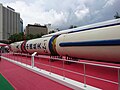 Long March 1
 -
 Long March 1 engine

.jpg)
Origins
[edit]The Long March 1 rocket is derived from earlier Chinese 2-stage Intermediate-range ballistic missile (IRBM) DF-4, or Dong Feng 4 missile, and the Long March 2, Long March 3, Long March 4 rocket families are derivatives of the Chinese 2-stage Intercontinental ballistic missile (ICBM) DF-5, or Dong Feng 5 missile.
However, like its counterparts in both the United States and in Russia, the differing needs of space rockets and strategic missiles have caused the development of space rockets and missiles to diverge. The main goal of a launch vehicle is to maximize payload, while for strategic missiles increased throw weight is much less important than the ability to launch quickly and to survive a first strike. This divergence has become clear in the next generation of Long March rockets, which use cryogenic propellants in sharp contrast to the next generation of strategic missiles, which are mobile and solid fuelled.
The next generation of Long March rocket, Long March 5 rocket family, is a brand new design, while Long March 6 and Long March 7 can be seen as derivations because they use the liquid rocket booster design of Long March 5 to build small-to-mid capacity launch vehicles.
Entry into commercial launch market
[edit]
After the U.S. Space Shuttle Challenger was destroyed in 1986, a growing commercial backlog gave China the chance to enter the international launch market. In September 1988, U.S. President Ronald Reagan agreed to allow U.S. satellites to be launched on Chinese rockets.[4] Reagan's satellite export policy would continue to 1998, through Bush and Clinton administrations, with 20 or more approvals.[5] AsiaSat 1, which had originally been launched by the Space Shuttle and retrieved by another Space Shuttle after a failure, was launched by a Long March 3 in 1990 as the first foreign payload on a Chinese rocket.
However, major setbacks occurred in 1992–1996. The Long March 2E was designed with a defective payload fairing, which collapsed when faced with the rocket's excessive vibration. After just seven launches, the Long March 2E destroyed the Optus B2 and Apstar 2 satellites and damaged AsiaSat 2.[6][7] The Long March 3B also experienced a catastrophic failure in 1996, veering off course shortly after liftoff and crashing into a nearby village. At least 6 people were killed on the ground, and the Intelsat 708 satellite was also destroyed.[8] A Long March 3 also experienced a partial failure in August 1996 during the launch of Chinasat-7.[9] Six Long March rockets (Chang Zheng 2C/SD) launched 12 Iridium satellites, about a sixth of Iridium satellites in the original fleet.[10]
United States embargo on Chinese launches
[edit]The involvement of United States companies in the Apstar 2 and Intelsat 708 investigations caused great controversy in the United States. In the Cox Report, the United States Congress accused Space Systems/Loral and Hughes Aircraft Company of transferring information that would improve the design of Chinese rockets and ballistic missiles.[11] Although the Long March was allowed to launch its commercial backlog, the United States Department of State has not approved any satellite export licenses to China since 1998. ChinaSat 8, which had been scheduled for launch in April 1999 on a Long March 3B rocket,[12] was placed in storage, sold to the Singapore company ProtoStar, and finally launched on a European rocket Ariane 5 in 2008.[11]
From 2005 to 2012, Long March rockets launched ITAR-free satellites made by the European company Thales Alenia Space.[13] However, Thales Alenia was forced to discontinue its ITAR-free satellite line in 2013 after the United States State Department fined a United States company for selling ITAR components.[14] Thales Alenia Space had long complained that "every satellite nut and bolt" was being ITAR-restricted, and the European Space Agency (ESA) accused the United States of using ITAR to block exports to China instead of protecting technology.[15] In 2016, an official at the United States Bureau of Industry and Security confirmed that "no U.S.-origin content, regardless of significance, regardless of whether it is incorporated into a foreign-made item, can go to China". Since 2016, the European aerospace industry is working on developing replacements for United States satellite components.[16]
Return to success
[edit]
After the failures of 1992–1996, the troublesome Long March 2E was withdrawn from the market. Design changes were made to improve the reliability of Long March rockets. From October 1996 to April 2009, the Long March rocket family delivered 75 consecutive successful launches, including several major milestones in space flight:
- On 15 October 2003, the Long March 2F rocket successfully launched the Shenzhou 5 spacecraft, carrying China's first astronaut into space. China became the third nation with independent human spaceflight capability, after the Soviet Union/Russia and the United States.
- On 1 June 2007, Long March rockets completed their 100th launch overall.
- On 24 October 2007, the Long March 3A successfully launched (10:05 UTC) the "Chang'e 1" lunar orbiting spacecraft from the Xichang Satellite Launch Center.
The Long March rockets have subsequently maintained an excellent reliability record. Since 2010, Long March launches have made up 15–25% of all space launches globally. Growing domestic demand has maintained a healthy manifest. International deals have been secured through a package deal that bundles the launch with a Chinese satellite, circumventing the United States embargo.[17]
Payloads
[edit]The Long March is China's primary expendable launch system family. The Shenzhou spacecraft and Chang'e lunar orbiters are also launched on the Long March rocket. The maximum payload for LEO is 25,000 kilograms (CZ-5B), the maximum payload for GTO is 14,000 kg (CZ-5). The next generation rocket Long March 5 variants will offer more payload in the future.
Propellants
[edit]
Long March 1's 1st and 2nd stage used nitric acid and unsymmetrical dimethylhydrazine (UDMH) propellants, and its upper stage used a spin-stabilized solid rocket engine.
Long March 2, Long March 3, Long March 4, the main stages and associated liquid rocket boosters use dinitrogen tetroxide (N2O4) as the oxidizing agent and UDMH as the fuel. The upper stages (third stage) of Long March 3 rockets use YF-73 and YF-75 engines, using liquid hydrogen (LH2) as the fuel and liquid oxygen (LOX) as the oxidizer.
The new generation of Long March rocket family, Long March 5 and its derivations Long March 6, Long March 7, Long March 8, and Long March 10 use non-toxic LOX/kerosene and LOX/LH2 liquid propellants (except in some upper stages where UDMH/N2O4 continues to be used).
Long March 9 is being developed as a LOX/[[CH4]], or methalox, rocket.
Long March 11 is a solid-fuel rocket.
Long March 12 uses non-toxic LOX/kerosene liquid propellants for the first 2 stages.
Variants
[edit]Timeline bars start at first launch (rather than start of development).

The Long March rockets are organized into several series:
- Long March 1
- Long March 2
- Long March 3
- Long March 4
- Long March 5
- Long March 6
- Long March 7
- Long March 8
- Long March 9
- Long March 10
- Long March 11
- Long March 12
The Long March 5, 6 and 7 are a newer generation of rockets sharing the new 1200 kN class YF-100 engines, which burns RP-1 / LOX, unlike earlier 2, 3 and 4 series which uses more expensive and dangerous N2O4 / UDMH propellants.[18] The 5 series is a heavy-lift launch vehicle, with a capacity of 25,000 kg to LEO while the 6 series is a small-lift launch vehicle with a capacity of 1,500 kg to LEO, and the 7 series is a medium-lift launch vehicle, with a capacity of 14,000 kg to LEO.
The Long March 10A is a partially-reusable crewed-rated rocket designed for LEO missions currently under development; the Long March 9 is initially designed to be partially reusable before becoming a fully reusable launcher.

| Model | Status | Stages | Length (m) |
Max. diameter (m) |
Liftoff mass (t) |
Liftoff thrust (kN) |
Payload (LEO, kg) |
Payload (SSO, kg) | Payload (GTO, kg) |
|---|---|---|---|---|---|---|---|---|---|
| Long March 1 | Retired | 3 | 29.86 | 2.25 | 81.6 | 1020 | 300 | – | – |
| Long March 1D | Retired | 3 | 28.22 | 2.25 | 81.1 | 1101.2 | 930 | – | – |
| Long March 2A | Retired | 2 | 31.17 | 3.35 | 190 | 2,786 | 1,800 | – | – |
| Long March 2C | Active | 2 | 43.72 | 3.35 | 245 | 2,961.6 | 4,000 | 2,100 | 1,250 |
| Long March 2D | Active | 2 | 41.056 (without shield) | 3.35 | 249.6 | 2,961.6 | 3,500 | 1,300 | – |
| Long March 2E | Retired[19] | 2 (+ 4 boosters) | 49.686 | 3.35 | 464 | 5,923.2 | 9,500 | 4,350 | 3,500 |
| Long March 2F | Retired | 2 (+ 4 boosters) | 58.34 | 3.35 | 493 | 6512 | 8,800 | – | – |
| Long March 2F/G | Active | 2 (+ 4 boosters) | 58.34 | 3.35 | 493 | 6512 | 8,800 | – | – |
| Long March 2F/T | Active | 2 (+ 4 boosters) | 58.34 | 3.35 | 493 | 6512 | 8,800 | – | – |
| Long March 3 | Retired[19] | 3 | 44.9 | 3.35 | 205 | 2,961.6 | 5,000 | – | 1,600 |
| Long March 3A | Retired | 3 | 52.52 | 3.35 | 242 | 2,961.6 | 6,000 | 5,100 | 2,600 |
| Long March 3B | Retired[a] | 3 (+ 4 boosters) | 54.838 | 7.85 (including boosters) | 425.8 | 5,923.2 | 11,200 | 6,850 | 5,100 |
| Long March 3B/E | Active | 3 (+ 4 boosters) | 56.326 | 7.85 (including boosters) | 458.97 | 5923.2 | 11,500 | 7,100 | 5,500 |
| Long March 3C | Retired | 3 (+ 4 boosters) | 55.638 | 7.85 (including boosters) | 345 | 4,442.4 | 9,100 | 6,450 | 3,900 |
| Long March 3C/E | Active | 3 (+ 4 boosters) | 55.638 | 7.85 (including boosters) | 345 | 4,442.4 | 9,100 | 6,450 | 3,900 |
| Long March 4A | Retired | 3 | 41.9 | 3.35 | 241.1 | 2,961.6 | 3,800 | 1,600 | – |
| Long March 4B | Active | 3 | 48 | 3.35 | 249.2 | 2,961.6 | 4,200 | 2,295 | – |
| Long March 4C | Active | 3 | 48 | 3.35 | 249.2 | 2,961.6 | 4,200 | 2,947 | 1,500 |
| Long March 5 [20][21] | Active | 2 (+ 4 boosters, optional upper stage) | 57 | 11.7 (including boosters) | 854.5 | 10620 | – | – | 14,400 |
| Long March 5B | Active | 1 (+ 4 boosters) | 53.7 | 11.7 (including boosters) | 837.5 | 10620 | 25,000 | 15,000 | – |
| Long March 6[22][23] | Active | 3 | 29 | 3.35 | 103 | 1200 | >1,500 | 500~1,080 | – |
| Long March 6A | Active | 2 (+ 4 solid fuel boosters) | 50~55 | 7.35 (including boosters) | 530 | 7230 | >8,000 | >5,000 | – |
| Long March 6C | Active | 2 | 43 | 3.35 | 217 | 2,376 | 4,500 | 2,000 | 1,400 |
| Long March 7 | Active | 2 (+ 4 boosters) | 53 | 7.85 (including boosters) | 597 | 7,200 | 14,000 | 5,500 | – |
| Long March 7A | Active | 3 (+ 4 boosters) | 60.13–60.7 | 7.85 (including boosters) | 573 | 7,200 | – | – | 7,800 |
| Long March 8 | Active | 2 (2 boosters, optional) | 50.3 | 3–7.85 (including boosters) | 356.6 | 4,800 | 8,100[24] | 5,000[24] | 2,800[24] |
| Long March 8A | Active | 2 (+ 2 boosters) | 50.5 | 3.35–7.85 (including boosters) | 371 | 4,800 | 9,800 | 7,000 | 3,500 |
| Long March 9 | Planned | 3 | 114 | 10.6 | 4,369 | 60,000 | 150,000 | – | – |
| Long March 10 | Planned | 3 (+ 2 common core boosters) | 88.5–91.6 | 15 (including boosters) | 2,187 | 26,250 | 70,000 | – | 32,000 |
| Long March 10A | Planned | 3 | 88.5–91.6 | 5 | ? | 8750 | >18,000 expened >14,000 reusable |
– | - |
| Long March 11 | Active | 4 | 20.8 | ~2 | 58 | 1188 | 700 | 350 | – |
| Long March 12 | Active | 2 | 62 | 3.8 | 433 | 5,000 | >10,000 | 6,000 | – |
| Long March 12A | Planned | 2 | 59 | 3.8 | 433 | 5,000 | 10,000 | 6,000 | – |
| 2A | 2C | 2D | 2E | 2F | 3 | 3A | 3B | 3C | 4A | 4B | 4C |
|---|---|---|---|---|---|---|---|---|---|---|---|
 |
 |
 |
 |
 |
 |
 |
 |
 |
 |
 |

|
Long March 8
[edit]The Long March 8 is a new series of launch vehicles, which is geared towards Sun-synchronous orbit (SSO) launches.[25] In early 2017, it was expected to be based on the Long March 7, and have two solid fuel boosters, and first launch by the end of 2018.[26] By 2019, it was intended to be partially reusable. The first stage will have legs and grid fins (like Falcon 9) and it may land with side boosters still attached.[27] The first Long March 8 was rolled out to for a test launch on or around 20 December 2020 and launched on 22 December 2020.[28] The second flight with no side boosters occurred on 27 February 2022, sending a national record of 22 satellites into SSO.[29][needs update]
Future development
[edit]Long March 9
[edit]The Long March 9 (LM-9, CZ-9, or Changzheng 9, Chinese: 长征九号) is a Chinese super-heavy carrier rocket concept proposed in 2018[30] that is currently in study. It is planned for a maximum payload capacity of 140,000 kg[31] to low Earth orbit (LEO), 50,000 kg to trans-lunar injection or 44,000 kg to Mars.[32][33] Its first flight is expected by 2028 or 2029 in preparation for a lunar landing sometime in the 2030s;[34] a sample return mission from Mars has been proposed as first major mission.[33] It has been stated that around 70% of the hardware and components needed for a test flight are currently undergoing testing, with the first engine test to occur by the end of 2018. The 2011 proposed design would be a three-staged rocket, with the initial core having a diameter of 10 meters and use a cluster of four engines. Multiple variants of the rocket have been proposed, CZ-9 being the largest with four liquid-fuel boosters with the aforementioned LEO payload capacity of 140,000 kg, CZ-9A having just two boosters and a LEO payload capacity of 100,000 kg, and finally CZ-9B having just the core stage and a LEO payload capacity of 50,000 kg.[35]
2021 respecification
[edit]Approved in 2021, the Long March 9 is classified as a super heavy-lift launch vehicle.[34] A very different design of LM-9 was announced in June 2021, with more engines and no external boosters.[36] Payload capacities are 160 tonnes to LEO and 53 tonnes to TLI.[37][38]
Long March 10
[edit]The Long March 10, previously known as the "921 rocket",[39] is under development for crewed lunar missions. The nickname "921" refers to the founding date of China's human spaceflight program. Like the Long March 5, it uses 5-meter (16.4 ft) diameter rocket bodies and YF-100K engines, although with 7 engines on each of 3 cores.[40][41] The launch weight is 2187 tonnes, delivering 25 tonnes into trans-lunar injection.[42] The proposed crewed lunar mission uses two rockets; the crewed spacecraft and lunar landing stack launch separately and rendezvous in lunar orbit.[43] Development was announced at the 2020 China Space Conference.[42] As of 2022, the first flight of this triple-cored rocket is targeted for 2027.[44]
Launch sites
[edit]There are four launch centers in China. They are:
- Jiuquan Satellite Launch Center
- Taiyuan Satellite Launch Center
- Wenchang Spacecraft Launch Site
- Xichang Satellite Launch Center
Most of the commercial satellite launches of Long March vehicles have been from Xichang Satellite Launch Center, located in Xichang, Sichuan province. Wenchang Spacecraft Launch Site in Hainan province is under expansion and will be the main launch center for future commercial satellite launches. Long March launches also take place from the more military oriented Jiuquan Satellite Launch Center in Gansu province from which the crewed Shenzhou spacecraft also launches. Taiyuan Satellite Launch Center is located in Shanxi province and focuses on the launches of Sun-synchronous orbit (SSO) satellites.
On 5 June 2019, China launched a Long March 11 rocket from a mobile launch platform in the Yellow Sea.[45]
Commercial launch services
[edit]China markets launch services under the China Aerospace Science and Technology Corporation (China Great Wall Industry Corporation).[46] Its efforts to launch communications satellites were dealt a blow in the mid-1990s after the United States stopped issuing export licenses to companies to allow them to launch on Chinese launch vehicles out of fear that this would help China's military. In the face of this, Thales Alenia Space built the Chinasat-6B satellite with no components from the United States whatsoever. This allowed it to be launched on a Chinese launch vehicle without violating United States International Traffic in Arms Regulations (ITAR) restrictions.[47] The launch, on a Long March 3B rocket, was successfully conducted on 5 July 2007.
A Chinese Long March 2D launched VRSS-1 (Venezuelan Remote Sensing Satellite-1) of Venezuela, "Francisco de Miranda" on 29 September 2012.
Notes
[edit]See also
[edit]

- China National Space Administration
- Shenzhou spacecraft – Class of crewed spacecraft from China
- Space program of China
- Tsien Hsue-shen – Chinese rocket scientist (1911–2009)
- Comparison of orbital launchers families
- Comparison of orbital launch systems
- Kaituozhe launcher – Chinese solid fueled launch vehicle based on the road mobile DF-21 IRBM
- Kuaizhou launcher – Family of Chinese "quick-reaction" orbital launch vehicles
References
[edit]- ^ a b "长征_中国航天科技集团有限公司". China Aerospace Science and Technology Corporation spacechina.com. Retrieved 28 May 2022.
- ^ a b "Launch Vehicles". China Aerospace Science and Technology Corporation. 28 May 2022.
- ^ "我国运载火箭为什么以"长征"命名-新华网". Xinhua News Agency. Retrieved 28 May 2022.
- ^ Stevenson, Richard W. (16 September 1988). "Shaky Start for Rocket Business". The New York Times. Archived from the original on 1 December 2017. Retrieved 28 January 2018.
- ^ "Clinton Defends China Satellite Waiver – May 22, 1998". www.cnn.com. Retrieved 13 December 2021.
- ^ Zinger, Kurtis J. (2014). An Overreaction that Destroyed an Industry: The Past, Present, and Future of U.S. Satellite Export Controls (PDF) (Report). Archived (PDF) from the original on 1 December 2017. Retrieved 28 November 2017.
- ^ "CZ-2E Space Launch Vehicle". globalsecurity.org. Archived from the original on 1 December 2017. Retrieved 28 November 2017.
- ^ Lan, Chen. "Mist around the CZ-3B disaster, part 1". The Space Review. Archived from the original on 1 December 2017. Retrieved 18 January 2014.
- ^ "NASA – NSSDCA – Spacecraft – Details". nssdc.gsfc.nasa.gov. Retrieved 15 December 2021.
- ^ Graham, William (30 March 2018). "Iridium NEXT-5 satellites ride to orbit on SpaceX Falcon 9". NASASpaceFlight.com. Retrieved 15 December 2021.
- ^ a b Zelnio, Ryan (9 January 2006). "A short history of export control policy". The Space Review. Archived from the original on 11 December 2017. Retrieved 28 November 2017.
- ^ Associate Administrator for Commercial Space Transportation, Federal Aviation Administration (1999). Commercial Space Transportation Quarterly Launch Report (PDF) (Report). Archived (PDF) from the original on 4 May 2017. Retrieved 28 November 2017.
 This article incorporates text from this source, which is in the public domain.
- ^ Harvey, Brian (2013). China in Space: The Great Leap Forward. New York: Springer. pp. 160–162. ISBN 9781461450436.
- ^ Ferster, Warren (5 September 2013). "U.S. Satellite Component Maker Fined US$8 Million for ITAR Violations". SpaceNews.
- ^ de Selding, Peter B. (9 August 2013). "Thales Alenia Space: U.S. Suppliers at Fault in "ITAR-free" Misnomer". SpaceNews.
- ^ de Selding, Peter B. (14 April 2016). "U.S. ITAR satellite export regime's effects still strong in Europe". SpaceNews.
- ^ Henry, Caleb (22 August 2017). "Back-to-back commercial satellite wins leave China Great Wall hungry for more". SpaceNews.
- ^ SINA News Sina, 19 November 2010, [1]
- ^ a b "CZ". Astronautix.com. Archived from the original on 11 June 2009. Retrieved 10 August 2010.
- ^ "cz5". SinoDefence. Archived from the original on 15 September 2008.
- ^ "CZ-NGLV". astronautix.com. Archived from the original on 7 September 2008.
- ^ "China starts developing Long March 6 carrier rockets for space mission". Xinhuanet News. 6 September 2009. Archived from the original on 2 November 2012. Retrieved 10 August 2010.
- ^ "ChangZheng 6 (Long March 6) Launch Vehicle". SinoDefence.com. 20 February 2009. Archived from the original on 2 March 2009. Retrieved 10 August 2010.
- ^ a b c Rui C. Barbosa (22 December 2020). "Long March 8 – a future reusable rocket – conducts debut launch". nasaspaceflight.com. Retrieved 7 May 2023.
- ^ "中国长征系列运载火箭大家族将添六大新成员-中新网". Archived from the original on 12 March 2015. Retrieved 8 March 2015.
- ^ Jones (February 2017). "hina is aiming to launch a new Long March 8 rocket". gbtimes.com. Archived from the original on 20 March 2018. Retrieved 19 March 2018.
- ^ Meet the Long March 8 - January 2020 Archived 20 January 2020 at the Wayback Machine Includes CGI image of first stage landing
- ^ Jones, Andrew (18 December 2020). "China rolls out Long March 8 rocket for weekend test flight". SpaceNews. Retrieved 21 December 2020.
- ^ Jones, Andrew (27 February 2022). "China launches national record 22 satellites on Long March 8 commercial rideshare". SpaceNews. Retrieved 1 March 2022.
- ^ Jones, Andrew (5 July 2018). "China reveals details for super-heavy-lift Long March 9 and reusable Long March 8 rockets". SpaceNews. Retrieved 1 March 2021.
- ^ "First Look: China's Big New Rockets". AmericaSpace. 18 July 2012. Archived from the original on 20 January 2017. Retrieved 25 August 2013.
- ^ "梁小虹委员:我国重型运载火箭正着手立项 与美俄同步". scitech.people.com.cn. Archived from the original on 28 July 2013. Retrieved 28 June 2013.
- ^ a b "China reveals details for super-heavy-lift Long March 9 and reusable Long March 8 rockets". 5 July 2018. Archived from the original on 1 August 2018. Retrieved 7 July 2018.
- ^ a b Berger, Eric (24 February 2021). "China officially plans to move ahead with super-heavy Long March 9 rocket". Ars Technica. Retrieved 1 March 2021.
- ^ "China Aims for Humanity's Return to the Moon in the 2030s". popsci.com. 5 May 2016. Archived from the original on 8 May 2016. Retrieved 14 July 2018.
- ^ Red Heaven: China sets its sights on the stars (part 1)
- ^ "China National Space Day". kevinjamesng.com. 25 April 2022. Retrieved 27 April 2022.
- ^ "10 more engines!The Long March 9 rocket has a new configuration, which is thicker and taller and can be reused". inf.news. 27 April 2022. Retrieved 27 April 2022.
- ^ 汪淼 (24 February 2023). "我国新一代载人运载火箭命名为"长征十号",将用于登月任务" (in Simplified Chinese). IT之家. Retrieved 25 February 2023.
- ^ Lund, J. (7 October 2020). "China's Mysterious Manned Moon Rocket".
- ^ Jones, Andrew (17 December 2021). "China's new rocket for crewed moon missions to launch around 2026". SpaceNews. Retrieved 19 December 2021.
- ^ a b Jones, Andrew (1 October 2020). "China is building a new rocket to fly its astronauts on the Moon". SPACE.com.
- ^ Jones, Andrew (30 October 2020). "China outlines architecture for future crewed moon landings". SpaceNews.
- ^ Jones, Andrew (11 November 2022). "China's huge new crew-launching moon rocket could fly for 1st time in 2027". Space.com. Retrieved 18 November 2022.
- ^ "China Gains New Flexible Launch Capabilities with First Sea Launch". Space.com. 6 June 2019. Archived from the original on 7 June 2019. Retrieved 6 June 2019.
- ^ "About CGWIC". CGWIC. Archived from the original on 8 July 2008.
- ^ "China launches satellite despite restrictions". USA Today. 6 July 2007. Archived from the original on 23 May 2011. Retrieved 11 May 2010.

External links
[edit]
- Extensive information on the Chinese space program
- China Great Wall Industry Corporation Archived 5 October 2006 at the Wayback Machine
- NASA links – substitute year for other years
- Long March Engines List
- Rocket and Space Technology
- Chinese Launch Vehicle Overview
| Rockets |  | |
|---|---|---|
| Launch sites | ||
| Manufacturers | ||
| Designers | ||
Long March (rocket family)
View on GrokipediaOrigins and Early Development
Initial Design and First Launches
The Long March rocket family originated from China's Dongfeng ballistic missile development programs in the mid-20th century, with the initial designs leveraging missile technology for space launch capabilities during the late 1960s. The first variant, Long March 1 (CZ-1), adapted the first two stages of the DF-4 intermediate-range ballistic missile, which used storable hypergolic propellants—unsymmetrical dimethylhydrazine (UDMH) and nitrogen tetroxide (N2O4)—for reliable ignition without complex turbopumps suited to missile applications. A new solid-propellant third stage was added to achieve orbital insertion, though the vehicle's limited payload capacity, approximately 300 kg to low Earth orbit, reflected its origins in military hardware not optimized for satellite deployment.[10][11] China's inaugural orbital launch occurred on April 24, 1970, when a Long March 1 successfully placed the Dong Fang Hong 1 satellite—China's first independent spacecraft, weighing 173 kg—into a 441 km by 2,384 km elliptical orbit from Jiuquan Launch Site. This mission demonstrated basic satellite transmission capabilities, including broadcasting the Chinese national anthem, marking China as the fifth nation to achieve independent orbital access. A follow-up launch on March 3, 1971, deployed the Shi Jian 1 scientific satellite, further validating the vehicle's reliability despite early constraints like rudimentary guidance and separation systems derived from missile reentry technology.[12][13][14] These initial efforts highlighted challenges such as the toxicity and handling risks of hypergolic fuels, which prioritized storability over performance efficiency, and the absence of cryogenic alternatives that could offer higher specific impulse. To address limitations in supporting recoverable payloads, development shifted to the Long March 2 (CZ-2), derived from the larger DF-5 intercontinental ballistic missile, enabling greater lift for reentry vehicles. The CZ-2's maiden flight on November 26, 1975, successfully recovered a 473 kg Fanhui Shi Weixing (FSW-0) prototype satellite after two days in orbit, proving suborbital reusability and paving the way for operational missions in the early 1980s.[15][11]Influences from Foreign Technology
The development of the Long March rocket family drew significantly from Soviet technological transfers during the 1950s, which provided foundational expertise in liquid-propellant rocketry and missile systems. Under bilateral agreements, the Soviet Union supplied China with technical documentation, equipment, and training for ballistic missiles, including samples of the R-1 (a copy of the German V-2) and R-2 short-range ballistic missiles.[16][17] China reverse-engineered these designs to produce its Dong Feng-1 (DF-1) missile by 1960, incorporating Soviet staging principles and hypergolic propellants that later informed orbital launch capabilities.[18] This assistance accelerated China's progression from rudimentary solid-fuel experiments to reliable liquid-fueled boosters, as domestic metallurgy and guidance systems were initially insufficient for independent replication.[19] The 1960 Sino-Soviet split abruptly terminated this collaboration, with all Soviet advisors withdrawing by August 1960 and denying further blueprints or materials, compelling China to indigenize adaptations under resource constraints.[19] Despite the rupture, the pre-split inflows established critical baselines: Soviet-derived inertial guidance and clustered engine configurations enabled the Long March 1's debut in 1970, derived from the DF-4 intermediate-range ballistic missile, which itself evolved from earlier R-2 influences.[18] Without these inputs, China's rocketry would likely have lagged by a decade, as evidenced by the program's reliance on imported precision components until domestic substitutes matured post-1960; the split forced innovations like simplified staging to mitigate guidance inaccuracies inherent in purely indigenous efforts.[20] In the 1970s, foreign influences shifted to sporadic, non-Soviet acquisitions amid China's economic opening, including purchases of guidance gyroscopes and materials from European suppliers before tightened export controls.[21] These were reverse-engineered to enhance later variants, such as improved avionics in the Long March 2, but remained marginal compared to the Soviet foundation, with verifiable transfers limited to dual-use components rather than complete systems.[22] Empirical outcomes show these inflows causally boosted payload reliability—e.g., from the Long March 1's 173 kg to orbit to subsequent models' capacities—by integrating foreign precision elements with adapted Soviet architectures, underscoring how targeted technology absorption outpaced isolated domestic R&D in achieving operational maturity.[23]Technical Specifications
Propellants and Propulsion Systems
The Long March rocket family predominantly employs hypergolic propellants, specifically unsymmetrical dimethylhydrazine (UDMH) as fuel and dinitrogen tetroxide (N2O4) as oxidizer, in the liquid stages of early variants for their storability and spontaneous ignition upon contact, which enhances reliability in upper stages and reduces pre-launch preparation time compared to cryogenic systems.[24][11] These propellants, while enabling immediate restart capability essential for orbital insertion maneuvers, exhibit lower specific impulse values—typically around 287 seconds in vacuum for associated engines—due to their chemical properties, and pose handling challenges from high toxicity and corrosiveness, as evidenced by documented ground infrastructure requirements and safety protocols in Chinese launch operations.[24] Newer developments within the family incorporate cryogenic propellants for improved efficiency, including liquid oxygen (LOX) with kerosene (RP-1) in first and booster stages of variants like Long March 6 and 7, achieving specific impulses up to 335 seconds in vacuum, which supports higher payload fractions through denser energy content and cleaner combustion relative to hypergolics.[25][26] LOX/liquid hydrogen (LH2) combinations appear in core stages of heavy-lift configurations, delivering specific impulses exceeding 430 seconds in vacuum owing to hydrogen's high exhaust velocity, though this necessitates insulated tanks and venting to mitigate boil-off losses during countdowns.[27] Central to these systems are the YF-series engines developed by the Academy of Aerospace Propulsion Technology, with the YF-20 and YF-21 families powering early hypergolic stages through clustered gimbaled configurations for thrust vector control, evolving into higher-thrust kerosene-LOX variants like the YF-100 (300 seconds sea-level specific impulse) that employ gas-generator cycles for scalability in booster applications.[25][24] The YF-77, utilizing staged combustion for LH2/LOX propulsion, exemplifies advancements in upper-stage efficiency with vacuum thrusts around 700 kN and burn times over 500 seconds, reflecting iterative improvements in turbopump reliability derived from empirical testing data.[27] Hypergolics maintain an edge in operational simplicity and storability for missions requiring multiple ignitions, whereas cryogenic shifts prioritize performance metrics validated by launch success rates exceeding 95% in recent campaigns, albeit with added complexity in cryogenic handling.[28]Structural and Staging Design
The Long March rocket family utilizes serial multi-stage architectures, where each stage provides incremental velocity increases toward orbital insertion, with expended stages separated to minimize mass during subsequent burns. The inaugural Long March 1 featured a simple two-stage all-solid configuration, with a gross lift-off weight of 81,310 kg.[29] Subsequent developments introduced liquid-fueled stages for greater control and efficiency, evolving into three- or four-stage vehicles in medium- and heavy-lift variants. Medium-lift models like the Long March 3 and 4 series incorporate optional strap-on boosters to augment first-stage thrust, enabling higher payloads. The Long March 3B, for example, consists of a three-stage core augmented by four parallel liquid boosters attached to the base of the first stage, forming a clustered configuration for enhanced initial acceleration.[30] Heavy-lift variants such as the Long March 5 employ a larger core stage with four strap-on boosters, scaling gross lift-off weights to 869 tons while maintaining modular staging for geostationary or trans-lunar trajectories.[31] Structural designs initially relied on metallic alloys for propellant tanks and airframes, but newer generations integrate composite materials to achieve mass reductions of up to 30% in components like interstage sections and fairings. Experimental composite tanks, including a 3.35-meter-diameter prototype for liquid oxygen environments, demonstrate lighter alternatives to traditional aluminum or steel structures.[32] Payload fairing diameters have correspondingly expanded from 2.25–3.35 meters in early small- and medium-lift rockets to 5 meters or more in heavy variants, accommodating larger satellite volumes without compromising aerodynamic stability.[25] This evolution optimizes structural integrity under dynamic launch loads while prioritizing payload capacity.Major Variants
First-Generation Variants (Long March 1–4)
The first-generation Long March variants, encompassing the Long March 1 (LM-1) through Long March 4 (LM-4), were derived from China's Dong Feng ballistic missile series and marked the nation's entry into orbital spaceflight. These liquid-fueled rockets, primarily using unsymmetrical dimethylhydrazine (UDMH) and nitrogen tetroxide (NTO) propellants, featured staged designs optimized for low Earth orbit (LEO) insertions and, in later models, geostationary transfer orbit (GTO) capabilities. Early development emphasized reliability through iterative testing, with the LM-1 serving as a proof-of-concept for satellite deployment.[33] The LM-1, a two-stage vehicle with a length of approximately 19 meters and liftoff mass of 18,000 kg, achieved China's inaugural orbital success on April 24, 1970, deploying the 173 kg Dong Fang Hong I satellite into a 441 km × 2,384 km orbit. Capable of delivering up to 300 kg to LEO, the LM-1 conducted limited missions, including suborbital tests and two confirmed orbital attempts, before being phased out by the mid-1970s due to its modest performance and the advent of more capable successors. Its success rate was modest, reflecting the nascent state of Chinese rocketry.[33] The LM-2 series expanded on this foundation, introducing variants tailored for diverse payloads. The baseline LM-2, a two-stage rocket standing 33 meters tall with a 250-tonne liftoff mass, offered about 2,000–3,100 kg to LEO at 200 km altitude. Subvariants included the LM-2C (payload 2,500 kg to LEO), LM-2D (enhanced avionics for 3,500 kg LEO), and LM-2E (with four strap-on boosters boosting LEO capacity to 9,500 kg). The LM-2F, introduced in 2003, was the first human-rated version, measuring 58.3 meters long with a 498-tonne mass and 600-tonne thrust, enabling Shenzhou crewed missions to LEO with reinforced structures for astronaut safety. Over dozens of launches from Jiuquan and Xichang sites, the LM-2 family demonstrated improving reliability, though early flights encountered failures like the 1996 Intelsat 708 explosion.[34][35][36][37] The LM-3 addressed GTO requirements with a three-stage configuration, incorporating a third stage for perigee velocity augmentation. Measuring 44.6 meters in length and weighing 201 tonnes at liftoff, the baseline LM-3 delivered 1,500 kg to GTO. Enhanced models like the LM-3A increased this to 2,600 kg through refined propulsion and guidance, while the LM-3B, with boosters, reached 5,000 kg to GTO. Launched exclusively from Xichang, the series supported domestic and commercial geostationary satellites, achieving over 100 missions by the 2020s with a success rate exceeding 95% in mature phases, despite initial setbacks such as the 1984 third-stage failure.[38][39] The LM-4 series, optimized for sun-synchronous orbits from the Taiyuan site, featured polar launch capabilities for remote sensing payloads. The three-stage LM-4 had a 41.9-meter length, 3.35-meter diameter, 240-tonne mass, and 2,942 kN thrust, with variants like the LM-4B and LM-4C providing 2,000–4,000 kg to sun-synchronous LEO at 700 km. The LM-4A, limited to two launches in 1988 and 1990, was retired early, but successors continued operations into the 2020s, logging over 100 flights for Earth observation missions with high reliability post-2000. Earlier first-generation models like the LM-1 and basic LM-2/3 saw retirement by the 2010s as upgraded variants and newer families assumed primary roles, contributing to a cumulative success rate near 97% across the Long March lineage.[40][38][41]Second-Generation Variants (Long March 5–8)
The second-generation Long March variants, designated Long March 5 through 8, were developed starting in the early 2000s by the China Academy of Launch Vehicle Technology to provide enhanced lift capacities for ambitious programs including the Tiangong space station and Chang'e lunar missions, utilizing modular designs with kerosene/liquid oxygen (kerolox) and liquid hydrogen/liquid oxygen (hydrolox) engines rather than hypergolic propellants tied to intercontinental ballistic missile origins.[42] These rockets feature larger diameters—up to 5 meters for the Long March 5—and higher thrust levels, with the Long March 5's core stage delivering over 20 MN through twin YF-77 hydrolox engines, enabling payload masses exceeding 70 metric tons to low Earth orbit (LEO) in expendable configuration, though official capacities are often conservatively stated at around 25 tons to LEO.[43][44] The Long March 5, a heavy-lift vehicle standing 57 meters tall with a launch mass of approximately 867 tons, debuted on November 3, 2016, from Wenchang Launch Site, successfully placing a test payload into orbit despite minor trajectory deviations; its second flight in July 2017 failed due to second-stage anomalies, but subsequent missions achieved high reliability, with 15 successes out of 16 attempts by October 2025, supporting key insertions like the Tianhe core module for Tiangong and Chang'e lunar sample return vehicles.[44][45] The design incorporates four strap-on boosters each powered by two YF-100 kerolox engines producing about 1.2 MN each, alongside a core stage with YF-77 engines for upper-stage efficiency, prioritizing non-toxic propellants for reduced ground hazards.[27] Long March 6 serves as a small-to-medium lift option, optimized for sun-synchronous orbits with a debut flight in September 2015 from Taiyuan, employing a single YF-100 first-stage engine and YF-115 upper stage for payloads up to 20 tons to LEO or 12 tons to sun-synchronous orbit (SSO), with variants like Long March 6A adding solid boosters for increased capacity to about 4.5 tons SSO.[26] This kerosene-fueled rocket, roughly 29 meters in length, facilitates frequent launches of small satellite constellations, as evidenced by missions deploying multiple commercial payloads.[46] The Long March 7, a medium-lift rocket with 13.5-ton LEO capacity, first flew in June 2016 from Wenchang and primarily supports cargo resupply to the Tiangong station via Tianzhou spacecraft, using a kerolox first stage with four YF-100 engines and hydrolox upper stages; the Long March 7A variant enhances flexibility with a restartable third stage for geostationary transfer orbits.[47] While primarily land-based, adaptations for maritime launch platforms have been considered to expand operational flexibility, aligning with China's broader sea-launch initiatives.[48] Long March 8, introduced in December 2020, targets medium-lift needs for satellite constellations with up to 7 tons to SSO, deriving from Long March 7 architecture but incorporating two YF-100 engines on the first stage and optional liquid boosters; early designs envisioned reusable first-stage recovery via powered descent, though operational flights remain expendable, with ongoing developments toward reusability to compete in commercial markets by 2025.[49][8] The Long March 8A variant, debuting in 2022, boosts payload through enlarged fairings and adaptability for megaconstellation deployments like Guowang.[50]Specialized and Solid-Fuel Variants
The Long March 11 (LM-11) represents the primary all-solid-propellant member of the Long March family, engineered as a four-stage vehicle for responsive launches of small satellites. Measuring 21 meters in length with a liftoff mass of 57.7 tonnes, it supports payloads of up to approximately 1 tonne to sun-synchronous orbits at 500-700 km altitude. Its solid motors enable road-mobile transport and erection, with launches possible from inland sites like Jiuquan or Xichang, or maritime platforms in the Yellow Sea, facilitating operations without fixed infrastructure. Debuting in January 2015, the LM-11 has achieved at least 16 consecutive successes by March 2023, underscoring its reliability for quick-turnaround missions.[51][52] Solid propellants in the LM-11 eliminate the need for cryogenic fueling and complex ground support, allowing preparation and launch within hours—contrasting with days required for liquid variants—thus prioritizing rapid replenishment of satellite constellations in contested environments. This mobility and simplicity yield failure rates under 5%, aligning with the broader Long March series' global-leading success metrics exceeding 95%. The design's cold-launch capability, using gas generators for initial liftoff, further minimizes site dependencies and enhances operational flexibility.[53][54][55] Hybrid configurations integrate solid boosters into liquid architectures for specialized performance, as seen in the Long March 6A, which pairs four solid strap-ons with a kerosene-liquid oxygen core stage. This 50-meter, 530-tonne vehicle delivers up to 4 tonnes to 700 km sun-synchronous orbits, leveraging solids for high-thrust ascent augmentation while retaining liquid efficiency for precision orbital insertion. Maiden flight in March 2022 confirmed the viability of this approach, with subsequent missions demonstrating enhanced capacity for medium-lift responsive payloads without full reliance on all-liquid staging.[56][57] Variants like the LM-2C and LM-2D, while primarily liquid-fueled, adapt for small-payload niches through modular fairings and upper stages, occasionally incorporating solid kick motors for fine orbital adjustments, though they lack the full solid-propellant rapidity of the LM-11. These specialized evolutions prioritize deployment speed and reduced infrastructure over maximal payload, addressing tactical needs where liquid preparation delays pose risks.[25]Launch Infrastructure
Primary Launch Sites
The Jiuquan Satellite Launch Center, situated in the Gobi Desert of Inner Mongolia at approximately 40.96°N latitude, primarily supports Long March launches into low Earth orbit (LEO) and mid-inclination trajectories, including crewed missions via Launch Site 2 (SLS-2) for variants like the Long March 2F and Launch Site 4 (SLS-4) for polar orbits with the Long March 4 series.[1][58] Its inland location and extensive facilities, established in 1958, enable compatibility with hypergolic-fueled rockets through mobile service towers and rail transport adaptations for rapid turnaround.[58] The Xichang Satellite Launch Center in Sichuan Province, at about 28°N latitude, is optimized for geostationary transfer orbits (GTO) due to its southerly position allowing eastward launches over the Pacific Ocean, minimizing ground hazards and maximizing delta-v efficiency for Long March 2E, 3, and 4 variants.[1][59] Infrastructure includes dedicated pads like SLS-3 for high-energy missions, with post-2010 enhancements such as upgraded fueling systems and environmental controls to handle the corrosive propellants used in these rockets.[60] Taiyuan Satellite Launch Center in Shanxi Province, located at roughly 37.5°N, specializes in sun-synchronous orbits (SSO) for remote sensing and meteorological satellites, primarily using Long March 4B/C and newer Long March 6/6A from sites like SLS-1, leveraging its northern latitude for near-polar inclinations.[1][59] The Wenchang Spacecraft Launch Site on Hainan Island, China's southernmost facility at 19.6°N, accommodates heavy-lift Long March 5 series for LEO, GTO, and lunar transfers, as well as medium-lift Long March 7 and 8 from Launch Complex 201 (LC-201), benefiting from equatorial proximity to reduce Earth's rotational penalties and enable sea-based payload delivery via adjacent ports.[60][48] Operational since 2016, it features cryogenic propellant handling upgrades and mobile launchers installed post-2010 to support larger diameters and higher cadences for kerosene-liquid oxygen stages.[60] These sites have undergone coordinated infrastructure modernizations since 2010, including automated assembly buildings, expanded rail networks, and reusable transporter-erector-launchers, facilitating China's escalation to over 60 annual Long March launches by 2025 through parallel processing and reduced setup times.[60][1]Facilities and Support Systems
The Long March rocket family employs cryogenic propellant storage and handling facilities designed for liquid oxygen (LOX) and liquid hydrogen (LH2) in heavy-lift variants such as the Long March 5, which requires precise temperature control and insulated tanks to maintain propellant integrity during pre-launch operations.[43] These systems incorporate automated fueling arms and safety interlocks to mitigate risks associated with boil-off and thermal expansion.[61] Solid-fueled variants, including the Long March 11, utilize mobile transporter erector launchers (TELs) that integrate storage, transportation, and elevation functions into a single trailer system, allowing for rapid setup and launch from unprepared sites without fixed infrastructure.[62] This mobility supports tactical deployment, as demonstrated in sea-based launches from barges in the Yellow Sea.[63] Maritime support for downrange tracking relies on the Yuanwang-class vessels operated by the People's Liberation Army Navy, equipped with large parabolic antennas, radar systems, and telemetry receivers to monitor rocket ascent trajectories and satellite insertions in real-time.[64] These ships have conducted measurements for numerous Long March missions, such as the 2019 Long March 5 launch where Yuanwang-3 and Yuanwang-7 provided orbital data acquisition.[65][66] The overarching telemetry, tracking, and command (TT&C) network comprises ground stations linked with Yuanwang ships to form an integrated space-ground system, enabling continuous data relay and command uplink during flights.[67] Integration with the Beidou satellite navigation constellation provides precise positioning and timing signals, enhancing tracking accuracy and supporting autonomous navigation corrections for launch vehicles. The reliability of these facilities contributed to the Long March series reaching its 600th launch on October 16, 2025, via a Long March 8A mission, with telemetry from TT&C assets facilitating detailed post-flight reviews that attribute anomalies to specific subsystems, such as stage separation or propulsion failures, for iterative improvements.[68][69]Operational History and Performance
Launch Statistics and Reliability
As of October 16, 2025, the Long March rocket family has achieved its 600th launch, encompassing a wide array of orbital missions that account for approximately 86 percent of China's total space missions.[70][69] This milestone reflects a cumulative payload deployment of nearly 1,400 spacecraft, with the series demonstrating a sustained overall success rate exceeding 96 percent when accounting for both full and partial successes up to the 500th launch in December 2023, extended by subsequent reliable operations.[1][71] Launch cadence has evolved markedly, beginning with 1–2 attempts annually in the 1980s during initial development and testing phases, progressing to dozens per year by the 2010s, and accelerating to over 60 launches in recent years amid expanded infrastructure and mission demands.[25][71] Variant-specific reliability varies but remains high for mature models; for instance, the Long March 3 series records a 97.1 percent success rate across 170 attempts, with only two full failures and six partials, while the Long March 4 family exceeds 95 percent.[72] These rates stem from empirical refinements, including ground-based iterative testing to mitigate recurrence of identified issues. Early reliability challenges, such as guidance system anomalies and control software errors in the 1990s, contributed to a handful of full failures, but subsequent improvements—driven by fault-tree analysis and enhanced quality controls in propulsion and staging—have reduced partial failures, particularly those involving stage separation or thrust vectoring.[73][74] By the third century of launches around 2019, the family-wide success rate stabilized at 96 percent, underscoring causal progress through systematic failure investigations rather than radical redesigns.[75]| Variant | Launches (approx.) | Success Rate | Notable Factors |
|---|---|---|---|
| Long March 3 | 170 | 97.1% | High GEO precision; few recent issues[72] |
| Long March 4 | 80+ | >95% | Reliable for polar/SSO; minimal failures post-2000s |
| Long March 2 | 200+ | ~95% | Versatile; early guidance fixes key[1] |