


Community hub
Recent from talks
Contribute something
Nothing was collected or created yet.
Western Xia
View on Wikipedia
Key Information


| Part of a series on the |
| History of China |
|---|
 |
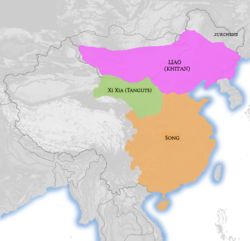
The Western Xia or the Xi Xia (Chinese: 西夏; pinyin: Xī Xià; Wade–Giles: Hsi1 Hsia4), officially the Great Xia (大夏; Dà Xià; Ta4 Hsia4), also known as the Tangut Empire, and known as Mi-nyak[6] to the Tanguts and Tibetans, was a Tangut-led imperial dynasty of China that existed from 1038 to 1227. At its peak, the dynasty ruled over modern-day north-central China, including parts of Ningxia, Gansu, eastern Qinghai, northern Shaanxi, northeastern Xinjiang, and southwest Inner Mongolia, and southernmost Outer Mongolia, measuring about 800,000 square kilometres (310,000 square miles).[7][8][9]
The capital of Western Xia was Xingqing (modern Yinchuan); another major Xia city and archaeological site is Khara-Khoto. Western Xia was annihilated by the Mongols in 1227. Most of its written records and architecture were destroyed, so the founders and history of the empire remained obscure until 20th-century research in China and the West. Today the Tangut language and its unique script are extinct, only fragments of Tangut literature remain.
The Western Xia occupied the area around the Hexi Corridor, a stretch of the Silk Road, the most important trade route between northern China and Central Asia. They made significant achievements in literature, art, music, and architecture, which was characterized as "shining and sparkling".[10] Their extensive stance among the other empires of the Liao, Song, and Jin was attributable to their effective military organizations that integrated cavalry, chariots, archery, shields, artillery (cannons carried on the back of camels), and amphibious troops for combat on land and water.[11]
Name
[edit]The full title of the Western Xia as named by their own state is L1572 L1890 L2937 L4456 reconstructed as /*phiow¹-bjij²-lhjij-lhjij²/, which word by word denotes 'white', 'high', 'kingdom', 'great', or 𗴂𗹭𘜶𗴲𗂧, 'white', 'high', 'great', 'summer', 'kingdom'. The corresponding Chinese name, 白高大夏國 ("White High Great Xia State"), was also used. Chinese and Japanese scholars commonly interpret the first two words as "upper reaches of the White River", which was possibly referring to the Yellow River.[12] Kepping (1994) proposed the translation "the Kingdom of the Great Xia of the White and Lofty", and suggested that the name refers to a peak in the Helan Mountains named the "White and Lofty Mother".[13] The region was known to the Tanguts as /mjɨ-njaa/, and to the Tibetans as Minyak.[6][14] Another name the Tanguts used for their state was /khjɨ-dwuu-lhjij/ (萬祕國), which means the "State of Ten Thousand Secrets".[13] "Western Xia" or "Xi Xia" is the state's Chinese name. "Western" refers to its location to the west of the Liao (916–1125) and Jin (1115–1234) dynasties, as well as the Song. "Xia" (pointing to the Xia dynasty) is a historical name for the region that originated from the 5th-century Hu Xia dynasty.[15]
The name Tangut is derived from a form first found in the Orkhon inscriptions dated to 735, which is transcribed in Chinese as Tangwu or Tangute (Tangghut (Tangɣud) in Mongolian). Tangut was used a common name for certain tribes in the Amdo-Kokonor-Gansu region until the 19th century. The Tanguts called themselves Minag, transcribed in Chinese as Mianyao or Miyao.[16]
History
[edit]
Origins
[edit]The Tanguts originally came from the Qinghai-Sichuan-Tibet region, whose home originally was in the highlands of western Sichuan.[17] According to Chinese records, which called them the Dangxiang, the Tanguts were descended from the Western Qiang people, and occupied the steppes around Qinghai Lake and the mountains to its south.[16]
In 608, the Tanguts helped the Sui dynasty defeat the Tuyuhun, however they were betrayed by the Sui forces, who took the chance to loot the Tanguts. In 635, they were requested to serve as guides for Emperor Taizong's campaign against Tuyuhun, but the Tang forces double crossed them in a surprise attack and seized thousands of livestock. In retaliation, the Tanguts attacked the Tang and killed thousands of their soldiers.[18]
By the 650s, the Tanguts had left their homeland to escape pressure from the Tibetans and migrated eastward, to what are now parts of Shanxi and Shaanxi. In 584-5 Tuoba Ningzong led the first group of Tanguts to submit to the Sui. In 628-629 another group under the leadership of Xifeng Bulai surrendered to the Tang. After the Tuyuhun were defeated in 635, the Tanguts under Tuoba Chici also surrendered. The 340,000 Tanguts were divided into 32 jimi prefectures under the control of Tangut chieftains appointed as prefects. Another wave of Tanguts entered Tang territory in 692, adding as many as 200,000 persons to the population in Lingzhou and Xiazhou. In 721–722, Tuoba Sitai, a descendant of Tuoba Chici, aided the Tang in putting down a Sogdian-led revolt in Shuofang.[19] By the time of the An Lushan Rebellion in the 750s, the Tanguts had become the primary local power in the Ordos region in northern Shaanxi. In the 760s, the military commander, Ashina Sijian, harassed six Tangut tribes and took their camels and horses. The Tanguts fled west across the Yellow River and started working for the Tibetans as guides on raiding expeditions. In 764, the Tanguts joined the Tibetans and Uyghurs in supporting the Tang rebel Pugu Huaien.[18] After the Tang reasserted their authority, a descendant of Tuoba Chici, Tuoba Chaoguang, was put in charge of the loyal Tanguts. The Yeli, Bali, and Bozhou clans continued to side with the Tibetans, however the Tanguts also came under Tibetan predation, and frontier settlements continued switching between Tang and Tibetan control for many years.[20] In 806, the Acting Minister of Works, Du You, admitted that they treated the Tanguts badly:
In recent years, corrupt frontier generals have repeatedly harassed and mistreated [the Tanguts]. Some profited from [unfair trading in] their fine horses; some seized their sons and daughters. Some accepted their local products as bribes, and some imposed corvée on them. Having suffered so much hardship, the Tanguts rebelled and fled. They either sent envoys to contact the Uighurs or cooperated with the Tibetans to raid our borders. These are the consequences of [Tang frontier generals’ wrong] deeds. We must discipline them.[21]
— Du You
In 814 the Tang appointed a Commissioner for Pacifying the Tanguts to Youzhou (modern Otog Banner), however this did not resolve the Tangut problem. In 820 the Tanguts were subjected to the tyranny of a local governor, Tian Jin. They retaliated by joining the Tibetans in raids on Tang garrisons. Sporadic conflict with the Tanguts lasted until the 840s when they rose in open revolt against the Tang, but the rebellion was suppressed. Eventually the Tang court was able to mollify the Tanguts by admonishing their frontier generals and replacing them with more disciplined ones.[22] The Tanguts also fought against the Uyghurs after the collapse of the Uyghur Khaganate because they both wanted to monopolize the horse trade which passed through Lingzhou.[23]
Dingnan Jiedushi
[edit]In 873, the senior Tangut leader at Xiazhou, Tuoba Sigong, occupied Youzhou and declared himself prefect. When Chang'an fell to Huang Chao in 880, Sigong led a Chinese-Tangut army to assist Tang forces in driving out the rebels. For his service, he was granted in 881 control of Xiazhou, Youzhou, Suizhou, Yinzhou, and later also Jingbian. Together the territory was called Dingnan Jiedushi, also known as Xiasui, centered on modern Yulin, Shaanxi. After the Huang Chao rebellion's defeat in 883, Sigong was granted the dynastic surname Li and enfeoffed as "Duke of Xia". In 878, the Shatuo chieftain Li Guochang attacked the Tanguts but was repelled by a Tuyuhun intervention.[24]

Sigong died in 886 and was succeeded by his brother Sijian. In 905 Li Keyong's independent regime allied with the Khitans, which pushed the Tanguts into an alliance with Later Liang, which awarded the Dingnan rulers with honorary titles. Sijian died in 908 and was succeeded by his adopted son Yichang, who was murdered by his officer Gao Zongyi in 909. Gao Zongyi was himself murdered by soldiers of Dingnan and was replaced by Yichang's uncle, Renfu, who was a popular officer in the army. In 910 Dingnan came under a monthlong siege by the forces of Qi and Jin but was able to repel the invasion with the aid of Later Liang. In 922 Renfu sent 500 horses to Luoyang, perhaps to aid the Later Liang in fighting the Shatuo. In 924 Renfu was enfeoffed as "Prince of Shuofang" by Later Tang. When Renfu died in 933, Later Tang tried to replace his son, Yichao, with a Sogdian governor, An Congjin. An Congjin besieged Xiazhou with 50,000 soldiers, but the Tanguts mounted a successful defensive by rallying the tribes and stripping the countryside of any resources. The Later Tang army was forced to retreat after three months. Despite Later Tang aggression, Yichao made peace with them by sending 50 horses as an offering.[25]
Yichao died in 935 and was succeeded by his brother Yixing. Yixing discovered a plot by his brother, Yimin, to overthrow him in 943. Yimin fled to Chinese territory, but was returned to Xiazhou for execution. Over 200 clan members were implicated in the plot, resulting in a purge of the core ranks. Yimin's post was taken by a loyal official, Renyu. Not long afterward, Renyu was killed by the Yemu Qiang, who departed for Chinese territory. In 944 Yixing may have attacked the Liao dynasty on behalf of the Later Jin. The sources are not clear on the event. In 948 Yixing requested permission to cross the border and attack the Yemu Qiang but was refused. Instead Yixing attacked a neighboring circuit under encouragement from the rebel Li Shouzhen, but retreated upon encountering an imperial force. In 952 the Yeji people north of Qingzhou rebelled, causing the Tanguts significant difficulty. Honorary titles were given out by the Later Han to appease local commanders, including Yixing. In 960 Dingnan came under attack by Northern Han and successfully repelled invading forces. In 962 Yixing offered horses as tribute to the Song dynasty. Yixing died in 967 and was succeeded by his son, Kerui.[26]
Kerui died in 978 and was succeeded by Jiyun. Jiyun ruled for only a year before dying in 980. His son was still an infant, so Jiyun's brother, Jipeng, assumed leadership. Jipeng did not go through the traditional channel of acquiring consent from the elders, which caused dissent among the Tangut elites. The Tangut prefect of Suizhou challenged Jipeng's succession. In 982 Jipeng fled to the Song court and surrendered control of Dingnan Jiedushi. His brother or cousin, Jiqian, did not agree to this and refused to submit to Song administration. Jiqian led a group of bandit holdouts and resisted Song control. In 984, the Song attacked his camp and captured his mother and wife, but he narrowly escaped. He rebounded from this defeat by capturing Yinzhou the next year.[27] Along with Yinzhou, Jiqian captured large amounts of supply, allowing him to increase his following. In 986, Jiqian submitted to the Khitans and in 989, Jiqian married into Khitan nobility.[28] Jiqian also made symbolic obeisance to the Song, but the Song remained unconvinced of his intentions. Jipeng was sent by the Song to destroy Jiqian, but he was defeated in battle on 6 May 994, and fled back to Xiazhou. Jiqian sent tribute on 9 September as well as his younger brother on 1 October to the Song court. Emperor Taizong of Song was receptive of these gestures, but Jiqian returned to raiding Song territory the next year. In April 996, Taizong sent troops to suppress Jiqian, who raided Lingzhou in May and again in November 997. For a brief period after 998, Jiqian accepted Song suzerainty, until the fall of 1001 when he began raiding again. Jiqian died on 6 January 1004 from an arrow wound. His son and successor, Deming, proved to be more amicable towards the Song than his predecessor.[29]
Jingzong (1038–1048)
[edit].jpg)
Deming sent tribute missions to both the Liao dynasty and the Song dynasty. At the same time he expanded Tangut territory to the west. In 1028, he sent his son Yuanhao to conquer the Ganzhou Uyghur Kingdom. Two years later the Guiyi Circuit surrendered to the Tanguts. Yuanhao invaded the Qinghai region as well but was repelled by the newly risen Tibetan kingdom of Tsongkha. In 1032, Yuanhao annexed the Tibetan confederation of Xiliangfu, and soon after his father died, leaving him ruler of the Tangut state.[30]
Upon his father's death, Yuanhao adopted the Tangut surname of Weiming (Tangut: Nweimi) for his clan. He levied all able bodied men between 15 and 60 years of age, providing him with a 150,000 strong army. By 1036, he had annexed both the Ganzhou Uyghur Kingdom and the Guiyi Circuit to his west. In the same year, the Tangut script was disseminated for use in the Tangut government and translations of Chinese and Tibetan works began at once. The script's creation is attributed to Yeli Renrong and work on it likely began during the reign of Deming.[31]
In 1038, Yuanhao declared himself emperor (wu zu or Blue Son of Heaven), posthumously Emperor Jingzong of Western Xia, of the Great Xia with his capital at Xingqing in modern Yinchuan. Jingzong expanded the bureaucratic apparatus mirroring Chinese institutional practices. A Secretariat (Zhongshu sheng), Bureau of Military Affairs (Shumi yuan), Finance Office (San si), Censorate (Yushi tai), and 16 bureaus (shiliu si) under the supervision of a chancellor (shangshu ling) were created. Jingzong enacted a head shaving decree that ordered all his countrymen to shave the top of their heads so that if within three days, someone had not followed his order, they were allowed to be killed.[32]
In response, the Song dynasty offered to bestow ranks on the Tanguts, which Jingzong rejected. The Song then cut off border trade and put a bounty on his head.[33][34] The Xia's chief military leader, Weiming Shanyu, also fled to seek asylum with the Song, however he was executed at Youzhou.[32] What ensued was a prolonged war with the Song dynasty which resulted in several victories at great cost to the Xia economy.
Beyond establishing a Chinese-style central government for the militarized kingdom (which included sixteen bureaus), he also designated eighteen military control commissions spread among five military zones: (1) 70,000 soldiers to deal with the Liao, (2) 50,000 assigned to deal with Huan, Qing, Zhenrong, and Yuan prefectures, (3) 50,000 opposite Fuyan circuit and Lin and Fu[1] prefectures, (4) 30,000 to deal with the Xifan and Huige to the west, and (5) 50,000 in the eastern skirtlands of Helan Mountains, 50,000 at Ling, and 70,000 spread between Xing prefecture and Xingqing fu, or superior prefecture. Altogether Yuanhao had as many as 370,000 men under arms. These were mounted forces, which had been stretched thin by hard warfare and probably excessive use of non-warrior horsemen impressed to fill the army. He maintained a six-unit bodyguard of 5,000 and his elite cavalry force, Iron Cavalry (tieqi) of 3,000. It was a fearful concentration of military might overlaying a relatively shallow economic base.[35]
— Michael C. McGrath

In the winter of 1039–1040, Jingzong laid siege to Yanzhou (now Yan'an) with over 100,000 troops. The prefect of Yanzhou, Fan Yong, gave contradictory orders to his military deputy, Liu Ping, making him move his forces (9,000) in random directions until they were defeated by Xia forces (50,000) at Sanchuan Pass. Liu Ping was taken captive.[36] Despite the defenders' mediocre performance, Jingzong was forced to lift the siege and retreat to a ring of forts overlooking Yanzhou, when heavy winter snows set in.[37] A Song army of 30,000 returned later that winter under the command of Ren Fu. They were ambushed at Haoshuichuan and annihilated.[38] Despite such victories, Jingzong failed to make any headway against Song fortifications, garrisoned by 200,000 troops on rotation from the capital,[39] and remained unable to seize any territory.[40] In 1042, Jingzong advanced south and surrounded the fort of Dingchuan.[41] The defending commander Ge Huaimin lost his nerve and decided to run, abandoning his troops to be slaughtered.[42] Again, Jingzong failed to gain significant territory. Half his soldiers had died from attrition and after two years, Xia could no longer support his military endeavors. Tangut forces began suffering small defeats, being turned back by Song forces at Weizhou and Linzhou.[43]
By 1043, there were several hundred thousand trained local archer and crossbow militiamen in Shaanxi, and their archery skills were now generally effective. Crucial to defense (or offense) was the use of local non-Chinese allies to screen Song from the monetary costs and social costs of full-scale war. By mid-1042, the accumulated efforts of men like Fan Zhongyan and others to entice the fan to settle in the in-between areas were paying off. The fan generally and the Qiang specifically were siding with the Song much more than with the Xia at this point. By now, also, there were enough forts and walled cities to limit Yuanhao’s maneuverability and to improve mutual support against him.[44]
— Michael C. McGrath
The Liao dynasty took advantage of the Song's dire predicaments by increasing annual tribute payments by 100,000 units of silk and silver (each).[43] The Song appealed to the Liao for help, and as a result, Emperor Xingzong of Liao invaded Western Xia with a force of 100,000 in 1044.[45] Liao forces enjoyed an initial victory but failed to take the Xia capital and were brutally mauled by Jingzong's defenders.[46] According to Song spies, there was a succession of carts bearing Liao dead across the desert.[47] Having exhausted his resources, Jingzong made peace with the Song, who recognized him as the ruler of Xia lands and agreed to pay an annual tribute of 250,000 units of silk, silver, and tea.[47]
Toward the end of the war, Jingzong took the intended bride of his son, Lady Moyi, as his concubine. Jingzong's designated heir, Ninglingge, was the son of the Yeli empress, whose uncle Yeli Wangrong was concerned about the development. Ninglingge was thus arranged to marry the daughter of Wangrong, who planned to kill the emperor on the eve of the wedding. The plot leaked and Wangrong as well as four other Yeli conspirators were executed. The Yeli empress was demoted and Lady Moyi was installed in her place. Another concubine, Lady Mocang, bore the emperor a male child in 1047, named Liangzuo, who was raised by his uncle, Mocang Epang. The disinherited heir apparent stabbed Jingzong in the nose and fled to Mocang Epang's residence where he was arrested and executed. Jingzong died the next day on 19 January 1048 at the age of 44.[48]
Yizong (1048–1068)
[edit]
After Emperor Jingzong of Western Xia died in 1048, a council of elders selected his cousin as the new ruler. Mocang Epang objected on grounds of primogeniture and put forth his nephew, the son of Jingzong and Lady Mocang, as candidate. No dissent was forthcoming, so the two-year-old Liangzuo became emperor, posthumously known as Emperor Yizong of Western Xia.[49]
During Yizong's childhood, the Mocang empress dowager and her brother, Mocang Epang, ruled as regents. In 1049 and 1050, the Liao dynasty invaded Xia territory, raided Liangzhou, and captured one of the wives of the former emperor, Jingzong. However the Liao Khitans suffered severe losses during the invasion and accepted the empress dowager's offer to normalize relations.[50]
In 1050, the empress dowager commemorated the construction of a Buddhist temple named Chengtian Temple (Received from Heaven Temple) for the purpose of enshrining Buddhist relics. The empress dowager took the opportunity to assert her legitimacy as regent by utilizing Chinese modes of rhetoric, suggesting that she had an audience familiar with Chinese culture. According to a Qing dynasty text (Xi Xia shushi), the empress dowager received the Tripitaka from the Song dynasty and raised tens of thousands of soldiers to build the temple in Xingqing. Buddhist Uyghur monks were present and gave lectures on the sutras.[51]
In 1056 the empress dowager was assassinated by her brother, Epang, for opposing his desire to colonize territory claimed by the Song. The Mocang empress dowager was returning from a hunting expedition in the Helan Mountains when she was ambushed and killed by a group of mounted tribesmen. Subsequently, Epang took over as regent and married his daughter to Yizong, who was at the time nine years old. Under Epang's regency, the Xia started encroaching upon Song lands in 1057. In response, the Song shut down border markets. Yet soon after the Tanguts requested a copy of the Tripitaka from the Song, which the Song agreed to in early 1058.[52]
In 1061, Yizong befriended the wife of Epang's son, Lady Liang, and allied himself to discontent courtiers. They raised a force to murder Mocang Epang and his clan, including the daughter that had been married to Yizong. Yizong then married Lady Liang and appointed her brother, Liang Yimai, as palace minister. This would start two generations of Liang dominance in Xia. During Yizong's reign, he attempted to enact more Chinese forms of governance by replacing Tangut rites with Chinese court ritual and dress, which was opposed by the Liang faction that favored Tangut forms. From 1061-1062, Yizong started communicating with the Song using Chinese courtesy protocols and requested imports of Chinese official clothing and books from the Song. He also requested a Song princess in marriage as well as skilled artisans from the Song, but these requests were denied. At the same time, Song and Xia emissaries regularly exchanged insults.[53][54]
The emperor supported sinification through the import of Chinese books, revived the use of his Chinese surname Li and other Chinese protocols, and pursued accommodation with the Song dynasty in border disputes and opening of trade. However, these diplomatic overtures were squandered by arrogant Song representatives who insulted the Xia envoy. The Liang clan was reportedly of Han Chinese ancestry, albeit assimilated into Tangut culture, but their faction would later lead the opposition to the pro-Chinese policy.[55] The Han Chinese empresses of the Liang clan, Paul Forage notes, were more aggressive in their stance against the Song dynasty than the emperors they were representing.[56] However the Liang name has also been attached to the Dangchang clan, who were ancestors of the Tanguts, so the Liang clan may have been simply Tanguts who were knowledgeable about Chinese culture.[54]
In 1064, Yizong raided the Song dynasty. In the fall of 1066, he mounted two more raids and in September, an attack on Qingzhou was launched. The Tangut forces destroyed several fortified settlements. Song forces were surrounded for three days before cavalry reinforcements arrived. Yizong was wounded by a crossbow and forced to retreat. Tangut forces attempted another raid later on but failed, and a night attack by Song forces scattered the Tangut army. Yizong regrouped at Qingtang and launched another attack on Qingzhou in December but withdrew after threats by Emperor Yingzong of Song to escalate the conflict.[57] The next year, the Song commander Chong E attacked and captured Suizhou.[58]
Yizong died in January 1068, presumably from his wounds, at the age of 20.[53]
Huizong (1068–1086)
[edit]

The seven-year-old Bingchang, posthumously Emperor Huizong of Western Xia, succeeded his father, Emperor Yizong of Western Xia.[53] Under the regency of empress dowager Liang, the Xia reverted to Tangut rites in 1069.[59]
Huizong's reign began with an inconclusive war with the Song dynasty in 1070–1071 over Suizhou.[60] In 1072 Huizong's sister was married to Linbuzhi (Rinpoche), the son of the Tsongkha ruler, Dongzhan. These events occurred under the regency of the Empress Dowager Liang and her brother, Liang Yimai. Huizong was married to one of Yimai's daughters to ensure the continued control of the Liang over the imperial Weiming clan. In 1080 Huizong rebelled against his mother's dominance by discarding with Tangut ritual in favor of Chinese ceremonies. A year later a plot by Huizong and his concubine, Li Qing, to turn over the Xia's southern territory to the Song was uncovered. Huizong escaped an ambush by Yimai at a banquet but was eventually captured. Li Qing was executed and Huizong was imprisoned in a dungeon. The emperor's loyalists immediately rallied their forces to oppose Liang rule while Yimai tried to in vain to summon them with the imperial silver paiza.[61]
Seeing the infighting breaking out in the Xia, the Song decided to go on the offensive.[55] In 1081, the Song dynasty launched a five-pronged attack on the Xia. After initial victories, Song forces failed to take the capital of Xia, Xingqing, and remained on the defensive for the next three years. Xia counterattacks also experienced initial success before failing to take Lanzhou multiple times. In 1085, the war ended with the death of Emperor Shenzong of Song.
In the summer of 1081, the five Song armies invaded Western Xia. Chong E defeated a Xia army, killing 8,000.[62] In October, Li Xian took Lanzhou.[62][63] On 15 October, Liu Changzuo's 50,000-strong army met a Xia force of 30,000 led by the Empress Regent Liang's brother. Liu's commanders advised him to take a defensive position, but he refused, and led a contingent of shield warriors with two ranks of crossbowmen and cavalry behind, with himself leading at the front with two shields. The battle lasted for several hours before the Xia forces retreated, suffering 2,700 casualties.[64] Afterwards, Liu captured a large supply of millet at the town of Mingsha, and headed towards Lingzhou.[64] Liu's vanguard attacked the town's gate before the defenders had a chance to close it, dealing several hundred casualties, and seizing more than 1,000 cattle before retreating. Liu wanted Gao Zunyu to help him take Lingzhou, but Gao refused. Then Liu suggested they take the Xia capital instead, to which Gao also refused, and instead took it as a slight that he could not take Lingzhou. Gao relayed his version of events to the Song court, then had Liu removed from command, merging the two forces.[65]
By November, the Xia had abandoned the middle of the Ordos plateau, losing Xiazhou.[62] On 20 November, Wang Zhongzheng took Youzhou and slaughtered its inhabitants.[62] At this point Wang became concerned that he would run out of supplies and quarreled with Chong E over provisions. He also forbade his troops from cooking their meals because he feared it would alert Xia raiders of their position. His troops became ill from their uncooked food, started to starve, and came under attack by enemy cavalry anyway. Wang was ordered to withdraw while Chong E covered his retreat. Wang lost 20,000 men.[66]
On 8 December, Gao Zunyu decided to attack Lingzhou, only to realize he had forgotten to bring any siege equipment, and there were not enough trees around for their construction. Gao took out his frustration on Liu Changzuo, who he tried to have executed. Liu's troops were on the verge of mutiny before Fan Chuncui, a Circuit judge, convinced Gao to reconcile with Liu. On 21 December, Xia forces breached the dikes along the Yellow River and flooded the camps of the two besieging Song armies, forcing them to retreat. Xia harassment turned the retreat into a rout.[66][67]
By the end of 1081, only Chong E remained in active command.[66] In September 1082, the Xia counterattacked with a 300,000 strong army, laying siege to Yongle, a fortress town west of Mizhi. The Xia sent out cavalry to prevent Song relief attempts. The defending commander, Xu Xi, deployed his troops outside the town gates but refused to attack the enemy troops while they forded the river. Then he refused to let his troops in when the Tangut Iron Hawk cavalry attacked, decimating the defending army. With the capture of Yongle, the Song lost 17,300 troops.[68]
In March 1083, Xia forces attacked Lanzhou. The defending commander, Wang Wenyu, led a small contingent out at night and made a surprise attack on the Xia encampment, forcing them to retreat. The Tanguts made two more attempts to take Lanzhou in April and May but failed on both accounts. Their simultaneous attack on Linzhou also failed.[69] After multiple defeats, the Xia offered peace demands to the Song, which they refused.[69] In January 1084, Xia forces made a last attempt to take Lanzhou. The siege lasted for 10 days before the Tangut army ran out of supplies and was forced to retreat.[69]
The war ended in 1085 with the death of Emperor Shenzong in April. In exchange for 100 Chinese prisoners, the Song returned four of the six captured towns. Hostilities between the Song and Xia would flare up again five years later, and conflict would continue sporadically until the Song lost Kaifeng in the Jingkang incident of 1127.[69]
Huizong was returned to his throne in 1083. Liang Yimai died in 1085 and his son, Liang Qipu, succeeded his position as chief minister. The Empress Dowager Liang also died later that year. In 1086 Huizong died at the age of 26.[70]
Chongzong (1086–1139)
[edit]
The three-year-old Qianshun succeeded his father, Emperor Huizong of Western Xia, as emperor, posthumously Emperor Chongzong of Western Xia. His mother, the new Empress Dowager Liang, the younger sister of Liang Qipu, ruled as regent. The Song dynasty continued to campaign against the Xia in 1091 and 1093. In 1094, Rende Baozhuang and Weiming Awu slew Liang Qipu and exterminated his clan. In 1096 the Song stopped paying tribute to the Xia and the next year, launched an "advance and fortify" campaign centered on guarding key locations along river valleys and mountains to erode the Xia position. From 1097 to 1099, the Song army constructed 40 fortifications across the Ordos plateau. In 1098, the Empress Regent Liang sent a 100,000 strong army to recapture Pingxia. The Tangut army was completely defeated in their attempt to dislodge the Song from their high ground position, and their generals Weiming Amai and Meiledubu were both captured.[71] Empress Dowager Liang died in 1099, apparently poisoned by assassins from the Liao dynasty. At the same time, the Tanguts were also involved in a war with the Zubu to their north.[70]
In 1103, the Song annexed Tsongkha and spent the following year weeding out native resistance. The expansion of Song territory threatened the Xia's southern border, resulting in Tangut incursions in 1104 and 1105. Eventually the Xia launched an all out attack on Lanzhou and Qingtang. However, after the Advance and Fortify campaign of 1097–1099, Xia forces were no longer able to defeat Song positions. Failing to take major cities, the Tangut forces went on a rampage, killing tens of thousands of local civilians. The next year, Chongzong made peace with the Song, but was unable to clearly demarcate their borders, leading to another war in 1113.[72]
In 1113, the Xia started building fortifications in disputed territory with the Song, and took the Qingtang region. Incensed at this provocation, Emperor Huizong of Song dispatched Tong Guan to evict the Tanguts. In 1115, 150,000 troops under the command of Liu Fa penetrated deep into Xia territory and slaughtered the Tangut garrison at Gugulong. Meanwhile, Wang Hou and Liu Chongwu attacked the newly built Tangut fortress of Zangdihe. The siege ended in failure and the death of half the invasion force. Wang bribed Tong to keep the number of casualties a secret from the emperor. The next year, Liu Fa and Liu Chongwu took a walled Tangut city called Rendequan. Another 100,000 troops were sent against Zangdihe and succeeded in taking the fortress. The Xia made a successful counterattack in the winter of 1116–1117. Despite piling casualties on the Song side, Tong was adamant about eradicating the Xia once and for all. He gave orders for Liu Fa to lead 200,000 into the heart of the Xia empire, aiming straight at the capital region. It quickly became apparent that this was a suicide mission. The Song army was met outside the city by an even larger Tangut army led by the Xia prince, Chage. The Tangut army surrounded the Song forces, killing half of them, with the remaining falling back during the night. The Tanguts pursued the Song and defeated them again the next day. Liu was beheaded. A ceasefire was called in 1119 and Huizong issued an apology to Xia.[73]
.png)
.png)
In 1122, the Jürchen Jin dynasty took the Southern Capital of the Liao dynasty, and the remaining Khitans fled in two groups to the west. One group led by Xiao Gan fled to Xia where they set up a short lived Xi dynasty that lasted only five months before Gan died at the hands of his own troops. The other group, led by Yelü Dashi, joined Emperor Tianzuo of Liao at the Xia border. In the early summer of 1123, Dashi was captured by the Jin and forced to lead them to Tianzuo's camp, where the entire imperial family except for Tianzuo and one son were captured. Tianzuo sought refuge with Chongzong, who while initially receptive, changed his mind after warnings from the Jurchens and declared himself a vassal of Jin in 1124.[74]
Domestically the reign of Chongzong saw a formal consolidation of the relationship between the imperial court and the great clans, whose positions were assured in legal documents. After his mother's death in 1099, Chongzong stripped the Rende clan of its military power. Rende Baozhuang was demoted. Chongzong's brother, Chage, was given command of the Tangut army, which he led to many victories against the Song. A state school was established with 300 students supported by government stipends. A "civilian" faction arose under the leadership of the imperial Prince Weiming Renzhong, who often denounced Chage for corruption and abuse of power. Chongzong shuffled appointments to play the two factions against each other. In 1105, Chongzong married a Liao princess, who along with her son, apparently died of heartbreak in 1125 when the Khitan emperor was captured by the Jurchens. In 1138, the penultimate year of his reign, Chongzong took the daughter of Ren Dejing as his empress.[75]
Chongzong died at the age of 56 in the summer of 1139.[76]
Renzong (1139–1193)
[edit]_-_1149-1169_Commonest_of_dynasty._(FD1683,_S1078,_HG866.1)_-_Scott_Semans_06.jpg)

The 16-year-old Renxiao succeeded his father, Emperor Chongzong of Western Xia, as emperor, posthumously Emperor Renzong of Western Xia. His mother was the Chinese concubine, Lady Cao.[76]
In 1140 a group of Khitan exiles led by Xiao Heda rebelled. The Xia forces under Ren Dejing crushed them. Renzong wanted to reward Ren with a palace appointment but his councilor, Weiming Renzhong, convinced him to keep him as a field commander.[76]
In 1142-3 famine and earthquake caused unrest in Xiazhou. Renzong responded with tax remissions and relief measures.[76]
In 1144 Renzong decreed the establishment of schools throughout the country and a secondary school opened for imperial scions aged seven to fifteen. A Superior School of Chinese Learning was opened the following year and Confucian temples were built throughout the land. In 1147 imperial examinations were instituted for the selection of candidates to office, however the Tangut law code do not mention these exams as an official method for official recruitment. While other sources do confirm that examination degrees were awarded, the Tangut law code only discusses inheritance of office and rank. In 1148 an Inner Academy was established and staffed with renowned scholars.[77] Renzong also greatly patronized Buddhist learning. The majority of the Tangut Tripitaka was completed during his reign. In 1189, the 50th anniversary of Renzong's accession, 100,000 copies of the "Sutra on the visualization of the Maitreya Bodhisattva's ascent and rebirth in Tushita Heaven" (Guan Mile pusa shang sheng Toushuai tian jing) was printed and distributed in both Chinese and Tangut, and 50,000 copies of other sutras were also printed.[78]
After the deaths of Renzhong and Chage in 1156, Ren Dejing rose through the ranks and became very powerful. In 1160 he obtained the noble title of Chu, the first Chinese to do so in the Tangut state. Ren tried to have the schools shut down and called them useless Chinese institutions wasting resources on parasitic scholars. It is unknown how the emperor responded but the schools were not closed. In 1161 the emperor opened a Hanlin Academy to compile the Xia historical records.[79]
In 1161-2 the Tanguts briefly occupied territory of both the Jurchen Jin dynasty and Song dynasty during the Jin–Song Wars.[80]
From 1165 to 1170, Ren Dejing tried to establish his own semi-autonomous realm, and in the process meddled in the affairs of the Zhuanglang tribes, who lived in the border region of the Tao River valley. He also tried to enlist the help of the Jurchens, but they refused his overtures. Ren started construction of fortifications along the Jin border. In 1170 Ren pressured Renzong to grant him the eastern half of the realm as well as for Emperor Shizong of Jin to grant him investiture. In the summer of that year, Renzong's men secretly rounded up Ren Dejing and his adherents, executing them.[81]
Wo Daochong succeeded Ren Dejing as chief minister. A Confucian scholar, he translated the Analects and provided commentary to it in the Tangut language. Upon his death, Renzong honored him by having his portrait displayed in all the Confucian temples and schools.[82]
The Jurchens closed down border markets in Lanzhou and Baoan in 1172 and would not reopen them until 1197. They accused the Tanguts of trading worthless gems and jades for their silk. Tangut border raids increased during this period until the Jurchens reopened one market in 1181. In 1191 some Tangut herdsmen strayed into Jurchen territory and was chased away by a Jin patrol. They them ambushed and killed the pursuing patrol officer. Renzong refused to extradite the herdsmen and assured the Jurchens that they would be punished.[83]
Renzong died in 1193 at the age of 70.[83]
Huanzong (1193–1206)
[edit]
The 17-year-old Chunyou succeeded his father, Emperor Renzong of Western Xia, as emperor, posthumously Emperor Huanzong of Western Xia. Little besides the rise of Temüjin and his conflict with Western Xia is known about Huanzong's reign. In 1203, Toghrul was defeated by Temüjin. Toghrul's son, Nilqa Senggum, fled through Tangut territory and although the Tanguts refused to provide him with refuge, and he raided their territory, Temüjin used this as pretext to raid Western Xia. The resulting attack in 1205 caused one local Tangut noble to defect to the Mongols, the plundering of several fortified settlements, and loss of livestock.[84][85][86]
In 1206, Temüjin was formally proclaimed Genghis Khan, ruler of all Mongols, marking the official start of the Mongol Empire. In the same year, Huanzong was deposed in a coup by his cousin Anquan, who installed himself as Emperor Xiangzong of Western Xia. Huanzong died much later in captivity.[87]
Xiangzong (1206–1211)
[edit]In 1207, Genghis led another raid into Western Xia, invading the Ordos Loop and sacking Wulahai, the main garrison along the Yellow River, before withdrawing in the spring of 1208.[88] The Tanguts tried to form a united front with the Jurchen Jin dynasty against the Mongols, but the usurper monarch, Wanyan Yongji, refused to cooperate and declared that it was to their advantage that enemies attack one another.[87]
In the autumn of 1209, Genghis received the submission of the Uyghurs to the west and invaded Western Xia. After defeating an army led by Gao Lianghui outside Wulahai, Genghis captured the city and pushed up along the Yellow River, capturing several garrisons and defeating another imperial army. The Mongols besieged the capital, Zhongxing, which held a well-fortified garrison of 150,000,[89] and attempted to flood the city by diverting the Yellow River. The dike they built broke and flooded the Mongol camp, forcing them to withdraw.[85] In 1210, Xiangzong agreed to submit to Mongol rule, and demonstrated his loyalty by giving a daughter, Chaka, in marriage to Genghis and paying a tribute of camels, falcons, and textiles.[90]
After their defeat in 1210, Western Xia attacked the Jin dynasty in response to their refusal to aid them against the Mongols.[91] The following year, the Mongols joined Western Xia and began a 23-year-long campaign against Jin. In the same year Xiangzong's nephew Zunxu seized power in a coup and became Emperor Shenzong of Western Xia. Xiangzong died a month later.[92]
Shenzong (1211–1223)
[edit]Emperor Shenzong of Western Xia was the first person in the imperial family to pass the palace examinations and receive a jinshi degree.[92]
Shenzong appeased the Mongols by attacking the Jurchens and in 1214, supported a rebellion against the Jurchens. In 1216, Western Xia provided auxiliary troops to the Mongols for an attack on Jin territory. The Tanguts also invited the Song dynasty to join them in attacking the Jin, but nothing came of this except an aborted joint action in 1220. The antagonistic policy towards the Jurchen Jin was unpopular at court, as was cooperating with the Mongols. A certain Asha Gambu emerged as an outspoken proponent of anti-Mongol policy. In the winter of 1217–1218, the Mongols called on Western Xia to provide them troops for campaigns further west, but they refused to comply. No immediate retaliation occurred since Genghis left for the west in 1219 and left Muqali in charge of North China. In 1223, Muqali died. At the same time, Shenzong abdicated to his son, Dewang, posthumously Emperor Xianzong of Western Xia.[93]
Xianzong (1223–1226)
[edit].jpg)
Emperor Xianzong of Western Xia began peace talks with the Jurchen Jin in 1224 and the peace agreement was finalized in the fall of 1225. The Tanguts continued to defy the Mongols by refusing to send a hostage prince to the Mongol court.[93]
After defeating Khwarazm in 1221, Genghis prepared his armies to punish Western Xia. In 1225, Genghis attacked with a force of approximately 180,000.[94] According to the Secret History of the Mongols, Genghis was injured in 1225 during a horse hunt when his horse bolted from under him. Genghis then tried to offer Western Xia the chance to willingly submit, but Asha Gambhu mocked the Mongols and challenged them to battle. Genghis pledged to avenge this insult.[95] Genghis ordered his generals to systematically destroy cities and garrisons as they went.[96]
Genghis divided his army and sent general Subutai to take care of the westernmost cities, while the main force under Genghis moved east into the heart of the Western Xia and took Suzhou and Ganzhou, which was spared destruction upon its capture due to it being the hometown of Genghis's commander Chagaan.[97] After taking Khara-Khoto in early 1226, the Mongols began a steady advance southward. Asha, commander of the Western Xia troops, could not afford to meet the Mongols as it would involve an exhausting westward march from the capital through 500 kilometers of desert, so the Mongols steadily advanced from city to city.[98]
In August 1226, Mongol troops approached Liangzhou, the second-largest city in Western Xia, which surrendered without resistance.[99] In autumn 1226, Genghis crossed the Helan Mountains, and in November laid siege to Lingwu, a mere 30 kilometers from the capital.[100] At this point, Xianzong died, leaving his relative, Xian, posthumously Emperor Mozhu of Western Xia, to deal with the Mongol invasion.[101]
Mo (1226–1227)
[edit]Emperor Mo of Western Xia led a 300,000 strong army against the Mongols and was defeated. The Mongols sacked Lingzhou.[101][102]
Genghis reached the Western Xia capital in 1227, laid siege to the city, and launched several offensives against the Jin to prevent them from sending reinforcements to Western Xia, with one force reaching as a far as Kaifeng, the Jin capital.[103] The siege lasted for six months before Genghis offered terms of surrender.[104] During the peace negotiations, Genghis continued his military operations around the Liupan mountains near Guyuan, rejected a peace offer from the Jin, and prepared to invade them near their border with the Song.[105]
In August 1227, Genghis died of uncertain causes, and, in order not to jeopardize the ongoing campaign, his death was kept a secret.[106][107] In September 1227, Emperor Mo surrendered to the Mongols and was promptly executed.[108][109] The Mongols then pillaged the capital, slaughtered the city's population, plundered the imperial tombs to the west, and completed the annihilation of the Western Xia state.[110][111][112]
Destruction
[edit]The destruction of Western Xia during the second campaign was nearly total. According to John Man, Western Xia is little known to anyone other than experts in the field due to Genghis Khan's policy calling for their complete eradication. He states that "There is a case to be made that this was the first ever recorded example of attempted genocide. It was certainly very successful ethnocide."[113] However, some members of the Western Xia royal clan emigrated to western Sichuan, northern Tibet, and even possibly Northeast India, in some instances becoming local rulers.[114] A small Western Xia state was established in Tibet along the upper reaches of the Yalong River while other Western Xia populations settled in what are now the modern provinces of Henan and Hebei.[115] In China, remnants of the Western Xia persisted into the middle of the Ming dynasty.[116]
Military
[edit].jpg)

The Western Xia had two elite military units, the Iron Hawks (tie yaozi), a 3,000 strong heavy cavalry unit, and Trekker infantry (bubazi), mountain infantry.[117] The brother of Emperor Chongzong of Western Xia, Chage, mentioned that Trekker infantry had difficulty fighting Mighty-Arm bows, a type of Song dynasty crossbow:
Since ancient times we have fought using both infantry and cavalry. Although we have the Iron Hawks that can charge on the plains and the Trekker infantry that can fight in the hills, if we happen to encounter some new tactic our cavalry will have difficulty deploying. If we encounter [Mighty- Arm bows], then our infantry will be scattered. The problem is our troops can only fight according to convention and are unable to adapt to changes during battle.[64]
— Chage
In 1980, the Wuwei Bronze Cannon was discovered in a cellar dating to the Western Xia period. Dating to the early 13th century, it is one of the earliest cannons ever discovered. It weighs 108 kg and was discovered with an iron ball about 9cm in diameter inside its barrel.[118]
Culture
[edit]

Language
[edit]The kingdom developed a Tangut script to write its own Tangut language, a now extinct Tibeto-Burman language[6][119] probably related to the Horpa taxon.[120]
Tibetans, Uyghurs, Han, and Tanguts served as officials in Western Xia.[121] It is unclear how distinct the different ethnic groups were in the Xia state as intermarriage was never prohibited. Tangut, Chinese and Tibetan were all official languages.[122]
A system of writing its language, based on Chinese and Khitan, was created in 1036, and many Chinese books were translated and then printed in this script. Gifts and exchanges of books were arranged with the Sung court from time to time; Buddhist sutras were donated no fewer than six times and some of them were translated and printed. After the Mongol conquest of Tangut and China, a Tangut edition of the Tripitaka in the Hsi-hsia script, in more than 3620 chüan, was printed in Hangchow and completed in 1302, and about a hundred copies were distributed to monasteries in the former Tangut region. Many fragments of books in Tangut and Chinese were discovered at the beginning of this century, including two editions of the Diamond sutra printed in 1016 and 1189, and two bilingual glossaries, the Hsi-Hsia Tzu Shu Yun Thung (+ 1132), and the Fan Han Ho Shih Chang Chung Chu (+ 1190). Apparently many books in their native tongue were also printed under the Tangut rulers.[123]
— Tsien Tsuen-hsuin
Western Xia pioneered the use of movable type printing, using both ceramic and wooden movable type to print texts. After the death of Bi Sheng (972–1051), who invented movable type, the technology next appeared in Western Xia. A Buddhist text known as the Vimalakirti Nirdesa Sutra was found in modern Wuwei, Gansu, dating to the reign of Emperor Renzong of Western Xia (r. 1125-1193). The text features traits that have been identified as hallmarks of clay movable type such as the hollowness of the character strokes and deformed and broken strokes.[124] The Tanguts printed the Auspicious Tantra of All-Reaching Union, a 449-page text considered to be the earliest extant example of a text printed using the wooden movable type. The Auspicious Tantra texts were found in the ruins of the Baisigou Square Pagoda in the Helan Mountains, Ningxia. They feature traits of movable type texts such as identical length bar lines, some characters printed upside down, different shades of ink, and interlaced lines. Another Tangut text known as the Avatamsaka Sutra contains descriptions of the merits of wooden movable type such as a "vow to carve individual characters", "those engaged in typesetting are virtuous", and "those engaged in carving characters and printing are intelligent and can expect to have their wishes fulfilled". The text shows traits of movable type such as correcting mistakes by directly overlaying incorrect characters with the correct ones.[125][126] Twelve Tangut titles printed in movable type survive to this day.[127]
Dress
[edit]In 1034 Li Yuanhao (Emperor Jingzong) introduced and decreed a new custom for Western Xia subjects to shave their heads, leaving a fringe covering the forehead and temples, ostensibly to distinguish them from neighbouring countries. Clothing was regulated for different classes of official and commoners. Dress seemed to be influenced by Tibetan and Uighur clothing.[128]
In 1061, Emperor Yizong of Western Xia decreed that the court would adopt Chinese court rituals and dress.[54]
Religion
[edit]The government-sponsored state religion was a blend of Tibetan Tantric Buddhism and Chinese Mahayana Buddhism with a Sino-Nepalese artistic style. The scholar-official class engaged in the study of Confucian classics, Taoist texts, and Buddhist sermons, while the Emperor portrayed himself as a Buddhist king and patron of Lamas.[122] Early in the kingdom's history, Chinese Buddhism was the most widespread form of Buddhism practiced. However, around the mid-twelfth century Tibetan Buddhism gained prominence as rulers invited Tibetan monks to hold the distinctive office of state preceptor.[129] The practice of Tantric Buddhism in Western Xia led to the spread of some sexually related customs. Before they could marry men of their own ethnicity when they reached 30 years old, Uighur women in Shaanxi in the 12th century had children after having relations with multiple ethnic Han men, with her desirability as a wife enhancing if she had been with a large number of men.[130][131][132]
During the Song invasion of 1081, an officer remarked that Liangzhou was full of Buddhist monks as well as Taoist priests.[133]
Economy
[edit]The economy of the empire mainly consisted of agriculture, pastoralism, and trade (especially with Central Asia).[134][135]
Rulers
[edit]
| Temple Name | Posthumous Name | Personal Name | Reign Dates |
|---|---|---|---|
| Jǐngzōng 景宗 | Emperor Wǔliè 武烈皇帝 | Lǐ Yuánhào 李元昊 | 1038–1048 |
| Yìzōng 毅宗 | Emperor Zhāoyīng 昭英皇帝 | Lǐ Liàngzuò 李諒祚 | 1048–1067 |
| Huìzōng 惠宗 | Emperor Kāngjìng 康靖皇帝 | Lǐ Bǐngcháng 李秉常[136][137] | 1067–1086 |
| Chóngzōng 崇宗 | Emperor Shèngwén 聖文皇帝 | Lǐ Qiánshùn 李乾順[138][139] | 1086–1139 |
| Rénzōng 仁宗 | Emperor Shèngdé 聖德皇帝 | Lǐ Rénxiào 李仁孝[140] | 1139–1193 |
| Huánzōng 桓宗 | Emperor Zhāojiǎn 昭簡皇帝 | Lǐ Chúnyòu 李純佑 | 1193–1206 |
| Xiāngzōng 襄宗 | Emperor Jìngmù 敬慕皇帝 | Lǐ Ānquán 李安全 | 1206–1211 |
| Shénzōng 神宗 | Emperor Yīngwén 英文皇帝 | Lǐ Zūnxū 李遵頊 | 1211–1223 |
| Xiànzōng 獻宗 | None | Lǐ Déwàng 李德旺[141][142][143] | 1223–1226 |
| None | None | Lǐ Xiàn 李晛 | 1226–1227 |
Each Western Xia emperor established one or more era name in Chinese and Tangut, although not all the Tangut versions of era names are known.
| Emperor | Era Name | Dates |
|---|---|---|
| Jǐngzōng | Tiānshòu Lǐfǎ Yánzuò 天授禮法延祚 | 1038–1048 |
| Yìzōng | Yánsì Níngguó 延嗣寧國 | 1049 |
| Tiānyòu Chuíshèng 天祐垂聖 | 1050–1052 | |
| Fúshèng Chéngdào 福聖承道 (Tangut 𗼃𗼕 or 𗣼𗧯) | 1053–1056 | |
| Duǒdū 奲都 | 1057–1062 | |
| Gǒnghuà 拱化 | 1063–1067 | |
| Huìzōng | Qiándào 乾道 | 1068–1069 |
| Tiāncì Lǐshèng Guóqìng 天賜禮盛國慶 (Tangut 𘀗𗙀𗅲𗯿𗂧𗴴) | 1070–1074 | |
| Dà'ān 大安 (Tangut 𘜶𗵐) | 1075–1085 | |
| Tiān'ān Lǐdìng 天安禮定 (Tangut 𘓺𗪚𗅲𗧯) | 1086 | |
| Chóngzōng | Tiānyí Zhìpíng 天儀治平 (Tangut 𘓺𗫸𗁣𘇚) | 1086–1089 |
| Tiānyòu Mín'ān 天祐民安 (Tangut 𘓺𗼕𘂀𗴴) | 1090–1097 | |
| Yǒng'ān 永安 (Tangut 𗦷𗪚) | 1098–1100 | |
| Zhēnguān 貞觀 (Tangut 𗣼𘝯) | 1101–1113 | |
| Yōngníng 雍寧 (Tangut 𗖠𗪚) | 1114–1118 | |
| Yuándé 元德 (Tangut 𗣼𗪟) | 1119–1127 | |
| Zhèngdé 正德 (Tangut 𗣼𘇚) | 1127–1134 | |
| Dàdé 大德 (Tangut 𘜶𗣼) | 1135–1139 | |
| Rénzōng | Daqing 大慶 (Tangut 𘜶𘅝) | 1140–1143 |
| Rénqìng 人慶 (Tangut 𗸦𘅝) | 1144–1148 | |
| Tiānshèng 天盛 (Tangut 𘓺𘃸) | 1149–1169 | |
| Qiányòu 乾祐 (Tangut 𘀗𘑨) | 1170–1193 | |
| Huánzōng | Tiānqìng 天慶 (Tangut 𘓺𘅝) | 1194–1206 |
| Xiāngzōng | Yìngtiān 應天 | 1206–1209 |
| Huángjiàn 皇建 (Tangut 𘓺𘚪) | 1210–1211 | |
| Shénzōng | Guāngdìng 光定 (Tangut 𗪚𗏴) | 1211–1223 |
| Xiànzōng | Qiándìng 乾定 | 1223–1226 |
| Lǐ Xiàn | Bǎoqìng 寶慶 | 1226–1227 |
Administrative divisions
[edit] |
| Region | Prefecture | Modern location |
|---|---|---|
| Hexi | Xingzhou (Xingqing, Ducheng) | Yinchuan |
| Dingzhou | Pingluo County | |
| Huaizhou | East of Yinchuan | |
| Yongzhou | Yongning County | |
| Liangzhou (Xiliangfu) | Wuwei | |
| Ganzhou (Xuanhuafu) | Zhangye | |
| Suzhou | Jiuquan | |
| Guazhou | Guazhou County | |
| Shazhou | Dunhuang | |
| Henan | Lingzhou | Northwest of Wuzhong |
| Hongzhou | Southwest of Jingbian | |
| Youzhou | Otog Front Banner | |
| Yinzhou | East of Hengshan | |
| Xiazhou | North of Jingbian | |
| Shizhou | Hengshan | |
| Yanzhou | Dingbian County | |
| Nanweizhou | Tongxin County | |
| Huizhou | Jingyuan | |
| Other | Xiningzhou | Xining |
| Lezhou | South of Ledu | |
| Kuozhou | Southwest of Hualong | |
| Jishizhou | Xunhua Salar Autonomous County |
Gallery
[edit]-
 A clay head of the Buddha, Western Xia dynasty, 12th century
 -
 A winged kalavinka made of grey pottery, Western Xia dynasty
 -
 A painting of the Buddhist manjusri, from the Yulin Caves of Gansu, China, from the Tangut-led Western Xia dynasty
 -
 Concubines of the Tangut ruler
 -
 Wooden figure of a Tangut soldier
 -
 Tangut women
 -
 Tangut bride
 -
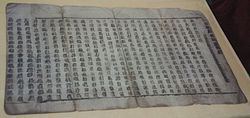 Printed text using pottery (argile) movable type from Western Xia around the mid-12th century. Found in Xinhua Xiang (新华乡); Wuwei City, Gansu province.
 -
 The Golden Light Sutra written in the Tangut script


.jpg)


See also
[edit]

References
[edit]Citations
[edit]- ^ Turchin, Peter; Adams, Jonathan M.; Hall, Thomas D. (December 2006). "East-West Orientation of Historical Empires". Journal of World-Systems Research. 12 (2): 222. ISSN 1076-156X. Retrieved 16 September 2016.
- ^ Kuhn, Dieter (15 October 2011). The Age of Confucian Rule: The Song Transformation of China. Harvard University Press. p. 50. ISBN 9780674062023.
- ^ Bowman, Rocco (2014). "Bounded Empires: Ecological and Geographic Implications in Sino-Tangut Relations, 960-1127" (PDF). The Undergraduate Historical Journal at UC Merced. 2: 11. doi:10.5070/H321025689.
- ^ McGrath, Michael C. Frustrated Empires: The Song-Tangut Xia War of 1038-44. In Wyatt. p. 153.
- ^ Chinaknowledge.de Chinese History - Western Xia Empire Economy. 2000 ff. © Ulrich Theobald. Retrieved: 13 July 2017.
- ^ a b c Stein (1972), pp. 70–71.
- ^ Wang, Tianshun [王天顺] (1993). Xixia Zhan Shi [The Battle History of Western Xia] 《西夏战史》. Yinchuan [银川], Ningxia ren min chu ban she [Ningxia People's Press] 宁夏人民出版社.
- ^ Bian, Ren [边人] (2005). Xixia: xiaoshi zai lishi jiyi zhong de guodu [Western Xia: the kingdom lost in historical memories] 《西夏: 消逝在历史记忆中的国度》. Beijing [北京], Waiwen Chubanshe [Foreign Languages Press] 外文出版社.
- ^ Li, Fanwen [李范文] (2005). Xixia tong shi [Comprehensive History of Western Xia] 西夏通史. Beijing [北京] and Yinchuan [银川], Ren min chu ban she [People's Press] 人民出版社; Ningxia ren min chu ban she [Ningxia People's Press] 宁夏人民出版社.
- ^ Zhao, Yanlong [赵彦龙] (2005). "Qian tan xi xia gong wen wen feng yu gong wen zai ti [A brief discussion on the writing style in official documents and documental carrier] 浅谈西夏公文文风与公文载体." Xibei min zu yan jiu [Northwest Nationalities Research] 西北民族研究 45(2): 78-84.
- ^ Qin, Wenzhong [秦文忠], Zhou Haitao [周海涛] and Qin Ling [秦岭] (1998). "Xixia jun shi ti yu yu ke xue ji shu [The military sports, science and technology of West Xia] 西夏军事体育与科学技术." Ningxia Daxue Xuebao [Journal of Ningxia University] 《宁夏大学学报》 79 (2): 48-50.
- ^ Kepping 1994, p. 364.
- ^ a b Kepping 1994, p. 373.
- ^ Dorje (1999), p. 444.
- ^ Kepping 1994, pp. 359–361.
- ^ a b Twitchett 1994, p. 156.
- ^ Waugh, Daniel C. "The Tanguts". depts.washington.edu. Retrieved 24 March 2023.
- ^ a b Wang 2013, p. 226-227.
- ^ Twitchett 1994, p. 157-159.
- ^ Twitchett 1994, p. 161.
- ^ Wang 2013, p. 277.
- ^ Wang 2013, p. 227-228.
- ^ Twitchett 1994, p. 162.
- ^ Twitchett 1994, p. 163.
- ^ Twitchett 1994, p. 164-165.
- ^ Twitchett 1994, p. 165-167.
- ^ Twitchett 1994, p. 170.
- ^ Mote 2003, p. 173.
- ^ Lorge 2015, p. 243-244.
- ^ McGrath 2008, p. 154.
- ^ Twitchett 1994, p. 182.
- ^ a b Twitchett 1994, p. 186.
- ^ Smith 2015, p. 73.
- ^ Twitchett 1994, p. 181.
- ^ McGrath 2008, p. 156.
- ^ Smith 2015, p. 76.
- ^ Smith 2015, p. 77.
- ^ Smith 2015, p. 78.
- ^ Smith 2015, p. 86.
- ^ Smith 2015, p. 79.
- ^ Twitchett 2009, p. 314.
- ^ Smith 2015, p. 80.
- ^ a b Smith 2015, p. 91.
- ^ McGrath 2008, p. 168.
- ^ Twitchett 1994, p. 122.
- ^ Mote 2003, p. 185.
- ^ a b Smith 2015, p. 126.
- ^ Twitchett 1994, p. 190.
- ^ Twitchett 1994, p. 191.
- ^ Dunnell 1996, p. 52.
- ^ Dunnell 1996, p. 52-55.
- ^ Dunnell 1996, p. 55-58.
- ^ a b c Twitchett 1994, p. 192.
- ^ a b c Dunnell 1996, p. 59.
- ^ a b Mote 2003, pp. 187–188.
- ^ Forage 1991.
- ^ Twitchett 2009, p. 343-344.
- ^ Twitchett 2009, p. 469.
- ^ Dunnell 1996, p. 60.
- ^ Twitchett 2009, p. 46-470.
- ^ Twitchett 1994, p. 193.
- ^ a b c d Forage 1991, p. 9.
- ^ Nie 2015, p. 374.
- ^ a b c Forage 1991, p. 10.
- ^ Forage 1991, p. 15.
- ^ a b c Forage 1991, p. 16.
- ^ Nie 2015, p. 376.
- ^ Forage 1991, p. 17.
- ^ a b c d Forage 1991, p. 18.
- ^ a b Twitchett 1994, p. 194.
- ^ Twitchett 2009, p. 548-551.
- ^ Twitchett 2009, p. 619-620.
- ^ Twitchett 2009, p. 620-621.
- ^ Twitchett 1994, p. 149-151.
- ^ Twitchett 1994, p. 197-198.
- ^ a b c d Twitchett 1994, p. 199.
- ^ Twitchett 1994, p. 200.
- ^ Twitchett 1994, p. 204-205.
- ^ Twitchett 1994, p. 200-201.
- ^ Twitchett 1994, p. 201.
- ^ Twitchett 1994, p. 201-202.
- ^ Twitchett 1994, p. 204.
- ^ a b Twitchett 1994, p. 205.
- ^ Twitchett 1994, p. 205-7.
- ^ a b May, Timothy (2012). The Mongol Conquests in World History. London: Reaktion Books. p. 1211. ISBN 9781861899712.
- ^ J. Bor Mongol hiigeed Eurasiin diplomat shashtir, vol.II, p.204
- ^ a b Twitchett 1994, p. 207.
- ^ Rossabi, William (2009). Genghis Khan and the Mongol empire. Seattle: University of Washington Press. p. 156. ISBN 978-9622178359.
- ^ Jack Weatherford Genghis Khan and the Making of the Modern World, p.85
- ^ Man 2004, p. 133.
- ^ Kessler, Adam T. (2012). Song Blue and White Porcelain on the Silk Road. Leiden: Brill Publishers. p. 91. ISBN 9789004218598.
- ^ a b Twitchett 1994, p. 208.
- ^ a b Twitchett 1994, p. 210.
- ^ Emmons, James B. (2012). "Genghis Khan". In Li, Xiaobing (ed.). China at War: An Encyclopedia. Santa Barbara, California: ABC-CLIO. p. 139. ISBN 9781598844153.
- ^ Twitchett 1994, p. 211.
- ^ Mote 2003, pp. 255–256.
- ^ Man 2004, pp. 212–213.
- ^ Man 2004, p. 212.
- ^ Man 2004, p. 213.
- ^ Man 2004, p. 214; de Hartog 2004, p. 134.
- ^ a b Man 2004, p. 214.
- ^ Tucker, Spencer C., ed. (2010). A Global Chronology of Conflict: From the Ancient World to the Modern Middle East: From the Ancient World to the Modern Middle East. Santa Barbara, California: ABC-CLIO. p. 276. ISBN 978-1851096725.
- ^ de Hartog 2004, p. 135.
- ^ Man 2004, p. 219.
- ^ Man 2004; de Hartog 2004, p. 137.
- ^ Lange, Brenda (2003). Genghis Khan. New York City: Infobase Publishing. p. 71. ISBN 9780791072226.
- ^ Man 2004, p. 238.
- ^ de Hartog 2004, p. 137.
- ^ Sinor, D.; Shimin, Geng; Kychanov, Y. I. (1998). "The Uighurs, the Kyrgyz and the Tangut (Eighth to the Thirteenth Century)". In Asimov, M. S.; Bosworth, C. E. (eds.). History of Civilizations of Central Asia. Vol. 4: Age of Achievement: A.D. 750 to the End of the Fifteenth Century. Paris: UNESCO. p. 214. ISBN 9231034677.
- ^ Ebrey, Patricia Buckley (2012). East Asia: A Cultural, Social, and Political History (3rd ed.). Stamford, Connecticut: Cengage Learning. p. 199. ISBN 9781133606475.
- ^ de Hartog 2004, p. 137; Mote 2003, p. 256.
- ^ Boland-Crewe, Tara; Lea, David, eds. (2002). The Territories of the People's Republic of China. London: Europa Publications. p. 215. ISBN 9780203403112.
- ^ Man 2004, p. 116–117.
- ^ Franke, Herbert and Twitchett, Denis, ed. (1995). The Cambridge History of China: Vol. VI: Alien Regimes & Border States, 907–1368. Cambridge: Cambridge University Press. pg. 214.
- ^ Mote 2003, p. 256.
- ^ Mote 2003, pp. 256–257.
- ^ Forage 1991, p. 11.
- ^ Andrade 2016, pp. 53–54.
- ^ Leffman, et al. (2005), p. 988.
- ^ Beaudouin, Mathieu (2023). "Tangut and Horpa languages: some shared morphosyntactic features". Language and Linguistics. 24 (4). doi:10.1075/LALI.00142.BEA.
- ^ Yang, Shao-yun (2014). "Fan and Han: The Origins and Uses of a Conceptual Dichotomy in Mid-Imperial China, ca. 500-1200". In Fiaschetti, Francesca; Schneider, Julia (eds.). Political Strategies of Identity Building in Non-Han Empires in China. Wiesbaden: Harrassowitz Verlag. p. 24.
- ^ a b Denis C. Twitchett; Herbert Franke; John King Fairbank (1994). The Cambridge History of China: Volume 6, Alien Regimes and Border States, 907-1368. Cambridge University Press. pp. 154–155. ISBN 978-0-521-24331-5.
- ^ Tsien 1985, p. 169.
- ^ Qi 2015, p. 214.
- ^ Qi 2015, p. 212-214.
- ^ Hou Jianmei (侯健美); Tong Shuquan (童曙泉) (20 December 2004). "《大夏寻踪》今展国博" ['In the Footsteps of the Great Xia' now exhibiting at the National Museum]. Beijing Daily.
- ^ McDermott 2015, p. 17.
- ^ Denis C. Twitchett; Herbert Franke; John King Fairbank (1994). The Cambridge History of China: Volume 6, Alien Regimes and Border States, 907-1368. Cambridge University Press. pp. 181–182. ISBN 978-0-521-24331-5.
- ^ Atwood, Christopher Pratt (2004). Encyclopedia of Mongolia and the Mongol Empire. Facts On File. p. 590. ISBN 978-0-8160-4671-3.
- ^ Michal Biran (15 September 2005). The Empire of the Qara Khitai in Eurasian History: Between China and the Islamic World. Cambridge University Press. pp. 164–. ISBN 978-0-521-84226-6.
- ^ Dunnell, Ruth W. (1983). Tanguts and the Tangut State of Ta Hsia. Princeton University., page 228
- ^ 洪, 皓. 松漠紀聞.
- ^ Dunnell 1996, p. 61.
- ^ Dillon, Michael, ed. (1998). China: A Cultural and Historical Dictionary. London: Curzon Press. p. 351. ISBN 0-7007-0439-6.
- ^ Rossabi, Morris (2014). A History of China. Wiley-Blackwell. p. 195. ISBN 978-1-57718-113-2.
- ^ Royal Asiatic Society of Great Britain and Ireland (1883). Journal of the Royal Asiatic Society of Great Britain & Ireland. Cambridge University Press for the Royal Asiatic Society. pp. 463–.
- ^ Journal of the Royal Asiatic Society of Great Britain and Ireland. 1883. pp. 463–.
- ^ Karl-Heinz Golzio (1984). Kings, khans, and other rulers of early Central Asia: chronological tables. In Kommission bei E.J. Brill. p. 68. ISBN 9783923956111.
- ^ Denis C. Twitchett; Herbert Franke; John King Fairbank (1994). The Cambridge History of China: Volume 6, Alien Regimes and Border States, 907-1368. Cambridge University Press. pp. 818–. ISBN 978-0-521-24331-5.
- ^ Denis C. Twitchett; Herbert Franke; John King Fairbank (1994). The Cambridge History of China: Volume 6, Alien Regimes and Border States, 907-1368. Cambridge University Press. pp. xxiii–. ISBN 978-0-521-24331-5.
- ^ Chris Peers (31 March 2015). Genghis Khan and the Mongol War Machine. Pen and Sword. pp. 149–. ISBN 978-1-4738-5382-9.
- ^ Mongolia Society (2002). Occasional papers. Mongolia Society. pp. 25–26.
- ^ Luc Kwanten (1 January 1979). Imperial Nomads: A History of Central Asia, 500-1500. University of Pennsylvania Press. p. 123. ISBN 978-0-8122-7750-0.
Sources
[edit]- Andrade, Tonio (2016), The Gunpowder Age: China, Military Innovation, and the Rise of the West in World History, Princeton University Press, ISBN 978-0-691-13597-7.
- Asimov, M. S. (1998), History of civilizations of Central Asia Volume IV The age of achievement: A.D. 750 to the end of the fifteenth century Part One The historical, social and economic setting, UNESCO Publishing
- Barfield, Thomas (1989), The Perilous Frontier: Nomadic Empires and China, Basil Blackwell
- Barrett, Timothy Hugh (2008), The Woman Who Discovered Printing, Great Britain: Yale University Press, ISBN 978-0-300-12728-7 (alk. paper)
- Beckwith, Christopher I (1987), The Tibetan Empire in Central Asia: A History of the Struggle for Great Power among Tibetans, Turks, Arabs, and Chinese during the Early Middle Ages, Princeton University Press
- Bregel, Yuri (2003), An Historical Atlas of Central Asia, Brill
- Dorje, Gyurme (1999), Footprint Tibet Handbook with Bhutan, Footprint Handbooks
- Drompp, Michael Robert (2005), Tang China And The Collapse Of The Uighur Empire: A Documentary History, Brill
- Dunnell, Ruth W. (1996), The Great State of White and High: Buddhism and State Formation in Eleventh-Century Xia, University of Hawai‘i Press
- Ebrey, Patricia Buckley (1999), The Cambridge Illustrated History of China, Cambridge, England: Cambridge University Press, ISBN 0-521-66991-X (paperback).
- Ebrey, Patricia Buckley; Walthall, Anne; Palais, James B. (2006), East Asia: A Cultural, Social, and Political History, Boston, MA: Houghton Mifflin, ISBN 0-618-13384-4
- Ferenczy, Mary (1984), The Formation of Tangut Statehood as Seen by Chinese Historiographers, Akadémiai Kiadó, Budapest
- Forage, Paul C. (1991), "The Sino-Tangut War of 1081-1085", Journal of Asian History, 25 (1): 1–28, JSTOR 41930788
- Golden, Peter B. (1992), An Introduction to the History of the Turkic Peoples: Ethnogenesis and State-Formation in Medieval and Early Modern Eurasia and the Middle East, OTTO HARRASSOWITZ · WIESBADEN
- Graff, David A. (2002), Medieval Chinese Warfare, 300-900, Warfare and History, London: Routledge, ISBN 0415239559
- Graff, David Andrew (2016), The Eurasian Way of War Military Practice in Seventh-Century China and Byzantium, Routledge, ISBN 978-0-415-46034-7.
- Guy, R. Kent (2010), Qing Governors and Their Provinces: The Evolution of Territorial Administration in China, 1644-1796, Seattle, WA: University of Washington Press, ISBN 9780295990187
- de Hartog, Leo (2004), Genghis Khan: Conqueror of the World, New York, NY: I.B. Tauris, ISBN 1860649726
- Haywood, John (1998), Historical Atlas of the Medieval World, AD 600-1492, Barnes & Noble
- Kepping, Ksenia Borisovna (1994), The Name of the Tangut Empire
- Kwanten, Luc (1974), Chingis Kan's Conquest of Tibet, Myth or Reality, Journal of Asian History
- Latourette, Kenneth Scott (1964), The Chinese, their history and culture, Volumes 1-2, Macmillan
- Leffman, David (2005), The Rough Guide to China, Rough Guides
- Lorge, Peter A. (2008), The Asian Military Revolution: from Gunpowder to the Bomb, Cambridge University Press, ISBN 978-0-521-60954-8
- Lorge, Peter (2015), The Reunification of China: Peace through War under the Song Dynasty, Cambridge University Press
- Mackintosh-Smith, Tim (2014), Two Arabic Travel Books, Library of Arabic Literature
- McDermott, Joseph P. (2006), A Social History of the Chinese Book
- Man, John (2004), Genghis Khan: Life, Death, and Resurrection, New York, NY: St. Martin's Press, ISBN 9780312366247
- McGrath, Michael C. (2008), Frustrated Empires: The Song-Tangut Xia War of 1038-1044
- Millward, James (2009), Eurasian Crossroads: A History of Xinjiang, Columbia University Press
- Mote, F. W. (2003), Imperial China: 900–1800, Harvard University Press, ISBN 978-0674012127
- Needham, Joseph (1986), Science & Civilisation in China, vol. 7: The Gunpowder Epic, Cambridge University Press, ISBN 0-521-30358-3
- Nie, Lina (January 2015), "A Grand Strategy or a Military Operation? A Reconsideration of the Liangzhou Campaign of 1081", Journal of Song-Yuan Studies, 45 (1): 371–385, doi:10.1353/sys.2015.0010
- Perry, John C.; L. Smith, Bardwell (1976), Essays on T'ang Society: The Interplay of Social, Political and Economic Forces, Leiden, The Netherlands: E. J. Brill, ISBN 90-04-047611
- Qi, Han (2015), Lecture 2 Printing, Springer
- Rong, Xinjiang (2013), Eighteen Lectures on Dunhuang, Brill
- Shaban, M. A. (1979), The ʿAbbāsid Revolution, Cambridge, England: Cambridge University Press, ISBN 0-521-29534-3
- Sima, Guang (2015), Bóyángbǎn Zīzhìtōngjiàn 54 huánghòu shīzōng 柏楊版資治通鑑54皇后失蹤, Yuǎnliú chūbǎnshìyè gǔfèn yǒuxiàn gōngsī, ISBN 978-957-32-0876-1
- Skaff, Jonathan Karam (2012), Sui-Tang China and Its Turko-Mongol Neighbors: Culture, Power, and Connections, 580-800 (Oxford Studies in Early Empires), Oxford University Press
- Smith, Paul Jakov (2015), A Crisis in the Literati State
- Stein, R. A. (1972), "Tibetan Civilization", The Geographical Journal, 138 (4), London and Stanford University Press: 501, Bibcode:1972GeogJ.138..501W, doi:10.2307/1795516, JSTOR 1795516
- Twitchett, D. (1979), Cambridge History of China, Sui and T'ang China 589-906, Part I, vol. 3, Cambridge University Press, ISBN 0-521-21446-7
- Tsien, Tsuen-hsuin (1985), Science and Civilization in China 5
- Twitchett, Denis (1994), "The Liao", The Cambridge History of China, vol. 6: Alien Regime and Border States, 907–1368, Cambridge, England: Cambridge University Press, pp. 43–153, ISBN 0521243319
- Twitchett, Denis (2009), The Cambridge History of China, vol. 5: The Sung dynasty and its Predecessors, 907–1279, Cambridge University Press
- Wang, Zhenping (2013), Tang China in Multi-Polar Asia: A History of Diplomacy and War, University of Hawaii Press
- Wilkinson, Endymion (2015). Chinese History: A New Manual, 4th edition. Cambridge, MA: Harvard University Asia Center distributed by Harvard University Press. ISBN 9780674088467.
- Xiong, Victor Cunrui (2000), Sui-Tang Chang'an: A Study in the Urban History of Late Medieval China (Michigan Monographs in Chinese Studies), U OF M CENTER FOR CHINESE STUDIES, ISBN 0892641371
- Xiong, Victor Cunrui (2009), Historical Dictionary of Medieval China, United States of America: Scarecrow Press, Inc., ISBN 978-0810860537
- Xu, Elina-Qian (2005), HISTORICAL DEVELOPMENT OF THE PRE-DYNASTIC KHITAN, Institute for Asian and African Studies 7
- Xue, Zongzheng (1992), Turkic peoples, 中国社会科学出版社
- Yuan, Shu (2001), Bóyáng bǎn Tōngjiàn Jìshìběnmò 28 dìèrcìhuànguánshídài 柏楊版通鑑記事本末28第二次宦官時代, Yuǎnliú chūbǎnshìyè gǔfèn yǒuxiàn gōngsī, ISBN 957-32-4273-7
External links
[edit]
- 宁夏新闻网 (Ningxia News Web): 西夏研究 (Xixia Research).
- 宁夏新闻网 (Ningxia News Web): 文化频道 (Cultural Channel).
Western Xia
View on GrokipediaNomenclature and Identity
Etymology and Terminology
The term "Western Xia" (Chinese: 西夏, Xīxià) was coined in Song dynasty (960–1279) historiography to denote the Tangut-led empire's position west of Song territories, thereby differentiating it from the ancient Xia (c. 2070–1600 BCE) dynasty of legendary Chinese tradition.[4] This exonym reflects the geopolitical perspective of Chinese chroniclers, who viewed the state as a peripheral power.[6] The empire's rulers proclaimed its official title as Great Xia (大夏, Dà Xià) upon formal independence in 1038 under Li Yuanhao (Emperor Jingzong, r. 1038–1048), invoking the prestige of the archaic Xia to legitimize their sovereignty and cultural claims.[6] In the Tangut language, the state's name was rendered in native script as a compound approximately reconstructed as "Great White-and-Lofty Xia Kingdom" (based on phonetic readings like /*phiow-bjij-lhjij-lhjij/), symbolizing the elevated terrain of the Helan Mountains and the purity of their realm.[7] The ruling ethnicity is designated "Tangut" in modern English scholarship, a term tracing to Mongolian "Tangud" (used after the 1227 Mongol conquest) and earlier attested in 8th-century Old Turkic Orkhon inscriptions referring to highland tribes west of the Orkhon Valley.[8] The Tanguts' endonym was "Mïňak" or "Mi-nyak," a designation shared in Tibetan sources for the northwestern highlanders, emphasizing their distinct Sino-Tibetan linguistic and cultural identity separate from Han Chinese or Turkic neighbors.[9] Chinese sources rendered this as Dangxiang (黨項), denoting tribal confederations active since the Tang era (618–907).[10] Terminology in primary sources often conflates the people, language, and state, with "Xia" serving as a Sinicized shorthand post-1038, while Tangut inscriptions in their vertical script—developed circa 1036 with over 6,000 characters—preserved native formulations for imperial edicts, Buddhist texts, and coinage.[11]Ethnic Origins and Distinctiveness
The Tangut people, founders of the Western Xia dynasty, belonged to the Qiangic subgroup of the Tibeto-Burman language family and were ethnically related to the Tibetans as part of the broader Qiang ethnic confederation.[6] They originated as pastoral nomads in the Amdo region of modern Qinghai, descending from the Dangxiang (Tangut) tribes, historically linked to the Western Qiang and possibly the Tuoba Chidi subgroup of the Xianbei.[6] By the 7th century, Tangut leaders had integrated into Tang dynasty administration, receiving the imperial surname Li and military titles, but retained tribal autonomy amid migrations eastward into Gansu and northern Sichuan following the 609 destruction of the Tuyuhun federation by Tibetan forces.[6] Linguistically, Tangut was distinct from Sinitic languages, exhibiting Qiangic phonological traits such as "brightening" (Proto-Tibeto-Burman *-a reflexes shifting to -i in over 37 shared etyma like those for "axe" and "child") and complex verbal morphology, with no direct modern descendants.[12] The empire's rulers commissioned a unique logographic script around 1036 under Yeli Renrong, comprising over 6,000 characters, used for extensive Buddhist and secular literature that preserved Tangut identity separate from Chinese literary traditions.[12] [6] Culturally, the Tanguts emphasized distinctiveness through customs like short or shaved hairstyles and traditional attire, contrasting Han Chinese norms of long, knotted hair, and rejected full sinicization by maintaining tribal hierarchies and pastoral economies alongside agriculture.[6] Emperor Li Yuanhao (r. 1038–1048) reinforced this by mandating Tangut script, surnames, and dress in official use, prohibiting Chinese styles to assert independence from Song suzerainty, though selective adoption of Chinese bureaucracy occurred without erasing core ethnic markers.[6] This hybrid yet predominantly Tangut orientation persisted, as evidenced by the dynasty's self-designation as the "Great White and Lofty State" rather than adopting Chinese imperial nomenclature exclusively.[6]Geography and Administration
Territorial Extent and Borders
The Western Xia empire controlled a vast arid expanse in northwestern China, centered on the fertile Hetao Plain along the Yellow River's northern loop and extending through the Hexi Corridor. Its territory primarily included modern Ningxia Hui Autonomous Region, eastern Gansu Province, northern Shaanxi Province, and western Inner Mongolia Autonomous Region, with key geographical features such as the Helan Mountains to the west, the Qilian Mountains to the southwest, and the Tengger Desert to the north.[7] This positioning facilitated control over oases and river valleys critical for agriculture and trade routes linking China to Central Asia.[13] Southern borders adjoined the Song Dynasty, running irregularly along the Loess Plateau and fortified lines in Shaanxi and Gansu, subject to frequent incursions and shifts due to military campaigns, such as Tangut advances in 1041–1044 and Song counteroffensives.[14] To the east, boundaries with the Liao Dynasty followed the Yellow River's bend near the Ordos region, marked by alliances and conflicts that evolved into tribute relations until the Liao's fall in 1125.[7] Western frontiers bordered Tibetan tribes and Uyghur principalities beyond the Hexi Corridor, while northern limits abutted Mongol nomadic groups across the Gobi steppe, reinforced by structures like the Gobi Wall circa 1142.[13] At its zenith around 1100–1150 under emperors like Huizong, Western Xia's domain expanded to incorporate additional oases in the Alashan area and pushed southern claims into Song-held Sichuan fringes, though these gains proved transient amid internal revolts and external pressures from the rising Jin Dynasty, which supplanted Liao and inherited eastern borders.[7] By the late 12th century, territorial integrity eroded through Mongol raids starting in 1205, culminating in the empire's collapse by 1227.[6]Administrative Divisions and Governance
The administrative framework of Western Xia integrated Tangut tribal hierarchies with Song dynasty bureaucratic models, prioritizing military control alongside civil functions to sustain imperial authority amid nomadic and sedentary populations. In 1033, Emperor Jingzong (r. 1032–1048) reformed the central government by adopting Song institutions, including the Secretariat (Zhongshu sheng) for policy deliberation, the Bureau of Military Affairs (Shumiyuan) for command over armed forces, the State Financial Commission (Sansi) for revenue and expenditure oversight, and the Censorate (Yushitai) for auditing officials and impeaching corruption.[15] These organs formed a tripartite executive structure akin to Song precedents, though adapted to restrict high military commands to Tangut elites, ensuring clan loyalty while permitting Chinese scholars in civil roles to leverage administrative expertise.[15] Territorially, the empire was organized into ten provinces (dao), each governed by a military prefect (tuiguan) who wielded dual civil-military authority, a system reflecting the Tanguts' steppe heritage where defense dictated resource allocation.[15] Provinces subdivided into approximately 70 prefectures (zhou or jun) and over 200 counties (xian), with local magistrates handling taxation via agricultural levies and corvée labor, conscription for peasant infantry (who supplied their own gear), and enforcement of edicts from the capital at Yinchuan.[15] This hierarchy maintained central oversight through rotating appointments and imperial inspectors, countering tribal fragmentation by binding peripheral chieftains to bureaucratic oaths. Legal governance evolved under Emperor Renzong (r. 1139–1193), who promulgated the Tiansheng lüling (Heavenly Prosperity Code Order) around 1149, a comprehensive statute blending Song penal codes with Tangut customary law on inheritance and pastoral disputes to unify adjudication and deter rebellion.[15] Fiscal policies emphasized self-sufficiency, funding elite cavalry units provisioned by the throne with horses and camels, while broader administration tolerated hybrid ethnic staffing to harness Chinese literacy for record-keeping in Tangut script, fostering resilience against Song and Liao pressures until Mongol incursions eroded cohesion.[15]Origins and Establishment
Tangut Ancestors and Early Migrations
The Tangut people, known in Chinese sources as the Dangxiang (黨項), were a Qiangic branch of the Tibeto-Burman linguistic and ethnic continuum, with ancestral ties to the Tibetan-related populations inhabiting the eastern fringes of the Tibetan Plateau. Their earliest recorded habitats encompassed the steppes, mountains, and highlands of southeastern Qinghai and northwestern Sichuan provinces, regions where pastoralism and semi-nomadic herding predominated amid interactions with neighboring Tuyuhun and Qiang groups.[16][10] Linguistic evidence from the Tangut language, classified as Qiangic within Tibeto-Burman, supports this plateau-adjacent origin, distinct from Han Chinese or Altaic affiliations despite later cultural admixtures.[17] The Dangxiang initially fell under Tuyuhun hegemony before submitting to the Tang dynasty (618–907 CE) following Emperor Taizong's campaigns in 635 CE, which incorporated them as border auxiliaries. However, the Tibetan Empire's aggressive expansions from the mid-7th century onward disrupted this equilibrium, triggering phased migrations eastward and northward. A pivotal displacement occurred in 663 CE, when Tibetan forces overran their Qinghai strongholds, compelling clans to relocate to Qingyang in eastern Gansu for refuge and grazing lands.[16] Subsequent Tibetan incursions, peaking in the 760s CE during the sack of Chang'an and control over the Gansu Corridor, accelerated further inland shifts, with Dangxiang groups penetrating the Ordos Loop and Hexi Corridor by the late 8th century.[18] These movements, driven by resource competition and military displacement rather than unified conquest, preserved the Dangxiang's tribal structure of approximately 36 clans, later grouped into eight major and seven minor confederations, including the prominent White (northern) and Black (southern) divisions. By the 9th century, amid Tang decline post-An Lushan Rebellion (755–763 CE), the migrants leveraged alliances with the Tang against Uighurs and Tibetans, securing fortified positions in present-day Ningxia and gaining de facto autonomy that presaged state formation.[10] Archaeological traces, such as Qiangic-influenced pottery and burial practices in Gansu sites, corroborate this trajectory of adaptive relocation without evidence of wholesale population replacement.[16]Formation of the State (990–1038)
The Tangut leader Li Jiqian initiated a sustained rebellion against the Song dynasty in 984, leveraging an alliance with the Liao empire to challenge Chinese suzerainty over the northwestern frontier.[6] By the 990s, his forces had captured key territories including the Ordos region, establishing a base for Tangut autonomy amid ongoing raids and battles that disrupted Song supply lines.[19] In 997, a temporary peace was negotiated with Song, granting Li Jiqian nominal titles, though hostilities resumed as he expanded control over Lingzhou, renaming it Xipingfu in 1002 and designating it the Tangut capital.[6] His death in battle against Tibetan forces in early 1004 marked the transition to his son Li Deming, but not before Li Jiqian had laid the groundwork for a confederated Tangut polity resistant to full Song assimilation.[6] Li Deming, assuming leadership in 1004, prioritized diplomatic stabilization and territorial expansion to consolidate Tangut power. He secured peace treaties with both Song and Liao, receiving Song investiture as a military commissioner and the honorary title of King of Great Xia, which acknowledged de facto independence while maintaining tributary relations.[6] Over the next two decades, Li Deming directed campaigns westward, subduing Tibetan tribes and conquering the Ganzhou Uyghur kingdom by 1028, thereby extending Tangut influence into the Hexi Corridor and securing vital trade routes along the Silk Road.[6] Administrative efforts under his rule included fortifying Xipingfu (modern Yinchuan) as a political center and fostering a mixed economy of pastoralism, agriculture, and commerce, which strengthened the emerging state's resilience against nomadic rivals.[20] By his death in 1032, the Tangut domains had evolved from fragmented tribal holdings into a cohesive entity capable of balancing relations with imperial neighbors.[6] Upon Li Deming's death in 1032, his son Li Yuanhao—born in 1003—ascended as ruler, initiating reforms to assert Tangut cultural and political distinctiveness. Li Yuanhao reorganized the military into a standing army of approximately 150,000 troops, emphasizing cavalry tactics suited to the steppe environment, and commissioned the creation of a Tangut script in 1034 to standardize administration and reduce reliance on Chinese literacy.[6] He promoted indigenous customs, including traditional dress and rituals, while integrating Buddhist elements to legitimize authority, drawing on the Tangut adoption of Mahayana traditions for state ideology.[21] Tensions escalated with Song over titles and tribute; Li Yuanhao rejected subordinate status and, after failed negotiations in 1036–1037, mobilized for independence. On November 11, 1038, he proclaimed the establishment of the Great Xia empire (later known as Western Xia to Song chroniclers), adopting the era name Guangyun and renaming the capital Xingqingfu, thereby formalizing the Tangut state as a sovereign entity rivaling Song and Liao.[6] This declaration, accompanied by military victories such as the defeat of Song forces at Sanchuankou earlier that year, signaled the culmination of nearly five decades of resistance and state-building.[6]Dynastic History
Founding and Early Emperors (1038–1068)
The Western Xia empire was formally established on November 11, 1038, when Tangut leader Li Yuanhao proclaimed himself emperor, adopting the regnal name Jingzong and the dynastic title of Great Xia, with its capital at Xingqing (modern Yinchuan in Ningxia).[6] This declaration followed his father's reign as Li Deming (r. 1004–1032), who had maintained nominal vassalage to the Song dynasty while expanding Tangut control over the northwestern frontier, including territories in Gansu and Shaanxi.[6] Yuanhao, having consolidated power since 1032, rejected Song suzerainty by creating a distinct Tangut script in 1036—derived from Chinese characters but adapted for the Tangut language—to promote cultural independence and administrative efficiency.[6] He also reformed military organization, establishing elite "iron-capped" cavalry units and a decimal-based ordnance system, while changing elite surnames to the ancient Tuoba clan's to evoke Xianbei heritage and legitimize rule.[6] Jingzong's early reign emphasized expansion and autonomy, including campaigns against Uyghur remnants in Gansu to secure Silk Road trade routes.[4] Relations with the Liao dynasty deteriorated as he broke prior alliances, asserting Tangut sovereignty.[6] Domestically, he enforced Tangut customs, prohibiting Han Chinese dress and language in officialdom to foster ethnic cohesion among the Tangut-Qiang population.[6] Conflict with the Song dynasty erupted immediately after the 1038 proclamation, with Jingzong launching invasions into Song-held territories in 1039–1040, capturing key forts like Tiancheng.[6] Song counteroffensives, including the 1040 Battle of Dingchuan and the 1042 Battle of Haoshuichuan—where Tangut forces inflicted heavy casualties on Song armies—culminated in Song's inability to decisively defeat the mobile Tangut cavalry.[6] Exhaustion on both sides led to the 1044 peace treaty, under which Song agreed to annual tribute of 200,000 taels of silver, 100,000 bolts of silk, 4,000 horses, and 20,000 cattle, while granting Jingzong the title King of Great Xia and recognizing mutual imperial legitimacy (with Song as "uncle" in diplomatic rhetoric).[6] This accord stabilized borders but highlighted Western Xia's strategic leverage through control of arid northwestern passes. Jingzong's rule ended violently in 1048 when his son Li Liangzuo, angered by a blinding punishment, assassinated him during a hunt.[6] Li Liangzuo, aged about one year at ascension, was enthroned as Emperor Yizong (r. 1048–1067), with his mother Liang serving as regent alongside court officials.[6] Yizong's minority triggered succession intrigues; powerful general Mozang Epang, Jingzong's nephew, seized regency and sought to install himself, but was defeated and executed in 1049 by forces loyal to Liang and minister Liang Yimai.[6] The regents reinstated strict Tangut cultural policies, purging pro-Song elements and reinforcing imperial authority.[6] Peace with Song held, enabling internal consolidation, though Liao incursions tested borders in the 1050s.[6] By 1067, as Yizong approached maturity, factional tensions over Sinicization versus Tangut traditions simmered, presaging his death in early 1068 and succession by Li Bingchang as Huizong.[6]Period of Expansion and Stability (1068–1139)
Emperor Huizong (Li Bingchang) ascended the throne in 1068 at a young age, inheriting a realm shaped by his father's military innovations but facing internal resistance from conservative Tangut nobles opposed to his favoritism toward Chinese administrative practices and advisors.[6] His reign periods included Qiandao (1068), Tianci lisheng guoqing (1069–1073), Da'an (1074–1084), and Tian'an liding (1085–1086), during which the empire maintained fragile peace with the Northern Song dynasty following the 1044 treaty, allowing recovery from prior exhaustive wars.[22] Border skirmishes persisted, but no major expansions occurred, as Huizong prioritized internal governance amid noble intrigues, including the influential Liang family.[6] Huizong's death in 1086 led to the accession of his nephew, Emperor Chongzong (Li Qianshun), whose 52-year reign (1087–1139) exemplified consolidation and relative stability through decisive centralization.[22] Chongzong systematically diminished the power of hereditary Tangut aristocrats, replacing noble dominance with a merit-based Confucian bureaucracy that included civil service examinations modeled on Chinese systems.[6] He established a National University to train officials, fostering administrative efficiency and cultural Sinicization while preserving Tangut identity via the empire's script and institutions.[6] These reforms stabilized governance, enabling economic growth through agricultural intensification in the Hexi Corridor and trade along Silk Road routes controlled by Western Xia.[1] Militarily, Chongzong's early rule saw opportunistic expansions westward against Tibetan principalities and Uyghur remnants, securing tribute and buffer zones beyond prior conquests under Li Deming.[7] Relations with the Liao Khitan involved alliances and conflicts, but defeats against Song incursions after 1114 prompted tactical shifts toward diplomacy, including tribute exchanges that preserved core territories.[6] By the 1120s, as Jurchen Jin rose against Liao, Western Xia maneuvered to exploit the power vacuum, gaining marginal lands from weakened Song positions along the Yellow River bend through indirect pressure rather than outright conquest.[20] Chongzong's era thus balanced assertive defense with pragmatic restraint, averting collapse and enabling a peak of territorial integrity spanning modern Ningxia, Gansu, and parts of Shaanxi, with a population estimated at several million supporting a standing army of up to 500,000.[1] This stability underpinned advancements in statecraft, though underlying ethnic tensions and nomadic heritage constrained full assimilation of Confucian ideals.[6]Later Reigns and Internal Strains (1139–1206)
Emperor Renzong (Li Renxiao) ascended the throne in 1140 following the death of his father, Emperor Chongzong, and ruled until 1193, marking one of the longest reigns in Western Xia history. Influenced by his Chinese mother, Empress Dowager Xingqing, he prioritized internal reforms to strengthen central authority, including the establishment of a National University and the introduction of state examinations modeled on Confucian bureaucracy.[6] These measures aimed to cultivate a merit-based administration, diminishing the hereditary power of the Tangut aristocracy and integrating Han Chinese scholarly traditions into governance. While enhancing administrative efficiency and fostering economic and cultural stability during a period of relative peace with the Jin and Southern Song dynasties, the reforms exacerbated tensions between the centralized bureaucracy and traditional noble elites, who resented the erosion of their privileges.[6][23] Renzong's long rule saw limited external conflicts, allowing focus on domestic consolidation, but underlying ethnic and class frictions persisted in the multi-ethnic empire, where Tangut rulers governed over Han Chinese, Tibetan, Uyghur, and Qiang populations. Succession proceeded smoothly to his son, Li Chunyou, who took the throne as Emperor Huanzong in 1193 at age 16. Huanzong's 13-year reign (1193–1206) faced mounting external threats from the rising Mongol leader Temüjin (later Genghis Khan), culminating in initial Mongol raids in 1205–1206 that razed border cities, captured livestock and populations, and exposed military vulnerabilities.[6] Internally, Huanzong's era intensified strains from natural disasters, such as famines and floods, which fueled peasant uprisings and aristocratic discontent. Powerful ministers like Ren Dejing exploited these crises to amass influence, leading to rebellions that challenged royal authority and highlighted divisions between the court bureaucracy and regional lords.[6] These power struggles weakened cohesion, as nobles maneuvered amid the young emperor's limited experience, setting the stage for a coup in 1206 by Li Anquan (later Emperor Xiangzong), who deposed Huanzong and assumed control, signaling the onset of dynastic instability.[6] The combination of reform-induced elite alienation under Renzong and crisis-driven factionalism under Huanzong undermined the empire's resilience against emerging nomadic threats.Final Decades and Collapse (1206–1227)
In 1206, Li Anquan, nephew of the previous emperor, orchestrated a coup against his cousin Emperor Huanzong and ascended the throne as Emperor Xiangzong (r. 1206–1210).[6] This internal upheaval occurred amid escalating Mongol raids; between 1205 and 1207, Genghis Khan's forces conducted punitive incursions into Western Xia territory, destroying settlements and seizing livestock and captives, which further eroded the empire's military and economic capacity.[6][24] The decisive Mongol offensive began in 1209, when Genghis Khan mobilized approximately 100,000 troops to subjugate Western Xia for its refusal to provide full tributary support during earlier campaigns. Western Xia armies suffered defeats in open field battles, including at key passes in the Helan Mountains, allowing Mongol forces to advance on the capital Zhongxing (modern Yinchuan).[24] The prolonged siege of Zhongxing from late 1209 into early 1210 involved Mongol engineers diverting irrigation canals to flood the city, exacerbating famine and disease among the defenders; Xiangzong surrendered in January 1210, pledging vassalage, annual tribute of 100,000 ounces of silver and silk, daughters for the Mongol court, and skilled artisans.[24] Xiangzong abdicated in 1210 and died in 1211, succeeded by his son Li Zunxu as Emperor Shenzong (r. 1211–1223), under whose rule Western Xia maintained nominal submission to the Mongols while grappling with succession disputes, famines, and failed attempts to forge alliances with the rival Jin dynasty.[6] Shenzong's death in 1223 led to the brief reign of Li Dewang as Emperor Xianzong (r. 1223–1226), followed by Li Xian (also known as Mozhu) as the final emperor in 1226.[6] Perceived disloyalty— including delayed tributes and covert aid to Jin—prompted Genghis Khan to launch a second campaign in 1225 upon returning from Central Asian conquests.[6][1] Mongol armies, led by Genghis and commanders like Tolui, traversed the arid Gobi and captured border fortresses in 1226, systematically razing cities such as Wuwei and Ganzhou.[24] By summer 1227, they besieged Zhongxing once more, again employing river diversions to flood defenses and block relief, while preventing Jin reinforcements through diversionary strikes.[24] Genghis Khan died on August 18, 1227, likely from injuries sustained in the campaign or a fall from his horse, but his orders for total annihilation stood; the starving Tangut forces capitulated in September, with Li Xian executed en route to the Mongol camp.[6][1] The ensuing Mongol purge decimated the Tangut population, enslaved survivors, and razed infrastructure, effectively erasing Western Xia as a polity by late 1227.[1]Military Organization and Conflicts
Structure of the Armed Forces
The Western Xia armed forces emphasized cavalry, drawing from the Tangut people's expertise in horsemanship and pastoral traditions.[10] Social organization was oriented toward maintaining cavalry units, with tribes contributing riders skilled in mounted archery and maneuvers suited to the arid northwestern terrain.[10] Standing armies formed a core but remained skeletal in peacetime, relying on rapid mobilization of tribal levies and peasant conscripts to achieve full strength.[25] Recruited peasants supplied their own weapons, armor, and provisions, while higher officers, predominantly ethnic Tanguts or other non-Han groups, personally provided horses and camels for campaigns.[15] Emperors commanded elite imperial guards and cavalry contingents directly, often leading troops in person and convening war councils where officers swore blood oaths of loyalty.[15] Two specialized elite units distinguished the forces: the Iron Hawks (tie yaozi), a heavy cavalry formation of approximately 3,000 riders equipped for shock charges, and the Trekker infantry (bubazi), light mountain troops adapted for rugged terrain but less effective in open plains.[26] These units enabled versatile operations against Song infantry phalanxes and Liao horsemen, though total mobilized strength varied, with Song records estimating up to 150,000 defenders during major sieges like that of Yinchuan in 1227.[27]Key Battles and Strategic Achievements
The founding emperor Jingzong (Li Yuanhao) secured Western Xia's independence through military victories against regional powers, including Tibetan (Tubo) and Uyghur tribes, prior to proclaiming the empire in 1038. These campaigns expanded Tangut control over the Hexi Corridor, vital for Silk Road trade, and demonstrated effective cavalry tactics adapted to arid terrain.[6] Against the Song dynasty, Yuanhao's forces achieved key successes in the 1040 invasion, defeating Song armies in initial clashes and inflicting heavy losses, such as at Haoshuichuan where Song commanders were killed. This pressured the Song into the 1044 Shanyuan-like treaty, securing annual tribute of 100,000 taels of silver and 200,000 bolts of silk, along with formal recognition of Xia's imperial title— a strategic diplomatic triumph affirming parity with the larger Song empire.[6][28] Western Xia also repelled Liao dynasty incursions, notably mauling invading forces that failed to capture the capital Xingqing despite initial advances, bolstering defenses through fortified cities and universal conscription of males aged 15–60 into a standing army emphasizing heavy cavalry.[6] Under later rulers like Huizong, offensives such as the 1082 siege of Yongle fortress with 300,000 troops highlighted sustained offensive capacity, extracting further concessions amid ongoing border raids.[6] Strategically, Western Xia's achievements included military reforms under Yuanhao, including creation of a native script for command documents to prevent espionage and organization into three elite divisions, enabling balance-of-power diplomacy: extracting tribute from Song while neutralizing Liao threats and later maneuvering between Jin and Mongols, preserving autonomy until the 1220s despite encirclement by superior foes.[6][10]Diplomatic and Tributary Relations with Neighbors
The Western Xia maintained a pragmatic foreign policy centered on balancing military pressure with negotiated settlements to secure borders and economic benefits amid rivalries with the Song, Liao, and later Jin dynasties. Early diplomacy with the Song under Li Deming (r. 1022–1032) involved mutual agreements, including Song conferral of titles such as military commissioner and King of Great Xia, which facilitated temporary peace but masked underlying tensions over territory in the northwest.[6] These relations deteriorated after Li Yuanhao's proclamation of the empire in 1038, sparking the Song-Xia wars (1040–1044), during which Western Xia forces inflicted heavy defeats on Song armies. The resulting Qingli Peace Treaty of 1044 ended hostilities, with the Song recognizing Li Yuanhao's royal title (while nominally styling him as a subordinate), ceding no territory but agreeing to annual payments to Western Xia of approximately 72,000 ounces of silver, 152,000 bolts of silk, and 20,000 jin of tea—framed as "gifts" but functioning as tribute to buy peace.[29] Subsequent renewals of this arrangement, such as under Emperor Huizong (r. 1068–1086), maintained the flow of Song stipends, though border skirmishes persisted until a more stable accord in 1091 under Li Qianshun (r. 1086–1139).[16] Relations with the Liao were initially cooperative, with Tangut leaders like Li Jiqian forging an alliance in 984 against Song incursions, receiving military aid and nominal vassal status in exchange for tributary presents of local goods such as salt, jade, and musk.[6] Li Deming continued these ties, but Li Yuanhao's assertion of imperial independence strained them, prompting a Liao invasion of Western Xia in 1044 with 100,000 troops, which ultimately failed to subdue the Tanguts.[6] Despite this, Western Xia preserved a tributary relationship with Liao, presenting goods during diplomatic missions to sustain trade in silk, porcelain, and medicines, while avoiding full subjugation; this nominal vassalage allowed Liao to extract symbolic deference without constant interference, though conflicts over grazing lands occasionally flared.[7] Following the Liao's collapse in 1125, Western Xia shifted allegiance to the rising Jin dynasty, with Emperor Chongzong submitting as a vassal in the early 1130s to avert invasion, including compliance with Jin demands such as the extradition of the fugitive Liao emperor Tianzuo in 1123.[6] This vassalage involved regular tributary offerings from Western Xia to Jin—primarily raw materials and livestock—to affirm subordination and enable frontier trade, though Jin extracted little direct tribute compared to its exactions from the Song.[30] Diplomatic overtures for joint action against the Song in the 1140s yielded limited alliances, but by the 1210s, Western Xia's appeals for Jin aid against Mongol incursions went unheeded, straining ties and leading to punitive raids on Jin borders in 1210; nonetheless, the tributary framework persisted until the Mongol conquest disrupted it entirely.[6]Economy and Society
Agricultural and Trade Foundations
The economy of Western Xia relied heavily on agriculture adapted to its arid, continental climate in the northwest, characterized by long winters and short growing seasons that limited crop maturation periods.[7] Irrigation systems, drawing from the Yellow River and extended canal networks inherited and expanded from prior dynasties, formed the backbone of farming, enabling cultivation in the Hexi Corridor and surrounding oases.[31][32] Millet served as the primary staple crop, supplemented by pastoralism involving sheep, goats, and camels, which integrated herding with sedentary farming among the Tangut population and Han settlers who introduced central Chinese techniques.[33] State-owned lands predominated, allocated to peasant households in exchange for grain taxes, with early leaders like Li Jiqian (d. 1004) initiating wasteland reclamation to bolster food production before the dynasty's formal establishment in 1038.[30][1] By the 11th century, systematic irrigation management, including canals and ditches, supported higher yields, though vulnerability to droughts and floods persisted due to the region's sparse rainfall.[32] Trade amplified agricultural output through the dynasty's strategic control of the Hexi Corridor, a vital Silk Road segment linking northern China to Central Asia, positioning Western Xia as intermediaries in exchanges of horses, salt, and metals for silk, tea, and grain from the Song dynasty.[34] Initially, the Song represented the primary partner via three border channels, but trade volume shifted toward the Jurchen Jin after 1127, involving regulated markets and occasional contraband flows despite prohibitions on strategic goods like iron.[1] Government monopolies on salt and enforced tariffs sustained revenues, with pastoral products like wool and hides exported westward, fostering economic resilience amid frequent warfare.[33][30]Social Hierarchy and Daily Life
Tangut society in the Western Xia empire was organized around an absolute monarchy, with power concentrated in the royal family and a bureaucratic aristocracy of large landowners and pasture-owners who controlled vast arable lands and grazing areas essential to the economy.[16] This elite class, often tribal patriarchs, formed the core of political and military authority, with social organization historically geared toward cavalry units where tribes were named after leading families.[10] Below them ranked soldiers, who held significant influence in the militarized state, followed by an emerging merchant class active in frontier trade.[16] The majority of the population consisted of peasants, herdsmen, and artisans engaged in sustaining the agrarian and pastoral economy, with land primarily owned by the state, emperor, aristocracy, officials, and religious institutions like Buddhist and Daoist monasteries rather than individual smallholders.[30] A lower stratum included semi-slaves (known as shi-jun) and quasi-slaves serving as domestic laborers with restricted rights, alongside fugitives, beggars, and vagabonds at the margins of society.[16] Ethnic diversity incorporated Han Chinese, Tibetans, and Uyghurs, but Tangut dominance prevailed, with non-Tangut groups often integrated into herding or administrative roles.[1] Daily life blended nomadic pastoralism in northern grasslands—raising sheep, goats, horses, oxen, and camels—with sedentary agriculture in southern oases, supported by extensive irrigation systems like the Liwang Canal near the capital Xingqing (modern Yinchuan).[30] Communities stored surplus grain in imperial granaries (yucang) and produced woolen goods, iron implements, and pottery, though the latter's quality lagged behind contemporary Song dynasty wares.[30] Wall paintings in cave sites illustrate routine activities such as farming, herding, and craftsmanship, reflecting a barter-dominant economy supplemented by cast coins and regulated markets (quechang and heshi) for exchanging salt, jade, wool, silk, and porcelain.[30] Military obligations permeated civilian life, as households contributed to cavalry levies, while Buddhist practices influenced communal rituals amid a landscape of fortified towns and monasteries.[16]Culture and Intellectual Life
Language, Script, and Literature
The Tangut language, the primary tongue of the Western Xia empire, belongs to the Qiangic branch of the Tibeto-Burman group within the Sino-Tibetan family.[35] It functioned as the official language and a lingua franca among diverse ethnic groups in the region, featuring complex morphosyntactic traits such as shared verbal structures with related languages like Horpa.[36] Phonologically, it distinguished three tonal grades and included uvular sounds, contributing to its distinct auditory profile.[35] The Tangut script, a logographic writing system, was promulgated in 1036 during the reign of Emperor Jingzong (Li Yuanhao), reportedly devised by the scholar Yeli Renrong to transcribe the Tangut language.[37] Comprising approximately 5,863 to 6,600 characters—excluding variants—this script drew structural influences from Chinese characters but adapted to Tangut phonetics and semantics, with characters often exhibiting rectangular forms and intricate compositions of multiple components rather than pictographic simplicity.[38] Unlike purely phonetic systems, it encoded both meanings and sounds, though only about 10% of characters incorporate explicit phonetic indicators.[39] Tangut literature centered on Buddhist texts, with extensive translations of sutras from Chinese, Tibetan, and Indic sources forming the bulk of preserved works, including certified editions of the Tripitaka as a state-sponsored project demonstrating imperial authority.[40] Surviving manuscripts, numbering around 10,000 volumes primarily from the 12th–13th centuries, encompass religious commentaries, legal codes, and administrative documents, unearthed notably from the ruins of Khara-Khoto.[41] Original compositions, such as colophons authenticating translations, highlight the role of Tangut scholars in adapting foreign canons to local contexts, though secular literature remains underrepresented relative to religious output.[42]Art, Architecture, and Material Culture
Western Xia architecture prominently featured imperial tombs and Buddhist structures blending Tangut traditions with Chinese and Tibetan influences. The Xixia Imperial Tombs near Yinchuan in Ningxia comprise nine mausoleums for seven emperors and two ancestors, alongside 271 subordinate tombs, a northern ritual complex, and 32 flood-control features including dikes and ditches spanning over 3 kilometers.[43] Constructed primarily from rammed earth and mud bricks, with stone and glazed terracotta accents, these tombs incorporate octagonal or circular stupas rising 5 to 7 storeys, sacrificial halls, que gates, and stele pavilions, often with burial chambers offset from the stupa axis to align with feng shui and animist practices.[43] Pagodas like the Hongfo Pagoda in the Hexi Corridor exemplify hybrid designs merging Chinese pagoda bases with Tibetan-style stupa superstructures, reflecting the dynasty's multicultural patronage of Buddhism from 1038 to 1227.[44] Artistic production emphasized Buddhist themes through murals, paintings, and sculptures, drawing on syncretic styles from Chinese Mahayana, Tibetan Tantric, and Indian Pāla traditions, while incorporating distinct Tangut iconography such as Saḍakṣarī Avalokiteśvara.[44] Murals from the early period (1038–1158) adorn sites like Mogao Cave 465 and Yulin Cave 3, depicting mandalas like Marici and integrating Tibetan esoteric elements with local motifs.[44] Over 300 paintings recovered from Khara Khoto, dating to the 12th–14th centuries, include thangkas and woodblock prints such as the Pancharaksha, showcasing wood-carved block printing techniques for protective texts.[44] Sculptures, often in metal or stone, feature Pāla-derived forms, as seen in a late 12th- to early 13th-century thangka of Vajravarahi in the Wuwei Xixia Museum and tomb murals of warriors on wood panels from Wuwei, Gansu.[44] Material culture artifacts reveal administrative, religious, and daily Tangut practices, with seals crafted in gold, silver, and copper inlaid with silver bearing inscriptions in Tangut script for official authentication.[16] Coins like the Tian Sheng Yuan Bao circulated as cast bronze currency, supporting trade along Silk Road routes.[45] Excavations from tombs yielded over 7,000 terracotta and stone ornaments, alongside ceramics exhibiting Xi Xia stylistic traits such as pastoral motifs, and utilitarian items like wooden stupas and clay tablets used in rituals.[43][46] These objects underscore a pastoral-nomadic heritage fused with sedentary Buddhist influences, evident in artifacts from sites like Khara Khoto and the Gobi Wall region.[44]Religious Syncretism and Practices
The Tangut Empire of Western Xia (1038–1227) primarily adhered to Mahayana Buddhism, which served as the state religion following its formal adoption by founding emperor Yuanhao (Li Yuanhao, r. 1032–1048) in 1038, integrating it into imperial ideology for political legitimation and state protection. This endorsement involved extensive patronage, including the construction of monasteries such as the Chengtian Monastery in Yinchuan and the Huguo Monastery in Wuwei, as well as the erection of pagodas and 108 Lamaist stupas at Qingtongxia. Buddhism drew from Sinitic, Indian, Tibetan, and Central Asian traditions, fostering a multi-ethnic sangha comprising Tangut, Uighur, Tibetan, and Chinese monks, with compulsory study of Tibetan language among clergy to facilitate esoteric practices.[47][48][44] Syncretism manifested in the fusion of Buddhism with indigenous Tangut animistic beliefs, which emphasized spirits, shamanistic intermediaries (known as siji or siye), and practices like cremation (huozang), remnants of pre-Buddhist natural religion. Emperors repurposed shamanic elements into Buddhist frameworks, such as apotropaic rituals invoking relics and deities like Uṣṇīṣavijayā for imperial safeguarding, while tantric cults (e.g., Hevajra and Cakrasaṃvara) blended Tibetan esoteric teachings with local customs. Confucianism played a subordinate role, primarily in administrative and legal spheres rather than doctrinal integration, with emperors like Huizong (Qianshun, r. 1086–1139) and Renzong (r. 1139–1193) promoting Confucian schools and examinations for governance, elevating Confucius to imperial status without merging it deeply with Buddhist cosmology. Taoism remained marginal (daojiao), appearing sporadically in elite contexts but overshadowed by Buddhist dominance.[48][44][41] Key practices included the translation and printing of Buddhist sutras into the Tangut script, culminating in the production of the Xi Xia or Hexi Buddhist Canon (approximately 3,620 rolls), with hundreds of thousands of copies disseminated under imperial decree to propagate teachings. Emperors hosted grand retreats, such as Renzong's 50th anniversary event in the mid-12th century, emphasizing both exoteric Mahayana doctrines and esoteric tantric initiations. Strict state regulations governed religious instruction, enforcing doctrinal purity while tolerating minor faiths like Nestorian Christianity and Islam among traders, though these lacked institutional support. Archaeological evidence from sites like Khara Khoto reveals artistic expressions of this syncretism, including murals depicting hybrid Sino-Tibetan iconography.[44][41][48]List of Rulers
The Western Xia dynasty was governed by a sequence of ten rulers who adopted imperial titles modeled on Chinese conventions, beginning with the proclamation of independence in 1038 and ending with the Mongol conquest in 1227.[22] Succession generally followed patrilineal lines within the Li clan, originally surnamed Tuoba or Weiming before adopting Li under Chinese influence, though periods of regency and internal strife marked several transitions.[22]| Temple Name | Personal Name | Reign Period |
|---|---|---|
| Jingzong | Li Yuanhao | 1038–1048 |
| Yizong | Li Liangzuo | 1048–1067 |
| Huizong | Li Bingchang | 1068–1086 |
| Chongzong | Li Qianshun | 1086–1139 |
| Renzong | Li Renxiao | 1139–1193 |
| Huanzong | Li Chunyou | 1193–1206 |
| Xiangzong | Li Anquan | 1206–1210 |
| Shenzong | Li Zunxu | 1211–1211 |
| Xianzong | Li Dewang | 1211–1223 |
| None (final ruler) | Li Xian | 1223–1227 |