
.jpg/250px-Three-masted_training_ship_MERSEY_viewed_on_the_bow_starboard_quarter,_1908-1915_(11785933603).jpg)


.jpg)
Community hub
Recent from talks
Contribute something
Nothing was collected or created yet.
Mast (sailing)
View on Wikipedia.jpg)
The mast of a sailing vessel is a tall spar, or arrangement of spars, erected vertically or near-vertically on the median line of a ship or boat. A mast may carry sails, spars, and derricks. It may also give necessary height to a navigation light, look-out position, signal yard, control position, radio aerial, or signal lamp.[1] Large ships have several masts, with the size and configuration depending on the style of ship. Nearly all sailing masts are guyed.[2]
Until the mid-19th century, all vessels' masts were made of wood, formed from one or several pieces of timber. This was typically the trunk of a single conifer tree; however, from the 16th century, vessels were often built too large for that. Larger vessels needed taller and thicker masts, which could not be made from single tree trunks. To achieve the required height, these masts were built from up to four sections (also called masts). From lowest to highest, these were called "lower", "top", "topgallant", and "royal" masts.[3] For the lower sections to be thick enough, they needed to be built up from multiple pieces of wood. Such a section was known as a made mast, while a section formed from a single piece of timber was known as a pole mast.
Those who specialised in making masts were known as mastmakers.
Nomenclature
[edit]
For square-sail carrying ships, masts in their standard names in bow to stern (front to back) order, are:
- Sprit topmast: a small mast set on the end of the bowsprit (discontinued after the early 18th century); not usually counted as a mast, however, when identifying a ship as "two-masted" or "three-masted"
- Fore-mast: the mast nearest the bow, or the mast forward of the main-mast.[3] As it is the furthest afore, it may be rigged to the bowsprit.
- Sections: fore-mast lower, fore topmast, fore topgallant mast
- Main-mast: the tallest mast, usually located near the center of the ship
- Sections: main-mast lower, main topmast, main topgallant mast, royal mast (if fitted)
- Mizzen-mast: the aft-most mast. Typically shorter than the fore-mast.
- Sections: mizzen-mast lower, mizzen topmast, mizzen topgallant mast[4]
Some names given to masts in ships carrying other types of rig (where the naming is less standardised) are:
- Bonaventure mizzen: the fourth mast on larger 16th-century galleons, typically lateen-rigged and shorter than the main mizzen.
- Jigger-mast: typically, where it is the shortest, the aftmost mast on vessels with more than three masts.
- Sections: jigger-mast lower, jigger topmast, jigger topgallant mast

When a vessel has two masts, as a general rule, the main mast is the one setting the largest sail. Therefore, in a brig, the forward mast is the foremast and the after mast is the mainmast. In a schooner with two masts, even if the masts are of the same height, the after one usually carries a larger sail (because a longer boom can be used), so the after mast is the mainmast. This contrasts with a ketch or a yawl, where the after mast, and its principal sail, is clearly the smaller of the two, so the terminology is (from forward) mainmast and mizzen. (In a yawl, the term "jigger" is occasionally used for the aftermast.)[5]
Some two-masted luggers have a fore-mast and a mizzen-mast – there is no main-mast. This is because these traditional types used to have three masts, but it was found convenient to dispense with the main-mast and carry larger sails on the remaining masts. This gave more working room, particularly on fishing vessels.[6]: 19
On square-rigged vessels, each mast carries several horizontal yards from which the individual sails are rigged.[7]
Folding mast ships use a tabernacle anchor point. Definitions include: "the partly open socket or double post on the deck, into which a mast is fixed, with a pivot near the top so that the mast can be lowered";[8] "large bracket attached firmly to the deck, to which the foot of the mast is fixed; it has two sides or cheeks and a bolt forming the pivot around which the mast is raised and lowered"; "substantial fitting for mounting the mast on deck, so that it can be lowered easily for trailering or for sailing under bridges",[9] "hinged device allowing for the easy folding of a mast 90 degrees from perpendicular, as for transporting the boat on a trailer, or passing under a bridge" [10]
History
[edit]
The oldest evidence for the use of masts comes from the Ubaid period site of H3 in Kuwait, dating to the second half of the sixth millennium BC. Here, a clay disc made from a sherd that appears to depict a reed bundle boat with two masts has been recovered.[11]
In the West, the concept of a ship carrying more than one mast, to give it more speed under sail and to improve its sailing qualities, evolved in northern Mediterranean waters: The earliest foremast has been identified on an Etruscan pyxis from Caere, Italy, dating to the mid-7th century BC: a warship with a furled mainsail is engaging an enemy vessel, deploying a foresail.[12] A two-masted merchant vessel with a sizable foresail rigged on a slightly inclined foremast is depicted in an Etruscan tomb painting from 475 to 450 BC.[13] An artemon (Greek for foresail) almost the same size as the galley's mainsail can be found on a Corinthian krater as early as the late 6th century BC; apart from that Greek longships are uniformly shown without it until the 4th century BC.[14] In the East, ancient Indian Kingdoms like the Kalinga from as early as 2nd century are believed to have commanded naval sail ships. One of the earliest documented evidence of Indian sail building comes from the mural of the three-masted ship in Ajanta caves that date back to 400–500 CE.[15][16]
The foremast became fairly common on Roman galleys, where, inclined at an angle of 45°, it was more akin to a bowsprit, and the foresail set on it, reduced in size, seems to be used rather as an aid to steering than for propulsion.[14][17] While most of the ancient evidence is iconographic, the existence of foremasts can also be deduced archaeologically from slots in foremast-feets located too close to the prow for a mainsail.[18]

Artemon, along with mainsail and topsail, developed into the standard rig of seagoing vessels in imperial times, complemented by a mizzen on the largest freighters.[19] The earliest recorded three-masters were the giant Syracusia, a prestige object commissioned by king Hiero II of Syracuse and devised by the polymath Archimedes around 240 BC, and other Syracusan merchant ships of the time.[20] The imperial grain freighters travelling the routes between Alexandria and Rome also included three-masted vessels.[20] A mosaic in Ostia (c. 200 AD) depicts a freighter with a three-masted rig entering Rome's harbour.[21] Special craft could carry many more masts: Theophrastus (Hist. Plant. 5.8.2) records how the Romans imported Corsican timber by way of a huge raft propelled by as many as fifty masts and sails.[22]

Throughout antiquity, both foresail and mizzen remained secondary in terms of canvas size, although large enough to require full running rigging.[19] In late antiquity, the foremast lost most of its tilt, standing nearly upright on some ships.[19]
By the onset of the Early Middle Ages, rigging had undergone a fundamental transformation in Mediterranean navigation: the lateen which had long evolved on smaller Greco-Roman craft replaced the square rig, the chief sail type of the ancients, that practically disappeared from the record until the 14th century (while it remained dominant in northern Europe).[23][24] The dromon, the lateen-rigged and oared bireme of the Byzantine navy, almost certainly had two masts, a larger foremast and one midships. Their length has been estimated at 12 m and 8 m respectively, somewhat smaller than the Sicilian war galleys of the time.[25]
Multiple-masted sailing ships were reintroduced into the Mediterranean Sea by the Late Middle Ages. Large vessels were coming more and more into use and the need for additional masts to control these ships adequately grew with the increase in tonnage. Unlike in antiquity, the mizzen-mast was adopted on medieval two-masters earlier than the foremast, a process which can be traced back by pictorial evidence from Venice and Barcelona to the mid-14th century. To balance out the sail plan the next obvious step was to add a mast fore of the main-mast, which first appears in a Catalan ink drawing from 1409. With the three-masted ship established, propelled by square rig and lateen, and guided by the pintle-and-gudgeon rudder, all advanced ship design technology necessary for the great transoceanic voyages was in place by the beginning of the 15th century.[26]
The first hollow mast was fitted on the American sloop Maria in 1845, 28 m (92 ft) long and built of staves bound with iron hoops like a barrel. Other hollow masts were made from two tapered timbers hollowed and glued together.[27] Nearly a century later, the simple box form of mast[clarification needed] was arrived at.[27]
Modern masts
[edit]

Although sailing ships were superseded by engine-powered ships in the 19th century, recreational sailing ships and yachts continue to be designed and constructed.
In the 1930s aluminum masts were introduced on large J-class yachts. An aluminum mast has considerable advantages over a wooden one: it is lighter and slimmer than a wooden one of the same strength, is impervious to rot, and can be produced as a single extruded length. During the 1960s wood was eclipsed by aluminum. Aluminum alloys, generally 6000 series, are commonly utilised.[28]
Recently some sailing yachts (particularly home-built yachts) have begun to use steel masts. Whilst somewhat heavier than aluminum, steel has its own set of advantages. It is significantly cheaper, and a steel mast of an equivalent strength can be smaller in diameter than an aluminum mast, allowing less turbulence and a better airflow onto the sail.[29][30]

From the mid-1990s racing yachts introduced the use of carbon fibre and other composite materials to construct masts with even better strength-to-weight ratios. Carbon fibre masts could also be constructed with more precisely engineered aerodynamic profiles.
Modern masts form the leading edge of a sail's airfoil and tend to have a teardrop-shaped cross-section. On smaller racing yachts and catamarans, the mast rotates to the optimum angle for the sail's airfoil. If the mast has a long, thin cross-section and makes up a significant area of the airfoil, it is called a wing-mast; boats using these have a smaller sail area to compensate for the larger mast area. There are many manufacturers of modern masts for sailing yachts of all sizes, a few notable companies are Hall Spars, Offshore Spars, and Southern Spars.
After the end of the age of sail, warships retained masts, initially as observation posts and to observe fall of shot, also holding fire control equipment such as rangefinders, and later as a mounting point for radar and telecommunication antennas, which need to be mounted high up to increase range. Simple pole, lattice, and tripod masts have been used—also, on some past Japanese warships, complex pagoda masts.
-
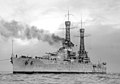 USS Nevada with lattice masts (photographed in 1926)
 -
 HMS Invincible with tripod masts (photographed in 1907)
 -
 SMS Scharnhorst with pole masts (photographed in 1907)
 -
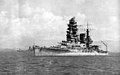 Nagato with pagoda mast (photographed in 1944)
 -
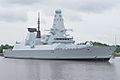 HMS Duncan with fully enclosed mainmast to reduce RCS (photographed in 2012)

_British_Battleship.jpg)


.jpg)
See also
[edit]References
[edit]- ^ Layton, Cyril Walter Thomas, Peter Clissold, and A. G. W. Miller. Dictionary of nautical words and terms. Brown, Son & Ferguson, 1973.
- ^ Harland, John. Seamanship in the Age of Sail, pp. 22–5, Naval Institute Press, Annapolis, Maryland, 1992. ISBN 0-87021-955-3.
- ^ a b Keegan, John (1989). The Price of Admiralty. New York: Viking. pp. 278&281. ISBN 0-670-81416-4.
- ^ Harland, John. Seamanship in the Age of Sail, pp. 15, 19–22, 36–37, Naval Institute Press, Annapolis, Maryland, 1992. ISBN 0-87021-955-3.
- ^ Bennett, Jenny (2005). Sailing Rigs, an Illustrated Guide. London: Chatham Publishing. ISBN 1-86176-243-7.
- ^ March, Edgar J. (1952). Sailing Drifters: The story of the herring lugger of England, Scotland and the Isle of Man (1969 reprint ed.). Newton Abbott: David and Charles (Publishers) Limited. ISBN 0-7153-4679-2.
{{cite book}}: ISBN / Date incompatibility (help) - ^ Harland, John. Seamanship in the Age of Sail, pp. 20–2, Naval Institute Press, Annapolis, Maryland, 1992. ISBN 0-87021-955-3.
- ^ New Oxford American Dictionary (American English) via Apple Dictionary
- ^ "Tabernacle". Sea Talk Nautical Dictionary. 26 September 2023. Archived from the original on April 22, 2007.
- ^ "Tabernacle". Your Dictionary.
- ^ Carter, Robert (2006-03-01). "Boat remains and maritime trade in the Persian Gulf during the sixth and fifth millennia BC". Antiquity. 80 (307): 52–63. doi:10.1017/S0003598X0009325X. ISSN 0003-598X.
- ^ Turfa, J. MacIntosh; Steinmayer, A. G. (1999): "The Earliest Foresail, on Another Etruscan Vase", The International Journal of Nautical Archaeology, Vol. 28, No. 3, pp. 292–296 (295)
- ^ Casson, Lionel (1963): "The Earliest Two-masted Ship", Archaeology, Vol. 16, No. 2, pp. 108–111 (111)
- ^ a b Casson, Lionel (1980): "Two-masted Greek ships", The International Journal of Nautical Archaeology, Vol. 9, No. 1, pp. 68–69 (69)
- ^ Pamulaparthy, Sweekar Bhushan. "Ancient Indian Ship". World History Encyclopedia. Retrieved 2022-12-05.
- ^ "Ajanta: Boat from right wall of Cave II". British Library. Retrieved 2022-12-05.
- ^ Casson, Lionel (1963): "The Earliest Two-masted Ship", Archaeology, Vol. 16, No. 2, pp. 108–111 (109)
- ^ Beltrame, Carlo (1996): "Archaeological Evidence of the Foremast on Ancient Sailing Ships", The International Journal of Nautical Archaeology, Vol. 25, No. 2, pp. 135–139 (135)
- ^ a b c Casson, Lionel (1995): "Ships and Seamanship in the Ancient World", Johns Hopkins University Press, ISBN 978-0-8018-5130-8, pp. 239–243
- ^ a b Casson, Lionel (1995): "Ships and Seamanship in the Ancient World", Johns Hopkins University Press, ISBN 978-0-8018-5130-8, p. 242, fn. 75
- ^ Casson, Lionel (1995): "Ships and Seamanship in the Ancient World", Johns Hopkins University Press, ISBN 978-0-8018-5130-8, pp. XXIV, picture 145
- ^ Casson, Lionel (1995): "Ships and Seamanship in the Ancient World", Johns Hopkins University Press, ISBN 978-0-8018-5130-8, p. 4, fn. 2
- ^ Casson, Lionel (1995): "Ships and Seamanship in the Ancient World", Johns Hopkins University Press, ISBN 978-0-8018-5130-8, pp. 243–245
- ^ Pryor, John H.; Jeffreys, Elizabeth M. (2006): "The Age of the ΔΡΟΜΩΝ. The Byzantine Navy ca. 500–1204", The Medieval Mediterranean. Peoples, Economies and Cultures, 400–1500, Vol. 62, Brill Academic Publishers, ISBN 978-90-04-15197-0, pp. 153–161
- ^ Pryor, John H.; Jeffreys, Elizabeth M. (2006): "The Age of the ΔΡΟΜΩΝ. The Byzantine Navy ca. 500–1204", The Medieval Mediterranean. Peoples, Economies and Cultures, 400–1500, Vol. 62, Brill Academic Publishers, ISBN 978-90-04-15197-0, pp. 238f., 244
- ^ Mott, Lawrence V. (1994): "A Three-masted Ship Depiction from 1409", The International Journal of Nautical Archaeology, Vol. 23, No. 1, pp. 39–40
- ^ a b Philips-Birt, Douglas (1954). Rigs and Rigging of Yachts. W&J Mackay & Co. Ltd. pp. 87–88.
- ^ Beck, R., et al. "SAILING YACHT DESIGN." (2009).
- ^ Schinas, Jill (9 July 2013). "Build your own steel masts". Yacht Mollymawk. Retrieved 1 August 2013.
- ^ Dix, Dudley. "Dudley Dix Yacht Design FAQ - Steel Boats". Retrieved 1 August 2013.
External links
[edit]

Mast (sailing)
View on GrokipediaFundamentals
Definition and Purpose
In sailing vessels, a mast is defined as a long pole or spar rising from the keel or deck to support the yards, booms, and rigging.[1] It serves as the primary vertical or near-vertical structure that enables the hoisting and trimming of sails to capture wind for propulsion.[6] The core purposes of the mast include bearing the load of the sails to generate forward thrust, providing attachment points for standing rigging such as shrouds and stays to reinforce the hull against lateral forces, and contributing to the vessel's overall balance by influencing the center of effort—the point where the combined wind forces on the sails act.[6][7][8] Standing rigging attached to the mast prevents it from toppling under wind pressure, thereby maintaining the structural integrity of the vessel.[7] Masts facilitate wind capture by allowing sails to be adjusted for optimal angle relative to the apparent wind, which in turn affects the heel angle—the degree to which the vessel tilts due to wind-induced forces—and ensures mast stability during maneuvers.[6] From a physics perspective, the mast distributes vertical and compressive forces from wind pressure on the sails downward to the keel, converting aerodynamic lift into propulsion while the keel counters lateral heeling moments for equilibrium.[9][6]Basic Components
The basic anatomy of a sailing mast consists of a vertical spar or series of spars designed to support sails and rigging, with key elements ensuring structural integrity from base to top. The heel, or lower end of the mast, serves as the base attachment point, typically resting in a step or socket on the keel for keel-stepped masts or directly on the deck for deck-stepped designs, distributing compressive loads to the hull.[10] In multi-section masts common to larger vessels, the structure interconnects via specialized fittings: the lower mast forms the primary vertical section from the heel upward, often extending through the deck; the topmast fits atop the lower mast, secured by a fid—a square or rectangular bar of wood or iron driven through aligned holes in both sections to lock them together and bear the weight of upper spars.[11] Above the topmast sits the topgallant mast, the uppermost extension in traditional three-section rigs, similarly joined and allowing for greater sail area by stacking height in a telescoping manner.[10] Modern masts often feature a luff groove or sail track along the aft side for securing the mainsail's luff, facilitating easy hoisting and trimming.[12] At the deck level, the partners provide critical support, comprising reinforced timbers or a collar fitted around the deck opening where the mast penetrates, stiffened by wedges inserted between the mast and the surrounding structure to prevent lateral movement and absorb compression forces, thereby interconnecting the mast seamlessly with the deck for load distribution.[13] A mast coat, typically a tarred or painted canvas sleeve nailed around the mast at the partners, seals this penetration to prevent water ingress below decks, with its edges secured to maintain waterproofing under dynamic sailing conditions.[14] The masthead, at the apex, features a fitted assembly with sheaves (pulleys) to guide halyards for hoisting sails, often including attachment points for standing rigging like shrouds and stays to maintain upright alignment.[15] In designs requiring frequent raising or lowering, such as trailering small boats, a tabernacle replaces a fixed heel: this hinged, box-like structure pivots on a bolt near its top, allowing the mast to rotate aft while keeping the heel positioned, differentiating it from rigid fixed masts that demand full disassembly for transport.[16] These components collectively form a load-bearing column that interconnects with the vessel's hull and deck, enabling efficient sail support without compromising hull integrity.[13]Nomenclature
Standard Terms
In modern English nautical contexts, standard terminology for masts and their components provides a universal framework for sailors, shipbuilders, and naval architects to describe and maintain sailing vessels. These terms, rooted in centuries of maritime practice, emphasize precision to ensure clear communication across international waters. The word "mast" derives from Old English mæst, meaning a pole or rod, tracing back to Proto-Indo-European mazdo- for a staff or support.[17] Standardization of such terminology gained momentum in the 19th century through comprehensive references like W.H. Smyth's The Sailor's Word-Book (1867), which compiled and defined nautical expressions for naval and commercial use.[18] The following glossary lists essential terms related to masts, with definitions focused on their roles in sailing rig configuration:- Mast: A tall, vertical spar erected on the centerline of a vessel to support sails, yards, and rigging.[18][19]
- Spar: A general term for any slender pole, such as a mast, boom, or yard, used to extend or control sails in the rigging system.[18][15]
- Heel: The lower end of the mast, which rests in a step or tabernacle on the keel or deck to secure it against the hull.[18][10]
- Head: The upper end of the mast, typically fitted with sheaves, caps, or other hardware to accommodate rigging attachments.[18][15]
- Shrouds: Lateral wire or rope supports running from the masthead to the sides of the vessel, providing sideways stability to the mast.[18][5]
- Stays: Fore-and-aft wire or rope supports, such as the forestay (to the bow) or backstay (to the stern), that prevent the mast from tilting forward or backward.[18][10]
- Halyards: Running rigging lines used to hoist or lower sails, flags, or spars along the mast.[18][20]
- Truck: A circular cap or disk fitted at the extreme top of the mast to secure halyards or support a flagstaff.[18][10]
- Parrel: A sliding hoop, rope, or bead assembly that attaches a yard or boom to the mast, allowing vertical movement while maintaining alignment.[18][10]
- Masthead fitting: The assembly of sheaves, blocks, or connectors at the masthead for routing halyards and attaching standing rigging.[18][15]
- Mast step: The deck or keel fitting that receives and supports the heel of the mast, distributing compressive loads to the hull.[19][15]
- Standing rigging: The fixed wires or ropes, including shrouds and stays, that provide permanent support to the mast.[5][10]
- Running rigging: Adjustable lines, such as halyards and sheets, that pass through mast fittings to control sail position and tension.[21][18]
- Trestle-trees: Horizontal platforms or crosspieces near the head of a lower mast to support the topmast and rigging attachments.[18]
Historical and Regional Variations
The nomenclature for masts in sailing vessels evolved significantly from the Viking Age through the Age of Sail, reflecting changes in ship design and rigging complexity. In Viking longships of the 8th to 11th centuries, the typical single central mast was termed siglutré in Old Norse, emphasizing its role as the primary vertical support for a square sail.[22] By the 17th century, as multi-masted square-riggers became dominant in European navies and merchant fleets, the central and tallest mast was commonly designated the "great mast" or mainmast, distinguishing it from the shorter foremast and mizzenmast.[23] One notable term that fell into disuse during this period was the "bonaventure mizzen," which described a small fourth mast positioned aft of the main mizzen on 16th-century galleons, typically fitted with a lateen sail for additional maneuverability; as ship configurations standardized to three or four principal masts by the early 17th century, this supplementary mast was largely eliminated from designs. Regional variations in mast terminology arose from linguistic and cultural influences in maritime trade and exploration. In Scandinavian traditions, vessels like the galeas—a three-masted merchant ship common in the 18th and 19th centuries—retained nomenclature rooted in Nordic languages, with the main mast often simply called the "huvudmast" (head mast) in Swedish dialects, echoing the Old Norse origins of the English "mast."[24] French colonial shipping introduced terms like "mât de misaine" for the foremast on barque longue vessels, two-masted explorers used in the 17th century, influencing English-speaking crews in North American and Caribbean waters through shared shipbuilding practices.[25] Across the Atlantic, American and British differences emerged in smaller rigs; for instance, 19th-century American schooners frequently used "jigger mast" for the short aftermost mast in four- or five-masted configurations, while British terminology more commonly applied "spanker mast" to the gaff-rigged aft mast supporting the spanker sail, particularly in naval barques.[5] Specific eras highlight contrasts in usage, such as between formal Royal Navy glossaries and informal speech in the 18th century. Royal Navy documents from the period standardized terms like "foremast," "mainmast," and "mizzenmast" for ships of the line, with ceremonies like "captain's mast" held under the mainmast for disciplinary proceedings.[26] In contrast, crews operating captured vessels like Baltimore clippers—fast two-masted schooners favored by American privateers—used terms like "jury masts" for temporary replacement masts, a nautical term of uncertain etymology referring to expedient repairs. Trade languages further shaped terminology, particularly through interactions with Mediterranean maritime traditions. The English "mizzenmast" derives from Italian mezzana (middle), via Middle French misaine, referring to the aftermost fore-and-aft mast on a three-masted ship.[27]Historical Development
Ancient and Medieval Periods
The origins of sailing masts trace back to ancient Egypt around 3000 BCE, where single-pole masts constructed from bundled reeds or early wooden spars supported square sails on papyrus reed boats primarily for Nile River navigation and limited coastal voyages.[28] These simple, forward-stepped masts, often positioned near the bow, allowed for efficient downwind sailing and reflected the era's reliance on lightweight, flexible materials suited to calm waters.[29] By the Old Kingdom, such designs evolved to include bipod configurations for better stability on larger vessels used in trade expeditions, as evidenced in tomb reliefs and models.[30] In ancient Greece, particularly with the development of triremes during the 5th century BCE, single masts became integral to oar-sail hybrid systems, providing auxiliary propulsion for long voyages while allowing quick removal for ramming maneuvers in naval warfare. These masts, secured by stays and partners, distributed weight across the slender hulls and enabled transitions between rowing and sailing based on wind conditions.[31] The design's innovation lay in its adaptability, supporting Athens' dominance in the Mediterranean through combined speed and maneuverability.[32] Roman and Byzantine shipbuilders refined these concepts for galleys, incorporating hinged bases—often tabernacles or pivot fittings—that permitted rapid lowering of masts during battles or port entries to reduce profiles and enhance oar efficiency.[33] Pine, prized for its flexibility and resistance to splintering under stress, became the preferred material for these masts, allowing them to bend without breaking in rough seas.[34] This adaptation persisted into the Byzantine era, where dromons employed similar mechanisms to integrate sails with banks of oars for imperial fleet operations. Medieval advancements marked a shift toward more robust designs, as seen in Viking clinker-built longships from approximately 800 to 1100 CE, which featured removable single masts stepped into keel sockets and secured by mast partners—lateral supports—for easy disassembly during overland portage or pure rowing phases.[35] These masts, typically of spruce or pine, supported large square sails for open-ocean raids and explorations.[36] By the 12th century, northern European cogs featured a single mast, often taller than in earlier designs to support greater sail area for bulk cargo transport while maintaining stability through reinforced partners.[37] Masts were pivotal in key historical events, such as the Norman Conquest of 1066, where William's fleet of over 700 vessels utilized Viking-influenced removable masts to navigate the English Channel and assemble quickly at Pevensey Bay, facilitating the invasion's success.[38] In the Hanseatic League's trade networks from the 13th to 15th centuries, cog masts stepped amidships in oak partners supported expansive Baltic and North Sea commerce, carrying goods like timber and grain across vast distances with minimal crew intervention.[39] These techniques, involving sheer legs or A-frames for raising, underscored the era's emphasis on practical innovation for economic expansion.[40]Age of Sail and Industrial Era
During the 16th to 18th centuries, the development of three-masted ships of the line marked a significant advancement in mast design, enabling greater sail area and maneuverability for naval warfare and exploration. These vessels featured a foremast, mainmast, and mizzenmast, each composed of multiple sections: a lower mast, a topmast, and a topgallant mast, which allowed for the hoisting of course, topsail, topgallant, and often royal sails to capture higher winds.[41] This configuration optimized height and stability, with the mainmast positioned centrally as the tallest and strongest spar. A prime example is HMS Victory, launched in 1765, whose mainmast reached over 200 feet from the waterline to the truck, supporting an extensive array of sails for her role as a 104-gun first-rate ship of the line. In the 19th century, innovations further refined mast attachments and construction to enhance speed and durability, particularly in clipper ships designed for global trade routes. Iron mast hoops began replacing traditional wooden parrels and hoops around the early 1800s, providing stronger, more secure fittings for sails along the mast without the wear of rope or wood; by mid-century, these iron bands were standard on larger vessels, reducing friction and allowing quicker sail adjustments.[42] The clipper ship Cutty Sark, built in 1869, exemplified this era with her three masts optimized for rapid tea and wool transport, featuring a mainmast height of 152 feet from the deck to support a total sail area exceeding 32,000 square feet.[43] The Industrial Revolution profoundly influenced mast production through steam-powered sawmills, which emerged in the early 19th century and enabled the cutting of longer, straighter single-piece timbers from vast forests, surpassing the limitations of water-powered or hand mills. This allowed for masts up to 200 feet in length on merchant ships by the 1830s, facilitating larger hulls and greater cargo capacity.[44] However, the introduction of auxiliary steam engines in sailing ships from the 1850s onward accelerated the decline of pure sail rigs, as hybrid vessels used engines for calm winds or emergencies, reducing reliance on tall masts and leading to shorter, lighter designs by the late 19th century.[45] Key naval engagements, such as the Battle of Trafalgar in 1805, highlighted vulnerabilities in mast design and prompted reinforcements; multiple British ships, including HMS Royal Sovereign, suffered catastrophic mast losses from enemy fire, with only the foremast remaining intact on some, exposing the need for iron banding and thicker lower sections to withstand cannon impacts.[46] These failures influenced subsequent standards, emphasizing composite construction and metal reinforcements to improve resilience in combat.[47]Types and Configurations
Single-Mast Rigs
Single-mast rigs, also known as one-mast configurations, feature a solitary mast supporting the vessel's entire sail plan, typically arranged fore-and-aft for efficient windward performance in smaller boats. These rigs prioritize simplicity and ease of operation, making them ideal for vessels under 45 feet where distributed sail loads are unnecessary. Common variants include the sloop, cutter, catboat, and lugger, each adapted to specific sailing needs through differences in sail arrangement and mast position.[48][49] The sloop rig employs a single mast with a triangular mainsail and one headsail, such as a jib or genoa, forming the fore-and-aft Bermudan (or Marconi) configuration prevalent in modern yachts. The mast is positioned forward of the vessel's center to balance the sail forces, allowing effective upwind sailing. Cutters extend this setup with two headsails on separate forestays, enabling versatile sail trimming for varying conditions; their mast is set farther aft to accommodate the additional forward sails without a bowsprit. Catboats use a single large sail aft of a forward-placed mast, often unstayed for minimal rigging, which positions the mast near the bow to counterbalance the sail's leverage and maintain stability. Luggers feature a four-sided lug sail—such as standing, balanced, or dipping variants—on a forward mast, providing a traditional setup without booms or complex standing rigging.[50][49][48] These rigs offer key advantages, including simplified rigging that reduces the number of lines and fittings, facilitating easier handling by small crews or solo sailors. Their lower overall windage minimizes drag in coastal or light-wind environments, and the absence of multiple masts lowers maintenance demands compared to multi-mast setups. For instance, catboats and luggers excel in quick setup and reefing, while sloops and cutters provide balanced control for recreational outings.[50][48][49] Applications span modern dinghies and classic yachts, such as the Laser dinghy's catboat-inspired single-sail design for racing and training, or traditional fishing luggers used historically for inshore netting. Sloops dominate recreational cruising in boats like the J/24 yacht, valued for their versatility, while cutters suit extended coastal voyages on vessels up to 40 feet. Mast placement is critical for balance: in catboats, the forward position allows unobstructed cockpit space and helm response, whereas cutters' aft mast optimizes headsail area for heavy weather.[50][48][49] Load considerations center on the single mast bearing the full sail area, subjecting it to compression from shroud tension and bending moments from wind pressure, particularly in gusts. This concentrated loading underscores the need for precise engineering in single-mast vessels to distribute forces evenly across stays and the hull.[51][52]Multi-Mast Rigs
Multi-mast rigs in sailing vessels feature two or more masts, allowing for a greater total sail area distributed across multiple spars to enhance propulsion efficiency and stability on larger hulls. This configuration contrasts with single-mast setups by enabling more complex sail plans that can be adjusted for varying wind conditions, though it requires coordinated handling among the masts. Common types of multi-mast rigs include the ketch and yawl, both fore-and-aft rigged with two masts: a taller mainmast forward and a shorter mizzenmast aft. In a ketch, the mizzenmast is positioned forward of the rudder post, allowing for a larger mizzen sail and better balance under sail. The yawl places the mizzenmast aft of the rudder, resulting in a smaller mizzen but improved steering control and the ability to trim the mizzen independently for fine-tuning helm balance. These rigs are popular for cruising yachts over 40 feet, as they permit easier reefing and sail handling by distributing the sail area, reducing the size of the mainsail compared to a sloop of similar overall sail area.[53][54] The schooner employs a fore-and-aft sail plan on two or more masts with the foremost mast shorter than the others, facilitating easier tacking and maneuverability in coastal waters. The brig, a two-masted vessel with square sails on both masts, provides strong downwind performance suitable for merchant trade routes. Barques typically have three masts, with square sails on the foremast and mainmast but fore-and-aft sails on the mizzenmast, balancing power and handling for long ocean voyages. Full-rigged ships, often with three or more masts all carrying square sails, represent the pinnacle of sail power for transoceanic travel, as seen in historical naval designs. The primary advantages of multi-mast rigs lie in dividing the sail area across several masts, which reduces the structural load on any single mast and allows for finer control over the vessel's speed and direction. For instance, ketches and yawls offer versatility for long-distance cruising by enabling balanced sail reduction in heavy weather, while schooners excel in fore-and-aft efficiency for upwind sailing, and square-rigged brigs and barques offer superior power in trade winds, minimizing the need for excessive crew labor compared to single-mast alternatives. In applications, multi-mast rigs are prominent in tall ships such as the USS Constitution, a three-masted frigate with square sails on all masts that exemplifies naval combat and training vessels from the early 19th century. Modern replicas like the STS Young Endeavour, a two-masted brigantine used for sail training, demonstrate the enduring utility of these rigs in educational programs. Racing yachts, including contemporary schooner-rigged designs, leverage multi-mast setups for competitive offshore events, where the distributed sail plan aids in speed optimization. Ketches and yawls are favored in cruising yachts like the Westsail 32 or traditional designs for offshore passages, providing manageable sail plans for smaller crews. Masts in multi-mast rigs are named hierarchically, with the central or largest typically designated as the mainmast, the rearmost as the mizzenmast, and additional aft masts as jiggermasts in four-masted configurations, ensuring clear communication during sail handling. Rigging interactions are crucial, as stays and shrouds from forward masts provide lateral support to aft ones, creating a interdependent system that maintains overall rig tension. This setup helps balance the center of effort—the point where aerodynamic forces act—preventing excessive heeling or weather helm by aligning sail forces with the hull's center of lateral resistance.Materials and Construction
Traditional Wooden Masts
Traditional wooden masts, essential to sailing vessels from ancient times through the early 20th century, were crafted primarily from select softwoods valued for their strength-to-weight ratio and flexibility under sail loads. These masts provided the vertical support for sails, allowing ships to harness wind power efficiently, and their construction emphasized durability against bending stresses while minimizing weight aloft to improve stability. In some contemporary traditional or replica builds, wooden masts continue to be used for their aesthetic and historical authenticity, though modern alternatives like composites offer greater resistance to environmental degradation.[55] Preferred woods for these masts included Douglas fir (Pseudotsuga menziesii), selected for its straight grain, high strength, and resistance to splitting, making it ideal for mainmasts and lower spars where substantial loads were borne. Sitka spruce (Picea sitchensis) was favored for topmasts due to its exceptional lightness and stiffness, reducing the overall weight high on the rig without sacrificing performance under tension.[55][56] Construction techniques focused on optimizing strength and reducing mass through methods like the birdsmouth hollowing process, where multiple staves of wood were cut with V-shaped grooves to form a lightweight, tubular spar that distributed loads evenly and minimized material use. Scarf joints, with overlaps at least 10 times the wood's thickness, enabled the assembly of multi-section masts from shorter logs, ensuring seamless strength along the length while staggering joints to avoid weak points. Seasoning processes, involving air-drying or kiln treatment of timber to 12-15% moisture content, were critical to prevent warping, cracking, or shakes during service, as green wood absorbed finishes poorly and developed internal stresses.[57][57][57] Historically, sourcing mast timber in 18th-century New England relied on vast white pine forests, where straight, knot-free trees up to 250 feet tall were felled and floated to coastal mast ponds—shallow, brackish impoundments that preserved logs by limiting oxygen and preventing decay—for extended storage before transport to shipyards. These ponds, managed by British naval agents under the "King's Broad Arrow" policy, held hundreds of masts, including 149 rough spars measuring 27 to 34 inches in diameter in one 1760s inventory, supporting the Royal Navy's demands. For a typical frigate mainmast, dimensions often reached around 30 inches in diameter at the base, tapering upward to accommodate a total height of 90-100 feet, balancing sail area with structural integrity.[58][59][60] The mechanical properties of these woods, particularly their elastic modulus of approximately 10-15 GPa along the longitudinal grain, allowed masts to flex under dynamic wind and wave loads without permanent deformation, as seen in Douglas fir at 13.4 GPa and Sitka spruce at about 11 GPa. However, vulnerabilities included susceptibility to fungal rot, which could reduce strength by 20-80% with just 5-10% weight loss through decay, and attacks by shipworms (Teredo navalis), wood-boring mollusks that tunneled into submerged sections, historically contributing to the structural failure of thousands of wooden vessels over centuries.[61][61][62]Modern Composite and Metal Masts
Modern composite masts in sailing primarily utilize carbon fiber reinforced polymers (CFRP), where pre-preg layups—fibers pre-impregnated with epoxy resin—provide high stiffness-to-weight ratios, with tensile moduli reaching up to 200 GPa for the carbon fibers.[63] Epoxy resins serve as the matrix, offering waterproofing and adhesion to prevent delamination in marine environments.[64] These materials enable masts that are engineered for optimal load distribution, contrasting with the variable properties of traditional wooden baselines.[63] Fabrication of composite masts often involves mandrel wrapping, where carbon fiber sheets are wound around a removable tapered mandrel to create seamless, conical shapes that mimic natural tree tapers for aerodynamic efficiency and strength.[64] Vacuum bagging techniques then apply uniform pressure during curing to eliminate voids and ensure resin distribution, enhancing structural integrity.[63] Design optimization relies on finite element analysis (FEA), which simulates stress distribution under dynamic sailing loads, such as wind and hydrodynamic forces, allowing for precise tailoring of fiber orientations to minimize buckling risks.[64] Metal masts, predominantly aluminum, are produced via extrusion of 6061-T6 alloy sections, forming lightweight, uniform profiles that can be joined into sectional assemblies for transport and customization.[65] Anodizing provides a protective oxide layer for corrosion resistance in saltwater, while designs incorporate fittings compatible with stainless steel standing rigging to avoid galvanic reactions through insulation barriers.[65] Both composite and metal masts offer advantages over wood, including significant weight reductions aloft (typically 40-60% for composites), which improve boat stability, speed, and righting moment by lowering the center of gravity.[66] Composites excel in corrosion resistance and tunable bend characteristics through layered fiber placement, reducing fatigue and allowing pre-bend for better sail shape retention.[67] Aluminum provides similar durability with easier repairs. In high-performance applications, such as America's Cup yachts, pre-preg carbon masts using monocoque sandwich construction deliver exceptional stiffness and minimal weight, contributing to competitive edges in speed and handling.[68][64]Modern Design and Practices
Engineering and Aerodynamics
The engineering of sailing masts involves rigorous structural analysis to withstand compressive loads from the rigging and bending moments induced by wind forces on the sails. The primary bending moment is calculated as , where represents the wind force acting on the sail area and is the lever arm from the force application point to the mast base or support. This moment is distributed along the mast, with maximum values occurring near the partners or deck level, requiring a factor of safety typically around 3.0 to account for dynamic amplifications.[69] To prevent compression buckling, masts rely on stays and shrouds that triangulate the structure, converting axial compression into a combination of tension and bending that the mast can resist. For stayed masts, the stays provide lateral support, limiting the effective unsupported length and thus the Euler buckling load, calculated as , where is the modulus of elasticity, is the moment of inertia, is the length, and is the effective length factor reduced by stays. In freestanding designs, buckling is averted through sufficient wall thickness, often at least 3% of the inside diameter for composite laminates with 50-80% unidirectional fibers.[69] Aerodynamically, mast design optimizes the airfoil profile to minimize drag while enhancing lift in conjunction with the sails. Teardrop or elliptical cross-sections are preferred, as they promote attached flow and reduce separation bubbles, particularly at Reynolds numbers ranging from 200,000 to 2,000,000 typical for yacht masts, where higher values decrease the drag coefficient by facilitating earlier laminar-to-turbulent transition. The slot effect between the mast and luff of the sail accelerates airflow, creating a favorable pressure gradient that increases circulation and lift coefficient , where is lift force, is dynamic pressure, and is chord length, thereby improving overall sail efficiency.[70] Key design factors include the aspect ratio, defined as sail height squared divided by sail area, which enhances upwind efficiency by reducing induced drag in high-aspect configurations common in modern racing yachts. Dynamic loading from wind gusts and wave-induced motions subjects masts to fatigue cycles often exceeding over a few weeks of offshore sailing, necessitating materials and geometries that endure cyclic stresses without crack propagation. Finite element analysis software such as NASTRAN is employed to simulate these loads, performing buckling checks and stress distributions to validate designs against resonance and fatigue failure.[71][72][73] A notable case study is the dismasting of the Volvo 70 Groupama 4 during the 2011-2012 Volvo Ocean Race in moderate conditions (21 knots true wind, 12 knots boat speed). Fluid-structure interaction simulations revealed that failure initiated from either the port D1 shroud or first spreader, leading to excessive bending moments higher on the mast and rapid deflections, highlighting the critical need to model unsteady interactions for preventing overload in racing scenarios.[74]Maintenance and Innovations
Maintenance of sailing masts involves regular inspections and adjustments to ensure structural integrity and safe operation. Annual visual inspections are recommended to detect cracks, delamination in composite materials, and signs of wear at fittings and attachments.[75][76] These checks should include a thorough examination from deck level using a bosun's chair, focusing on high-stress areas like the mast base, spreaders, and halyard sheaves. Rigging tension must be verified periodically, with turnbuckles adjusted to maintain even loading on shrouds and stays, typically aiming for 10-20% of the wire's breaking strength depending on the rig type.[77][78] For metal masts, particularly aluminum, corrosion protection is essential through the installation of sacrificial anodes, such as zinc or aluminum blocks attached to the mast base or grounding plate, which preferentially corrode to shield the primary structure from galvanic action in saltwater environments.[79][80] Common issues in sailing masts arise from environmental and operational stresses, including fatigue from cyclic loading during repeated sail hoisting and gusts, which can lead to micro-cracks in both metal and composite spars. In composite masts, UV degradation poses a significant risk, as prolonged exposure breaks down the epoxy resin matrix, causing chalking, brittleness, and reduced load-bearing capacity.[81][82] Solutions include applying protective coatings like two-part polyurethane or Awlgrip varnish to block UV rays and preserve resin integrity, with reapplication every 1-2 years in high-exposure conditions. For fatigue-related damage, such as cracks from cyclic stress, repairs often involve carbon fiber wraps or sleeves epoxied around the affected area to restore strength, allowing the mast to return to near-original performance without full replacement.[83][84][85] Innovations in mast technology focus on enhancing performance and reliability through advanced designs and monitoring. Rotating masts paired with wing sails, as seen in the superyacht Black Pearl launched in 2018, utilize carbon DynaRig systems with freestanding, electrically rotating masts supporting rigid yards and furling sails, enabling efficient tacking and speeds over 24 knots without traditional winches. Integrated sensors, such as wireless load cells and strain gauges embedded in the mast, provide real-time stress monitoring via Bluetooth or data logging, allowing sailors to optimize rig tension and detect fatigue early during races or passages. In high-performance racing, flexible "bendy" masts made of tuned carbon fiber are standard in IMOCA 60 class yachts, where controlled bending under load improves sail shape and reduces heeling moments, contributing to foiling speeds exceeding 30 knots in ocean races.[86][87][88][89] Safety standards for yacht masts have evolved to address risks highlighted by dismasting incidents, with ISO 12215-10 providing guidelines for calculating rig loads, stresses, and scantlings on elements like masts and attachments for vessels up to 24 meters. Post-2000 regulations, influenced by events such as the 2018 catastrophic rigging failure on a commercial sailing yacht that led to total mast loss without injuries, emphasize rigorous scantling verification and material testing under dynamic loads. World Sailing's Offshore Special Regulations, updated biennially since 2000, mandate inspections and compliance with ISO standards for ocean-rated craft, including limits on mast height-to-beam ratios and requirements for emergency cutting tools to mitigate collapse risks.[90][91][92]References
- https://en.wiktionary.org/wiki/m%C3%A2t_de_misaine