


Community hub
Recent from talks
Contribute something
Nothing was collected or created yet.
Mor Hananyo Monastery
View on Wikipedia
The Mor Hananyo[a] Monastery (Syriac: ܕܝܪܐ ܕܡܪܝ ܚܢܢܝܐ, romanised: Dayro d-Mor Hananyo), also called Monastery of Saint Ananias, Deyrulzafaran (Arabic: ديرالزعفران, romanised: Dayr al-Za'farān) or Dayro d-Kurkmo (Syriac: ܕܝܪܐ ܕܟܘܪܟܡܐ),[1] and in Turkish, Deyrulzafaran Manastırı, commonly known in English as the Saffron Monastery, is one of the most renowned monasteries of the Syriac Orthodox Church. Located about 3 km (1.9 mi) east of Mardin, Turkey, in the Syriac cultural region Tur Abdin, it has served as a spiritual, cultural, and intellectual centre of Syriac Orthodox Christianity for centuries. From 1166 to 1932, it functioned as the Patriarchal See of Antioch, housing 53 patriarchs and metropolitans in its burial chambers.
Key Information


Beginning as a temple to the Assyrian sun‑god Šamaš, the site was converted into a monastery in the Christian era. Over the centuries it endured repeated attacks by Mongols, Turks, and Kurds, during which the monastery, its artworks, and many manuscripts were abused and destroyed. Despite this, the monastery survives and today is headed by its abbot Mor Filüksinos (Philoxenos) Saliba Özmen.
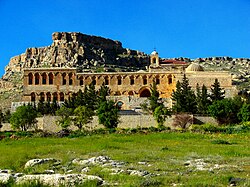
Externally, the monastery's walls are famously yellow‑tinted. Inside are many ornate and beautiful structures, including the Domed Church, the Sayyida (Church of the Virgin Mary), the Church of the Patriarchal Throne, a mausoleum, and a garden structure known as the 'Paradise'.
The monastery, regarded as the "Mecca of Assyrians" and a jewel of Tur Abdin, continues to function as a monastic community, tourist site, and centre of learning, attracting thousands of visitors annually, in addition to its critical ecclesiastical functions since its inception. Syriac Orthodox culture was centred in two monasteries in western Tur Abdin, Mor Hananyo and Mor Gabriel.
Name
[edit]The monastery was originally dedicated to Saint Solomon (Mor Shlemun), thought to have been its first abbot, persecuted under Byzantine emperor Justin I during his intense anti-Miaphysite policies, as described by Michael the Syrian.[2] The modern name derives from Mor Hananyo (Saint Hananya), metropolitan of Mardin and Kafartut, who purchased and restored the ruined site in 793 and gave it new life.[3] Patriarch Ignatius Aphrem I Barsoum believed Solomon to have been a disciple of Saint Augen, explaining why the monastery was sometimes also called Mor Hananyo & Augen.[2]
The Arabic name Dayr al-Za'faran ("Saffron Monastery"), with its Syriac translation Dayro d-Kurkmo, is traced to the 15th century. Tradition recalls that a merchant carrying saffron (za'faran) passed by this monastery during its rebuilding. The abbot purchased the saffron from him, mixed it with lime, and used it for building the monastery, lending its walls their distinctive warm, yellowish hue. Another theory for the name is that saffron was cultivated in the surrounding area with records indicating its cultivation in the fields of a monastery near Nusaybin.[4]
Thus, the monastery was initially called 'Mor Shlemun', then 'Mor Hananyo', then 'Mor Hananyo & Augen', and currently, it is referred to by both names 'Mor Hananyo' and 'Deyrulzafaran'.
History
[edit]Early history
[edit]According to archaeological and traditional accounts, the site of the monastery was originally occupied by a temple dedicated to the Assyrian sun-god Šamaš, dating back to c. 2000 BC.[5] The temple's massive stone vaults, constructed without mortar, are still preserved beneath the monastery. One of its windows is aligned to catch the sunrise, suggesting its use in ritual observances and sacrifices.[6]
In late antiquity, the complex was transformed into a Roman citadel, later expanded into a Byzantine fortress. When the Romans abandoned the site in the late 5th century, it was converted into a Christian monastery by Mor Shlemon (Solomon) in 493 AD.[7] Architectural remains from this period, including floor mosaics, are still visible within the monastery.[8] The oldest surviving church, dedicated to the Virgin Mary, dates from the 5th–6th centuries and features four altars, with carved wooden sanctuaries added in 1699.[9] It was raided and destroyed by the Persians in 607 AD when they conquered the region from Byzantine forces, leaving the monastery deserted afterwards.[3]
Ananias (Hananyo) was educated and ordained as a monk at the Monastery of Mor Mattai near Mosul.[10] He was later ordained as the metropolitan bishop of Mardin and Kafartut, undertaking major restoration of the monastery. He also established a grand library of manuscripts, and under his leadership, the monastic community grew to about 80 monks. From this period onward, the monastery became a prominent religious centre and has since borne his name as Mor Hananyo Monastery.[3] Ananias was succeeded by his disciple Ignatius I in 816, who was the 80th bishop of the church and further expanded the monastery's structures and its library.[11]
| Part of a series on |
| Oriental Orthodoxy |
|---|
 |
| Oriental Orthodox churches |
 Christianity portal Christianity portal |


Medieval history
[edit]In 1034, the 67th Patriarch of Antioch, Dionysius IV Yahya (1031–1042), settled in Amid (modern-day Diyarbakır) after seeking the protection of the Muslim rulers. He also spent some time in Mor Hananyo, becoming the first patriarch to do so.[12] The region was invaded by Islamic forces in 640, and in 1106, it came under the control of the Artukids. The monastery was later abandoned and re-founded by Yuhanon (John) IV, bishop of Mardin, who renovated the complex between 1125 and 1148, after which it was designated the patriarchal residence before his death on 12 July 1165. The region was devastated by Mongol invaders in 1394 and in subsequent years.[13][14] In 1166, Patriarch Michael the Great was enthroned there, initiating nearly eight centuries of patriarchal presence.[15]
During the 14th–15th centuries, the monastery endured devastation. In 1396, Tamerlane attacked Mardin for the second time, killing, looting, and taking many captives. As a result, some of its monasteries were destroyed, including the walls, cells, and the door of Mor Hananyo.[16] Kurdish raiders inflicted great damage on the monastery and surrounding villages over the years as well, including in 1516. The monastery further deteriorated due to neglect.[17] Patriarch Ignatius II rebuilt the monastery between 1696 and 1699, adding the Church of the Patriarchal Throne which was intended for synods and patriarchal elections. Later patriarchs would also gradually renovate it.[18] The patriarchal throne and many relics are still located in the monastery, in addition to the tombs of various patriarchs.[19]
Modern history
[edit]Since the 13th century, the monastery has faced repeated Kurdish incursions, looting, and desecration. The wider insecurity of southeastern Anatolia, where most Assyrian Christians lived, left their communities vulnerable to frequent raids by neighbouring Kurdish Muslim groups. As the patriarchal seat of the Church, the monastery was directly affected. Horatio Southgate, an American missionary who visited in the 19th century, noted that Mor Hananyo had been invaded and occupied by Kurds. Regional upheavals, including the rebellion of Badr Khan in the 1840s, brought devastation to Assyrians of both the Syriac Orthodox Church in Tur Abdin and the neighbouring Church of the East in Hakkari.[20]
Some of the worst violence, however, was unleashed in the massacres beginning in 1895.[21] During this period, the monastery was repeatedly occupied by Kurdish Muslims, who neglected and abused the site. Ancient manuscripts were destroyed, with some used as gunwadding for rifles or as kindling for fire, and clergy were powerless against local violence. The monastery's condition deteriorated rapidly, leaving it little more than a ruin by the time restoration was attempted.[22] Despite this, the monastery also became a refuge for displaced villagers, particularly during the massacres of 1895. Syriac Orthodox manuscripts preserved at the monastery contain eyewitness accounts of the atrocities in Syriac, Arabic and Garshuni.[23] There were widespread killings of men, women, childrenm and clergy; burnings of monasteries, homes, and churches; and the ransacking of villages across Mardin, Diyarbakır, and the surrounding regions. More than fifty villages were reported as emptied of their indigenous Assyrian population. Refugees who fled to the monastery were ordered by Ottoman officials to return to their ruined villages, where starvation, exposure, and renewed attacks caused further deaths. Contemporary letters also document appeals to the patriarch to intervene in cases of abduction and forced conversion, including an Armenian plea to rescue his wife and child from Kurdish captors who claim the wife converted to Islam after her kidnapping, and thus will not be returned. The violence has been described by scholars as a precursor to the Assyrian genocide of 1915.[20]
| Part of a series on |
| Assyrians |
|---|
 |
| Assyrian culture |
| By country |
| Assyrian diaspora |
| Language |
| Subgroups |
| Religion |
| By location |
| Persecution |
The monastery itself sheltered hundreds of women, children, and the elderly during the crises. One account recalls that only the intervention of an Ottoman army officer, moved to pity by the state of the refugees, prevented the complete massacre of those inside. Nevertheless, the villages surrounding the monastery — including Bnabil, Dara, Bkeera, Qillath, al-Mansuriyah, Macsarta, Baval, Sour, al-Qusour, al-Qalsatma — were devastated, with their Christian populations eradicated. The destruction extended across Diyarbakır, Nusaybin, Azekh, and Siirt, where the Chaldean Catholic archbishop and scholar Addai Sher was murdered. Further looting of farmland and livestock was reported by villagers who resorted to begging to survive. A state of anarchy prevailed, with both ecclesiastical and local civil authorities rendered helpless before the tyranny of Kurdish tribes, who operated undeterred under the blessing of the Ottoman state. They pillaged, murdered, raped, kidnapped, and harassed the indigenous Christians of the monastery and surrounding villages, who were also subjected to forced conversion to Islam against their will. The violence reflected deep-rooted attitudes that persisted long after these events.[24]
During the Seferberlik massacres, part of the 1915 Assyrian genocide, Kurdish tribes besieged the monastery, intent on killing refugees from surrounding villages. One Assyrian man disguised himself to smuggle food past the besiegers.[25]
Despite centuries of upheaval, Mor Hananyo remained the patriarchal seat of the Syriac Orthodox Church for nearly a millennium. This ended in 1924, soon after the establishment of the Turkish Republic, when Patriarch Ignatius Elias III received a telegram from Mustafa Kemal Atatürk delivered via the governor of Mardin, declaring:
The clerical leader in the black cassock [the Patriarch] should leave Turkey immediately and should never ever return![26]
The patriarch was stripped of Turkish citizenship, and the patriarchate relocated first to Homs, and then to Damascus, where it remains today as the Syriac Orthodox Patriarchal Archdiocese of Damascus. Mor Hananyo, however, would continue to function as a monastic centre, despite everything.[27]
Over its history, at least 21 Syriac Orthodox synods were convened there, the last on 30 November 1916, when Ignatius Elias III was elected Patriarch of Antioch.[28]
Church architecture
[edit]
Mor Hananyo Monastery is one of the main centres of the Syriac Orthodox Church, renowned for its magnificent architecture. The various churches and buildings of the monastery still preserve a significant amount of the original decoration and sculpture, many of which exhibit very high artistic quality.[8] The monastery is regarded as one of the largest and most influential in Mesopotamia. It is situated on a mound approximately 3 km east of the city of Mardin, Turkey. The monastery measures about 71 × 63 m, fortified by a strong wall, and is surrounded by water channels. Its courtyard features porches on four sides facing one another, and in the middle are two large cisterns fed from nearby springs through aqueducts that were used for storing fresh water during winter and spring.[29][30]
The complex is constructed on several levels, with two storeys across most of the site and three storeys in the southern section. These higher structures, considered the best-preserved parts of the monastery, contain the patriarchal apartments and the monks' cells. The construction is irregular, which reflects centuries of additions and reconstruction. Remains of the earliest building phases, made from large carved stones and bricks, can still be seen in the churches and the vaults of the lower storey.[29]
The monastery incorporates a variety of ecclesiastical buildings: the Domed Church of Mor Hananyo, the Church of the Virgin Mary (Sayyida), the Church of the Patriarchal Throne, the Mausoleum of the Fathers (Beth Qadisheh), and a garden structure known as the Paradise.[31] In addition, St Peter's Church and accommodation for patriarchs, metropolitans, and clergy are part of the compound.[14]
One of the most striking architectural features is the so-called Sun Temple, an underground vault beneath the main courtyard. This structure predates the monastery and is approximately 4500 years old, originally dedicated to the Mesopotamian sun-god Šamaš. The ceiling, constructed with massive stones fitted without mortar using interlocking techniques, has remained intact for millennia, going all the way back to ancient Assyrian times. A window in its eastern wall was aligned to capture the first rays of sunrise, likely used in ritual sacrifice. The chamber's stone blocks, some weighing up to one tonne and standing two metres high, are held together without mortar, with a central keystone locking them in place. The temple comprises two rooms, one covered by stone vaults and the other by a ceiling of fitted blocks. This subterranean sanctuary represents the oldest preserved part of the monastery.[32][6][7] Located to the north of the monastery are three smaller monasteries: one dedicated to the Theotokos (Syriac: ܝܘܠܕܬ ܐܠܗܐ, romanised: Yoldāth Alāhā, lit. 'Mother of God'), also known as 'Our Lady of the Dripping Water'; one to Mor Ozoziel;[33] and one to Jacob of Serug, who is dubbed 'the Teacher'.[34]
Main Church (Domed Church)
[edit]
The church located in the east wing of the monastery was meticulously built by Mor Hananyo (793–816) himself, which is why it is also named after him. The structure remains intact more than eleven centuries on. It was here that Patriarch Michael the Great was enthroned in 1166, followed by subsequent patriarchs.[15]
The building is shaped like a cross and measures 17.7 × 12.3 m; it is regarded as exceptionally beautiful.[35] Byzantine Emperor Anastasius I Dicorus (491–518) is said to have commissioned its construction, carried out by the Assyrian architects Theodosius and Theodore.[14] Its dome is shaped in the form of a cross, which has earned it the name 'Domed Church'. The surface area measures 271 m2, and the interior height rises to 17.7 m.[15]
The outer walls bear various animal motifs, while the southern gate is decorated with inscriptions narrating episodes from the life of Jesus, though many have faded with time. The same gate also contains the Greek letters Alpha and Omega (Α and Ω), echoing Revelation 22:13 and symbolising Christ as the beginning and the end.[15]
Internally, the church was once adorned with frescoes, but only a single depiction of St Ananias survives, tall and narrow in form.[6] Its rich altar was historically laden with gold and silver.[36] Wooden service platforms to the north and south of the apse date from 1699, though the central platform was destroyed by fire in 1941, leaving only two columns intact.[35]
The church has six gates in total, and although Patriarch Ignatius Abded Mshiho II ordered plastering of the walls in 1903, which obscured some of the original decoration, a portrait of St Ananias himself is still preserved in the southern section.[15]
Temple of the Sun (Shamash Temple)
[edit]
This underground sanctuary, dating back to c. 2000 BC, predates the Christian monastery and was originally utilised for solar worship by the ancient Assyrians of the region.[37]
The ceiling is supported by immense stones, standing two metres tall and weighing 500–1,000 kg each. These stones are ingeniously fitted without mortar through interlocking methods that have preserved their stability for millennia. At the eastern end, there is a small opening that allows the rays of the rising sun to penetrate directly to the altar, where sacrifices were offered to the sun god Shamash.[6][38]
The temple is formed of two rooms, one smaller chamber covered by stone vaults, and a larger one with a ceiling of vast unmortared blocks. The monastery itself symbolically preserves the solar theme with 365 rooms, each representing a day of the year. The first rays of the sun enter the temple through a small opening in its eastern wall every morning.[38]
Mausoleum of the Fathers
[edit]
Also called the Beth Qadisheh (Syriac: ܒܝܬ ܩܕܝܫܗ, romanised: House of Saints), this mausoleum is located on the southeastern façade of the Domed Church. It measures 10.5 × 5.4 m. The doors to this chamber are double doors of walnut, dating back 300 years. The chamber contains seven burial niches, three of which are reserved for patriarchs.[39] Altogether, the bones of 53 patriarchs, metropolitans, and saints are interred here across several chambers, including those of Saint Hananya himself.[40]
Stone carvings embellish the interior, including grape clusters, vases with rods protruding, and seashells in semi-circular niches. Above the doorway is a cross surrounded by dolphins.[41] Inscriptions in Estrangelo and Serto Syriac scripts record the sanctity of the space, one explicitly stating 'Entombed here are the remains of saints'. The structure was renovated in 1884 by Patriarch Peter IV, the last patriarch later entombed there in 1894.[18]
Church of Virgin Mary (Sayyida Church)
[edit]The Church of the Virgin Mary, also called Sayyida, stands in the northern section of the monastery. It dates back to the 5th–6th centuries and is regarded as the original church of the complex. Measuring 10.75 × 14.25 m, it is spacious and venerable.[18]
The church contains four altars, each with a finely crafted wooden Holy of Holies built in 1699, some inscribed with verses from the Psalms.[18] Three handmade wooden doors, also from 1699, bear additional Syriac inscriptions of the Psalms of David.[7]
Inside, mosaics of the Byzantine era decorate the apse, and some of the ceilings and walls are built of baked brick in a Byzantine style. An octagonal baptismal font for adults remains in use today for baptism ceremonies.[6]
Patriarch Jirjis II restored parts of the church in the late 17th century.[18] It remains one of the central liturgical spaces of the monastery.
Church of the Patriarchal Throne
[edit]Above the Church of the Virgin Mary to the south lies the Church of the Patriarchal Throne, built by Patriarch Jirjis II between 1696 and 1699 in honour of Saint Peter. Measuring 17.5 × 9.25 m, it was intended as the venue for patriarchal synods to convene and elect new patriarchs. Renovations and decorations were later added by Patriarchs Shukr Allah (1727), Jirjis IV (1773), and Jirjis V (1830). The altar front bears inscriptions from the Gospels in Estrangelo script, while a nearby Serto Syriac inscription states that relics of saints rest at the site, making it an important symbolic space within the monastery. The throne itself stands on the eastern side of the church and is fashioned of marble, richly ornamented with carvings.[18]
The Paradise (Dayr al-Firdaws)
[edit]Adjoining the eastern side of the Sayyida Church is a smaller chamber known as the 'Paradise' (Dayr al-Firdaws), which served as a burial chamber for bishops and dignitaries. Measuring 6.5 × 5.7 m, it contains six stone graves covered with arches. There is a bountiful spring nearby known as Jroun Spring, along with mulberry trees.[39]
The chamber walls bear decorative carvings, including crosses and geometric designs. A Syriac inscription records its dedication as a place for interring the righteous, and Byzantine-style mosaics survive on the floor.[39]
Traditionally, it was considered a particularly sanctified place within the monastery, reserved for ascetics who had achieved high spiritual standing. Renovations carried out during the 18th century reinforced the structure while preserving its original style.[39]
Manuscripts and scholarship
[edit]A significant library was established at the monastery during the renovations under Ananias in the late eighth century. Over the following centuries, the monks of Mor Hananyo produced and copied a large number of manuscripts covering a wide range of subjects, bearing witness to their diverse intellectual interests. These manuscripts extended far beyond religious literature. For example, a codex copied in 1308–09 contains the Syriac translation of Ptolemy's Tetrabiblon alongside Severus Sebokht's Treatise on the Constellations.[34][42]
Among the most celebrated works preserved is the Lectionary of Deir ez-Za‘faran, copied in the mid-thirteenth century by Dioscorus Theodorus, later bishop of Hesna d‑Ziyad (Kharput). The manuscript contains twenty miniatures, elaborate ornaments of colourful circles, stars, and crosses, and full-page decorative crosses introducing the canon tables. The frontispiece is set under a gold portion, and the interlaced borders in red, blue, and yellow closely follow Byzantine iconographic models. Unlike many contemporaneous manuscripts, the physiognomic rendering of its figures was not 'Islamicised' but retained a distinct Syriac Christian aesthetic.[34]
The monastery also preserves a Bible of considerable historical value and a sacred stone traditionally associated with the founding of the first school of medicine in the region. Among the renowned scholars connected with the monastery are Iwannis, metropolitan of Dara (8th–9th century), Patriarch Ignatius Aphrem I Barsoum (1933–1957), and Metropolitan Mor Philoxenos Yuhanon Dolabani (1947–1969). Mor Philoxenos Saliba Özmen, ordained Metropolitan of Mardin in 2003, also resides at Mor Hananyo.[34]
Despite its prestige, the library suffered catastrophic losses through time, looting, and repeated pillaging. It suffered devastation by Turks, by the Mongols under Tamerlane, and later by Kurdish tribes, who used precious manuscripts either as rifle wadding or kindling for fires.[43] Even so, today the library of Mor Hananyo still contains more than 300 Syriac and Arabic manuscripts, the oldest dating to the 9th century, covering theology, patristics, scripture, law, grammar, philology, asceticism, rituals, and history, authored by both Greek and Syriac writers of various traditions, including Miaphysite and Nestorian.[44]
In 1928, Metropolitan Yuhanon Dolabani compiled a Syriac facsimile catalogue of all manuscripts in the monastery, which was translated into Arabic in Damascus in 2002 by Yohanna Ibrahim and later into English by Matti Moosa.[42]
Printing press
[edit]
The monastery of Mor Hananyo holds a remarkable position in the history of printing in the Middle East. In 1874, Patriarch Peter IV and Archbishop Gregorios journeyed to England and acquired a printing press, which was transported to Aleppo by Antonius Azar before being installed at the monastery in 1881. A dedicated printing-house was constructed on the site in 1882. An additional press had already been brought from England in the 1880s as a backup and was installed in Jerusalem.[45]
The first book printed in the monastery appeared in 1888, and a copy was sent to Queen Victoria. Subsequently, the press remained active until 1917, producing books in Syriac, Arabic, and Turkish, in addition to the periodical Hikmet (Syriac: ܚܟܡܬܐ, romanised: Ḥekmṯo, lit. 'Wisdom') in 1913–1914. During the era of the Turkish Republic, the monastery's press was used to print official documents, as it was the only printing facility available in the region. Publications continued until 1969; additionally, a monthly magazine titled Öz Hikmet was printed until 1953.[45]
Today some of the surviving works printed at Mor Hananyo are on display within the monastery, and others are exhibited at Kırklar Church (Mor Behnam) in Mardin.[46]
Modern-day significance
[edit]Mor Hananyo served as the seat of the Syriac Orthodox Patriarchate from c. 1160–1932 when it was relocated to Homs and later to Damascus, marking the end of its nearly eight‑century tenure as the ecclesiastical centre of the Syriac Orthodox Church.
The monastery is one of the oldest still-functioning sacred sites in Mesopotamia. So great is the significance of the site to Assyrian Christians worldwide and their deep-rooted heritage in their homeland,[47] that (in 2013) the monastery attracted over 109,000 visitors, and most were non-residents of Mardin, even though only about 4,000 Assyrians lived in Mardin.[14] There continues to be an influx of visitors seeking to experience the site's historic spiritual and architectural legacy, and many locals refer to it as the "Mecca of Assyrians".[6]
Mor Hananyo is still a key player in Syriac liturgical observances, with services still being provided in Classical Syriac — one of the oldest liturgical languages of Christianity.[48] The upper floor is still occupied by visiting guests including the patriarch who occasionally visits from time to time.[6]
Complementing the monastery's significance, its enduring presence marks part of larger efforts by Assyrian communities to reclaim and maintain their cultural and religious identity in their ancestral region.[47]
Tourism
[edit]Today, the monastery functions both as a religious site and a tourist attraction. Open to visitors during designated hours, it offers guided tours and has a café, souvenir shop, and occasional displays of locally produced Assyrian wine called Dzafaran.[49] It is situated in Tur Abdin, a historically Assyrian region, and is preparing for potential World Heritage recognition under UNESCO's Tentative List programme.[5][50]
Admission to the monastery is 100₺ (as of September 2024) and it is open every day. Guided tours are sometimes conducted in Turkish, but many of the local clergymen also speak English. Visitors must wear appropriate attire.[51]
Gallery
[edit]-
 The Saffron Monastery
 -
 The tree-lined path to the monastery
 -
 The main entrance, accessed from the outer courtyard
 -
 The Patriarchal Throne
 -
 Mor Hananyo Monastery with its farms in the background
 -
 Bible and pulpit
 -
 The main inner courtyard
 -
 New block beside the entrance gate of the monastery housing a wine shop and a small museum
 -
 Domed Church containing a portrait of Saint Hananya
 -
 Virgin Mary image in the Sayyida Chapel
 -
 Entrance to one of the churches


.jpg)
.jpg)

See also
[edit]Notes
[edit]- ^ "Hananyo" is the West-Syriac pronunciation and appears on the monastery's entrance. In Classical Syriac it is pronounced "Hananya" and found transliterated as such in some literature.
References
[edit]- ^ Dinno 2017, p. 501.
- ^ a b Ignatius Aphram I Barsoum 2008, pp. 17–18.
- ^ a b c Ignatius Aphram I Barsoum 2008, p. 7.
- ^ Ignatius Aphram I Barsoum 2008, pp. 19–20.
- ^ a b "Mor Hananyo Monastery | Archiqoo". archiqoo.com. Retrieved 9 September 2025.
- ^ a b c d e f g Jin, De Wet and (2 May 2023). "Mor Hananyo Monastery: Visit Turkey's Saffron Convent in Mardin". Museum of Wander. Retrieved 9 June 2025.
- ^ a b c "Eglise syriaque orthodoxe d'Antioche". Archived from the original on 26 February 2012. Retrieved 9 September 2025.
- ^ a b "Mor Hananyo Dayro, Turkey". syriacchristianity.in. Retrieved 9 June 2025.
- ^ Ignatius Aphram I Barsoum 2008, pp. 5–7.
- ^ Ignatius Yacoub III (11 September 2008). History of the Monastery of Saint Matthew in Mosul. Translated by Matti Moosa. Gorgias Press. p. 56. doi:10.31826/9781463213978/html. ISBN 978-1-4632-1397-8.
- ^ Ignatius Aphram I Barsoum 2008, p. 9.
- ^ Dinno 2017, p. 23.
- ^ "Mor Hananyo Dayro, Turkey". Archived from the original on 27 September 2007.
- ^ a b c d Toprak, Lokman (December 2014). "Significance of Dayro D-Mor Hananyo and Mor Gabriel Monasteries within the scope of belief tourism". European Journal of Science and Theology – via ResearchGate.
- ^ a b c d e Ignatius Aphram I Barsoum 2008, p. 4.
- ^ Ignatius Aphram I Barsoum 2008, p. 35.
- ^ Ignatius Aphram I Barsoum 2008, p. 36.
- ^ a b c d e f Ignatius Aphram I Barsoum 2008, p. 5.
- ^ Traces in the Desert: Journeys of Discovery across Central Asia. (2008). Christoph Baumer. I. B. Tauris, New York, p. 21.
- ^ a b Dinno 2017, pp. 89–90.
- ^ Dinno 2017, p. 41.
- ^ Dinno 2017, pp. 89–90, 302.
- ^ Ignatius Aphram I Barsoum 2008, pp. 176–180.
- ^ Dinno 2017, pp. 176–180.
- ^ Talay, Shabo; Barthoma, Soner Ö. (2018). Sayfo 1915 - An Anthology of Essays on the Genocide of Assyrians/Arameans During WWI. Gorgias Press. p. 151. ISBN 978-1-4632-0730-4. ISSN 1539-1507.
- ^ Dinno 2017, pp. 223–225.
- ^ Dinno 2017, p. 302.
- ^ Ignatius Aphram I Barsoum 2008, pp. 49–51.
- ^ a b Ignatius Aphram I Barsoum 2008, p. 1.
- ^ Toprak 2014, p. 23.
- ^ Ignatius Aphram I Barsoum 2008, pp. 1–6.
- ^ Toprak 2014, pp. 23–24.
- ^ Carlson, Thomas A. "Mor ʿAzozoʾil". syriaca.org. Retrieved 9 September 2025.
A monastery in the hills above Dayr al-Zaʿfarān.
- ^ a b c d "Mor Hananyo Dayro, Turkey". www.syrianchurch.org. Archived from the original on 27 September 2007. Retrieved 9 September 2025.
- ^ a b "A Historical Heritage in Mardin: Mor Hananyo Monastery | Grand Sirkeci Hotel". www.grandsirkeci.com. Retrieved 9 September 2025.
- ^ Courtois, Sébastien de (2004). The Forgotten Genocide (in French). Translated by Aurora, Vincent (1st ed.). Piscataway, NJ: Gorgias Press. p. 11. ISBN 978-1-59333-077-4.
- ^ Toprak 2014, p. 65.
- ^ a b "Syriac Heritage in Mardin & Midyat". grande flânerie. 26 October 2023. Retrieved 9 September 2025.
- ^ a b c d Ignatius Aphram I Barsoum 2008, p. 6.
- ^ Doğukan, Kubilayhan (12 October 2022). "A Mysterious Journey to Deyrulzafaran Monastery". Şiir Tadında. Retrieved 9 June 2025.
- ^ "Deyrulzafaran Manastırı - Mardin". www.deyrulzafaran.org. Retrieved 9 June 2025.
- ^ a b Dolabani, Philoxenos Yuhanon (2009). Ibrahim, Gregorios Yohanna (ed.). Catalogue of Syriac Manuscripts in Za‘faran Monastery. Dar Mardin: Christian Arabic and Syriac Studies from the Middle East. Piscataway, NJ: Gorgias Press. ISBN 978-1-60724-252-9.
- ^ Courtois 2004, p. 10.
- ^ Ignatius Aphram I Barsoum 2008, p. 71.
- ^ a b Vrolijk, Arnoud Vrolijk (2014). Roper, Geoffrey (ed.). Historical Aspects of Printing and Publishing in Languages of the Middle East: Papers from the Third Symposium on the History of Printing and Publishing in the Languages and Countries of the Middle East. Islamic Manuscripts and Books. Leiden; Boston: Brill. pp. 181–192. ISBN 978-90-04-25505-0.
- ^ Doğukan, Kubilayhan (12 October 2022). "A Mysterious Journey to Deyrulzafaran Monastery". Şiir Tadında. Retrieved 9 September 2025.
- ^ a b Culture, Germany. "Mardin Culture, In Depth Analysis of Mardin Culture". Germany Culture. Retrieved 9 September 2025.
- ^ Tours, Mexico Turqia. "Mardin Kontes Travel". Mardin Kontes Travel (in Spanish). Retrieved 9 September 2025.
- ^ "Meet the Turkish winemaker taking risks to restore Assyrian culture". euronews. 4 November 2021. Retrieved 9 September 2025.
- ^ Agency, Anadolu (15 February 2022). "UNESCO protocol signed for 9 churches, monasteries in Turkey's Mardin". Daily Sabah. Retrieved 9 September 2025.
- ^ nomadicniko (8 June 2024). "Tur Abdin & Syriac Orthodox Monasteries in Southeastern Turkey". Nomadic Niko. Retrieved 9 September 2025.
Sources
[edit]- Üngör, Uğur Ümit (2011). The Making of Modern Turkey: Nation and State in Eastern Anatolia, 1913–1950. Oxford University Press. ISBN 978-0-19-965522-9.
- Ignatius Aphram I Barsoum (2008). History of the Za’faraan Monastery. Publications of the Archdiocese of the Syriac Orthodox Church. Translated by Matti Moosa. Piscataway, NJ: Gorgias Press. ISBN 978-1-59333-639-4.
- Dinno, Khalid S. (2017). The Syrian Orthodox Christians in the Late Ottoman Period and Beyond: Crisis, Then Revival. Gorgias Eastern Christian studies. Piscataway (N.J.): Gorgias Press. ISBN 978-1-4632-0575-1.
External links
[edit]
- Official website
- Charity House
- Presentation Archived 2012-02-06 at the Wayback Machine
- Presentation
Syriac Orthodox monasteries | |
|---|---|
| Active monasteries | |
| Historic monasteries | |

Ethno-linguistic group(s) indigenous to the Middle East; also known as Syriac-Arameans or Chaldeans | |||||||||
| Identity | |||||||||
| Syriac Christianity |
| ||||||||
| Neo-Aramaic dialects | |||||||||
| Culture | |||||||||
| History (including related contexts) |
| ||||||||
| By country |
| ||||||||
| Politics | |||||||||
.svg)


| International | |
|---|---|
| National | |
| Other | |

Mor Hananyo Monastery
View on GrokipediaNames and Etymology
Historical Names
The Mor Hananyo Monastery was originally established in 493 AD and known as Mor Shlemun, or the Monastery of Saint Solomon, named after its founder, the Syriac monk Shleymun, who is believed to have been the first abbot.[4][1] This name reflected the monastery's dedication to Saint Solomon during its early years as a center of Syriac Orthodox monastic life in the Tur Abdin region.[4] An earlier dedication to Mor Augen is also noted in some historical accounts, leading to references as the monastery of Mor Hananyo and Mor Augen by later scribes.[2] In 793 AD, the monastery underwent significant restoration under the leadership of Mor Hanayo, the metropolitan bishop of Mardin and Kefertuth, prompting its renaming to Mor Hananyo in his honor.[4][1] This refounding marked a pivotal revival, establishing the site as the bishopric seat and solidifying its role in the Syriac Orthodox Church.[4] The name Mor Hananyo, derived from the Syriac form of Hananiah, a biblical figure venerated in the Syriac Orthodox tradition, underscores the monastery's ties to early Christian saints; Hananiah itself originates from the Hebrew חָנַנְיָה (Ḥănanyāh), combining חָנַן (ḥānan, "to be gracious") with יָהּ (Yah, a shortened form of Yahweh), meaning "Yahweh is gracious."[5] By the 15th century, the monastery had also become widely associated with the name Deyrulzafaran, or the Saffron Monastery, in Arabic (Deir al-Za'faran), owing to the yellowish hue of its stone construction, possibly enhanced by saffron dye in the plaster or the presence of saffron crocus flowers nearby.[4][1] This moniker persists in local usage alongside the official Syriac designation Dayro d-Mor Hananyo, highlighting the site's enduring cultural and linguistic layers.[1]Linguistic Variations
The name of the monastery in Syriac, the liturgical language of the Syriac Orthodox Church, is rendered as ܕܝܪܐ ܕܡܪܝ ܚܢܢܝܐ, commonly transliterated as Dayro d-Mor Hananyo, where dayro means "monastery" and Mor denotes "Saint" or "Lord."[1] The element Hananyo derives from the Aramaic form of the biblical name Ananias, rooted in Hebrew Ḥananyāh, signifying "Yahweh has been gracious" or "God has been gracious," reflecting a theophoric construction combining the verb ḥanan (to be gracious) with the divine name Yah.[6] This transliteration preserves the phonetic qualities of Classical Syriac, with the "ḥ" representing a guttural fricative sound absent in many modern languages. In Arabic, the monastery is known as دير الزعفران, transliterated as Dayr al-Zaʿfarān, literally meaning "Monastery of Saffron," a name that emerged due to the yellowish hue of its stone facade, evoking the color of saffron dye.[2] This adaptation reflects the phonetic simplification common in Arabic-Syriac interactions, where the Syriac kurkmo (saffron) influences the term zaʿfarān. The Turkish designation, Deyrülzafaran Manastırı, directly borrows from the Arabic, with deyr for "monastery," ülzafaran as a compound for "of saffron," and manastırı meaning "monastery," illustrating Ottoman-era linguistic assimilation in the region.[7] In English and other Western languages, the name appears as Mor Hananyo Monastery to retain the Syriac honorific and proper noun, or alternatively as Saffron Convent, prioritizing the descriptive Arabic-derived epithet for accessibility.[1] These variations highlight cross-cultural transliteration challenges, such as rendering the Syriac "nyo" ending into Latin script without diacritics, often resulting in anglicized forms like "Hananyo" or "Hananoyo." The saffron association, briefly, ties to the monastery's yellowish limestone, as noted in historical descriptions.[7]Location and Setting
Geographical Position
The Mor Hananyo Monastery is located approximately 5–6 kilometers southeast of Mardin in southeastern Turkey, within the Tur Abdin plateau of the province of Mardin.[4][3] Its exact geographical coordinates are 37°17′58″N 40°47′18″E.[8] Perched at an elevation of approximately 1,000 meters, the monastery occupies a prominent position halfway up a limestone hill, offering sweeping vistas over the expansive Mesopotamian plain to the south.[9][10] This elevated site, part of the rugged Tur Abdin landscape known for its Syriac heritage, places the monastery in close proximity to the Mardin citadel, about 5 kilometers to the west.[4][11] The foundation rests on limestone bedrock typical of the region, which has directly shaped the monastery's construction through the use of locally quarried limestone blocks for its walls and structures.[12][11] From this vantage, it overlooks the broader Tigris River valley, approximately 70 kilometers southeast, marking the transition from the Anatolian plateau to the fertile Mesopotamian lowlands.[13][14]Regional Context
Tur Abdin, known in Syriac as the "Mountain of the Servants of God," has historically functioned as a core heartland for Syriac communities, fostering ancient Christian populations that trace their roots to the early adoption of Christianity in the region during the 1st century CE. This area, encompassing over 80 villages and numerous monastic sites, served as a vital center for the Syriac Orthodox Church, with its patriarchate headquartered at nearby monasteries until the early 20th century. The enduring presence of Syriac-speaking Christians here reflects a continuity of Aramean cultural and religious traditions amidst successive empires.[15][16] The religious landscape of Tur Abdin bears significant imprints from ancient Mesopotamian civilizations, particularly the Assyrian Empire, which exerted control over the region as early as the 13th century BCE, as evidenced by inscriptions from kings like Adad-nirari I referencing it as a frontier to conquer and exploit. Babylonian influences are also apparent through shared cultural motifs in the broader Mesopotamian cradle, though the area's pre-Christian sites, such as pagan sun temples later repurposed for Christian worship, highlight a transition from polytheistic practices to Syriac Christianity. These layers underscore how the region's spiritual heritage evolved from imperial Mesopotamian dominance to a stronghold of Eastern Christianity.[17][18][16] In contemporary times, Tur Abdin's demographics have undergone profound changes, with Kurdish and Turkish populations now forming the majority due to historical migrations and settlements, particularly of Kurdish tribes from eastern Anatolia in the 19th and 20th centuries. The Syriac Christian community, once dominant, has sharply declined to an estimated 2,000–3,000 individuals in the region—out of approximately 25,000 nationwide (as of 2023)—largely as a result of 20th-century emigrations triggered by persecution, economic hardship, and conflict. This exodus has left many ancient villages depopulated, transforming the ethnic and cultural fabric of the area. In recent years, the region's cultural heritage has gained international recognition, including its nomination to UNESCO's World Heritage Tentative List in 2021 and the awarding of the village of Hah as one of the world's Best Tourism Villages by the UNWTO in 2025.[19][20][21][22][23] Amidst such turmoil, Tur Abdin and its monasteries have played crucial roles in regional conflicts, notably during the 1915 Sayfo genocide, when Mor Hananyo Monastery sheltered thousands of Syriac Christians fleeing massacres and deportations in the Mardin and Diyarbakır provinces. Over 90,000 Syriac Orthodox perished across the broader area, with the monastery—alongside sites like Mor Gabriel—serving as a defended sanctuary despite attacks by Kurdish irregulars, as documented in survivor accounts and ecclesiastical records. This function as a refuge highlighted the monasteries' enduring significance in preserving community amid Ottoman-era violence targeting Christian minorities.[24]Historical Development
Pre-Monastic Origins
The site of Mor Hananyo Monastery, located near Mardin in southeastern Turkey, originated as a sacred space dedicated to the worship of the Mesopotamian sun god Šamaš (also known as Shamash) during the first millennium BCE.[4][25] This pre-Christian temple served as a focal point for pagan rituals, evidenced by the site's structural remnants, including an eastward-facing orientation designed to capture the sunrise, a key element in solar veneration.[25] Archaeological investigations have identified foundational elements beneath the later monastic buildings that align with ancient Mesopotamian temple architecture, underscoring the site's long-standing religious significance prior to Christian adaptation.[4] During the Roman period, the sun temple was repurposed as a fortress or citadel, leveraging the natural topography of the region for defensive purposes.[25] The location's hilltop position on a limestone outcrop, combined with extensive natural cave systems—some of which were later expanded artificially—provided strategic advantages for fortification while also offering secluded spaces that would later attract early Christian ascetics.[25] As the Byzantine Empire asserted control in the region during the late 5th century CE, the site began transitioning toward Christian use, with hermits utilizing the caves for contemplation before the formal establishment of the monastery in 493 CE.[25] This shift reflects broader patterns of religious transformation in the Near East, where pagan sites were often Christianized to symbolize the triumph of the new faith.[4]Establishment and Early Growth
The Mor Hananyo Monastery was founded in 493 AD by Mor Shelmon, also known as Saint Solomon, who transformed an abandoned Roman fortress atop an ancient sun temple site into a Christian monastic complex dedicated to Syriac Orthodox ascetic practices.[4] This establishment marked the beginning of the site's role as a spiritual refuge amid the religious tensions of late antiquity, particularly under Byzantine imperial oversight that often persecuted non-Chalcedonian communities like the Syriac Orthodox.[1] Mor Shelmon, believed to be a disciple of the early Syriac missionary Saint Augen, consecrated the space and initiated a small community of monks focused on prayer, study, and communal living.[26] During its early growth in the 6th century, the monastery underwent initial construction phases that laid the foundation for its enduring layout, including the erection of basic churches and monastic quarters organized around a central cloistered courtyard.[4] Key among these were the main Mor Hananyo Church, constructed between 491 and 518 AD under the patronage of Byzantine Emperor Anastasius I by the Syriac brothers Theodosius and Theodore, along with the Church of the Virgin Mary and the Beth Qadishe (House of Saints).[26] These structures, built from local yellowish limestone with irregular stonework reflecting phased development, provided essential spaces for liturgy, relic veneration, and ascetic residence, fostering the monastery's emergence as a vital hub for Syriac Orthodox scholarship and monastic discipline in the Tur Abdin region.[3] By the late 8th century, the monastery faced decline due to regional instability but experienced significant restoration in 793 AD under the leadership of Metropolitan Mor Hananyo (Saint Hananya) of Mardin and Kefertuth, who repaired the dilapidated buildings and expanded the monastic community.[4] This renewal not only revitalized the site's infrastructure but also solidified its prominence within the Syriac Orthodox tradition, with the complex renamed in honor of its restorer.[27] The efforts attracted more monks and pilgrims, enhancing the monastery's early reputation as a resilient center of faith amid Byzantine-Sassanian conflicts and theological divisions.[1]Medieval and Ottoman Periods
In 1166, under the leadership of Patriarch Michael the Syrian, Dayro d-Mor Hananyo was designated as the Patriarchal See of the Syriac Orthodox Church of Antioch, marking a pivotal shift in its institutional role. This status was reaffirmed in 1293 by Patriarch Ignatius II, and the monastery served as the primary residence for the patriarchate—with occasional interruptions—until 1932, hosting 53 patriarchs during this span. Many of these leaders were buried in the monastery's Beth Qadishe, underscoring its enduring spiritual centrality.[28][1] Throughout the medieval period, the monastery endured severe challenges from invading forces, including Mongol incursions in the 13th century that damaged its structures around 1231 and 1242 amid broader regional devastation. Further destruction occurred in 1394 during Timur's campaigns, where remains of monks killed in 1401 were later discovered in the site's caves, evidencing the brutality of these assaults. From the 16th to 19th centuries, the community faced repeated raids by Kurdish tribes, such as those documented in 1878 targeting nearby Syriac villages, which threatened the monastery's security and population.[29][30] Despite these adversities, the monastery flourished under the Ottoman Empire's millet system, where Syriac Orthodox Christians initially fell under the Armenian millet before seeking greater autonomy in the 19th century. Protections were secured through imperial firmans, notably one issued by Sultan Abdülhamid II in 1895 in response to tribal violence, allowing refugees to seek safety within its walls. This relative stability enabled cultural and intellectual growth, including the expansion of its library and scriptorium, which by the early 20th century housed around 350 manuscripts and introduced a printing press in 1881 to preserve Syriac texts.[30][28]20th Century and Beyond
During the Sayfo massacres of 1915, the Mor Hananyo Monastery served as a critical refuge for Syriac Orthodox Christians fleeing violence in surrounding villages, including Mansurieh, where survivors sought shelter within its fortified walls amid widespread killings in the Mardin region.[31] The monastery also provided sanctuary during the turbulent population exchanges and migrations following World War I, as many Syriacs displaced by the 1923 Treaty of Lausanne and subsequent upheavals found temporary protection there before relocating to Syria and Iraq. These events marked a period of intense persecution, with the monastery's role as a haven underscoring its enduring significance amid the genocide that claimed an estimated 250,000–300,000 Syriac lives across the Ottoman Empire.[32] In response to ongoing political pressures and the Turkish Republic's policies toward non-Muslim minorities, the Syriac Orthodox Patriarchate, long seated at Mor Hananyo since the 12th century, relocated in 1933 to Homs, Syria, to better serve the dispersed community.[33] The move was prompted by the aftermath of the Sayfo and World War I, which drastically reduced the Christian population in Turkey and restricted ecclesiastical activities. By 1959, the patriarchate shifted again to Damascus, where it remains headquartered at the Cathedral of Saint George, though the monastery retains symbolic importance as the patriarchal throne's historical home.[33] Post-World War II, the monastery experienced a sharp decline in its monastic community, reflecting broader demographic losses in Tur Abdin due to emigration, assimilation, and socioeconomic challenges; by the late 20th century, only two monks remained, down from a more robust presence in the early 1900s.[1] As of 2024, the monastic community consists of approximately 2 monks and 15 nuns, with the site sustained by this small resident community and lay support.[34] In the 21st century, revival efforts have gained momentum through Turkish government initiatives recognizing Syriac heritage, including the 2011 return of confiscated church properties to the Syriac Orthodox community and subsequent restorations at Mor Hananyo. The monastery was included in 2021 on UNESCO's Tentative World Heritage List as part of the "Late Antique and Medieval Churches and Monasteries of Midyat and Tur Abdin" nomination, highlighting its cultural preservation amid renewed interest in Syriac history. These developments, coupled with increased tourism and scholarly attention, have bolstered the site's role as a living center of Syriac Orthodox tradition.Architectural Features
Overall Complex Layout
The Mor Hananyo Monastery complex occupies a rectangular area measuring 71 meters in length by 63 meters in width, constructed primarily from local yellow limestone blocks that contribute to its distinctive warm-toned exterior.[35][4] The mortar used in assembly incorporates saffron dye, enhancing the yellowish hue of the walls and reflecting traditional building techniques in the region.[4] At its core, the layout revolves around a central cloistered courtyard, which serves as the organizational hub, surrounded by key structures including churches, monastic cells, and service areas, with porches lining all four sides of the yard.[4][35] The complex is enclosed by thick defensive walls, a remnant of its early use as a fortress, providing protection against historical threats in the Tur Abdin region.[35] The structure spans multiple levels, beginning with a subterranean basement that preserves remnants of a pre-Christian sun temple, progressing to ground-level ecclesiastical and communal spaces, and culminating in upper stories dedicated to living quarters and administrative functions, forming a cohesive three-story ensemble.[4][35] This vertical organization, combined with the site's ancient temple foundations, underscores the monastery's adaptation of earlier pagan influences into a fortified Christian stronghold.[35]Sun Temple Basement
The Sun Temple Basement at Mor Hananyo Monastery preserves subterranean remnants of a pre-Christian temple dedicated to the Mesopotamian sun god Šamaš, forming the foundational layer of the Syriac Orthodox complex. Archaeological evidence indicates that the temple originated during the first millennium BC, predating the monastery's establishment in the 5th century AD by centuries of solar worship. The structure was subsequently repurposed as part of the Christian site's infrastructure, with its pagan elements integrated into the overall foundations.[4] The basement comprises a primary chamber characterized by a low, vaulted ceiling built from unmortared stones, exemplifying ancient Mesopotamian building techniques. A distinctive eastern-facing aperture in the wall allows sunlight to enter at dawn, facilitating rituals aligned with Šamaš's solar attributes. Access occurs via a staircase descending from the monastery proper, leading visitors into the dimly lit space that evokes the site's layered historical transitions. Over millennia, roughly 3 meters of soil and debris have accumulated, diminishing the chamber's original height and underscoring its long-term entombment.[4][25] Christian adaptations transformed the temple into supportive elements of the monastery, such as potential crypts, by burying portions to obscure non-Christian origins while reusing the robust stonework. This integration highlights the continuity of sacred space at the site, where pagan substrates bolstered early monastic construction without extensive alteration to the core architecture. The basement's preservation today offers insight into Tur Abdin's multicultural religious history, though detailed excavations remain limited.[25][4]Beth Qadishe (House of Saints)
The Beth Qadishe, or House of Saints, occupies the northeastern part of the Mor Hananyo Monastery complex and functions as the primary mausoleum for Syriac Orthodox leaders, housing the tombs of 52 patriarchs. This sacred burial site underscores the monastery's longstanding role as a patriarchal center from the late 12th century onward.[36][28] Architecturally, the Beth Qadishe consists of vaulted chapel-type chambers featuring nine arcosolia—arched niches along the walls that accommodate stone sarcophagi for the interred remains. There are 15 such niches in total, some containing multiple burials, reflecting an elaborate design typical of late antique monastic funerary architecture in northern Mesopotamia. The structure's exterior includes a portal lintel carved with a cross flanked by two sea monsters and a pearl, symbolizing Christian triumph over chaos.[4][37] Burials here date from the 12th century, beginning with the consecration of Michael the Great (Michael Rabo) in 1166, through the medieval and Ottoman eras, and continuing into the 20th century until the patriarchal seat's relocation after World War I. The site also preserves relics of saints alongside the patriarchs, facilitating veneration and commemoration within the Syriac Orthodox tradition. Among the interred are notable figures like Ignatius II (b. Wahib), who formalized the monastery as the patriarchal residence in 1293.[28][37] Decorative elements enhance the chamber's solemnity, with interior walls bearing carved or painted motifs such as schematic peacocks, scallop shells paired with palm fronds, and jars from which vines emerge—symbols evoking paradise and eternal life. Syriac epitaphs inscribed on the sarcophagi provide biographical details and prayers for the deceased, while possible remnants of frescoes contribute to the space's devotional atmosphere, though preservation varies due to historical renovations.[4]Mor Hananyo Church
The Mor Hananyo Church, serving as the central place of worship in the Dayro d-Mor Hananyo Monastery, was constructed between 491 and 518 AD during the reign of Byzantine Emperor Anastasius I by the Syriac brothers Theodosius and Theodore. This early Christian structure reflects the monastery's origins as a key Syriac Orthodox site, built atop pre-existing pagan foundations to assert Christian presence in the region. The church's dedication to Mor Hananyo, the 8th-century bishop who contributed to its later renovations, underscores its enduring ties to Syriac ecclesiastical leadership.[3][38][26] Architecturally, the church is distinguished by its central dome, which crowns a cross-shaped interior plan typical of early Byzantine influences adapted for Syriac liturgy. The eastern apse, housing the main altar, features remnants of Byzantine-era mosaics and frescoes depicting Syriac saints and biblical narratives, though many were damaged or lost over time, including a fire in 1941 that affected the apse area. Intricate stone carvings, including reliefs and arches, adorn the walls and entrances, emphasizing the church's role in blending local Tur Abdin craftsmanship with Christian iconography.[26][34][4] With dimensions of approximately 12.3 meters in width and 17.7 meters in height, covering about 271 square meters, the church provides an intimate yet resonant space for communal prayer. Its liturgical significance lies in functioning as the primary venue for Syriac Orthodox services, including the Divine Liturgy in Classical Syriac, and historically hosting patriarchal consecrations from the 12th century onward until the early 20th century. This centrality made it a focal point for monastic life, theological reflection, and the preservation of Syriac traditions amid regional upheavals.[26][3][28]Church of the Virgin Mary
The Church of the Virgin Mary, also referred to as the Sayyida Church, was constructed in the 6th century and stands as the oldest extant structure within the Mor Hananyo Monastery. Positioned adjacent to the main Mor Hananyo Church in the northeastern corner of the primary courtyard, it exemplifies early Syriac Orthodox architecture built during the monastery's formative period under Byzantine influence. This secondary sanctuary reflects the devotion to the Virgin Mary central to the faith, serving as a dedicated space for veneration amid the complex's expansion in late antiquity.[39][26] The church features robust baked-brick walls characteristic of Byzantine construction techniques, creating a compact yet intimate worship space. Its interior is distinguished by Byzantine-era mosaics adorning the apse, which depict the Theotokos (Mother of God) alongside biblical scenes rendered in the traditional Syriac style, blending Eastern Christian iconographic motifs with local artistic expressions. A wooden iconostasis separates the nave from the sanctuary, enhancing the liturgical division, while three wooden entrance doors installed in 1699 bear inscriptions of Syriac Psalm verses, adding to the church's scriptural ambiance. These elements underscore the church's role as a preserved relic of 6th-century Christian artistry in Tur Abdin.[26][3] In the monastery's religious practices, the Church of the Virgin Mary holds particular significance for Marian feasts, such as the Dormition and Nativity of the Theotokos, where liturgies emphasize her intercessory role in Syriac Orthodox theology. It also connects to the broader women's monastic traditions, as the dedication to the Virgin Mary has historically inspired female spiritual life within Syriac communities, including periods when nuns resided or participated in the monastery's conventual activities. The space is utilized for targeted ceremonies, notably annual baptisms of children in its octagonal font, reinforcing its ongoing pastoral function despite limited daily use.[10][40]Religious and Cultural Significance
Patriarchal Role
The Mor Hananyo Monastery, also known as Dayro d-Mor Hananyo or Deyrulzafaran, served as the official seat of the Syriac Orthodox Patriarchate of Antioch from c. 1160 until 1932, functioning as the central hub for the church's ecclesiastical leadership during this period.[1][28] This residency marked a significant consolidation of authority in the region of Tur Abdin, where the monastery hosted the installation of numerous high-ranking clergy, including 21 patriarchs, 7 maphrianos (Catholicos), and 111 bishops, underscoring its pivotal role in the church's hierarchical structure.[2] Administrative decisions, doctrinal deliberations, and governance of the global Syriac Orthodox community were conducted from its premises, with the patriarchal throne—engraved with a spiral list of patriarchs dating back centuries—symbolizing continuity and legitimacy.[41] Throughout its tenure as patriarchal residence, the monastery was a venue for key church events, including consecrations of patriarchs and synods that addressed theological and organizational matters for the Syriac Orthodox Church.[2] These gatherings reinforced the institution's influence over scattered communities across the Middle East and beyond, managing ecclesiastical affairs amid political upheavals in the medieval and Ottoman eras. The site's enduring legacy is further evidenced by the Beth Qadishe, which houses the tombs of numerous patriarchs and metropolitans (reported as 52 ecclesiastical leaders in total), the last being Moran Mor Ignatius Pathros IV in 1894, representing a tangible link to the church's historical leadership.[2][1] Since 1932, it has continued as the seat of the Metropolitan of Tur Abdin, maintaining its role in Syriac scholarship.[42][2]Scholarly and Artistic Legacy
Mor Hananyo Monastery, as a longstanding patriarchal seat of the Syriac Orthodox Church, functioned as a vital center for Syriac theology from the medieval period onward. Monks and scholars residing there composed and copied hymns, biblical commentaries, and translations of patristic works, contributing to the intellectual heritage of the Syriac tradition. Notable among these efforts were the preservation and dissemination of theological texts by early Syriac fathers, reinforcing the monastery's role in sustaining doctrinal purity and liturgical exegesis amid evolving regional influences.[28][43] The monastery's artistic legacy is evident in its traditions of illuminated manuscripts and ecclesiastical frescoes, executed in the distinctive Syriac style characterized by intricate geometric patterns, symbolic motifs, and narrative biblical scenes. While many original works have perished due to time and conflict, the surviving fresco in the Mor Hananyo Church—depicting the monastery's patron saint in a tall, narrow composition—exemplifies the East Syriac-influenced aesthetic adapted by Syriac Orthodox artisans, blending ascetic simplicity with vibrant iconography. These artistic endeavors extended to regional influences, where the monastery's scribes and painters advanced Syriac calligraphy techniques, employing Estrangela and Serto scripts in ornate headings and illuminations, and shaped local icon painting practices that emphasized Christological themes and saintly veneration.[43][28] Throughout its history, particularly during eras of persecution under Byzantine, Islamic, and Ottoman rule, the monastery served as a bastion for preserving the Aramaic liturgy of the Syriac Orthodox Church. Monks safeguarded ancient liturgical manuscripts and oral traditions, ensuring the continuity of Aramaic chants, prayers, and rituals that formed the core of communal worship. This preservation effort not only protected the linguistic and spiritual essence of Syriac Christianity but also transmitted it to subsequent generations, underscoring the monastery's enduring cultural resilience.[28]Printing Press and Library
Establishment and Operations
The printing press at Mor Hananyo Monastery, also known as Deyrulzafaran, was established in 1888 as the first Syriac-language press in the Ottoman Empire.[44] This initiative was spearheaded by Syriac Orthodox Patriarch Ignatius Peter IV, who acquired the equipment during his visit to England in 1874–1875 and had it transported to the monastery, where it was installed in a dedicated wing by 1881.[44] After acquiring specialized typefaces for the Syriac alphabet from printers in London and Oxford, the press's inaugural publications in 1888 included the liturgical text Tūrōs Mammlō (The Bull of the Church), followed by other works such as Yullfōnō Mšīḥōyō (The Calendar of Christ) and Sḥīmō (The Common of the Office), all printed in Syriac script.[44] Operations relied on manual printing presses imported from England, supplemented by tools like a paper-cutting machine, and were managed by monks trained in European printing techniques.[44] Key figures included Archbishop Mor Ignatios ʿAbd Allāh Saṭṭūf, who received training in England, and later administrators such as Afrem Barṣōm (from 1911) and Yuhanna Dolabani, who oversaw revivals after interruptions.[44] The press produced numerous titles across its history, focusing on liturgical books, Bibles, and periodicals that preserved and disseminated Syriac Orthodox texts in Syriac, Arabic, and Turkish.[25] Notable outputs included the monthly periodical Öz Hikmet (True Wisdom), published from 1913 to 1953, which addressed theological and cultural topics for the Syriac community.[45] The press functioned intermittently due to regional upheavals, including a pause in 1889 due to new regulations and cessation during the Ottoman Empire's collapse around 1917, but was revived in the early Turkish Republic era, ceased again, and resumed on 4 May 1947 under Hanna Dolabani, continuing until 1969.[44][25] Throughout its run, it served as the official printing house for the Syriac Orthodox Patriarchate, benefiting from Ottoman-era protections for monastic institutions that allowed such cultural endeavors.[46] By the mid-20th century, it had become a vital tool for maintaining the church's literary traditions amid declining monastic populations.[25]Manuscript Collection
The manuscript collection at Mor Hananyo Monastery, housed in its historic library, consists of over 300 manuscripts, primarily in Syriac with some in Arabic and Garshuni, dating from the 9th to the 19th centuries, forming a cornerstone of Syriac Orthodox heritage.[47] These handwritten works were catalogued in detail by the scholar Philoxenos Yuhanna Dolabani in the mid-20th century, providing scholars with an essential inventory of the monastery's scribal output.[47] The collection's chronological span reflects the monastery's enduring role as a center of learning, capturing theological, liturgical, and intellectual traditions across more than a millennium. The contents of these manuscripts cover diverse genres essential to Syriac Christianity, including biblical texts such as lectionaries and Gospel commentaries, patristic works by early Church Fathers, hagiographies recounting saints' lives, and even medical treatises on healing practices.[47] For instance, biblical manuscripts preserve ancient translations and interpretations central to Syriac liturgy, while patristic and hagiographical texts offer insights into doctrinal development and monastic spirituality.[48] Medical treatises, less common but significant, document traditional knowledge blending Syriac and regional influences, highlighting the monastery's broader cultural exchanges.[47] This variety underscores the collection's scholarly value, serving as a primary resource for researchers studying Syriac language, theology, and history. Notable among the former holdings is the Lectionary of Dioscorus Theodoros, a mid-13th-century illuminated liturgical volume copied by the bishop of Amid, featuring intricate miniatures that enhance its aesthetic and devotional appeal; it is now preserved in the Church of the Forty Martyrs in Mardin.[49] Preservation of the collection presents ongoing challenges, as some manuscripts have suffered damage from humidity in the monastery's environment, leading to deterioration of parchment and ink.[50] In response, the Hill Museum & Manuscript Library (HMML) has digitized 274 of these items since the early 2000s, making high-resolution images accessible online and mitigating risks to the originals through non-invasive conservation.[51] This digitization effort not only safeguards the manuscripts but also amplifies their scholarly impact by enabling global access to these irreplaceable artifacts.Modern Role and Preservation
Current Activities
The Mor Hananyo Monastery remains an active spiritual center for the Syriac Orthodox Church, serving as home to a small number of monks, estimated at fewer than 10, who maintain the traditional rites and daily prayer cycles conducted in Aramaic. These services, held in the monastery's historic churches, form the core of monastic life and preserve ancient liturgical practices central to the faith.[10][27] In addition to religious observance, the monastery supports educational initiatives for a small number of resident students, focusing on Syriac language instruction to sustain the community's linguistic heritage amid broader demographic challenges, including a historical decline in monk numbers. While formal seminary training for priests was restricted by government policies in the late 20th century, informal programs continue to emphasize theological and liturgical studies within the monastic setting.[52][53][54] Annual feasts, such as the Exaltation of the Cross, are observed with pilgrim gatherings that reinforce communal bonds and draw Syriac Orthodox faithful for worship and reflection. The monastery also engages in community outreach, providing aid to nearby Syriac villages through cultural preservation efforts and participating in interfaith dialogues to promote regional harmony.[55]Tourism and Conservation Efforts
The Mor Hananyo Monastery, also known as Deyrulzafaran, serves as a significant tourist attraction in southeastern Turkey, drawing visitors interested in its Syriac Orthodox heritage and architectural splendor. As of 2023, the broader Mardin region hosted nearly 650,000 tourists, with the monastery contributing substantially to this influx due to its proximity to the city and status as a key cultural site.[56] In 2013, the monastery alone attracted over 109,000 visitors, predominantly non-local tourists, reflecting its growing appeal beyond regional pilgrims. Recent estimates indicate annual visitors exceeding 100,000, underscoring its role in Turkey's religious and cultural tourism sector. Access requires a guided tour, with an entry fee of 150 Turkish lira per person as of October 2025.[34] Conservation efforts at the monastery have focused on preserving its ancient structures amid ongoing challenges. In 2007, the Deyrulzafaran Monastery Care, Restore and Survival Foundation initiated the first major scientific restoration in a century, funded by the European Union's Fund for the Protection of Cultural Heritage. This project removed modern cement additions, restored original stone walls, domes, and terraces using traditional techniques, and strengthened the Mor Hananyo Church dome to enhance structural integrity.[3] Subsequent work has addressed vulnerabilities in the region's seismic activity, including reinforcements to key architectural elements like vaults and roofs, as part of broader post-earthquake preservation initiatives in Turkey's southeast. No major new restorations have been reported as of 2025.[57] The monastery holds a place on UNESCO's World Heritage Tentative List as part of the "Late Antique and Medieval Churches and Monasteries of Midyat and Surrounding Area (Tur ʿAbdin)," nominated in 2021 alongside eight other sites in Mardin Province, with efforts ongoing for full inscription.[58] Despite these advancements, conservation faces risks from vandalism and neglect, which threaten the site's exposed stonework and frescoes, particularly in an area with historical land disputes affecting Syriac heritage properties.[42]References
- https://commons.wikimedia.org/wiki/File:Mor_Hananyo_Monastery_2.jpg