


Community hub
Recent from talks
Contribute something
Nothing was collected or created yet.
Armstrong Flight Research Center
View on Wikipedia
 | |
 | |
 Neil A. Armstrong Flight Research Center from the air. | |
| Agency overview | |
|---|---|
| Preceding agencies |
|
| Jurisdiction | U.S. federal government |
| Headquarters | Edwards Air Force Base, California, United States |
| Agency executive |
|
| Parent agency | NASA |
| Website | nasa |

The NASA Neil A. Armstrong Flight Research Center (AFRC) is an aeronautical research center operated by NASA. Its primary campus is located inside Edwards Air Force Base in California and is considered NASA's premier site for aeronautical research.[1] AFRC operates some of the most advanced aircraft in the world and is known for many aviation firsts, including supporting the first crewed airplane to exceed the speed of sound in level flight (Bell X-1),[2] highest speed by a crewed, powered aircraft (North American X-15),[3][4] the first pure digital fly-by-wire aircraft (F-8 DFBW),[5] and many others. AFRC operated a second site next to Air Force Plant 42 in Palmdale, California, known as Building 703, once the former Rockwell International/North American Aviation production facility.[6] There, AFRC housed and operated several of NASA's Science Mission Directorate aircraft including SOFIA (Stratospheric Observatory For Infrared Astronomy), a DC-8 Flying Laboratory, a Gulfstream C-20A UAVSAR and ER-2 High Altitude Platform.[1] In 2024, following the retirements of SOFIA and the DC-8, NASA vacated Building 703, as the continued lease of the large hangar was no longer justified or a prudent use of taxpayer dollars. As of 2023, Bradley Flick is the center's director.[7]
Established as the National Advisory Committee for Aeronautics Muroc Flight Test Unit (1946), the center was subsequently known as the NACA High-Speed Flight Research Station (1949), the NACA High-Speed Flight Station (1954), the NASA High-Speed Flight Station (1958) and the NASA Flight Research Center (1959). On 26 March 1976, the center was renamed the NASA Ames-Dryden Flight Research Center (DFRC)[8] after Hugh L. Dryden, a prominent aeronautical engineer who died in office as NASA's deputy administrator in 1965 and Joseph Sweetman Ames, who was an eminent physicist, and served as president of Johns Hopkins University. The facility took its current name on 1 March 2014, honoring Neil Armstrong, a former test pilot at the center and the first human being to walk on the Moon.[9][10]
AFRC was the home of the Shuttle Carrier Aircraft (SCA), a modified Boeing 747 designed to carry a Space Shuttle orbiter back to Kennedy Space Center if one landed at Edwards.
The center long operated the oldest B-52 Stratofortress bomber, a B-52B (dubbed Balls 8 after its tail number, 008) that had been converted to a drop test aircraft. 008 dropped many supersonic test vehicles, from the X-15 to its last research program, the hypersonic X-43A, powered by a Pegasus rocket. Retired in 2004, the aircraft is on display near Edwards' North Gate.[11]
Location
[edit]Though Armstrong Flight Research Center has always been located on the shore of Rogers Dry Lake, its precise location has changed over the years. It currently resides on the northwestern edge of the lake bed, just south of North Gate. Visitors must obtain access to both Edwards AFB and NASA AFRC.
The Rogers Dry Lake bed offers a unique landscape well suited for flight research, namely, dry conditions, few rainy days per year, and large, flat, open spaces in which emergency landings can be performed. At times, the bed can host a runway length of over 40,000 feet. It is home to a compass rose that measures 5,200 feet across, and where aircraft can land into the wind in any direction.
List of current projects
[edit]- X-59 QueSST
- X-66 Sustainable Flight Demonstrator
- UAS in the NAS Archived November 26, 2022, at the Wayback Machine
- TGALS
Historic projects
[edit]Douglas Skyrocket
[edit]
NASA's predecessor, the NACA, operated the Douglas Skyrocket. A successor to the Air Force's Bell X-1, the D-558-II could operate under rocket or jet power. It conducted extensive tests into aircraft stability in the transsonic range, optimal supersonic wing configurations, rocket plume effects, and high-speed flight dynamics. On November 20, 1953, the Douglas Skyrocket became the first aircraft to fly at over twice the speed of sound when it attained a speed of Mach 2.005. Like the X-1, the D-558-II could be air-launched using a B-29 Superfortress. Unlike the X-1, the Skyrocket could also takeoff from a runway with the help of JATO units.
Controlled Impact Demonstration
[edit]
The Controlled Impact Demonstration was a joint project with the Federal Aviation Administration to research a new jet fuel that would decrease the damage due to fire in the crash of a large airliner. On 1 December 1984, a remotely piloted Boeing 720 aircraft was flown into specially built wing openers which tore the wings open, fuel spraying everywhere. Despite the new fuel additive, the resulting fireball was huge; the fire still took an hour to fully extinguish.
Even though the fuel additive did not prevent a fire, it still prevented the combustion of some fuel which flowed over the fuselage of the aircraft, and served to cool it, similar to how a conventional rocket engine cools its nozzle. Also, instrumented crash test dummies were in the airplane for the impact, and provided valuable research into other aspects of crash survivability for the occupants.
Linear Aerospike SR-71 Experiment
[edit]
LASRE was a NASA experiment in cooperation with Lockheed Martin to study a reusable launch vehicle design based on a linear aerospike rocket engine. The experiment's goal was to provide in-flight data to help Lockheed Martin validate the computational predictive tools they developed to design the craft. LASRE was a small, half-span model of a lifting body with eight thrust cells of an aerospike engine. The experiment, mounted on the back of an SR-71 Blackbird aircraft, operated like a kind of "flying wind tunnel."
The experiment focused on determining how a reusable launch vehicle's engine plume would affect the aerodynamics of its lifting-body shape at specific altitudes and speeds reaching approximately 340 m/s (760 mph). The interaction of the aerodynamic flow with the engine plume could create drag; design refinements look to minimize that interaction.
Lunar Landing Research Vehicle
[edit]
The Lunar Landing Research Vehicle or LLRV was an Apollo Project era program to build a simulator for the Moon landing. The LLRVs, humorously referred to as "Flying Bedsteads," were used by the FRC, now known as the Armstrong Flight Research Center, at Edwards Air Force Base, California, to study and analyze piloting techniques needed to fly and land the Apollo Lunar Module in the moon's airless environment.
Aircraft on display
[edit]- NB-52B Balls 8 NASA 008
- Bell X-1E AF Ser. No. 46-063
- F-104N - NASA 826
- F-8 Supercritical wing - NASA 810
- F-8 Digital Fly-by-wire - NASA 802
- F-15B ACTIVE - NASA 837
- Grumman X-29 - NASA 849
- Lockheed SR-71 Blackbird LASRE - NASA 844
- Northrop HL-10 Lifting Body - NASA 804
- Rockwell HiMAT
Gallery
[edit]-
 These aircraft in Dryden's NACA hangar show the some of the research activities being undertaken in the 1950s
 -
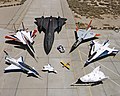 The Dryden Flight Research Center's fleet of aircraft in 1997
 -
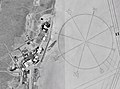 The satellite image of Armstrong Flight Research Center and the Edwards compass rose
 -
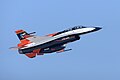 F-16-based VISTA multifunctional testbed aircraft (former NF-16D and now X-62A) in 2019 under a new paint scheme


List of center directors
[edit]The following persons have served as the Armstrong Flight Research Center director:[12][13]
| No. | Image | Director | Start | End | Notes |
|---|---|---|---|---|---|
| 1 | 
|
Walter C. Williams | September 30, 1946 | Fall 1949 | Supervisor, NACA Muroc Flight Test Unit |
| Fall 1949 | July 1, 1954 | Supervisor, NACA High Speed Flight Research Station | |||
| July 1, 1954 | September 15, 1959 | Director, NACA High Speed Flight Station[14] | |||
| 2 | 
|
Paul F. Bikle | September 15, 1959 | May 31, 1971 | [15] |
| Acting | 
|
De E. Beeler | June 1, 1971 | October 11, 1971 | [16] |
| 3 | 
|
Lee R. Scherer | October 11, 1971 | January 19, 1975 | [17] |
| 4 | 
|
David R. Scott | April 18, 1975 | October 30, 1977 | [18] |
| Acting | Isaac T. Gillam | October 30, 1977 | June 18, 1978 | ||
| 5 | June 18, 1978 | October 1, 1981 | [19] | ||
| 6 | 
|
John A. Manke | October 1, 1981 | April 27, 1984 | Director of Flight Operations[20] |
| 7 | 
|
Martin Knutson | May 1984 | December 2, 1990 | Director of Flight Operations and Site Director[21] |
| 8 | 
|
Kenneth J. Szalai | December 3, 1990 | March 1, 1994 | Facility Director |
| March 1, 1994 | July 31, 1998 | [22] | |||
| Acting | 
|
Kevin L. Petersen | August 1, 1998 | February 7, 1999 | |
| 9 | February 8, 1999 | April 3, 2009 | [23] | ||
| Acting | 
|
David D. McBride | April 4, 2009 | January 3, 2010 | |
| 10 | January 4, 2010 | December 4, 2022 | [24] | ||
| 11 | 
|
Bradley Flick | December 5, 2022 | present | [25] |
Notable employees
[edit]See also
[edit]


- Gromov Flight Research Institute - the Russia counterpart of the Armstrong Flight Research Centre
- List of aerospace flight test centres
References
[edit]- ^ a b Conner, Monroe (February 19, 2015). "Building 703 Facilities Overview". NASA. Archived from the original on May 1, 2017. Retrieved September 26, 2017.
- ^ Gibbs, Yvonne (August 12, 2015). "NASA Armstrong Fact Sheet: First Generation X-1". NASA. Archived from the original on June 21, 2017. Retrieved September 26, 2017.
- ^ "Aerospaceweb.org | Aircraft Museum - X-15". www.aerospaceweb.org. Archived from the original on February 10, 2020. Retrieved September 26, 2017.
- ^ Gibbs, Yvonne (August 13, 2015). "NASA Armstrong Fact Sheet: X-15 Hypersonic Research Program". NASA. Archived from the original on June 21, 2017. Retrieved September 26, 2017.
- ^ Gibbs, Yvonne (May 10, 2017). "F-8 Digital Fly-By-Wire". NASA. Archived from the original on March 4, 2016. Retrieved September 26, 2017.
- ^ Conner, Monroe (February 19, 2015). "Building 703 in Palmdale". NASA. Archived from the original on May 4, 2017. Retrieved September 26, 2017.
- ^ Bardan, Roxana (December 5, 2022). "NASA Administrator Names New Leadership at Two Agency Centers". NASA. Retrieved May 30, 2023.
- ^ "What's In a Name". NASA. February 27, 2014. Archived from the original on March 8, 2014. Retrieved December 11, 2017.
- ^ "NASA Center Renamed in Honor of Neil A. Armstrong". NASA. April 9, 2015. Archived from the original on January 19, 2014. Retrieved January 18, 2014.
- ^ "NASA Honors Astronaut Neil Armstrong with Center Renaming". NASA Press Release 14-061. February 28, 2014. Archived from the original on March 4, 2014. Retrieved February 28, 2014.
- ^ Google Earth imagery date 26 August 2012, at 34°59′34″N 117°53′00″W / 34.99278°N 117.88333°W
- ^ "Former NASA Armstrong Center Directors". NASA.
- ^ "Personnel". NASA.
- ^ "Walter C. Williams". NASA.
- ^ "Paul F. Bikle". NASA.
- ^ "De E. Beeler". NASA.
- ^ "Lee R. Scherer". NASA.
- ^ "Dr. David R. Scott". NASA.
- ^ "Isaac T. Gillam IV". NASA.
- ^ "John A. Manke". NASA.
- ^ "Martin A. Knutson". NASA.
- ^ "Kenneth J. Szalai". NASA.
- ^ "Kevin L. Petersen". NASA.
- ^ "David D. McBride". NASA.
- ^ "Bradley C. Flick". NASA.
External links
[edit]
- X-Press official newsletter Archived June 23, 2017, at the Wayback Machine
- Photo Collection for NASA Dryden Flight Research Center
- The Spoken Word: Recollections of Dryden History, the Early Years, edited by Curtis Peebles
- Flight Research: Problems Encountered and What They Should Teach Us by Milton O. Thompson—The early days of the DFRC

| International | |
|---|---|
| National | |
| Other | |

Armstrong Flight Research Center
View on GrokipediaHistory
Origins and Establishment
The National Advisory Committee for Aeronautics (NACA) established a presence at Muroc Army Air Field in California's Mojave Desert on September 30, 1946, when 13 personnel from NACA's Langley Memorial Aeronautical Laboratory arrived to support flight research on rocket-powered aircraft, particularly the Bell X-1 program aimed at exploring transonic and supersonic aerodynamics.[3] This initial contingent formed the basis of what became the NACA Muroc Flight Test Unit, officially granted permanent status on September 7, 1947, under the leadership of Walter C. Williams, with a staff of 27 by early 1948.[6] The unit's primary purpose was to conduct in-flight testing of advanced U.S. experimental designs to address aerodynamic challenges in high-speed flight, in close collaboration with the U.S. Army Air Forces (later Air Force) amid the post-World War II push for technological superiority during the emerging Cold War arms race.[7] A foundational event for the unit occurred on October 14, 1947, when Air Force Captain Charles E. "Chuck" Yeager piloted the Bell X-1 to exceed the speed of sound (Mach 1.06) for the first time in level flight, validating NACA's research on supersonic phenomena and demonstrating the site's suitability for high-risk testing.[3] This achievement, supported by NACA engineers analyzing flight data to refine aircraft stability and control, underscored the unit's role in pioneering safe transonic flight techniques.[8] In November 1949, the facility was redesignated the NACA High-Speed Flight Research Station, reflecting its expanded focus on supersonic research programs, including subsequent X-series aircraft tests.[9] Early infrastructure development leveraged the Mojave Desert's vast, flat Rogers Dry Lake bed—spanning approximately 65 square miles—for emergency landings and long runways, minimizing risks during experimental flights; basic support buildings and instrumentation hangars were constructed starting in 1947, with initial wind tunnel capabilities supplemented from Langley until on-site facilities like the 8-foot transonic tunnel emerged in the early 1950s.[7] Key early personnel, including test pilots like Howard C. "Tick" Lilly and engineers from Langley, worked alongside Air Force counterparts to integrate military operational needs with civilian research, fostering joint programs that accelerated U.S. aviation advancements.[3]Renamings and Milestones
In 1959, following the creation of the National Aeronautics and Space Administration (NASA), the National Advisory Committee for Aeronautics' Muroc Flight Test Unit was integrated into the new agency and redesignated as NASA's Flight Research Center, broadening its mandate to encompass aeronautical research supporting emerging space exploration efforts.[3] The center underwent its first major renaming in 1976, becoming the Hugh L. Dryden Flight Research Center in tribute to Hugh L. Dryden, NASA's deputy administrator from 1958 to 1965, who had made pivotal contributions to aeronautics and hypersonic flight theory during his tenure at the National Advisory Committee for Aeronautics.[10] A significant organizational shift occurred in 2014 when the facility was renamed the Neil A. Armstrong Flight Research Center, effective March 1, to honor Neil A. Armstrong, the Apollo 11 astronaut and first human to walk on the Moon, who had served as a test pilot at the center from 1955 to 1962. This change was enacted through legislation passed by Congress and signed into law by President Barack Obama on January 16, 2014, accompanied by a dedication ceremony on May 13, 2014, at Edwards Air Force Base, which featured speeches from NASA officials and updated signage and branding across the facility; concurrently, the adjacent test range was redesignated the Hugh L. Dryden Aeronautical Test Range to preserve recognition of Dryden's legacy.[4] Key milestones in the center's evolution include its 75th anniversary celebration in 2021, marking 75 years since its 1946 founding and highlighting decades of innovation in flight research, with cumulative achievements encompassing thousands of research flight hours and contributions to more than 50 experimental X-plane programs that advanced aviation boundaries from the Bell X-1's supersonic breakthrough onward.[11] As part of this anniversary, NASA released a 12-part video series exploring the center's history, including the installment "75 Years of Armstrong: Simulators," which details the pivotal role of flight simulators in supporting experimental programs.[12] The center's Flight Research Center Simulation Laboratory (FSL), established in the mid-1950s, has been central to these efforts, beginning with analog simulations in 1955 for aircraft like the F-100 and evolving through hybrid systems in the 1960s to support projects such as the X-15 program, providing pilot training, mission planning, and stability analysis. By the 1970s, the FSL transitioned to all-digital simulations, contributing to a wide array of X-plane and experimental vehicle research.[13] By 2025, the center continued to build on this legacy through hypersonic technology testing, such as fiber optic sensing systems for high-speed data collection. Partnerships with industry, exemplified by collaboration with Lockheed Martin on the X-59 Quiet Supersonic Technology demonstrator, have integrated commercial expertise into NASA's flight research to accelerate sustainable high-speed aviation development.[14][15]Facilities and Location
Geographic and Environmental Setting
The Armstrong Flight Research Center is situated within Edwards Air Force Base in the Mojave Desert of Kern County, California, at coordinates 35°0′35″N 117°53′11″W.[2] This remote desert location provides ideal conditions for aeronautical testing, including vast open spaces and minimal population interference.[1] The center benefits from access to approximately 301,000 acres of restricted land within the R-2508 Complex, which enables safe conduct of high-risk flight experiments away from civilian air traffic.[16] The Mojave Desert's environmental advantages include year-round favorable weather, characterized by low turbulence, clear visibility, and consistent flying conditions that support uninterrupted operations.[2] Additionally, the site's proximity to other NASA facilities, such as the Jet Propulsion Laboratory approximately 100 miles to the south, and nearby military installations like China Lake Naval Air Weapons Station, fosters interdisciplinary collaborations in aeronautics and space research.[2] Environmental management at the center emphasizes preservation of the fragile desert ecosystem, including protection of species such as the desert tortoise through monitoring, habitat restoration, and compliance with federal regulations like the Endangered Species Act and Department of Defense environmental policies.[17] The facility spans over 300,000 acres shared with Edwards Air Force Base, where biologists track wildlife movements and implement measures to minimize human impact on native flora and fauna.[17] A key feature of the site's historical significance is Rogers Dry Lake bed, a natural 44-square-mile hardpan surface that serves as an emergency landing area for aircraft without requiring paved runways.[18] This expansive, smooth playa has facilitated numerous high-speed flight tests, including landings of the X-15 rocket plane during early experimental programs.[18]Infrastructure and Operational Assets
The Armstrong Flight Research Center (AFRC) maintains a robust infrastructure on its primary campus at Edwards Air Force Base in California, enabling high-risk atmospheric flight testing and research. Key features include access to approximately 29,000 feet of concrete runways across multiple paved surfaces, complemented by extensive lakebed runways on Rogers Dry Lake that can extend total usable lengths beyond 40,000 feet in optimal conditions.[19][20] The center's flagship runway, shared with Edwards AFB, measures 15,000 feet and is recognized as one of the world's longest, supporting heavy aircraft operations and emergency overruns up to an additional 9,000 feet on the adjacent dry lakebed.[21] Support assets at AFRC include specialized hangars for aircraft integration and maintenance, such as Building 703 in nearby Palmdale, which houses research platforms during modification phases. Mission control centers, part of the Dryden Aeronautical Test Range (DATR), facilitate real-time oversight of flight tests through integrated telemetry and radar systems, including the Telemetry/Radar Acquisition & Processing System (TRAPS) for data collection from multiple sources.[22][23] Telemetry infrastructure features advanced antennas like the Triplex 7M system, enabling high-speed data transmission critical for analyzing flight dynamics. Simulation labs provide pre-flight modeling and software validation to mitigate risks before actual operations.[24] AFRC's remote operational areas encompass over 301,000 acres of restricted land in the western Mojave Desert, designated for safe testing of experimental vehicles and ecological monitoring. This includes the NASA-managed desert expanse used as landing zones and for environmental impact assessments supporting flight research.[1] These enhancements support ongoing projects, including ground and flight preparations for the X-59 QueSST aircraft to study quiet supersonic flight.[25][26]Organization and Personnel
Center Directors
The Armstrong Flight Research Center, originally established as the NACA Muroc Flight Test Unit in 1946, has been led by a series of directors appointed by the NASA Administrator, typically aeronautical engineers with extensive flight test and research experience.[3] These leaders have guided the center through pivotal advancements in high-speed flight, space systems integration, and sustainable aviation technologies.| Director | Tenure | Key Contributions |
|---|---|---|
| Walter C. Williams | 1946–1959 | Directed the establishment of the NACA High-Speed Flight Station and oversaw supersonic research programs, including the Bell X-1's sound barrier breakthrough, D-558-II transonic flights, and X-15 development requirements.[27] |
| Paul F. Bikle | 1959–1971 | Managed major rocket-powered and lifting-body programs, such as the X-15 hypersonic flights, XB-70 supersonic bomber tests, Lunar Landing Research Vehicle simulations, and early space shuttle precursors.[28] |
| De E. Beeler (acting) | 1971 | Provided transitional leadership during the directorship changeover, drawing on his 33-year career in aeronautical engineering and advanced aircraft project planning at NACA/NASA.[29] |
| Lee R. Scherer | 1971–1975 | Advanced research in flight control systems and materials while supporting NASA's broader goals, including contributions to the Apollo-Soyuz Test Project preparations.[30] |
| David R. Scott | 1975–1977 | Leveraged his Apollo 15 commander experience to direct aeronautical research projects, emphasizing technical and managerial oversight in high-risk flight testing.[31] |
| Isaac T. Gillam IV | 1978–1981 | Supervised flight testing of high-speed aircraft and space transportation systems, earning NASA's Distinguished Service Medal for launch program advancements.[32] |
| John A. Manke | 1981–1984 | Oversaw flight operations for the Space Shuttle carrier aircraft (Shuttle/Boeing 747) and other advanced test programs, building on his role as a lifting-body pilot.[33] |
| Martin A. Knutson | 1984–1990 | Ensured operational readiness for Space Shuttle landings at Edwards and secured SR-71 aircraft for NASA's environmental and high-altitude missions.[34] |
| Kenneth J. Szalai | 1990–1998 | Advanced digital fly-by-wire technologies and aeronautical research, including principal investigator work on the F-8 digital fly-by-wire program.[35][36] |
| Kevin L. Petersen | 1999–2009 | Directed aeronautical flight research and space technology support, including Global Hawk Earth science missions, while fostering agency-wide collaborations.[37] |
| David D. McBride | 2010–2022 | Led transformative projects like the X-48 hybrid wing-body demonstrator and Orion Launch Abort System tests; shaped NASA's Aeronautics Research Mission Directorate strategies as the longest-serving director.[38] |
| Bradley C. Flick | 2022–present | Provides technical oversight for flight projects, emphasizing sustainable aviation, airspace integration, and innovative air transportation systems.[39] |