


Community hub
Recent from talks
Contribute something
Nothing was collected or created yet.
Library of Congress
View on Wikipedia
The Library of Congress (LC or sometimes LOC) is a research library in Washington, D.C., serving as the library and research service for the United States Congress and the de facto national library of the United States.[3] It also administers copyright law through the United States Copyright Office, and it houses the Congressional Research Service.
Key Information


Founded in 1800, the Library of Congress is the oldest federal cultural institution in the United States.[4] It is housed in three buildings on Capitol Hill, adjacent to the United States Capitol, along with the National Audio-Visual Conservation Center in Culpeper, Virginia, and additional storage facilities at Fort George G. Meade and Cabin Branch in Hyattsville, Maryland.[5] The library's functions are overseen by the librarian of Congress, and its buildings are maintained by the architect of the Capitol. The LC is one of the largest libraries in the world,[3][6] containing approximately 173 million items and employing over 3,000 staff. Its collections are "universal, not limited by subject, format, or national boundary, and include research materials from all parts of the world and in more than 470 languages".[4]
When Congress moved to Washington in November 1800, a small congressional library was housed in the Capitol. Much of the original collection was lost during the 1814 burning of Washington by British forces during the War of 1812. Congress accepted former president Thomas Jefferson's offer to sell his entire personal collection of 6,487 books to restore the library. The collection grew slowly and suffered another major fire in 1851, which destroyed two-thirds of Jefferson's original books.
The Library of Congress faced space shortages, understaffing, and lack of funding, until the American Civil War increased the importance of legislative research to meet the demands of a growing federal government.[7][clarification needed] In 1870, the library gained the right to receive two copies of every copyrightable work printed in the United States; it also built its collections through acquisitions and donations. Between 1890 and 1897, a new library building, now the Thomas Jefferson Building, was constructed. Two additional buildings, the John Adams Building (opened in 1939) and the James Madison Memorial Building (opened in 1980), were later added.
The LC's Congressional Research Service provides objective non-partisan research to Congress to assist it in passing legislation. The library is open to the public for research, although only members of Congress, their staff, and library employees may borrow materials for use outside the library.[8]
History
[edit]
1800–1851: Origin and Jefferson's contribution
[edit]In 1783, James Madison, a Founding Father and the nation's fourth president, proposed creating a congressional library, but failed to gain necessary support for the idea. After the American Revolutionary War, however, the Philadelphia Library Company and New York Society Library served as surrogate congressional libraries when Congress convened in those cities.[9]
On April 24, 1800, the Library of Congress was established when John Adams, the nation's second president, signed an act of Congress, which appropriated $5,000 "for the purchase of such books as may be necessary for the use of Congress...and for fitting up a suitable apartment for containing them."[10] Books were ordered from London, forming a collection of 740 books and three maps housed in the new United States Capitol.[11]
Adams' successor as U.S. president, Thomas Jefferson, also played a crucial role in shaping development of the Library of Congress. On January 26, 1802, Jefferson signed a bill allowing the president to appoint the librarian of Congress and establishing a Joint Committee on the Library to oversee it. The law also extended borrowing privileges to the president and vice president.[12][13]
In August 1814, British forces occupied Washington and, in retaliation for American acts of destruction in Canada, burned several federal government buildings. Among the buildings burnt was the Library of Congress, which saw over 3,000 of its volumes destroyed.[11] These volumes were held in the Senate wing of the Capitol; one surviving volume was a government account book from 1810.[13][14][15] The volume was taken by British Admiral George Cockburn as a souvenir, and was later returned to the U.S. in 1940 by his family.[16]
Within a month, Jefferson offered to sell his large personal library[17][18][19] as a replacement. He had reconstituted his own collection after losing part of it to a fire. Congress accepted the offer in January 1815, appropriating $23,950 to purchase his 6,487 books.[11] Some House members, including New Hampshire representative Daniel Webster, opposed the purchase, wanting to exclude "books of an atheistical, irreligious, and immoral tendency".[20]
Jefferson's collection, gathered over 50 years, covered various subjects and languages, including topics not typically found in a legislative library.[9] He believed all subjects had a place in the Library of Congress, stating:
I do not know that it contains any branch of science which Congress would wish to exclude from their collection; there is, in fact, no subject to which a Member of Congress may not have occasion to refer.[20]
Jefferson's library was a working collection for a scholar, not for display. It doubled the size of the original library, transforming it from a specialist's library to a more general one.[21] He organized his books based on Francis Bacon's organization of knowledge, grouping them into Memory, Reason, and Imagination with 44 subdivisions.[22] The library used this scheme until the late 19th century when librarian Herbert Putnam introduced the Library of Congress Classification, now applying to over 138 million items.
A February 24, 1824, report from the Committee of Ways and Means recommended a $5,000 appropriation for the Library of Congress, noting the need to improve its collections in "Law, Politics, Commerce, History, and Geography," which were crucial for Congress.[23]
1851–1865: Weakening
[edit]
On December 24, 1851, the largest fire in the library's history destroyed 35,000 books, two-thirds of the library's collection, and two-thirds of Thomas Jefferson's original transfer. Congress appropriated $168,700 to replace the lost books in 1852 but not to acquire new materials.[24] (By 2008, the librarians of Congress had found replacements for all but 300 of the works that had been documented as being in Jefferson's original collection.[25]) This marked the start of a conservative period in the library's administration by librarian John Silva Meehan and joint committee chairman James A. Pearce, who restricted the library's activities.[24] Meehan and Pearce's views about a restricted scope for the Library of Congress reflected those shared by members of Congress.
While Meehan was a librarian, he supported and perpetuated the notion that "the congressional library should play a limited role on the national scene and that its collections, by and large, should emphasize American materials of obvious use to the U.S. Congress."[26] In 1859, Congress transferred the library's public document distribution activities to the Department of the Interior and its international book exchange program to the Department of State.[27]
During the 1850s, Smithsonian Institution librarian Charles Coffin Jewett aggressively tried to develop the Smithsonian as the United States national library. His efforts were rejected by Smithsonian secretary Joseph Henry, who advocated a focus on scientific research and publication.[28] To reinforce his intentions for the Smithsonian, Henry established laboratories, developed a robust physical sciences library, and started the Smithsonian Contributions to Knowledge, the first of many publications intended to disseminate research results.[29] For Henry, the Library of Congress was the obvious choice as the national library. Unable to resolve the conflict, Henry dismissed Jewett in July 1854.
In 1865, the Smithsonian building, also called the Castle due to its Norman architectural style, was severely damaged by fire. This incident presented Henry with an opportunity related to the Smithsonian's non-scientific library. Around this time, the Library of Congress was planning to build and relocate to the new Thomas Jefferson Building, designed to be fireproof.[30] Authorized by an act of Congress, Henry transferred the Smithsonian's non-scientific library of 40,000 volumes to the Library of Congress in 1866.[31]
In 1861, President Abraham Lincoln appointed John G. Stephenson as Librarian of Congress; the appointment is regarded as the most political to date.[32] Stephenson was a physician and spent equal time serving as librarian and as a physician in the Union Army. He could manage this division of interest because he hired Ainsworth Rand Spofford as his assistant.[32] Despite his new job, Stephenson focused on the war. Three weeks into his term as Librarian of Congress, he left Washington, D.C., to serve as a volunteer aide-de-camp at the battles of Chancellorsville and Gettysburg during the American Civil War.[32] Stephenson's hiring of Spofford, who directed the library in his absence, may have been his most significant achievement.[32]
1865–1897: Spofford's expansion
[edit]
Librarian Ainsworth Rand Spofford, who directed the Library of Congress from 1865 to 1897, built broad bipartisan support to develop it as a national library and a legislative resource.[33][34] He was aided by expansion of the federal government after the war and a favorable political climate. He began comprehensively collecting Americana and American literature, led the construction of a new building to house the library, and transformed the librarian of Congress position into one of strength and independence. Between 1865 and 1870, Congress appropriated funds for the construction of the Thomas Jefferson Building, placed all copyright registration and deposit activities under the library's control, and restored the international book exchange. The library also acquired the vast libraries of the Smithsonian and of historian Peter Force, strengthening its scientific and Americana collections significantly. By 1876, the Library of Congress had 300,000 volumes; it was tied with the Boston Public Library as the nation's largest library. It moved from the Capitol building to its new headquarters in 1897 with more than 840,000 volumes, 40 percent of which had been acquired through copyright deposit.[11]
A year before the library's relocation, the Joint Library Committee held hearings to assess the condition of the library and plan for its future growth and possible reorganization. Spofford and six experts sent by the American Library Association[35] testified that the library should continue its expansion to become a true national library. Based on the hearings, Congress authorized a budget that allowed the library to more than double its staff, from 42 to 108 persons. Senators Justin Morrill of Vermont and Daniel W. Voorhees of Indiana were particularly helpful in gaining this support. The library also established new administrative units for all aspects of the collection. In its bill, Congress strengthened the role of librarian of Congress: it became responsible for governing the library and making staff appointments. As with presidential Cabinet appointments, the Senate was required to approve presidential appointees to the position.[11]
In 1893, Elizabeth Dwyer became the first woman to be appointed to the staff of the library.[36]
1897–1939: Post-reorganization
[edit]

With this support and the 1897 reorganization upon moving into its new home, the Library of Congress began to grow and develop more rapidly. Librarian Spofford's successor John Russell Young overhauled the library's bureaucracy, used his connections as a former diplomat to acquire more materials from around the world, and established the library's first assistance programs for the blind and physically disabled, with the establishment of the National Library Service for the Blind and Print Disabled.
Librarian Young's successor Herbert Putnam held the office for forty years of the 20th century from 1899 to 1939. Two years after he took office, the library became the first in the United States to hold one million volumes.[11] Putnam focused his efforts to make the library more accessible and useful for the public and for other libraries. He instituted the interlibrary loan service, transforming the Library of Congress into what he referred to as a "library of last resort".[37] Putnam also expanded library access to "scientific investigators and duly qualified individuals", and began publishing primary sources for the benefit of scholars.[11]
During Putnam's tenure, the library broadened the diversity of its acquisitions. In 1903, Putnam persuaded President Theodore Roosevelt to use an executive order to transfer the papers of the Founding Fathers from the State Department to the Library of Congress.
Putnam also expanded foreign acquisitions, including the 1904 purchase of a 4,000-volume library of Indica, the 1906 purchase of G. V. Yudin's 80,000-volume Russian library, the 1908 Schatz collection of early opera librettos, and the early 1930s purchase of the Russian Imperial Collection, consisting of 2,600 volumes from the library of the Romanov family on a variety of topics. Collections of Hebraica, Chinese, and Japanese works were also acquired. On one occasion, Congress initiated an acquisition: in 1929 Congressman Ross Collins (D-Mississippi) gained approval for the library to purchase Otto Vollbehr's collection of incunabula for $1.5 million. This collection included one of three remaining perfect vellum copies of the Gutenberg Bible.[11][38]

Putnam established the Legislative Reference Service (LRS) in 1914 as a separative administrative unit of the library. Based on the Progressive Era's philosophy of science to be used to solve problems, and modeled after successful research branches of state legislatures, the LRS would provide informed answers to Congressional research inquiries on almost any topic. Congress passed in 1925 an act allowing the Library of Congress to establish a trust fund board to accept donations and endowments, giving the library a role as a patron of the arts. The library received donations and endowments by such prominent wealthy individuals as John D. Rockefeller, James B. Wilbur, and Archer M. Huntington. Gertrude Clarke Whittall donated five Stradivarius violins to the library. Elizabeth Sprague Coolidge's donations paid for a concert hall to be constructed within the Library of Congress building and an honorarium established for the Music Division to pay live performers for concerts. A number of chairs and consultantships were established from the donations, the most well-known of which is the Poet Laureate Consultant.[11]
The library's expansion eventually filled the library's Main Building, although it used shelving expansions in 1910 and 1927. The library needed to expand into a new structure. Congress acquired nearby land in 1928 and approved construction of the Annex Building (later known as the John Adams Building) in 1930. Although delayed during the Depression years, it was completed in 1938 and opened to the public in 1939.[11]
1939–1987: National versus legislative role
[edit].jpg)
In 1939, following Putnam's retirement, President Franklin D. Roosevelt appointed poet and writer Archibald MacLeish as his successor. Occupying the post from 1939 to 1944 during the height of World War II, MacLeish became the most widely known librarian of Congress in the library's history. MacLeish encouraged librarians to oppose totalitarianism on behalf of democracy; dedicated the South Reading Room of the Adams Building to Thomas Jefferson, and commissioned artist Ezra Winter to paint four themed murals for the room. He established a "democracy alcove" in the Main Reading Room of the Jefferson Building for essential documents such as the Declaration of Independence, the Constitution, and The Federalist Papers. The Library of Congress assisted during the war effort, ranging from storage of the Declaration of Independence and the United States Constitution in Fort Knox for safekeeping to researching weather data on the Himalayas for Air Force pilots. MacLeish resigned in 1944 when appointed as Assistant Secretary of State.
President Harry Truman appointed Luther H. Evans as Librarian of Congress. Evans, who served until 1953, expanded the library's acquisitions, cataloging, and bibliographic services. But he is best known for creating Library of Congress Missions worldwide. Missions played a variety of roles in the postwar world: the mission in San Francisco assisted participants in the meeting that established the United Nations, the mission in Europe acquired European publications for the Library of Congress and other American libraries, and the mission in Japan aided in the creation of the National Diet Library.[11]

Evans' successor Lawrence Quincy Mumford took over in 1953. During his tenure, lasting until 1974, Mumford directed the initiation of construction of the James Madison Memorial Building, the third Library of Congress building on Capitol Hill. Mumford led the library during the government's increased educational spending. The library was able to establish new acquisition centers abroad, including in Cairo and New Delhi. In 1967, the library began experimenting with book preservation techniques through a Preservation Office. This has developed as the most extensive library research and conservation effort in the United States.
During Mumford's administration, the last significant public debate occurred about the Library of Congress's role as both a legislative and national library. Asked by Joint Library Committee chairman Senator Claiborne Pell (D-RI) to assess operations and make recommendations, Douglas Bryant of Harvard University Library proposed several institutional reforms. These included expanding national activities and services and various organizational changes, all of which would emphasize the library's federal role rather than its legislative role. Bryant suggested changing the name of the Library of Congress, a recommendation rebuked by Mumford as "unspeakable violence to tradition." The debate continued within the library community for some time. The Legislative Reorganization Act of 1970 renewed emphasis for the library on its legislative roles, requiring a greater focus on research for Congress and congressional committees, and renaming the Legislative Reference Service as the Congressional Research Service.[11]

After Mumford retired in 1974, President Gerald Ford appointed historian Daniel J. Boorstin as a librarian. Boorstin's first challenge was to manage the relocation of some sections to the new Madison Building, which took place between 1980 and 1982. With this accomplished, Boorstin focused on other areas of library administration, such as acquisitions and collections. Taking advantage of steady budgetary growth, from $116 million in 1975 to over $250 million by 1987, Boorstin enhanced institutional and staff ties with scholars, authors, publishers, cultural leaders, and the business community. His activities changed the post of librarian of Congress so that by the time he retired in 1987, The New York Times called this office "perhaps the leading intellectual public position in the nation."
1987–2015 Billington leadership, digitization and programs
[edit]In 1987, President Ronald Reagan nominated historian James H. Billington as the thirteenth librarian of Congress, and the U.S. Senate unanimously confirmed the appointment.[40]
Under Billington's leadership, the library doubled the size of its analog collections from 85.5 million items in 1987 to more than 160 million items in 2014. At the same time, it established new programs and employed new technologies to "get the champagne out of the bottle". These included:
- American Memory created in 1990, which became the National Digital Library in 1994. It provides free access online to digitized American history and culture resources, including primary sources, with curatorial explanations to support use in K-12 education.[41]
- THOMAS.gov website launched in 1994 to provide free public access to U.S. federal legislative information with ongoing updates; and Congress.gov website to provide a state-of-the-art framework for both Congress and the public in 2012;[42]
- National Book Festival, founded in 2001 with First Lady Laura Bush,[43] has attracted more than 1,000 authors and a million guests to the National Mall and the Washington Convention Center to celebrate reading. With a major gift from David Rubenstein in 2013, the library established the Library of Congress Literacy Awards to recognize and support achievements in improving literacy in the U.S. and abroad;[44]
- Kluge Center, started with a grant of $60 million from John W. Kluge in 2000, brings international scholars and researchers to use library resources and to interact with policymakers and the public. It hosts public lectures and scholarly events, provides endowed Kluge fellowships, and awards the Kluge Prize for the Study of Humanity (now worth $1.5 million), the first Nobel-level international prize for lifetime achievement in the humanities and social sciences (subjects not included in the Nobel awards);[45]
- Open World Leadership Center, established in 2000; by 2015 this program administered 23,000 professional exchanges for emerging post-Soviet leaders in Russia, Ukraine, and other successor states of the former USSR. Open World began as a Library of Congress project, and later was established as an independent agency in the legislative branch.[46]
- Veterans History Project, congressionally mandated in 2000 to collect, preserve, and make accessible the personal accounts of American war veterans from World War I to the present day;[47]
- National Audio-Visual Conservation Center opened in 2007 at a 45-acre site in Culpeper, Virginia, established with a gift of more than $150 million by the Packard Humanities Institute, and $82.1 million in additional support from Congress.

Since 1988, the library has administered the National Film Preservation Board. Established by congressional mandate, it selects twenty-five American films annually for preservation and inclusion in the National Film Registry, a collection of American films, for which the Library of Congress accepts nominations each year.[48] There also exists a National Recording Registry administered by the National Recording Preservation Board that serves a similar purpose for music and sound recordings.
The library has made some of these available on the Internet for free streaming and additionally has provided brief essays on the films that have been added to the registry.[49][50] By 2015, the librarian had named 650 films to the registry.[51] The films in the collection date from the earliest period to ones produced more than ten years ago; they are selected from nominations submitted to the board. Further programs included:
- Gershwin Prize for Popular Song,[52] was launched in 2007 to honor the work of an artist whose career reflects lifetime achievement in song composition. Winners have included Paul Simon, Stevie Wonder, Paul McCartney, Burt Bacharach and Hal David, Carole King, Billy Joel, and Willie Nelson, as of 2015. The library also launched the Living Legend Awards in 2000 to honor artists, activists, filmmakers, and others who have contributed to America's diverse cultural, scientific, and social heritage;
- Fiction Prize (now the Library of Congress Prize for American Fiction) was started in 2008 to recognize distinguished lifetime achievement in the writing of fiction.[53]
- World Digital Library, established in association with UNESCO and 181 partners in 81 countries in 2009, makes copies of professionally curated primary materials of the world's varied cultures freely available online in multiple languages.[54]
- National Jukebox, launched in 2011, provides streaming free online access to more than 10,000 out-of-print music and spoken-word recordings.[55]
- BARD was started in 2013; it is a digital, talking books mobile app for braille and audio reading downloads, in partnership with the library's National Library Service for the Blind and Print Disabled. It enables free downloads of audio and braille books to mobile devices via the Apple App Store.[56]
During Billington's tenure, the library acquired General Lafayette's papers in 1996 from a castle at La Grange, France; they had previously been inaccessible.
It also acquired the only copy of the 1507 Waldseemüller world map ("America's birth certificate") in 2003; it is on permanent display in the library's Thomas Jefferson Building.
Using privately raised funds, the Library of Congress has created a reconstruction of Thomas Jefferson's original library. This has been on permanent display in the Jefferson building since 2008.[57]

Under Billington, public spaces of the Jefferson Building were enlarged and technologically enhanced to serve as a national exhibition venue. It has hosted more than 100 exhibitions.[58] These included exhibits on the Vatican Library and the Bibliothèque Nationale de France, several on the Civil War and Lincoln, on African-American culture, on Religion and the founding of the American Republic, the Early Americas (the Kislak Collection became a permanent display), on the global celebration commemorating the 800th anniversary of Magna Carta, and on early American printing, featuring the Rubenstein Bay Psalm Book.
Onsite access to the Library of Congress has been increased. Billington gained an underground connection between the new U.S. Capitol Visitors Center and the library in 2008 to increase both congressional usage and public tours of the library's Thomas Jefferson Building.[40]
In 2001, the library began a mass deacidification program, to extend the lifespan of almost 4 million volumes and 12 million manuscript sheets. In 2002, a new storage facility was completed at Fort Meade, Maryland,[5] where a collection of storage modules have preserved and made accessible more than 4 million items from the library's analog collections.[citation needed]
Billington established the Library Collections Security Oversight Committee in 1992 to improve protection of the collections, and also the Library of Congress Congressional Caucus in 2008 to draw attention to the library's curators and collections. He created the library's first Young Readers Center in the Jefferson Building in 2009, and the first large-scale summer intern (Junior Fellows) program for university students in 1991.[59]
Under Billington, the library sponsored the Gateway to Knowledge in 2010 to 2011, a mobile exhibition to ninety sites, covering all states east of the Mississippi, in a specially designed eighteen-wheel truck. This increased public access to library collections off-site, particularly for rural populations, and helped raise awareness of what was also available online.[60]
Billington raised more than half a billion dollars of private support to supplement Congressional appropriations for library collections, programs, and digital outreach. These private funds helped the library to continue its growth and outreach in the face of a 30% decrease in staffing, caused mainly by legislative appropriations cutbacks. He created the library's first development office for private fundraising in 1987. In 1990, he established the James Madison Council, the library's first national private sector donor-support group. In 1987, Billington also asked the Government Accountability Office (GAO) to conduct the first library-wide audit. He created the first Office of the Inspector General at the library to provide regular, independent reviews of library operations. This precedent has resulted in regular annual financial audits at the library; it has received unmodified ("clean") opinions from 1995 onward.[40] In April 2010, the library announced plans to archive all public communication on Twitter, including all communication since Twitter's launch in March 2006.[61] As of 2015[update], the Twitter archive remains unfinished.[62]
Before retiring in 2015, after 28 years of service, Billington had come "under pressure" as librarian of Congress.[63] This followed a GAO report that described a "work environment lacking central oversight" and faulted Billington for "ignoring repeated calls to hire a chief information officer, as required by law."[64]
When Billington announced his plans to retire in 2015, commentator George Weigel described the Library of Congress as "one of the last refuges in Washington of serious bipartisanship and calm, considered conversation", and "one of the world's greatest cultural centers".[65]
2016–2025 Hayden leadership
[edit]Appointed in 2016 by President Barack Obama, Carla D. Hayden was sworn in as the fourteenth librarian of Congress on September 14, 2016. She is the first professional librarian to hold the post since 1974,[66] holding a Ph.D. in library science from the University of Chicago. She was the CEO of Enoch Pratt Free Library in Baltimore, Maryland, from 1993 until 2016, and president of the American Library Association (ALA) from 2003 to 2004.[67][68][69] She also is the first woman and the first African American to hold the position.[70][71] She continued the work of digitizing as much as possible of the collection and of expanding electronic access to the collection. She initiated programs to modernize the library, expand access from rural areas, and expanding the infrastructure and technological capacity of the library and assessment of her leadership of the library by the community reflects her expressed goals. The Association of Research Libraries noted Hayden's transformation of the library "into a more open, accessible, and celebrated U.S. institution, while reaffirming its role as the people’s library".[72] The American Library Association characterized Hayden as a "wise and faithful steward of the Library of Congress – the library she has called our 'national treasure'".[73]

In 2017, Hayden announced the Librarian-in-Residence program, which aims to support the future generation of librarians by giving them the opportunity to gain work experience in five different areas of librarianship, including: Acquisitions/Collection Development, Cataloging/Metadata, and Collection Preservation.[74]
On January 6, 2021, at 1:11 pm EST, the Library's Madison Building and the Cannon House Office Building were the first buildings in the Capitol Complex to be ordered to evacuate as rioters breached security perimeters before storming the Capitol building.[75][76][77] Hayden clarified two days later that rioters did not breach any of the Library buildings or collections and all staff members were safely evacuated.[78]
On February 14, 2023, Hayden announced that the Lilly Endowment gifted the library with $2.5 million as a five-year grant to "launch programs that foster greater understanding of religious cultures in Africa, Central Asia, and the Middle East".[79] The Library plans to leverage the donation in these areas:
- Produce a book and a film about Omar ibn Said
- Provide public access to "programs that enhance knowledge about faiths practiced in the regions, including Indigenous African religious traditions, Judaism, Christianity, Islam, and their influence on daily life."[79]
On May 8, 2025, two days after Hayden had given testimony to the Senate Committee on Appropriations and the Committee on House Administration,[80][81] via email and without any explanation, she was abruptly fired by President Trump.[82][83] Publishers' Weekly characterized Hayden's termination as the "latest blow to professional research and the literary and arts community."[84][85]
No replacement of Hayden has been nominated. Principal Deputy Librarian Robert Newlen,[86] who would have served as interim librarian was fired and Trump named Deputy Attorney General Todd Blanche as acting librarian of Congress and later fired the deputy librarian and copyright office director (Perlmutter and Newlen), appointing senior DOJ officials Brian Nieves and Paul Perkins as respectively, for the interim. This has been interpreted as an attack on the separation of powers.[87] Perlmutter has sued to dispute the legality of the dismissal,[88] as the Register is appointed by, and responsible to, the Librarian of Congress.
Holdings
[edit].jpg)


The collections of the Library of Congress include more than 32 million catalogued books and other print materials in 470 languages; more than 61 million manuscripts; the largest rare book collection[89] in North America, including the rough draft of the Declaration of Independence, a Gutenberg Bible (originating from the Saint Blaise Abbey, Black Forest—one of only three perfect vellum copies known to exist);[90][91][92] over 1 million U.S. government publications; 1 million issues of world newspapers spanning the past three centuries; 33,000 bound newspaper volumes; 500,000 microfilm reels; U.S. and foreign comic books—over 12,000 titles in all, totaling more than 140,000 issues;[93] 1.9 million moving images (as of 2020); 5.3 million maps; 6 million works of sheet music; 3 million sound recordings; more than 14.7 million prints and photographic images including fine and popular art pieces and architectural drawings;[94] the Betts Stradivarius; and the Cassavetti Stradivarius.
The library developed a system of book classification called Library of Congress Classification (LCC), which is used by most U.S. research and university libraries.
The library serves as a legal repository for copyright protection and copyright registration, and as the base for the United States Copyright Office. Regardless of whether they register their copyright, all publishers are required to submit two complete copies of their published works to the library—this requirement is known as mandatory deposit.[95] Nearly 15,000 new items published in the U.S. arrive every business day at the library. Contrary to popular belief, however, the library does not retain all of these works in its permanent collection, although it does add an average of 12,000 items per day.[4] Rejected items are used in trades with other libraries around the world, distributed to federal agencies, or donated to schools, communities, and other organizations within the United States.[4]
The legal requirement of mandatory deposit was challenged in Valancourt Books v. Garland, with the court finding that requiring a publisher to deposit copies of its books at the Library of Congress was a violation of the Takings Clause.[96]
As is true of many similar libraries, the Library of Congress retains copies of every publication in the English language that is deemed significant. The Library of Congress states that its collection fills about 838 mi (1,349 km) of bookshelves and holds more than 167 million items with over 39 million books and other print materials.[6] A 2000 study by information scientists Peter Lyman and Hal Varian suggested that the amount of uncompressed textual data represented by the 26 million books then in the collection was 10 terabytes.[97]
The library also administers the National Library Service for the Blind and Physically Handicapped, an audio book and braille library program provided to more than 766,000 Americans.
Digital
[edit]The library's first digitization project, American Memory, was launched in 1990, and was initially planned to choose 160 million objects from its collection to make digitally available on LaserDiscs and CDs, which were distributed to schools and libraries.
After realizing that this plan would be too expensive and inefficient, and with the rise of the Internet, the library decided to instead make digitized material available over the Internet. This project was made official in the National Digital Library Program (NDLP), created in October 1994. By 1999, the NDLP had succeeded in digitizing over 5 million objects and had a budget of $12 million. As of 2022, the library's website contains 914 million unique digital objects, comprising over 21 petabytes of data.[98]
American Memory is a source for public domain image resources, as well as audio, video, and archived Web content.
Nearly all of the lists of holdings, the catalogs of the library, can be consulted directly on its website. Librarians all over the world consult these catalogs, through the Web or through other media better suited to their needs, when they need to catalog for their collection a book published in the United States. They use the Library of Congress Control Number to make sure of the exact identity of the book.
Digital images are also available at Snapshots of the Past, which provides archival prints.[99] The library has a budget of $6–8 million each year for digitization, meaning that not all works can be digitized. It makes determinations about what objects to prioritize based on what is especially important to Congress or potentially interesting for the public. The 15 million digitized items represent less than 10% of the library's total 160-million-item collection.
The library has chosen not to participate in other digital library projects such as Google Books and the Digital Public Library of America, although it has supported the Internet Archive project.[98]
Congressional
[edit]In 1995, the Library of Congress established THOMAS, an online archive of the proceedings of the United States Congress, which included the full text of proposed legislation, bill summaries, and statuses, Congressional Record text, and an index of the Congressional Record. In 2005 and again in 2010, the THOMAS system received major updates. A migration to a more modernized Web system, Congress.gov, began in 2012, and the THOMAS system was retired in 2016.[100] Congress.gov is a joint project of the Library of Congress, the House, the Senate, and the Government Publishing Office.[101]
Buildings
[edit]
The Library of Congress is physically housed in three buildings on Capitol Hill and a conservation center in rural Virginia. The library's Capitol Hill buildings are all connected by underground passageways, so that a library user need pass through security only once in a single visit. The library also has off-site storage facilities in Maryland for less commonly requested materials.
Thomas Jefferson Building
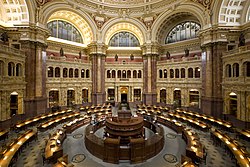
[edit]The Thomas Jefferson Building is located between Independence Avenue and East Capitol Street on First Street SE. Construction began in 1890 with granite supplied by New England Granite Works, owned by James G. Batterson.[102] The building opened in 1897 as the main building of the library and is the oldest of the three buildings. Known originally as the Library of Congress Building or Main Building, it took its present name on June 13, 1980.[103]
John Adams Building
[edit].jpg)
The John Adams Building is located between Independence Avenue and East Capitol Street on 2nd Street SE, the block adjacent to the Jefferson Building. The building was originally known as The Annex to the Main Building, which had run out of space. It opened its doors to the public on January 3, 1939.[104] Initially, it also housed the U.S. Copyright Office which moved to the Madison building in the 1970s.
James Madison Memorial Building
[edit]
The James Madison Memorial Building is located between First and Second Streets on Independence Avenue SE. The building was constructed from 1971 to 1976, and serves as the official memorial to James Madison, a Founding Father and the fourth President of the United States[105]
The Madison Building is also home to the United States Copyright Office and to the Mary Pickford Theater, the "motion picture and television reading room" of the Library of Congress. The theater hosts regular free screenings of classic and contemporary movies and television shows.[106]
Packard Campus for Audio-Visual Conservation
[edit]
Founded in 2007 and located in Culpeper, Virginia in Northern Virginia, the National Audio-Visual Conservation Center is the Library of Congress's newest building.[107] It was constructed out of a former Federal Reserve storage center and Cold War bunker. The campus is designed to act as a single site to store all of the library's movie, television, and sound collections. It is named in honor of David Woodley Packard, whose Packard Humanities Institute oversaw the design and construction of the facility. The centerpiece of the complex is a reproduction Art Deco movie theater that presents free movie screenings to the public on a semi-weekly basis.[108]
Copyright Act
[edit]The Library of Congress, through both the librarian of Congress and the register of copyrights, is responsible for authorizing exceptions to Section 1201 of Title 17 of the United States Code as part of the Digital Millennium Copyright Act. This process is done every three years, with the register receiving proposals from the public and acting as an advisor to the librarian, who issues a ruling on what is exempt. After three years have passed, the ruling is no longer valid and a new ruling on exemptions must be made.[109][110]
Access
[edit]The library is open for academic research to anyone with a Reader Identification Card. One may not remove library items from the reading rooms or the library buildings. Most of the library's general collection of books and journals are in the closed stacks of the Jefferson and Adams Buildings; specialized collections of books and other materials are in closed stacks in all three main library buildings, or are stored off-site. Access to the closed stacks is not permitted under any circumstances, except to authorized library staff, and occasionally, to dignitaries. Only the reading room reference collections are on open shelves.[111]
Since 1902, American libraries have been able to request books and other items through interlibrary loan from the Library of Congress if these items are not readily available elsewhere. Through this system, the Library of Congress has served as a "library of last resort", according to Herbert Putnam, the Librarian of Congress from 1899 to 1939.[37] The Library of Congress lends books to other libraries with the stipulation that they be used only inside the borrowing library.[112] In 2017, the Library of Congress began development on a reader's card for children under the age of sixteen.[113]
Standards
[edit]In addition to its library services, the Library of Congress is actively involved in various standard activities in areas related to bibliographical and search and retrieval standards. Areas of work include MARC standards, Metadata Encoding and Transmission Standard (METS), Metadata Object Description Schema (MODS), Z39.50 and Search/Retrieve Web Service (SRW), and Search/Retrieve via URL (SRU).[114] The Law Library of Congress "seeks to further legal scholarship by providing opportunities for scholars and practitioners to conduct significant legal research. Individuals are invited to apply for projects which would further the multi-faceted mission of the law library in serving the U.S. Congress, other governmental agencies, and the public."[115]
Annual events
[edit]Notable personnel
[edit]- Henriette Avram: Developed the MARC format (Machine Readable Cataloging), the international data standard for bibliographic and holdings information in libraries.
- John Y. Cole: founder of the Center for the Book and first historian of the Library of Congress.
- Cecil Hobbs: American scholar of Southeast Asian history, head of the Southern Asia Section of the Orientalia (now Asian) Division of the Library of Congress, and a major contributor to scholarship on Asia and the development of South East Asian coverage in American library collections.[116]
- Julius C. Jefferson Jr., head of the Congressional Research Service, president of the American Library Association (2020–2021), president of the Freedom to Read Foundation (2013–2016).
See also
[edit]
- Architecture of Washington, D.C.
- Documents Expediting Project
- Federal Research Division
- Feleky Collection
- Law Library of Congress
- Library of Congress Classification
- Library of Congress Country Studies
- Library of Congress Living Legend
- Library of Congress Subject Headings
- Minerva Initiative
- National Digital Library Program (NDLP)
- National Film Registry
- National Recording Registry
- National Archives and Records Administration
- United States Senate Library
Explanatory notes
[edit]References
[edit]- ^ "Year 2020 at a Glance". Library of Congress. 2020. Archived from the original on February 23, 2021. Retrieved November 5, 2021.
- ^ a b "2021 Annual Report of the Librarian of Congress" (PDF). Library of Congress. Archived (PDF) from the original on February 3, 2023. Retrieved December 2, 2022.
- ^ a b "Library of Congress". Encyclopædia Britannica. Archived from the original on April 5, 2020. Retrieved September 3, 2017.
- ^ a b c d "Fascinating Facts". Library of Congress. Archived from the original on April 5, 2020. Retrieved April 25, 2018.
- ^ a b "General Information". Library of Congress. Archived from the original on February 23, 2021. Retrieved January 28, 2023.
- ^ a b "Fascinating Facts – Statistics". Library of Congress. Archived from the original on April 5, 2020. Retrieved February 16, 2017.
- ^ "The Library of Congress: A Timeline | History of the Library of Congress | About the Library | Library of Congress". Library of Congress, Washington, D.C. 20540 USA. Retrieved September 4, 2024.
- ^ "FY 2019–2023 Strategic Plan of the Library of Congress". Library of Congress. Retrieved October 20, 2020.
- ^ a b Murray, Stuart. The Library: An Illustrated History (New York, Skyhouse Publishing, 2012): 155.
- ^ 2 Stat. 55
- ^ a b c d e f g h i j k l "Jefferson's Legacy: A Brief History of the Library of Congress". Library of Congress. March 6, 2006. Archived from the original on March 12, 2011. Retrieved January 14, 2008.
- ^ 2 Stat. 128
- ^ a b Murray, Stuart P. (2009). The library: an illustrated history. New York, NY: Skyhorse Pub. pp. 158. ISBN 9781602397064.
- ^ Greenpan, Jesse (August 22, 2014). "The British Burn Washington, D.C., 200 Years Ago". History.com. Archived from the original on January 8, 2021. Retrieved January 8, 2021.
- ^ Murray, Stuart (2009). The Library An Illustrated History. Chicago, Illinois: Skyhorse Publishing. p. 159.
- ^ Murray, Stuart (2009). The library : an illustrated history. New York, NY: Skyhorse Pub. ISBN 978-1-60239-706-4.
- ^ "Thomas Jefferson's personal library, at LibraryThing, based on scholarship". LibraryThing. Archived from the original on April 7, 2020. Retrieved November 4, 2012.
- ^ LibraryThing profile page for Thomas Jefferson's library Archived September 3, 2009, at the Wayback Machine, summarizing contents and indicating sources
- ^ "Jefferson's Library". Library of Congress. April 24, 2000. Archived from the original on March 22, 2015. Retrieved October 24, 2021.
- ^ a b Murray, Stuart P. (2009). The library : an illustrated history. Chicago: Skyhorse Pub. pp. 162. ISBN 9781602397064.
- ^ Murray, Stuart A.P. The Library: An Illustrated History. Skyhorse Publishing, 2012. 9781616084530, pp. 161
- ^ Murray, Stuart (2009). The Library: An Illustrated History. New York: Skyhorse Publishing. p. 162. ISBN 978-1-60239-706-4.
- ^ "H. Rept. 18–69 – Report of the Committee of Ways and Means, to whom was referred a resolution of the House of Representatives of 21st January, 1824, instructing said committee to inquire into the expediency of appropriating $5,000 for the use of the Library of Congress, accompanying a bill for effecting that object. February 24, 1824. Read, and, with the bill, committed to a Committee of the Whole House". GovInfo. U.S. Government Printing Office. Archived from the original on June 19, 2023. Retrieved June 19, 2023.
- ^ a b Cole, J.Y. (1993). Jefferson's Legacy: a brief history of the Library of Congress. Washington, D.C.: Library of Congress. p. 14.
- ^ Fineberg, Gail (June 2007). "Thomas Jefferson's Library". The Gazette. 67 (6). Library of Congress. Archived from the original on July 6, 2014. Retrieved January 4, 2015.
- ^ Cole, J.Y. (2005). "The Library of Congress Becomes a World Leader, 1815–2005". Libraries & Culture. 40 (3): 386. doi:10.1353/lac.2005.0046. S2CID 142764409.
- ^ Interior Library (August 4, 2015). "History of the Interior Library". U.S. Department for the Interior. Archived from the original on May 21, 2017. Retrieved April 30, 2018.
- ^ Smithsonian Institution (1904). An Account Of The Smithsonian: Its Origin, History, Objects and Achievements. Washington, D.C. p. 12.
{{cite book}}: CS1 maint: location missing publisher (link) - ^ Mearns, D.C. (1946). The Story Up to Now: The Library of Congress, 1800–1946. Washington, D.C.: Government Printing Office. p. 100.
- ^ Library of Congress. "Annual Report of the Librarian of Congress 1866" (PDF). U.S. Copyright Office. Archived (PDF) from the original on April 27, 2017. Retrieved April 30, 2018.
- ^ Gwinn, Nancy. "History". Smithsonian Libraries. Archived from the original on May 1, 2018. Retrieved April 30, 2018.
- ^ a b c d Library of Congress. "John G Stephenson". John G Stephenson – Previous Librarians of Congress. Archived from the original on April 21, 2018. Retrieved April 30, 2018.
- ^ Aikin, Jane (2010). "Histories of the Library of Congress". Libraries & the Cultural Record. 45 (1): 11–12. doi:10.1353/lac.0.0113. ISSN 1932-4855. JSTOR 20720636.
- ^ Weeks, Linton (December 13, 1999). "A Bicentennial for the Books". The Washington Post. Archived from the original on January 18, 2023. Retrieved October 3, 2021.
- ^ These included future Librarian of Congress Herbert Putnam and Melvil Dewey of the New York State Library.
- ^ U.S. Civil Service Commission, Women in the Federal Service (Washington, D.C.: Civil Service Commission, 1938), 3–6, 9.
- ^ a b "Interlibrary Loan (Collections Access, Management and Loan Division, Library of Congress)". Library of Congress website. October 25, 2007. Archived from the original on November 29, 2007. Retrieved December 4, 2007.
- ^ Snapp, Elizabeth (April 1975). "The Acquisition of the Vollbehr Collection of Incunabula for the Library of Congress". The Journal of Library History. 10 (2). University of Texas Press: 152–161. JSTOR 25540624. (restricted access)
- ^ Cole, John Y. "The James Madison Building (On These Walls: Inscriptions and Quotations in the Buildings of the Library of Congress, by John Y. Cole)". loc.gov. Archived from the original on February 7, 2011. Retrieved February 20, 2022.
- ^ a b c "Key Milestones of James H. Billington's Tenure | News Releases – Library of Congress". Loc.gov. Archived from the original on September 6, 2015. Retrieved September 22, 2015.
- ^ "American Memory from the Library of Congress – Home Page". Memory.loc.gov. Archived from the original on May 4, 1999. Retrieved September 22, 2015.
- ^ "Congress.gov | Library of Congress". congress.gov. Archived from the original on March 25, 2018. Retrieved September 22, 2015.
- ^ Oder, Norman. "First Lady Launches Book Festival." Library Journal 126, no. 14 (2001): 17
- ^ "2015 Book Festival | National Book Festival – Library of Congress". Loc.gov. Archived from the original on February 3, 2023. Retrieved September 22, 2015.
- ^ "The John W. Kluge Center – Library of Congress". Loc.gov. Archived from the original on September 20, 2015. Retrieved September 22, 2015.
- ^ "Founding Chairman | OpenWorld". openworld.gov. Archived from the original on September 5, 2015. Retrieved September 22, 2015.
- ^ "Veterans History Project (Library of Congress)". Loc.gov. Archived from the original on September 23, 2015. Retrieved September 22, 2015.
- ^ "Film Registry | National Film Preservation Board | Programs | Library of Congress". Library of Congress. Archived from the original on February 25, 2021. Retrieved March 25, 2022.
- ^ Dargis, Manohla (April 3, 2020), "Film Treasures, Streaming Courtesy of the Library of Congress" Archived April 14, 2020, at the Wayback Machine, The New York Times, with links to videos and collections, and on April 4, 2020, Section C, Page 1, New York edition with the headline: An Online Trove of Film Treasures
- ^ "Complete National Film Registry Listing". Library of Congress. Archived from the original on March 3, 2020. Retrieved March 25, 2022.
- ^ "Inside the Nuclear Bunker Where America Preserves Its Movie History". Wired. Archived from the original on September 12, 2015. Retrieved September 22, 2015.
- ^ "Gershwin Prize". Library of Congress. Archived from the original on September 20, 2015. Retrieved September 22, 2015.
- ^ "Fiction Prize". Library of Congress. Archived from the original on September 20, 2015. Retrieved September 22, 2015.
- ^ "Background – World Digital Library". wdl.org. Archived from the original on September 23, 2015. Retrieved September 22, 2015.
- ^ "National Jukebox LOC.gov". Loc.gov. Archived from the original on September 29, 2015. Retrieved September 22, 2015.
- ^ "NLS Home". Loc.gov. Archived from the original on September 23, 2015. Retrieved September 22, 2015.
- ^ "Thomas Jefferson's Library | Exhibitions – Library of Congress". loc.gov. April 11, 2008. Archived from the original on October 2, 2015. Retrieved September 22, 2015.
- ^ "All Exhibitions". Library of Congress. Archived from the original on September 16, 2015.
- ^ "2015 Junior Fellows Summer Intern Program Home (Library of Congress)". Loc.gov. Archived from the original on September 30, 2015. Retrieved September 22, 2015.
- ^ "Gateway to Knowledge – Educational Resources – Library of Congress". Loc.gov. Archived from the original on September 30, 2015. Retrieved September 22, 2015.
- ^ Grier, Peter (April 16, 2010). "Twitter hits Library of Congress: Would Founding Fathers tweet?". Christian Science Monitor. Archived from the original on October 30, 2014. Retrieved January 4, 2015.
- ^ Zimmer, Michael (2015). "The Twitter Archive at the Library of Congress: Challenges for information practice and information policy". First Monday. doi:10.5210/fm.v20i7.5619. Archived from the original on September 10, 2015. Retrieved November 3, 2015.
- ^ "Librarian of Congress gets a Due Date Archived February 2, 2021, at the Wayback Machine" by Maria Recio, McClatchy DC, Oct. 30. 2015
- ^ America's 'national library' is lacking in leadership, yet another report finds Archived October 11, 2020, at the Wayback Machine by Peggy McGlone, The Washington Post, March 31, 2015.
- ^ Weigel, George (June 12, 2015). "America's Next 'Minister of Culture': Don't Politicize the Appointment". National Review. Archived from the original on September 23, 2015. Retrieved September 22, 2015.
- ^ Hines, Shawnda (July 16, 2016). "Dr. Carla Hayden to serve as the next Librarian of Congress" (Press release). American Library Association. Archived from the original on December 30, 2018. Retrieved February 25, 2025.
- ^ "Enoch Pratt library names Gordon Krabbe acting CEO". The Baltimore Sun. August 11, 2016.
- ^ "ALA Past Presidents". American Library Association. Retrieved February 25, 2025.
- ^ "Carla Hayden Elected New American Library Association President". Jet. Johnson Publishing Company. May 27, 2002.
- ^ McGlone, Peggy (July 13, 2016). "Carla Hayden confirmed as 14th librarian of Congress". Washingtonpost.com. Archived from the original on March 2, 2017. Retrieved May 5, 2017.
- ^ "Carla Hayden to be sworn in on September 14 – American Libraries Magazine". Americanlibrariesmagazine.org. Archived from the original on May 10, 2017. Retrieved May 5, 2017.
- ^ "ARL Comments on the Dismissal of Dr. Carla Hayden from the Library of Congress". Association of Research Libraries. May 9, 2025. Retrieved May 10, 2025.
- ^ Hohl, Cindy (May 9, 2025). "ALA praises service of Dr. Carla Hayden, decries "unjust dismissal"". American Library Association. Retrieved May 10, 2025.
- ^ "Librarians-in-Residence –". The Library of Congress. Archived from the original on November 7, 2017. Retrieved November 7, 2017.
- ^ Budryk, Zack; Lillis, Mike; Coleman, Justine (January 6, 2021). "Capitol placed on lockdown, buildings evacuated amid protests". The Hill. Archived from the original on February 22, 2021. Retrieved January 8, 2021.
- ^ "Timeline: How a Trump mob stormed the US Capitol, forcing Washington into lockdown". USA Today. January 8, 2021. Archived from the original on January 24, 2021. Retrieved January 8, 2021.
- ^ @sarahnferris (January 6, 2021). "WOW Hill staff just got this alert "Madison: EVACUATE. Proceed to your designated assembly area. USCP"" (Tweet) – via Twitter.
- ^ Hayden, Carla (January 8, 2021). "Thoughts on this week's unrest" (PDF). The Library of Congress Gazette. 32. Archived (PDF) from the original on May 13, 2021. Retrieved May 17, 2021.
- ^ a b Banks, Adelle M. (February 14, 2023). "Library of Congress to highlight Muslim slave and scholar with $2.5 million grant". Religion News Service. Retrieved March 6, 2023.
- ^ "A Review of the Fiscal Year 2026 Budget Requests for the Library of Congress and the Architect of the Capitol". www.appropriations.senate.gov. United States Senate Committee on Appropriations. Retrieved May 10, 2025.
Hayden, Carla (May 6, 2025). "Statement of Carla Hayden The Librarian of Congress Before the Subcommittee on the Legislative Branch Committee on Appropriations United States Senate" (PDF). Retrieved May 10, 2025. - ^ "Full Committee Hearing: "Oversight of the Operations of the Library of Congress"". United States Committee on House Administration. May 6, 2025. Retrieved May 10, 2025.
- ^ Seung, Min Kim; Miller, Zeke; Mascaro, Lisa (May 9, 2025). "President Trump fires Librarian of Congress Carla Hayden". AP News. Retrieved May 10, 2025.
- ^ "President Trump fires Librarian of Congress Carla Hayden". Associated Press. May 10, 2025. Retrieved May 10, 2025.
- ^ op de Beeck, Nathalie (May 9, 2025). "Librarian of Congress Carla Hayden Fired by White House". Publishers' Weekly. Retrieved May 10, 2025.
- ^ Italie, Hillel, Firing, hiring and a mystery: The 225-year-old Library of Congress has never had a moment like this, The Associated Press, May 15, 2025
- ^ Tully-McManus, Katherine; Carney, Jordain; Cheney, Kyle (May 12, 2025). "Hill leaders question Trump's attempted Library of Congress takeover". Politico. Retrieved May 14, 2025.
- ^ Kim, Seung Min, Donald Trump’s Library of Congress fight is really about the separation of powers, Associated Press, May 16, 2025
- ^ Smith, Dylan, Fired Copyright Office Head Shira Perlmutter Sues Trump Administration Over ‘Blatantly Unlawful’ Dismissal, Digital Music News, May 23, 2025
- ^ "Rare Book and Special Collections Reading Room (Library of Congress)". Loc.gov. Archived from the original on May 6, 2017. Retrieved May 5, 2017.
- ^ Nga, Brett. "Gutenberg's Bibles— Where to Find Them". ApprovedArticles.com. Archived from the original on July 6, 2008. Retrieved April 1, 2008.
- ^ "Octavo Editions: Gutenberg Bible". octavo.com. Archived from the original on November 27, 2004.
- ^ "Europe (Library of Congress Rare Books and Special Collections: An Illustrated Guide)". Loc.gov. Archived from the original on April 7, 2020. Retrieved May 5, 2017.
- ^ "Comic Book Collection". The Library of Congress. August 27, 2020. Archived from the original on August 5, 2019. Retrieved August 27, 2020.
- ^ Annual Report of the Librarian of Congress (PDF), Library of Congress, 2009, archived from the original on April 5, 2017, retrieved December 30, 2017
- ^ "Mandatory Deposit". Copyright.gov. Archived from the original on July 26, 2006. Retrieved August 8, 2006.
- ^ Brittain, Blake (August 29, 2023). "US appeals court curbs Copyright Office's mandatory deposit policy". Reuters. Retrieved November 9, 2025.
- ^ Lyman, Peter; Varian, Hal R. (October 18, 2000). "How Much Information?" (PDF). Archived from the original (PDF) on August 16, 2011. Retrieved October 14, 2013.
10 Terabytes: The printed collection of the US Library of Congress
- ^ a b "Frequently Asked Questions | About This Program | Digital Collections Management Compendium | Programs | Library of Congress". Library of Congress, Washington, D.C. 20540 USA. Retrieved September 9, 2025.
- ^ "About Us". Snapshots of the Past. Archived from the original on May 14, 2016. Retrieved April 26, 2016.
- ^ David Gewirtz, So long, Thomas.gov: Inside the retirement of a classic Web 1.0 application Archived May 5, 2016, at the Wayback Machine, ZDNet (May 4, 2016).
- ^ Mazmanian, Adam (April 28, 2016). "Library of Congress to retire Thomas". Federal Computer Week. Archived from the original on June 7, 2016.
- ^ "Death List of a Day" (PDF). The New York Times. September 19, 1901. Retrieved September 19, 2024.
- ^ Cole, John (2008). "The Thomas Jefferson Building". On These Walls: Inscriptions and Quotations in the Buildings of the Library of Congress. Scala Arts Publishers Inc. ISBN 978-1857595451. Archived from the original on July 20, 2018. Retrieved April 23, 2018.
- ^ Cole, John (2008). "The John Adams Building". On These Walls: Inscriptions and Quotations in the Buildings of the Library of Congress. Scala Arts Publishers Inc. ISBN 978-1857595451. Archived from the original on July 20, 2018. Retrieved April 23, 2018.
- ^ Cole, John (2008). "The James Madison Memorial Building". On These Walls: Inscriptions and Quotations in the Buildings of the Library of Congress. Scala Arts Publishers Inc. ISBN 978-1857595451. Archived from the original on July 20, 2018. Retrieved April 23, 2018.
- ^ "Mary Pickford Theater Film Schedule". Moving Image Research Center. Library of Congress. Archived from the original on April 23, 2018. Retrieved April 23, 2018.
- ^ "The Packard Campus – A/V Conservation (Library of Congress)". Loc.gov. Archived from the original on May 6, 2017. Retrieved May 5, 2017.
- ^ "Library of Congress events listing". Loc.gov. Archived from the original on November 2, 2012. Retrieved November 4, 2012.
- ^ "Section 1201: Exemptions to Prohibition Against Circumvention of Technological Measures Protecting Copyrighted Works". United States Copyright Office. 2013. Archived from the original on August 6, 2009. Retrieved July 26, 2014.
- ^ "Statement Regarding White House Response to 1201 Rulemaking" (Press release). Library of Congress. 2013. Archived from the original on August 2, 2014. Retrieved July 26, 2014.
- ^ "Using the Library's Collections (Research and Reference Services, Library of Congress)". loc.gov. Archived from the original on February 23, 2022. Retrieved February 23, 2022.
- ^ "Subpage Title (Interlibrary Loan, Library of Congress)". Loc.gov. July 14, 2010. Archived from the original on November 4, 2012. Retrieved November 4, 2012.
- ^ "Adam Coffey, 8, of San Clemente Convinces Library of Congress to Initiate Children's Program". Picket Fence Media. October 26, 2017. Retrieved April 13, 2024.
- ^ "Standards at the Library of Congress". Loc.gov. Archived from the original on May 4, 2017. Retrieved May 5, 2017.
- ^ "Opportunities". Law Library of Congress. loc.gov.
- ^ Tsuneishi, Warren (May 1992). "Obituary: Cecil Hobbs (1907–1991)". Journal of Asian Studies. 51 (2): 472–473. doi:10.1017/s0021911800041607.
Architecture
[edit]- Cole, John Y. and Henry Hope Reed. The Library of Congress: The Art and Architecture of the Thomas Jefferson Building (1998) excerpt and text search
- Small, Herbert, and Henry Hope Reed. The Library of Congress: Its Architecture and Decoration (1983)
Further reading
[edit]- Aikin, Jane (2010). "Histories of the Library of Congress". Libraries & the Cultural Record. 45 (1): 5–24. doi:10.1353/lac.0.0113. S2CID 161865550.
- Anderson, Gillian B. (1989), "Putting the Experience of the World at the Nation's Command: Music at the Library of Congress, 1800–1917", Journal of the American Musicological Society, 42 (1): 108–49, doi:10.2307/831419, JSTOR 831419
- Bisbort, Alan, and Linda Barrett Osborne. The Nation's Library: The Library of Congress, Washington, D. C. (Library of Congress, 2000)
- Cole, John Young. Jefferson's legacy: a brief history of the Library of Congress (Library of Congress, 1993)
- Cole, John Young. "The library of congress becomes a world library, 1815–2005." Libraries & culture (2005) 40#3: 385–398. in Project MUSE
- Cope, R. L. "Management Review of the Library of Congress: The 1996 Booz Allen & Hamilton Report," Australian Academic & Research Libraries (1997) 28#1 online
- Mearns, David Chambers. The Story Up to Now: The Library of Congress, 1800–1946 (1947), detailed narrative
- Ostrowski, Carl. Books, Maps, and Politics: A Cultural History of the Library of Congress, 1783–1861 (2004)
- Rosenberg, Jane Aiken. The Nation's Great Library: Herbert Putnam and the Library of Congress, 1899–1939 (University of Illinois Press, 1993)
- Shevlin, Eleanor F.; Lindquist, Eric N. (2010). "The Center for the Book and the History of the Book". Libraries & the Cultural Record. 45 (1): 56–69. doi:10.1353/lac.0.0112. S2CID 161311744.
- Tabb, Winston; et al. (2003). "Library of Congress". Encyclopedia of Library and Information Science. 3: 1593–1612.
External links
[edit]


- The Library of Congress website (loc.gov)
- Library of Congress channel on YouTube
- Search the Library of Congress catalog
- Library Of Congress Meeting Notices and Rule Changes from The Federal Register RSS Feed
- Library of Congress photos on Flickr
- Works by Library of Congress at Project Gutenberg
- Works by or about Library of Congress at the Internet Archive
- Library of Congress at FamilySearch Research Wiki for genealogists
- . Encyclopedia Americana. 1920.
- Library of Congress documentary and resources on C-SPAN
- The Library of Congress National Library Service (NLS)
- Video: "Library of Congress in 1968 – Computer Automation" on YouTube from Computer History Archive Project
- Library of Congress Web Archives (Search by URL)
|  | |


| International | |
|---|---|
| National | |
| Geographic | |
| Academics | |
| Artists | |
| People | |
| Other | |
Library of Congress
View on GrokipediaHistory
Founding and Jefferson's Contribution (1800–1851)
The Library of Congress was established on April 24, 1800, when President John Adams signed an act of Congress that appropriated $5,000 for the purchase of books deemed necessary for congressional use, coinciding with the relocation of the federal government to Washington, D.C.[3] The initial collection focused on legal texts, legislative reports, and reference materials, totaling around 740 volumes by 1801, and was housed in a room within the U.S. Capitol.[3] In 1802, President Thomas Jefferson approved legislation designating the Librarian of Congress as a presidential appointee, personally selecting John J. Beckley and after him Patrick Magruder for the role; both also served as clerks of the House of Representatives, reflecting the library's modest early operations.[3] By 1814, the collection had grown to approximately 3,000 volumes, serving primarily as a legislative resource.[9] On August 24, 1814, during the War of 1812, British forces burned the Capitol, destroying the entire library collection.[3] In response, former President Thomas Jefferson offered to sell his personal library to Congress in September 1814, arguing that its breadth was essential since "there is, in fact, no subject to which a Member of Congress may not have occasion to refer."[9] After debate over the inclusion of non-legal works like fiction and poetry, Congress approved the purchase of 6,487 volumes for $23,950 on January 30, 1815.[9] The books, shipped from Monticello, more than doubled the library's holdings and introduced Jefferson's categorical classification system, expanding its scope beyond law to encompass philosophy, science, history, and literature.[9] Jefferson's contribution profoundly shaped the institution, establishing the principle of comprehensive acquisition for a national legislative library.[9] The collection grew steadily through acquisitions and donations in the ensuing decades, reaching over 50,000 volumes by the mid-19th century, though it remained understaffed and space-constrained in the Capitol.[3] This period of rebuilding and expansion ended abruptly on December 24, 1851, when a fire sparked by overturned gas lamps destroyed about 35,000 books, including two-thirds of Jefferson's volumes.[9]Mid-19th Century Setbacks and Rebuilding (1851–1865)
On December 24, 1851, a fire originating from a faulty flue in the room below ignited the Library of Congress's collection within the U.S. Capitol, destroying approximately 35,000 volumes—two-thirds of its 55,000-book holdings—and severely damaging the structure.[10] [11] This catastrophe eliminated most of Thomas Jefferson's donated library, leaving only about 20,000 volumes intact, and underscored vulnerabilities in the library's storage amid inadequate fire safeguards in the wooden Capitol environment.[10] The loss prompted congressional scrutiny of the institution's management and funding, revealing chronic underinvestment that had allowed the collection to stagnate relative to national needs.[12] In response, Congress allocated $72,500 for reconstruction and acquisitions, leading to the design of fireproof quarters by Capitol Architect Thomas U. Walter, featuring iron construction to prevent recurrence.[13] [14] These new facilities, dubbed the "largest iron room in the world," occupied the west central front of the Capitol and opened in 1853, enabling gradual restoration of operations with enhanced shelving for up to 150,000 volumes.[12] Efforts to rebuild the collection focused on replacing lost Jefferson titles through purchases and international exchanges, though fiscal conservatism limited growth; by the mid-1850s, holdings had recovered modestly via copyright deposits, which provided steady but uneven influxes of new publications.[15] The American Civil War (1861–1865) compounded setbacks, diverting resources and personnel amid threats to Washington, D.C., yet the library persisted under Librarian John G. Stephenson, appointed by President Abraham Lincoln in May 1861 as a political loyalist.[16] Stephenson, a physician from Indiana, balanced administrative duties with volunteer military service as an aide, exposing institutional reliance on underqualified appointees during crises.[17] He enlisted assistant Ainsworth Rand Spofford in 1864 to manage acquisitions, emphasizing copyright enforcement to bolster holdings amid wartime disruptions, which included sporadic Confederate threats to the Capitol but no direct damage to the library.[17] By Stephenson's resignation in July 1864, the collection had incrementally expanded through mandatory deposits, setting the stage for post-war acceleration, though annual budgets remained constrained at under $30,000.[16]Expansion under Ainsworth Spofford (1865–1897)
Ainsworth Rand Spofford, appointed acting Librarian of Congress in 1864 and confirmed in the permanent role shortly thereafter, initiated a period of transformative growth for the institution, shifting it from a modest legislative resource toward a comprehensive national library.[16] His tenure emphasized aggressive acquisition strategies, particularly through federal copyright mechanisms, which dramatically increased holdings and necessitated infrastructural changes.[18] A pivotal achievement was the centralization of U.S. copyright registration and deposit privileges at the Library under the Copyright Act of 1870, which Spofford championed to ensure steady influxes of books, periodicals, maps, prints, and other works.[3] [19] This reform, building on earlier deposits, fueled rapid expansion: the collection swelled from 99,000 volumes in 1864 to 293,000 by the early 1870s, with annual accretions exceeding prior totals due to mandatory submissions from publishers.[20] Between 1865 and 1870, Spofford secured congressional enactments broadening eligible deposit materials—including photographs in 1865—and enhancing public accessibility, thereby elevating the Library's role beyond congressional use to scholarly research.[21] [22] The ensuing overcrowding in Capitol basement quarters, exacerbated by copyright operations and general acquisitions, prompted Spofford to advocate persistently for a dedicated facility.[17] In 1871, he warned Congress of imminent space exhaustion; by 1873, he formally urged construction of a fireproof, standalone building to accommodate projected growth.[17] [23] Appropriations followed in 1873, with groundbreaking in 1886 and completion of the Thomas Jefferson Building in 1897, marking the Library's physical independence from the Capitol and symbolizing its elevated status.[17] [24] Spofford further diversified collections through international exchanges formalized in 1866 legislation and private donations, such as the 1882 gift of 38,000 volumes from physician Joseph M. Toner, establishing precedents for endowments.[21] [25] By 1897, these efforts had positioned the Library as a burgeoning repository of American intellectual output, though administrative strains from copyright duties foreshadowed future reorganizations.[26]Institutional Reorganization and Early 20th-Century Growth (1897–1939)
The opening of the Thomas Jefferson Building on November 1, 1897, marked a pivotal moment in the Library of Congress's development, coinciding with legislative reforms that enhanced its administrative autonomy and operational capacity.[10] The Legislative Branch Appropriations Act of 1898, enacted on February 19, 1897, more than doubled the Library's staff from approximately 42 to over 100 employees and established specialized divisions for copyright, law, manuscripts, and bibliography, centralizing authority under the Librarian of Congress and enabling systematic cataloging and service expansion.[27] These changes, overseen initially by Librarian John Russell Young, addressed longstanding overcrowding in the Capitol and positioned the institution for national-scale operations, with the new building's Italian Renaissance design accommodating up to 2 million volumes.[3] Young's tenure ended abruptly with his death in June 1899, after which Herbert Putnam, previously librarian of the Boston Public Library, was appointed by President William McKinley on April 5, 1899, initiating a 40-year era of professionalization and growth.[28] [29] Putnam, a trained lawyer and advocate for public access, prioritized a "universal collection" model, emphasizing comprehensive subject coverage over mere legislative utility, and introduced efficiencies like the Library of Congress Classification (LCC) system, with printed cards distributed nationally starting in 1902 to standardize shelving and retrieval.[3] Under his leadership, annual appropriations rose steadily, supporting staff expansion to over 1,000 by the 1920s and fostering bibliographic services that served libraries across the United States.[30] Collections expanded rapidly through mandatory copyright deposits—required since 1870 but more rigorously enforced post-1897—adding tens of thousands of items yearly, alongside targeted acquisitions such as the 1903 transfer of Continental Congress records and founding fathers' papers via executive order.[3] By the 1910s, the Library's volumes exceeded 2 million, bolstered by initiatives like the 1914 establishment of the Legislative Reference Service to provide nonpartisan research support to Congress, reflecting Putnam's balance of legislative mandates with broader scholarly utility.[3] World War I accelerated this trajectory, as the Library supplied informational resources to federal agencies, while interwar purchases, including the $1.5 million acquisition of the Otto H. Vollbehr collection in 1930—featuring a Gutenberg Bible—diversified holdings in rare books and incunabula.[10] The period culminated in physical expansion with the John Adams Building (initially the Annex), construction of which began in 1930 amid growing space constraints; it opened to the public on January 3, 1939, doubling storage capacity to approximately 4 million volumes and incorporating modern features like climate-controlled stacks.[10] Putnam's retirement later that year followed the creation of the Library of Congress Trust Fund Board in 1925, which formalized endowment management for acquisitions and preservation, ensuring fiscal independence amid federal budget fluctuations.[31] These developments transformed the Library from a congressional resource into a de facto national archive, with collections surpassing 5 million items by 1939, driven by deposit laws, purchases, and donations rather than diffusion to other institutions.[3]Balancing National and Legislative Mandates (1939–1987)
The tenure of Archibald MacLeish as Librarian of Congress from 1939 to 1944 marked a pivotal reorganization amid World War II, emphasizing the institution's role as a repository of democratic heritage while safeguarding national treasures like the Declaration of Independence and U.S. Constitution, which were relocated to Fort Knox for protection.[3] MacLeish, a poet appointed by President Franklin D. Roosevelt, shifted focus toward broader cultural and national functions, restructuring administrative divisions to enhance efficiency and public access, though this drew criticism from traditionalists for prioritizing intellectual leadership over conventional librarianship.[32] The opening of the John Adams Building (Annex) on January 3, 1939, provided expanded space for growing collections, underscoring the Library's evolving national mandate beyond strict congressional support.[10] Luther Harris Evans, serving from 1945 to 1953, bolstered legislative services through increased budgeting and specialization while advancing national and international cooperation, such as cooperative cataloging networks with other U.S. libraries.[33] The 1946 Legislative Reorganization Act formalized the Legislative Reference Service (LRS) as a permanent department with experts in 19 policy fields, reinforcing the Library's core role in nonpartisan congressional research.[10] Evans simultaneously pursued global outreach, laying groundwork for overseas acquisitions that positioned the Library as a de facto national institution, though fiscal constraints post-war highlighted ongoing tensions between resource allocation for Congress-specific needs and broader public benefits.[34] Under L. Quincy Mumford (1954–1974), the Library experienced explosive growth, with holdings surging from 10 million to 17 million items, staff expanding from 1,600 to 4,500, and the annual budget rising from $9.5 million to $116 million, driven by automation in cataloging and aggressive overseas procurement programs.[3] Public Law 480 in 1958 and the Higher Education Act of 1965 enabled systematic acquisition of foreign materials, enhancing national research capabilities, while the 1970 Legislative Reorganization Act upgraded LRS to the Congressional Research Service (CRS) for deeper policy analysis, maintaining legislative primacy.[10] Mumford defended the Library's legislative branch status in 1962 congressional hearings against proposals for independent national library governance, arguing that separation would undermine its integrated service to Congress without compromising national functions.[3] Daniel J. Boorstin, from 1975 to 1987, further accentuated public engagement and national visibility by establishing entities like the American Folklife Center and Center for the Book, while overseeing the 1980 opening of the James Madison Memorial Building, the third major facility, which alleviated space pressures from burgeoning national collections.[3] Boorstin's historian perspective modernized operations, securing 1984 funding for restoring the Jefferson and Adams Buildings and promoting exhibitions that bridged scholarly legislative support with widespread cultural access, though critics noted persistent underfunding strained the dual mandates amid rising congressional demands via CRS.[35] Throughout the era, the Library navigated fiscal and jurisdictional debates—evident in GAO reviews of its "ad hoc" national role—prioritizing empirical expansion over ideological shifts, with legislative services comprising core funding justification amid national growth.[36]Digitization Era under James Billington (1987–2015)
James H. Billington, appointed as the 13th Librarian of Congress on September 14, 1987, prioritized expanding public access to the Library's collections through digital means, envisioning broader dissemination of its resources beyond physical walls.[37] His tenure marked a shift toward integrating technology, building on earlier experiments but accelerating efforts amid the internet's rise, with initiatives aimed at democratizing historical and cultural materials.[38] By fostering partnerships with universities, libraries, and government entities, Billington oversaw the creation of online platforms that handled billions of electronic transactions annually by the early 2000s.[39] A cornerstone was the American Memory project, launched in 1990, which evolved into the National Digital Library Program by 1994—a five-year effort to digitize and provide free online access to core American historical and cultural documents, including photographs, manuscripts, maps, and sound recordings.[40] This program, supported by congressional funding and collaborations, assembled millions of primary sources, emphasizing preservation and public education while stimulating demand for complementary physical research.[41] Under Billington's direction, it laid groundwork for sustained digital growth, with the Library's web services expanding to include specialized exhibits and thematic collections by the late 1990s.[37] Complementing cultural digitization, Billington advanced legislative transparency via THOMAS, an online system debuted on January 5, 1995, named for Thomas Jefferson and offering public access to bills, resolutions, committee reports, and congressional records dating back to the 101st Congress.[42] Administered by the Library, THOMAS integrated with the Legislative Information System, enabling keyword searches and tracking of legislative processes, which by the 2010s served millions of users before transitioning to Congress.gov in 2012.[43] This initiative aligned with Billington's mandate to support Congress while extending services to citizens, processing vast data volumes without compromising the Library's nonpartisan role.[44] Internationally, Billington proposed the World Digital Library in a June 2005 address to the U.S. National Commission for UNESCO, aiming to create a multilingual digital repository of global cultural heritage.[45] Launched in 2009 through Library-UNESCO partnerships with over 180 institutions, it aggregated digitized manuscripts, maps, rare books, and multimedia from diverse nations, reaching 10,000 items by 2014 with features for cross-cultural search and preservation.[46][47] These efforts under Billington transformed the Library into a pioneer of born-digital and retroactively digitized content, though challenges like storage constraints and funding persisted amid collection growth exceeding physical capacity.[48]Carla Hayden's Tenure and Digitization Advances (2016–2025)
Carla Hayden was confirmed by the U.S. Senate on July 13, 2016, and sworn in as the 14th Librarian of Congress on September 14, 2016, marking the first time a woman or African American held the position.[49] During her tenure, Hayden prioritized expanding public access to the Library's collections through technological innovation, stating in her inaugural address that "through the power of technology, we can connect people to the enduring truths and beauty in the Library's collections."[50] She launched initiatives to modernize the institution's digital infrastructure, addressing longstanding IT challenges identified in a 2015 Government Accountability Office audit by implementing significant upgrades to systems and networks.[51] A core focus was accelerating digitization to make the Library's vast holdings—encompassing over 170 million items—available online to a global audience.[52] In 2019, Hayden approved a five-year strategic plan for expanding digital collecting, which broadened the Library's mandate to acquire and preserve born-digital content such as websites, social media, and electronic publications, ensuring comprehensive representation of contemporary cultural records.[53] This effort included partnerships with tech companies and public crowdsourcing campaigns under the "Of the People" initiative, launched to solicit contributions from underserved communities, including Black, Indigenous, Hispanic, and rural populations, thereby enhancing the diversity of digital archives.[54] Hayden's leadership also advanced audiovisual preservation through enhanced digitization at facilities like the National Audiovisual Conservation Center, converting analog films, recordings, and photographs into stable digital formats to combat deterioration.[55] These projects resulted in millions of new digital items added to the Library's online portal, with improved metadata and search functionalities facilitating researcher access without physical visits.[56] Outreach extended to virtual exhibitions and educational programs, reaching online and rural users via collaborations with schools and libraries nationwide.[57] Her tenure concluded on May 8, 2025, following her dismissal by President Donald Trump, amid disputes over content selection and institutional priorities.[58]2025 Leadership Transition and Governance Disputes
On May 8, 2025, President Donald Trump dismissed Carla Hayden from her position as the 14th Librarian of Congress via a two-sentence email, approximately one year before the scheduled end of her 10-year term in 2026.[59][60] Hayden, appointed by President Barack Obama in 2016 and confirmed by the Senate, was the first woman and first African American to hold the role, overseeing advancements in digitization and public access during her tenure.[60] The abrupt removal, without public explanation from the administration, drew criticism from library associations and Democratic lawmakers, who described it as unjust and politically motivated.[61][62] In response to Hayden's dismissal, the Library of Congress invoked its internal seniority regulations and succession rules, appointing Robert R. Newlen, a veteran staff member with decades of service, as acting Librarian.[63] Newlen, formerly associate librarian for library services, assumed the role to maintain operational continuity amid the vacancy.[63] However, on May 12, 2025, the White House countered by designating Deputy Attorney General Todd Blanche as acting Librarian, asserting executive authority over the position.[64][65] Blanche, a Trump appointee and former defense attorney in high-profile cases, lacked prior library experience, prompting concerns from congressional oversight committees about potential disruptions to the institution's nonpartisan mandate.[64][66] The conflicting appointments ignited a governance dispute testing separation-of-powers boundaries, as the Librarian of Congress is a presidential appointee confirmed by the Senate but historically viewed as a lifetime position insulated from partisan shifts.[67][68] Democratic leaders, including Senate Minority Leader Chuck Schumer, argued that the executive overreach undermined Congress's constitutional oversight of the library, established under Article I to serve legislative needs.[69][70] Proposals emerged to reform the appointment process, granting Congress greater authority to select or approve successors, reflecting long-standing debates over the role's independence from executive influence.[69] Republicans defended the president's removal power, citing at-will federal employment precedents, though the library's unique status as a legislative support agency complicated the legal terrain.[67] Compounding the transition, on May 10, 2025, Shira Perlmutter, the Register of Copyrights and Director of the U.S. Copyright Office (a subordinate office within the Library), was also dismissed, raising alarms about ripple effects on copyright policy, intellectual property adjudication, and the library's role in digital preservation.[71][72] Stakeholders in publishing and academia warned that leadership instability could delay ongoing initiatives, such as H.R. 1234's push for efficient constitutional annotations, and erode the institution's credibility as a neutral repository.[72][73] By July 2025, Hayden had transitioned to the Andrew W. Mellon Foundation, where she continued advocating for library access, while the acting leadership limbo persisted without a permanent nominee announced.[60] The episode highlighted tensions between executive efficiency and legislative autonomy, with no resolution by late 2025.[68]Governance and Leadership
Constitutional Status and Appointment Process
The Library of Congress holds no explicit constitutional mandate but was created by statute through an act of Congress signed by President John Adams on April 24, 1800, which allocated $5,000 for acquiring books deemed necessary for congressional use in the new capital.[3] This establishment falls under Congress's implied powers in Article I, Section 8 of the U.S. Constitution, particularly the necessary and proper clause, to facilitate legislative functions such as research, record-keeping, and informed debate, without deriving from any direct textual provision for a national library.[74] As a legislative branch agency, the Library operates to support Congress's constitutional duties, including lawmaking and oversight, while its statutory framework grants Congress primary governance authority over operations, funding, and policy, distinct from executive or judicial branches.[75] The Librarian of Congress, the institution's chief administrator, is appointed through a process defined by federal statute rather than constitutional text. Initially, the role lacked a formalized mechanism, but an 1802 congressional act designated it as a presidential appointment, with the incumbent serving indefinitely at the President's discretion and without Senate involvement.[3] This arrangement persisted for over two centuries, treating the position akin to a lifetime tenure subject to presidential removal, which raised separation-of-powers concerns given the Library's legislative orientation.[76] Public Law 114-86, enacted on November 5, 2015, reformed the process to impose a fixed 10-year term, renewable at presidential discretion, with the nominee requiring Senate confirmation by majority vote. Codified at 2 U.S.C. § 136-1, this change mandates that appointees possess "professional qualifications" in library science or related fields, aiming to balance executive nomination with legislative oversight and mitigate potential politicization of the role.[77] The reform responded to criticisms of unchecked presidential influence, as evidenced by prior appointments and removals, though it has not eliminated debates over executive encroachments on legislative independence, particularly in contexts like copyright administration.[78]Key Librarians of Congress and Their Impacts
Ainsworth Rand Spofford, who served as Librarian of Congress from 1864 to 1897, fundamentally expanded the institution's scope and resources by centralizing U.S. copyright deposits at the Library, resulting in a collection growth from approximately 200,000 to over 1.1 million items during his tenure.[17] This policy, enacted through the Copyright Act of 1870, positioned the Library as a de facto national repository, compelling publishers to submit copies of new works and thereby ensuring comprehensive acquisition without reliance on purchases or donations alone.[30] Spofford also lobbied Congress for administrative reforms, including increased staffing and budget allocations that rose from $120,000 in 1865 to over $500,000 by 1897, enabling cataloging and reference services to support both legislative needs and public access.[79] Herbert Putnam, Librarian from 1899 to 1939, professionalized operations and elevated the Library's global standing by implementing the Library of Congress Classification system in 1901, which provided a subject-based organization superior to the Dewey Decimal for scholarly research and influenced academic libraries nationwide.[80] Under his leadership, the collections doubled to more than 5 million volumes, with expansions into maps, manuscripts, and music; he established the Legislative Reference Service in 1914 to deliver nonpartisan policy analysis to Congress, enhancing its role in governance.[28] Putnam created the Library's Trust Fund Board in 1925, securing private endowments that funded acquisitions like the 1926 purchase of the Vollbehr Incunabula Collection containing the Gutenberg Bible, ensuring financial independence from fluctuating congressional appropriations.[80] James H. Billington, who held the position from 1987 to 2015, spearheaded the transition to digital infrastructure, launching the National Digital Library program in 1994 that digitized over 5 million items by 1999 and laid the foundation for THOMAS (1995), an online legislative database accessed by millions annually.[81] His initiatives included the World Digital Library in 2009, partnering with 180 institutions to provide multilingual access to cultural heritage materials, and the expansion of the Packard Campus for audio-visual conservation, preserving over 2 million recordings.[82] Billington doubled analog holdings to 160 million items while integrating technology, such as the 1990s automation of cataloging, which improved retrieval efficiency for congressional researchers amid rising demands from a digitized era.[40] Carla Hayden, appointed in 2016 as the first woman and African American Librarian, advanced public engagement and accessibility by expanding experiential learning programs, including the 2019 Banned Books initiative that drew over 100,000 visitors, and by overseeing the digitization of 20 million additional items, making them freely available online to broaden national outreach beyond legislative priorities.[49] Her tenure emphasized community partnerships, such as collaborations with public libraries during the COVID-19 pandemic to distribute federal resources, though it also faced scrutiny for prioritizing diversity initiatives that some critics argued diverted focus from core preservation mandates.[56] Hayden's leadership culminated in heightened visibility for the Library's cultural role, with events like the 2020 virtual concerts reaching global audiences, before the 2025 transition amid governance debates.[49]Political Influences and Separation-of-Powers Debates
The appointment of the Librarian of Congress by the President with Senate confirmation, as stipulated in 2 U.S.C. § 136, has historically introduced executive branch influence into an institution primarily serving Congress's legislative needs, including research support and copyright administration. While Librarians have traditionally enjoyed de facto lifetime tenure without partisan interference, presidential selections have reflected administrative priorities, such as Herbert Putnam's 1899 appointment under President McKinley emphasizing efficiency reforms or Archibald MacLeish's 1939 selection by President Roosevelt amid New Deal-era expansions.[3] These choices underscore subtle political dynamics, where the executive's role in naming the head of a legislative agency can align the Library's direction with broader policy agendas, though overt partisanship has been rare due to the institution's nonpartisan mandate. Separation-of-powers debates intensified in the late 20th and early 21st centuries over the Librarian's authority, particularly regarding the U.S. Copyright Office, which operates under the Library but generates substantial fees—over $300 million annually by 2020—that fund non-appropriated activities.[83] Critics, including some legal scholars, argued that the Librarian's appointment of the Register of Copyrights without separate Senate confirmation violated the Appointments Clause, as the role exercises significant executive-like powers in rulemaking and adjudication affecting private rights. This tension peaked in cases like Perlmutter v. Librarian of Congress (2020 onward), where challenges questioned whether copyright functions inherently belong to the executive branch, given Article I's grant of copyright authority to Congress but the practical delegation to an appointee.[84] Proponents of reform contended that insulating the Copyright Office from presidential oversight better preserved congressional intent, while opponents viewed it as an evasion of accountability, potentially allowing unelected officials to shape industries like technology and media without electoral checks.[85] The inherent ambiguity in the Library's status—as a legislative support agency funded almost entirely by congressional appropriations yet headed by a presidential appointee—has fueled ongoing disputes about removal powers.[86] Absent explicit statutory language on tenure or dismissal, traditions held that Librarians served indefinitely, akin to independent agency heads, to shield operations from short-term political pressures.[87] However, assertions of at-will removal by the executive have clashed with congressional claims of oversight primacy, exemplified by bicameral resistance to perceived encroachments that could politicize collections or research neutrality.[88] Such conflicts highlight causal tensions: executive appointment ensures alignment with national policy but risks subordinating legislative tools to partisan ends, while congressional dominance might entrench bureaucratic inertia unmoored from broader democratic inputs. Legal resolutions remain unsettled, with courts weighing precedents like Humphrey's Executor v. United States (1935) on for-cause protections against the Library's unique hybrid nature.[89][78] These debates reflect deeper structural realities: the Library's $800 million-plus annual budget, derived from Congress, incentivizes legislative guardianship, yet its role in federal information policy invites executive interest, particularly in copyright disputes involving tech giants and content creators. Bipartisan lawmakers have periodically proposed reforms, such as term limits or joint congressional appointment, to mitigate influences, but none have advanced amid fears of gridlock or overreach.[90] Empirical evidence from past tenures shows minimal overt politicization—e.g., no documented censorship under varying administrations—but vulnerabilities persist, as control over vast archives (over 170 million items) could theoretically shape historical narratives or policy research.[6] Ultimately, the absence of clear constitutional delineation perpetuates friction, underscoring the need for statutory clarification to balance branches without compromising the Library's truth-preserving mission.[91]Collections and Holdings
Physical Collections Overview
The physical collections of the Library of Congress constitute the world's largest library holdings, totaling 178.2 million items as of fiscal year 2023.[7] These encompass printed materials, manuscripts, visual and cartographic resources, audiovisual formats, and other artifacts acquired primarily through copyright deposits under U.S. law, purchases, gifts, and exchanges.[7] The collections emphasize comprehensive coverage of American history, culture, and governance, alongside global scholarship, with mandatory deposit requirements ensuring ongoing expansion at rates exceeding 2 million items annually in recent years.[7] Key categories within the physical collections include:| Category | Approximate Items (2023) |
|---|---|
| Cataloged Books | 25.77 million |
| Nonclassified Print | 15.99 million |
| Manuscripts | 78.5 million |
| Maps | 5.8 million |
| Photographs | 15.7 million |
| Audio Materials | 4.3 million |
| Moving Images | 1.8 million |
| Sheet Music | 8.2 million |
| Microforms | 17.5 million |
| Posters/Prints/Drawings | 870,000 |
| Other (e.g., broadsides) | 1.4 million |
Digital Collections and Recent Milestones
The digital collections of the Library of Congress provide free public access to digitized portions of its holdings, including photographs, manuscripts, maps, sound recordings, moving images, sheet music, and newspapers, organized through thematic portals on loc.gov. These resources draw from the Library's universal collections, enabling remote research into American history, culture, and global materials without physical visitation. As of 2022, the digital holdings encompassed 21 petabytes of content across 914 million unique files, reflecting ongoing efforts to preserve and disseminate analog materials in born-digital formats.[92] Key initiatives include the National Digital Newspaper Program's Chronicling America portal, which aggregates digitized historic newspapers from 1770 to 1963, and web archiving efforts that have captured over 16,000 sites since the program's inception, preserving transient online content for scholarly analysis. The Library's Digitization Strategy for 2023–2027 prioritizes scalable scanning infrastructure, with a new Digital Scan Center opened in 2021 to boost image production and post-processing capabilities. These efforts support broader goals of enhancing discoverability amid growing data volumes, including partnerships for collaborative digitization.[93][94][95] Recent milestones underscore advancements in accessibility and infrastructure. On June 30, 2025, the Library launched the Collections Access Platform, an open-source system based on FOLIO software developed with EBSCO Information Services, replacing outdated cataloging and acquisition tools to improve search facets, e-resource integration, and user interfaces. This rollout followed phased implementations, including acquisitions in October 2024 and e-resources in December 2024, culminating in expanded support for Congressional Research Service and National Library Service users by early June 2025. Complementing this, on August 4, 2025, Chronicling America transitioned to a redesigned interface with enhanced search, accessibility features, and backend stability, automatically redirecting users from the legacy site. In parallel, the LOCal initiative, announced August 5, 2025, fosters multiyear collaborations with public libraries to co-create digital experiences, broadening engagement with collections through community-driven tools and interfaces. These developments align with storage architecture discussions held in May 2025, addressing long-term preservation of expanding digital assets.[96][97][98][99]Congressional Research and Specialized Holdings
The Congressional Research Service (CRS), a division of the Library of Congress, functions as the primary research arm supporting the U.S. Congress by delivering objective, nonpartisan policy and legal analysis exclusively to its members and committees.[100] Established originally as the Legislative Reference Service in 1914 and reorganized and renamed CRS in 1970, it provides timely, confidential assistance throughout the legislative process, including bill drafting, issue briefs, and in-depth reports on topics ranging from domestic policy to international affairs.[101] CRS employs approximately 600 staff, including analysts, attorneys, and information specialists organized into subject-specific divisions such as American Law, Foreign Affairs, Defense, and Resources, Science, and Industry, enabling comprehensive coverage of legislative needs without public dissemination of most products to maintain confidentiality.[100] CRS leverages the Library's extensive collections to produce its analyses, drawing on primary sources like statutes, case law, and historical documents to inform congressional decision-making.[102] Its reports, while not publicly released by CRS itself, become accessible through congressional offices or platforms like Congress.gov, where over 20,000 CRS products have been cataloged as of 2023, covering legislative histories, economic impacts, and scientific assessments.[102] This service underscores the Library's constitutional mandate under Article I, Section 8 to support Congress's informational needs, with CRS handling thousands of requests annually from lawmakers seeking data-driven insights free from partisan influence.[2] Complementing CRS efforts, the Library maintains specialized holdings tailored for congressional research, notably the Law Library of Congress, which houses the world's largest legal collection exceeding 2.9 million volumes as of 2023, including comprehensive U.S. congressional publications from the nation's founding.[6] This repository features one of the finest rare law book collections globally and the most complete set of foreign, international, and comparative legal gazettes available in the United States, enabling detailed analysis of precedents, treaties, and regulatory frameworks critical to legislation.[6] Additionally, the Library's Government Publications Section curates extensive federal documents, including the U.S. Serial Set—a chronological compilation of congressional reports and debates spanning from 1817—and bound Congressional Records, providing lawmakers with historical and evidentiary context for policy formulation.[103] These holdings extend to niche areas like the Veterans History Project, established by Congress in 2000 and administered through the American Folklife Center, which has amassed over 100,000 oral histories and artifacts from military veterans, including congressional veterans, to inform defense and veterans' affairs legislation.[6] Such resources ensure Congress accesses unparalleled depth in empirical data, from legislative archives to specialized manuscripts, fostering informed deliberation while CRS synthesizes them into actionable intelligence.[104]Facilities and Infrastructure
Thomas Jefferson Building
The Thomas Jefferson Building serves as the flagship structure of the Library of Congress, housing administrative offices, public exhibition spaces, and key reading rooms. Construction commenced in 1888 following congressional approval in 1886 to address overcrowding in the U.S. Capitol, where the library's collections had expanded beyond capacity after earlier destructions by fire in 1814 and 1851.[105][106] Designed initially by architects John L. Smithmeyer and Paul J. Pelz, who won a 1873 competition, the building exemplifies Italian Renaissance Revival architecture with Beaux-Arts ornamentation, featuring elaborate facades of granite and 15 varieties of marble, bronze elements, and gilded accents.[23][14][105] Paul J. Pelz supervised construction, while Edward Pearce Casey oversaw interior designs, incorporating sculptures, murals, and mosaics by artists such as Elihu Vedder and John White Alexander. The structure spans approximately 500 feet in length, with a central dome topped by a gilded Flame of Knowledge.[107][108][105] Opened to the public on November 1, 1897, amid rainy conditions, the building was immediately acclaimed as a monumental expression of American intellectual aspirations, often described as the nation's most beautiful public edifice at the time. Notable interior features include the Great Hall with its intricate ironwork and stained glass; the Main Reading Room, accommodating 18 researchers at octagonal desks under a 160-foot-high dome adorned with Vedder's thematic murals on governance; and exterior elements like the Court of Neptune fountain and sculpted bronze doors depicting intellectual pursuits.[105][109][108] Renamed the Thomas Jefferson Building in 1980 to honor the third president's donation of his personal library, which replenished collections post-1814 fire, it underwent a major $81.5 million restoration starting in 1984, addressing structural wear including dome regilding—copper sheeting had replaced original gold leaf in the 1930s—and preserving decorative elements through meticulous conservation.[3][12][23] Today, it symbolizes the Library's role as a repository of knowledge, hosting exhibits and serving scholars while embodying neoclassical ideals of enlightenment and progress.[105]John Adams Building
The John Adams Building, the second structure erected for the Library of Congress, was authorized by Congress in 1928 with the purchase of land immediately east of the Thomas Jefferson Building to accommodate the institution's expanding collections.[110] Construction commenced following appropriations in 1930 and 1935, totaling $8,226,457, and was completed on December 2, 1938, under the supervision of Architect of the Capitol David Lynn.[110] Designed by the firm Pierson & Wilson with Alexander Buel Trowbridge as consulting architect, the building opened to the public on January 3, 1939, initially housing the Card Division and tripling the Library's shelving capacity.[111] [110] Intended as a functional annex rather than an ornate monument, the structure embodies stripped classicism with Art Deco influences, including streamline classicism and decorative cubism elements.[111] Its exterior features white Georgia marble cladding, while the interior incorporates modern materials such as acoustical blocks, Formica, vitrolite, and glass tubing for efficiency.[111] The design prioritizes utility, comprising a central bookstack encircled by workspaces, with five stories above ground—the fifth set back 35 feet—and connected to the Jefferson Building via an underground tunnel.[110] Upon completion, it provided 180 miles of shelving across 12 tiers from basement to fourth floor, each tier offering approximately 13 acres of shelf space, sufficient for 10 million volumes.[111] [110] Originally designated simply as the "Annex," the building was renamed the John Adams Building on June 24, 1980, in honor of President John Adams, who on April 24, 1800, signed the act establishing the Library of Congress by appropriating $5,000 for its initial collection.[111] This renaming underscores Adams's foundational role in the institution's creation amid early debates over federal support for intellectual resources.[3] Today, the John Adams Building primarily serves as a storage facility for portions of the Library's general collections, housing over 12 million volumes in its stacks, and supports operational divisions including cataloging and reference services.[30] It features specialized spaces such as the South Reading Room, adorned with murals by Ezra Winter, and continues to facilitate research and administrative functions integral to the Library's mission.[110] The structure's advanced features for its era, including air-conditioning, elevators, and pneumatic tubes, reflected a shift toward pragmatic modernism in federal architecture.[112]James Madison Memorial Building
The James Madison Memorial Building, the third structure in the Library of Congress complex on Capitol Hill, serves as both a functional library facility and an official memorial to Founding Father and fourth U.S. President James Madison.[113] Construction began with excavation in June 1971 and concluded in 1976, with dedication ceremonies on April 24, 1980, followed by public opening on May 28, 1980.[114] At 2,100,000 square feet, it is the largest library building in the world and an unusual blend of monumental symbolism and practical space for expanding collections.[114] Designed by the architectural firm DeWitt, Poor, and Shelton Associates, the building features a modernist exterior with precast concrete panels and a prominent bronze sculptural screen titled A Cascade of Books by Frank Eliscu, installed in 1983 and rising five stories above the main entrance.[113] The design prioritizes utility over ornate decoration, contrasting with the neoclassical Thomas Jefferson Building, while incorporating secure underground storage for presidential papers and other archives.[115] Initial plans approved in 1965 estimated costs at $75 million, but the project faced overruns typical of large federal constructions.[116] The building primarily houses the Law Library of Congress, which holds over 2.9 million volumes on legal topics from around the world as of recent inventories, along with the Copyright Office and the Congressional Research Service.[117] Key facilities include the Manuscript Reading Room, Geography and Map Division Reading Room, Newspaper and Current Periodical Reading Room, and the National Digital Library Learning Center, supporting specialized research for Congress, scholars, and the public.[117] Its opening enabled renovations to older Library structures and addressed space constraints from growing holdings in law, manuscripts, and periodicals.[118]Packard Campus for Audio-Visual Conservation
The Packard Campus of the National Audio-Visual Conservation Center, located in Culpeper, Virginia, serves as the Library of Congress's primary facility for the acquisition, preservation, and access to its audiovisual collections.[119] Spanning 45 acres at the foothills of the Blue Ridge Mountains, the campus opened in September 2007 following construction on a site previously used as a Federal Reserve storage bunker built in 1969.[120] [121] It houses the world's largest and most comprehensive repository of films, television programs, radio broadcasts, and sound recordings, totaling over 6.2 million items as of recent assessments.[122] Established through a partnership between the Packard Humanities Institute (PHI), the U.S. Congress, the Library of Congress, and the Architect of the Capitol, the facility received $155 million from PHI for design and construction, marking one of the largest private donations to the Library.[120] [123] The campus integrates traditional photochemical preservation techniques with advanced digital systems, enabling the reformatting of obsolete audiovisual formats dating back over a century.[122] Its 415,000-square-foot complex includes 90 miles of climate-controlled shelving, 35 vaults for safety film and videotape, and 124 specialized nitrate film vaults to mitigate degradation risks from highly flammable early motion picture stock.[119] Preservation efforts at the Packard Campus emphasize both analog duplication and robotic digitization, generating multiple petabytes of digital archives annually to safeguard deteriorating analog media against format obsolescence and environmental threats.[122] The collections encompass over 1.1 million moving image items from the 1890s onward and nearly 3.5 million sound recordings across formats like wax cylinders and magnetic tape.[122] Specialized labs support photochemical film-to-film transfers alongside digital scanning, while the facility extends services to external archives lacking such capabilities.[119] Public engagement occurs through the 205-seat Packard Campus Theater, which hosts year-round screenings of preserved materials, and occasional open houses demonstrating conservation processes.[119] The center also contributes to national initiatives, including the National Film Preservation Board and registries identifying culturally significant works for prioritized conservation.[122] By centralizing these operations away from Washington, D.C., the campus enhances long-term stewardship of America's audiovisual heritage amid growing collection sizes and technological demands.[119]Copyright Office Operations
Historical Role in Copyright Registration
The administration of U.S. copyright prior to 1870 involved decentralized registrations at federal district courts, established under the Copyright Act of 1790, with required deposits of copies that were often deposited locally or inconsistently forwarded to institutions like the Library of Congress or Smithsonian Institution.[18][22] An 1846 amendment mandated deposits to both the Library and Smithsonian, but this provision was repealed in 1859 amid complaints of burden, leaving the system fragmented and inefficient for national record-keeping.[18] The Copyright Act of 1870, signed into law by President Ulysses S. Grant on July 8, 1870, fundamentally altered this by centralizing all copyright registrations, record-keeping, and deposits under the Library of Congress, designating it as the sole national repository and eliminating district court involvement.[18][124][125] Librarian Ainsworth Rand Spofford, who had long advocated for reform to streamline processes and enrich the Library's holdings, influenced Congress to enact this consolidation, which required submitters to provide two copies of each registered work—one for the deposit archive and one potentially for public use.[124][126] This shift not only standardized procedures but also propelled the Library's collection growth, as deposited materials formed the core of its expanding American literature and creative output holdings, with over 100,000 items received in the first decade alone.[126][127] By the late 19th century, the volume of registrations strained Library resources, leading Congress in 1897 to formally establish the Copyright Office as a distinct department within the institution, complete with a dedicated Register of Copyrights appointed by the Librarian to oversee operations.[83][26] This separation enhanced administrative efficiency, enabling specialized handling of registrations, which by 1900 exceeded 30,000 annually, while continuing to supply the Library with mandatory deposits that bolstered its role as a comprehensive national archive.[83] The historical framework persisted through subsequent laws, such as the 1909 Copyright Act, which retained the Library's central role in registration and deposits, underscoring its dual function in legal administration and cultural preservation until major reforms in the 20th century.[128][129]Modern Challenges and Reforms
The U.S. Copyright Office has faced significant challenges in adapting to the digital economy, including the surge in online content creation, software registrations, and the complexities of digital rights management under the Digital Millennium Copyright Act (DMCA). These issues have strained administrative resources, with historical backlogs in processing physical deposits exacerbated by the COVID-19 pandemic, leading to delays in cataloging deposits received before on-site operations resumed in 2020.[130] By 2024, average processing times for all registration claims stabilized at 2.1 months, though the office still communicates with applicants on 25% of claims to resolve deficiencies, highlighting ongoing efficiency hurdles in handling high-volume digital submissions.[131] A prominent modern challenge involves artificial intelligence (AI), particularly the copyrightability of AI-generated works and the use of copyrighted materials in training generative AI models. The Copyright Office's multi-part study, initiated in 2023, examined these issues, concluding in Part 2 (released January 2025) that human authorship remains essential for copyright protection, rejecting proposals to extend protection to purely AI outputs without endorsing major legal changes.[132][133] This reflects broader tensions, as AI tools have proliferated, raising policy questions about infringement liability for training data and fair use defenses, with the office issuing registration guidance to clarify that AI-assisted works require substantial human input for eligibility.[134] Reforms have centered on technological modernization to address these pressures, including the development of the Enterprise Copyright System (ECS) for streamlined electronic filing and internal workflows. Launched incrementally since 2019, this system supports continuous IT updates, with an online recordation portal for copyright transfers opening to the public in August 2022, enabling self-service submissions without paper processing.[135][136] A comprehensive IT modernization plan, estimated at $165 million over five years, aims to upgrade legacy systems inherited from the pre-digital era, while the reauthorized Copyright Public Modernization Committee—renewed for a second three-year term in 2024—provides stakeholder input on user-facing improvements like deposit digitization and best-edition requirements for the Library's collections.[137] DMCA rulemaking has also seen reforms, such as expanded exemptions in 2024 for right-to-repair activities, including commercial food preparation equipment, to balance anti-circumvention rules with practical innovation needs amid digital device proliferation.[138] These efforts, informed by public consultations, demonstrate incremental adaptation, though critics argue that persistent funding constraints and legislative inertia—evident in stalled proposals like the Copyright Office for the Digital Economy (CODE) Act—limit full resolution of orphan works and mass-digitization challenges. Overall, while processing metrics have improved, the office's capacity to enforce copyrights in an AI-driven landscape remains tested, with ongoing studies underscoring the need for evidence-based policy evolution.[139]Cataloging Standards
Library of Congress Classification System
The Library of Congress Classification (LCC) is a subject-based classification system designed to organize the Library of Congress's vast collections of books, serials, and other materials by discipline and topic.[8] Developed internally to meet the institution's needs for detailed categorization, particularly in areas like American history, law, and government documents, LCC employs an alphanumeric notation that allows for hierarchical subdivision and expansion as knowledge grows. Unlike purely decimal systems, it prioritizes enumerative specificity for scholarly resources, enabling precise shelving in large research libraries.[140] Initiated in 1897 when the Library determined that existing schemes, such as the Dewey Decimal Classification, lacked sufficient granularity for its specialized holdings, LCC's creation was led by classifiers in the Catalog Division. The first schedule, covering Class E-F (History of the Americas), was printed between 1901 and 1902, with subsequent classes issued incrementally as cataloging demands arose; by the 1920s, the core structure was largely established.[141] This phased rollout reflected practical necessities rather than a preconceived universal outline, allowing adaptation to the Library's emphasis on legislative and historical materials.[8] Today, LCC encompasses 21 main classes, over 225 subclasses, and thousands of further divisions, maintained through ongoing revisions by the Library's Policy, Training, and Cooperative Programs Division.[140] LCC organizes knowledge into broad classes denoted by uppercase letters (A through Z, omitting I, O, W, X, and Y to avoid confusion with numerals or other symbols), followed by subclasses using letter combinations, decimal numbers for specific topics, and Cutter numbers (alphanumeric codes based on author or title) for individual works.[142] For example, a call number like QB981.3 .S57 2020 breaks down as QB (Astronomy subclass), 981.3 (cosmology subtopic), .S57 (Cutter for a specific author or title), and 2020 (publication year).[143] This structure supports both topical grouping on shelves and unique identification for retrieval, with geographic and temporal subdivisions often integrated via tables or auxiliary notations.[8] The main classes are as follows:| Class | Title |
|---|---|
| A | General Works |
| B | Philosophy, Psychology, Religion |
| C | Auxiliary Sciences of History |
| D | World History and History of Europe, Asia, Africa, Australia, New Zealand, etc. |
| E-F | History of the Americas |
| G | Geography, Anthropology, Recreation |
| H | Social Sciences |
| J | Political Science |
| K | Law |
| L | Education |
| M | Music and Books on Music |
| N | Fine Arts |
| P | Language and Literature |
| Q | Science |
| R | Medicine |
| S | Agriculture |
| T | Technology |
| U | Military Science |
| V | Naval Science |
| Z | Bibliography, Library Science, Information Resources (General) |