Hubbry Logo
ExcavataExcavataMain
Open search
Excavata
Community hub
Excavata
logo
8 pages, 0 posts
0 subscribers
Be the first to start a discussion here.
Excavata
Excavata
from Wikipedia

Excavates
Temporal range: Neoproterozoic–present
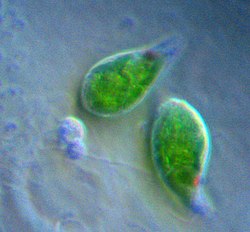
Giardia lamblia, a parasitic diplomonad
Scientific classificationEdit this classification
(obsolete as paraphyletic)
Domain: Eukaryota
(unranked): Excavata
(Cavalier-Smith), 2002
Groups included

See text

Cladistically included but traditionally excluded taxa

All of other Eukaryota

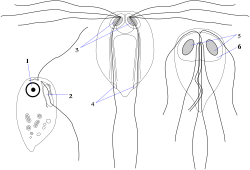
Three types of excavate cells. Top: Jakobida, 1-nucleus, 2-anterior flagellum, 3-ventral/posterior flagellum, 4-ventral feeding groove. Middle: Euglenozoa, 1-nucleus, 2-flagellar pocket/reservoir, 3-dorsal/anterior flagellum, 4-ventral/posterior flagellum, 5-cytostome/feeding apparatus. Bottom: Metamonada, 1-anterior flagella, 2-parabasal body, 3-undulating membrane, 4-posterior flagellum, 5-nucleus, 6-axostyle.

Excavata is an obsolete, extensive and diverse paraphyletic group of unicellular Eukaryota.[1][2] The group was first suggested by Simpson and Patterson in 1999[3][4] and the name latinized and assigned a rank by Thomas Cavalier-Smith in 2002. It contains a variety of free-living and symbiotic protists, and includes some important parasites of humans such as Giardia and Trichomonas.[5] Excavates were formerly considered to be included in the now- obsolete Protista kingdom.[6] They were distinguished from other lineages based on electron-microscopic information about how the cells are arranged (they have a distinctive ultrastructural identity).[4] They are considered to be a basal flagellate lineage.[7]

On the basis of phylogenomic analyses, the group was shown to contain three widely separated eukaryote groups, the discobids, metamonads, and malawimonads.[8][9][10][11] A current view of the composition of the excavates is given below, indicating that the group is paraphyletic. Except for some Euglenozoa, all are non-photosynthetic.

Characteristics

[edit]

Most excavates are unicellular, heterotrophic flagellates. Only some Euglenozoa are photosynthetic. In some (particularly anaerobic intestinal parasites), the mitochondria have been greatly reduced.[5] Some excavates lack "classical" mitochondria, and are called "amitochondriate", although most retain a mitochondrial organelle in greatly modified form (e.g. a hydrogenosome or mitosome). Among those with mitochondria, the mitochondrial cristae may be tubular, discoidal, or in some cases, laminar. Most excavates have two, four, or more flagella.[4] Many have a conspicuous ventral feeding groove with a characteristic ultrastructure, supported by microtubules—the "excavated" appearance of this groove giving the organisms their name.[3][6] However, various groups that lack these traits are considered to be derived excavates based on genetic evidence (primarily phylogenetic trees of molecular sequences).[6]

The Acrasidae slime molds are the only excavates to exhibit limited multicellularity. Like other cellular slime molds, they live most of their life as single cells, but will sometimes assemble into larger clusters.

Proposed group

[edit]

Excavate relationships were always uncertain, suggesting that they are not a monophyletic group.[12] Phylogenetic analyses often do not place malawimonads on the same branch as the other Excavata.[13]

Excavates were thought to include multiple groups:

Taxon Included taxa Representative genera (examples) Description
Discoba or JEH or Eozoa Tsukubea Tsukubamonas
Euglenozoa Euglena, Trypanosoma Many important parasites, one large group with plastids (chloroplasts)
Percolozoa Naegleria, Acrasis Most alternate between flagellate and amoeboid forms
Jakobea Jakoba, Reclinomonas Free-living, sometimes loricate flagellates, with very gene-rich mitochondrial genomes
Metamonada or POD Preaxostyla Trimastix, Paratrimastix Amitochondriate flagellates, either free-living (Trimastix, Paratrimastix) or living in the hindguts of insects
Fornicata Giardia, Carpediemonas Amitochondriate, mostly symbiotes and parasites of animals.
Parabasalia Trichomonas, Cochlosoma Amitochondriate flagellates, generally intestinal commensals of insects. Some human pathogens.
Anaeramoebidae Anaeramoeba Anaerobic protists with hydrogenosomes instead of mitochondria.
Malawimonada Malawimonadea Malawimonas, Imasa

Discobids or JEH clade

[edit]

Euglenozoa and Heterolobosea (Percolozoa) or Eozoa (as named by Cavalier-Smith[14]) appear to be particularly close relatives, and are united by the presence of discoid cristae within the mitochondria (superphylum Discicristata). A close relationship has been shown between Discicristata and Jakobida,[15] the latter having tubular cristae like most other protists, and hence were united under the taxon name Discoba, which was proposed for this supposedly monophyletic group.[1] This clade was defined as a node-based clade, receiving the definition "The least inclusive clade containing Jakoba libera (Ruinen, 1938) Patterson, 1990; Andalucia godoyi, Lara et al., 2006; Euglena gracilis Klebs 1883; and Naegleria gruberi (Schardinger, 1899) Alexeieff, 1912." Alternatively, the clade has been termed the jakobid, euglenozoan and heterolobosean group JEH.[16]

Metamonads

[edit]

Metamonads are unusual in not having classical mitochondria—instead they have hydrogenosomes, mitosomes or uncharacterised organelles. The oxymonad Monocercomonoides is reported to have completely lost homologous organelles. There are competing explanations.[17][18]

Malawimonads

[edit]

The malawimonads have been proposed to be members of Excavata owing to their typical excavate morphology, and phylogenetic affinity to other excavate groups in some molecular phylogenies. However, their position among eukaryotes remains elusive.[2]

Ancyromonads

[edit]

Ancyromonads are small free-living cells with a narrow longitudinal groove down one side of the cell. The ancyromonad groove is not used for "suspension feeding", unlike in "typical excavates" (e.g. malawimonads, jakobids, Trimastix, Carpediemonas, Kiperferlia, etc). Ancyromonads instead capture prokaryotes attached to surfaces. The phylogenetic placement of ancyromonads is poorly understood (in 2020), however some phylogenetic analyses place them as close relatives of malawimonads.[9]

Evolution

[edit]

Origin of the eukaryotes

[edit]

The conventional explanation for the origin of the eukaryotes is that a heimdallarchaeian or another Archaea acquired an alphaproteobacterium[19] as an endosymbiont, and that this became the mitochondrion, the organelle providing oxidative respiration to the eukaryotic cell.[20]

Caesar al Jewari and Sandra Baldauf argue instead that the eukaryotes possibly started with an endosymbiosis event of a Deltaproteobacterium or Gammaproteobacterium, accounting for the otherwise unexplained presence of anaerobic bacterial enzymes in Metamonada. The sister of the Preaxostyla within Metamonada represents the rest of the eukaryotes which acquired an Alphaproteobacterium. In their scenario, the hydrogenosome and mitosome, both conventionally considered "mitochondrion-derived organelles", would predate the mitochondrion, and instead be derived from the earlier symbiotic bacterium.[18]

Phylogeny

[edit]

In 2023, using molecular phylogenetic analysis of 186 taxa, Al Jewari and Baldauf proposed a phylogenetic tree with the metamonad Parabasalia as basal eukaryotes. Discoba and the rest of the Eukaryota appear to have emerged as sister taxon to the Preaxostyla, incorporating a single alphaproteobacterium as mitochondria by endosymbiosis. Thus the Fornicata are more closely related to e.g. animals than to Parabasalia. The rest of the eukaryotes emerged within the Excavata as sister of the Discoba; as they are within the same clade but are not cladistically considered part of the Excavata yet, the Excavata in this analysis is highly paraphyletic.[18]

"Hodarchaeales"[20]

Eukaryota

Parabasalia

Fornicata

Preaxostyla

Discoba
Neokaryotes

Amorphea (inc. animals, fungi)

SAR

Archaeplastida (inc. plants)

+ α‑proteobacterium
+ δ/γ‑proteobacterium
"Excavata"

The Anaeramoeba are associated with Parabasalia, but could turn out to be more basal as the root of a tree is often difficult to pinpoint.[21]

See also

[edit]
[edit]

References

[edit]
[edit]
Revisions and contributorsEdit on WikipediaRead on Wikipedia
from Grokipedia
Excavates are a diverse assemblage of predominantly unicellular eukaryotic microorganisms, traditionally united in the proposed supergroup Excavata based on shared morphological features such as a ventral feeding groove () and specialized cytoskeletal structures associated with flagella, though recent phylogenomic analyses indicate they form a paraphyletic or grade-like group rather than a strict . This group encompasses a wide range of lifestyles, including free-living heterotrophs, photosynthetic forms, and significant parasites that cause and animal diseases, with members inhabiting diverse environments from freshwater and marine habitats to the guts of hosts. Their metabolic diversity includes anaerobic adaptations, with organelles like hydrogenosomes or mitosomes replacing typical mitochondria in some lineages, reflecting adaptations to low-oxygen conditions. The excavates are broadly divided into three main clades: Metamonada, Discoba, and Malawimonadida, each exhibiting distinct ultrastructural and genetic traits. Metamonada includes anaerobic flagellates such as diplomonads (e.g., Giardia intestinalis, a common intestinal parasite causing in humans and wildlife) and parabasalids (e.g., , responsible for , a prevalent ). Discoba comprises euglenozoans (including photosynthetic species with chloroplasts acquired via secondary endosymbiosis and kinetoplastids like , the causative agent of African sleeping sickness) alongside heteroloboseans (e.g., the pathogenic , known for causing rare but fatal primary amoebic ) and jakobids, which possess the most gene-rich mitochondrial genomes among eukaryotes. Malawimonadida represents a smaller, enigmatic lineage of free-living flagellates with uncertain affinities but sharing excavate-like cytoskeletal features. Evolutionarily, excavates are positioned as one of the earliest-diverging eukaryotic lineages, with recent phylogenomic studies suggesting they may represent the ancestral state for eukaryotes or even straddle the root of the eukaryotic tree, influencing understandings of evolution and the last eukaryotic common ancestor (LECA). Their remains dynamic, driven by advances in multi-gene and genomic sequencing that challenge earlier morphological-based groupings, yet highlight their role in eukaryotic diversification and as models for studying endosymbiosis, anaerobiosis, and .

History and Taxonomy

Proposal and Definition

The excavate hypothesis was originally proposed by Alastair G.B. Simpson and David J. Patterson in 1999, based on ultrastructural similarities among certain heterotrophic protists, particularly the presence of a ventral feeding groove or "excavated" that facilitates . This groove, often associated with a distinctive cytoskeletal organization involving and flagella, was observed in diverse free-living and parasitic unicellular eukaryotes through electron microscopy studies. The proposal aimed to unify these organisms under a common morphological theme, highlighting their shared adaptations for feeding and locomotion. In 2002, Thomas Cavalier-Smith formalized as a major supergroup within his revised eukaryotic , designating it as one of six primary lineages alongside , Opisthokonta, , Chromalveolata, and . Cavalier-Smith emphasized not only the excavated groove but also shared cytoskeletal features, such as the ventral insertion of flagella and a reduced mitochondrial cristae morphology in some members, to support the group's coherence. This framework positioned as a diverse assemblage encompassing diplomonads (e.g., ), parabasalids (e.g., ), euglenids, and heteroloboseans, all linked by the unifying "excavated" morphology that suggested a common evolutionary origin. This proposal emerged amid broader shifts in eukaryotic taxonomy during the late and early , as electron microscopy revealed fine ultrastructural details and early molecular data from and protein sequences began challenging traditional kingdom-level classifications. These advances facilitated the recognition of supergroups as higher-level clades, moving away from Linnaean hierarchies toward phylogenetically informed groupings that integrated morphological and genetic . The thus represented a pivotal step in this transitional era of systematics.

Current Classification Status

Phylogenomic studies conducted after 2010 have increasingly demonstrated that Excavata is a paraphyletic assemblage rather than a monophyletic supergroup, rendering the taxon obsolete in contemporary eukaryotic classifications. Although earlier analyses, such as Hampl et al. (2009), supported its unity based on shared ultrastructural traits and molecular data from 143 proteins across 48 taxa, subsequent broader phylogenomic efforts revealed inconsistent clustering of its proposed subgroups, attributing prior monophyly signals to long-branch attraction artifacts or limited taxon sampling. Burki et al. (2020) synthesized these findings, concluding that Excavata lacks robust molecular support as a cohesive clade and should be dismantled, with its members redistributed across the eukaryotic tree based on multi-gene datasets emphasizing deep-branching positions. The former members of Excavata are now scattered into distinct lineages: Discoba, encompassing , Heterolobosea, and Jakobida, forms the monophyletic Discicristata and branches as a major deep-diverging group sister to other core eukaryotes; subgroups traditionally united as Metamonada, such as Fornicata (including diplomonads and retortamonads) and Parabasalia, emerge as separate anaerobic lineages often positioned near the eukaryotic root in anoxic-branching scenarios, suggesting within Metamonada; and Malawimonadida, a group of heterotrophic flagellates, aligns phylogenetically within or sister to , diverging from other excavate-like forms despite morphological similarities. This redistribution highlights how morphological convergence, such as the excavated feeding groove, masked underlying evolutionary . A pivotal 2023 phylogenomic by Al Jewari and Baldauf, utilizing 183 archaeal-origin proteins across 186 taxa including 31 excavates, reinforced Excavata's by recovering its four primary lineages—Parabasalia, Fornicata, Preaxostyla, and Discoba—as successive basal branches without forming a unified group, suggesting a paraphyletic root configuration for the tree. This study employed advanced site-heterogeneous models to mitigate compositional biases, placing the root between these excavate-derived branches and the remaining eukaryotes. These revisions have broader implications for eukaryotic supergroup frameworks, shifting from the six-supergroup model (including Excavata) to a more dynamic structure of five to nine major lineages as of 2025, such as (encompassing Opisthokonta and ) and (including and SAR clades), with excavate remnants integrated as independent deep branches rather than a singular entity. A 2025 study in further supports this excavate root, positioning it between the Opimoda and Diphoda assemblages based on a mitochondrial-targeted , with typical excavates branching on both sides of the root. This updated phylogeny underscores the primacy of genomic data in resolving early eukaryotic diversification under potentially anoxic conditions.

Shared Characteristics

Morphological Features

Excavata are characterized by a distinctive ultrastructural feature: an excavated ventral feeding groove, often referred to as a , which serves as a key site for particle ingestion and suspension-feeding. This groove typically runs along the ventral surface of the cell, facilitating the capture of prey or nutrients through directed water currents generated by flagella. In many members, such as jakobids and diplomonads, the groove is supported by specialized cytoskeletal structures and is integral to phagocytic processes, where particles are funneled toward the posterior end for engulfment. A typical flagellar configuration unites diverse excavates, featuring an anteriorly directed dorsal flagellum that propels swimming motion and a posterior ventral flagellum that beats within or along the groove to enable gliding over substrates and generate feeding currents. The posterior flagellum often bears vanes or mastigoneme-like structures, such as tape-like hairs, which enhance hydrodynamic efficiency and direct flow at frequencies of 25–50 Hz. This arrangement is evident in groups like retortamonads and heteroloboseans, where the posterior flagellum's beating creates a three-dimensional flow pattern that channels particles laterally into the ventral groove. Cytoskeletal elements, revealed through electron microscopy, provide structural reinforcement to the feeding apparatus across excavates. Prominent among these is the ventral filament, a microtubular root (often designated R1) that splits into inner and outer portions to support the groove's walls, as observed in jakobids like Reclinomonas americana. Striated fibrous roots, including the I fibre, B fibre, and C fibre, anchor basal bodies and stabilize flagellar insertion points; these are particularly well-developed in diplomonads such as Spironucleus and jakobids, contributing to the groove's rigidity during feeding. While excavates exhibit considerable diversity in overall cell morphology—from biflagellate, pear-shaped diplomonads like to multiflagellate, elongate parabasalids such as —they are unified by the ventral groove's central role in . This structure enables efficient prey clearance, with rates ranging from 0.24 × 10⁶ to 3.3 × 10⁶ µm³/s in studied , underscoring its adaptive significance despite variations in flagellar number and body form.

Cellular and Genetic Traits

Members of Excavata frequently exhibit an amitochondriate condition or possess modified mitochondria, such as hydrogenosomes in parabasalids like Trichomonas vaginalis and mitosomes in diplomonads like Giardia intestinalis, where essential mitochondrial functions are maintained but ATP production via is absent. These organelles represent reductive adaptations to anaerobic or microaerophilic environments, with hydrogenosomes generating ATP through and producing gas as a byproduct. In both cases, many mitochondrial genes have been transferred to the nuclear genome, relocating their expression and import of proteins back to the organelles via specialized targeting signals. High rates of endosymbiotic transfer from mitochondria to the nucleus have contributed to the reduction of genomes across Excavata. For instance, in the euglenozoan , the mitochondrial genome is highly streamlined, encoding only seven proteins and lacking typical tRNA s, with most mitochondrial functions supported by nuclear-encoded proteins imported from the . This gene relocation is a common pattern in the supergroup, reflecting evolutionary pressures for genome compaction in organelles adapted to low-oxygen niches. Genomic analyses of Excavata parasites reveal compact nuclear genomes with distinctive features, such as the ~11.7 Mb haploid of intestinalis, which is notably smaller than those of many free-living eukaryotes. This exhibits unusual scarcity, with early sequencing identifying only six cis-spliced introns, though recent annotations have expanded this to around 42, still far fewer than in typical eukaryotes that possess thousands. Post-2000 genome sequencing projects, including those for and related diplomonads, have highlighted these traits as adaptations to parasitic lifestyles, with reduced splicing machinery and reliance on trans-splicing for mRNA maturation. Biochemically, many Excavata species depend on as their primary energy pathway in anaerobic environments, bypassing the tricarboxylic acid cycle and . In metamonads such as those harboring hydrogenosomes, this includes the production of gas via [FeFe]-hydrogenases, facilitating balance under oxygen-limited conditions. These metabolic shifts underscore the supergroup's specialization for hypoxic habitats, often linked to the modified organelles that support fermentative processes.

Constituent Groups

Discoba

Discoba is a major within the proposed supergroup Excavata, comprising diverse unicellular eukaryotes characterized by their phylogenetic unity and distinctive ultrastructural features. It encompasses the subgroups , Heterolobosea (also known as Percolozoa), and Jakobida (including Tsukubamonadida), forming a assemblage supported by phylogenomic analyses of multiple protein-coding genes. This monophyly is reinforced by recent comprehensive datasets, such as those analyzed using the PhyloFisher framework, which recover Discoba as a robust group branching within broader eukaryotic trees. Discoba is often classified under the higher taxon Discicristata when emphasizing shared mitochondrial morphology, though the full clade includes jakobids with tubular cristae. A defining trait of Discoba is the presence of disc-shaped (discoidal) mitochondrial cristae, which differ from the tubular or flat forms seen in many other eukaryotes and likely represent an ancestral configuration adapted for efficient energy production in varied environments. In euglenozoans, particularly kinetoplastids, these cristae often house a kinetoplast—a unique mass of concatenated DNA networks within the that supports rapid replication and segregation during . This structural innovation correlates with the clade's metabolic versatility, including aerobic respiration and, in some cases, compartmentalized glycosomes for . The diversity of Discoba spans free-living, parasitic, and photosynthetic lifestyles, reflecting adaptations to aquatic and terrestrial habitats. , the largest subgroup, includes photosynthetic euglenids like Euglena gracilis, which possess secondary green plastids derived from and contribute to in freshwater ecosystems, as well as parasitic kinetoplastids such as Trypanosoma brucei, the causative agent of African sleeping sickness in humans and livestock. Heterolobosea are predominantly free-living amoeboflagellates, with species like Naegleria fowleri capable of opportunistic parasitism, invading the human brain via nasal entry in warm freshwater environments and causing primary amoebic . Jakobida, meanwhile, are bacterivorous flagellates such as Jakoba libera, notable for their unusually complex and gene-rich mitochondrial genomes that retain bacteria-like operons and over 60 protein-coding genes, providing insights into early mitochondrial evolution. Ecologically, discobids play key roles in nutrient cycling and food webs, particularly in freshwater, , and marine sediments where they act as predators of and or serve as prey for larger organisms. Their mix of autotrophy, heterotrophy, and underscores Discoba's evolutionary success, with free-living forms dominating oligotrophic waters and soils while parasitic members pose significant medical and veterinary challenges in tropical regions.

Metamonada

Metamonada is a major within the Excavata supergroup, comprising primarily anaerobic or microaerophilic unicellular eukaryotes adapted to low-oxygen environments. These organisms are characterized by the absence of classical mitochondria, instead possessing hydrogenosomes or mitosomes for energy production via , which generate ATP and hydrogen gas in oxygen-poor niches. Additionally, metamonads exhibit a reduced or absent Golgi apparatus, with dictyosomes often fragmented or not detectable by standard , reflecting their streamlined cellular organization for parasitic or symbiotic lifestyles. The clade is divided into three principal subgroups: Fornicata, Parabasalia, and Preaxostyla. Fornicata includes diplomonads such as Giardia lamblia, a flagellated parasite transmitted via contaminated water that causes , a diarrheal illness affecting the . Parabasalia encompasses parabasalids like Trichomonas vaginalis, which possesses multiple flagella arranged in a parabasal apparatus and causes , a estimated to result in approximately 156 million new cases annually worldwide among individuals aged 15–49 years. Preaxostyla comprises oxymonads and related forms, such as those in the genus Oxymonas, which are symbiotic gut inhabitants in lower , aiding in digestion through associations with prokaryotic symbionts. Metamonads are predominantly parasitic or commensal in animal hosts, including humans, , and , with limited free-living representatives. Their ecological roles often involve disrupting host mucosal barriers or facilitating breakdown in anaerobic guts, while medically, they contribute to significant morbidity; for instance, is linked to increased transmission risk and adverse outcomes. Phylogenomic analyses confirm Metamonada as a monophyletic group, potentially positioned near the base of the tree in recent studies, though its specific ties to other Excavata lineages remain under investigation. Shared genetic reductions, such as losses in mitochondrial import pathways, underscore their adaptation to anaerobiosis but are detailed elsewhere.

Other Proposed Members

Ancyromonadida comprises small, biflagellate gliding protists that employ for locomotion and feeding, often resembling amoeboflagellates in their bean-shaped morphology and in aquatic and soil environments. Although early classifications tentatively allied them with Excavata based on superficial ultrastructural similarities, such as flagellar insertion patterns, phylogenomic analyses using dozens of conserved genes have robustly positioned Ancyromonadida as a distinct lineage sister to or embedded within , excluding them from the Excavata core. This reclassification stems from multi-gene datasets demonstrating their closer affinity to , amoebozoans, and related groups, rather than to discobids or metamonads. Malawimonadida includes deep-branching, heterotrophic flagellates such as Malawimonas californiana and the recently described Gefionella okellyi, characterized by a ventral feeding groove and reduced mitochondrial organelles that retain a relatively gene-rich . Once considered potential excavates due to shared cytoskeletal elements like a striated root and flagellar vane, phylogenomic studies have variably placed them within , as a to or , or basal to other eukaryotes, with their inclusion in Excavata remaining debated as of 2025. Notably, their mitochondrial genes show similarities to those in jakobids (a discobid group), including high coding density and retention of bacterial-like operons, yet overall nuclear phylogenies confirm their distinct placement outside the core Excavata. Recent 2025 analyses, such as those using expanded phylogenomic datasets, continue to highlight uncertainty in their exact affinities, sometimes recovering them sister to Ancyromonadida or near the eukaryotic root. Historically, taxa such as Trimastix and Carpediemonas were included in broader Excavata proposals owing to their anaerobic metabolism, multiple , and ventral grooves suggestive of transitional forms between free-living and parasitic lifestyles. These genera, now reclassified under Preaxostyla (Trimastix) and Fornicata (Carpediemonas) within Metamonada, exhibit intermediate features like a recurrent flagellum for and cytopharyngeal rods that echo discobid morphologies while aligning molecularly with diplomonads and parabasalids. Their retention in Metamonada underscores the paraphyletic nature of early Excavata definitions, as they lack the full suite of shared apomorphies defining the monophyletic core. The primary reasons for excluding these groups from contemporary Excavata circumscriptions include the absence of the canonical ventral feeding groove and associated in Ancyromonadida and Malawimonadida, coupled with inconsistent molecular signals in phylogenies. Multi-gene analyses, such as a 2008 study employing 19 nuclear-encoded proteins across 72 eukaryotic lineages, revealed weak bootstrap support for Excavata as a cohesive and positioned these taxa as unstable outliers amid conflicting tree topologies. Subsequent phylogenomics have reinforced this instability, emphasizing Excavata's reduction to Discoba and Metamonada based on robust, shared genetic and ultrastructural synapomorphies, while groups like Malawimonadida are sometimes retained in broader proposals despite phylogenetic challenges.

Phylogeny

Early Hypotheses

The excavate hypothesis was first formally proposed in 1999 by Alastair G.B. Simpson and David J. Patterson, based on shared ultrastructural features observed through electron microscopy (EM), such as a ventral feeding groove and homologous flagellar arrangements, across diverse groups including diplomonads, retortamonads, and euglenids. Initial molecular support came from small subunit ribosomal RNA () phylogenies, which suggested clustering of these taxa near the base of the eukaryotic tree, reinforcing the ultrastructural homologies despite some inconsistencies in branching order. In 2002, Thomas Cavalier-Smith expanded the concept by elevating Excavata to kingdom rank within , incorporating the —a proposed group of amitochondriate protists like diplomonads and parabasalids—as primitive members that retained ancestral eukaryotic traits without secondary losses. This model positioned Excavata as a key lineage linking to the origins of eukaryotes, emphasizing the groove as a synapomorphy and as evidence for an early, pre-mitochondrial radiation of nucleated cells. By the mid-2000s, multi-gene analyses provided stronger evidence for Excavata's . For instance, a 2006 study using six protein-coding genes confirmed clustering of excavate representatives, aligning with patterns and . Culminating in a 2009 phylogenomic analysis of 143 genes across 48 taxa, Excavata emerged as a robust monophyletic supergroup, one of three primary eukaryotic divisions alongside Opisthokonta and a clade including , plants, and chromalveolates. However, these early hypotheses faced limitations, including heavy reliance on limited genetic markers like , which were prone to long-branch attraction artifacts that artificially grouped fast-evolving lineages such as diplomonads and euglenozoans. Multi-gene approaches up to 2009, while broader, still suffered from incomplete sampling and potential biases in gene selection, potentially overlooking heterotrophic excavates with divergent sequences.

Contemporary Analyses

Recent phylogenomic studies employing large-scale datasets have increasingly challenged the of Excavata, demonstrating that its constituent groups, such as Discoba and Metamonada, occupy distant positions in the . For instance, analyses utilizing datasets of over 120 nucleus-encoded proteins across hundreds of eukaryotic taxa, including more than 200 species, reveal inconsistent support for Excavata as a cohesive , with Discoba often aligning within the supergroup and Metamonada branching separately, potentially near the eukaryotic . These findings highlight Excavata's paraphyletic nature, attributing earlier perceptions of unity to long-branch attraction artifacts in smaller datasets or morphology-based classifications. The PhyloFisher framework, introduced in 2021, further corroborates this through a curated database of 240 protein-coding genes sampled from 304 eukaryotic taxa, enabling robust supermatrix and supertree analyses. In reconstructed phylogenies, Metamonada emerges as a monophyletic group positioned near the base of the eukaryotic tree, while Discoba clusters within the clade, underscoring their evolutionary separation and the artificiality of Excavata as a supergroup. This approach emphasizes ortholog selection and paralog identification to minimize contamination, yielding trees with high bootstrap support that refute monophyletic Excavata. A 2023 study analyzing 183 eukaryotic proteins of archaeal ancestry across 186 taxa provides additional evidence of Excavata's , positioning four major lineages—Parabasalia, Fornicata, Preaxostyla, and Discoba—as successive basal branches without forming a unified . This suggests an "Excavata-like grade" at the base, where these groups represent early-diverging forms rather than a monophyletic entity, with 100% bootstrap support for their individual branching points. A 2025 phylogenomic analysis using a of 93 proteins across 100 eukaryotic taxa, employing state-of-the-art phylogenetic models including site-heterogeneous substitution models, robustly roots the eukaryotic tree and reveals an excavate ancestry for the last eukaryotic common ancestor (LECA). The study confirms that excavate lineages branch early and successively at the base, supporting the paraphyletic "Excavata grade" hypothesis while providing high-confidence resolution of deep eukaryotic relationships. Methodological advancements in these post-2010 studies, such as site-heterogeneous substitution models (e.g., CAT-GTR in PhyloBayes), have been crucial for accommodating evolutionary rate variations and compositional heterogeneity, reducing systematic biases that previously obscured deep relationships. Additionally, the incorporation of rare genomic changes (RGCs), like gene fusions or indels unique to specific lineages, serves as independent markers to validate tree topologies and avoid long-branch artifacts, confirming the non-monophyly of Excavata across conflicting datasets.

Evolutionary Implications

Role in Eukaryote Origins

The Archezoa hypothesis, proposed by Cavalier-Smith in 1987, posited that certain amitochondriate eukaryotes, including diplomonads like Giardia within Excavata, represented primitive relics of a pre-mitochondrial eukaryotic ancestor that diverged before the endosymbiotic acquisition of mitochondria. This idea suggested that groups such as Metamonada and Parabasalia in Excavata lacked mitochondria due to their absence in the last eukaryotic common ancestor (LECA), positioning them as basal lineages in early eukaryote evolution. However, subsequent discoveries of mitochondrial remnant organelles, such as mitosomes in Giardia and hydrogenosomes in parabasalids, demonstrated that these lineages retained modified versions of the organelle, leading to the widespread rejection of the Archezoa hypothesis by the early 2000s. Hydrogenosomes, double-membrane-bound organelles found in several Excavata groups like Parabasalia, produce hydrogen and ATP under anaerobic conditions and have been shown to derive from alphaproteobacterial ancestors shared with canonical mitochondria. A 2023 phylogenomic analysis using reconstructions and gene content comparisons across diverse s confirmed that hydrogenosomes evolved from the same endosymbiotic alphaproteobacterium as mitochondria, likely soon after the initial endosymbiosis in an anaerobic host environment. This supports models of early eukaryote evolution where anaerobiosis persisted post-endosymbiosis, with hydrogenosomes representing adaptive modifications rather than independent origins, as evidenced by shared protein import machineries and biosynthetic pathways. Recent phylogenomic studies, including 2024 analyses of genomes from free-living metamonads, support Metamonada's early divergence near the base of the eukaryotic tree, highlighting their role in illuminating primitive eukaryotic traits such as extensive gene losses and a reduced splicing machinery lacking several spliceosomal proteins. Such reductions, including minimal presence, suggest Metamonada retain a simplified genetic architecture from early diversification, informing hypotheses on the minimal toolkit of LECA under hypoxic conditions. The diversity within Excavata, particularly the mitochondria of jakobids (a Discoba lineage), provides key insights into serial endosymbiosis models by preserving bacterial-like genomic features lost in most s. Jakobid mitochondrial genomes, such as that of Reclinomonas americana, encode 97 genes—including a multi-subunit and ribosomal proteins—mirroring the alphaproteobacterial more closely than any other known . This gene-rich state indicates limited gene transfer to the nucleus post-endosymbiosis, supporting scenarios where early mitochondrial retention of bacterial operons and machinery facilitated rapid host-symbiont integration during .

Ecological and Medical Importance

Excavata taxa occupy diverse ecological niches, ranging from free-living predators in aquatic and soil environments to symbiotic roles in host digestive systems. Free-living species such as amoebae thrive in warm freshwater bodies like lakes and rivers, where they function as bacterivores, significantly contributing to bacterial mortality and nutrient cycling in microbial communities. Symbiotic oxymonads, found in the hindguts of lower , play a crucial role in digestion by harboring bacterial endosymbionts that break down lignocellulose, enabling termites to process wood as a primary food source. These interactions highlight the group's integral position in both free-living and mutualistic ecosystems. Medically, Excavata includes several prominent parasites that pose significant global health burdens. Trypanosoma brucei subspecies cause human (sleeping sickness), with fewer than 1,000 cases reported annually since 2019 (as of 2024, 546 gambiense cases), primarily the chronic T. b. gambiense form affecting west and ; notable progress includes eliminations as a problem in (2024) and Kenya (2025). Giardia lamblia contaminates water sources worldwide, leading to , the most prevalent enteric protozoal infection, with estimates of over 1.1 million illnesses annually in the United States alone and higher burdens in developing regions due to poor . Trichomonas vaginalis is responsible for , the most common non-viral , with approximately 156 million new cases among individuals aged 15–49 in 2020. Excavata contributes to biodiversity by supporting primary production and microbial dynamics in various habitats. Euglenids like Euglena serve as primary producers in freshwater ponds and puddles, utilizing to form the base of aquatic food webs and occasionally forming blooms that influence . Heterolobosean amoebae participate in microbial loops, preying on to regulate community structure and facilitate nutrient turnover, particularly in bulk environments. Conservation challenges include the exacerbation of amoebic infections like those from due to , as rising water temperatures expand suitable habitats for this thermophilic pathogen. Additionally, excavate flagellates aid through predation on in systems, enhancing microbial community balance and pollutant degradation in treatment facilities.

References

Add your contribution
Related Hubs
User Avatar
No comments yet.