Hubbry Logo
logo
Pareto efficiency
Community hub

Pareto efficiency

logo
0 subscribers
Read side by side
from Wikipedia

In welfare economics, a Pareto improvement formalizes the idea of an outcome being "better in every possible way". A change is called a Pareto improvement if it leaves at least one person in society better off without leaving anyone else worse off than they were before. A situation is called Pareto efficient or Pareto optimal if all possible Pareto improvements have already been made; in other words, there are no longer any ways left to make one person better off without making some other person worse-off.[1]

In social choice theory, the same concept is sometimes called the unanimity principle, which says that if everyone in a society (non-strictly) prefers A to B, society as a whole also non-strictly prefers A to B. The Pareto front consists of all Pareto-efficient situations.[2]

In addition to the context of efficiency in allocation, the concept of Pareto efficiency also arises in the context of efficiency in production vs. x-inefficiency: a set of outputs of goods is Pareto-efficient if there is no feasible re-allocation of productive inputs such that output of one product increases while the outputs of all other goods either increase or remain the same.[3]

Besides economics, the notion of Pareto efficiency has also been applied to selecting alternatives in engineering and biology. Each option is first assessed, under multiple criteria, and then a subset of options is identified with the property that no other option can categorically outperform the specified option. It is a statement of impossibility of improving one variable without harming other variables in the subject of multi-objective optimization (also termed Pareto optimization).

History

[edit]

The concept is named after Vilfredo Pareto (1848–1923), an Italian civil engineer and economist, who used the concept in his studies of economic efficiency and income distribution.

Pareto originally used the word "optimal" for the concept, but this is somewhat of a misnomer: Pareto's concept more closely aligns with an idea of "efficiency", because it does not identify a single "best" (optimal) outcome. Instead, it only identifies a set of outcomes that might be considered optimal, by at least one person.[4]

Overview

[edit]

Formally, a state is Pareto-optimal if there is no alternative state where at least one participant's well-being is higher, and nobody else's well-being is lower. If there is a state change that satisfies this condition, the new state is called a "Pareto improvement". When no Pareto improvements are possible, the state is a "Pareto optimum".

In other words, Pareto efficiency is when it is impossible to make one party better off without making another party worse off.[5] This state indicates that resources can no longer be allocated in a way that makes one party better off without harming other parties. In a state of Pareto Efficiency, resources are allocated in the most efficient way possible.[5]

Pareto efficiency is mathematically represented when there is no other strategy profile s' such that ui (s') ≥ ui (s) for every player i and uj (s') > uj (s) for some player j. In this equation s represents the strategy profile, u represents the utility or benefit, and j represents the player.[6]

Efficiency is an important criterion for judging behavior in a game. In zero-sum games, every outcome is Pareto-efficient.

A special case of a state is an allocation of resources. The formal presentation of the concept in an economy is the following: Consider an economy with agents and goods. Then an allocation , where for all i, is Pareto-optimal if there is no other feasible allocation where, for utility function for each agent , for all with for some .[7] Here, in this simple economy, "feasibility" refers to an allocation where the total amount of each good that is allocated sums to no more than the total amount of the good in the economy. In a more complex economy with production, an allocation would consist both of consumption vectors and production vectors, and feasibility would require that the total amount of each consumed good is no greater than the initial endowment plus the amount produced.

Under the assumptions of the first welfare theorem, a competitive market leads to a Pareto-efficient outcome. This result was first demonstrated mathematically by economists Kenneth Arrow and Gérard Debreu.[8] However, the result only holds under the assumptions of the theorem: markets exist for all possible goods, there are no externalities, markets are perfectly competitive, and market participants have perfect information.

In the absence of perfect information or complete markets, outcomes will generally be Pareto-inefficient, per the Greenwald–Stiglitz theorem.[9]

The second welfare theorem is essentially the reverse of the first welfare theorem. It states that under similar, ideal assumptions, any Pareto optimum can be obtained by some competitive equilibrium, or free market system, although it may also require a lump-sum transfer of wealth.[7]

Pareto efficiency and market failure

[edit]

An ineffective distribution of resources in a free market is known as market failure. Given that there is room for improvement, market failure implies Pareto inefficiency.

For instance, excessive use of negative commodities (such as drugs and cigarettes) results in expenses to non-smokers as well as early mortality for smokers. Cigarette taxes may help individuals stop smoking while also raising money to address ailments brought on by smoking.

Pareto efficiency and equity

[edit]

A Pareto improvement may be seen, but this does not always imply that the result is desirable or equitable. After a Pareto improvement, inequality could still exist. However, it does imply that any change will violate the "do no harm" principle, because at least one person will be worse off.

A society may be Pareto efficient but have significant levels of inequality. For example, if there are three persons and a pie, the most equitable course of action would be to split the pie into three equal portions. By contrast, splitting the pie in half and giving each piece only to two individuals would be considered Pareto efficient, too, because the third person who receives no pie at all is nonetheless not any worse off than before the pie became available.

On a frontier of production possibilities, Pareto efficiency will happen. It is impossible to raise the output of products without decreasing the output of services when an economy is functioning on a basic production potential frontier, such as at point A, B, or C.

Pareto order

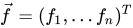
[edit]

If multiple sub-goals (with ) exist, combined into a vector-valued objective function , generally, finding a unique optimum becomes challenging. This is due to the absence of a total order relation for which would not always prioritize one target over another target (like the lexicographical order). In the multi-objective optimization setting, various solutions can be "incomparable"[10] as there is no total order relation to facilitate the comparison . Only the Pareto order is applicable:

Consider a vector-valued minimization problem: Pareto dominates if and only if:[11] : and We then write , where is the Pareto order. This means that is not worse than in any goal but is better (since smaller) in at least one goal . The Pareto order is a strict partial order, though it is not a product order (neither non-strict nor strict).

If[11] , then this defines a preorder in the search space and we say Pareto dominates the alternative and we write .
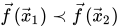
dominates in the Pareto order (which seeks to minimize the goals and ).
does not dominate in the Pareto order and does not dominate in the Pareto order (which seeks to minimize the goals and ).

Variants

[edit]

Weak Pareto efficiency

[edit]

Weak Pareto efficiency is a situation that cannot be strictly improved for every individual.[12]

Formally, a strong Pareto improvement is defined as a situation in which all agents are strictly better-off (in contrast to just "Pareto improvement", which requires that one agent is strictly better-off and the other agents are at least as good). A situation is weak Pareto-efficient if it has no strong Pareto improvements.

Any strong Pareto improvement is also a weak Pareto improvement. The opposite is not true; for example, consider a resource allocation problem with two resources, which Alice values at {10, 0}, and George values at {5, 5}. Consider the allocation giving all resources to Alice, where the utility profile is (10, 0):

  • It is a weak PO, since no other allocation is strictly better to both agents (there are no strong Pareto improvements).
  • But it is not a strong PO, since the allocation in which George gets the second resource is strictly better for George and weakly better for Alice (it is a weak Pareto improvement) – its utility profile is (10, 5).

A market does not require local nonsatiation to get to a weak Pareto optimum.[13]

Constrained Pareto efficiency

[edit]

Constrained Pareto efficiency is a weakening of Pareto optimality, accounting for the fact that a potential planner (e.g., the government) may not be able to improve upon a decentralized market outcome, even if that outcome is inefficient. This will occur if it is limited by the same informational or institutional constraints as are individual agents.[14]

An example is of a setting where individuals have private information (for example, a labor market where the worker's own productivity is known to the worker but not to a potential employer, or a used-car market where the quality of a car is known to the seller but not to the buyer) which results in moral hazard or an adverse selection and a sub-optimal outcome. In such a case, a planner who wishes to improve the situation is unlikely to have access to any information that the participants in the markets do not have. Hence, the planner cannot implement allocation rules which are based on the idiosyncratic characteristics of individuals; for example, "if a person is of type A, they pay price p1, but if of type B, they pay price p2" (see Lindahl prices). Essentially, only anonymous rules are allowed (of the sort "Everyone pays price p") or rules based on observable behavior; "if any person chooses x at price px, then they get a subsidy of ten dollars, and nothing otherwise". If there exists no allowed rule that can successfully improve upon the market outcome, then that outcome is said to be "constrained Pareto-optimal".

Fractional Pareto efficiency

[edit]

Fractional Pareto efficiency is a strengthening of Pareto efficiency in the context of fair item allocation. An allocation of indivisible items is fractionally Pareto-efficient (fPE or fPO) if it is not Pareto-dominated even by an allocation in which some items are split between agents. This is in contrast to standard Pareto efficiency, which only considers domination by feasible (discrete) allocations.[15][16]

As an example, consider an item allocation problem with two items, which Alice values at {3, 2} and George values at {4, 1}. Consider the allocation giving the first item to Alice and the second to George, where the utility profile is (3, 1):

  • It is Pareto-efficient, since any other discrete allocation (without splitting items) makes someone worse-off.
  • However, it is not fractionally Pareto-efficient, since it is Pareto-dominated by the allocation giving to Alice 1/2 of the first item and the whole second item, and the other 1/2 of the first item to George – its utility profile is (3.5, 2).

Ex-ante Pareto efficiency

[edit]

When the decision process is random, such as in fair random assignment or random social choice or fractional approval voting, there is a difference between ex-post and ex-ante Pareto efficiency:

  • Ex-post Pareto efficiency means that any outcome of the random process is Pareto-efficient.
  • Ex-ante Pareto efficiency means that the lottery determined by the process is Pareto-efficient with respect to the expected utilities. That is: no other lottery gives a higher expected utility to one agent and at least as high expected utility to all agents.

If some lottery L is ex-ante PE, then it is also ex-post PE. Proof: suppose that one of the ex-post outcomes x of L is Pareto-dominated by some other outcome y. Then, by moving some probability mass from x to y, one attains another lottery L' that ex-ante Pareto-dominates L.

The opposite is not true: ex-ante PE is stronger that ex-post PE. For example, suppose there are two objects – a car and a house. Alice values the car at 2 and the house at 3; George values the car at 2 and the house at 9. Consider the following two lotteries:

  1. With probability 1/2, give car to Alice and house to George; otherwise, give car to George and house to Alice. The expected utility is (2/2 + 3/2) = 2.5 for Alice and (2/2 + 9/2) = 5.5 for George. Both allocations are ex-post PE, since the one who got the car cannot be made better-off without harming the one who got the house.
  2. With probability 1, give car to Alice, then with probability 1/3 give the house to Alice, otherwise give it to George. The expected utility is (2 + 3/3) = 3 for Alice and (9 × 2/3) = 6 for George. Again, both allocations are ex-post PE.

While both lotteries are ex-post PE, the lottery 1 is not ex-ante PE, since it is Pareto-dominated by lottery 2.

Another example involves dichotomous preferences.[17] There are 5 possible outcomes (a, b, c, d, e) and 6 voters. The voters' approval sets are (ac, ad, ae, bc, bd, be). All five outcomes are PE, so every lottery is ex-post PE. But the lottery selecting c, d, e with probability 1/3 each is not ex-ante PE, since it gives an expected utility of 1/3 to each voter, while the lottery selecting a, b with probability 1/2 each gives an expected utility of 1/2 to each voter.

Bayesian Pareto efficiency

[edit]

Bayesian efficiency is an adaptation of Pareto efficiency to settings in which players have incomplete information regarding the types of other players.

Ordinal Pareto efficiency

[edit]

Ordinal Pareto efficiency is an adaptation of Pareto efficiency to settings in which players report only rankings on individual items, and we do not know for sure how they rank entire bundles.

Pareto efficiency and equity

[edit]

Although an outcome may be a Pareto improvement, this does not imply that the outcome is equitable. It is possible that inequality persists even after a Pareto improvement. Despite the fact that it is frequently used in conjunction with the idea of Pareto optimality, the term "efficiency" refers to the process of increasing societal productivity.[18] It is possible for a society to have Pareto efficiency while also have high levels of inequality. Consider the following scenario: there is a pie and three persons; the most equitable way would be to divide the pie into three equal portions. However, if the pie is divided in half and shared between two people, it is considered Pareto efficient – meaning that the third person does not lose out (despite the fact that he does not receive a piece of the pie). When making judgments, it is critical to consider a variety of aspects, including social efficiency, overall welfare, and issues such as diminishing marginal value.

Pareto efficiency and market failure

[edit]

In order to fully understand market failure, one must first comprehend market success, which is defined as the ability of a set of idealized competitive markets to achieve an equilibrium allocation of resources that is Pareto-optimal in terms of resource allocation. According to the definition of market failure, it is a circumstance in which the conclusion of the first fundamental theorem of welfare is erroneous; that is, when the allocations made through markets are not efficient.[19] In a free market, market failure is defined as an inefficient allocation of resources. Due to the fact that it is feasible to improve, market failure implies Pareto inefficiency. For example, excessive consumption of depreciating items (drugs/tobacco) results in external costs to non-smokers, as well as premature death for smokers who do not quit. An increase in the price of cigarettes could motivate people to quit smoking while also raising funds for the treatment of smoking-related ailments.

Approximate Pareto efficiency

[edit]

Given some ε > 0, an outcome is called ε-Pareto-efficient if no other outcome gives all agents at least the same utility, and one agent a utility at least (1 + ε) higher. This captures the notion that improvements smaller than (1 + ε) are negligible and should not be considered a breach of efficiency.

Pareto-efficiency and welfare-maximization

[edit]

Suppose each agent i is assigned a positive weight ai. For every allocation x, define the welfare of x as the weighted sum of utilities of all agents in x:
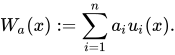
Let xa be an allocation that maximizes the welfare over all allocations:

It is easy to show that the allocation xa is Pareto-efficient: since all weights are positive, any Pareto improvement would increase the sum, contradicting the definition of xa.

Japanese neo-Walrasian economist Takashi Negishi proved[20] that, under certain assumptions, the opposite is also true: for every Pareto-efficient allocation x, there exists a positive vector a such that x maximizes Wa. A shorter proof is provided by Hal Varian.[21]

Use in engineering

[edit]

The notion of Pareto efficiency has been used in engineering.[22] Given a set of choices and a way of valuing them, the Pareto front (or Pareto set or Pareto frontier) is the set of choices that are Pareto-efficient. By restricting attention to the set of choices that are Pareto-efficient, a designer can make trade-offs within this set, rather than considering the full range of every parameter.[23]

Use in public policy

[edit]

Modern microeconomic theory has drawn heavily upon the concept of Pareto efficiency for inspiration. Pareto and his successors have tended to describe this technical definition of optimal resource allocation in the context of it being an equilibrium that can theoretically be achieved within an abstract model of market competition. It has therefore very often been treated as a corroboration of Adam Smith's "invisible hand" notion. More specifically, it motivated the debate over "market socialism" in the 1930s.[4]

However, because the Pareto-efficient outcome is difficult to assess in the real world when issues including asymmetric information, signalling, adverse selection, and moral hazard are introduced, most people do not take the theorems of welfare economics as accurate descriptions of the real world. Therefore, the significance of the two welfare theorems of economics is in their ability to generate a framework that has dominated neoclassical thinking about public policy. That framework is that the welfare economics theorems allow the political economy to be studied in the following two situations: "market failure" and "the problem of redistribution".[24]

Analysis of "market failure" can be understood by the literature surrounding externalities. When comparing the "real" economy to the complete contingent markets economy (which is considered efficient), the inefficiencies become clear. These inefficiencies, or externalities, are then able to be addressed by mechanisms, including property rights and corrective taxes.[24]

Analysis of "the problem with redistribution" deals with the observed political question of how income or commodity taxes should be utilized. The theorem tells us that no taxation is Pareto-efficient and that taxation with redistribution is Pareto-inefficient. Because of this, most of the literature is focused on finding solutions where given there is a tax structure, how can the tax structure prescribe a situation where no person could be made better off by a change in available taxes.[24]

Use in biology

[edit]

Pareto optimisation has also been studied in biological processes.[25] In bacteria, genes were shown to be either inexpensive to make (resource-efficient) or easier to read (translation-efficient). Natural selection acts to push highly expressed genes towards the Pareto frontier for resource use and translational efficiency.[26] Genes near the Pareto frontier were also shown to evolve more slowly (indicating that they are providing a selective advantage).[27]

Common misconceptions

[edit]

It would be incorrect to treat Pareto efficiency as equivalent to societal optimization,[28] as the latter is a normative concept, which is a matter of interpretation that typically would account for the consequence of degrees of inequality of distribution.[29] An example would be the interpretation of one school district with low property tax revenue versus another with much higher revenue as a sign that more equal distribution occurs with the help of government redistribution.[30]

Criticism

[edit]

Some commentators contest that Pareto efficiency could potentially serve as an ideological tool. With it implying that capitalism is self-regulated thereof, it is likely that the embedded structural problems such as unemployment would be treated as deviating from the equilibrium or norm, and thus neglected or discounted.[4]

Pareto efficiency does not require a totally equitable distribution of wealth, which is another aspect that draws in criticism.[31] An economy in which a wealthy few hold the vast majority of resources can be Pareto-efficient. A simple example is the distribution of a pie among three people. The most equitable distribution would assign one third to each person. However, the assignment of, say, a half section to each of two individuals and none to the third is also Pareto-optimal despite not being equitable, because none of the recipients could be made better off without decreasing someone else's share; and there are many other such distribution examples. An example of a Pareto-inefficient distribution of the pie would be allocation of a quarter of the pie to each of the three, with the remainder discarded.[32]

The liberal paradox elaborated by Amartya Sen shows that when people have preferences about what other people do, the goal of Pareto efficiency can come into conflict with the goal of individual liberty.[33]

Lastly, it is proposed that Pareto efficiency to some extent inhibited discussion of other possible criteria of efficiency. As Wharton School professor Ben Lockwood argues, one possible reason is that any other efficiency criteria established in the neoclassical domain will reduce to Pareto efficiency at the end.[4]

See also

[edit]

References

[edit]

Further reading

[edit]
Revisions and contributorsEdit on WikipediaRead on Wikipedia
from Grokipedia
Pareto efficiency, also known as Pareto optimality, is an economic state in which resources are allocated such that it is impossible to reallocate them to make any one agent better off without making at least one other agent worse off.[1] The concept originates from the work of Italian economist and sociologist Vilfredo Pareto (1848–1923), who formalized it in his Manual of Political Economy (1906), describing an "ophelimity" maximum where no variation in the economic system can increase the ophelimity (satisfaction or utility) of one residue class without decreasing that of another.[2][3] In welfare economics, Pareto efficiency serves as a benchmark for evaluating resource allocations, underpinning key results such as the first fundamental theorem of welfare economics, which asserts that a competitive market equilibrium is Pareto efficient under assumptions of perfect information, no externalities, and complete markets.[4] This theorem highlights how decentralized market processes can achieve efficiency without central planning, provided those ideal conditions hold.[4] The second fundamental theorem complements this by showing that any Pareto efficient allocation can be supported as a competitive equilibrium through appropriate initial endowments or lump-sum transfers, emphasizing the separation of efficiency from equity concerns.[4] Despite its analytical utility, Pareto efficiency has notable limitations: it identifies a set of efficient outcomes but remains silent on distributive justice, permitting allocations that are efficient yet starkly unequal, such as one where a single agent consumes all resources.[5] Real-world deviations from the theorem's assumptions—such as market failures via externalities, public goods, or imperfect competition—often prevent markets from attaining Pareto efficiency, necessitating policy interventions that must balance efficiency gains against potential efficiency losses.[5] These characteristics define Pareto efficiency as a positive tool for assessing allocative efficiency rather than a prescriptive criterion for social optimality.[6]

History

Origins in Vilfredo Pareto's Work

Vilfredo Pareto, an Italian engineer and economist born in 1848, succeeded Léon Walras as professor of political economy at the University of Lausanne in 1893, where he refined ideas on economic equilibrium and welfare.[3] In his early work, Cours d'économie politique published in two volumes between 1896 and 1897, Pareto introduced the notion of "ophelimity" as a measurable form of satisfaction derived from goods, distinct from cardinal utility, emphasizing ordinal preferences for analyzing consumer behavior without assuming interpersonal utility comparisons.[3] He discussed collective ophelimity, suggesting that economic arrangements could maximize total satisfaction under constraints, but the precise criterion for what later became known as Pareto efficiency emerged more formally in his subsequent writings.[2] Pareto's seminal contribution appeared in Manuale di Economia Politica, published in Milan in 1906, where he articulated the condition for a "maximum of ophelimity" in an economy.[7] In this text, Pareto defined an optimal allocation as one in which no modification of resource distribution could increase the ophelimity (well-being) of at least one individual without simultaneously decreasing it for another, stating explicitly that such a position represents an equilibrium where further improvements are impossible without trade-offs.[8] This formulation applied to both exchange and production, extending Walrasian general equilibrium by incorporating mutual interdependence among agents' preferences and endowments, without relying on utilitarian summation of utilities.[2] Pareto illustrated this through mathematical conditions, such as the equality of marginal rates of substitution across individuals, ensuring no unexploited gains from trade or reallocation exist.[9] The 1906 Manuale thus laid the analytical foundation for efficiency in resource allocation, influencing later welfare economics by prioritizing non-worsening improvements over aggregate welfare metrics.[3] A French edition followed in 1909 as Manuel d'économie politique, which reiterated and slightly expanded these ideas, but the core insight originated in the Italian original.[7] Pareto's approach stemmed from empirical observation of market processes and deductive reasoning on individual choices, rejecting normative impositions in favor of descriptive maxima achievable through voluntary exchanges.[2] This criterion, though not termed "Pareto optimum" until mid-20th-century interpretations, marked a shift toward ordinalist welfare analysis in neoclassical economics.[9]

Integration into Neoclassical Economics

Pareto's formulation of efficiency, articulated in his 1906 Manual of Political Economy, provided a criterion for resource allocation where no individual could gain without another losing, shifting neoclassical analysis away from cardinal utility measures toward ordinal preferences and avoiding interpersonal comparisons.[10] This integration built on the Lausanne School's general equilibrium tradition, where Pareto succeeded Léon Walras and emphasized mathematical rigor in equilibrium states.[5] The concept gained formal prominence in neoclassical welfare economics during the mid-20th century, particularly through the First Fundamental Theorem of Welfare Economics, which asserts that under conditions of perfect competition, local non-satiation, and convexity, a competitive equilibrium allocation is Pareto efficient. Kenneth Arrow proved this theorem in 1951, extending classical results without requiring utility differentiability, thereby embedding Pareto efficiency as a benchmark for market outcomes in general equilibrium models.[11][12] Subsequent developments, such as the Arrow-Debreu model formalized in 1954, demonstrated that equilibria in economies with complete markets and no externalities achieve Pareto optimality, reinforcing the theorem's role in validating decentralized markets as efficient resource allocators.[13] This mathematical codification transformed Pareto's qualitative insight into a cornerstone of neoclassical theory, linking efficiency to price-mediated exchanges while highlighting limitations like the inability to rank inequitable Pareto optima.[14]

Evolution in Welfare Economics Post-1930s

Following Lionel Robbins's 1932 critique, which argued that interpersonal utility comparisons were unscientific and unverifiable, welfare economists increasingly rejected cardinal utility and utilitarian frameworks, turning instead to ordinal preferences and the Pareto criterion as a minimal, non-comparative standard for efficiency.[15] This shift birthed the New Welfare Economics in the late 1930s, which sought to derive welfare propositions from revealed preferences and Paretian logic alone.[16] Key innovations included compensation tests to extend Pareto improvements beyond strict cases. Nicholas Kaldor in 1939 proposed that a resource reallocation improves welfare if gainers could compensate losers and still benefit, capturing potential efficiency gains without actual transfers.[17] John Hicks in 1939 refined this with a criterion based on equivalent variations, focusing on whether losers could be compensated from foregone gains.[17] Tibor Scitovsky in 1941 exposed a paradox: a change satisfying the Kaldor-Hicks test might revert under the same logic, revealing the criterion's potential inconsistency and prompting double-criteria requirements for stability.[18] These tools, while departing from pure Pareto by invoking hypothetical compensation, anchored welfare analysis in efficiency without ethical judgments on distribution.[16] In the 1940s and 1950s, general equilibrium theory formalized Pareto's integration via the Fundamental Theorems of Welfare Economics. Oskar Lange in 1942 and Maurice Allais in 1943 provided early proofs that competitive equilibria achieve Pareto efficiency under assumptions like convexities and no externalities.[16] Kenneth Arrow in 1951 and Gérard Debreu in 1954 offered rigorous demonstrations: the First Theorem states that any competitive equilibrium allocation is Pareto efficient, as no reallocation can improve one agent's utility without harming another given market prices.[19] [20] The Second Theorem asserts the converse—that any Pareto efficient allocation can be sustained as a competitive equilibrium through suitable lump-sum redistributions of endowments, decoupling efficiency from initial equity.[19] [16] These theorems, building on Vilfredo Pareto's earlier insights, elevated Pareto efficiency to the neoclassical benchmark for market optimality, justifying decentralized pricing while isolating equity as a political matter.[21] Yet, their dependence on idealized conditions—complete information, perfect competition, and absence of public goods or monopolies—drew scrutiny, as empirical deviations like market failures undermine real-world applicability.[19] Arrow's 1951 impossibility theorem further underscored Pareto's limits by showing no consistent aggregation of individual ordinal preferences into a complete social ordering without dictatorship, reinforcing reliance on partial criteria like Pareto for feasible analysis.[21]

Core Concepts

Definition of Pareto Improvement

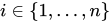
A Pareto improvement is defined as a reallocation of goods or resources in an economy such that the welfare, as represented by individual utility functions, of at least one agent strictly increases while the welfare of no agent decreases.[22][23] This criterion provides a benchmark for evaluating changes in resource distribution without requiring interpersonal utility comparisons or aggregate measures like total welfare.[24] Formally, consider an economy with n agents, each receiving an allocation bundle xix_i from an initial feasible allocation {x1,,xn}\{x_1, \dots, x_n\}, where each xiRkx_i \in \mathbb{R}^k denotes the vector of goods assigned to agent i.![{\displaystyle \{x_{1},\dots ,x_{n}\}}} [inline]![{\displaystyle x_{i}\in \mathbb {R} ^{k}}] [inline] A alternative feasible allocation {x1,,xn}\{x_1', \dots, x_n'\} represents a Pareto improvement if, for every agent i, the utility satisfies ui(xi)ui(xi)u_i(x_i') \geq u_i(x_i), with strict inequality holding for at least one agent.![{\displaystyle \{x_{1}',\dots ,x_{n}'\}}} [inline]![{\displaystyle u_{i}xix_{i}'\geq u_{i}xix_{i}}}] [inline]![{\displaystyle u_{i}xix_{i}'>u_{i}xix_{i}}}] [inline]![{\displaystyle i\in \{1,\dots ,n\}}}] [inline] This formulation assumes well-defined, continuous, and quasi-concave utility functions representing agent preferences, though the core condition hinges on non-decreasing utilities across the board with at least one gain.[23][25] The concept originates from Vilfredo Pareto's 1906 Manuale di Economia Politica, where he described economic states in terms of "ophelimity" (a measure akin to utility) such that no further increase in ophelimity for one individual could occur without diminishing it for another, implying that movements toward such states via non-harmful gains constitute improvements.[26] In practice, examples include voluntary trades where both parties value the exchanged goods differently, leading to mutual gains without losses, or technological advancements that expand production possibilities without reducing outputs for any sector.[27] Such improvements exhaust potential mutual gains from reallocations under the given constraints, serving as a foundational tool in welfare economics for identifying inefficient equilibria.[22]

Pareto Optimality and the Pareto Frontier

Pareto optimality, synonymous with Pareto efficiency in economic contexts, describes a resource allocation where no agent can be made strictly better off without rendering at least one other agent worse off.[28] Formally, in an economy with $ n $ agents, an allocation $ {x_1, \dots, x_n} $ with each $ x_i \in \mathbb{R}^k $ is Pareto optimal if there exists no alternative feasible allocation $ {x_1', \dots, x_n'} $ such that $ u_i(x_i') \geq u_i(x_i) $ for all $ i \in {1, \dots, n} $, with strict inequality holding for at least one $ i $.[29] This condition ensures that all potential Pareto improvements—reallocations enhancing at least one utility without reducing any others—have been exhausted.[30] The Pareto frontier, or Pareto set, comprises the collection of all Pareto optimal allocations within the feasible set of an economy.[31] In the utility space, it forms the boundary of the utility possibility set, where utility vectors are non-dominated: no feasible vector Pareto-dominates another on this frontier, meaning one cannot increase any component without decreasing at least one other.[32] For exchange economies, this frontier corresponds to the contract curve in an Edgeworth box diagram, tracing allocations where marginal rates of substitution equalize across agents.[25] In production economies, it aligns with efficient input-output combinations, excluding slack where resources remain unoptimized. Points interior to the feasible set are inefficient, as reallocations can yield Pareto improvements; the frontier thus delineates maximal efficiency trade-offs, prioritizing undominated outcomes over egalitarian or aggregate measures like total utility.[33] While the frontier's shape depends on preferences, endowments, and technology—convex under standard assumptions like quasi-concavity of utilities—it highlights that multiple Pareto optimal points exist, necessitating additional criteria (e.g., equity weights) for selection in policy applications.[34]

The Pareto Order and Comparability

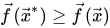
The Pareto order defines a partial ordering on the set of feasible allocations in an economy, where one allocation x=(x1,,xn)x = (x_1, \dots, x_n) Pareto-dominates another y=(y1,,yn)y = (y_1, \dots, y_n) if, for utility functions uiu_i representing individual preferences, ui(xi)ui(yi)u_i(x_i) \geq u_i(y_i) holds for all agents i{1,,n}i \in \{1, \dots, n\} and strict inequality ui(xi)>ui(yi)u_i(x_i) > u_i(y_i) holds for at least one ii.[35] This relation is reflexive (every allocation dominates itself), antisymmetric (mutual dominance implies identity), and transitive (if xx dominates yy and yy dominates zz, then xx dominates zz), satisfying the axioms of a partial order on the allocation space.[36] In vector terms, for objective functions fif_i, dominance corresponds to f(x)f(x)\vec{f}(x^*) \geq \vec{f}(x) componentwise with at least one strict inequality, capturing unanimous non-decreasing welfare without requiring cardinality or interpersonal comparisons of utilities.[37] The partial rather than total nature of the Pareto order implies limited comparability: many allocation pairs are incomparable, as neither dominates the other when gains for some agents entail losses for others. For example, a reallocation improving utilities for agents 1 through kk but reducing them for agents k+1k+1 through nn yields no dominance relation, reflecting conflicting preferences without a mechanism for aggregation or compensation.[4] This incomparability stems from the order's reliance on ordinal, agent-specific utilities, eschewing cardinal measurability or equity weights that could enable trade-offs, as formalized in axiomatic characterizations where Pareto dominance is the unique nontrivial partial order invariant under positive affine transformations and monotonic in each component.[35] In welfare economics, this structure restricts the Pareto order to identifying improvements and efficient frontiers but precludes a complete ranking of outcomes, necessitating supplementary criteria like distributional judgments for policy choices among incomparable Pareto optima. Historical developments in the field, post-Pareto's 1906 Manuale di Economia Politica, emphasized this incompleteness, leading to extensions such as potential Pareto (Kaldor-Hicks) criteria that invoke hypothetical compensations, though these introduce assumptions about feasibility and incentives absent in the strict order.[38] The order's uncontroversial foundation—rooted in non-paternalistic respect for individual preferences—thus highlights a core tension: empirical allocative efficiency gains may coexist with incomparable alternatives, demanding causal analysis of market failures or institutional designs to navigate the partiality.[39]

Variants

Weak vs. Strong Pareto Efficiency

An allocation x=(x1,,xn)x = (x_1, \dots, x_n) is weakly Pareto efficient if there exists no feasible alternative allocation x=(x1,,xn)x' = (x_1', \dots, x_n') such that ui(xi)>ui(xi)u_i(x_i') > u_i(x_i) for all agents i{1,,n}i \in \{1, \dots, n\}, where uiu_i denotes agent ii's utility function.[40][41] This condition prohibits unanimous strict gains but permits improvements where some agents remain indifferent. ![{\displaystyle u_{i}xix_{i}'>u_{i}xix_{i}}][float-right] In contrast, an allocation is strongly Pareto efficient if no feasible xx' exists such that ui(xi)ui(xi)u_i(x_i') \geq u_i(x_i) for all ii, with strict inequality for at least one ii.[40][42] This stricter criterion rules out any reallocation that avoids harming anyone while benefiting at least one, encompassing both strict unanimous improvements and those involving indifference for some.[43] Strong Pareto efficiency implies weak Pareto efficiency, as any unanimous strict improvement violates the strong condition. However, the converse holds only under additional assumptions, such as strictly monotonic preferences (where more of any good strictly increases utility), rendering the concepts equivalent.[40][44] Without such assumptions, weak efficiency may obtain in cases precluding strong efficiency; for instance, consider two agents with identical Leontief utility functions ui(x,y)=min(x,y)u_i(x,y) = \min(x,y) and an allocation (1,1)(1,1) for both, feasible alongside (2,0)(2,0) for one and (0,2)(0,2) for the other—no reallocation makes both strictly better, satisfying weak efficiency, but swapping yields indifference for both, violating strong efficiency absent strict monotonicity.[45] The distinction arises prominently in non-convex settings or with indivisibilities, where weak optima may not align with intuitive efficiency; for example, in production economies with fixed inputs, weak Pareto optima can include allocations inefficient under strong criteria due to feasible trades benefiting some without loss.[46] In welfare economics, strong Pareto efficiency underpins theorems like the first welfare theorem, linking competitive equilibria to undominated allocations, while weak variants suffice for weaker results in optimization contexts like multi-objective programming.[47] Empirical applications, such as resource allocation in engineering, often prioritize strong efficiency to avoid "free lunch" opportunities, though computational tractability may favor weak approximations.[41]

Constrained and Fractional Pareto Efficiency

Constrained Pareto efficiency, also known as constrained Pareto optimality, evaluates allocations within a limited feasible set defined by model-specific restrictions, such as budget constraints, incomplete financial markets, or resource limitations, rather than the full set of unconstrained possibilities.[48] In such settings, an allocation is constrained Pareto efficient if no alternative allocation within the restricted set Pareto dominates it, meaning it cannot make at least one agent better off without worsening another's position under the given constraints.[49] This concept arises in models where full Pareto efficiency is unattainable due to informational asymmetries, market incompleteness, or incentive compatibility requirements; for instance, in optimal income taxation, constrained efficiency implies that no alternative tax schedule can induce a feasible allocation that improves utilities for all or some agents without harming others, often leading to distortions like positive marginal tax rates at high incomes to address adverse selection.[48] Empirical applications, such as in general equilibrium models with externalities, characterize constrained equilibria as solutions to optimization problems incorporating Pigouvian taxes or coalition-specific feasibility, ensuring efficiency relative to the constrained environment.[50] Fractional Pareto efficiency extends standard Pareto efficiency to settings involving indivisible goods or discrete allocations, where efficiency is assessed against both discrete and fractional (divisible) reallocation possibilities.[51] An allocation of indivisible items is fractionally Pareto efficient if no other allocation—whether fully discrete or allowing fractional shares of items—can improve at least one agent's utility without decreasing another's.[52] This criterion strengthens traditional Pareto efficiency by ruling out improvements via sharing mechanisms, which is particularly relevant in fair division problems, such as resource allocation among agents with additive utilities over chores or tasks.[53] For example, in mechanism design for matching or item allocation, fractional Pareto efficiency ensures non-wastefulness and compatibility with strategy-proofness, as fractional relaxations reveal potential inefficiencies in discrete outcomes that standard Pareto checks might overlook.[52] Research in algorithmic game theory demonstrates that achieving fractional Pareto efficiency often requires minimal sharing, with worst-case bounds on fractional components derived from envy-freeness or proportionality relaxations.[51] These variants address limitations of classical Pareto efficiency in practical or computationally constrained domains: constrained efficiency adapts to real-world frictions like market incompleteness, where full efficiency demands unrealistic assumptions, while fractional efficiency bridges discrete and continuous allocation models, enhancing applicability in computational economics and optimization.[49][53] Both concepts maintain the core Pareto principle of undominated improvements but relativize it to feasible perturbations, avoiding over-optimism about achievable outcomes in non-ideal settings.

Ex-Ante, Bayesian, and Ordinal Variants

Ex-ante Pareto efficiency applies to settings involving uncertainty or randomized allocations, where outcomes are evaluated prior to the resolution of uncertainty. An allocation, often represented as a lottery over possible states, is ex-ante Pareto efficient if no alternative feasible lottery yields a higher expected utility for at least one agent without reducing the expected utility for any other agent. This criterion prioritizes optimality in terms of agents' von Neumann-Morgenstern utilities over the distribution of outcomes, allowing for potential inefficiencies in realized (ex-post) states as long as expectations are optimized. For instance, in matching markets with private information or stochastic elements, mechanisms achieving ex-ante efficiency, such as the expected externality mechanism, ensure Bayesian incentive compatibility alongside Pareto optimality when transfers are feasible.[54][55] Bayesian Pareto efficiency extends the concept to environments with incomplete information and heterogeneous beliefs, focusing on incentive-compatible allocations under Bayesian Nash equilibria. It requires that, from an ex-ante perspective, no other Bayesian incentive-compatible mechanism provides higher interim expected utilities to some agent without lowering them for others, often incorporating interdependent utilities or type-contingent optimality. This variant addresses challenges in general equilibrium with asymmetric information, where full revelation may be impossible, leading to interim Pareto optimality: for each agent's type, the allocation maximizes utilities conditional on beliefs about others' types. Impossibility results highlight tensions, such as those showing that ex-ante Pareto efficiency combined with Bayesian incentive compatibility implies dictatorship in certain social choice functions.[56][57] Ordinal variants of Pareto efficiency adapt the criterion to scenarios where agents reveal only preference rankings, without cardinal intensity or probabilistic assessments. Standard Pareto efficiency relies on ordinal preferences—weakly preferred bundles for all and strictly for some—but ordinal extensions handle lotteries or incomplete information via stochastic dominance: an allocation is ordinally efficient if no alternative stochastically dominates it in first-order sense for all agents (higher probability of preferred outcomes) with strict dominance for at least one. In matching problems like school choice, this manifests as ordinal Pareto efficiency, where no rematching improves rankings for all students weakly and some strictly, achievable in deferred acceptance algorithms under stability assumptions. Such variants are weaker than cardinal versions, accommodating real-world limitations like non-comparable utilities, but preserve core incomparability of allocations.[58][59]

Theoretical Foundations and Theorems

First and Second Welfare Theorems

The First Fundamental Theorem of Welfare Economics asserts that any competitive equilibrium allocation in a market economy is Pareto efficient, provided the economy satisfies standard assumptions including complete and competitive markets, the absence of externalities, continuous and locally non-satiated preferences for consumers, and profit-maximizing behavior by producers.[60] This theorem, formalized within the Arrow-Debreu general equilibrium framework, implies that decentralized market outcomes achieve an allocation where no agent can be made better off without making another worse off.[61] The proof proceeds by contradiction: suppose a competitive equilibrium allocation xx^* is Pareto dominated by some feasible xx'; then, given equilibrium prices pp^*, the value of xx' exceeds agents' budgets or firms' profits, violating individual optimization and resource feasibility.[60] Local non-satiation ensures that if improvement were possible, agents would demand adjustments inconsistent with market clearing.[61] The theorem's assumptions exclude real-world frictions such as incomplete markets or public goods, limiting its direct applicability without extensions, though it underpins arguments for market efficiency in idealized settings. Empirical tests, such as those in experimental economics, often confirm Pareto efficiency in simple exchange environments but reveal deviations under uncertainty or asymmetric information. The Second Fundamental Theorem of Welfare Economics states that any Pareto efficient allocation can be decentralized as a competitive equilibrium through appropriate lump-sum redistribution of initial endowments, assuming stricter conditions like convex preferences and production sets to ensure the required supporting hyperplane exists.[62][63] This result, which requires convexity for the feasible set to allow separation theorems in proofs, justifies redistributive policies to achieve desired efficiency points while preserving incentive compatibility via prices.[62] Unlike the first theorem, it demands no externalities and often quasi-concavity of utility to avoid non-convexities that could prevent equilibrium support; violations, such as in economies with increasing returns, necessitate alternative mechanisms like subsidies. Together, the theorems link Pareto efficiency to competitive equilibria, with the first establishing efficiency from markets and the second showing attainability via redistribution; both rely on the Arrow-Debreu model's core assumptions, developed in the 1950s, and have influenced policy debates on market interventions since their formalization.[63]

Assumptions Required for Pareto Efficiency

The concept of Pareto efficiency, while definable with minimal prerequisites such as complete and transitive preferences over consumption bundles, requires stronger assumptions when establishing that specific economic outcomes—like competitive equilibria—are Pareto efficient. These assumptions underpin the First Welfare Theorem, which asserts that a competitive equilibrium allocation is Pareto optimal provided agents act as price takers, preferences satisfy local non-satiation (ensuring no allocation leaves agents indifferent to small improvements), and there are no externalities affecting consumption or production.[64] Local non-satiation implies that for any feasible allocation, some reallocation can improve at least one agent's utility without reducing others', preventing inefficient satiation points.[61] Additional requirements include convexity of preference relations and production sets, ensuring that marginal rates of substitution and transformation align smoothly to support efficiency without kinks or discontinuities that could trap equilibria away from the Pareto frontier.[65] Convexity guarantees the existence of supporting hyperplanes separating efficient allocations from infeasible ones, as formalized in the Arrow-Debreu model, where firms maximize profits and households maximize utility subject to budgets under complete markets spanning all commodities, including contingent claims for uncertainty.[66] Complete markets eliminate missing trades that could allow Pareto improvements, while perfect competition ensures no agent can influence prices, aligning individual optimizations with social efficiency.[67] Absence of externalities is critical, as interpersonal spillovers—such as pollution from one firm's production reducing another's output—violate the theorem by allowing reallocations that internalize costs without harming initial parties.[61] Well-defined property rights further support enforceability of contracts, preventing disputes that undermine voluntary exchanges leading to efficiency.[68] These conditions, while sufficient for theoretical Pareto efficiency in Walrasian equilibria, are often violated in real economies, highlighting the theorem's role as a benchmark rather than a universal descriptor.[20]

Relation to Competitive Equilibrium

![Supply and demand equilibrium][float-right] In a competitive equilibrium, prices adjust such that each consumer maximizes utility subject to their budget constraint, and each producer maximizes profit given technology, with markets clearing for all goods.[33] This equilibrium allocation is Pareto efficient under the assumptions of the First Fundamental Theorem of Welfare Economics, which holds in models like Arrow-Debreu where preferences are convex, markets are complete, there are no externalities, and agents act as price takers.[69][66] The theorem's proof proceeds by contradiction: suppose a feasible allocation Pareto dominates the equilibrium allocation, improving at least one agent's utility without reducing others'. However, since agents optimize at equilibrium prices, any such improvement would require violating budget constraints or market clearing, which contradicts the equilibrium conditions.[33][61] This establishes that competitive equilibria lie on the Pareto frontier, meaning no further Pareto improvements are possible through reallocation.[13] Key assumptions include local non-satiation of preferences, ensuring agents spend all income, and convexity to guarantee interior solutions and marginal conditions aligning with efficiency.[69] Without these—such as in cases of increasing returns or incomplete markets—equilibria may fail to be Pareto efficient, as seen in models with externalities or monopolies.[33] The result underscores the efficiency of decentralized price mechanisms in achieving Pareto optimality when ideal conditions hold, as formalized in general equilibrium theory since Arrow and Debreu's 1954 work.[66]

Applications

In Microeconomics and Resource Allocation

In microeconomics, Pareto efficiency evaluates resource allocations by determining whether scarce goods and services are distributed such that no reallocation can increase one agent's utility without decreasing another's. This criterion applies to exchange economies where agents have initial endowments and preferences over bundles of goods; an allocation is efficient if marginal rates of substitution across agents are equalized, preventing mutually beneficial trades.[4] A foundational example involves two agents and two goods, such as apples and oranges, with differing preferences: if agent A values apples more highly relative to oranges than agent B, a Pareto efficient allocation assigns apples predominantly to A and oranges to B, assuming no gains from trade remain.[70] In graphical terms, using the Edgeworth box, efficient allocations trace the contract curve where indifference curves are tangent, reflecting equalized marginal rates of substitution; deviations from this curve allow Pareto improvements via barter.[71][5] In production contexts, Pareto efficiency extends to input allocation across firms or technologies, where resources like labor and capital are assigned to maximize output vectors without waste; for instance, an economy's production possibility frontier delineates Pareto efficient points, as interior points permit reallocations increasing output in one good without reducing the other.[6] This framework underpins analyses of competitive markets, where price signals guide resources to uses equating marginal benefits and costs, achieving efficiency absent distortions.[72] Partial equilibrium models demonstrate this through supply-demand intersections, where the quantity traded equates marginal private benefits to costs, yielding a Pareto efficient outcome for that market under perfect competition and no externalities.[6] Empirical applications include auction designs for spectrum allocation, where mechanisms like Vickrey auctions seek Pareto efficient assignments of licenses to highest-valuing bidders, as implemented by the U.S. Federal Communications Commission in its 1994 spectrum auctions that raised $7 billion while assigning resources without residual gains from reallocation.[71]

In Engineering and Optimization

In multi-objective optimization problems common in engineering, Pareto efficiency, also termed Pareto optimality, identifies solutions where no objective function—such as minimizing cost while maximizing performance—can be improved without degrading at least one other objective.[41] This concept guides designers in navigating trade-offs, as the set of Pareto-optimal solutions forms the Pareto front, a boundary in the objective space representing non-dominated alternatives.[73] For instance, in structural engineering, optimizing beam designs might involve balancing material weight against load-bearing capacity; points on the Pareto front allow engineers to select based on project priorities without suboptimal concessions.[74] Algorithms like the non-dominated sorting genetic algorithm (NSGA-II) approximate the Pareto front by evolving populations of candidate solutions, prioritizing diversity and convergence to non-dominated sets.[75] Weighted sum methods scalarize objectives into a single function for optimization, though they may miss non-convex fronts, prompting hybrid approaches in fields like aerospace for fuel efficiency versus structural integrity.[75] In control systems engineering, Pareto optimality evaluates trade-offs between stability margins and response speed, ensuring robust designs under uncertainty.[76] Applications extend to network optimization, where Pareto-efficient configurations maximize throughput while minimizing latency, as in telecommunications infrastructure.[76] Visualization tools aid decision-making by plotting the Pareto front, enabling engineers to assess multivariate sensitivities, such as in automotive component design balancing durability, cost, and emissions.[77] These methods enhance efficiency by focusing computational resources on viable trade-off surfaces rather than exhaustive searches, with empirical validations showing improved design outcomes in peer-reviewed benchmarks.[78]

In Public Policy and Cost-Benefit Analysis

In public policy, Pareto efficiency serves as a benchmark for evaluating interventions that reallocate resources without imposing uncompensated losses on any party, though strict adherence is uncommon due to the interpersonal trade-offs inherent in government actions. A policy achieves Pareto efficiency relative to the status quo if it improves outcomes for at least one individual without worsening any other's utility, as defined in welfare economics.[79] However, real-world policies rarely meet this criterion because they often involve redistributive effects or externalities affecting diverse groups, such as tax reforms or regulatory changes that benefit aggregate welfare but harm specific sectors.[80] Cost-benefit analysis (CBA) operationalizes a relaxed version of Pareto efficiency known as the Kaldor-Hicks criterion, or potential Pareto improvement, where a policy is deemed efficient if the total benefits exceed total costs, implying that gainers could theoretically compensate losers to achieve a Pareto-superior outcome.[81] This approach underpins CBA in agencies like the U.S. Office of Management and Budget, which requires discounting future benefits and costs at rates such as 3% or 7% real to assess net present value for regulations under Executive Order 13771 (2017), focusing on aggregate efficiency rather than actual transfers. For instance, environmental regulations like the Clean Air Act amendments have been justified via CBA showing benefits (e.g., $2 trillion in health gains from 1990-2020) outweighing compliance costs ($65 billion), approximating Kaldor-Hicks efficiency despite uncompensated burdens on industries. Critics argue that reliance on Kaldor-Hicks in CBA can overlook distributional inequities, as hypothetical compensation seldom materializes, potentially endorsing policies that exacerbate inequality without Pareto dominance.[82] Empirical studies, such as those evaluating U.S. infrastructure investments, reveal that while CBA identifies potential efficiency gains—e.g., the Interstate Highway System's $1.2 trillion in benefits versus $500 billion costs from 1956 onward—implementation often fails to mitigate localized losses for displaced communities, diverging from strict Pareto ideals. Moreover, interpersonal utility comparisons implicit in aggregating benefits challenge the criterion's foundations, as it assumes commensurability absent in pure Pareto analysis.[83] Thus, while CBA promotes resource allocation aligned with efficiency, it prioritizes aggregate gains over inviolable individual protections, informing policy but requiring supplementary equity assessments.

In Biology and Evolutionary Models

In biological systems, natural selection often optimizes phenotypes across multiple conflicting objectives, such as maximizing speed while minimizing energy cost or balancing structural integrity against weight. Pareto optimality provides a framework for analyzing these trade-offs, where a phenotype is considered Pareto optimal if no alternative feasible phenotype can improve performance in one objective without degrading it in another. Observed biological traits frequently approximate points on the Pareto front—the boundary of undominated solutions in multi-objective space—suggesting evolutionary pressures drive organisms toward these compromises rather than single-objective maxima.[84][85] Empirical studies in comparative physiology demonstrate this pattern. For instance, in the morphology of vertebrate locomotion, trade-offs between locomotor speed and metabolic cost yield Pareto fronts that align closely with empirical data across taxa, including fish swimming, amphibian walking, and bird flight; deviations from the front are rare and often linked to specialized niches. Similarly, in endothermic vertebrates, evolutionary models of basal metabolic rate versus body size reveal Pareto-optimal scaling relationships, where increasing heat production efficiency compromises other physiological demands like cardiovascular load. These findings indicate that natural selection efficiently explores high-dimensional trait spaces but converges on low-dimensional Pareto fronts, typically linear or polygonal geometries, due to biophysical constraints.[84][86][87] In cellular biology, Pareto optimality explains parameter tuning in molecular machines. Ion channel conductances in neurons, for example, exhibit economy-effectiveness trade-offs: maximal ion flux enhances signaling speed but increases energetic costs and risks like excitotoxicity; empirical distributions cluster near the Pareto front predicted by biophysical models, implying selection favors balanced conductances over extremes. A 2022 analysis of squid and mammalian neuron models confirmed this, showing that Pareto-optimal parameter sets match observed variability better than random or single-objective optimizations, supporting the role of multi-task evolutionary pressures in circuit-level design.[88][89] Evolutionary game theory extends Pareto concepts to population dynamics, where strategies evolve toward equilibria that may or may not achieve optimality. Evolutionary stable strategies (ESS) ensure invasion resistance but can be Pareto inefficient, as in the hawk-dove game, where aggressive contests yield lower average fitness than a cooperative alternative, yet persist due to frequency-dependent selection; mechanisms like kin selection or network reciprocity can shift toward Pareto-superior outcomes. Recent models of coevolving networks in coordination games show that dynamic structure formation enhances selection of Pareto-optimal equilibria, mirroring observations in microbial cooperation where spatial clustering promotes efficient resource sharing.[90][91]

Pareto Efficiency and Market Outcomes

Achievement Under Perfect Competition

In perfect competition, markets feature numerous price-taking buyers and sellers, homogeneous products, perfect information, and costless entry and exit, leading to an equilibrium where supply equals demand at prices reflecting marginal costs.[6] This equilibrium allocation is Pareto efficient, as established by the First Fundamental Theorem of Welfare Economics, which states that under these conditions—including convex preferences, production technologies without externalities, and complete markets—a competitive equilibrium yields a Pareto optimal outcome where no agent can improve their welfare without reducing another's.[92][93] The mechanism achieving this efficiency involves decentralized optimization: consumers maximize utility subject to budget constraints, equating their marginal rates of substitution (MRS) to relative prices, while firms maximize profits by setting marginal rates of transformation (MRT) equal to prices, ensuring economy-wide MRS equals MRT—a necessary condition for Pareto optimality.[67] Prices thus coordinate individual actions to replicate the efficient resource allocation that a central planner would select under the same assumptions, without requiring interpersonal utility comparisons.[33] Empirical approximations occur in agricultural commodity markets, where near-perfect competition has been observed to minimize deadweight losses, aligning closely with theoretical Pareto efficiency; for instance, studies of U.S. wheat markets in the mid-20th century showed price-cost margins approaching zero, indicative of efficient outcomes.[94] However, real-world deviations, such as imperfect information or barriers, underscore that full achievement demands the theorem's strict assumptions, which are idealized rather than routinely met.[60]

Pareto Improvements via Voluntary Exchange

In an exchange economy, voluntary trade between rational agents facilitates Pareto improvements by reallocating initial endowments such that at least one agent achieves higher utility while no agent experiences a decline. Agents participate only when the exchange aligns with their preferences, ensuring mutual consent and non-harm to any party. This mechanism underpins the idea that self-interested bargaining can enhance overall allocation without coercion.[95][96] The Edgeworth box diagram models this process for two agents and two goods, depicting total fixed endowments as the box's dimensions. Starting from an initial endowment point within the "lens" formed by overlapping indifference curves, voluntary trades proceed along paths where both agents gain, contracting the lens until reaching the contract curve—where indifference curves are tangent and no further improvements exist. Each step represents a Pareto improvement, as trades halt only when marginal rates of substitution equalize, precluding additional gains without loss to the other agent.[95] Under assumptions of complete information, well-defined property rights, and negligible transaction costs, iterative voluntary exchanges converge to Pareto-efficient outcomes, as no unexploited gains from trade remain. This aligns with the Coase theorem's insight that efficiency emerges from bargaining regardless of initial rights assignment, provided trade is frictionless. Empirical analogs appear in barter or spot markets, where observed trades empirically reflect such improvements absent externalities.[96][97] However, real-world frictions like asymmetric information or holdout problems can arrest this process short of efficiency, though the principle holds that voluntary exchange inherently avoids Pareto-worsening changes.[95]

Market Failures Precluding Pareto Efficiency

Market failures arise when the assumptions underlying the first welfare theorem—such as perfect competition, complete information, and no externalities—are violated, resulting in competitive equilibria that fail to achieve Pareto efficiency. In such cases, the market allocation permits Pareto improvements, where resources can be reallocated to make at least one agent better off without worsening the position of any other.[67] These failures stem from structural features of markets that prevent prices from fully reflecting social costs and benefits, leading to misallocations of resources.[98] Externalities represent a primary deviation, occurring when the actions of one agent impose uncompensated costs or benefits on others not party to the transaction. Negative externalities, such as pollution from industrial production, cause overproduction because private marginal costs underestimate social marginal costs, yielding an output level where marginal social cost exceeds marginal social benefit and Pareto improvements are possible through reduced production or internalization via taxes.[99] Positive externalities, like knowledge spillovers from research and development, lead to underproduction as private marginal benefits fall short of social marginal benefits, allowing efficiency gains from subsidies or public provision that increase output without harming producers.[99] Empirical estimates indicate that externalities contribute significantly to global inefficiencies; for instance, unpriced environmental damages from fossil fuel combustion were valued at approximately $4.3 trillion annually in 2019, equivalent to 5.8% of global GDP, highlighting persistent Pareto suboptimality.[99][98] Public goods, characterized by non-excludability and non-rivalry in consumption, suffer from the free-rider problem, where individuals benefit without contributing, leading private markets to underprovide or withhold supply altogether. In equilibrium, too few resources are allocated to such goods compared to the Pareto-efficient level, where the sum of marginal rates of substitution equals the marginal rate of transformation, enabling improvements via collective provision that raises utility for all without reducing any.[100] For example, national defense or basic scientific research often requires public funding because voluntary contributions fall short, as each agent's contribution induces others to free-ride, resulting in quantities below the social optimum.[101] Market power, as in monopolies or oligopolies, distorts efficiency by enabling firms to restrict output below competitive levels to elevate prices, creating deadweight loss where potential gains from trade remain unrealized. A monopolist maximizes profit where marginal revenue equals marginal cost, but this quantity is less than the Pareto-efficient output where price equals marginal cost, allowing reallocations—such as increased production funded by consumer transfers—that improve aggregate welfare without net harm./18:_General_Equilibrium/18.04:_General_Equilibrium_Monopoly) Antitrust data from the U.S. Federal Trade Commission show that mergers enhancing market concentration correlate with price increases of 1-5% and output reductions, underscoring ongoing inefficiencies precluded under perfect competition./18:_General_Equilibrium/18.04:_General_Equilibrium_Monopoly) Asymmetric information introduces further barriers through adverse selection and moral hazard. Adverse selection arises pre-contract when sellers know more about quality than buyers, leading markets like used cars (Akerlof's "market for lemons") to unravel as high-quality goods exit, resulting in inefficiently low trade volumes where Pareto improvements could restore balance via signaling or screening.[102] Moral hazard occurs post-contract, as when insured parties take excessive risks due to coverage, inflating costs beyond efficient levels and permitting improvements through monitoring or deductibles that align incentives without reducing coverage for low-risk behaviors. In health insurance, for instance, moral hazard contributes to overutilization estimated at 10-30% of expenditures in systems with generous coverage, deviating from Pareto optimality.[102]

Pareto Efficiency Versus Equity and Welfare Maximization

Distinction from Equity Considerations

Pareto efficiency assesses resource allocations based on whether any reallocation can enhance one agent's welfare without reducing another's, rendering it indifferent to the interpersonal distribution of outcomes. An allocation remains Pareto efficient irrespective of inequality levels; for instance, a scenario where a single individual controls virtually all resources, leaving others with negligible portions, qualifies as efficient if no alternative improves any participant without detriment to at least one.[103] This distributional neutrality arises because the criterion employs ordinal utility rankings without cardinal interpersonal comparisons, focusing exclusively on unanimous improvements rather than aggregate or equitable shares.[32] Equity evaluations, in distinction, invoke normative standards for fair distribution, such as egalitarian outcomes or merit-based rewards, which Pareto efficiency neither endorses nor critiques. Economic analysis separates these domains: efficiency concerns allocative optimality given preferences and endowments, while equity demands value-laden judgments on initial conditions or end-state fairness, often leading to policy debates over redistribution. For example, general equilibrium theory demonstrates that competitive equilibria are Pareto efficient contingent on starting endowments, implying that unequal distributions propagate through efficient processes without inherent correction.[95][4] This separation underscores Pareto's role as a minimal efficiency benchmark, insufficient for comprehensive welfare assessment without equity weighting. Attempts to integrate equity via mechanisms like lump-sum transfers preserve efficiency only if they avoid distorting marginal incentives, as incentive-compatible redistributions—such as those analyzed in optimal taxation models—may still compromise pure Pareto outcomes by altering behavioral responses. Empirical observations from market economies, where Gini coefficients often exceed 0.4 despite allocative efficiency, illustrate that efficiency coexists with persistent inequality, necessitating explicit equity trade-offs in policy design.[104][32]

Social Welfare Functions and Aggregation

A Bergson-Samuelson social welfare function (SWF) provides an ordinal ranking of social states based on individual utility levels, represented as W(u1,u2,,un)W(u_1, u_2, \dots, u_n) where each uiu_i denotes agent ii's utility and the function is strictly increasing in every argument to respect Pareto dominance.[105][106] Such functions enable selection among the set of Pareto efficient allocations, which form the utility possibility frontier (UPF)—the locus of utility vectors where no further Pareto improvements are possible.[107] An allocation is Pareto optimal if and only if it maximizes some Bergson-Samuelson SWF subject to feasible resource and production constraints.[105] Aggregation via SWF requires interpersonal utility comparisons, as it weighs individual utilities to derive a collective measure, often incorporating ethical judgments about distribution.[108] For instance, the utilitarian SWF, W=uiW = \sum u_i, prioritizes total utility maximization, implying that any Pareto efficient allocation achievable under competitive equilibria maximizes it under the first welfare theorem's assumptions of complete markets and no externalities.[109] Alternative forms, such as Rawlsian SWF focusing on the minimum utility (W=minuiW = \min u_i), rank allocations differently among the Pareto set, favoring egalitarian outcomes over total sums.[110] These specifications reveal that Pareto efficiency identifies efficiency but not optimality under a specific distributive ethic, as the UPF's slope reflects trade-offs where improving one agent's utility necessitates reducing another's.[107] Challenges in aggregation stem from ordinalist critiques, where utilities are non-comparable across individuals without cardinal scaling, leading to Arrow's impossibility theorem: no non-dictatorial social ordering of ordinal preferences satisfies unanimity (Pareto principle), independence of irrelevant alternatives, and non-dictatorship.[111] This limits SWF applicability to cases assuming cardinal utilities or shared interpersonal weights, as defended in utilitarian frameworks but contested for lacking empirical grounding in utility commensurability.[108] Empirical welfare analysis thus often proxies aggregation through revealed preferences or Gini coefficients, though these sidestep full Pareto-respecting SWFs.[68]

Empirical Evidence on Trade-offs Between Efficiency and Redistribution

Empirical analyses of redistributive policies, typically involving progressive taxation and transfers, consistently reveal efficiency costs arising from distorted incentives, such as reduced labor participation, entrepreneurship, and capital accumulation, which diminish aggregate output relative to Pareto-efficient allocations.[112] These costs manifest as deadweight losses, estimated in various studies to range from 20% to 50% of revenue raised through distortionary taxes, implying that a dollar redistributed often yields less than a dollar in recipient utility due to behavioral responses.[113] For instance, meta-analyses of labor supply elasticities indicate that marginal tax rate increases reduce hours worked and participation, particularly among secondary earners and high-income individuals, with uncompensated elasticities averaging 0.2 to 0.5, leading to output losses of 0.1% to 0.3% of GDP per percentage point tax hike. Cross-country panel data further substantiate growth trade-offs, with higher initial income inequality often correlating positively with subsequent GDP per capita growth, while greater redistribution—measured as the equalizing effect of taxes and transfers on the Gini coefficient—associates negatively, reducing annual growth by 0.1 to 0.4 percentage points per standard deviation increase in redistribution intensity across samples spanning 1965 to 2010 in 34 OECD and emerging economies.[112] Macroeconomic vector autoregression models of tax changes in the U.S. from 1947 to 2007 estimate that a 1% of GDP tax increase lowers real GDP by 2.5% to 3.6% over three years, attributable to curtailed investment and consumption rather than demand effects alone, highlighting causal efficiency reductions from fiscal redistribution. Similar patterns emerge in European Union data, where welfare state expansions via fiscal instruments like progressive income taxes and means-tested benefits trade off against efficiency by lowering productivity growth, with elasticities implying that equity gains come at a cost of 0.5% to 1% reduced output per decade.[114] Countervailing evidence, such as Nordic countries sustaining high redistribution alongside robust growth, is often explained by confounding factors like homogeneous societies, strong work norms, and resource advantages rather than the policies themselves mitigating trade-offs; econometric controls for these reveal persistent negative growth impacts from redistribution in comparable settings.[115] Experimental and survey data reinforce this, showing that observed efficiency losses—such as 10-30% output reductions in lab-simulated redistribution scenarios—erode public support for transfers, underscoring real-world incentive constraints absent in theoretical models assuming costless enforcement.[116] Overall, while magnitudes vary by policy design and context, the preponderance of peer-reviewed evidence affirms non-trivial Pareto-relevant trade-offs, where redistribution expands the set of feasible allocations but contracts the efficient frontier by inducing avoidable resource misallocations.[117]

Criticisms and Limitations

Ethical Critiques and Status Quo Bias

Critics of Pareto efficiency argue that its ethical foundation is incomplete because it disregards distributive justice and interpersonal equity, permitting allocations that maximize efficiency at the expense of fairness. For example, a distribution granting vast resources to a single agent while leaving others destitute remains Pareto efficient if no reallocation enhances one person's welfare without diminishing another's, even though such outcomes intuitively violate egalitarian principles.[5] Amartya Sen, in his 1998 Nobel lecture, critiqued this narrow focus, asserting that Pareto efficiency restricts welfare analysis to changes where no one is harmed, thereby evading necessary comparisons of utility across individuals and rendering it insufficient for comprehensive ethical assessment.[118] This limitation implies that efficiency alone cannot adjudicate between allocations where total output is identical but inequality varies starkly, as seen in edge cases like a monopoly outcome versus competitive dispersion, both potentially efficient yet ethically divergent.[119] The criterion's status quo bias further undermines its ethical neutrality by entrenching existing distributions, as Pareto improvements demand universal consent or non-harm, a threshold rarely met in real-world reallocations involving historical endowments. Reforms addressing inherited inequalities—such as progressive taxation or land redistribution—often fail the Pareto test because they impose losses on current beneficiaries, even if aggregate welfare rises post-compensation, thus preserving potentially unjust baselines like those stemming from conquest or market distortions.[120] Economists like Michael Mandler have shown that incorporating status quo preferences into welfare economics amplifies this inertia, where agents' attachment to the present allocation dilutes Pareto's discriminatory power and favors minimalism over transformative equity. Historically, Vilfredo Pareto himself viewed this bias favorably as a bulwark against radical redistribution, aligning efficiency with conservative preservation of property rights amid socialist pressures in early 20th-century Europe.[121] Empirical applications reveal this bias in policy stasis: for instance, analyses of debt relief or environmental regulations frequently identify Kaldor-Hicks improvements (where gains exceed losses, theoretically compensable) but reject them under strict Pareto due to uncompensated harms, perpetuating inefficiencies masked as optimality.[122] Sen extended this critique via his Paretian liberal paradox, demonstrating that minimal individual rights can yield Pareto-inefficient outcomes, highlighting tensions between efficiency, liberty, and equity without resolution in the Pareto framework alone.[118] Proponents counter that Pareto's agnosticism on origins promotes voluntary exchange over coercive judgments, yet detractors maintain it systematically underweights causal histories of inequality, such as colonial legacies or monopsonistic labor markets, in favor of snapshot efficiency.[123]

Practical Impossibility and Measurement Challenges

In real-world economies, achieving Pareto efficiency is practically unattainable due to pervasive frictions such as transaction costs, which include expenses for search, negotiation, and enforcement that deter mutually beneficial exchanges even when they would improve welfare without harming others.[6] Information asymmetry further complicates this, as agents possess private knowledge leading to adverse selection or moral hazard, preventing markets from clearing at efficient points without mechanisms like signaling or screening that often fail under uncertainty.[124] Externalities, where actions impose uncompensated costs or benefits on third parties, also preclude efficiency unless perfectly internalized via property rights or taxes, conditions rarely met amid dispersed impacts and enforcement challenges.[125] Verifying whether an allocation is Pareto efficient poses severe measurement challenges, as it demands comprehensive knowledge of all individuals' utility functions and feasible reallocations, which are unobservable and combinatorially explosive in scale for economies with millions of agents.[83] Utilities are inherently subjective and ordinal, rendering interpersonal comparisons infeasible without cardinal assumptions that lack empirical grounding, while revealed preference methods provide only partial, incentive-constrained insights rather than true welfare rankings.[4] Empirical assessments often resort to approximations like Kaldor-Hicks efficiency, which allows hypothetical compensation but deviates from strict Pareto criteria by permitting actual harm if gains elsewhere could theoretically offset it, introducing bias toward status quo policies that overlook distribution.[126] These hurdles imply that proclaimed Pareto improvements in policy debates, such as deregulation claims, frequently rely on untestable assumptions about counterfactual utilities rather than direct verification.[119]

Overreliance on Pareto in Policy and Its Alternatives

The Pareto criterion's insistence on unanimous improvement without harm to any party renders it impractical for most policy decisions, as real-world interventions invariably produce both beneficiaries and losers, often resulting in policy stasis or entrenchment of the status quo.[120] For instance, reforms such as reducing government debt may enhance long-term efficiency by lowering interest burdens on future generations but fail the Pareto test if they impose immediate costs on current debtors or public sector employees, thereby discouraging implementation despite net gains.[122] This overreliance fosters a bias toward preserving existing allocations, even when they are inefficient, as changes require either lump-sum transfers (rarely feasible due to information asymmetries and transaction costs) or universal consent, which political processes seldom achieve.[126] Critics, including Amartya Sen, argue that Pareto optimality provides only a "very limited kind of success," permitting states of extreme inequality or deprivation so long as no reallocation improves one without worsening another, thus sidelining distributive justice in policy evaluation.[127] Empirical applications in areas like trade liberalization or environmental regulation illustrate this: while such policies may boost aggregate output, concentrated losses to specific sectors (e.g., import-competing industries) preclude Pareto classification, leading policymakers to undervalue reforms that demand compensatory mechanisms. Consequently, adherence to Pareto discourages dynamic adjustments in economies characterized by uncertainty and heterogeneous impacts, amplifying resistance to efficiency-enhancing shifts.[5] A primary alternative is the Kaldor-Hicks criterion, which deems a policy efficient if the gains to winners exceed the losses to losers, allowing for potential (rather than actual) compensation through side payments.[128] This standard underpins cost-benefit analysis in public policy, as employed by agencies like the U.S. Office of Management and Budget since the 1980s, where net present value calculations proxy interpersonal welfare trade-offs without mandating transfers.[129] However, Kaldor-Hicks permits efficiency rankings that could cycle under Scitovsky reversals—where a policy passes the test relative to the status quo but fails in reverse—necessitating supplementary equity assessments.[108] Other approaches include social welfare functions that aggregate utilities with diminishing marginal returns to income, prioritizing redistribution alongside efficiency, or Rawlsian maximin principles that safeguard the least advantaged, though these require cardinal utility assumptions contested in empirical welfare economics.[130] In practice, hybrid frameworks combining Kaldor-Hicks with distributional weights have been proposed to mitigate Pareto's rigidity while addressing its ethical blind spots.[79]

References

User Avatar
No comments yet.